healthcarereimagined

Envisioning healthcare for the 21st century

  • About
  • Economics

Health Data Exchange Mired in Paper

Posted by timmreardon on 10/28/2013
Posted in: Uncategorized. Tagged: ASG Software Solutions, Electronic health record, Health Information Exchange, HIE, HIMSS, Hospital, Information technology, Patient. Leave a comment

September 24, 2013 | Bernie Monegain – Editor POSTED IN: Electronic Health Records, Health Information Exchange (HIE), Quality and Safety

Health information exchange organizations continue to rely on paper and fax to provide data among hospitals, according to a new HIMSS Analytics report released today.

The report, sponsored by ASG, examines the current state of information exchange among U.S. hospitals and explores the opportunities for improving the collection and exchange of patient data.

Here are the key findings: • 64 percent of the HIOs reported that sharing data with hospitals not participating in an HIO was conducted via fax • 63 percent of the same HIOs processed faxed information into an electronic format via scanning • 84 percent of respondents directly integrated their output/print environment with their EMR/HIS system • 42 percent of respondents characterized their output/print environment as “high effort”

Survey respondents – 157 senior hospital information technology executives – indicated that there are two major challenges in the collection and sharing of patient information despite high levels of HIE participation:

• Healthcare facilities that are participating in some form of health information exchange organization reported difficulties in exchanging patient information in robust, meaningful ways.

• Respondents indicated sharing information outside of HIOs is constrained by budget limitations and staffing resources.

More than 70 percent of respondents reported that their organization was part of a HIO, meaning that they participate in HIE with other hospitals and health systems. Approximately half of those respondents also reported improved access to patient information. However, the benefit did not result in robust data sharing, as 49 percent of the respondents cited this as the primary challenge to sharing patient information.

“Based on high participation numbers, hospitals clearly understand the value of electronic sharing of health-related information among organizations and the important role it can play in improving the speed, quality, safety and cost of patient care,” said Jennifer Horowitz, senior director of research for HIMSS Analytics. “But meaningful engagement between healthcare organizations and easy ways to share patient information, both in paper and electronic formats, still remain a challenge. We hope this new report will shed light on those issues and help IT professionals integrate their HIE strategies with their output/print environments.”

Additional data exchange difficulties were reported in the ways facilities integrate faxed and scanned documents into EHRs for data exchange, or output/print strategies.

In most instances, faxing was only one part of a broader strategy for sharing patient information. Furthermore, respondents were concerned with strategies that relied heavily on faxing, with 22 percent indicating that meaningful use would have a high impact on this way of exchanging information.

“The number one barrier to developing the ideal, integrated HIE and output/printing strategy is the fact that it falls to such a low priority in comparison to other strategic efforts,” Theresa Kollath, vice president of information management line of business for ASG Software Solutions, said in a news release.  “We are thrilled to see that HIMSS has addressed the importance of aligning both the electronic and paper record sharing systems in the study and is encouraging healthcare organizations to evaluate their overall strategy accordingly.”

Providers still sluggish with health IT – HealthcareIT News

Posted by timmreardon on 10/28/2013
Posted in: Integrated Electronic Health Records, Uncategorized. Tagged: Business case, Case Management Society of America, Electronic health record, Health information technology, Health Insurance Portability and Accountability Act, Integrated electronic health record, Patient portal, Personal health record, Quality assurance, United States. Leave a comment

POSTED IN: Electronic Health Records, Mobile/Wireless, Quality and Safety

Despite the billions of incentive dollars injected into the healthcare system to spur health information technology adoption and boost patient engagement, traditional forms of communication between provider and patient still dominate, according to a new study.
The majority of providers are still using telephone (91 percent), face-to-face conversations (71 percent) or letters (74 percent) to communicate with patients rather than opting for portals, remote monitoring or online personal health records, according to a new health IT survey sponsored by TCS Healthcare Technologies, the Case Management Society of America and the American Board of Quality Assurance and Utilization Review Physicians.
[See also: Health IT market in growth mode.]
Of the more than 600 healthcare providers surveyed, only 15 percent indicated they were using patient portals to communicate with patients; 7 percent were using remote monitoring devices, and 8 percent were using smartphone applications.
“Although recent research shows consumers are using smartphone applications regularly in the marketplace, most case managers and responders are not taking advantage of smartphone applications with their patients,” the report read, as only 6 percent utilize this type of remote monitoring IT solution.
Despite the low numbers in the more technologically-advanced forms of communication, however, findings do underscore an uptick in use. Social networking site communication, for example, doubled to nine percent from 2010, and text messaging increased by nearly two-fold in a two year period. And email stands strong, with the majority of providers (54 percent) using it to reach their patients or clients.
[See also: Health data exchange mired in paper.]
“The acceptance of email communication is a perfect example of how care managers can adopt new technologies that patients are comfortable with, and focus their efforts directly on patient guidance and engagement,” said Cheri Lattimer, RN, CMSA executive director, in a news release. “This shift is also indicative of where we need to more diligently address issues and barriers associated with mobile applications, HIPPA restraints, as well as enhance financial and performance alignment to support advancing technology innovations.”
Survey findings also highlight a surprisingly lower number of patients having access to a personal health record, compared to two years ago, which report officials said may be due to the uptick in mobile phones and the decrease in personal desktop computers.

Health IT takes hold around the world

Posted by timmreardon on 10/25/2013
Posted in: Uncategorized. Tagged: EHealth, Health system, Margaret Chan, mHealth, mHealth Alliance, UHC, Universal health care, World Health Organization. Leave a comment
         Photo Sesame Workshop India

We put the spotlight on four health IT initiatives that have lessons to share

October 24, 2013

Zack McCartney, Contributing Writer
Zack McCartney is a contributing writer for Healthcare IT News.  He covers mobile healthcare applications (mHealth) and trends in data collection standards and interoperability

http://www.healthcareitnews.com/news/health-it-takes-hold-around-world?page=1

Every country, every government, every population is a participant in a global trial and error. Each one faces different circumstances and, therefore, approaches healthcare differently.  But, as world health leaders see it, everyone can learn from others’ struggles and successes to improve and simplify their respective strategies. Health information technology is at the core.

Finding the global lessons from local healthcare strategies facilitates progress toward Universal Health Coverage, or UHC, a public health concept championed notably by the World Health Organization and it’s director, Margaret Chan. According to Najeeb Al-Shorbaji, director of knowledge, management, and sharing at the WHO, in a statement released to Healthcare IT News, WHO defines UHC as “all people receiving quality health services that meet their needs without exposing them to financial hardship in paying for them.”

A video on the WHO’s website, “The many paths to universal health coverage,” documents the various  efforts in Thailand, Rwanda, Oman, China, Mexico, and Turkey to achieve this lofty goal. As the video notes, “Their experience can provide lessons to countries just beginning the journey” toward UHC. This means, ideally, more time and money spent repeating past successes and avoiding past errors – and also innovating.

In December 2012, the UN passed a resolution on UHC that urges member states to develop health systems capable of providing high-quality care while avoiding direct payments at the point of delivery.

Healthcare IT plays a central role in modern healthcare strategies.

As a relatively new component of healthcare, there is still much to learn about how best to integrate digital health systems. Keeping an eye out for successes and innovations — learning opportunities around the world — should be a priority for all countries, world health leaders say.

“Similar to UHC, an eHealth strategy is unique to the situation in the country,” said Al-Shorbaji, “But there are still common elements, methodologies and best practices that can help countries to avoid mistakes, for example, investing large amounts of money without a proper plan, roadmap or a strategy – this leads to fragmentation, wasting resources, disconnection with people and ‘solutions looking for problems,’”

Al-Shorbaji detailed several points on how information and communications technology is important to universal healthcare along with the challenges WHO has encountered when working with member states to integrate newer technologies into their healthcare systems. Simply put, “Data collection for public health surveillance or for personal use is a prerequisite for successful health intervention. Absence of timely and quality health data simply means hasty decision-making, non-evidence based planning, low and delayed care delivery, opinion driven management and so on.”

If UHC means targeting everyone with high-quality, affordable services, healthcare systems need to be able to record data on all of its patients, as in a national electronic health record that can allow physicians and patients to share data. Practitioners need to monitor quality of care. The health needs of the population need to be defined and monitored.

The five main challenges for developing an IT infrastructure, says Al-Shorbaji, are issues of standardization and interoperability, lack of national planning, lack of solid evidence, sustainability (as insufficient funding has limited the success of many eHealth projects), and lack of human resources. ICT, therefore, is a central component to any UHC strategy, as there needs to be a system in place that can collect and share data in the healthcare system. Finding the best route to a meaningful HIT system, though, is still being worked out around the world.

Here are glimpses at several healthcare IT projects around the world. Some have already proved successful.  Others are in the works, but are exciting prospects for the use of information technology in healthcare.

The officials we talked with say the projects have the potential to contribute to the world’s growing body of knowledge on how the world can best use health IT to provide more comprehensive, more accessible healthcare.

Patty Mechael mHealth Alliance

Mobile technology’s feasibility as a health solution is no longer in question.

“Countries are really looking at mHealth as a critical strategy towards improving the health and wellbeing of women and children in particular, but also in dealing with diseases like HIV and AIDS and malaria, Patricia Mechael asserted in an Oct. 2 interview with Healthcare IT News.

Mechael is the director of the mHealth Alliance, an organization that promotes the global integration of mobile technology into health systems, programs, and services.

Last September the Alliance announced the third round of its grant program for mHealth projects across the world. In association with NORAD and the Every Woman, Every Child Innovation Working Group, the Alliance provided catalytic grants to various mHealth projects to help them scale up from pilot stage.

Once involved in the program, the grantees form classes that network with each other, sharing their own best practices. This knowledge-sharing proves fruitful not just for the grantees, but for mHealth in general, since “out of [that networking], in collaboration with the World Health Organization, we capture those learnings and then develop tools and frameworks that can then be used by others who are looking to design and implement mHealth for maternal and child health programs,” Mechael said.

[See also: Growth in the cards for mobile market.]

The grantees had to meet the following criteria, “ingredients for success in mHealth,” as Mechael described them: “They have to have done some formative research that shows positive health outcomes in the use of their technology, they have to be engaged in public-private partnership, and they have to provide a letter of support, particularly from the public side to show there’s government buy-in.” This final requirement is especially important as a project’s disconnection from the public sector inhibits its sustainability and potential for scale.

Herein lies the project’s future direction.

“We’re spending a lot more time in the countries conducting capacity assessments with the grantees and then working to ensure linkages with other grantees and the broader ecosystem at the country level.” The Alliance now aims to bridge the gap between organizations working with mHealth and local governments struggling to implement mHealth solutions. By convening these organizations and stakeholders, the Alliance hopes to facilitate the creation of policy frameworks to ensure environments for scaling mHealth projects in their respective countries.

When asked which projects had been particularly successful, Mechael brought up cStock, the John Snow, Inc. program in Malawi that monitors health products inventory and reports stock-outs, and a UNICEF project in Uganda.

The latter project is exciting, said Mechael, because it links two platforms that are already scaled.

“What we’re seeing now in the mHealth evolution is greater integration between different technology approaches and systems so that you have broader reach and broader impact,” she said.

The UNICEF project links a citizen reporting platform, U-report, to health service delivery data, thereby allowing citizens to hold the health system more accountable. U-report has already allowed citizens to successfully lobby the Ugandan parliament to push through health funding for immunizations.

Australia: Personally controlled EHRs, telehealth pilots

Back in 2009, the Australian government began constructing the National Broadband Network, a project that aims to give all Australians access to high-speed broadband and telephone services. The project stands to provide the IT infrastructure that will enable the Australian Government to achieve its goal of positioning Australia as a leading digital economy by 2020, according to the Australian Department of Health website.

The NBN’s ongoing development has exciting implications for healthcare IT.

On July 1, 2012, the government launched its personally controlled electronic health record system. A PCEHR allows patients to detail their own health information on a secure, online platform.

“To date over 900,000 consumers have registered for an eHealth record. It is an opt-in system and consumers control which providers have access to their eHealth record,” said a spokesperson from the Australian Government Department of Health in a statement released to Healthcare IT News. The PCEHR Act established the circumstances in which patient information can be accessed outside a patient’s access controls, for example, in an emergency.

The Department of Health spokesperson noted, “PCEHR data is stored in a secure data center in Australia, in line with the Australian Government Protective Security Policy Framework.

As the number of Australian citizens and organizations — including healthcare professionals and clinics — with access to high-speed broadband increases, patients will be able to communicate more effectively with the providers they need.

[See also: Australian government launches telehealth initiative.]

For Australians living in rural and remote areas, far from high-quality clinical care found in urban centers, the NBN Enabled Telehealth Pilots Program could potentially alleviate the difficulty citizens face in accessing healthcare. The program, focusing on care for the aged, palliative care and cancer care, will fund a group of telehealth projects.

Developing and testing these services over the 2012-2013 and 2013-2014 financial years, program officials aim to demonstrate how, using the NBN infrastructure, health related transport needs can be reduced, and consumers can collaborate and communicate with their caregivers and health service providers to improve quality of care and health outcomes.

Telehealth services are scalable and able to provide an increased volume of care without a corresponding increased cost, they say, and use of a telehealth infrastructure may increase healthcare access and reduce social isolation.

Doha, Qatar: Sidra Medical and Research Center 

There is movement in Qatar toward improving healthcare. Qatar’s National Vision for 2030 sets two goals for the country’s development by that year: sustaining its own development and providing a high standard of living for its entire population.

“Sidra, as part of Qatar Foundation, aims to help deliver these goals through its vision of providing high quality patient care and unparalleled medical education, and becoming a leading center for biomedical research,” said Khalid Al Mohannadi, director of communications at Sidra, in a statement released to Healthcare IT News.

In the not too distant future, Sidra Medical and Research Center, a technologically advanced academic medical center, will be fully operational and open to patients.


Khalid Al Mohannadi“Sidra’s primary focus will be on specialty care for pregnant women and tertiary care for children,” said Mohannadi. Sidra will serve as a teaching hospital in partnership with Cornell University’s Weill Cornell Medical College in Qatar and it will conduct biomedical research in development and preventative medicine, pregnancy, health, and fertility, and women’s health. Mohannadi gave the end of 2013 as a target for fully equipping the center so that it can enter its commissioning and testing phase. Arabianbusiness.com reports that Sidra will be open to patients by 2015.

IT will feature prominently at Sidra. According to Mohannadi, Sidra will meet HIMSS Analytics Stage 6 at opening and Stage 7 soon thereafter.

[See also: Qatar taps Healthcare Solutions for integration work.]

“Sidra’s informatics system, called Patient Electronically Accessible Record for Life, PEARL, will ensure that patients and the healthcare professionals involved in their treatment will have instant and seamless access to accurate information at the touch of a button. Patients will be able to communicate with their providers and review their medical information via the patient portal, allowing them to be part of their own care.”

All this contributes to an IT-driven hospital experience, which includes “an in-room information system” where patients can identify their caregivers and access information about their care. Moreover, Sidra will outfit every patient with an RFID tag, which, said Mohannadi, “will be used to locate and track patients around the hospital, ensuring that they are safe, comfortable and enjoy personalized medicine across their continuum of care.”

Denmark: sundhed.dk

Denmark is widely regarded as offering some of the best healthcare in the world in terms of both patient satisfaction and affordability. The entire population receives coverage from the country’s publicly funded system.

IT has factored heavily into this success. To better understand why the Danish healthcare system works so well, it is important to look at the national eHealth portal, sundhed.dk (sundhed is Danish for “health”).

[See also: Southern Denmark: telemedicine and assisted living solutions rolled out.]

According to the portal’s website, representatives from numerous countries have consulted sundhed.dk to learn how they can realize similar health IT success.

Morten Elbæk Petersen asked which feature could translate universally to health IT strategies, Morten Elbæk Petersen told Healthcare IT News in a statement: “I think it must be the anywhere anytime access to EHR for every citizen at every hospital and GP!”

Sundhed.dk, which launched in 2003, is a full-scale, nationwide solution, bypassing any issues of incompatibility among a multitude of local solutions. The portal serves as a communication platform between GPs and patients. Clinicians can access patient information once it has been uploaded to the EHR and share information with other providers. Patients can access their EHR securely and research available providers to determine the ones most suited to their particular care. The platform contains official health information approved by specialists from a variety of services.

Sundhed.dk also houses online patient communities, an example of healthcare successfully establishing social media to bring together similarly affected patients to share their experiences and cope together. While only portal registrants can publish to these communities, everyone can access them.

Sundhed.dk is a service to watch as healthcare in Denmark becomes increasingly digital.

“In Denmark the digital services from the public sector started as an extra channel that could be used for convenience,” said Petersen, “The government, however, has an ambitious goal that 80 percent of the communication between the public sector and the citizens should be digital by 2015. This means making the digital channels mandatory/first choice for most citizens and cutting the costs involved in providing the traditional non-digital channels. This development may of course result in more users as other channels cease to exist.”

More on healthcare IT around the world

The projects listed above are of course only a small sampling of all the exciting HIT work under way all over the world.  To learn more, check out the following sites:

HUB (healthunbound.org), a network and knowledge resource center for members of the worldwide mHealth community, powered by the mHealth Alliance.

The WHO’s Global Observatory for eHealth (http://www.who.int/goe/en/) has a directory of eHealth policies for its individual member states.

Topics: Electronic Health Record (EHR), Mobile/Wireless, Network Infrastructure, Interoperability, Telehealth, , HIMSS analytics, Patient portals, Social media

The Paradigm Shift Needed for iEHRs

Posted by timmreardon on 10/24/2013
Posted in: Uncategorized. Leave a comment

The Paradigm Shift Needed for iEHRs

How Integrated EHRs Might Operate

Posted by timmreardon on 10/24/2013
Posted in: Uncategorized. Leave a comment

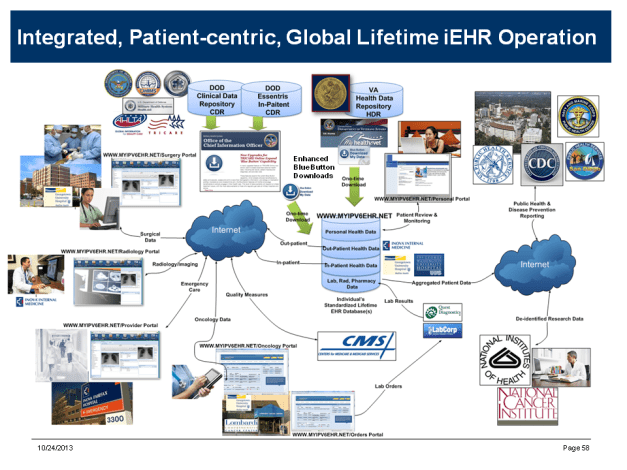
How Integrated EHRs Might Operate

Why Are Integrated EHRs Needed?

Posted by timmreardon on 10/24/2013
Posted in: Uncategorized. Leave a comment

Why Are Integrated EHRs Needed?

What is the DoD/VA ESCAPE FIRE?

Posted by timmreardon on 10/24/2013
Posted in: Uncategorized. Leave a comment

What is the DoD/VA ESCAPE FIRE?

Veterans Affairs, Defense Depts. spend billions in effort to coordinate records

Posted by timmreardon on 10/24/2013
Posted in: Uncategorized. Tagged: Afghanistan, Department of Defense, Department of Veterans Affairs, Electronic health record, National Defense Authorization Act, United States Department of Defense, United States Department of Veterans Affairs, Veterans Benefit Administration. Leave a comment

By Hannah Winston 6:00 am, August 27, 2013 Updated: 12:57 pm, August 27, 2013

The Department of Veterans Affairs and the Department of Defense spent at least $1.3 billion during the last four years trying unsuccessfully to develop a single electronic health-records system between the two departments — leaving veterans’ disability claims to continue piling up in paper files across the country, a News21 investigation shows.

This does not include billions of other dollars wasted during the last three decades, including $2 billion spent on a failed upgrade to the DOD’s existing electronic health-records system.

For a veteran in the disability claims process, these records are critical: They include DOD service and health records needed by the VA to decide veterans’ disability ratings and the compensation they will receive for their injuries. Stacks of paper files — including veterans’ evidence from DOD of their military service and injuries — sit at VA regional offices waiting to be processed instead of being readily accessible in electronic files.

Although Congress repeatedly has demanded an “integrated” and “interoperable” electronic health-records system, neither the DOD nor the VA is able to completely access the other’s electronic records. Meanwhile, each has spent hundreds of millions of dollars on upgrades to its information technology and on attempts to improve interoperability between their systems.

At a July hearing before the House Armed Services Committee and the House Committee on Veterans’ Affairs, Rep. Jeff Miller, R-Fla., said he was disappointed and frustrated by the years of promises and billions of dollars spent without interoperable health records. “The only thing interoperable we get are the litany of excuses flying across both departments every year as to why it has taken so long to get this done,” said Miller, the chairman of the Veterans Affairs Committee.

The National Defense Authorization Act for 2008 mandated that the DOD and VA secretaries “develop and implement electronic health-record systems or capabilities that allow for full interoperability of personal health information between the Department of Defense and the Department of Veterans Affairs.”

In 2011, the DOD and VA decided the solution would be to create a single electronic healthcare record together. But after two years and more than $1 billion spent on a single, joint integrated electronic health record between the DOD and VA, the department’s two secretaries in February canceled the plan with little explanation.

“It’s frustrating. It’s been inefficient for service members to have to hand-deliver records from one system to another when they get out of the military,” then-Defense Secretary Leon Panetta said at the time. “It doesn’t make a hell of a lot of sense.”

Instead of a joint system, Panetta said the two agencies would upgrade their own electronic health-record systems and build software that would allow the two systems to talk with each other to exchange files. “As President (Barack) Obama directed in 2009, we can and we must do better.”

Panetta said the new direction would allow the departments to meet the president’s goal and do it for a lower cost. But records show the cost may not be lower.

Meanwhile, the VA has moved to invest $12 billion over five years on an entirely new project called Transformation Twenty-One Total Technology, or T4, to upgrade its own technologies. Those upgrades are supposed to include interoperable software that can be used between the VA and DOD.

According to contract data gathered by News21, the VA began paying companies for the project in July 2011, at the same time money still was still being spent by both the DOD and VA on the single, joint health care records system.

In fact, one of the VA’s contractors, Harris Corp., has a multiyear contract with the VA worth $80.3 million to create software allowing the two departments’ systems to communicate with each other, a deal that was signed almost a year before the DOD and VA gave up on a single electronic health record.

The DOD also is looking for a replacement for its health record system. The 2014 DOD budget requests $466.9 million for “initial outfitting” and “replacement and modernization” of its current health care record.

Sen. Patty Murray, D-Wash., a member of the Committee on Veterans’ Affairs, told News21 in an email statement that she is concerned about the future of electronic health records shared between DOD and VA.

“While it is not easy to get the government’s two largest bureaucracies to work together efficiently, I have been very troubled about the effort to develop systems to allow communication between VA and DOD’s medical records,” she said. “I am especially concerned DOD spent hundreds of millions of tax dollars — and thousands of staff hours over the last few years — trying to create an integrated IT platform with the VA only to announce they were unable to come to a solution.”

For a disability claim to be processed in 125 days, a goal outlined in a Jan. 25 VA report, the files must be electronic, which means all paper records must be scanned into the system.

The VA scanning system — Veterans Benefits Management System (VBMS) — cost $480 million between 2009 and 2012, yet the VA never set deadlines for the records to be scanned. As of early July, only about 30 percent of paper claims had been scanned — that’s 165 million pieces of paper, according to the VA.

That represents about one-third of the entire paper workload, which does not include the estimated 26,000 service members who will make their way home within the next year from Afghanistan. Nor does it include veterans who have yet to file disability claims.

Those pieces of paper can make or break a veteran’s chance of getting the correct disability compensation. The compensation can help offset costs such as rent and car payments for those who may not be able to work because of issues they suffer, such as post-traumatic stress disorder or chronic back pain. All are common among veterans who served in Iraq and Afghanistan.

In 2012, the average time a claim waited for evidence to be processed — which includes those health and service records from DOD as well as physical exams — was 206.7 days, according to Veterans Benefits Administration documents. Gathering evidence is the longest part of the claims process.

DOD health records make their way to the VA within 45 days, DOD spokeswoman Cynthia O. Smith told News21 in an email. She wrote that, although the records are available electronically on request, all DOD records are transferred on paper to the VA. Yet, DOD Undersecretary of Defense for Acquisition, Technology and Logistics Frank Kendall contradicted her, saying most records are transferred electronically.

The VA did not say how it receives records from the DOD.

The National Defense Authorization Act for 2008 also called for the creation of an agency to fix the interoperability problems between the VA and DOD. The Interagency Program Office was established as the “single point of accountability” between the two departments.

Debbie Filippi, the first director of the office, said restrictions from the VA and DOD, as well as a minimal budget, kept the office from making progress during her two-year tenure. “It takes time to turn an aircraft carrier,” she said.

Filippi retired in 2011, before this February’s cancellation of the joint electronic health-record project. “The hope had fizzled out and then re-gathered,” she said. “And then it broke apart again.”

In March, Allison Hickey, undersecretary of the Veterans Benefits Administration, told members of Congress there is an agreement in place requiring the DOD to provide “100-percent-complete service treatment and personnel records in an electronic, searchable format.”

The VBA estimates such a move would cut the claims backlog time by anywhere from 60 to 90 days.

An amendment to the 2014 National Defense Authorization Act, proposed by Rep. Ann Kirkpatrick, D-Ariz., would require the DOD to provide complete service treatment records to the VA within 90 days of a service member leaving the military. “No doubt in my mind our veterans will be better served by an electronic system,” Kirkpatrick told News21.

The Janus Joint Legacy Viewer, a cloud-based medical records system that allows DOD and VA medical records to be displayed on one screen, launched at nine sites in July. David Waltman, the VA’s chief user experience architect of the integrated electronic health record, said the department is exploring the use of the Janus Joint Legacy Viewer to help in the claims process. He said it will ultimately be tested at regional offices this year, but only two employees at each office will have training and access.

Rep. Phil Roe, R-Tenn., in May introduced legislation requiring the VA and DOD to revive plans for the single, integrated health record system. “You don’t spend a billion dollars and say we can’t do it,” Roe told News21 in a phone interview.

“This is one we have to get right,” he said. “Not for my generation, but for future soldiers I don’t even know.”

More stories about

Health, Social Issues, Medicine, Electronic health record, Health and Medical and Pharma, United States Department of Veterans Affairs, Medical informatics, Health informatics, Veterans Benefits Administration, BHIE, VistA

DoD/VA Joint Strategic Plan 2013 – 2015

Posted by timmreardon on 10/23/2013
Posted in: Uncategorized. Tagged: Chuck Hagel, Department of Defense, Department of Veterans Affairs, Government, Secretaries, United States, United States Department of Defense, United States Department of Veterans Affairs. Leave a comment

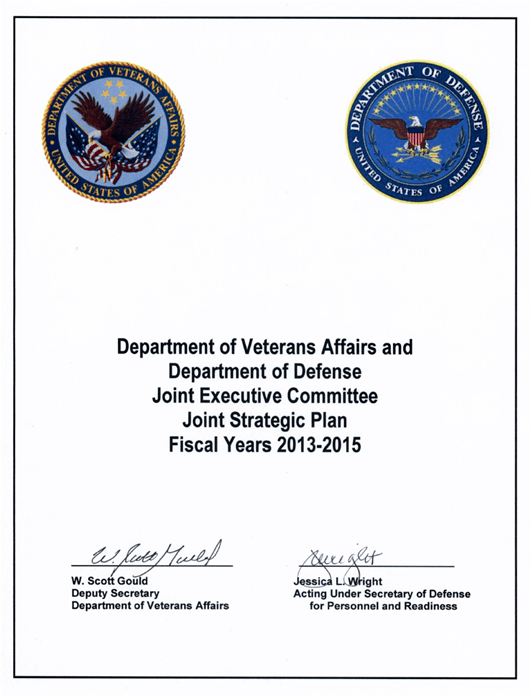
DOD/VA Joint Strategic Plan 2013 - 2015


The Department of Veterans Affairs (VA) and the Department of Defense (DoD) Joint Executive Committee (JEC) Joint Strategic Plan (JSP) is the primary source document that conveys to the Secretaries of the Departments the JEC’s recommendations for the strategic direction of joint coordination and sharing efforts between the two Departments. Co-Chaired by the Deputy Secretary of Veterans Affairs and the Under Secretary of Defense for Personnel and Readiness, the JEC manages and implements the joint priorities monitored by the Secretaries of both Departments.

Why Integrated EHRs are needed; DOD and VA should lead the Nation, developing iEHRs

Posted by timmreardon on 10/22/2013
Posted in: Uncategorized. Tagged: Department of Defense, Department of Veterans Affairs, Electronic health record, Health care, Medicine, United States, United States Department of Defense, United States Department of Veterans Affairs. Leave a comment

The following is an excerpt from Section 734 of H.R. 1960 – pending National Defense Authorization Act 2014 legislation, page 399.

SEC. 734. INTEGRATED ELECTRONIC HEALTH RECORD OF THE DEPARTMENTS OF DEFENSE AND VETERANS AFFAIRS.

(a) SENSE OF CONGRESS.—It is the sense of Congress that—

(1) despite repeated attempts at cooperation over the past 20 years, the Department of Defense and the Department of Veterans Affairs have failed to implement a solution that allows for seamless electronic sharing of medical health care data;

(2) the recent decision by the Secretary of Defense and the Secretary of Veterans Affairs to abandon their earlier agreement and pursue separate paths to integration jeopardizes the stated goal of providing ‘‘a patient-centered health care system that delivers excellent quality, access, satisfaction, and value, consistently across the Departments’’;

(3) despite the repeated concerns and objections of the congressional committees of jurisdiction, the Department of Defense and the Department of Veterans Affairs seem to be on a continued path to fail in achieving the goal of creating a seamless health record that integrates data across the Departments; and

(4) the President should make the necessary leadership changes to assure timely completion of this requirement.

(b) IMPLEMENTATION.—The Secretary of Defense and the Secretary of Veterans Affairs shall—

(1) implement an integrated electronic health record to be used by each of the Secretaries; and
(2) deploy such record by not later than October 1, 2016.
(c) DESIGN PRINCIPLES.—The integrated electronic health record established under subsection
(b) shall adhere to the following principles:

(1) To the extent practicable, efforts to establish such record shall be based on objectives, activities, and milestones established by the Joint Executive Committee Joint Strategic Plan Fiscal Years 2013–2015, including any requirements, definition,documents, or analyses previously developed to satisfy said Joint Strategic Plan.

(2) Principles with respect to open architecture standards, including—

(A) modular designs based on standards with loose coupling and high cohesion that allow for independent acquisition of system components;

(B) if existing national standards do not exist as of the date on which the record is being established, the Secretaries shall agree upon and adopt a standard for purposes of the record until such time as national standards are established;

http://www.gpo.gov/fdsys/pkg/BILLS-113hr1960pcs/pdf/BILLS-113hr1960pcs.pdf

Posts navigation

← Older Entries
Newer Entries →
  • Search site

  • Follow healthcarereimagined on WordPress.com
  • Recent Posts

    • Why opinion on AI is so divided – MIT Technology Review 04/14/2026
    • The Global Healthcare System Is Broken. Japan Fixed It for $4,100 Per Person. 04/10/2026
    • When Not to Use AI – MIT Sloan 04/01/2026
    • There are more AI health tools than ever—but how well do they work? – MIT Technology Review 03/30/2026
    • Are AI Tools Ready to Answer Patients’ Questions About Their Medical Care? – JAMA 03/27/2026
    • How AI use in scholarly publishing threatens research integrity, lessens trust, and invites misinformation – Bulletin of the Atomic Scientists 03/25/2026
    • VA Prepares April Relaunch of EHR Program – GovCIO 03/19/2026
    • Strong call for universal healthcare from Pope Leo today – FAN 03/18/2026
    • EHR fragmentation offers an opportunity to enhance care coordination and experience 03/16/2026
    • When AI Governance Fails 03/15/2026
  • Categories

    • Accountable Care Organizations
    • ACOs
    • AHRQ
    • American Board of Internal Medicine
    • Big Data
    • Blue Button
    • Board Certification
    • Cancer Treatment
    • Data Science
    • Digital Services Playbook
    • DoD
    • EHR Interoperability
    • EHR Usability
    • Emergency Medicine
    • FDA
    • FDASIA
    • GAO Reports
    • Genetic Data
    • Genetic Research
    • Genomic Data
    • Global Standards
    • Health Care Costs
    • Health Care Economics
    • Health IT adoption
    • Health Outcomes
    • Healthcare Delivery
    • Healthcare Informatics
    • Healthcare Outcomes
    • Healthcare Security
    • Helathcare Delivery
    • HHS
    • HIPAA
    • ICD-10
    • Innovation
    • Integrated Electronic Health Records
    • IT Acquisition
    • JASONS
    • Lab Report Access
    • Military Health System Reform
    • Mobile Health
    • Mobile Healthcare
    • National Health IT System
    • NSF
    • ONC Reports to Congress
    • Oncology
    • Open Data
    • Patient Centered Medical Home
    • Patient Portals
    • PCMH
    • Precision Medicine
    • Primary Care
    • Public Health
    • Quadruple Aim
    • Quality Measures
    • Rehab Medicine
    • TechFAR Handbook
    • Triple Aim
    • U.S. Air Force Medicine
    • U.S. Army
    • U.S. Army Medicine
    • U.S. Navy Medicine
    • U.S. Surgeon General
    • Uncategorized
    • Value-based Care
    • Veterans Affairs
    • Warrior Transistion Units
    • XPRIZE
  • Archives

    • April 2026 (3)
    • March 2026 (9)
    • February 2026 (6)
    • January 2026 (8)
    • December 2025 (11)
    • November 2025 (9)
    • October 2025 (10)
    • September 2025 (4)
    • August 2025 (7)
    • July 2025 (2)
    • June 2025 (9)
    • May 2025 (4)
    • April 2025 (11)
    • March 2025 (11)
    • February 2025 (10)
    • January 2025 (12)
    • December 2024 (12)
    • November 2024 (7)
    • October 2024 (5)
    • September 2024 (9)
    • August 2024 (10)
    • July 2024 (13)
    • June 2024 (18)
    • May 2024 (10)
    • April 2024 (19)
    • March 2024 (35)
    • February 2024 (23)
    • January 2024 (16)
    • December 2023 (22)
    • November 2023 (38)
    • October 2023 (24)
    • September 2023 (24)
    • August 2023 (34)
    • July 2023 (33)
    • June 2023 (30)
    • May 2023 (35)
    • April 2023 (30)
    • March 2023 (30)
    • February 2023 (15)
    • January 2023 (17)
    • December 2022 (10)
    • November 2022 (7)
    • October 2022 (22)
    • September 2022 (16)
    • August 2022 (33)
    • July 2022 (28)
    • June 2022 (42)
    • May 2022 (53)
    • April 2022 (35)
    • March 2022 (37)
    • February 2022 (21)
    • January 2022 (28)
    • December 2021 (23)
    • November 2021 (12)
    • October 2021 (10)
    • September 2021 (4)
    • August 2021 (4)
    • July 2021 (4)
    • May 2021 (3)
    • April 2021 (1)
    • March 2021 (2)
    • February 2021 (1)
    • January 2021 (4)
    • December 2020 (7)
    • November 2020 (2)
    • October 2020 (4)
    • September 2020 (7)
    • August 2020 (11)
    • July 2020 (3)
    • June 2020 (5)
    • April 2020 (3)
    • March 2020 (1)
    • February 2020 (1)
    • January 2020 (2)
    • December 2019 (2)
    • November 2019 (1)
    • September 2019 (4)
    • August 2019 (3)
    • July 2019 (5)
    • June 2019 (10)
    • May 2019 (8)
    • April 2019 (6)
    • March 2019 (7)
    • February 2019 (17)
    • January 2019 (14)
    • December 2018 (10)
    • November 2018 (20)
    • October 2018 (14)
    • September 2018 (27)
    • August 2018 (19)
    • July 2018 (16)
    • June 2018 (18)
    • May 2018 (28)
    • April 2018 (3)
    • March 2018 (11)
    • February 2018 (5)
    • January 2018 (10)
    • December 2017 (20)
    • November 2017 (30)
    • October 2017 (33)
    • September 2017 (11)
    • August 2017 (13)
    • July 2017 (9)
    • June 2017 (8)
    • May 2017 (9)
    • April 2017 (4)
    • March 2017 (12)
    • December 2016 (3)
    • September 2016 (4)
    • August 2016 (1)
    • July 2016 (7)
    • June 2016 (7)
    • April 2016 (4)
    • March 2016 (7)
    • February 2016 (1)
    • January 2016 (3)
    • November 2015 (3)
    • October 2015 (2)
    • September 2015 (9)
    • August 2015 (6)
    • June 2015 (5)
    • May 2015 (6)
    • April 2015 (3)
    • March 2015 (16)
    • February 2015 (10)
    • January 2015 (16)
    • December 2014 (9)
    • November 2014 (7)
    • October 2014 (21)
    • September 2014 (8)
    • August 2014 (9)
    • July 2014 (7)
    • June 2014 (5)
    • May 2014 (8)
    • April 2014 (19)
    • March 2014 (8)
    • February 2014 (9)
    • January 2014 (31)
    • December 2013 (23)
    • November 2013 (48)
    • October 2013 (25)
  • Tags

    Business Defense Department Department of Veterans Affairs EHealth EHR Electronic health record Food and Drug Administration Health Health informatics Health Information Exchange Health information technology Health system HIE Hospital IBM Mayo Clinic Medicare Medicine Military Health System Patient Patient portal Patient Protection and Affordable Care Act United States United States Department of Defense United States Department of Veterans Affairs
  • Upcoming Events

Blog at WordPress.com.
healthcarereimagined
Blog at WordPress.com.
  • Subscribe Subscribed
    • healthcarereimagined
    • Join 153 other subscribers
    • Already have a WordPress.com account? Log in now.
    • healthcarereimagined
    • Subscribe Subscribed
    • Sign up
    • Log in
    • Report this content
    • View site in Reader
    • Manage subscriptions
    • Collapse this bar
 

Loading Comments...