Cloud resources are now incredibly varied and accessible, with a large ecosystem of industry-specific cloud-based managed services specializing in these complexities. Which means the average healthcare organization can, indeed, afford to tap into supercloud power — they just get it as a service.
When it comes to information technology (IT), the “whether and why” discussion about cloud use is pretty much over. As noted in some recent analysis from Accenture, “The last two years have laid bare the power and agility of cloud…and a new understanding that cloud at scale is essential for operations maturity, and ultimately, value.”
Even in the slow-to-digitize healthcare sector, contemporary estimates indicate around 90% of the industry has leveled-up to using some degree of cloud computing for some functions and in various incarnations (private-, public-, hybrid-, multi-cloud).
Supercharging IT with cloud power may now be essential, but that doesn’t necessarily mean it’s simple. Despite an accelerated cloud adoption curve over the past couple of years, a huge swath of healthcare organizations still rely on infrastructure predating the advent of the iPhone. And as everyone knows, hordes of valuable data remain confined to countless racks of servers siloed in hospital basements and assorted colocation data centers far and wide.
Working with assemblages of those very old systems and very new cloud deployments can get very, very complicated.
It’s difficult to rectify the sheer magnitude of differences in both fundamental operation and capability between legacy on-premise infrastructure and cloud infrastructure. Picture someone from the horse-and-buggy age being presented with access to a rocket ship and trying to conceptualize whether it will fit in the barn or what to feed it. That’s kind of where healthcare finds itself.
The world of technology moves at lightning speed. For a host of reasons, the healthcare sector hasstruggled to keep pace. What lies between is a gulf of IT complexitythat stymies even the most sophisticated organizations. Thus a host of promising models and solutions are continually evolving to help bridge the gap. The latest of these is the supercloud.
Supercloud
The “supercloud” term dates back to a 2016 Cornell University project describing an “architecture that enables application migration as a service across different availability zones or cloud providers. The supercloud provides interfaces to allocate, migrate, and terminate resources such as virtual machines and storage and presents a homogeneous network to tie these resources together…[and] span across all major public cloud providers…as well as private clouds.”
Much of the current excitement about the concept is centered around making everything portable across existing hyperscalers such as Amazon Web Services (AWS), Microsoft Azure, and Google Cloud, and the big business potential in constructing specialized clouds on top of them. Trendy examples of this model can be found in Snowflake’s recently launched Healthcare & Life Sciences Data Cloud and Databricks’ new Lakehouse for Healthcare and Life Sciences.
The central value of the supercloud concept really hinges on provisioning the best cutting edge technology available while simplifying the way the organization interacts with it. The real magic of cloud power today isn’t really in portable IT workloads; it’s in the vendor-specific cloud-native services that the big hyperscalers supply. For example, Amazon Web Services has some really cool database and stream management technology. Microsoft Azure has some really cool storage technology. Google Cloud has some really cool machine learning technology. But your average healthcare business can’t afford to staff a huge IT department that:
The central value of the supercloud concept really hinges on provisioning the best cutting edge technology available while simplifying the way the organization interacts with it. The real magic of cloud power today isn’t really in portable IT workloads; it’s in the vendor-specific cloud-native services that the big hyperscalers supply. For example, Amazon Web Services has some really cool database and stream management technology. Microsoft Azure has some really cool storage technology. Google Cloud has some really cool machine learning technology. But your average healthcare business can’t afford to staff a huge IT department that:
Keeps up with all of those developing services;
Manages strict compliance and security requirements;
Keeps the proverbial lights on for all their internal systems; and
Finds innovative ways to utilize nifty new technologies for the business.
It’s just not feasible.
However, cloud resources are now incredibly varied and accessible, with a large ecosystem of industry-specific cloud-based managed services specializing in these complexities. Which means the average healthcare organization can, indeed, afford to tap into supercloud power — they just get it as a service.
Essentially, healthcare organizations can get a service layer designed for their industry with sets of application programming interfaces (APIs) that are called to implement best-of-breed cloud services in a hybrid fashion amongst the appropriate hyperscalers. The right cloud is picked for particular use cases, and a mesh service layer covers all of it. Unique compliance and security requirements are automated, and the underlying implementation complexities are hidden from the business users of those services. So the healthcare organization’s IT department can pretty much offload tasks 1 through 3 and focus entirely on innovating ways to help the business.
You’ll sometimes see a similar ideal touted as “industry cloud.” As recently noted by Brian Campbell of Deloitte Consulting in HealthITSecurity, “Industry clouds are a portfolio of business transformation-focused solutions, assets, and accelerators that ultimately help to reinvent and transform the business side of that specific industry,” supplying an excellent option for healthcare organizations looking to “keep pace with the changing digital landscape.”
Superpower
Regardless of how a healthcare organization goes about increasing IT agility, reducing complexity, and reinventing business processes, the cloud should be central to the effort. A simple fact has been established: Cloud power increases healthcare power.
To demonstrate, consider a recent six-month study where a team of researchers shattered the record for diagnosing rare genetic diseases with DNA sequencing, and set a new Guinness World Record of 5 hours and 2 minutes to sequence a patient’s genome. At Stanford Hospital, the team dedicated specialized flow cell sequencing hardware to try to speed sequencing a single patient’s genome. But the amount of data being produced overwhelmed the lab’s computational systems.
According to Stanford study team member Euan A. Ashley, “We weren’t able to process the data fast enough. We had to completely rethink and revamp our data pipelines and storage systems.” Team member Sneha Goenka “found a way to funnel the data straight to a cloud-based storage system where computational power could be amplified enough to sift through the data in real time.”
The results?
They were able to sequence and diagnose a genetic illness in 7 hours and 18 minutes, which is about twice as fast as the previous record. For one teenaged patient in their study, their sequencing data showed his condition was rooted in genetics within a matter of hours, and he was immediately placed on a heart transplant list. He received a new heart three weeks later, and as of January this year, his mom says he’s doing “exceptionally well.”
I am the Founder and CEO of Cloudticity. I spend my days thinking about how to help the healthcare industry best leverage cloud technology to enable them to help people live healthier lives. I have spent the last 30 years navigating the technology industry. Prior to Cloudticity, I was brought in as the chief operating officer at ePrize; I turned around a failing company that was eventually sold for a fourfold return on the initial private equity investment. Before ePrize, I spent eight years at Microsoft, first as chief technology officer for the US central region, then running the global business unit that oversaw General Motors (Microsoft’s second-largest customer), growing that account from $20MM to over $100MM in three years. Prior to Microsoft, I spent nearly a decade in the technology consulting and startup industry. I hold all the core five AWS certifications.
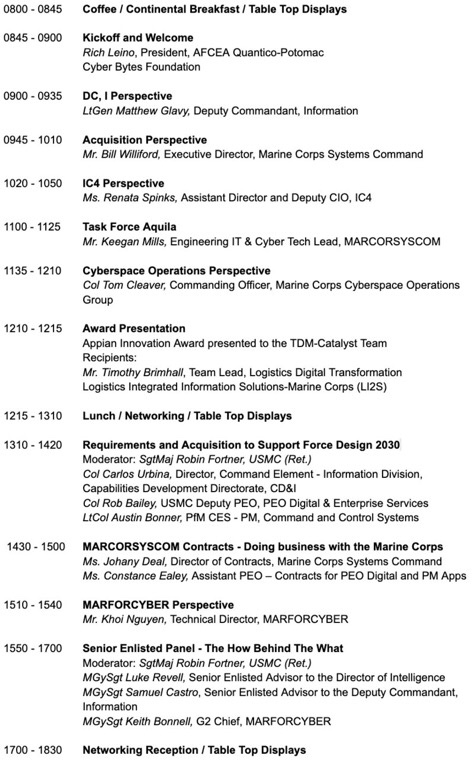
If you haven’t already, be sure to register to join us on May 19th for United States Marine Corps IT Day! You won’t want to miss out on this power house line up!
AFCEA Quantico-Potomac | Matthew Weaver | ♦️Amanda S. | Jonathan Payton | Joel Scharlat | Dr Aaron J Miller | Dr. Paul de Souza | Jeremy Rockett | Jonathan Mappin | Rich Leino |
USMC #AFCEA #IT #ITday #Networking #DoD
HAVE YOU REGISTERED FOR USMC IT DAY???? May 19th At the Cyber Bytes Foundation in Stafford, VA.
Check out the JAM PACKED AGENDA and Click the link below for more info and to register! You don’t want to miss this spectacular lineup! Confirmed speakers from Marine Corps Systems Command, DON PEO Digital, U.S. Marine Corps Forces Cyberspace Command (MARFORCYBER), and many others!
William S. Williford III, Keegan Mills, Robin Fortner, MA, RBLP-T, Carlos Urbina, Robert Bailey, USMC, PMP, Khoi Nguyen, CISSP-ISSAP, PMP, Luke Revell, Samuel Castro, Keith Bonnell Jeremy Rockett, Rich Leino, Jay Storms, Jonathan Mappin, Matt Sladky, Grant Huckestein, Krista McKendree, ♦️Amanda S., Jonathan Payton, Joel Scharlat
Researchers with cybersecurity firm Cybereason briefed the FBI and Justice Department recently about Operation CuckooBees, an alleged espionage effort by Chinese state-sponsored hackers to steal proprietary information from dozens of global defense, energy, biotech, aerospace and pharmaceutical companies.
The organizations affected were not named in Cybereason’s report but allegedly include some of the largest companies in North America, Europe and Asia. Cybereason tied the campaign to the prolific Winnti Group, also known as APT 41.
Cybereason CEO Lior Div told The Record that the most alarming aspect of the investigation into Operation CuckooBees was the evasive and sophisticated measures used to hide inside the networks of dozens of the largest global manufacturing companies in North America, Europe and Asia as far back as 2019.
“The group operates like a guided missile and once it locks in on its target, it attacks and doesn’t stop until it steals a company’s crown jewels,” Div said.
“Winnti pilfered thousands of gigabytes of data and to add insult to injury also made off with proprietary info on business units, customer and partner data, employee emails and other personal information for use in blackmail or extortions schemes at a time of their choosing.”
Cybereason said that throughout its 12-month investigation, it found the intruders took troves of intellectual property and sensitive proprietary data, including formulas, source code, R&D documents and blueprints, as well as diagrams of fighter jets, helicopters, missiles and more.
The attackers also gained information that could be used for future cyberattacks, like details about a company’s business units, network architecture, user accounts and credentials, employee emails, and customer data.
Most concerning, according to Div, was that the companies had no clue they were breached.
In two detailed reports, Cybereason attributes the attacks to Winnti based on an analysis of the digital artifacts the group seemed to have left behind after its intrusions.
Several cybersecurity companies have been tracking Winnti since it emerged in 2010 and experts have noted the hackers to be operating on behalf of Chinese state interests, specializing in cyber-espionage and intellectual property theft.
The group used a previously undocumented malware strain called DEPLOYLOG as well as new versions of malware like Spyder Loader, PRIVATELOG, and WINNKIT.
The malware included digitally signed, kernel-level rootkits as well as an elaborate multi-stage infection chain that enabled the operation to remain undetected, Cybereason said.
The group also managed to abuse the Windows Common Log File System (CLFS) mechanism, which allowed the intruders to “conceal their payloads and evade detection by traditional security products.”
CLFS is a logging framework that was first introduced by Microsoft in Windows Server 2003 R2 and included in later Windows operating systems.
“The attackers implemented a delicate ‘house of cards’ approach, meaning that each component depends on the others to execute properly, making it very difficult to analyze each component separately,” Div explained.
Operation CuckooBees generally took advantage of existing weaknesses, Div said, such as “unpatched systems, insufficient network segmentation, unmanaged assets, forgotten accounts and no use of multi-factor authentications products.”
Cybereason said that the attackers gained their initial foothold in the organizations through vulnerabilities in Enterprise Resource Planning platforms.
Last month, FBI director Chris Wray told 60 Minutes that the “biggest” threat American law enforcement officials face is from Chinese hackers stealing proprietary information. The bureau opens a new China counterintelligence investigation about every 12 hours, he said.
“They are targeting our innovation, our trade secrets, our intellectual property on a scale that’s unprecedented in history. They have a bigger hacking program than that of every other major nation combined,” Wray said.
“They have stolen more of Americans’ personal and corporate data than every nation combined. It affects everything from agriculture to aviation to high tech to healthcare, pretty much every sector of our economy. Anything that makes an industry tick, they target.”
Why do some products, companies, and social programs thrive as they grow while others peter out? According to the author, there are five causes: 1) False positives, or inaccurately interpreting a piece of evidence or data; 2) Biased representativeness of population, or not making sure your samples reflect the larger population at scale; 3) Non-negotiables that can’t grow or be replicated; 4) Negative spillovers, or unintended outcomes; and 5) Cost traps. Here, he explains and offers examples of each cause, as well as how to anticipate or avoid them.
For the last several years, I’ve been at the forefront of a movement known as implementation science, or the science of scaling. In this work, we are trying to understand why some products, companies, and social programs thrive as they grow, while others peter out.
When a seemingly promising idea loses efficacy or profitability as it expands, we call it a “voltage drop.” These failures to scale never happen because of one single reason.
Over the last 25 years as a behavioral economist, consultant to companies large and small, and former White House economic adviser, I’ve identified five causes, what I call “vital signs,” of voltage drops.
1. False Positives
This occurs when you interpret a piece of evidence or data as proof that something is true, when in fact it isn’t — for example, as we’ve seen with inaccurate Covid test results. For scaling, a false positive is an erroneous sign that an idea has voltage when it really doesn’t.
Sometimes a false positive occurs because of a statistical error, as was the case with the famous drug abuse prevention program, D.A.R.E. After an independent study showed promising short-term results, the program received an influx of funding from the U.S. Department of Justice. However, there were several problems with the study: It excluded drugs like alcohol and marijuana, focusing on tobacco; it was based on a small sample size; and later studies and even metanalyses could not replicate the results.
In other cases, false positives result from intentional lying. Think of Elizabeth Holmes and the purportedly groundbreaking blood-testing technology of Theranos, which didn’t actually exist.
When possible, the solution for rooting out false positives is to have at least three independent replications of the idea that show early promise. In companies with confidential research, employees must be incentivized with financial rewards that encourage them to question results.
2. Biased Representativeness of Population
Once you’ve reliably demonstrated the efficacy of the endeavor you hope to scale, the next step is to answer the question “How broadlywill the idea work?”
All ventures must understand their potential audience. The first way to do this is by making sure your test samples in the small scale reflect the larger population at scale. Otherwise, you’ll be like McDonald’s, which fell victim to selection bias when it launched the unsuccessful Arch Deluxe. Focus group participants loved the new product, but they weren’t representative of the majority of Americans, who simply wanted to keep eating their Big Macs.
To weed out such biases, make sure your early adopters are a random sample. You should also make sure that your survey respondents have appropriate incentives to tell you the truth. A focus group participant who says they would purchase a product if it was introduced could simply be saying, “I would love the option to consider that product in the future,” as opposed to “I will be purchasing the product in the future.”
3. Non-Negotiables That Can’t Grow or Be Replicated
For an idea or enterprise to hold strong at scale, you need to know whether your “non-negotiables” — the drivers of your success — can be replicated at scale. In other words, is your secret sauce the “chef” or the “ingredients”? Since people don’t scale well (i.e., they can’t be cloned), talent-centric ventures often don’t either. You can’t afford all the talent you need as you grow, so you hire fewer high-performers and quality suffers at scale — a cruel voltage drop.
But, this vital sign is about much more than just people. As you scale, regulatory constraints, resource constraints, fidelity concerns, and a host of other issues might arise. In the end, we must bring these scaling constraints back to the petri dish and make sure the idea works with them in place.
4. Negative Spillovers
A spillover effect is the unintended impact one event or outcome can have on another event or outcome. A classic example is when a city opens a new factory, and the air pollution it produces impacts the health of nearby residents.
As you scale, the likelihood of spillovers increases dramatically. General equilibrium effects, or natural readjustments of the market, are one chief cause. I saw this firsthand when I was the chief economist at Uber. A coupon that led to more riders in one area of Seattle failed when we scaled it to the whole city because surge prices kicked in, and users found cheaper ways to get around that night.
Positive spillovers exist too, like network effects that make a social-media platform more valuable as more people join it. When designing your idea early on, you must anticipate negative spillovers and look for opportunities to engineer and benefit from positive ones.
5. The Cost Trap
To scale successfully, you need to determine not only how many people like your idea, but also what they’re willing to pay for it and, crucially, how much it will cost to provide.
When designing your enterprise, you must account for two types of costs: upfront fixed costs, like the one-time investment for the research and development to create a new product or service, and your ongoing operating expenses. Upfront costs can be recouped, but operating ones can bleed you and lead to a voltage drop, as happened to the innovative scientific wellness startup Arivale, which was poised to change preventative health care, only to go bankrupt a few years later, because it couldn’t find a viable price point for its services.
One strategy to escape the cost trap of scaling is to make sure you benefit from economies of scale, a skill Elon Musk excels at in all his ventures. Ever since he helped transform the world of online banking at PayPal, each major innovation he has undertaken thrives on scale economies. Consider Tesla. Its massive success can be traced to economies of scale of its two most important components: batteries and solar power generation cells, both of which can be manufactured significantly cheaper in higher numbers. In addition, everything at Tesla is geared toward increasing the efficiency of “the machine that makes the machines,” or what Musk affectionately calls his “Alien Dreadnought” — that is, a highly advanced, fully automated production facility.
Another strategy is to create models that don’t rely on top-tier talent. As you scale, finding and paying high-performers will become prohibitive. The solution is to create products that can give their full value to customers even with average performers delivering it.
When I give talks on this topic, I like to invoke the famous opening line of Leo Tolstoy’s novel Anna Karenina: “Happy families are all alike; every unhappy family is unhappy in its own way.” Similarly, scalable ideas are all alike; every unscalable idea is unscalable in its own way. The difference with scaling is there are only five main obstacles you face. And once you anticipate and avoid them, you can scale your idea for the highest voltage possible.
John A. List is the Kenneth C. Griffin Distinguished Service Professor in Economics at the University of Chicago and Distinguished Professor of Economics at the Australian National University, as well as the chief economist at Lyft and, previously, at Uber. He has served on the Council of Economic Advisers and is the recipient of numerous awards and honors, including the AAEA’s Galbraith Award. His work has been featured in The New York Times, The Economist, Harvard Business Review, Fortune, Slate, and The Washington Post, and on NPR, NBC, and Bloomberg. List has authored over 250 peer-reviewed journal articles, several academic books, including national bestseller The Voltage Effect.
WASHINGTON — The chief digital innovation officer for the U.S. Navy this week hailed 5G as a “great enabler” of future operations, as the service experiments with the technology and focuses on greater connectivity through Project Overmatch.
Fifth-generation wireless gear is being considered for a range of applications, Michael Galbraith suggested April 19, from pier-side and shipboard links to smart warehouses and other logistical feats.
“Think of a ship, think of a carrier group — we need to work in the run quiet, run deep kind of thing, can’t use SATCOM,” Galbraith said at the Cloudera Government Forum. “I still need to communicate from the first deck to the third deck, I still need to communicate from that carrier to the destroyer, and 5G and other millimeter wave technologies allow that to happen.”
Exactly how 5G, the so-called internet of things and data collection interact with the Navy’s major networks is an “issue that we are actively working on,” Galbraith said. “You hear about Project Overmatch, communication as a service. That is a part of that work that the team that” Rear Adm. Doug Small’s “group is doing. That is vitally important.”
Project Overmatch is the Navy’s clandestine contribution to Joint All-Domain Command and Control, a broader Pentagon effort to better connect sensors and shooters and dissolve communication barriers between the services. Small is the leader of the Naval Information Warfare Systems Command, a key JADC2 player.
Small in early April told C4ISRNET his team was “working across systems commands, warfare centers, services and with industry to provide the architecture, or framework, for how the various components are stitched together, including the networks, infrastructure, data architecture, tools and analytics to improve on our decision advantage.”
“Ultimately,” Small said at the time, “this will aid our ability to provide synchronized effects near and far in all domains, ensuring a more lethal and better-connected fleet now and far into the future.”
Fifth-generation wireless technology promises faster speeds, lower latency and other improvements compared with its predecessors. Alone, 5G is “more, better, faster,” Galbraith said. But when synced with other capabilities, he added, the potential really shines.
“We in the Navy, you know, we work at the edge, have been working at the edge since the 1700s,” he said. “In that information domain, there are other network capabilities, and 5G just is, again, a great enabler.”
The Department of Defense has selected a dozen military installations as test beds for 5G, including sites in California, Georgia and Virginia. This month, the department unveiled a multimillion-dollar challenge to accelerate the growth and adoption of a fifth-generation open ecosystem.
AT&T Inc. this year claimed initial success in setting up a 5G network experiment that could realize smart warehouses for the Navy, Defense News reported. The service believes smart warehouses could boost the efficiency and fidelity of its logistics.
“When we first started experimenting and piloting in 5G,” Galbraith said Tuesday, “we looked at what our priorities were.”
The Defense Department received nearly $338 million for 5G and microelectronics in fiscal year 2022. It requested $250 million for fiscal year 2023, budget documents show.
Colin Demarest is a reporter at C4ISRNET, where he covers networks and IT. Colin previously covered the Department of Energy and its National Nuclear Security Administration — namely nuclear weapons development and Cold War cleanup — for a daily newspaper in South Carolina.
Although research partnerships with foreign companies can yield potential medical breakthroughs, the collection of US personal health data by foreign companies can also pose serious risks. To protect personal health data from foreign exploitation, see: https://lnkd.in/ep8at2_C
The White House announced new plans to promote quantum technology research and development while helping U.S. computer networks transition to post-quantum cryptography standards.
The Biden administration announced two new directives that focus on incorporating quantum computing technology into the U.S. cybersecurity infrastructure and policy landscape, the latest federal action regarding the emerging technology.
Announced on Tuesday afternoon, the directives work to establish a government oversight board to advance quantum science and technological development, emphasizing innovations in quantum computing technologies in relation to cryptography.
“While quantum itself is not new, recent developments in the field have shown the potential to drive innovation across the American economy, from energy to medicine, through advancements in computing, networking, and much like the earlier technological revolutions brought about by the Internet, GPS, and even the combustion engine,” a senior administration official said on a background call.
While the first directive lays out an independent advisory body for quantum information science and technology. This board will work on disseminating knowledge about the latest developments in quantum to lawmakers and the general public and guide policymaking. It will work directly beneath the White House.
The second directive focuses on quantum’s intersection within national security. Dubbed the National Security Memorandum, it will act as a guidebook for agencies and other institutions to transition their systems to become quantum-resistant.
Officials are pushing for digital networks to adapt to post-quantum cryptography standards as a functioning quantum computer could use advanced algorithms to break through standard encryption.
“Given the complexity, costs and time required to fully transition to quantum resistance standards, the (National Science Foundation) provides a roadmap for agencies to inventory their IP system for quantum vulnerable cryptography,” the official said.
Quantum technology has been gaining mainstream attention by governments around the world in recent years. While harnessing the technology stands to impact a myriad of sectors, such as telecommunications and touch-based sensors, officials are concerned that a functioning quantum computer could undermine sensitive data through its powerful decrypting algorithms.
Experts estimate that a functioning quantum computer will be operational within five to 10 years.
Biden’s directives aim to jumpstart the broad transition to post-quantum cryptography to safeguard national infrastructure ahead of time.
“There’s a particular need for our national security community to prove quantum cryptography,” a spokesperson said.
Earlier this year, the Biden administration unveiled a new education initiative to help foster a quantum-ready workforce, along with the previous Trump administration national strategy plans published in 2018.
Congress has followed suit, introducing a slew of new legislation aimed at promoting quantum research and cryptography standards within the U.S. and protecting databases and infrastructure networks.
“The process to transition America’s most vulnerable IT systems to these new standards will take substantial time, resources and commitment,” a Biden administration spokesperson said. “Accordingly, America must start the lengthy process of updating our IT infrastructure today to protect against this quantum computing threat tomorrow.”
“We strongly believe that the ability for others to scrutinize your work is an important part of research. We really invite that collaboration,” says Joelle Pineau, a longtime advocate for transparency in the development of technology, who is now managing director at Meta AI.
Meta’s move is the first time that a fully trained large language model will be made available to any researcher who wants to study it. The news has been welcomed by many concerned about the way this powerful technology is being built by small teams behind closed doors.
“I applaud the transparency here,” says Emily M. Bender, a computational linguist at the University of Washington and a frequent critic of the way language models are developed and deployed.
“It’s a great move,” says Thomas Wolf, chief scientist at Hugging Face, the AI startup behind BigScience, a project in which more than 1,000 volunteers around the world are collaborating on an open-source language model. “The more open models the better,” he says.
Large language models—powerful programs that can generate paragraphs of text and mimic human conversation—have become one of the hottest trends in AI in the last couple of years. But they have deep flaws, parroting misinformation, prejudice, and toxic language.
In theory, putting more people to work on the problem should help. Yet because language models require vast amounts of data and computing power to train, they have so far remained projects for rich tech firms. The wider research community, including ethicists and social scientists concerned about their misuse, has had to watch from the sidelines.
Meta AI says it wants to change that. “Many of us have been university researchers,” says Pineau. “We know the gap that exists between universities and industry in terms of the ability to build these models. Making this one available to researchers was a no-brainer.” She hopes that others will pore over their work and pull it apart or build on it. Breakthroughs come faster when more people are involved, she says.
Meta is making its model, called Open Pretrained Transformer (OPT), available for non-commercial use. It is also releasing its code and a logbook that documents the training process. The logbook contains daily updates from members of the team about the training data: how it was added to the model and when, what worked and what didn’t. In more than 100 pages of notes, the researchers log every bug, crash, and reboot in a three-month training process that ran nonstop from October 2021 to January 2022.
With 175 billion parameters (the values in a neural network that get tweaked during training), OPT is the same size as GPT-3. This was by design, says Pineau. The team built OPT to match GPT-3 both in its accuracy on language tasks and in its toxicity. OpenAI has made GPT-3 available as a paid service but has not shared the model itself or its code. The idea was to provide researchers with a similar language model to study, says Pineau.
OpenAI declined an invitation to comment on Meta’s announcement.
So why is Meta doing this? After all, Meta is a company that has said little about how the algorithms behind Facebook and Instagram work and has a reputation for burying unfavorable findings by its own in-house research teams. A big reason for the different approach by Meta AI is Pineau herself, who has been pushing for more transparency in AI for a number of years.
Tech giants dominate research but the line between real breakthrough and product showcase can be fuzzy. Some scientists have had enough.
Pineau helped change how research is published in several of the largest conferences, introducing a checklist of things that researchers must submit alongside their results, including code and details about how experiments are run. Since she joined Meta (then Facebook) in 2017, she has championed that culture in its AI lab.
“That commitment to open science is why I’m here,” she says. “I wouldn’t be here on any other terms.”
Ultimately, Pineau wants to change how we judge AI. “What we call state-of-the-art nowadays can’t just be about performance,” she says. “It has to be state-of-the-art in terms of responsibility as well.”
Still, giving away a large language model is a bold move for Meta. “I can’t tell you that there’s no risk of this model producing language that we’re not proud of,” says Pineau. “It will.”
Weighing the risks
Margaret Mitchell, one of the AI ethics researchers Google forced out in 2020, who is now at Hugging Face, sees the release of OPT as a positive move. But she thinks there are limits to transparency. Has the language model been tested with sufficient rigor? Do the foreseeable benefits outweigh the foreseeable harms—such as the generation of misinformation, or racist and misogynistic language?
“Releasing a large language model to the world where a wide audience is likely to use it, or be affected by its output, comes with responsibilities,” she says. Mitchell notes that this model will be able to generate harmful content not only by itself, but through downstream applications that researchers build on top of it.
Meta AI audited OPT to remove some harmful behaviors, but the point is to release a model that researchers can learn from, warts and all, says Pineau.
“There were a lot of conversations about how to do that in a way that lets us sleep at night, knowing that there’s a non-zero risk in terms of reputation, a non-zero risk in terms of harm,” she says. She dismisses the idea that you should not release a model because it’s too dangerous—which is the reason OpenAI gave for not releasing GPT-3’s predecessor, GPT-2. “I understand the weaknesses of these models, but that’s not a research mindset,” she says.
Hundreds of scientists around the world are working together to understand one of the most powerful emerging technologies before it’s too late.
Bender, who coauthored the study at the center of the Google dispute with Mitchell, is also concerned about how the potential harms will be handled. “One thing that is really key in mitigating the risks of any kind of machine-learning technology is to ground evaluations and explorations in specific use cases,” she says. “What will the system be used for? Who will be using it, and how will the system outputs be presented to them?”
Some researchers question why large language models are being built at all, given their potential for harm. For Pineau, these concerns should be met with more exposure, not less. “I believe the only way to build trust is extreme transparency,” she says.
“We have different opinions around the world about what speech is appropriate, and AI is a part of that conversation,” she says. She doesn’t expect language models to say things that everyone agrees with. “But how do we grapple with that? You need many voices in that discussion.”
Finding the right balance between continuity and change can help leaders better manage the cultural changes that occur during a digital transformation.
Digital transformation transcends technology and business models. Organizational culture also plays a critical role in successfully leading an organization into the digital era; indeed, the success of a digital transformation relies on a deep understanding of the intricacies of culture. But few business leaders fully understand how a company’s culture changes during a digital transformation — and, more importantly, how it doesn’t change.
Consider the case of Maersk, the Danish shipping and integrated logistics company, which has been undergoing a significant digital transformation. Those efforts, which took off when Jim Hagemann Snabe became chairman of the board in 2016, entailed collaborating on blockchain with IBM and providing digital platforms to customers. Internal cultural tensions at Maersk became apparent late in 2021, when Søren Vind, a senior engineering manager and head of forecasting, had a public disagreement about the company’s identity with a veteran Maersk sea captain who serves as the employee representative on the board. In an interview with a Danish publication, Vind argued that Maersk “used to be an industrial company that had technology on [the] side” but had become “a technology company where we have some physical devices we need to move around.” Captain Thomas Lindegaard Madsen responded in a public LinkedIn post — subsequently edited to defuse his criticism — that read, “I am very sorry, but I will have to correct you.” Pointing out that the maritime business contributed 78% of group revenue and that the group has 12,000 seafarers, the captain declared, “We are NOT a tech company who ‘happens’ to operate ships.”
Of course, both the captain and the executive are right — and wrong — in their statements, which merely represent different perspectives on how digital transformation and culture interact. Where the IT executive views digital transformation from a cultural changelens, the sea captain views it from a cultural continuity lens. Both lenses are valid, both can coexist, and both need to be jointly managed for a transformation effort to thrive.
The Culture-Transformation Matrix
As the names imply, cultural changerefers to how a digital transformation may alter an organization’s culture, and cultural continuity refers to elements of the culture that remain stable. In short, during any organizational transformation there’s always an interplay between cultural change and continuity as cultures evolve, but most digital transformation initiatives instead
Carsten Lund Pedersen is associate professor in digital transformation at the IT University of Copenhagen in Denmark and coeditor of the book Big Data in Small Business: Data-Driven Growth in Small and Medium-Sized Enterprises (Edward Elgar Publishing, 2021).
REFERENCES (1)
1. For related work on strategies entailing continuity and change, see D. Ravasi and M. Schultz, “Responding to Organizational Identity Threats: Exploring the Role of Organizational Culture,” Academy of Management Journal 49, no. 3 (June 2006): 433-458; S. Nasim and Sushil, “Revisiting Organizational Change: Exploring the Paradox of Managing Continuity and Change,” Journal of Change Management 11, no. 2 (June 2011): 185-206; S. Nasim and Sushil, “Flexible Strategy Framework for Managing Continuity and Change in E-Government,” in “The Flexible Enterprise,” eds. Sushil and E.A. Stohr (Delhi: Springer India, 2014), 47-66; and Sushil, “A Flexible Strategy Framework for Managing Continuity and Change,” International Journal of Global Business and Competitiveness 1, no. 1 (2005): 22-32.
Major contending forces, says this expert on business strategy, determine the state of competition in an industry: the threat of new entrants, the bargaining power of customers and of suppliers, the intense rivalry of competitors, and the threat of substitute services or products. Once the corporate strategist has assessed these forces, he can identify his own company’s strengths and weaknesses and act accordingly to put up the best defense against competitive assaults.
Editor’s note (2022): To mark our 100th anniversary, we’re highlighting 12 of our very favorite articles. Subscribers can access all 12 at any time and, for nonsubscribers, we’re unlocking one per month this year. For February, we’re sharing Harvard Business School professor Michael E. Porter’s 1979 article that first introduced his groundbreaking five forces framework.
The essence of strategy formulation is coping with competition. Yet it is easy to view competition too narrowly and too pessimistically. While one sometimes hears executives complaining to the contrary, intense competition in an industry is neither coincidence nor bad luck.
Moreover, in the fight for market share, competition is not manifested only in the other players. Rather, competition in an industry is rooted in its underlying economics, and competitive forces exist that go well beyond the established combatants in a particular industry. Customers, suppliers, potential entrants, and substitute products are all competitors that may be more or less prominent or active depending on the industry.
The state of competition in an industrydepends on five basic forces, which are diagrammed below. The collective strength of these forces determines the ultimate profit potential of an industry. It ranges from intense in industries like tires, metal cans, and steel, where no company earns spectacular returns on investment, to mild in industries like oil field services and equipment, soft drinks, and toiletries, where there is room for quite high returns.
In the economists’ “perfectly competitive” industry, jockeying for position is unbridled and entry to the industry very easy. This kind of industry structure, of course, offers the worst prospect for long-run profitability. The weaker the forces collectively, however, the greater the opportunity for superior performance.
Whatever their collective strength, the corporate strategist’s goal is to find a position in the industry where his or her company can best defend itself against these forces or can influence them in its favor. The collective strength of the forces may be painfully apparent to all the antagonists; but to cope with them, the strategist must delve below the surface and analyze the sources of each. For example, what makes the industry vulnerable to entry? What determines the bargaining power of suppliers?
Knowledge of these underlying sources of competitive pressure provides the groundwork for a strategic agenda of action. They highlight the critical strengths and weaknesses of the company, animate the positioning of the company in its industry, clarify the areas where strategic changes may yield the greatest payoff, and highlight the places where industry trends promise to hold the greatest significance as either opportunities or threats. Understanding these sources also proves to be of help in considering areas for diversification.
Contending Forces
The strongest competitive force or forces determine the profitability of an industry and so are of greatest importance in strategy formulation. For example, even a company with a strong position in an industry unthreatened by potential entrants will earn low returns if it faces a superior or a lower-cost substitute product—as the leading manufacturers of vacuum tubes and coffee percolators have learned to their sorrow. In such a situation, coping with the substitute product becomes the number one strategic priority.
Different forces take on prominence, of course, in shaping competition in each industry. In the ocean-going tanker industry the key force is probably the buyers (the major oil companies), while in tires it is powerful OEM buyers coupled with tough competitors. In the steel industry the key forces are foreign competitors and substitute materials.
Every industry has an underlying structure, or a set of fundamental economic and technical characteristics, that gives rise to these competitive forces. The strategist, wanting to position his or her company to cope best with its industry environment or to influence that environment in the company’s favor, must learn what makes the environment tick.
This view of competition pertains equally to industries dealing in services and to those selling products. To avoid monotony in this article, I refer to both products and services as “products.” The same general principles apply to all types of business.
A few characteristics are critical to the strength of each competitive force. I shall discuss them in this section.
Threat of entry.
New entrants to an industry bring new capacity, the desire to gain market share, and often substantial resources. Companies diversifying through acquisition into the industry from other markets often leverage their resources to cause a shake-up, as Philip Morris did with Miller beer.
The seriousness of the threat of entry depends on the barriers present and on the reaction from existing competitors that entrants can expect. If barriers to entry are high and newcomers can expect sharp retaliation from the entrenched competitors, obviously the newcomers will not pose a serious threat of entering.
There are six major sources of barriers to entry:
1. Economies of scale. These economies deter entry by forcing the aspirant either to come in on a large scale or to accept a cost disadvantage. Scale economies in production, research, marketing, and service are probably the key barriers to entry in the mainframe computer industry, as Xerox and GE sadly discovered. Economies of scale can also act as hurdles in distribution, utilization of the sales force, financing, and nearly any other part of a business.
2. Product differentiation. Brand identification creates a barrier by forcing entrants to spend heavily to overcome customer loyalty. Advertising, customer service, being first in the industry, and product differences are among the factors fostering brand identification. It is perhaps the most important entry barrier in soft drinks, over-the-counter drugs, cosmetics, investment banking, and public accounting. To create high fences around their businesses, brewers couple brand identification with economies of scale in production, distribution, and marketing.
3. Capital requirements. The need to invest large financial resources in order to compete creates a barrier to entry, particularly if the capital is required for unrecoverable expenditures in up-front advertising or R&D. Capital is necessary not only for fixed facilities but also for customer credit, inventories, and absorbing start-up losses. While major corporations have the financial resources to invade almost any industry, the huge capital requirements in certain fields, such as computer manufacturing and mineral extraction, limit the pool of likely entrants.
4. Cost disadvantages independent of size. Entrenched companies may have cost advantages not available to potential rivals, no matter what their size and attainable economies of scale. These advantages can stem from the effects of the learning curve (and of its first cousin, the experience curve), proprietary technology, access to the best raw materials sources, assets purchased at preinflation prices, government subsidies, or favorable locations. Sometimes cost advantages are legally enforceable, as they are through patents. (For an analysis of the much-discussed experience curve as a barrier to entry, see the sidebar “The Experience Curve as an Entry Barrier.”)
The Experience Curve as an Entry Barrier
In recent years, the experience curve has become widely …
5. Access to distribution channels. The newcomer on the block must, of course, secure distribution of its product or service. A new food product, for example, must displace others from the supermarket shelf via price breaks, promotions, intense selling efforts, or some other means. The more limited the wholesale or retail channels are and the more that existing competitors have these tied up, obviously the tougher that entry into the industry will be. Sometimes this barrier is so high that, to surmount it, a new contestant must create its own distribution channels, as Timex did in the watch industry in the 1950s.
6. Government policy. The government can limit or even foreclose entry to industries with such controls as license requirements and limits on access to raw materials. Regulated industries like trucking, liquor retailing, and freight forwarding are noticeable examples; more-subtle government restrictions operate in fields like ski-area development and coal mining. The government also can play a major indirect role by affecting entry barriers through controls such as air and water pollution standards and safety regulations.
The potential rival’s expectations about the reaction of existing competitors also will influence its decision on whether to enter. The company is likely to have second thoughts if incumbents have previously lashed out at new entrants or if:
The incumbents possess substantial resources to fight back, including excess cash and unused borrowing power, productive capacity, or clout with distribution channels and customers.
The incumbents seem likely to cut prices because of a desire to keep market shares or because of industrywide excess capacity.
Industry growth is slow, affecting its ability to absorb the new arrival and probably causing the financial performance of all the parties involved to decline.
Changing conditions.
From a strategic standpoint there are two important additional points to note about the threat of entry.
First, it changes, of course, as these conditions change. The expiration of Polaroid’s basic patents on instant photography, for instance, greatly reduced its absolute cost entry barrier built by proprietary technology. It is not surprising that Kodak plunged into the market. Product differentiation in printing has all but disappeared. Conversely, in the auto industry economies of scale increased enormously with post–World War II automation and vertical integration—virtually stopping successful new entry
Second, strategic decisions involving a large segment of an industry can have a major impact on the conditions determining the threat of entry. For example, the actions of many U.S. wine producers in the 1960s to step up product introductions, raise advertising levels, and expand distribution nationally surely strengthened the entry roadblocks by raising economies of scale and making access to distribution channels more difficult. Similarly, decisions by members of the recreational vehicle industry to vertically integrate in order to lower costs have greatly increased the economies of scale and raised the capital cost barriers.
Powerful suppliers and buyers.
Suppliers can exert bargaining power on participants in an industry by raising prices or reducing the quality of purchased goods and services. Powerful suppliers can thereby squeeze profitability out of an industry unable to recover cost increases in its own prices. By raising their prices, soft drink concentrate producers have contributed to the erosion of profitability of bottling companies because the bottlers, facing intense competition from powdered mixes, fruit drinks, and other beverages, have limited freedom to raise theirprices accordingly. Customers likewise can force down prices, demand higher quality or more service, and play competitors off against each other—all at the expense of industry profits.
The power of each important supplier or buyer group depends on a number of characteristics of its market situation and on the relative importance of its sales or purchases to the industry compared with its overall business.
A supplier group is powerful if:
It is dominated by a few companies and is more concentrated than the industry it sells to.
Its product is unique or at least differentiated, or if it has built up switching costs. Switching costs are fixed costs buyers face in changing suppliers. These arise because, among other things, a buyer’s product specifications tie it to particular suppliers, it has invested heavily in specialized ancillary equipment or in learning how to operate a supplier’s equipment (as in computer software), or its production lines are connected to the supplier’s manufacturing facilities (as in some manufacture of beverage containers).
It is not obliged to contend with other products for sale to the industry. For instance, the competition between the steel companies and the aluminum companies to sell to the can industry checks the power of each supplier.
It poses a credible threat of integrating forward into the industry’s business. This provides a check against the industry’s ability to improve the terms on which it purchases.
The industry is not an important customer of the supplier group. If the industry is an important customer, suppliers’ fortunes will be closely tied to the industry, and they will want to protect the industry through reasonable pricing and assistance in activities like R&D and lobbying.
A buyer group is powerful if:
It is concentrated or purchases in large volumes. Large-volume buyers are particularly potent forces if heavy fixed costs characterize the industry—as they do in metal containers, corn refining, and bulk chemicals, for example—which raise the stakes to keep capacity filled.
The products it purchases from the industry are standard or undifferentiated. The buyers, sure that they can always find alternative suppliers, may play one company against another, as they do in aluminum extrusion.
The products it purchases from the industry form a component of its product and represent a significant fraction of its cost. The buyers are likely to shop for a favorable price and purchase selectively. Where the product sold by the industry in question is a small fraction of buyers’ costs, buyers are usually much less price sensitive.
The industry’s product is unimportant to the quality of the buyers’ products or services. Where the quality of the buyers’ products is very much affected by the industry’s product, buyers are generally less price sensitive. Industries in which this situation obtains include oil field equipment, where a malfunction can lead to large losses, and enclosures for electronic medical and test instruments, where the quality of the enclosure can influence the user’s impression about the quality of the equipment inside.
The industry’s product does not save the buyer money. Where the industry’s product or service can pay for itself many times over, the buyer is rarely price sensitive; rather, he is interested in quality. This is true in services like investment banking and public accounting, where errors in judgment can be costly and embarrassing, and in businesses like the logging of oil wells, where an accurate survey can save thousands of dollars in drilling costs.
The buyers pose a credible threat of integrating backward to make the industry’s product. The Big Three auto producers and major buyers of cars have often used the threat of self-manufacture as a bargaining lever. But sometimes an industry engenders a threat to buyers that its members may integrate forward.
Most of these sources of buyer power can be attributed to consumers as a group as well as to industrial and commercial buyers; only a modification of the frame of reference is necessary. Consumers tend to be more price sensitive if they are purchasing products that are undifferentiated, expensive relative to their incomes, and of a sort where quality is not particularly important.
The buying power of retailers is determined by the same rules, with one important addition. Retailers can gain significant bargaining power over manufacturers when they can influence consumers’ purchasing decisions, as they do in audio components, jewelry, appliances, sporting goods, and other goods.
Strategic action.
A company’s choice of suppliers to buy from or buyer groups to sell to should be viewed as a crucial strategic decision. A company can improve its strategic posture by finding suppliers or buyers who possess the least power to influence it adversely.
Most common is the situation of a company being able to choose whom it will sell to—in other words, buyer selection. Rarely do all the buyer groups a company sells to enjoy equal power. Even if a company sells to a single industry, segments usually exist within that industry that exercise less power (and that are therefore less price sensitive) than others. For example, the replacement market for most products is less price sensitive than the overall market.
As a rule, a company can sell to powerful buyers and still come away with above-average profitability only if it is a low-cost producer in its industry or if its product enjoys some unusual, if not unique, features. In supplying large customers with electric motors, Emerson Electric earns high returns because its low cost position permits the company to meet or undercut competitors’ prices.
If the company lacks a low cost position or a unique product, selling to everyone is self-defeating because the more sales it achieves, the more vulnerable it becomes. The company may have to muster the courage to turn away business and sell only to less potent customers.
Buyer selection has been a key to the success of National Can and Crown Cork & Seal. They focus on the segments of the can industry where they can create product differentiation, minimize the threat of backward integration, and otherwise mitigate the awesome power of their customers. Of course, some industries do not enjoy the luxury of selecting “good” buyers.
As the factors creating supplier and buyer power change with time or as a result of a company’s strategic decisions, naturally the power of these groups rises or declines. In the ready-to-wear clothing industry, as the buyers (department stores and clothing stores) have become more concentrated and control has passed to large chains, the industry has come under increasing pressure and suffered falling margins. The industry has been unable to differentiate its product or engender switching costs that lock in its buyers enough to neutralize these trends.
Substitute products.
By placing a ceiling on prices it can charge, substitute products or services limit the potential of an industry. Unless it can upgrade the quality of the product or differentiate it somehow (as via marketing), the industry will suffer in earnings and possibly in growth.
Manifestly, the more attractive the price-performance trade-off offered by substitute products, the firmer the lid placed on the industry’s profit potential. Sugar producers confronted with the large-scale commercialization of high-fructose corn syrup, a sugar substitute, are learning this lesson today.
Substitutes not only limit profits in normal times; they also reduce the bonanza an industry can reap in boom times. In 1978 the producers of fiberglass insulation enjoyed unprecedented demand as a result of high energy costs and severe winter weather. But the industry’s ability to raise prices was tempered by the plethora of insulation substitutes, including cellulose, rock wool, and styrofoam. These substitutes are bound to become an even stronger force once the current round of plant additions by fiberglass insulation producers has boosted capacity enough to meet demand (and then some).
Substitute products that deserve the most attention strategically are those that (a) are subject to trends improving their price-performance trade-off with the industry’s product, or (b) are produced by industries earning high profits. Substitutes often come rapidly into play if some development increases competition in their industries and causes price reduction or performance improvement.
Jockeying for position.
Rivalry among existing competitors takes the familiar form of jockeying for position—using tactics like price competition, product introduction, and advertising slugfests. Intense rivalry is related to the presence of a number of factors:
Competitors are numerous or are roughly equal in size and power. In many U.S. industries in recent years foreign contenders, of course, have become part of the competitive picture.
Industry growth is slow, precipitating fights for market share that involve expansion-minded members.
The product or service lacks differentiation or switching costs, which lock in buyers and protect one combatant from raids on its customers by another.
Fixed costs are high or the product is perishable, creating strong temptation to cut prices. Many basic materials businesses, like paper and aluminum, suffer from this problem when demand slackens.
Capacity is normally augmented in large increments. Such additions, as in the chlorine and vinyl chloride businesses, disrupt the industry’s supply-demand balance and often lead to periods of overcapacity and price-cutting.
Exit barriers are high. Exit barriers, like very specialized assets or management’s loyalty to a particular business, keep companies competing even though they may be earning low or even negative returns on investment. Excess capacity remains functioning, and the profitability of the healthy competitors suffers as the sick ones hang on. If the entire industry suffers from overcapacity, it may seek government help—particularly if foreign competition is present.
The rivals are diverse in strategies, origins, and “personalities.” They have different ideas about how to compete and continually run head-on into each other in the process.
As an industry matures, its growth rate changes, resulting in declining profits and (often) a shakeout. In the booming recreational vehicle industry of the early 1970s, nearly every producer did well; but slow growth since then has eliminated the high returns, except for the strongest members, not to mention many of the weaker companies. The same profit story has been played out in industry after industry—snowmobiles, aerosol packaging, and sports equipment are just a few examples.
An acquisition can introduce a very different personality to an industry, as has been the case with Black & Decker’s takeover of McCullough, the producer of chain saws. Technological innovation can boost the level of fixed costs in the production process, as it did in the shift from batch to continuous-line photofinishing in the 1960s.
While a company must live with many of these factors—because they are built into industry economics—it may have some latitude for improving matters through strategic shifts. For example, it may try to raise buyers’ switching costs or increase product differentiation. A focus on selling efforts in the fastest-growing segments of the industry or on market areas with the lowest fixed costs can reduce the impact of industry rivalry. If it is feasible, a company can try to avoid confrontation with competitors having high exit barriers and can thus sidestep involvement in bitter price-cutting.
Formulation of Strategy
Once having assessed the forces affecting competition in an industry and their underlying causes, the corporate strategist can identify the company’s strengths and weaknesses. The crucial strengths and weaknesses from a strategic standpoint are the company’s posture vis-à-vis the underlying causes of each force. Where does it stand against substitutes? Against the sources of entry barriers?
Then the strategist can devise a plan of action that may include (l) positioning the company so that its capabilities provide the best defense against the competitive force; and/or (2) influencing the balance of the forces through strategic moves, thereby improving the company’s position; and/or (3) anticipating shifts in the factors underlying the forces and responding to them, with the hope of exploiting change by choosing a strategy appropriate for the new competitive balance before opponents recognize it. I shall consider each strategic approach in turn.
Positioning the company.
The first approach takes the structure of the industry as given and matches the company’s strengths and weaknesses to it. Strategy can be viewed as building defenses against the competitive forces or as finding positions in the industry where the forces are weakest.
Knowledge of the company’s capabilities and of the causes of the competitive forces will highlight the areas where the company should confront competition and where avoid it. If the company is a low-cost producer, it may choose to confront powerful buyers while it takes care to sell them only products not vulnerable to competition from substitutes.
HThe success of Dr Pepper in the soft drink industry illustrates the coupling of realistic knowledge of corporate strengths with sound industry analysis to yield a superior strategy. Coca-Cola and PepsiCola dominate Dr Pepper’s industry, where many small concentrate producers compete for a piece of the action. Dr Pepper chose a strategy of avoiding the largest-selling drink segment, maintaining a narrow flavor line, forgoing the development of a captive bottler network, and marketing heavily. The company positioned itself so as to be least vulnerable to its competitive forces while it exploited its small size.
In the $11.5 billion soft drink industry, barriers to entry in the form of brand identification, large-scale marketing, and access to a bottler network are enormous. Rather than accept the formidable costs and scale economies in having its own bottler network—that is, following the lead of the Big Two and of Seven-Up—Dr Pepper took advantage of the different flavor of its drink to “piggyback” on Coke and Pepsi bottlers who wanted a full line to sell to customers. Dr Pepper coped with the power of these buyers through extraordinary service and other efforts to distinguish its treatment of them from that of Coke and Pepsi.
Many small companies in the soft drink business offer cola drinks that thrust them into head-to-head competition against the majors. Dr Pepper, however, maximized product differentiation by maintaining a narrow line of beverages built around an unusual flavor.
Finally, Dr Pepper met Coke and Pepsi with an advertising onslaught emphasizing the alleged uniqueness of its single flavor. This campaign built strong brand identification and great customer loyalty. Helping its efforts was the fact that Dr Pepper’s formula involved lower raw materials cost, which gave the company an absolute cost advantage over its major competitors.
There are no economies of scale in soft drink concentrate production, so Dr Pepper could prosper despite its small share of the business (6%). Thus Dr Pepper confronted competition in marketing but avoided it in product line and in distribution. This artful positioning combined with good implementation has led to an enviable record in earnings and in the stock market.
Influencing the balance.
When dealing with the forces that drive industry competition, a company can devise a strategy that takes the offensive. This posture is designed to do more than merely cope with the forces themselves; it is meant to alter their causes.
Innovations in marketing can raise brand identification or otherwise differentiate the product. Capital investments in large-scale facilities or vertical integration affect entry barriers. The balance of forces is partly a result of external factors and partly in the company’s control.
Exploiting industry change.
Industry evolution is important strategically because evolution, of course, brings with it changes in the sources of competition I have identified. In the familiar product life-cycle pattern, for example, growth rates change, product differentiation is said to decline as the business becomes more mature, and the companies tend to integrate vertically.
These trends are not so important in themselves; what is critical is whether they affect the sources of competition. Consider vertical integration. In the maturing minicomputer industry, extensive vertical integration, both in manufacturing and in software development, is taking place. This very significant trend is greatly raising economies of scale as well as the amount of capital necessary to compete in the industry. This in turn is raising barriers to entry and may drive some smaller competitors out of the industry once growth levels off.
Obviously, the trends carrying the highest priority from a strategic standpoint are those that affect the most important sources of competition in the industry and those that elevate new causes to the forefront. In contract aerosol packaging, for example, the trend toward less product differentiation is now dominant. It has increased buyers’ power, lowered the barriers to entry, and intensified competition.
The framework for analyzing competition that I have described can also be used to predict the eventual profitability of an industry. In long-range planning the task is to examine each competitive force, forecast the magnitude of each underlying cause, and then construct a composite picture of the likely profit potential of the industry.
The outcome of such an exercise may differ a great deal from the existing industry structure. Today, for example, the solar heating business is populated by dozens and perhaps hundreds of companies, none with a major market position. Entry is easy, and competitors are battling to establish solar heating as a superior substitute for conventional methods.
The potential of this industry will depend largely on the shape of future barriers to entry, the improvement of the industry’s position relative to substitutes, the ultimate intensity of competition, and the power captured by buyers and suppliers. These characteristics will in turn be influenced by such factors as the establishment of brand identities, significant economies of scale or experience curves in equipment manufacture wrought by technological change, the ultimate capital costs to compete, and the extent of overhead in production facilities.
The framework for analyzing industry competition has direct benefits in setting diversification strategy. It provides a road map for answering the extremely difficult question inherent in diversification decisions: “What is the potential of this business?” Combining the framework with judgment in its application, a company may be able to spot an industry with a good future before this good future is reflected in the prices of acquisition candidates.
Multifaceted Rivalry
Corporate managers have directed a great deal of attention to defining their businesses as a crucial step in strategy formulation. Theodore Levitt, in his classic 1960 article in HBR, argued strongly for avoiding the myopia of narrow, product-oriented industry definition. Numerous other authorities have also stressed the need to look beyond product to function in defining a business, beyond national boundaries to potential international competition, and beyond the ranks of one’s competitors today to those that may become competitors tomorrow. As a result of these urgings, the proper definition of a company’s industry or industries has become an endlessly debated subject.
One motive behind this debate is the desire to exploit new markets. Another, perhaps more important motive is the fear of overlooking latent sources of competition that someday may threaten the industry. Many managers concentrate so single-mindedly on their direct antagonists in the fight for market share that they fail to realize that they are also competing with their customers and their suppliers for bargaining power. Meanwhile, they also neglect to keep a wary eye out for new entrants to the contest or fail to recognize the subtle threat of substitute products.
The key to growth—even survival—is to stake out a position that is less vulnerable to attack from head-to-head opponents, whether established or new, and less vulnerable to erosion from the direction of buyers, suppliers, and substitute goods. Establishing such a position can take many forms—solidifying relationships with favorable customers, differentiating the product either substantively or psychologically through marketing, integrating forward or backward, establishing technological leadership.
A version of this article appeared in the March–April 1979 issue of Harvard Business Review.
Michael E. Porter is the Bishop William Lawrence University Professor at Harvard Business School. He has served as an adviser to governments and campaigns around the world on the advancement of social policy and economic policy, including Mitt Romney’s presidential campaign. His latest paper is The Role of Business in Society. He is an academic adviser to the Leadership Now Project.