Pope Francis has not tried to hide his desire to radically reform the administrative structures of the Catholic Church, which he sees as imperious and insular. The Church is, essentially, a bureaucracy, full of good-hearted but imperfect people – not much different than any organization, making the Pope’s counsel relevant for leaders everywhere. Pope Francis’s 2014 address of the Roman Curia can be translated into corporate-speak. It identifies 15 “diseases” of leadership that can weaken the effectiveness of any organization. These diseases include excessive busyness that neglects the need for rest, and mental and emotional “petrification” that prevents compassion and humility. The Pope also warns against poor coordination, losing a sense of community by failing to work together. A set of questions corresponding to the 15 diseases can help you determine if you are a “healthy” leader.
Pope Francis has made no secret of his intention to radically reform the administrative structures of the Catholic church, which he regards as insular, imperious, and bureaucratic. He understands that in a hyper-kinetic world, inward-looking and self-obsessed leaders are a liability.
Last year, just before Christmas, the Pope addressed the leaders of the Roman Curia — the Cardinals and other officials who are charged with running the church’s byzantine network of administrative bodies. The Pope’s message to his colleagues was blunt. Leaders are susceptible to an array of debilitating maladies, including arrogance, intolerance, myopia, and pettiness. When those diseases go untreated, the organization itself is enfeebled. To have a healthy church, we need healthy leaders.
Through the years, I’ve heard dozens of management experts enumerate the qualities of great leaders. Seldom, though, do they speak plainly about the “diseases” of leadership. The Pope is more forthright. He understands that as human beings we have certain proclivities — not all of them noble. Nevertheless, leaders should be held to a high standard, since their scope of influence makes their ailments particularly infectious.
The Catholic Church is a bureaucracy: a hierarchy populated by good-hearted, but less-than-perfect souls. In that sense, it’s not much different than your organization. That’s why the Pope’s counsel is relevant to leaders everywhere.
With that in mind, I spent a couple of hours translating the Pope’s address into something a little closer to corporate-speak. (I don’t know if there’s a prohibition on paraphrasing Papal pronouncements, but since I’m not Catholic, I’m willing to take the risk.)
Herewith, then, the Pope (more or less):
____________________
The leadership team is called constantly to improve and to grow in rapport and wisdom, in order to carry out fully its mission. And yet, like any body, like any human body, it is also exposed to diseases, malfunctioning, infirmity. Here I would like to mention some of these “[leadership] diseases.” They are diseases and temptations which can dangerously weaken the effectiveness of any organization.
The disease of thinking we are immortal, immune, or downright indispensable, [and therefore] neglecting the need for regular check-ups. A leadership team which is not self-critical, which does not keep up with things, which does not seek to be more fit, is a sick body. A simple visit to the cemetery might help us see the names of many people who thought they were immortal, immune, and indispensable! It is the disease of those who turn into lords and masters, who think of themselves as above others and not at their service. It is the pathology of power and comes from a superiority complex, from a narcissism which passionately gazes at its own image and does not see the face of others, especially the weakest and those most in need. The antidote to this plague is humility; to say heartily, “I am merely a servant. I have only done what was my duty.”
Another disease is excessive busyness. It is found in those who immerse themselves in work and inevitably neglect to “rest a while.” Neglecting needed rest leads to stress and agitation. A time of rest, for those who have completed their work, is necessary, obligatory and should be taken seriously: by spending time with one’s family and respecting holidays as moments for recharging.
Then there is the disease of mental and [emotional] “petrification.” It is found in leaders who have a heart of stone, the “stiff-necked;” in those who in the course of time lose their interior serenity, alertness and daring, and hide under a pile of papers, turning into paper pushers and not men and women of compassion. It is dangerous to lose the human sensitivity that enables us to weep with those who weep and to rejoice with those who rejoice! Because as time goes on, our hearts grow hard and become incapable of loving all those around us. Being a humane leader means having the sentiments of humility and unselfishness, of detachment and generosity.
The disease of excessive planning and of functionalism. When a leader plans everything down to the last detail and believes that with perfect planning things will fall into place, he or she becomes an accountant or an office manager. Things need to be prepared well, but without ever falling into the temptation of trying to eliminate spontaneity and serendipity, which is always more flexible than any human planning. We contract this disease because it is easy and comfortable to settle in our own sedentary and unchanging ways.
The disease of poor coordination. Once leaders lose a sense of community among themselves, the body loses its harmonious functioning and its equilibrium; it then becomes an orchestra that produces noise: its members do not work together and lose the spirit of camaraderie and teamwork. When the foot says to the arm: ‘I don’t need you,’ or the hand says to the head, ‘I’m in charge,’ they create discomfort and parochialism.
There is also a sort of “leadership Alzheimer’s disease.” It consists in losing the memory of those who nurtured, mentored and supported us in our own journeys. We see this in those who have lost the memory of their encounters with the great leaders who inspired them; in those who are completely caught up in the present moment, in their passions, whims and obsessions; in those who build walls and routines around themselves, and thus become more and more the slaves of idols carved by their own hands.
The disease of rivalry and vainglory. When appearances, our perks, and our titles become the primary object in life, we forget our fundamental duty as leaders—to “do nothing from selfishness or conceit but in humility count others better than ourselves.” [As leaders, we must] look not only to [our] own interests, but also to the interests of others.
The disease of existential schizophrenia. This is the disease of those who live a double life, the fruit of that hypocrisy typical of the mediocre and of a progressive emotional emptiness which no [accomplishment or] title can fill. It is a disease which often strikes those who are no longer directly in touch with customers and “ordinary” employees, and restrict themselves to bureaucratic matters, thus losing contact with reality, with concrete people.
The disease of gossiping, grumbling, and back-biting.This is a grave illness which begins simply, perhaps even in small talk, and takes over a person, making him become a “sower of weeds” and in many cases, a cold-blooded killer of the good name of colleagues. It is the disease of cowardly persons who lack the courage to speak out directly, but instead speak behind other people’s backs. Let us be on our guard against the terrorism of gossip!
The disease of idolizing superiors. This is the disease of those who court their superiors in the hope of gaining their favor. They are victims of careerism and opportunism; they honor persons [rather than the larger mission of the organization]. They think only of what they can get and not of what they should give; small-minded persons, unhappy and inspired only by their own lethal selfishness. Superiors themselves can be affected by this disease, when they try to obtain the submission, loyalty and psychological dependency of their subordinates, but the end result is unhealthy complicity.
The disease of indifference to others. This is where each leader thinks only of himself or herself, and loses the sincerity and warmth of [genuine] human relationships. This can happen in many ways: When the most knowledgeable person does not put that knowledge at the service of less knowledgeable colleagues, when you learn something and then keep it to yourself rather than sharing it in a helpful way with others; when out of jealousy or deceit you take joy in seeing others fall instead of helping them up and encouraging them.
The disease of a downcast face. You see this disease in those glum and dour persons who think that to be serious you have to put on a face of melancholy and severity, and treat others—especially those we consider our inferiors—with rigor, brusqueness and arrogance. In fact, a show of severity and sterile pessimism are frequently symptoms of fear and insecurity. A leader must make an effort to be courteous, serene, enthusiastic and joyful, a person who transmits joy everywhere he goes. A happy heart radiates an infectious joy: it is immediately evident! So a leader should never lose that joyful, humorous and even self-deprecating spirit which makes people amiable even in difficult situations. How beneficial is a good dose of humor! …
The disease of hoarding. This occurs when a leader tries to fill an existential void in his or her heart by accumulating material goods, not out of need but only in order to feel secure. The fact is that we are not able to bring material goods with us when we leave this life, since “the winding sheet does not have pockets” and all our treasures will never be able to fill that void; instead, they will only make it deeper and more demanding. Accumulating goods only burdens and inexorably slows down the journey!
The disease of closed circles, where belonging to a clique becomes more powerful than our shared identity. This disease too always begins with good intentions, but with the passing of time it enslaves its members and becomes a cancer which threatens the harmony of the organization and causes immense evil, especially to those we treat as outsiders. “Friendly fire” from our fellow soldiers, is the most insidious danger. It is the evil which strikes from within. As it says in the bible, “Every kingdom divided against itself is laid waste.”
Lastly: the disease of extravagance and self-exhibition. This happens when a leader turns his or her service into power, and uses that power for material gain, or to acquire even greater power. This is the disease of persons who insatiably try to accumulate power and to this end are ready to slander, defame and discredit others; who put themselves on display to show that they are more capable than others. This disease does great harm because it leads people to justify the use of any means whatsoever to attain their goal, often in the name of justice and transparency! Here I remember a leader who used to call journalists to tell and invent private and confidential matters involving his colleagues. The only thing he was concerned about was being able to see himself on the front page, since this made him feel powerful and glamorous, while causing great harm to others and to the organization.
Friends, these diseases are a danger for every leader and every organization, and they can strike at the individual and the community levels.
____________________
So, are you a healthy leader? Use the Pope’s inventory of leadership maladies to find out. Ask yourself, on a scale of 1 to 5, to what extent do I . . .
Feel superior to those who work for me?
Demonstrate an imbalance between work and other areas of life?
Substitute formality for true human intimacy?
Rely too much on plans and not enough on intuition and improvisation?
Spend too little time breaking silos and building bridges?
Fail to regularly acknowledge the debt I owe to my mentors and to others?
Take too much satisfaction in my perks and privileges?
Isolate myself from customers and first-level employees?
Denigrate the motives and accomplishments of others?
Exhibit or encourage undue deference and servility?
Put my own success ahead of the success of others?
Fail to cultivate a fun and joy-filled work environment?
Exhibit selfishness when it comes to sharing rewards and praise?
Encourage parochialism rather than community?
Behave in ways that seem egocentric to those around me?
As in all health matters, it’s good to get a second or third opinion. Ask your colleagues to score you on the same fifteen items. Don’t be surprised if they say, “Gee boss, you’re not looking too good today.” Like a battery of medical tests, these questions can help you zero in on opportunities to prevent disease and improve your health. A Papal leadership assessment may seem like a bit of a stretch. But remember: the responsibilities you hold as a leader, and the influence you have over others’ lives, can be profound. Why not turn to the Pope — a spiritual leader of leaders — for wisdom and advice?
When tasked with implementing large-scale organizational change, leaders often give too much attention to the what of change — such as a new organization strategy, operating model or acquisition integration — not the how — the particular way they will approach such changes. Such inattention to the how comes with the major risk that old routines will be used to get to new places. Any unquestioned, “default” approach to change may lead to a lot of busy action, but not genuine system transformation. Through their practice and research, the authors have identified the optimal ways to conceive, design, and implement successful organizational change.
Management of long-term, complex, large-scale change has a reputation of not delivering the anticipated benefits. A primary reason for this is that leaders generally fail to consider how to approach change in a way that matches their intent.
Consider Ling Yen*, a client of ours and finance director at an industrial manufacturing company. She sat with her leadership team, aware that the board’s decision to set up a global organization for the company’s specialist functions would not sit well with them. They had been through two global restructures in the last four years — with mixed success. Those changes had required endless governance-reporting back to HQ, as well as tool kits and implementations that change-weary local businesses were finding only partially relevant. Ling Yen decided that she couldn’t ask her people to go through that type of change again. How could she approach this change in a way that was different, sustainable, and less effortful?
When we ask leaders what they think about when deciding how to go about any major organizational change, they often struggle to answer. Too often, their attention is focused on the what of change — such as a new organization strategy, operating model or acquisition integration — not the how — the particular way they will approach such changes. Such inattention to the how comes with the major risk that old routines will be used to get to new places.
Any unquestioned, “default” approach to change may lead to a lot of busy action, but not genuine system transformation. Through our practice and research, we’ve identified the optimal ways to conceive, design, and implement successful organizational change.
Four change approaches
Our change-approaches framework, comprised of four distinct approaches to change, steers leaders through their choices, helping them assess what model they currently use and make decisions about the optimal approach to take. This often requires a shift in leadership attitude and skill.
Directive change: A tightly controlled series of steps and recipes are prescribed by top management, who alone decide on the direction of the change (the what) and the way to get there (the how). There is close control over what needs to be done, change is led through marshaled programs, and buy-in is demanded. There is minimal capability building, and communications are in one-way “transmit” mode. The predominant leader mindset is “I can manage change.” To Ling Yen, this sounded familiar.
Self-assembly change: While top management has a clear definition of the change direction, implementation (including adaptation) is largely delegated to local management. In this approach, you see a proliferation of tools, templates, and workshops to launch change, and while these activities are closely tracked, their impact is overlooked. There might be some minimal capability building led by the tool/initiative providers (e.g., a central program management office). The predominant leader mindset is “launch enough and something will stick.” Ling Yen really felt her anxiety rising when she read this.
Masterful change: Change direction is led through top management and held in a consistent manner across the organization, and leaders spend extensive time and energy on high-quality engagement and dialogue with multiple stakeholders to refine it. Within this clearly defined frame, top management gives people freedom to implement as they see fit and supports them with significant change-capability building. Formal and coordinated networks are set up to spread learning. The predominant leader mindset is “I trust my people to solve things with me.” Ling Yen felt relief when considering this option (“If only!” she said).
Emergent change: Leaders have a guiding intention and a loose direction, but within this expansive frame, only a few “hard rules” govern the actions of those involved in the change. Rather than having a fixed, grand plan, leaders focus their action on a few hot spots and leave room for experimentation and learning from rapid feedback loops. Change moves in a step-by-step fashion, and leaders stay alert and responsive to dynamic changes in the environment. The predominant leader mindset is “I can only create the conditions for change.” Ling Yen felt that the technical complexity of her tax function could be compromised if this approach were followed, at least for now.
In four rounds of research across two decades, we’ve found that the two change approaches most present in successful, high-magnitude change are masterful and emergent. Masterful was particularly present in successful long-term change, emergent in change at pace. Conversely, directive and self-assembly change are most present in stories of low success in complex change, with self-assembly being negatively related to change outcomes in all circumstances. Such simplistic approaches, while the most dominant across our research, won’t cut it in today’s dynamic, interconnected world.
Here’s how business leaders can use the change-approaches framework to move toward the two modes of implementation most correlated with success.
Masterful change in action
After learning about the four change approaches, Ling Yen was considering trying out masterful change and worked on getting support from the board:
Due to my own exhaustion, I was finding it hard to create the space to think differently. I also felt a personal responsibility to lead my people closely to contain their anxiety to ensure we could get better at change. I voiced my concerns to my board members and agreed that so long as the broad organizational principles and benefits in the business case were met, they would support a different approach to change.
Here’s how Ling Yen put the masterful change approach into action:
Naming what had been difficultabout previous large-scale changes and consciously agreeing on what to do differently with her team. Ling Yen’s speaking about her own doubt led her team to be open about theirs. That candor helped them start to form a strategy: “We noted that in the previous single-minded focus on delivery and doing what the global project management office told us, we had stopped talking to the people most affected. That had to change,” Ling Yen told us.
Her team then put significant resources into discovering and understanding their stakeholders and networks,using design thinking. What did the stakeholders want and how would they like to work? How could they share the load of this complex project? “Just as the board was trusting me with a new approach, we were also trusting others. This was a revelation, and it enabled us to decide where to put our effort and where not to.” Deeper understanding led her team to take further new action.
They then put significant investment into dedicated change skill-building initiatives, including having conversations that got beneath the surface to detect and work with systemic issues as they arose rather than after the event. They also looked at the underlying forcesthat would support or hinder change — for example, the company’s tax function might now have to pay a price for the change.
They relaxed control and created a place for learning. Previously in directive change, they had been spending inordinate time just monitoring and managing the program and not hearing about the learning that was occurring. The feedback from this approach was that “no-one listens to us” and “the left hand doesn’t know what the right hand is doing” — in other words, people felt ignored. Now by including stakeholders, they created formal learning networks that regularly fed back what needed to be adjusted to make the mandated change to their function effective.
These basic changes made a large difference. While the change solution — the restructure — was set from the top, people felt more engaged and had ownership of the change. Creative ideas about how to make the model work flowed in from local geographies. The project was delivered because leaders trusted their people to solve things with them.
Emergent change in action
Another client of ours, a charity, saw its primary source of revenue drop by 47% due to the closure of its physical retail shops during the Covid pandemic. Pre-pandemic, the shops had been managed regionally with a standard set of operational principles. All of this was about to change. At a critical meeting of the board of trustees, they agreed to use their volunteers as a resource. Here’s how Julian, the charity head, adopted an emergent change approach:
Julian set a loose intention that united the whole system — in this case, halting revenue decline had become the number-one priority. Emergence requires an aligning “ripe issue,” yet the solution is not pre-determined (as it was in Ling Yen’s case).
It was time to experiment and use the passion and energy of the thousands of volunteers who worked with the organization. Julian’s board of trustees specifically agreed that they had to create an environment of high trust and rely on the volunteers’ experience of running retail and hear their ideas.
Emergent change is not a free for all, so they agreed that there should be a minimal set of principles (i.e., “hard rules”) within which the physical retail offering could be adjusted: a) No new financial or contractual obligations. b) Retail space can be used for anything that contributes to the generation of revenue. c) Project teams post their learning on the nationwide knowledge-sharing platform
Julian fostered conditions of connectivity and rapid feedback loops. Previously organized in regional pockets, technology enabled the volunteer network to collaborate at a national level. This network provided valuable insights into how retail worked as a whole. After an initial idea-generation forum, smaller networks began to form around ideas about what might halt the decline of revenue. “It was amazing,” Julian said. “It felt as if we had unlocked and released a huge wave of energy that was up for anything.”
Julian engaged the periphery and allowed differentiation. Without formal managed control but following the “hard rules,” shops were now being tried and tested based on their ideas for what would work in their specific area. Differentiating ideas for urban versus rural contexts arose and proved impactful. The volunteers had also created safe spaces for people to come and meet and learn about the charity, leading to longer-term donor relationships.
Julian perfectly summed up this approach to change: “We can only create the space and permission for change to happen — the rest is up to the others.”
How to approach change
Here’s how leaders can implement the change-approaches framework at their organizations:
Start by determining your change intention. Broadly, what will the change generate? How complex will this change be? Consider its scale, time horizon, and impact on different stakeholders and areas of the organization, as well as how many variables will require change.
Use the change-approaches framework to diagnose the current and past approaches and what might be needed now. We’ve found masterful change to be most related to success in long-term change, and emergent change to be well-suited for when you need change to happen quickly.
Revert to your intention. If your change requires a deep transformation in underlying beliefs and new ways of working in complex contexts, it’s more than likely that a combination of masterful and emergent change approaches will be the most successful.
If there is a gap between how you currently approach change and the approaches you most need now, investigate the underlying leadership mindsets that might need adjusting.
Communicate your conscious decision about the change approach clearly and consistently to your organization. How you plan to go about the change is of equal importance to what the change is going to be about. Get feedback from your organization as you implement change to keep you and your team honest. Ask, “Does the way in which we go about change now feel genuinely different?” Maintain a curious approach.
Build change literacy and capability broadly within your organization — it’s not just you who needs to know about these change approaches.
The first step to being a successful change leader is to be aware of the change-implementation choices available to you. Then, make a thoughtful, intentional choice about which approach to take, and consistently hold to that choice throughout the implementation.
* Names have been changed throughout.
Deborah Rowland is the co-author of Sustaining Change: Leadership That Works, Still Moving: How to Lead Mindful Change, and the Still Moving Field Guide: Change Vitality at Your Fingertips. She has personally led change at Shell, Gucci Group, BBC Worldwide, and PepsiCo and pioneered original research in the field, accepted as a paper at the 2016 Academy of Management and the 2019 European Academy of Management. Thinkers50 Radar named as one of the generation of management thinkers changing the world of business in 2017, and she’s on the 2021 HR Most Influential Thinker list. She is Cambridge University 1st Class Archaeology & Anthropology Graduate.
Michael Thorley is a qualified accountant, psychotherapist, executive psychological coach, and coach supervisor integrating all modalities to create a unique approach. Combining his extensive experience of running P&L accounts and developing approaches that combine “hard”-edged and “softer”-edged management approaches, he works as a non-executive director and advisor to many different organizations across the world that wish to generate a new perspective on change.
Nicole Brauckmann focuses on helping organizations and individuals create the conditions for successful emergent change to unfold. As an executive and consultant, she has worked to deliver large-scale complex change across different industries, including energy, engineering, financial services, media, and not-for profit. She holds a PhD at Faculty of Philosophy, Westfaelische Wilhelms University Muenster and spent several years on academic research and teaching at University of San Diego Business School.
The authors of this Perspective explore how Truth Decay — the diminishing role of facts and analysis in American public life — affects U.S. national security, what should be done about it, and what future research on this topic should focus on. They highlight research gaps in this field, identify pathways to further discuss and explore in this overlap area, and encourage a shared foundation and framework for future research.
On April 12, Houston, TX-based Hewlett Packard Enterprise announced that the Defense Information Systems Agency (DISA), a combat support agency of the United State Department of Defense (DoD) headquartered in Fort Meade, MD, is modernizing and securing multi-class wireless networks with HPE Aruba Networking ESP (Edge Services Platform) solutions. As part of DISA’s digital transformation strategy under the Fourth Estate Network Optimization (4ENO) initiative, the deployment will include HPE Aruba Networking Wi-Fi 6 Access Points (APs) and HPE Aruba Networking ClearPass in support of approximately 400,000 DoD users and warfighters worldwide.
The 4ENO initiative includes an upgrade to a unified HPE Aruba Networking wireless infrastructure and new security capabilities at DISA Headquarters, for 4th Estate Agencies, and across DISA’s new DoDNet. The 4th Estate is a group of approximately two dozen DoD agencies that support the armed services and intelligence communities. DoDNet will provide secure as-a-service networking, IT systems, and business applications to participating 4th Estate agencies in support of DISA’s vision for establishing a single digital enterprise.
To enable its desired outcomes for reducing complexity and increasing interoperability with open standards-based technologies, DISA selected HPE Aruba Networking Wi-Fi 6 APs to be deployed at its Headquarters. HPE Aruba Networking’s advanced Wi-Fi 6 capabilities will provide DISA employees, mission partners, and guests with secure, high-performance connectivity. The deployment also supplies an enterprise-wide unified user experience for mobile, IoT, and operational technology (OT) devices across numerous business applications, including Microsoft 365 and other information systems.
Adopting Wi-Fi 6 enables DISA to fortify a Zero-Trust posture with built-in security capabilities such as Wi-Fi Protected Access 3 (WPA3) for improved password and guest access protections. Looking ahead, DISA also gains the future capability to establish seamless and secure transitions from 5G cellular networks onto internal classified and unclassified networks.
As the DoD’s information services provider, DISA is also deploying a secure HPE Aruba Networking WLAN for DoDNet, including HPE Aruba Networking Wi-Fi 6 and HPE Aruba Networking ClearPass. This will enable DoDNet to provide unified, streamlined, and secure wireless access for government furnished equipment (GFE) across all classification levels. The HPE Aruba Networking technology delivers device visibility, policy control, workflow automation, and cybersecurity threat response, all in one cohesive solution that provides built-in Zero Trust security.
Today, the U.S. is supporting a proxy war with Russia while attempting to deter a China cross-strait invasion of Taiwan. Both are wake-up calls that victory and deterrence in modern war will be determined by a state’s ability to simultaneously use traditional weapons systems and rapidly acquire, deploy and integrate commercial technologies (drones, satellites, targeting software, etc.) into operations at every level.
Ukraine’s military is not burdened with the U.S. Defense Department’s decades-old acquisition process and 20th century operational concepts. It is learning and adapting on the fly.
China has made the leap to a whole-of-nation approach. This has allowed the People’s Liberation Army to integrate private capital and commercial technology and use them as a force multiplier to dominate the South China Sea and prepare for a cross-strait invasion of Taiwan.
The DoD has not done either of these. It is currently organized and oriented to acquire traditional weapons systems and execute operational concepts with its traditional vendors and research centers, and it is woefully unprepared to integrate commercial technologies and private capital at scale.
Copying Defense Secretary Ash Carter’s 2015 strategy, China has been engaged in civil-military fusion that employs a whole-of-government, coordinated effort to harness disruptive commercial technologies for its national security needs. To fuel the development of technologies critical for defense, China has tapped into $900 billion of private capital in civil-military guidance (investment) funds and has taken public, state-owned enterprises to fund their new shipyards, aircraft and avionics. Worse, China will learn from and apply the lessons from Russia’s failures in Ukraine.
But unlike America’s arch strategic rival, the U.S. has been unwilling and unable to adapt and adopt new models of systems — attritable systems, autonomous systems, swarms, and other new, emerging defense platforms — and operational concepts — ones that threaten but look beyond legacy systems as well as incumbent vendors, organizations and cultures — at the speed of our adversaries.
Viewing the DoD budget as a zero-sum game has turned the major defense primes and K Street lobbyists into saboteurs for DoD organizational innovation that threaten their business models. Using private capital could be a force multiplier by adding hundreds of billions of dollars outside the DoD budget. The U.S. is on a collision course to experience catastrophic failure in a future conflict because of it. Only Congress can alter this equation.
For the U.S. to deter and prevail against China, the DoD must create both a strategy and a redesigned organization to embrace those untapped external resources — private capital and commercial innovation.
A reorganized and refocused DoD could acquire traditional weapons systems while simultaneously rapidly acquiring, deploying and integrating commercial technologies. It would create a national industrial policy that incentivizes the development of 21st century shipyards, drone and satellite factories, and a new industrial base along the lines of the CHIPS and the Innovation and Competition acts.
While it’s not easy to predict the next breakthrough, most experts estimate quantum computers with tens of thousands of qubits that can crack current encryption will be developed by the mid-2030s.
The challenge is not solely technical, and coordination across government and industry will be required to implement and deploy solutions. Aware of the impending threat, the US government is setting plans in motion. Last year the National Institute of Standards and Technology (NIST) announced four quantum-resistant cryptographic (PQC) algorithms it will develop into standards by 2024. The National Security Agency (NSA) set a 2035 deadline for national security systems to implement PQC. And late last year Congress passed the Quantum Computing Cybersecurity Preparedness Act, which addresses the migration of all other federal government IT systems to PQC along the same timeline as the NSA.
Why the urgency if the so-called “Q-Day” is likely a decade away? First, because US adversaries can record encrypted Internet traffic today, store it indefinitely, and then decrypt it once they have a capable quantum computer, known as harvest now, decrypt later (HNDL) schemes.
Second, the process of cryptographic migration could take more than a decade to complete depending on the size and complexity of an organization and its IT architecture. The Internet has become so complex and dependent on infrastructure from different organizations that one weak link can undo all of the preparation by the others. And that decade lines up with the timeline for quantum computers that can break current cryptography.
Protecting All the Things
The tech industry will update a myriad of security standards to incorporate PQC algorithms to protect their intellectual property and other valuable data assets. Open source software needs to integrate these algorithms and standards. Major operating systems need to incorporate them as well, from Windows to Apple and Android.
Beyond software, we also need hardware chips to implement these algorithms — especially hardware security modules that manage encryption keys in an extremely secure manner.
Devices including smartphones, cars, industrial systems, and network infrastructure will also require upgrading. They all rely on cryptography to securely connect to the Internet and cloud-based control systems. We need to protect the Internet of Things from widespread hacking. These upgrades may be more difficult because they could rely on hardware encryption devices, such as SIM cards in smartphones.
Last, and perhaps most importantly, the public key infrastructure that cryptography currently depends on needs to be upgraded to support PQC algorithms.
Making PQC Happen in the Real World
Cryptography on the Internet works because of trusted third parties known as certificate authorities. Their job is to certify the authenticity of encryption keys. When you visit your bank’s website, a certificate authority is vouching for your bank’s encryption keys, allowing you to trust them. These authorities need to be upgraded to support PQC as well.
Among the most important use cases is code signing. Every time your computer downloads a software update from the Internet, it verifies a digital signature that guarantees its authenticity and asserts that it hasn’t been modified by a hacker. This is extremely important because a malicious software update could effectively take control of your device and its data.
PQC migration will begin with developing a cryptographic inventorythat maps all of the cryptography deployed in an organization to identify potential vulnerabilities. A comprehensive cryptographic inventory will also help to create a migration road map and projected costs before analysis, remediation, and management begins.
A hybrid approach to cryptography will also be required for some time, when both old and new encryption keys are simultaneously supported. With that infrastructure in place, enterprisewide upgrades can be implemented. Cryptographic agilitywill be essential to respond to evolving cybersecurity compliance requirements and threats, without requiring significant infrastructure changes, to ensure organizations maintain mission continuity.
But the entire tech industry needs to move together with urgency to meet a threat that is already present. Regardless of whether Q-Day is five or 50 years away, sensitive data and communications are vulnerable to exposure in the future without immediate, comprehensive action.
The Office of the Secretary of Defense is requesting $75 million in fiscal 2024 to initiate a brand new pursuit intended to both accelerate the commercialization and operationalization of quantum devices for Pentagon purposes, and mature the U.S. supply chain underpinning the making of emerging quantum technologies.
Tucked into the Defense Department’s latest batch of budget justification documents, this new-start project is referred to as Quantum Transition Acceleration.
“The [DOD’s] research and development of quantum technologies is critical to maintaining the nation’s technological superiority,” officials wrote in the Defense-wide justification book for fiscal 2024 budget estimates.
Broadly, quantum information science (QIS) encompasses the investigation and application of complex phenomena happening at atomic and subatomic levels to process and transmit information.
Experts largely predict that this field will enable disruptive, transformational science, engineering and communication applications in the not-so-distant future.
“Quantum technology is approaching a tipping point that will determine how quickly it can make an impact. If the [U.S.] can stay on pace, many important outcomes for the [DOD] can be realized including robust position, navigation and timing for DOD freedom of operations with precision strike even with contests in spectrum, space, or cyber operations,” Pentagon officials wrote in the budget justification documents.
They further noted that quantum computation could lead to “rapid advances in materials and chemistry for advanced energetics, propulsion, and platform coatings” — as well as enable nascent optimization techniques for stealth properties, logistics and machine learning.
Quantum tech might also drastically enhance electromagnetic spectrum capabilities, which they said holds promise to supply DOD with “significant advantages” associated with electronic warfare, intelligence collection and more.
For a number of reasons at this point, however, the department recognizes “risk” for the slowdown of technological maturation affiliated with quantum applications for defense.
“Two challenges and barriers to implementation are: component and supply chain maturity of bleeding-edge capability in photonics, including lasers, active light manipulation, light delivery, and packaging; and misalignment of government with industry regarding quantum technology development priorities, maturity time-line realism, and technology protection strategy,” officials wrote in the budget justification documents.
The Pentagon seeks to alleviate those major issues via the new Quantum Transition Acceleration project.
Of the $75 million requested for fiscal 2024 to fund that work, $45 million would be used for “maturing, demonstrating, and transitioning quantum inertial sensors, gravity sensors, atomic clocks, and quantum electro-magnetic sensors,” officials wrote, noting that those specific technologies would be “sourced from existing projects that have already demonstrated performance advantages.”
The other $30 million would focus on “identifying, developing and maturing critical components supporting technology for atomic clocks, quantum sensors, and quantum computers” — and ultimately help “accelerate the transition of laboratory-scale systems to manufacturable commercial products,” per the budget justification documents.
On top of the $75 million requested for the Quantum Transition Acceleration initiative in fiscal 2024, the department also projects that it will request $100 million per year in the fiscal 2025-2028 time frame to continue to push it forward.
“This investment will be key to help the U.S. stay competitive with other nations, not only in quantum computing, but also in many other quantum-enabled technologies — such as entanglement-based sensing capabilities, secure communications and computing, secure access to the quantum cloud, and many more applications — which have key national security implications,” University of Arizona professor Saikat Guha told DefenseScoop in an email on Wednesday.
A leading expert in this field, Guha also serves as the director of the National Science Foundation’s Engineering Research Center for Quantum Networks, or CQN. This week, he’s hosting the Arizona Quantum Initiative Inaugural Workshop to bring together those interested in the technology, and spotlight some of the university’s latest research findings.
Guha, as well as other University of Arizona-affiliated scientists and students, are working directly with multiple Pentagon components to generate and deploy quantum-enabled solutions.
“Although the technologies are in various stages of development, we envision some to have an impact in DOD’s capabilities and provide the U.S. a leading edge over its adversaries,” he told DefenseScoop.
With the Office of Naval Research, for example, Guha and his team are “using squeezed light — a form of light whose properties can only be described by the quantum theory of optics — to enhance the sensitivity of multiple photonic sensor modalities,” he said. That work could eventually lead to fiber-optic gyroscopes for position and navigation in GPS-denied environments and quantum-enhanced radio-frequency photonic antennas to detect hidden signals that are inaccessible otherwise, among other nascent capabilities.
There are other ongoing, quantum-focused efforts the university is leading with the Army, Defense Advanced Research Projects Agency and others.
While he was pleased to see the new-start quantum program’s inclusion in the 2024 defense budget estimate, Guha said he “would love to see more concerted investments and programs tailored to transitioning technologies to the end users — both in the government as well as the industry.”
“In my experience, there is a lot of very high impact work that comes out of [DARPA’s Defense Sciences Office] programs, which do not make their way to the transition partners in a natural way. Many quantum-enabled technologies are ready for such transition,” Guha told DefenseScoop.
Businesses put an awful lot of effort into meeting the diverse needs of their stakeholders — customers, investors, employees, and society at large. But they’re not paying enough attention to one ingredient that’s crucial to productive relationships with those stakeholders: trust.
Trust, as defined by organizational scholars, is our willingness to be vulnerable to the actions of others because we believe they have good intentions and will behave well toward us. In other words, we let others have power over us because we think they won’t hurt us and will in fact help us. When we decide to interact with a company, we believe it won’t deceive us or abuse its relationship with us. However, trust is a double-edged sword. Our willingness to be vulnerable also means that our trust can be betrayed. And over and over, businesses have betrayed stakeholders’ trust.
Consider Facebook. In April 2018, CEO Mark Zuckerberg came beforeCongress and was questioned about Facebook’s commitment to data privacy after it came to light that the company had exposed the personal data of 87 million users to the political consultant Cambridge Analytica, which used it to target voters during the 2016 U.S. presidential election. Then, in September, Facebook admitted that hackers had gained access to the log-in information of 50 million of its users. The year closed out with a New York Times investigation revealing that Facebook had given Netflix, Spotify, Microsoft, Yahoo, and Amazon access to its users’ personal data, including in some cases their private messages.
So, in the middle of last year, when Zuckerberg announced that Facebook would launch a dating app, observers shook their heads. And this past April, when the company announced it was releasing an app that allowed people to share photos and make video calls on its smart-home gadget Portal, TechCrunch observed that “critics were mostly surprised by the device’s quality but too freaked out to recommend it.” Why would we trust Facebook with personal data on something as sensitive as dating — or with a camera and microphone — given its horrible track record?
Volkswagen is still struggling with the aftermath of the 2015 revelation that it cheated on emissions tests. United Airlines has yet to fully recover from two self-inflicted wounds: getting security to drag a doctor off a plane after he resisted giving up his seat in 2017, and the death of a puppy on a plane in 2018 after a flight attendant insisted its owner put it in an overhead bin. In the spring of 2019 Boeing had to be forced by a presidential order to ground its 737 Max jets in the United States, even though crashes had killed everyone on board two planes in five months and some 42 other countries had forbidden the jets to fly. Later the news broke that Boeing had known there was a problem with the jet’s safety features as early as 2017 but failed to disclose it. Now, customers, pilots and crew, and regulators all over the world are wondering why they should trust Boeing. Whose interests was it serving?
Betrayals of trust have major financial consequences. In 2018 the Economist studied eight of the largest recent business scandals, comparing the companies involved with their peer groups, and found that they had forfeited significant amounts of value. The median firm was worth 30% less than it would have been valued had it not experienced a scandal. That same year another study, by IBM Security and Ponemon Institute, put the average cost of a data breach at $3.86 million, a 6.4% increase over the year before, and calculated that on average each stolen record cost a company $148.
Creating trust, in contrast, lifts performance. In a 1999 study of Holiday Inns, 6,500 employees rated their trust in their managers on a scale of 1 to 5. The researchers found that a one-eighth point improvement in scores could be expected to increase an inn’s annual profits by 2.5% of revenues, or $250,000 more per hotel. No other aspect of managers’ behavior had such a large impact on profits.
Trust also has macro-level benefits. A 1997 study of 29 market economies across one decade by World Bank economists showed that a 10-percentage-point increase in trust in an environment was correlated with a 0.8-percentage-point bump in per capita income growth.
So our need to trust and be trusted has a very real economic impact. More than that, it deeply affects the fabric of society. If we can’t trust other people, we’ll avoid interacting with them, which will make it hard to build anything, solve problems, or innovate.
Building trust isn’t glamorous or easy. And at times it involves making complex decisions and difficult trade-offs.
In her 15 years of research into what trusted companies do, Sandra has found — no surprise — that they have strong relationships with all their main stakeholders. But the behaviors and processes that built those relationships weresurprising. She has distilled her findings into a framework that can help companies nurture and maintain trust. It explains the basic promises stakeholders expect a company to keep, the four ways they evaluate companies for trustworthiness, and five myths that prevent companies from rebuilding trust.
What Stakeholders Want
Companies can’t build trust unless they understand the fundamental promises they make to stakeholders. Firms have three kinds of responsibilities: Economically, people count on them to provide value. Legally,people expect them to follow not just the letter of the law but also its spirit. Ethically, people want companies to pursue moral ends, through moral means, for moral motives.
What this looks like varies with each kind of stakeholder. To customers, for instance, economic value means creating products and services that enhance their lives; to employees, it means a livelihood; to investors, it means returns; and to society, it means both fulfilling important needs and providing growth and prosperity. Here’s the complete set of stakeholder expectations:
The Fundamental Promises of Business
STAKEHOLDER: CUSTOMERSEconomic Promise
To provide products and services that enhance their lives
Legal Promise
To follow consumer protection laws and industry regulations
Ethical Promise
To make good on commitments
To disclose risks
To remediate mistakes made or harm done
STAKEHOLDER: EMPLOYEESEconomic Promise
To provide a livelihood (pay, benefits, training, opportunity)
Legal Promise
To follow labor, antidiscrimination, and workplace safety laws
Ethical Promise
To provide safe work conditions and job security
To treat everyone fairly
STAKEHOLDER: INVESTORSEconomic Promise
To provide returns
To manage risk
Legal Promise
To fulfill fiduciary duties
To disclose material information
Ethical Promise
To oversee employees’ conduct
To abstain from insider trading and self-dealing
STAKEHOLDER: SOCIETYEconomic Promise
To offer employment and economic development
To fulfill important needs
Legal Promise
To follow local and federal laws
To work with regulators
Ethical Promise
To protect public health, the environment, and the local community
To set industry standards
Of course, expectations can vary within a stakeholder group, leading to ambiguity about what companies need to live up to. Investors are a prime example. Some believe the only duty of a company is to maximize shareholder returns, while others think companies have an obligation to create positive societal effects by employing sound environmental, social, and governance practices.
How Stakeholders Evaluate Trust
Trust is multifaceted: Not only do stakeholders depend on businesses for different things, but they may trust an organization in some ways but not others. To judge the worthiness of companies, stakeholders continually ask four questions. Let’s look at each in turn.
Is the company competent?
At the most fundamental level companies are evaluated on their ability to create and deliver a product or service. There are two aspects to this:
Technical competence refers to the nuts and bolts of developing, manufacturing, and selling products or services. It includes the ability to innovate, to harness technological advances, and to marshal resources and talent.
Social competence involves understanding the business environment and sensing and responding to changes. A company must have insight into different markets and what offerings may be attractive to them now and in the future. It also needs to recognize how competition is shifting and know how to work with partners such as suppliers, government authorities, regulators, NGOs, the media, and unions.
In the short term technical competence wins customers, but in the long run social competence is necessary to build a company that can navigate a constantly evolving business landscape.
Consider Uber. The company has weathered an avalanche of scandals, including reports of sexual harassment, a toxic corporate culture, and shady business practices in 2017, which led to CEO Travis Kalanick’s departure. Uber’s losses that year came to $4.5 billion. And yet, by the end of 2018, Uber was operating in 63 countries and had 91 million active monthly users. We love Uber, we hate Uber, and sometimes we leave Uber.
We keep using Uber not because we don’t care about its mistakes but because Uber fills a need and does it well. Consumers trust that when they put an order into Uber a car will arrive to pick them up. We forget how difficult that is to do. In 2007, two years before Uber’s launch, an app called Taxi Magic entered the market. Taxi Magic worked with fleet owners, and drivers leased cars from the fleet owners, so there was little accountability. If a cab saw another passenger on its way to pick up a Taxi Magic rider, it might abandon the Taxi Magic customer. In 2009, another start-up, Cabulous, also created an app that people could use to book rides. However, that app often didn’t work, and Cabulous had no means of regulating supply and demand, so taxi drivers wouldn’t turn on the app when they were busy. Neither business achieved anything on the scale of Uber. We might have mixed feelings about Uber’s surge pricing, but it helps make sure there are enough drivers on the road to meet demand.
Meanwhile, on a social level Uber has managed to transform the taxi industry. Before Uber, cities limited the number of taxis in the streets by requiring drivers to purchase medallions. In 2013, a medallion in New York City could cost as much as $1.32 million. Such sky-high prices made it difficult for newcomers to enter the market, and lack of competition meant drivers had little incentive to provide good service. Uber brought new drivers into the market, improved service, and increased accessibility to rides in areas with limited taxi coverage.
Still, we use Uber with mixed feelings. Uber achieved much of its growth by quickly acquiring capital, which allowed it to develop technology for fast pickups and to offer drivers high pay and riders low fares. At the same time it was a ruthless competitor that reportedly was not above using underhanded tactics, such as ordering and then cancelling Lyft rides (a charge Uber denied) and misleading drivers about their potential earnings.
We don’t trust Uber to treat its employees or customers well or to conduct business cleanly. In other words we don’t trust Uber’s motives, means, or impact. This has consequences. Although Uber was projected to reach 44 million users in 2017, it hit only 41 million. Since then Uber’s growth has continued to be lower than expected, and the company has ceded market share to Lyft. This year Uber’s much-anticipated IPO underperformed after thousands of Uber drivers went on strike to protest their working conditions. The company’s stock price fell by 11% after its first earnings report for 2019 revealed that it had lost more than $1 billion in its first quarter.
Is the company motivated to serve others’ interests as well as its own?
Stakeholders need to believe a company is doing what’s good for them, not just what’s best for itself. However, stakeholders’ concerns and goals aren’t all the same. While many actions can serve multiple parties, companies must figure out how to prioritize stakeholder interests and avoid harming one group in an attempt to benefit another.
To determine whether they’re doing right by all of their stakeholders, companies should examine their own motivations — by asking these three questions:
Do we tell the truth?
On whose behalf are we acting?
Do our actions actually benefit those who trust us?
Honeywell is an example of a company that works hard to serve — and balance — the needs of all its stakeholders. Let’s look at what happened there during the Great Recession, when it needed to reduce costs but wanted to keep making good on stakeholder expectations. Dave Cote, Honeywell’s CEO at the time, explained how the company thought about that challenge: “We have these three constituencies we have to manage. If we don’t do a great job with customers, both employees and investors will get hurt. So we said our first priority is customers. We need to make sure we can still deliver, that it’s a quality product, and that if we’ve committed to a project, it will get done on time.”
For investors and employees, he continued, “we have to balance the pain, because if you’re in the middle of a recession, there’s going to be pain….Investors need to know they can count on the company, that we’re also going to be doing all the right things for the long term, but we’re thinking about them. After all, they’re the owners of the company, and we work for them.…But at the same time we need to recognize that the employees are the base for success in the future…and we need to be thoughtful about how we treat them. And I think if you get the balance right between those two, yeah, investors might not be as happy in the short term if you could have generated more earnings, but they’re definitely going to be happier in the longer term. Employees might not be as happy in the short term because they might have preferred that you just say to heck with all the investors. But in the long term they’re going to benefit also because you’re going to have a much more robust company for them to be part of.”
During the recession, Honeywell used furloughs, rather than layoffs, to lower payroll costs. But it limited the scale and duration of the furloughs by first implementing a hiring freeze, eliminating wage increases, reducing overtime, temporarily halting the employee rewards and recognition program, and cutting the company match for 401(k)s from 100% to 50%. The company distributed a reduced bonus pool as restricted stock so that employees could share in the stock’s post-recovery upside. And Cote and his entire leadership team refused to take a bonus in 2009, reinforcing the message of shared pain.
To protect customers’ interests during the downturn, Honeywell came up with the idea of placing advance orders with suppliers that the company would activate as soon as sales picked up. Suppliers were happy with the guaranteed production, and Honeywell stole a march on its competitors by filling customer orders faster than they could as the recovery began.
In the long run, those moves paid off for investors. During the recovery, from 2009 to 2012, they were rewarded with a 75% increase in Honeywell’s total stock value — which was 20 percentage points higher than the stock value increase of its nearest competitor.
Cote also built trust with the public by moving from a previous approach of litigating claims for asbestos and environmental damage to settling them. Honeywell began to issue payouts of $150 million for claims annually, making its liabilities more manageable and easing investors’ worries about future litigation costs. Cote also systematically went about cleaning up contaminated sites. That kind of attention to the interests of stakeholders gave people faith in the company’s good intentions.
Does the company use fair means to achieve its goals?
A company’s approach to dealing with customers, employees, investors, and society often comes under scrutiny. Companies that are trusted are given more leeway to create rules of engagement. Companies that aren’t face regulation. Just ask Facebook.
To build strong trust, firms need to understand — and measure up on — four types of fairness that organizational scholars have identified:
Procedural fairness: Whether good processes, based on accurate data, are used to make decisions and are applied consistently, and whether groups are given a voice in decisions affecting them. Distributive fairness: How resources (such as pay and promotions) or pain points (such as layoffs) are allocated. Interpersonal fairness: How well stakeholders are treated. Informational fairness: Whether communication is honest and clear. (In a 2011 study Jason Colquitt and Jessica Rodell found that this was the most important aspect for developing trust.)
The French tire maker Michelin learned how important it is to have fair processes in 1999, when it decided to cut 7,500 jobs after posting a 17% increase in profits. The outrage in response to that move was so great that eventually the French prime minister outlawed subsidies for any business making layoffs without proof of financial duress.
So in 2003, when Michelin realized it would have to continue restructuring to remain competitive, the company decided it needed to find a better way. It spent the next decade developing new approaches to managing change in its manufacturing facilities. The first strategy, called “ramp down and up,” focused on shifting resources among plants — closing some while expanding others — as new products were brought on line and market needs evolved. Under this strategy, Michelin made every effort to keep affected employees in jobs at Michelin. The company would help them relocate to factories that were growing and provided support for the transition, such as assistance finding housing and information on the schools in their new towns. When relocation was not an option, Michelin would provide employees training in skills needed for jobs that were available locally and offer them professional counseling and support groups.
Success with the ramp-down-and-up approach led Michelin’s leaders to later devise a bolder “turnaround” strategy, under which the management and employees of factories at risk of being shut down could propose detailed business plans to return them to profitability. If accepted, the plans would trigger investment from Michelin.
In carrying out these new approaches, the company demonstrated procedural, informational, interpersonal, and distributive fairness. In total it conducted 15 restructuring programs from 2003 to 2013, which included closing some plants while growing others and changing the mix of production capabilities among plants. But those reorganization efforts didn’t get a lot of flack from the media, because the public didn’t sound the alarm. In 2015, Michelin’s first plant turnaround won the support of 95% of the factory’s unionized workers. Michelin had demonstrated that it would use its power to treat employees fairly.
Does the company take responsibility for all its impact?
If stakeholders don’t believe a company will produce positive effects, they’ll limit its power. Part of the reason we have trouble forgiving Facebook is that its impact has been so enormous. The company might never have imagined that a hostile government would use its platform to influence an election or that a political consulting firm would harvest its users’ data without their consent, but that’s exactly what happened. And ultimately, what happens on Facebook’s platform is seen as the responsibility of Facebook.
Wanting to generate beneficial effects isn’t enough. Companies should carefully define the kind of impact they desire and then devise ways to measure and foster it. They must also have a plan for handling any unintended impact when it happens.
Pinterest, the social media platform, offers a good counterpoint to Facebook. Pinterest has very clearly defined the impact it wants to have on the world. Its mission statement reads: “Our mission is to help you discover and do what you love. That means showing you ideas that are relevant, interesting, and personal to you, and making sure you don’t see anything that’s inappropriate or spammy.”
In extensive community guidelines, Pinterest details what it doesn’t allow. For example, the company explains that it will “remove hate speech and discrimination, or groups and people that advocate either.” Pinterest then elaborates: “Hate speech includes serious attacks on people based on their race, ethnicity, national origin, religion, gender identity, sexual orientation, disability or medical condition. Also, please don’t target people based on their age, weight, immigration or veteran status.”
The company trains reviewers to screen the content on its site to enforce its guidelines. Every six months it updates the training and guidelines, even though the process is time-consuming and expensive.
In fall of 2018, when people in the anti-vaccine movement chose to use the platform to spread their message, Pinterest took a simple yet effective step: It banned vaccination searches. Now if you search for vaccinations on the platform, nothing shows up. A few months later, Pinterest blocked accounts promoting fake cancer treatments and other nonscientifically vetted medical goods.
The company continues to work with outside experts to improve its ability to stop disinformation on its site. Pinterest understands that, given its estimated 250 million users, its platform could be both used and abused, and has taken action to ensure that it doesn’t become a vehicle for causing harm.
How to Build and Rebuild Trust
Trust is less fragile than we think. Companies can be trusted in some ways but not others and still succeed. And trust can also be rebuilt.
Take the Japanese conglomerate Recruit Holdings. Its core businesses are advertising and online search and staffing, but its life-event platforms have transformed the way people find jobs, get married, and buy cars and houses, while its lifestyle platforms help customers book hair and nail appointments, make restaurant reservations, and take vacations.
From the beginning, Recruit designed its offerings around the principles of creating value and contributing to society. At the time it was launched, in 1960, large Japanese companies typically found new hires by hosting exams for job candidates at the top universities. Smaller companies that couldn’t afford to host exams and students at other universities were shut out of the process. So Recruit’s founder, Hiromasa Ezoe, started a magazine in which employers of all sizes could post job advertisements that could reach students at any university. Soon Recruit added such businesses as a magazine for selling secondhand cars and the first job-recruitment magazine aimed specifically at women.
However, in the 1980s, disaster struck the company. Ezoe was caught offering shares in a subsidiary to business, government, and media leaders before it went public. In all, 159 people were implicated in the scandal, and Japan’s prime minister and his entire cabinet were forced to resign. A few years later one of Recruit’s subsidiaries failed, saddling the company with annual interest payments that exceeded its annual income by ¥3 billion. Not long after that, Recruit suffered another major blow, when a main source of revenue, print advertising, was devastated by the rise of the internet.
This sequence of events would have easily felled another company, yet in 2018 Recruit had 40,000 employees and sales of $20 billion and operated in more than 60 countries. Today it’s an internet giant, running 264 magazines (most online), some 200 websites, and 350 mobile apps. Despite its setbacks, Recruit continued to attract customers, nurture the best efforts of committed employees, and reward investors, and regained the respect of society.
To many executives, what Recruit pulled off sounds impossible. That may be because they subscribe to five popular myths that prevent people from understanding how to build and rebuild trust. Let’s explore each of those myths and see how Recruit’s experiences prove them wrong.
Myth: Trust has no boundaries. Reality: Trust is limited.
Trust has three main components: the trusted party, the trusting party, and the action the trusted party is expected to perform. It’s built by creating real but narrowly defined relationships.
Recruit was respected for its competence and, in particular, the way it trained its advertising salespeople to actively observe customers and come up with ways to make their businesses more successful. In the wake of the scandal, Recruit kept focusing on delivering the same high level of service. Because the stock violation didn’t alter the company’s ability to meet customers’ expectations of competence, customers were willing to overlook it, and Recruit lost very few of them.
Myth: Trust is objective. Reality: Trust is subjective.
Trust is based on the judgment of people and groups, not on some universal code of good conduct. If trust were a universal standard, Recruit’s scandal would have led to its demise. However, even if society was outraged by the founder’s actions (employees recalled that their children were embarrassed by their parents’ jobs), customers still believed that Recruit’s employees had their interests at heart. In time customers’ trust led to increased profits, which made Recruit attractive to investors and society.
Myth: Trust is managed from the outside in — by controlling a firm’s external image. Reality: Trust is managed from the inside out — by running a good business.
All too often managers believe that improving a company’s reputation is the work of advertising and PR firms or ever-vigilant online image-protection platforms. In actuality, reputation is an outputthat results when a company uses fair processes to deal with stakeholders. Be trustworthy and you will be trusted. Recruit had not only a track record for delivering good products and good service but a salesforce that was willing to work to save the company. Why? Because it had created a culture and systems that engaged and motivated employees. Employees wanted to save Recruit because they could not imagine a better place to work.
Recruit was built on the belief that employees do their best work when they discover a passion and learn to rely on themselves to pursue it. The company’s motto is “Create your own opportunities and let the opportunities change you.” Managers ask employees “Why are you here?” to help them invent projects that link their passions to a contribution to society. Here’s how one employee in Recruit’s Lifestyle Company recently described his project: “I’m involved with the development of a smartphone app…which helps men monitor their fertility and lower the obstacles they face in trying to conceive.…It is a real challenge to envision products that do not yet exist and make them real, but I am confident that in some small way my creative abilities can provide a service that will help people.”
To ensure that all employees feel inspired by their work, Recruit makes them a unique offer: Once they reach the age of 35, they have the option of taking a $75,000 retirement bonus, providing they’ve been at Recruit at least six and a half years. The amount of the bonus increases as employees grow older. This offer is accompanied by career coaching that helps people make the right choice. People who have other dreams use the bonus to transition to different careers, making way for new employees with fresh perspectives on the needs of customers and society.
Myth: Companies are judged for their purpose. Reality: Companies are judged for their purpose and their impact.
Recruit’s purpose had always been to add value to society. However, that did not protect the company from fallout from the scandal. Recruit was forced to take responsibility for the impact it had on the country before it could regain people’s trust. Because its senior managers understood this, they disregarded PR’s dictate not to discuss the scandal and told employees they could too. Kazuhiro Fujihara, who was the head of sales at the time, explains: “I gathered my employees and told them we could criticize the company for what it had done. PR said we couldn’t criticize the company, but I ignored that.” Today, Recruit has a section on its website describing the scandal, what it learned, and the actions it took to ensure that it would not let something similar happen again. Recruit was well aware that even though the scandal was caused by its founder, Ezoe’s actions were still its responsibility.
Myth: Trust is fragile. Once lost, it can never be regained. Reality: Trust waxes and wanes.
More than three decades later, Recruit’s stock scandal is still infamous, but the company is thriving. The fall from grace was, Recruit says on its website, “an opportunity to transform ourselves into a new Recruit by encouraging each employee to confront the situation, think, make suggestions, and take action with a sense of ownership rather than waiting passively based on the assumption that the management team would rectify the situation. All proposals were welcomed, including those concerning new business undertakings and business improvements, provided they were forward looking.” That approach helped Recruit evolve and grow. It has expanded so much internationally, in fact, that 46% of revenues now come from outside Japan (up from 3.6% in 2011).
. . .
Now that we’ve broken down what trust is made of, let’s put it all together.
Building trust depends not on good PR but rather on clear purpose, smart strategy, and definitive action. It takes courage and common sense. It requires recognizing all the people and groups your company affects and focusing on serving their interests, not just your firm’s. It means being competent, playing fair, and most of all, acknowledging and, if necessary, remediating, all the impact your company has, whether intended or not.
It’s not always possible to make decisions that completely delight each of your stakeholder groups, but it is possible to make decisions that keep faith with and retain the trust they have in your company.
Sandra J. Sucher is a professor of management practice at Harvard Business School. She is co-author of The Power of Trust: How Companies Build It, Lose It, and Regain It (PublicAffairs 2021).
Shalene Gupta is a research associate at Harvard Business School. She is co-author of The Power of Trust: How Companies Build It, Lose It, and Regain It (PublicAffairs, 2021).
This article is from The Technocrat, MIT Technology Review’s weekly tech policy newsletter about power, politics, and Silicon Valley. To receive it in your inbox every Friday, sign up here.
Earlier this week, I was chatting with a policy professor in Washington, DC, who told me that students and colleagues alike are asking about GPT-4 and generative AI: What should they be reading? How much attention should they be paying?
She wanted to know if I had any suggestions, and asked what I thought all the new advances meant for lawmakers. I’ve spent a few days thinking, reading, and chatting with the experts about this, and my answer morphed into this newsletter. So here goes!
Though GPT-4 is the standard bearer, it’s just one of many high-profile generative AI releases in the past few months: Google,Nvidia, Adobe, and Baidu have all announced their own projects. In short, generative AI is the thing that everyone is talking about. And though the tech is not new, its policy implications are months if not years from being understood.
GPT-4, released by OpenAI last week, is a multimodal large language model that uses deep learning to predict words in a sentence. It generates remarkably fluent text, and it can respond to images as well as word-based prompts. For paying customers, GPT-4 will now power ChatGPT, which has already been incorporated into commercial applications.
The newest iteration has made a major splash, and Bill Gates called it “revolutionary” in a letter this week. However, OpenAI has also been criticized for a lack of transparency about how the model was trained and evaluated for bias.
Despite all the excitement, generative AI comes with significant risks. The models are trained on the toxic repository that is the internet, which means they often produce racist and sexist output. They also regularly make things up and state them with convincing confidence. That could be a nightmare from a misinformation standpoint and could make scams more persuasive and prolific.
Generative AI tools are also potential threats to people’s security and privacy, and they have little regard for copyright laws. Companies using generative AI that has stolen the work of others are already being sued.
Alex Engler, a fellow in governance studies at the Brookings Institution, has considered how policymakers should be thinking about this and sees two main types of risks: harms from malicious use and harms from commercial use. Malicious uses of the technology, like disinformation, automated hate speech, and scamming, “have a lot in common with content moderation,” Engler said in an email to me, “and the best way to tackle these risks is likely platform governance.” (If you want to learn more about this, I’d recommend listening to this week’s Sunday Show from Tech Policy Press, where Justin Hendrix, an editor and a lecturer on tech, media, and democracy, talks with a panel of experts about whether generative AI systems should be regulated similarly to search and recommendation algorithms. Hint: Section 230.)
Policy discussions about generative AI have so far focused on that second category: risks from commercial use of the technology, like coding or advertising. So far, the US government has taken small but notable actions, primarily through the Federal Trade Commission (FTC). The FTC issued a warning statement to companies last month urging them not to make claims about technical capabilities that they can’t substantiate, such as overstating what AI can do. This week, on its business blog, it used even stronger language about risks companies should consider when using generative AI.
“If you develop or offer a synthetic media or generative AI product, consider at the design stage and thereafter the reasonably foreseeable—and often obvious—ways it could be misused for fraud or cause other harm. Then ask yourself whether such risks are high enough that you shouldn’t offer the product at all,” the blog post reads.
The US Copyright Office also launched a new initiative intended to deal with the thorny policy questions around AI, attribution, and intellectual property.
The EU, meanwhile, is sticking true to its reputation as the world leader in tech policy. At the start of this year my colleague Melissa Heikkilä wrote about the EU’s efforts to try to pass the AI Act. It’s a set of rules that would prevent companies from releasing models into the wild without disclosing their inner workings, which is precisely what some critics are accusing OpenAI of with the GPT-4 release.
The EU intends to separate high-risk uses of AI, like hiring, legal, or financial applications, from lower-risk uses like video games and spam filters, and require more transparency around the more sensitive uses. OpenAI has acknowledged some of the concerns about the speed of adoption. In fact, its own CEO, Sam Altman, told ABC News he shares many of the same fears. However, the company is still not disclosing key data about GPT-4.
For policy folks in Washington, Brussels, London, and offices everywhere else in the world, it’s important to understand that generative AI is here to stay. Yes, there’s significant hype, but the recent advances in AI are as real and important as the risks that they pose.
What I am reading this week
Yesterday, the United States Congress called Shou Zi Chew, the CEO of TikTok, to a hearing about privacy and security concerns raised by the popular social media app. His appearance came after the Biden administration threatened a national ban if its parent company, ByteDance, didn’t sell off the majority of its shares.
There were lots of headlines, most using a temporal pun, and the hearing laid bare the depths of the new technological cold war between the US and China. For many watching, the hearing was both important and disappointing, with some legislators displaying poor technical understanding and hypocrisy about how Chinese companies handle privacy when American companies collect and trade data in much the same ways.
It also revealed how deeply American lawmakers distrust Chinese tech. Here are some of the spicier takes and helpful articles to get up to speed:
AI is able to persuade people to change their minds about hot-button political issues like an assault weapon ban and paid parental leave, according to a study by a team at Stanford’s Polarization and Social Change Lab. The researchers compared people’s political opinions on a topic before and after reading an AI-generated argument, and found that these arguments can be as effective as human-written ones in persuading the readers: “AI ranked consistently as more factual and logical, less angry, and less reliant upon storytelling as a persuasive technique.”
The teams point to concerns about the use of generative AI in a political context, such as in lobbying or online discourse. (For more on the use of generative AI in politics, do please read this recent piece by Nathan Sanders and Bruce Schneier.)
“Amongst the novel objects that attracted my attention during my stay in the United States, nothing nothing struck me more forcibly than the general equality of conditions. I readily discovered the prodigious influence which this primarily fact exercises on the whole course of society, by giving a certain direction to public opinion, and a certain tenor to the laws; while imparting new maximums to the governing powers, and peculiar habits to the governed. I speedily perceived that the influence of this fact extends far beyond the political character and laws of the country, and that it has no less empire over civil society than over the Government; it creates opinions, engenders sentiments, suggests the ordinary practices of life, and modifies whatever it does not produce. The more I advanced in the study of American society, the more I perceived that the equality of conditions is the fundamental fact from which all others seem to be derived, and the central point at which all my observations constantly terminated.”





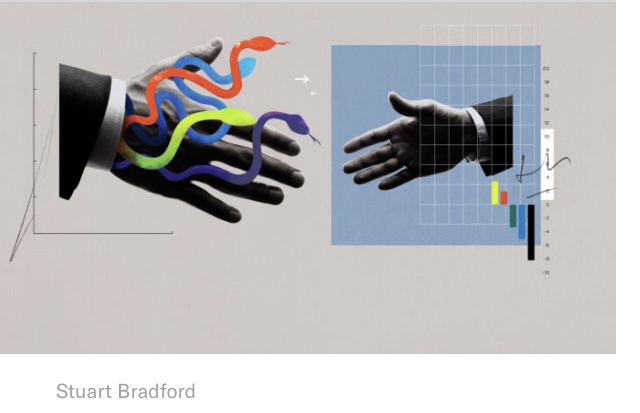




 healthcarereimagined