healthcarereimagined

Envisioning healthcare for the 21st century

  • About
  • Economics

AMA backs payment models for doc-led, team-based care – Modern Healthcare

Posted by timmreardon on 11/20/2013
Posted in: Integrated Electronic Health Records, Uncategorized. Tagged: AMA, American Medical Association, Geisinger Health System, Institute of Medicine, Intermountain Healthcare, Nurse practitioner, Nursing, United States. Leave a comment


<!–by Maureen McKinney–> By Maureen McKinney

Posted: November 19, 2013 – 1:15 pm ET
The American Medical Association threw its weight behind emerging models of payment for team-based care—that is, as long as those teams are led by physicians.AMA President Dr. Ardis Hoven said in a news release that physician-led team-based care “represents the future of healthcare delivery in America,” and she pointed to successful examples at high-profile health systems such as Intermountain Healthcare and Geisinger Health System.

According to recommendations adopted Monday during the AMA House of Delegates’ interim meeting in National Harbor, Md., physician leaders should be the ones who receive payment for services and they should also make decisions about how much each of the other team members gets paid. Those disbursement decisions should be based on a number of factors, including volume and intensity of services, quality of care, and team members’ professions, they said.

The AMA has pushed back hard against efforts to expand the scope of practice of other clinicians—most notably nurse practitioners—who have sought a larger role in providing unsupervised patient care.

In 2010, after the release of an Institute of Medicine report on the future of nursing, Dr. Rebecca Patchin, an AMA board member, released a statement arguing that physicians’ level of experience and training “are vital to optimal patient care, especially in the event of a complication or medical emergency, and patients agree”

The AMA has continued to voice concerns about nurse-led practices, particularly as lawmakers in states such as California consider bills that would allow nurse practitioners to practice independently, with fewer restrictions.

Nurse practitioners, meanwhile, have fired back, arguing that their skills are sufficiently needed to address a primary-care shortage, especially in medically underserved communities. This month the American Association of Nurse Practitioners released survey results showing wide public support for easing supervision requirements for nurse practitioners.

American Medical Association (AMA), Ardis Hoven, Intermountain Healthcare, Nursing, Patient Care, Physicians, Quality, Reimbursement

Interoperability: A critical mess – Fierce Health IT

Posted by timmreardon on 11/20/2013
Posted in: Integrated Electronic Health Records, Uncategorized. Tagged: Atlanta, Electronic health record, Emory University, Health information technology, Interoperability, Jeff Balser, Vanderbilt University Medical Center, West Health. Leave a comment

November 18, 2013  | By Gienna Shaw

I recently moderated a panel discussion on one of the most intractable problems in healthcare today: the ability–or lack thereof–to seamlessly share data across organizations, systems, platforms, devices and more. The live and online event on interoperability was hosted by West Health, a research organization that focuses on technologies to reduce healthcare costs.

Interoperability is an issue that the health IT community has been talking about for so many years–and yet solutions are tantalizingly out of reach. This despite the fact that there are enormous incentives to get it done.

Webinar: Data analytics: How healthcare institutions are benefiting clinically and financially

Date: Tuesday, December 10, 2 pm ET / 11 am PT

In this webinar, participants will hear from providers who have successfully implemented data analytics into their everyday processes. They’ll discuss the ways in which they’re using such tools, as well as the clinical and financial results reaped from those efforts. Register Now!

Sign up for our FREE newsletter for more news like this sent to your inbox!

The discussion kicked off with an arresting image–a photo of a patient in an intensive care unit room chock full of medical devices and a menagerie of carts and monitors. A jumble of wires completed the vision. You could barely see the patient and the clinician in the middle of it all. Different medical devices and systems look different, of course, but what struck me was that each monitor display also had a different look and feel.

The picture is a good analogy for interoperability itself–it’s an intensive, mission-critical mess that the industry must address.

“When you look at that photo, it’s hard to imagine that is the standard of care for patients in the intensive care unit in this country. There’s something like 10 or 12 devices trying to maintain the care and wellbeing of her father in this most dire time,” said Nick Valeriani, chief executive of the San Diego-based West Health. “And none of those devices talk to one another. None of those devices share information to enhance both his safety, the quality of his care and the cost of that care.”

Because panelist Jeff Balser, M.D., vice chancellor of Vanderbilt University Medical Center in Nashville, has spent a lot of time in ICU rooms during his medical career, and he gave the audience some specifics about what is wrong with that ICU picture.

“One of these devices … opens and shuts a balloon to assist the heart in beating. So you can just imagine the timing of that pulsation would need to be synchronized with the EKG,” he said.

“Way back here is the electro-cardiogram being recorded off the chest. And those two devices have to talk to each other or nothing works. I used to spend about an hour … fighting with those two machines to make them talk to each other,” he said. “Instead of taking care of the patient, I was making those devices talk to each other. It still doesn’t work.”

The thing about interoperability is that success in this area will not only lead to better patient care but is also good business.

There’s a human element here, the panelists said.

“The data that I carry as a patient belongs to me. It’s not a vendor’s data. It’s not my hospital’s data. It’s not my doctor’s data. I want my data to flow where it needs to be when I’m receiving any kind of healthcare,” said Michael Johns, M.D., chairman of West Health’s newly-formed Center for Medical Interoperability and former chancellor of Emory University in Atlanta and CEO of its Health Sciences Center. “The way information and data flows is a real detriment to the quality of patient care.”

At Vanderbilt, Balser conducted a survey asking patients what is important to them. There were 40 things on the list, from free parking to knowing that all of their providers have access to the same information.

“One of the things on the list was knowing all of my providers have access to the same information. “I thought people would pick that–it came in No. 1 … It even beat parking,” he said. “People know immediately when we don’t have our act together. They get it. And we don’t have our act together.”

As for the business side of things, integration is especially critical in an era of accountable care, which has changed the provider landscape. “Hospitals come together and form health systems and networks that get bigger and bigger … physicians come from groups of twos and threes to groups in the fifties and hundreds and join up with the health systems,” Johns said. “The business model is that if we could [achieve interoperability], we would create tremendous efficiencies … we can do more throughput, we can have physicians and nurses taking care of people, talking to people, listening to people rather than sitting at the machine trying to find the data from the last visits and logging in from one web page to the other web page to try to get the lab data and imaging data and patient history.”

Balser agreed. “We’re spending an enormous amount of money hiring really highly-trained people to waste their time doing useless work,” he said. “It’s costing us a fortune.”

West Health’s mission is research to reduce the cost of healthcare, noted Valeriani. And interoperability is a ripe environment for cost reduction. Analysis by West Health found the healthcare industry could save roughly $30 billion if it fixes the interoperability problem, including $12 billion in savings when highly trained people are providing care instead of transcribing data from one device or system to another.

There was a lot more to discuss–more than I can fit in a single column. You can find a video of the full event and the photo of the ICU room that I described here. And you can follow the Twitter conversation during the event here.

By the way, FierceHealthIT has just published our latest free eBook, Interoperability: The Path To Management and Standardizing Health Data. Be sure to check it out and let me know what you think about how we can move interoperability out of the intensive care unit–or into it, as the case may be. – Gienna (@Gienna and @FierceHealthIT)

Read more: Interoperability: A critical mess – FierceHealthIT http://www.fiercehealthit.com/story/interoperability-critical-mess/2013-11-18#ixzz2lCU247NN Subscribe at FierceHealthIT

“A common and somewhat unique aspect to EHR vendor contracts is that the EHR vendor lays claim to the data entered into their system.” – Who’s data is it anyway?

Posted by timmreardon on 11/19/2013
Posted in: Uncategorized. Tagged: Contract, EHR, Electronic health record, Health Information Technology for Economic and Clinical Health Act, Office of the National Coordinator for Health Information Technology, ONC, Privacy, Vendor (supply chain). Leave a comment

Rob Tholemeier, Director, Chilmark Research, co-authored this post.

Article link: http://www.healthcareitnews.com/blog/whos-data-it-anyway

A common and somewhat unique aspect to EHR vendor contracts is that the EHR vendor lays claim to the data entered into their system. Rob and I have worked in many industries as analysts. Nowhere, in our collective experience, have we seen such a thing. Manufacturers, retailers, financial institutions, etc. would never think of relinquishing their data to their enterprise software vendor of choice.

It confounds us as to why healthcare organizations let their vendors of choice get away with this and frankly, in this day of increasing concerns about patient privacy, why is this practice allowed in the first place?

The Office of the National Coordinator for Health Information Technology (ONC) released a report this summer defining EHR contract terms and lending some advice on what should and should not be in your EHR vendor’s contract.

The ONC recommendations are good but incomplete and come from a legal perspective.

As we approach the 3-5 year anniversary of the beginning of the upsurge in EHR purchasing via the HITECH Act, cracks are beginning to show. Roughly a third of healthcare organizations are now looking to replace their EHR. To assist HCO clients we wrote an article published in our recent October Monthly Update for CAS clients expanding on some of the points made by the ONC, and adding a few more critical considerations for HCOs trying to lower EHR costs and reduce risk.

The one item in many EHR contracts that is most troubling is the notion the patient data HCOs enter into their EHR is becomes the property in whole, or in-part, of the EHR vendor.

It’s Your Data — Act Like it Prior to the internet-age the concept that any data input into software either on the desktop, on-premise or in the cloud (AKA hosted or time sharing) was not owned entirely by the users was unheard of. But with the emergence of search engines and social media, the rights to data have slowly eroded away from the user in favor of the software/service provider. Facebook is notorious for making subtle changes to its data privacy agreements that raise the ire of privacy rights advocates.

Of course this is not a good situation when we are talking about healthcare, a sector that collects the most personal data one may own. EHR purchasers need to take a hard detailed look at their software agreements to get a clear picture of what rights to data are being transferred to the software vendors and whether or not that is in the best interests of the HCO and the community it serves..

Our recommendation: Do not let EHR vendor have any rights to the data – Period!

The second data ownership challenge to be very careful of is the increasing incorporation of patient generated health data into the healthcare delivery system. We project an explosion in the use of biometric devices, be it consumer purchased or HCO supplied, to monitor the health of patients outside of the exam room. Much of this data will find its way into the EHR. Exactly who owns this data and what rights each party has is still debatable. It is critical that before HCOs accept user data they work out user data ownership processes, procedures, and rights.

If the EHR vendor has retained some rights to data the patients need to be informed and have consented to this sharing agreement. In our experience this is rarely if ever explicitly stated. HCOs need to be careful here as this could become a public relations disaster.

We are not lawyers, we are offering our advice and experience to HCO CEOs, CFOs and CIOs, from the perspective of business risk and economics. At Chilmark we have deep experience in best practices used in other industries with regards to data use and sharing agreements. We have also spent significant time reviewing the entire software purchasing lifecycle and culture, and are here to help HCOs in reviewing these contracts.

Topics: Data Warehousing, Electronic Health Record (EHR), Privacy and Security, Chilmark Research, The Office of the National Coordinator for Health Information Technology (ONC), Health Information Technology for Economic and Clinical Health (HITECH) Act, Social media

Committee to Evaluate the Department of Veterans Affairs Mental Health Services – IOM

Posted by timmreardon on 11/19/2013
Posted in: Integrated Electronic Health Records, Uncategorized. Tagged: Mental health, Mental health professional, Operation Enduring Freedom, Posttraumatic stress disorder, United States Department of Veterans Affairs, US Department of Veterans Affairs, Veteran, Veterans Health Administration. Leave a comment
Type: Consensus Study
Topics: Health Services, Coverage, and Access, Substance Abuse and Mental Health, Veterans Health
Board: Board on the Health of Select Populations

Article link: http://iom.edu/Activities/Veterans/VAMentalHealthServices.aspx?msg=thx

Activity Description

An IOM committee will comprehensively assess the quality, capacity, and access to mental health care services for veterans who served in the Armed Forces in Operation Enduring Freedom, Operation Iraqi Freedom, or Operation New Dawn (OEF/OIF/OND). The IOM committee will assess the spectrum of mental health services available across the entire US Department of Veterans Affairs (VA). The scope of this assessment will include analysis not only of the quality and capacity of mental health care services within the VA, but also barriers faced by patients in utilizing those services. Types of evidence to be considered by the IOM committee in its assessment include relevant scientific literature and other documents, interviews with VA mental health professionals, survey data to be provided by the VA, and results from surveys of veterans to be conducted independently by the committee. Site visits will be conducted to at least one VA medical center in each of 21 Veterans Integrated Service Networks across the country. In addition, the committee will hold an open meeting of experts to discuss the Secretary’s plan for the development and implementation of performance metrics and staffing guidance. The committee will provide a final report with recommendations to the Secretary of the VA regarding overcoming barriers and improving access to mental health care in the VA, as well as increasing effectiveness and efficiency.

Has open source officially taken off at DOD? – FCW

Posted by timmreardon on 11/19/2013
Posted in: Integrated Electronic Health Records, Uncategorized. Tagged: Distributed Common Ground System, Ed Boyajian, EnterpriseDB, Great Recession, Lockheed Martin, Open source, Proprietary software, United States Department of Defense. Leave a comment
  • By Amber Corrin
  • Nov 19, 2013
data abstract

As far as technology trends in the federal government go, the use of open source is on a multi-year hot streak. Alongside movements such as the cloud, open source is one of those agency options like an oasis – or perhaps a mirage — in a funding desert, promising savings and efficiencies.

At the Defense Department, the incorporation of open source has happened more slowly than at some other agencies. With its legacy systems built on proprietary technologies, multi-year acquisition cycles and inherent security concerns, opening to the public something as sensitive as intelligence software is not necessarily operationally organic for DOD decision-makers.

But that is exactly what is beginning to happen, as the need to cut costs, share information and buy and fix capabilities faster pushes the military toward solutions where the community, and not the major contractor, is the key partner.

“The problem with proprietary solutions is the limited set of folks who can use them, rather than opening the core components to the community to drive…and just be the experts and the integrators,” said Andy Goodson, program manager for Lockheed Martin’s Distributed Data Framework, a newly open source software search engine for intelligence.

The DDF, which the military’s Distributed Common Ground System relies on for real-time sharing of mission data in combat, previously was available only to DOD users. Lockheed recently donated the DDF’s source code to the Codice Foundation, a nonprofit supporting government open-source projects, opening up the system to U.S. partners and other users who otherwise would have had to buy commercial software licenses.

The DDF now “is about taking the old proprietary approach and moving into newer open-source solutions [with] no licensing costs,” Goodson said. “It used to take months and millions of dollars to make security changes,” but the ability for open source to facilitate quick fixes, including from other members of the community using the system, means the military can more rapidly respond to requests from the field for changes. It also means more mission-related information can be shared between coalition partners.

DCGS is just one instance of DOD’s implementation of open-source technologies, but it is a prime example of where the trend has been used first by the Pentagon: in tactical systems, supporting troops on the ground. But not everyone agrees that open-source should be the new go-to solution there, despite changing fiscal and digital realities.

“Perhaps the most important issue in a major DOD system is reliability, which includes the ability to scale under heavy load as well as a system’s security and information-assurance features. Testing and certification of an end-to-end solution can be extraordinarily expensive, especially if that system is changed frequently,” noted an October white paper from Oracle – a major producer of proprietary software — that warned of the drawbacks of open source. “Commercial software companies have developed highly refined methodologies to perform these tasks. Don’t underestimate the difficulties associated with testing open source software and incorporating required changes into the main development stream, especially when it comes to testing for robustness and reliability under load.”

Despite such hurdles, others argue the open-source movement can only be expected to grow.

“I’d like to think that at this late date, not even Oracle is so brash as to really believe an agency like the DOD… doesn’t know what it’s doing when it comes to open source,” Ed Boyajian, president and CEO of open-source enterprise database company EnterpriseDB, wrote in a Nov. 12 Silicon Angle blog post. “For government, the pressures for change are especially difficult with declining revenues brought on by the Great Recession, indiscriminate cuts due to sequestration, mandates for data center consolidation, and the need to move to newer low cost cloud platforms. The bottom line is that government agencies have to adopt paradigm-changing solutions that open source delivers to meet these challenges.

About the Author
Amber Corrin is a staff writer

“Patients should be in control of their records, it should be easy to get to, and it should be a byproduct of what the doctor does.” – Information Week

Posted by timmreardon on 11/18/2013
Posted in: Integrated Electronic Health Records, Uncategorized. Tagged: Albert Santalo, Box, CareCloud, Electronic health record, Google Health, Microsoft, Microsoft HealthVault, Patient portal. Leave a comment

Cloud Services May Replace EHR Portals

11/15/2013 09:05 AM

Ken Terry
Ken Terry

EHR integration with Box suggests a trend: cloud services for care coordination and one-stop patient record access.

Patient portals attached to EHRs are spreading rapidly, mainly because of the Meaningful Use Stage 2 requirement that providers share records electronically with patients. According to a new Frost & Sullivan report, 50 percent of hospitals and 40 percent of ambulatory physician practices already have such portals. But it’s unclear whether this kind of patient portal has the functionality required in the long run for patient engagement and collaboration among unrelated providers.

One recent development shows the possibility of an alternative path. The cloud-based file-sharing vendor Box announced that a link to its service has been embedded in the cloud EHRs of Dr. Chrono and CareCloud. Physicians using these EHR systems can easily transfer patient records to Box, where patients can securely download them or transfer them to other providers.

Theoretically, if Box or some other cloud service provider persuaded enough EHR vendors to sign on, patients with multiple providers could download and aggregate all their records in one place. Instead, they must now access their records on multiple portals attached to the EHRs of different practices and hospitals. According to a recent KLAS report, just 14 percent of EHR-tethered portals included information from health information exchanges (HIEs), and 11 percent included data from other EHRs.

Albert Santalo, president and CEO of CareCloud, told us that it decided to embed Box because it is ubiquitous and easy to use. “While CareCloud also has the ability to share records through our own portal, we feel that Box is a more widely used platform.” Also, patients want to download records from multiple providers. “Sometimes they want to go beyond a patient portal, so Box facilitates that.”

Santalo believes that patients should be able to access all of their records in one place. “Patients should be in control of their records, it should be easy to get to, and it should be a byproduct of what the doctor does. The patient shouldn’t have to do a lot of work to populate their personal health records. That’s why other initiatives have failed, like Google Health and Microsoft HealthVault. They put too much burden on the patient.”

Microsoft, which still operates HealthVault, has long tried to get providers to send patient records to HealthVault, so they can be stored in patient-controlled personal health records (PHRs). Its website says “a growing list of labs, pharmacies, hospitals, and clinics” will send patient records to HealthVault upon request, but it hasn’t made any big announcements about this in years.

The Meaningful Use regulations allow providers to send records to PHRs to meet the record-sharing requirement. So Microsoft has applied for certification of HealthVault as EHR technology that can be used to show Meaningful Use in Stage 2. Missy Krasner, managing director of health and life sciences for Box, said it is considering whether to seek Meaningful Use certification.

However, Femi Ladega, global industry technologist for healthcare and life sciences at the consulting and research firm CSC, told us the ability to help providers achieve Meaningful Use is secondary to the other advantages of a cloud-based patient portal. The care delivery model is shifting toward “a shared accountability with the patient,” and this requires the capability to create two-way online communications between patients and all their providers.

To do that, he said, providers must create an infrastructure that goes beyond the EHR of an individual practice or hospital. “A health information exchange may be part of that infrastructure, and its dataset may be part of that ecosystem. But you need to pull data together from multiple sources.”

A cloud-based portal will be needed to serve as a central point for patients to aggregate their medical records and forward them to their providers. However, such a portal must be able to “provide the right infrastructure for the associated data governance while assuring the data can be relied on and trusted.” The portal also must show where each piece of information came from and enable providers to understand the context of the data “to drive the right interventions.”

This kind of cloud-based portal can co-exist with EHR-related portals, Ladega said, but it must be able to give patients all the information they need to manage their own conditions, including educational materials, care alerts, and other self-management tools. And it must provide the capability for bilateral communications between patients and providers across care settings.

“That’s why you need an ecosystem that enables effective data sharing, underpinned by this infrastructure that allows you to trust the information that is being shared and allows you to act effectively on it,” he said.

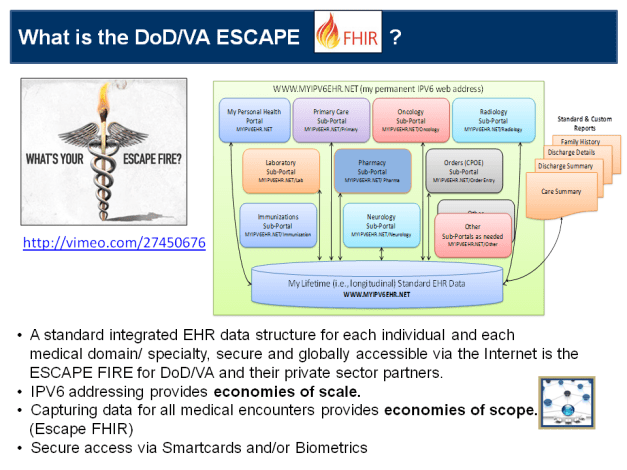
What is the DOD/VA Escape FHIR?

Posted by timmreardon on 11/16/2013
Posted in: Integrated Electronic Health Records, Uncategorized. Tagged: Fast Health Interoperable Resources, FHIR. Leave a comment

 FHIR® – Fast Health Interoperable Resources (hl7.org/fhir)

What is the DOD/VA Escape FHIR?

The IOM has several reports on Veterans health – Institute of Medicine

Posted by timmreardon on 11/16/2013
Posted in: Integrated Electronic Health Records, Uncategorized. Tagged: Department of Veterans Affairs, Health, Institute of Medicine, IOM, United States, United States Department of Defense, United States Department of Veterans Affairs, Wisconsin. Leave a comment

IOM reports provide objective and straightforward advice to decision makers and the public. This site includes IOM reports published after 1998. A complete list of IOM’s publications, from its establishment in 1970 through June 30, 2013, is available as a PDF.

Veterans Health Reports:

http://iom.edu/Reports.aspx?Topic1={2CF2CFE0-3290-4207-BC80-E691658C2074}&utm_source=Twitter&utm_medium=Tweet&utm_campaign=Hootsuite

Example Report:

Evaluation of the Lovell Federal Health Care Center Merger: Findings, Conclusions, and Recommendations

Released: October 16, 2012

            The 2010 opening of the Captain James A. Lovell Federal Health Care Center (FHCC) created a joint entity between the Department of Defense (DoD) and the Department of Veterans Affairs (VA) and replaced two separate centers in North Chicago. VA and DoD leaders envisioned a state-of-the-art facility that would deliver health care to both DoD and VA beneficiaries from northern Illinois to southern Wisconsin, providing service members and veterans seamless access to an expanded array of medical services. The DoD asked the IOM to evaluate whether the Lovell FHCC has improved health care access, quality, and cost for the DoD and the VA, compared with operating separate facilities, and to examine whether patients and health care providers are satisfied with joint VA/DoD delivery of health care.

IBM to Announce More Powerful Watson via the Internet – NY Times

Posted by timmreardon on 11/16/2013
Posted in: Uncategorized. Tagged: Amazon, Amazon Web Services, Cloud computing, Cycle Computing, IBM, Jeff Bezos, SoftLayer, Watson. Leave a comment

LAS VEGAS — Welcome to the age of supercomputing for everyone.

On Thursday IBM will announce that Watson, the computing system that beat all the humans on “Jeopardy!” two years ago, will be available in a form more than twice as powerful via the Internet.

WATSON-articleLarge

Companies, academics and individual software developers will be able to use it at a small fraction of the previous cost, drawing on IBM’s specialists in fields like computational linguistics to build machines that can interpret complex data and better interact with humans.

IBM’s move to make its marquee technology more widely available is the latest effort among big technology companies to make the world’s most powerful computers as accessible as the Angry Birds video game.

It is also an indication of how quickly the technology industry is changing, from complex systems that cost millions to install to pay-as-you-go deals that provide small companies and even individuals access to technology that just a few years ago only the largest companies could afford.

“The next generation will look back and see 2013 as a year of monumental change,” said Stephen Gold, vice president of the Watson project at IBM.

“This is the start of a shift in the way people interact with computers.”

IBM is wielding Watson in a fight to control the world of cloud computing — huge collections of computer servers connected over the Internet — with other big technology companies like Amazon.com, Google and Microsoft. It is no coincidence that IBM discussed its Watson news the same week Amazon was hosting clients at a conference here to pitch its own computing cloud, called Amazon Web Services or A.W.S.

The competition is still young, but its impact will be significant.

“Companies, governments and people will struggle to figure out what to do with all this,” said Jamie Popkin, an analyst with the research company Gartner. “It means there is going to be a new pace and velocity, making people rethink when humans make decisions, while machines make other decisions.”

Watson, a project on which IBM spent 14 years, is an artificial learning system that digests large volumes of information to find hidden meanings. Initial uses — besides  besting humans on game shows — include  examining medical patients and records to find an unexpected diagnosis, a bit like the genius portrayed in the television show “House.” Other uses include an online personal shopper and a virtual health aide that tailors exercises by asking questions.

IBM is opening Watson to more people in part to see what additional businesses might be created.

Watson is prominent, but similar projects are being run by other companies. On Tuesday, a company appearing at the Amazon conference said it had run in 18 hours a project on Amazon’s cloud of computer servers that would have taken 264 years on a single server.

The project, related to finding better materials for solar panels, cost $33,000, compared with an estimated $68 million to build and run a similar computer just a few years ago. Akin more to conventional supercomputing than Watson’s question-and-answer cognitive computing, the project was the first of several announced at the Amazon conference.

“It’s now $90 an hour to rent 10,000 computers,” the equivalent of a giant machine that would cost $4.4 million, said Jason Stowe, the chief executive of Cycle Computing, the company that did the Amazon supercomputing exercise, and whose clients include The Hartford, Novartis, and Johnson & Johnson. “Soon smart people will be renting a conference room to do some supercomputing.”

While revenues of Amazon’s cloud business are still small enough that the company does not have to disclose them, Amazon officials say Jeff Bezos, the company’s chief executive, believes A.W.S. could eventually dwarf Amazon’s businesses in books and merchandise, enterprises with $51 billion in revenue. This year, Gartner calculated that A.W.S. had five times the computing power of 14 other cloud computing companies, including IBM, combined.

Since then, IBM has spent an estimated $2 billion to acquire a cloud company called SoftLayer and has reconfigured Watson as a cloud product. It also hired buses that drove around the A.W.S. conference in Las Vegas, sporting ads that said they showed its superiority in cloud computing.

Besides gaining bragging rights and a much bigger customer base, IBM may be accelerating the growth of Watson’s power by putting it in the cloud. Mr. Gold said that Watson would retain learning from each customer interaction, gaining the ability to do things like interacting in different languages or identifying human preferences. IBM has taken steps to keep these improvements for its own benefit, by retaining rights in user agreements that customers are required to sign.

What is not yet clear is IBM’s plan to make money from taking Watson to the computing cloud. The company is experimenting with charging for data storage, or selling computing on a metered basis, like water or electricity. “There is no question the model will change,” Mr. Gold said. “You have to have flexibility to handle the breadth of cases we expect to see.”

It is likely that the competition among advanced computing systems will increase, lowering prices and delivering more capabilities to whatever use companies make of them.

This year, Google and a corporation associated with NASA acquired for study an experimental computer that appears to make use of quantum properties to deliver results sometimes 3,600 times faster than traditional supercomputers. The maker of the quantum computer, D-Wave Systems of Burnaby, British Columbia, counts Mr. Bezos as an investor.

&amp;lt;img src=”http://meter-svc.nytimes.com/meter.gif”/&amp;gt;

A version of this article appears in print on November 14, 2013, on page B1 of the New York edition with the headline: IBM to Announce More Powerful Watson via the Internet.

IBM hopes its Watson will become doctor’s sidekick – MPR News

Posted by timmreardon on 11/16/2013
Posted in: Integrated Electronic Health Records, Uncategorized. Tagged: IBM, Jeopardy, Mayo Clinic, Memorial Sloan–Kettering Cancer Center, Minnesota Public Radio, Sloan-Kettering, Thomas J. Watson, Watson. Leave a comment

by Elizabeth Stawicki, Minnesota Public Radio

June 13, 2012
ST. PAUL, Minn. — Remember Watson, the IBM supercomputer which made headlines last year by trouncing the top two contestants on the TV game show, Jeopardy?Watson’s million-dollar prize went to charity and now Big Blue is seeking gainful employment for Watson other than as a professional game show contestant.

Today, IBM’s chief medical scientist visited a Minneapolis hospital to talk about how Watson’s artificial intelligence could help doctors wade through loads of research data and apply that knowledge to treating patients.

Bulking up on a steady diet of the latest medical research, journals and textbooks, IBM’s Watson training to be a doctor’s assistant — an assistant who understands natural language and can provide a physician with a list of possible diagnoses and rank potential treatments.

At this stage, Watson is far from being able to do that job in a clinical setting, but that is the hope.

Named after IBM’s founder, Thomas J. Watson, a team of IBM scientists created the supercomputer to analyze human language, process huge amounts of information and return answers in less than three seconds.

IBM Chief Medical Scientist Dr. Martin Kohn told a group of health care workers at Abbott-Northwestern hospital that Watson would not make decisions for them; the goal is to help them make better decisions. Kohn said there is no way that physicians can keep current on all the latest medical breakthroughs, but Watson could.

Larger view
Jeopardy computer contestant

“The Watson that played Jeopardy! was able to read and understand 200 million pages of text in three seconds,” Kohn said. “Think of how many journal articles that is.”

Health care is increasingly pushing doctors to choose treatments based on the best evidence available about what is effective. IBM is touting Watson as a way to provide that analysis on the spot, but the computer still needs to get up to speed. Watson is getting that training at New York’s Memorial Sloan-Kettering Cancer Center, which agreed to collaborate with IBM.

The Cancer Center is providing Watson 1.5 million patient case histories and its specialists are developing systems that will allow Watson to correctly analyze medical questions.

Sloan-Kettering’s head of Thoracic Oncology, Mark Kris says Watson will be helpful to cancer doctors because oncology research moves at a rapid pace. He says Watson can provide doctors with an instant consultation.

“The way we doctors work — particularly where we have a case where it’s not as straightforward — we ask our colleagues, we ask specialists in the field,” Kris said. “In essence, Watson will have that capability.”

Watson is not without its limits, however.  Despite single-handedly beating the Jeopardy! champions, it also made what IBM concedes were some “spectacular errors.” In one of the final rounds, the category was U.S. cities.

For all of Watson’s vaunted processing power, the computer came up with an answer that wasn’t even in the right country. Watson’s human rivals got the answer right.

Larger view
Watson and health care

Watson’s miss received a lot of ink. But IBM’s Kohn explains Watson’s confidence in that response was very low. But under the game’s rules offering no response would have been a guaranteed wrong answer. Kohn says in the clinical setting Watson will provide physicians with its confidence level in a list of diagnoses and treatments.

In March, IBM announced it had formed a Watson Healthcare Advisory Board which includes representatives from leading cancer centers. Mayo Clinic is notably absent.

Dr. Dawn Milliner of Mayo said the world renowned clinic is in discussions with IBM about a potential role.

“We’ve been talking for some time and we continue to do so because we think this is a promising technology,” Milliner said. “But it’s a matter of the right timing and the right project for us to collaborate on to move this forward.”

IBM and Sloan-Kettering hope to have Watson ready to begin a pilot project analyzing cases by the end of the year.

Posts navigation

← Older Entries
Newer Entries →
  • Search site

  • Follow healthcarereimagined on WordPress.com
  • Recent Posts

    • Why opinion on AI is so divided – MIT Technology Review 04/14/2026
    • The Global Healthcare System Is Broken. Japan Fixed It for $4,100 Per Person. 04/10/2026
    • When Not to Use AI – MIT Sloan 04/01/2026
    • There are more AI health tools than ever—but how well do they work? – MIT Technology Review 03/30/2026
    • Are AI Tools Ready to Answer Patients’ Questions About Their Medical Care? – JAMA 03/27/2026
    • How AI use in scholarly publishing threatens research integrity, lessens trust, and invites misinformation – Bulletin of the Atomic Scientists 03/25/2026
    • VA Prepares April Relaunch of EHR Program – GovCIO 03/19/2026
    • Strong call for universal healthcare from Pope Leo today – FAN 03/18/2026
    • EHR fragmentation offers an opportunity to enhance care coordination and experience 03/16/2026
    • When AI Governance Fails 03/15/2026
  • Categories

    • Accountable Care Organizations
    • ACOs
    • AHRQ
    • American Board of Internal Medicine
    • Big Data
    • Blue Button
    • Board Certification
    • Cancer Treatment
    • Data Science
    • Digital Services Playbook
    • DoD
    • EHR Interoperability
    • EHR Usability
    • Emergency Medicine
    • FDA
    • FDASIA
    • GAO Reports
    • Genetic Data
    • Genetic Research
    • Genomic Data
    • Global Standards
    • Health Care Costs
    • Health Care Economics
    • Health IT adoption
    • Health Outcomes
    • Healthcare Delivery
    • Healthcare Informatics
    • Healthcare Outcomes
    • Healthcare Security
    • Helathcare Delivery
    • HHS
    • HIPAA
    • ICD-10
    • Innovation
    • Integrated Electronic Health Records
    • IT Acquisition
    • JASONS
    • Lab Report Access
    • Military Health System Reform
    • Mobile Health
    • Mobile Healthcare
    • National Health IT System
    • NSF
    • ONC Reports to Congress
    • Oncology
    • Open Data
    • Patient Centered Medical Home
    • Patient Portals
    • PCMH
    • Precision Medicine
    • Primary Care
    • Public Health
    • Quadruple Aim
    • Quality Measures
    • Rehab Medicine
    • TechFAR Handbook
    • Triple Aim
    • U.S. Air Force Medicine
    • U.S. Army
    • U.S. Army Medicine
    • U.S. Navy Medicine
    • U.S. Surgeon General
    • Uncategorized
    • Value-based Care
    • Veterans Affairs
    • Warrior Transistion Units
    • XPRIZE
  • Archives

    • April 2026 (3)
    • March 2026 (9)
    • February 2026 (6)
    • January 2026 (8)
    • December 2025 (11)
    • November 2025 (9)
    • October 2025 (10)
    • September 2025 (4)
    • August 2025 (7)
    • July 2025 (2)
    • June 2025 (9)
    • May 2025 (4)
    • April 2025 (11)
    • March 2025 (11)
    • February 2025 (10)
    • January 2025 (12)
    • December 2024 (12)
    • November 2024 (7)
    • October 2024 (5)
    • September 2024 (9)
    • August 2024 (10)
    • July 2024 (13)
    • June 2024 (18)
    • May 2024 (10)
    • April 2024 (19)
    • March 2024 (35)
    • February 2024 (23)
    • January 2024 (16)
    • December 2023 (22)
    • November 2023 (38)
    • October 2023 (24)
    • September 2023 (24)
    • August 2023 (34)
    • July 2023 (33)
    • June 2023 (30)
    • May 2023 (35)
    • April 2023 (30)
    • March 2023 (30)
    • February 2023 (15)
    • January 2023 (17)
    • December 2022 (10)
    • November 2022 (7)
    • October 2022 (22)
    • September 2022 (16)
    • August 2022 (33)
    • July 2022 (28)
    • June 2022 (42)
    • May 2022 (53)
    • April 2022 (35)
    • March 2022 (37)
    • February 2022 (21)
    • January 2022 (28)
    • December 2021 (23)
    • November 2021 (12)
    • October 2021 (10)
    • September 2021 (4)
    • August 2021 (4)
    • July 2021 (4)
    • May 2021 (3)
    • April 2021 (1)
    • March 2021 (2)
    • February 2021 (1)
    • January 2021 (4)
    • December 2020 (7)
    • November 2020 (2)
    • October 2020 (4)
    • September 2020 (7)
    • August 2020 (11)
    • July 2020 (3)
    • June 2020 (5)
    • April 2020 (3)
    • March 2020 (1)
    • February 2020 (1)
    • January 2020 (2)
    • December 2019 (2)
    • November 2019 (1)
    • September 2019 (4)
    • August 2019 (3)
    • July 2019 (5)
    • June 2019 (10)
    • May 2019 (8)
    • April 2019 (6)
    • March 2019 (7)
    • February 2019 (17)
    • January 2019 (14)
    • December 2018 (10)
    • November 2018 (20)
    • October 2018 (14)
    • September 2018 (27)
    • August 2018 (19)
    • July 2018 (16)
    • June 2018 (18)
    • May 2018 (28)
    • April 2018 (3)
    • March 2018 (11)
    • February 2018 (5)
    • January 2018 (10)
    • December 2017 (20)
    • November 2017 (30)
    • October 2017 (33)
    • September 2017 (11)
    • August 2017 (13)
    • July 2017 (9)
    • June 2017 (8)
    • May 2017 (9)
    • April 2017 (4)
    • March 2017 (12)
    • December 2016 (3)
    • September 2016 (4)
    • August 2016 (1)
    • July 2016 (7)
    • June 2016 (7)
    • April 2016 (4)
    • March 2016 (7)
    • February 2016 (1)
    • January 2016 (3)
    • November 2015 (3)
    • October 2015 (2)
    • September 2015 (9)
    • August 2015 (6)
    • June 2015 (5)
    • May 2015 (6)
    • April 2015 (3)
    • March 2015 (16)
    • February 2015 (10)
    • January 2015 (16)
    • December 2014 (9)
    • November 2014 (7)
    • October 2014 (21)
    • September 2014 (8)
    • August 2014 (9)
    • July 2014 (7)
    • June 2014 (5)
    • May 2014 (8)
    • April 2014 (19)
    • March 2014 (8)
    • February 2014 (9)
    • January 2014 (31)
    • December 2013 (23)
    • November 2013 (48)
    • October 2013 (25)
  • Tags

    Business Defense Department Department of Veterans Affairs EHealth EHR Electronic health record Food and Drug Administration Health Health informatics Health Information Exchange Health information technology Health system HIE Hospital IBM Mayo Clinic Medicare Medicine Military Health System Patient Patient portal Patient Protection and Affordable Care Act United States United States Department of Defense United States Department of Veterans Affairs
  • Upcoming Events

Blog at WordPress.com.
healthcarereimagined
Blog at WordPress.com.
  • Subscribe Subscribed
    • healthcarereimagined
    • Join 153 other subscribers
    • Already have a WordPress.com account? Log in now.
    • healthcarereimagined
    • Subscribe Subscribed
    • Sign up
    • Log in
    • Report this content
    • View site in Reader
    • Manage subscriptions
    • Collapse this bar
 

Loading Comments...