healthcarereimagined

Envisioning healthcare for the 21st century

  • About
  • Economics

23andMe’s New Formula: Patient Consent = $ – MIT Technology Review

Posted by timmreardon on 01/13/2015
Posted in: Big Data, Data Science, FDA, Genetic Data, Genetic Research, Genomic Data, Global Standards, Health Outcomes, Healthcare Informatics, HIPAA, Open Data, Patient Centered Medical Home, Patient Portals, PCMH. Leave a comment

Antonio Regalado
January 6, 2015

How a consumer genetics company amassed a database of willing research participants.

Facebook generates about $8 a year in revenue from each of its users. But what if you offered a company not just your photos and updates, but your entire genome?

Then you could be worth as much as $20,000.

That’s my rough calculation for what Genentech could pay direct-to-consumer gene testing company 23andMe for the chance to trawl the DNA of each of several thousand of its customers for genetic clues to Parkinson’s disease.

The deal between the two companies, announced today, provides some fascinating insights into the evolving DNA business and the commercial prospects for 23andMe, a high-flying company that’s had some problems in the U.S. with regulators. According to detailed coverage over at Forbes, Genentech will pay as much as $60 million for access to 3,000 Parkinson’s patients in 23andMe’s database.

The backstory is that 23andMe pioneered direct-to-consumer genetic tests starting in 2006. It asked consumers to spit in a tube and send it in, and sent back a detailed summary of their risks for common diseases like macular degeneration. But then in 2013 the U.S. Food & Drug Administration banned the test out of concern that the information wasn’t accurate.

That put a big crimp in 23andMe’s business, but it didn’t end it. As Forbes points out, the real business here is mining this data:

Such deals, which make use of the database created by customers who have bought 23andMe’s DNA test kits and donated their genetic and health data for research, could be a far more significant opportunity than 23andMe’s primary business of selling the DNA kits to consumers. Since it was founded in 2006, 23andMe has collected data from 800,000 customers and it sells its tests for $99 each. That means this single deal with one large drug company could generate almost as much revenue as doubling 23andMe’s customer base.

The company hasn’t stopped gathering DNA data either. It still sells its Personal Genome Service health kits in countries like Canada. In the U.S. it continues to offer a more limited genealogy test to people who want to learn what their DNA says about their ancestry and relatives.

The result is that 23andMe may have the largest DNA database anywhere that’s open for medical studies. Of its 820,000 customers, the company says, about 600,000 have also agreed to donate their DNA data for research purposes. According to Forbes:

“I think that this illustrates how pharma companies are interested in the fact that we have a massive amount of information,” says Anne Wojcicki, 23andMe’s chief executive and co-founder. “We have a very engaged consumer population, and these people want to participate in research.”

It’s also a reminder that 23andMe’s real business isn’t selling $99 tests, but selling access to data that it has managed to crowdsource as cleverly as Facebook has gathered other personal details. To some observers, that’s pretty worrisome. In 2013, journalist Charles Seife, writing in Scientific American, called 23andMe intentions “terrifying.”

As the FDA frets about the accuracy of 23andMe’s tests, it is missing their true function, and consequently the agency has no clue about the real dangers they pose. The Personal Genome Service isn’t primarily intended to be a medical device. It is a mechanism meant to be a front end for a massive information-gathering operation against an unwitting public.

Seife’s worry is that the consents customers agree to when they donate their DNA could turn out to be meaningless. Once you are hooked, companies like Google and Facebook often change their privacy policies to expose more and more of your data. Why should DNA be any different?

So far, 23andMe seems more sincere than sinister. Parkinson’s disease is personally important to Wojcicki and her husband, Google founder Sergey Brin: his mother was diagnosed with the disease, which runs in families. Todd Sherer, the head of the Michael J. Fox Foundation for Parksinon’s Research, told me that the couple (now separated) has been the organization’s biggest donor, giving more than $150 million.

But Seife is right about the economics of DNA. It’s collecting free-and-clear data and amassing willing users that counts. According to the Fox Foundation, 23andMe actually gave its testing service away to Parkinson’s patients. That helped it assemble enough of them to create a useful resource it could sell to Genentech to start mining.

As part of its research, Genentech will gain access to the stored spit samples of 3,000 Parkinson’s patients in order to access their full genomic information. That is something that is allowed by the agreements customers signed. But to make sense of the DNA data, Genenetech will also need a lot of extra information about people’s health situations and medical records.

In this case, Forbes reports, the company will be reaching out to them to craft new agreements to access that, too.

Article link: http://www.technologyreview.com/view/534006/23andmes-new-formula-patient-consent/?utm_campaign=newsletters&utm_source=newsletter-weekly-biomedicine&utm_medium=email&utm_content=20150113

Employee premium costs & deductibles grew faster than income in every state over last decade – Commonwealth Fund

Posted by timmreardon on 01/12/2015
Posted in: Health Care Costs, Health Care Economics, Health Outcomes, Healthcare Delivery, Uncategorized. Leave a comment

Overview
436x125
State Trends in the Cost of Employer Health Insurance Coverage, 2003-2013

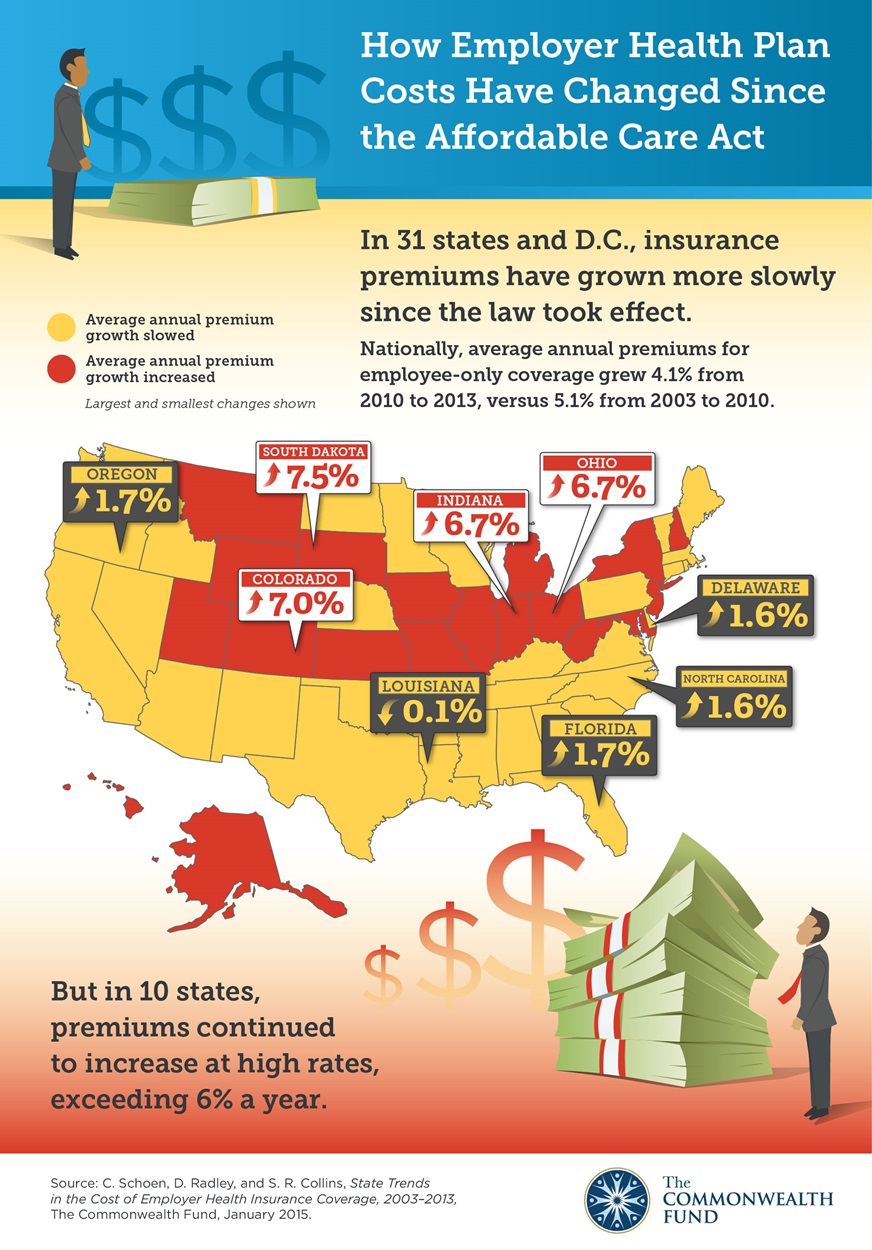
From 2010 to 2013—the years following the implementation of the Affordable Care Act—there has been a marked slowdown in premium growth in 31 states and the District of Columbia. Yet, the costs employees and their families pay out-of-pocket for deductibles and their share of premiums continued to rise, consuming a greater share of incomes across the country. In all but a handful of states, average deductibles more than doubled over the past decade for employees working in large and small firms. Workers are paying more but getting less protective benefits. Costs are particularly high, compared with median income, in Southern and South Central states, where incomes are below the national average. Based on recent forecasts that predict an uptick in private insurance growth rates starting in 2015, securing slow cost growth for workers, families, and employers will likely require action to address rising costs of medical care services. Read the brief or visit the interactive map.
Infographic_Schoen_state_trends_2003_2013_IG_v301 (2)

Article link: http://www.commonwealthfund.org/publications/issue-briefs/2015/jan/state-trends-in-employer-coverage?utm_content=bufferb4944&utm_medium=social&utm_source=twitter.com&utm_campaign=buffer

JASON Report: The Great American Experiment – iHealthBeat

Posted by timmreardon on 01/05/2015
Posted in: Big Data, Blue Button, Data Science, EHR Interoperability, Global Standards, Health Care Costs, Health Care Economics, Health IT adoption, Health Outcomes, Healthcare Delivery, Healthcare Informatics, Healthcare Security, Innovation, Integrated Electronic Health Records, JASONS, Military Health System Reform, National Health IT System, Open Data, Patient Centered Medical Home, Patient Portals, PCMH, Quadruple Aim, Quality Measures. Leave a comment

by Margalit Gur-Arie 12/15/2014
Jason-Report
The distinguished JASON group of anonymous scientists and academics that provides consulting services to the U.S. government on matters of defense science and technology, just published a sequel to the 2013 best seller, “A Robust Health Data Infrastructure”. The new report is titled “Data for Individual Health”, and it has two purposes. The first and foremost purpose is to backtrack on the searing criticism leveled at government efforts to promote health information technology, which evoked much angst and indignation earlier this year. The second purpose is to expound upon the exact nature of personal data required to feed the robust infrastructure laid out in the first JASON report, complete with illustrations and examples of breakthrough benefits to humanity, such as helping city planners design bicycle paths. Yes, bicycle paths. And if you didn’t know that the number one health care problem in this country is the layout of bicycle paths, then you are a Luddite, and luckily your generation will soon be dead.

After dutifully observing that only a tiny percentage of Americans use medical services of any kind, JASON is informing us that the government agencies that funded its work “specifically” asked the group “to address how to bridge, on the national scale, to a system focused on health of individuals rather than care of individuals” [italics in the original]. It seems that the overdetermined triple aim of health care reform, better health for populations, better care for individuals, at lower per capita costs, is finally being reformulated into a solvable optimization problem by removing the unprofitable constraints on caring for the sick.

As was the case with the previous JASON report, the group was briefed by a diverse array of researchers and technology experts, including the great new hope of health, our most beloved, innovative, tax evading, and slave labor supported, Apple Inc. The content of briefing sessions is not available to mere mortals, but one in particular is rather enlightening in its title: “Disrupting the Status Quo: Putting Healthy People First”. Never since the dawn of medicine, from Hippocrates, to Florence Nightingale, to Mother Teresa and today’s Doctors Without Borders, have we experienced greater disruption in the status quo.

Similar to the first JASON report, the second offering is chockfull of technical recommendations for the “collection, assimilation, and exchange” of quantifiable “data streams” emanating from living things, whether in traditional medical surroundings or as people go about living their healthy lives. There is nothing earth shattering in the JASON findings or recommendations, but some finer points may be worth mentioning anyway.

Phenotypes – After providing us with a crash course in genomic sequencing and the workings of RNA and other protein molecules in the first report, JASON argued that the “biomedical research community will be a major consumer of data from an interoperable health data infrastructure”, hence the government “should solicit input from the biomedical research community to ensure that the health data infrastructure meets the needs of researchers”. In the second installment, JASON is reiterating its obviously very strong interest in genotype-phenotype relationships and their assimilation into the IT system they are recommending we build. Luckily, some of the JASON briefers happened to hail from academic centers renowned for grant funded genomic research in general, and efforts to “develop algorithms and methods to convert EHR data into meaningful phenotypes” in particular.

In Vivo – I have to admit that compared to run of the mill interoperability papers, which deal with unconscious patients in the ER, or people irritated by having to fill out paper forms, the JASON report is much more interesting. Here is another supercool futuristic development that we absolutely must consider when creating an IT infrastructure to collect data for health related research, which is essentially the main concern of the JASON group. It seems that the Defense Advanced Research Projects Agency (DARPA) is working on in vivo nanoplatforms. Something about “ultra-small scaffolds inserted directly into the body” and “fluorescent nanospheres that are functionalized to detect biomarkers of interest”. The purpose seems to be “continuous physiological monitoring for the warfighter”. We do of course want to support our troops, so these cute little nanites must also be part of our robust health data infrastructure.

FHIR – In this report JASON is taking an unequivocal stand behind a new HL7 standard for clinical information exchange, the Fast Healthcare Interoperability Resources (FHIR), which is actually pretty neat, and has been in development for approximately three years. FHIR is envisioned as a replacement for the C-CDA, which replaced the CCD, which replaced the CCR, which replaced an array of HL7 2.x messages. JASON is recommending that government “policies should make it advantageous for one or more leading EHR vendors to be the first to propose such standards”. Lo and behold, two days after the JASON report was published, a group of leading vendors and institutions, several of which briefed JASON, and some who are helping the government implement JASON’s recommendation, launched the Argonaut Project for precisely this “advantageous” purpose.

FDA – For some reason the JASON report is engaging in a lengthy and strangely passionate litigation of the 23andMe (a DNA analysis service) tiff with the Food and Drug Administration (FDA) from a year or so ago, concluding with a recommendation that the FDA should take a “more nuanced approach” to its regulation of apps that could be construed as “practicing medicine”. The FDA regulatory authority over medical software has been in the crosshairs of corporate lobbyists (tech, pharma, telecom, etc.) for a couple of years now, with a variety of bipartisan deregulation bills introduced, or almost introduced, unsuccessfully in Congress. Coincidentally, two days after the publication of the JASON report, Senators Bennet (D-CO) and Hatch (R-UT) introduced the MEDTECH Act, the most serious attempt so far to restrain the FDA’s regulatory abilities.

Non-profits – JASON is recommending that non-profit organizations, either those that are disease specific or general in nature, “should be encouraged to assess their goals with respect to health data streams, and to provide “stamps of approval” for applications (apps) and other consumer tools”. In other words non-profit organizations should leverage the trust of their communities to monetize their members’ health data. JASON also recommends that private foundations should help the government by creating cash prizes to entice entire communities into participation in data wellness games. This is brilliant thinking, which leads me to hypothesize that at least one of the JASON members must be a Nobel laureate in marketing.

In this era of “transparency”, where every dollar from every pharmaceutical company or government agency, paid to every doctor and hospital, comes under relentless public scrutiny, why should JASON be exempt? Shouldn’t the JASON reports be accompanied by full disclosures of conflict of interest, both for JASON members and the various briefers whose pet projects populate every page of every report? Where is the media when a group of secretive researchers and private corporations are steering almost 20% of our economy towards endeavors immediately beneficial first and foremost to themselves?

When you read the JASON reports back to back, you are left with the impression that the group’s overarching goal is to create an international distributed repository of genetic materials tied to individual, environmental, behavioral and disease specific manifestations for all people on this planet. There is no doubt in my mind that a structure of this type and magnitude can facilitate an infinite number of perhaps beneficial research projects, and maybe even an IPO here and there. But if taxpayers are expected to fund the infrastructure for such expansive research, shouldn’t they be asked, or at the very least clearly informed?

And why rob the President of the United States of a legacy-defining “We choose to go to the moon” speech? It could go something like this: My fellow Americans, by 2025 every American will have his or her DNA collected and catalogued, and by 2025 every movement and every breath of every American man woman and child will be associated with their genomic sample, launching the grandest experiment in the history of mankind. From the ashes of the Great American Experiment, we will bring you more than freedom, more than liberty and more than a futile pursuit of happiness. We will bring you, Health. Download it for free from iTunes today.

In 1802, Thomas Jefferson wrote in a letter to David Hall: “We have no interests nor passions different from those of our fellow citizens. We have the same object: the success of representative government. Nor are we acting for ourselves alone, but for the whole human race. The event of our experiment is to show whether man can be trusted with self-government. The eyes of suffering humanity are fixed on us with anxiety as their only hope, and on such a theatre, for such a cause, we must suppress all smaller passions and local considerations.” Whatever.

Article link: http://hitconsultant.net/2014/12/15/jason-report-the-great-american-experiment/

Many U.S. Residents Want Access to EHRs Through Patient Portals – iHealthBeat

Posted by timmreardon on 01/05/2015
Posted in: Global Standards, Health Care Costs, Health Care Economics, Health IT adoption, Health Outcomes, Healthcare Delivery, Healthcare Informatics, Innovation, Integrated Electronic Health Records, Patient Centered Medical Home, Patient Portals, Quadruple Aim, Quality Measures. Leave a comment

Many U.S. residents want to access their electronic health records online but are unaware of how to do so, according a survey released Tuesday by Xerox, Health Data Management reports.
ElderlyCoupleatDesktopComputer
The annual survey, commissioned by Xerox and conducted by Harris Poll, included 2,017 adults and took place in September (Goth, Health Data Management, 12/17).

Survey Findings

The survey found that 64% of respondents did not use online patient portals, but 57% said they would be more proactive in their health care if they had online access to their EHRs (Gold, “Morning eHealth,” Politico, 12/16).

Of respondents who did not use patient portals:
•35% said they were unaware that a portal was available; and
•31% said their physician had never discussed the option.

Among respondents who did use patient portals, 59% said they have been more interested in their health care since receiving access to their health data (Health Data Management, 12/17).

The survey found that physicians could increase the use of portals by accounting for specific needs and interests of different generations of patients.

It also found that 64% of millennials who used online portals said they were more involved in their personal health care.

In addition, 56% of baby boomers who do not use patient portals said they would be more involved in their care if they had such access to their health data.

Meanwhile, the survey noted that millennials were more likely to access patient portals via smartphones and tablets.

The survey also found that 85% of respondents expressed concerns about the security of EHRs — up from 83% last year (Durben Hirsch, FierceEMR, 12/16).

Implications

Xerox executives said eligible professionals could “make strides” toward meeting requirements of Stage 2 of the meaningful use program by improving access to patient portals.

Under the 2009 economic stimulus package, health care providers who demonstrate meaningful use of certified EHRs can qualify for Medicaid and Medicare incentive payments. Eligible professionals must be able to provide patients the ability to view online, download and transmit their health information within four business days of the information being available to the eligible professional, and eligible professionals must get more than 5% of their patients to use it.

Tamara St. Claire, chief innovation officer of commercial health care at Xerox, said, “With providers facing regulatory changes, mounting costs and patients who increasingly seek access to more information, our survey points to an opportunity to address issues by simply opening dialogue with patients about patient portals.”

She added, “Educating patients will empower them to participate more fully in their own care while helping providers demonstrate that electronic health records are being used in a meaningful way” (Health Data Management, 12/17).

Article link: http://www.ihealthbeat.org/articles/2014/12/18/many-us-residents-want-access-to-ehrs-through-patient-portals

The Future of Electronic Health Records in the US: Lessons Learned from the UK – Breakaway Thinking

Posted by timmreardon on 01/05/2015
Posted in: Data Science, EHR Interoperability, Global Standards, Health Care Costs, Health Care Economics, Health IT adoption, Health Outcomes, Healthcare Delivery, Healthcare Informatics, Innovation, Integrated Electronic Health Records, Mobile Healthcare, Patient Centered Medical Home, Patient Portals, Public Health, Quadruple Aim. Leave a comment

The following is a guest blog post by Carrie Yasemin Paykoc, Senior Instructional Designer / Research Analyst at The Breakaway Group (A Xerox Company). Check out all of the blog posts in the Breakaway Thinking series.
Carrie Yasemin Paykoc
Carrie-Yasemin-Paykoc
With 2014 coming to a close, there is a natural tendency to reflect on the accomplishments of the year. We gauge our annual successes through comparison with expected outcomes, industry standards, and satisfaction with the work done. To continue momentum and improve outcomes in the coming years we look for fresh ideas. For example, healthcare organizations can compare their efforts with similar types of organizations both locally and abroad. In the United States, looking beyond our existing borders toward the international community can provide valuable insight. Many other nations such as the UK, are further down the path of providing national healthcare and adopting electronic health records. In fact, the National Health Service (NHS) of UK has started plans to allow access of Electronic Health Records (EHR) on Smartphones through approved health apps. Although healthcare industry standards appear to be in constant flux, these valuable international lessons can help local healthcare leaders develop strategies for 2015 and beyond.

By the year 2024, the Office of the National Coordinator (ONC) aims to improve population health through the interoperable exchange of health information, and the utilization of research and evidence-based medicine. These bold and inspiring goals are outlined in their 10 Year Vision to Achieve Interoperable Health IT Infrastructure, also known as ONC’s interoperability road map. This document provides initial guidance on how the US will lay the foundation for EHR adoption and interoperable Healthcare Information Technology (HIT) systems. ONC has also issued the Federal Health IT Strategic Plan 2015-2020. This strategy aims to improve national interoperability, patient engagement, and expansion of IT into long-term care and mental health. Achieving these audacious goals seems quite challenging but a necessary step in improving population health.

EHR Adoption in UK
The US is not alone in their EHR adoption and interoperability goals. Many nations in our international community are years ahead of the US in terms of EHR implementation and utilization. Just across the Atlantic Ocean, the United Kingdom has already begun addressing opportunities and challenges with EHR adoption and interoperability. In their latest proposal the NHS has outlined their future vision for personalized health care in 2020. This proposal discusses the UK’s strategy for integrating HIT systems into a national system in a meaningful way. This language is quite similar to Meaningful Use and ONC’s interoperability roadmap in the United States. With such HIT parallels much could be learned from the UK as the US progresses toward interoperability.

The UK began their national EHR journey in the 1990s with incentivizing the implementation of EHR systems. Although approximately 96 percent of all general provider practices use EHRs in the UK, only a small percentage of practices have adopted their systems. Clinicians in the UK are slow to share records electronically with patients or with their nation’s central database, the Spine.

Collaborative Approach
In the NHS’s Five Year Forward View they attempt to address these issues and provide guidance on how health organization can achieve EHR adoption with constrained resources. One of the strongest themes in the address is the need for a collaborative approach. The EHRs in the UK were procured centrally as part of their initial national IT strategy. Despite the variety of HIT systems, this top-down approach caused some resentment among the local regions and clinics. So although these HIT systems are implemented, clinicians have been slow to adopt the systems to their full potential. (Sarah P Slight, et al. (2014). A qualitative study to identify the cost categories associated with electronic health record implementation in the UK. JAMIA, 21:e226-e231) To overcome this resistance, the NHS must follow their recommendations and work collaboratively with clinical leadership at the local level to empower technology adoption and ownership. Overcoming resistance to change takes time, especially on such a large national scale.

Standard Education Approach
Before the UK can achieve adoption and interoperability, standardization must occur. Variation in system use and associated quality outcomes can cause further issues. EHR selection was largely controlled by the government, whereas local regions and clinics took varied approaches to implementing and educating their staff. “Letting a thousand flowers bloom” is often the analogy used when referring to the UK’s initial EHR strategy. Each hospital and clinic had the autonomy of deciding on their own training strategy which consisted of one-on-one training, classroom training, mass training, or a combination of training methods. They struggled to back-fill positions to allow clinicians time to learn the new system. This process was also expensive. At one hospital £750 000 (over $1.1 million US) was spent to back-fill clinical staff at one hospital to allow for attendance to training sessions. This expensive and varied approach to training makes it difficult to ensure proficient system use, end-user knowledge and confidence, and consistent data entry. In the US we also must address issues of consistency in our training to increase end-user proficiency levels. Otherwise the data being entered and shared is of little value.

One way to ensure consistent training and education is to develop a role-based education plan that provides only the details that clinicians need to know to perform their workflow. This strategy is more cost-effective and quickly builds end-user knowledge and confidence. In turn, as end-user knowledge and confidence builds, end users are more likely to adopt new technologies. Additionally, as staff and systems change, plans must address how to re-engage and educate clinicians on the latest workflows and templates to ensure standardized data entry. If the goal is to connect and share health information (interoperability), clinicians must follow best-practice workflows in order to capture consistent data. One way to bridge this gap is through standardized role-based education.

Conclusion
Whether in the US or UK, adopting HIT systems require a comprehensive IT strategy that includes engaged leadership, qualitative and quantitative metrics, education and training, and a commitment to sustain the overall effort. Although the structure of health care systems in the US and UK are different, many lessons can be learned and shared about implementing and adopting HIT systems. The US can further research benefits and challenges associated with the Spine, UK’s central database as the country moves toward interoperability. Whereas the UK can learn from education and change management approaches utilized in US healthcare organizations with higher levels of EHR adoption. Regardless of the continent, improving population health by harnessing available technologies is the ultimate goal of health IT. As 2015 and beyond approaches, collaborate with your stakeholders both locally and abroad to obtain fresh ideas and ensure your healthcare organization moves toward EHR adoption.

Xerox is a sponsor of the Breakaway Thinking series of blog posts.

Article link: http://www.emrandhipaa.com/guest/2014/12/17/the-future-of-electronic-health-records-in-the-us-lessons-learned-from-the-uk-breakaway-thinking/

Message from Lt. Gen. (Dr.) Douglas J. Robb – A Year in Military Health – Health.mil

Posted by timmreardon on 01/05/2015
Posted in: Accountable Care Organizations, Data Science, DoD, EHR Interoperability, Global Standards, Health Care Costs, Health Care Economics, Health IT adoption, Health Outcomes, Healthcare Delivery, Healthcare Informatics, Innovation, Integrated Electronic Health Records, Military Health System Reform, Mobile Healthcare, National Health IT System, Patient Centered Medical Home, Patient Portals, PCMH, Primary Care, Quadruple Aim, Quality Measures, U.S. Air Force Medicine, U.S. Army Medicine, U.S. Navy Medicine, Uncategorized, Veterans Affairs, Warrior Transistion Units. Leave a comment

12/1/2014
By: Health.mil Staff
GENROBB
We just completed a remarkable first year in the Defense Health Agency.

In December, you will all be receiving our first Annual Report on what we have accomplished, and where we are headed in 2015. But let me give you a preview of what I consider the principal takeaways from our first year.

Unity of Effort is critical. Our successes in year 1 are directly attributable to your ability to bring people together on behalf of our broader purpose in military medicine. We put a new system of decision-making for the Military Health System (MHS) in place. And it ensured engagement at every level – the Office of the Secretary of Defense, the service secretaries, the Joint Chiefs, the service Surgeons General and all of their staffs. To some, the MHSER, the SMMAC, the MDAG, the MOG, BOG, and MPOG are an alphabet soup of bureaucracy. But not to me, and hopefully not to you. These committees are the machinery that allows us to tee up, vet and make sound decisions on the future of this vital system of care. Together.

The business of building consensus is not easy – but the payoffs are enormous. And, so for the many initiatives that we introduced this year, we succeeded when the hard work of building trust, ensuring transparency and skillful execution were sustained.

And the inverse is also true, when unity of effort was lacking, when the processes became slow or bogged down – sometimes on substantive policy issues, sometimes on minutiae, and sometimes on simple misunderstanding – we fell short of our goals. But, if we had nothing but successes this year, I think it would be a sign that we were not challenging ourselves enough. Perseverance matters. We will pick it up in 2015.

Success is not only measured in dollars saved. I am as pleased as anyone that we saved $250 million in 2014, which was $250 million more than we projected! This was supposed to be a building year, creating the infrastructure and hiring staff. But through aggressive action by leaders at all levels, we also provided the department and the taxpayer with a return on investment. Yet, equally important to saving dollars is the long-term work of creating common clinical and business processes.

Let me give you one example of an area where no money has yet been saved, but tremendous progress has been made: creating a common cost accounting structure for the MHS. This has been “behind the scenes” work by an often unheralded team of budget and financial management experts. They are positioning the MHS for the long-game.

In the coming years, we will look back at the work of 2014 – across all of our domains – and we will recognize this was the beginning of a process that genuinely allows us to compare performance in a meaningful way across the system of care. Not just counting dollars and cents, but utilization, outcomes, quality, safety and access to care. Not every success has a price tag on it, but they are all valued.

2014 was a down payment on a bigger promise. It has been a transformational year. At the same time that we stood up the DHA, which required a tremendous amount of energy and intellect in its own right, we have also played an indispensable role in the Secretary of Defense’s “Review of the Military Health System” and in implementing the action plan that followed it. We have an important role to play – in creating, maintaining and communicating a Performance Management System as well as a broad mandate for ensuring greater transparency to the public.

Now, add in the deployment of thousands of service members to West Africa in support of the larger federal response to the Ebola outbreak, along with the deployment of service members to Iraq to confront the threats from ISIS, and you have a sense of why having a “Medically Ready Force…Ready Medical Force” is more than a mere slogan; it is a perpetual promise in our combat support agency role.

In such a world, our customers – the services and the combatant commanders – need a system that ensures their medical logistics needs are met. They need medical facilities that are designed, built and sustained for 21st century medicine. They need a pharmacy system that can deliver vaccines, therapeutics and other medicines that prevent disease when possible, and treat disease when needed, which is often immediately. They need a health system in which private sector providers complement our direct care system and reach every corner of the globe where our service members and families live and work. They expect the care that we provide in Afghanistan, Iraq, Liberia, South Korea or the South Pacific to be captured, shared and available worldwide to our medical teams through a functioning Electronic Health Record. They need a global public health system that monitors the environment and disease threats anywhere in the word. They demand a medical research and development system that never stops the search for better ways of addressing the myriad of threats and disease and injuries we face in this unique line of business. They need us to educate and train thousands of new recruits and experienced professionals. They need a procurement system that can respond in a timely manner with high quality products and services. And they need us to properly budget, oversee and account for all of these things. And they need leading, joint institutions for health care delivery – and they are right here in the National Capital Region.

And they need the DHA.

And we have a deep moral and personal obligation to ensure that their needs are met.

I know that many of you were double and triple-tasked to manage the avalanche of requests for policy reviews, data calls, and briefings. But it all had a purpose. In Dr. Woodson’s words, we are building a better, stronger, more relevant MHS. I can see the concepts that were just words a year ago beginning to take root. This has been an extraordinary year of progress. And, yet, our work has just begun. So, let’s keep our sleeves rolled-up and let’s keep our unity of effort focus … we’re burning daylight as we speak!

Article link: http://www.health.mil/News/Articles/2014/12/01/Robb-Leadership-Message

Why EHRs require continual modification – Government Health IT

Posted by timmreardon on 01/05/2015
Posted in: Big Data, Blue Button, Data Science, EHR Interoperability, Global Standards, Health Care Costs, Health Care Economics, Health IT adoption, Health Outcomes, Healthcare Delivery, Innovation, Integrated Electronic Health Records, National Health IT System, Quadruple Aim, Quality Measures. Leave a comment

December 29, 2014 | Government Health IT Staff

Inpatient Electronic Health Records (EHRs) are not optimized to support delivery of quality and safety initiatives and, as a result, providers must be prepared to devote time and effort to continually modify them as they are implemented.

That’s according to a new study published in Electronic Data Methods for which researchers monitored the use of an EHR at three hospitals within Baylor Scott & White Health (BSWH), the largest not-for-profit health care system in Texas and one of the largest systems in the U.S. The researchers focused on treatment of delirium, a common problem for ICU patients addressed through the care processes of daily awakening and breathing trials, formal delirium screening, and early mobility — collectively known as the “ABCDE bundle.”

The study showed that, to effectively use the EHR, the hospitals’ health care delivery system had to modify its inpatient EHR to accelerate the implementation and evaluation of ABCDE bundle deployment as a safety and quality initiative. The researchers worked with clinical and technical experts, including doctors, nurses and support staff at the hospitals to create structured data fields for documentation and to identify where these fields should be placed within the EHR to streamline staff workflow.

They found that modifying the EHRs to support ABCDE bundle deployment was a “complex and time-consuming process,” the researchers wrote. “These shortcomings prevented the delivery of efficient care and our ability to assess the potential benefits of this quality improvement initiative.”

The EHR was not structured in a manner “that facilitated interdisciplinary care coordination among the range of providers in the ICU including nurses, physicians, and respiratory, physical, and occupational therapists,” the researchers wrote. The EHR also failed to allow for documentation of patient eligibility for processes of care in the ICU, such as those contained in the ABCDE bundle, the report said.

The health workers were able to customize the EHR documentation fields to support of ABCDE bundle deployment by assembling a team of IT personnel and clinical experts to identify the bundle data elements to be added to the EHR, to streamline EHR documentation in support of staff workflow, and to make these data accessible to providers. A tab in the EHR Patient Viewer was created to allow clinicians to view in one place the performance of bundle for individual patients.

The researchers said the difficulties in adapting to the EHR in the case study “are generalizable to other healthcare settings and conditions.”

“Tailoring the EHR to accelerate adoption of the ABCDE bundle was a challenging, time-consuming, and resource-intensive process, but we learned many valuable lessons that can facilitate the implementation of future quality improvement projects involving EHR modifications,” the researchers wrote.

They cited the need to gain buy-in from senior leadership at the beginning of the project as crucial to ensure that EHR modifications can be prioritized and resourced properly. With competing demands for time, health systems need to set timeline expectations and provide ongoing training to staff on proper use of the new EHR documentation fields.

The researchers said health care systems are currently challenged to find efficient ways to modify the EHR, and successful implementation is currently dependent on an ability to modify EHRs to meet emerging care delivery and quality improvement needs.

“Many out-of-the-box EHRs are poorly designed for the delivery of clinical care and often do not include good documentation templates and decision-support tools for specific conditions,” the report concluded. “Continual modification and optimization of these systems is needed to meet the needs of providers and, more importantly, of the patients.”

Article link: http://www.govhealthit.com/news/why-ehrs-require-continual-modification

Challenges for data-centric future in public health – FierceHealthIT

Posted by timmreardon on 01/05/2015
Posted in: Big Data, Data Science, Global Standards, Healthcare Informatics, Public Health. Leave a comment

December 24, 2014 | By Susan D. Hall

Participants in a workshop on upcoming challenges and opportunities in healthcare informatics worried that public health agencies (PHAs) aren’t keeping up, according to an article at eGEMS (Generating Evidence & Methods to increase patient outcomes.)

At the two-day workshop, convened by the Public Health Informatics Institute and Institute for Alternative Futures, experts from the public and private sectors expressed a sense of urgency about developing a coordinated strategy to connect “siloes” or pockets of information that need to be aggregated to help inform public health.

They noted that public health agencies have not enjoyed the IT funding offered to doctors and hospitals through HITECH under the American Recovery and Reinvestment Act.

Participants agreed that PHAs will be critical players in providing vision and leadership to encourage data-sharing at national, state and local levels, and that public health agencies will need to modify some traditional practices of mandated data collection to embrace more collaborative data integration strategies.

Public health practice will require better measures, a stronger evidence base and strategic communications about its demonstrated ability to have an impact on population health. It will require expanded data-sharing, including new partners, and a standards-based and interoperable data infrastructure to make data available to them.

Participants also asserted that current approaches to address the shortages in the informatics workforce are inadequate. Increasing this workforce will require innovative approaches.

The past year brought with it “unprecedented” public health challenges, including Ebola, MERS and antibiotic resistance. Containing spread of the Ebola virus in West Africa, posed the biggest challenge, involving the largest such effort in the Centers for Disease Control’s history, which involved 170 field staff and 700 others.

Meanwhile, the American Health Information Management Association convened an international council from 12 countries focused on alignment and advancement of workforce training curriculum in health information management and health IT.

Article link: http://www.fiercehealthit.com/story/challenges-data-centric-future-public-health/2014-12-24

How to Stop the Overconsumption of Health Care – HBR

Posted by timmreardon on 01/05/2015
Posted in: Uncategorized. Leave a comment

by Eve A. Kerr, MD
and John Z. Ayanian

December 11, 2014
dec14_11_200538641-0011
Doctors and patients in the United State must work together to minimize waste in health care. The millions of health care decisions made each day — to see a provider, complete a medical test, fill a prescription, or undergo a procedure — come with benefits, risks, and costs. Many of the choices are well informed by clinical evidence and expertise. But all too often they are driven by habit, hunches, or misaligned economic incentives, leading to substantial overuse of unnecessary, even harmful, services. The Institute of Medicine estimates that unnecessary services represent about 10% of all U.S. health care spending — nearly $300 billion a year.

In 2012, the American Board of Internal Medicine Foundation launched the Choosing Wisely campaign to encourage doctors and patients to discuss the issue of unnecessary tests and treatments, also known as “overuse.” Building on initial efforts by primary care organizations, more than 60 medical specialty societies have identified more than 300 recommendations that should be addressed. The Choosing Wisely campaign focuses almost exclusively on professional education (through participating medical societies) and on public education in the form of videos and brochures for patients produced by Consumer Reports. As more and more health care organizations, medical groups, and individual doctors implement its recommendations, Choosing Wisely is helping to transform the culture of health care. That cultural shift helps to ensure that new approaches to quality management, price transparency, and economic incentives for providers ultimately bear fruit in reducing overuse.

Choosing Wisely has renewed the focus on overuse, but the campaign had its precursors. In the 1980s, researchers at RAND developed an approach for classifying health care into four categories of appropriateness, ranging from necessary services, whose benefits clearly outweigh the risks (not performing these services constitutes underuse), to inappropriate services, whose risks for harm exceed the potential benefits (performing these services constitutes overuse). Subsequent studies have documented substantial overuse of common procedures such as hysterectomy, common medications such as antibiotics, and even chemotherapy. Overuse of surgery or chemotherapy clearly has potential harms.

Other examples of overuse, however, are subtler. For example, an estimated 25% of Medicare beneficiaries undergo an imaging test for uncomplicated low-back pain. That may seem harmless on its face, but almost all patients with this symptom recover without an invasive procedure — and, in response to the imaging results, some patients undergo additional procedures they don’t actually need. Similarly, more than half of antibiotics prescribed for common colds and coughs may be unnecessary.

During the past 15 years, our health care system has made substantial strides in reducing underuse of high-value services. However, progress on overuse of low-value services (to which one quarter of Medicare beneficiaries may be exposed) has lagged, especially in regions that have higher levels of spending and that have more specialists relative to primary care physicians.

Overuse in health care has been tough to address for several reasons:
1.Americans are prone to think that more health care is better, so they often bristle at recommendations that seem to limit choice or advise waiting to see whether a symptom improves. The prospect of not ordering a test or a treatment, even when that approach constitutes better quality, stokes fears about “rationing.”

2.Some erroneous beliefs, such as the benefit of treating a cold with antibiotics, are so ingrained that public education campaigns can take years to have an impact.

3.Doctors often overvalue their own services, despite evidence to the contrary. For example, in 2013, more than a year after the U.S. Preventive Services Task Force concluded that routine prostate cancer screening with PSA testing has more potential harms than benefits, a urologist advised viewers of NBC’s Today Show, “There are no complications to screening. What we want people to know is, get your PSA baseline at the age of 40.”

4.Economic incentives can be perverse, as when fee-for-service payments encourage potentially unnecessary services or when patients don’t know the cost of a service they are receiving.

Choosing Wisely and other ongoing reforms in health care aim to address each of those impediments to progress, as we discuss below.

As early as 1986, RAND researchers wrote, “Physicians today face mounting pressures to use procedures only when clinically valid criteria indicate that they are appropriate.” Nearly 30 years later, those pressures persist. The Choosing Wisely campaign and the broader medical community are beginning to make a dent in overuse by focusing on these dimensions:

Putting quantity in the context of quality. Choosing Wisely helps patients and doctors see that more care is not always better care. Doctors have long known about some of the opportunities for reducing the quantity of care without compromising quality, such as not getting an imaging test for uncomplicated low back pain or not ordering an annual cardiac stress test in patients without symptoms. In these instances, Choosing Wisely can help educate patients about why an unnecessary test could wind up being bad for them so that doctors and patients can have more constructive conversations about the tests. For other, newer recommendations, Choosing Wisely may need to gain traction with doctors first. For example, the American Geriatrics Society advises limiting aggressive treatment of older patients with diabetes to prevent harmful episodes of low blood sugar — this recommendation has the potential to change the way many doctors practice.

Changing how quality is managed. We need to move from a quality assessment system that merely tracks use of services to a quality management system that helps providers and patients make better decisions about when care is necessary or inappropriate. That means using personalized assessments of potential benefits and harms, as well as taking into account the preferences of patients who are well informed about their options. For example, new guidelines for preventing heart disease use a personalized assessment that helps doctors identify an individual patient’s risk for a heart attack — and whether that patient should take a cholesterol-lowering statin drug and at what dose. Although Choosing Wisely does not specifically develop such tools, they are consistent with the culture of more-efficient, patient-centered quality management that the campaign promotes.

Helping doctors reconceive the value of their services. Most physicians are enthusiastic about limiting access to expensive tests that have little or no benefit as a way to curb excessive health care costs. Nevertheless, nearly three-quarters of doctors believe that the average physician orders unnecessary tests at least once per week, most often stemming from fear of lawsuits and general clinical uncertainty. In its campaign to educate doctors through their professional societies and the public through Consumer Reports, Choosing Wisely is promoting the view that not ordering unnecessary services can have as much value for patients as ordering appropriate tests and treatments.

Re-envisioning payments and pricing. With reforms in how insurers pay for medical services, doctors will need to think more carefully about which services they provide and for whom. For example, a “bundled payment” for an episode of care, such as all services related to knee-replacement surgery, could result in fewer unnecessary services within that episode (though some episodes of care may be unnecessary to begin with). Global capitation — a fixed, per-person, per-month fee regardless of the services provided — may encourage doctors to focus on limiting overuse and less on reducing underuse. Greater transparency of health care prices may also prompt patients and doctors to discuss when medical services are unnecessary. Choosing Wisely does not directly address such cost-related initiatives, but its focus on limiting overuse (in the interest of optimal care for patients) complements those aims.

All of these reforms will require careful consideration of unintended consequences, so that our efforts to limit overuse do not foster underuse of high-value services. We must continue to test approaches to limit overuse while ensuring that necessary services are provided. The principles of the Choosing Wisely campaign are consistent with this type of judicious approach. In a 2014 survey, 21% of doctors indicated that they were aware of the Choosing Wisely campaign, and 62% of that subgroup reported taking steps to reduce unnecessary services (compared with 45% of doctors who were not aware of Choosing Wisely). Clearly, many doctors have taken note of the campaign in its first two years, but many others remain to be engaged, and we will need new data to determine whether overuse of health care is actually declining.

Thirty years after the concepts of health care appropriateness were first developed, professionalism, payment policies, and science are aligning to create incentives and tools to help limit overuse. Together doctors and patients can choose a less wasteful approach as they aim to improve both the quality and efficiency of health care.

Eve A. Kerr, MD, is the director of the Center for Clinical Management Research at the Ann Arbor Veterans Affairs Healthcare System and a professor of internal medicine at the University of Michigan.

John Z. Ayanian, MD, is the director of the Institute for Healthcare Policy and Research and the Alice Hamilton Professor of Medicine at the University of Michigan.

Article link: https://hbr.org/2014/12/how-to-stop-the-overconsumption-of-health-care

2015 goal for VA claims backlog appears out of reach – Military Times

Posted by timmreardon on 01/05/2015
Posted in: Health Care Costs, Health Care Economics, Health IT adoption, Health Outcomes, Healthcare Delivery, Healthcare Informatics, Quadruple Aim, Quality Measures, Veterans Affairs. Leave a comment

By Leo Shane III, Staff Writer 12:10 p.m. EST December 31, 2014

The Veterans Affairs Department boasted another dramatic drop in its backlog of benefits claims in 2014, but will need an extra boost in coming months to meet its goal of zeroing out the payout delays by the end of 2015.
McDonald032
The backlog — the number of first-time VA benefits claims unresolved for more than four months — sits at around 245,000 cases, according to departmental data. That’s down more than 160,000 cases in 2014 and more than 250,000 cases since the start of 2013.

But despite that solid progress, VA workers are still not on pace to fully eliminate the backlog by the end of next year, a goal long promised by department officials.

“I think they can get close, but I don’t think they can get to zero,” said Jackie Maffucci, research director for Iraq and Afghanistan Veterans of America. “Just looking at the numbers, it’s doubtful.”

After two years of intense focus from lawmakers and critics, attention on the claims backlog has waned since early 2014. Worries about the thousands of veterans waiting for disability payouts were overtaken by worries about lengthy care delays at VA medical centers and data manipulation by department officials, scandals that forced the resignation of former VA Secretary Eric Shinseki.

In recent remarks, new VA Secretary Bob McDonald has reaffirmed the promise to not only zero out the backlog, but improve the process to prevent future delays in processing claims.

VA workers completed more than 1.3 million compensation and pension claims in fiscal 2014, a new record. Over the last two years, officials have used a combination of digital innovations, new software and worker overtime to aggressively whittle down the backlog total.

But the enormity of the workload — Maffucci says she sees no signs of a near-term drop in the number of incoming claims — and the size of a backlog that peaked above 610,000 cases in March 2013 make zero an elusive goal.

“And getting to zero is still important, because it’s a promise that was made to veterans,” said Maffucci, who tracks the department’s progress each week on the IAVA website. “Our members still tell us this is one of their top concerns. Keeping that promise still matters.”

As part of their budget agreement in December, lawmakers allotted an extra $40 million in VA funds for new backlog-related initiatives, including digital scanning of claims, hiring additional claims processors in regional offices, bolstering new mail and coordination projects.

They also added about $11 million to the VA budget request for the Board of Veterans Appeals to address the next disability claims problem: the appeals backlog.

Since the first-time claims backlog began dropping, the number of appeals has risen steadily, from about 245,000 cases in March 2013 to more than 287,000 cases today.

VA officials have said that’s due to a larger number of cases coming in, not a reflection of first-time claims being shifted into the appeals pile. Still, with appeals cases taking several years to complete, on average, veterans groups have raised concerns about that rising total.

The first-time claims backlog has remained stalled since early November, which mirrors similar holiday slowdowns for VA processors in recent years.

The department will need to make more progress in January and February to reach its zero goal by next December.

Article link: http://www.militarytimes.com/story/veterans/2014/12/31/2015-va-claims-backlog/21097689/

Posts navigation

← Older Entries
Newer Entries →
  • Search site

  • Follow healthcarereimagined on WordPress.com
  • Recent Posts

    • The Global Healthcare System Is Broken. Japan Fixed It for $4,100 Per Person. 04/10/2026
    • When Not to Use AI – MIT Sloan 04/01/2026
    • There are more AI health tools than ever—but how well do they work? – MIT Technology Review 03/30/2026
    • Are AI Tools Ready to Answer Patients’ Questions About Their Medical Care? – JAMA 03/27/2026
    • How AI use in scholarly publishing threatens research integrity, lessens trust, and invites misinformation – Bulletin of the Atomic Scientists 03/25/2026
    • VA Prepares April Relaunch of EHR Program – GovCIO 03/19/2026
    • Strong call for universal healthcare from Pope Leo today – FAN 03/18/2026
    • EHR fragmentation offers an opportunity to enhance care coordination and experience 03/16/2026
    • When AI Governance Fails 03/15/2026
    • Introduction: Disinformation as a multiplier of existential threat – Bulletin of the Atomic Scientists 03/12/2026
  • Categories

    • Accountable Care Organizations
    • ACOs
    • AHRQ
    • American Board of Internal Medicine
    • Big Data
    • Blue Button
    • Board Certification
    • Cancer Treatment
    • Data Science
    • Digital Services Playbook
    • DoD
    • EHR Interoperability
    • EHR Usability
    • Emergency Medicine
    • FDA
    • FDASIA
    • GAO Reports
    • Genetic Data
    • Genetic Research
    • Genomic Data
    • Global Standards
    • Health Care Costs
    • Health Care Economics
    • Health IT adoption
    • Health Outcomes
    • Healthcare Delivery
    • Healthcare Informatics
    • Healthcare Outcomes
    • Healthcare Security
    • Helathcare Delivery
    • HHS
    • HIPAA
    • ICD-10
    • Innovation
    • Integrated Electronic Health Records
    • IT Acquisition
    • JASONS
    • Lab Report Access
    • Military Health System Reform
    • Mobile Health
    • Mobile Healthcare
    • National Health IT System
    • NSF
    • ONC Reports to Congress
    • Oncology
    • Open Data
    • Patient Centered Medical Home
    • Patient Portals
    • PCMH
    • Precision Medicine
    • Primary Care
    • Public Health
    • Quadruple Aim
    • Quality Measures
    • Rehab Medicine
    • TechFAR Handbook
    • Triple Aim
    • U.S. Air Force Medicine
    • U.S. Army
    • U.S. Army Medicine
    • U.S. Navy Medicine
    • U.S. Surgeon General
    • Uncategorized
    • Value-based Care
    • Veterans Affairs
    • Warrior Transistion Units
    • XPRIZE
  • Archives

    • April 2026 (2)
    • March 2026 (9)
    • February 2026 (6)
    • January 2026 (8)
    • December 2025 (11)
    • November 2025 (9)
    • October 2025 (10)
    • September 2025 (4)
    • August 2025 (7)
    • July 2025 (2)
    • June 2025 (9)
    • May 2025 (4)
    • April 2025 (11)
    • March 2025 (11)
    • February 2025 (10)
    • January 2025 (12)
    • December 2024 (12)
    • November 2024 (7)
    • October 2024 (5)
    • September 2024 (9)
    • August 2024 (10)
    • July 2024 (13)
    • June 2024 (18)
    • May 2024 (10)
    • April 2024 (19)
    • March 2024 (35)
    • February 2024 (23)
    • January 2024 (16)
    • December 2023 (22)
    • November 2023 (38)
    • October 2023 (24)
    • September 2023 (24)
    • August 2023 (34)
    • July 2023 (33)
    • June 2023 (30)
    • May 2023 (35)
    • April 2023 (30)
    • March 2023 (30)
    • February 2023 (15)
    • January 2023 (17)
    • December 2022 (10)
    • November 2022 (7)
    • October 2022 (22)
    • September 2022 (16)
    • August 2022 (33)
    • July 2022 (28)
    • June 2022 (42)
    • May 2022 (53)
    • April 2022 (35)
    • March 2022 (37)
    • February 2022 (21)
    • January 2022 (28)
    • December 2021 (23)
    • November 2021 (12)
    • October 2021 (10)
    • September 2021 (4)
    • August 2021 (4)
    • July 2021 (4)
    • May 2021 (3)
    • April 2021 (1)
    • March 2021 (2)
    • February 2021 (1)
    • January 2021 (4)
    • December 2020 (7)
    • November 2020 (2)
    • October 2020 (4)
    • September 2020 (7)
    • August 2020 (11)
    • July 2020 (3)
    • June 2020 (5)
    • April 2020 (3)
    • March 2020 (1)
    • February 2020 (1)
    • January 2020 (2)
    • December 2019 (2)
    • November 2019 (1)
    • September 2019 (4)
    • August 2019 (3)
    • July 2019 (5)
    • June 2019 (10)
    • May 2019 (8)
    • April 2019 (6)
    • March 2019 (7)
    • February 2019 (17)
    • January 2019 (14)
    • December 2018 (10)
    • November 2018 (20)
    • October 2018 (14)
    • September 2018 (27)
    • August 2018 (19)
    • July 2018 (16)
    • June 2018 (18)
    • May 2018 (28)
    • April 2018 (3)
    • March 2018 (11)
    • February 2018 (5)
    • January 2018 (10)
    • December 2017 (20)
    • November 2017 (30)
    • October 2017 (33)
    • September 2017 (11)
    • August 2017 (13)
    • July 2017 (9)
    • June 2017 (8)
    • May 2017 (9)
    • April 2017 (4)
    • March 2017 (12)
    • December 2016 (3)
    • September 2016 (4)
    • August 2016 (1)
    • July 2016 (7)
    • June 2016 (7)
    • April 2016 (4)
    • March 2016 (7)
    • February 2016 (1)
    • January 2016 (3)
    • November 2015 (3)
    • October 2015 (2)
    • September 2015 (9)
    • August 2015 (6)
    • June 2015 (5)
    • May 2015 (6)
    • April 2015 (3)
    • March 2015 (16)
    • February 2015 (10)
    • January 2015 (16)
    • December 2014 (9)
    • November 2014 (7)
    • October 2014 (21)
    • September 2014 (8)
    • August 2014 (9)
    • July 2014 (7)
    • June 2014 (5)
    • May 2014 (8)
    • April 2014 (19)
    • March 2014 (8)
    • February 2014 (9)
    • January 2014 (31)
    • December 2013 (23)
    • November 2013 (48)
    • October 2013 (25)
  • Tags

    Business Defense Department Department of Veterans Affairs EHealth EHR Electronic health record Food and Drug Administration Health Health informatics Health Information Exchange Health information technology Health system HIE Hospital IBM Mayo Clinic Medicare Medicine Military Health System Patient Patient portal Patient Protection and Affordable Care Act United States United States Department of Defense United States Department of Veterans Affairs
  • Upcoming Events

Blog at WordPress.com.
healthcarereimagined
Blog at WordPress.com.
  • Subscribe Subscribed
    • healthcarereimagined
    • Join 153 other subscribers
    • Already have a WordPress.com account? Log in now.
    • healthcarereimagined
    • Subscribe Subscribed
    • Sign up
    • Log in
    • Report this content
    • View site in Reader
    • Manage subscriptions
    • Collapse this bar
 

Loading Comments...