healthcarereimagined

Envisioning healthcare for the 21st century

  • About
  • Economics

Can Transparency and Technology Make Us Healthier? – Commonwealth Fund

Posted by timmreardon on 08/26/2017
Posted in: Uncategorized. Leave a comment

Toplines

  • Current transparency efforts in health care produce information that’s too complex and hard for consumers to access

  • Smartphones, apps, and wearable devices could facilitate a new kind of data transparency that benefits our health

Wednesday, August 23, 2017

By Elena Fagotto and Archon Fung

There are many factors driving the recent push for greater transparency in health care, from the desire to identify waste and reward high-quality, low-cost care to an attempt to close the information gap between patients and physicians.

For more than 15 years the Transparency Policy Project, an interdisciplinary group based at the Harvard Kennedy School, has been studying policies that mandate information disclosure as a tool to curb risks to the public, such as exposure to pollutants, and to improve public services. One of our most important findings is that transparency works only if the pieces of a “demanding action cycle” that translates new information into changes in behavior are in place. The first and most important question for proponents of transparency is: What do you think users will do with the information that you provide?

One problem is that the information produced by transparency efforts may be too complex to understand, so it does not change consumers’ choices. Another is that the information people need may be available somewhere online, but not when and where they make their decisions. For example, information on hospital quality and safety is scattered across different websites, from Medicare.gov to the Leapfrog Group hospital ratings, and even Yelp. Wouldn’t it be easier if patients were offered quality and safety information when they get a referral from their primary care physician or when they book an appointment?

Finally, sometimes information is available, but people don’t use it because they don’t have a choice. People might have data about the health providers in their area, but their options may be confined to health providers within their health plan’s network. Or they may live in areas where only one hospital is available, or they have limited mobility. All of these factors diminish the possibility that people will use information to shop for the best available care.

We also have learned that, when designed correctly and applied to a context where alternatives are easily available, transparency can go a long way. Disclosing restaurant hygiene ratings as simple letters visible to patrons as they walk into a restaurant, for example, created powerful incentives for establishments to become cleaner, and reduced the number of hospitalizations for foodborne illnesses.

With support from The Commonwealth Fund, we are embarking on a project focused on how technological innovations such as smartphones, apps, and wearable devices facilitate a new kind of transparency that might be beneficial for our health. We will begin by interviewing experts to identify the most successful digital platforms through which patients can not only access information, but also generate and share their own health data, and connect with physicians, other patients, and research communities. Platforms in our initial scan include initiatives that connect patients with their peers, such as Smart Patients and MyHealthTeams, as well as patient-powered research networks that allow patients to share their health data to advance medical research.

We will develop detailed case studies to understand these platforms’ common features, the type of data and information that are exchanged, and how such flow of information empowers patients to take better care of their health. We also will examine whether platforms help all patients or only more tech-savvy users. We hope to find new pathways in transparency, especially as we explore how user-generated data feed into health care decisions and how patient communities crowdsource their data to influence medical research.

Article link: http://www.commonwealthfund.org/publications/blog/2017/aug/transparency-and-technology

A Way Forward for Bipartisan Health Reform? Democrat and Republican State Legislator Priorities for the Goals of Health Policy – Commonwealth Fund

Posted by timmreardon on 08/26/2017
Posted in: Uncategorized. Leave a comment

Common1
Toplines

Survey: Democratic and Republican state legislators agree on one health reform goal: reducing health care costs

Other priorities for Republicans include limiting the size of government; for Democrats, improving health outcomes

Synopsis

Health reform has become a politically divisive issue in the United States. But survey responses from Democratic and Republican state legislators show that both parties agree on one thing: the importance of reducing health care costs. While the parties have other competing priorities — like increasing access to health care and reducing the role of government — tackling costs could provide a basis for future bipartisan health reform.
The Issue

This survey demonstrates that common ground between Republicans and Democrats can be found on the sufficiently challenging task of tackling health care costs.
The passage of the Affordable Care Act and the many attempts to repeal and replace the law reflect the highly polarized nature of health care reform in the United States. Many observers have argued that only health reform carried out in a bipartisan manner is sustainable over the long run. But making such reform possible requires both Democratic and Republican policymakers to converge around specific, articulated health policy goals. A research term led by Christina Pagel, a 2016–2017 Commonwealth Fund Harkness Fellow in Health Care Policy and Practice, surveyed state legislators about their health policy goals to gain insight into the opportunities and challenges for future bipartisan reform.

Key Findings

Republican and Democratic state legislators differ in their priorities for health care but agree on the importance of reducing costs for individuals and families, as well as for payers, like government and employers. Republicans prioritize reducing costs and limiting the size of government. Democrats place improving health and equity outcomes and reducing costs at the top of their agenda.

Republicans are split on the relative importance of improving health versus limiting government involvement. About 30 percent of Republicans surveyed gave high priority to improving overall health and lower priority to reducing government involvement in health care; 40 percent said the opposite.

Republicans and Democrats disagree about the level of involvement the government should have in health care. Overall, Republicans ranked reducing the role of government as their second-most important priority, while Democrats ranked it lowest out of 13 possible goals.

The Big Picture

Based on the survey’s findings, Democratic-only health reform would prioritize expanding access for individuals and government-driven efforts to improve health outcomes. Republican-only reform, on the other hand, would prioritize limiting the role of government and decreasing government spending. Both sides agree on the importance of reducing costs, making it the most obvious area for bipartisan collaboration — provided that cost-control policies do not adversely affect the parties’ other goals. The authors suggest that advocates for health policies should emphasize their impact differently. For Democratic lawmakers, they should highlight the policy’s impact on reducing health disparities. For Republican lawmakers, they should focus on the potential for decreased government spending.

About the Study

The researchers surveyed a group of state legislators for their views on a list of 13 health policy goals developed with input from a bipartisan group of policymakers. The surveyed lawmakers all serve on health or budget committees in state legislative bodies. The research team received responses from 377 legislators: 192 Democrats, 182 Republicans, and three others.

Common2

Publication Details

Post link: http://www.commonwealthfund.org/publications/in-the-literature/2017/aug/bipartisan-health-reform-state

Publication Date: August 17, 2017

Authors: Christina Pagel, David Bates, M.D., Donald A. Goldmann, Christopher Koller
Contact: Mary Mahon, Vice President, Public Information, The Commonwealth Fund E-mail: mm@cmwf.org

Citation:

C. Pagel, D. W. Bates, D. A. Goldmann et al., “A Way Forward for Bipartisan Health Reform? Democrat and Republican State Legislator Priorities for the Goals of Health Policy,” American Journal of Public Health, published online Aug. 17, 2017.

View full article

Data Note: Modestly Strong but Malleable Support for Single-Payer Health Care – Kaiser Family Foundation

Posted by timmreardon on 08/26/2017
Posted in: Uncategorized. Leave a comment

As Congress continues to negotiate a repeal and replacement of the Affordable Care Act (ACA), some observers have suggested that if Republicans are unable to pass a replacement plan, it will create momentum for Democrats to push the country towards a single-payer health care system. This section of the latest Kaiser Health Tracking poll finds that while there has been a modest increase in the public’s level of support for single-payer in recent years, a substantial share of the public remains opposed to such a plan, and opinions are quite malleable when presented with the types of arguments that would be likely to arise during a national debate.

Trending Support for Single-Payer

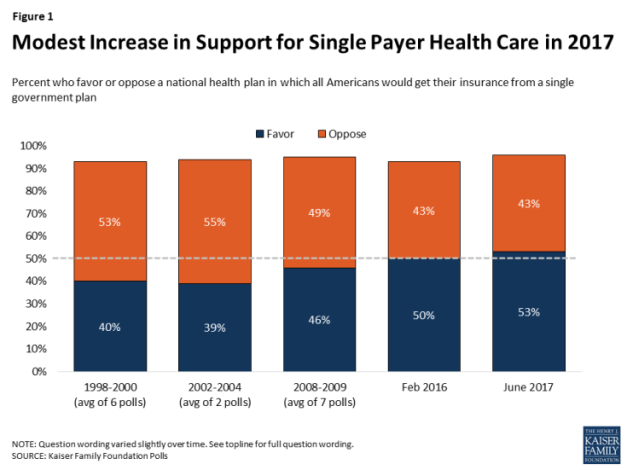
The June Kaiser Health Tracking poll finds that a slim majority of the public (53 percent) now favors a single-payer health plan in which all Americans would get their insurance from a single government plan, while just over four in ten (43 percent) are opposed. This is somewhat higher than the level of support found in a variety of Kaiser polls with slight variations in question wording dating back to 1998. From 1998 through 2004,  roughly four in ten supported a national health plan, while about half were opposed. In polling from 2008-2009, the period leading up to passage of the ACA, the public was more evenly divided, with about half in favor of a single-payer plan and half opposed.
Kaiser1

Figure 1: Modest Increase in Support for Single Payer Health Care in 2017

Independents May Be Driving Slight Shift in Overall Attitudes
Not surprisingly, there are partisan divisions in how the public feels about single-payer health care, with a majority of Democrats (64 percent) and just over half independents (55 percent) in favor and a majority of Republicans (67 percent) opposed. However, the recent increase in support for single-payer has largely been driven by an increase among independents. Among this group, on average in 2008-2009, 42 percent said they would favor a single-payer plan, a share that has increased to a majority (55 percent) in the most recent tracking poll.
Kaiser2

Figure 2: Increase in Support for Single-Payer Driven by Independents

“Medicare-for-all” vs. “Single-Payer”

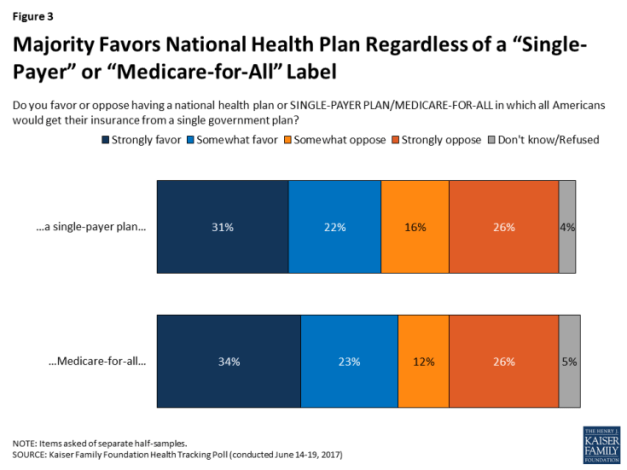
Language often matters in framing questions about health policy. For example, the February 2016 Kaiser Health Tracking Poll found that when terms were tested on their own, outside the definition of a national health plan that would cover all Americans, the public was more likely to react favorably to the term “Medicare-for-all” (64 percent favorable) than “single-payer health insurance system” (44 percent favorable). However, the current poll finds that when the plan is defined as one in which all Americans would get their insurance from a single government plan, support is similar when the plan was referred to as “Medicare-for-all” (57 percent in favor) as when it was referred to as “single payer” (53 percent).

Kaiser3

Figure 3: Majority Favors National Health Plan Regardless of a “Single-Payer” or “Medicare-for-All” Label

Support for Single-Payer is Malleable When Given Opposing Arguments

The poll finds the public’s attitudes on single-payer are quite malleable
While a slim majority favors the idea of a national health plan at the outset, a prolonged national debate over making such a dramatic change to the U.S. health care system would likely result in the public being exposed to multiple messages for and against such a plan. The poll finds the public’s attitudes on single-payer are quite malleable, and some people could be convinced to change their position after hearing typical pro and con arguments that might come up in a national debate. For example, when those who initially say they favor a single-payer or Medicare-for-all plan are asked how they would feel if they heard that such a plan would give the government too much control over health care, about four in ten (21 percent of the public overall) say they would change their mind and would now oppose the plan, pushing total opposition up to 62 percent. Similarly, when this group is told such a plan would require many Americans to pay more in taxes or that it would eliminate or replace the Affordable Care Act, total opposition increases to 60 percent and 53 percent, respectively.

Kaiser4

Figure 4: Arguments Against Single Payer Plan Sway Some Initial Supporters

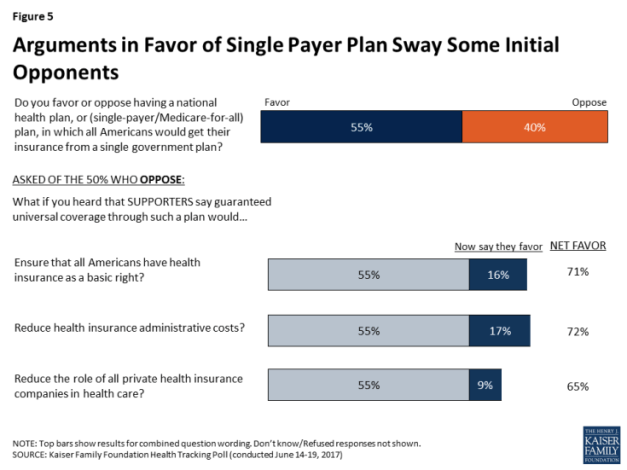
On the other side, when those who initially oppose a single-payer or Medicare-for-all plan are asked how they would feel if they heard such a plan would reduce health insurance administrative costs, four in ten (17 percent of the public overall) change their position and say they would now favor the plan, bringing total support to 72 percent. Similarly, when this group is told such a plan would ensure that all Americans have health insurance as a basic right or that it would reduce the role of private health insurance companies in health care, total support increases to 71 percent and 65 percent, respectively.

Kaiser5Figure 5: Arguments in Favor of Single Payer Plan Sway Some Initial Opponents

Article link: http://www.kff.org/health-reform/poll-finding/data-note-modestly-strong-but-malleable-support-for-single-payer-health-care/?utm_campaign=KFF-2017-polling-surveys&utm_content=59483160&utm_medium=social&utm_source=twitter

EHR vendor CliniComp sues government over no-bid VA contract with Cerner – Healthcare IT News

Posted by timmreardon on 08/24/2017
Posted in: Uncategorized. Leave a comment

The San Diego-based vendor scorned the VA for not conducting a competitive bidding process and alleged there is ample time for other EHR vendors to compete for the contract.

By Jessica Davis  August 22, 2017  03:39 PM

cerner

San Diego-based electronic health record vendor CliniComp has filed a bid protest with the U.S. Court of Federal Claims against the Department of Veterans Affairs for allegedly awarding Cerner a contract for its new EHR without conducting a competitive bidding process.

CliniComp has provided EHR systems to the U.S. Department of Defense and some VA hospitals since 2009. However, VA Secretary David Shulkin announced in June that the VA would award Cerner a sole contract to replace its legacy VistA EHR system with a Cerner EHR.

[Also: How Jared Kushner helped the VA pick Cerner… quickly]

CliniComp said it filed an agency-level protest to contest the sole source award shortly after the announcement, according to the complaint. But the VA Deputy Assistant Secretary for Acquisition denied the protest on Aug. 7. In doing so, the VA violated the Competition in Contracting Act of 1978, the company claims.

Shulkin has told Congress that the price for the EHR has not yet been negotiated. And
CliniComp alleges that this timeframe could be used to open up competition among other vendors. Competitive bidding can also reduce costs associated with an EHR implementation.

“As shown by the nine counts set forth below, the VA’s decision to award a sole-source contract to Cerner is arbitrary, capricious, an abuse of discretion and violates the CICA and Federal Acquisition Regulations,” according to the suit.

[Also: Pew calls on VA to ensure interoperability, patient matching with Cerner EHR]

The VA has been pressed by Congress for many years to replace its outdated system with a modernized, off-the-shelf EHR. Shulkin said in the spring the VA would make its decision about its legacy system in July — but made the announcement a month earlier.

In making the announcement, Shulkin said the agency “does not have sufficient time to allow for full and open competition.”

CliniComp said this statement “lacks a reasonable basis.”

“In the six to eight months to negotiate a sole source contract with Cerner, the VA could hold an accelerated full and open competition for the next generation of EHR,” the company claimed.

Officials from CliniComp and the VA were not immediately available for comment.

Article link: http://www.healthcareitnews.com/news/ehr-vendor-clinicomp-sues-government-over-no-bid-va-contract-cerner

Quality of Care for PTSD and Depression in the Military Health System – RAND

Posted by timmreardon on 08/20/2017
Posted in: Uncategorized. Leave a comment

Rand1by Kimberly A. Hepner, Carol P. Roth, Elizabeth M. Sloss, Susan M. Paddock, Praise O. Iyiewuare, Martha J. Timmer, Harold Alan Pincus

The U.S. Department of Defense (DoD) strives to maintain a physically and psychologically healthy, mission-ready force, and the care provided by the Military Health System (MHS) is critical to meeting this goal. Attention has been directed to ensuring the quality and availability of programs and services for posttraumatic stress disorder (PTSD) and depression. This report is a comprehensive assessment of the quality of care delivered by the MHS in 2013–2014 for over 38,000 active-component service members with PTSD or depression. The assessment includes performance on 30 quality measures to evaluate the receipt of recommended assessments and treatments. These measures draw on multiple data sources including administrative encounter data, medical record review data, and patient self-reported outcome monitoring data. The assessment identified strengths and areas for improvement for the MHS. In particular, the MHS excels at screening for suicide risk and substance use, but rates of appropriate follow-up for service members with suicide risk are lower. Most service members received at least some psychotherapy, but less than half of psychotherapy delivered was evidence-based. In analyses focused on Army soldiers, outcome monitoring increased notably over time, yet preliminary analyses suggest that more work is needed to ensure that services are effective in reducing symptoms. When comparing performance between 2012–2013 and 2013–2014, most measures demonstrated slight improvement, but targeted efforts will be needed to support further improvements. RAND provides recommendations for strategies to improve the quality of care delivered for these conditions.

Key Findings

  • The MHS performed well in providing initial screening for suicide and substance use, but needs to improve at providing adequate follow-up to service members with suicide risk.
  • Most service members with PTSD or depression received at least some psychotherapy, but fewer received psychotherapy that was evidence-based.
  • Service members with PTSD or depression use a high volume of health services and see multiple providers, suggesting the need to ensure coordination of care.
  • The MHS continues to be a leader in achieving high rates of follow-up after psychiatric hospitalization.
  • Less than half of service members receive an adequate amount of initial care when beginning treatment for PTSD or depression.
  • Army demonstrated increased outcome monitoring over time and preliminary analyses suggest that more effort is needed to ensure service members who receive care achieve positive outcomes.
  • Performance on most administrative data–based quality measures improved slightly between 2012–2013 and 2013–2014, but targeted efforts are needed to support further improvements.
  • Quality of care for PTSD and depression varied by service branch, TRICARE region, and service member characteristics, suggesting opportunities for quality improvement.

Recommendations

  • Improve the quality of care delivered by the Military Health System for psychological health conditions by immediately focusing on specific care processes identified for improvement.
  • Expand efforts to routinely assess quality of psychological health care: Establish an enterprise-wide performance measurement, monitoring, and improvement system that includes high-priority standardized measures to assess care for psychological health conditions; and routinely report quality measure scores for psychological health conditions internally, enterprise-wide, and publicly to support and incentivize ongoing quality improvement and facilitate transparency.
  • Expand efforts to monitor and use treatment outcomes for service members with psychological health conditions: Integrate routine outcome monitoring for service members with PH conditions as structured data in the medical record as part of a measurement-based care strategy; monitor implementation of outcome monitoring across service branches and evaluate how providers use symptom data to inform clinical care; and build strategies to effectively use outcome data and address the limitations of these data.
  • Investigate the reasons for significant variation in quality of care for PH conditions by service branch, region, and service member characteristics.

Article link: https://www.rand.org/pubs/research_reports/RR1542.html?adbsc=social_20170819_1715911&adbid=898976864525365248&adbpl=tw&adbpr=22545453

Why Single-Payer Health Care Saves Money – NY Times

Posted by timmreardon on 07/30/2017
Posted in: Uncategorized. Leave a comment

Economic View

By ROBERT H. FRANK JULY 7, 2017

NYT - Rubik
The total cost of providing health coverage under the single-payer approach is actually substantially lower than under the current system in the United States.
Credit Christophe Vorlet  

Lingering uncertainty about the fate of the Affordable Care Act has spurred the California legislature to consider adoption of a statewide single-payer health care system.

Sometimes described as Medicare for all, single-payer is a system in which a public agency handles health care financing while the delivery of care remains largely in private hands.

Discussions of the California measure have stalled, however, in the wake of preliminary estimates pegging the cost of the program as greater than the entire state government budget. Similar cost concerns derailed single-payer proposals in Colorado and Vermont.

Voters need to understand that this cost objection is specious. That’s because, as experience in many countries has demonstrated, the total cost of providing health coverage under the single-payer approach is actually substantially lower than under the current system in the United States. It is a bedrock economic principle that if we can find a way to

By analogy, suppose that your state’s government took over road maintenance from the county governments within it, in the process reducing total maintenance costs by 30 percent. Your state taxes would obviously have to go up under this arrangement.

But if roads would be as well maintained as before, would that be a reason to oppose the move? Clearly not, since the resulting cost savings would reduce your county taxes by more than your state taxes went up. Likewise, it makes no sense to oppose single-payer on the grounds that it would require additional tax revenue. In each case, the resulting gains in efficiency would leave you with greater effective purchasing power than before.

Total costs are lower under single-payer systems for several reasons. One is that administrative costs average only about 2 percent of total expenses under a single-payer program like Medicare, less than one-sixth the corresponding percentage for many private insurers. Single-payer systems also spend virtually nothing on competitive advertising, which can account for more than 15 percent of total expenses for private insurers.

The most important source of cost savings under single-payer is that large government entities are able to negotiate much more favorable terms with service providers. In 2012, for example, the average cost of coronary bypass surgery was more than $73,000 in the United States but less than $23,000 in France.

Despite this evidence, respected commentators continue to cite costs as a reason to doubt that single-payer can succeed in the United States. A recent Washington Post editorial, for example, ominously predicted that budget realities would dampen enthusiasm for single-payer, noting that the per capita expenditures under existing single-payer programs in the United States were much higher than those in other countries.

But this comparison is misleading. In most other countries, single-payer covers the whole population, most of which has only minimal health needs. In contrast, single-payer components of the United States system disproportionately cover population subgroups with the heaviest medical needs: older people (Medicare), the poor and disabled (Medicaid) and returned service personnel (Department of Veterans Affairs).

In short, the evidence is clear that single-payer delivers quality care at significantly lower cost than the current American hybrid system. It thus makes no sense to reject single-payer on the grounds that it would require higher tax revenues. That’s true, of course, but it’s an irrelevant objection.

In addition to being far cheaper, single-payer would also defuse the powerful political objections to the Affordable Care Act’s participation mandate. Polls consistently show that large majorities want people with pre-existing conditions to be able to obtain health coverage at affordable rates. But that goal cannot be achieved unless healthy people are required to join the insured pool. Officials in the Obama administration tried, largely in vain, to explain why the program’s insurance exchanges would collapse in the absence of the participation mandate.

But the logic of the underlying argument is actually very simple. Most people seem able to grasp it if you ask them what would happen if the government required companies to sell fire insurance at affordable rates to people whose houses had already burned down.

Advertisement

Continue reading the main story

No home insurer could remain in business if each policy it sold required it to replace a house costing several hundred thousand dollars. Similarly, no health insurer could remain in business if each of its policy holders generated many thousands of dollars in health care reimbursements each month.

That’s why the lack of a mandate in the alternative plans under consideration means that millions of people with pre-existing conditions will become uninsurable if repeal efforts are successful. An underappreciated advantage of the single-payer approach is that it sidesteps the mandate objection by paying to cover everyone out of tax revenue.

Of course, having to pay taxes is itself a mandate of a sort, but it’s one the electorate has largely come to terms with. Apart from fringe groups that denounce all taxation as theft, most people understand that our entire system would collapse if tax payments were purely voluntary.

The Affordable Care Act is an inefficient system that was adopted only because its architects believed, plausibly, that the more efficient single-payer approach would not be politically achievable in 2009. But single-payer now enjoys significantly higher support than it did then, and is actually strongly favored by voters in some states.

Solid majorities nationwide now favor expansion of the existing single-payer elements of our current system, such as Medicare and Medicaid. Medicaid cuts proposed in Congress have been roundly criticized. Perhaps it’s time to go further: Individual states and, eventually, the entire country, can save money and improve services by embracing single-payer health care.

Robert H. Frank is an economics professor at the Johnson Graduate School of Management at Cornell University. Follow him on Twitter at @econnaturalist.

Article link: https://www.nytimes.com/2017/07/07/upshot/why-single-payer-health-care-saves-money.html?smid=tw-nytimes&smtyp=cur


DoD rolls out Cerner EHR at second military site – Healthcare IT News

Posted by timmreardon on 07/30/2017
Posted in: Uncategorized. Leave a comment

Naval Hospital Oak Harbor in Washington State has transitioned to the MHS GENESIS electronic health record, marking a milestone as the inpatient components are now officially deployed.

By Bill Siwicki July 17, 2017 04:04 PM

USNH_OakHarbor-press-release-712

Naval Hospital Oak Harbor in Washington State has transitioned to the MHS GENESIS electronic health record from Cerner, the U.S. Department of Defense announced today.

Oak Harbor is the second site to come online as part of the Department of Defense’s initial operating capability program, and the go-live marks a significant milestone as the inpatient components of MHS GENESIS are now officially deployed, wrote Travis Dalton, senior vice president at Cerner, in a Cerner blog post. The first Cerner deployment occurred in February at a clinic at Fairchild Air Force Base.

[Also: DoD says Cerner EHR deployment to reach next milestone in July]

“The integrated system aggregates information into a single EHR, standardized across the branches of the military, to facilitate the safe transition of care across the spectrum of military operations to include garrison, theatre and en route care,” Dalton explained. “At its core, MHS GENESIS is the same commercially available, off-the-shelf electronic medical record that is deployed at thousands of facilities worldwide, operating on one code set.”

Cerner said this creates an integrated and longitudinal patient record and coordination across the continuum of care, regardless of environment, scope and size of military and dental treatment facilities. The ability to integrate and share interoperable patient information with the U.S. Department of Veterans Affairs health care enterprise and civilian health systems is critical and is inherently built into MHS GENISIS, Dalton added.

Naval Hospital Bremerton and Madigan Army Medical Center, both also in Washington State, are slated for the Leidos-led implementation later in 2017, MHS Genesis program executive officer Stacy Cummings said in a statement.

The DoD has promised the U.S. House appropriations committee it will complete deployment at Madigan Army Medical Center by October. The military will conduct tests once the Cerner system is installed at all four bases. It then will conclude if it’s ready to move forward with the remainder of the $4.3 billion Cerner project, slated for completion in 2022.

The Naval Hospital Oak Harbor go-live marks the debut of certain MHS GENESIS capabilities and applications designed, Cerner said, to improve patient safety and clinical efficiency.

According to Dalton, these include a single integrated record across ambulatory, acute and all other venues in the Oak Harbor medical enterprise; medical device interoperability via Cerner’s CareAware medical device connectivity platform; advanced clinical decision support capabilities; advanced specialty provider workflows and embedded clinical calculators; barcode medication administration; and a labor and maternity-specific module designed to create a new infant record upon barcode scan and treatment plans tailored to mother and child.

The U.S. Department of Defense’s MHS GENESIS project encompasses the replacement of three existing EHRs to create a single patient record. It is interoperable with 24 legacy systems and offers improvements designed to save clinicians and patients time, eliminate paper, and reduce potential medical errors and delays, Dalton wrote.

“It’s also engineered to enable interoperability between the private and public sectors,” he added. “MHS GENESIS is designed so that a record can follow a soldier once they leave active military duty or if they visit a civilian health facility.”

Twitter: @SiwickiHealthIT
Email the writer: bill.siwic
ki@himssmedia.com

Article link: http://www.healthcareitnews.com/news/dod-rolls-out-cerner-ehr-second-military-site


OIG plans to investigate $15 billion in meaningful use payments – Healthcare IT News

Posted by timmreardon on 07/30/2017
Posted in: Uncategorized. Leave a comment

The Office of the Inspector General said will review the accuracy of payments to Medicare hospitals between 2011 and 2016, as well as telemedicine payments.

By Bill Siwicki July 18, 2017 11:41 AM

cms

The Department of Health and Human Services Office of Inspector General will review the accuracy of $14.6 billion in meaningful use payments made to hospitals by Medicare between 2011 and 2016. Earlier this year, the OIG estimated physicians were wrongfully paid $729 million under meaningful use.

Medicare incentive payments were authorized over a 5-year period to hospitals that adopted electronic health record technology. From January 1, 2011, through December 31, 2016, the Centers for Medicare and Medicaid Services made Medicare EHR incentive payments to hospitals totaling $14.6 billion, the OIG said.

[Also: Senators press CMS to recoup EHR overpayments under meaningful use]

The Government Accountability Office identified improper incentive payments as the primary risk to the Medicare EHR incentive program. An OIG report described the obstacles that CMS faces in overseeing the Medicare EHR incentive program. In addition, previous OIG reviews of Medicaid EHR incentive payments found that state agencies overpaid hospitals by $66.7 million and would in the future overpay these hospitals an additional $13.2 million, the OIG said.

“These overpayments resulted from inaccuracies in the hospitals’ calculations of total incentive payments,” the OIG said. “We will review the hospitals’ incentive payment calculations to identify potential overpayments that the hospitals would have received as a result of the inaccuracies.”

[Also: CMS won’t punish eClinicalWorks customers for meaningful use EHR attestations]

On another front, the OIG will be reviewing the accuracy of telemedicine payments under Medicare.

Medicare Part B covers expenses for telehealth services on the telehealth list when those services are delivered via an interactive telecommunications system, provided certain conditions are met. To support rural access to care, Medicare pays for telehealth services provided through live, interactive videoconferencing between a beneficiary located at a rural originating site and a practitioner located at a distant site.

“An eligible originating site must be the practitioner’s office or a specified medical facility, not a beneficiary’s home or office,” the OIG explained. “We will review Medicare claims paid for telehealth services provided at distant sites that do not have corresponding claims from originating sites to determine whether those services met Medicare requirements.”

Twitter: @SiwickiHealthIT
Email the writer: bill.siwicki@himssmedia.com

Article link: http://www.healthcareitnews.com/news/oig-plans-investigate-15-billion-meaningful-use-payments


Wait! What? Amazon and Apple eye building EHRs – Healthcare IT News

Posted by timmreardon on 07/30/2017
Posted in: Uncategorized. Leave a comment

Just weeks after rumors hinted that Apple is working on a way to bring health records together on iPhones, Amazon appears to have launched an investigation about building EHR software.

By Bernie Monegain  July 27, 2017  04:38 PM

Besos

Amazon has started a secret lab at its Seattle headquarters to explore business prospects in the healthcare sector, including EHRs and telemedicine, according CNBC. That report comes on the heels of swirling rumors that Apple is in talks with hospitals and other healthcare organizations to explore the possibility of bringing health records together on the iPhone.

It’s important to note that press reports thus far are based on unnamed sources and industry analysts speculate that even for the likes of Amazon and Apple stealing customers away from Epic, Cerner and Allscripts would likely be a difficult and lengthy process.

Amazon is reportedly considering developing an EHR platform as well as telemedicine and health apps for existing devices, such as its Echo.

[Also: Timeline: How Apple is piecing together its secret healthcare plan]

Amazon has dubbed the covert team “1492,” the year Columbus first landed in the Americas, and it is hiring for positions that are searchable on Amazon using the keyword “a1.492.” The crew is also working on healthcare applications for Amazon devices, such as Echo and Dash Wand.

Apple, for its part, already has a big toe in the healthcare market with its HealthKit and ResearchKit apps, Apple Watch, and work with Health Gorilla to add diagnostic data to the iPhone, including measures such as blood work, by integrating with hospitals, lab test companies and imaging centers.

The Cupertino, California giant has also recently hired people with top healthcare credentials who are savvy in the digital realm.

In seemingly unconnected news, President Trump today announced Apple CEO Tim Cook had promised to build three big manufacturing plants in the U.S. Cook has been mum on the announcement.

Twitter: @Bernie_HITN
Email the writer: bernie.monegain@himssmedia.com

Article link: http://www.healthcareitnews.com/news/wait-what-amazon-and-apple-eye-building-ehrs


At Our Own Peril: DoD Risk Assessment in a Post-Primacy World – USAWC

Posted by timmreardon on 07/30/2017
Posted in: Uncategorized. Leave a comment

Authored by Mr. Nathan P. Freier, Colonel (Ret.) Christopher M. Bado, Dr. Christopher J. Bolan, Colonel (Ret.) Robert S. Hume, Colonel J. Matthew Lissner.

Brief Synopsis

View the Executive Summary

USAWC

  • Added June 29, 2017
  • Type: Monograph
  • 145 Pages
  • Download Format:
    PDF (Recommended)
    Kindle Reader
    ePub (Mobile Devices)
  • Cost: Free
  • Send this page to a colleague.
  • Alert me when similar studies are published

    The U.S. Department of Defense (DoD) faces persistent fundamental change in its strategic and operating environments. This report suggests this reality is the product of the United States entering or being in the midst of a new, more competitive, post-U.S. primacy environment. Post-primacy conditions promise far-reaching impacts on U.S. national security and defense strategy. Consequently, there is an urgent requirement for DoD to examine and adapt how it develops strategy and describes, identifies, assesses, and communicates corporate-level risk. This report takes on the latter risk challenge. It argues for a new post-primacy risk concept and its four governing principles of diversity, dynamism, persistent dialogue, and adaptation. The authors suggest that this approach is critical to maintaining U.S. military advantage into the future. Absent change in current risk convention, the report suggests DoD exposes current and future military performance to potential failure or gross under-performance.


Article link: https://ssi.armywarcollege.edu/pubs/display.cfm?pubID=1358


Posts navigation

← Older Entries
Newer Entries →
  • Search site

  • Follow healthcarereimagined on WordPress.com
  • Recent Posts

    • The Global Healthcare System Is Broken. Japan Fixed It for $4,100 Per Person. 04/10/2026
    • When Not to Use AI – MIT Sloan 04/01/2026
    • There are more AI health tools than ever—but how well do they work? – MIT Technology Review 03/30/2026
    • Are AI Tools Ready to Answer Patients’ Questions About Their Medical Care? – JAMA 03/27/2026
    • How AI use in scholarly publishing threatens research integrity, lessens trust, and invites misinformation – Bulletin of the Atomic Scientists 03/25/2026
    • VA Prepares April Relaunch of EHR Program – GovCIO 03/19/2026
    • Strong call for universal healthcare from Pope Leo today – FAN 03/18/2026
    • EHR fragmentation offers an opportunity to enhance care coordination and experience 03/16/2026
    • When AI Governance Fails 03/15/2026
    • Introduction: Disinformation as a multiplier of existential threat – Bulletin of the Atomic Scientists 03/12/2026
  • Categories

    • Accountable Care Organizations
    • ACOs
    • AHRQ
    • American Board of Internal Medicine
    • Big Data
    • Blue Button
    • Board Certification
    • Cancer Treatment
    • Data Science
    • Digital Services Playbook
    • DoD
    • EHR Interoperability
    • EHR Usability
    • Emergency Medicine
    • FDA
    • FDASIA
    • GAO Reports
    • Genetic Data
    • Genetic Research
    • Genomic Data
    • Global Standards
    • Health Care Costs
    • Health Care Economics
    • Health IT adoption
    • Health Outcomes
    • Healthcare Delivery
    • Healthcare Informatics
    • Healthcare Outcomes
    • Healthcare Security
    • Helathcare Delivery
    • HHS
    • HIPAA
    • ICD-10
    • Innovation
    • Integrated Electronic Health Records
    • IT Acquisition
    • JASONS
    • Lab Report Access
    • Military Health System Reform
    • Mobile Health
    • Mobile Healthcare
    • National Health IT System
    • NSF
    • ONC Reports to Congress
    • Oncology
    • Open Data
    • Patient Centered Medical Home
    • Patient Portals
    • PCMH
    • Precision Medicine
    • Primary Care
    • Public Health
    • Quadruple Aim
    • Quality Measures
    • Rehab Medicine
    • TechFAR Handbook
    • Triple Aim
    • U.S. Air Force Medicine
    • U.S. Army
    • U.S. Army Medicine
    • U.S. Navy Medicine
    • U.S. Surgeon General
    • Uncategorized
    • Value-based Care
    • Veterans Affairs
    • Warrior Transistion Units
    • XPRIZE
  • Archives

    • April 2026 (2)
    • March 2026 (9)
    • February 2026 (6)
    • January 2026 (8)
    • December 2025 (11)
    • November 2025 (9)
    • October 2025 (10)
    • September 2025 (4)
    • August 2025 (7)
    • July 2025 (2)
    • June 2025 (9)
    • May 2025 (4)
    • April 2025 (11)
    • March 2025 (11)
    • February 2025 (10)
    • January 2025 (12)
    • December 2024 (12)
    • November 2024 (7)
    • October 2024 (5)
    • September 2024 (9)
    • August 2024 (10)
    • July 2024 (13)
    • June 2024 (18)
    • May 2024 (10)
    • April 2024 (19)
    • March 2024 (35)
    • February 2024 (23)
    • January 2024 (16)
    • December 2023 (22)
    • November 2023 (38)
    • October 2023 (24)
    • September 2023 (24)
    • August 2023 (34)
    • July 2023 (33)
    • June 2023 (30)
    • May 2023 (35)
    • April 2023 (30)
    • March 2023 (30)
    • February 2023 (15)
    • January 2023 (17)
    • December 2022 (10)
    • November 2022 (7)
    • October 2022 (22)
    • September 2022 (16)
    • August 2022 (33)
    • July 2022 (28)
    • June 2022 (42)
    • May 2022 (53)
    • April 2022 (35)
    • March 2022 (37)
    • February 2022 (21)
    • January 2022 (28)
    • December 2021 (23)
    • November 2021 (12)
    • October 2021 (10)
    • September 2021 (4)
    • August 2021 (4)
    • July 2021 (4)
    • May 2021 (3)
    • April 2021 (1)
    • March 2021 (2)
    • February 2021 (1)
    • January 2021 (4)
    • December 2020 (7)
    • November 2020 (2)
    • October 2020 (4)
    • September 2020 (7)
    • August 2020 (11)
    • July 2020 (3)
    • June 2020 (5)
    • April 2020 (3)
    • March 2020 (1)
    • February 2020 (1)
    • January 2020 (2)
    • December 2019 (2)
    • November 2019 (1)
    • September 2019 (4)
    • August 2019 (3)
    • July 2019 (5)
    • June 2019 (10)
    • May 2019 (8)
    • April 2019 (6)
    • March 2019 (7)
    • February 2019 (17)
    • January 2019 (14)
    • December 2018 (10)
    • November 2018 (20)
    • October 2018 (14)
    • September 2018 (27)
    • August 2018 (19)
    • July 2018 (16)
    • June 2018 (18)
    • May 2018 (28)
    • April 2018 (3)
    • March 2018 (11)
    • February 2018 (5)
    • January 2018 (10)
    • December 2017 (20)
    • November 2017 (30)
    • October 2017 (33)
    • September 2017 (11)
    • August 2017 (13)
    • July 2017 (9)
    • June 2017 (8)
    • May 2017 (9)
    • April 2017 (4)
    • March 2017 (12)
    • December 2016 (3)
    • September 2016 (4)
    • August 2016 (1)
    • July 2016 (7)
    • June 2016 (7)
    • April 2016 (4)
    • March 2016 (7)
    • February 2016 (1)
    • January 2016 (3)
    • November 2015 (3)
    • October 2015 (2)
    • September 2015 (9)
    • August 2015 (6)
    • June 2015 (5)
    • May 2015 (6)
    • April 2015 (3)
    • March 2015 (16)
    • February 2015 (10)
    • January 2015 (16)
    • December 2014 (9)
    • November 2014 (7)
    • October 2014 (21)
    • September 2014 (8)
    • August 2014 (9)
    • July 2014 (7)
    • June 2014 (5)
    • May 2014 (8)
    • April 2014 (19)
    • March 2014 (8)
    • February 2014 (9)
    • January 2014 (31)
    • December 2013 (23)
    • November 2013 (48)
    • October 2013 (25)
  • Tags

    Business Defense Department Department of Veterans Affairs EHealth EHR Electronic health record Food and Drug Administration Health Health informatics Health Information Exchange Health information technology Health system HIE Hospital IBM Mayo Clinic Medicare Medicine Military Health System Patient Patient portal Patient Protection and Affordable Care Act United States United States Department of Defense United States Department of Veterans Affairs
  • Upcoming Events

Blog at WordPress.com.
healthcarereimagined
Blog at WordPress.com.
  • Subscribe Subscribed
    • healthcarereimagined
    • Join 153 other subscribers
    • Already have a WordPress.com account? Log in now.
    • healthcarereimagined
    • Subscribe Subscribed
    • Sign up
    • Log in
    • Report this content
    • View site in Reader
    • Manage subscriptions
    • Collapse this bar
 

Loading Comments...