healthcarereimagined

Envisioning healthcare for the 21st century

  • About
  • Economics

The Quiet Room – NEJM

Posted by timmreardon on 11/28/2017
Posted in: Uncategorized. Leave a comment

ter T. Masiakos, M.D., and Cornelia Griggs, M.D.

November 15, 2017   DOI: 10.1056/NEJMp1714825

At the end of an inconspicuous hallway and strategically placed far from the controlled chaos of the trauma room lies a dimly lit waiting area that we in the medical field call “the quiet room.” It is a bland spot; a few soft chairs surround a table that holds a box of crisp institutional tissues. There may be a picture or two on the wall, but generally it is an unassuming room where we physicians tell mothers about the deaths of their children, far too often because of firearm violence.

As we make our way to this room, we recite a careful script; we use words intended to ease this painful first-and-only meeting. The reality is that over the years, we have found that there is no good way to tell a mother that her child has died, especially when the unexpected death might have been avoidable.

We introduce ourselves as the doctor who took care of their child. We take a deep breath, look into their eyes, and quickly break the devastating news — there is no reason to delay. What follows is the visceral, piercing shriek of a mother’s wailing, “Please God, not my baby!” We often weep with these mothers, we sometimes quietly blame ourselves for not being able to do more to save their baby’s life — and when they are alone, as is often the case, we hold them up while they cry.

We walk away from the encounter, our stomachs churning from the stale, metallic scent of a child’s blood barely dried on our clogs, our faces streaked with tears, and our hearts gripped in a vise as we tell ourselves that this senseless dying must end. But it doesn’t end. Another child is shot, and another mother is heartbroken.

There is nothing quiet about this room.

In the month since the mass shooting in Las Vegas, over 1300 more Americans have been killed, and more than twice that number have been injured, by firearm violence. Every day, 46 children and teenagers are shot and 7 of them die. The overwhelming majority of those shootings and deaths are the result of interpersonal violence, though some are from an accidental discharge of an unsecured firearm and some are suicides and are attributed to underlying mental illness.1 Sometimes the shooting is described in a bylined article in the local newspaper, but most of the time it is not reported at all. What does get reported skews toward senseless acts of terror, with the blame placed squarely on the shoulders of a mentally ill monster. But gun violence in the United States is not primarily a mental health problem.

Nearly a month after the deadliest mass shooting in modern American history, which killed 58 people, we predictably find ourselves witness to another mass shooting, this time in a small town near San Antonio, Texas. In this attack, 25 Americans, including a pregnant woman and up to 14 children (the most children affected since the shooting in Newtown, CT, in 2012), were murdered by a single perpetrator during Sunday prayer services. On the evening news, only hours after the tragedy, we are told once again that it is time for “a national conversation about guns.”

From the vantage point of a trauma surgeon, conversation seems a terribly feeble response. Gun violence, whether on the streets of Chicago or in the churches of Charleston and Sutherland Springs, is a national health emergency. It is an epidemic as deadly as the global Ebola crisis or the opioid epidemic in this country. But in those emergencies, a call for action has been followed by at least some action, not simply by the ritual and empty call for thoughts and prayers and, at most, a mere discussion. Congress appropriated $5.4 billion for the Ebola response as part of its final fiscal year 2015 spending package. The Centers for Disease Control and Prevention is awarding more than $40 million to support state efforts to address the opioid-overdose epidemic. After the introduction of the Dickey Amendment in 1996, government funding for research into firearm injuries and deaths has been restricted.

President Donald Trump has said that gun violence in America is a mental health problem, but the issue is far more complicated. Only if funding for research on firearm-violence prevention and public health surveillance is reinstated can we determine the best approach to addressing the public health crisis of firearm violence. Furthermore, expanding the National Violent Death Reporting System from 40 states to all 50 states plus Washington, D.C., would provide more information about where we should be focusing our attention.

In addition, the American Academy of Pediatrics has laid out three key priorities for confronting the crisis2: access to appropriate mental health services, particularly to address the effects of exposure to violence; enactment of firearm legislation that includes stronger background checks, banning assault weapons, addressing firearm trafficking, and encouraging safe firearm storage; and protecting the crucial role of physicians in providing anticipatory guidance to patients about the health hazards of firearms.

It is time for more than a discussion. Surely there is, in our collective power, some more concrete way to address the public health crisis that is gun access. We can no longer allow one mother after another to know the pain of losing a child to senseless gun violence. We remain haunted by their screams.

Disclosure forms provided by the authors are available at NEJM.org.

This article was published on November 15, 2017, at NEJM.org.

Source Information

From Massachusetts General Hospital, Boston.

Article link: http://www.nejm.org/doi/full/10.1056/NEJMp1714825
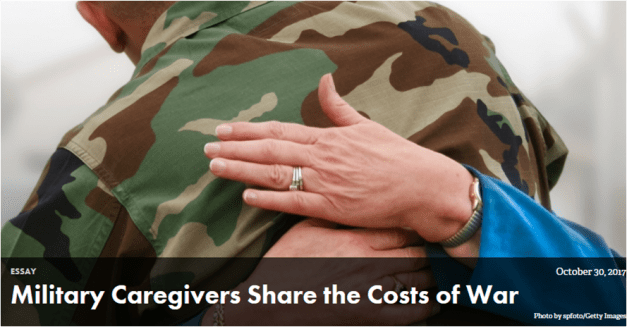
 

Military Caregivers Share the Costs of War – RAND

Posted by timmreardon on 11/25/2017
Posted in: Uncategorized. Leave a comment

Rand3

They are wives, husbands, mothers and fathers, a good neighbor checking in, a best friend helping out. They sacrifice their time, their jobs, even their health to provide a service worth billions of dollars to the United States, often with no recognition whatsoever.

They are caregivers to active or retired military service members—not paid professionals, but loved ones thrown into battle against panic attacks, traumatic brain injuries, or just the everyday bureaucracies of American health care.

RAND research has helped bring their stories to light in recent years—who they are, what they do, and above all, what they need to succeed. That research has revealed the enormous sacrifices that millions of military caregivers make every day, as well as the gaps in support programs meant to help them.

It has helped define military caregivers as public servants in their own right, America’s “hidden heroes.”

An Untold Story of Profound Need

Elizabeth Dole spent most of 2010 at the hospital bedside of her husband, Bob, as he recovered from a long illness at Walter Reed National Military Medical Center. As she walked the halls, the former senator came to realize that a “quiet, untold story of profound need” was playing out behind every door—a caregiving crisis that had gone almost entirely unnoticed.

She asked RAND to investigate. By then, the United States had been fighting wars in Iraq and Afghanistan for the better part of a decade. Yet few studies had looked at the people caring for service members when they came home. The best data RAND could find suggested there might be 275,000 of them—or there could be well more than a million.

That was the starting point for what became the most comprehensive study of military caregivers ever undertaken. RAND researchers surveyed thousands of military households and interviewed dozens of individual caregivers in face-to-face focus groups. They worked through resource guides, websites, and word of mouth to identify every known support program available to caregivers and their care recipients.

1.1 million people provide support to veterans of the post–9/11 wars in Iraq and Afghanistan.

They concluded that 1.1 million people were providing support to veterans of the post–9/11 wars in Iraq and Afghanistan. Another 4.4 million people were caring for veterans of earlier eras. The value of that, if they were all professional caregivers, would approach $14 billion a year.

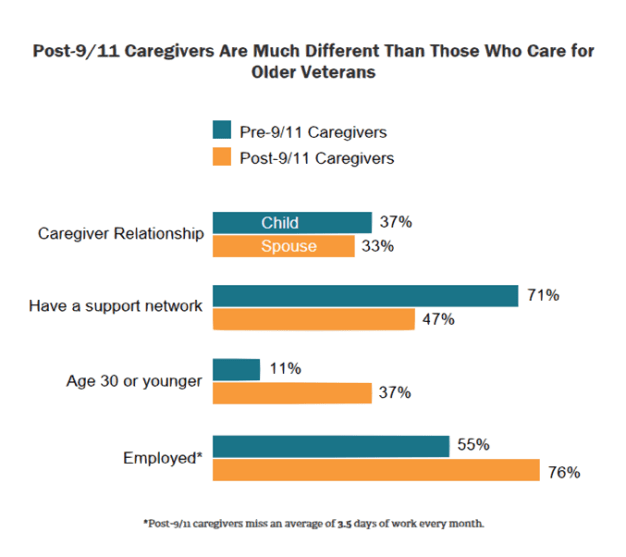
Those caring for older veterans looked in many ways like other caregivers in the civilian world. They were most likely to be older adult children helping a parent with the physical disabilities of age or illness, with well-established networks of support to help them.

The post–9/11 caregivers were much different.

Post–9/11 Caregivers Are Young and Have Less Support

They were most often spouses (33 percent), parents (25 percent), or unrelated friends and neighbors (23 percent); around 40 percent of them were men. More than one-third of them had not yet turned 31.

Most were employed, and they reported missing an average of 3.5 days of work every month because of their caregiving duties. Nearly half said they had no support network.

Nearly 40 percent met the clinical criteria for major depression.

The needs of their care recipients were different as well. Nearly two-thirds had some kind of mental-health disorder, such as post-traumatic stress disorder (PTSD), or were struggling with substance abuse. One of the most common tasks their caregivers performed was helping them cope with stressful situations or other triggers.

Rand6

Yet all too often, the programs meant to help military caregivers had not adjusted to those new realities, the researchers found. Many were still focused on older veterans with physical illnesses such as dementia, not younger veterans of Iraq or Afghanistan haunted by depression or substance-use disorders. Other programs were only open to immediate family members of service members or veterans, not friends or neighbors.

Almost none of the programs provided financial support to caregivers, or helped connect them with health care, the researchers found. And only a handful provided respite care, to allow caregivers a much-needed break from their responsibilities.

Rand5

RAND Research Shines a Light on Caregiver

Continue Reading: https://www.rand.org/blog/rand-review/2017/10/military-caregivers-share-the-costs-of-war.html


Value in Healthcare: Laying the Foundation for Health System Transformation – World Economic Forum

Posted by timmreardon on 11/25/2017
Posted in: Uncategorized. Leave a comment

Wef1

Download Mandarin Version

The World Bank estimates global population sizes of approximately 8.5 billion by 2030 and 9.2 billion by 2040. As recently as 2014, the United States and United Kingdom spent approximately 17.1% and 9.1% of Gross Domestic Product on healthcare related expenditures respectively. This is expected to grow in line with the increasing population at rates that will prove to be unsustainable in the medium to long term. Despite these predictions, the approach to healthcare delivery in most markets remains focused on volume and process guidelines rather than true value for patients. Value in this case is defined as the outcomes that matter to patients relative to the cost of delivering those outcomes (i.e. outcomes per dollar spent).

A fundamental recalibration of focus – from volume to value – is needed to ensure a system where the outcomes that matter to patients are prioritized. A value based approach starts by measuring outcomes that matter to a particular population segment and then using those measurements to tailor interventions for that population segment across the care pathway. Four game-changing enablers need to be in place to accelerate the shift towards a patient-centric value-driven approach:

· Informatics: Our ability to leverage the capabilities of advancing technologies to collect, analyze and reuse data to measure and compare value

· Benchmarking Research & Tools: Creating transparency for evidence-based comparisons that spur relevant innovation while also creating algorithms to assist clinician and physician decision making

· Payments: Compensation and reimbursement mechanisms that support value improvement rather than increased volume of care

· Delivery Organisations: Adapting the way providers, pharma, and medtech partner to collaborate across the care chain in pursuit of better patient outcomes

In addition to these enablers, the ability of policymakers to remove barriers to outcomes measurement, data sharing, innovative payments, cooperation along the care chain, and new business models will be crucial in ensuring a level playing field and ensuring a focus on value.

Elements of a value based approach to care delivery has shown significant success at the organizational level in institutions such as Kaiser Permanente, but all the critical enablers have never been fully implemented at the national level. With wider adoption, value-based healthcare has the potential to truly revolutionise healthcare delivery systems of the future.

Article link: https://www.weforum.org/reports/value-in-healthcare-laying-the-foundation-for-health-system-transformation

What do we know about social determinants of health in the U.S. and comparable countries? – Peterson – Kaiser

Posted by timmreardon on 11/25/2017
Posted in: Uncategorized. Leave a comment

By Rabah Kamal, Cynthia Cox and Erik Blumenkranz   Kaiser Family Foundation

Chart Collections

Access & Affordability

Posted: November 21, 2017

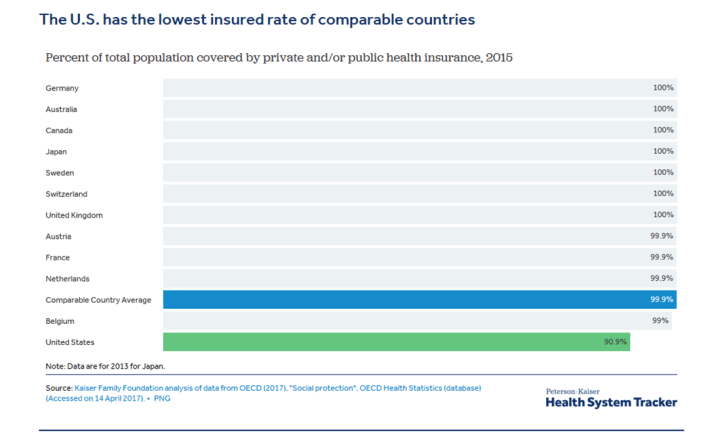
This collection of charts explore international comparisons of social, environmental, and economic factors that influence health but are in some respects outside the control of the health system. Relative to similarly wealthy countries, the U.S. has worse life expectancy, mortality, and disease burden rates, which may be due in part to the quality of care provided (a comparative chart collection is available here). However, these external factors – broadly referred to as social determinants – may contribute to some of the cross-national differences in costs and outcomes between the U.S. and comparable countries. A related brief discusses data available as of February 2016.

Kaiserx1

Article link: https://www.healthsystemtracker.org/chart-collection/know-social-determinants-health-u-s-comparable-countries

Cerner DoD overhaul coming out in waves; VA deal means ‘single system’ approach – HealthcareIT News

Posted by timmreardon on 11/22/2017
Posted in: Uncategorized. Leave a comment

The VistA replacement will be built off the MHS Genesis work already in progress for the Defense Department.

By Mike Miliard   November 16, 2017

Cerner3

Now that Cerner has successfully rolled out its electronic health record platform at four military provider sites in the Pacific Northwest – Fairchild Air Force Base, Naval Health Clinic Oak Harbor, Naval Hospital Bremerton and, most recently, Madigan Army Medical Center in Tacoma, Washington – the “Initial Operational Capability” of the Department of Defense’s massive MHS Genesis project is complete.

Now the real work begins – with the added challenge of also outfitting the vast VA system its own modernized EHR over the coming 10 years.

[Also: Shulkin asks Congress for $782 million to jumpstart Cerner EHR project for VA]

Cerner, working alongside Leidos and Accenture Federal Services in a collaboration known as the Leidos Partnership for Defense Health, has so far implemented an EHR system built around its Millennium commercial platform (and linked with an electronic dental record built by Henry Schein) at those four sites.

Next up: 23 more “waves” of three or so hospitals with a dozen or so ambulatory sites for the MHS Genesis initiative. Pending the eventual signing of a contract with the U.S. Department of Veterans Affairs, which is expected to happen soon, Cerner will also roll out a Millennium-based EHR for the VA, in some four-dozen phases over the next decade

For the VA project, it hasn’t been confirmed who Cerner’s partners would be, since a contract has yet to be finalized. But VA Secretary David Shulkin, MD, wants the DoD and VA system to be tightly unified, and so having Leidos and Accenture on board would certainly help with continuity.

[Also: How Cerner won the biggest EHR deal ever, twice]

“Obviously we still have to get to a contract, but we’re anxious to do that and are working hard to do that,” said Cerner President Zane Burke. “We haven’t finished our teaming agreement, our partnership piece, we’ll be announcing that soon, but it’s a safe bet to say we plan to keep the band together.”

In the meantime, Burke, says he’s been pleased with the progress made during the pilot phase of MHS Genesis. His colleagues from Leidos and Accenture are too, and are looking toward the future as the rest of the sprawling DoD project plays out.

The initial goal was “to go from simpler to medium-complexity to high-complexity here at Madigan,” said Leidos Group President Jon Scholl.

Along the way, there were “no surprises, but a lot of work,” he said. “The checkpoint now is to step back and say what are the lessons learned, how do we change the process going forward so we can incorporate all those learnings and move forward from there.”

The military’s processes and protocols are unique, he said, “just like any hospitals’ are unique. So the learning has really come down to clinical change management, how the system is to operate in best support of the troops and the facilities in which it operates in the DoD.”

Accenture Managing Director for Federal Health Jim Traficant applauded the four DoD provider sites, each of which “owned the responsibility of being an initial operating capability (participant) and trying to help provide input to strengthen the process of what will happen downstream on behalf of the DoD. They’re to be commended for their success as well as their input. I think both sides working together is a very good model for the good of the country.”

Along the way in this complex process, clinicians and their workflow have been the lodestar in the initial phase of the MHS Genesis project, said Leidos Defense Health SVP Jerry Hogge.

“Prior to the awarding of our contract, we independently with our partners developed workflows that we thought would fit within the operation of the military health system,” he said. “And the government did that privately on their side. Then when we were awarded the contract we got together and compared notes. And we found good alignment between those sets of workflows.”

Of course, said Hogge, over two-plus years of working together, “there’s been a lot of refinement of that: getting the workflows adjusted and tweaked to the exact way healthcare is delivered in each facility is one of the biggest focus areas of any deployment, either inside the federal marketplace or commercially. That’s where a lot of our attention has been.

“And then training the staff. There are some unique elements to training in a military health environment because of the OPTEMPO (operational tempo) of the sites, and the way people rotate in and out of the sites. We’ve had to tweak our commercial best practice to adapt to a military health setting. But those have been key focus points for our team – getting the system in, while you’re continuing to treat patients and not disrupting the treatment.”

Now the addition of Cerner’s VA contract adds to the scope and complexity of this project.

Secretary Shulkin is clearly keen to capitalize on the momentum of the MHS Genesis pilots, and asked this week asked Congress for $782 million to kickoff the Cerner implementation across the VA.

“We’ll work with the Leidos Partnership for Health, and our respective clients, to really create the most effective and efficient rollout possible for the servicemen and women and the veterans, which likely is a geographical approach that we’ll tweak as that goes forward,” said Zane Burke. “We’ll work hand in hand to make that happen.”

Should these two projects be thought of as two distinct initiatives at this point, one for the DoD and on for the VA? Or is it now one massive undertaking from here on in?

“We have two clients, we’re serving two customers, but it is one system,” said Burke. “You’ve got to think about it as a single system that supports the both the DoD and the VA. It’s obviously complex, what we’re doing.

“It was already complex, and the VA adds additional elements to it, but the VA is going to start with the DoD system and use that work moving forward,” he added. “We already work with multiple partners and again, some consistency pieces are important moving forward, making sure we’re as synergistic as possible.”

And that, said Burke is what the government is looking for: “How do they do this in an efficient and effective manner. And have it so the servicemen and women have access to their healthcare records in that geography, whether they’re active-duty or retired.”

Article link: http://www.healthcareitnews.com/news/cerner-dod-overhaul-coming-out-waves-va-deal-means-single-system-approach

Twitter: @MikeMiliardHITN
Email the writer: mike.miliard@himssmedia.com

Topics:

Clinical, Electronic Health Records (EHR, EMR), Government & Policy, Interoperability, Workflow

Cerner data center to support DoD and VA EHRs – Health Data Management

Posted by timmreardon on 11/21/2017
Posted in: Uncategorized. Leave a comment
By Greg Slabodkin
Published November 17 2017, 7:24am EST

As the Departments of Defense and Veterans Affairs look to create a common shared electronic health record system, the VA is poised to benefit from DoD investments in a Cerner data center that currently hosts the military’s new EHR.

DoD’s system—called MHS GENESIS—leverages the Cerner Millennium platform, as will the VA’s EHR after the agency concludes contract negotiations with the vendor later this month, creating a lifetime health record that will facilitate the transition of active duty military members to veteran status.

According to Stacy Cummings, program executive officer for Defense Healthcare Management Systems, the two agencies will share a data center hosted at Cerner’s Kansas City headquarters in which “both DoD and VA data will reside in a single platform.” Cummings said the VA will take advantage of DoD’s investments in the commercial data center.

Also See: DoD, VA look to align their Cerner EHR rollouts

“Part of the leverage that VA is getting by their choice to use this very same system is they avoid the investment, cost and the time” that DoD has already put into the initial operating capability phase of MHS GENESIS, says Jerry Hogge, senior vice president at Leidos Defense Health.

In 2015, DoD awarded a $4.3 billion contract to prime contractor Leidos to modernize the military’s EHR system. The Leidos-led team includes consultancy Accenture, dental software vendor Henry Schein and Cerner, which provides the core Millennium capability as a software-as-a-service hosted in the vendor’s data center.

Cerner1.jpg

 The DoD contract with Leidos includes several services, including hosting MHS GENESIS in a separate enclave, incorporating significant cybersecurity enhancements to protect the data, as well as physical and virtual separation from commercial clients.DoD modified its contract with Leidos in 2015 to meet EHR hosting requirements that the military said could only be met by a data center owned and operated by Cerner.

“It was a design feature of the original contract, where the government left open its hosting choice,” recounts Hogge. “It could have been a public service like Amazon Web Services, or a (Defense Information Systems Agency) mega center, or it could have been the winner of the contract—in this case Cerner—to provide hosting services. The customer allowed for that choice to be made.”

However, according to DoD, Cerner’s data center enables direct access to the vendor’s proprietary data that would otherwise not be possible in a government-hosted environment.

“The proprietary data consists of quantitative models and strategies which are the result of extensive Cerner-funded research and development efforts conducted over 15 years,” contends the military. “The models are based on analysis of clinical, operational, and financial data associated and incorporate vast amounts of actual longitudinal patient data and information collected through other Cerner applications.”

Despite being hosted in a separate enclave, anonymized DoD population health data can be analyzed with the rest of the Cerner client patient population, enabling trending and other healthcare analytics. VA and DoD provide healthcare services to essentially the same patient population. In fact, within the last seven years, about 5.7 million patients have received care at both a VA and DoD facility.

Hogge adds that the cybersecurity architecture for the new DoD EHR is “one of the most effortful parts of the project” to ensure that the deployment is consistent with military requirements. “It’s not quite the same in the (Cerner) data center as a commercial deployment because of those connections to the DoD’s networks—but, it’s being done very carefully and in a very secure way,” he contends.

Cerner President Zane Burke notes that MHS Genesis is the first commercially available off-the-shelf EHR solution that is connected to the DoD system. As a result, Burke says “there’s quite a high level of scrutiny from a cybersecurity perspective.”

DoD’s hospitals and clinics are connected to the Cerner data center over a private network called the Medical Community of Interest (Med-COI). Hogge describes this secure, interoperable network for DoD medical community information technology communications and operations as an important “separation from the public Internet.” Burke calls it a “private military cloud.”

“The government has a unique way of configuring their systems and working with their patients,” observes Jon Scholl, president of Leidos Health Group.

So far, DoD has implemented its Cerner system to four military sites in the Pacific Northwest as part of the initial operating capability phase for MHS GENESIS. VA Secretary David Shulkin, MD, has said that the agency plans to align the deployment and implementation of its EHR with the rollout of DoD’s own system—starting in the Pacific Northwest.

Overall, VA will capitalize on DoD’s data hosting, standard workflows and enhanced cybersecurity, as well as advanced data analytics for providing visibility into military-specific health patterns based on combat and geographic exposures.

More in
  • EHR implementations
  • EHR system transition
  • EHR interoperability
  • The VA
  • DoD
  • Cerner
Article link: https://www.healthdatamanagement.com/news/cerner-data-center-to-support-dod-and-va-ehrs

Don’t Confuse Digital With Digitization – MIT Sloan

Posted by timmreardon on 11/21/2017
Posted in: Uncategorized. Leave a comment

Jeanne Ross   September 29, 2017

Digitization involves standardizing business processes and is associated with cost cutting and operational excellence. In essence, it imposes discipline on business processes that, over the years, were executed by individual heroes in a variety of creative (but not always optimal) ways. SAP, PeopleSoft, and other integrated software packages that burst onto the scene in the 1990s helped lead the way into more digitizing, but it remains a painful process.

Today, companies are confronting something new and different: digital. Digital, of course, is an adjective. It refers to a host of powerful, accessible, and potentially game-changing technologies like social, mobile, cloud, analytics, internet of things, cognitive computing, and biometrics. It also refers to the transformation that companies must undergo to take advantage of the opportunities these technologies create. A digital transformation involves rethinking the company’s value proposition, not just its operations. A digital company innovates to deliver enhanced products, services, and customer engagement. Digital is exciting, thrilling — and a bit unnerving!

The problem is this: We have found that many business leaders are thinking of digital as advanced digitization, such as enhancing the customer experience with mobile technologies or implementing internet of things capabilities to improve operations. But “becoming digital” is a totally different exercise from digitizing. Companies today must become digital to compete in a world in which both end consumers and business customers expect products and services to meet their needs on demand across channels. In most industries, digital is already a business imperative. Digitization is an important enabler of digital, but all the digitization in the world won’t, on its own, make a business a digital company. I would argue, in fact, that failing to distinguish increased digitization (even radically increased digitization) from a digital transformation could be a fatal mistake.

Digitization Is an Operational Necessity

The benefits of digitization are significant: efficiency, operational excellence, predictability. For all the pain that it entails, digitization is an essential undertaking in companies. Without digitization, companies cannot scale; they cannot absorb the complexity of expanded product portfolios; they cannot personalize services. Disciplined, standardized business processes, where appropriate, ensure the accuracy and security of core transactions and back-office processes. They make data accessible and reliable.

Most companies have grossly underestimated the challenge of digitization. Shedding habits — imposing discipline — has proved to be harder than business leaders imagined. In many cases, leaders have committed to digitization initiatives thinking they are funding new and better technology. Many didn’t recognize that digitization requires a commitment to fundamental changes in how people work. Consequently, most digitization efforts cost more — and generate fewer benefits — than anticipated.

Despite more than 20 years of business digitization history, MIT Center for Information Systems Research (CISR) has found that only 28% of established companies have successfully digitized. This is a problem, because companies must be digitized if they hope to become digital. Without digitization, management’s attention will be consumed with fixing whatever is going wrong today in a company’s operations. There will be no time for innovation. Leaders won’t have the resources to invest in a digital transformation or the operational excellence to support their digital value proposition.

Digital Is a Customer-Centric Value Proposition

To become digital, leaders must articulate a visionary digital value proposition. This value proposition must reassess how digital technologies and information can enhance an organization’s existing assets and capabilities to create new customer value. Being digital is not just introducing mobile apps for customers. It is taking advantage of the opportunity to redefine a business — and possibly even an industry.

Big, old companies have started to define visionary digital value propositions. Schneider Electric SE has moved beyond selling electrical products to providing energy management solutions. Kaiser Permanente views itself not as a health care provider but as a patient-provider collaboration. BMW is not just an automobile manufacturer; it’s a provider of individual mobility. Philips has sold off multiple businesses, including its foundational lighting business, to focus on “improving lives through health care innovation.”

Article link: http://sloanreview.mit.edu/article/dont-confuse-digital-with-digitization

Kaiser Health Tracking Poll – November 2017: The Role of Health Care in the Republican Tax Plan – Kaiser Health

Posted by timmreardon on 11/20/2017
Posted in: Uncategorized. Leave a comment

About 1/3 of those who support eliminating ACA individual mandate via tax reform switch to opposing it after presented with facts/arguments

Nov 15, 2017 | Ashley Kirzinger Follow @AshleyKirzinger on Twitter , Bianca DiJulio Follow @BeeDiJulio on Twitter , Cailey Muñana, and Mollyann Brodie Follow @Mollybrodie

KEY FINDINGS:

Poll: Public more likely to rank CHIP & hurricane relief than #TaxReform as top priorities for Congress

  • As Republicans in Congress continue efforts to pass tax reform, the November Kaiser Health Tracking Poll examines views of the plans and how they relate to health care issues. Overall, reforming the tax code is seen as a “top priority” for President Trump and Congress by about three in ten (28 percent), falling well-behind several health care issues such as reauthorizing funding for the State Children’s Health Insurance Program (CHIP) (62 percent) and stabilizing the ACA marketplaces (48 percent). Among Republicans, about half (51 percent) say reforming the tax code is a “top priority” which is similar to the share who say the same about providing funding for places in the U.S. affected by hurricanes (52 percent), repealing the ACA (50 percent), reauthorizing CHIP (46 percent), stabilizing the ACA marketplaces (46 percent), and addressing the prescription painkiller epidemic (46 percent).


  • One possible change in a Republican tax plan is eliminating the deduction allowed for high medical costs. The majority of the public (68 percent) – including majorities of Democrats (77 percent), independents (66 percent), and Republicans (61 percent) – oppose eliminating the tax deduction for individuals who have high health care costs. One reason why the majority of the public may oppose eliminating the tax deduction for high medical expenses is because more than four in ten (44 percent) think eliminating this tax deduction would affect them and their families.


  • The majority of the public (55 percent) support the idea of eliminating the requirement for all Americans to have health insurance or else pay a fine as part of the Republican tax plan. Views are largely driven by party with three-fourths of Republicans (73 percent) and six in ten independents (58 percent) supporting eliminating the individual mandate, while the majority of Democrats (59 percent) oppose eliminating the requirement as part of the Republican tax plan. Attitudes towards this idea are malleable with the share of the public who oppose eliminating the individual mandate growing to 62 percent when hearing that most people get their coverage through their employer or a public insurance program and therefore are not affected by the requirement.


  • Looking to the political landscape and the 2018 midterm elections, the public is divided in their views of which could prove to be a bigger deal for President Trump and Republicans in Congress: not passing a tax reform plan or not repealing the ACA. Nearly half of the public say it will be a bigger problem if the president and Republicans are unable to pass their tax reform plan (47 percent), which is similar to the share who say it will be a bigger problem if they have not repealed the ACA (44 percent). Republicans are also divided with half saying it will be a bigger problem if President Trump and Republicans are unable to repeal the ACA compared to a similar share who say it will be a bigger problem if they are unable to pass their tax reform plan (45 percent).

Current Priorities for President Trump and Congress

When asked about a series of things that President Trump and Congress might try to do in the coming months, about six in ten of the public say reauthorizing funding for the State Children’s Health Insurance Program (CHIP) (62 percent) and providing funding for places in the U.S. affected by hurricanes (61 percent) should each be a “top priority.” This is followed by half (48 percent) who say stabilizing the ACA marketplaces where people who don’t get health insurance through their employer can buy coverage should be a “top priority” and four in ten (43 percent) who say addressing the prescription painkiller addiction epidemic should be a “top priority” for President Trump and Congress. Other issues, like strengthening immigration controls (35 percent)  and passing legislation to allow Dreamers to stay in the U.S. (34 percent) have about a third of the public reporting each should be a “top priority.”

Despite the recent attention given to the Republican tax reform plan, it falls lower on the list of the public’s priorities, with about three in ten (28 percent) saying it should be a “top priority.” It ranks similar to repealing the 2010 Affordable Care Act (ACA) with about three in ten (29 percent) saying it should be a “top priority.” The share who say repealing the 2010 health care law should be a “top priority” for President Trump and Congress has decreased over the past year (down from 37 percent in December 2016). Among Republicans, the share who say repealing the ACA is a top priority has decreased 13 percentage points over the past year, from 63 percent in December 2016 to 50 percent this month.

Read more: https://www.kff.org/health-reform/poll-finding/kaiser-health-tracking-poll-november-2017-the-role-of-health-care-in-the-republican-tax-plan/?utm_campaign=KFF-2017-November-Poll-Tax-Reform-Vote&utm_content=63288026&utm_medium=social&utm_source=twitter

MIT Technology Emerging Technologies – 2017

Posted by timmreardon on 11/19/2017
Posted in: Uncategorized. Leave a comment

MIT EM Tech

MIT Em Tech1

10 Breakthrough Technologies 2017 – MIT Technology Review

Posted by timmreardon on 11/19/2017
Posted in: Uncategorized. Leave a comment

MIT 10 10 Breakthrough Technologies 2017

These technologies all have staying power. They will affect the economy and our politics, improve medicine, or influence our culture. Some are unfolding now; others will take a decade or more to develop. But you should know about all of them right now.

       10 Breakthrough Technologies

Posts navigation

← Older Entries
Newer Entries →
  • Search site

  • Follow healthcarereimagined on WordPress.com
  • Recent Posts

    • The Global Healthcare System Is Broken. Japan Fixed It for $4,100 Per Person. 04/10/2026
    • When Not to Use AI – MIT Sloan 04/01/2026
    • There are more AI health tools than ever—but how well do they work? – MIT Technology Review 03/30/2026
    • Are AI Tools Ready to Answer Patients’ Questions About Their Medical Care? – JAMA 03/27/2026
    • How AI use in scholarly publishing threatens research integrity, lessens trust, and invites misinformation – Bulletin of the Atomic Scientists 03/25/2026
    • VA Prepares April Relaunch of EHR Program – GovCIO 03/19/2026
    • Strong call for universal healthcare from Pope Leo today – FAN 03/18/2026
    • EHR fragmentation offers an opportunity to enhance care coordination and experience 03/16/2026
    • When AI Governance Fails 03/15/2026
    • Introduction: Disinformation as a multiplier of existential threat – Bulletin of the Atomic Scientists 03/12/2026
  • Categories

    • Accountable Care Organizations
    • ACOs
    • AHRQ
    • American Board of Internal Medicine
    • Big Data
    • Blue Button
    • Board Certification
    • Cancer Treatment
    • Data Science
    • Digital Services Playbook
    • DoD
    • EHR Interoperability
    • EHR Usability
    • Emergency Medicine
    • FDA
    • FDASIA
    • GAO Reports
    • Genetic Data
    • Genetic Research
    • Genomic Data
    • Global Standards
    • Health Care Costs
    • Health Care Economics
    • Health IT adoption
    • Health Outcomes
    • Healthcare Delivery
    • Healthcare Informatics
    • Healthcare Outcomes
    • Healthcare Security
    • Helathcare Delivery
    • HHS
    • HIPAA
    • ICD-10
    • Innovation
    • Integrated Electronic Health Records
    • IT Acquisition
    • JASONS
    • Lab Report Access
    • Military Health System Reform
    • Mobile Health
    • Mobile Healthcare
    • National Health IT System
    • NSF
    • ONC Reports to Congress
    • Oncology
    • Open Data
    • Patient Centered Medical Home
    • Patient Portals
    • PCMH
    • Precision Medicine
    • Primary Care
    • Public Health
    • Quadruple Aim
    • Quality Measures
    • Rehab Medicine
    • TechFAR Handbook
    • Triple Aim
    • U.S. Air Force Medicine
    • U.S. Army
    • U.S. Army Medicine
    • U.S. Navy Medicine
    • U.S. Surgeon General
    • Uncategorized
    • Value-based Care
    • Veterans Affairs
    • Warrior Transistion Units
    • XPRIZE
  • Archives

    • April 2026 (2)
    • March 2026 (9)
    • February 2026 (6)
    • January 2026 (8)
    • December 2025 (11)
    • November 2025 (9)
    • October 2025 (10)
    • September 2025 (4)
    • August 2025 (7)
    • July 2025 (2)
    • June 2025 (9)
    • May 2025 (4)
    • April 2025 (11)
    • March 2025 (11)
    • February 2025 (10)
    • January 2025 (12)
    • December 2024 (12)
    • November 2024 (7)
    • October 2024 (5)
    • September 2024 (9)
    • August 2024 (10)
    • July 2024 (13)
    • June 2024 (18)
    • May 2024 (10)
    • April 2024 (19)
    • March 2024 (35)
    • February 2024 (23)
    • January 2024 (16)
    • December 2023 (22)
    • November 2023 (38)
    • October 2023 (24)
    • September 2023 (24)
    • August 2023 (34)
    • July 2023 (33)
    • June 2023 (30)
    • May 2023 (35)
    • April 2023 (30)
    • March 2023 (30)
    • February 2023 (15)
    • January 2023 (17)
    • December 2022 (10)
    • November 2022 (7)
    • October 2022 (22)
    • September 2022 (16)
    • August 2022 (33)
    • July 2022 (28)
    • June 2022 (42)
    • May 2022 (53)
    • April 2022 (35)
    • March 2022 (37)
    • February 2022 (21)
    • January 2022 (28)
    • December 2021 (23)
    • November 2021 (12)
    • October 2021 (10)
    • September 2021 (4)
    • August 2021 (4)
    • July 2021 (4)
    • May 2021 (3)
    • April 2021 (1)
    • March 2021 (2)
    • February 2021 (1)
    • January 2021 (4)
    • December 2020 (7)
    • November 2020 (2)
    • October 2020 (4)
    • September 2020 (7)
    • August 2020 (11)
    • July 2020 (3)
    • June 2020 (5)
    • April 2020 (3)
    • March 2020 (1)
    • February 2020 (1)
    • January 2020 (2)
    • December 2019 (2)
    • November 2019 (1)
    • September 2019 (4)
    • August 2019 (3)
    • July 2019 (5)
    • June 2019 (10)
    • May 2019 (8)
    • April 2019 (6)
    • March 2019 (7)
    • February 2019 (17)
    • January 2019 (14)
    • December 2018 (10)
    • November 2018 (20)
    • October 2018 (14)
    • September 2018 (27)
    • August 2018 (19)
    • July 2018 (16)
    • June 2018 (18)
    • May 2018 (28)
    • April 2018 (3)
    • March 2018 (11)
    • February 2018 (5)
    • January 2018 (10)
    • December 2017 (20)
    • November 2017 (30)
    • October 2017 (33)
    • September 2017 (11)
    • August 2017 (13)
    • July 2017 (9)
    • June 2017 (8)
    • May 2017 (9)
    • April 2017 (4)
    • March 2017 (12)
    • December 2016 (3)
    • September 2016 (4)
    • August 2016 (1)
    • July 2016 (7)
    • June 2016 (7)
    • April 2016 (4)
    • March 2016 (7)
    • February 2016 (1)
    • January 2016 (3)
    • November 2015 (3)
    • October 2015 (2)
    • September 2015 (9)
    • August 2015 (6)
    • June 2015 (5)
    • May 2015 (6)
    • April 2015 (3)
    • March 2015 (16)
    • February 2015 (10)
    • January 2015 (16)
    • December 2014 (9)
    • November 2014 (7)
    • October 2014 (21)
    • September 2014 (8)
    • August 2014 (9)
    • July 2014 (7)
    • June 2014 (5)
    • May 2014 (8)
    • April 2014 (19)
    • March 2014 (8)
    • February 2014 (9)
    • January 2014 (31)
    • December 2013 (23)
    • November 2013 (48)
    • October 2013 (25)
  • Tags

    Business Defense Department Department of Veterans Affairs EHealth EHR Electronic health record Food and Drug Administration Health Health informatics Health Information Exchange Health information technology Health system HIE Hospital IBM Mayo Clinic Medicare Medicine Military Health System Patient Patient portal Patient Protection and Affordable Care Act United States United States Department of Defense United States Department of Veterans Affairs
  • Upcoming Events

Blog at WordPress.com.
healthcarereimagined
Blog at WordPress.com.
  • Subscribe Subscribed
    • healthcarereimagined
    • Join 153 other subscribers
    • Already have a WordPress.com account? Log in now.
    • healthcarereimagined
    • Subscribe Subscribed
    • Sign up
    • Log in
    • Report this content
    • View site in Reader
    • Manage subscriptions
    • Collapse this bar
 

Loading Comments...