healthcarereimagined

Envisioning healthcare for the 21st century

  • About
  • Economics

Return of the JEDI?

Posted by timmreardon on 12/15/2017
Posted in: Uncategorized. Leave a comment

JEDI

Pentagon’s Next Cloud Contract Could Be Worth Billions – Nextgov

Posted by timmreardon on 12/14/2017
Posted in: Uncategorized. Leave a comment

PentagonxDecember 12, 2017

The Defense Department intends to award a cloud computing contract next year that could disrupt the entire federal market.

The Defense Department’s developing cloud strategy has put the tech industry on edge.

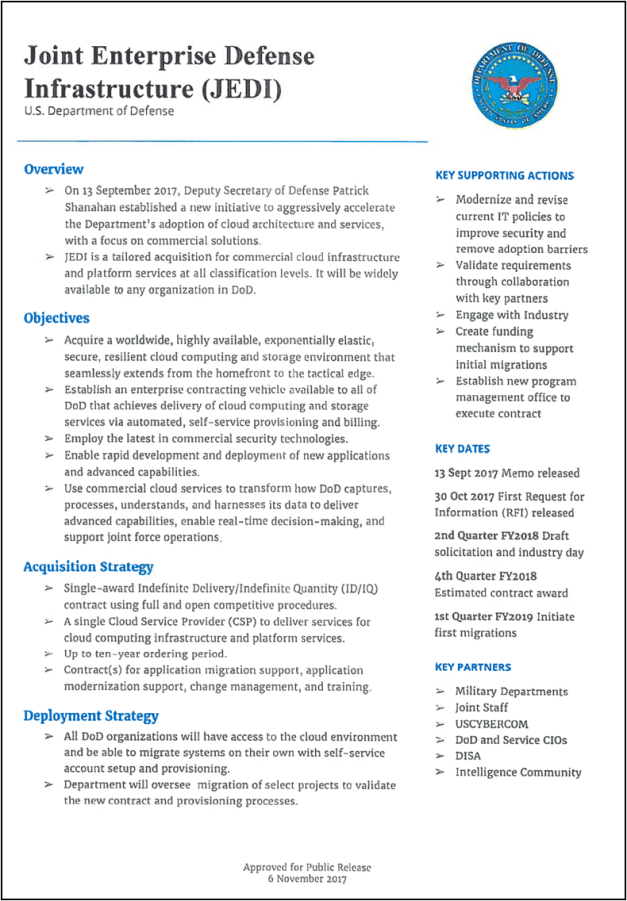
According to an internal strategy document obtained by Nextgov, the Pentagon aims to award a 10-year cloud computing contract—potentially worth billions—to a single company by the fourth quarter of 2018.

The contract would call on one commercial cloud service provider to host unclassified, secret and top secret Defense Department data, and the Pentagon’s approach mirrors the CIA’s enterprisewide approach to cloud four years ago, which resulted in a 10-year, $600 million contract with Amazon Web Services. AWS has since invested heavily to provide capabilities across all data classification levels.

The similarities between the Defense’s early cloud strategy and the CIA’s has rival tech companies worried that the department’s acquisition may lean toward AWS. In any case, such a massive contract could disrupt the $100 billion federal IT market and leave the winner in a position to dominate it for years to come.

Industry fears were further stoked last week when Pentagon acquisition chief Ellen Lord essentially confirmed the department’s intent. Lord chairs an executive steering committee to accelerate cloud adoption created by Deputy Secretary Patrick Shanahan and backed by Defense Secretary Jim Mattis, who visited Seattle and Silicon Valley earlier this year.

“We are, no kidding, right now writing the contract to get everything moved to one cloud to begin with and then go from there,” said Lord, speaking Dec. 3 at the Reagan Defense Forum. “A fundamental shift we’re making is to move the entire DOD to the cloud so our data can be shared and leveraged and we can do big data analytics.”

Lord perhaps realized the weight of her words and ordered senior officials not to publicly discuss the Pentagon’s cloud adoption effort “to reduce the amount of misinformation” being discussed publicly, according to Bloomberg. Some publications reporting on Lords’ remarks appeared to conflate a single-award contract with a sole-source contract, in which the department would issue a contract without competition from other companies.

Pentagon spokesperson Patrick Evans clarified to Nextgov that the Cloud Executive Steering Committee “is not planning this acquisition to be a sole source to any cloud service provider.”

“The CESG is aggressively analyzing information in order to determine how many contracts will best meet DOD’s needs. The contracting action will be a full and open competition. It is too early to reach any conclusions at this time,” Evans said.

Still, the tech industry is spooked, and nearly every company that isn’t Amazon is speaking out against the Pentagon’s perceived plans because a departmentwide cloud contract would have massive consequences. Defense spends $40 billion on information technology annually and accounts for close to half the entire federal government’s tech spending.

“The Defense Department would be making a big mistake” if it awarded a single massive contract to one vendor, said Sam Gordy, general manager for IBM Federal. Gordy said Defense would be better off creating a common infrastructure and awarding a commercial cloud services contract to multiple vendors to host department data.

IBM is not alone in its criticism. The Professional Services Council, which represents more than 400 tech companies, called on the department to “avoid vendor lock-in” and advised against limiting the number of contract awards in its response to the Defense Department’s request for information.

“DOD is heterogeneous and comprises organizations that vary greatly in terms of size and specific mission needs,” the recommendations state. “DOD should at least consider a multi-cloud contract should RFP responses indicate an advantage to doing so.”

As outlined by the Joint Enterprise Defense Infrastructure (JEDI) strategy, Defense intends to issue a draft solicitation by the second quarter of 2018 for a cloud that “all DOD organizations” would be able to access.

Alex Rossino, senior principal research analyst for Deltek, said a single enterprise cloud contract “is just not necessary” given the host of existing cloud service contracts across the Defense landscape. Each military service has their own enterprisewise cloud vehicles, and Defense just awarded Falls Church, Virginia-based contractor CSRA a $500 million contract to build an internal cloud for Defense users dubbed milCloud 2.0. Defense customers can also procure cloud services from other governmentwide contracting vehicles, like Alliant 2 or the Schedule 70 series run by the General Services Administration.

Don’t Miss

  • NGA Launches Bold Recruitment Plan to Hire Silicon Valley’s Best
  • VA Wasted $1.1 Billion on Failed IT Projects in Six Years
  • The Government’s Struggle to Hire Young Tech Talent is Worse Than You Thought

The import placed on the directive from the Pentagon’s top leadership may halt or stall existing Defense cloud contracts, Rossino said, especially if the inevitable contract becomes the de-facto way to buy cloud across the entire military.

“If this contract becomes a ‘thou-shalt-use’ contract, it cuts out anybody who isn’t on the contract,” Rossino said.

However, Katell Thielemann, research vice president at Gartner, Inc., said industry fears “are overblown.” Were a single vendor to capture this Defense contract, she said other cloud providers would still have countless opportunities to win business.

“Even if DOD were to issue a contact to one vendor in short order, it doesn’t mean that’s the only cloud provider they’ll deal with,” she said. “It’s highly unlikely that only one cloud vendor will become the only player in what is a huge, fragmented complex in the ever-evolving DOD environment.”

Thielemann views Defense’s push to cloud as a technological epiphany that emerging technologies need to factor into the changing character of war. The department, she said, now seems to understand that it needs the same rapid pace of innovation Silicon Valley and other tech hubs are known for.

Recommended for You

  • Here’s Who Might Dominate Alliant 2 Business
  • Lawmakers to VA: “We’ve Got Your Back” on $10B IT Contract
  • Wikipedia’s Cofounder on How He’s Creating a Bigger, Better Rival—On the Blockchain

“What is really striking to me is that for the first time, DOD is articulating that emerging technologies adoption is an imperative,” Thielemann said. “It used to be, ‘Oh, we need to move to cloud to save money on data centers.’ Now, the discussion is that failure to do so puts us as a military disadvantage. The narrative has changed.”

Dave Mihelcic, former chief technology officer at the Defense Information Systems Agency, told Nextgov cloud adoption was something the Pentagon’s IT arm could never quite get right in part because it didn’t know what it did wrong.

“If I was able to give the cloud steering group any advice as they digest the results of the RFI, it’d be that they should be going out and looking at those who’ve attempted to utilize cloud and look at what have been the disablers,” Mihelcic said.

Mihelcic said a multi-vendor approach would keep the department from ever relying too heavily on a single vendor.

“We’re not going to live in a world of a single cloud or computing technology, we’re going to live in a world of many clouds and legacy systems,” Mihelcic said.

Article link: http://www.nextgov.com/it-modernization/2017/12/pentagons-next-cloud-contract-could-be-worth-billions/144506/

Why Veterans Affairs Isn’t Waiting for a ‘Perfect’ Health Records Solution – Nextgov

Posted by timmreardon on 12/14/2017
Posted in: Uncategorized. Leave a comment

ShulkinxDecember 13, 2017 01:25 PM ET

The department’s aiming for as seamless a solution for medical records as technologically possible, VA Secretary David Shulkin said.

Despite the challenges that lie ahead, Veterans Affairs Secretary David Shulkin said now’s the time to press ahead with the agency’s plan to modernize its electronic health records system and create “as great an interoperability solution as is technologically possible.”

As the VA finalizes its $10 billion contract with Cerner Corp. to put VA on the same electronic health records platform as the Defense Department, Shulkin said he saw it as his job to break the gridlock and address the long-standing issue of disparate medical records head on.

“I’m not going to fall back on waiting for the perfect because you’re always going to wait,” he said Tuesday at a forum hosted by Politico. “Most of the arguments in government are reasons to not take action and maintain the status quo, and that’s what got us into this trouble in the first place.”

The project to put both VA and Defense on Cerner’s platform would allow veterans to seamlessly transfer medical records between agencies and put to rest a costly IT issue that has plagued both organizations for years. Over the next 10 years, VA will transition to the Cerner platform from the Veterans Information Systems and Technology Architecture system, which the agency has relied on since the 1980s.

The transition to Cerner will entail moving data on the agency’s 9 million beneficiaries from disparate platforms to a single system, a process VA officials have called one of the biggest IT implementations in history. While industry leaders acknowledge the difficulty of the task at hand, they said it will be more a test of motivation than any feats of innovation.

“It’s not a technology problem, and it’s not a VA problem,” said Peter Levin, CEO of Amida Technology Solutions. “This is about political will … and I know that [Shulkin] is holding a very firm line about it.”

A commercial platform like Cerner enables the agency to keep up with accelerating advances in IT without diverting as many resources away from veterans, said Shulkin. Because VA allowed local managers to customize each facility’s local platform, Shulkin said there are about 130 different versions of VistA across the country.

“We aren’t in the software business,” he said. “VA had emphasized in its culture innovation over centralization, and we got too far off this way. Good things happened because of it, but we’re suffering the consequences.”

A single standard platform would not only be more efficient, but would also promote more collaboration with Defense. Though the agencies operate a number of joint facilities, they often waste resources on duplicate services, Shulkin said.

“We can’t continue with the current model,” he said. “We have to work closer with DOD. They need us, we need them.”

Article link: http://www.nextgov.com/it-modernization/2017/12/why-veterans-affairs-isnt-waiting-perfect-health-records-solution/144516/


WHO Global Surveillance and Monitoring System for substandard and falsified medical products – WHO

Posted by timmreardon on 12/11/2017
Posted in: Uncategorized. Leave a comment


WHOx1

This report has grown out of the work of the GSMS, which provides national regulatory authorities with an interconnected network. This allows them, for the first time, to cross-reference reports of suspect products with those reported from other regions by searching the WHO database and accessing photograph libraries of confirmed substandard and falsified products.

Lawmakers to VA: “We’ve Got Your Back” on $10B IT Contract – Nextgov

Posted by timmreardon on 12/09/2017
Posted in: Uncategorized. Leave a comment

Shulkinx

December 7, 2017 05:48 PM ET

Congress expressed its support for VA’s electronic health records contract with Cerner, but promised to keep a close watch on its implementation

Officials from the Veterans Affairs Department on Thursday defended their decision to scrap previous plans and begin a fourth, and hopefully final, attempt to modernize the agency’s electronic health records system.

In June, VA Secretary David Shulkin announced his plan to award Cerner Corp. a single-source contract to put the agency on the same electronic health records platform as the Defense Department. At a price-tag of about $10 billion, it would be one of the biggest health IT implementations in history, said VA Chief Information Officer Scott Blackburn.

Blackburn highlighted the differences between the Cerner plan and previous failed attempts at achieving interoperability between VA and DoD medical records before a House Oversight and Government Reform subcommittee. Unlike previous attempts to modernize a motley crue of decades-old IT systems, the new plan would put every VA facility on a single, uniform platform over the next 10 years.

The Government Accountability Office found that VA awarded more than $1.1 billion to 138 contractors from fiscal 2011 to fiscal 2016 in a failed attempt to upgrade its existing Veterans Information Systems and Technology Architecture system. The agency decided to scrap the effort after officials realized the revamp would be “incredibly costly,” according to Blackburn. One independent group estimated the total project would top $19 billion, he said.

Blackburn said VA opted to start fresh with Cerner in part because the company is already developing the DOD’s MHS Genesis platform. Putting both agencies on the same system would allow veterans to transfer medical records between agencies “seamlessly”, he said, putting to rest the costly issue of disparate medical systems that has plagued both organizations for years.

Lawmakers who initially balked at the massive price-tag took turns pressing Blackburn on the steps being taken to mitigate costs.

Rep. Greg Gianforte, R-Montana, focused specifically on how much of the platform Cerner would customize for VA. One-off alterations could create barriers to interoperability, he said, and drive up costs in the long run.

Unlike previous modernization attempts, Blackburn said, the agency would rely heavily on “off the shelf” solutions and minimize the customization for the new platform. The VA’s 168 nationwide facilities all currently run a unique version of VistA, he said, but what the Cerner platform “will force us to do is standardize [procedures] across our medical system and also [put them] in line with the workflows of DOD.”

Congressmen commended officials the for the “life changing” impact an integrated platform could have on veterans’ lives, but also warned that strict oversight and realistic goals were needed to avoid the failures of the past.

“We are committed on a bipartisan basis to make this happen,” said committee Chairman Will Hurd, R-Texas. “We’ve got your back, but we’re also more than willing to create pressure and stress where it’s needed to improve performance.

Article link: http://m.nextgov.com/it-modernization/2017/12/lawmakers-va-weve-got-your-back-10b-it-contract/144399/

What Everyone Gets Wrong About Change Management – HBR

Posted by timmreardon on 12/08/2017
Posted in: Uncategorized. Leave a comment

N. Anand  & Jean-Louis Barsoux

HBRx1

From the November–December 2017 Issue

Corporate transformations still have a miserable success rate, even though scholars and consultants have significantly improved our understanding of how they work. Studies consistently report that about three-quarters of change efforts flop—either they fail to deliver the anticipated benefits or they are abandoned entirely.Because flawed implementation is most often blamed for such failures, organizations have focused on improving execution. They have embraced the idea that transformation is a process with key stages that must be carefully managed and levers that must be pulled—indeed, expressions such as “burning platform,” “guiding coalition,” and “quick wins” are now common in the change management lexicon. But poor execution is only part of the problem; our analysis suggests that misdiagnosis is equally to blame. Often organizations pursue the wrong changes—especially in complex and fast-moving environments, where decisions about what to transform in order to remain competitive can be hasty or misguided.

Before worrying about how to change, executive teams need to figure out what to change—in particular, what to change first. That’s the challenge we set out to investigate in our four-year study of 62 corporate transformations.

When companies don’t choose their transformation battles wisely, their efforts have a negative effect on performance. Consider what happened after Ron Johnson took over as CEO of J.C. Penney: He immediately gave store design and pricing an overhaul to attract younger, trendier customers. Sales sank by a quarter, and the stock plummeted by half.

Johnson’s first priority should have been a better integration of JCP’s in-store and online operations. At that time customers could not find in the stores what was being showcased online, and vice versa. The two channels were run separately, each with its own merchandise and supply chain. Johnson’s eventual replacement, Marvin Ellison, recognized the misalignment and restored JCP to profitability. Under Ellison’s leadership, JCP became nimbler and more responsive to customers looking for deals (who had left in droves because of Johnson’s changes). The retailer redesigned its shopping app to make it easier for in-store customers to find discounts, improved its website, and caught up with rivals by offering same-day in-store pickup of items ordered online.

As JCP and many other companies have learned, the costs of setting off on the wrong transformation journey are significant: First, underlying problems will persist and worsen as attention is invested elsewhere (JCP fell further behind in online sales as it freshened up store design). Second, new problems may emerge (JCP alienated loyal, deal-driven customers with its new pricing strategy and saddled itself with more than $5 billion of debt, which hampered its ability to invest in technology). And third, the executive team risks undermining employee commitment to future initiatives (Ellison had to remobilize a workforce still traumatized by JCP’s near collapse under Johnson). Having “fixed the plumbing,” Ellison’s leadership team has turned its attention to making JCP more relevant to shoppers in the coming decade. Although it has averted disaster, the company still has a lot of work to do. After a rough holiday season in 2016, the executive team decided to close almost 140 stores to compete more effectively with online retailers. The need for transformation is ongoing.

So how can leaders decide which changes to prioritize at the moment? By fully understanding three things: the catalyst for transformation, the organization’s underlying quest, and the leadership capabilities needed to see it through. Our analysis of stalled transformations suggests that failing to examine and align these factors drastically reduces the odds of producing lasting change. In this article we illustrate this dynamic with several classic case studies that provide enough distance to observe and compare clear, verifiable outcomes. We also offer tools to help diagnose what’s needed in your company’s transformation efforts.

The Catalyst: Pursuing Value

The trigger for any corporate transformation is the pursuit of value. Ideally, that entails both improving efficiency (through streamlining and cost cutting) and reinvesting in growth. But many transformation efforts derail because they focus too narrowly on one or the other.

In some cases, attempts to streamline the business through productivity improvements, outsourcing, divestments, or restructuring undermine growth. The cuts are so deep that they hollow out capabilities, sap morale, and remove the slack that could have fueled new endeavors.

Consider Norske Skog, once the world’s largest newsprint producer—now, according to Bloomberg, the third largest in Europe, in a dwindling market. Hit by falling demand for paper more than a decade ago, the Norwegian company was forced to divest unprofitable operations across four continents. Thanks to its profitability improvement program, it became so good at identifying where to make cuts that it was praised by BusinessWeek in 2009 for turning “shrinking into a science.” But although the company has survived, it has not found a way to rebound. Like many companies in contracting or commoditizing industries, it is stuck in turnaround mode, with its share price consistently in decline. By contrast, its Swedish-Finnish paper rival Stora Enso also went through several rounds of painful restructuring but has since reinvented itself as a renewable-materials company.

In other cases, reinvestment in growth spins out of control. Lego had this problem. The Danish toy maker made two large-scale attempts to transform itself through greater innovation. The first, launched in 2000, delivered a wealth of freewheeling experimentation that over the next few years drove the company to the brink of bankruptcy. The second, launched in 2006 (once the company had recovered its financial stability), catapulted Lego past the two U.S. giants Hasbro and Mattel to become the world’s most profitable toy company by 2014, with margins greater than 30%. Why the big difference? The second time around, under then CEO Jørgen Vig Knudstorp, Lego maintained a dual focus on growth and discipline. The company set up a cross-functional committee (the Executive Innovation Governance Group) to fund, monitor, and strategically coordinate innovation activities, ensuring that they remained “around the box” rather than drifting way outside it.

This example brings us to a larger point about catalysts for change: While you’re striving for growth, discipline—through governance, metrics, and other controls—allows you to stay on track later on, after you have chosen your journey’s direction. Without such controls in place, your company can easily lose its way. This often happens through the hasty purchase of an overpriced or tough-to-integrate “transformative acquisition” that is meant to redirect the strategy but just ends up sucking value out of the corporation. Hewlett-Packard is a notable recidivist in this domain: Recall its ill-fated acquisitions of Compaq, EDS, and Autonomy.

But how can you and others on the leadership team figure out what kind of transformation to pursue, once growth opportunities or declining performance has alerted you to the need for major change of some kind? That’s the second step in the process—defining the quest.

The Quest: Choosing Your Direction

Next the organization must identify the specific quest that will lead to greater value generation. Executives increasingly use the term “transformation” as shorthand for “digital transformation.” But the ongoing digital revolution does not itself constitute a transformation—it is a means to an end, and you must define what that end should be.

Studies and analysis that we have conducted show that most corporate transformation efforts are either derivatives or combinations of five prototypical quests:

  1. Global presence: extending market reach and becoming more international in terms of leadership, innovation, talent flows, capabilities, and best practices
  2. Customer focus: understanding your customers’ needs and providing enhanced insights, experiences, or outcomes (integrated solutions) rather than just products or services
  3. Nimbleness: accelerating processes or simplifying how work gets done to become more strategically, operationally, and culturally agile
  4. Innovation: incorporating ideas and approaches from fresh sources, both internal and external, to expand the organization’s options for exploiting new opportunities
  5. Sustainability: becoming greener and more socially responsible in positioning and execution

Each quest has its own focus, enablers, and derailers, and each requires the company to do something more or different with its operating model, customers, partners, internal processes, or resources. “Going digital” can support any of the five quests, and all of them call for discipline.

Understanding the Five Quests

The best execution in the world won’t lead to a successful transformation if your organization pursues the wrong change. Quests fall into five categories, and more than one may be relevant, so leadership teams must decide which to prioritize and which to postpone. Pursuing too many quests at once is a recipe for failure.
Global presence
Quest
Become more international in mindset as well as market reach by reconfiguring the operating model
Enablers
  • Rewiring systems and networks to leverage capabilities, knowledge, and ideas wherever they are
  • Preserving corporate principles while remaining flexible on cultural practices
  • Using diversity as a source of competitive advantage
Blockers
  • Acquiring weak businesses in haste to develop a global footprint
  • Honoring the “dominant” culture while paying lip service to the rest
  • Failing to integrate talent on a global scale
Customer focus
Quest
Provide tailored solutions to user problems by reconfiguring the customer experience
Enablers
  • Organizing, equipping, training, and rewarding the workforce to better understand and address customers’ needs
  • Redefining relationships with vendors, intermediaries, and suppliers
  • Reframing customer relations to learn rather than simply to close deals
Blockers
  • Failing to reshape an entrenched culture that emphasizes pushing products
  • Continuing to depend on former sales intermediaries
  • Not coordinating front- and back-office units to deliver seamless solutions
Innovation
Quest
Tap multiple sources of ideas and approaches by reconfiguring R&D partners
Enablers
  • Navigating the full innovation spectrum, from value chain partners to competitors to lead users and crowdsourcing
  • Collaborating to convert new ideas into tangible innovation
  • Articulating innovation needs clearly and creating win-win outcomes with partners
Blockers
  • Relying too much on one or two parts of the innovation spectrum
  • Resorting to rigid contracts with innovation partners
  • Lacking oversight that ensures frugal investment
Nimbleness
Quest
Become more strategically, operationally, and culturally agile by reconfiguring business processes
Enablers
  • Developing the capability to detect and respond to major changes in the environment
  • Leveraging diversity to exploit opportunities
  • Learning to prototype rapidly and institutionalizing what works
Blockers
  • Allowing blind spots to produce an incomplete picture
  • Responding too slowly because of red tape
  • Taking too long to cut your losses when something doesn’t work
Sustainability
Quest
Become greener and more socially responsible by reconfiguring resources
Enablers
  • Engaging all stakeholders to become sustainable
  • Leveraging sustainability as a source of strategic advantage
  • Communicating top-team commitment to the sustainability agenda
Blockers
  • Undermeasuring or -reporting progress toward sustainability
  • Broadcasting shallow PR victories (“greenwashing”)
  • Failing to balance efficiency and sustainability goals
Let’s return to the paper giant Stora Enso to see how it defined its quest. The catalyst for transformation was the plunging demand for paper along with the rise of digitization. Stora desperately needed not only to cut costs but also to rethink its business focus.

Members of the top team consulted widely with various divisions and layers of the company and engaged in lengthy deliberations. Weighing the options, they concluded that pursuing nimbleness, global presence, or customer focus would merely yield more market share in a declining industry. Innovation would not solve the main issue either. But the company had developed some breakthrough green offerings, including environmentally friendly packaging for the expanding e-commerce delivery market. Its greatest opportunity lay in shifting the whole axis of the business to specialize in offerings made with renewable and bio-based materials. So Stora’s was a sustainability quest. That turned out to be a shrewd pivot. Traditional paper-based products now represent only 8% of Stora’s profits, and the company’s share price has almost tripled since November 2011.

It can be difficult to choose the right quest. Should the company expand into new regions, get closer to customers, innovate with more partners, get faster and more responsive, or become more sustainable? Executives sometimes say “all of the above”—but that’s too much to handle at once. The right quest should be a compelling and uncontested priority. In some of the cases we analyzed, companies straddled quests (customer focus and agility, for instance, or innovation and sustainability). That can work as long as the components are fused into one cogent focus.

With multiple organizational challenges jostling for attention, top teams are liable to disagree on the transformation priority. That’s why we created a 15-question audit. In our research and consulting engagements, we’ve found that this tool allows executives to do their own systematic review so that they can make smart decisions regarding transformation. For example, at a French utility company we worked with, the top 200 executives participated in a “transformation jam” where they all filled out a status report that identified the critical enablers and blockers for each potential quest. This and the quest audit helped to clarify and reconcile the priorities of different parts of the organization, from the boardroom and the C-suite to the front line

Conduct a Quest Audit

Rate each of these competencies on a 1-to-7 scale (7 is strongest). Your lowest scores will identify your most urgent priorities for change.

Global Presence
How well do we…
  • pursue expansion with a strategic global perspective?
  • share local learning about business practices globally?
  • use digital technology to bring together key populations?
Customer Focus
How well do we…
  • create offerings with meaningful value to customers?
  • recognize team-based efforts in developing and selling solutions?
  • use analytics to identify which solutions customers need most?
Innovation
How well do we…
  • cooperate with external partners to create new technologies and offerings?
  • create an environment of trust for effective collaboration?
  • leverage digital platforms for innovation?
Nimbleness
How well do we…
  • sense changes in the environment?
  • act on those changes in a timely way?
  • share information across the organization?
Sustainability
How well do we…
  • Integrate our sustainability strategy into the overall corporate vision and strategy?
  • Implement sustainability in decision making, processes, and systems throughout the organization?
  • Use digital technology to catalog and evaluate sustainability initiatives?
Read more

The Capabilities: Developing Leaders

Finally, to support the chosen quest, the company must develop leaders who can see it through. Sustained transformation depends on this.

Again Stora Enso is a useful case in point. Jouko Karvinen, the company’s CEO until July 2014, realized that his executive team—all Nordics, all industry veterans—could continue to squeeze costs out of core businesses but would struggle to explore prospects for fresh growth. So, in close consultation with then HR head Lars Häggström, he set up a parallel “Pathfinders” leadership team—a dozen managers from various parts of the organization—and gave them a mandate to identify sustainability opportunities that were falling between silos and, more broadly, to challenge the old ways of doing business. Each year the organization replaces its Pathfinders with a new cohort of up to 16 members. At first this was mainly a way to keep bringing new perspectives into high-level decision making, but it expanded into a program for identifying and developing change agents within the organization who would then serve as internal management consultants. The Pathfinders program became the centerpiece of the company’s new leadership-development activities.

Transformation journeys run out of steam when companies neglect leadership development. In order to keep an organization moving in the desired direction, executives and managers at all levels must understand which mindsets and behaviors will take the company there and then take care to model them so that employees know how to act in the new context.

Any mismatch between the leadership-development effort and the transformation quest is bound to impair value generation. The need for alignment is well demonstrated by the familiar but instructive story of two Asian rivals in personal computing.

The right quest should be a compelling and uncontested priority.

In 2008 Taiwan’s Acer and China’s Lenovo ranked third and fourth respectively in global market share, well behind HP and Dell. By 2015 Lenovo had claimed the top spot and Acer had slipped to sixth. They had defined similar quests—achieving global reach—and they pursued similar strategies, seizing opportunities to generate value and transform their global presence by acquiring embattled Western businesses. Lenovo grabbed IBM’s PC division in 2005; Acer snapped up Gateway in the United States in 2007 and Packard Bell in Europe in 2008. But a key difference between Lenovo and Acer was their commitment to globalizing the senior leadership ranks.

Acer’s board struggled with “de-Taiwanization,” rejecting CEO Gianfranco Lanci’s bold plans to hire foreign talent with expertise in mobile technology and to triple the number of engineers. (It’s worth noting that Lanci soon left Acer to head up Lenovo’s PC group.) In 2010 Acer had six foreigners among its top 24 executives; by 2014 it was down to three out of 23. In the same period, the board went from having two foreign directors to having none. Predictably, the top team’s decision making became increasingly cautious and inward-looking. In 2016, for example, it hired the founder’s son to head up the company’s cloud services, which prompted the TechNews headline “Is Acer Becoming a Family Business?”

By contrast, leadership development at Lenovo was fully in line with the company’s quest for a greater global presence. By 2012 its top team of nine represented six nationalities. Its Chinese CEO, Yang Yuanqing, relocated to the United States, and other members of the team were scattered globally, gathering for one week each month in a different strategic market. Aware of the challenges his team faced as a result of its members’ varied backgrounds, the CEO brought in a coach to work with the executives on cross-cultural issues. And to promote diversity as a source of competitive advantage—in both hiring and operations companywide—Lenovo elevated the role of cultural integration and diversity VP to the C-suite. Such efforts paved the way for ambitious acquisitions and joint ventures with German, Japanese, Brazilian, and U.S. companies—enabling Lenovo to extend into new software and services categories globally.

Transformation Traps

Many transformation efforts are set up to fail at the quest stage. Top teams get sidetracked or overreach when they lose focus on what value is worth pursuing—or they take on more change than their leadership capabilities can steer. Our investigations reveal three common failings:

Neglecting the quest.

In companies that don’t identify a mobilizing theme, value generation and leadership development can become ends in themselves—generic efforts, not really linked to the strategy. For example, India’s Infosys developed a widely admired approach to leadership development but ran into trouble because it failed to tie that to the transformational needs of the business—forcing the IT giant to turn to an outside CEO to drive the necessary changes.

Being seduced by the wrong quest.

The board and the top team may be led astray by the vision of a forceful CEO (like Ron Johnson at J.C. Penney), try to copy the strategic moves of competitors, or fall for recommendations from consultants who favor particular quests. In those situations, the chosen quest misfires because it was not the product of deep deliberation or shared conviction or it fails to address the central issue. For example, GE transplant Bob Nardelli tried to transform Home Depot by selling supplies to construction professionals as well as to homeowners. The pursuit of customers in adjacent markets distracted attention from Home Depot’s core problem of slumping store sales. When Nardelli resigned, under intense pressure from shareholders, the strategy was immediately reversed and the wholesale arm sold off to allow the company to refocus on its core retail business. From seventh-largest global retailer, Home Depot has since jumped to third.

Focusing on multiple quests.

The quest choice may be muddled if leaders can’t agree on which direction to go. Different parts of the business (regions, functions, levels) see different problems and priorities. Some corporations overreach, taking on too many quests at once or overestimating their leadership capabilities in a given area. Back in 2009 the incoming Carrefour CEO, Lars Olofsson, launched an ambitious transformation plan for the retail giant based on seven strategic initiatives, including enhanced innovation, customer engagement, agility, and global expansion. The result was confusion, a loss of domestic market share, and a 53% plunge in share price in one year. Olofsson lasted barely two years in the job. His replacement, Georges Plassat, panned the leadership capability of the previous team, labeling the members “incompetent in mass retailing.” In a successful recovery plan, Plassat first focused on shedding operations in noncore markets and streamlining internal operations. He then reignited domestic sales by cutting prices and diversifying stores. Three years later Carrefour had regained a clear lead in the French market.

Getting Started

It can be useful to think of value generation and leadership development as the chariot wheels that support a transformation, and the quest as the horse that provides direction and momentum. Alignment among the three is critical if you want to reach your destination.

The quest audit facilitates alignment by making it easier to diagnose the current situation, identify which transformation could be a game changer, and decide which enablers and blockers to target to make it happen. This tool has been validated with more than 500 executives and road tested by a dozen companies (across industries and continents) seeking to transform themselves. It helps address these underlying challenges:

Facing reality.

Having a structured way to solicit and gather input allows senior teams to take a cold, hard look at the company. Knowledge, competencies, or activities that were once central to the organization may have become what Harvard’s Dorothy Leonard-Barton calls core rigidities. If so, they need to be adapted or jettisoned. The more radical the transformation, the greater the chance that such limitations will be exposed. Confronting harsh reality may also involve identifying and addressing blind spots.

For the HR head of a European postal services group, a quest audit revealed a disconcerting pattern. “The low scores on value, customer focus, and innovation seem to highlight our company’s ineffectiveness in listening respectively to the market, to our customers, and to suppliers or partners,” she told her team. “It’s hard to admit, but it’s better to recognize now the inertia of our organization that needs to be tackled urgently.” Similarly, the head of HR at a Japanese food group observed that doing the exercise opened up team dialogue on issues that were previously off-limits: “It provided ‘permission’ to reflect on the current reality and how we got to where we are. That immunity led us to frame some breakthrough questions to understand our challenge and what we needed to do to solve it.”

Debating priorities.

Often the diagnosis reveals multiple challenges and the debate centers on which of them matters most—or which can be tackled immediately, given the company’s current leadership capabilities. Conceptual tools can’t tell top teams what to do, but they can support a smarter discussion, with much of the critical information visible at a glance.

By mapping out where various parties see opportunities and hazards, executives can avoid a major decision-making trap: getting stuck with a false choice between pursuing one strategic option and doing nothing. Articulating the pressures and challenges makes it easier to debate and evaluate the relative merits of various responses.

Take the case of Cosentino, a Spanish manufacturer of engineered surfaces for kitchens and bathrooms. Because the company had established a solid distribution foothold in the United States, the most obvious strategy was to keep extending its global presence. But after using the quest audit to weigh their options, the top 70 executives decided instead to prioritize co-innovation—not just with Cosentino’s supply chain partners but with other high-end kitchen and bathroom businesses (facades, flooring, and equipment)—to anticipate new trends. They elected to work on their biggest weakness rather than to build on an obvious strength.

Top teams are liable to disagree on the transformation priority.

Reconciling perspectives or priorities and developing a shared understanding of the cause of the current state of affairs is not painless. But sidestepping that discomfort only reduces the chances of selecting a viable transformation objective. According to the head of finance of an Italian fashion group, “Our discussions highlighted areas where we perhaps were not as aligned as we thought and emphasized common pain points regardless of where you sit in the organization. The reflection drove convergence about what we needed to do and stop doing.”

Joint consultation also builds a sense of involvement that boosts the perception of fair process and therefore commitment to the chosen course of action.

Communicating choices.

Having debated the priorities and challenges, an organization’s leaders can feel more confident in advocating a particular course of action and communicating the message to others. They are better equipped to explain how they reached this conclusion, what alternatives they scrutinized, and why they think this is the right transformation journey. If employees feel that the analytical work was thorough and inclusive, they are more likely to accept the decision, even if they don’t like it.

Of course, analysis alone seldom inspires people to act in unfamiliar and perhaps unwelcome ways. When leading people into an uncertain future, it helps if the decision makers can get people talking about enablers and blockers. That gives everyone a sense of where the organization stands, what it must transform—and why, beyond “survival,” the journey is worth making.

Here’s an example of how this can play out: At GroupM, the world’s largest media investment group, the top team of the South Asia operation concluded that its competition in the digital age consisted of not just the traditional agency networks but also disruptive start-ups and digital platforms that could cultivate direct access to its clients. As the team debated priorities, innovation through deeper partnerships with potential new competitors emerged as number one. Further discussions, including one mediated by a “youth committee” made up of highfliers under the age of 30, revealed that a key enabler was the ability to pick the right innovation partners. A key blocker, according to C.V.L. Srinivas, the division’s CEO, was “getting people working in a successful organization to change their mindset and accept that we needed to change in order to stay relevant.” So the top team chose a communication strategy that balanced hard and soft approaches: setting tough targets for employees to increase their proportion of digital work while making it clear that they would receive the support and training to achieve those goals.

CONCLUSION

As the shelf life of business strategies grows shorter, a corporation’s transformation capability becomes its only enduring advantage. A quest for innovation provided a focus for Lego’s transformation under Knudstorp. But now, as Lego nears saturation in its lead markets, such as the United States and Germany, its attention is on fast-growth emerging economies—the new quest being to transform a Danish brand with global appeal into a truly global corporation.

With serial transformations becoming the norm, a key strategic question for any corporate leader is, How can we make our next transformation flourish? This article will help you answer that question.

A version of this article appeared in the November–December 2017 issue (pp.78–85) of Harvard Business Review.

N. Anand is the Shell Professor of Global Leadership and the dean of faculty and R&D at IMD.

Jean-Louis Barsoux is a senior research fellow at IMD.


This article is about LEADERSHIP DEVELOPMENT
 Article link: https://hbr.org/2017/11/what-everyone-gets-wrong-about-change-management

Moral Choices for Today’s Physician – JAMA

Posted by timmreardon on 12/06/2017
Posted in: Uncategorized. Leave a comment

Donald M. Berwick, MD, MPP1

Author Affiliations    Article Information1Institute for Healthcare Improvement, Cambridge, Massachusetts
JAMA. 2017;318(21):2081-2082. doi:10.1001/jama.2017.16254
The current generation of physicians is the most challenged by moral choices in perhaps a century. Those choices come in three tiers: personal, organizational, and societal.

Carl Sandburg’s poem,1 about fog rolling in “on little cat feet” comes to mind:

Some moral choices arrive with drama, but most do not. Most come unannounced, silent in arrival—on little cat feet—and are gone almost before we notice.

Forty-five years ago, I was a medical student interviewing for the match. The night before my Peter Bent Brigham Hospital interview, I was on overnight duty.

“I’m having my Brigham interview tomorrow and I’m nervous,” I told my resident.

“You should be,” he said. “They’re brutal. I still remember the question they opened with. It was impossible.”

“Tell me more,” I said.

“Well, they told me a story from the very first days of hemodialysis, which the Brigham pioneered. They said that a patient on dialysis had become confused and then delirious. They called the medical resident to come and see him. The resident examined the man. He noticed nystagmus, immediately made the correct diagnosis, began the correct treatment, and, arguably, saved the man’s life. They asked me, ‘What was that diagnosis?’”

“I have no idea,” I said.

“Neither did I,” said the resident. “Later on someone told me the answer. The man had Wernicke’s encephalopathy. He was acutely thiamine deficient. Dialysis was removing water-soluble vitamins from his body, and no one had, up to that time, realized that the dialysis could cause acute vitamin deficiency. The resident gave him thiamine, and rescued him.”

“I’m cooked,” I said.

The Brigham interview the next day was a marathon of three-person panels, each of which peppered the candidates with questions for 5 or 10 minutes. I was half way through when I entered the room with what I instantly knew was THE panel… the chief of medicine, the head of the residency program, and another world-famous physician. They paused and glared down at me. I gulped, and then the chief began.

“Mr Berwick, some years ago, during the first days of dialysis here, a patient suddenly became disoriented and dizzy. A resident was called, he noticed nystagmus, and he made the correct diagnosis….”

To this day, I recall the surge of feeling. The impulse to burst out laughing. The sweat breaking on my body. Unannounced. On little cat feet. The test was to be not of my knowledge or promise as a doctor. It was to be of my character.

I am not proud of this story. I failed that test. With cold-blooded precision, I furrowed my brow and faked it. I pretended I was reasoning my way to the right answer, even though, without forewarning, I could no more have done that on my own than I could perform an Olympic gymnastics floor routine.

I could see it in their eyes. They wanted me. The questions stopped, and they spent the rest of the interview telling me how fine a place the Brigham was for training.

A day or two later, I could not resist telling a close friend and mentor the funny story. His reaction woke me up. He did not laugh. Instead he said, “I am a bit disappointed in you, Don.”

I realized, I was too. I dropped the Brigham from my match list. But that has never, not to this day, felt like absolution for me. A choice came, on little cat feet, and I did not see it at the time for what it was.

This is the moral choice in its simplest, purest, most elemental form. To tell the truth, or not, when “not” is perhaps in your short-term self-interest.

I say “perhaps” because when I recall that moment of choice, which I have done a thousand times, I can’t help but wonder what would have been the consequence of honesty. “Sirs,” I would have said to the panel, “this is an incredible coincidence, but last night I asked my resident about his interview here, and he told me that same story and the correct answer, which I assure you I would not by any stretch of the imagination, have arrived at.” I wonder what would have happened then. I will never know.

A second form of choice comes in equal silence and has to do with one’s self-image as a physician. It is the choice between being a hero and being a citizen.

The white coat, stethoscope, and prescription rights tempt some physicians into hero mode. Physicians have the power to look and act like we know what to do, even when we do not. We have the power to assert prerogatives denied to others: “my schedule,” “my OR time,” “my air time,” “my excellence.”

But health care is an exercise in interdependency, not personal heroism. Physicians simply cannot do the right job alone. This produces a clash between the time-honored, romantic image of the great physician and the greater need for teamwork, generosity, and deference. That greater need demands that the question, “What am I part of?” should supersede prerogative. It counsels a continual inquiry: Who depends on me? And how am I doing in their eyes?

In the past, an exploration of moral choices might have stopped with these two levels: personal honesty and proper organizational citizenship. But times have changed and the stakes are higher. As a newly minted physician, I held unquestioned the belief that the organizations I worked in and for were, at their core, ethical; that health care institutions usually, if not always, put the interests of those they served ahead of their own.

This may or may not have been true then, but it is not true now. At least, ethics cannot be taken for granted, not when the interests to be served are those of society as a whole. The symptoms of organizational gluttony are rampant, and the damage is severe.

For example, the drugs patients depend on are experiencing price increases that cannot withstand the scrutiny of public interest or moral compass. New biologics of undeniable value are being priced at levels that are not just like extortion—they are extortion, holding patients hostage. Old, invaluable preparations, like insulin, epinephrine, 17-hydroxyprogesterone, colchicine, and others, are being captured or patented under legal loopholes and then priced 10-fold, 30-fold, 100-fold more than their prior, customary levels.

Hospitals today play the games afforded by an opaque and fragmented payment system and by the concentration of market share to near-monopoly levels that allow them to elevate costs and prices nearly at will, confiscating resources from other badly needed enterprises, both inside health (like prevention) and outside (like schools, housing, and jobs).

And this unfairness—this self-interest—this defense of local stakes at the expense of fragile communities and disadvantaged populations goes far, far beyond health care itself. So does the physician’s ethical duty. Two examples help make the point.

In my view, the biggest travesty in current US social policy is not the failure to fund health care properly or the pricing games of health care companies. It is the nation’s criminal justice system, incarcerating and then stealing the spirit and hope of by far a larger proportion of our population than in any other developed nation on earth.2 If taking the life-years and self-respect of millions of youth (with black individuals being imprisoned at more than five times the rate of whites),3 leaving them without choice, freedom, or the hope of growth is not a health problem, then what is?

Second, the harm done to our planet by inattention to and denial of the facts of science is grievous too. If poisoning the air, drying up the rivers, and drowning the cities—our own, and those of the poorest people on earth, and creating a tsunami of displaced people greater than the world has ever known before, is not a health problem, then what is?

Healers cannot deny that leaving refugees at our gates unwanted, or children unfed, or families unhoused, or basic medical care uncovered, or relying on conflict, rather than compassion, are health problems. So is war. So is ignorance. So is hopelessness. So is blaming the blameless.

The work of a physician as healer cannot stop at the door of an office, the threshold of an operating room, or the front gate of a hospital. The rescue of a society and the restoration of a political ethos that remembers to heal have become the physician’s jobs, too. Professional silence in the face of social injustice is wrong.

It is chilling to see the great institutions of health care, hospitals, physician groups, scientific bodies assume that the seat of bystander is available. That seat is gone. To try to avoid the political fray through silence is impossible, because silence is now political. Either engage, or assist the harm. There is no third choice.

Section Editor: Preeti Malani, MD, MSJ, Associate Editor.

Back to top

Article Information

Corresponding Author: Donald M. Berwick, MD, MPP, Institute for Healthcare Improvement, 20 University Rd, Seventh Floor, Cambridge, MA 02138 (donberwick@gmail.com).

Conflict of Interest Disclosures: The author has completed and submitted the ICMJE Form for Disclosure of Potential Conflicts of Interest and none were reported.

Disclaimer: The views expressed herein are those of the author and do not necessarily reflect the views of the Institute for Healthcare Improvement.

Additional Information: This essay is adapted from a graduation address given at Dartmouth Medical School on June 3, 2017.

Article link: https://jamanetwork.com/journals/jama/fullarticle/2665004

References

1. Sandburg  C. Fog. https://www.poets.org/poetsorg/poem/fog. Accessed November 3, 2017.
2. World Prison Brief website. Highest to lowest—prison population rate. http://www.prisonstudies.org/highest-to-lowest/prison_population_rate?field_region_taxonomy_tid=All. Accessed October 2, 2017.
3. The Sentencing Project. The color of justice: racial and ethnic disparity in state prisons. http://www.sentencingproject.org/wp-content/uploads/2016/06/The-Color-of-Justice-Racial-and-Ethnic-Disparity-in-State-Prisons.pdf. Published 2016. Accessed October 2, 2017.

Blockchains Are Poised to End the Password Era – MIT Technology Review

Posted by timmreardon on 12/02/2017
Posted in: Uncategorized. Leave a comment

MITzxMany technologists think blockchains can revolutionize how we keep track of our identities.

by Mike Orcutt  November 30, 2017

he massive password heists keeping coming, and one thing is certain: the way we prove our identities online is in need of a major upgrade. A growing chorus of technologists and entrepreneurs is convinced that the key to revolutionizing digital identity can be found in the same technology that runs cryptocurrencies.

Recommended for You
  1. Ambient AI Is About to Devour the Software Industry
  2. A Warmer World Will Dent the Productivity of Factories
  3. Lenses Are Being Reinvented, and Cameras Will Never Be the Same
  4. Blink and You’ll Miss How Fast This Souped-Up 3-D Printer Makes Prototypes
  5. Lidar Just Got Way Better—But It’s Still Too Expensive for Your Car

This piece first appeared in our new twice-weekly newsletter, Chain Letter, which covers the world of blockchain and cryptocurrencies. Sign up here – it’s free!

Their bet is that we are on the verge of a fundamental shift—away from a model in which our valuable digital identities are managed by companies, banks, governments, and other central authorities to one in which this information is kept on a decentralized ledger, or blockchain, under the full control of individuals. Advocates say systems like Bitcoin, which uses cryptography and a network of computers to facilitate the secure exchange of digital coins without a middleman, can do something similar for identity credentials. (For more: “What Bitcoin Is, and Why It Matters” and “Why Bitcoin Could Be Much More Than a Currency”)

Blockchain technology can eliminate the need for companies and other organizations to maintain centralized repositories of identifying information, and users can gain permanent control over who can access their data (hence “self-sovereign”), says Drummond Reed, chief trust officer at Evernym, a startup that’s developing a blockchain network specifically for managing digital identities.

Self-sovereign identity systems rely on public-key cryptography, the same kind that blockchain networks use to validate transactions. Although it’s been around for decades, the technology has thus far proved difficult to implement for consumer applications. But the popularity of cryptocurrencies has inspired fresh commercial interest in making it more user-friendly.

Public-key cryptography relies on pairs of keys, one public and one private, which are used to authenticate users and verify their encrypted transactions. Bitcoin users are represented on the blockchain by strings of characters called addresses, which are derived from their public keys. The “wallet” applications they use to hold and exchange digital coins are essentially management systems for their private keys. Just like a real wallet, they can also hold credentials that serve as proof of identification, says Reed. Using a smartphone or some other device, a person could use a wallet-like application to manage access to these credentials.

The idea might already be catching on, at least with governments. The state of Illinois recently partnered with Evernym to create self-sovereign birth certificates for babies born in the state. This month, the city of Zug, Switzerland, launched a project in collaboration with uPort, a startup whose identity management system relies on the Ethereum blockchain, to provide self-sovereign IDs to its citizens. Brazil’s government is also experimenting with uPort’s technology.

But will regular consumers buy in? Technologists will need to create a form factor and user experience compelling enough to convince them to abandon their familiar usernames and passwords, says Meltem Demirors, development director at Digital Currency Group, an investment firm that funds blockchain companies. The task calls for reinforcements, she says: “The geeks are working on it right now, but we need the designers, we need the sociologists, and we need people who study ethics of technology to participate.”

Hear more about blockchains from the experts at the Business of Blockchain on April 23, 2018 in Cambridge.

Article link: https://www.technologyreview.com/s/609583/why-blockchains-are-poised-to-end-the-password-era/

Learn more and register

Blockchain, explained – MIT Sloan

Posted by timmreardon on 11/29/2017
Posted in: Uncategorized. Leave a comment

An MIT expert on why distributed ledgers and cryptocurrencies have the potential to affect every industry.

By Zach Church  |  May 25, 2017

Sloanxy

Why It Matters

Like the internet in its early years, blockchain technology is hard to understand and predict, but could become ubiquitous in the exchange of digital and physical goods, information, and online platforms. Figure it out now.

What is a blockchain?
Blockchain is a term widely used to represent an entire new suite of technologies. There is substantial confusion around its definition because the technology is early-stage, and can be implemented in many ways depending on the objective.

“At a high level, blockchain technology allows a network of computers to agree at regular intervals on the true state of a distributed ledger,” says MIT Sloan Assistant Professor Christian Catalini, an expert in blockchain technologies and cryptocurrency. “Such ledgers can contain different types of shared data, such as transaction records, attributes of transactions, credentials, or other pieces of information. The ledger is often secured through a clever mix of cryptography and game theory, and does not require trusted nodes like traditional networks. This is what allows bitcoin to transfer value across the globe without resorting to traditional intermediaries such as banks.”

On a blockchain, transactions are recorded chronologically, forming an immutable chain, and can be more or less private or anonymous depending on how the technology is implemented. The ledger is distributed across many participants in the network — it doesn’t exist in one place. Instead, copies exist and are simultaneously updated with every fully participating node in the ecosystem. A block could represent transactions and data of many types — currency, digital rights, intellectual property, identity, or property titles, to name a few.

“The technology is particularly useful when you combine a distributed ledger together with a cryptotoken,” Catalini says. “Suddenly you can bootstrap an entire network that can achieve internet-level consensus about the state and authenticity of a block’s contents in a decentralized way. Every node that participates in the network can verify the true state of the ledger and transact on it at a very low cost. This is one step away from a distributed marketplace, and will enable new types of digital platforms.”

How is blockchain related to bitcoin?
Bitcoin, with a market cap of more than $40 billion, is the largest implementation of blockchain technology to date. While a lot of media attention has shifted from bitcoin to blockchain, the two are intertwined.

“When The Economist put blockchain on the cover in 2015, it wasn’t really about its use to support a digital currency anymore. It was all about the other applications this technology will unleash within the next 5 to 10 years,” Catalini says. “For example, in finance and accounting there is excitement about the ability to settle and reconcile global transactions at a lower cost using the technology. In logistics the attention is all on how you can use the immutable audit trail generated by a blockchain to improve the tracking of goods through the economy. Others are fascinated by the possibility to use this as a better identity and authentication system.”

There are two types of costs blockchain could reduce for you: the cost of verification and the cost of networking.
So what’s the big deal? In a recent paper, Catalini explains why business leaders should be excited about blockchain — it can save them money and could upend how business is conducted.

Every business and organization engages in many types of transactions every day. Each of those transactions requires verification. In many cases, that verification is easy. You know your customers, your clients, your colleagues, and your business partners. Having worked with them and their products, data, or information, you have a pretty good idea of their value and trustworthiness.

“But every so often, there’s a problem, and when a problem arises, we often have to perform some sort of audit,” Catalini says. “It could be actual auditors coming into a firm. But in many other cases, you’re running some sort of process to make sure the person claiming to have those credentials did have those credentials, or the firm selling you the goods did have the certification. When we do that, it’s a costly, labor-intensive process for society. The marketplace slows down and you have to incur additional costs to match demand and supply.”

“The reason distributed ledgers become so useful in these cases is because if you recorded those attributes you now need to verify securely on a blockchain, you can always go back and refer back to them at no cost,” he says. “It’s costless verification. So when you think about why bitcoin works, it’s because it can cheaply verify that the funds are actually there. You can transfer value from here to anywhere on the globe at almost zero transaction cost. Sending secure messages that carry value does not require a bank or PayPal in the middle anymore.”

In short: Because the blockchain verifies trustworthiness, you don’t have to. And the friction of the transaction is reduced, resulting in cost and time savings.

Using a blockchain can also reduce the cost of running a secure network. This will happen over a longer timeline, Catalini says, perhaps a decade. The internet has already allowed for a faster, less stilted exchange of goods and services. But it still needs intermediaries, however efficient they may be — think eBay, Airbnb, and Uber.

“Those intermediaries are costly and earn rents for processing payments, maintaining a reputation system, matching demand and supply,” Catalini says. “This is where blockchain technology, combined with a cryptotoken, allows you to rethink an entire value chain from the ground up. That’s where incumbents should be slightly worried, because in the long run the way you may be delivering value to your customers and competing against other companies could be fundamentally different.”

Blockchain technology could mean greater privacy and security for you and your customers.
Catalini calls it data leakage. When you give a bartender your driver’s license, all that person needs to know is your age. But you’re revealing so much more — your address, your height, whether you’re an organ donor, etc.

The same thing happens in commercial transactions.

“As your business partner, I need to know that you’re trustworthy and reliable, but for simple transactions I don’t really need to know many other things about you,” Catalini says. “Information disclosure is increasingly becoming a cost because of data breaches. We can’t keep our data private and it’s becoming increasingly complex to do so within large organizations. So imagine a model where you can verify certain attributes are true or false, potentially using a decentralized infrastructure, but you don’t have to reveal all these attributes all the time.”

In a business transaction context, Catalini says, a blockchain could be used to build a reputation score for a party, who could then be verified as trustworthy or solvent without having to open its books for a full audit.

“Reputation scores both for businesses and individuals are today siloed into different platforms, and there is very little portability across platforms. Blockchain can improve on this,” he says.

Which industries could blockchain disrupt?
“All of them,” Catalini says. “The technology is what economists call a general purpose technology, and we will see many applications across different verticals.”

Here are a few to keep an eye on.

Central banks: Many central banks — including those in Canada, Singapore, and England — are studying and experimenting with blockchain technology and cryptocurrencies. The potential applications include lower settlement risk, more efficient taxation, faster cross-border payments, inter-bank payments, and novel approaches to quantitative easing. Imagine a central bank stimulating the economy by delivering digital currency automatically to citizens. Don’t expect big moves from big countries soon. The risk is too high, Catalini says. But expect to see smaller, developed countries with a high tolerance for technology experimentation lead the way and possibly experiment with a fiat-backed, digital currency for some of their needs.

Finance: The busiest area of application so far, blockchain is being used by companies seeking to offer low cost, secure, verifiable international payments and settlement. Ripple is  one of the leaders in this space on the banking side. Meanwhile, companies like Digital Asset and Chain seek to create a faster, more efficient financial infrastructure for tracking and exchanging financial assets of any type.

Money transfer: In 2014, two MIT students raised and distributed $100 worth of bitcoin to every MIT undergraduate. They wanted to see what would happen and generate interest on campus. Catalini, together with Professor Catherine Tucker, designed the experiment and studied the results. While 11 percent immediately cashed out their bitcoin, 49 percent were still holding on to some bitcoin. Some students used the funds to make purchases at local merchants, some of whom accepted bitcoin. Others traded with each other. Meanwhile, startups around the world competed to become the consumer trading application for bitcoin. Then PayPal bought Venmo, a payment platform that trades cash. PayPal’s own mobile app allows for peer-to-peer transactions, as well. The bitcoin-based consumer payment industry cooled down. But the application of blockchain remains attractive because of the lower costs it could offer parties in global, peer-to-peer transactions. Rapid payment company Circle, which advertises itself as “Like a text filled with cash,” stopped allowing users to exchange bitcoin last year, but is building a protocol that allows digital wallets to exchange value using a blockchain.

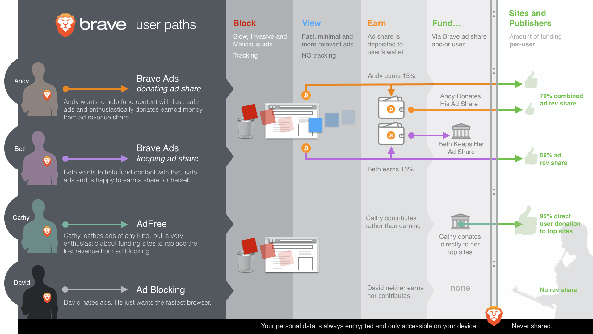
SloanyxWeb browser company Brave uses a blockchain to verify when users have viewed ads and, in turn, pays publishers when those same users consume content.

Micropayments: What if, instead of subscribing to a news site online, you paid only for the articles you read? As you click through the web, your browser would track the pages and record them for payment. Or what if you could get small payments for doing work — completing surveys, working as a freelance copy editor — for a variety of clients. By reducing the cost of the transaction and verifying the legitimacy of parties on either end, blockchain could make these micropayments, new types of cross-platform subscriptions, and forms of crowdsourcing possible and practical. A company called Brave is already attempting this, with potential ramifications for the digital advertising industry.

Identity and privacy: In October 2013, the arrest of the founder of Silk Road, a deep web marketplace where users paid for illegal goods with bitcoin, showed just how anonymous bitcoin really wasn’t. Nor was it ever intended to be — bitcoin addresses function much as a pseudonym does for a writer, Catalini says. Users can never completely mask their transactions. But others are trying. Zcash promises to be a fully private cryptocurrency. There are significant downsides to the anonymity a blockchain could offer, such as the ability to fund terrorism or facilitate money laundering. But there are many virtuous applications too — Google’s DeepMind is attempting to use blockchain to layer privacy and security in electronic health care records.

Smart contracts: This application is still in the early stages, Catalini says, but by recording information on a blockchain, contracts could use that information to make themselves self-executing if certain conditions are met. This idea backfired last year when code was exploited to steal $60 million from The DAO, a blockchain-based venture capital firm.

Provenance and ownership: A blockchain could be used to record details about physical products, helping to verify authenticity and prevent fraud and counterfeiting. London-based EverLedger is tracking diamonds and envisions doing the same for fine wines. At the same time, for all these applications, a blockchain is only as useful as the quality of the information recorded on it in the first place.

Internet of things, robotics, and artificial intelligence: Your appliances are already talking to each other — think smart home technologies like Nest thermostats and security systems. What if they could barter or acquire resources? What if a highway could verify the identity of and accept payment from a self-driving car, opening up a pay-per-use fast lane to commuters in a rush? At the outer edge of application, but not outside the realm of possibility, Catalini says.

When will this disruption happen?
Over a period of more than ten years. Catalini is convinced blockchain has internet-level disruption potential, but like the internet it will come over a multi-decade timeline with fits and starts, and occasional setbacks. Some industries, especially finance, will see drastic change soon. Others will take longer.

“A lot of the work in this space is experimental,” Catalini says. “We are at the infrastructure building stage. Bitcoin has a market capitalization of $42 billion, which is nothing compared to the mainstream financial platforms and exchanges that move trillions of dollars every day. But the technology is maturing and growing. At some point, one of the startups in this space may reveal itself to be the Netscape of cryptocurrencies. What would follow is something we have seen play out many times before in history.”

Ready to go deeper?
New research, writing, and videos from Catalini and other MIT Sloan faculty members is available at blockchain.mit.edu. Sign up there to receive updates with the latest and most important MIT work about blockchain.

Article link: http://mitsloan.mit.edu/newsroom/articles/blockchain-explained

The expert

Christian Catalini blockchain

Christian Catalini is the Fred Kayne (1960) Career Development Professor of Entrepreneurship, and Assistant Professor of Technological Innovation, Entrepreneurship, and Strategic Management at MIT Sloan. He is an expert in blockchain technology and cryptocurrencies, equity crowdfunding, the adoption of technology standards, and science and technology interactions. He is one of the principal investigators of the MIT Digital Currency Study, which gave all MIT undergraduate students access to bitcoin in Fall 2014. He is also part of the MIT Initiative on the Digital Economy. His work has been featured in Nature, the New York Times, the Wall Street Journal, the Economist, WIRED, NPR, Forbes, Bloomberg, the Chicago Tribune, the Boston Globe, and VICE News, among others.

Patient-Centered Care: What Does It Take? – Commonwealth Fund

Posted by timmreardon on 11/28/2017
Posted in: Uncategorized. Leave a comment

Commonwealth11
The concept of patient-centered care has gained increasing prominence in recent years as a key aim of the U.S. health care system. Yet despite growing recognition of the importance of patient-centered care, as well as evidence of its effectiveness in contributing to other system goals such as efficiency and effectiveness, the nation’s health care system falls short of achieving it. Data from national and international studies indicate that patients often rate hospitals and medical care providers highly, but report significant problems in gaining access to critical information, understanding treatment options, getting explanations regarding medications, and receiving responsive, compassionate service from their caregivers.

This paper was commissioned by The Picker Institute to explore what it will take to achieve more rapid and widespread implementation of patient-centered care in both inpatient and ambulatory health care settings. The findings and recommendations of this paper are based largely on a series of interviews with opinion leaders selected for their experience and expertise in either designing or implementing strategies for achieving excellence in patient-centered care.

Key Attributes of Patient-Centered Care

A high degree of consensus exists regarding the key attributes of patient-centered care. In a systematic review of nine models and frameworks for defining patient-centered care, the following six core elements were identified most frequently:

  • Education and shared knowledge
  • Involvement of family and friends
  • Collaboration and team management
  • Sensitivity to nonmedical and spiritual dimensions of care

  • Respect for patient needs and preferences
  • Free flow and accessibility of information

Factors Contributing to Patient-Centered Care

The interviews and literature reviewed for this project identified seven key factors that contribute to achieving patient-centered care at the organizational level:

  • Leadership, at the level of the CEO and board of directors, sufficiently committed and engaged to unify and sustain the organization in a common mission.
  • A strategic vision clearly and constantly communicated to every member of the organization.
  • Involvement of patients and families at multiple levels, not only in the care process but as full participants in key committees throughout the organization.
  • Care for the caregivers through a supportive work environment that engages employees in all aspects of process design and treats them with the same dignity and respect that they are expected to show patients and families.
  • Systematic measurement and feedback to continuously monitor the impact of specific interventions and change strategies.
  • Quality of the built environment that provides a supportive and nurturing physical space and design for patients, families, and employees alike.
  • Supportive technology that engages patients and families directly in the process of care by facilitating information access and communication with their caregivers.

These factors can be found at work in a small but growing number of hospitals and medical groups across the country. Among the examples identified through the project interviews, a few were mentioned repeatedly as outstanding illustrations of organizations that have focused on these factors to achieve measurable excellence in performance. Two specific cases highlighted in this paper are the MCG Health System in Augusta, Georgia, and Bronson Methodist Hospital in Kalamazoo, Michigan. These two organizations demonstrate how most or all of the factors identified can be addressed in an integrated, comprehensive way to achieve high levels of patient-centered care, as measured through independently collected patient survey data as well as through other important health care outcomes and organization objectives.

Strategies for Leveraging Change

Key strategies identified as necessary to overcome barriers and to help leverage widespread implementation of patient-centered care can be divided into the following two groups.

  • Organization Level. Strategies designed primarily to strengthen the capacity to achieve patient-centered care at the organization level include:
    • Leadership development and training
    • Internal rewards and incentives
    • Training in quality improvement
    • Practical tools derived from an expanded evidence base
  • System Level. Strategies aimed at changing external incentives in the health care system as a whole, to positively influence and reward organizations striving to achieve high levels of patient-centered care, include:
    • Public education and patient engagement
    • Public reporting of standardized patient-centered measures
    • Accreditation and certification requirements

The findings from this project indicate that, while there are many promising examples of organizations achieving excellence in patient-centered care, these innovators are not yet the norm. The challenge lies in elevating the norm through strategies at both the organization and system level that leverage the experience of these innovators to motivate large-scale implementation of patient-centered care.

Article link: http://www.commonwealthfund.org/publications/fund-reports/2007/oct/patient-centered-care–what-does-it-take

Posts navigation

← Older Entries
Newer Entries →
  • Search site

  • Follow healthcarereimagined on WordPress.com
  • Recent Posts

    • The Global Healthcare System Is Broken. Japan Fixed It for $4,100 Per Person. 04/10/2026
    • When Not to Use AI – MIT Sloan 04/01/2026
    • There are more AI health tools than ever—but how well do they work? – MIT Technology Review 03/30/2026
    • Are AI Tools Ready to Answer Patients’ Questions About Their Medical Care? – JAMA 03/27/2026
    • How AI use in scholarly publishing threatens research integrity, lessens trust, and invites misinformation – Bulletin of the Atomic Scientists 03/25/2026
    • VA Prepares April Relaunch of EHR Program – GovCIO 03/19/2026
    • Strong call for universal healthcare from Pope Leo today – FAN 03/18/2026
    • EHR fragmentation offers an opportunity to enhance care coordination and experience 03/16/2026
    • When AI Governance Fails 03/15/2026
    • Introduction: Disinformation as a multiplier of existential threat – Bulletin of the Atomic Scientists 03/12/2026
  • Categories

    • Accountable Care Organizations
    • ACOs
    • AHRQ
    • American Board of Internal Medicine
    • Big Data
    • Blue Button
    • Board Certification
    • Cancer Treatment
    • Data Science
    • Digital Services Playbook
    • DoD
    • EHR Interoperability
    • EHR Usability
    • Emergency Medicine
    • FDA
    • FDASIA
    • GAO Reports
    • Genetic Data
    • Genetic Research
    • Genomic Data
    • Global Standards
    • Health Care Costs
    • Health Care Economics
    • Health IT adoption
    • Health Outcomes
    • Healthcare Delivery
    • Healthcare Informatics
    • Healthcare Outcomes
    • Healthcare Security
    • Helathcare Delivery
    • HHS
    • HIPAA
    • ICD-10
    • Innovation
    • Integrated Electronic Health Records
    • IT Acquisition
    • JASONS
    • Lab Report Access
    • Military Health System Reform
    • Mobile Health
    • Mobile Healthcare
    • National Health IT System
    • NSF
    • ONC Reports to Congress
    • Oncology
    • Open Data
    • Patient Centered Medical Home
    • Patient Portals
    • PCMH
    • Precision Medicine
    • Primary Care
    • Public Health
    • Quadruple Aim
    • Quality Measures
    • Rehab Medicine
    • TechFAR Handbook
    • Triple Aim
    • U.S. Air Force Medicine
    • U.S. Army
    • U.S. Army Medicine
    • U.S. Navy Medicine
    • U.S. Surgeon General
    • Uncategorized
    • Value-based Care
    • Veterans Affairs
    • Warrior Transistion Units
    • XPRIZE
  • Archives

    • April 2026 (2)
    • March 2026 (9)
    • February 2026 (6)
    • January 2026 (8)
    • December 2025 (11)
    • November 2025 (9)
    • October 2025 (10)
    • September 2025 (4)
    • August 2025 (7)
    • July 2025 (2)
    • June 2025 (9)
    • May 2025 (4)
    • April 2025 (11)
    • March 2025 (11)
    • February 2025 (10)
    • January 2025 (12)
    • December 2024 (12)
    • November 2024 (7)
    • October 2024 (5)
    • September 2024 (9)
    • August 2024 (10)
    • July 2024 (13)
    • June 2024 (18)
    • May 2024 (10)
    • April 2024 (19)
    • March 2024 (35)
    • February 2024 (23)
    • January 2024 (16)
    • December 2023 (22)
    • November 2023 (38)
    • October 2023 (24)
    • September 2023 (24)
    • August 2023 (34)
    • July 2023 (33)
    • June 2023 (30)
    • May 2023 (35)
    • April 2023 (30)
    • March 2023 (30)
    • February 2023 (15)
    • January 2023 (17)
    • December 2022 (10)
    • November 2022 (7)
    • October 2022 (22)
    • September 2022 (16)
    • August 2022 (33)
    • July 2022 (28)
    • June 2022 (42)
    • May 2022 (53)
    • April 2022 (35)
    • March 2022 (37)
    • February 2022 (21)
    • January 2022 (28)
    • December 2021 (23)
    • November 2021 (12)
    • October 2021 (10)
    • September 2021 (4)
    • August 2021 (4)
    • July 2021 (4)
    • May 2021 (3)
    • April 2021 (1)
    • March 2021 (2)
    • February 2021 (1)
    • January 2021 (4)
    • December 2020 (7)
    • November 2020 (2)
    • October 2020 (4)
    • September 2020 (7)
    • August 2020 (11)
    • July 2020 (3)
    • June 2020 (5)
    • April 2020 (3)
    • March 2020 (1)
    • February 2020 (1)
    • January 2020 (2)
    • December 2019 (2)
    • November 2019 (1)
    • September 2019 (4)
    • August 2019 (3)
    • July 2019 (5)
    • June 2019 (10)
    • May 2019 (8)
    • April 2019 (6)
    • March 2019 (7)
    • February 2019 (17)
    • January 2019 (14)
    • December 2018 (10)
    • November 2018 (20)
    • October 2018 (14)
    • September 2018 (27)
    • August 2018 (19)
    • July 2018 (16)
    • June 2018 (18)
    • May 2018 (28)
    • April 2018 (3)
    • March 2018 (11)
    • February 2018 (5)
    • January 2018 (10)
    • December 2017 (20)
    • November 2017 (30)
    • October 2017 (33)
    • September 2017 (11)
    • August 2017 (13)
    • July 2017 (9)
    • June 2017 (8)
    • May 2017 (9)
    • April 2017 (4)
    • March 2017 (12)
    • December 2016 (3)
    • September 2016 (4)
    • August 2016 (1)
    • July 2016 (7)
    • June 2016 (7)
    • April 2016 (4)
    • March 2016 (7)
    • February 2016 (1)
    • January 2016 (3)
    • November 2015 (3)
    • October 2015 (2)
    • September 2015 (9)
    • August 2015 (6)
    • June 2015 (5)
    • May 2015 (6)
    • April 2015 (3)
    • March 2015 (16)
    • February 2015 (10)
    • January 2015 (16)
    • December 2014 (9)
    • November 2014 (7)
    • October 2014 (21)
    • September 2014 (8)
    • August 2014 (9)
    • July 2014 (7)
    • June 2014 (5)
    • May 2014 (8)
    • April 2014 (19)
    • March 2014 (8)
    • February 2014 (9)
    • January 2014 (31)
    • December 2013 (23)
    • November 2013 (48)
    • October 2013 (25)
  • Tags

    Business Defense Department Department of Veterans Affairs EHealth EHR Electronic health record Food and Drug Administration Health Health informatics Health Information Exchange Health information technology Health system HIE Hospital IBM Mayo Clinic Medicare Medicine Military Health System Patient Patient portal Patient Protection and Affordable Care Act United States United States Department of Defense United States Department of Veterans Affairs
  • Upcoming Events

Blog at WordPress.com.
healthcarereimagined
Blog at WordPress.com.
  • Subscribe Subscribed
    • healthcarereimagined
    • Join 153 other subscribers
    • Already have a WordPress.com account? Log in now.
    • healthcarereimagined
    • Subscribe Subscribed
    • Sign up
    • Log in
    • Report this content
    • View site in Reader
    • Manage subscriptions
    • Collapse this bar
 

Loading Comments...