healthcarereimagined

Envisioning healthcare for the 21st century

  • About
  • Economics

A culture of innovation is not just about generating ideas, but also about putting them into practice – HBR

Posted by timmreardon on 12/28/2017
Posted in: Uncategorized. Leave a comment

How One Insurance Firm Learned to Create an Innovation Culture

HBRi

More and more companies are realizing they must reinvent their cultures by infusing innovation into their DNA. Unlike startups that get to shape culture from scratch, established companies must transform existing norms, values, and assumptions in ways that inspire everyone to innovate — not just at the top of the organization, but at all levels.

One company that’s making headway on that goal is CSAA Insurance Group (CSAA IG), one of the insurance companies affiliated with the 55 million-member American Automobile Association (AAA). With almost 4,000 employees, CSAA IG has embarked on a systemic approach to create a pervasive culture of innovation. The tactics being used by CSAA IG are all ones that leaders in other companies can apply to their own innovation culture change efforts.

Early on, CSAA IG’s executive team recognized that to create a culture of innovation, the organization needed to do more than embrace individual innovation projects. To ensure a truly transformative culture change effort, the team outlined a new corporate-wide organizational strategy to sit alongside its other market-focused strategies: “Foster a culture of insight and innovation.” They also made it part of their talent management approach: Innovation was added to the company’s values statement and included as a core competency to consider in assessing, rewarding, and developing employees.

But they also realized that the term “innovation” was pretty vague; if they were measuring people on it, and making it part of their strategy, they’d have to be more concrete about what they meant by it. CSAA IG’s executive team outlined three specific types of innovation — incremental, evolutionary, and disruptive — to help employees understand their roles in fostering a culture of innovation.

Most people focus on the first type of innovation: incremental. Leadership realistically expects that the vast majority of the company’s innovation will involve smaller tweaks that advance the core business. It’s perfectly OK that most people – from call center employees to claims adjusters in the field – focus on continuous improvements to current business processes, the customer experience, and insurance products.

While the company also wants “evolutionary” (e.g., creating new digital customer experiences) and “disruptive innovation” (e.g., exploring the insurance implications of self-driving cars) as part of its innovation strategy, fewer overall resources are allotted to these larger efforts. It’s all part of CSAA IG’s portfolio approach.

To help employees spot these opportunities, CSAA IG delivers innovation training to all employees. Its program provides tools and applied exercises based on design thinking, and makes it clear that everyone can—and should—contribute creative ideas for improvement in business processes, customer experiences, and product offerings. Employees participate in a half-day program that tackles real business problems facing their workgroups, and results in a prioritized list of ideas.

This all-hands-on-deck approach to innovation training has not only provided a greater sense of ownership and engagement among CSAA Insurance Group’s workforce, it has produced tangible results. For example, a team of insurance underwriters analyzed call data and led improvements to voice prompts that reduced misrouted phone interactions to their department by 40 percent. Other teams have helped streamline the process for issuing proof of insurance cards and are contributing to prototyping efforts for “smart claims” systems, allowing customers to submit images of damaged property for online assessment.

There’s nothing worse for a company’s innovation culture than soliciting ideas and doing nothing with them. So to ensure that employees’ ideas actually get implemented, CSAA IG’s managers are expected to engage their teams after the training sessions to select specific ideas to implement based on what everyone just generated. Employees also have access to CSAA IG’s “Innovation Hub,” an online portal, that includes a self-service smorgasbord of resources including a design thinking toolkit, calendar of innovation-related events, self-paced training materials, articles from innovation experts, and more.  The company also set up an idea management platform, where various departments can post their innovation challenges, and where the crowd can contribute, evaluate, and develop solutions.

To help generate excitement for the idea management platform, during the first online innovation challenge event, anyone who submitted an idea was surprised with a physical paper light bulb posted in their cubicle workspace.  With light bulbs popping up all around the office, employees’ motivation to participate skyrocketed – and the company’s first online challenge received an 80% participation rate.

Creating a culture of innovation is about much more than hiring a Chief Innovation Officer or creating a new department.  Culture change takes time and significant effort, and shifting culture toward innovation is no different. The process may start at the top, but it’s fundamentally about getting all employees involved.

Article link: https://hbr.org/2017/08/how-one-insurance-firm-learned-to-create-an-innovation-culture


Soren Kaplan is an Affiliated Professor at the Center for Effective Organizations at USC’s Marshall School of Business. He is the author of The Invisible Advantage and founder of InnovationPoint.


This article is about ORGANIZATIONAL CULTURE

What happens in an internet minute in 2017? – WEF

Posted by timmreardon on 12/27/2017
Posted in: Uncategorized. Leave a comment

InternetminOver 16 million text messages are sent in one internet minute in 2017.
Image: REUTERS/Alessandro Bianchi

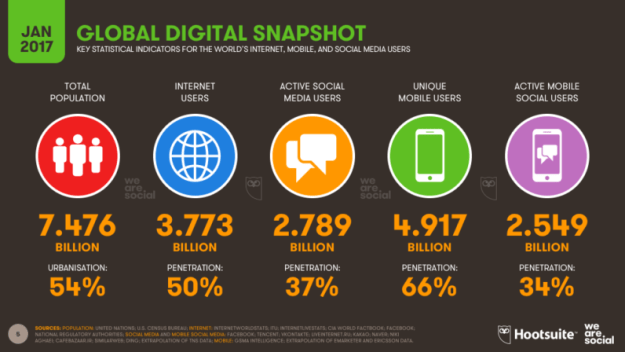
Just a month ago, it was revealed that Facebook has more than two billion active monthly users. That means that in any given month, more than 25% of Earth’s population logs in to their Facebook account at least once.


This kind of scale is almost impossible to grasp.


Here’s one attempt to put it in perspective: imagine Yankee Stadium’s seats packed with 50,000 people, and multiply this by a factor of 40,000. That’s about how many different people log into Facebook every month worldwide.


A smaller window

The Yankee Stadium analogy sort of helps, but it’s still very hard to picture.

The scale of the internet is so great, that it doesn’t make sense to look at the information on a monthly basis, or even to use daily figures.

Instead, let’s drill down to just what happens in just one internet minute:

Internetminute

Created each year by Lori Lewis and Chadd Callahan of Cumulus Media, the above graphic shows the incredible scale of e-commerce, social media, email, and other content creation that happens on the web.

Have you read?

  • If you’re using emojis at work you need to stop. This is why
  • 6 ways social media is changing the world
  • These are the top 10 emerging technologies of 2017

Content competition

If you’ve ever had a post on Facebook or Instagram fizzle out, it’s safe to say that the above proliferation of content in our social feeds is part of the cause.

In a social media universe where there are no barriers to entry and almost infinite amounts of competition, the content game has tilted to become a “winner take all” scenario. Since people don’t have the time to look at the 452,200 tweets sent every minute, they naturally gravitate to the things that already have social proof.

People look to the people they trust to see what’s already being talking about, which is why influencers are more important than ever to marketers.

Eyes on the prize

For those that are able to get the strategy and timing right, the potential spoils are salivating:


InternetSnapshot

The never-ending challenge, however, is how to stand out from the crowd.

Written by

Jeff Desjardins, Founder and editor of Visual Capitalist

The views expressed in this article are those of the author alone and not the World Economic Forum.

Article link: https://www.weforum.org/agenda/2017/08/what-happens-in-an-internet-minute-in-2017

Rethinking The United States’ Military Health System – Health Affairs

Posted by timmreardon on 12/26/2017
Posted in: Uncategorized. Leave a comment

Arthur Kellermann  April 27, 2017

Military-Health

During Operations Enduring Freedom and Iraqi Freedom (2001–2014), the United States’ military health system completely transformed its approach to casualty care, achieving the highest rate of survival from battlefield wounds in the history of warfare. It is one of the most remarkable accomplishments in the history of US medicine.

Ironically, the same health care system that worked miracles “down range” in Iraq and Afghanistan faces mounting criticism at home. How can this be? In part, it is because the military health system has two distinctive missions: support combat and humanitarian assistance missions overseas and provide comprehensive health services to millions of service members, their families, and military retirees at home.

The core mission of the military health system is unique. Unlike the Department of Veterans Affairs (VA) and large, private health care systems, the military health system must be ready to deploy thousands of health care providers to the other side of the world at a moment’s notice and fly critically wounded warfighters home within one to three days of injury [See Photo Above]. Since the founding of our Republic, military medicine has supported our armed forces whenever and wherever they go in harm’s way.

The other mission of the military health system is to deliver health care at home through a network of military hospitals and clinics, supplemented by health care purchased from thousands of private doctors and other providers. This second mission reinforces the first: Service members stay healthy, and when deployed, they can be confident that their families will be looked after. Military health care providers between deployments maintain their clinical skills by treating service members and millions of beneficiaries. Military hospitals provide valuable platforms for teaching the next generation of uniformed health care professionals and standby capacity for combat casualties.

The Current Challenge

Some critics allege that the military health system’s stateside mission costs too much, delivers care of uneven quality, and doesn’t attract enough complex cases to keep provider skills sharp between deployments. They want the Department of Defense to close most of its remaining facilities, outsource the care to the private sector, and position more military providers in civilian hospitals. Before these ideas receive serious thought, it is worth examining the assumptions on which they are based:

Costs

According to the Congressional Budget Office (CBO), the Department of Defense spends $52 billion, about 10 percent of its budget, to provide a variety of services to 9.4 million beneficiaries. This total includes costs not counted by civilian health systems, such as $1 billion annually for military health research and billions more for “TRICARE for Life,” a first-dollar, wraparound plan Congress mandated to supplement the Medicare coverage of military retirees. In fact, yearly spending varies by $2 billion or more due to fluctuations in military construction. To put this in context, in 2016 Kaiser Permanente collected $64.6 billion to care for its 11.3 million members. The Department of Defense’s FY2017 budget for military health is $48.8 billion to care for its 9.4 million beneficiaries.

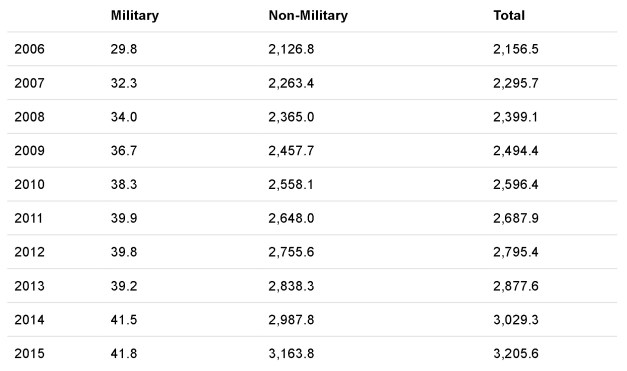
Growth in health care spending is not limited to the military. Civilian health spending has outpaced our nation’s economy as far back as 1950. Between 1999 and 2009 alone, health spending grew so fast, it wiped out the income gains of average US families. Military health spending grew too, but recently it has increased at a far slower pace than civilian health spending. According to the Centers for Medicare and Medicaid Services (CMS), between 2009 and 2015, civilian health spending increased 32.6 percent. During the same timeframe, military health spending grew 13.9 percent (See Exhibit 1). A recent analysis produced by the CBO attributes most military health spending growth since 2000 to congressionally mandated expansion of TRICARE benefits, including the establishment of TRICARE for Life, an insurance option that eliminates most out-of-pocket costs faced by Medicare-eligible military retirees and their families.

US health care is not only costly; it is inefficient. The National Academy of Medicine estimates that our nation wastes $750 billion per year on “unnecessary or inefficient services, excessive administrative costs, high prices, healthcare fraud and missed opportunities for prevention.” In 2015, aggregate health care spending approached $3.2 trillion dollars. Only 1.5 percent is devoted to military health. Given these facts, it is hard to see how outsourcing more care will save money.

Quality

Critics assert that the military health system does not perform enough complex surgical procedures in peacetime to maintain provider skills. The volume-quality relationship is strong, but it is not absolute. High-quality training and strict adherence to procedures—an approach first championed by military aviation—can largely compensate for smaller case volumes. In 2014, the military health system compared its performance to three of our nation’s top health care systems—Geisinger, Intermountain Healthcare, and Kaiser Permanente—and found that it did better in some areas, worse in others, and generally as well overall.

A recent American College of Surgeons assessment of surgical outcomes, based on national data, identified several military health system hospitals as top performers. Another study found that the military health system does not have the racial disparities in care commonly seen in civilian hospitals. A recently published analysis of more than 10,000 military health system beneficiaries with carotid artery stenosis (a condition that can lead to stroke) found that patients treated by military doctors got fewer procedures but had better outcomes than beneficiaries treated by private, fee-for-service doctors.

Productivity

Is the military health system less productive? That depends on how productivity is defined. Because most civilian hospitals rely on fee-for-service billing, their staffs have a strong incentive to see lots of patients and order large numbers of tests and treatments. This translates into the appearance of productivity as measured by “relative value units” (RVUs)—the most commonly used metric of clinical workload. There are two problems with this approach, however. First, RVUs measure the volume of care, not its value. It doesn’t even matter if a procedure helped the patient; it only matters that it was done. Second, RVUs undervalue primary care and overvalue procedures performed by specialty providers. As a result, keeping patients healthy looks less “productive” than filling hospital beds and performing lots of complex procedures.

Consider the previously-mentioned study of military health system beneficiaries with carotid artery stenosis. Although military doctors performed fewer expensive procedures and the patients they treated were less likely to die or have a stroke than those treated by fee-for-service doctors, judicious management looks less “productive” since it generates fewer RVUs.

The purpose of the military health system is to protect the health of the force, not to generate RVUs. In 1866, Dr. Jonathan Letterman, the “father of battlefield medicine,” wrote: “A corps of medical officers was not established solely for the purpose of attending the wounded and sick. The leading idea is to strengthen the hands of the Commanding General by keeping his army in the most vigorous health, thus rendering it, in the highest degree, efficient for enduring fatigue and privation, and for fighting.” In light of this responsibility, using RVUs to assess the clinical productivity of the military health system makes as much sense judging the effectiveness of a combat unit by counting the number of bullets it shoots.

Finding A Better Way

Rather than dismantle the military health system, policy makers should let it operate more efficiently. Among the options that follow are four opportunities created by provisions embedded in Section VII of the 2017 National Defense Authorization Act (NDAA):

  1. Make greater use of enlisted providers—Overseas and aboard ships, the military health system relies on its corpsmen, medics, and med techs to deliver routine care under supervision, as well as save lives in combat. However, the moment these skilled providers come home, they are relegated to minor clinical or clerical tasks because no comparable role exists in civilian health systems. If the military health system allowed them to function as “primary care technicians,” it could expand access to care, reduce use of emergency departments and urgent care centers, and strengthen readiness for future deployments.
  2. Consolidate treatment of complex cases—When a service member is wounded in combat, he or she is MEDEVACed to the nearest combat support hospital, then flown by Critical Care Air Transport to a stateside military hospital. Two decades ago, the military health system used a similar approach inside the United States to concentrate complex care to its top medical centers. If it reinstituted the practice, patients and taxpayers would benefit. Studies show that Walter Reed’s Murtha Cancer Center achieves better outcomes at lower cost than comparable civilian cancer centers.
  3. Systematically improve practice—Many of the advances in trauma care in Iraq and Afghanistan came from the Joint Trauma System, which systematically analyzed casualty data to identify opportunities to improve. If the military health system employed a similar approach to assess delivery of high-risk care in stateside hospitals, it could ensure that beneficiaries get the right care at the right place for the right reason.
  4. Standardize to optimize—The US armed forces have learned the value of training and fighting as a joint force. Military health care providers have learned the same lesson in combat zones but when they return home, they tend to revert to the old ways. Some variations in approach are inevitable, but the military health system should strive to standardize key workflows, equipment, and even the layout of its operating rooms and delivery suites. That way, when a military health system provider rotates to a new hospital, he or she can swiftly integrate into a new health care team.
  5. Keep patients healthy—In war zones, protecting the health of the force is a top priority. Taking an equally diligent approach to population health at home could produce substantial benefits. Redoubling efforts to boost rates of vaccination, discourage smoking and use of smokeless tobacco, prevent injuries, and treat hypertension and obesity could generate huge downstream savings.
  6. Treat selected civilians—In war zones, commanders have the latitude to treat ill and injured civilians if doing so will help win the support of the local population. Currently, most lack this authority in the United States. At present, only two military medical centers participate in their state’s trauma system. If more were allowed to do so, their medical staffs would benefit from the extra caseload, and the civilians they treat would benefit from the world-class trauma, burn, and rehab care available at these medical centers. Any VA hospital with a waiting list should preferentially refer its patients to the closest military hospital. Section 717 of the NDAA should facilitate the needed changes in policy.
  7. Ensure clinical proficiency—Military surgeons are already partnering with the American College of Surgeons to devise objective ways to assess surgeons’ readiness to deploy. Recently, they devised a way to cross-walk Current Procedural Terminology codes used to track performance of surgical procedures to critical wartime surgical skills. Once this approach is refined, it will be extended to other wartime specialties such as emergency medicine, anesthesiology, and intensive care. This will help the military health system comply with Section 708 of the NDAA.
  8. Measure what matters—To ensure military providers address the “quadruple aim”—readiness, better health, better care, and lower per capita costs—the military health system has adopted 30 “Partnership for Improvement” measures. Adopting a smaller, high-yield set of “vital signs” metrics devised by the National Academy of Medicine would allow military health system leaders to compare their system’s overall performance to other large health systems and satisfy Section 730 of the NDAA.
  9. Embrace Telehealth—In deployed settings, the military health system uses telehealth to support health care providers working in small forward operating bases and on ships at sea. Global teleconferencing allows trauma experts across 12 time zones to regularly meet, discuss complex cases, and identify opportunities to improve. Despite its success with telehealth overseas, the military health system was slow to adopt it at home due to stringent information security requirements and budgetary constraints. Section 718 of the NDAA directs the military health system to rapidly expand the use of telehealth in its clinical operations.
  10. Centralize licensure and credentialing—Typically, military health care professionals change duty stations every two or three years. Federal law allows those licensed in one state to practice in others, but only on federal property. If providers could reach outside their treatment facilities, the military health system could fully use telehealth and improve access to care. Provider credentialing is equally cumbersome. Although the military health system has a global reach, it still credentials most providers at the facility level. A systemwide approach makes more sense.

Facing the Future

In Iraq and Afghanistan, the military health system demonstrated a remarkable capacity to innovate when necessary to protect the health of US and coalition forces. Dr. Don Berwick, founder of the Institute for Healthcare Improvement, recently observed that “Military medicine put the learning health system framework into practice before the Institute of Medicine described it.” Today, US soldiers, sailors, airmen, and Marines know that if they are badly wounded in combat, the military health system offers their best chance of coming home alive and recovering. This confidence is a force multiplier on the battlefield.

Looking forward, we cannot assume that future conflicts will resemble the most recent ones. As US forces evolve to meet the threats posed by near-peer adversaries, the military health system must evolve, too. The best way it can maintain readiness to support combat operations and strengthen its capacity to innovate is to employ the same techniques, teamwork, and enterprising spirit that serve it so well “down range” to meet the health care needs of its beneficiaries in the United States.

Coaches often remind their teams that “You play the way you practice.” By “practicing” at home the way it “plays” overseas, the military health system can deliver better care at lower cost and strengthen its capacity to support and sustain our armed forces on any future battlefield.

Exhibit 1: Military Health Spending, 2006–2015
MHS1

Source: National Health Expenditure 2015 Centers for Medicare & Medicaid Services, Office of the Actuary, National Health Statistics Group from the methodology paper. Note: Department of Defense spending for health care services (hospital, ambulatory care, provider, diagnostics, pharmacy, etc.) an this total does not include the cost of accrual payments made to fund TRICARE for Life. Non-Military: Includes out of pocket, private insurance, Medicare, Medicaid, CHIP, VA, Worker’s compensation, Indian Health Services, General Assistance, Vocational Rehabilitation, maternal/child health, other federal and state programs that provide subsidies, high risk pools under ACA, school health, public health, SAMHSA treatment services, investments in research and facilities. Total spending for health care, including federal and state programs, private health insurance, and out-of-pocket spending. Column numbers may not add to totals due to rounding. Dollar amounts shown are in current US dollars.

Author’s Note

The author is dean of the School of Medicine at the Uniformed Services University (USU) of the Health Sciences, and as such he is an employee of the Department of Defense. His views are his own and do not necessarily reflect those of USU, the military health system, the Department of Defense, or the US government.

Article link: https://www.healthaffairs.org/do/10.1377/hblog20170427.059833/full/

Vint Cerf: Putting Humanity at the Center of the Internet

Posted by timmreardon on 12/26/2017
Posted in: Uncategorized. Leave a comment
Vala Afshar, Contributor, Chief Digital Evangelist, Salesforce

12/10/2017 06:29 pm ET Updated Dec 10, 2017

“We cannot solve our problems with the same thinking we used when we created them.” —Albert Einstein

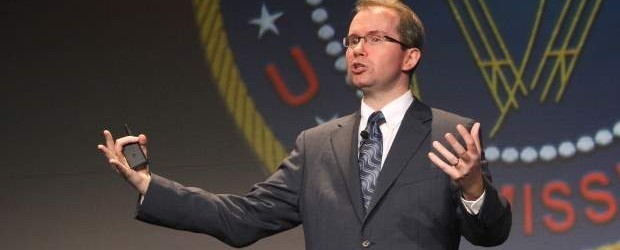
Vinton G. Cerf is Vice President and Chief Internet Evangelist for Google. He contributes to global policy development and continued spread of the Internet. Widely known as one of the “Fathers of the Internet,” Cerf is the co-designer of the TCP/IP protocols and the architecture of the Internet.   He has served in executive positions at MCI, the Corporation for National Research Initiatives and the Defense Advanced Research Projects Agency and on the faculty of Stanford University.

Cerf’s contributions have been acknowledged and lauded, repeatedly, with honorary degrees and awards that include the National Medal of Technology, the Turing Award, the Presidential Medal of Freedom, the Marconi Prize and membership in the National Academy of Engineering.

VintCerf

Cerf is also focusing on putting humanity at the center of the Internet. To do this, Cerf serves as the Chairman and co-founder of the People Centered Internet (PCI). The People-Centered Internet (PCI) believes in putting humanity – people and their needs and aspirations – at the center of the Internet. PCI is committed to using the power of the Internet to improve the lives of the global poor by collecting data that can be used to transform communities and meet basic needs.

“The Internet provides unprecedented access to education, medical assistance, economic opportunity, services and personal connections. Yet of the seven and a half billion people on the planet, less than half are online today. People-Centered Internet exists to change this. PCI is an international coalition created to connect the dots, fill in the gaps, and unite humanity. Founded and chaired by Vint Cerf, the Internet’s co-inventor and architect, People-Centered Internet is central to activating international commitments to make sure the Internet reaches everyone.” — People Centered Internet

To learn more about the People Centered Internet, Ray Wang, CEO and founder of Constellation Research, and I invited Cerf and his team, including PCI co-founder Mei Lin Fung and Dr. David Bray, Executive Director at PCI to join our weekly show DisrupTV.

Here are the key takeaways from our conversation with Vint Cerf:

The People Centered Internet: Mission

The mission of the People Centered Internet is to make the internet useful for people in some measurable way. It is about making information more locally available, across multiple languages, and to help people with their health, well-being and ability to work. The point is to pay attention to the Internet infrastructure and applications to benefit people. It is more than just access to the Internet infrastructure, it is also about access to the applications that can help improve the quality of life and work.

Large Scale Change Requires Strong Selling Skills

According to Cerf, in order to create the conditions for success, and to be a successful change agent for large scale initiatives, you must be able to sell your ideas to other people. “You won’t do anything very big, if you cannot convince other people to do what you want to get done,” said Cerf. Once you can learn to sell your idea, and motivate people, then you can effectively drive change. Cerf reminds his engineers to master the craft of selling their ideas in addition to building products.

Large Scale Change Must be Network Driven

Dr. David Bray notes that technology can bring people together in order to create positive outcomes. The goal of PCI is to provide expertise and the power of the community to help improve the quality of life and work around the world.

Artificial Intelligence (AI) Will Be a Benefit to Society

According to Cerf, AI and machine learning will be used as tools to augment our ability to do things better. Cerf spoke about Google search as an example benefit. He also talked about language translations via machines to help connect with people around the world. Cerf notes that we are already using AI in everyday applications that are hidden from us. Cerf is not ready to discount the concerns regarding autonomous software – software that is running on its own that may make mistakes. We must ensure there is enough care and control to ensure proper software behavior powered by AI.

Reduction of Cost, For Both Technology and Access, Will Lead To An Expanded Internet

Cerf believes that we are driving cost out of devices that are needed to access the Internet. He referenced the Google Chrome Book as a great contribution towards Internet access using affordable technology. The cost for access will also come down, if we can encourage competition. Countries can adopt rules to invite competition and this will drive costs out. Cerf notes that that the digital divide is largely an economic one.

If You Want To Make a Big Impact, Solve a Real Problem

Cerf reminds us of Jeff Bezos as an example of someone who was thinking bold by building the biggest book store in the world. But Cerf didn’t start off by changing the world. He simply wanted to solve a problem that would make a difference. Cerf advice to change agents is to work on solving a real problem. Cerf shared a parable with us about solving a real problem by being smart and focused.

Find The Right Pebble, Not Another Boulder

The pebble and the boulder parable by Vint Cerf: Imagine that you are living in a little town in a valley, surrounded by mountains, and there is a giant boulder at the top of the mountain. One day you notice that the boulder is about to roll down the hill and destroy the village. Now you know that you cannot run up the hill and stop the boulder – you are too small, the boulder is too big. But you are smart and you know that if you find a pebble, of the right shape, and you put it in the right place, it will divert the boulder. So that’s your job. Find the the pebble that can divert the boulder and then make a big difference. The secret is finding the pebble, not another boulder.

Mr. Cerf also talked to us about the invention of the world wide web, search engines, social networks and other technologies that stemmed from the Internet. Please watch our full interview with the Vint Cerf, the Founding Father of the Internet and Co-Founder and Chairman of the People Centered Internet.

Mei Lin Fung founded the People Centered Internet chaired by Vint Cerf. She is the founding Unit Coordinator for the California Health Medical Reserve Corps. As an early pioneer, Mei Lin co-designed the first CRM system at Oracle. Mei Lin has served as the technical lead for the US Department of Defense’s initiative on the Future of Health, and is a member of the Digital Economy and Society World Future Council of the World Economic Forum. She also serves as vice chair of the Internet Inclusion IEEE sub-committee, one of 3 tracks under the IEEE Internet Initiative. You can follow Fung on Twitter at: @meilinfung.

The important lessons learned by speaking to Mei Lin Fung included:

The Power of Communities Drive Innovation and Inventions

Fung believes that we achieve more, and do good, by creating a condition for success based on communities. The guiding principle for PCI is to help expand and develop an Internet, by the people, for the people.

Fung reminds us that we have to be people centered as we evolve and expand the Internet to the 4 billion people today that do not have access to Internet. Fung is one of the most positive and passionate people that I know. She is an incredible connector and beacon of light for many technologist, entrepreneurs and business leaders.

Fung spoke to us about the PCI efforts regarding the rebuilding of Puerto Rico. PCI is working with network of 81 health centers in Puerto Rico to rebuild the digital infrastructure after the devastating storms of 2017. Using a network of networks, PCI is determined to help improve the current and future state of Puerto Rico. Fung spoke about the importance of ‘people centered’ communities that shift from top-down mandates towards breakthrough collaborative environments that achieve far more.

Dr. Bray reminds us that movements begin when you can set a vision that is informed by listening to the community. The art of working towards a shared goal, up front, then leads to a collation of change agents to drive positive outcomes. Set the vision, establish a shared goal, and finally help the community make forward progress. To be adaptive and responsive, PCI is working towards empowering the edge to measurably improve the quality of life using the Internet.

Fung shared incredible statistics regarding the efforts to rebuild Puerto Rico. She is also reminds us that anytime she digs into any community, she finds amazing gifts and talents of the community, including the incredible change agents who are working with PCI to assist with regaining power and other infrastructure rebuilding initiatives.

Afters speaking Fung, we invited an inspiring public servant and positive change agent to discuss the importance of inclusion and diversity for business to achieve greater positive outcomes.

Teresa Booher is a program analyst at the National Institutes of Health OCIO. She is a role model public servant and a positive change agent. Teresa joined the federal government as a public servant in 2011. While her primary role focuses on IT Policy and Strategic Planning, her work extends well beyond her official position. Teresa has been a featured speaker across government and private industry sharing her experience and encouraging accessibility and inclusion, particularly in the IT space. Teresa has been actively engaged in activities to promote inclusion of persons with disabilities. In 2011, she spearheaded the establishment of a blind and low-vision resource sharing group, 3 Blind Mice, and continues to lead the group today.

Booher’s life took a big change when she went from being fully sighted to being blind essentially overnight. Booher spoke about the fact that the largest minority population in the US is people with disabilities, and yet when most companies talk about inclusion and diversity, the discussion is less about disabilities.

“Diversity and inclusion of disabilities is one categorization that does not discriminate,” said Booher. It stretches across all ages, all races, all sexual preferences, and religions. Disabilities will include all and most disabilities are acquired at some point in your life – not something you are born with. It is a matter of when. The longer you live, the more likely that you will acquire a disability – hearing, vision, etc. Any impact on a system of your body, that influences how you live is a general definition of disabilities.

Booher is very optimistic about new technologies like AI (machine learning, natural language processing) that can further empower individuals with disabilities. When product designers consider improving products for all, then build better and smarter products and services.With technology and pace of innovation at current rates, there is great optimism with respect to possibilities to improve the quality of life and work experiences.

Loss of vision did not define Booher. She is an incredible positive change agent and a relentless champion for informing, education and inspiring organizations to be mindful of inclusion and diversity as it relates to the population with disabilities. I highly encourage you to watch our conversation with Booher – she will inspire you to become a positive change agent.

Ray and finished our conversation by speaking to Dr. David Bray about PCI and his areas of focus for 2018.

Dr. David A. Bray is the Executive Director at the People-Centered Internet, focused on providing support and expertise for community-focused projects that measurably improve people’s lives using the internet. . Dr. Bray was named one of the top “24 Americans Who Are Changing the World” under 40 by Business Insider in 2016. He was also named a Young Global Leader by the World Economic Forum for 2016-2021. Dr. Bray He accepted a role of Co-Chair for an IEEE Committee focused on Artificial Intelligence, automated systems, and innovative policies globally for 2016-2017 and has been serving as a Visiting Executive In-Residence at Harvard University. He was named the most social CIO in the world in 2016 so he is a must follow on Twitter: @chief_ventures.

Bray

Dr. Bray summarized our conversation by reminding us that it is not about a technology or individual, but rather the community and the network of networks that drive large scale change. Bray also reminds us that the obstacles and diversities that we all face at some point in our lives does not have to define us. Dr. Bray said that real change happens when people connect with other people and respect each other, even if our points of view differ. Ray Wang reminds us that we must be the change that we want to see the world. Change has to start with you. We closed our show with a haiku from Dr. David Bray:

“networks can help bring together diverse ideas and communities,

of different people, sometimes quietly, sometimes  boldly — hearts and minds,

each of us, can be positive change agents and help improve the world.”

I highly encourage you to learn about the People Centered Internet. Each of us have the opportunity to be positive change agents. Together, we can all make a positive difference.

Article link: https://www.huffingtonpost.com/entry/vint-cerf-putting-humanity-at-the-center-of-the-internet_us_5a2da2e7e4b04e0bc8f3b601

A Christmas Message from Brother James, On The Consensus Network – LaSalle College High School

Posted by timmreardon on 12/23/2017
Posted in: Uncategorized. Leave a comment

 LaSalle

Dear La Salle College High School Family,

As the Christmases add up in our lives, we probably find ways to distinguish one from another.  One might be in the year of the big snowstorm, or that in which temperatures on Christmas Day hit 70 degrees.  We might mark them by references to changes in family dynamics, the first with a new daughter-in-law or grandbaby, the first spent without a son and family who have moved to the west coast or a grandparent who has moved beyond places we can find with Google Maps

For most of us, 2017 will be the first Christmas with Bitcoin, or perhaps more accurately, “Bitcoin consciousness.”  After all, Bitcoin has been around a while, but it has just drifted into awareness for most of us now that it has come to be traded on the futures markets in a couple of locations and now that its relative value has soared

What is Bitcoin?  Well, it’s a cryptocurrency.  That’s hardly a helpful response.  “What’s that?”  Well, one way of thinking about it is as “limited entries in a database that no one can change without fulfilling specific conditions.”  Huh? I’d certainly never invest in that.  So, try this.  Currency is always based on value.  First, it was the value of precious metals.  Soon it became the value of a central authority, typically a nation state or at least a central bank.  With cryptocurrencies, actors have faith in a “consensus network” which agrees that Investor 1 has Bitcoin of n value, some portion of which he is free to transfer to Investor 2 in return for something bearing a mutually agreed upon value

What?  Isn’t this supposed to be a Christmas letter?   This sounds like one that should come have come out on the 30th anniversary of Black Monday a couple of months ago or one that would be better saved for Black Friday next year.  Well, maybe, but don’t overlook the connection.  What thrills (or frightens depending on perspective) Bitcoin enthusiasts so much is that its value comes from a decentralized consensus network.  Instead of trusting the probity of a particular government, investors trust two things: the network and mathematics

This would be quite the jolly holiday epistle if I started discussing mathematics, so let’s focus on that idea of a consensus network.  Isn’t that fundamentally what we have here at La Salle College High School, regardless of the perspective from which we join the network? Whether our commitment to this school spans four years or 40, belonging here tends to ensure that we emphatically concur that:

  • The potential of young people is not something to take for granted, but something to invest in—whether you are a parent, a teacher, or someone who followed the same path in earlier times;
  • The high school years are among the most influential in a man’s life, whether he is going through them right now, or looking back on them from the perspective of 50 years out;
  • That adults who function not as relentless taskmasters, not as reservoirs of erudition, not as chummy avatars of arrested development, but as wise older brothers and sisters, vigilant without being suffocating, prescient about what is to come without defining that future reality, are those best likely to form the character of that Christian gentleman we hold up as an ideal;
  • That gentleness itself, however much it may be devalued in our recent national or global discourse, is a trait to be both respected and nurtured;
  • That advantages, whether intellectual, athletic, economic, social, or psychological, are only given us for the general good, for the creation of community, to advantage the least advantaged, and, ultimately, to build up the Body of Christ;
  • That the people surrounding a student at La Salle are not merely classmates, interchangeable seat-fillers assigned in forty-minute increments over four years.  Rather, all are windows opening into the Presence of God, and many are destined to be brothers for life;
  • That life, whether looked at from the perspective of 18 or 81 years, is not best viewed as project to be completed, battle to be won, or trial to be endured, but as Sacrament: a privileged encounter with the living God.

Such values are true throughout the year, of course, but at Christmas, our network focuses on a few other subjects of clear consensus:

  • That God loves us enough to enter into our human reality, not only once for all in Bethlehem, but in the people we encounter and the events we participate in each day, people and events we may only make time to reflect on the significance of in the season of Christmas;
  • That God loves us not based on how we shape up against some “centralized authority” defining the ideal for a married couple, the epitome of family relationships, or even a paragon of fidelity to the Catholic religious life, but just exactly as we are–flawed and bumbling, untidy and short-tempered, resentful and corner-cutting–loves us even while we’re scraping the burnt edges of the crescent rolls off into the trash, because “where are you going to find someplace that sells this dough at 3PM on Christmas Day?”
  • That such careful salvage activity speaks not only of a poorly calibrated oven temperature.  It speaks of love, love for that smorgasbord of personality quirks you call a family and call to your table this Christmas, the love of the Father who gave us His Son to share our lives and understand our experience, the love of a young woman who responded to the overwhelming and ineffable with the stunningly simple, “Be it done unto me according to your word.”

Time will tell whether Bitcoin heralds the dawn of a new economy that some have predicted.  Time has shown, however, that nothing in the history of joy compares with the transforming potential brought by that first Christmas day.  May such joy be felt in your hearts and those of your families this Christmas morning…and Forever!

Fraternally,

Lasalle1


Brother James L. Butler, FSC
President

FDA Releases Guidance on Advancing New Digital Health Policies – HIMSS

Posted by timmreardon on 12/23/2017
Posted in: Uncategorized. Leave a comment

December 15, 2017

HIMSSx

On December 7, 2017 the Food and Drug Administration (FDA) took their next step in the implementation of the 21st Century Cures law, with the release of three new policy documents in hopes of advancing the FDA’s approach to the development and proper oversight of innovative digital health tools. This release is another step in the agency’s Digital Health Innovation Action Plan, which began this past summer and outlines the FDA’s efforts to reimagine its approach to ensuring all Americans have timely access to high-quality, safe and effective digital health products.  The three new guidances-two draft and one final-offer additional clarity about where the FDA sees its role in digital health, and importantly, where we don’t see a need for FDA involvement.

The first draft guidance, “Clinical and Patient Decision Support Software,” outlines the FDA’s approach to clinical decision support software (CDS). This type of technology has the potential to enable providers and patients to fully leverage digital tools to improve decision making. The FDA wants to encourage developers to create, adapt and expand the functionalities of their software to aid providers in diagnosing and treating old and new medical maladies.  This draft guidance is intended to make clear what types of CDS would no longer be defined as a medical device, and would not be regulated by the agency. For example, generally, CDS that allows for the provider to independently review the basis for the recommendations are excluded from the FDA’s regulation.

The second draft guidance being released, “Changes to Existing Medical Software Policies Resulting from Section 3060 of the 21st Century Cures Act,” addresses other digital health provisions included in the Cures Act. Specifically, this second guidance outlines the FDA’s interpretation of the types of software that are no longer considered medical devices. The agency is making clear that certain digital health technologies – such as mobile apps that are intended only for maintaining or encouraging a healthy lifestyle – generally fall outside the scope of the FDA’s regulation. Such technologies tend to pose a low risk to patients, but can provide great value to consumers and the healthcare system. Both of these draft guidance are subject to stakeholder comments which are due on February 6, 2018.

Finally, the FDA also issued a final guidance, “Software as a Medical Device: Clinical Evaluation,” in fulfillment of international harmonization efforts.   This guidance establishes common principles for regulators to use in evaluating the safety, effectiveness and performance of Software as a Medical Device (SaMD). This final guidance provides globally recognized principles for analyzing and assessing SaMD, based on the overall risk of the product.

Article link: http://www.himss.org/news/fda-releases-guidance-advancing-new-digital-health-policies

HHS task force says healthcare cybersecurity in ‘critical condition’ – Healthcare IT News

Posted by timmreardon on 12/23/2017
Posted in: Uncategorized. Leave a comment

A cybersecurity task force report released Friday revealed a laundry list of vulnerabilities including the lack of capable security workforce.

By Jessica Davis  June 05, 2017

Hospital Emergency Entrance

U.S. healthcare organizations are severely flawed when it comes to cybersecurity and lags other sectors in safeguarding systems and sensitive information, the U.S. Department of Health and Human Services’ said Friday in its long-awaited Health Care Industry Cybersecurity Task Force report.

Although the healthcare industry is working toward modernizing its IT systems and building security, the failures carry very high risk since the information these organizations hold is often the most private.

“What we consistently encountered was a strategic pitfall in cybersecurity environment,” said Atlantic Council Director of the Cyber Statecraft Initiative and HHS Cybersecurity Task Force member Josh Corman. “Healthcare cybersecurity is in critical condition.”

[Also: Ransomware worse than WannaCry discovered, also leverages NSA tools]

To combat this, the task force identified six key imperatives: Define and streamline leadership, governance and expectations for healthcare cybersecurity; improve medical device and health IT security and resilience; develop the necessary healthcare workforce capacity to prioritize and ensure cybersecurity awareness and technical capabilities; increase industry readiness with better cybersecurity awareness and education; identify mechanisms to protect research and development efforts and intellectual property from attacks and exposures; and improve data sharing of industry threats, risks and mitigation.

Specifically, healthcare staffing issues have become so dire that three out of four hospitals don’t have a designated security person and have been forced to get creative with security needs.

[Also: Symantec cites links between WannaCry ransomware and Lazurus, but ICIT calls report a ‘distraction’]

In 2015, the healthcare industry experienced more breaches stemming from cyberattacks than any other industry, the report found. And the rise of ransomware in 2016 has only compounded the issue.

Adding to these risks is the flawed perception of small organizations that only large hospitals are being targeted by cybercriminals, and the task force found this is not the case. In fact, all healthcare organizations, no matter the size are being targeted due to the value and sensitivity of healthcare data.

“Less mature entities have yet to understand or implement these protections due to a lack of awareness, financial resources or staff,” the report authors said.

“Given the interconnectivity and diversity within the sector, the interdependency of subsectors on one another, and the disparity between organizations’ ability to address cybersecurity issues, healthcare as a whole will only be as secure as the weakest link,” they said.

The report — compiled by 21 cybersecurity experts — contains over 100 recommendations in response to these imperatives that will bolster cybersecurity in the healthcare industry. Included in those recommendations is a call for a healthcare-specific cybersecurity framework.

The report also called for the HHS Secretary to name and resource a cybersecurity leader for sector engagement, who would work with federal, state and industry partners. The leader would create a plan to establish cybersecurity priorities, report to other federal agencies and coordinate with the U.S. and international intelligence agencies to bolster the Vulnerability Equities Process.

HIMSS applauded the report, which it feels “emphasized the themes put forward in the HIMSS Cybersecurity Position Statement from September 2016, which recommended adopting a universal information privacy and security framework for the health sector, creating an HHS cyber leader role, and addressing the shortage of qualified cybersecurity professionals.”

“HIMSS also appreciates the focus from the Task Force on promoting the greater sharing of threat information across the entire community, and tailoring information sharing for easier consumption by small and medium-size organizations,” officials said in a statement. “HIMSS stands ready to continue to work with HHS to increase healthcare industry readiness through improved cybersecurity awareness and education.”

http://players.brightcove.net/1824526989001/default_default/index.html?videoId=5403329815001

Article link: http://www.healthcareitnews.com/news/hhs-task-force-says-healthcare-cybersecurity-critical-condition

OIG: HHS audit results reveal cybersecurity flaws in configuration, access controls – Healthcare IT News

Posted by timmreardon on 12/23/2017
Posted in: Uncategorized. Leave a comment

The watchdog’s biggest concern was the agency’s identity and access management at four operating divisions in 2016.

By Jessica Davis December 20, 2017

HHS-building

The U.S. Department of Health and Human Services security controls need improvement, and there are flaws in its configuration management and access controls, according to a new Office of the Inspector General report.

OIG audited four HHS operating divisions in 2016, penetration testing the agency’s network and web applications. The watchdog made six observations, which HHS concurred with, in general – and findings were identified by HHS and were either corrected or are in the process of being corrected.

The report was restricted and did not list specific flaws, but it’s just the latest in a series of reports that highlight the agency’s flawed security.

In March, OIG found that while HHS security programs had made slight improvements, nine areas had serious flaws. The watchdog’s biggest concern was the agency’s identity and access management. OIG found that two of HHS’ departments didn’t follow account management policies, including shared accounts and removing inactive accounts in a timely manner.

[Also: HHS task force says healthcare cybersecurity in ‘critical condition’]

And a Brookings Institution report from 2105 called HHS’ cybersecurity focus “abysmal.”

OIG will continue to audit HHS’ cybersecurity and incident response capabilities and will release the results in 2018.

Congress also is working to improve cybersecurity at HHS. House leaders introduced legislation in the fall to elevate cybersecurity leadership at the agency. If passed, the chief information security officer would be required to report directly to the HHS secretary – a move outlined in HIMSS’ three legislative goals for 2018.

Article link: http://www.healthcareitnews.com/news/oig-hhs-audit-results-reveal-cybersecurity-flaws-configuration-access-controls

Twitter: @JessieFDavis
Email the writer: jessica.davis@himssmedia.com

Topics:

Government & Policy, Privacy & Security

Oversight of IT and Cybersecurity at the Department of Veterans Affairs – U.S. House of Representatives – IT Oversight

Posted by timmreardon on 12/18/2017
Posted in: Uncategorized. Leave a comment

Subcommittee on Information Technology

Subcommittee on Information Technology

Hearing Date: December 7, 2017 2:00 pm 2154 Rayburn HOB
[youtube https://www.youtube.com/watch?v=DqEMICgVTLw&w=650&h=366

PURPOSE:

  • To examine the Department of Veterans Affairs (VA) information technology systems, including Federal Information Technology Acquisition Reform Act (FITARA) performance, development of the Electronic Health Record system, and efforts to modernize its Veterans Health Information Systems and Technology Architecture (VistA).

BACKGROUND:

  • In June 2017, Secretary Shulkin announced the VA’s plan to discontinue

    their attempt at developing an Electronic Health Record that would be interoperable with the Department of Defense health information systems
    and purchase the same electronic health record system used by the Department of Defense.
  • On November 15, 2017, the Subcommittee on Information Technology held ahearing to examine federal agency implementation of FITARA. The VA received an overall score of B+ on the latest scorecard.
  • On May 27, 2016, Chairman Hurd and Ranking Member Kelly requested information from the GAO regarding VistA modernization efforts. GAO will provide an update of their review.

Witnesses and testimonies

Name Title Organization Panel Document
Mr. Scott Blackburn Acting Chief Information Officer Department of Veteran Affairs Document
Mr. Dominic Cussatt Chief Information Security Officer Department of Veteran Affairs Document
Mr. David A. Powner Director, IT Management Issues U.S. Government Accountability Office Document
Mr. John Windom Program Executive for Electronic Health Records Modernization U.S. Department of Veterans Affairs Document
Mr. Bill James Deputy Assistant Secretary for the Enterprise Program Management Office U.S. Department of Veterans Affairs Document


IT Subcommittee Grills VA on New Health Records Plan – MeriTalk

Posted by timmreardon on 12/18/2017
Posted in: Uncategorized. Leave a comment

By: Grace Ballenger

veterans-healthSince 2001, the Department of Veterans Affairs (VA) has tried three different modernization programs for its healthcare system. So when the department announced another plan to modernize by adopting the same system as the Department of Defense (DoD), the Subcommittee on Information Technology was skeptical and interrogated them in a Dec.7 hearing.

The VA announced in June that it would no longer develop the Veterans Health Information Systems and Technology Architecture (VistA) program, a decentralized system that launched in the early 1980s. Even though physicians voted this system the most user-friendly, VA officials want to move to a centralized, unified system. The VA will centralize its healthcare infrastructure by moving to the same Cerner system as the Department of Defense (DoD). This $10 billion system should begin operating within a year and a half, and be completed in 10 years.

According to Scott Blackburn, the acting CIO for VA, the department decided to abandon the VistA effort because “to bring VistA up to where it needs to be is our most expensive option. VA would have to spend roughly $19 billion over 10 years to upgrade and maintain VistA to industry standards, and this still would not provide all the needed enhancements and upgrades as well as interoperability with DoD.”

The two biggest advantages of adopting the same Electronic Health Records (EHR) system as the DoD are seamless operation and giving veterans one healthcare record from the time they enter the service.

Committee members, including Reps. Will Hurd, R-Texas, and Gerry Connolly, D-Va., expressed skepticism of VA’s plans to modernize. They grilled VA officials about how the system will operate during the transition, how veterans will schedule appointments in that period, and how much of the new system will reside in the cloud. While the current VA scheduling system meets the seven requirements outlined in the Faster Care for Veterans Act, it also has multiple systems performing the same task. Committee members suggested that VA use off-the-shelf scheduling options to transition its program and simplify scheduling options.

Blackburn revealed that the program planned to customize Cerner’s offering as little as possible to avoid the complexity of previous customized systems.

John Windom, the program executive for EHR modernization at VA could not say what percentage of the new system live in the cloud – and conceded that it would not be an entirely cloud-based system.

The VA received a B+ for its grade on the FITARA scorecard, and promised to improve to an A by optimizing its data centers. VA revealed that it has a total of 386 centers. The department closed 23 of them this year and aims to close 91 by the end of 2018. VA asserted that using the Cerner system will help it cut the number of data centers dramatically, and that the department’s ultimate goal is to consolidate to 14 core and 42 special-purpose data centers by 2020.

David Powner, director of IT management issues at the Government Accountability Office (GAO), made five recommendations to VA based on the GAO’s report. He advocated for involving the Executive Office in order to keep leadership consistent despite possible CIO turnover, building a robust program management team, being willing to change operating practices, using lessons from the DoD, and building appropriate cybersecurity measures into the modernization process.

As VA embarks on its latest modernization effort, veterans hoping fourth time’s the charm.

Article link: https://www.meritalk.com/articles/it-subcommittee-grills-va-on-new-health-records-plan/


Posts navigation

← Older Entries
Newer Entries →
  • Search site

  • Follow healthcarereimagined on WordPress.com
  • Recent Posts

    • The Global Healthcare System Is Broken. Japan Fixed It for $4,100 Per Person. 04/10/2026
    • When Not to Use AI – MIT Sloan 04/01/2026
    • There are more AI health tools than ever—but how well do they work? – MIT Technology Review 03/30/2026
    • Are AI Tools Ready to Answer Patients’ Questions About Their Medical Care? – JAMA 03/27/2026
    • How AI use in scholarly publishing threatens research integrity, lessens trust, and invites misinformation – Bulletin of the Atomic Scientists 03/25/2026
    • VA Prepares April Relaunch of EHR Program – GovCIO 03/19/2026
    • Strong call for universal healthcare from Pope Leo today – FAN 03/18/2026
    • EHR fragmentation offers an opportunity to enhance care coordination and experience 03/16/2026
    • When AI Governance Fails 03/15/2026
    • Introduction: Disinformation as a multiplier of existential threat – Bulletin of the Atomic Scientists 03/12/2026
  • Categories

    • Accountable Care Organizations
    • ACOs
    • AHRQ
    • American Board of Internal Medicine
    • Big Data
    • Blue Button
    • Board Certification
    • Cancer Treatment
    • Data Science
    • Digital Services Playbook
    • DoD
    • EHR Interoperability
    • EHR Usability
    • Emergency Medicine
    • FDA
    • FDASIA
    • GAO Reports
    • Genetic Data
    • Genetic Research
    • Genomic Data
    • Global Standards
    • Health Care Costs
    • Health Care Economics
    • Health IT adoption
    • Health Outcomes
    • Healthcare Delivery
    • Healthcare Informatics
    • Healthcare Outcomes
    • Healthcare Security
    • Helathcare Delivery
    • HHS
    • HIPAA
    • ICD-10
    • Innovation
    • Integrated Electronic Health Records
    • IT Acquisition
    • JASONS
    • Lab Report Access
    • Military Health System Reform
    • Mobile Health
    • Mobile Healthcare
    • National Health IT System
    • NSF
    • ONC Reports to Congress
    • Oncology
    • Open Data
    • Patient Centered Medical Home
    • Patient Portals
    • PCMH
    • Precision Medicine
    • Primary Care
    • Public Health
    • Quadruple Aim
    • Quality Measures
    • Rehab Medicine
    • TechFAR Handbook
    • Triple Aim
    • U.S. Air Force Medicine
    • U.S. Army
    • U.S. Army Medicine
    • U.S. Navy Medicine
    • U.S. Surgeon General
    • Uncategorized
    • Value-based Care
    • Veterans Affairs
    • Warrior Transistion Units
    • XPRIZE
  • Archives

    • April 2026 (2)
    • March 2026 (9)
    • February 2026 (6)
    • January 2026 (8)
    • December 2025 (11)
    • November 2025 (9)
    • October 2025 (10)
    • September 2025 (4)
    • August 2025 (7)
    • July 2025 (2)
    • June 2025 (9)
    • May 2025 (4)
    • April 2025 (11)
    • March 2025 (11)
    • February 2025 (10)
    • January 2025 (12)
    • December 2024 (12)
    • November 2024 (7)
    • October 2024 (5)
    • September 2024 (9)
    • August 2024 (10)
    • July 2024 (13)
    • June 2024 (18)
    • May 2024 (10)
    • April 2024 (19)
    • March 2024 (35)
    • February 2024 (23)
    • January 2024 (16)
    • December 2023 (22)
    • November 2023 (38)
    • October 2023 (24)
    • September 2023 (24)
    • August 2023 (34)
    • July 2023 (33)
    • June 2023 (30)
    • May 2023 (35)
    • April 2023 (30)
    • March 2023 (30)
    • February 2023 (15)
    • January 2023 (17)
    • December 2022 (10)
    • November 2022 (7)
    • October 2022 (22)
    • September 2022 (16)
    • August 2022 (33)
    • July 2022 (28)
    • June 2022 (42)
    • May 2022 (53)
    • April 2022 (35)
    • March 2022 (37)
    • February 2022 (21)
    • January 2022 (28)
    • December 2021 (23)
    • November 2021 (12)
    • October 2021 (10)
    • September 2021 (4)
    • August 2021 (4)
    • July 2021 (4)
    • May 2021 (3)
    • April 2021 (1)
    • March 2021 (2)
    • February 2021 (1)
    • January 2021 (4)
    • December 2020 (7)
    • November 2020 (2)
    • October 2020 (4)
    • September 2020 (7)
    • August 2020 (11)
    • July 2020 (3)
    • June 2020 (5)
    • April 2020 (3)
    • March 2020 (1)
    • February 2020 (1)
    • January 2020 (2)
    • December 2019 (2)
    • November 2019 (1)
    • September 2019 (4)
    • August 2019 (3)
    • July 2019 (5)
    • June 2019 (10)
    • May 2019 (8)
    • April 2019 (6)
    • March 2019 (7)
    • February 2019 (17)
    • January 2019 (14)
    • December 2018 (10)
    • November 2018 (20)
    • October 2018 (14)
    • September 2018 (27)
    • August 2018 (19)
    • July 2018 (16)
    • June 2018 (18)
    • May 2018 (28)
    • April 2018 (3)
    • March 2018 (11)
    • February 2018 (5)
    • January 2018 (10)
    • December 2017 (20)
    • November 2017 (30)
    • October 2017 (33)
    • September 2017 (11)
    • August 2017 (13)
    • July 2017 (9)
    • June 2017 (8)
    • May 2017 (9)
    • April 2017 (4)
    • March 2017 (12)
    • December 2016 (3)
    • September 2016 (4)
    • August 2016 (1)
    • July 2016 (7)
    • June 2016 (7)
    • April 2016 (4)
    • March 2016 (7)
    • February 2016 (1)
    • January 2016 (3)
    • November 2015 (3)
    • October 2015 (2)
    • September 2015 (9)
    • August 2015 (6)
    • June 2015 (5)
    • May 2015 (6)
    • April 2015 (3)
    • March 2015 (16)
    • February 2015 (10)
    • January 2015 (16)
    • December 2014 (9)
    • November 2014 (7)
    • October 2014 (21)
    • September 2014 (8)
    • August 2014 (9)
    • July 2014 (7)
    • June 2014 (5)
    • May 2014 (8)
    • April 2014 (19)
    • March 2014 (8)
    • February 2014 (9)
    • January 2014 (31)
    • December 2013 (23)
    • November 2013 (48)
    • October 2013 (25)
  • Tags

    Business Defense Department Department of Veterans Affairs EHealth EHR Electronic health record Food and Drug Administration Health Health informatics Health Information Exchange Health information technology Health system HIE Hospital IBM Mayo Clinic Medicare Medicine Military Health System Patient Patient portal Patient Protection and Affordable Care Act United States United States Department of Defense United States Department of Veterans Affairs
  • Upcoming Events

Blog at WordPress.com.
healthcarereimagined
Blog at WordPress.com.
  • Subscribe Subscribed
    • healthcarereimagined
    • Join 153 other subscribers
    • Already have a WordPress.com account? Log in now.
    • healthcarereimagined
    • Subscribe Subscribed
    • Sign up
    • Log in
    • Report this content
    • View site in Reader
    • Manage subscriptions
    • Collapse this bar
 

Loading Comments...