healthcarereimagined

Envisioning healthcare for the 21st century

  • About
  • Economics

In Focus: Reducing Racial Disparities in Health Care by Confronting Racism – Commonwealth Fund

Posted by timmreardon on 10/19/2018
Posted in: Uncategorized. 1 Comment
September 27, 2018
Martha Hostetter and Sarah Klein


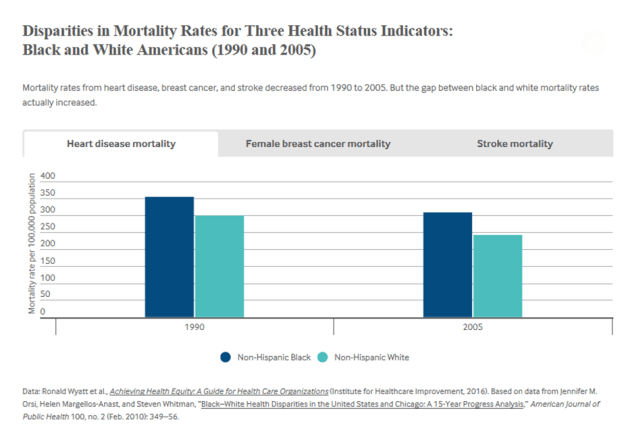
Compared with whites, members of racial and ethnic minorities are less likely to receive preventive health services and often receive lower-quality care. They also have worse health outcomes for certain conditions. To combat these disparities, advocates say health care professionals must explicitly acknowledge that race and racism factor into health care. This issue of Transforming Care offers examples of health systems that are making efforts to identify implicit bias and structural racism in their organizations, and developing customized approaches to engaging and supporting patients to ameliorate their effects.

It’s been 15 years since the publication of the Institute of Medicine’s Unequal Treatment report, which synthesized a wide body of research demonstrating that U.S. racial and ethnic minorities are less likely to receive preventive medical treatments than whites and often receive lower-quality care. Most startling, the analysis found that even after taking into account income, neighborhood, comorbid illnesses, and health insurance type — factors typically invoked to explain racial disparities — health outcomes among blacks, in particular, were still worse than whites.

This research prompted the Institute of Medicine to add equity to a list of aims for the U.S. health care system, but efforts to ensure all Americans have equal opportunity to live long and healthy lives have been given less attention than have efforts to improve health care quality or reduce costs. A recent Institute for Healthcare Improvement white paper called equity “the forgotten aim,” noting as did the 2010 Institute of Medicine report, How Far Have We Come in Reducing Health Disparities?, how little progress has been made.

To reduce racial and ethnic health disparities, advocates say health care professionals must explicitly acknowledge that race and racism factor into health care. Less directed efforts to improve health outcomes, ones for instance that fail to consider the particular factors that may lead to worse outcomes for blacks, Hispanics, or other patients of color, may not lead to equal gains across groups — and in some cases may exacerbate racial health disparities.

Commonwealthzz

Full Article: https://www.commonwealthfund.org/publications/newsletter-article/2018/sep/focus-reducing-racial-disparities-health-care-confronting


Go Upstream to Pursue Health Equity – IHI

Posted by timmreardon on 10/19/2018
Posted in: Uncategorized. Leave a comment

By Richard Foster | Wednesday, October 17, 2018

October 17 blog photo

Over seven years ago, the South Carolina Hospital Association (SCHA) and its member health systems made a commitment to join with other stakeholders across our state in pursuit of the Triple Aim of better health and health care for all South Carolinians. This decision to align our efforts on the population and community health front resulted in the creation of the Alliance for a Healthier South Carolina (AHSC), a multi-sector, collective impact-based coalition that now has over 60 member organizations.

From the early stages of the AHSC, our membership has worked to ensure that our collective decisions and actions are all filtered through a health equity lens. In 2016, AHSC leadership established the SC Call to Action for Health Equity built on four key areas of equity-based strategic focus:

  1. Establish just and equitable organizational cultures;
  2. Focus on diversity and inclusion in the educational and workforce pipeline;
  3. Actively partner with at-risk communities and populations on solutions targeted to eliminate specific inequities; and
  4. Ensure equity stratification of health data collection, analysis and dissemination.

The vast majority of AHSC members and health systems have adopted the guiding principles of this call to action and are addressing specific policy and practice barriers that result in major disparities in health care access and health outcomes.

Earlier this year, the SCHA Board representing a diverse mix of health system senior leaders endorsed the Institute for Healthcare Improvement Leadership Alliance’s Health Equity Call to Action as a framework for the next stage of our collective efforts in pursuit of improving the health and wellbeing of everyone in SC. In particular, a growing number of health systems across our state are working with community partners to invest in upstream programs and solutions focused on the major social, economic and environmental drivers of health inequities.

Several key examples of these financial and human resource investments in South Carolina include:

  • The health system in Anderson is building an equitable organizational culture with a focus on diversity and inclusion across all levels of their workforce and providing opportunities for members of the community to have a more active voice in all aspects of their health and care.
  • The health systems in Spartanburg are partnering with many community organizations to reinvigorate a vulnerable neighborhood. These efforts include investments in safe green space, affordable housing options, a minority-owned healthy food hub, and targeted training and employment opportunities for residents.
  • The largest system in the Columbia area has partnered with a network of churches and faith-based organizations to institute health improvement outreach programs targeted to stroke and diabetes prevention and influenza immunization.
  • The Medical University of South Carolina has ensured that minority-owned businesses in their local community make up a significant portion of the companies contracted for the construction and ongoing maintenance of their new Women’s and Children’s Hospital.
  • The health system serving Orangeburg and many other rural counties is working with a local public charter school, High School for Health Professions, to provide scholarships and employment opportunities for minority students.
  • Both Greenville health systems are partnering with community-based organizations to provide outreach services for a growing Latino population including coverage for community health workers and community paramedics.

We still have a long way to go on our collective journey here in South Carolina in pursuit of health equity and improved health for vulnerable people and communities. However, a growing number of urban and rural health systems across our state are taking unprecedented steps with key community partners to move upstream and provide and pay for programs and services designed to remove social, educational, and economic barriers to good health and wellbeing.

In the next stage of this journey, the AHSC will work closely with our member organizations to establish a statewide Health Equity Action Plan to guide and support our future efforts to eliminate equity-based health disparities and give a more active voice to those with lived experience. Join us as we travel upstream together in search of health equity and social justice for all.

Rick Foster, MD, is Executive Director for the Alliance for a Healthier South Carolina and member of the IHI Leadership Alliance.

Article link: http://www.ihi.org/communities/blogs/go-upstream-to-pursue-health-equity

Learn more about the IHI Leadership Alliance work on pursuing of health equity:

How to Achieve the Triple Aim for All

Lesson from Kansas: Start Addressing Health Equity in Your Own Backyard

You may also be interested in:

IHI white paper — Achieving Health Equity: A Guide for Health Care Organizations

Equity is a featured track at this year’s IHI National Forum.

Tags: Equitable Care Delivery, Leadership, Quality Improvement, Community, IHI Leadership Alliance

VA-DoD Leaders Signal Commitment to Achieving Interoperability, but What Uphill Challenges Will They Face? – Healthcare Informatics

Posted by timmreardon on 10/17/2018
Posted in: Uncategorized. Leave a comment

October 15, 2018

by Heather Landi, Associate Editor
“There is no precedent for this level of interoperability in healthcare,” says one industry thought leader
HC Informatics1

The U.S. Secretaries of Veterans Affairs (VA) and Defense (DOD) have signaled their commitment to achieving interoperability between the two agencies by implementing a single, seamlessly integrated electronic health record (EHR), according to a joint statement published last week.

VA Secretary Robert Wilkie and Defense Secretary James N. Mattis signed a joint statement Sept. 26 pledging that their two departments will “align their plans, strategies and structures as they roll out a EHR system that will allow VA and DoD to share patient data seamlessly,” according to a press release about the joint statement.

“The Department of Defense and Department of Veterans Affairs are jointly committed to implementing a single, seamlessly integrated electronic health record (EHR) that will accurately and efficiently share health data between our two agencies and ensure health record interoperability with our networks of supporting community healthcare providers,” the joint statement from Wilkie and Mattis states. “It remains a shared vision and mission to provide users with the best possible patient-centered EHR solution and related platforms in support of the lifetime care of our Service members, Veterans, and their families.”

The VA and the DoD are both undertaking massive projects to modernize their EHR systems and both departments plan to standardize on Cerner’s EHR. The hope is that this will provide a more complete longitudinal health record and make the transition from DoD to VA more seamless for active duty, retired personnel and their dependents. Once completed, the project would cover about 18 million people in both the DoD and VA systems.

The VA signed its $10 billion contract with Cerner May 17 to replace VA’s 40-year-old legacy health information system—the Veterans Health Information Systems and Technology Architecture (VistA)—over the next 10 years with the new Cerner system, which is in the pilot phase at DoD.

Webinar:

Safety & Unintended Consequences of Interoperability: Establishing High Reliability Principles & Techniques

Interoperability may seem like just a technology challenge, but in actuality it is a people, process, and technology challenge. Healthcare systems increasingly look to create high-reliability…

DoD began rolling out its EHR modernization project, called Military Health System (MHS) Genesis, in January 2017 at Fairchild Air Force Base and three other pilot sites in Washington State. The DoD EHR overhaul contract, which was awarded in 2015 to Cerner, Leidos and others, is currently valued at $4.3 billion. The new EHR system is expected to be deployed at every military medical facility in phases over the next five years.

“There is no precedent for this level of interoperability in healthcare, but one can hope the DoD-VA effort will drive the evolution of meaningful interoperability forward and benefit everyone,” says Dave Levin, M.D., chief medical officer at Sansoro Health and former chief medical information officer (CMIO) for Cleveland Clinic. Levin has been observing the VA-DoD interoperability efforts and has written several blogs pointing out the critical challenges facing the two agencies in these efforts.

“There is a long-standing need for the VA and the DoD to be on the same information database for service members and veterans. Cerner is a good product. I am hopeful that Cerner’s commitment to the FHIR (Fast Healthcare Interoperability Resources) standard and to process interoperability standards will be revealed to the general community and implemented wholeheartedly, because at the end of the day, it’s not what’s best for VA and DoD, it’s what’s best for veterans and service members as they consume care along their own personal pathways,” says Shane McNamee, M.D., who previously served as the clinical lead for the VA’s Enterprise Health Management Platform (eHMP) effort and also the VHA business lead for the development and deployment of the VA’s Joint Legacy Viewer. He is now the chief medical officer of Cleveland-based software company mdlogix.

In the press release, Wilkie said the joint statement represents “tangible evidence” of VA and DoD’s commitment. “The new EHR system will be interoperable with DoD, while also improving VA’s ability to collaborate and share information with community care providers. This will ease the burden on service members as they transition from military careers and will be supported by multiple medical providers throughout their lives.”

Wilkie also said the new EHR system will give health care providers a full picture of patient medical history and will help to identify Veterans proactively who are at higher risk for issues, such as opioid addiction and suicide, so health care providers can intervene earlier and save lives.

Specifically, the joint statement pledges that VA and DoD will develop an accountability mechanism to coordinate decision-making and oversight. “The importance, magnitude, and overall financial investment of our EHR modernization efforts demand alignment of plans, strategies and structure across the two departments,” the two agency leaders stated in the joint statement. “To this end, DoD and VA will institute an optimal organizational design that prioritizes accountability and effectiveness, while continuing to advance unity, synergy and efficiencies between our two departments.”

VA and DoD will construct a plan of execution that includes a new organizational structure that optimally coordinates clinical and business workflows, operations, data management and technology solutions and a more detailed implementation timeline.

“We are committed to partnering with the VA to support the lifetime care of our service members, Veterans and their families,” Mattis said in the press release. “This modern electronic health record will ensure those who serve our nation have quality health care as they transition from service member to Veteran.”

An Uphill Battle for Interoperability

Interoperability between the VA and DoD has been a long-standing goal for both agencies, and the past two decades has seen the agencies making strides to achieve interoperability between two separate health IT systems. However, progress on this front has been slowed by both operational and technical challenges.

Back in April 2016, the DoD and VA signed off on achieving one level of interoperability, after the VA implemented its Joint Legacy Viewer (JLV) the previous fall. The JLV is a web-based integrated system that combines electronic health records from both the DoD and the VA, which enables clinicians from both agencies to access health records.

However, as reported by Healthcare Informatics, during a congressional hearing in July 2016, a Government Accountability Office (GAO) official testified that in 2011, DoD and VA announced they would develop one integrated system to replace separate systems, and sidestep many of their previous challenges to achieving interoperability. “However, after two years and at a cost of $560 million, the departments abandoned that plan, saying a separate system with interoperability between them could be achieved faster and at less overall cost,” Valerie Melvin, director of information management and technology resources issues at the GAO, testified at the time.

Melvin said that the VA has been working with the DoD for the past two decades to advance EHR interoperability between the two systems, however, “while the department has made progress, significant IT challenges contributed” to the GAO designating VA as “high risk.”

And, Melvin summarized the GAO’s concerns about the VA’s ongoing modernization efforts. “With regard to EHR interoperability, we have consistently pointed to the troubled path toward achieving this capability. Since 1998, VA has undertaken a patchwork of initiatives with DoD. These efforts have yielded increasing amounts of standardized health data and made an integrated view of data available to clinicians. Nevertheless, a modernized VA EHR that is fully interoperable with DoD system is still years away,” Melvin said during that hearing two years ago.

Fast forward to June 2017 when then-VA Secretary David Shulkin announced that the department plans to replace VistA by adopting the same EHR platform as DoD. Six months later, Shulkin then said that the contracting process was halted due to concerns about interoperability. According to reports, VA leaders’ concerns centered on whether the Cerner EHR would be fully interoperable with private-sector providers who play a key role in the military health system. VA leaders finally signed the Cerner contract this past May.

The Pentagon also has hit some road bumps with its EHR rollout. In January 2018, DoD announced the project would be suspended for eight weeks with the goal to assess the “successes and failures” of the sites where the rollouts had already been deployed. This spring, a Politico report detailed that the first stage of implementations “has been riddled with problems so severe they could have led to patient deaths.” Indeed, some clinicians at one of four pilot centers, Naval Station Bremerton, quit because they were terrified they might hurt patients, or even kill them, the report attested.

Media reports this past summer indicated that the Cerner platform was up and running at all four initial DoD pilot sites, with federal officials saying the agency is still troubleshooting the platform at the initial facilities, but the overall adoption’s shown “measurable success.” This month, media reports indicated that DoD is moving onto a second set of site locations for its Cerner EHR rollouts, with three bases in California and one in Idaho.

According to the VA press release issued last week, collaborating with DoD will ensure that VA “understands the challenges encountered as DoD deploys its EHR system called MHS GENESIS; adapts an approach by applying lessons learned to anticipate and mitigate known issues; assesses prospective efficiencies to help deploy faster; and delivers an EHR that is fully interoperable.”

While both Levin and McNamee praise the VA-DoD interoperability efforts, they note the substantial challenges the effort faces. In a January blog post, Levin wrote at the heart of this VA-DoD interoperability challenge are two fundamental issues: “an anemic definition of interoperability and the inevitable short comings of a ‘one platform’ strategy.”

In response to the joint statement issued last week, Levin provided his observations via email: “DoD and VA will have separate instances of the Cerner EMR. They will not be on the same EMR with a single, shared record but rather on distinct and separate implementations of the same brand of EMR. The choice of language in the announcement is interesting: they are saying they will create a single EHR [author’s emphasis] through interoperability between these separate EMRs and with the EMRs in the civilian health system, which is essential since a lot care for active duty, Veterans, and dependents is rendered outside the military system. This will depend greatly on the extent and depth of interoperability between the different EMRs.”

Levin continued, “My second observation relates to interoperability between the EMRs, or EHR system, and the many other apps and data services within military health IT. For example, there is an emerging class of apps sometimes referred to as ‘wounded warrior’ apps. These are specially designed for this population. They will need to be effectively integrated into this new IT ecosystem or their value will be greatly diminished, if not lost.”

McNamee points out there are different layers of interoperability—data interoperability, or ensuring data flows back and forth (the Joint Legacy Viewer achieved this level of interoperability, he says), semantic interoperability, in which meaningful information is associated with the data, and then standards-based process interoperability.

The lack of standards-based process interoperability continues to be a roadblock for all healthcare providers, and this issue has yet to be solved by any one specific EHR vendor, many industry thought leaders note.

“The challenges that VA and DoD face are similar to what the rest of healthcare faces in this country,” McNamee says. “There’s more than 10 million patients between these two organizations, meditated across thousands of different sites and the inability to transfer information and process for the VA and the DoD is similar as the rest of the country.”

He continues, “If you talk to any informatics or health IT professional about the most challenging thing that they’ve ever had to do in their career it’s to install an EHR into their hospital; it’s incredibly disruptive and, if not done well, it can negatively impact patient care, reimbursement and morale. VA and DoD are attempting to do this across thousands of healthcare sites, with millions of patients, and hundreds of thousands of healthcare providers, in one project, that’s a daunting task, to do that well and do that seamlessly.”

Article link: https://www.healthcare-informatics.com/article/interoperability/va-dod-leaders-signal-commitment-achieving-interoperability-what-uphill

Navy Cmdr. Alexander Holston discusses MHS GENESIS, the DoD’s modernized electronic health record – PEO DHMS

Posted by timmreardon on 10/16/2018
Posted in: Uncategorized. Leave a comment


IMG_5297

PEO DHMS (@DoD_EHR)     10/16/18, 11:01 AM

Navy Cmdr. Alexander Holston discusses MHS GENESIS, the DoD’s modernized electronic health record, with Fedscoop. He speaks about a commitment to creating a responsive system that supports the delivery of quality healthcare to beneficiaries. ow.ly/ASUv30mcfzU

How to create an agile organization – McKinsey

Posted by timmreardon on 10/16/2018
Posted in: Uncategorized. Leave a comment


McKinsey-x1
www.mckinsey.com

Transforming companies to achieve organizational agility is in its early days but already yielding positive returns. While the paths can vary, survey findings suggest how to start.

Rapid changes in competition, demand, technology, and regulations have made it more important than ever for organizations to be able to respond and adapt quickly. But according to a recent McKinsey Global Survey, organizational agility—the ability to quickly reconfigure strategy, structure, processes, people, and technology toward value-creating and value-protecting opportunities—is elusive for most.1 Many respondents say their companies have not yet fully implemented agile ways of working, either company-wide or in the performance units where they work,2 though the advantages are clear. Respondents in agile units report better performance than all others do, and companies in more volatile or uncertain environments are more likely than others to be pursuing agile transformations.

Few companies are yet reaping these benefits, but that may soon change; the results also indicate that organizational agility is catching fire. For many respondents, agility ranks as a high strategic priority in their performance units. Moreover, companies are transforming activities in several parts of the organization—from innovation and customer experience to operations and strategy—to become more agile. Finally, respondents in all sectors believe more of their employees should be working in agile ways. For organizations and their performance units that aren’t yet agile, the path to achieving agility depends on their starting points. But the results indicate some clear guidance on how and where they can improve, whether they are lacking in stability or dynamism.

Organizational agility is on the rise

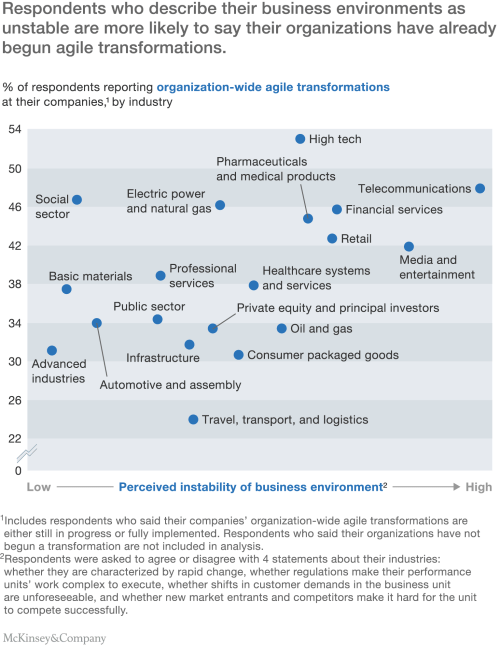
Across industries and regions, most survey participants agree that the world around them is changing, and quickly. Business environments are increasingly complex and volatile, with two-thirds of respondents saying their sectors are characterized by rapid change. In such environments, the need for companies to demonstrate agility is top of mind: the more unstable that respondents say their environments are, the more likely they are to say their companies have begun agile transformations (Exhibit 1).

Exhibit 1

McKinseyxx1

To date, though, few organization-wide agile transformations have been completed. Only 4 percent of all respondents say their companies have fully implemented one, though another 37 percent say company-wide transformations are in progress. When asked where their companies apply agile ways of working,3 respondents most often identify activities that are closest to the customer: innovation, customer experience, sales and servicing, and product management.4 This is not too surprising, since customer centricity is cited most often—followed by productivity and employee engagement—as the objective of agile transformations. Companies are also focusing on internal end-to-end processes. At least four in ten respondents say their companies are applying agile ways of working in processes related to operations, strategy, and technology, while roughly one-third say they are doing so in supply-chain management and talent management.5

Looking forward, the results suggest that companies have higher aspirations for agility. Three-quarters of respondents say organizational agility is a top or top-three priority on their units’ agendas, and more transformations appear to be on the way. Of those who have not begun agile transformations, more than half say plans for either unit-level or company-wide transformations are in the works. Respondents across industries also report a desire to scale up agile ways of working. On average, they believe 68 percent of their companies’ employees should be working in agile ways, compared with the 44 percent of employees who currently do. By industry, respondents in telecom and the electric-power and natural-gas industries report the biggest differences between their actual and ideal shares of employees working in agile ways—followed closely by respondents in several other industries: media and entertainment, the public sector, oil and gas, pharma, and advanced industries.

What’s more, the survey also confirms that agility pays off. Eighty-one percent of respondents in agile units report a moderate or significant increase in overall performance since their transformations began. And on average, respondents in agile units are 1.5 times more likely than others to report financial outperformance relative to peers, and 1.7 times more likely to report outperforming their peers on nonfinancial measures.6

Agile organizations excel at both stability and dynamism

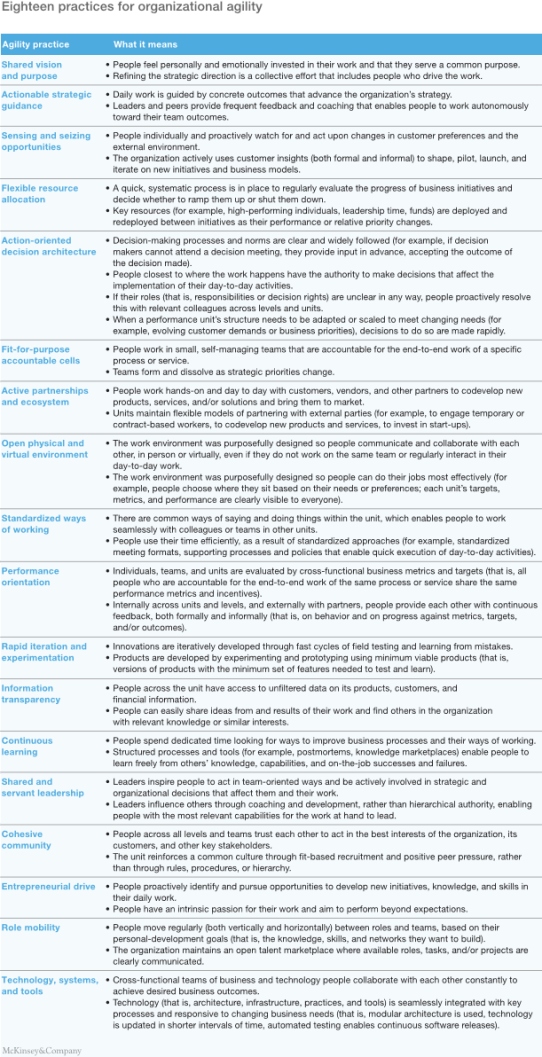
Eighteen practices for organizational agility

The survey asked respondents about a series of specific actions that underlie each of the 18 practices (9 of them stable, and 9 dynamic) of organizational agility; all of the practices are summarized in the table below. To rate respondents’ organizations, we asked how frequently their performance units engaged in each action that supports a given practice.

McKinsey1 sidebar

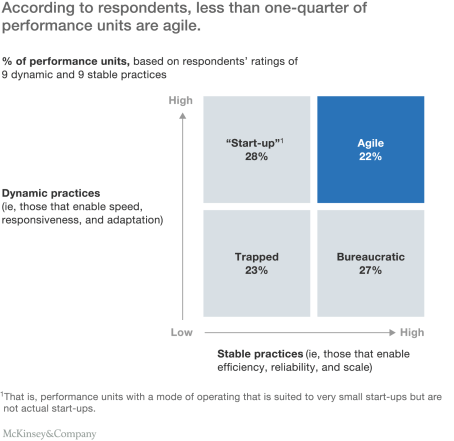
In previous work, we have determined that, to be agile, an organization needs to be both dynamic and stable.7 Dynamic practices enable companies to respond nimbly and quickly to new challenges and opportunities, while stable practices cultivate reliability and efficiency by establishing a backbone of elements that don’t need to change frequently. The survey scored organizations across eighteen practices (see sidebar, “Eighteen practices for organizational agility.”), which our research suggests are all critical for achieving organizational agility. According to the results, less than one-quarter of performance units are agile. The remaining performance units lack either dynamism, stability, or both (Exhibit 2).

Exhibit 2
McKinseyxx2

Of the 18 practices, the 3 where agile units most often excel relate to strategy and people (Exhibit 3). More than 90 percent of agile respondents say that their leaders provide actionable strategic guidance (that is, each team’s daily work is guided by concrete outcomes that advance the strategy); that they have established a shared vision and purpose (namely, that people feel personally and emotionally engaged in their work and are actively involved in refining the strategic direction); and that people in their unit are entrepreneurial (in other words, they proactively identify and pursue opportunities to develop in their daily work). By contrast, just about half of their peers in nonagile units say the same.

Exhibit 3
McKinsey ex3

After strategy, agile units most often follow four stable practices related to process and people: entrepreneurial drive, shared and servant leadership, standardized ways of working, and cohesive community. When looking more closely at standardized ways of working, the agile units excel most on two actions: the unit’s processes are enabled by shared digital platforms and tools (91 percent, compared with 54 percent for others), and processes are standardized, including the use of a common language and common tools (cited by 90 percent of agile respondents and just 58 percent of all others).

Among the dynamic practices, process—and information transparency, in particular—is a strength for agile units. Within transparency, for example, 90 percent of agile respondents say information on everything from customers to financials is freely available to employees. Among their peers in other units, only 49 percent say the same. The second practice where agile units most differ from others is in rapid iteration and experimentation. More than 80 percent of agile respondents say their companies’ new products and services are developed in close interaction with customers and that ideas and prototypes are field-tested early in the development process, so units can quickly gather data on possible improvements.

The path to agility depends on the starting point

For the performance units that aren’t yet agile, the survey results suggest clear guidance for how to move forward. But organizational agility is not a one-size-fits-all undertaking. The specific practices a unit or organization should focus on to become agile depend on whether it is currently bureaucratic, start-up, or trapped.

Bureaucratic units

By definition, bureaucratic units are relatively low in dynamism and most often characterized by reliability, standard ways of working, risk aversion, silos, and efficiency. To overcome the established norms that keep them from moving fast, these units need to develop further their dynamic practices and modify their stable backbones, especially on practices related to people, process, and structure.

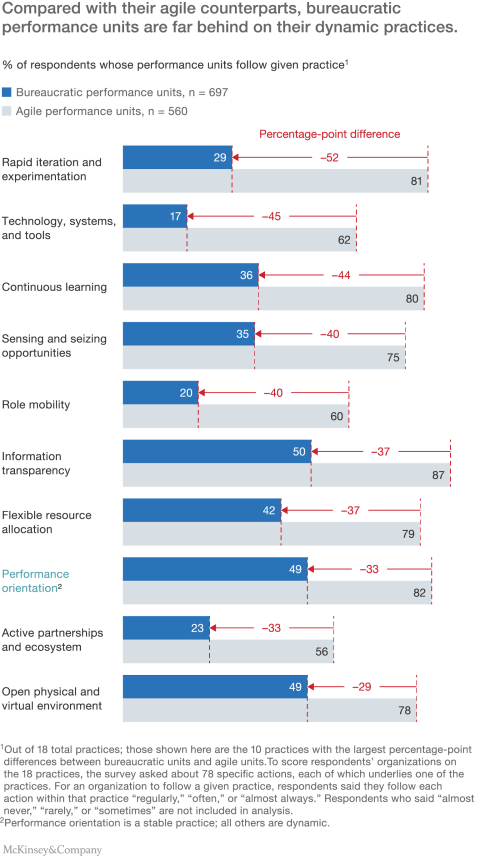
First is the need to address the dynamic practices where, compared with agile units, the bureaucratic units are furthest behind (Exhibit 4). Only 29 percent of bureaucratic respondents, for example, report following rapid iteration and experimentation, while 81 percent of agile respondents say the same. A particular weakness in this area is the use of minimum viable products to quickly test new ideas: just 19 percent of bureaucratic respondents report doing so, compared with 74 percent of agile respondents. After that, the largest gap between bureaucratic units and agile units is their ability to roll out suitable technology, systems, and tools that support agile ways of working.

Exhibit 4
McKinsey ex4

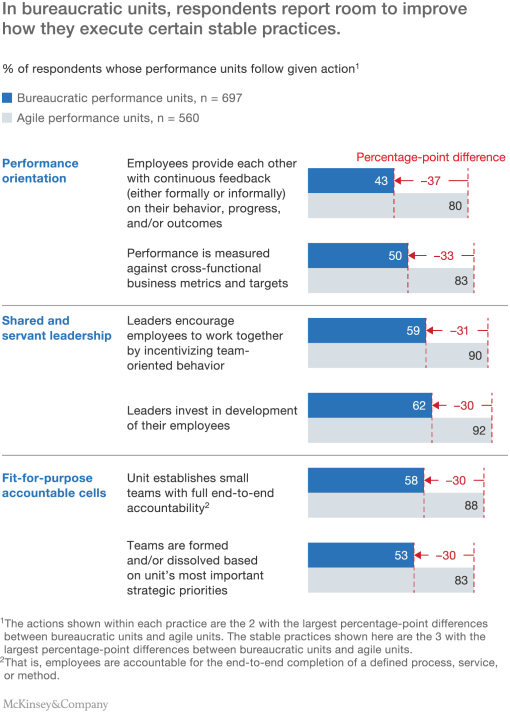
At the same time, bureaucratic units also have room to improve on certain stable practices (Exhibit 5). For example, bureaucratic units are furthest behind in performance orientation; in agile units, employees are far more likely to provide each other with continuous feedback on both their behavior and their business outcomes. What’s more, leaders in these units are better at embracing shared and servant leadership by more frequently incentivizing team-oriented behavior and investing in employee development. And it’s much more common in agile units to create small teams that are fully accountable for completing a defined process or service.

Exhibit 5
McKinsey ex5

Start-up units

Start-up units, on the other hand, are low in stability and characterized as creative, ad hoc, constantly shifting focus, unpredictable, and reinventing the wheel. These organizations tend to act quickly but often lack discipline and systematic execution. To overcome the tendencies that keep them from sustaining effective operations, these units need to further develop all of their stable practices—and also broaden their use of the dynamic practices related to process and strategy in order to maintain sufficient speed.

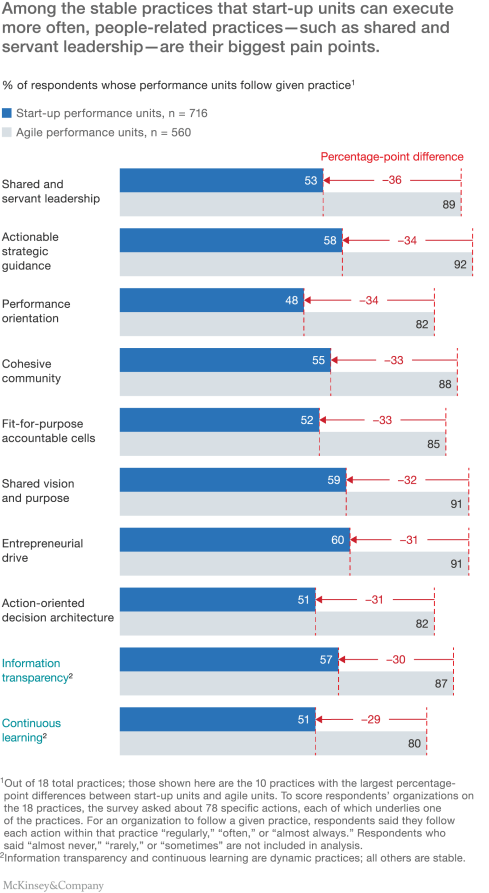
First is focusing on a stronger overall stable backbone. On average, 55 percent of start-up respondents report that they implement all nine stable practices, compared with 88 percent of agile respondents who report the same. According to the results, a particular sore spot is people-related practices—especially shared and servant leadership (Exhibit 6). For example, just under half of start-up respondents say their leaders involve employees in strategic and organizational decisions that affect them, compared with 85 percent of their agile peers. Similar to bureaucratic units, respondents at start-up units also report challenges with process, particularly with regard to performance orientation. Within that practice, only 44 percent of respondents at start-up units say their people provide each other with continuous feedback on both their behavior and their business outcomes; 80 percent at agile units report the same.

Exhibit 6
McKinsey ex6

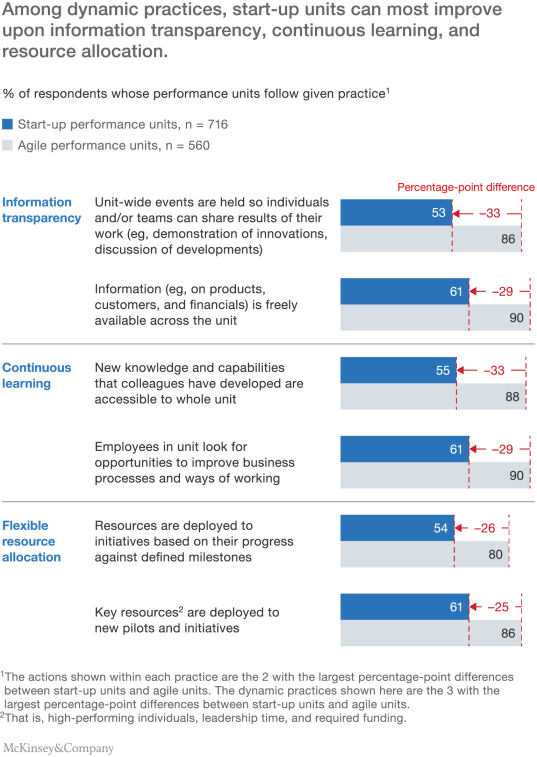
Start-up units also have room to improve their use of dynamic practices, particularly in process and strategy. According to respondents, the agile units excel much more often than their start-up counterparts at information transparency—for example, holding events where people and teams share their work with the unit (Exhibit 7). Moreover, agile respondents are much more likely to say new knowledge and capabilities are available to the whole unit, which enables continuous learning. On the strategy front, the start-up units are furthest behind their agile peers on flexible resource allocation—more specifically, deploying their key resources to new pilots and initiatives based on progress against milestones.

Exhibit 7
McKinsey ex7

Trapped units

The trapped units are often associated with firefighting, politics, a lack of coordination, protecting turf, and local tribes. These organizations find themselves lacking both a stable backbone and dynamic capabilities. In applying the stable practices, the trapped units are most behind on those related to people: specifically, shared and servant leadership and entrepreneurial drive. Just 13 percent of respondents at trapped units say they follow shared and servant leadership, compared with 89 percent of their agile peers. The dynamic practices in which they are furthest behind are process related, especially continuous learning and rapid iteration and experimentation.

Looking ahead

In response to the challenges that the survey results revealed, here are some principles executives and their units or organizations should act upon, whether or not they have already begun agile transformations:

  • Embrace the magnitude of the change. Based on the survey, the biggest challenges during agile transformations are cultural—in particular, the misalignment between agile ways of working and the daily requirements of people’s jobs, a lack of collaboration across levels and units, and employee resistance to changes. In our experience, agile transformations are more likely to succeed when they are supported by comprehensive change-management actions to cocreate an agile-friendly culture and mind-sets. These actions should cover four main aspects. First, leaders and people across the organization align on the mind-sets and behaviors they need to move toward. Second, they role-model the new mind-sets and behaviors and hold each other accountable for making these changes. Third, employees are supported in developing the new skills they need to succeed in the future organization. And finally, formal mechanisms are put in place to reinforce the changes, rewarding and incentivizing people to demonstrate new behaviors.8
  • Be clear on the vision. The results show that agile units excel most at creating a shared vision and purpose and aligning on this vision through actionable strategic guidance. In contrast, at companies that have not yet started a transformation, one of the most common limitations is the inability to create a meaningful or clearly communicated vision. An important first step in deciding whether to start an agile transformation is clearly articulating what benefits are expected and how to measure the transformation’s impact. This vision of the new organization must be collectively held and supported by the top leadership.
  • Decide where and how to start. Respondents whose organizations have not started agile transformations most often say it’s because they lack a clear implementation plan. While the right plan will vary by company, depending on its vision, companies should first identify the part(s) of the organization that they want to transform and how (for example, by prototyping the changes in smaller parts of the performance unit before scaling them up, or by making changes to more foundational elements that go beyond a single unit). Second, they should assess which of the 18 agile practices the organization most needs to strengthen in order to achieve agility, so that the actions taken across strategy, structure, process, people, and technology are mutually reinforcing. Third, they should determine the resources and time frame that the transformation requires, so the effort maintains its momentum but the scope remains manageable at any point in time.

Article link: https://www.mckinsey.com/business-functions/organization/our-insights/how-to-create-an-agile-organization#0

About the author(s)

The contributors to the development and analysis of this survey include Karin Ahlbäck, a consultant in McKinsey’s London office; Clemens Fahrbach, a consultant in the Munich office; Monica Murarka, a senior expert in the San Francisco office; and Olli Salo, an associate partner in the Helsinki office.

They would like to acknowledge Wouter Aghina, Esmee Bergman, Aaron De Smet, and Michael Lurie for their contributions to this work.

VA, DoD creating single governance point for Cerner EHR modernization – Healthcare IT News

Posted by timmreardon on 10/12/2018
Posted in: Uncategorized. Leave a comment

Veterans Affairs selected the Veterans Integrated Service Network 20 in the Pacific Northwest for the initial pilot site, VA Secretary Robert Wilkie said at the “State of the VA” hearing.

By Jessica Davis

September 27, 2018 12:46 PM
Department of Veterans Affairs Building Sign

The U.S. Department of Veterans Affairs will work with the Department of Defense to create a single point of authority over the Cerner EHR modernization project, VA Secretary Robert Wilkie testified at the Senate “State of the VA” hearing on Wednesday.

HERE’S THE IMPACT

Although the Interagency Program Office was designed to govern the previous VA-DoD EHR project, Wilkie said he understood the agency lacked the governance power. His response mirrored concerns shared with Congress in mid-September that revealed leadership couldn’t agree upon who was in charge of governing the new EHR.

During that hearing, the Government Accountability Office Director of Management Issues Carol Harris testified that both DoD and VA officials have ignored GAO’s advice for years on how to empower the Interagency Program Office. And that, without change, “we are going to continue to have dysfunction in moving forward.”

THE BIGGER TREND

Wilkie stressed that the VA’s Office of Electronic Health Record Modernization and DoD will be “joined at the hip” throughout the project and supported VA OEHRM Director John Windom’s leadership as point-person between the VA and DoD.

“Engaging front-line staff and clinicians is a fundamental aspect in ensuring we meet the program’s goals, and we have begun work with the leadership teams in place in the Pacific Northwest,” Wilkie said.

“OEHRM has established clinical councils from the field that will develop national workflows and serve as change agents at the local level,” he continued. “The work at the IOC sites will help VA identify efficiencies to optimize the schedule, hone governance, refine configurations and standardize processes for future locations.”

In fact, Wilkie said they’ve selected the Veterans Integrated Service Network 20 in the Pacific Northwest as the initial operating capability pilot site that will test the new Cerner EHR. The rollout will follow the DoD’s own EHR rollout in the Pacific Northwest, scheduled to restart implementation on Oct 1.

The partnership with DoD will help VA “understand the challenges and obstacles they are encountering, adapt our approach to mitigate those issues and identify efficiencies,” Wilkie said.

But the DoD has faced a wide range of performance issues with its EHR rollout. The Initial Operational Test and Evaluation found the platform was “not operationally suitable because of poor system usability, insufficient training and help desk support.”

Both DoD and Cerner have repeatedly stressed those issues were expected and the challenges will only benefit future rollouts. In July, Stacy Cummings, program executive officer for Defense Healthcare Management Systems, said DoD has found “measurable success” in its workflow adoptions.

However, if an amendment to the Senate appropriations bill introduced in August is passed, the GAO will review the DoD EHR project.

Yet Wilkie doubled-down.

“My understanding of what went on, on the DoD side, is that they were testing it for mistakes and they found them,” Wilkie said. “I would rather find them there than down the line after we spent the $16 billion.”

The first Cerner install for VA is scheduled to go live in 2020.

Article link: https://www.healthcareitnews.com/news/va-dod-creating-single-governance-point-cerner-ehr-modernization

Twitter: @JF_Davis_
Email the writer: jessica.davis@himssmedia.com

Topics:

Electronic Health Records (EHR, EMR), Government & Policy, Network Infrastructure

One-on-one EHR training improves physician satisfaction, saves time – Modern Healthcare

Posted by timmreardon on 10/12/2018
Posted in: Uncategorized. Leave a comment

By Maria Castellucci  | September 15, 2018

MHCx1One-on-one EHR training improves physician satisfaction, saves time

The Epic electronic health record at UC Davis Health has been a source of great frustration for Dr. Molly Davis.

A primary-care physician at the health system’s clinic in Rancho Cordova, Calif., Davis spends too much time writing patient notes, answering emails and gathering lab results in the EHR.

“It always seemed like the work was redundant and there was a faster way to do things,” she said.

Her frustrations aren’t unique. Dr. Scott MacDonald, EHR medical director at UC Davis, heard regularly from colleagues that they had a hard time navigating the EHR. Nationally, physicians point to EHRs as a major contributor to workplace stress. A recent survey of 250 physicians cited EHRs as the leading cause of burnout.

But MacDonald said physicians could drastically improve their experience if they had better training.

“I know first-hand if they know how to use the system well and leverage the efficiencies and the tools, they are going to be a lot happier and they finish faster,” MacDonald said.

So with support from leadership, MacDonald in February launched the Physician Efficiency Program, which provides one-on-one training to doctors to improve their experience with the technology. The results so far have been promising. Since the program launched, physicians have reported a 24% improvement in self-rated efficiency with the EHR and a 12% increase in satisfaction. Additionally, the time doctors spend working on records after hours has declined.

For the program, UC Davis hired a team of four EHR trainers and two Epic-certified builders who can add functions to the system to improve usability.

The program initially rolled out to physicians at UC Davis’ 208 ambulatory clinics because they haven’t had robust EHR training since 2004, which is longer than the hospital physicians. UC Davis plans to complete the training across the whole system by 2020.

The EHR training team spends about three to eight weeks at a clinic, depending on its staff size. Each physician spends four hours with a trainer. The training is interspersed throughout the day so the physician can get the hands-on practice right away and follow up with the trainer on any issues or questions.

“We teach it, and then we help them implement it and do it,” MacDonald said.

To ensure the training addresses every physician’s unique concerns, UC Davis deployed several data gathering platforms. The team uses Epic’s provider efficiency profile tool, which tracks how much time a user is spending on the EHR and what functions they use the most and the least. UC Davis then surveys all the physicians before their training to gauge their satisfaction with the system, what they need most help with and how often they spend on the EHR after hours, also called pajama time. UC Davis created its own tool to measure the time physicians spend in the system from 5 p.m. to 8 a.m. as well as on weekends.

During her training last month, Davis was taught several shortcuts to better navigate the various interfaces. Additionally, a template was made for her patient notes so she doesn’t have to spend so much time typing. “It’s been super helpful. I have used a lot of the preferences that have been made,” she said.

The Epic builders are also ready to create interfaces or tools that will improve a physician’s efficiency. For instance, the builders have made several charts that display all the relevant data on a given condition including recommended tests, drugs and management protocols.

“It decreases the number of clicks and the time it takes to gather that information by putting it all in one place,” MacDonald said. The screen can also be shared with patients to help them better understand their disease, he added.

The program is targeted for physicians because they spend the most time with the EHR, but advanced practitioners are also involved in the training if they are the main users at their clinic.

While the EHR trainers are at clinics, weekly meetings are held to share lessons learned so far.

“They tend to be very enriching sessions,” MacDonald said. “Physicians can share their own efficiencies and they are engaging with one another.”

Articlelink: http://www.modernhealthcare.com/article/20180915/TRANSFORMATION02/180919952

Tags: Best Practices, Electronic Health Records (EHR), Operations, Transformation

New tool aims to simplify medical records requests – Clinical Innovation + Technology

Posted by timmreardon on 10/08/2018
Posted in: Uncategorized. Leave a comment

October 02, 2018 | Danielle Brown | EHR & EMR

A team of health technology organizations joined forces to develop a new tool that makes it easier for patients to request and receive digital copies of their health records in the format of their choice.

The new Health Records Request Wizard prototype was released during the Biden Cancer Summit in Washington, D.C., last month. According to a press release, the tool streamlines and simplifies the records request process for patients, providers and medical records experts.

The tool works as a “start form” and helps users or patients explain what records they need, in what formats and when they’re needed. The request is then delivered to a provider’s medical records specialist who responds.

“This tool will help bring an outdated process into the 21st century and make it easier to obtain and organize health records in electronic formats, ultimately helping create a comprehensive picture of a person’s health,” Christine Bechtel, co-founder and president of X4 Health, said in the release. X4 Health led the team of organizations in developing the prototype.

The Health Records Request Wizard live prototype is available at healthrecordwizard.com. Additional information on the tool can also be found at x4health.com/healthdata.

Article link: https://www.clinical-innovation.com/topics/ehr-emr/tool-aims-simplify-medical-records-requests

Baylor, Memorial Hermann in talks for giant hospital merger – Axios

Posted by timmreardon on 10/05/2018
Posted in: Uncategorized. Leave a comment

We are seeing the creation of super-regional and multi-state hospital systems. Hospitals are scooping up market power all in the name of “value-based care.” – Bob Herman

Baylor University Medical Center in Dallas. Photo: Baylor Scott & White Health

Leaders of Baylor Scott & White Health and Memorial Hermann Health System said Monday they are discussing a potential merger that would create a behemoth not-for-profit system across Texas with 68 hospitals and almost $15 billion in annual revenue.

Why it matters: Hospitals have been consolidating rapidly, as executives argue bigger scale will lead to better care and lower costs. But researchshows hospitals with more market power raise prices, and these deals do not guarantee better, less expensive care.

The details: Baylor Scott & White mostly operates throughout central Texas, with a heavy presence in Dallas, while Memorial Hermann is based in Houston. Both systems also own their own health insurance companies.

  • Baylor Scott & White itself is the product of the merger between Baylor Health Care System and Scott & White Healthcare five years ago.
  • Baylor Scott & White has above-average profits, recording a 7% operating margin and 10% total margin in the first nine months of its latest fiscal year. Memorial Hermann is profitable, but has struggled in the past 18 months in the competitive Houston area.
  • The two systems expect to close a deal by next year and did not say whether there would be layoffs. Baylor Scott & White CEO Jim Hinton would be the CEO of the combined system

Article link: https://www.axios.com/baylor-scott-white-memorial-hermann-texas-hospital-merger-fdc0edc7-441c-40c3-b006-987db1975420.html

Creating Effective Health Care Markets – Commonwealth Fund

Posted by timmreardon on 10/01/2018
Posted in: Uncategorized. Leave a comment
September 7, 2018
David Blumenthal, M.D.

Hand arranging wood block stacking with icon healthcare medical, Insurance for your health concept

Disagreement about the role of markets lies at the root of many of our fiercest health care controversies. One side believes that unleashing market forces will rescue our health care system. From this viewpoint, government involvement is inherently destructive, except in rare circumstances. Many opponents of the Affordable Care Act share this opinion.

The other side believes that health care markets are deeply flawed and that government must play a major role in achieving a higher-performing health system. These people point out that markets make no claim to ensuring equity in the use of health care resources, only improved efficiency. Supporters of the ACA tend to hold this view.

Given this fundamental divide, it’s worth considering the conditions underlying the effective functioning of market economies, whether those conditions currently prevail in health care and, if not, what changes would be required to establish them.

Students learn in Economics 101 that several assumptions must hold for free markets to achieve their potential:

  • First, consumers and suppliers of goods and services have perfect — or at least sufficient — information. They know or can find out the price and quality of available products.
  • Second, consumers and producers are rational. They make reasoned decisions about what to purchase and supply. These decisions maximize their welfare as consumers and their profits as businesses.
  • Third, it is easy for producers to enter markets, thus assuring that monopolies don’t form, and that increased competition occurs where prices are excessive, reducing prices to efficient levels.
  • Fourth, in any market, there are large numbers of firms selling a homogeneous product.
  • Fifth, individual firms cannot affect market prices.

Practically speaking, these conditions rarely exist in pure form anywhere in our economy. In the case of health care, there are a variety of different types of markets. For example, employers purchase insurance, large hospital systems purchase medical supplies, and individuals purchase insurance plans. These markets may embody these conditions to varying degrees, but the most basic health care markets, in which consumers or patients directly buy health care services, depart from this ideal dramatically, as the following examples illustrate.

To begin with, health care consumers not only lack perfect information, but often any information at all. At present, prices in the U.S. health care market are virtually unknowable. Quality data are scant, imperfect, and often confound even experts. Further, medicine is a complex science-based service: even highly trained health professionals struggle to stay current. As a result of social media and the internet, consumers are better informed than ever before, but most depend on advice from health professionals to make informed health care purchases. This kind of imperfect information may help explain why consumers in high-deductible health plans are equally likely to reduce their use of high-value or low-value health care services. They are just as likely to forgo their blood pressure treatments as unnecessary back surgery.

Health care consumers also face unusual challenges to making rational decisions. In medicine there is a saying that any doctor who treats herself has a fool for a patient. Even the most informed individual can have difficulty acting rationally when confronting the emotional turmoil that accompanies their own illness or that of a loved one. Beyond this, there are clear situations where patients’ cognitive abilities are compromised, for example, in cases of stroke, dementia, intoxication, loss of consciousness, delirium, or mental illness.

Competent patients have the inherent right to make their own medical decisions, and many do so wisely and well. But market advocates also must recognize the special obstacles to rational decision-making that face health care consumers.

Consolidation among insurers and health care organizations has radically reduced the number of providers selling health care and health insurance in many U.S. health care markets. Recent work shows that providers in 90 percent of U.S. markets are highly or “super” concentrated.

This consolidation and resulting lack of competition has enabled individual providers to charge excessive prices in many markets. Similarly, government-granted patents create monopolies that enable drug manufacturers to set astounding prices for new drugs and raise them almost at will.

These and other departures from the conditions necessary for effective market functioning suggest the dangers of uncritical reliance on free markets to improve our health care system. At a minimum, advocates of market solutions would be wise to consider three interventions that could increase the probability that markets will function as desired.

  1. Develop better information on prices and quality. Consumers need information to make informed decisions. Publishing raw data on the prices of care — often referred to as price transparency — is insufficient because it rarely reflects the actual cost consumers face during an episode of care. The price of a chest x-ray that diagnoses pneumonia, for instance, is a poor indicator of the costs of a subsequent hospitalization, not to mention the downstream costs for any previously undetected lung disease. To make health care markets work, advocates must develop approaches to price transparency and quality measurement that are meaningful and understandable to consumers.
  2. Foster markets for health services that pose the smallest challenges to rational decision-making. Certain health services — often referred to as “shoppable” — involve tests or treatments that are either elective, relatively simple to understand, or nonurgent, which allows patients time to learn and think about them. Examples include screening tests for generally healthy individuals (e.g., colonoscopies, mammograms), elective surgeries (e.g., hip and knee replacement), or necessary but nonemergent care (e.g.,whether to add insulin to a diabetic regimen). Fostering competitive forces in these areas could improve the functioning of the health care market overall. But reformers should be aware that these services are likely to account for a minority of health care activities and, frequently, are not the most expensive ones.
  3. Promote competition. Unless government finds ways to restore competition among providers where it no longer exists, markets can’t succeed. This is true both for health care services generally and pharmaceuticals in particular.

Given our desperate need for health care reform, the appeal of market solutions is understandable. But it is naïve to assume that they will work in health care just like they do in other sectors. It is time for a frank, open, and nonideological discussion of the problems markets can address in health care and how we can create conditions that will enable markets to function as intended.

Article link: https://www.commonwealthfund.org/blog/2018/creating-effective-health-care-markets


Posts navigation

← Older Entries
Newer Entries →
  • Search site

  • Follow healthcarereimagined on WordPress.com
  • Recent Posts

    • When Not to Use AI – MIT Sloan 04/01/2026
    • There are more AI health tools than ever—but how well do they work? – MIT Technology Review 03/30/2026
    • Are AI Tools Ready to Answer Patients’ Questions About Their Medical Care? – JAMA 03/27/2026
    • How AI use in scholarly publishing threatens research integrity, lessens trust, and invites misinformation – Bulletin of the Atomic Scientists 03/25/2026
    • VA Prepares April Relaunch of EHR Program – GovCIO 03/19/2026
    • Strong call for universal healthcare from Pope Leo today – FAN 03/18/2026
    • EHR fragmentation offers an opportunity to enhance care coordination and experience 03/16/2026
    • When AI Governance Fails 03/15/2026
    • Introduction: Disinformation as a multiplier of existential threat – Bulletin of the Atomic Scientists 03/12/2026
    • AI is reinventing hiring — with the same old biases. Here’s how to avoid that trap – MIT Sloan 03/08/2026
  • Categories

    • Accountable Care Organizations
    • ACOs
    • AHRQ
    • American Board of Internal Medicine
    • Big Data
    • Blue Button
    • Board Certification
    • Cancer Treatment
    • Data Science
    • Digital Services Playbook
    • DoD
    • EHR Interoperability
    • EHR Usability
    • Emergency Medicine
    • FDA
    • FDASIA
    • GAO Reports
    • Genetic Data
    • Genetic Research
    • Genomic Data
    • Global Standards
    • Health Care Costs
    • Health Care Economics
    • Health IT adoption
    • Health Outcomes
    • Healthcare Delivery
    • Healthcare Informatics
    • Healthcare Outcomes
    • Healthcare Security
    • Helathcare Delivery
    • HHS
    • HIPAA
    • ICD-10
    • Innovation
    • Integrated Electronic Health Records
    • IT Acquisition
    • JASONS
    • Lab Report Access
    • Military Health System Reform
    • Mobile Health
    • Mobile Healthcare
    • National Health IT System
    • NSF
    • ONC Reports to Congress
    • Oncology
    • Open Data
    • Patient Centered Medical Home
    • Patient Portals
    • PCMH
    • Precision Medicine
    • Primary Care
    • Public Health
    • Quadruple Aim
    • Quality Measures
    • Rehab Medicine
    • TechFAR Handbook
    • Triple Aim
    • U.S. Air Force Medicine
    • U.S. Army
    • U.S. Army Medicine
    • U.S. Navy Medicine
    • U.S. Surgeon General
    • Uncategorized
    • Value-based Care
    • Veterans Affairs
    • Warrior Transistion Units
    • XPRIZE
  • Archives

    • April 2026 (1)
    • March 2026 (9)
    • February 2026 (6)
    • January 2026 (8)
    • December 2025 (11)
    • November 2025 (9)
    • October 2025 (10)
    • September 2025 (4)
    • August 2025 (7)
    • July 2025 (2)
    • June 2025 (9)
    • May 2025 (4)
    • April 2025 (11)
    • March 2025 (11)
    • February 2025 (10)
    • January 2025 (12)
    • December 2024 (12)
    • November 2024 (7)
    • October 2024 (5)
    • September 2024 (9)
    • August 2024 (10)
    • July 2024 (13)
    • June 2024 (18)
    • May 2024 (10)
    • April 2024 (19)
    • March 2024 (35)
    • February 2024 (23)
    • January 2024 (16)
    • December 2023 (22)
    • November 2023 (38)
    • October 2023 (24)
    • September 2023 (24)
    • August 2023 (34)
    • July 2023 (33)
    • June 2023 (30)
    • May 2023 (35)
    • April 2023 (30)
    • March 2023 (30)
    • February 2023 (15)
    • January 2023 (17)
    • December 2022 (10)
    • November 2022 (7)
    • October 2022 (22)
    • September 2022 (16)
    • August 2022 (33)
    • July 2022 (28)
    • June 2022 (42)
    • May 2022 (53)
    • April 2022 (35)
    • March 2022 (37)
    • February 2022 (21)
    • January 2022 (28)
    • December 2021 (23)
    • November 2021 (12)
    • October 2021 (10)
    • September 2021 (4)
    • August 2021 (4)
    • July 2021 (4)
    • May 2021 (3)
    • April 2021 (1)
    • March 2021 (2)
    • February 2021 (1)
    • January 2021 (4)
    • December 2020 (7)
    • November 2020 (2)
    • October 2020 (4)
    • September 2020 (7)
    • August 2020 (11)
    • July 2020 (3)
    • June 2020 (5)
    • April 2020 (3)
    • March 2020 (1)
    • February 2020 (1)
    • January 2020 (2)
    • December 2019 (2)
    • November 2019 (1)
    • September 2019 (4)
    • August 2019 (3)
    • July 2019 (5)
    • June 2019 (10)
    • May 2019 (8)
    • April 2019 (6)
    • March 2019 (7)
    • February 2019 (17)
    • January 2019 (14)
    • December 2018 (10)
    • November 2018 (20)
    • October 2018 (14)
    • September 2018 (27)
    • August 2018 (19)
    • July 2018 (16)
    • June 2018 (18)
    • May 2018 (28)
    • April 2018 (3)
    • March 2018 (11)
    • February 2018 (5)
    • January 2018 (10)
    • December 2017 (20)
    • November 2017 (30)
    • October 2017 (33)
    • September 2017 (11)
    • August 2017 (13)
    • July 2017 (9)
    • June 2017 (8)
    • May 2017 (9)
    • April 2017 (4)
    • March 2017 (12)
    • December 2016 (3)
    • September 2016 (4)
    • August 2016 (1)
    • July 2016 (7)
    • June 2016 (7)
    • April 2016 (4)
    • March 2016 (7)
    • February 2016 (1)
    • January 2016 (3)
    • November 2015 (3)
    • October 2015 (2)
    • September 2015 (9)
    • August 2015 (6)
    • June 2015 (5)
    • May 2015 (6)
    • April 2015 (3)
    • March 2015 (16)
    • February 2015 (10)
    • January 2015 (16)
    • December 2014 (9)
    • November 2014 (7)
    • October 2014 (21)
    • September 2014 (8)
    • August 2014 (9)
    • July 2014 (7)
    • June 2014 (5)
    • May 2014 (8)
    • April 2014 (19)
    • March 2014 (8)
    • February 2014 (9)
    • January 2014 (31)
    • December 2013 (23)
    • November 2013 (48)
    • October 2013 (25)
  • Tags

    Business Defense Department Department of Veterans Affairs EHealth EHR Electronic health record Food and Drug Administration Health Health informatics Health Information Exchange Health information technology Health system HIE Hospital IBM Mayo Clinic Medicare Medicine Military Health System Patient Patient portal Patient Protection and Affordable Care Act United States United States Department of Defense United States Department of Veterans Affairs
  • Upcoming Events

Blog at WordPress.com.
healthcarereimagined
Blog at WordPress.com.
  • Subscribe Subscribed
    • healthcarereimagined
    • Join 153 other subscribers
    • Already have a WordPress.com account? Log in now.
    • healthcarereimagined
    • Subscribe Subscribed
    • Sign up
    • Log in
    • Report this content
    • View site in Reader
    • Manage subscriptions
    • Collapse this bar
 

Loading Comments...