healthcarereimagined

Envisioning healthcare for the 21st century

  • About
  • Economics

Many Strategies Fail Because They’re Not Actually Strategies – HBR

Posted by timmreardon on 08/15/2020
Posted in: Uncategorized. Leave a comment

by Freek Vermeulen
November 08, 2017

Many strategy execution processes fail because the firm does not have something worth executing.

HBRzz`

Executive Summary

Many strategy execution processes fail because “new strategies” are often not strategies at all. A real strategy involves a clear set of choices that define what the firm is going to do and what it’s not going to do. Many strategies fail to get implemented because they do not represent such a set of clear choices. And many so-called strategies are in fact goals. “We want to be the number one or number two in all the markets in which we operate” is one of those. It does not tell you what you are going to do; all it does is tell you what you hope the outcome will be. But you’ll still need a strategy to achieve it. Another reason why many implementation efforts fail is that executives see it as a pure top-down, two-step process: “The strategy is made; now we implement it.” That’s unlikely to work. A successful strategy execution process is seldom a one-way trickle-down cascade of decisions.

The strategy consultants come in, do their work, and document the new strategy in a PowerPoint presentation and a weighty report. Town hall meetings are organized, employees are told to change their behavior, balanced scorecards are reformulated, and budgets are set aside to support initiatives that fit the new strategy. And then nothing happens.

One major reason for the lack of action is that “new strategies” are often not strategies at all. A real strategy involves a clear set of choices that define what the firm is going to do and what it’s not going to do. Many strategies fail to get implemented, despite the ample efforts of hard-working people, because they do not represent a set of clear choices.

Many so-called strategies are in fact goals. “We want to be the number one or number two in all the markets in which we operate” is one of those. It does not tell you what you are going to do; all it does is tell you what you hope the outcome will be. But you’ll still need a strategy to achieve it.

Others may represent a couple of the firm’s priorities and choices, but they do not form a coherent strategy when considered in conjunction. For example, consider “We want to increase operational efficiency; we will target Europe, the Middle East, and Africa; and we will divest business X.” These may be excellent decisions and priorities, but together they do not form a strategy.

Let me give you a better example. About 15 years ago, the iconic British toy company Hornby Railways — maker of model railways and Scalextric slot car racing tracks — was facing bankruptcy. Under the new CEO, Frank Martin, the company decided to change course and focus on collectors and hobbyists instead. As a new strategy, Martin aimed (1) to make perfect scale models (rather than toys); (2) for adult collectors (rather than for children); (3) that appealed to a sense of nostalgia (because it reminded adults of their childhoods). The switch became a runaway success, increasing Hornby’s share price from £35 to £250 over just five years.

That’s because it represented a clear set of just three choices, which fit together to form a clear strategic direction for the company. (Unfortunately, in recent years Hornby abandoned its set of choices, to quite disastrous consequences, where it was forced to issue a string of profit warnings and Martin was encouraged to take early retirement.) Without a clear strategic direction, any implementation process is doomed to fail.

Communicate your logic. Sly Bailey, at the time the CEO of UK newspaper publisher Trinity Mirror, once told me, “If there is one thing I have learned about communicating choices, it is that we always focus on what the choices are. I now realize you have to spend at least as much time on explaining the logic behind the choices.”

A set of a limited number of choices that fit together — such as Hornby’s “perfect-scale models for adult collectors that appeal to nostalgia” — is easy to communicate, which is one reason you need them. You cannot communicate a list of 20 choices; employees simply will not remember them. And if they don’t remember them, the choices cannot influence their behavior, in which case you do not have a strategy (but merely a PowerPoint deck). However, as Bailey suggested, communicating the choices is not enough.

Consider Hornby again. Its employees — product designers and technical engineers, for example — could all tell me their company’s new choices. But they could also tell me the rudimentary logic behind them: that their iconic brand names appealed more to adults, who remembered them from their childhoods; that the hobby market was less competitive, with more barriers to entry and less switching by consumers. It is because they understood the reasoning behind Frank Martin’s choices that they believed in them and followed up on them in their day-to-day work.

It’s not just a top-down process. Another reason many implementation efforts fail is that executives see it as a pure top-down, two-step process: “The strategy is made; now we implement it.” That’s unlikely to work. A successful strategy execution process is seldom a one-way trickle-down cascade of decisions.

Stanford professor Robert Burgelman said, “Successful firms are characterized by maintaining bottom-up internal experimentation and selection processes while simultaneously maintaining top-driven strategic intent.” This is quite a mouthful, but what Burgelman meant is that you indeed need a clear, top-down strategic direction (such as Hornby’s set of choices). But this will only be effective if, at the same time, you enable your employees to create bottom-up initiatives that fall within the boundaries set by that strategic intent.

Burgelman was speaking about Intel, when it was still a company focused on producing memory chips. Its top-down strategy was clear: (1) to be on the forefront of (2) semiconductor technology and (3) to be aimed at the memory business (not coincidentally a set of three clear choices!). But Intel implemented it by providing ample autonomy and decentralized budgets to its various groups and teams, for employees to experiment with initiatives that would bring this strategic intent to life and fruition.

Many of these experiments failed — they were “selected out,” in Burgelman’s terminology — but others became successes. One of them formed the basis of the Pentium microprocessor, which would turn Intel into one of most successful technology companies the world has ever seen. It was the combination of a broad yet clear top-down strategic direction and ample bottom-up initiatives that made it work.

Let selection happen organically. A common mistake in the bottom-up implementation process is that many top managers cannot resist doing the selection themselves. They look at the various initiatives that employees propose as part of the strategy execution process and then they pick the ones they like best.

In contrast, top executives should resist the temptation to decide what projects live and die within their firms. Strategy implementation requires top managers to design the company’s internal system that does the selection for them. Intel’s top management, for example, did not choose among the various initiatives in the firm personally, but used an objective formula to assign production capacity. They also gave division managers ample autonomy to decide what technology they wanted to work on, so projects that few people believed in automatically failed to get staffed.

Be brave enough to resist making these bottom-up choices, but design a system that does it for you.

Make change your default. Finally, another reason many implementation efforts fail is that they usually require changing people’s habits. And habits in organizations are notoriously sticky and persistent. Habits certainly don’t change by telling people in a town hall meeting that they should act differently. People are often not even aware that they are doing things in a particular way and that there might be different ways to run the same process.

Identifying and countering the bad habits that keep your strategy from getting executed is not an easy process, but — as I elaborate on in my book Breaking Bad Habits — there are various practices you can build into your organization to make it work. Depending on your specific circumstances and strategy, this might involve taking on difficult clients or projects that fit your new strategy and that trigger learning throughout the firm. It may involve reshuffling people into different units, to disrupt and alter habitual ways of working and to expose people to alternative ways of doing things. It may also involve identifying key processes and explicitly asking the question “Why do we do it this way?” If the answer is a shrug of the shoulders and a proclamation of “That’s how we’ve always done it,” it may be a prime candidate for change.

There are usually different ways of doing things, and there is seldom one perfect solution, since all alternatives have advantages and disadvantages — whether it concerns an organization’s structure, incentive system, or resource allocation process. We often resist change unless it is crystal clear that the alternative is substantially better. For a successful strategy implementation process, however, it is useful to put the default the other way around: Change it unless it is crystal clear that the old way is substantially better. Execution involves change. Embrace it.

Article link: https://hbr.org/2017/11/many-strategies-fail-because-theyre-not-actually-strategies?

Freek Vermeulen is a professor of strategy and entrepreneurship at London Business School and the author of Breaking Bad Habits: Defy Industry Norms and Reinvigorate Your Business (Harvard Business Review Press, 2017). Twitter: @Freek_Vermeulen.

What Made U.S. Health Care So Vulnerable to Covid-19 – Bloomberg

Posted by timmreardon on 08/15/2020
Posted in: Uncategorized. 1 Comment
By Danielle Parnass and Adam Schank
July 29, 2020, 12:00 AM EDT
Bloom1

America’s health-care system, the most expensive in the world, is under renewed scrutiny because of the coronavirus pandemic. U.S. employers and households spend almost $4 trillion annually on medical care, yet America regularly lags its peers in key health metrics, and it registered the greatest number of confirmed coronavirus cases and deaths anywhere in the first six months of the global crisis. In advance of a presidential election in November, the virus’s assault shined a spotlight on the gaps and inequities in the market-driven approach of the only rich country not to have universal health care.

1. How is U.S. health care different?

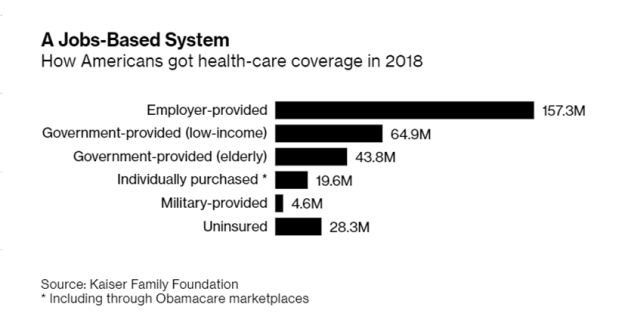
Government involvement in health care goes against the libertarian streak that distinguishes the U.S. from, say, the U.K. and Canada, whose state-funded health systems guaranteeing care for all are derided by some Americans as “socialized medicine.” Only about 36% of Americans, mainly the elderly and poor, receive health-care coverage through the government, via the Medicare and Medicaid programs. More than half of Americans have health insurance as a benefit through work (and can lose coverage if laid off). The 2010 Affordable Care Act, more commonly called Obamacare, has helped about 20 million Americans get health coverage by expanding access to Medicaid and subsidizing purchases of individual plans. Still, as of 2018, about 9% of the population, or 28.3 million people, had no health insurance.

Bloom2

2. What do the uninsured do?

About 1-in-4 put off seeking care in 2018 because of the expense, according to the Centers for Disease Control and Prevention. When emergencies arise, those lacking insurance often seek treatment at hospitals, which by law can’t turn them away. Even among those with insurance, about 29% were “underinsured” in 2018, meaning they faced high out-of-pocket costs when seeking care, according to the Commonwealth Fund, a private foundation. Those costs can total about $650 a year on average for the non-elderly and can reach into many thousands of dollars in the event of a “surprise billing,” when a patient receives care, often in an emergency, from a provider that’s not covered by the patient’s insurer. Medical expenses or health-related income loss resulted in an average of 530,000 bankruptcies each year in the U.S. from 2013 to 2016, according to the American Public Health Association.

3. What happened when the virus hit?

America’s patchwork system created confusion, muddling the response. Since prices are unregulated, concerns about out-of-pocket costs for coronavirus tests lingered even after federal officials assured Americans they’d pay nothing. The federal government also promised to pay the hospital bills of uninsured Covid-19 patients, and major insurers eventually pledged to waive out-of-pocket hospital expenses for their customers, but concerns about unexpected bills remained. The virus took a particularly harsh toll on Black Americans, who, as a result of income inequality and disparities in access to health care, are more likely to have underlying conditions such as diabetes, hypertension and lung disease. Some state governors bemoaned the lack of a coordinated federal response to challenges such as ensuring sufficient supplies of tests, ventilators and personal protective equipment for health-care workers, tasks that were left to underfunded statelevel public-health departments. The U.S. spent 17% of gross domestic product on health care in 2019, double the average of the well-to-do members of the Organization for Economic Cooperation and Development. But it allots only 3 cents out of every dollar to public health, the field devoted to protecting entire populations by, among other things, responding to infectious disease.

4. Where does U.S. health spending go?

The system encourages more expensive, specialized treatment over primary care. This does make the U.S. a leader in many aspects of medicine. It’s long been at the forefront of research and has lower death rates for breast cancer, heart attacks and strokes. Patients face shorter wait times to see specialists and can have access to state-of-the-art procedures. U.S. doctors earn roughly twice as much as those in other wealthy countries. At the same time, the U.S. has some of the worst health outcomes, including the lowest life expectancy among its peers and the highest rate of “avoidable deaths” — those that could have been prevented with effective care.

5. How is health care an election issue?

President Donald Trump and the Republican Party generally regard Obamacare as government overreach and support a challenge before the Supreme Court that could gut it. Some Democrats want to abolish the existing system of private insurance in favor of a government program along the lines of the U.K.’s. Trump’s presumptive Democratic challenger, former Vice President Joe Biden, doesn’t go that far but does want to lower the age for Medicare eligibility to 60 from 65 and create a government-provided health plan — a “public option” — that Americans could buy into.

The Reference Shelf

  • QuickTake explainers on surprise billing, what’s left of Obamacare and what’s meant by “Medicare for all.”
  • These charts show the disproportionate effect of Covid-19 in majority-Black counties.
  • How U.S. health care puts $4 trillion in all the wrong places.

— With assistance by John Tozzi

Article link: https://www.bloomberg.com/news/articles/2020-07-29/what-made-u-s-health-care-so-vulnerable-to-covid-19-quicktake?

We Need to Change How We Share Our Personal Data Online in the Age of COVID-19 – Time

Posted by timmreardon on 08/15/2020
Posted in: Uncategorized. Leave a comment
IDEAS
BY TIM BERNERS-LEE
JULY 15, 2020 3:57 PM EDT
Sir Tim Berners-Lee is the CTO and co-founder of Inrupt and inventor of the world wide web.

Afew months into the coronavirus pandemic, the web is more central to humanity’s functioning than I could have imagined 30 years ago. It’s now a lifeline for billions of people and businesses worldwide. But I’m more frustrated now with the current state of the web than ever before. We could be doing so much better.

COVID-19 underscores how urgently we need a new approach to organizing and sharing personal data. You only have to look at the limited scope and the widespread adoption challenges of the pandemic apps offered by various tech companies and governments.

Think of all the data about your life accumulated in the various applications you use – social gatherings, frequent contacts, recent travel, health, fitness, photos, and so on. Why is it that none of that information can be combined and used to help you, especially during a crisis?

It’s because you aren’t in control of your data. Most businesses, from big tech to consumer brands, have siphoned it for their own agendas. Our global reactions to COVID-19 should present us with an urgent impetus to rethink this arrangement.

For some years now, I, along with a growing number of dedicated engineers, have been working on a different kind of technology for the web. It’s called Solid. It’s an update to the web – a course-correction if you will – that provides you with a trusted place or places to store all your digital information about your life, at work and home, no matter what application you use that produces it. The data remains under your control, and you can easily choose who can access it, for what purpose, and for how long. With Solid, you can effectively decide how to share anything with anyone, no matter what app you or the recipient uses. It’s as if your apps could all talk to one another, but only under your supervision.

I think of all the possibilities this new relationship to our data could unlock, especially in the case of a pandemic.

Take virus infection detection and contact tracing apps: the pandemic hits and there is a call for people to share specific parts of their health data. These apps would be swift to develop and deploy, and more trusted by everyday citizens. Once the crisis passes, people would simply revoke permission for their data and the app would no longer have access to it.

There’s even more that could have been done to benefit the lives of people impacted by the crisis – simply by linking data between apps. For example:

What if you could safely share photos about your symptoms, your fitness log, the medications you’ve taken, and places you’ve been directly with your doctor? All under your control.

What if your whole family could automatically share location information and daily temperature readings with each other so you’d all feel assured when it was safe to visit your grandfather? And be sure no-one else would see it.

What if health providers could during an outbreak see a map of households flagged as immuno-compromised or at-risk, so they could organize regular medical check-ins? And once the crisis is over, their access to your data could be taken away, and privacy restored.

What if grocery delivery apps could prioritize homes based on whether elderly residents lived there? Without those homes or the people in them having their personal details known by the delivery service.

What if a suddenly unemployed person could, from one simple app, give every government agency access to their financial status and quickly receive a complete overview of all the services for which they’re eligible? Without being concerned that any agency could pry into their personal activity.

None of this is possible within the constructs of today’s web. But all of it and much more could be possible. I don’t believe we should accept the web as it currently is or be resigned to its shortcomings, just because we need it so much. It doesn’t have to be this way. We can make it better.

My goal has always been a web that empowers human beings, redistributes power to individuals, and reimagines distributed creativity, collaboration, and compassion.

Today, developers are creating exciting new applications and organizations are exploring new ways to innovate. The momentum for this new and vibrant web is already palpable, but we must not let the crisis distract us. We must be ready to hit the ground running once this crisis passes so we are better prepared to navigate the next one. To help make this a reality, I co-founded a company, called Inrupt, to support Solid’s evolution into a high-quality, reliable technology that can be used at scale by businesses, developers, and, eventually, by everyone.

Let’s free data from silos and put it to work for our personal benefit and the greater good. Let’s collaborate more effectively and innovate in ways that benefit humanity and revitalize economies. Let’s build these new systems with which people will work together more effectively. Let’s inspire businesses, governments, and developers to build powerful application platforms that work for us, not just for them.

Let’s focus on making the post-COVID-19 world much more effective than the pre-COVID-19 world. Our future depends on it.

Article link: https://time.com/5867314/we-need-to-change-how-we-share-our-personal-data-online-in-the-age-of-covid-19/

Doing vs being: Practical lessons on building an agile culture – McKinsey

Posted by timmreardon on 08/15/2020
Posted in: Uncategorized. Leave a comment

McKi3a

By Nikola Jurisic, Michael Lurie, Philippine Risch, and Olli Salo

Four global success stories offer insights and lessons learned on achieving organizational agility.

DOWNLOADS

Open interactive popup

Article (7 pages)

Around the world, a growing number of organizations are embracing agility to improve delivery, increase speed, and enhance customer and employee experience. Indeed, in the time of COVID-19, many organizations have accelerated their shift to agile. Our recent research found that agile organizations responded faster to the crisis, while those that do not embrace agile working may well forfeit the benefits of speed and resilience needed in the “next normal” after the COVID-19 pandemic.

In essence, agility at an enterprise level means moving strategy, structure, processes, people, and technology toward a new operating model by rebuilding an organization around hundreds of self-steering, high-performing teams supported by a stable backbone. On starting an agile transformation, many organizations emphasize and discuss tribes, squads, chapters, scrums, and DevOps pipelines. Our research shows, however, that the people dimension—culture especially—is the most difficult to get right. In fact, the challenges of culture change are more than twice as common as the average of the other top five challenges (Exhibit 1).

Exhibit 1
MCKI1A
We strive to provide individuals with disabilities equal access to our website. If you would like information about this content we will be happy to work with you. Please email us at: McKinsey_Website_Accessibility@mckinsey.com

Shifting culture requires dedicated effort. Unfortunately, many organizations on this journey struggle to articulate their aspired agile culture and bring it to life. This article demystifies culture change in an agile world through four practical lessons drawn from real-life success stories from around the world.

Lesson 1: Define the from–tos

Each organization is unique. Accordingly, each needs its unique culture to power the new agile operating model. Organizations building an agile culture should base their approach on aspirational goals. They also need to understand their current culture, including the behavioral pain points that can be used as a starting point to articulate three to five specific mindset and behavior shifts that would make the biggest difference in delivering business results.

At New Zealand–based digital-services and telecommunications company Spark, one of the first steps the leadership team took in its agile transformation was to launch an effort to articulate the cultural from–tos. Spark boldly decided to go all in on agile across the entire organization in 2017—flipping the whole organization to an agile operating model in less than a year. From the beginning, Spark understood that the change needed to be a “hearts and minds” transformation if it was to successfully enable radical shifts to structure, processes, and technology.

Spark’s culture change started with its Sounding Board, a diverse group of 70 volunteers from across the organization. These were opinion leaders—the “water cooler” leaders and Spark’s “neural network”—not the usual suspects visible to management. The Sounding Board’s role was creating buy-in for and comprehension about the new model and designing enablers (behavioral shifts and new values) to help employees along the agile journey.

An early task for the Sounding Board was to identify the behavioral shifts teams would need to thrive in the new agile operating model. Members used their experiences, inspirational examples from other companies, and Spark’s work on culture and talent to define these shifts. And to help inform what changes were necessary, the Sounding Board sought to understand mindsets (those underlying thoughts, feelings, and beliefs that explain why people act the way they do) that were driving behaviors.

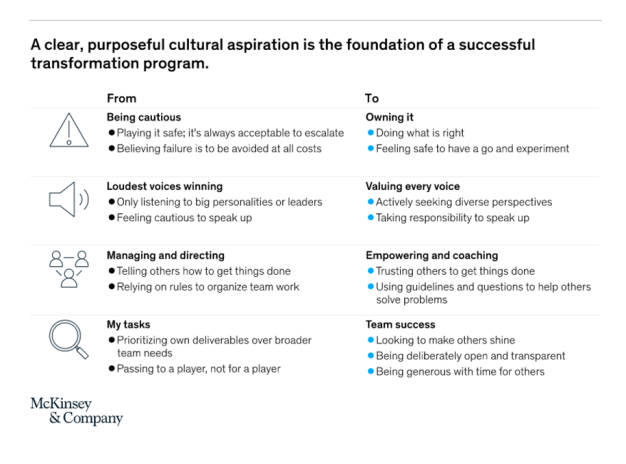
The from–to aspirations were then shared with different groups, including the top team, and distilled into four key themes. Each theme had to resonate with colleagues across the organization, be both practical and achievable, be specific to the company (that is, not derived from general agile theory). The resulting articulation of from–to behaviors allowed Spark to understand and compare its existing cultural reality with the desired end state (Exhibit 2). 1

Exhibit 2
McKi2a
We strive to provide individuals with disabilities equal access to our website. If you would like information about this content we will be happy to work with you. Please email us at: McKinsey_Website_Accessibility@mckinsey.com

Finally, to set up its from–tos as more than words on paper, Spark made culture one of the agile transformation’s work streams, sponsored by a top team member and discussed weekly in transformation sessions. The work stream brought culture to life through action. The from–to changes were incorporated in all major design choices, events, and capability-building activities. The work stream aligned fully with other culture initiatives that would help to move the needle on cultural change, such as diversity and inclusion.

Melissa Anastasiou, the team member who led the company’s culture workstream, observed: “Like many organizations, the company’s experience has been that culture change is hard and does not happen overnight. It takes collective and consistent effort, as well as a genuine belief in and understanding of the ‘why’ at all levels of the organization. Setting a clear and purposeful vision for what great looks like—and ensuring that this vision is authentically bought in from bottom to top that is, from shop floor to C-suite—put us in the best possible position to deliver the change to full business agile.”

Lesson 2: Make it personal

This lesson is about making the change personally meaningful to employees. To take change from the organizational to the personal frontier, leaders need to give their people the space and support to define what the agile mindset means to them. This will differ among senior leaders, middle managers, and frontline staff, and have different implications for each. Inviting colleagues to share personal experiences and struggles can build transformational momentum and unlock transformational energy.

This was an approach adopted by Roche, a 122-year-old biotechnology company with 94,000 employees in more than 100 countries. In order to build an agile culture, Roche facilitated a deep, personal change process among senior leaders. More than 1,000 of these leaders were invited to learn a new, more agile approach to leadership through a four-day immersive program that introduced them to the mindsets and capabilities needed to lead an agile organization. The program, called Kinesis, focused on enabling leaders to shift from a limiting, reactive mindset to an enabling, creative one. It also started the journey of learning how to shift from a traditional organization designed for command, control, and value capture to an agile organization designed for innovation, collaboration, and value creation.

Throughout the program, leaders came to recognize the ways in which their individual mindsets, thoughts, and feelings manifested in the design architecture and culture of the organizations they led. This recognition highlights why change programs that start with personal transformation are more successful. Organizations are built and led by their leaders: the way they think, make decisions, and show up shapes every part of the organization. This dynamic is amplified in agile organizations, which have an unusually high degree of openness and transparency.

The Kinesis program focused on leading through example. Roche’s head of talent innovation (the primary architect of the initiative) heard dozens of stories of leaders coming back from Kinesis and showing up differently. Beyond its learning programs, Kinesis also helped make the change personal by catalyzing large-scale experimentation in organization and business models. Within six months of the senior leader programs, many participants had launched agile experiments with their own leadership teams, departments, and several in their organizational units—engaging thousands of people in cocreating innovative ways to embed agility within the organization.

A core tenet of Kinesis was invitation, not expectation. Leaders were invited to apply lessons learned back to their own organizations. With the new mindset and the invitation, most participants did. Compared with the initial expectations of 5 to 10 percent of participants running a follow-up session with their teams, 95 percent chose to do so. 2 Today, agility has been embraced and widely deployed with Roche in many forms and across many of its organizations, engaging tens of thousands of people in applying agile mindsets and ways of working.

Lesson 3: Culturally engineer the architecture

Even the best-designed culture programs can fail if the surrounding context does not support—or worse, hinders—new mindsets and behaviors. To sustain a new culture, the structures, processes, and technology must be redesigned to support behavioral expectations. To be successful, the desired culture change needs to be hardwired into all elements of the business-as-usual organization as well as the transformation.

Magyar Telekom of Hungary (a Deutsche Telekom subsidiary), invested to embed and ingrain agile mindsets and behaviors throughout the agile transformation it started in 2018. As with Spark and Roche, Magyar Telekom began with the foundational lesson of defining its from–to. The telco started with three core values that, as the transformation matured, eventually evolved into seven values and were translated into slogans for more effective communication: 3

  • Focus, becoming more focused by critically assessing the current tasks and saying no to things that are not worth the required effort
  • Ownership, encouraging ownership by nudging employees to think of their tasks as if being performed for their own company
  • Retrospection, emphasizing the need to review and assess, celebrating successes and learning from failures

To ensure formal mechanisms supported this agile mindset shift, Magyar Telekom used structural changes on an individual and organizational level, aligning the people, customer, and business processes as well as the physical and digital working environments to an agile culture.

Magyar Telekom’s people processes, for example, practically reflected four principles:

  • All messages employees receive from the company are consistent with its cultural values
  • The cultural values and themes of focus, ownership, and retrospection are embedded in all HR and people processes
  • The employer brand, recruitment process, and onboarding journey ensure every new employee understands the agile culture’s cornerstones
  • Criteria for career progression define and support agile mindsets and behavior shifts

Magyar Telekom’s business processes were also hardwired to support its culture values. One of several examples used to support the focus and retrospective themes was the quarterly business review (QBR), a common element of agile operating models for business planning and resource allocation. QBRs typically involve stakeholders from major areas of the organization to set priorities and manage organizational demand and dependencies.

To further emphasize focus, the telco committed to implementing and scaling the QBR in the whole organization, including nontribe areas such as customer care or field execution. This formal mechanism had strong cultural implications. First, it signaled that the organization was committed to its cultural theme of focus. Second, the company-wide QBR aligned the whole organization around clear priorities, helping employees focus only on activities that create value while explicitly recognizing and deprioritizing activities that do not. Third, the QBR cycle also included retrospectives to understand and learn from previous successes and failures in a formal, structured, and highly visible process.

Another powerful way to ingrain culture is to change the physical and digital environments. Floors and walls can, quite literally, create either collaboration or barriers between teams. Magyar Telekom altered its floor plans to create spaces for individual squads, as well as all squads in a tribe, to sit and work together. The new physical environment promoted collaboration and continuous interactions. Team- level tools were introduced—including spaces for squads’ ceremonies and writeable walls where teams could visualize priorities, track progress, and engage in real-time creative thinking. Similarly, the digital work environment was updated with agile tools such as Jira issue-tracking and Confluence collaboration software, enabling efficient handling of epics, features and user stories. Within weeks, the Magyar Telekom work spaces turned from stereotypical offices to collaborative incubators of the new agile culture.

Lesson 4: Monitor and learn

Continuous learning and improvement is a core principle of agile working. It applies to agile culture as well. Successful agile transformations have shown the value of monitoring progress, evaluating behavioral change and its impact on performance, and running regular retrospectives to learn from successes and failures. However, measuring behavioral change has traditionally been a challenge.

ING, a well-known leader of agile transformations in banking, innovated here and used multiple approaches to track the impact of its agile transformation on productivity and several dimensions of performance, time to market and volume, and employee engagement. As part of these tracking initiatives, ING also tracked the progress of culture change and its impact on the overall transformation. The bank even teamed with INSEAD’s Maria Guadalupe, a professor of economics, to study and improve the quality of tracking efforts and the resulting insights.

ING’s first tracking initiative was a 40-question survey with 1,000 respondents that ran five times between 2015 and 2017. The survey questions, including those related to culture, were linked to the bank’s objectives and key results. This correlation between the transformation’s soft and hard drivers and its performance metrics allowed ING to see which cultural factors led to results and were critical to the transformation’s success. According to Michel Zuidgeest, ING’s lead of Global Change Execution, the product-owner roles and their corresponding behaviors, for example, turned out to be one of the most important factors affecting outcomes. Skill sets for product owners, chapter leads, and agile coaches—as well as the way they work together—were not clearly defined at the start of the transformation, and individuals in these roles had to grow the right mindsets and behaviors before team performance improved.

ING’s second tracking initiative, started in 2019, combined a 300-person “working floor” survey with senior leadership interviews across 15 countries. Once again, metrics on agile included culture-related questions on whether people on the floor felt more responsibility, whether they could collaborate better, and whether they were more able to learn from others in the company. In parallel, ING used qualitative methods to track the shift toward an agile culture. Updated performance frameworks and dialogues, for example, tracked whether employees were adopting desired behaviors while a continuous listening framework gave an ongoing pulse check of how people were doing.

ING used the data from its tracking initiatives to produce practical learning. Survey and interview results were used in QBRs, leadership dialogues, and improvement cycles. Outcomes were shared with tribes, the central works council, advisory groups, and others, and used in performance dialogues. ING also shared its findings with universities, sharpening both the company’s tracking efforts and university research. The value of tracking became very clear. ING managed to measure culture progress, establish the correlation between culture and performance, and use culture data to bring its agile operating model to life.

ING’s tracking initiatives produced insights on agile maturity, performance, and culture. Payam Djavdan, ING’s global head for One Agile Way of Working, explains that as the agile culture metrics improved—specifically the sense of belonging, motivation, purpose, and empowerment—employee engagement consistently increased. Similarly, several dimensions of team performance improved as the culture of credibility and clarity took hold while greater autonomy, a core principle of agile culture, allowed teams to take on their own challenges. In parallel, performance dialogues revealed that trust in tribe leads was a defining factor in employees’ engagement and their ability to share the tribe’s purpose.


Culture counts in all organizational transformations; it becomes critical in agile transformations. Organizations can do agile by changing their structure, processes, and technology. But they cannot be agile without changing the way people work and interact daily. Enabling a successful, agile transformation requires a fundamental shift in culture. Lessons from organizations that have successfully made this shift can give others a head start on their own transformation journeys.

Article link: https://www.mckinsey.com/business-functions/organization/our-insights/doing-vs-being-practical-lessons-on-building-an-agile-culture?

About the author(s)

Nikola Jurisic is a senior expert in McKinsey’s Dubai office, Michael Lurie is a partner in the Southern California office, Olli Salo is a partner in the Helsinki office, and Philippine Risch is a partner at Aberkyn.

The authors wish to thank Christopher Handscomb, Jelle Maddens, Andrew St. George, Dorottya Svab, Tal Shavit, David Pralong, Laura Furstenthal, Marcus Sieberer, and Daniel Rona for their contributions to this article.

Ten ‘antipatterns’ that are derailing technology transformations – McKinsey

Posted by timmreardon on 07/24/2020
Posted in: Uncategorized. Leave a comment
McKin-July20Shortsighted solutions to recurring problems—antipatterns—often sabotage a company’s transformation.

DOWNLOADS

Open interactive popup

 Article (6 pages)


Most major organizations today have embarked on transformation programs in response to changes in customer, competitive, and regulatory landscapes. Whether the transformations are labeled agile, digital, or DevOps, their fundamental premise is to build value by establishing short, iterative, and continuous feedback loops between product and customers that dramatically improve both the product and its time to market.

Technology has a crucial role in enabling this faster and more flexible approach. In our experience, however, technology does not get sufficient attention on the executive agenda. This is a serious flaw given the importance of technology in driving successful digital transformations.

There can be many reasons for this, but one of the main culprits is that technology is often viewed as a “specialist thing,” and IT leaders often have a hard time communicating about technology in a way that engages non-technologists. This reality often leads to “antipatterns”: an ineffective solution for a problem. Antipatterns have serious and sometimes fatal ramifications for technology transformations.

In this article, we synthesize ten of the most frequent technology antipatterns that we have observed in transformations across more than 50 major organizations. How many do you recognize in your organization?

Technology choices

1. Force-fitting technology solutions: Are you choosing technology out of context?

Watch out when technology decisions do not attract business scrutiny beyond cost and a cursory discussion of “scalability/strategic alignment.” For instance, we hear in many organizations about a “microservice-first” approach. While microservices are a critical component of many IT modernization journeys, they don’t fit the bill in all circumstances.

At one major corporation, the architects of the transformation suggested an approach that built microservices for a client-side application. But microservices is fundamentally a server-side architecture. The architects were simply responding to an organizational push to become technologically modern, but since installation and management of a client-side application was much more cumbersome due to the multiple independent components that would need to work together seamlessly, the approach would have resulted in significant cost and complexity with no additional benefit.

Recommendation

Leaders need to raise their hands to ask “silly” questions to fully understand the rationale and purported benefit of the recommended technology choices. In the preceding example, an executive’s simple series of questions, starting with, “Explain microservices to me as if I were an eight-year old,” could have saved the company millions of dollars!

2. Adopting cutting-edge tech that’s not fully mature: Are you adopting new technology that seems promising but doesn’t have a proven track record?

With stability and scalability as two core elements of any IT organization’s focus, very careful due diligence and decision making are needed to avoid adopting technologies that haven’t fully matured. Leaders should be cautious about any technology recommendation that is pitched primarily because it is in vogue or promises to attract new talent.

A leading bank launched a major redesign for its customer-facing application, using the latest web front-end framework as the software solution stack. It was touted as “future-proof” technology that would attract new talent. The project suffered serious setbacks and cost overruns because staff didn’t have the right capabilities to support it, resulting in time and money to upskill them. It was finally delivered after two years—18 months behind schedule.

Another major bank decided to rewrite its core accounting systems, which were more than 20 years old. While the systems were clean and extensible, the bank wanted to use the latest data-store technology. The project was shelved after an investment of more than €100 million because the new technology was not stable and the architecture created to support it had several fatal flaws.

Recommendation

Choose simple, proven technologies with which your people are familiar.

3. Building out your own cloud infrastructure without sufficient capabilities: Have you let security and regulation block your adoption of public cloud?

Companies are looking to take advantage of new infrastructure platforms and technologies such as container orchestrators, serverless platforms, and analytics solutions. These are complex pieces of technology that major cloud providers are constantly evolving, both in terms of capabilities and reduction in price point, to win the market.

If providing cloud-based infrastructure is not your core business, it will be impossible for you to match the cloud providers on the talent needed to build and run these platforms in a scalable, efficient, and secure way. Moreover, your (digital) competitors will be using these providers to enable them to operate at a completely different price point. At one major financial-services company, we identified more than four different private-cloud initiatives—converged infrastructure, OpenShift, Mesos/Marathon, and OpenStack—each struggling to achieve scale and competing for talent. After many months, the company halted those programs and rightly focused on public-cloud solutions. This is just one of more than 50 examples of private-cloud initiatives that have failed to deliver, often after the investment of millions of euros.

Recommendation

Focus your IT-for-IT investments in public cloud. Start by adopting only one of the major public-cloud providers for running your application workloads. Do not pursue a multicloud approach at first, as all major platforms differ significantly in setup and usage and require inordinate effort and investment for a similarly customized setup. For IT tooling, leverage SaaS solutions, such as workflow systems, source-code management, continuous integration, and collaboration platforms, as much as possible. For the workloads that you need to keep on the premises, use infrastructure patterns that you know and can operate safely and securely at scale.

Would you like to learn more about McKinsey Digital?

Technology road map

4. Initiating big-system-replacement programs: Are you focusing on system replacement rather than improving existing systems in a way that is faster and more cost-effective?

System-replacement projects are fundamentally complex, cost intensive, and inherently risky. They also distract the organization from building customer-centric capabilities and features in the short-to-medium term. Consequently, big-system-replacement projects should be avoided unless all other paths have proven not to be viable.

A major bank considered a core-banking-system replacement primarily because it was running an old Unix-based system on legacy hardware. But very quickly into the replacement project, the bank realized that its existing system was readily portable to new platforms, including public cloud. Additionally, updating the original monolithic code would entail substantially less cost, effort, and risk than replacing the entire system. Hence, after initial exploration, the bank chose to achieve the target business outcome by gradually modernizing the existing system at a fraction of the estimated big-system-replacement cost.

Recommendation

Before embarking on big-system replacement, ask the following:

  • Can you incrementally improve the old system instead of replacing it?
  • If you need to build a new system, will it deliver incremental value to your customers as it scales up over time?
  • Can you gradually phase out the old system?

5. Focusing on architecture and tooling improvements without enhancing process and delivery discipline: Did you re-architect and implement new tooling but forget to adapt the delivery processes?

One of the biggest sources of impact in technology transformations comes from simplifying the path to production, the steps involved from defining requirements to releasing software and using it with disciplined repetition across teams. This requires a lot of organizational and executive patience, as the impacted teams—app development, operations, security, support—can take weeks and months to perfect this coordinated dance. Tools and architecture changes can help, but to be effective, they need to be paired with changes to engineering practices, processes, and behaviors. Launching programs for large architecture and tooling changes often requires minimal effort, catches the executive and board’s fancy, and represents that things are moving. However, in our experience, without changes to engineering practices, processes, and behaviors, such programs have minimal or no impact.

A major bank realized, after several years of significant investment in development, release, and collaboration tools, that it had no improvement in time to market and a low adoption rate. After months of futile top-down incentives and nudges for tools adoption, the bank refocused on how the tools enabled a new set of engineering practices and collaboration between teams. It showed how the new tools could simplify the path to production. At last check, more than 40 percent of the teams were onboarded on the new way, and there was dramatic improvement in both time to market and the tactical adoption of tools. In a similar example, a major European bank dramatically increased delivery speed by focusing on a common and clear understanding of all components of the delivery process, establishing a strict cadence on how it would be executed, and simplifying some of the documents and approvals required before releasing software to production.

Recommendation

To improve speed of delivery, start with baselining the path to production to identify strengths and gaps. Follow this with simplification of process and delivery artifacts and addressing relevant gaps through tools and architectural changes, as required. Once the new process has been instituted, ensure that the teams adopt the cadence of disciplined repetition of this process.

Technology management

6. Focusing on outputs rather than business outcomes: Are your technologists focused on output instead of business/technology outcome?

Are your technology targets too . . . tech-y? Does the technology organization clearly articulate and track customer-focused targets? If the answer to any of these questions is even a mild pause to reflect, you need to dig deeper.

Well-meaning technologists, even in customer-centric organizations, often default to focusing on tech output. It is easily measurable, all-consuming, and very “in control.” Examples include amount of screens delivered, functionalities deployed, and defects tackled. The tech-output metrics might be great, but unless you’re measuring the direct impact of technology on customers, they are not particularly relevant. At one of the major financial organizations, the app-development group focused on 100 percent test automation as a key result and celebrated success—and closure—when they achieved it. However, testing took as many days as it had before, and there was no improvement in the product’s time to customer.

Recommendation

  • Business and technology leaders should define joint accountability for desired outcomes (aka “two in a box”):
    • Business outcomes: usage of your products (number of customers, daily usage) and customer satisfaction (net promoter scores, number of support requests)
    • Technology outcomes: functional availability/security of your product and efficiency of development (release frequency, toil)
  • Have the technologists and business articulate specific and measurable business and technical outcomes instead of technology outputs. The magic of product ownership and cross-functional teams lies in understanding the trade-offs between these different business and technology outcomes and making conscious choices about what to prioritize to balance short-term objectives with long-term product health.

How to restart your stalled digital transformation

Read the survey

7. Managing IT purely for cost: Are you sacrificing significant value by overindexing on price and cost?

Managing IT purely as a cost center is an outdated mindset that can have drastic repercussions, ranging from the inability to attract the right talent to discouraging use of critical and expensive technologies and platforms. For example, hiring or sourcing primarily on price typically results in subpar talent.

One financial-services company paid its vendor cheap day rates, and the vendor “recouped” the discounts by staffing novices and inflating estimates on what it would take to deliver certain features. The result was very low-quality code and long cycle times.

Recommendation

Instead of managing internal IT as a cost center, consider the following to think through how to set and align efficiency incentives:

  • Bring competence into the mix when talking about the cost of talent. Some companies have defined a unified competence model ranging from “novice” to “expert” for both internal engineers and vendors. Vendor pricing is discussed in terms of “novice equivalents,” recognizing that productivity differences between novice and expert engineers are a factor of eight to ten.
  • Create a true total-cost-of-ownership (TCO) view of your products to make sensible trade-off decisions on whether to invest in new features, automation, or infrastructure optimization.

8. Investing in developing new platforms without involving the business: Is your primary focus platform development instead of platform adoption by the business?

IT organizations rightly invest significant effort and resources in building and deploying robust platforms. However, quite often business is not involved in platform design or development, leading to new platforms with minimal relevance for the business side and, hence, poor adoption.

A major US bank made a multimillion-dollar investment in a data lake, ostensibly to pivot to a data-first culture. As a data-organization project within IT, it was conceived, designed, and developed primarily without business engagement. The data lake was delivered slightly behind schedule. More than a year later, the bank was still trying to make progress capturing use cases the data lake supported. In addition to the unused platform, the data organization suffered significant staff turnover due to poor morale. The bank has now launched multiple programs to update the data lake to meet business needs.

Recommendation

Start and end the conversation on all technology platforms with the business problem that they will address. Focus on that relentlessly, and ensure that all the right stakeholders across business and technology have joint accountability for the platform’s delivery of customer value. When building your platform, focus on building use cases, and instead of spending time up front on putting enablers in place, accept that you might want to refactor pieces of the platform when you onboard more use cases.

Managing technologists

9. Outsourcing your core value streams: Are vendors doing the work that creates the most value for your business?

If your core technology knowledge or intellectual property (IP) is outsourced (either through offshoring agreements or vendor-support contracts), you risk limiting the impact of any transformation and depending to an unhealthy degree on a third party. Because outsourcing has proven to be an effective tool to reduce cost for commoditized activities, some leaders have expanded its scope in response to cost pressures and outsourced entire subgroups or critical platforms. Such dependence has severely restricted organizations in making bold strategy and partner choices, mostly because they have little or no control over their own IP.

For instance, at a major insurer, 90 percent of the technology organization was outsourced across different vendors. During its transformation, it realized that a major reason for underperformance was that the knowledge of its three core systems was held by three individuals at different vendors. Not only that, but they had never spoken with each other.

Recommendation

Clearly demarcate the boundaries for outsourcing at business-critical technologies or activities. If you are currently heavily outsourced for critical activities, align with your peer group and the board on a plan to progressively bring them in-house.

10. Building up an army of managers rather than developing an engineering culture: Do you value your managers more than your engineers?

Career growth in most organizations usually entails people management. Gradually, talented employees who once showed great technology promise spend more time on managing people and administrative activities than on practicing the craft of engineering. They become full-time managers. Over time, they lose the ability to engage in deep technical conversations with their teams, to role-model technical problem solving and innovation, and—most damaging—to effectively manage team performance based on detailed technical merit. Consequently, organizations have a large IT group that consistently underperforms and has little technical guidance or accountability.

One major financial organization launched a program to overhaul its performance-management process and discovered that, on average, managers spent less than an hour a week in technical discussions with their teams. Does that sound familiar?

Recommendation

Give technology managers specific responsibilities for tech delivery. Encourage a culture of tech expertise for technology managers through monetary and nonmonetary incentives. To build an engineering culture, define granular performance-review criteria for technologists that are focused on both delivery and expertise.


Identifying and addressing these challenges require a concerted effort, with focus and ownership from both business and technology leadership. As more and more organizations launch and mature their digital transformations, executives must constantly probe for any evidence of the above antipatterns and urgently move to address them. Only then can the technology transformations evolve sufficiently to support the most vaunted three-part outcome of the digital transformation: faster customer-centric delivery, business growth, and happier employees.

About the author(s)

Sven Blumberg is a senior partner in McKinsey’s Istanbul office, Thomas Delaet is a partner in the Brussels office, and Kartikeya Swami is an alumnus of the New York office.

Article link: https://www.mckinsey.com/business-functions/mckinsey-digital/our-insights/ten-antipatterns-that-are-derailing-technology-transformations

MOST POPULAR INSIGHTS

  1. COVID-19: Implications for business
  2. ‘True Gen’: Generation Z and its implications for companies
  3. Ready, set, go: Reinventing the organization for speed in the post-COVID-19 era
  4. Consumer sentiment and behavior continue to reflect the uncertainty of the COVID-19 crisis
  5. Reimagining the office and work life after COVID-19

Big Changes to Military Health System Will Be Delayed, Top Health Official Says – Military.com

Posted by timmreardon on 07/06/2020
Posted in: Uncategorized. Leave a comment

MilitaryCom1
The COVID-19 pandemic is having a significant impact on reforms of the Pentagon’s health system, delaying plans to reduce services at 48 hospitals and clinics by months and forcing additional reviews of civilian care in locations affected by the changes.

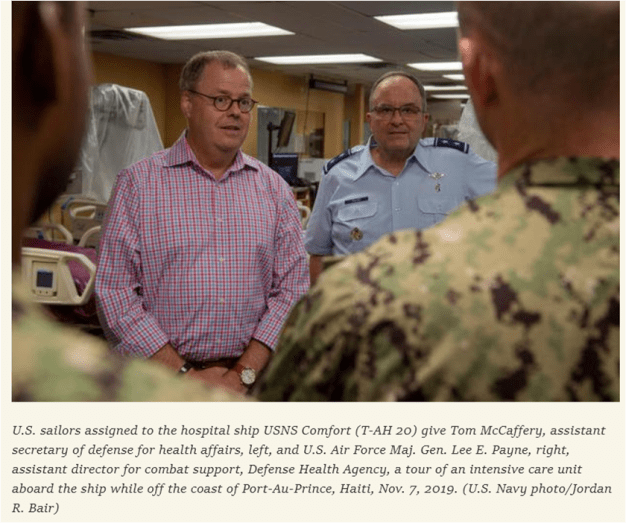
Assistant Secretary of Defense for Health Affairs Thomas McCaffery told reporters Thursday that efforts to alter operations at some military treatment facilities was scheduled to begin in September, but now may start “more toward the end of the year” or later.

Read Next: Senate’s $740 Billion Defense Bill Includes Pay Raise, Controversial Changes

The changes, designed to focus the facilities on providing medical care to active-duty personnel only as well as training military medical personnel, thereby shedding non-uniformed beneficiaries to the Tricare network, will result in outsourcing health care for at least 200,000 patients.

For the plan to work, the Defense Department is dependent on the availability of providers within Tricare. With the ongoing pandemic, however, “it’s going to affect the timeline as to when that happens,” McCaffery said during a conference call with the Defense Writers Group, an association of defense and national security correspondents.

“Because of the requirements of the health system — that we really have been diverting more time and resources to the COVID response — it could be something more to the end of the year that we would have a better idea of which military treatment facilities of the 48 would be earlier implementation and which would be later,” he said.

The changes originally were expected to take two to four years. McCaffery said implementation at each MTF will largely depend on the ability of local providers to absorb new patients. But with both military and civilian health care workers engaged in pandemic response, local networks “may not be able to engage with us at this moment,” he said.

“The key driver here is whatever change we make, we want to maintain access to care for our beneficiaries, and obviously that only works if that private-sector network is available,” McCaffery said.

Efforts to reform the military health system date to 2012 with the creation of the Defense Health Agency, a DoD department created to standardize and consolidate health care functions and services across the Army, Navy and Air Force medical commands.

But the transformation snowballed under the fiscal 2017 National Defense Authorization Act, which required DHA to assume management of all military hospitals and clinics, as well as many medical functions, and left the service medical commands to focus on providing medical care only to military personnel.

Defense officials say the efforts will curb costs and improve care and services across the board for beneficiaries. But the changes have met pushback from the services — which continue to support DHA with hospital management and face a reduction of medical personnel billets — as well as some military advocates.

In December, Army Secretary Ryan McCarthy sent a memo to Deputy Defense Secretary David Norquist expressing concern over what he saw as a “lack of performance and planning with respect to the transition” by the Defense Health Agency.

McCarthy asked for a delay in transitioning Army health facilities to DHA and also sought to keep the Army Public Health Center and Army Medical Research and Development Command, slated to transfer to DHA.

On Thursday, McCaffery did not comment on McCarthy’s request, but said much of the DoD’s funding for research and development comes through his office, and he works with the DHA and the services to determine priorities and allocate the money to various offices and research arms.

“We think that approach works well, and we are going to continue that,” he said.

Among the ongoing reforms within the military health system is a planned reduction of more than 17,000 medical billets. Early last year, the Army, Navy and Air Force quietly began planning to eliminate positions for several thousand doctors, nurses, technicians, medics and corpsmen and administrative personnel.

But which positions have been targeted has not been made public: Neither the DHA nor the services have released their plans, even as they have said they already are jettisoning those jobs through attrition.

Congress has requested a detailed report on the reductions; McCaffery said Thursday it will be forwarded to the House and Senate this month.

But even that plan may be subject to change as a result of the pandemic, he added.

“Obviously, implementation of that or other reforms will be tied to what we have learned and what we are learning with regard to the pandemic,” he said.

Nearly 4,000 active-duty, reserve and National Guard medical personnel deployed within the United States and elsewhere to assist the U.S. public health response to the COVID-19 pandemic.

As of Thursday, more than 7,400 military members, 1,213 family members, 1,691 civilian DoD employees and 771 defense contractors have tested positive for the coronavirus. Thirty-six, including three service members, have died.

McCaffery, a former health industry executive who took office last August, said he initially was concerned at the two- to three-year turnover of military medical community positions, the result of changes in duty stations and deployments.

But he expressed enthusiasm for the DoD’s ability this year to switch rapidly from focusing on health system reform to responding to a national emergency.

“It’s very easy for [health system leadership] to quickly pivot. … Usually, when our medical forces are deployed, whether it’s overseas or domestically, it’s for trauma-related events. This was very different, a very different enemy,” he said.

— Patricia Kime can be reached at Patricia.Kime@Monster.com. Follow her on Twitter @patriciakime.

Related: Here’s the List of Military Health Facilities That Will No Longer Service Retirees, Families.

Article link: https://www.military.com/daily-news/2020/06/12/big-changes-military-health-system-will-be-delayed-top-health-official-says.html

VA and DOD Now Default to Sharing Patient Data with Private-Sector Providers – Nextgov

Posted by timmreardon on 07/06/2020
Posted in: Uncategorized. Leave a comment
NxtGov1z
APRIL 20, 2020

The joint electronic health records management office launched an information exchange program to make it easier to share patient data with thousands of “community partners.”

While many of the central projects under the Veterans Affairs and Defense departments’ concurrent electronic health records rollouts are being delayed to deal with the COVID-19 outbreak, the joint program office reached a major data-sharing milestone this weekend.

On Saturday, the joint Federal Electronic Health Record Modernization, or FEHRM, program office stood up the DOD and VA Health Information Exchange, which will allow medical providers at both agencies to share patient data with private-sector health care organization, such as specialists and urgent care clinics.

The new exchange is an integral part of the agencies’ electronic health records programs. Both DOD and VA had major EHR management system rollouts planned for this spring but had to delay those projects as health care workers focus on combating the spread of coronavirus. However, in a letter to Congress in early April, VA Secretary Robert Wilkie said work on the health exchange was on target.

“The recent COVID-19 pandemic underlines the importance for clinicians on the front lines to quickly access a patient’s health record, regardless of where that patient previously received care,” said Dr. Neil Evans, FEHRM program office interim director. “As the DOD and VA implement a single, common record, the joint health information exchange and the associated expansion of community exchange partners is a critical step forward, delivering immediate value to all DOD and VA sites.”

The exchange—formally announced Monday—includes 215 partners, with most providers able to send and receive patient data from the agencies. However, a few providers only share patient data in one direction, either sharing data with VA and DOD or accepting information from the agencies, but not both.

The number of partner providers is expected to increase significantly before the end of the year, as the FEHRM office plans to connect to a third-party platform called CommonWell, “a network of more than 15,000 community providers,” according to the release.

Health information exchanges are not new in the private sector but weren’t available at VA until the 2018 passage of the VA MISSION Act, which, among other things, prompted the agency to begin work on a data-sharing platform.

Prior to launch of the new exchange, veterans could share information with private-sector providers but had to file a specific form to opt-in. Under the new exchange, veterans and active-duty service members are automatically enrolled to share data with approved “participating partners.”

As with similar programs, patients can opt-out of the health exchange if they don’t want to share their health data.

Article link: https://www.nextgov.com/it-modernization/2020/04/va-and-dod-now-default-sharing-patient-data-private-sector-providers/164752/

Leading Change – DoD Platform One

Posted by timmreardon on 06/29/2020
Posted in: Uncategorized. Leave a comment

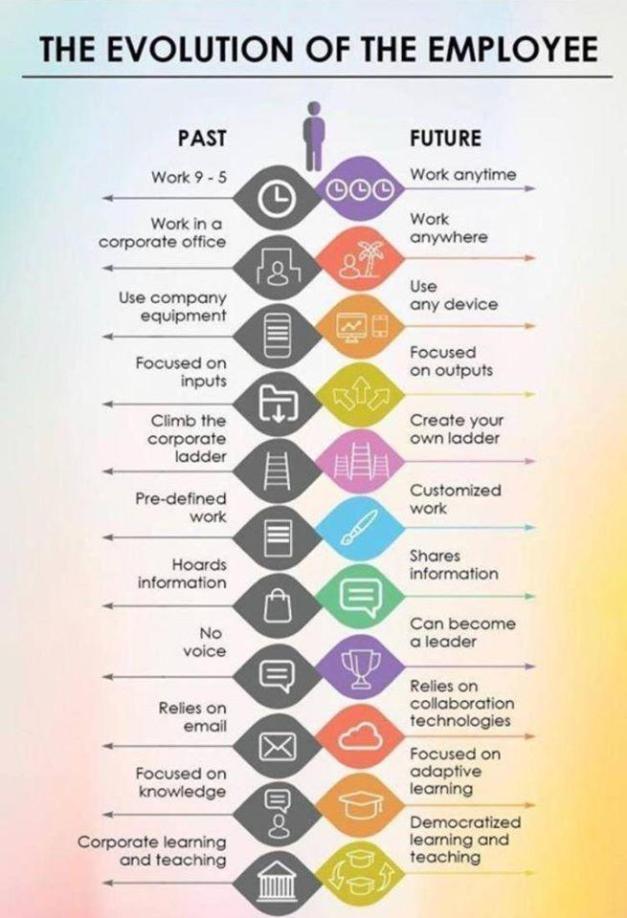
At DoD Platform One, we’re not only leading the charge at driving transformation on a technical level but we are #missionobsessed to accomplish this on a cultural level too.

We’re committed to role modeling the innovative approach unlike anything DoD has seen before, but we want to see become a standard of service. We deeply care about the needs of our workforce, we understand talent and how to find it, and we evolve our structure to fit what’s happening now — and where we want to go.

We’ll continue to lead the charge in changing what the future looks like and what it truly means to love Mondays and feel pride in being #missionobsessed.

By the way, do we have your resume yet?

#leadership #culturefirst #tomorrowstartstoday #firstmover

Image credit: Jacob Morgan “Future of Work”

PlatformOne

Article link: https://www.linkedin.com/posts/dodplatformone_missionobsessed-missionobsessed-leadership-activity-6681205017573232641-M6QG

The Military We Have Vs. The Military We Need – Defense One

Posted by timmreardon on 06/29/2020
Posted in: Uncategorized. Leave a comment

DefOnez1

BY GREGORY D. FOSTERPROFESSOR, NATIONAL DEFENSE UNIVERSITY

We only pretend to build armed forces to confront the threats we face.

“Disruptive change” is probably the most rhetorically popular, yet intellectually vacuous, turn of phrase now in use throughout the U.S. defense establishment. For an inherently conservative, parochial institution whose conception of the future is dominated by its preference for a canonical past, disruptive change is an attractive meme meant to convey progressive imagery to audiences inside and outside who might otherwise be inclined to expose the institution’s well-established lack of imagination and originality.

What is seen as the blueprint for disruptive change is the National Defense Strategy, or NDS, promulgated by the Trump administration’s first Defense Secretary, James Mattis, and his Marine brother in arms, then-Chairman of the Joint Chiefs of Staff Joseph Dunford. Together, they passed this ideological tract off as a legitimate strategy based on bona fide strategic thinking to indoctrinate the defense establishment and its bureaucratic and political disciples. Their successors and their successors’ subordinates have unquestioningly and unthinkingly endorsed the stultifying received truths of the document, so much so that any thought of meaningful transformative change within the institution, however much needed, seems frustratingly out of the question in the absence of some jolt to the system.

The NDS — here’s the unclassified summary — epitomizes the intellectual stagnation that pervades the military. It is predicated on the asserted “truths” that:

  • The U.S. military, in the years preceding the Trump administration, was emasculated and rendered largely impotent by forcing it to focus on frivolous, tangential threats and missions such as countering violent extremism.
  • The United States has been disadvantaged and is in danger of being unseated from its rightful position of primacy in all domains of warfare – land, sea, air, space, and cyberspace – by reformist powers bent on challenging U.S. global supremacy.
  • The world we face today and in the years ahead is defined by great-power competition (presumably involving the use of traditional, military-centered great-power means to achieve traditional great-power ends of superiority and dominance).
  • To properly compete in this great-power arena, our organizational, doctrinal, and technological emphases must be based, above all else, on “lethality” (meaning, by implication, killing power and destructive capacity fed by large-scale industrial innovation and sustained by big-war mobilization measures).

How woefully and dangerously outmoded, outdated, self-serving, self-deluding, and self-perpetuating such received truths are. This is Cold War redivivus; Old War become New War. One need only compare the rhetoric of misuse associated with the wars we conduct that don’t coincide with our idealized conception of war – be it Vietnam or the Global War on Terrorism – with the reality of the methods we use and the defense posture we maintain to prosecute such wars. And one need only compare great-power, big-war rhetoric with the realities today of pandemic disease, cyberattacks, climate-induced natural disasters, and violent, rogue-actor extremism.

We live today in a postmodern age defined, as with all conceptions of postmodernism, by irony and the need for fundamental redefinition of hallowed concepts and terms. Ironically speaking, old strengths (such as wealth, size, and population) have become new weaknesses; old advantages (such as technological superiority or expansive overseas presence) have become new disadvantages; old successes (like the end of the Cold War) have become new failures; old friends have become new enemies; and old forms of plenty (e.g., nuclear supremacy) have become new forms of scarcity (e.g., nuclear peace). Terms of reference once considered clear, immutable, and sacrosanct – war, peace, security, aggression, intervention, sovereignty, power – now beg for redefinition.

In the grand evolution of war in which we are unsuspectingly involved, we have passed from a deep historical period of “Hot War” dating to antiquity, in which the use of military force was the central element in the conduct of statecraft; to the prolonged period of Cold War familiar to us all, in which the non-use of force (at least against our principal adversary, the Soviet Union), and the attendant avoidance of large-scale war, was the defining element; to the present period of “New War,” in which the use of non-military power and non-traditional uses of the military are – or, to be more accurate, should be – at the heart of statecraft; to a yet-to-be-recognized, much less realized, period of “No War,” the normative strategic end-state we should be seeking, in which militaries as we have known them become essentially irrelevant. To reach such an idealized – many would say unrealistic and unrealizable – end-state, arguably will require as preconditions the attainment of denuclearization, delethalization, and ultimately demilitarization. Demilitarization can be brought about only by the military: not a militaristic military committed to the supernal mission of warfighting, but a military organized, equipped, trained, and deployed in dramatically new ways that redefine what militaries properly do.

Related: How ‘Great-Power Competition’ Became Washington’s Favorite Frame

Related: How to Get the National Defense Strategy Out of Its Mideast Rut

If we were to have a truly healthy state of civil-military relations, which we don’t, two of its cardinal defining elements would be a strategically effective (not just a militarily effective) military and a properly subordinated military-industrial complex that supports rather than dictates our military posture. In fact, in the cosmic international pecking order that differentiates superpowers from great powers, great powers from major powers, and major powers from minor powers, the possession of a strategically effective military is one of the principal indicators of standing and status. By any measure, the military we have today not only isn’t strategically effective, it isn’t even militarily effective. We don’t win wars. We don’t prevent wars. We certainly don’t eliminate wars. But we do feed escalation, provocation, and mirror imaging. Even if we were to claim a militarily effective military, we would have no choice but to admit that its defining features are all the things a truly strategically effective military wouldn’t be: disproportionately destructive, indiscriminately lethal, exorbitantly expensive, overly provocative and escalatory, unduly consumptive, largely alienated from society, and environmentally damaging.

At root, our problem derives from our prevailing frame of reference: Defense, narrowly conceived, dominates security, broadly conceived. Military power dominates non-military power. Wars of choice dominate wars of necessity, rhetoric to the contrary notwithstanding. Tactics dominates strategy. Unilateralism (and the attendant felt need for self-sufficiency) dominates multilateralism (with the attendant imperative for collective decision-making and action). Conventional, high-intensity capabilities dominate unconventional, low-intensity capabilities. Technology dominates doctrine and force structure, and high technology dominates appropriate technology. Means dominate ends. And, finally, logistics dominates operations, after all is said and done.

Although we pretend to orient and structure our military around the threats we face, in point of fact our approach is very much capabilities-based; we have the military we want, and we insist on imposing that preferred force on the situations we face, invariably with unsatisfactory results. The ideal would be a state of affairs in which recognized vulnerabilities determine what our interests are; interests would determine what circumstances and actors constitute threats; those threats would be the basis for determining requirements; and those requirements would dictate the capabilities we seek to have on hand. In practice, the reality is just the opposite; our preferred capabilities determine everything else.

While we persist in the pursuit of capabilities for competing in a great-power world that satisfies our hunger for the heaviest, most expensive, most destructive and lethal armaments in the world, and that mollifies industrial actors that provide jobs and contribute big bucks to politicians, the threats we actually face today demand something quite different. The wars we face today are entirely wars of choice. No existing conflict, nor any reasonably to be anticipated, demands our involvement. And the wars we face are far removed from the total wars of the distant past and even farther removed from an idealized state of stable peace we have yet to seriously pursue, much less achieve. No, our wars occupy the space between limited war and violent peace; and the prime defining characteristics of these wars are twofold: they are asymmetric, hybrid wars; and, as such, they are inherently unwinnable.

So, pandemics, natural disasters, cyberattacks, and random acts of violent extremism are very real, very serious, very deadly, and very demanding. They are the threats we face and will continue to face in perpetuity. Traditional wars against China and Russia are unrealistic, highly unlikely fantasy. China and Russia, if they are to oppose us, will do so asymmetrically, as they already are; not symmetrically in a manner that would justify and legitimize our misplaced preparations and capabilities. Do we prepare for the most serious wars we won’t face or the most likely “wars” we will face? The answer should be more obvious than it is: not the former, but the latter.

To cope effectively with the actual threats that confront us, we must decide, for starters, what the military’s role properly ought to be: to serve itself (in the manner of a self-interested interest group); to serve the regime in power; to serve the state; or to serve society and even humanity (as grandiose as that might sound)? And no less must we decide what the military’s proper function ought to be: to prepare for and wage war; to secure and preserve peace; or something in between, like providing for the common defense, or preventing war, or providing for security? “All of the above” is too vague an answer, and “they’re all the same” is too simplistic. A military whose raison d’être is preparing for and waging war – the military we have – is demonstrably different from one that seeks to secure and preserve peace – the one we need.

The military we have is heavy, destructive, lethal, blunt, combat-oriented, technology-dominant, general purpose, unilaterally capable, provocative, escalatory, expensive (gluttonously so), and unsustainable. It is basically a hard-power warfighting machine, totally captive of and obsessed with its own warfighting/warfighter verbiage, useful primarily for tacit threatmaking based on ostensibly superior capabilities, and prepared – arguably – only for traditional, conventional war (even though deployed for a variety of missions).

The military we need would be quite the opposite: light, constructive, predominantly nonlethal, precise, noncombat-oriented, manpower-dominant, tailored, multilaterally-capable/-dependent, reassuring, de-escalatory, affordable, and sustainable. It would be a strategically effective force, designed to respond to a robust array of complex, most-frequently-occurring emergencies – peacekeeping, nation-building, humanitarian assistance, disaster response – that ultimately contribute most demonstrably to the overarching normative strategic aim of enduring global peace.

Should such sweeping, transformative overhaul ever become a reality? Yes – if peace is actually our ultimate aim. Could it take place? Unlikely – given the intellectual shortcomings of the defense establishment in particular, and the national security community in general. These are heretical, heterodox ideas that can take root and be acted upon only as an outgrowth of new thinking that is in inexcusably short supply in government and think tank thought factories. In the final analysis, though, the military will have to take the lead – and want to take the lead – in dramatically reforming itself because politicians have major vested interests, political and economic, in preserving the status quo and in letting the military dictate its own fate. Whether the military has the intellectual wherewithal to measure up to such a challenge is a matter for high hopes, but measured expectations. But if we are to produce a future that is better than the past, we shouldn’t give up on hope. 

  • Gregory D. Foster is a professor at the National Defense University, a West Point graduate, and a decorated Vietnam War veteran. The views expressed here are his own. FULL BIO

Article link: https://www.defenseone.com/ideas/2020/06/military-we-have-vs-military-we-need/166470/

The US Intel Community Is Being Disrupted – Defense One

Posted by timmreardon on 06/24/2020
Posted in: Uncategorized. Leave a comment

Intel1BY ZACHERY TYSON BROWN READ BIO JUNE 23, 2020

Intelligence agencies aren’t businesses, but they’d better learn from private-sector giants gone by.

American intelligence needs a new business model that’s better suited to an era of novel threats, abundant information, and changing user preferences. The next generation of national security leaders expects more—more customization, more contribution, and above all, more access.

Intelligence officers are likely to bristle at the comparison—intelligence isn’t a business, nor are its officers motivated by profit. But the intelligence community’s leaders should borrow a few of the private sector’s concepts to help them better understand and adapt to the successive waves of disruption that are undermining the foundations of their institution they lead.

Business models are stories about how an enterprise works. They are built from assumptions about the competitive environment and the kinds of problems that people need to solve. Good business models have compelling value propositions that explain how a product or service the business offers solves those problems. Successful businesses offer better solutions than their competitors.

When the intelligence community was established at the beginning of the Cold War, its business model and its value proposition were straightforward. The community’s architects held the assumption, reasonably at the time, that only a well-funded, centralized conglomerate could build and operate the prohibitively expensive technical collection platforms necessary to pierce the Iron Curtain and obtain useful information about the Soviet Union. Borrowing from the private sector’s best practices of the day, they created a multi-divisional hierarchy of agencies, each a semi-autonomous unit with its own customer base and “brand” to manage. Atop this apparatus sat the National Security Council, a body created as a coordinating forum but that quickly became something more like a board of directors.

Throughout the Cold War, the assumptions that buttressed this “classified collection business model” held. Unassailable barriers to entry prevented any serious competition, and the general scarcity of information regarding the Soviets meant the intelligence community’s views were at least heard, if not always adhered to. It effectively enjoyed a monopoly—or, more precisely an oligopoly—over its mission “to inform national security decisions.”

But sooner or later, every business model fails. They are disrupted—which means broken—either naturally through market forces (which are really just the continually changing social, political, and technological milieu) that undo the assumptions they were built upon, or by the emergence of competitors with better models. Disruptions occur when someone uses a new technology—a better tool, a faster process, a more efficient organizational structure—to create a new business model that is so much cheaper, faster, or more convenient for customers that it renders the old one obsolete.

There are plenty of examples of business-model disruption, but the one most salient to the intelligence community is that of 20th-century photography giant Eastman-Kodak. Kodak’s tragedy is the story of an institution whose biggest impediment—like the intelligence community—was a legacy its leaders failed to overcome.

What Kodak’s leaders belatedly discovered was that while their path of least resistance was up—building a better camera every year—the most dangerous threat to their business model came from below. No one denied Kodak’s cameras were qualitatively superior to newer digital alternatives, but it didn’t matter in the end because the competition’s models were cheaper, faster, and more convenient.

Like Kodak, the intelligence community’s leaders know the world has changed. Like Kodak, the agencies they lead own every aspect of the intelligence production cycle—from the satellites in the sky and the technicians who exploit the data they gather, to the analysts who refine that data into “finished” reports and the distribution channels that determine who gets to see them. And just like Kodak, the intelligence community’s last-century business model is beginning to be disrupted by competitors it has never faced before, competitors who quite simply couldn’t exist in the closed, information-scarce context of the Cold War.

The information revolution has sparked the growth of an ecosystem of competitors who offer not only intelligence-like products like news aggregation and data analytics, but full-on strategic intelligence services such as on-demand overhead imagery collection and long-term forecasting and analysis. And while intelligence officers might tell themselves that these aren’t as sophisticated or authoritative as the information that they, themselves, can provide, the fact is that it often doesn’t matter, because they are “good enough” to satisfy most users’ immediate needs.

The reason disruptive innovations are so disruptive is that big institutions are often blinded by their success. As their business model becomes dominant, they are tempted to mistake their way of doing things for the way of doing things. But just by proving a value proposition, they invite imitation. Through the continuous improvement of their products, they facilitate commoditization. This eventually lowers barriers to entry, even as it overshoots the minimal functionality the majority of users need. Big companies often then find themselves immobilized by sunk costs, and unable to appeal to broader segments of users who increasingly can’t afford or aren’t interested in their now exquisite product.

Like Kodak, whose entire physical plant revolved around film, Americans have spent billions improving the classified collection business model. Our intelligence agencies have engineered an elaborate technical architecture that encompasses the globe, practically perfecting their ability to gather secrets. By one admittedly rough estimate, this armature of acquisition produces 50,000 finished intelligence reports every year.

Unfortunately, many of these reports go unread by anyone but other intelligence officers, because the “sources and methods” from which they’re derived require such strict security measures that only a small handful of people ever actually get to see them. The vast majority of the national security workforce—to say nothing of the wider government—are effectively priced out, unable to access the fruits of the intelligence community’s labor. So while the intelligence community may like to think of itself as “speaking truth to power,” the fact is it is often only talking to itself.

That’s a big problem because broad accessibility is where real value is created today. Value is how the user benefits. It is why the user chooses a particular product or service. Today, value comes from the edge, where it is collaboratively generated by the creative abrasion of what were once “producers” and “consumers.” This is why disaggregated platforms like Twitter, whose corporate mission is “to give everyone the power to create and share ideas and information instantly without barriers,” are so successful.

Now is a vital moment in our nation’s history. Threats to our security, our prosperity, and even our liberty itself are as grave as any faced by past generations, and the latitude America once enjoyed is long gone. If we hope to pilot the proverbial ship of state safely through the uncharted waters of the 21st-century, American leaders must make sound decisions.

So, what should the intelligence community’s role in decision-making be?

Merely acquiring information—a resource that is now both abundant and, for the most part, free—doesn’t cut it anymore. The problem of information scarcity that the intelligence community was created to solve no longer exists. Rather than squaring off against a monolithic adversary hidden behind a wall of secrecy, the United States today faces an array of greater and lesser threats—some conventional, others novel, all of them connected in various ways, many of which act quite openly.

Reform within the existing model won’t suffice. Another rearrangement of the proverbial deck chairs, the creation of a new agency responsible for the crisis du jour, or the movement of missions and authorities from one office to another won’t help much, either. These are more like sidesteps than solutions, akin to when a declining business shunts an unprofitable division or reassigns a struggling brand as it scrambles to eke out the last bit of value from their broken business model before it fails.

It’s time to reframe our conception of intelligence itself. To do so, we must strive to differentiate between mission and tradition—between things today’s users find valuable, and things that are just the way we’ve always done it.

To succeed today, the intelligence community needs a business model fit for today’s challenges—one that solves the sorts of problems today’s leaders have. It needs a value proposition compelling enough to justify the sustained investment of the American people, and, because value is generated throughout the network rather than from the top down, it must be accessible enough to benefit the entire national security enterprise—whose concerns are, of course, far broader than in the past.

Rather than merely informing decisions, intelligence should actively help its users to make better ones. The decision in question might be whether or not to authorize a lethal drone strike in Syria, which economic pressure points to apply against a great power competitor, or how limited budget dollars should be invested to build resilience against cyber-attacks. Regardless, all intelligence should have the same aim: helping leaders make better choices.

This requires a shift in how we think of intelligence. Instead of “products” to be delivered, we should see intelligence as an intangible, continuous, user-focused service that expands its users’ mental map of the world and helps them to navigate it more easily by building context and understanding, with them, rather than dictating judgments at them.

This shift would enable the sort of strategic sensemaking that helps organizations to see beyond immediate challenges and recognize strategic threats before they metastasize. In short, we should start to view intelligence officers themselves as the product, collaborating with users to create value for the national security enterprise.

To do that, the community must traffic in trust, and trust depends on transparency. This doesn’t mean dragging all the skeletons out of the closet or recklessly revealing national secrets. What it does mean is becoming much more comfortable operating “in the open,” being much clearer about how analytic judgments were reached, and speaking far more regularly and plainly with both the public and their elected representatives.

The business model analogy only takes us so far. At the end of the day, the intelligence community is not a business; it is a vital public institution. As such it remains only a loosely-federated medley of competing and unequal federal agencies, too-often subject to bureaucratic knife-fights or at the mercy of political caprice.

The community’s leaders have recognized the need for change, highlighting the need to modernize analytic tradecraft, sketching out a plan to integrate artificial intelligence, and pushing for greater transparency overall. The community itself is well-positioned to adopt new concepts and to leverage new technologies to meet its users’ changing needs, should it choose to do so—intelligence officers are bright, diligent, and famously dedicated to the mission of keeping Americans safe. They have, over nearly two decades of war, performed admirably all over the world—often in austere conditions, and not infrequently under fire. Several of them have paid the ultimate price.

But the intelligence community can’t afford to rest on its laurels. Past pedigree counts for little in today’s world, and previous success guarantees nothing. As former Principal Deputy Director of National Intelligence Sue Gordon put it, “We’ve never been as good as we are now, but we have to be better.”

  • Zachery Tyson Brown is an intelligence specialist and strategic futurist who works at the intersection of national security, disruptive technologies, and organizational design. He is a Security Fellow at the Truman National Security Project, a proclaimed U.S. Army “Mad Scientist,” and serves on … Full bio

Related: After 9/11, US Intelligence Reinvented Itself. It’s Time to Do It Again

Related: Weird Hours, Contractor Concerns: How the Intelligence Community Is Grappling with Coronavirus

Article link: https://www.defenseone.com/ideas/2020/06/us-intel-community-being-disrupted/166372/

Posts navigation

← Older Entries
Newer Entries →
  • Search site

  • Follow healthcarereimagined on WordPress.com
  • Recent Posts

    • When Not to Use AI – MIT Sloan 04/01/2026
    • There are more AI health tools than ever—but how well do they work? – MIT Technology Review 03/30/2026
    • Are AI Tools Ready to Answer Patients’ Questions About Their Medical Care? – JAMA 03/27/2026
    • How AI use in scholarly publishing threatens research integrity, lessens trust, and invites misinformation – Bulletin of the Atomic Scientists 03/25/2026
    • VA Prepares April Relaunch of EHR Program – GovCIO 03/19/2026
    • Strong call for universal healthcare from Pope Leo today – FAN 03/18/2026
    • EHR fragmentation offers an opportunity to enhance care coordination and experience 03/16/2026
    • When AI Governance Fails 03/15/2026
    • Introduction: Disinformation as a multiplier of existential threat – Bulletin of the Atomic Scientists 03/12/2026
    • AI is reinventing hiring — with the same old biases. Here’s how to avoid that trap – MIT Sloan 03/08/2026
  • Categories

    • Accountable Care Organizations
    • ACOs
    • AHRQ
    • American Board of Internal Medicine
    • Big Data
    • Blue Button
    • Board Certification
    • Cancer Treatment
    • Data Science
    • Digital Services Playbook
    • DoD
    • EHR Interoperability
    • EHR Usability
    • Emergency Medicine
    • FDA
    • FDASIA
    • GAO Reports
    • Genetic Data
    • Genetic Research
    • Genomic Data
    • Global Standards
    • Health Care Costs
    • Health Care Economics
    • Health IT adoption
    • Health Outcomes
    • Healthcare Delivery
    • Healthcare Informatics
    • Healthcare Outcomes
    • Healthcare Security
    • Helathcare Delivery
    • HHS
    • HIPAA
    • ICD-10
    • Innovation
    • Integrated Electronic Health Records
    • IT Acquisition
    • JASONS
    • Lab Report Access
    • Military Health System Reform
    • Mobile Health
    • Mobile Healthcare
    • National Health IT System
    • NSF
    • ONC Reports to Congress
    • Oncology
    • Open Data
    • Patient Centered Medical Home
    • Patient Portals
    • PCMH
    • Precision Medicine
    • Primary Care
    • Public Health
    • Quadruple Aim
    • Quality Measures
    • Rehab Medicine
    • TechFAR Handbook
    • Triple Aim
    • U.S. Air Force Medicine
    • U.S. Army
    • U.S. Army Medicine
    • U.S. Navy Medicine
    • U.S. Surgeon General
    • Uncategorized
    • Value-based Care
    • Veterans Affairs
    • Warrior Transistion Units
    • XPRIZE
  • Archives

    • April 2026 (1)
    • March 2026 (9)
    • February 2026 (6)
    • January 2026 (8)
    • December 2025 (11)
    • November 2025 (9)
    • October 2025 (10)
    • September 2025 (4)
    • August 2025 (7)
    • July 2025 (2)
    • June 2025 (9)
    • May 2025 (4)
    • April 2025 (11)
    • March 2025 (11)
    • February 2025 (10)
    • January 2025 (12)
    • December 2024 (12)
    • November 2024 (7)
    • October 2024 (5)
    • September 2024 (9)
    • August 2024 (10)
    • July 2024 (13)
    • June 2024 (18)
    • May 2024 (10)
    • April 2024 (19)
    • March 2024 (35)
    • February 2024 (23)
    • January 2024 (16)
    • December 2023 (22)
    • November 2023 (38)
    • October 2023 (24)
    • September 2023 (24)
    • August 2023 (34)
    • July 2023 (33)
    • June 2023 (30)
    • May 2023 (35)
    • April 2023 (30)
    • March 2023 (30)
    • February 2023 (15)
    • January 2023 (17)
    • December 2022 (10)
    • November 2022 (7)
    • October 2022 (22)
    • September 2022 (16)
    • August 2022 (33)
    • July 2022 (28)
    • June 2022 (42)
    • May 2022 (53)
    • April 2022 (35)
    • March 2022 (37)
    • February 2022 (21)
    • January 2022 (28)
    • December 2021 (23)
    • November 2021 (12)
    • October 2021 (10)
    • September 2021 (4)
    • August 2021 (4)
    • July 2021 (4)
    • May 2021 (3)
    • April 2021 (1)
    • March 2021 (2)
    • February 2021 (1)
    • January 2021 (4)
    • December 2020 (7)
    • November 2020 (2)
    • October 2020 (4)
    • September 2020 (7)
    • August 2020 (11)
    • July 2020 (3)
    • June 2020 (5)
    • April 2020 (3)
    • March 2020 (1)
    • February 2020 (1)
    • January 2020 (2)
    • December 2019 (2)
    • November 2019 (1)
    • September 2019 (4)
    • August 2019 (3)
    • July 2019 (5)
    • June 2019 (10)
    • May 2019 (8)
    • April 2019 (6)
    • March 2019 (7)
    • February 2019 (17)
    • January 2019 (14)
    • December 2018 (10)
    • November 2018 (20)
    • October 2018 (14)
    • September 2018 (27)
    • August 2018 (19)
    • July 2018 (16)
    • June 2018 (18)
    • May 2018 (28)
    • April 2018 (3)
    • March 2018 (11)
    • February 2018 (5)
    • January 2018 (10)
    • December 2017 (20)
    • November 2017 (30)
    • October 2017 (33)
    • September 2017 (11)
    • August 2017 (13)
    • July 2017 (9)
    • June 2017 (8)
    • May 2017 (9)
    • April 2017 (4)
    • March 2017 (12)
    • December 2016 (3)
    • September 2016 (4)
    • August 2016 (1)
    • July 2016 (7)
    • June 2016 (7)
    • April 2016 (4)
    • March 2016 (7)
    • February 2016 (1)
    • January 2016 (3)
    • November 2015 (3)
    • October 2015 (2)
    • September 2015 (9)
    • August 2015 (6)
    • June 2015 (5)
    • May 2015 (6)
    • April 2015 (3)
    • March 2015 (16)
    • February 2015 (10)
    • January 2015 (16)
    • December 2014 (9)
    • November 2014 (7)
    • October 2014 (21)
    • September 2014 (8)
    • August 2014 (9)
    • July 2014 (7)
    • June 2014 (5)
    • May 2014 (8)
    • April 2014 (19)
    • March 2014 (8)
    • February 2014 (9)
    • January 2014 (31)
    • December 2013 (23)
    • November 2013 (48)
    • October 2013 (25)
  • Tags

    Business Defense Department Department of Veterans Affairs EHealth EHR Electronic health record Food and Drug Administration Health Health informatics Health Information Exchange Health information technology Health system HIE Hospital IBM Mayo Clinic Medicare Medicine Military Health System Patient Patient portal Patient Protection and Affordable Care Act United States United States Department of Defense United States Department of Veterans Affairs
  • Upcoming Events

Blog at WordPress.com.
healthcarereimagined
Blog at WordPress.com.
  • Subscribe Subscribed
    • healthcarereimagined
    • Join 153 other subscribers
    • Already have a WordPress.com account? Log in now.
    • healthcarereimagined
    • Subscribe Subscribed
    • Sign up
    • Log in
    • Report this content
    • View site in Reader
    • Manage subscriptions
    • Collapse this bar
 

Loading Comments...