healthcarereimagined

Envisioning healthcare for the 21st century

  • About
  • Economics

The Psychology Behind Unethical Behavior HBR

Posted by timmreardon on 09/22/2021
Posted in: Uncategorized. Leave a comment

by Merete Wedell-WedellsborgApril 12, 2019

On a warm evening after a strategy off-site, a team of executives arrives at a well-known local restaurant. The group is looking forward to having dinner together, but the CEO is not happy about the table and demands a change. “This isn’t the one that my assistant usually reserves for me,” he says. A young waiter quickly finds the manager who explains that there are no other tables available.

The group tries to move on but is once again interrupted by the CEO. “Am I the only one annoyed by the view? Why is there construction happening today?” he demands to know. The waiter tries to explain, but to no avail. “You really need to up your game here,” the CEO replies. The air is thick with tension. After the waiter walks away, someone makes a joke about the man’s competence. This seems to please the CEO, who responds with his own derogatory quip. The group laughs.

If you were present at that dinner would you let the CEO know that you disapprove of his language and behavior? Would you try to set a better example? Or stay silent?

This scene encapsulates three psychological dynamics that lead to crossing ethical lines. First, there’s omnipotence: when someone feels so aggrandized and entitled that they believe the rules of decent behavior don’t apply to them. Second, we have cultural numbness: when others play along and gradually begin to accept and embody deviant norms. Finally, we see justified neglect: when people don’t speak up about ethical breaches because they are thinking of more immediate rewards such as staying on a good footing with the powerful.

The same dynamics come into play when much bigger lines get crossed in the corporate arena: allegations of corruption at Nissan, sexual harassment charges in the media sector,privacy breaches at Facebook, money laundering in the financial sector, and pharmaceuticals’ role in the opioid crisis.

While it is hard, if not impossible, to find evidence that leaders in general have become less ethical over the years, some are sounding the alarm. Warren Buffett, explaining Berkshire Hathaway’s practices in the annual letter shareholders, notes that he and vice chairman Charlie Munger

“…have seen all sorts of bad corporate behavior, both accounting and operational, induced by the desire of management to meet Wall Street expectations. What starts as an ‘innocent’ fudge in order to not disappoint ‘the Street’ — say, trade-loading at quarter-end, turning a blind eye to rising insurance losses, or drawing down a ‘cookie-jar’ reserve — can become the first step toward full-fledged fraud.”

Buffett’s note is important because it’s really about the majority of us:  neither saints nor criminals but well-meaning leaders who sometimes fail to consult their moral compass while speeding ahead in a landscape full of tripwires and pitfalls. For that majority, moral leadership is not simply a question of acting in good or bad faith. It is about navigating the vast space in between.

So how do you know when you, or your team, is on the road to an ethical lapse?  Here’s more on how to identify omnipotence, cultural numbness, and justified neglect in yourself and on your team, and a few tips on fighting each dynamic: 

Omnipotence. Many moral lapses can be traced back to this feeling that you are invincible, untouchable, and hyper-capable, which can energize and create a sense of elation. To the omnipotent leader, rules and norms are meant for everyone but them. Crossing a line feels less like a transgression and more like what they are owed. They feel they have the right to skip or redraw the lines. In the dinner party example above, it is no coincidence that the CEO’s entitled and condescending behavior comes after a day of strategizing and masterminding the next big moves.

Omnipotence is not all bad. Sometimes the rush you get from bold action is what’s required to make breakthroughs or real progress. But, the higher you climb on the ladder, the more it can become a liability. This is especially true if fewer and fewer of the people around you are willing and able to keep you grounded. If no one tells you “no,” you have a problem. One way to gauge whether you’ve reached “peak omnipotence” is if your decisions are met only with applause, deference, and silence.

The psychological counterweight to omnipotence is owning your flaws. It’s a mature capability to look in the mirror and recognize that you are not above it all. Especially if you’re in a leadership position, assume you have weaknesses and think about them regularly.

Sometimes, you’ll need help with this. The best performing executives I see have close colleagues, friends, coaches, or mentors who dare to tell them the truth about their performance and judgment. You should cultivate a similar group of trusted peers who will tell you the truth even when it is unpleasant. In addition, make sure to encourage an “obligation to dissent” among your core team.

Cultural numbness. No matter how principled you are, you must recognize that, over time, the bearings of your moral compass will shift toward the culture of your organization or team.

From my work with police and military units infiltrating criminal groups, I have seen examples of how cultural numbness makes leaders cross lines. It usually starts subtly. Officers need to get to know and infiltrate a new culture. They need to fit in by speaking the language, acting according to code, and dressing to fit in. But, in doing that, they risk going too far — mimicking the culture of the gang members they are out to stop and getting caught up in a group’s values system.

The same kind of “moral capture” takes place in companies, not overnight, but gradually. Psychologically, you’re making a trade-off between fitting into the culture and staying true to what you value.

At first, cultural numbness can take the shape of ironic distance or disillusioned resignation when there is a discrepancy between the two, or between the ideals your company espouses and what you see demonstrated and rewarded. But the mind needs resolution. So, over time, you stop noticing when offensive language becomes the norm or you start to behave in ways that you would never have expected to be part of your repertoire.

Cultural numbness is where I have seen the most severe breakdowns in ethical leadership because it’s so hard to detect. Leaders who have crossed a line never describe this as a clear choice on that path but as wandering down a muddy road, where there they lost track of what was right and wrong. They describe a process where they became numb to others’ language and behavior and then to their own and lost their sense of objectivity. In essence, their warning bells simply stopped ringing.

So, start looking out for signs of moral capture:  those brief moments when you don’t recognize yourself and any other indications that you are subjecting your own personal agency to the deviant norms of the collective. Another regular gut-check you can use involves asking whether you would be comfortable telling a journalist or a judge about what’s going on.

At the same time, you can’t always trust yourself in these situations. As with omnipotence, it can help to get an outsider’s perspective, turning to a trusted friend or family member, who might be able to detect changes in you that you are not able to see. Also remember to regularly extract yourself from your organization to compare and contrast its culture with others and remind yourself that the rest of the world may not work the same way.

Justified neglect. The human mind is skilled at justifying minor incursions when there is a tangible reward at stake — and when the risk of getting caught is low.

On the production line of a pharmaceutical company, for example, a hurried lab assistant forgets to remove all of her makeup. A speck of mascara accidentally drops into a batch of medicine large enough to serve a mid-sized country for a year. For a brief moment, the miniscule impurity draws a thin, yellowish color trail, but then it is gone, impossible to detect. The medicine is life-saving and very valuable, with just a hint of makeup that’s probably harmless.

Would you report the incident? If you were a manager who was quietly asked what to do, would you destroy the batch?  Would you change your mind knowing that patients might suffer or even die from a serious production delay? Would your ballooning production budget and the tenuous financial situation of your company factor into your decision? Would you push the problem up to your superiors knowing that those with a greater stake in the outcome might turn a blind eye to the incident?

Many leaders have faced a choice between getting the reward or doing the right thing. The slippery slope starts right when you begin to rationalize actions and tell yourself and others, “This is an exceptional situation,” or “We have to bend the rules a little to get things done here,” or “We are here to make money, not to do charity.”

These initial slips cascade into more, which turn into habits you know are bad but which start to feel excusable and even acceptable, given the circumstances, and eventually, become part of your moral fabric. It is hard to pinpoint exactly when an important line is crossed, but it’s much easier to course-correct at the very start of the slippery slope than when you are gliding full speed away from what is right.

Remember that power corrodes more than it corrupts, often as a result of clever justifications of ethical neglect. You can combat this psychological dynamic by creating formal and social contracts that obligate both you and your colleagues to do right; rewarding ethical behavior; and defining and sharing your boundaries. The latter could be as simple as making a list of things you will not do for profit or pleasure, keeping it in a convenient place to read regularly, and occasionally showing it to your team as a reminder.

****

The reality is that, for many leaders, there is no true straight-and-narrow path to follow. You beat the path as you go. Therefore, ethical leadership relies a lot on your personal judgment. Because of this, the moral or ethical dilemmas you experience may feel solitary or taboo — struggles you don’t want to let your peers know about. It can sometimes feel shameful to admit that you feel torn or unsure about how to proceed. But you have to recognize that this is part of work life and should be addressed in a direct and open way.

Even though most companies have some cultural and structural checks and balances, including values statements, CSR guidelines, and even whistleblower functions, leaders must also be mindful of the psychological conditions that push people — including themselves — to cross ethical lines. Understanding the dangers of omnipotence, cultural numbness, and justified neglect are like installing the first few warning signs on the long road of your career. You will inevitably hit some bumps, but the more prepared you are to handle them, the likelier you are to keep your integrity intact.

Head shot of Merete Wedell-Wedellsborg

Dr. Merete Wedell-Wedellsborg runs her own business psychology practice with clients in the financial, pharmaceutical, and defense sectors, as well as family offices. Merete holds a Ph.D. in Business Economics from Copenhagen Business School and an M.A. in Psychology from University of Copenhagen (Clinical Psychology). she is the author of the book Battle Mind: How to Navigate in Chaos and Perform Under Pressure.


Article link: https://hbr-org.cdn.ampproject.org/c/s/hbr.org/amp/2019/04/the-psychology-behind-unethical-behavior

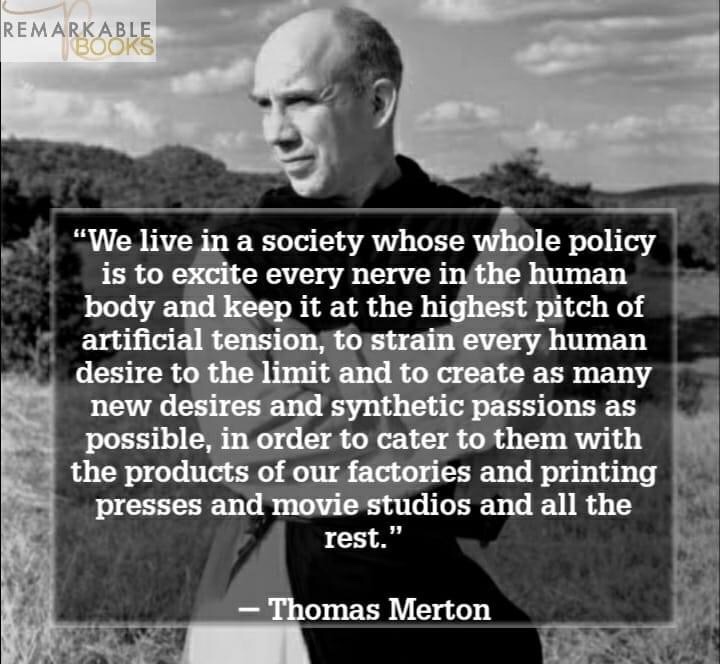
Thoughtful Observation about Today’s Society

Posted by timmreardon on 09/21/2021
Posted in: Uncategorized. Leave a comment

The Future of Work Series

Posted by timmreardon on 09/20/2021
Posted in: Uncategorized. Leave a comment

https://youtu.be/OYxP_DCENaI

The Practices That Set Learning Organizations Apart – MIT Tech Review

Posted by timmreardon on 09/05/2021
Posted in: Uncategorized. Leave a comment

Companies committed to building workforces equipped for the future apply seven key principles to training and development.

Image courtesy of Michael Glenwood Gibbs/theispot.com

Organizations are struggling to keep pace with the new skills needed in their workforces, thanks to large-scale trends such as the shift to digital business models and the increased adoption of workplace automation, AI, and advanced analytics. The pandemic accelerated those trends, putting an increased premium on learning and development (L&D) as a means of equipping companies to handle both long-term challenges and short-term crises.

To understand the implications of these changes, we recently engaged in more than 60 in-depth conversations with CEOs, chief human resources officers, chief learning officers, chief operating officers, and other senior HR and business leaders across six countries. We supplemented that research through surveys of more than 250 professionals worldwide about their approaches to L&D. The results show that relatively few organizations had strong L&D programs in place before the pandemic.

Those companies offer a model of how learning and development makes companies more responsive and agile. In studying their practices, we identified seven core principles that other companies can implement to improve their L&D efforts and equip themselves to thrive in both the short and long terms.

The Case for Investments in L&D

We conducted our quantitative survey in 2019 and found that few organizations had a strategic, forward-looking approach to L&D. Only 4 in 10 respondents to our survey identified preparing for the future as a high or top priority for their organization, and only 30% of respondents were confident in their ability to meet future skill needs.

Before COVID-19, technology was already changing employee and customer behaviors in dramatic ways, but the pace has now increased. Consultancy Global Workplace Analytics expects that an estimated 25% to 30% of the labor force will be working from home multiple days a week by the end of 2021.1 There is evidence of a growing performance gap between companies with digitally enabled, agile business models and those with traditional, legacy business models.2

We gained a unique perspective based on the timing of our research, given that we began interviewing company leaders before the pandemic and continued to speak with them throughout the crisis. We found that companies that had a strong, long-term L&D orientation going into the pandemic were well equipped to handle the short-term pressures that it created and to adapt quickly to new ways of working. Our findings are consistent with prior research showing that organizations that were already in the lead in terms of L&D before a crisis are better positioned for the post-crisis rebound. For example, research on previous global recessions shows the value of investment in L&D in equipping businesses for the subsequent recovery.3

There is a clear case for making investments now to build for the future. Some organizations are already making changes. According to a recent LinkedIn Learning report reflecting the impact of the COVID-19 pandemic, L&D professionals reported a 159% increase in the extent to which their CEOs were championing learning and development in their organizations, while 64% reported that reskilling the workforce was more of a priority than ever before.4 The imperative is to make sure that those investments yield results, building the skills and capabilities needed to take advantage of technologies such as big data and AI, and adjust to changes in work due to automation and on-demand contingent labor.

The digitalization of business processes and models and the attendant implications for how and where people work, and how customers engage with organizations, emerged as key areas of focus in our research. We identified seven key insights from the organizations that have been most successful in developing and implementing strong L&D programs.

1. Identify a North Star to guide L&D decisions. Organizations that were best prepared to respond to the changing world of work are guided by what we call a North Star — an overarching objective that informs decisions about employee skills and development.

Consider global pharmaceutical company Novartis, which set a North Star of evolving into a data-driven business in order to reimagine medicine and improve patients’ lives. To support that mission, Novartis identified five strategic priorities and built the underlying L&D components to support each of them. The initiative is backed by an investment of $100 million in learning and development over a five-year period, with an aim for all employees to spend 5% of their time learning. It includes partnerships with learning platforms such as Skillsoft, GetAbstract, Coursera, and LinkedIn.

For example, benchmark data from Coursera aided the L&D team in identifying a need for enhanced data visualization skills, in line with its strategic priority of data and digitalization. The team took a range of actions to build these skills and close the gap, tracking performance on a quarterly basis. Within two years of the program’s launch, Novartis surpassed the industry benchmark for data visualization skills.

In the U.S., Dell has repositioned itself from a traditional technology hardware company to a cloud-based infrastructure provider, with the ambition of enabling digital transformation for its customers. This is the organization’s North Star, and it has guided Dell to rethink the skills base of the organization. Dell developed a new career framework with 23 core skills, as well as a set of leadership principles to deliver on that ambition. Those core skills in turn inform the L&D strategy in terms of program design and content curation.

2. Establish a skills baseline. The second key insight is the importance of conducting an inventory of the current skills and capabilities of your workforce. Among the companies we studied, inventories such as these were seen as crucial in understanding current capabilities, identifying skills gaps more quickly, and taking action to fill any deficits.

For example, a European technology company launched a nine-month project to assess both the supply and demand of strategic skills that it would need in the future. The project, executed through IBM’s Kenexa Talent Frameworks, resulted in the company taking an inventory of skills across the organization and mapping them to job profiles as it worked to define and audit individual skills and roles. The skills inventory also provided a way to think about the key responsibilities, job levels, and core competencies of these roles.

The analysis highlighted that the company was hiring overqualified candidates for some roles. This resulted in annual labor costs that were roughly 1 million euros (about $1.2 million) higher than necessary to acquire skills that were not being deployed. The analysis also identified a number of new skill sets already in the organization that were likely to prove valuable in the future, and resulted in a renewed focus on internal development over external hiring.

We recognize that in larger organizations, completing such skills audits across so many roles, business units, and geographies can be a challenge, particularly when the pace of change is so rapid. Our research found that companies often succeed by breaking the process down into more manageable chunks, such as pilot exercises or skills inventories conducted at the level of business units or geographic regions. Regardless of the ultimate scope of the project, organizations should not think of these as “one and done” processes. Rather, the audits must be repeated to account for changes in the business landscape and within the organization itself.

3. Align L&D efforts with strategic priorities. We identified relatively few organizations that were systematically planning for the skills they would need in the future. The areas of AI and automation are good examples. Our findings show that those technologies were regularly overlooked by L&D teams prior to the crisis (likely due to significant pressure to deliver on short-term priorities, combined with a lack of resources), despite their visibility and clear business value. Many organizations continue to build L&D plans that overemphasize skills that were important in the past.

In contrast, leading organizations look forward and assess their strategic priorities, skills needed to execute on those priorities, and the future
impact on their workforces. For example, in 2019 a European insurance company projected changes in jobs due to the impact of technology and other factors over the next five to 10 years. It estimated that 15% of the company’s jobs were likely to be eliminated by technology and an additional 50% would be augmented by technology in that period. This analysis provided a road map as the company planned for the reskilling and redeployment of workers. Some of these measures overlapped with more urgent ones needed to respond to the pandemic; for example, the company was forced to accelerate its shift to digital processes in areas such as claims handling. The project provided a clear template for the development of digital and analytical skills by identifying the areas with the most opportunity for redeployment and where reskilling would add the most value.

Similarly, at professional services firm PwC, a team composed of business heads and led by the global human capital leader was tasked with ensuring that the organization had the capabilities to match its growth ambitions. A key initiative launched in 2019, supported by a $3 billion investment, focused on digital upskilling. All 276,000 employees worldwide underwent a two-day digital training session, and PwC offered new incentives to digitalize processes and improve performance across the organization. So far, millions of work hours have been saved through process improvements and innovations across the organization. In one example, an audit process that formerly took two weeks to complete is now automated and takes just 12 minutes. PwC’s digitalization journey was particularly valuable in the shift to virtual working in response to COVID-19.5

4. Ensure that the L&D team has the right skills and resources. The capabilities that L&D professionals need are quickly evolving alongside those of the overall workforce. We found an increased demand for digital and analytical skills among L&D teams, particularly regarding digital learning, virtual facilitation, and the curation of online content. We also saw increased expectations of L&D professionals in terms of their knowledge of the business and strategy, as well as the coaching and consulting skills required to fully engage with and deliver strategic value for the business.

At a U.K. bank, these demands have resulted in an L&D team that is smaller than in the past but more skilled and delivering a higher level of value for the business. As a more credible partner to the business, the team is now equipped to have more challenging conversations with organizational leaders to ensure that content offerings and even delivery modes match business needs and expectations. The team has also helped challenge outdated views on learning needs and has instead focused L&D investments on the future. Data analytics and visualization capabilities within the team, combined with deep knowledge of the business, have played a key role on this journey. In a recent regrading exercise, all members of the team had their job grades increased one level to reflect their increased contributions.

Technology also plays an increasingly important role as a platform for enabling L&D to support a company’s organizational strategy. In some cases, technology can create efficiencies and free up people for value-creating work. At ICON, an Irish global health care organization, we saw the deployment of a digital bot to schedule training in 2019. This bot freed up capacity equivalent to a full-time employee on the team, enabling that person to focus on more important tasks. Other companies have invested in technology to upgrade learning management systems, equipping L&D teams to deliver learning both during and after the crisis.

Not only did these organizations have the capabilities required for enabling digital learning and targeted curation of online content, but they also demonstrated a deep understanding of the challenges and opportunities of virtual learning design and facilitation.

5. Design learning to accommodate evolving conditions. Many organizations’ L&D budgets have been cut or frozen in response to current economic conditions. Additionally, most face-to-face training has been halted, at least in the short term. However, this offers the opportunity to shift from formal, event-based training that is separate from work to learning that happens in a more organic fashion throughout an employee’s workday, often termed learning in the flow of work.6 By blending technology, strategic partnerships, and internal processes, top-performing companies create learning that is “just in time, just enough, and just for me.”7 These opportunities might include short video clips on YouTube or active discussions on collaboration platforms such as Slack, Zoom, Facebook Workplace, or Microsoft Teams.

In fact, the shift to learning in the flow of work can offer real advantages in terms of employee engagement. Research by The Conference Board shows a strong preference among employees for working on tasks that require them to learn new things.8 In our own research, we also found that employee attitudes about learning are evolving, with an increased appreciation for virtual delivery. In the past, online learning was often viewed as a second-rate option, but for many employees, it is now the primary way to access training. For example, polling and analytics company Gallup reported that its employees appreciated a more individualized focus on their needs, combined with greater connection and intimacy enabled by virtual L&D.9

A number of organizations where we conducted interviews cited the value of global collaboration via virtual channels. Although programs may have been delivered onsite locally or regionally in the past, the shift to virtual operations means that participants from across the globe are more likely to be part of a single cohort. This has led to increased knowledge sharing across geographies.

Internal opportunity marketplaces, which match organizational needs with employee capabilities, are also increasingly prevalent.10 A Dell initiative connects people to work opportunities inside the company that are not full-time jobs and focuses on the skills that the future will demand. The internal talent marketplace is akin to crowdsourcing for skills — individuals bid to work on projects where their skills would fill a need on the project team. These projects are viewed as a means of developing individual capabilities while also building one’s social capital within the organization.

A number of our respondents pointed to the increasing emphasis on the 70:20:10 model of development. Under this model, development through on-the-job experiences should account for 70% of learning, while 20% comes from feedback and coaching and only 10% from more formal instruction.11 As one chief learning officer noted, the COVID-19 crisis served as a proof of concept for the 70:20:10 model because the organization was essentially forced to emphasize learning in the flow of work.

6. Create individualized learning pathways. Companies are also seeing an accelerated trend toward individualized learning pathways, reflecting the wider range of priorities and responsibilities among individual employees as their roles have evolved in response to the crisis. This also reflects a shift away from standardized learning pathways, which typically assume a standard baseline level of ability as people enter an organization and follow standard career paths.

As the head of L&D in a European banking organization told us, “We’re in this age where people just want the stuff that they need. They just want it really efficiently. ‘What can I do just to get this information, get it done, and move on?’” Notably, L&D platform LinkedIn Learning reported a threefold increase in its site traffic over the course of the pandemic through late 2020.12

A key challenge for L&D teams lies in helping employees understand which skills they need and how to access relevant content. As part of its digitalization strategy, PwC developed an app that allows employees to assess their current level of “digital fitness” and identifies resources to help them improve their scores. (The app is now available to the public for free.) In other organizations, technology has also played a key role, with LinkedIn Learning and YouTube also providing bite-size content focused on immediate needs.

7. Stay agile and adapt over time. The disruptions caused by the pandemic have shown companies how rapidly the priorities and requirements of L&D functions can change. This volatility challenges L&D teams to be responsive and agile. Rather than seeking perfection in program offerings, nimble L&D teams think in terms of getting a minimal viable product into the hands of users, testing the program, learning from experience, and making iterative changes and upgrades over time.

During the first few months of the pandemic, the initial requirement for L&D teams was to support employees working at home. However, priorities quickly shifted to a focus on well-being and mental health, and then to helping teams collaborate in new ways through virtual channels. This is a major shift from traditional L&D frameworks, which were often quite rigid. Yet the L&D teams that responded effectively recognized the importance of reevaluating decisions and priorities as new data became available.

A recurring theme among our recent discussions with organizational leaders was how the L&D team maintained its credibility by being responsive to the needs of the business during the crisis. We also had a small number of organizations report that adopting agile methodologies in their HR and L&D teams has aided their ability to adapt quickly in response to changing business needs. These examples point to the importance of continually assessing the effectiveness of L&D interventions and adapting to meet individual and organizational needs.

Related Articles

Sponsor’s Content | Online Learning: What Today’s Students Want — and ExpectSponsor’s Content | Developing the Data-Driven Organization: Leadership, Culture, and LearningHow Leaders Can Solve the Learning DilemmaDon’t Let Digital Obsession Destroy Your Organization

We also observed a number of instances in which organizational frameworks were too slow to respond to the pace of change during the pandemic, and L&D teams had to innovate to ensure responsive delivery. In one global organization, the signoff requirements for the centrally managed learning management system were slowing down content development. To move faster, some national units in that organization developed content locally and delivered it via Facebook Workplace.

Amid competing priorities, L&D may appear to be an issue that is secondary to more urgent challenges. However, L&D is itself the means by which companies equip themselves to take on those challenges, in particular by ensuring that their workforces have the skills to implement and adopt technologies that enhance competitiveness and productivity. As our research shows, that requires investing in learning and development with a long-term perspective and a strategic orientation, and being prepared to adapt over time.https://7d2e8d5f0842fa5843c841a5cef08fdf.safeframe.googlesyndication.com/safeframe/1-0-38/html/container.html

ABOUT THE AUTHORS

David G. Collings (@collingsdg) is a professor of human resource management at Dublin City University Business School. John McMackin is an assistant professor in human resource management and organizational behavior at Dublin City University Business School.

Article link: https://sloanreview.mit.edu/article/the-practices-that-set-learning-organizations-apart/

REFERENCES (12)

1. “Work-at-Home After COVID-19 — Our Forecast,” Global Workplace Analytics, accessed Dec. 16, 2020, https://globalworkplaceanalytics.com.

2. C. Bradley, M. Hirt, S. Hudson, et al., “The Great Acceleration,” McKinsey & Company, July 14, 2020, http://www.mckinsey.com.

3. Y. Kim and R.E. Ployhart, “The Effects of Staffing and Training on Firm Productivity and Profit Growth Before, During, and After the Great Recession,” Journal of Applied Psychology 99, no. 3 (May 2014): 361-389.

4. “Leading With Learning: Insights and Advice on the New State of L&D,” PDF file (Carpinteria, California: LinkedIn Learning, 2020), https://learning.linkedin.com.

5. A. Kidwai, “How PwC Keeps Its Digital Upskilling Relevant,” HRDive, May 12, 2020, http://www.hrdive.com.

6. J. Bersin and M. Zao-Sanders, “Making Learning a Part of Everyday Work,” Harvard Business Review, Feb. 19, 2019, https://hbr.org.

7. K. Peters, “m-Learning: Positioning Educators for a Mobile, Connected Future,” International Review of Research in Open and Distance Learning 8, no. 2 (June 2007): 1-17.

8. R.L. Ray, P. Hyland, A. Pressman, et al., “DNA of Engagement: How Organizations Can Foster Employee Ownership of Engagement,” PDF file (New York: The Conference Board, 2017), http://www.conference-board.org.

9. V. Ratanjee, “Four Ways to Continue Employee Development When Budgets Are Cut,” Gallup, Aug. 3, 2020, http://www.gallup.com.

10. M. Schrage, J. Schwartz, D. Kiron, et al., “Opportunity Marketplaces: Aligning Workforce Investment and Value Creation in the Digital Enterprise,” MIT Sloan Management Review, April 28, 2020, https://sloanreview.mit.edu.

11. M. Lombardo and R.W. Eichinger, “The Career Architect Development Planner” (Minneapolis: Lominger, 1996).

12. T. Vander Ark, “Pandemic Spike in AI Learning — and What It Means for Schools,” Forbes, May 7, 2020, http://www.forbes.com.

Is the Intelligence Community Staying Ahead of the Digital Curve? – Harvard Kennedy School Belfer Center

Posted by timmreardon on 08/22/2021
Posted in: Uncategorized. Leave a comment

Document Link: https://www.belfercenter.org/sites/default/files/files/publication/Ahead%20of%20the%20Digital%20Curve%20-%20Leyne%20and%20Nonte.pdf

The coming war on the hidden algorithms that trap people in poverty – MIT Tech Review

Posted by timmreardon on 08/19/2021
Posted in: Uncategorized. Leave a comment

Miriam was only 21 when she met Nick. She was a photographer, fresh out of college, waiting tables. He was 16 years her senior and a local business owner who had worked in finance. He was charming and charismatic; he took her out on fancy dates and paid for everything. She quickly fell into his orbit.

It began with one credit card. At the time, it was the only one she had. Nick would max it out with $5,000 worth of business purchases and promptly pay it off the next day. Miriam, who asked me not to use their real names for fear of interfering with their ongoing divorce proceedings, discovered that this was boosting her credit score. Having grown up with a single dad in a low-income household, she trusted Nick’s know-how over her own. He readily encouraged the dynamic, telling her she didn’t understand finance. She opened up more credit cards for him under her name.

The trouble started three years in. Nick asked her to quit her job to help out with his business. She did. He told her to go to grad school and not worry about compounding her existing student debt. She did. He promised to take care of everything, and she believed him. Soon after, he stopped settling her credit card balances. Her score began to crater.

Still, Miriam stayed with him. They got married. They had three kids. Then one day, the FBI came to their house and arrested him. In federal court, the judge convicted him on nearly $250,000 of wire fraud. Miriam discovered the full extent of the tens of thousands of dollars in debt he’d racked up in her name. “The day that he went to prison, I had $250 cash, a house in foreclosure, a car up for repossession, three kids,” she says. “I went within a month from having a nanny and living in a nice house and everything to just really abject poverty.”

Miriam is a survivor of what’s known as “coerced debt,” a form of abuse usually perpetrated by an intimate partner or family member. While economic abuse is a long-standing problem, digital banking has made it easier to open accounts and take out loans in a victim’s name, says Carla Sanchez-Adams, an attorney at Texas RioGrande Legal Aid. In the era of automated credit-scoring algorithms, the repercussions can also be far more devastating.

Credit scores have been used for decades to assess consumer creditworthiness, but their scope is far greater now that they are powered by algorithms: not only do they consider vastly more data, in both volume and type, but they increasingly affect whether you can buy a car, rent an apartment, or get a full-time job. Their comprehensive influence means that if your score is ruined, it can be nearly impossible to recover. Worse, the algorithms are owned by private companies that don’t divulge how they come to their decisions. Victims can be sent in a downward spiral that sometimes ends in homelessness or a return to their abuser.

Credit-scoring algorithms are not the only ones that affect people’s economic well-being and access to basic services. Algorithms now decide which children enter foster care, which patients receive medical care, which families get access to stable housing. Those of us with means can pass our lives unaware of any of this. But for low-income individuals, the rapid growth and adoption of automated decision-making systems has created a hidden web of interlocking traps.

Fortunately, a growing group of civil lawyers are beginning to organize around this issue. Borrowing a playbook from the criminal defense world’s pushback against risk-assessment algorithms, they’re seeking to educate themselves on these systems, build a community, and develop litigation strategies. “Basically every civil lawyer is starting to deal with this stuff, because all of our clients are in some way or another being touched by these systems,” says Michele Gilman, a clinical law professor at the University of Baltimore. “We need to wake up, get training. If we want to be really good holistic lawyers, we need to be aware of that.”

“Am I going to cross-examine an algorithm?”

Gilman has been practicing law in Baltimore for 20 years. In her work as a civil lawyer and a poverty lawyer, her cases have always come down to the same things: representing people who’ve lost access to basic needs, like housing, food, education, work, or health care. Sometimes that means facing off with a government agency. Other times it’s with a credit reporting agency, or a landlord. Increasingly, the fight over a client’s eligibility now involves some kind of algorithm.

“This is happening across the board to our clients,” she says. “They’re enmeshed in so many different algorithms that are barring them from basic services. And the clients may not be aware of that, because a lot of these systems are invisible.”

A homeless person bundled up on the street.
For low-income individuals, one temporary economic hardship can lead to a vicious cycle that sometimes ends in bankruptcy or homelessness.

She doesn’t remember exactly when she realized that some eligibility decisions were being made by algorithms. But when that transition first started happening, it was rarely obvious. Once, she was representing an elderly, disabled client who had inexplicably been cut off from her Medicaid-funded home health-care assistance. “We couldn’t find out why,” Gilman remembers. “She was getting sicker, and normally if you get sicker, you get more hours, not less.”

Not until they were standing in the courtroom in the middle of a hearing did the witness representing the state reveal that the government had just adopted a new algorithm. The witness, a nurse, couldn’t explain anything about it. “Of course not—they bought it off the shelf,” Gilman says. “She’s a nurse, not a computer scientist. She couldn’t answer what factors go into it. How is it weighted? What are the outcomes that you’re looking for? So there I am with my student attorney, who’s in my clinic with me, and it’s like, ‘Oh, am I going to cross-examine an algorithm?’”

For Kevin De Liban, an attorney at Legal Aid of Arkansas, the change was equally insidious. In 2014, his state also instituted a new system for distributing Medicaid-funded in-home assistance, cutting off a whole host of people who had previously been eligible. At the time, he and his colleagues couldn’t identify the root problem. They only knew that something was different. “We could recognize that there was a change in assessment systems from a 20-question paper questionnaire to a 283-question electronic questionnaire,” he says.

It was two years later, when an error in the algorithm once again brought it under legal scrutiny, that De Liban finally got to the bottom of the issue. He realized that nurses were telling patients, “Well, the computer did it—it’s not me.” “That’s what tipped us off,” he says. “If I had known what I knew in 2016, I would have probably done a better job advocating in 2014,” he adds.

“One person walks through so many systems on a day-to-day basis”

Gilman has since grown a lot more savvy. From her vantage point representing clients with a range of issues, she’s observed the rise and collision of two algorithmic webs. The first consists of credit-reporting algorithms, like the ones that snared Miriam, which affect access to private goods and services like cars, homes, and employment. The second encompasses algorithms adopted by government agencies, which affect access to public benefits like health care, unemployment, and child support services.

On the credit-reporting side, the growth of algorithms has been driven by the proliferation of data, which is easier than ever to collect and share. Credit reports aren’t new, but these days their footprint is far more expansive. Consumer reporting agencies, including credit bureaus, tenant screening companies, or check verification services, amass this information from a wide range of sources: public records, social media, web browsing, banking activity, app usage, and more. The algorithms then assign people “worthiness” scores, which figure heavily into background checks performed by lenders, employers, landlords, even schools.

Government agencies, on the other hand, are driven to adopt algorithms when they want to modernize their systems. The push to adopt web-based apps and digital tools began in the early 2000s and has continued with a move toward more data-driven automated systems and AI. There are good reasons to seek these changes. During the pandemic, many unemployment benefit systems struggled to handle the massive volume of new requests, leading to significant delays. Modernizing these legacy systems promises faster and more reliable results.

But the software procurement process is rarely transparent, and thus lacks accountability. Public agencies often buy automated decision-making tools directly from private vendors. The result is that when systems go awry, the individuals affected——and their lawyers—are left in the dark. “They don’t advertise it anywhere,” says Julia Simon-Mishel, an attorney at Philadelphia Legal Assistance. “It’s often not written in any sort of policy guides or policy manuals. We’re at a disadvantage.”

The lack of public vetting also makes the systems more prone to error. One of the most egregious malfunctions happened in Michigan in 2013. After a big effort to automate the state’s unemployment benefits system, the algorithm incorrectly flagged over 34,000 people for fraud. “It caused a massive loss of benefits,” Simon-Mishel says. “There were bankruptcies; there were unfortunately suicides. It was a whole mess.”

NEW YORK, NY – JULY 31: Housing activists gather to protest alleged tenant harassment by a landlord and call for cancellation of rent in the Crown Heights neighborhood on July 31, 2020 in Brooklyn, New York. Since the onset of the coronavirus crisis, millions of Americans have fallen behind on rent payments, leading many to speculate that an eviction crisis and drastic rise in homelessness is inevitable unless drastic action is taken by state and federal lawmakers. (Photo by Scott Heins/Getty Images)

Low-income individuals bear the brunt of the shift toward algorithms. They are the people most vulnerable to temporary economic hardships that get codified into consumer reports, and the ones who need and seek public benefits. Over the years, Gilman has seen more and more cases where clients risk entering a vicious cycle. “One person walks through so many systems on a day-to-day basis,” she says. “I mean, we all do. But the consequences of it are much more harsh for poor people and minorities.”

She brings up a current case in her clinic as an example. A family member lost work because of the pandemic and was denied unemployment benefits because of an automated system failure. The family then fell behind on rent payments, which led their landlord to sue them for eviction. While the eviction won’t be legal because of the CDC’s moratorium, the lawsuit will still be logged in public records. Those records could then feed into tenant-screening algorithms, which could make it harder for the family to find stable housing in the future. Their failure to pay rent and utilities could also be a ding on their credit score, which once again has repercussions. “If they are trying to set up cell-phone service or take out a loan or buy a car or apply for a job, it just has these cascading ripple effects,” Gilman says.

“Every case is going to turn into an algorithm case”

In September, Gilman, who is currently a faculty fellow at the Data and Society research institute, released a report documenting all the various algorithms that poverty lawyers might encounter. Called Poverty Lawgorithms, it’s meant to be a guide for her colleagues in the field. Divided into specific practice areas like consumer law, family law, housing, and public benefits, it explains how to deal with issues raised by algorithms and other data-driven technologies within the scope of existing laws.

If a client is denied an apartment because of a poor credit score, for example, the report recommends that a lawyer first check whether the data being fed into the scoring system is accurate. Under the Fair Credit Reporting Act, reporting agencies are required to ensure the validity of their information, but this doesn’t always happen. Disputing any faulty claims could help restore the client’s credit and, thus, access to housing. The report acknowledges, however, that existing laws can only go so far. There are still regulatory gaps to fill, Gilman says.

Gilman hopes the report will be a wake-up call. Many of her colleagues still don’t realize any of this is going on, and they aren’t able to ask the right questions to uncover the algorithms. Those who are aware of the problem are scattered around the US, learning about, navigating, and fighting these systems in isolation. She sees an opportunity to connect them and create a broader community of people who can help one another. “We all need more training, more knowledge—not just in the law, but in these systems,” she says. “Ultimately it’s like every case is going to turn into an algorithm case.”

In the long run, she looks to the criminal legal world for inspiration. Criminal lawyers have been “ahead of the curve,” she says, in organizing as a community and pushing back against risk-assessment algorithms that determine sentencing. She wants to see civil lawyers do the same thing: create a movement to bring more public scrutiny and regulation to the hidden web of algorithms their clients face. “In some cases, it probably should just be shut down because there’s no way to make it equitable,” she says.

As for Miriam, after Nick’s conviction, she walked away for good. She moved with her three kids to a new state and connected with a nonprofit that supports survivors of coerced debt and domestic violence. Through them, she took a series of classes that taught her how to manage her finances. The organization helped her dismiss many of her coerced debts and learn more about credit algorithms. When she went to buy a car, her credit score just barely cleared the minimum with her dad as co-signer. Since then, her consistent payments on her car and her student debt have slowly replenished her credit score.

Miriam still has to stay vigilant. Nick has her Social Security number, and they’re not yet divorced. She worries constantly that he could open more accounts, take out more loans in her name. For a while, she checked her credit report daily for fraudulent activity. But these days, she also has something to look forward to. Her dad, in his mid-60s, wants to retire and move in. The two of them are now laser-focused on preparing to buy a home. “I’m pretty psyched about it. My goal is by the end of the year to get it to a 700,” she says of her score, “and then I am definitely home-buyer ready.”

“I’ve never lived in a house that I’ve owned, ever,” she adds. “He and I are working together to save for a forever home.”

Article link: https://www.technologyreview.com/2020/12/04/1013068/algorithms-create-a-poverty-trap-lawyers-fight-back/?

Explainer: What is quantum communication? – MIT Tech Review

Posted by timmreardon on 08/19/2021
Posted in: Uncategorized. Leave a comment

This is the second in a series of explainers on quantum technology. The other two are on quantum computing and post-quantum cryptography.

Barely a week goes by without reports of some new mega-hack that’s exposed huge amounts of sensitive information, from people’s credit card details and health records to companies’ valuable intellectual property. The threat posed by cyberattacks is forcing governments, militaries, and businesses to explore more secure ways of transmitting information.

Today, sensitive data is typically encrypted and then sent across fiber-optic cables and other channels together with the digital “keys” needed to decode the information. The data and the keys are sent as classical bits—a stream of electrical or optical pulses representing 1s and 0s. And that makes them vulnerable. Smart hackers can read and copy bits in transit without leaving a trace.

Quantum communication takes advantage of the laws of quantum physics to protect data. These laws allow particles—typically photons of light for transmitting data along optical cables—to take on a state of superposition, which means they can represent multiple combinations of 1 and 0 simultaneously. The particles are known as quantum bits, or qubits.

The beauty of qubits from a cybersecurity perspective is that if a hacker tries to observe them in transit, their super-fragile quantum state “collapses” to either 1 or 0. This means a hacker can’t tamper with the qubits without leaving behind a telltale sign of the activity.

Some companies have taken advantage of this property to create networks for transmitting highly sensitive data based on a process called quantum key distribution, or QKD. In theory, at least, these networks are ultra-secure.

What is quantum key distribution?

QKD involves sending encrypted data as classical bits over networks, while the keys to decrypt the information are encoded and transmitted in a quantum state using qubits.

Various approaches, or protocols, have been developed for implementing QKD. A widely used one known as BB84 works like this. Imagine two people, Alice and Bob. Alice wants to send data securely to Bob. To do so, she creates an encryption key in the form of qubits whose polarization states represent the individual bit values of the key.

The qubits can be sent to Bob through a fiber-optic cable. By comparing measurements of the state of a fraction of these qubits—a process known as “key sifting”—Alice and Bob can establish that they hold the same key.

As the qubits travel to their destination, the fragile quantum state of some of them will collapse because of decoherence. To account for this, Alice and Bob next run through a process known as “key distillation,” which involves calculating whether the error rate is high enough to suggest that a hacker has tried to intercept the key.

If it is, they ditch the suspect key and keep generating new ones until they are confident that they share a secure key. Alice can then use hers to encrypt data and send it in classical bits to Bob, who uses his key to decode the information.

We’re already starting to see more QKD networks emerge. The longest is in China, which boasts a 2,032-kilometer (1,263-mile) ground link between Beijing and Shanghai. Banks and other financial companies are already using it to transmit data. In the US, a startup called Quantum Xchange has struck a deal giving it access to 500 miles (805 kilometers) of fiber-optic cable running along the East Coast to create a QKD network. The initial leg will link Manhattan with New Jersey, where many banks have large data centers.

Although QKD is relatively secure, it would be even safer if it could count on quantum repeaters.

What is a quantum repeater?

Materials in cables can absorb photons, which means they can typically travel for no more than a few tens of kilometers. In a classical network, repeaters at various points along a cable are used to amplify the signal to compensate for this.

QKD networks have come up with a similar solution, creating “trusted nodes” at various points. The Beijing-to-Shanghai network has 32 of them, for instance. At these waystations, quantum keys are decrypted into bits and then reencrypted in a fresh quantum state for their journey to the next node. But this means trusted nodes can’t really be trusted: a hacker who breached the nodes’ security could copy the bits undetected and thus acquire a key, as could a company or government running the nodes.

Ideally, we need quantum repeaters, or waystations with quantum processors in them that would allow encryption keys to remain in quantum form as they are amplified and sent over long distances. Researchers have demonstrated it’s possible in principle to build such repeaters, but they haven’t yet been able to produce a working prototype.

There’s another issue with QKD. The underlying data is still transmitted as encrypted bits across conventional networks. This means a hacker who breached a network’s defenses could copy the bits undetected, and then use powerful computers to try to crack the key used to encrypt them.

The most powerful encryption algorithms are pretty robust, but the risk is big enough to spur some researchers to work on an alternative approach known as quantum teleportation.

What is quantum teleportation?

This may sound like science fiction, but it’s a real method that involves transmitting data wholly in quantum form. The approach relies on a quantum phenomenon known as entanglement.

Quantum teleportation works by creating pairs of entangled photons and then sending one of each pair to the sender of data and the other to a recipient. When Alice receives her entangled photon, she lets it interact with a “memory qubit” that holds the data she wants to transmit to Bob. This interaction changes the state of her photon, and because it is entangled with Bob’s, the interaction instantaneously changes the state of his photon too.

In effect, this “teleports” the data in Alice’s memory qubit from her photon to Bob’s. The graphic below lays out the process in a little more detail:

Researchers in the US, China, and Europe are racing to create teleportation networks capable of distributing entangled photons. But getting them to scale will be a massive scientific and engineering challenge. The many hurdles include finding reliable ways of churning out lots of linked photons on demand, and maintaining their entanglement over very long distances—something that quantum repeaters would make easier.

Still, these challenges haven’t stopped researchers from dreaming of a future quantum internet.

What is a quantum internet?

Just like the traditional internet, this would be a globe-spanning network of networks. The big difference is that the underlying communications networks would be quantum ones.

It isn’t going to replace the internet as we know it today. Cat photos, music videos, and a great deal of non-sensitive business information will still move around in the form of classical bits. But a quantum internet will appeal to organizations that need to keep particularly valuable data secure. It could also be an ideal way to connect information flowing between quantum computers, which are increasingly being made available through the computing cloud.

China is in the vanguard of the push toward a quantum internet. It launched a dedicated quantum communications satellite called Micius a few years ago, and in 2017 the satellite helped stage the world’s first intercontinental, QKD-secured video conference, between Beijing and Vienna. A ground station already links the satellite to the Beijing-to-Shanghai terrestrial network. China plans to launch more quantum satellites, and several cities in the country are laying plans for municipal QKD networks.

Some researchers have warned that even a fully quantum internet may ultimately become vulnerable to new attacks that are themselves quantum based. But faced with the hacking onslaught that plagues today’s internet, businesses, governments, and the military are going to keep exploring the tantalizing prospect of a more secure quantum alternative.

Article link: https://www.technologyreview.com/2019/02/14/103409/what-is-quantum-communications/?

Future proof: Solving the ‘adaptability paradox’ for the long term – McKinsey

Posted by timmreardon on 08/18/2021
Posted in: Uncategorized. Leave a comment

Just when leaders need fresh thinking and decisiveness, they tend to fall back on tried-and-true ways. Five actions can transform your relationship with uncertainty and help you thrive.

Shutdowns and supply-chain hacks. Hybrid work, remote shopping, settling up via blockchain. The past year has made it abundantly clear, if it wasn’t already, that a volatile and complex world is  serving up change at an accelerating pace.

Individuals and organizations need to be ready. That doesn’t mean reacting to the next challenge that comes our way but rather being prepared to meet it when it arrives. There’s one tool above all others that can help leaders do that: adaptability.

MOST POPULAR INSIGHTS

  1. Defining the skills citizens will need in the future world of work
  2. Back to the future? Airline sector poised for change post-COVID-19
  3. COVID-19: Implications for business
  4. It’s time for leaders to get real about hybrid
  5. The comeback of corporate travel: How should companies be planning?

Adaptability is the ability to learn flexibly and efficiently and to apply that knowledge across situations. It’s not so much a skill as a meta-skill—learning how to learn and being conscious of when to put that learner’s mind into action. By becoming aware of and open to change now, we can maintain control over uncertainty before pressures build to the point where altering course is much more difficult, or even futile.

Our research shows that adaptability is the critical success factor during periods of transformation and systemic change. It allows us to be faster and better at learning, and it orients us toward the opportunities ahead, not just the challenges.

Yet the same conditions that make adapting so important can also trigger fear, making us default to familiar patterns or whatever solutions worked the last time. We call this the “adaptability paradox”: when we most need to learn and change, we stick with what we know, often in a way that stifles learning and innovation. Even positive events, such as receiving a promotion or beginning a new workstream, can turn negative unless we can maintain a learning mindset while under pressure.

But people often don’t put in the hard work of learning and mastering something new unless there is compelling motivation to do so. When that motivation arrives, it’s often accompanied by pressure—to avert failure, for instance, or to attain a high-stakes reward or incentive.1

To avoid this trap, leaders must work on transforming their relationship with change and uncertainty by building adaptability as an evergreen skill that benefits themselves and their organizations at a deeper level.

This is not a natural skill—even for the most successful among us—but it can be nurtured. And the rewards are worth the effort: companies with strong cultures that emphasize adaptability turn in better financial performance than entities that lack those attributes, research shows.2

In this article, we delve into five steps that leaders can take to become more adaptable, including emphasizing both well-being and purpose, practicing an adaptive mindset, building deeper human connections, and making it safe to learn.

Why building an adaptability muscle is so important

The power of resilience has been amply demonstrated during the COVID-19 crisis. Although resilience and adaptability are linked, they are different in important ways. Resilience often entails responding well to an external event, while adaptability moves us from enduring a challenge to thriving beyond it. We don’t just “bounce back” from difficult situations—we “bounce forward” into new realms, learning to be more adaptable as our circumstances evolve and change.

Learning agility,3 emotional flexibility, and openness to experience are all part of a multidimensional understanding of adaptability.4 They help us maintain deliberate calm under pressure and display curiosity amid change. They allow us to respond in ways that are the opposite of a knee-jerk reaction by making thoughtful choices.

Studies have shown that adaptability is also linked to important psychological skills, ranging from coping to personal growth. In the workplace,5 higher levels of adaptability are associated with greater levels of learning ability and better performance, confidence, and creative output.6 Adaptability is also crucial for psychological and physical well-being and is linked to higher levels of social support and overall life satisfaction.7

Now that we’ve enumerated the benefits of adaptability, let’s go through the five ways leaders can invest in it to prepare for a fast-paced and uncertain future.

Step 1: Practice well-being as a foundational skill

From the beginning of the COVID-19 pandemic, executives have made sure to check on employees’ health. But that may have been putting the cart before the horse: research shows that leaders experienced anxiety and burnout symptoms at unprecedented rates8 as they focused on others without restoring their own energy levels.

A Harvard Business Review–sponsored survey conducted in the fall of 2020 gathered feedback from more than 1,500 respondents from 46 countries9 —the majority of whom were at or above supervisor level. Eighty-five percent of these respondents said their well-being had declined, while 56 percent said their job demands had increased. Moreover, 62 percent who were struggling to manage their workloads said they had experienced burnout “often” or “extremely often” in the previous three months.

The number of people reporting more symptoms of burnout has increased since then, not only in C-suites but also across organizations. When people are exhausted, they fall into a scarcity mindset (thinking about what they don’t have) and aren’t as adaptable or open to learning. We expect to see these mental-health and well-being challenges continue for at least the next year or two.

The best way to handle demanding situations is by investing in one’s own well-being first. Just like athletes who continually invest in their own physical and mental health—not only before a game or a race—leaders have to be fit to face whatever comes their way and to support others for however long it takes. Leaders should focus on allowing themselves to thrive, and then helping others to be at their physical, mental, and emotional best.10

The CEO of a global mobility tech company told us that when the pandemic began, he took advantage of not having to travel by restarting a daily running routine. He started at five kilometers a day, using the time and physical activity to reflect and refresh, eventually building his runs to marathon length. After injuring himself, however, he realized that he had begun to approach running as a goal to be achieved rather than as a nurturing practice to enjoy. So he shifted back to his original goal of giving himself time to reflect, which in turn helped him perform and nurture his team.

Research shows that taking deliberate breaks accelerates learning and skill acquisition. For example, a study of violin prodigies11 revealed that students who were quickest to master the instrument took regular and significant breaks, including naps between practice sessions, rather than playing for hours on end. In another study of people trying to perform a task involving new skills, those who took breaks to mentally reset improved much more quickly under performance pressure.12

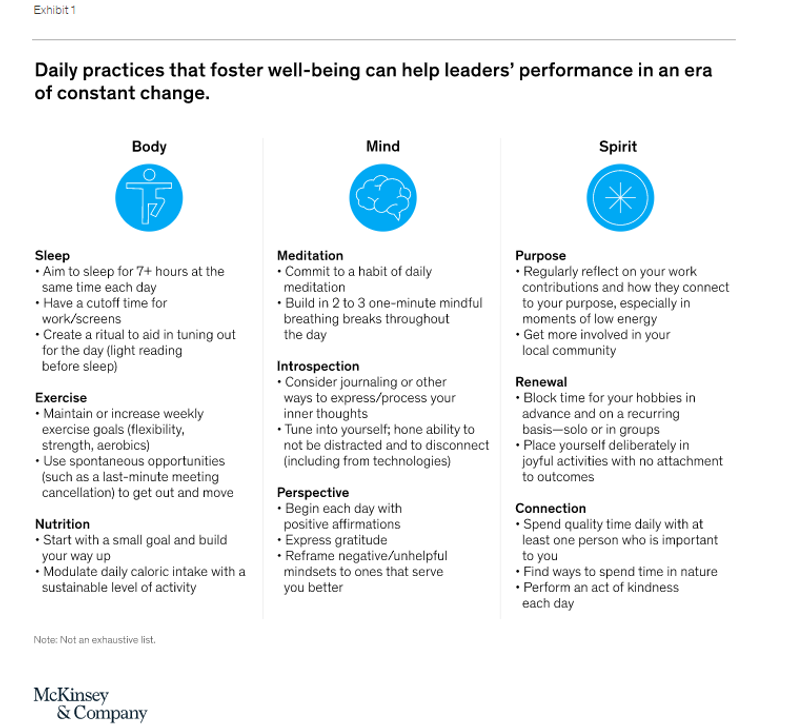
Counter to what leaders may think, attending to one’s own physical well-being is not selfish. Rather, physical and mental health are necessary to build sound decision-making skills amid uncertainty (Exhibit 1).

Many leaders think they have to show their organizations that they are always “on,” never being out of pocket long or taking needed vacations. But research shows that leaders who are role models for well-being can have a positive impact across their organizations. They understand from their own experience that people learn better and faster when they are healthy and well-rested.

A McKinsey survey on employee experience found that taking care of one’s physical and mental health was associated with a 21 percent improvement in work effectiveness, a 46 percent improvement in employee engagement, and a 45 percent improvement in well-being. Organizations that invest in scaling well-being and improving employee experience have seen lower rates of employee turnover, higher ratings on innovation, and even increased Iong-term stock performance.13 They are also more frequently cited as great places to work.

Step 2: Make purpose your North Star and define your ‘nonnegotiables’

While learning is normally invigorating, it can feel daunting during challenging times. We often fall into the trap of attending to the most urgent tasks rather than what is the most important. That’s where a sense of purpose comes in: it offers a framework that makes hard work worthwhile and expands tolerance for change. When employees feel that their purpose is aligned with that of their organization, the benefits expand to include stronger engagement and self-efficacy, as well as heightened loyalty.

Purpose starts with exploring what truly matters to you and what you want to spend time on. As your North Star, your purpose can guide you through tough decisions and inspire you to move forward.

While purpose helps define what you hope to gain, it also frames what you don’t want to lose—your “nonnegotiables.” These are the vows you make to yourself that you will not break no matter what: I will coach junior colleagues; I will be home for my child’s birthday; I will take time off to see my parents. Even if they’re sometimes tough to execute, keeping these vows is worth it.

The link between well-being and purpose is strong. People who say that they are “living their purpose” at work report levels of well-being that are five times higher than those who say that they are not. Research shows they are also healthier, more productive, and more resilient. For their part, leaders who link their own purpose to that of their organization in a genuine fashion help their employees do the same, creating stronger relationships over time.

Step 3: Experience the world through an adaptability lens

Unless the brain learns something new, it will forecast what will happen based on what it has seen and learned before.14 That is why people default to certain behavioral patterns, especially under stress. Some want to control the situation. Others tend to see themselves as victims, claiming everything is out of their control and shutting down.

Our default patterns may serve to protect us in the moment. But ultimately, they may hinder our ability to adapt and respond in ways that a new situation requires. Often, we realize this is the case only after an interaction in which our default patterns have caused friction in a relationship. These can be missed opportunities to take a proactive approach to the situation.

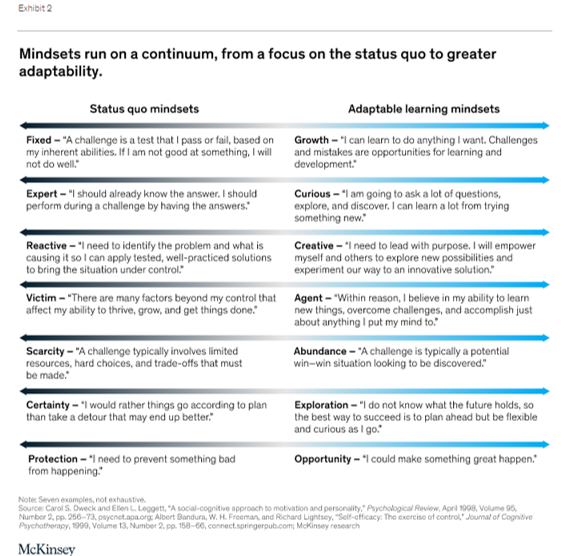
Underlying these patterns are mindsets and beliefs we hold, often unconsciously, that influence how we perceive reality and make us less flexible and adaptable to changing circumstances. However, if we can recognize that we’re moving to our default mindset for stressful situations—signals such as sweaty palms or other physical reactions to perceived threats—and instead push ourselves to see multiple perspectives, we move into a world that offers more possibilities.

While status quo mindsets may be perfectly reasonable in some routine (or low-stress) situations, they are progressively less useful as circumstances become more complex and we’re under more pressure. What becomes optimal then is for leaders and organizations to shift into adaptable learning mindsets (Exhibit 2).

For leaders, one enemy of the adaptive mindset is a belief that it’s their job to have the “right answers” rather than knowing when to ask the right questions. It’s essentially the same trap that Zen Buddhism warns against falling into, thus urging practitioners to adopt what it calls the beginner’s mind, or shoshin. “In the beginner’s mind, there are many possibilities,” according to this concept. “In the expert’s mind, there are few.”

What we now know is that this beginner’s mind is not a fixed personality trait or a skill available only to Zen masters; it is a learnable skill for everyone. We can build ours through deliberate practice. If leaders shed their “expert” status, they can navigate uncertain situations by collecting information in new and productive ways. By shifting their mindset to encourage learning, curiosity, and openness to change, leaders can display the flexibility to find solutions.

For instance, C-suite leaders at a multinational corporation were struggling with how best to support employees during the pandemic as burnout rates rose. As a practitioner of the “expert mindset,” the CEO felt he should already know the answers and was unable to accept such uncertainty. He was coached to approach the problem by seeking different perspectives—for instance, by turning to team members with nursing, military, and paramedic backgrounds, who had experience dealing with trauma. Making such a journey requires awareness of your default mindsets, understanding when they are not serving you, opening up to what else may be true, and intentionally shifting into a new, adaptable mindset.

Self-awareness and reflection are critical components of adaptability. Ways to build awareness include making a “to be” list—that is, a list of the values we want to embody—and setting your intentions in the morning, ahead of a busy day, or at work when things get challenging. Reflecting at the end of the day about difficult moments also helps build an adaptable “unlocking mindset” for the future. The central issue is not that we experience anxiety or uncertainty—that will happen frequently—but rather whether we respond to those pressures in ways that lead us to do more of the same rather than learning and changing.

Step 4: Build deeper and more diverse connections

Strong interpersonal relationships also bolster adaptability, since human beings need meaningful connections to survive and thrive. These community networks can even affect longevity, research shows.15

We typically go through our daily work routine actively engaging with tasks and indirectly engaging with colleagues to help us achieve those tasks. But that emphasis is misplaced: inattention to colleagues is actually counterproductive to both our well-being and our productivity at work.

Research has found that deep and diverse connections that provide social support are fundamental elements of the rich tapestry feeding our well-being and learning,16 especially during periods of uncertainty and heightened stress.

As a leader, there are certain actions you can take to foster deeper connections:

  • Pay full attention to the person in front of you. When in conversation, we often let our minds stray, or we multitask by checking our phone or email. Full attention requires tuning our awareness toward the other person and listening deeply, without judgment. When people feel heard, they can also hear you.
  • Allow yourself to be vulnerable. Show up as your authentic self and be willing to share your fears, concerns, and imperfections. While it can feel risky to be exposed, this process is always one of deliberate choice.
  • Show empathy, but don’t stop there. Empathy alone is not enough. Leaders can learn to channel the right kind of empathy, which involves taking into account the other person’s perspective without being distracted from the situation at hand or, potentially, using up your own energy on unpleasant feelings. Once you understand the other person’s perspective, you become aware of the best course of action.
  • Meet others with compassion. If you’ve noticed someone else’s pain—physical, mental, or social—demonstrate your intent to take supportive action. At the same time, be aware that you can never fully understand what they’re going through, so keep an open mind. While general acts of kindness are appreciated, compassion is more nuanced and specific to the needs of the individual.

We have worked with leaders who have changed how they connect with people by considering the ways described above. For instance, the head of plastic surgery at a major hospital in North America was enlisted to sponsor one of the hospital’s new cohorts. During a live coaching exercise, he was unhappy that a team member waited until the end of a three-week consultation process before opposing new safety protocols the group wanted to implement.

Initially frustrated, he asked why she had waited until the last minute. As he reflected more, though, he realized that he had failed to create a safe enough environment for this team member to raise her concerns. He realized he had tried to convince everyone to take a specific action but had failed to create an atmosphere in which people could discuss their views openly.

His mindset then shifted to “What can I do differently to make sure that these voices speak up earlier?” He debriefed the team, held himself accountable, and worked with others to set new norms. By creating these deeper connections, he allowed team members to bring their whole selves to work and feel valued enough to contribute honestly.

Step 5: Make it safe to learn

Healthy team dynamics also foster adaptability. Working in teams influences the extent to which we prioritize learning, especially from setbacks and failures. The absence of conflict and the appearance of compliance may not reflect that dynamic, however. Teams can have cultures in which setbacks and failures go unacknowledged or, worse, are punished, or they can have cultures that seize setbacks as opportunities from which to learn and grow.

Leaders can have a unique influence on which team culture is adopted depending on the degree to which they foster psychological safety. This is a shared belief held by team members that interpersonal risk taking is safe—that ideas, questions, concerns, or mistakes will be welcomed and valued.17

Experiencing safety is an essential ingredient for higher performance, creativity, and improved well-being. It invites full, authentic participation from every member, fosters constructive debate and creative problem solving, and allows teams to learn quickly. For such a climate to be successful, leaders should be aware of and model the requisite behaviors and deliberately support team members. Put simply, by creating psychological safety, leaders simultaneously demonstrate their own adaptability and create an environment where adaptability can flourish for their teams. This is very different from a leader who believes, “I know best and the team should follow me.”

Here are four practices that can help leaders foster psychological safety:

  • Reframe “failures.” Failure is emotionally difficult, since we are primed to succeed. Leaders can help frame failure as a way to learn from missteps and build future successes. This emphasis helps reinforce an adaptable environment in which people feel comfortable being honest and vulnerable; it also invites curious, open, and growth mindsets.
  • Encourage team voice. A diversity of perspectives pushes us to be innovative and elevates our performance. Leaders can strive to invite team input into decision making and use more dialogue to encourage discussion. Reinforce “messenger” behavior by appreciating all ideas and thanking those who share them, even if that message is not ultimately acted on. If the idea is dismissed, be sure to explain why, and seek to “unmute” the voices of those who are silent.
  • Appreciate others. To drive full participation, team members need to feel valued for their contributions. Leaders can avoid generic congratulations or only recognizing results. Instead, they can reward members’ efforts, making recognition for their contributions part of the team’s vernacular.
  • Coach team members to support one another. As a contributor to psychological safety, team climate is more than twice as important as leadership style, we’ve found. Coaching, role modeling, mentoring, and setting up structures are critical to creating an environment that feels safe.

Recently, we had a conversation with a leadership team at an international relief organization that wanted to build healthier dynamics. The team was preparing to welcome a new CEO though during the previous transition, there was a lot of unhelpful history that got in the way of performance.

The new CEO decided to go on a journey with this team to transform that challenging history into a story of hope and opportunity. He engaged external coaches to help encourage team learning, feedback, curiosity, and mindsets open to transformation. Over time, the group went from a collection of individuals lacking mutual trust to a close-knit team that is much stronger today, despite bumps along the road. The CEO’s focus on building trust, along with his growth mindset and willingness to appear vulnerable, made it possible for a fresh culture of psychological safety to arise.

Four ways to build adaptability at scale

The power of adaptability grows when the entire organization reinforces these cultural norms and behaviors. From our experience with both virtual and in-person capability building, we have identified a few ingredients as particularly important. As they enter a new chapter of hybrid work, organizations must seize the opportunity to integrate these elements with the more traditional in-person immersive experience. Here are four ways leaders can scale adaptability building.

Use bite-size training as practice. The prevailing belief has been that deeper awareness and habit-shifting work was possible only through immersive in-person experiences. But as with so many other paradigms, the COVID-19 pandemic changed that view. Many organizations have rolled out short digital training modules coupled with the use of behavioral-reinforcement tools, such as nudges. This content focuses on teaching simple adaptability concepts that participants can practice in their day-to-day lives, which can accelerate learning and behavior changes.

We’ve seen this approach help companies undergoing upheaval—for instance, at a global company that went through a complex merger before the pandemic hit. To improve adaptability, it designed a fully digital program to train 5,000 of its top people managers. The program offered a dozen 20- to 30-minute modules delivered over three months, accompanied by weekly emails to reinforce adaptability behaviors.

At the end of the program, it found that participants who engaged with most of the content (four to six hours over three months) saw 2.7 times the improvement in adaptability behaviors (learning skills, empathy and compassion, and fostering psychological safety and greater self-awareness) and 3.0 times the improvement in outcomes (performance, well-being, adapting to change, and developing new skills) as the control group. Even participants who engaged for just 20 to 30 minutes per month saw meaningful increases in adaptability and outcomes, at 1.4 times and 1.9 times the control group, respectively.

Create learning communities. Virtual learning can reach more people faster, engaging larger cohorts in shared experiences. This helps create networks across the organization and a deeper sense of belonging, both of which support adaptability.

During the pandemic, the hospital system we mentioned earlier created formal learning communities for leaders who had graduated from a virtual learning program. These groups continue to meet regularly, applying the lessons they learned to challenges including scheduling patients or clinical personnel, solving conflicts, and supporting a grieving colleague. Such cohorts provide a unique resource to combat feelings of isolation and augment a shared sense of belonging.

Role model at all levels, including visible sponsors at the top. Virtual learning can help senior leaders connect meaningfully with more people faster. At the hospital system, one of the sponsors of the learning program was a well-respected plastic surgeon. He was coached live, in front of the group, encouraging his cohort to share learning stories and generate engagement. He told us that being a sponsor was the best leadership-development training he had ever done, helping him to adopt a leadership mindset in which his role was to serve and support his staff, rather than the other way around. The impact was also positive for participants, who started to build more trust with senior management.

Create enabling mechanisms to build enduring capabilities. To build adaptability into a skill that becomes part of the organization’s core, it’s important to track progress frequently and meticulously. For instance, organizations can use a multirater feedback tool—a digital platform that assesses the effectiveness of the adaptability learning journey for employees. It also shares aggregate data with leaders and tracks when course corrections are necessary.

By investing in measures that emphasize well-being, purpose, mindset shifts, deeper connections, and team learning, leaders become better equipped to meet the challenges ahead. Applying these lessons throughout their organizations makes for healthier and more responsive teams.


Leaders should understand that adaptability is a skill that is mastered with continual practice—the ability to “learn how to learn” does not materialize overnight. Those who have the courage and humility to do this work can summon their adaptability skills right when they are needed most. In a world of constant flux, that is a crucial skill set indeed.

Article link: https://www.mckinsey.com/business-functions/organization/our-insights/Future-proof-Solving-the-adaptability-paradox-for-the-long-term

ABOUT THE AUTHOR(S)

Jacqueline Brassey is a global director of learning in McKinsey’s Amsterdam office and affiliate leader of McKinsey’s Center for Societal Benefit through Healthcare; Aaron De Smet is a senior partner in the New Jersey office; Ashish Kothari is a partner in the Denver office; Johanne Lavoie is a partner in the Calgary office; and Marino Mugayar-Baldocchi is a research science specialist in the New York office, where Sasha Zolley is a solution associate partner.

The authors wish to thank Kate Lazaroff-Puck and Laura Tegelberg for their contributions to this article.


This article was edited by Barbara Tierney, a senior editor in the New York office.

The race to understand the exhilarating, dangerous world of language AI – MIT Tech Review

Posted by timmreardon on 07/01/2021
Posted in: Uncategorized. Leave a comment

Hundreds of scientists around the world are working together to understand one of the most powerful emerging technologies before it’s too late.by 

  • Karen Haoarchive page

May 20, 2021conceptual illustration or a brain with 3 scientists inside itARIEL DAVIS

On May 18, Google CEO Sundar Pichai announced an impressive new tool: an AI system called LaMDA that can chat to users about any subject.

To start, Google plans to integrate LaMDA into its main search portal, its voice assistant, and Workplace, its collection of cloud-based work software that includes Gmail, Docs, and Drive. But the eventual goal, said Pichai, is to create a conversational interface that allows people to retrieve any kind of information—text, visual, audio—across all Google’s products just by asking.

LaMDA’s rollout signals yet another way in which language technologies are becoming enmeshed in our day-to-day lives. But Google’s flashy presentation belied the ethical debate that now surrounds such cutting-edge systems. LaMDA is what’s known as a large language model (LLM)—a deep-learning algorithm trained on enormous amounts of text data.

Studies have already shown how racist, sexist, and abusive ideas are embedded in these models. They associate categories like doctors with men and nurses with women; good words with white people and bad ones with Black people. Probe them with the right prompts, and they also begin to encourage things like genocide, self-harm, and child sexual abuse. Because of their size, they have a shockingly high carbon footprint. Because of their fluency, they easily confuse people into thinking a human wrote their outputs, which experts warn could enable the mass production of misinformation.

In December, Google ousted its ethical AI co-lead Timnit Gebru after she refused to retract a paper that made many of these points. A few months later, after wide-scale denunciation of what an open letter from Google employees called the company’s “unprecedented research censorship,” it fired Gebru’s coauthor and co-lead Margaret Mitchell as well.

It’s not just Google that is deploying this technology. The highest-profile language models so far have been OpenAI’s GPT-2 and GPT-3, which spew remarkably convincing passages of text and can even be repurposed to finish off music compositions and computer code. Microsoft now exclusively licenses GPT-3 to incorporate into yet-unannounced products. Facebook has developed its own LLMs for translation and content moderation. And startups are creating dozens of products and services based on the tech giants’ models. Soon enough, all of our digital interactions—when we email, search, or post on social media—will be filtered through LLMs.

Unfortunately, very little research is being done to understand how the flaws of this technology could affect people in real-world applications, or to figure out how to design better LLMs that mitigate these challenges. As Google underscored in its treatment of Gebru and Mitchell, the few companies rich enough to train and maintain LLMs have a heavy financial interest in declining to examine them carefully. In other words, LLMs are increasingly being integrated into the linguistic infrastructure of the internet atop shaky scientific foundations.

More than 500 researchers around the world are now racing to learn more about the capabilities and limitations of these models. Working together under the BigScience project led by Huggingface, a startup that takes an “open science” approach to understanding natural-language processing (NLP), they seek to build an open-source LLM that will serve as a shared resource for the scientific community. The goal is to generate as much scholarship as possible within a single focused year. Their central question: How and when should LLMs be developed and deployed to reap their benefits without their harmful consequences?

“We can’t really stop this craziness around large language models, where everybody wants to train them,” says Thomas Wolf, the chief science officer at Huggingface, who is co-leading the initiative. “But what we can do is try to nudge this in a direction that is in the end more beneficial.”

Stochastic parrots

In the same month that BigScience kicked off its activities, a startup named Cohere quietly came out of stealth. Started by former Google researchers, it promises to bring LLMs to any business that wants one—with a single line of code. It has developed a technique to train and host its own model with the idle scraps of computational resources in a data center, which holds down the costs of renting out the necessary cloud space for upkeep and deployment.

Among its early clients is the startup Ada Support, a platform for building no-code customer support chatbots, which itself has clients like Facebook and Zoom. And Cohere’s investor list includes some of the biggest names in the field: computer vision pioneer Fei-Fei Li, Turing Award winner Geoffrey Hinton, and Apple’s head of AI, Ian Goodfellow.

Cohere is one of several startups and initiatives now seeking to bring LLMs to various industries. There’s also Aleph Alpha, a startup based in Germany that seeks to build a German GPT-3; an unnamed venture started by several former OpenAI researchers; and the open-source initiative Eleuther, which recently launched GPT-Neo, a free (and somewhat less powerful) reproduction of GPT-3.

But it’s the gap between what LLMs are and what they aspire to be that has concerned a growing number of researchers. LLMs are effectively the world’s most powerful autocomplete technologies. By ingesting millions of sentences, paragraphs, and even samples of dialogue, they learn the statistical patterns that govern how each of these elements should be assembled in a sensible order. This means LLMs can enhance certain activities: for example, they are good for creating more interactive and conversationally fluid chatbots that follow a well-established script. But they do not actually understand what they’re reading or saying. Many of the most advanced capabilities of LLMs today are also available only in English.

Related Story

We read the paper that forced Timnit Gebru out of Google. Here’s what it says.

The company’s star ethics researcher highlighted the risks of large language models, which are key to Google’s business.

Among other things, this is what Gebru, Mitchell, and five other scientists warned about in their paper, which calls LLMs “stochastic parrots.” “Language technology can be very, very useful when it is appropriately scoped and situated and framed,” says Emily Bender, a professor of linguistics at the University of Washington and one of the coauthors of the paper. But the general-purpose nature of LLMs—and the persuasiveness of their mimicry—entices companies to use them in areas they aren’t necessarily equipped for.

In a recent keynote at one of the largest AI conferences, Gebru tied this hasty deployment of LLMs to consequences she’d experienced in her own life. Gebru was born and raised in Ethiopia, where an escalating war has ravaged the northernmost Tigray region. Ethiopia is also a country where 86 languages are spoken, nearly all of them unaccounted for in mainstream language technologies.

Despite LLMs having these linguistic deficiencies, Facebook relies heavily on them to automate its content moderation globally. When the war in Tigray first broke out in November, Gebru saw the platform flounder to get a handle on the flurry of misinformation. This is emblematic of a persistent pattern that researchers have observed in content moderation. Communities that speak languages not prioritized by Silicon Valley suffer the most hostile digital environments.

Gebru noted that this isn’t where the harm ends, either. When fake news, hate speech, and even death threats aren’t moderated out, they are then scraped as training data to build the next generation of LLMs. And those models, parroting back what they’re trained on, end up regurgitating these toxic linguistic patterns on the internet.

In many cases, researchers haven’t investigated thoroughly enough to know how this toxicity might manifest in downstream applications. But some scholarship does exist. In her 2018 book Algorithms of Oppression, Safiya Noble, an associate professor of information and African-American studies at the University of California, Los Angeles, documented how biases embedded in Google search perpetuate racism and, in extreme cases, perhaps even motivate racial violence.

“The consequences are pretty severe and significant,” she says. Google isn’t just the primary knowledge portal for average citizens. It also provides the information infrastructure for institutions, universities, and state and federal governments.

Google already uses an LLM to optimize some of its search results. With its latest announcement of LaMDA and a recent proposal it published in a preprint paper, the company has made clear it will only increase its reliance on the technology. Noble worries this could make the problems she uncovered even worse: “The fact that Google’s ethical AI team was fired for raising very important questions about the racist and sexist patterns of discrimination embedded in large language models should have been a wake-up call.”

BigScience

The BigScience project began in direct response to the growing need for scientific scrutiny of LLMs. In observing the technology’s rapid proliferation and Google’s attempted censorship of Gebru and Mitchell, Wolf and several colleagues realized it was time for the research community to take matters into its own hands.

Inspired by open scientific collaborations like CERN in particle physics, they conceived of an idea for an open-source LLM that could be used to conduct critical research independent of any company. In April of this year, the group received a grant to build it using the French government’s supercomputer.

At tech companies, LLMs are often built by only half a dozen people who have primarily technical expertise. BigScience wanted to bring in hundreds of researchers from a broad range of countries and disciplines to participate in a truly collaborative model-construction process. Wolf, who is French, first approached the French NLP community. From there, the initiative snowballed into a global operation encompassing more than 500 people.

The collaborative is now loosely organized into a dozen working groups and counting, each tackling different aspects of model development and investigation. One group will measure the model’s environmental impact, including the carbon footprint of training and running the LLM and factoring in the life-cycle costs of the supercomputer. Another will focus on developing responsible ways of sourcing the training data—seeking alternatives to simply scraping data from the web, such as transcribing historical radio archives or podcasts. The goal here is to avoid toxic language and nonconsensual collection of private information.

Related Story

Why GPT-3 is the best and worst of AI right now

Open AI’s language AI wowed the public with its apparent mastery of English – but is it all an illusion?

Other working groups are dedicated to developing and evaluating the model’s “multilinguality.” To start, BigScience has selected eight languages or language families, including English, Chinese, Arabic, Indic (including Hindi and Urdu), and Bantu (including Swahili). The plan is to work closely with every language community to map out as many of its regional dialects as possible and ensure that its distinct data privacy norms are respected. “We want people to have a say in how their data is used,” says Yacine Jernite, a Huggingface researcher.

The point is not to build a commercially viable LLM to compete with the likes of GPT-3 or LaMDA. The model will be too big and too slow to be useful to companies, says Karën Fort, an associate professor at the Sorbonne. Instead, the resource is being designed purely for research. Every data point and every modeling decision is being carefully and publicly documented, so it’s easier to analyze how all the pieces affect the model’s outcomes. “It’s not just about delivering the final product,” says Angela Fan, a Facebook researcher. “We envision every single piece of it as a delivery point, as an artifact.”

The project is undoubtedly ambitious—more globally expansive and collaborative than any the AI community has seen before. The logistics of coordinating so many researchers is itself a challenge. (In fact, there’s a working group for that, too.) What’s more, every single researcher is contributing on a volunteer basis. The grant from the French government covers only computational, not human, resources.

But researchers say the shared need that brought the community together has galvanized an impressive level of energy and momentum. Many are optimistic that by the end of the project, which will run until May of next year, they will have produced not only deeper scholarship on the limitations of LLMs but also better tools and practices for building and deploying them responsibly.

The organizers hope this will inspire more people within industry to incorporate those practices into their own LLM strategy, though they are the first to admit they are being idealistic. If anything, the sheer number of researchers involved, including many from tech giants, will help establish new norms within the NLP community.

In some ways the norms have already shifted. In response to conversations around the firing of Gebru and Mitchell, Cohere heard from several of its clients that they were worried about the technology’s safety. On its site it includes a page on its website featuring a pledge to continuously invest in technical and non-technical research to mitigate the possible harms of its model. It says it will also assemble an advisory council made up of external experts to help it create policies on the permissible use of its technologies.

“NLP is at a very important turning point,” says Fort. That’s why BigScience is exciting. It allows the community to push the research forward and provide a hopeful alternative to the status quo within industry: “It says, ‘Let’s take another pass. Let’s take it together—to figure out all the ways and all the things we can do to help society.’”

“I want NLP to help people,” she says, “not to put them down.”

Update: Cohere’s responsibility initiatives have been clarified.

Article link: The race to understand the thrilling, dangerous world of language AI | MIT Technology Review

Language models like GPT-3 could herald a new type of search engine – MIT Tech Review

Posted by timmreardon on 07/01/2021
Posted in: Uncategorized. Leave a comment

The way we search online hasn’t changed in decades. A new idea from Google researchers could make it more like talking to a human expert

In 1998 a couple of Stanford graduate students published a paper describing a new kind of search engine: “In this paper, we present Google, a prototype of a large-scale search engine which makes heavy use of the structure present in hypertext. Google is designed to crawl and index the Web efficiently and produce much more satisfying search results than existing systems.”

The key innovation was an algorithm called PageRank, which ranked search results by calculating how relevant they were to a user’s query on the basis of their links to other pages on the web. On the back of PageRank, Google became the gateway to the internet, and Sergey Brin and Larry Page built one of the biggest companies in the world.

Now a team of Google researchers has published a proposal for a radical redesign that throws out the ranking approach and replaces it with a single large AI language model—a future version of BERT or GPT-3. The idea is that instead of searching for information in a vast list of web pages, users would ask questions and have a language model trained on those pages answer them directly. The approach could change not only how search engines work, but how we interact with them.

Many issues with existing language models will need to be fixed first. For a start, these AIs can sometimes generate biased and toxic responses to queries—a problem that researchers at Google and elsewhere have pointed out.

Rethinking PageRank

Search engines have become faster and more accurate, even as the web has exploded in size. AI is now used to rank results, and Google uses BERT to understand search queries better. Yet beneath these tweaks, all mainstream search engines still work the same way they did 20 years ago: web pages are indexed by crawlers (software that reads the web nonstop and maintains a list of everything it finds), results that match a user’s query are gathered from this index, and the results are ranked.

“This index-retrieve-then-rank blueprint has withstood the test of time and has rarely been challenged or seriously rethought,” Donald Metzler and his colleagues at Google Research write. (Metzler declined a request to comment.)

The problem is that even the best search engines today still respond with a list of documents that include the information asked for, not with the information itself. Search engines are also not good at responding to queries that require answers drawn from multiple sources. It’s as if you asked your doctor for advice and received a list of articles to read instead of a straight answer.

Metzler and his colleagues are interested in a search engine that behaves like a human expert. It should produce answers in natural language, synthesized from more than one document, and back up its answers with references to supporting evidence, as Wikipedia articles aim to do.  

Large language models get us part of the way there. Trained on most of the web and hundreds of books, GPT-3 draws information from multiple sources to answer questions in natural language. The problem is that it does not keep track of those sources and cannot provide evidence for its answers. There’s no way to tell if GPT-3 is parroting trustworthy information or disinformation—or simply spewing nonsense of its own making.

Metzler and his colleagues call language models dilettantes—“They are perceived to know a lot but their knowledge is skin deep.” The solution, they claim, is to build and train future BERTs and GPT-3s to retain records of where their words come from. No such models are yet able to do this, but it is possible in principle, and there is early work in that direction.

There have been decades of progress on different areas of search, from answering queries to summarizing documents to structuring information, says Ziqi Zhang at the University of Sheffield, UK, who studies information retrieval on the web. But none of these technologies overhauled search because they each address specific problems and are not generalizable. The exciting premise of this paper is that large language models are able to do all these things at the same time, he says.

Yet Zhang notes that language models do not perform well with technical or specialist subjects because there are fewer examples in the text they are trained on. “There are probably hundreds of times more data on e-commerce on the web than data about quantum mechanics,” he says. Language models today are also skewed toward English, which would leave non-English parts of the web underserved.  

Hanna Hajishirzi, who studies natural language processing at the University of Washington, welcomes the idea but warns that their would be problems in practice. “I believe large language models are very important and potentially the future of search engines, but they require large memory and computational resources,” she says. “I don’t think they would replace indexing.”

Still, Zhang is excited by the possibilities. “This has not been possible in the past, because large language models only took off recently,” he says. “If it works, it would transform our search experience.”

Update: we have changed the text to more clearly represent the problems with existing large language models.

Article link: Language models like GPT-3 could herald a new type of search engine | MIT Technology Review

Posts navigation

← Older Entries
Newer Entries →
  • Search site

  • Follow healthcarereimagined on WordPress.com
  • Recent Posts

    • When Not to Use AI – MIT Sloan 04/01/2026
    • There are more AI health tools than ever—but how well do they work? – MIT Technology Review 03/30/2026
    • Are AI Tools Ready to Answer Patients’ Questions About Their Medical Care? – JAMA 03/27/2026
    • How AI use in scholarly publishing threatens research integrity, lessens trust, and invites misinformation – Bulletin of the Atomic Scientists 03/25/2026
    • VA Prepares April Relaunch of EHR Program – GovCIO 03/19/2026
    • Strong call for universal healthcare from Pope Leo today – FAN 03/18/2026
    • EHR fragmentation offers an opportunity to enhance care coordination and experience 03/16/2026
    • When AI Governance Fails 03/15/2026
    • Introduction: Disinformation as a multiplier of existential threat – Bulletin of the Atomic Scientists 03/12/2026
    • AI is reinventing hiring — with the same old biases. Here’s how to avoid that trap – MIT Sloan 03/08/2026
  • Categories

    • Accountable Care Organizations
    • ACOs
    • AHRQ
    • American Board of Internal Medicine
    • Big Data
    • Blue Button
    • Board Certification
    • Cancer Treatment
    • Data Science
    • Digital Services Playbook
    • DoD
    • EHR Interoperability
    • EHR Usability
    • Emergency Medicine
    • FDA
    • FDASIA
    • GAO Reports
    • Genetic Data
    • Genetic Research
    • Genomic Data
    • Global Standards
    • Health Care Costs
    • Health Care Economics
    • Health IT adoption
    • Health Outcomes
    • Healthcare Delivery
    • Healthcare Informatics
    • Healthcare Outcomes
    • Healthcare Security
    • Helathcare Delivery
    • HHS
    • HIPAA
    • ICD-10
    • Innovation
    • Integrated Electronic Health Records
    • IT Acquisition
    • JASONS
    • Lab Report Access
    • Military Health System Reform
    • Mobile Health
    • Mobile Healthcare
    • National Health IT System
    • NSF
    • ONC Reports to Congress
    • Oncology
    • Open Data
    • Patient Centered Medical Home
    • Patient Portals
    • PCMH
    • Precision Medicine
    • Primary Care
    • Public Health
    • Quadruple Aim
    • Quality Measures
    • Rehab Medicine
    • TechFAR Handbook
    • Triple Aim
    • U.S. Air Force Medicine
    • U.S. Army
    • U.S. Army Medicine
    • U.S. Navy Medicine
    • U.S. Surgeon General
    • Uncategorized
    • Value-based Care
    • Veterans Affairs
    • Warrior Transistion Units
    • XPRIZE
  • Archives

    • April 2026 (1)
    • March 2026 (9)
    • February 2026 (6)
    • January 2026 (8)
    • December 2025 (11)
    • November 2025 (9)
    • October 2025 (10)
    • September 2025 (4)
    • August 2025 (7)
    • July 2025 (2)
    • June 2025 (9)
    • May 2025 (4)
    • April 2025 (11)
    • March 2025 (11)
    • February 2025 (10)
    • January 2025 (12)
    • December 2024 (12)
    • November 2024 (7)
    • October 2024 (5)
    • September 2024 (9)
    • August 2024 (10)
    • July 2024 (13)
    • June 2024 (18)
    • May 2024 (10)
    • April 2024 (19)
    • March 2024 (35)
    • February 2024 (23)
    • January 2024 (16)
    • December 2023 (22)
    • November 2023 (38)
    • October 2023 (24)
    • September 2023 (24)
    • August 2023 (34)
    • July 2023 (33)
    • June 2023 (30)
    • May 2023 (35)
    • April 2023 (30)
    • March 2023 (30)
    • February 2023 (15)
    • January 2023 (17)
    • December 2022 (10)
    • November 2022 (7)
    • October 2022 (22)
    • September 2022 (16)
    • August 2022 (33)
    • July 2022 (28)
    • June 2022 (42)
    • May 2022 (53)
    • April 2022 (35)
    • March 2022 (37)
    • February 2022 (21)
    • January 2022 (28)
    • December 2021 (23)
    • November 2021 (12)
    • October 2021 (10)
    • September 2021 (4)
    • August 2021 (4)
    • July 2021 (4)
    • May 2021 (3)
    • April 2021 (1)
    • March 2021 (2)
    • February 2021 (1)
    • January 2021 (4)
    • December 2020 (7)
    • November 2020 (2)
    • October 2020 (4)
    • September 2020 (7)
    • August 2020 (11)
    • July 2020 (3)
    • June 2020 (5)
    • April 2020 (3)
    • March 2020 (1)
    • February 2020 (1)
    • January 2020 (2)
    • December 2019 (2)
    • November 2019 (1)
    • September 2019 (4)
    • August 2019 (3)
    • July 2019 (5)
    • June 2019 (10)
    • May 2019 (8)
    • April 2019 (6)
    • March 2019 (7)
    • February 2019 (17)
    • January 2019 (14)
    • December 2018 (10)
    • November 2018 (20)
    • October 2018 (14)
    • September 2018 (27)
    • August 2018 (19)
    • July 2018 (16)
    • June 2018 (18)
    • May 2018 (28)
    • April 2018 (3)
    • March 2018 (11)
    • February 2018 (5)
    • January 2018 (10)
    • December 2017 (20)
    • November 2017 (30)
    • October 2017 (33)
    • September 2017 (11)
    • August 2017 (13)
    • July 2017 (9)
    • June 2017 (8)
    • May 2017 (9)
    • April 2017 (4)
    • March 2017 (12)
    • December 2016 (3)
    • September 2016 (4)
    • August 2016 (1)
    • July 2016 (7)
    • June 2016 (7)
    • April 2016 (4)
    • March 2016 (7)
    • February 2016 (1)
    • January 2016 (3)
    • November 2015 (3)
    • October 2015 (2)
    • September 2015 (9)
    • August 2015 (6)
    • June 2015 (5)
    • May 2015 (6)
    • April 2015 (3)
    • March 2015 (16)
    • February 2015 (10)
    • January 2015 (16)
    • December 2014 (9)
    • November 2014 (7)
    • October 2014 (21)
    • September 2014 (8)
    • August 2014 (9)
    • July 2014 (7)
    • June 2014 (5)
    • May 2014 (8)
    • April 2014 (19)
    • March 2014 (8)
    • February 2014 (9)
    • January 2014 (31)
    • December 2013 (23)
    • November 2013 (48)
    • October 2013 (25)
  • Tags

    Business Defense Department Department of Veterans Affairs EHealth EHR Electronic health record Food and Drug Administration Health Health informatics Health Information Exchange Health information technology Health system HIE Hospital IBM Mayo Clinic Medicare Medicine Military Health System Patient Patient portal Patient Protection and Affordable Care Act United States United States Department of Defense United States Department of Veterans Affairs
  • Upcoming Events

Blog at WordPress.com.
healthcarereimagined
Blog at WordPress.com.
  • Subscribe Subscribed
    • healthcarereimagined
    • Join 153 other subscribers
    • Already have a WordPress.com account? Log in now.
    • healthcarereimagined
    • Subscribe Subscribed
    • Sign up
    • Log in
    • Report this content
    • View site in Reader
    • Manage subscriptions
    • Collapse this bar
 

Loading Comments...