Document Link: https://www.belfercenter.org/sites/default/files/files/publication/Ahead%20of%20the%20Digital%20Curve%20-%20Leyne%20and%20Nonte.pdf
Uncategorized
Miriam was only 21 when she met Nick. She was a photographer, fresh out of college, waiting tables. He was 16 years her senior and a local business owner who had worked in finance. He was charming and charismatic; he took her out on fancy dates and paid for everything. She quickly fell into his orbit.
It began with one credit card. At the time, it was the only one she had. Nick would max it out with $5,000 worth of business purchases and promptly pay it off the next day. Miriam, who asked me not to use their real names for fear of interfering with their ongoing divorce proceedings, discovered that this was boosting her credit score. Having grown up with a single dad in a low-income household, she trusted Nick’s know-how over her own. He readily encouraged the dynamic, telling her she didn’t understand finance. She opened up more credit cards for him under her name.
The trouble started three years in. Nick asked her to quit her job to help out with his business. She did. He told her to go to grad school and not worry about compounding her existing student debt. She did. He promised to take care of everything, and she believed him. Soon after, he stopped settling her credit card balances. Her score began to crater.
Still, Miriam stayed with him. They got married. They had three kids. Then one day, the FBI came to their house and arrested him. In federal court, the judge convicted him on nearly $250,000 of wire fraud. Miriam discovered the full extent of the tens of thousands of dollars in debt he’d racked up in her name. “The day that he went to prison, I had $250 cash, a house in foreclosure, a car up for repossession, three kids,” she says. “I went within a month from having a nanny and living in a nice house and everything to just really abject poverty.”
Miriam is a survivor of what’s known as “coerced debt,” a form of abuse usually perpetrated by an intimate partner or family member. While economic abuse is a long-standing problem, digital banking has made it easier to open accounts and take out loans in a victim’s name, says Carla Sanchez-Adams, an attorney at Texas RioGrande Legal Aid. In the era of automated credit-scoring algorithms, the repercussions can also be far more devastating.
Credit scores have been used for decades to assess consumer creditworthiness, but their scope is far greater now that they are powered by algorithms: not only do they consider vastly more data, in both volume and type, but they increasingly affect whether you can buy a car, rent an apartment, or get a full-time job. Their comprehensive influence means that if your score is ruined, it can be nearly impossible to recover. Worse, the algorithms are owned by private companies that don’t divulge how they come to their decisions. Victims can be sent in a downward spiral that sometimes ends in homelessness or a return to their abuser.
Credit-scoring algorithms are not the only ones that affect people’s economic well-being and access to basic services. Algorithms now decide which children enter foster care, which patients receive medical care, which families get access to stable housing. Those of us with means can pass our lives unaware of any of this. But for low-income individuals, the rapid growth and adoption of automated decision-making systems has created a hidden web of interlocking traps.
Fortunately, a growing group of civil lawyers are beginning to organize around this issue. Borrowing a playbook from the criminal defense world’s pushback against risk-assessment algorithms, they’re seeking to educate themselves on these systems, build a community, and develop litigation strategies. “Basically every civil lawyer is starting to deal with this stuff, because all of our clients are in some way or another being touched by these systems,” says Michele Gilman, a clinical law professor at the University of Baltimore. “We need to wake up, get training. If we want to be really good holistic lawyers, we need to be aware of that.”
“Am I going to cross-examine an algorithm?”
Gilman has been practicing law in Baltimore for 20 years. In her work as a civil lawyer and a poverty lawyer, her cases have always come down to the same things: representing people who’ve lost access to basic needs, like housing, food, education, work, or health care. Sometimes that means facing off with a government agency. Other times it’s with a credit reporting agency, or a landlord. Increasingly, the fight over a client’s eligibility now involves some kind of algorithm.
“This is happening across the board to our clients,” she says. “They’re enmeshed in so many different algorithms that are barring them from basic services. And the clients may not be aware of that, because a lot of these systems are invisible.”

She doesn’t remember exactly when she realized that some eligibility decisions were being made by algorithms. But when that transition first started happening, it was rarely obvious. Once, she was representing an elderly, disabled client who had inexplicably been cut off from her Medicaid-funded home health-care assistance. “We couldn’t find out why,” Gilman remembers. “She was getting sicker, and normally if you get sicker, you get more hours, not less.”
Not until they were standing in the courtroom in the middle of a hearing did the witness representing the state reveal that the government had just adopted a new algorithm. The witness, a nurse, couldn’t explain anything about it. “Of course not—they bought it off the shelf,” Gilman says. “She’s a nurse, not a computer scientist. She couldn’t answer what factors go into it. How is it weighted? What are the outcomes that you’re looking for? So there I am with my student attorney, who’s in my clinic with me, and it’s like, ‘Oh, am I going to cross-examine an algorithm?’”
For Kevin De Liban, an attorney at Legal Aid of Arkansas, the change was equally insidious. In 2014, his state also instituted a new system for distributing Medicaid-funded in-home assistance, cutting off a whole host of people who had previously been eligible. At the time, he and his colleagues couldn’t identify the root problem. They only knew that something was different. “We could recognize that there was a change in assessment systems from a 20-question paper questionnaire to a 283-question electronic questionnaire,” he says.
It was two years later, when an error in the algorithm once again brought it under legal scrutiny, that De Liban finally got to the bottom of the issue. He realized that nurses were telling patients, “Well, the computer did it—it’s not me.” “That’s what tipped us off,” he says. “If I had known what I knew in 2016, I would have probably done a better job advocating in 2014,” he adds.
“One person walks through so many systems on a day-to-day basis”
Gilman has since grown a lot more savvy. From her vantage point representing clients with a range of issues, she’s observed the rise and collision of two algorithmic webs. The first consists of credit-reporting algorithms, like the ones that snared Miriam, which affect access to private goods and services like cars, homes, and employment. The second encompasses algorithms adopted by government agencies, which affect access to public benefits like health care, unemployment, and child support services.
On the credit-reporting side, the growth of algorithms has been driven by the proliferation of data, which is easier than ever to collect and share. Credit reports aren’t new, but these days their footprint is far more expansive. Consumer reporting agencies, including credit bureaus, tenant screening companies, or check verification services, amass this information from a wide range of sources: public records, social media, web browsing, banking activity, app usage, and more. The algorithms then assign people “worthiness” scores, which figure heavily into background checks performed by lenders, employers, landlords, even schools.
Government agencies, on the other hand, are driven to adopt algorithms when they want to modernize their systems. The push to adopt web-based apps and digital tools began in the early 2000s and has continued with a move toward more data-driven automated systems and AI. There are good reasons to seek these changes. During the pandemic, many unemployment benefit systems struggled to handle the massive volume of new requests, leading to significant delays. Modernizing these legacy systems promises faster and more reliable results.
But the software procurement process is rarely transparent, and thus lacks accountability. Public agencies often buy automated decision-making tools directly from private vendors. The result is that when systems go awry, the individuals affected——and their lawyers—are left in the dark. “They don’t advertise it anywhere,” says Julia Simon-Mishel, an attorney at Philadelphia Legal Assistance. “It’s often not written in any sort of policy guides or policy manuals. We’re at a disadvantage.”
The lack of public vetting also makes the systems more prone to error. One of the most egregious malfunctions happened in Michigan in 2013. After a big effort to automate the state’s unemployment benefits system, the algorithm incorrectly flagged over 34,000 people for fraud. “It caused a massive loss of benefits,” Simon-Mishel says. “There were bankruptcies; there were unfortunately suicides. It was a whole mess.”

Low-income individuals bear the brunt of the shift toward algorithms. They are the people most vulnerable to temporary economic hardships that get codified into consumer reports, and the ones who need and seek public benefits. Over the years, Gilman has seen more and more cases where clients risk entering a vicious cycle. “One person walks through so many systems on a day-to-day basis,” she says. “I mean, we all do. But the consequences of it are much more harsh for poor people and minorities.”
She brings up a current case in her clinic as an example. A family member lost work because of the pandemic and was denied unemployment benefits because of an automated system failure. The family then fell behind on rent payments, which led their landlord to sue them for eviction. While the eviction won’t be legal because of the CDC’s moratorium, the lawsuit will still be logged in public records. Those records could then feed into tenant-screening algorithms, which could make it harder for the family to find stable housing in the future. Their failure to pay rent and utilities could also be a ding on their credit score, which once again has repercussions. “If they are trying to set up cell-phone service or take out a loan or buy a car or apply for a job, it just has these cascading ripple effects,” Gilman says.
“Every case is going to turn into an algorithm case”
In September, Gilman, who is currently a faculty fellow at the Data and Society research institute, released a report documenting all the various algorithms that poverty lawyers might encounter. Called Poverty Lawgorithms, it’s meant to be a guide for her colleagues in the field. Divided into specific practice areas like consumer law, family law, housing, and public benefits, it explains how to deal with issues raised by algorithms and other data-driven technologies within the scope of existing laws.
If a client is denied an apartment because of a poor credit score, for example, the report recommends that a lawyer first check whether the data being fed into the scoring system is accurate. Under the Fair Credit Reporting Act, reporting agencies are required to ensure the validity of their information, but this doesn’t always happen. Disputing any faulty claims could help restore the client’s credit and, thus, access to housing. The report acknowledges, however, that existing laws can only go so far. There are still regulatory gaps to fill, Gilman says.
Gilman hopes the report will be a wake-up call. Many of her colleagues still don’t realize any of this is going on, and they aren’t able to ask the right questions to uncover the algorithms. Those who are aware of the problem are scattered around the US, learning about, navigating, and fighting these systems in isolation. She sees an opportunity to connect them and create a broader community of people who can help one another. “We all need more training, more knowledge—not just in the law, but in these systems,” she says. “Ultimately it’s like every case is going to turn into an algorithm case.”
In the long run, she looks to the criminal legal world for inspiration. Criminal lawyers have been “ahead of the curve,” she says, in organizing as a community and pushing back against risk-assessment algorithms that determine sentencing. She wants to see civil lawyers do the same thing: create a movement to bring more public scrutiny and regulation to the hidden web of algorithms their clients face. “In some cases, it probably should just be shut down because there’s no way to make it equitable,” she says.
As for Miriam, after Nick’s conviction, she walked away for good. She moved with her three kids to a new state and connected with a nonprofit that supports survivors of coerced debt and domestic violence. Through them, she took a series of classes that taught her how to manage her finances. The organization helped her dismiss many of her coerced debts and learn more about credit algorithms. When she went to buy a car, her credit score just barely cleared the minimum with her dad as co-signer. Since then, her consistent payments on her car and her student debt have slowly replenished her credit score.
Miriam still has to stay vigilant. Nick has her Social Security number, and they’re not yet divorced. She worries constantly that he could open more accounts, take out more loans in her name. For a while, she checked her credit report daily for fraudulent activity. But these days, she also has something to look forward to. Her dad, in his mid-60s, wants to retire and move in. The two of them are now laser-focused on preparing to buy a home. “I’m pretty psyched about it. My goal is by the end of the year to get it to a 700,” she says of her score, “and then I am definitely home-buyer ready.”
“I’ve never lived in a house that I’ve owned, ever,” she adds. “He and I are working together to save for a forever home.”
Article link: https://www.technologyreview.com/2020/12/04/1013068/algorithms-create-a-poverty-trap-lawyers-fight-back/?
This is the second in a series of explainers on quantum technology. The other two are on quantum computing and post-quantum cryptography.
Barely a week goes by without reports of some new mega-hack that’s exposed huge amounts of sensitive information, from people’s credit card details and health records to companies’ valuable intellectual property. The threat posed by cyberattacks is forcing governments, militaries, and businesses to explore more secure ways of transmitting information.
Today, sensitive data is typically encrypted and then sent across fiber-optic cables and other channels together with the digital “keys” needed to decode the information. The data and the keys are sent as classical bits—a stream of electrical or optical pulses representing 1s and 0s. And that makes them vulnerable. Smart hackers can read and copy bits in transit without leaving a trace.
Quantum communication takes advantage of the laws of quantum physics to protect data. These laws allow particles—typically photons of light for transmitting data along optical cables—to take on a state of superposition, which means they can represent multiple combinations of 1 and 0 simultaneously. The particles are known as quantum bits, or qubits.
The beauty of qubits from a cybersecurity perspective is that if a hacker tries to observe them in transit, their super-fragile quantum state “collapses” to either 1 or 0. This means a hacker can’t tamper with the qubits without leaving behind a telltale sign of the activity.
Some companies have taken advantage of this property to create networks for transmitting highly sensitive data based on a process called quantum key distribution, or QKD. In theory, at least, these networks are ultra-secure.
What is quantum key distribution?
QKD involves sending encrypted data as classical bits over networks, while the keys to decrypt the information are encoded and transmitted in a quantum state using qubits.
Various approaches, or protocols, have been developed for implementing QKD. A widely used one known as BB84 works like this. Imagine two people, Alice and Bob. Alice wants to send data securely to Bob. To do so, she creates an encryption key in the form of qubits whose polarization states represent the individual bit values of the key.
The qubits can be sent to Bob through a fiber-optic cable. By comparing measurements of the state of a fraction of these qubits—a process known as “key sifting”—Alice and Bob can establish that they hold the same key.
As the qubits travel to their destination, the fragile quantum state of some of them will collapse because of decoherence. To account for this, Alice and Bob next run through a process known as “key distillation,” which involves calculating whether the error rate is high enough to suggest that a hacker has tried to intercept the key.
If it is, they ditch the suspect key and keep generating new ones until they are confident that they share a secure key. Alice can then use hers to encrypt data and send it in classical bits to Bob, who uses his key to decode the information.
We’re already starting to see more QKD networks emerge. The longest is in China, which boasts a 2,032-kilometer (1,263-mile) ground link between Beijing and Shanghai. Banks and other financial companies are already using it to transmit data. In the US, a startup called Quantum Xchange has struck a deal giving it access to 500 miles (805 kilometers) of fiber-optic cable running along the East Coast to create a QKD network. The initial leg will link Manhattan with New Jersey, where many banks have large data centers.
Although QKD is relatively secure, it would be even safer if it could count on quantum repeaters.
What is a quantum repeater?
Materials in cables can absorb photons, which means they can typically travel for no more than a few tens of kilometers. In a classical network, repeaters at various points along a cable are used to amplify the signal to compensate for this.
QKD networks have come up with a similar solution, creating “trusted nodes” at various points. The Beijing-to-Shanghai network has 32 of them, for instance. At these waystations, quantum keys are decrypted into bits and then reencrypted in a fresh quantum state for their journey to the next node. But this means trusted nodes can’t really be trusted: a hacker who breached the nodes’ security could copy the bits undetected and thus acquire a key, as could a company or government running the nodes.
Ideally, we need quantum repeaters, or waystations with quantum processors in them that would allow encryption keys to remain in quantum form as they are amplified and sent over long distances. Researchers have demonstrated it’s possible in principle to build such repeaters, but they haven’t yet been able to produce a working prototype.
There’s another issue with QKD. The underlying data is still transmitted as encrypted bits across conventional networks. This means a hacker who breached a network’s defenses could copy the bits undetected, and then use powerful computers to try to crack the key used to encrypt them.
The most powerful encryption algorithms are pretty robust, but the risk is big enough to spur some researchers to work on an alternative approach known as quantum teleportation.
What is quantum teleportation?
This may sound like science fiction, but it’s a real method that involves transmitting data wholly in quantum form. The approach relies on a quantum phenomenon known as entanglement.
Quantum teleportation works by creating pairs of entangled photons and then sending one of each pair to the sender of data and the other to a recipient. When Alice receives her entangled photon, she lets it interact with a “memory qubit” that holds the data she wants to transmit to Bob. This interaction changes the state of her photon, and because it is entangled with Bob’s, the interaction instantaneously changes the state of his photon too.
In effect, this “teleports” the data in Alice’s memory qubit from her photon to Bob’s. The graphic below lays out the process in a little more detail:
Researchers in the US, China, and Europe are racing to create teleportation networks capable of distributing entangled photons. But getting them to scale will be a massive scientific and engineering challenge. The many hurdles include finding reliable ways of churning out lots of linked photons on demand, and maintaining their entanglement over very long distances—something that quantum repeaters would make easier.
Still, these challenges haven’t stopped researchers from dreaming of a future quantum internet.
What is a quantum internet?
Just like the traditional internet, this would be a globe-spanning network of networks. The big difference is that the underlying communications networks would be quantum ones.
It isn’t going to replace the internet as we know it today. Cat photos, music videos, and a great deal of non-sensitive business information will still move around in the form of classical bits. But a quantum internet will appeal to organizations that need to keep particularly valuable data secure. It could also be an ideal way to connect information flowing between quantum computers, which are increasingly being made available through the computing cloud.
China is in the vanguard of the push toward a quantum internet. It launched a dedicated quantum communications satellite called Micius a few years ago, and in 2017 the satellite helped stage the world’s first intercontinental, QKD-secured video conference, between Beijing and Vienna. A ground station already links the satellite to the Beijing-to-Shanghai terrestrial network. China plans to launch more quantum satellites, and several cities in the country are laying plans for municipal QKD networks.
Some researchers have warned that even a fully quantum internet may ultimately become vulnerable to new attacks that are themselves quantum based. But faced with the hacking onslaught that plagues today’s internet, businesses, governments, and the military are going to keep exploring the tantalizing prospect of a more secure quantum alternative.
Article link: https://www.technologyreview.com/2019/02/14/103409/what-is-quantum-communications/?
Just when leaders need fresh thinking and decisiveness, they tend to fall back on tried-and-true ways. Five actions can transform your relationship with uncertainty and help you thrive.
Shutdowns and supply-chain hacks. Hybrid work, remote shopping, settling up via blockchain. The past year has made it abundantly clear, if it wasn’t already, that a volatile and complex world is serving up change at an accelerating pace.
Individuals and organizations need to be ready. That doesn’t mean reacting to the next challenge that comes our way but rather being prepared to meet it when it arrives. There’s one tool above all others that can help leaders do that: adaptability.
MOST POPULAR INSIGHTS
- Defining the skills citizens will need in the future world of work
- Back to the future? Airline sector poised for change post-COVID-19
- COVID-19: Implications for business
- It’s time for leaders to get real about hybrid
- The comeback of corporate travel: How should companies be planning?
Adaptability is the ability to learn flexibly and efficiently and to apply that knowledge across situations. It’s not so much a skill as a meta-skill—learning how to learn and being conscious of when to put that learner’s mind into action. By becoming aware of and open to change now, we can maintain control over uncertainty before pressures build to the point where altering course is much more difficult, or even futile.
Our research shows that adaptability is the critical success factor during periods of transformation and systemic change. It allows us to be faster and better at learning, and it orients us toward the opportunities ahead, not just the challenges.
Yet the same conditions that make adapting so important can also trigger fear, making us default to familiar patterns or whatever solutions worked the last time. We call this the “adaptability paradox”: when we most need to learn and change, we stick with what we know, often in a way that stifles learning and innovation. Even positive events, such as receiving a promotion or beginning a new workstream, can turn negative unless we can maintain a learning mindset while under pressure.
But people often don’t put in the hard work of learning and mastering something new unless there is compelling motivation to do so. When that motivation arrives, it’s often accompanied by pressure—to avert failure, for instance, or to attain a high-stakes reward or incentive.1
To avoid this trap, leaders must work on transforming their relationship with change and uncertainty by building adaptability as an evergreen skill that benefits themselves and their organizations at a deeper level.
This is not a natural skill—even for the most successful among us—but it can be nurtured. And the rewards are worth the effort: companies with strong cultures that emphasize adaptability turn in better financial performance than entities that lack those attributes, research shows.2
In this article, we delve into five steps that leaders can take to become more adaptable, including emphasizing both well-being and purpose, practicing an adaptive mindset, building deeper human connections, and making it safe to learn.
Why building an adaptability muscle is so important
The power of resilience has been amply demonstrated during the COVID-19 crisis. Although resilience and adaptability are linked, they are different in important ways. Resilience often entails responding well to an external event, while adaptability moves us from enduring a challenge to thriving beyond it. We don’t just “bounce back” from difficult situations—we “bounce forward” into new realms, learning to be more adaptable as our circumstances evolve and change.
Learning agility,3 emotional flexibility, and openness to experience are all part of a multidimensional understanding of adaptability.4 They help us maintain deliberate calm under pressure and display curiosity amid change. They allow us to respond in ways that are the opposite of a knee-jerk reaction by making thoughtful choices.
Studies have shown that adaptability is also linked to important psychological skills, ranging from coping to personal growth. In the workplace,5 higher levels of adaptability are associated with greater levels of learning ability and better performance, confidence, and creative output.6 Adaptability is also crucial for psychological and physical well-being and is linked to higher levels of social support and overall life satisfaction.7
Now that we’ve enumerated the benefits of adaptability, let’s go through the five ways leaders can invest in it to prepare for a fast-paced and uncertain future.
Step 1: Practice well-being as a foundational skill
From the beginning of the COVID-19 pandemic, executives have made sure to check on employees’ health. But that may have been putting the cart before the horse: research shows that leaders experienced anxiety and burnout symptoms at unprecedented rates8 as they focused on others without restoring their own energy levels.
A Harvard Business Review–sponsored survey conducted in the fall of 2020 gathered feedback from more than 1,500 respondents from 46 countries9 —the majority of whom were at or above supervisor level. Eighty-five percent of these respondents said their well-being had declined, while 56 percent said their job demands had increased. Moreover, 62 percent who were struggling to manage their workloads said they had experienced burnout “often” or “extremely often” in the previous three months.
The number of people reporting more symptoms of burnout has increased since then, not only in C-suites but also across organizations. When people are exhausted, they fall into a scarcity mindset (thinking about what they don’t have) and aren’t as adaptable or open to learning. We expect to see these mental-health and well-being challenges continue for at least the next year or two.
The best way to handle demanding situations is by investing in one’s own well-being first. Just like athletes who continually invest in their own physical and mental health—not only before a game or a race—leaders have to be fit to face whatever comes their way and to support others for however long it takes. Leaders should focus on allowing themselves to thrive, and then helping others to be at their physical, mental, and emotional best.10
The CEO of a global mobility tech company told us that when the pandemic began, he took advantage of not having to travel by restarting a daily running routine. He started at five kilometers a day, using the time and physical activity to reflect and refresh, eventually building his runs to marathon length. After injuring himself, however, he realized that he had begun to approach running as a goal to be achieved rather than as a nurturing practice to enjoy. So he shifted back to his original goal of giving himself time to reflect, which in turn helped him perform and nurture his team.
Research shows that taking deliberate breaks accelerates learning and skill acquisition. For example, a study of violin prodigies11 revealed that students who were quickest to master the instrument took regular and significant breaks, including naps between practice sessions, rather than playing for hours on end. In another study of people trying to perform a task involving new skills, those who took breaks to mentally reset improved much more quickly under performance pressure.12
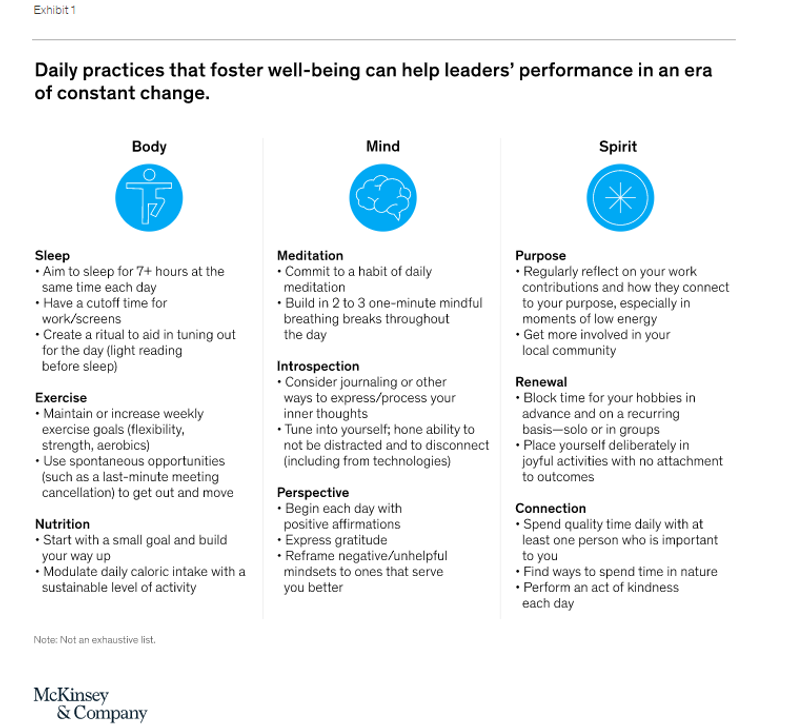
Counter to what leaders may think, attending to one’s own physical well-being is not selfish. Rather, physical and mental health are necessary to build sound decision-making skills amid uncertainty (Exhibit 1).
Many leaders think they have to show their organizations that they are always “on,” never being out of pocket long or taking needed vacations. But research shows that leaders who are role models for well-being can have a positive impact across their organizations. They understand from their own experience that people learn better and faster when they are healthy and well-rested.
A McKinsey survey on employee experience found that taking care of one’s physical and mental health was associated with a 21 percent improvement in work effectiveness, a 46 percent improvement in employee engagement, and a 45 percent improvement in well-being. Organizations that invest in scaling well-being and improving employee experience have seen lower rates of employee turnover, higher ratings on innovation, and even increased Iong-term stock performance.13 They are also more frequently cited as great places to work.
Step 2: Make purpose your North Star and define your ‘nonnegotiables’
While learning is normally invigorating, it can feel daunting during challenging times. We often fall into the trap of attending to the most urgent tasks rather than what is the most important. That’s where a sense of purpose comes in: it offers a framework that makes hard work worthwhile and expands tolerance for change. When employees feel that their purpose is aligned with that of their organization, the benefits expand to include stronger engagement and self-efficacy, as well as heightened loyalty.
Purpose starts with exploring what truly matters to you and what you want to spend time on. As your North Star, your purpose can guide you through tough decisions and inspire you to move forward.
While purpose helps define what you hope to gain, it also frames what you don’t want to lose—your “nonnegotiables.” These are the vows you make to yourself that you will not break no matter what: I will coach junior colleagues; I will be home for my child’s birthday; I will take time off to see my parents. Even if they’re sometimes tough to execute, keeping these vows is worth it.
The link between well-being and purpose is strong. People who say that they are “living their purpose” at work report levels of well-being that are five times higher than those who say that they are not. Research shows they are also healthier, more productive, and more resilient. For their part, leaders who link their own purpose to that of their organization in a genuine fashion help their employees do the same, creating stronger relationships over time.
Step 3: Experience the world through an adaptability lens
Unless the brain learns something new, it will forecast what will happen based on what it has seen and learned before.14 That is why people default to certain behavioral patterns, especially under stress. Some want to control the situation. Others tend to see themselves as victims, claiming everything is out of their control and shutting down.
Our default patterns may serve to protect us in the moment. But ultimately, they may hinder our ability to adapt and respond in ways that a new situation requires. Often, we realize this is the case only after an interaction in which our default patterns have caused friction in a relationship. These can be missed opportunities to take a proactive approach to the situation.
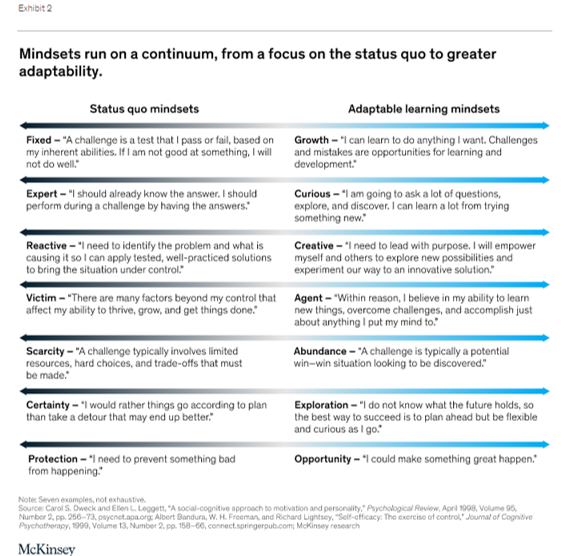
Underlying these patterns are mindsets and beliefs we hold, often unconsciously, that influence how we perceive reality and make us less flexible and adaptable to changing circumstances. However, if we can recognize that we’re moving to our default mindset for stressful situations—signals such as sweaty palms or other physical reactions to perceived threats—and instead push ourselves to see multiple perspectives, we move into a world that offers more possibilities.
While status quo mindsets may be perfectly reasonable in some routine (or low-stress) situations, they are progressively less useful as circumstances become more complex and we’re under more pressure. What becomes optimal then is for leaders and organizations to shift into adaptable learning mindsets (Exhibit 2).
For leaders, one enemy of the adaptive mindset is a belief that it’s their job to have the “right answers” rather than knowing when to ask the right questions. It’s essentially the same trap that Zen Buddhism warns against falling into, thus urging practitioners to adopt what it calls the beginner’s mind, or shoshin. “In the beginner’s mind, there are many possibilities,” according to this concept. “In the expert’s mind, there are few.”
What we now know is that this beginner’s mind is not a fixed personality trait or a skill available only to Zen masters; it is a learnable skill for everyone. We can build ours through deliberate practice. If leaders shed their “expert” status, they can navigate uncertain situations by collecting information in new and productive ways. By shifting their mindset to encourage learning, curiosity, and openness to change, leaders can display the flexibility to find solutions.
For instance, C-suite leaders at a multinational corporation were struggling with how best to support employees during the pandemic as burnout rates rose. As a practitioner of the “expert mindset,” the CEO felt he should already know the answers and was unable to accept such uncertainty. He was coached to approach the problem by seeking different perspectives—for instance, by turning to team members with nursing, military, and paramedic backgrounds, who had experience dealing with trauma. Making such a journey requires awareness of your default mindsets, understanding when they are not serving you, opening up to what else may be true, and intentionally shifting into a new, adaptable mindset.
Self-awareness and reflection are critical components of adaptability. Ways to build awareness include making a “to be” list—that is, a list of the values we want to embody—and setting your intentions in the morning, ahead of a busy day, or at work when things get challenging. Reflecting at the end of the day about difficult moments also helps build an adaptable “unlocking mindset” for the future. The central issue is not that we experience anxiety or uncertainty—that will happen frequently—but rather whether we respond to those pressures in ways that lead us to do more of the same rather than learning and changing.
Step 4: Build deeper and more diverse connections
Strong interpersonal relationships also bolster adaptability, since human beings need meaningful connections to survive and thrive. These community networks can even affect longevity, research shows.15
We typically go through our daily work routine actively engaging with tasks and indirectly engaging with colleagues to help us achieve those tasks. But that emphasis is misplaced: inattention to colleagues is actually counterproductive to both our well-being and our productivity at work.
Research has found that deep and diverse connections that provide social support are fundamental elements of the rich tapestry feeding our well-being and learning,16 especially during periods of uncertainty and heightened stress.
As a leader, there are certain actions you can take to foster deeper connections:
- Pay full attention to the person in front of you. When in conversation, we often let our minds stray, or we multitask by checking our phone or email. Full attention requires tuning our awareness toward the other person and listening deeply, without judgment. When people feel heard, they can also hear you.
- Allow yourself to be vulnerable. Show up as your authentic self and be willing to share your fears, concerns, and imperfections. While it can feel risky to be exposed, this process is always one of deliberate choice.
- Show empathy, but don’t stop there. Empathy alone is not enough. Leaders can learn to channel the right kind of empathy, which involves taking into account the other person’s perspective without being distracted from the situation at hand or, potentially, using up your own energy on unpleasant feelings. Once you understand the other person’s perspective, you become aware of the best course of action.
- Meet others with compassion. If you’ve noticed someone else’s pain—physical, mental, or social—demonstrate your intent to take supportive action. At the same time, be aware that you can never fully understand what they’re going through, so keep an open mind. While general acts of kindness are appreciated, compassion is more nuanced and specific to the needs of the individual.
We have worked with leaders who have changed how they connect with people by considering the ways described above. For instance, the head of plastic surgery at a major hospital in North America was enlisted to sponsor one of the hospital’s new cohorts. During a live coaching exercise, he was unhappy that a team member waited until the end of a three-week consultation process before opposing new safety protocols the group wanted to implement.
Initially frustrated, he asked why she had waited until the last minute. As he reflected more, though, he realized that he had failed to create a safe enough environment for this team member to raise her concerns. He realized he had tried to convince everyone to take a specific action but had failed to create an atmosphere in which people could discuss their views openly.
His mindset then shifted to “What can I do differently to make sure that these voices speak up earlier?” He debriefed the team, held himself accountable, and worked with others to set new norms. By creating these deeper connections, he allowed team members to bring their whole selves to work and feel valued enough to contribute honestly.
Step 5: Make it safe to learn
Healthy team dynamics also foster adaptability. Working in teams influences the extent to which we prioritize learning, especially from setbacks and failures. The absence of conflict and the appearance of compliance may not reflect that dynamic, however. Teams can have cultures in which setbacks and failures go unacknowledged or, worse, are punished, or they can have cultures that seize setbacks as opportunities from which to learn and grow.
Leaders can have a unique influence on which team culture is adopted depending on the degree to which they foster psychological safety. This is a shared belief held by team members that interpersonal risk taking is safe—that ideas, questions, concerns, or mistakes will be welcomed and valued.17
Experiencing safety is an essential ingredient for higher performance, creativity, and improved well-being. It invites full, authentic participation from every member, fosters constructive debate and creative problem solving, and allows teams to learn quickly. For such a climate to be successful, leaders should be aware of and model the requisite behaviors and deliberately support team members. Put simply, by creating psychological safety, leaders simultaneously demonstrate their own adaptability and create an environment where adaptability can flourish for their teams. This is very different from a leader who believes, “I know best and the team should follow me.”
Here are four practices that can help leaders foster psychological safety:
- Reframe “failures.” Failure is emotionally difficult, since we are primed to succeed. Leaders can help frame failure as a way to learn from missteps and build future successes. This emphasis helps reinforce an adaptable environment in which people feel comfortable being honest and vulnerable; it also invites curious, open, and growth mindsets.
- Encourage team voice. A diversity of perspectives pushes us to be innovative and elevates our performance. Leaders can strive to invite team input into decision making and use more dialogue to encourage discussion. Reinforce “messenger” behavior by appreciating all ideas and thanking those who share them, even if that message is not ultimately acted on. If the idea is dismissed, be sure to explain why, and seek to “unmute” the voices of those who are silent.
- Appreciate others. To drive full participation, team members need to feel valued for their contributions. Leaders can avoid generic congratulations or only recognizing results. Instead, they can reward members’ efforts, making recognition for their contributions part of the team’s vernacular.
- Coach team members to support one another. As a contributor to psychological safety, team climate is more than twice as important as leadership style, we’ve found. Coaching, role modeling, mentoring, and setting up structures are critical to creating an environment that feels safe.
Recently, we had a conversation with a leadership team at an international relief organization that wanted to build healthier dynamics. The team was preparing to welcome a new CEO though during the previous transition, there was a lot of unhelpful history that got in the way of performance.
The new CEO decided to go on a journey with this team to transform that challenging history into a story of hope and opportunity. He engaged external coaches to help encourage team learning, feedback, curiosity, and mindsets open to transformation. Over time, the group went from a collection of individuals lacking mutual trust to a close-knit team that is much stronger today, despite bumps along the road. The CEO’s focus on building trust, along with his growth mindset and willingness to appear vulnerable, made it possible for a fresh culture of psychological safety to arise.
Four ways to build adaptability at scale
The power of adaptability grows when the entire organization reinforces these cultural norms and behaviors. From our experience with both virtual and in-person capability building, we have identified a few ingredients as particularly important. As they enter a new chapter of hybrid work, organizations must seize the opportunity to integrate these elements with the more traditional in-person immersive experience. Here are four ways leaders can scale adaptability building.
Use bite-size training as practice. The prevailing belief has been that deeper awareness and habit-shifting work was possible only through immersive in-person experiences. But as with so many other paradigms, the COVID-19 pandemic changed that view. Many organizations have rolled out short digital training modules coupled with the use of behavioral-reinforcement tools, such as nudges. This content focuses on teaching simple adaptability concepts that participants can practice in their day-to-day lives, which can accelerate learning and behavior changes.
We’ve seen this approach help companies undergoing upheaval—for instance, at a global company that went through a complex merger before the pandemic hit. To improve adaptability, it designed a fully digital program to train 5,000 of its top people managers. The program offered a dozen 20- to 30-minute modules delivered over three months, accompanied by weekly emails to reinforce adaptability behaviors.
At the end of the program, it found that participants who engaged with most of the content (four to six hours over three months) saw 2.7 times the improvement in adaptability behaviors (learning skills, empathy and compassion, and fostering psychological safety and greater self-awareness) and 3.0 times the improvement in outcomes (performance, well-being, adapting to change, and developing new skills) as the control group. Even participants who engaged for just 20 to 30 minutes per month saw meaningful increases in adaptability and outcomes, at 1.4 times and 1.9 times the control group, respectively.
Create learning communities. Virtual learning can reach more people faster, engaging larger cohorts in shared experiences. This helps create networks across the organization and a deeper sense of belonging, both of which support adaptability.
During the pandemic, the hospital system we mentioned earlier created formal learning communities for leaders who had graduated from a virtual learning program. These groups continue to meet regularly, applying the lessons they learned to challenges including scheduling patients or clinical personnel, solving conflicts, and supporting a grieving colleague. Such cohorts provide a unique resource to combat feelings of isolation and augment a shared sense of belonging.
Role model at all levels, including visible sponsors at the top. Virtual learning can help senior leaders connect meaningfully with more people faster. At the hospital system, one of the sponsors of the learning program was a well-respected plastic surgeon. He was coached live, in front of the group, encouraging his cohort to share learning stories and generate engagement. He told us that being a sponsor was the best leadership-development training he had ever done, helping him to adopt a leadership mindset in which his role was to serve and support his staff, rather than the other way around. The impact was also positive for participants, who started to build more trust with senior management.
Create enabling mechanisms to build enduring capabilities. To build adaptability into a skill that becomes part of the organization’s core, it’s important to track progress frequently and meticulously. For instance, organizations can use a multirater feedback tool—a digital platform that assesses the effectiveness of the adaptability learning journey for employees. It also shares aggregate data with leaders and tracks when course corrections are necessary.
By investing in measures that emphasize well-being, purpose, mindset shifts, deeper connections, and team learning, leaders become better equipped to meet the challenges ahead. Applying these lessons throughout their organizations makes for healthier and more responsive teams.
Leaders should understand that adaptability is a skill that is mastered with continual practice—the ability to “learn how to learn” does not materialize overnight. Those who have the courage and humility to do this work can summon their adaptability skills right when they are needed most. In a world of constant flux, that is a crucial skill set indeed.
ABOUT THE AUTHOR(S)
Jacqueline Brassey is a global director of learning in McKinsey’s Amsterdam office and affiliate leader of McKinsey’s Center for Societal Benefit through Healthcare; Aaron De Smet is a senior partner in the New Jersey office; Ashish Kothari is a partner in the Denver office; Johanne Lavoie is a partner in the Calgary office; and Marino Mugayar-Baldocchi is a research science specialist in the New York office, where Sasha Zolley is a solution associate partner.
The authors wish to thank Kate Lazaroff-Puck and Laura Tegelberg for their contributions to this article.
This article was edited by Barbara Tierney, a senior editor in the New York office.
Hundreds of scientists around the world are working together to understand one of the most powerful emerging technologies before it’s too late.by
May 20, 2021
ARIEL DAVIS
On May 18, Google CEO Sundar Pichai announced an impressive new tool: an AI system called LaMDA that can chat to users about any subject.
To start, Google plans to integrate LaMDA into its main search portal, its voice assistant, and Workplace, its collection of cloud-based work software that includes Gmail, Docs, and Drive. But the eventual goal, said Pichai, is to create a conversational interface that allows people to retrieve any kind of information—text, visual, audio—across all Google’s products just by asking.
LaMDA’s rollout signals yet another way in which language technologies are becoming enmeshed in our day-to-day lives. But Google’s flashy presentation belied the ethical debate that now surrounds such cutting-edge systems. LaMDA is what’s known as a large language model (LLM)—a deep-learning algorithm trained on enormous amounts of text data.
Studies have already shown how racist, sexist, and abusive ideas are embedded in these models. They associate categories like doctors with men and nurses with women; good words with white people and bad ones with Black people. Probe them with the right prompts, and they also begin to encourage things like genocide, self-harm, and child sexual abuse. Because of their size, they have a shockingly high carbon footprint. Because of their fluency, they easily confuse people into thinking a human wrote their outputs, which experts warn could enable the mass production of misinformation.
In December, Google ousted its ethical AI co-lead Timnit Gebru after she refused to retract a paper that made many of these points. A few months later, after wide-scale denunciation of what an open letter from Google employees called the company’s “unprecedented research censorship,” it fired Gebru’s coauthor and co-lead Margaret Mitchell as well.
It’s not just Google that is deploying this technology. The highest-profile language models so far have been OpenAI’s GPT-2 and GPT-3, which spew remarkably convincing passages of text and can even be repurposed to finish off music compositions and computer code. Microsoft now exclusively licenses GPT-3 to incorporate into yet-unannounced products. Facebook has developed its own LLMs for translation and content moderation. And startups are creating dozens of products and services based on the tech giants’ models. Soon enough, all of our digital interactions—when we email, search, or post on social media—will be filtered through LLMs.
Unfortunately, very little research is being done to understand how the flaws of this technology could affect people in real-world applications, or to figure out how to design better LLMs that mitigate these challenges. As Google underscored in its treatment of Gebru and Mitchell, the few companies rich enough to train and maintain LLMs have a heavy financial interest in declining to examine them carefully. In other words, LLMs are increasingly being integrated into the linguistic infrastructure of the internet atop shaky scientific foundations.
More than 500 researchers around the world are now racing to learn more about the capabilities and limitations of these models. Working together under the BigScience project led by Huggingface, a startup that takes an “open science” approach to understanding natural-language processing (NLP), they seek to build an open-source LLM that will serve as a shared resource for the scientific community. The goal is to generate as much scholarship as possible within a single focused year. Their central question: How and when should LLMs be developed and deployed to reap their benefits without their harmful consequences?
“We can’t really stop this craziness around large language models, where everybody wants to train them,” says Thomas Wolf, the chief science officer at Huggingface, who is co-leading the initiative. “But what we can do is try to nudge this in a direction that is in the end more beneficial.”
Stochastic parrots
In the same month that BigScience kicked off its activities, a startup named Cohere quietly came out of stealth. Started by former Google researchers, it promises to bring LLMs to any business that wants one—with a single line of code. It has developed a technique to train and host its own model with the idle scraps of computational resources in a data center, which holds down the costs of renting out the necessary cloud space for upkeep and deployment.
Among its early clients is the startup Ada Support, a platform for building no-code customer support chatbots, which itself has clients like Facebook and Zoom. And Cohere’s investor list includes some of the biggest names in the field: computer vision pioneer Fei-Fei Li, Turing Award winner Geoffrey Hinton, and Apple’s head of AI, Ian Goodfellow.
Cohere is one of several startups and initiatives now seeking to bring LLMs to various industries. There’s also Aleph Alpha, a startup based in Germany that seeks to build a German GPT-3; an unnamed venture started by several former OpenAI researchers; and the open-source initiative Eleuther, which recently launched GPT-Neo, a free (and somewhat less powerful) reproduction of GPT-3.
But it’s the gap between what LLMs are and what they aspire to be that has concerned a growing number of researchers. LLMs are effectively the world’s most powerful autocomplete technologies. By ingesting millions of sentences, paragraphs, and even samples of dialogue, they learn the statistical patterns that govern how each of these elements should be assembled in a sensible order. This means LLMs can enhance certain activities: for example, they are good for creating more interactive and conversationally fluid chatbots that follow a well-established script. But they do not actually understand what they’re reading or saying. Many of the most advanced capabilities of LLMs today are also available only in English.
Related Story
We read the paper that forced Timnit Gebru out of Google. Here’s what it says.
The company’s star ethics researcher highlighted the risks of large language models, which are key to Google’s business.
Among other things, this is what Gebru, Mitchell, and five other scientists warned about in their paper, which calls LLMs “stochastic parrots.” “Language technology can be very, very useful when it is appropriately scoped and situated and framed,” says Emily Bender, a professor of linguistics at the University of Washington and one of the coauthors of the paper. But the general-purpose nature of LLMs—and the persuasiveness of their mimicry—entices companies to use them in areas they aren’t necessarily equipped for.
In a recent keynote at one of the largest AI conferences, Gebru tied this hasty deployment of LLMs to consequences she’d experienced in her own life. Gebru was born and raised in Ethiopia, where an escalating war has ravaged the northernmost Tigray region. Ethiopia is also a country where 86 languages are spoken, nearly all of them unaccounted for in mainstream language technologies.
Despite LLMs having these linguistic deficiencies, Facebook relies heavily on them to automate its content moderation globally. When the war in Tigray first broke out in November, Gebru saw the platform flounder to get a handle on the flurry of misinformation. This is emblematic of a persistent pattern that researchers have observed in content moderation. Communities that speak languages not prioritized by Silicon Valley suffer the most hostile digital environments.
Gebru noted that this isn’t where the harm ends, either. When fake news, hate speech, and even death threats aren’t moderated out, they are then scraped as training data to build the next generation of LLMs. And those models, parroting back what they’re trained on, end up regurgitating these toxic linguistic patterns on the internet.
In many cases, researchers haven’t investigated thoroughly enough to know how this toxicity might manifest in downstream applications. But some scholarship does exist. In her 2018 book Algorithms of Oppression, Safiya Noble, an associate professor of information and African-American studies at the University of California, Los Angeles, documented how biases embedded in Google search perpetuate racism and, in extreme cases, perhaps even motivate racial violence.
“The consequences are pretty severe and significant,” she says. Google isn’t just the primary knowledge portal for average citizens. It also provides the information infrastructure for institutions, universities, and state and federal governments.
Google already uses an LLM to optimize some of its search results. With its latest announcement of LaMDA and a recent proposal it published in a preprint paper, the company has made clear it will only increase its reliance on the technology. Noble worries this could make the problems she uncovered even worse: “The fact that Google’s ethical AI team was fired for raising very important questions about the racist and sexist patterns of discrimination embedded in large language models should have been a wake-up call.”
BigScience
The BigScience project began in direct response to the growing need for scientific scrutiny of LLMs. In observing the technology’s rapid proliferation and Google’s attempted censorship of Gebru and Mitchell, Wolf and several colleagues realized it was time for the research community to take matters into its own hands.
Inspired by open scientific collaborations like CERN in particle physics, they conceived of an idea for an open-source LLM that could be used to conduct critical research independent of any company. In April of this year, the group received a grant to build it using the French government’s supercomputer.
At tech companies, LLMs are often built by only half a dozen people who have primarily technical expertise. BigScience wanted to bring in hundreds of researchers from a broad range of countries and disciplines to participate in a truly collaborative model-construction process. Wolf, who is French, first approached the French NLP community. From there, the initiative snowballed into a global operation encompassing more than 500 people.
The collaborative is now loosely organized into a dozen working groups and counting, each tackling different aspects of model development and investigation. One group will measure the model’s environmental impact, including the carbon footprint of training and running the LLM and factoring in the life-cycle costs of the supercomputer. Another will focus on developing responsible ways of sourcing the training data—seeking alternatives to simply scraping data from the web, such as transcribing historical radio archives or podcasts. The goal here is to avoid toxic language and nonconsensual collection of private information.
Related Story
Why GPT-3 is the best and worst of AI right now
Open AI’s language AI wowed the public with its apparent mastery of English – but is it all an illusion?
Other working groups are dedicated to developing and evaluating the model’s “multilinguality.” To start, BigScience has selected eight languages or language families, including English, Chinese, Arabic, Indic (including Hindi and Urdu), and Bantu (including Swahili). The plan is to work closely with every language community to map out as many of its regional dialects as possible and ensure that its distinct data privacy norms are respected. “We want people to have a say in how their data is used,” says Yacine Jernite, a Huggingface researcher.
The point is not to build a commercially viable LLM to compete with the likes of GPT-3 or LaMDA. The model will be too big and too slow to be useful to companies, says Karën Fort, an associate professor at the Sorbonne. Instead, the resource is being designed purely for research. Every data point and every modeling decision is being carefully and publicly documented, so it’s easier to analyze how all the pieces affect the model’s outcomes. “It’s not just about delivering the final product,” says Angela Fan, a Facebook researcher. “We envision every single piece of it as a delivery point, as an artifact.”
The project is undoubtedly ambitious—more globally expansive and collaborative than any the AI community has seen before. The logistics of coordinating so many researchers is itself a challenge. (In fact, there’s a working group for that, too.) What’s more, every single researcher is contributing on a volunteer basis. The grant from the French government covers only computational, not human, resources.
But researchers say the shared need that brought the community together has galvanized an impressive level of energy and momentum. Many are optimistic that by the end of the project, which will run until May of next year, they will have produced not only deeper scholarship on the limitations of LLMs but also better tools and practices for building and deploying them responsibly.
The organizers hope this will inspire more people within industry to incorporate those practices into their own LLM strategy, though they are the first to admit they are being idealistic. If anything, the sheer number of researchers involved, including many from tech giants, will help establish new norms within the NLP community.
In some ways the norms have already shifted. In response to conversations around the firing of Gebru and Mitchell, Cohere heard from several of its clients that they were worried about the technology’s safety. On its site it includes a page on its website featuring a pledge to continuously invest in technical and non-technical research to mitigate the possible harms of its model. It says it will also assemble an advisory council made up of external experts to help it create policies on the permissible use of its technologies.
“NLP is at a very important turning point,” says Fort. That’s why BigScience is exciting. It allows the community to push the research forward and provide a hopeful alternative to the status quo within industry: “It says, ‘Let’s take another pass. Let’s take it together—to figure out all the ways and all the things we can do to help society.’”
“I want NLP to help people,” she says, “not to put them down.”
Update: Cohere’s responsibility initiatives have been clarified.
Article link: The race to understand the thrilling, dangerous world of language AI | MIT Technology Review
The way we search online hasn’t changed in decades. A new idea from Google researchers could make it more like talking to a human expert
In 1998 a couple of Stanford graduate students published a paper describing a new kind of search engine: “In this paper, we present Google, a prototype of a large-scale search engine which makes heavy use of the structure present in hypertext. Google is designed to crawl and index the Web efficiently and produce much more satisfying search results than existing systems.”
The key innovation was an algorithm called PageRank, which ranked search results by calculating how relevant they were to a user’s query on the basis of their links to other pages on the web. On the back of PageRank, Google became the gateway to the internet, and Sergey Brin and Larry Page built one of the biggest companies in the world.
Now a team of Google researchers has published a proposal for a radical redesign that throws out the ranking approach and replaces it with a single large AI language model—a future version of BERT or GPT-3. The idea is that instead of searching for information in a vast list of web pages, users would ask questions and have a language model trained on those pages answer them directly. The approach could change not only how search engines work, but how we interact with them.
Many issues with existing language models will need to be fixed first. For a start, these AIs can sometimes generate biased and toxic responses to queries—a problem that researchers at Google and elsewhere have pointed out.
Rethinking PageRank
Search engines have become faster and more accurate, even as the web has exploded in size. AI is now used to rank results, and Google uses BERT to understand search queries better. Yet beneath these tweaks, all mainstream search engines still work the same way they did 20 years ago: web pages are indexed by crawlers (software that reads the web nonstop and maintains a list of everything it finds), results that match a user’s query are gathered from this index, and the results are ranked.
“This index-retrieve-then-rank blueprint has withstood the test of time and has rarely been challenged or seriously rethought,” Donald Metzler and his colleagues at Google Research write. (Metzler declined a request to comment.)
The problem is that even the best search engines today still respond with a list of documents that include the information asked for, not with the information itself. Search engines are also not good at responding to queries that require answers drawn from multiple sources. It’s as if you asked your doctor for advice and received a list of articles to read instead of a straight answer.
Metzler and his colleagues are interested in a search engine that behaves like a human expert. It should produce answers in natural language, synthesized from more than one document, and back up its answers with references to supporting evidence, as Wikipedia articles aim to do.
Large language models get us part of the way there. Trained on most of the web and hundreds of books, GPT-3 draws information from multiple sources to answer questions in natural language. The problem is that it does not keep track of those sources and cannot provide evidence for its answers. There’s no way to tell if GPT-3 is parroting trustworthy information or disinformation—or simply spewing nonsense of its own making.
Metzler and his colleagues call language models dilettantes—“They are perceived to know a lot but their knowledge is skin deep.” The solution, they claim, is to build and train future BERTs and GPT-3s to retain records of where their words come from. No such models are yet able to do this, but it is possible in principle, and there is early work in that direction.
There have been decades of progress on different areas of search, from answering queries to summarizing documents to structuring information, says Ziqi Zhang at the University of Sheffield, UK, who studies information retrieval on the web. But none of these technologies overhauled search because they each address specific problems and are not generalizable. The exciting premise of this paper is that large language models are able to do all these things at the same time, he says.
Yet Zhang notes that language models do not perform well with technical or specialist subjects because there are fewer examples in the text they are trained on. “There are probably hundreds of times more data on e-commerce on the web than data about quantum mechanics,” he says. Language models today are also skewed toward English, which would leave non-English parts of the web underserved.
Hanna Hajishirzi, who studies natural language processing at the University of Washington, welcomes the idea but warns that their would be problems in practice. “I believe large language models are very important and potentially the future of search engines, but they require large memory and computational resources,” she says. “I don’t think they would replace indexing.”
Still, Zhang is excited by the possibilities. “This has not been possible in the past, because large language models only took off recently,” he says. “If it works, it would transform our search experience.”
Update: we have changed the text to more clearly represent the problems with existing large language models.
Article link: Language models like GPT-3 could herald a new type of search engine | MIT Technology Review
How to create more value by connecting experts from inside and outside the organization by
From the Magazine (May–June 2019)

About the Art: In 2010, Christopher Payne discovered an old (but still functioning) yarn mill in Maine and was inspired to explore, through his photography, how the iconic American textile industry has changed and what its future may hold. Christopher Payne/Esto
Today the most promising innovation and business opportunities require collaboration among functions, offices, and organizations. To realize them, companies must break down silos and get people working together across boundaries. But that’s a challenge for many leaders. Employees naturally default to focusing on vertical relationships, and formal restructuring is costly, confusing, and slow. What, then, is the solution? Engaging in four activities that promote horizontal teamwork: (1) developing cultural brokers, or employees who excel at connecting across divides; (2) encouraging people to ask questions in an open-ended, unbiased way that genuinely explores others’ thinking; (3) getting people to actively take other points of view; and (4) broadening employees’ vision to include more-distant networks.
By supporting these activities, leaders can help employees connect with new pools of expertise and learn from and relate to people who think very differently from them. And when that happens, interface collaboration will become second nature.
Idea in Brief
The Challenge
Innovation initiatives, globalization, and digitalization increasingly require people to collaborate across functional and national boundaries. But breaking down silos remains frustratingly difficult.
The Cause
Employees don’t know how to identify expertise outside their own work domains and struggle to understand the perspectives of colleagues who think very differently from them.
The Solution
Leaders can help employees connect with and relate to people across organizational divides by doing four things: developing and deploying “cultural brokers,” who help groups overcome differences; encouraging and training workers to ask the right questions; getting people to see things through others’ eyes; and broadening everyone’s vision of networks of expertise inside and outside the company.
Though most executives recognize the importance of breaking down silos to help people collaborate across boundaries, they struggle to make it happen. That’s understandable: It is devilishly difficult. Think about your own relationships at work—the people you report to and those who report to you, for starters. Now consider the people in other functions, units, or geographies whose work touches yours in some way. Which relationships get prioritized in your day-to-day job?
We’ve posed that question to managers, engineers, salespeople, and consultants in companies around the world. The response we get is almost always the same: vertical relationships.
But when we ask, “Which relationships are most important for creating value for customers?” the answers flip. Today the vast majority of innovation and business-development opportunities lie in the interfaces between functions, offices, or organizations. In short, the integrated solutions that most customers want—but companies wrestle with developing—require horizontal collaboration.
The value of horizontal teamwork is widely recognized. Employees who can reach outside their silos to find colleagues with complementary expertise learn more, sell more, and gain skills faster. Harvard’s Heidi Gardner has found that firms with more cross-boundary collaboration achieve greater customer loyalty and higher margins. As innovation hinges more and more on interdisciplinary cooperation, digitalization transforms business at a breakneck pace, and globalization increasingly requires people to work across national borders, the demand for executives who can lead projects at interfaces keeps rising.
Our research and consulting work with hundreds of executives and managers in dozens of organizations confirms both the need for and the challenge of horizontal collaboration. “There’s no doubt. We should focus on big projects that call for integration across practices,” a partner in a global accounting firm told us. “That’s where our greatest distinctive value is developed. But most of us confine ourselves to the smaller projects that we can handle within our practice areas. It’s frustrating.” A senior partner in a leading consulting firm put it slightly differently: “You know you should swim farther to catch a bigger fish, but it is a lot easier to swim in your own pond and catch a bunch of small fish.”
One way to break down silos is to redesign the formal organizational structure. But that approach has limits: It’s costly, confusing, and slow. Worse, every new structure solves some problems but creates others. That’s why we’ve focused on identifying activities that facilitate boundary crossing. We’ve found that people can be trained to see and connect with pools of expertise throughout their organizations and to work better with colleagues who think very differently from them. The core challenges of operating effectively at interfaces are simple: learning about people on the other side and relating to them. But simple does not mean easy; human beings have always struggled to understand and relate to those who are different.
Leaders need to help people develop the capacity to overcome these challenges on both individual and organizational levels. That means providing training in and support for four practices that enable effective interface work.
1. Develop and Deploy Cultural Brokers
Fortunately, in most companies there are people who already excel at interface collaboration. They usually have experiences and relationships that span multiple sectors, functions, or domains and informally serve as links between them. We call these people cultural brokers. In studies involving more than 2,000 global teams, one of us—Sujin—found that diverse teams containing a cultural broker significantly outperformed diverse teams without one. (See “The Most Creative Teams Have a Specific Type of Cultural Diversity,” HBR.org, July 24, 2018.) Companies should identify these individuals and help them increase their impact.
Cultural brokers promote cross-boundary work in one of two ways: by acting as a bridge or as an adhesive.
A bridge offers himself as a go-between, allowing people in different functions or geographies to collaborate with minimal disruption to their day-to-day routine. Bridges are most effective when they have considerable knowledge of both sides and can figure out what each one needs. This is why the champagne and spirits distributor Moët Hennessy España hired two enologists, or wine experts, to help coordinate the work of its marketing and sales groups, which had a history of miscommunication and conflict. The enologists could relate to both groups equally: They could speak to marketers about the emotional content (the ephemeral “bouquet”) of brands, while also providing pragmatic salespeople with details on the distinctive features of products they needed to win over retailers. Understanding both worlds, the enologists were able to communicate the rationale for each group’s modus operandi to the other, allowing marketing and sales to work more synergistically even without directly interacting. This kind of cultural brokerage is efficient because it lets disparate parties work around differences without investing in learning the other side’s perspective or changing how they work. It’s especially valuable for one-off collaborations or when the company is under intense time pressure to deliver results.
Employees who can reach outside their silos learn more and sell more.
Adhesives, in contrast, bring people together and help build mutual understanding and lasting relationships. Take one manager we spoke with at National Instruments, a global producer of automated test equipment. He frequently connects colleagues from different regions and functions. “I think of it as building up the relationships between them,” he told us. “If a colleague needs to work with someone in another office or function, I would tell them, ‘OK, here’s the person to call.’ Then I’d take the time to sit down and say, ‘Well, let me tell you a little bit about how these guys work.’” Adhesives facilitate collaboration by vouching for people and helping them decipher one another’s language. Unlike bridges, adhesives develop others’ capacity to work across a boundary in the future without their assistance.
Company leaders can build both bridging and adhesive capabilities in their organizations by hiring people with multifunctional or multicultural backgrounds who have the strong interpersonal skills needed to build rapport with multiple parties. Because it takes resilience to work with people across cultural divides, firms should also look for a growth mindset—the desire to learn and to take on challenges and “stretch” opportunities.
In addition, leaders can develop more brokers by giving people at all levels the chance to move into roles that expose them to multiple parts of the company. This, by the way, is good training for general managers and is what many rotational leadership-development programs aim to accomplish. Claudine Wolfe, the head of talent and development at the global insurer Chubb, maintains that the company’s capacity to serve customers around the world rests on giving top performers opportunities to work in different geographies and cultivate an international mindset. “We give people their critical development experiences steeped in the job, in the region,” she says. “They get coaching in the cultural norms and the language, but then they live it and internalize it. They go to the local bodega, take notice of the products on the shelves, have conversations with the merchant, and learn what it really means to live in that environment.”
Matrix organizational structures, in which people report to two (or more) groups, can also help develop cultural brokers. Despite their inherent challenges (they can be infuriatingly hard to navigate without strong leadership and accountability), matrices get people used to operating at interfaces.
We’re not saying that everyone in your organization needs to be a full-fledged cultural broker. But consciously expanding the ranks of brokers and deploying them to grease the wheels of collaboration can go a long way.
2. Encourage People to Ask the Right Questions
It’s nearly impossible to work across boundaries without asking a lot of questions. Inquiry is critical because what we see and take for granted on one side of an interface is not the same as what people experience on the other side.
Indeed, a study of more than 1,000 middle managers at a large bank that Tiziana conducted with Bill McEvily and Evelyn Zhang of the University of Toronto and Francesca Gino of Harvard Business School highlights the value of inquisitiveness in boundary-crossing work. It showed that managers with high levels of curiosity were more likely to build networks that spanned disconnected parts of the company.
But all of us are vulnerable to forgetting the crucial practice of asking questions as we move up the ladder. High-achieving people in particular frequently fail to wonder what others are seeing. Worse, when we do recognize that we don’t know something, we may avoid asking a question out of (misguided) fear that it will make us look incompetent or weak. “Not asking questions is a big mistake many professionals make,” Norma Kraay, the managing partner of talent for Deloitte Canada, told us. “Expert advisers want to offer a solution. That’s what they’re trained to do.”
Leaders can encourage inquiry in two important ways—and in the process help create an organization where it’s psychologically safe to ask questions.
Be a role model.
When leaders show interest in what others are seeing and thinking by asking questions, it has a stunning effect: It prompts people in their organizations to do the same.
Asking questions also conveys the humility that more and more business leaders and researchers are pointing to as vital to success. According to Laszlo Bock, Google’s former senior vice president of people operations, humble people are better at bringing others together to solve tough problems. In a fast-changing business environment, humility—not to be confused with false modesty—is simply a strength. Its power comes from realism (as in It really is a complex, challenging world out there; if we don’t work together, we don’t stand a chance).
Gino says one way a leader can make employees feel comfortable asking questions is by openly acknowledging when he or she doesn’t know the answer. Another, she says, is by having days in which employees are explicitly encouraged to ask “Why?” “What if…?” and “How might we…?” (See “The Business Case for Curiosity,” HBR, September–October 2018.)
Teach employees the art of inquiry.
Training can help expand the range and frequency of questions employees ask and, according to Hal Gregersen of the MIT Leadership Center, can reinvigorate their sense of curiosity. But some questions are better than others. And if you simply tell people to raise more questions, you might unleash interrogation tactics that inhibit rather than encourage the development of new perspectives. As MIT’s Edgar Schein explains in his book Humble Inquiry, questions are the secret to productive work relationships—but they must be driven by genuine interest in understanding another’s view.
How to Ask Good Questions
| COMMON PITFALLS | EFFECTIVE INQUIRY |
| Start with yes-or-no questions. | Start with open-ended questions that minimize preconceptions. (“How are things going on your end?” “What does your group see as the key opportunity in this space?”) |
| Continue asking overly general questions (“What’s on your mind?”) that may invite long off-point responses. | As collaborations develop, ask questions that focus on specific issues but allow people plenty of room to elaborate. (“What do you know about x?” “Can you explain how that works?”) |
| Assume that you’ve grasped what speakers intended. | Check your understanding by summarizing what you’re hearing and asking explicitly for corrections or missing elements. (“Does that sound right—am I missing anything?” “Can you help me fill in the gaps?”) |
| Assume the collaboration process will take care of itself. | Periodically take time to inquire into others’ experiences of the process or relationship. (“How do you think the project is going?” “What could we do to work together more effectively?”) |
Show more
It’s also important to learn how to request information in the least biased way possible. This means asking open-ended questions that minimize preconceptions, rather than yes-or-no questions. For instance, “What do you see as the key opportunity in this space?” will generate a richer dialogue than “Do you think this is the right opportunity to pursue?”
As collaborations move forward, it’s helpful for team leaders or project managers to raise queries that encourage others to dive more deeply into specific issues and express related ideas or experiences. “What do you know about x?” and “Can you explain how that works?” are two examples. These questions are focused but neither limit responses nor invite long discourses that stray too far from the issue at hand.
How you process the answers also matters. It’s natural, as conversations unfold, to assume you understand what’s being said. But what people hear is biased by their expertise and experiences. So it’s important to train people to check whether they’re truly getting their colleagues’ meaning, by using language like “This is what I’m hearing—did I miss anything?” or “Can you help me fill in the gaps?” or “I think what you said means the project is on track. Is that correct?”
Finally, periodic temperature taking is needed to examine the collaborative process itself. The only way to find out how others are experiencing a project or relationship is by asking questions such as “How do you think the project is going?” and “What could we do to work together more effectively?”
3. Get People to See the World Through Others’ Eyes
Leaders shouldn’t just encourage employees to be curious about different groups and ask questions about their thinking and practices; they should also urge their people to actively consider others’ points of view. People from different organizational groups don’t see things the same way. Studies (including research on barriers to successful product innovation that the management professor Deborah Dougherty conducted at Wharton) consistently reveal that this leads to misunderstandings in interface work. It’s vital, therefore, to help people learn how to take the perspectives of others. One of us, Amy, has done research showing that ambitious cross-industry innovation projects succeed when diverse participants discover how to do this. New Songdo, a project to build a city from scratch in South Korea that launched a decade ago, provides an instructive example. Early in the effort, project leaders brought together architects, engineers, planners, and environmental experts and helped them integrate their expertise in a carefully crafted learning process designed to break down barriers between disciplines. Today, in striking contrast to other “smart” city projects, New Songdo is 50% complete and has 30,000 residents, 33,000 jobs, and emissions that are 70% lower than those of other developments its size.
In a study of jazz bands and Broadway productions, Brian Uzzi of Northwestern University found that leaders of successful teams had an unusual ability to assume other people’s viewpoints. These leaders could speak the multiple “languages” of their teammates. Other research has shown that when members of a diverse team proactively take the perspectives of others, it enhances the positive effect of information sharing and increases the team’s creativity.
Creating a culture that fosters this kind of behavior is a senior leadership responsibility. Psychological research suggests that while most people are capable of taking others’ perspectives, they are rarely motivated to do so. Leaders can provide some motivation by emphasizing to their teams how much the integration of diverse expertise enhances new value creation. But a couple of other tactics will help:
Organize cross-silo dialogues.
Instead of holding one-way information sessions, leaders should set up cross-silo discussions that help employees see the world through the eyes of customers or colleagues in other parts of the company. The goal is to get everyone to share knowledge and work on synthesizing that diverse input into new solutions. This happens best in face-to-face meetings that are carefully structured to allow people time to listen to one another’s thinking. Sometimes the process includes customers; one consulting firm we know started to replace traditional meetings, at which the firm conveyed information to clients, with a workshop format designed to explore questions and develop solutions in collaboration with them. The new format gives both the clients and the consultants a chance to learn from each other.
One of the more thoughtful uses of cross-silo dialogue is the “focused event analysis” (FEA) at Children’s Minnesota. In an FEA people from the health system’s different clinical and operational groups come together after a failure, such as the administration of the wrong medication to a patient. One at a time participants offer their take on what happened; the goal is to carefully document multiple perspectives before trying to identify a cause. Often participants are surprised to learn how people from other groups saw the incident. The assumption underlying the FEA is that most failures have not one root cause but many. Once the folks involved have a multifunctional picture of the contributing factors, they can alter procedures and systems to prevent similar failures.
Hire for curiosity and empathy.
You can boost your company’s capacity to see the world from different perspectives by bringing on board people who relate to and sympathize with the feelings, thoughts, and attitudes of others. Southwest Airlines, which hires fewer than 2% of all applicants, selects people with empathy and enthusiasm for customer service, evaluating them through behavioral interviews (“Tell me about a time when…”) and team interviews in which candidates are observed interacting.
4. Broaden Your Employees’ Vision
You can’t lead at the interfaces if you don’t know where they are. Yet many organizations unwittingly encourage employees to never look beyond their own immediate environment, such as their function or business unit, and as a result miss out on potential insights employees could get if they scanned more-distant networks. Here are some ways that leaders can create opportunities for employees to widen their horizons, both within the company and beyond it:
Bring employees from diverse groups together on initiatives.
As a rule, cross-functional teams give people across silos a chance to identify various kinds of expertise within their organization, map how they’re connected or disconnected, and see how the internal knowledge network can be linked to enable valuable collaboration.
At one global consulting firm, the leader of the digital health-care practice used to have its consultants speak just to clients’ CIOs and CTOs. But she realized that that “unnecessarily limited the practice’s ability to identify opportunities to serve clients beyond IT,” she says. So she began to set up sessions with the entire C-suite at clients and brought in consultants from across all her firm’s health-care practices—including systems redesign, operations excellence, strategy, and financing—to provide a more integrated look at the firm’s health-care innovation expertise.
Those meetings allowed the consultants to discover the connections among the practices in the health-care division, identify the people best positioned to bridge the different practices, and see novel ways to combine the firm’s various kinds of expertise to meet clients’ needs. That helped the consultants spot value-generating opportunities for services at the interfaces between the practices. The new approach was so effective that, in short order, the leader was asked to head up a new practice that served as an interface across all the practices in the IT division so that she could replicate her success in other parts of the firm.
Urge employees to explore distant networks.
Employees also need to be pushed to tap into expertise outside the company and even outside the industry. The domains of human knowledge span science, technology, business, geography, politics, history, the arts, the humanities, and beyond, and any interface between them could hold new business opportunities. Consider the work of the innovation consultancy IDEO. By bringing design techniques from technology, science, and the arts to business, it has been able to create revolutionary products, like the first Apple mouse (which it developed from a Xerox PARC prototype into a commercial offering), and help companies in many industries embrace design thinking as an innovation strategy.
The tricky part is finding the domains most relevant to key business goals. Although many innovations have stemmed from what Abraham Flexner, the founding director of the Institute for Advanced Study, called “the usefulness of useless knowledge,” businesses can ill afford to rely on open-ended exploratory search alone. To avoid this fate, leaders can take one of two approaches:
A top-down approach works when the knowledge domains with high potential for value creation have already been identified. For example, a partner in an accounting firm who sees machine learning as key to the profession’s future might have an interested consultant or analyst in her practice take online courses or attend industry conferences about the technology and ask that person to come back with ideas about its implications. The partner might organize workshops in which the junior employee shares takeaways from the learning experiences and brainstorms, with experienced colleagues, potential applications in the firm.
You can’t lead at the interfaces if you don’t know where they are.
A bottom-up approach is better when leaders have trouble determining which outside domains the organization should connect with—a growing challenge given the speed at which new knowledge is being created. Increasingly, leaders must rely on employees to identify and forge connections with far-flung domains. One approach is to crowdsource ideas for promising interfaces—for example, by inviting employees to propose conferences in other industries they’d like to attend, courses on new skill sets they’d like to take, or domain experts they’d like to bring in for workshops. It’s also critical to give employees the time and resources to scan external domains and build connections to them.
Breaking Down Silos
In today’s economy everyone knows that finding new ways to combine an organization’s diverse knowledge is a winning strategy for creating lasting value. But it doesn’t happen unless employees have the opportunities and tools to work together productively across silos. To unleash the potential of horizontal collaboration, leaders must equip people to learn and to relate to one another across cultural and logistical divides. The four practices we’ve just described can help.
Not only is each one useful on its own in tackling the distinct challenges of interface work, but together these practices are mutually enhancing: Engaging in one promotes competency in another. Deploying cultural brokers who build connections across groups gets people to ask questions and learn what employees in other groups are thinking. When people start asking better questions, they’re immediately better positioned to understand others’ perspectives and challenges. Seeing things from someone else’s perspective—walking in his or her moccasins—in turn makes it easier to detect more pockets of knowledge. And network scanning illuminates interfaces where cultural brokers might be able to help groups collaborate effectively.
Over time these practices—none of which require advanced degrees or deep technical smarts—dissolve the barriers that make boundary-crossing work so difficult. When leaders create conditions that encourage and support these practices, collaboration across the interface will ultimately become second nature. A version of this article appeared in the May–June 2019 issue (pp.130–139) of Harvard Business Review.
Article link: What Cross-Silo Leadership Looks Like (hbr.org)
by
June 24, 2021
Summary.
Data is more important than ever, but most organizations still struggle with a few common issues: They focus more on data infrastructure than data products; data is often created with the needs of a particular department in mind, but little thought for the end use; they lack a common “data language” with each department coding and classifying with their own system; and they’re increasingly focused on outside data, but have few quality control systems in place. By focusing on “data supply chain” management, companies can address these and other issues. Similar to physical supply chains, companies should think systematically, focus on end products, define standards and measurements, introduce quality controls, and constantly refine their approach across all phases of data gathering and analysis.
Data management has bedeviled large companies for decades. Almost all firms spend a lot on it but find the results unsatisfactory. While the issue does not appear to be growing worse, resolving it is increasingly urgent as managers and companies strive to become more data driven, leverage advanced analytics and artificial intelligence, and compete with data. In this article we’ll explore a powerful approach to data management through the lens of “data products” and “data supply chains.”
Most companies struggle with a few common but significant data management issues.
First, companies have concentrated on the technical capabilities of data management, which are controlled by the IT function and are needed to acquire, store, and move data. This is no mean feat — building technical “pipes” is a challenging job. But in so doing they have focused more on infrastructure and much less on the outputs: the data products that are used to make decisions, differentiate products and services, and satisfy customers.
Second, data is created in different parts of the organization to meet the needs of various departments, not for later use by others in data products, business decisions, or processes. Contrast that with a physical product, such as a car, where components such as the chassis and the starter are designed with the end product in mind.
Third, most organizations lack a common data language. Data is subtle and nuanced and has different meanings for different people in different contexts. Exacerbating this, some departments, taking ownership for “their data,” may be reluctant to share. Or while willing to share, they will not make time to explain these nuances so others can use it effectively. This leads other departments to set up their own “near-redundant” databases, adding to the overall confusion.
Finally, companies are increasingly interested in what happens outside their walls, tapping external data to answer a variety of questions. But external data is largely unmanaged, with little supplier qualification or data quality assessment.
Data supply chain management, with data products as the end result of the process, can help to address each of these issues. It puts equal emphasis on all phases of data management — from collection to organization to consumption of data products. It’s a means of balancing the benefits of common data with those of unique and tailored data in products, and it’s equally suited to internal and external data. Relatively few companies employ data supply chain management, but those that do tend to report better results.
Process and Supplier Management for Data Products
Companies have always produced data products in the form of financial statements, reports to regulators, and so forth. Still, the range and importance of such products is growing. For many, the goal is to embed analytics and AI-derived models into products that serve both internal and external customers. Morgan Stanley’s Next Best Action, LinkedIn’s People You May Know, Google’s many search offerings, and MasterCard’s SpendingPulse and Business Locator are good examples. With the issues cited above in full display, “wrangling” the data takes far longer than building the model and still doesn’t solve all the issues.
Fortunately, there is a better way to source high-quality data. It builds on the process and supplier management techniques used by manufacturers of physical products. In particular, manufacturers extend deep into their supply chains to clarify their requirements, qualify suppliers, insist that suppliers measure quality, and make needed improvements at the source(s) of problem(s). This enables them to assemble components into finished products with minimal “physical product wrangling,” improving quality and lowering costs.
One organization employing supplier quality management in its data supply chain is Altria, the U.S.-based provider of tobacco and smoke-free products. Altria depends on point-of-sale data from more than 100,000 convenience stores daily to complete its market reports and analysis. A team reporting to Kirby Forlin, VP Advanced Analytics, manages this base. Data requirements are spelled out in contracts, and the team aims to help stores meet them. To begin, Altria concentrated on its most basic requirements. Quality was poor, with only 58% of daily submissions meeting them. But the Altria team worked patiently, improving quality to 98% in three years. As the score for basic quality improved, the Altria team added its more advanced requirements to the mix. As Forlin noted, “This is a work in progress. The evidence that we can increasingly trust the data saves us a lot of work in our analytics practice and builds trust into our work.”
Steps Toward a Data Supply Chain
The data supply chain can be established within a company by following some of the same steps used in process and quality management for physical supply chains:
- Establish management responsibilities. As step 1a, the chief data officer or product manager should name a “data supply chain manager” from their staff to coordinate the effort and recruit “responsible parties” from each department (including external data sources) across the supply chain. Step 1b is to put issues associated with data sharing and ownership front and center. We find that most issues melt away, as few managers wish to take a hard stance against data sharing in front of their peers.
- Identify and document the data and associated cost, time, and quality requirements needed to create and maintain data products.
- Describe the supply chain. Develop a flowchart that describes points of data creation/original sources of data and the steps taken to move, enrich, and analyze data for use in data products.
- Define and establish measurements. Generally, the idea is to implement measurements that indicate whether requirements are met. Start with data accuracy and the elapsed time from data creation to incorporation into a data product. Measures will vary for each data product’s supply chain.
- Establish process control and assess conformance to requirements. Use the measurements of step four to put the process in control and determine how well the requirements of step two are met and to identify gaps.
- Investigate the supply chain to identify needed improvements — overall and for particular data products. Determine where gaps uncovered in step five originate in the flowchart of step three.
- Make improvements and continuously monitor. Identify and eliminate root causes of gaps identified in step six, and return to previous steps if necessary. Continuously monitor both the input data and the data products, looking to improve products and for the new data and better sources needed to do so.
- “Qualify” data sources. Companies will continue to employ increasing numbers of external data suppliers and it is helpful to identify those that consistently provide high-quality data. Audits of their data quality programs provide the means “qualify” those that do and identify areas of weakness in those that do not.
Key Bank, a top 20 U.S. bank in asset size, uses a broad data supply chain concept to structure its data management initiatives. It breaks its process into the areas of “capture/organize/consume” and attempts to improve efficiency and effectiveness in each area. It recently shifted much of its data storage and analytics to the cloud, and found major improvements in flexibility and speed across the supply chain. Its consumption activities were historically focused on classic business intelligence capabilities, but now it also has a strong data science function.
That necessitated a change in the supply chain toward greater data virtualization and the ability to construct views of data that cut across different data marts and that incorporate external data as well. The bank has been able to use its data supply chain to rapidly develop new banking products that rely heavily on data. For example, it was one of the largest lenders of Payroll Protection Plan loans in the U.S., and also recently introduced a national digital bank for doctors. Mike Onders, the bank’s chief data officer, is effectively the data supply chain manager. He and his staff have evaluated the ability of the bank’s data supply chain to supply a variety of needed data products.
We urge all companies to aggressively manage their most important data supply chains. Data is as important an asset to businesses as any other type, and data products are increasingly as important as physical ones. The same thinking that has improved physical supply chains for decades is proving equally valuable for data.
Article link: Your Data Supply Chains Are Probably a Mess. Here’s How to Fix Them. (hbr.org)
Training a single AI model can emit as much carbon as five cars in their lifetimes – MIT Tech Review
Deep learning has a terrible carbon footprint.by
June 6, 2019
The artificial-intelligence industry is often compared to the oil industry: once mined and refined, data, like oil, can be a highly lucrative commodity. Now it seems the metaphor may extend even further. Like its fossil-fuel counterpart, the process of deep learning has an outsize environmental impact.
In a new paper, researchers at the University of Massachusetts, Amherst, performed a life cycle assessment for training several common large AI models. They found that the process can emit more than 626,000 pounds of carbon dioxide equivalent—nearly five times the lifetime emissions of the average American car (and that includes manufacture of the car itself).
It’s a jarring quantification of something AI researchers have suspected for a long time. “While probably many of us have thought of this in an abstract, vague level, the figures really show the magnitude of the problem,” says Carlos Gómez-Rodríguez, a computer scientist at the University of A Coruña in Spain, who was not involved in the research. “Neither I nor other researchers I’ve discussed them with thought the environmental impact was that substantial.”
The carbon footprint of natural-language processing
The paper specifically examines the model training process for natural-language processing (NLP), the subfield of AI that focuses on teaching machines to handle human language. In the last two years, the NLP community has reached several noteworthy performance milestones in machine translation, sentence completion, and other standard benchmarking tasks. OpenAI’s infamous GPT-2 model, as one example, excelled at writing convincing fake news articles.
But such advances have required training ever larger models on sprawling data sets of sentences scraped from the internet. The approach is computationally expensive—and highly energy intensive.
The researchers looked at four models in the field that have been responsible for the biggest leaps in performance: the Transformer, ELMo, BERT, and GPT-2. They trained each on a single GPU for up to a day to measure its power draw. They then used the number of training hours listed in the model’s original papers to calculate the total energy consumed over the complete training process. That number was converted into pounds of carbon dioxide equivalent based on the average energy mix in the US, which closely matches the energy mix used by Amazon’s AWS, the largest cloud services provider.
They found that the computational and environmental costs of training grew proportionally to model size and then exploded when additional tuning steps were used to increase the model’s final accuracy. In particular, they found that a tuning process known as neural architecture search, which tries to optimize a model by incrementally tweaking a neural network’s design through exhaustive trial and error, had extraordinarily high associated costs for little performance benefit. Without it, the most costly model, BERT, had a carbon footprint of roughly 1,400 pounds of carbon dioxide equivalent, close to a round-trip trans-America flight for one person.
What’s more, the researchers note that the figures should only be considered as baselines. “Training a single model is the minimum amount of work you can do,” says Emma Strubell, a PhD candidate at the University of Massachusetts, Amherst, and the lead author of the paper. In practice, it’s much more likely that AI researchers would develop a new model from scratch or adapt an existing model to a new data set, either of which can require many more rounds of training and tuning.
To get a better handle on what the full development pipeline might look like in terms of carbon footprint, Strubell and her colleagues used a model they’d produced in a previous paper as a case study. They found that the process of building and testing a final paper-worthy model required training 4,789 models over a six-month period. Converted to CO2 equivalent, it emitted more than 78,000 pounds and is likely representative of typical work in the field.
The significance of those figures is colossal—especially when considering the current trends in AI research. “In general, much of the latest research in AI neglects efficiency, as very large neural networks have been found to be useful for a variety of tasks, and companies and institutions that have abundant access to computational resources can leverage this to obtain a competitive advantage,” Gómez-Rodríguez says. “This kind of analysis needed to be done to raise awareness about the resources being spent […] and will spark a debate.”
“What probably many of us did not comprehend is the scale of it until we saw these comparisons,” echoed Siva Reddy, a postdoc at Stanford University who was not involved in the research.
The privatization of AI research
The results underscore another growing problem in AI, too: the sheer intensity of resources now required to produce paper-worthy results has made it increasingly challenging for people working in academia to continue contributing to research.
“This trend toward training huge models on tons of data is not feasible for academics—grad students especially, because we don’t have the computational resources,” says Strubell. “So there’s an issue of equitable access between researchers in academia versus researchers in industry.”
Strubell and her coauthors hope that their colleagues will heed the paper’s findings and help level the playing field by investing in developing more efficient hardware and algorithms.
Reddy agrees. “Human brains can do amazing things with little power consumption,” he says. “The bigger question is how can we build such machines.”
Article link: https://www.technologyreview.com/2019/06/06/239031/training-a-single-ai-model-can-emit-as-much-carbon-as-five-cars-in-their-lifetimes/?
Article meta
Share
- facebooklink opens in a new window
- twitterlink opens in a new window
- redditlink opens in a new window
- linkedinlink opens in a new window
- whatsapplink opens in a new window
- emaillink opens in a new window
- Link
Author

After spending a few years cutting through Big Tech’s B.S. about AI ethics, one of our AI writers created a glossary to help you decode what all of their favorite terms actually mean.
tech #technews #mit #mittechnologyreview #technologyreview #techreview #bigtech #artificialintelligence #siliconvalley #aiethics
AI researchers often say good machine learning is really more art than science. The same could be said for effective public relations. Selecting the right words to strike a positive tone or reframe the conversation about AI is a delicate task: done well, it can strengthen one’s brand image, but done poorly, it can trigger an even greater backlash.
The tech giants would know. Over the last few years, they’ve had to learn this art quickly as they’ve faced increasing public distrust of their actions and intensifying criticism about their AI research and technologies.
Now they’ve developed a new vocabulary to use when they want to assure the public that they care deeply about developing AI responsibly—but want to make sure they don’t invite too much scrutiny. Here’s an insider’s guide to decoding their language and challenging the assumptions and values baked in.
accountability (n) – The act of holding someone else responsible for the consequences when your AI system fails.
accuracy (n) – Technical correctness. The most important measure of success in evaluating an AI model’s performance. See validation.
adversary (n) – A lone engineer capable of disrupting your powerful revenue-generating AI system. See robustness, security.
alignment (n) – The challenge of designing AI systems that do what we tell them to and value what we value. Purposely abstract. Avoid using real examples of harmful unintended consequences. See safety.
artificial general intelligence (phrase) – A hypothetical AI god that’s probably far off in the future but also maybe imminent. Can be really good or really bad whichever is more rhetorically useful. Obviously you’re building the good one. Which is expensive. Therefore, you need more money. See long-term risks.
audit (n) – A review that you pay someone else to do of your company or AI system so that you appear more transparent without needing to change anything. See impact assessment.
augment (v) – To increase the productivity of white-collar workers. Side effect: automating away blue-collar jobs. Sad but inevitable.
beneficial (adj) – A blanket descriptorfor what you are trying to build. Conveniently ill-defined. See value.
by design (ph) – As in “fairness by design” or “accountability by design.” A phrase to signal that you are thinking hard about important things from the beginning.
compliance (n) – The act of following the law. Anything that isn’t illegal goes.
data labelers (ph) – The people who allegedly exist behind Amazon’s Mechanical Turk interface to do data cleaning work for cheap. Unsure who they are. Never met them.
democratize (v) – To scale a technology at all costs. A justification for concentrating resources. See scale.
diversity, equity, and inclusion (ph) – The act of hiring engineers and researchers from marginalized groups so you can parade them around to the public. If they challenge the status quo, fire them.
efficiency (n) – The use of less data, memory, staff, or energy to build an AI system.
ethics board (ph) – A group of advisors without real power, convened to create the appearance that your company is actively listening. Examples: Google’s AI ethics board (canceled), Facebook’s Oversight Board (still standing).
ethics principles (ph) – A set of truisms used to signal your good intentions. Keep it high-level. The vaguer the language, the better. See responsible AI.
explainable (adj) – For describing an AI system that you, the developer, and the user can understand. Much harder to achieve for the people it’s used on. Probably not worth the effort. See interpretable.
fairness (n) – A complicated notion of impartiality used to describe unbiased algorithms. Can be defined in dozens of ways based on your preference.
for good (ph) – As in “AI for good” or “data for good.” An initiative completely tangential to your core business that helps you generate good publicity.
foresight (n) – The ability to peer into the future. Basically impossible: thus, a perfectly reasonable explanation for why you can’t rid your AI system of unintended consequences.
framework (n) – A set of guidelines for making decisions. A good way to appear thoughtful and measured while delaying actual decision-making.
generalizable (adj) – The sign of a good AI model. One that continues to work under changing conditions. See real world.
governance (n) – Bureaucracy.
human-centered design (ph) – A process that involves using “personas” to imagine what an average user might want from your AI system. May involve soliciting feedback from actual users. Only if there’s time. See stakeholders.
human in the loop (ph) – Any person that is part of an AI system. Responsibilities range from faking the system’s capabilities to warding off accusations of automation.
impact assessment (ph) – A review that you do yourself of your company or AI system to show your willingness to consider its downsides without changing anything. See audit.
interpretable (adj) – Description of an AI system whose computation you, the developer, can follow step by step to understand how it arrived at its answer. Actually probably just linear regression. AI sounds better.
integrity (n) – Issues that undermine the technical performance of your model or your company’s ability to scale. Not to be confused with issues that are bad for society. Not to be confused with honesty.
interdisciplinary (adj) – Term used of any team or project involving people who do not code: user researchers, product managers, moral philosophers. Especially moral philosophers.
long-term risks (n) – Bad things that could have catastrophic effects in the far-off future. Probably will never happen, but more important to study and avoid than the immediate harms of existing AI systems.
partners (n) – Other elite groups who share your worldview and can work with you to maintain the status quo. See stakeholders.
privacy trade-off (ph) – The noble sacrifice of individual control over personal information for group benefits like AI-driven health-care advancements, which also happen to be highly profitable.
progress (n) – Scientific and technological advancement. An inherent good.
real world (ph) – The opposite of the simulated world. A dynamic physical environment filled with unexpected surprises that AI models are trained to survive. Not to be confused with humans and society.
regulation (n) – What you call for to shift the responsibility for mitigating harmful AI onto policymakers. Not to be confused with policies that would hinder your growth.
responsible AI (n)- A moniker for any work at your company that could be construed by the public as a sincere effort to mitigate the harms of your AI systems.
robustness (n) – The ability of an AI model to function consistently and accurately under nefarious attempts to feed it corrupted data.
safety (n)- The challenge of building AI systems that don’t go rogue from the designer’s intentions. Not to be confused with building AI systems that don’t fail. See alignment.
scale (n)- The de facto end state that any good AI system should strive to achieve.
security (n) – The act of protecting valuable or sensitive data and AI models from being breached by bad actors. See adversary.
stakeholders (n) – Shareholders, regulators, users. The people in power you want to keep happy.
transparency (n) – Revealing your data and code. Bad for proprietary and sensitive information. Thus really hard; quite frankly, even impossible. Not to be confused with clear communication about how your system actually works.
trustworthy (adj) – An assessment of an AI system that can be manufactured with enough coordinated publicity.
universal basic income (ph) – The idea that paying everyone a fixed salary will solve the massive economic upheaval caused when automation leads to widespread job loss. Popularized by 2020 presidential candidate Andrew Yang. See wealth redistribution.
validation (n) – The process of testing an AI model on data other than the data it was trained on, to check that it is still accurate.
value (n) – An intangible benefit rendered to your users that makes you a lot of money.
values (n) – You have them. Remind people.
wealth redistribution (ph) – A useful idea to dangle around when people scrutinize you for using way too many resources and making way too much money. How would wealth redistribution work? Universal basic income, of course. Also not something you could figure out yourself. Would require regulation. See regulation.
withhold publication (ph) – The benevolent act of choosing not to open-source your code because it could fall into the hands of a bad actor. Better to limit access to partners who can afford it.2 free stories remaining Sign in Subscribe now
Article link:
https://www.technologyreview.com/2021/04/13/1022568/big-tech-ai-ethics-guide/