Link to Full Text: NDAA 2014 – Section 713
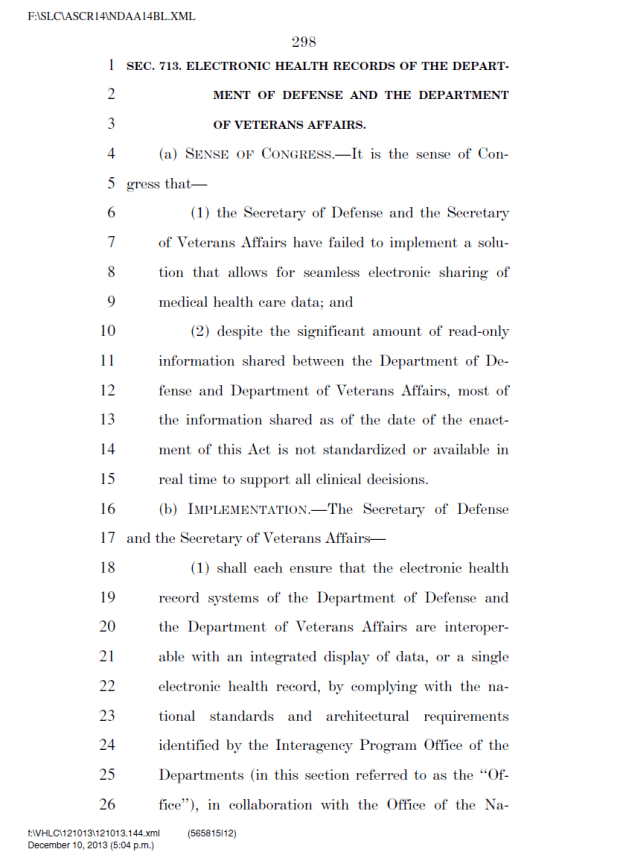
Link to Full Text: NDAA 2014 – Section 713

Article link: http://www.nextgov.com/defense/2014/01/quit-wasting-money-e-health-records-congress-tells-defense-and-va/76943/
Worried that the Defense and Veterans Affairs departments might continue to spend years and billions of dollars in a “futile exercise” to develop their own electronic health record systems “and lose sight of the end-goal of an interoperable record,” lawmakers included funding restrictions in the 2014 Omnibus Appropriations Act the House passed Wednesday.
Both the House VA and Defense appropriations committees have defined the goal –interoperability — as the ability to exchange computable information electronically between the departments based on common data standards. Similar language is included in the 2014 National Defense Authorization Act signed by President Obama late last month. The omnibus spending bill eliminated language in an earlier version of the 2014 VA appropriations bill that called for development of a single record to serve both departments.
The two departments abandoned efforts to develop a single EHR in February 2013 when the estimated costs of a system reached $28 billion, four years after President Obama called for development of a joint record in April 2009.
“The committees want to be very clear with both departments: An interoperable record between the two departments is the chief end goal for Congress,” said the VA section of the omnibus bill the House approved Wednesday.
“The evolution and/or procurement of new health record systems is an important project for the departments to undertake, but it will end up being a futile exercise if the result is not the development of systems that will be interoperable, defined as the ability to exchange computable information electronically,” the section said. “There is rising concern the departments will spend years and billions of dollars on their own electronic health record systems and lose sight of the end-goal of an interoperable record.”
The VA section of the omnibus bill transfers $251.9 million that VA originally requested for the integrated EHR to support development of an upgraded version of its Veterans Health Information Systems and Technology Architecture, dubbed VistA Evolution. It provides $32.9 million for the Virtual Lifetime Electronic Record, which includes benefits information.
The language precludes VA from spending more than 25 percent of the VistA Evolution budget until the department describes to Congress how it will adhere to data standards defined by the Interagency Program Office, or IPO, which was originally set up to develop the integrated EHR. The lawmakers also want updates on “how testing will be conducted in order to ensure interoperabity between current and future DoD and VA systems.”
The Defense Appropriations Committee said the IPO — whose director, Barclay Butler, departed last September with little public notice — now has the responsibility to establish and approve the clinical and technical data standards that “will insure seamless integration of health data between the two departments and private health care providers.”
Last May, Defense Secretary Chuck Hagel backed development of a new Defense EHR based on commercial software. In September, the Pentagon established the Defense Healthcare Management Systems Modernization, or DHMSM, office to manage development of the new EHR.
DHMSM plans to kick off a procurement for the new Defense EHR in March. The Defense section of the omnibus bill allows DHMSM to spend only 25 percent of its budget until it provides Congress with a budget for the full cost of the new EHR. The omnibus bill does not break out the DHSM EHR budget, but chopped the overall procurement budget for the Defense Health Agency by $204.2 million for the integrated EHR it now considers as “excess.”
The Defense Appropriations Committee echoed the VA Committee, saying it is “imperative” that the Pentagon “does not lose sight of the ultimate goal of interoperability” with the VA EHR.
Get the Nextgov iPhone app to keep up with government technology news.
(Image via mayamaya/Shutterstock.com)

January 17, 2014
The healthcare IT industry just marked the 10-year anniversary of then President George W. Bush’s call to action – in his 2004 State of the Union address – to finally transform a paper-mired healthcare system into a digital-age industry that operates more like other sectors of the economy.
As we look back on 10 years, we spoke to some leaders on the frontline of health information technology, asking them to take measure of how far the industry has moved towards a truly high-tech, data-driven system of care.
Bill Spooner, Sharp Healthcare
Bill Spooner, vice president and chief information officer of Sharp Healthcare in San Diego has had an epiphany or two on his way to digital transformation. There was a time, for instance, when he advocated for best-of-breed systems. But he changed his tune when he realized there were too many interoperability headaches.
In an interview with Healthcare IT News in early 2010, Spooner addressed the issue of best-of breed technology versus enterprise systems.
He was proud, he said, of his and his colleagues’ willingness to make a change when it became clear they needed to go in a different direction on their core hospital systems, or EMR, back in 2006.
 Bill Spooner“We were willing to recognize that the strategy we were taking in terms of our best-of-breed group of products just wasn’t going to bring us the value that we really needed to achieve,” Spooner said in the interview. “We began to pull out a half a dozen best-of-breed products in exchange for the integrated group of products that we are now implementing from Cerner.”
Spooner may have been early to change his tack, but today he is far from alone, with many medium and large health systems rolling out Epic or Cerner EHRs. Even pioneers in health IT are replacing their homegrown systems with commercial systems, usually with either Epic or Cerner, the two most selected enterprise EHR companies in the market today.
Partners HealthCare in Boston is in the midst of an Epic system rollout. Intermountain Healthcare in Salt Lake City recently announced a partnership with Cerner.
“We have very set ideas on how we think these systems should work, and we feel very passionately about it,” said Intermountain CIO Marc Probst, in a video announcement last September. “Intermountain is committed to being innovative in the area of information systems.”
Intermountain is recognized as one of the pioneers of innovation, having built its own systems from the get go to advance its data-driven approach to healthcare, which continues today.
Cerner’s open architecture technology was critical to Intermountain’s decision to partner with the EHR vendor, Probst said. Among other advantages, the open architecture will allow for the addition of the new Intermountain content. Cerner’s focus on population health was another attraction.
“We share a common vision to improve care for populations of people,” said Brent James, MD, chief quality officer at Intermountain.
“This partnership will accelerate our efforts to provide core functionality to our caregivers as we create new innovations to transform healthcare,” he added, in a video announcing the launch. “By integrating the Cerner system with our electronic data warehouse, we will continue to drive improvements in healthcare quality.”
At Partners HealthCare, Scott MacLean, deputy CIO and director of IS Operations, said: “We realized that much of the functionality we developed is available commercially, so we’re adopting a vendor platform and will focus our innovation on genomics and other research discoveries we want to bring to the bedside and clinics.”
Sharp Healthcare’s Spooner said that today the health network has very little paper comprising the patient record. Physicians enter orders virtually, and they document online.
“The data has become actionable for care improvement,” he said.
In the not so distant past, physicians at Sharp Healthcare were not convinced the EMR was essential to the quality patient care, Spooner said. “Today they see it as indispensable to care. My challenge is to regularly bring added or improved EMR functionality, and to ensure constant availability – no scheduled or unscheduled downtime.”
 Paul Tang, MD, Palo Alto Medical Foundation
As vice president and chief innovation and technology officer at the Palo Alto Medical Foundation, as well as a top federal policy adviser, Paul Tang, MD, brings a unique perspective, as does Probst who, like Tang, serves as CIO at Intermountain and also sits on the federal Health IT Policy Committee, which advises the federal government on healthcare IT matters.
The HITECH legislation, and the EHR Incentive Program in particular, was the most significant and impactful HIT federal policy in the past decade, Tang said. It was also a necessary enabler for the Affordable Care Act that followed a year later, he added, since health information technology and EHRs are essential to support the transformation required by health reform.
“It’s clear that providers – both physicians and hospitals – cannot undertake the transition from volume to value without knowing their current performance and its costs and without having an electronic infrastructure to effect continuous improvement,” Tang said.
Tang is optimistic. He noted that in just two years time, the number of providers who have achieved meaningful use soared from about 3 percent, pre-HITECH, to more than 60 percent of eligible providers in 2013. Also, more than 80 percent of hospitals have invested in EHRs, he added.
“Yes, we have more work to do as we climb the meaningful use arc towards health information exchange, care coordination and patient engagement required in Stages 2 and 3,” Tang acknowledged. “But the laying down of an electronic infrastructure for the future is a salient milestone that wouldn’t have been possible without HITECH.”
 John Halamka, MD, Beth Israel Deaconess Medical Center
John Halamka, CIO of Beth Israel Medical Center in Boston and a longtime standards guru, tends to focus his attention on the task ahead. But he has been thinking about the past recently.
“When I first became a CIO, my role involved writing applications and managing architecture at a detailed level,” he recalled.
However, over the past 17 years, he said, his role has become much more strategic. He’s had to make sure the right investments were made for BIDMC, that the right architecture was in place and that the resources were there to support it.
“I’ve had to master the political, communication and interpersonal skills of leading rather than the technical skills of being a strong individual IT contributor,” he said.
He’s had to do so, not merely as CIO of one organization, but also in his broader role in the industry. Halamka serves as chairman of the New England Healthcare Exchange Network and co-chair of the Health IT Standards Committee that advises the federal government. He is a full professor at Harvard Medical School, and a practicing emergency physician, not to mention that he and his wife Kathy are building Unity Farm, work that he chronicles regularly on his blog.
The work of the CIO and IT team has grown exponentially over the past 10 years, according to Halamka.
“BIDMC has grown by merger and acquisition requiring transformational IT solutions such as care management applications, population health analytics, community-wide HIE, big data management and mobile enablement for all our stakeholders,” he said.
BIDMC is not unique in finding itself in this position, and some can’t keep up.
“Demand and expectations have exceeded the ability of many IT organizations to keep customers satisfied,” Halamka said.
 Scott MacLean, Partners HealthCare
Scott MacLean, deputy CIO and director of IS Operations, at Partners HealthCare in Boston, said he and his colleagues approach their work differently today than 10 years ago.
“We are not arguing that CPOE, electronic medication administration and other EHR functions are efficacious,” he said. “We are busy optimizing and measuring the results of these interventions.”
Just as CIOs and IT teams have changed how they look at their work, so have organizations. At Partners, which is in the midst of an Epic system rollout, MacLean says: “We realized that much of the functionality we developed is available commercially, so we’re adopting a vendor platform and will focus our innovation on genomics and other research discoveries we want to bring to the bedside and clinics.”
As he sees it, collaboration has taken hold across the industry, and interoperability is top of mind.
“In the past, healthcare systems sought to keep their patients’ information and HIT vendors wanted to sell all of their products to a provider, MacLean said. While that may still be the case at times, he said, “policy and payment models are driving collaboration, which will benefit consumers and save money.”
Collaboration is on Ed Ricks’ mind, too. Ricks, vice president and CIO at Beaufort Memorial Hospital in Beaufort, S.C., said, “I think it’s a very different skillset today. We’re collaborators now, working with the medical staff, and I’m trying to make the technology invisible to clinicians, and to open workflows. The technology is so cool right now and nobody has to care about the tech as much as what it does.”
 George Hickman, Albany Medical Center
George Hickman, executive vice president and CIO at Albany Medical Center in New York State’s capital city, works as hard as he ever has over the past 10 years, but he has to be more strategic, he said.
“I move as fast as I ever did,” Hickman said, “but I am much more deliberate about priorities. I pay attention to what could be most beneficial, most costly and most risky – in both qualitative and quantitative terms.” This change, he said, is both intuitive and analytical, and it has come with experience.
As was the case with many other health systems across the country over the past 10 years, the biggest change at Albany Medical Center was the implementation of an enterprise-wide electronic health record system, Hickman said, and all the supporting, secure infrastructure and people change expectations.
Hickman foresees many more challenges ahead. “How we understand, use and even exploit our data will be our next ‘EHR-like’ challenge,” he proffered. “I expect that this frontier will take the same sort of time and teaching patience, may be somewhat costly, and will certainly be transformative.”
 Harry Greenspun, MD, DeLoitte
“When you think back 10 years, at that time we had an industry way behind others,” said Harry Greenspun, MD, senior advisor at Deloitte’s Center for Health Solutions. “Stimulus and meaningful use gave us that push. It has created a tipping point of EHR adoption, now it’s actually happening and not just among brave innovators but bread-and-butter folks.”
As Greenspun sees it, pretty soon, if you can’t do a lot of simple things, like checking in at the doctor’s office electronically, it will be hard to remain competitive.
“My needs as a patient haven’t changed, but my expectations as a consumer have,” Greenspun said.
 Geeta Nayyar, MD, PatientPoint
Call her a poster child for the health IT generation. When Geeta Nayyar, MD, chief medical information officer at PatientPoint, graduated from medical school in 2003, one of the things she looked for in a residency program was that the hospital had some sort of electronic medical record.
“Everything was paper-based – charts, labs, X-rays,” she recalled. She did not want to spend her time prowling around the bowels of a hospital to find patient information, she said.
By the time she started her fellowship, that hospital had a fully integrated EMR.
“We have this whole different ball game today where the EMR is basic and a lot of the graduating students don’t use paper charts,” Nayyar said. “In 10 years, we have come a very long way. It’s not just the infrastructure being laid. Even more important, it’s the application.”
What do you wish had gone differently?
CIOs don’t tend to be a coulda-woulda-shoulda bunch, but they don’t mind engaging in a little Monday-morning quarterbacking now and then. So, what might have gone better in the past 10 years to nudge U.S. healthcare to an even better place on the digital continuum?
“I wish we had made greater progress towards standardization – vocabularies, care practice, etcetera – and interoperability,” Spooner said. “I wish EMR products had opened to interoperability much farther than has been the case.”
For Halamka, it was without a doubt, “certification and overall program timing.”
“Part of the problem, as I’ve discussed previously, is that the certification criteria are overly burdensome and in many circumstances disconnected from the attestation criteria, requiring very prescriptive features that go beyond the intent of Policy Committee and Standards Committee,” he wrote in a Nov. 27, 2013, blog post, titled “Rethinking Certification.”
In that blog, Halamka discusses the benefits of “agile technology” over “waterfall technology,” which was the method used to derive the regulatory language and certification scripts.
“I’ve spoken with many EHR vendors (to remain unnamed) and all have told me that they created software that will never be used by any clinician but was necessary to check the boxes of certification scripts that make no sense in real world workflows,” he wrote.
In a November 20, 2013, blog post on fine-tuning the healthcare IT timeline, he wrote: “People are working hard. Priority setting is appropriate. Funding is available. The problem is that the scope is too big and the timeline is too short.”
On Dec. 6, 2013, CMS and ONC announced an extension to the meaningful use program.
“Under the revised schedule, Stage 2 would be extended through 2016 and Stage 3 would begin in 2017 for those providers that have completed at least two years in Stage 2,” acting national coordinator Jacob Reider, MD, and Rod Tagalicod, director of the CMS office of health standards and services, announced.
MacLean is on board with all the changes that have been required to move healthcare from a paper-based system to a digital one. But he wishes it could have been accomplished differently.
“I wish the industry could have reformed itself without government intervention and public spending,” he said. “I think it’s unfortunate that the myriad regulations stifle innovation in clinical care and payment models. Still, we have tipped the fulcrum on HIT adoption and I don’t think we’ll be going back.”
Hickman, at Albany Medical Center, said he wishes “we knew when to understand that something didn’t need to be invented here. We could have done more, and faster.”
 Glen TullmanLooking to the future
Glen Tullman, former Allscripts CEO, turned venture capitalist and – as reported in Crain’s Chicago Business – creator of Ignite Glass Studios, a 20,000-square-foot, $5 million glassblowing facility he built in Chicago, continues to be bullish on healthcare IT.
“In the last 10 years, electronic health records have laid the foundation for everything that will change health and healthcare going forward,” he said, “just as computers paved the way for the apps that changed how we do almost everything in the rest of our lives. We’re closer than ever to enabling the intelligent, connected health consumer and, as in other industries, consumers equipped with information, mobility, transparency and access will change everything.”
He recognizes that many challenges remain, but he remains optimistic.
“As for those who point out what’s not working, those are just opportunities for health IT leaders to solve,” he said. “I believe we’re closer than ever to improved outcomes and bending the cost curve in the right direction.”
Spooner envisions a future – perhaps in 10 years – of smooth interoperability.
“Patient information will be interoperable across EMR systems, he said. As he sees it, the patient will be able to transport his full record from provider to provider irrespective of EMR choice. The patient will own the record and will enter/edit his own data to the EMR.
Also, “the U.S. will adopt a uniform patient identifier,” he added.
Compared to 10 years ago, Tang says, “I am more confident that the country will make the necessary paradigm shift from fee-for-service transactional care delivery to one focused on community health and wellbeing now that we are building the necessary information tools to support that transformation.
Denni McColm, CIO at Citizens Memorial Healthcare in Bolivar, Mo., recalls that it was 10 years ago – in December 2003 – that Citizens Memorial eliminated paper medical records.
“At the time, we thought everyone was doing the same thing, but found out over time that others were still just talking about it,” she said. “I’m surprised by how many hospitals still have paper medical records now. I’m thankful we were naïve enough not to know any better back then.”
Mulling it over today, she said, “It did teach us that following what everyone else is doing in IT is not always the best approach.”
Citizens Memorial Healthcare, a 76-bed fully integrated healthcare system, has never let its small size stand in the way of progress. In 2005, it was awarded the prestigious Davies Award from HIMSS, and in 2010, the health system reached Stage 7, the top level, on the HIMSS Analytics EMR Adoption Model scale.
MacLean’s high hope for the next 10 years of healthcare IT is that “we as consumer/patients will engage with the system and hold providers and payers accountable for quality and service.”
As for Halamka, he likens healthcare IT progress to air travel.
“When I became CIO in 1998, it was the Wright Brothers era of healthcare IT – building new technology was an amazing accomplishment,” Halamka said. “Today we’re in the biplane stage – solutions are commercially available but they are not agile or usable. I look forward to the Airbus 380 stage when the technology is safe, convenient, reliable and well engineered for purpose.”
Tang apparently prefers the train analogy.
“The journey, and work, is far from over,” he said, “but with the progress the country has achieved, the train is well out of the station, and we are well on our way towards a more adaptable and rational health system.”
HIMSS Media Executive Editor Tom Sullivan contributed to this article.

Article link: http://www.nextgov.com/health/health-it/2014/01/op-ed-open-data-policy-has-far-reaching-implications-health-care/76670/?oref=nextgov_healthit_nl
In May 2013, the Office of Management and Budget released an executive order that requires federal agencies to use machine-readable and open formats — in addition to data standards and other regulations — for creating and collecting information. This new policy will have a significant impact on how public and private organizations access and leverage information. It will also help build a foundation for easily sharing health data in the future.
How do open formats support interoperability? The concept isn’t all that different from what occurred in the early days of rail travel. Two centuries ago, most U.S. railroad companies used their own track gauges when building rail lines. Although this kept their railways proprietary, it also required companies to lay tracks where others might already exist, which was both inefficient and costly. Through consolidation and other partnerships, railways eventually standardized the track gauge, leading to a more collaborative, practical and efficient use of existing railways.
Just as “standard gauge” evolved to enable interconnectedness throughout the railway system, the new regulations requiring agencies to use data standards as well as machine-readable and open formats will help organizations access and leverage data more efficiently. Through the use of open data, for instance, well-documented schemas and interface definitions will establish the groundwork for easier access to information that can be used for analytical, research or commercial purposes. Likewise, this evolution will spur the development of new products and ultimately a vibrant product ecosystem.
By establishing standards at these levels, the government is helping organizations communicate more effectively. Essentially, it is laying the tracks for interoperability.
Implications for Health Care
Although the OMB executive order applies across different industries, there are specific implications for health care. In a nutshell, the requirements mean that key data will be more readily accessible and usable for analysis and research, in addition to other innovative purposes such as commercial development.
It is important to note that this policy applies to both public agencies and private organizations that communicate with public agencies. Therefore, organizations such as the Centers for Medicare and Medicaid Services, the Defense Health Agency, the Veterans Health Administration and others must comply along with any hospital, health system or provider that share information with them.
Consider the Veterans Affairs and Defense departments. They provide care but they also purchase care from private practitioners for military personnel and veterans when necessary. In these cases, the private providers that work with the VA and Defense must follow the same standards as the federal agencies. Because these private providers must rise to meet the government’s requirements, they are likely to continue using the standards with their commercial partners as well.
The government’s new policy has a direct impact on how most health care organizations –public and private — will send, receive and manage their data. With the public and private sectors working collaboratively to identify effective data standards and formats, the health care industry as a whole is getting one step closer to connecting its tracks and improving widespread interoperability.
Viet Nguyen, M.D., is the chief medical information officer at Systems Made Simple, Inc., a leading provider of IT systems and services to support critical architecture, data and application challenges in the healthcare industry. Rob Sax is the chief technology officer at SMS.
(Image via Tashatuvango/Shutterstock.com)
Article link: http://www.nextgov.com/defense/2014/01/navy-fast-tracked-record-scanning-system-over-holidays/76553/?oref=nextgov_healthit_nl
The Navy scrambled last month to meet a deadline for scanning and electronically transferring service treatment records to the Veterans Affairs Department by the start of 2014. The process involved an interim sole source contract and system tests during the last two weeks of December and into the New Year, Nextgov has learned.
The $5 million, 18-month sole source contract, awarded Dec. 19 to Anacomp Inc. of Chantilly, Va., calls for the company to scan 7,000 treatment records per month for discharged Navy and Marine personnel, with 13 million individual pages to be scanned in the first year of the contract.
VA and the Defense Department agreed in February that Defense would be bulk scanning all such treatment records by Dec. 31 for electronic transfer to VA.
A service treatment record contains all medical information on an active duty service member, from his or her first physical examination upon entering service through their final physical before discharge from service, along with clinical notes on all consultations and treatments received in the interim. VA needs complete treatment records to evaluate disability claims. Currently it takes the department 125 days to retrieve STRs from Defense, extending the time required to process a claim.
Navy hospitals and clinics will pack and mail the treatment records to Anacomp, rather than to the Navy Bureau of Medicine, or BUMED, surgery site in St. Louis — which is co-located with the VA National Records Center — as originally planned, a BUMED spokesman told Nextgov.
The Anacomp contract is only an interim, short-term solution while BUMED develops a long-term contract, the Navy Fleet Logistics Center disclosed in a Nov. 3 justification for that contract. BUMED started work on the requirement to digitize service treatment records in May 2013, a move the Fleet Logistics Center described as a “complex challenge.”
The project has had to “at a minimum, develop the integrated processes between the Navy and VA, define the business rules associated with those processes, determine the required infrastructure (building space, scanners, etc.), resolve security issues, and assess the IT solution necessary” to meet the January deadline for electronic transfer of treatment records to VA.
Since treatment records contain protected personal and health information, anyone handling those records needs to have completed a National Agency Check with Law and Credit, a security clearance process, and the contractor must adhere to federal standards for handling such information, the Fleet Logistics Center said.
To ensure BUMED oversight, the scanning facility needed to be located in the Washington area, as BUMED has limited travel funds. Only Anacomp, which already scans benefits claims for VA, met all these requirements, the Fleet Logistics Center said.
The Navy required a secure website be built to manage and track shipments of records. Each and every digitized page of an individual record must also include metadata identifiers – first and last names and social security numbers – to locate them after they are scanned into the Healthcare Artifact and Image Management Solution, or HAIMS, which was originally developed to store, manage and provide access to medical imagery, and now is used by Defense to transfer records to VA.
Paul Ross, a BUMED spokesman, said the command had set up a “tiger team” that developed a scanning solution and a HAIMS interface, which were shared with Anacomp after the contract award. Ross said the Navy was also able to leverage processes set up by Anacomp to ensure scanned images can be viewed by VA.
After the award, the agencies spent two weeks performing test scans with the contractor, and scanned images were successfully uploaded into HAIMS, including the metadata test, Ross said. The secure website to track shipments was also set up in that time frame, and quality of scanning and metadata was tested by HAIMS engineers, he added.
As of Jan. 1, all treatment records for Navy and Marine personnel separating or retiring are sent to Anacomp, and the company is ready to scan the records.
Pentagon spokeswomen for the Defense Health Agency have not responded to a mid-December query and a follow up on Jan. 3 about whether or not the Army and Air Force are in compliance with the agreement to electronically transfer service treatment records to VA as of this January. The Fleet Logistics Center contract justification document said, “Both the Army and Air Force are establishing central cells near the VA site in St. Louis where contractors will provide scanning services.”
Article link: http://www.bostonglobe.com/business/2014/01/09/billions-dollars-wasted-massachusetts-each-year-unneeded-medical-care-says-policy-group/7Cfbz2dyRFMK5020l1LaaJ/story.html
JANUARY 09, 2014
It’s no surprise that money is routinely wasted on unneeded medical care, but for the first time, officials have estimated just how many health care dollars may be squandered in Massachusetts. It could be as much as $27 billion a year.
Between 21 and 39 percent of medical expenditures in the state may be wasteful, according to the state’s newly formed Health Policy Commission. That added up to $14.7 billion to $26.9 billion in 2012. One large chunk of that went toward readmitting hospital patients who could have stayed home if their discharge planning had been better, such as having proper instructions for taking medication.
The commission, which released the report on health care cost trends Wednesday, said hospital readmissions may account for $700 million in unnecessary spending annually. It also blamed emergency room visits that could have been prevented with better primary care and treatment for hospital-acquired infections. Other factors included inappropriate imaging tests for low back pain, and unnecessarily inducing labor early in women, which can increase health problems for infants.
The group arrived at the findings a variety of ways, including using information from previous reports and analyzing new data from the state’s All-Payer Claims Database. That database contains information on all medical claims paid by private insurers and Medicare. The group was able to identify patients with low back pain who got CT scans or MRIs to diagnose the condition, rather than wait a few weeks for the pain to go away, which is usually what happens.
Economists and policy specialists also employed a formula typically used to estimate waste in health care spending nationally, said David Cutler, a Harvard University health economist and commission member. He said it is the first time wasteful spending has been estimated for a smaller geographic region.
In its report, the group pointed out that per-person spending on health care in Massachusetts is the highest in the nation.

The commission, established by the state’s health care cost control law passed in 2012, is an independent state agency responsible for slowing growth in medical spending, improving access to care, and creating better ways to pay for care.
In its report, the group pointed out that per-person spending on health care in Massachusetts is the highest in the nation and grew far faster than the national average until 2009. After that, increases in both national and state spending slowed.
Lynn Nicholas, president of the Massachusetts Hospital Association, said some of the report’s assertions are misleading. Since 2009, medical-cost growth has slowed more in Massachusetts than nationally, she said.
And the commission based its analysis of hospital readmissions, for example, on 2009 data, and hospitals and other providers have worked hard to become more efficient since then, Nicholas said. “It’s beginning to pay off,’’ she said, and those efforts are not reflected in the data.
The commission also analyzed high-cost patients, providing the first statewide attempt at “hot-spotting’’ — the identification of chronically ill patients who repeatedly visit emergency rooms and are often hospitalized.
It found that 5 percent of patients accounted for nearly half of all medical spending among those covered by Medicare and commercial insurance. Many of these patients also had mental health problems, or were poor. The commission said it hopes the findings will help focus resources as providers and insurers develop programs to improve primary care.
Dr. Ronald Dunlap, president of the Massachusetts Medical Society, said the problem is “we have two different cultures clashing.’’
On the one hand, he said, doctors who work in hospitals push hard to get patients diagnosed and discharged as quickly as possible to keep down costs. But the systems are not yet in place to make sure those patients have appropriate home visits and other follow-up care to keep them on the road to recovery. Doctors and nurses are trying to spend more time talking to and visiting patients to keep them healthy at home, he said, but insurers do not yet routinely pay for this extra work.
“We have already started to change our behavior, but the payment system has not caught up yet,’’ he said.

January 7, 2014
Ten years ago, the Center for Information Technology Leadership at Partners HealthCare in Boston published a widely heralded report suggesting that nationwide adoption of ambulatory CPOE, tightly coupled with electronic health records and clinical decision support, could prevent 2 million adverse drug events, 130,000 life-threatening medication errors and 190,000 hospital admissions per year – all while saving $44 billion, largely from avoiding duplication.
“Those were the days when electronic medical records were kind of a gleam in some people’s eyes,” recalled Jan Walker, RN, who served as executive director of the now-defunct CITL at the time the report came out.
Those also were the days when the Leapfrog Group, a Washington-based coalition of large healthcare purchasers, was heavily promoting CPOE adoption as a way to boost patient safety.
Most notably, though, hospitals were treading carefully after Cedars-Sinai Medical Center in Los Angeles turned off its CPOE system in early 2003. Medical staff there rebelled after a house-wide “big bang” rollout, realizing that the poorly planned system increased their workloads and encouraged cutting corners. It took another eight years before Cedars successfully implemented CPOE.
In the past decade, several studies have been published suggesting that CPOE can introduce and even magnify errors without proper safeguards, particularly against physicians suffering from “alert fatigue” turning off notifications.
 meaningful use in 2011, even as some remain wary.
A February 2013 paper in the Journal of the American Medical Informatics Association estimated that nearly a third of U.S. acute care hospitals had fully implemented CPOE by 2008.
Leapfrog used to give hospitals credit if they were merely planning on installing CPOE. Now, the technology not only has to be operational, it has to work properly.
In 2008, when Leapfrog began evaluating CPOE systems, 108 hospitals met the organization’s minimum standards. Five years later, 847 reported having functional CPOE and 523 passed the test. That represents about half of all hospitals reporting to the Leapfrog Group, and is up from 292 reporting and 181 passing in 2011.
“It’s a completely new ball game,” said Binder. She said meaningful use, which began in 2011, is the primary driver, even if the Stage 1 CPOE requirement of at least one medication order for 30 percent of patients was so low.
[See also: Brace for CPOE in MU Stage 2] and [CPOE seen as vital to meaningful use]
In Stage 2, the minimum increases to 60 percent of patients for medication orders, 30 percent for lab orders and 30 percent for radiology orders.
Leapfrog’s criteria are more stringent. The organization tests to make sure clinical decision support mechanisms are in place. A hospital has to show that more than 75 percent of medication orders are entered electronically in at least one inpatient unit because Leapfrog members want to emphasize prevention of adverse drug events.
“We have no better measure right now in this country for medication errors,” Binder explained. Medication error is the “No. 1 patient safety problem by far,” she continued. “We use CPOE as a proxy measure.”
From the provider side, CPOE can be a big help – or, as some learned years ago, an untenable burden.
Graham Hughes, MD, chief medical officer of analytics firm SAS, was at GE Healthcare during those heady days of the mid-2000s, and previously designed and developed CPOE systems.
“I’ve lived it and I have the scars,” Hughes quipped.
Today, what Hughes describes as the “PlayStation-Xbox generation” of physicians enter practice wondering why the level of automation has been so poor, said Hughes. “The difficulty with CPOE has been making it part of a physician’s natural workflow,” he suggested.
Longtime medical informatics professional Howard Landa, MD, tried to implement CPOE at Loma Linda University Medical Center in California in 2001, two years before the Cedars debacle. He brought it up on one unit, then took it down shortly thereafter because physicians complained of having to do too much work.
[See also: CPOE remains a challenge for many, surveys show.]
“We weren’t accounting for the workflows,” said Landa, now the chief medical information officer for Alameda County Medical Center in Oakland, Calif.
Landa, vice chairman of the Association of Medical Directors of Information Systems, knows today that there is a balance between facilitating workflow and disrupting it.
“We tried to do too much without understanding the integration of decision support into the workflow,” Landa said of earlier CPOE efforts. “All that does is frustrate.”
He believes CPOE has improved markedly in the last few years after a long period of stagnation. Landa used a Technicon Data Systems CPOE system as an intern at New York University in 1983.
“Between then and the early 2000s, you didn’t see much difference,” he said. There was little in the way of clinical decision support or workflow support for order entry, he said.
“I look at CPOE as a piece of decision support,” said Landa. “Rules and alerts require CPOE.” He added, “It is hard to do meaningful use without an aggressive CPOE program.”
Hughes said that there is kind of a spectrum of alert fatigue. System designers have begun to distinguish between subtle guidance and “you need to act now” kind of guidance.
“There is becoming stratification of alerts,” he said. And context matters. For example, test results often are abnormal in patients in intensive care, so it is almost counterproductive for a CPOE to keep flagging abnormal values in an ICU, he noted.
“I would say were in the second, maybe third generation of CPOE systems, we have a lot more refining to do,” Hughes said. “There’s a huge amount of opportunity for innovation still ahead.”
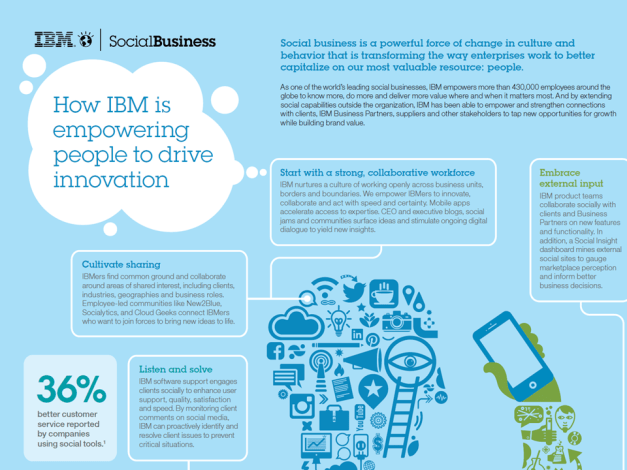
Social business is a powerful force of change in culture and behavior that is transforming the way enterprises work to better capitalize on our most valuable resource: people.
Fast track. That’s what it’s going to take to get your practice both into compliance and in shape to take advantage of ICD-10’s reimbursement benefits.
KPMG’s target is that by the summer of 2014, both providers and payers need to be testing for the go-live in October, according to Wayne Cafran, KPMG’s advisory principal for healthcare and life sciences.
But as of now, the consultancy found in research published on Jan. 8, many healthcare entities are lagging behind that timeline in terms of budgeting, testing, training and bracing for the permanent productivity losses that ICD-10 is expected to bring.
All that despite the finding that 73 percent of respondents fully anticipate moderate to severe revenue cycle impacts, coming largely in denials management and claims preparations and edits.
Where it gets worse is the general consensus that large health organizations tend to be further along than medium and smaller medical groups, an assertion several consultants and recognized experts have made to Medical Practice Insider through the last few months.
“The larger systems have indeed started earlier,” Cafran explained. “The mandate, of course applies to all payers and providers equally.”
Medical practices can catch up if they do these three things right:
1. Clinical documentation implementation programs, or CDI, is an area of increasing importance. By starting to focus on CDI requirements today, in fact, healthcare organizations can do more than merely comply with ICD-10; instead they can even optimize reimbursement. But KPMG found that the top CDI challenges are educating staff and understanding documentation complexities and nuances, neither of which can feasibly be ironed out overnight. And while 34 percent of those surveyed indicated they have implemented enhanced CDI strategies for ICD-10, 48 percent remain unsure if they have or will.
2. Recruitment, training and retention of coders. These professionals must quickly get up to speed on the new codes. “From a provider perspective, it’s not just the coders who have to be properly trained but physicians as well to prevent disruptions when ICD-10 is implemented.” Cafran said. And when it comes to those permanent productivity losses, 45 percent have not even calculated that impact, and among the ones who have, 22 percent expect a dip of 11-20 percent.
3. Ensure IT systems are ready to interface for data quality. Easier said that done. More than systems remediation for the 7-digit codes, this will tie back into internal and external testing of which 42 percent of respondents are currently doing so, 24 percent are not but plan to, while the remaining 34 percent are unsure when or if that will happen. When it comes to end-to-end testing, only 33 percent are conducting that today, 28 percent plan to, 36 percent are unsure. And 3 percent indicated that they do not plan to engage in end-to-end testing at all.
Cafran added that if medical practices can manage to correctly perform those 3 pieces of the ICD-10 transition they will be approximately 80 percent of the way there.
“If you have not started your implementation plan, is it impossible to get ready at this time?” Cafran asked rhetorically. “It’s not impossible but you need a quality assessment and a flawless execution of your implementation strategy — and that needs to happen now.”
Related articles:
Was 2013 the year ICD-10 stood still?

WASHINGTON | January 6, 2014
With Congress working on a long-term Medicare “SGR fix” in the recent short-term budget deal, lawmakers laid down seeds for addressing issues such as value-based reimbursement and EHR interoperability.
The House and Senate bills also revisit the HITECH Act. Senators John Thune and Mike Enzi, Republicans from South Dakota and Wyoming, added an amendment requiring “interoperability to be achieved by 2017 to be meaningful user under the Electronic Health Record Meaningful Use program,” with rules established via federal committee under the direction of the HHS Office of the National Coordinator.
Senator John Cornyn, a Republican from Texas, added a more specific and different amendment, directing HHS to adopt a common interoperability standard by 2017, as part of the rules for Meaningful Use Stage 3.
See also: [Stage set for big interoperability push.]
Members of the House Energy and Commerce Committee added similar provisions to their version of the SGR bill and also issued a report outlining their visions for health information technology, pointing out the connections between interoperability and quality and cost improvements.

Senator Mike Enzi“While technology has begun to change the way doctors provide care and patients engage in their health, we must recognize that these technologies will be unable to truly transform our health system unless they can easily locate and exchange health information,” the members wrote. “For this effort to be successful, however, more must be done to bolster interoperability. The Administration, acting through the Office of the National Coordinator for Health IT, must provide appropriate guidance to providers and to industry on its vision for interoperability and work to engage all stakeholders in adoption of those systems.”
The committee suggested that HHS adopt interoperability standards that “allow every healthcare provider to access and use longitudinal data on the patients they treat to make evidence-based decisions, coordinate care, and improve health outcomes as quickly as possible.”
With many payment reforms riding on information exchange, interoperability by 2018 “is reasonable,” they said, and “should be the highest priority for ONC in order to enable healthcare providers to measure, report, track, and perform on the quality measures and payment updates required by this legislation.”
[See also: Chasing the tail of interoperability.]
The timelines proposed for meaningful use fit within similar requirements Congress set for VA and DoD military health interoperability in the Defense Authorization Act, which even withholds some project funds until the agencies offer a plan for intergrated or interoperable systems.
The House and Senate attached riders to the budget, offering a three-month delay of the dreaded Medicare sustainable growth rate payment adjustment widely expected to be signed by President Obama.
The measure is billed as a bridge to more permanent solutions, if Congress and the President can find a compromise on certain matters this spring. With a 0.5 percent payment update instead of a 24 percent cut scheduled under the SGR, it give physicians a reprieve and time to build support for new ideas.
Among the amendments tacked onto the Senate bill are provisions for new integrated mental and behavioral health demonstrations, an increase in medical residency slots, and a mechanism for HHS to set aside funds for a stop-loss program to support hospitals seeing declines from the disproportionate share hospital program.
 healthcarereimagined