Since its creation in 1865, the United States Secret Service has been tasked with safeguarding the integrity of the nation’s economy. Initial efforts focused on putting an end to rampant counterfeiting taking place in the years following the American Civil War, a time in which as much as 30% of circulating currency was thought to be illicit. As individuals and organized networks evolved and sought new ways to defraud the public, special agents and criminal investigators with the Secret Service have responded, applying their experience and expertise to preventing other financially motivated crimes such as illicit credit card schemes, fraudulent wire transfers, computer fraud and abuse, and, most recently, the illicit use of digital assets, including cryptocurrencies to facilitate crimes like ransomware attacks.
What are digital assets?
The term digital assets refers broadly to representations of value in digital form, regardless of legal tender status. For example, digital assets include cryptocurrencies, stablecoins and nationally backed central bank digital currencies. Regardless of the label used, or the various definitions ascribed to them, digital assets can be used as a form of money or be a security, a commodity or a derivative of either. Digital assets may be exchanged across digital asset trading platforms, including centralized and decentralized finance platforms, or through peer-to-peer technologies.
Why does the Secret Service investigate the use of digital assets?
The Secret Service is responsible for detecting, investigating, and arresting any person who violates certain laws related to financial systems. In recent years digital assets have increasingly been used to facilitate a growing range of crimes, including various fraud schemes and the use of ransomware.
While the United States has been a leader in setting standards for regulating and supervising the use of digital assets for anti-money laundering and countering the financing of terrorism purposes, poor or nonexistent implementation of those standards in some jurisdictions abroad is presenting significant illicit financing risks that harm the American people and our foreign partners. For example, transnational organized criminals often launder and cash out their illicit proceeds using digital asset service providers in jurisdictions that have not yet effectively implemented international standards.
The ongoing growth in decentralized financial ecosystems, peer-to-peer payment activity and obscured blockchain ledgers presents additional risks to the American people and our foreign partners. When digital assets are abused and used in illicit ways it is in the national interest to take actions to mitigate these risks through law enforcement action and other government authorities. The U.S. Secret Service is committed to doing its part to safeguard the nation from illicit activity involving digital assets.
Useful Definitions
Address
Used to receive and transfer digital assets between users. Addresses are managed and stored within wallets. Addresses range in character length and type, but usually consist of long alphanumeric strings.
Altcoin
Typically any cryptocurrency that is not Bitcoin. An altcoin can be a divergent of the Bitcoin consensus model or a cryptocurrency that is linked to other types of blockchains or proofs of work. For example, Ether is one of the most well- known altcoins and is associated with the Ethereum network.
Central bank digital currencies
A form of digital money, denominated in the national unit of account, which is a direct liability of the central bank.
Stablecoins
A category of digital currencies with mechanisms aimed at maintaining a stable value.
Cryptocurrency
Refers to a digital asset, which may be a medium of exchange, for which ownership records are generated and supported through a decentralized distributed ledger technology that relies on cryptography, such as a blockchain.
Wallet
Software programs that interface with blockchains and generate and/or store public and private keys used to send and receive cryptocurrency. A public key or an address is akin to an email address, and a private key is akin to a password.
Bitcoin
A type of cryptocurrency. Payments or transfers of value made with bitcoin are recorded in the Bitcoin blockchain and thus are not maintained by any single administrator or entity.
Digital asset service provider
A custodian that allows users to buy, sell, store and trade digital assets. Forms of digital asset service providers include exchanges, digital asset ATMs and over-the-counter brokers. There are many such providers operating in the United States.
Blockchain
A decentralized distributed ledger technology where data are shared across network participants and the data are typically linked using cryptography to maintain the integrity of the ledger and execute other functions, including transfer of ownership or value.
Virtual currency
A medium of exchange that can operate like currency but does not have all the traditional attributes of “real” currency, including legal tender status.
Atos’ BullSequana XH3000 to enable exascale-class supercomputers in Q4 2022
Atos has introduced its new BullSequana XH3000 hybrid computing platform that enables exascale-class supercomputers. The new high-performance computing platform is agnostic to the hardware architectures it uses, so it is compatible with CPUs from AMD, Intel, Nvidia, and SiPearl, as well as compute GPUs from AMD, Intel, and Nvidia. In addition, the platform uses liquid cooling and can handle nodes with up to 1000W power consumption. The first systems are due in Q4.
Atos’ BullSequana XH3000 hybrid computing platform will offer maximum flexibility for systems with performance from 1 FP64 PetaFLOPS to 1 FP64 ExaFLOPS (and to 10 FP8/FP16 ExaFlops for AI applications) leveraging hardware due to be released during the next six years. In addition to traditional x86 CPUs from AMD and Intel, it also supports upcoming Arm-based Grace processors from Nvidia and Rhea high-performance system-on-chips from SiPearl. Furthermore, as suggested by its hybrid nature, the platform can support next-generation compute GPUs (or accelerators), including AMD’s CDNA 2/3-based designs, Intel’s Ponte Vecchio, and Nvidia’s next-gen GPU solutions.
The future CPUs and GPUs for datacenters and high-performance computing (HPC) promise to be extremely power-hungry, which is why the BullSequana XH3000 is designed for liquid cooling by default. The XH3000 will use Atos’ Direct Liquid Cooling (DLC) solution that promises to provide ‘over 50% more cooling power than previous generations’ and enable nodes that consume up to 1000W. While 1kW of power per node may sound extreme, it looks like this will be a fairly standard energy-efficient HPC node configuration in the future. For example, rumor has it that AMD’s Instinct MI250X consumes up to 550W, whereas the industry-standard OAM form-factor for such units is designed to supply up to 700W of power.
At present, we do not know a lot of specifics about the upcoming HPC solutions from AMD, Intel, Nvidia, and SiPearl, but the very fact that Atos claims compatibility with them indicates that their general characteristics (e.g., power consumption) are known to the server maker. In fact, Nvidia states that it has worked with Atos to build the platform.
“By combining the well-known expertise Atos has with Nvidia AI and HPC technologies and work at our joint lab, this platform will allow researchers to get significant insights much faster to grand challenges both in supercomputing and industrial HPC,” said John Josephakis, global vice president of sales and business development for HPC/supercomputing at Nvidia.
Given the availability timeframe of the first BullSequana XH3000 machines, it is likely that they will be among the first ones to support Nvidia’s upcoming next-gen compute GPUs due later this year.
As for interconnections, the BullSequana XH3000 supercomputer architecture will support a wide range of networking technologies, including BXI, High Speed Ethernet as well as HDR & NDR InfiniBand.
All three U.S. supercomputers announced to date rely on HPE’s Cray EX architecture that can use almost any CPU and various compute accelerators. These days Cray EX systems use AMD’s or EPYC or Intel’s Xeon Scalable CPUs along with compute GPUs from AMD, Nvidia, or Intel (when Ponte Vecchio is available). By adding support for Nvidia’s Grace and SiPearl’s Rhea, Atos offers a more flexible platform (yet we do not know what can stop HPE from adopting its architecture for Grace or Rhea SoCs).
“We are extremely proud of our role as a leader in HPC and of our new BullSequana supercomputer, revealed today, which results from 15 years of R&D efforts and brings together Atos’ proven expertise and experience in high-performance computing, AI, quantum, security and digital decarbonization,” said Rodolphe Belmer, CEO of Atos. “It will no doubt enable, through the gateway of exascale, some of the key scientific and industrial innovation breakthroughs of the future.”
The Kansas City-based health system has opened an inpatient virtual nursing unit that is managed almost entirely by nurses, and is fielding calls from health systems across the country interested in the concept.
KEY TAKEAWAYS
Saint Luke’s Health System has opened a unit in one of its hospitals that is managed virtually by nurses operating from a high-tech command center in downtown Kansas City.
The wing, built on a telemedicine platform designed by Teladoc Health, allows nurses to remotely monitor patients and handle a lot of the administrative work that typically leads to stress and burnout.
The virtual nursing unit has helped the hospital increase both patient and nurse satisfaction rates while improving discharge time and reducing ED waits for a hospital bed.
A Kansas City–based health system is putting nurses at the center of the virtual care platform and seeing positive results not only in patient and nurse satisfaction, but clinical and business outcomes as well.
Saint Luke’s Health System opened its virtual nursing unit in 2018. Launched by Susie Krug, chief nursing officer at Saint Luke’s East Hospital in Lee’s Summit, Missouri, the unit sits on a telemedicine platform built by Teladoc Health and managed by nurses at the health system’s technology center in downtown Kansas City.
“It’s a new model of care,” says Jennifer Ball, the health system’s director of virtual care. “It’s there to [help] the nurses as well as the patients, with a focus on virtual care. Virtual everything is going to be our future.”
It was designed, Ball says, with the idea that nurses are often the focal point of care in the inpatient wings, handling different tasks in between and around rounds and visits made by doctors and specialists. Nurses have the most contact with patients and their families, handle the administrative and educational tasks, manage bedside devices and data-gathering, even lend a hand with everything from the meals to the TV, she says.
That kind of work is why nurses have been rated the most trusted profession for 20 straight years by Gallup, but it’s also why so many are dealing with stress, anxiety and burnout—and why health systems are having a difficult time filling those positions. Add in the challenges of protecting both patients and care providers during a pandemic, and the job becomes tougher.
Due in part to the shift to virtual care caused by COVID-19, many health systems are rethinking how that strategy can be scaled and sustained beyond the pandemic—not only outside the hospital but inside as well.
Saint Luke’s virtual nursing unit operates on the idea that many of the tasks performed by nurses in the inpatient setting not only are repetitive but inefficient, and that a telemedicine platform that connects every room in the unit can allow nurses to manage those tasks from one place. Nurses and staff on the unit would then be freed up to focus on patient-facing care, while those in the command center would monitor the patients and enter data in the medical record.
“They chart in the same system,” Ball points out, “so everything is right in” the EMR.
Early results show positive outcomes for the virtual unit. Patient satisfaction is high, and patients are discharged within two hours of the discharge order, some 20% faster than in other units, and they’re also out of the hospital before noon at a 44% faster rate. This, in turn, reduces the wait time for patients in the ED and reduces the time to treatment.
Turning those metrics around, health system officials say the unit has boosted nurse morale as well, improving workforce engagement, reducing fatigue (physical and intellectual) and even improving Saint Luke’s recruitment capabilities.
Ball says the health system learned quickly that a virtual nursing unit is different from any other virtual care program. Workflows must be designed specifically with nursing in mind, and often go through a few iterations before working out.
“We’ve changed what the virtual nurse does several times,” she says. “It was challenging at first because this is a new model, and we had to learn what works and what doesn’t work. And while this is [modeled] as an observation unit, it has been anything but that over the past year. “
Ball says Saint Luke’s had the advantage of launching the program in a new, specially designed unit, rather than integrating it into an existing wing. She expects to integrate virtual nursing to other wings in the future, and to deal with new challenges as they expand the footprint.
“There will be some culture change involved,” she says.
For that reason, Saint Luke’s launched its own virtual nurses training program about a year ago, with the idea that nurses should be trained specifically in virtual care rather than brought over from another area of the hospital and introduced to it. With virtual care the emphasis is more on technology, as well as on communication. After all, sitting in a command center surrounded by six large monitors isn’t quite what nurses are taught to expect in school.
“For some of the nurses, it’s a lot, but for others not so much,” Ball says.
And that’s why education and team-building are so important to the program. Unlike many doctors, nurses work in a team setting, with the understanding that care coordination and management are group-based rather than individual goals.
“You need buy-in from nurses at the beginning,” Ball says. “You can’t start too early with education … and team building. In some cases, you have to sell what a virtual nurse can do,” but once they see what is possible, they’re invested in the program.
That goes for the patients as well. Many might wonder whether a virtual nursing unit isolates patients too much, depriving them of the in-person care that helps them adjust to being in a hospital and puts them on the path to recovery. But Ball says patients have come to appreciate the idea that they’re always being looked after, and they develop connections to their virtual nurses. They identify more closely with those nurses than with the nurse who shows up when someone pushes the help button.
Just as Saint Luke’s checked in on Ochsner Health’s virtual nursing model as it was developing its program, Ball says she’s fielding requests from other health systems who want to adopt that strategy. And she has an eye to the future as well, including integrating the virtual nursing model into existing wings and hospitals in the system.
“There’s always new technology as well,” she says, eyeing the fast-developing telemedicine landscape and the emergence of digital health tools, including wearables. “This [model] is going to be used in new ways in the future,” such as mentoring and precepting, and integrated with other services such as the pharmacy, social workers, dietitians, and chronic care management.
Eric Wicklund is the Technology Editor for HealthLeaders.
February 13, 2022 13:00, Last Updated: February 16, 2022 14:39
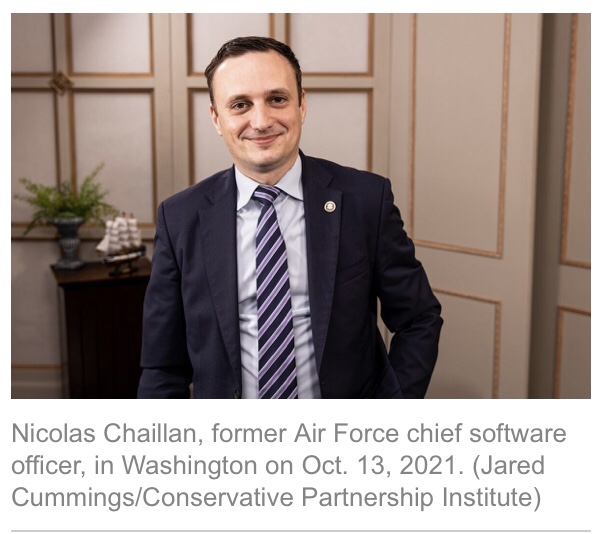
By Andrew Thornebrooke
Bureaucracy and waste are hamstringing U.S. militarydevelopment and adversely affecting the nation’s military readiness, according to the former chief software officer of the Air Force. That means the United States is less prepared for a potential conflict with China.
“Any bureaucracy which slows down outcomes for the sake of bureaucracy is going to ensure we get behind China,” Nicolas Chaillan, who resigned in September, said in a recent interview.
“China doesn’t let complacency or bureaucracy get in the way of [its military],” he told The Epoch Times.
He made the comments amid increasing tensions between the United States and the Chinese Communist Party (CCP) concerning the de facto independence of Taiwan, mass intellectual property theft, and human rights abuses in Xinjiang and elsewhere.
As that competition becomes more adversarial, the CCP has focused on technological development in sectors that its leadership considers vital, such as artificial intelligence (AI) and machine learning (AI/ML).
According to Chaillan, it’s these sectors, and IT more broadly, that U.S. military bureaucracy is negatively affecting the most.
A ‘Toxic’ Budgeting System
There are long-running concerns that the Pentagon is encumbered with red tape, redundant oversight measures, and safety protocols that slow military development to a snail’s pace. Indeed, the bureaucracy has become something close to synonymous with the Department of Defense (DoD), according to its leadership.
Gen. John Hyten, vice chair of the Joint Chiefs of Staff at the time, said in October 2021 that the Department’s bureaucracy was “brutal,” and that a risk-averse culture among military leadership was stifling technological development and allowing the CCP to seize the advantage in critical sectors such as hypersonic weapons development.
“The pace [China is] moving and the trajectory that they’re on will surpass Russia and the United States if we don’t do something to change it,” Hyten said. “It will happen.
“We can go fast if we want to. But the bureaucracy we’ve put in place is just brutal.”
When asked if he agreed with that assessment, Chaillan’s response was matter-of-fact.
“Yes, without a doubt,” he said. “Everything from the budget process with Congress … to the acquisition process that is cumbersome and prevents agile acquisition due to reporting requirements and [the fact that] budgets are allocated so far ahead that we are stuck in time.”
He added that the sheer amount of compartmentalization within the DoD makes it difficult to build consensus among leadership and to get anything done.
Chaillan also said that such difficulties were particularly burdensome in terms of developing cutting-edge technologies, as it was difficult within the DoD to upgrade to yesterday’s technologies, much less tomorrow’s.
He noted that the budgeting process as a whole ultimately is the responsibility of Congress to fix. The process’s knock-on effects throughout the DoD were dangerous nonetheless, he said. Key among them, he said, was the need to allot finances for specific projects many years in advance.
Currently, Pentagon leaders develop a five-year program that will serve as an outline for the scope and funding of their endeavors. This program is then used to inform the branch’s budget request of Congress. Congress then allocates funds for future use, as it dissects the Pentagon’s alleged needs.
The problem, of course, is that military responses to emerging threats and IT development can’t be pre-allocated, meaning that many programs come into existence and end up being unnecessary, while other needed technologies go unfunded.
“[The budget process] isn’t the Pentagon’s fault, but it has toxic ripple effects across the building as the Pentagon is now working the 2024 to 2029 budget,” Chaillan said.
“How could this even work out? No one knows what IT will look like in 2025, let alone 2029.”
As such, he said, current acquisition processes hinder the integration of expert industry experience into the military, effectively preventing the military from expanding its talent pool. This is because the Pentagon cannot effectively train and continuously fund IT workers whose expertise needs to be continuously changing with the technology, as the budget process forces them into long-term, semi-static programs agreed to at times years in advance.
Such statements echo similar remarksmade by Michael Sekora last month. Sekora, who spearheaded Project Socrates, a Reagan-era Defense Intelligence Agency program designed to increase U.S. competitive advantage, lambasted what he referred to as a “finance-planning” model of defense.
In such a system, Sekora said, the government merely allocates funds year by year, in the hope that the funds will somehow be transformed into the technologies that are needed when they are needed.
The CCP, meanwhile, was pursuing a technology-based strategy whereby specific technologies were created and deployed in a whole-of-society effort to address real problems in real time.
“China understands that exploiting technology more effectively than the competition is the foundation of all competitive advantage,” Sekora said.
“Anything else is a guaranteed exercise in futility.”
Talent Retention ‘Worse Than I’ve Ever Seen’
To that end, Chaillan noted that a vital aspect of working in technology-oriented fields is the need to be forever learning, improving, and iterating. Unfortunately, he said, making continuous learning a part of the job is not something that the military bureaucracy allows much of.
“We don’t invest enough in our talent,” Chaillan said. “We must understand that with the pace of IT, the only answer is continuous learning.”
Chaillan said that when he was chief software officer for the Air Force, he would give his team an hour every day to dedicate to learning new concepts. That model isn’t in vogue with the Pentagon, however, which typically approaches IT-related fields from a managerial perspective.
“Usually, learning is seen as a yearly thing or worse,” Chaillan said. “Additionally, the DoD believes in this concept of ‘knowing everything’ where no one is supposed really to become an expert at something, they just learn to manage and they supposedly can manage anything from a [fighter] wing to a maintenance crew to an IT team.”
This managerial approach was negatively affecting IT in the military, which requires a more active and entrepreneurial approach, Chaillan said. Moreover, it encourages the placement of military officers to leadership roles based purely on rank rather than in-field qualifications.
“We are setting up critical infrastructure to fail,” Chaillan wrote in a separate open letter in September that explored his reasons for resigning from the Pentagon.
“We would not put a pilot in the cockpit without extensive flight training; why would we expect someone with no IT experience to be close to successful?”
That problem was compounded, Chaillan said, by a lack of opportunities for IT professionals in the military to actually apply themselves at the jobs they were trained to do.
“Obviously, that doesn’t work with IT,” Chaillan said.
That means that many IT professionals in the military are prevented by bureaucratic processes from further developing professionally, eventually becoming “stale” at their skill set. It’s a problem that Chaillan himself cited as a reason for his own departure from the Pentagon.
Perhaps because of this, many of the companies at the forefront of new technological development simply won’t work with the DoD, Chaillan said.
“Unfortunately, many companies still refuse to work with DoD, which isn’t helping us get access to best-of-breed talent,” Chaillan said. “We also have a very tough time retaining talent right now, particularly in IT. It’s worse than I’ve ever seen.”
Chaillan lamented the fact that chief information officers in the DoD weren’t being fully utilized, and were effectively being treated as lottery tickets whose projects may or may not be picked for funding rather than as drivers of innovation.
“DoD Chief Information Officers are just seen as policy shops instead of actual doers,” Chaillan said. “That would never happen on the commercial side. That must be changed.”
Indeed, in his open letter, Chaillan wrote that the very same happened to him, much to the detriment of U.S. defense needs and equally to the advantage of the CCP. He was underutilized, he said, and spent the majority of his professional time trying to convince others to consider more efficient solutions to well-known problems.
“The DoD should stop pretending they want industry folks to come and help if they are not going to let them do the work,” he wrote. “While we wasted time in bureaucracy, our adversaries moved further ahead.”
‘Four Cents of Real Value on a Dollar’
That mismanagement and the adverse effects it has on military readiness are only the tip of the iceberg, however. By Chaillan’s estimation, the Pentagon is only utilizing 4 percent of its funds on actual solutions.
“Overall, I believe we get four cents of value out of one dollar of taxpayer money spent,” Chaillan said.
“First, probably 60 cents are wasted due to cumbersome acquisition processes and requirements which were made to prevent fraud or conflicts of interest or bad behavior, but really ended up creating a massive bureaucracy which created more waste than it is preventing.
“Second, because we are stuck in time and get requirements that are five to 10 years too old, we effectively buy many things that are obsolete or aren’t a good fit to the current mission and should have been voided but we don’t because we spent years trying to get the contract done.
“That’s probably another 30 cents. Another six cents is wasted by making mistakes, which are fair and common.
“That’s four cents of real value on a dollar. With $750 billion funding, that means $30 billion is actually real tangible value.”
Chaillan was careful to point out that the figure is only his opinion but said that most of his professional acquaintances would agree that the DoD loses at least 60 percent of its funds to such wastage.
Regardless, bureaucratic waste remains widespread, and outdated or otherwise unneeded technologies remain a persistent problem. The fact is that parts of the military, for its trillions of dollars received over the years, simply don’t have adequately functioning technology.
That problem was highlighted in anopen letter to the DoD penned in January by Michael Kanaan, director of operations for the Air Force-MIT Artificial Intelligence Accelerator, a joint AI research endeavor, in which he flogged military leadership about the fact that its IT professionals were working with computers that were decades old.
“Want innovation? You lost literally HUNDREDS OF THOUSANDS of employee hours last year because computers don’t work,” Kanaan, who was Air Force’s first chairman for AI, wrote. “Fix our computers.”
“It’s not a money problem, it’s a priority problem.”
US Approaching ‘The Point of No Return’
Such problems and the waste that causes them are not new, however, nor are they a secret. Indeed, in many instances, such waste is baked into the U.S. defense-industrial complex by excessive congressional oversight.
In 2015, then-Navy Secretary Ray Mabus said that 20 percent of the defense budget was “pure overhead.” Former Secretary of Defense Robert Gates, meanwhile, set that number at closer to 40 percent.
Likewise, another former Navy secretary, John Lehman, said that “roughly half of all uniformed personnel serve on staffs that spend most of their time going to meetings and responding to tasks from the hundreds of offices that have grown like mold throughout the vast Defense Department.”
In 2015, a DoD report was compiled to examine the problem, and found that $125 billion, roughly a quarter of its annual budget at the time, was lost on administrative waste over the course of five years.
The Pentagon ultimately buried the report, classifying its data out of a fear that Congress would cut its budget.
Likewise, accounting firm Ernst and Young found in 2018 that the Defense Logistics Agency, the Pentagon’s main procurement wing, failed to properly document more than $800 million in construction projects.
Perhaps unsurprisingly, the Pentagon also failed all three of its audits, each conducted since 2018, when it was subjected to its first independent and department-wide audit.
In 2020, then-DoD Comptroller Thomas Harker said that the department likely wouldn’t pass an audit until at least 2027.
In sum, the Pentagon is failing to invest in relevant new technologies because its bureaucracy is slowing the investments it does make. Meanwhile, its funding structure and excessive administrative oversight are hemorrhaging most of the funds it receives before the money gets to projects that might be outdated or unnecessary by the time the budget is approved.
According to Chaillan, the United States must compete with China’s superior population by becoming more efficient, more innovative, and more agile. Under the current bureaucratic structure, however, the likelihood of that happening is fast becoming an impossibility, he says.
Even as the CCP invests in AI/ML, autonomous systems, space warfare, and quantum computing, the U.S. military is struggling with a lack of basic, functioning IT equipment. Moreover, Chaillan said, it’s failing to deliver on the tangible products required to win a war.
“The biggest threats to readiness today [are] our lack of access to basic IT capabilities like Edge computing, Edge cloud, proper connectivity, modern devices, and ensuring we can connect all the military domains to get a full picture of our current situation,” Chaillan said.
“More importantly, the lack of investment in AI/ML tangible military outcomes instead of focusing on AI/ML ethics will be what leads us to getting behind to the point of no return if that doesn’t change by December 2022.”
Andrew Thornebrooke is a reporter for The Epoch Times covering China-related issues with a focus on defense, military affairs, and national security. He holds a master’s in military history from Norwich University
In Episode 46 of the Irregular Warfare Podcast, we discuss a fundamental change that has occurred in the nature of war—and what this means for the United States and its allies.
Our guests explain why this change renders the American way of war obsolete and turns assumptions about US military dominance on their heads. They discuss how China, our most capable potential adversary, has used technology to enhance the primacy of its kill chain, while the United States pursues a method of war that is platform-centric and dangerously outdated. They predict that within a few years, if the United States does not adopt a radically different approach to warfighting it will find itself completely outmatched by China militarily—with devastating consequences for America’s place in the world and for the global norms which we now take for granted.
General David Berger is the thirty-eighth commandant of the Marine Corps. An infantry officer by background, he has served in a wide variety of command and staff billets over the course of his forty-one-year career. In his Commandant’s Planning Guidance, he has set the Marine Corps on a course to divest legacy platforms such as tanks and artillery while pursuing capabilities such as long-range sensing and precision fires that will—he believes—better prepare it for future conflict.
Christian Brose is a senior fellow at the Carnegie Endowment for International Peace and the author of The Kill Chain: Defending America in the Future of High-Tech Warfare. From 2014 to 2018, he was the staff director of the Senate Armed Services Committee. He led a team of professional staff who supported Chairman John McCain and other majority committee members in overseeing the national defense budget, programs, and policies across the Department of Defense.
Together they discuss what needs to be done to enable the United States to maintain parity with China. That is, argues Brose, the best outcome that we can hope for at this stage in the game. General Berger, on the other hand, is more optimistic. He believes that the joint force—and the Marine Corps in particular—recognizes the threat and will move fast enough to find solutions and maintain US military dominance. Both agree, however, that this will not be easy, and they conclude with some valuable advice for both policymakers and practitioners alike.
The hosts for this episode are Andy Milburn and Shawna Sinnott. Please contact them with any questions about this episode or the Irregular Warfare Podcast.
The Wellness Center at St. Paul’s is open 9 a.m.-5 p.m., every Wednesday. The free clinic, staffed with licensed health care professionals from Widener University, provides services for men, women and children, with or without insurance. To make an appointment, call 610-872-2011. #wellnesscenter #healthclinic #wellbeing #WidenerUniversity #chestereastside
The solution embraces zero trust principles, officials said
After exploring multiple commercial prototypes, the Defense Innovation Unit is rolling out Google Cloud’s Secure Cloud Management solution, or SCM, across its entire organization.
Other Defense Department agencies can procure the offering through Other Transaction Authority agreements, according to a press release published by Google on Tuesday.
“In today’s new cybersecurity paradigm, it’s critical that government agencies see the benefits of adopting a zero trust security strategy and have the option of selecting more modern, cloud-native solutions that meet their unique needs,” Google Cloud Vice President, North America Public Sector, Lynn Martin wrote in the announcement.
Google Cloud developed SCM in collaboration with Palo Alto Networks.
The solution is considered a container-based offering that enables secure access to and management of hybrid cloud and multi-cloud applications, as well as ongoing monitoring.
This contract award follows a project in which DIU deployed three different year-long prototypes—each made individually by either Google, Zscaler, or McAfee Public Sector—to supply software-as-a-service options seamlessly over the internet.
SCM “embraces” zero trust principles and aligns with policies from President Joe Biden’s administration on implementing that modern approach, officials wrote in the release.
A third-party assessment organization evaluated this tool, they added, based on recommendations from the Defense Information Systems Agency.
To work with the Pentagon, cloud service providers have to show that they can meet specific security requirements, depending on the sensitivity of the data they will host. Lower “impact levels” handle data cleared for public release, and impact level six, or IL6, encompasses classified national security information.
“Google Cloud is FedRAMP High certified, has an IL2 PA globally, recently received an IL4 PA and is working with DISA for IL5 and IL6,” a Google spokesperson told Nextgov in an email on Wednesday. “Expanding our list of compliance certifications is a critical part of our mission and we are actively working towards higher approval levels.”
Google is one of several major technology companies preparing a bid for the Defense Department’s multibillion-dollar Joint Warfighting Cloud Capability, or JWCC contract.
WASHINGTON — The Pentagon’s new software modernization strategy calls for establishing an enterprise-level software factory ecosystem to make the tools and applications used by its development hubs a more regular part of doing business.
The document, released late last week, says the 29 software factories that exist today across the military services have made significant progress, but the Department of Defense needs to better take advantage of that innovation. Danielle Metz, deputy chief information officer for the information enterprise, told reporters on Monday the goal is to harness the success of those factories and “inculcate that into the DNA of the department.”
Today’s software factories serve as centralized teams that provide software development services to various program offices. Well-known hubs include the Air Force’s Kessel Run, the Navy’s Overmatch Software Armory and the Army’s Coding Resources and Transformation Ecosystem.
Metz and Pentagon Chief Software Officer Jason Weiss told reporters the department doesn’t necessarily want to make changes to how the factories operate, but instead wants to hear from those organizations about what policy changes and standardization might be most helpful.
Weiss said the department expects to gain efficiencies and cost savings by being more strategic about how the factories operate and ensuring any redundancies aren’t inhibiting economies of scale.
“If we can achieve that, then that allows the software factory ecosystem to continue to grow, but to operate with higher degrees of scale and precision without having to start from scratch at every point,” he said.
Beyond establishing an enterprise-wide development ecosystem, the strategy identifies two other goals: accelerating the DoD enterprise cloud environment and transforming processes to enable resilience and speed.
As part of the cloud acceleration focus, the strategy calls for an “innovative portfolio of cloud contracts” to offer better access to cloud services. It also emphasizes the need to secure data in the cloud and improve infrastructure outside the continental United States to ensure those installations can take advantage of cloud capabilities.
To improve its software development and acquisition processes, the department must reevaluate its policies and guidance to make sure they’re not overly restrictive and continue to support flexibility in the way it acquires and funds software, the strategy says.
A memo accompanying the strategy, signed by Deputy Secretary of Defense Kathleen Hicks, says the department will develop an implementation plan over the next six months. A newly formed Software Modernization Senior Steering Group will coordinate and prioritize efforts under the strategy and will develop a yearly action plan. The group will also create a software capability portfolio to inform budget decisions and make sure efforts are integrated across DoD.
Courtney Albon is C4ISRNET’s space and emerging technology reporter. She previously covered the U.S. Air Force and U.S. Space Force for Inside Defense.
The Defense Department released a broad plan to expand and ensure its technological edge on the shifting global conflict stage—equipped with a list of more than a dozen technologies it is prioritizing in the near term—via a six-page memorandum published on Thursday.
Penned by Defense Undersecretary for Research and Engineering and DOD Chief Technology Officer Heidi Shyu, the USD(R&E) Technology Vision for an Era of Competitionpreviews the impending National Defense Science and Technology Strategy and its development. Shyu’s office will also steer the making of that future-facing blueprint.
President Joe Biden’s administration is placing a sharp focus on strategic competition, particularly with Russia and China, as it crafts the latest National Defense Strategy that’s expected to be released early this year.
The Defense Department released a broad plan to expand and ensure its technological edge on the shifting global conflict stage—equipped with a list of more than a dozen technologies it is prioritizing in the near term—via a six-page memorandum published on Thursday.
President Joe Biden’s administration is placing a sharp focus on strategic competition, particularly with Russia and China, as it crafts the latest National Defense Strategy that’s expected to be released early this year.
A DOD spokesperson told Nextgov on Thursday that the S&T strategy’s release will depend on that of the National Defense Strategy, as the latter is considered the “guiding document.”
In the new memo, Shyu wrote that the United States’ “strategic competitors” have greater access to ultramodern commercial technologies “than ever before,” which can be used to disrupt America.
“The challenges facing our country are both diverse and complex, ranging from sophisticated cyber-attacks to supply chain risks, and from defending against hypersonic missiles to responding to biological threats,” she wrote, later adding that it’s “imperative for the department to nurture early research and discover new scientific breakthroughs to prevent technological surprise.”
Three pillars that will “anchor” the Pentagon’s forthcoming technology strategy are detailed in this memo. They are listed as:
Mission Focus: Leverage the United States’ incredible technology innovation potential to solve the department’s tough operational, engineering and mission-focused challenges.
Foundation Building: Set the foundation to attract and build a strong, talented future technical workforce that works in modernized laboratories and test facilities.
Succeed through Teamwork: Maximize asymmetric advantages by partnering with the larger innovation ecosystem, from industry to universities and to laboratories, allies and partners.
The undersecretary further emphasized that this “era of strategic competition demands collective cooperation.” Among others, DOD will need to work with the defense industrial base, academia, startups, international partners and “even with our competitors,” she wrote, to confront the challenges of this century.
Also in the memo are 14 “critical technology areas,” that DOD considers “vital to maintaining” U.S. national security. They are spread across three categories. The list will be updated as capabilities and the defense strategies evolve, but for now, it includes:
Seed areas of emerging opportunity: biotechnology, quantum science, future generation wireless tech—or FutureG—and advanced materials;
Effective adoption areas: trusted artificial intelligence and autonomy, integrated network system-of-systems, microelectronics, space technology, renewable generation and storage, advanced computing and software, and human-machine interfaces;
Defense-specific areas: directed energy weapons and systems, hypersonics, and integrated sensing and cyber.
“Successful competition requires imagining our military capability as an ever-evolving collective, not a static inventory of weapons in development or sustainment,” Shyu wrote. “In many cases, effective competition benefits from sidestepping symmetric arms races and instead comes from the creative application of new concepts with emerging science and technology.”









 healthcarereimagined