healthcarereimagined

Envisioning healthcare for the 21st century

  • About
  • Economics

Prioritizing technology transformations to win – McKinsey

Posted by timmreardon on 03/25/2022
Posted in: Uncategorized. Leave a comment

March 24, 2022 | Survey

Our latest IT survey confirms the accelerating pace of at-scale core technology transformations. The road map for success reflects the practices and capabilities of leading companies.

DOWNLOADS

 Article (8 pages)

In a time of significant, ever-quicker shifts in the IT portfolio, a new survey suggests that a company’s foundational technology has never been more important. In our latest McKinsey Global Survey of technology and business leaders,1 the results point to a much greater focus on cybersecurity and on investments in cloud technologies—even as most companies have continued transforming their core architecture and infrastructure in tandem.

The survey also confirms that the competitive divide between winners and the rest has only grown during the pandemic. Compared with the IT organizations at other companies, those at the top—rated by respondents in the top quartile of effectiveness for 15 key technology activities and capabilities—have made much more progress in their cyber, digital, and cloud moves. For companies trying to catch up, or at least keep themselves from falling further behind, these top performers’ responses point to a few key practices: a more aggressive and holistic agenda for tech transformations, greater involvement by tech leaders in business strategy, and a more proactive approach to people development. As we’ve seen in previous surveys, the latter is a bigger challenge than technology during these transformations.

In response to new realities, cybersecurity has moved to the forefront

Our latest survey results confirm the acceleration of corporate investments in technology transformations and the overall high value of these transformations,2 especially at companies where creating IT strategies is a joint effort by technology and business leaders. At such companies, respondents are more likely to report that their transformations have had a positive impact in every one of the four value-creation measures we asked about: increased revenue through existing streams, increased revenue from new streams, decreased costs, and improved employee satisfaction.

Yet the transformation landscape shifted dramatically in the past year. A larger proportion of respondents than in the previous survey (41 percent, up from 30 percent) cite an increasing likelihood of cyberthreats as a major transformation challenge. Respondents also report a significant increase in cybersecurity transformations at their companies (62 percent, up from 45 percent previously), followed by infrastructure and architecture transformations. A sizable share of respondents say their companies are pursuing several of these key transformations at once, which helps ensure that their interdependencies are understood and addressed: 42 percent report both cyber and infrastructure transformations, 40 percent both infrastructure and architecture transformations.

What’s more, respondents are betting that the increasing number of cyber incidents—coinciding with growing reliance on digitization, a proliferation of endpoint devices, and increased vulnerabilities in hybrid and remote-work setups—is not a pandemic-era phenomenon but rather part of a new business reality. Cybersecurity is the transformation respondents are most likely to cite as the one their companies will pursue in the nexttwo years; the share more than doubled since the previous survey (Exhibit 1). Respondents say that cybersecurity talent is in high demand to meet this need—second only to advanced-analytics specialists as the role their technology organizations are most focused on hiring.
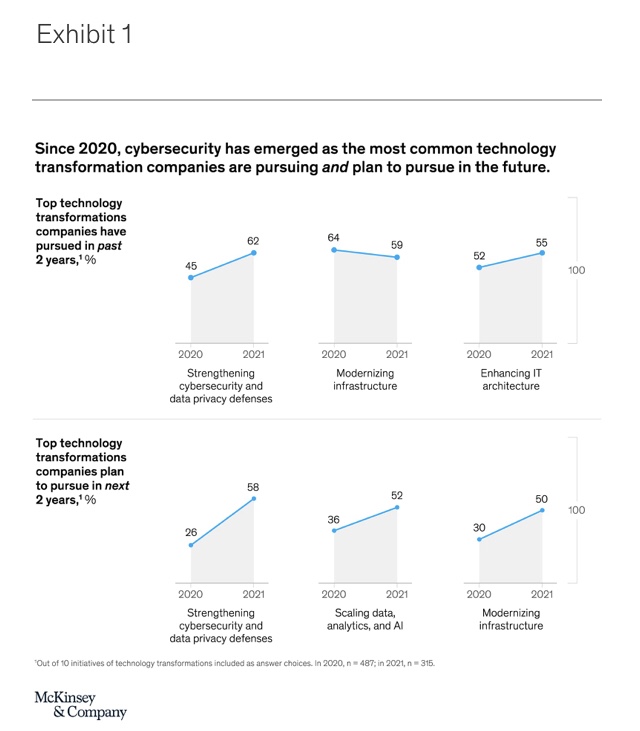
Since 2020, cybersecurity has emerged as the most common technology transformation companies are pursuing and plan to pursue in the future.

Would you like to learn more about McKinsey Digital?

Visit the page

A widening performance gap between top IT organizations and the rest

Our previous survey ran during the pandemic’s earliest days, when respondents at companies with top-performing IT organizations reported several ways they were making tech a key priority for their organizations. Such companies had tech leaders who were more involved in the business. They had adopted more advanced technologies. They were executing more technology transformations. Finally, they had created more value through those efforts. This year’s results suggest that on all these fronts, the top performers are further ahead of the others than before—and that their competitive edge is poised to grow even more unless other companies adopt many of the same practices.

For example, 73 percent of respondents at top-performing companies now say that their most senior tech leaders (the chief information officer or chief technology officer) are highly involved in shaping the company-wide strategy and agenda. Only 31 percent of other respondents say the same—a gap that’s more than twice as big as it was in 2020 (Exhibit 2).

At companies with top-performing IT organizations, technology leaders are much more likely to be involved in company-wide strategy.

The results suggest that companies in the top-performing group are also pulling away from the pack in their use of more advanced technologies, such as advanced analytics and edge computing, and in their overall level of transformation activities. In the newest survey, top performers are much more likely than other companies to have pursued five of the ten transformation moves we asked about (our “tech forward” approach) than they had been in the previous one—especially scaling up data and analytics and changing IT’s delivery model.

Furthermore, their transformation approach is more holistic: according to respondents, the gap between the average number of moves top performers and other companies made has grown since the previous survey. These top companies have also stepped up their game in enhancing their architectures, which they were less likely than others to report in the previous survey (Exhibit 3). Top performers remain ahead of their peers on cyber transformations, although those other companies are also much more likely to be pursuing such efforts than they were previously.

Top-quartile performers are pursuing transformations much more actively than their peers do—and than they themselves did a year earlier.

As we’ve seen in previous years, people—rather than technological—issues tend to be the biggest obstacles that keep companies from achieving their transformation goals. The COVID-19 crisis raised the stakes because the way people and teams work changed so fundamentally, and the results suggest that during this time, the top performers have taken a more proactive and effective approach to talent, culture, and people development. These respondents are much more likely to say that their companies redesigned their technology organizations to better support business strategy during the crisis and have effective core capabilities for managing IT talent (Exhibit 4).3

The top performers develop IT talent much more effectively than other companies do.

McKinsey Global Surveys

See the collection

The leaders of top-performing organizations also appear to be much more effective on these issues: 47 percent of respondents at these companies say that their senior technology leaders very effectively foster a culture that supports new and digital ways of working, such as “fail fast,” across the organization. Only 3 percent at all other companies say the same (Exhibit 5).

Individual tech leaders at top-quartile performers change the corporate culture and develop their people more effectively than other tech leaders do.

Companies are ramping up their cybersecurity defenses and their adoption of cloud technologies, which can create a more flexible infrastructure, speed up technology deployment, and get digital products to market more quickly.

The move to the cloud gains momentum

According to the survey, companies are also ramping up their adoption of cloud technologies, which can create a more flexible infrastructure, speed up technology deployment, and get digital products to market more quickly. Thirty-six percent of respondents say their companies have accelerated the migration to cloud technologies during the pandemic, and 86 percent of them expect this acceleration to persist postpandemic. At companies with higher levels of digital maturity, respondents are more likely than others to report cloud migrations. But fully half of the respondents say their companies are planning either large- or full-scale cloud transformations within the next two years. The top benefits from the use of cloud computing (Exhibit 6) include the optimization of technology costs (56 percent); risk reduction, such as improvements in business resilience and cybersecurity defenses (41 percent); and the digitization of core operations (39 percent).

Respondents report that their companies see a range of benefits from using the cloud.

These efforts aren’t without their challenges. Companies already pursuing a cloud migration most often face technical issues, conflicts with the business over timing, and an inability to realize the migration’s expected value (Exhibit 7). Again, these challenges are less acute if there is a close partnership with the business up front. At companies where technology strategy is created with the business, respondents are 34 percent less likely to report conflicts with it over timing and 60 percent less likely to report challenges in realizing the expected value. These results confirm the idea that being in lockstep with the business is essential to capture the cloud’s huge potential—which, our other research suggests, could involve up to $1 trillion in value globally.

The most common obstacles companies encounter when migrating to the cloud are technical challenges, timing conflicts, and difficulty realizing value.

Looking ahead, the need for corporate technology to be dynamic and responsive to the changing needs of business will only continue to grow. Companies that don’t already have a strong technology foundation are poised to fall even further behind. To reap the full benefits of technology, companies will have no choice but to pursue multiple transformation plays—for example, cloud, cyber, and talent—at the same time and to stay the course for each. The survey results suggest that even the more emergent aspects of the technology agenda (cybersecurity and the cloud) have real staying power and relevance, which only adds to the demands on technology leaders and their business partners.

Article link: https://www.mckinsey.com/business-functions/mckinsey-digital/our-insights/prioritizing-technology-transformations-to-win?

ABOUT THE AUTHOR(S)

The survey content and analysis were developed by the following members of the Chicago office: Anusha Dhasarathy, a partner; Ross Frazier,an associate partner; Naufal Khan, a senior partner; and Kristen Steagall,a consultant.

They wish to thank Eric Lamarre, Kate Smaje, and Audrey Wu for their contributions to this work.


This article was edited by Daniella Seiler, an executive editor in the New York office.
Making the Kessel Run – Air Force Magazine

Posted by timmreardon on 03/23/2022
Posted in: Uncategorized. Leave a comment

March 23, 2022

How a handful of Airmen brought DevOps to USAF, then used it to save more than 123,000 lives.

Kessel Run was founded on a hypothesis that by bringing commercial DevOps practices to the Air Force, warfighters could get better software, faster, for less money. Our experience over the last four years has borne that out. Our critical change was putting the developers, the security operations, and IT operations together in a single team to make a DevSecOps [development, security, and operations]unit. Traditionally, dev responsibilities fall within Air Force Materiel Command and IT operations within the operational MAJCOMs; this split slows down real time delivery. In August 2021, Kessel Run showed that developing software solutions in real time has real world impact and helped save the lives of more than 123,000 people. We have the results from the experiment, and the data show clearly that the Kessel Run model, the DevSecOps unit, should be the standard for Air Force software factories.

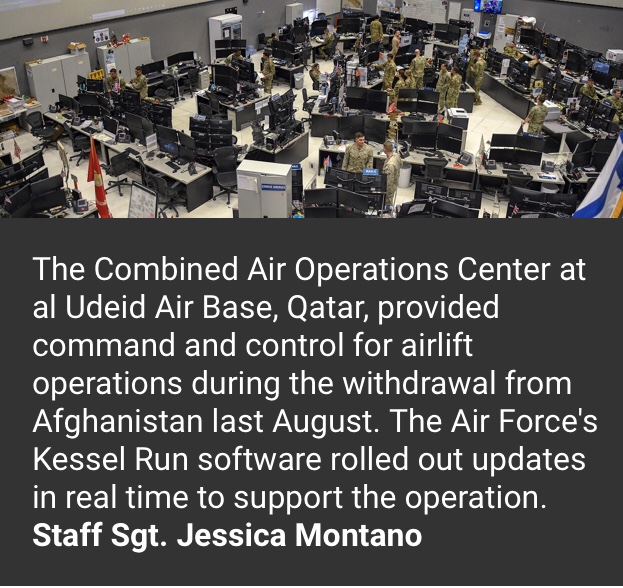
It’s Aug. 24, 2021, and tension is in the air inside the Combined Air and Space Operations Center (CAOC) in Al Udeid Air Base, Qatar. There’s only a week left before the Taliban deadline to evacuate the remaining Americans, interpreters, and others who had helped the United States in Afghanistan over the two decades since 9/11. Many are young enough to only have vague memories of what life was like prior to the Americans’ arrival in 2001. It’s here, at the CAOC, where the airlift is being planned and managed.

The situation in Afghanistan is similarly tense. Around 6,500 people are at the airport waiting for a flight out of the country. A week earlier, desperation led people to chase after or hide in the wheel wells of departing C-17s. Horrifically, some fell to their deaths when the aircraft took off. Now, the crowds are drawing the attention of ISIS-K, which is planning an attack that will come only two days from now. The need for an orderly plan to evacuate as many people as possible was clear.

Back at the CAOC, the team of air planners is trying to use Kessel Run’s software to plan the missions that will ferry people out of Kabul on planes from the United States and many other countries. A proper plan is critical because the air traffic control at Hamid Karzai International Airport (HKIA) is not used to this level of traffic, so the planners must space out the arrivals and departures into very precise time slots.

However, the software isn’t working.

The team is going to the Slapshot website, but it’s not loading. This was a known risk. As a development Minimal Viable Product (MVP), Kessel Run’s applications were designed to accommodate the number of missions in steady state operations. The changes needed to scale to over five times as many missions were in the backlog, but deferred for higher priority work until next summer. Now, the evacuation has driven the mission count up 10 times in a matter of days. If this evacuation fails, thousands of people would be stranded as the Taliban take control of Kabul and the rest of Afghanistan. It’s a literal life and death situation.

In the midst of the flurry of action on the CAOC ops floor, a young government civilian calmly goes to his computer at the back of the room and submits a message to a team in the United States. It’s a similar message to others the team has sent before, but this time the stakes are much higher.

“We are experiencing intermittent loading issues with Slapshot. The exercise theater does not load. We need to call an outage so that we can fix the issue,” he said.

Back to October 2016—the beginning

Eric Schmidt, then executive chairman of Alphabet, Inc., Google’s parent company, served as a member of the Defense Innovation Board (DIB). The board worked to find ways innovation could address future challenges to DOD. As part of that work, the board went to the same Operations Center in Al Udeid where this story began.

The whiteboard on which tanker refueling operations were planned was like a game of Tetris. While one teammate enters data into an Excel spreadsheet, another moved magnetic pucks and laminated cards around the whiteboard. Kessel Run converted the manual system into an automated software program.  USAF/courtesy

Famously, he saw Airmen planning refueling missions on a whiteboard with tape grids, magnetic pucks, and dry-erase marker lines connecting the puck together to define the plan.

When he later asked the Air Operations Center (AOC) commander what his biggest concern was, the commander said: “Well, frankly, … I don’t want them to erase my whiteboard.”

Shocked that an eraser created one of the biggest threats to the air war supporting operations across Iraq and Afghanistan, the board members pressed the team about why better tools don’t exist. He asked if they even had modern software. He was told, “Yes, but it doesn’t work.” This failed modernization effort left the AOC with the nearly the same system that was originally developed in the 1990’s—20 years and several software lifetimes ago.

This effort to modernize the AOC 10.1 software was called the AOC 10.2 program. The Capability Development Document of 2006 formalized key functional requirements for the AOC and in that same year Lockheed Martin was awarded a $589 million contract in order to “standardize, modernize, sustain, and transform” the AOCs. Under traditional acquisitions, this was pre-Milestone B “risk-reduction” activity. In 2013, Northrop Grumman won the development award and began work on the 10.2 program. By the fall of 2016, Northrop was already three years behind schedule and estimated development costs had ballooned from $374 million to $745 million. It was a decade after the requirements were identified and no code was delivered to the field for use. This is the scene that the Defense Innovation Board walked into when they visited the CAOC.

Raj Shah, a Managing Partner at Defense Innovation Unit (DIU) at the time, was with the Defense Innovation Board, and literally called Col. Enrique Oti, an officer at DIU, that night, and said that he would commit $1M of DIUx’s money. The goal was to get a new tanker planning tool and demonstrate DevOps can deliver solutions faster than traditional waterfall and Joint Capabilities Integration and Development System (JCIDS) development.

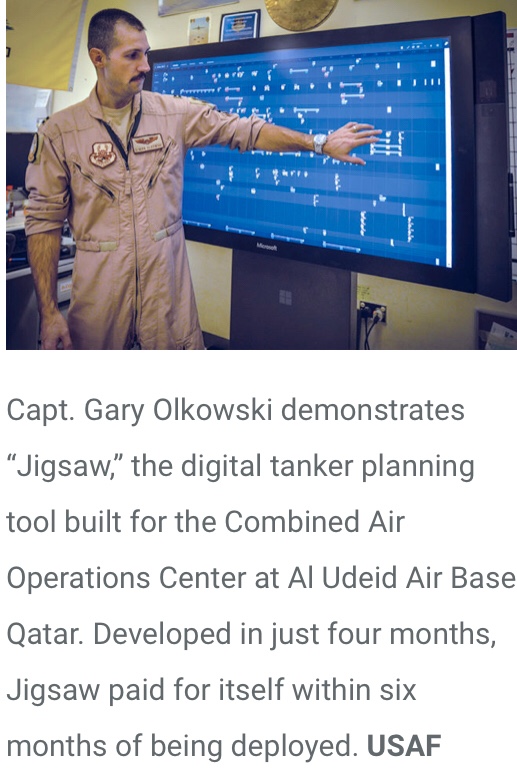
Capt. Gary Olkowski demonstrates “Jigsaw,” the digital tanker planning tool built for the Combined Air Operations Center at Al Udeid Air Base, Qatar. Developed in just four months, Jigsaw paid for itself within six months of being deployed.  USAF

The Air Force team, led by Oti, sat side by side with Airmen in the CAOC to design a warfighter-friendly tool. The resulting Jigsaw Tanker Planning Software turned an eight-hour task for six people into a three-hour activity. By April 2017, four months after work had started, the tanker planning tool was in use in Qatar.

Within six months, the Jigsaw application had essentially paid for itself. The efficiency it had created saved 400,000 to 500,000 pounds of fuel each week and required one less refueling aircraft. This saved the Air Force $750,000 to $1 million every week.

Remember, Raj only spent $1 million on the entire effort.

It’s no wonder that the 10.2 program received a stop-work order on April 19, 2017, and was terminated in July. The Air Force needed to do things differently to avoid the same outcomes. There was a team—also an experiment—that could lead that new approach. This new team of coders was going to build on Jigsaw’s success and modernize all of the AOC’s software.

Jigsaw was combined with the Targeting and GEOINT program office (also using DevOps to modernize their tools, led by Capt. Bryon Kroger), and the government team who was sustaining the AOC 10.1 system within PEO digital.

That team was named “Kessel Run,” both as an homage to “Star Wars” smuggler who could bring outside things (like DevOps) to a bunch of rebels, but also because Han made the Kessel Run in 12 parsecs, a hyperspace distance shorter than anyone else had done before. That was our mission: Shorten the time and distance it took to get to our destination.

Here are some of the ways that we close the gap.

User-focused design

Jigsaw began with our dev-teams sitting down with the users in the AOC to understand their value chain, and how they could be more effective and productive. We have continuous user interviews and track customer satisfaction scores. Getting software into users’ hands as soon as possible has led to our users coming up with new use cases. Today, we have our team members embedded at the 609th CAOC every day.

As we add new applications or features to our scope, we start with a discovery and framing session with our users. We don’t turn to requirements documents first or trust that documents written in 2006 represent the world as it is today. Instead, we work with the users to scope a MVP and then begin iterations of the build-test-learn cycle.

We map out their processes so we understand what the users need.

After that, we start designing the solution. We co-design with the users and start to map the data flows so we can see the interdependencies between applications and workflows.

Finally, the goal isn’t to provide a mock-up or a prototype, but to build an MVP that users can test and use to support operations. Having users test thin slices of the ultimate system starts the build-test-learn cycle and gives us constant feedback on our software to continuously learn what is working and where the gaps are.

This is very different from traditional acquisitions where only finalized systems are made available to users. It can create challenges since we release versions that we know don’t meet the entire set of needs, but can provide value that can grow over time. For example, our Kessel Run All Domain Operations Suite (KRADOS) in August had known issues around scaling for major operations.

More on that later.

Continuous delivery, in practice, means changes to the software are happening on a regular basis, multiple times a day, eventually adding up to major changes over time.

For example, Jigsaw has been used for every air refueling mission in the CAOC since December 2019 as a stand-alone application. Slapshot, the tool for planning the rest of the air missions, has also been used for every mission at the CAOC since December 2019. Again, it was used as a stand-alone application for over a year because we didn’t have the connection to a common data layer built yet. However, the integrated suite of 10 applications with a common data layer was released as an MVP in January 2021. It was accepted, and used for planning the Master Air Attack Plan at the CAOC, since May 2021.

Let’s dive a little deeper on how we make those changes to production software.

Continuous Innovation and Delivery

At Kessel Run, we have a different challenge from commercial software-as-a-service providers. We don’t have a single internet that we’re deploying to. We have 10 different environments because of users on unclassified, secret, and top secret networks—and the different variants of those networks for different coalition partners.

In order to manage deploying software to these regions, maintain version control, and reduce human touch points in the deployment process, we rely on automated continuous integration and continuous deployment pipelines.

That starts with our developer pipeline, which takes the application code from their workstations and puts it into the Gitlab repository where we maintain our code. When the dev-team thinks the changes are ready to deploy to our staging environment, they push the code through the CI pipeline along with a deployment manifest. The security release pipeline is part of this release, which includes code scanning, vetting dependencies, and putting the artifacts into our Nexus repository. Once there, they are available in the staging environment for testing and verifying integration with other applications and services.

When those changes are ready to be promoted to production, the immutable images are moved from Nexus into our purpose-built deployment manager (RADD) into the production environments. Our Continuous Deployment pipelines depend on whether the deployment is going to our AWS unclassified cloud, on-prem Secret, or Top Secret cloud.

We use these pipelines multiple times each day. On average, we deploy code through a deployment pipeline once every 3.3 hours. From the time the dev-team is ready to deploy, on average, it is only eight hours before the changes are available in production environments. Much of that time is spent moving artifacts from unclassified networks up to classified, which still requires burning CDs and rescanning on both sides of the air gap. We hope to have a cross-domain diode that will take the human touch point out of the process. That should speed the deployment times further and help us get to the self-service deployment using full automation.

Focus on applications in-production

While many teams see the job as finished when code gets into production, we see that the job is only partially done. While we haven’t yet established service level objectives, or agreements with our users, a point of pride for Kessel Run is our ability to service apps in production, respond to issues, and never have the same outage twice.

Our teams provide security support and monitor applications to ensure they are available. When we have an issue, on average we have it resolved in under 120 minutes. After every outage, we conduct a no-fault retro to identify root causes and assign fixes to the backlog.

That process begins with a report in our MatterMost channel for outages. That brings us back to Aug. 24, 2021, when our liaison officer at the 609th submitted the outage report.

DevOps in Practice

It was 2:49 a.m. in Boston. Remember, that we knew that the production version of our applications couldn’t handle the growth in mission counts that we saw in the evacuation effort. Now the software was being asked to do exactly that.

Meanwhile, the crowds outside HKIA grew and the deadline to get everyone out wasn’t going to change just because we had an outage in production.

Our platform team noticed spikes in latency seven minutes after the call was initiated. Along with the LNOs, the on-site platform team started collecting data on the classified network to help pinpoint the problem when the dev-teams in Boston get into the office.

The evacuation from Hamid Karzai International Airport, Kabul, Afghanistan, resucued more than 123,000 people. On-the-fly software updates made that possible.  Sgt. Isaiah Campbell/USMC

At 4:03 a.m. in Boston, the outage team began the response and began to work with the product manager to determine potential fixes. At 7:09 a.m., the dev-teams joined the outage call and confirmed the root cause. There was a setback at 8:28 a.m. when the apps completely crashed and the LNOs notified the center’s operations floor.

Still, only 12 minutes later, the platform team has cleared the bin files that had taken up all available disk space after the app lost connection to the SQL database. By 9:07 a.m., the team had doubled the number of compute instances available to Slapshot. At 10:25 a.m., the development team added a “theaters” feature to the production version of Slapshot that cut the number of missions displayed into smaller chunks.

That afternoon, at 1:44 p.m., additional compute instances were shifted to the 609th Slapshot, and it looked like the issues had been mitigated. At 4:06 p.m., our liaison officers confirmed with users in the 609th that the issue was resolved and got feedback on the new theater feature. They had positive feedback and the outage call ended.

The call ended only 12 hours and 3 minutes after the product manager was woken up at 4 a.m. to start the call. In those 12 hours, the team was able to shift compute and store resources to United States Central Command’s apps to improve performance, fix the SQL database connection errors, clean out the bin files, and add new features to help slice the data and improve load times. Our dev-teams and IT ops teams worked together—from Boston and in Qatar—to identify the issues, propose solutions, and implement them in a single day.

The airlift was able to continue.

USAF set a record on Aug. 15, 2021, when one flight safely transported 823 Afghanistan
refugees on a single C-17 flight. USAF/courtesy

Interpreters who had helped Americans and our partners were moved to safety. Women and girls fearful of a life under the Taliban were brought to safety where they could pursue their dreams. All American forces were out of Afghanistan by the Aug. 31 deadline.

To me, those 12 hours are the defining moment for Kessel Run. What started with Eric Schmidt’s disbelief in how planning was being done five years ago became an experiment to show a government-led DevOps team could deliver software better than traditional government acquisition. For comparison, that five years is the same time it took 10.2 to go through “risk-reduction” and start a development contract. Since the DIB visited the CAOC, we’ve been in use by users for all but the first six months of those five years. We add new features every week and move from stand-alone apps to an integrated suite. Kessel Run has shown that the full promise of DevOps is not something to see in the future—it’s happening now.

When lives depended on us, when the world challenged us, our DevOps Team delivered the software solutions our warfighters needed. In doing so, we demonstrated why DevOps—why the Kessel Run model—is an imperative for the Air Force.

Article link: https://www.airforcemag.com/article/making-the-kessel-run/


Col. Brian Beachkofski is commander of the Air Force Life Cycle Management Center’s Detachment 12, an agile software development lab known as “Kessel Run.”

Chester Eastside Leadership Opportunity

Posted by timmreardon on 03/23/2022
Posted in: Uncategorized. Leave a comment

Chester Eastside is looking for a strategic, effective leader to advance the organization’s commitment to the Chester community. The attached posting includes an overview of the organization and the job description. Salary will be commensurate with experience and flexible work arrangements will be considered. All interested applicants should send their resume and salary requirements to Recruiter@ceichester.org.
https://bit.ly/3JxHBFv

No-Code Is The Future Of Software: Here Are Five Critical Things To Drive Success In 2022 And Beyond – Forbes

Posted by timmreardon on 03/23/2022
Posted in: Uncategorized. Leave a comment

Mar 18, 2022,07:15am EDT|

Katherine Kostereva Forbes Council Member

Forbes Technology Council

COUNCIL POST| Membership (fee-based) Innovation

Katherine is the CEO of Creatio, a global vendor of one platform to automate industry workflows and CRM with no-code.

In early 2021, Gartner released a new forecast for low-code/no-code development tools. Driven by an increase in remote work due to the Covid-19 pandemic, Gartner projected a 23% increase for the global market for this type of technology. In the months that followed, low-code/no-code tools saw steady growth due to their effectiveness in addressing some of tech’s most complicated challenges—primarily the critical need to digitize workflows, enhance customer and employee experiences and boost the efficiency of commercial and operational teams.

According to Harvard Business Review, low-code/no-code platforms have evolved from just facilitating function-specific tools to making it possible for a broader range of business employees to truly own their automation and build new software applications with no coding while increasing organizational capacity.

Low-code/no-code tools also drew attention in the context of the Great Resignation, with Entrepreneur noting that low-code/no-code platforms make it easier for companies to address the ongoing shortage in engineering and developer talent. An increasing number of businesses and IT leaders are leveraging the possibilities of low-code/no-code tools as organizations work to turn more of their employees into citizen developers.

As the movement continues and adoption increases across key industries from financial services to manufacturing, organizations need to pay attention to these five topics in order to improve the performance of their new tools and ensure the success of their low-code/no-code initiatives.

1. Addressing Security In Low-Code/No-Code Platforms

It’s clear why executives would see the business benefits of adopting low-code/no-code platforms and tools. By giving nonIT employees the opportunity to build their own business applications, an organization can unlock new areas for rapid growth. However, some executives are cautious. As citizen developers are given the opportunity to build new applications, governance will be important. IT staff will need to put guardrails in place and have those built into low-code/no-code platforms to maintain consistent levels of security across the organization. 

For companies integrating new low-code/no-code tools into their tech stack, or leveraging existing tools, it’s important to remember some of today’s most common cybersecurity best practices: namely, training every employee at the organization on good security behavior and using compartmentalization and limited access to prevent opportunities for mistakes. 

2. Hiring, Training And Organizing Work For No-Code Developers

Encouraging employees to become no-code developers and create their own business applications requires a shift in mindset for everyone in the organization. This includes overarching processes like hiring and training, as the traits that make a good citizen developer may be different than those a company previously looked for. Above all, a good citizen developer is willing to be creative and take risks. 

While the employees themselves should be free to create their own tools and solutions, it’s incumbent on the organization to create the frameworks that will allow them to succeed. Companies that embrace low-code/no-code tools must ensure that employees have access to training, reference materials and policies that will help them to align their operations with other business units and the company as a whole.

3. Organizational Alignment For Low-Code/No-Code Development

Low-code/no-code platforms democratize the ability to create new software applications, making it possible for individual departments or units to solve problems without a direct need to rely solely on scarce IT resources. For no-code companies, harmonizing workflows is a key requirement for success. 

In a low-code/no-code organization, departments should be able to work without silos and communicate freely across functions. Low-code/no-code platforms make it easy to pass information from one area of the company to another and standardize the development approaches across business and IT teams. This emphasis on openness and alignment should come from the top, providing justification for employees at all levels to pursue new solutions. 

4. Embracing Hyperautomation For Rapid Progress

According to Gartner’s “Top Strategic Technology Trends for 2022,” hyperautomation will grow rapidly over the next three years in terms of both deployment and investment. Business-driven hyperautomation allows organizations to “rapidly identify, vet and automate as many business and IT processes as possible.” Low-code/no-code tools are poised to play a leading role in this hyperautomation arms race. Organizations that take a centralized, coordinated approach to hyperautomation will be able to find new efficiencies that map directly to their business goals. 

5. Speeding Time To Market With Composable Applications

Between the distributed aspects of hybrid work and the changing responsibilities enabled by low-code/no-code tools, the structure of modern business teams changed significantly over the past two years. Composability is the ability to assemble app components in various combinations to satisfy specific requirements. It makes it possible for organizations to increase production and accelerate timelines for innovation in a highly customizable way.

Article link: https://www.forbes.com/sites/forbestechcouncil/2022/03/18/no-code-is-the-future-of-software-here-are-five-critical-things-to-drive-success-in-2022-and-beyond/amp/

Forbes Technology Council is an invitation-only community for world-class CIOs, CTOs and technology executives. Do I qualify?


Follow me on LinkedIn. Check out my website. 

Katherine Kostereva

Katherine is the CEO of Creatio, a global vendor of one platform to automate industry workflows and CRM with no-code. Read Katherine Kostereva’s full executive profile here.

BEEN THERE, DONE THAT: BEHAVIORAL ACQUISITION –

Posted by timmreardon on 03/23/2022
Posted in: Uncategorized. Leave a comment

March 23, 2022

Acquisition, Army ALT Magazine

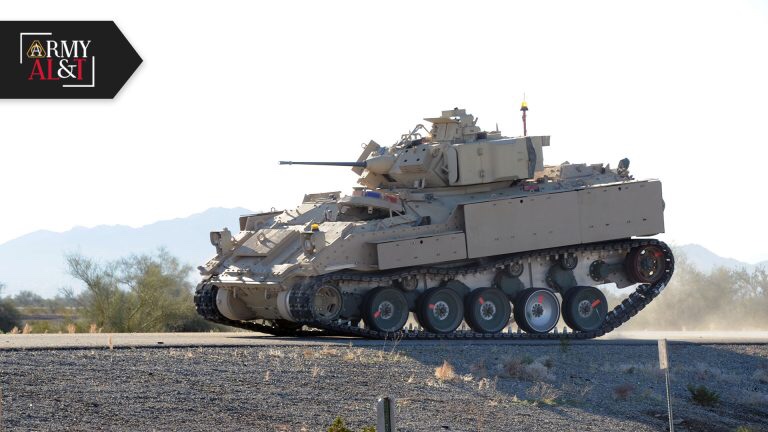
STAND-IN: In January 2020, the U.S. Army tested Advanced Running Gear on existing Bradley vehicles for potential use on the future Optionally Manned Fighting Vehicle at Yuma Proving Ground, Arizona. (Photo by Mark Schauer, Yuma Proving Ground)

Behavioral biases have played a significant role in acquisition program decision-making, specifically hampering the Army’s efforts to modernize and upgrade infantry combat vehicles.

by Robert F. Mortlock, Ph.D., Col., USA (Ret.)

This is the second in a series of articles focused on behavioral acquisition—a topic first introduced in the Fall 2021 Army AL&T magazine.

Behavioral acquisition explores defense acquisition from a behavioral standpoint, including the impact of psychology, organizational behavior and organizational politics on decision-making in acquisition programs that ultimately affect the delivery of capability to the warfighter. Behavioral acquisition studies how acquisition professionals think, manage and lead acquisition programs—and addresses organizations, hierarchies and the intersection of individual behavior, leadership, culture and decision-making.

One aspect in particular, behavioral biases, is the focus of this article. These biases have a common root in people’s limited ability to process large amounts of information, resulting in poor decision-making. That, in turn, contributes to acquisition program failures. A case study is the Army’s efforts to modernize its infantry combat fighting vehicles. The decadeslong effort has shown evidence of multiple decision-making biases: planning fallacy bias, overoptimism bias, recency bias and trade-off bias.

A HISTORY OF DECISIONS

The Bradley Fighting Vehicle remains the backbone of Army mechanized infantry warfighter formations. Developed in the 1960s, the Bradley (see Figure 1) was initially fielded in the early 1970s and has been upgraded several times to offer Soldiers enhanced capabilities. Since the early 2000s, the Army has been trying to replace the Bradley because size, weight and power constraints severely restrict potential upgrade options. After an 11-year development effort, the Bradley has been in production for 50 years.

EVOLUTION OF THE BRADLEY: After an 11-year development effort, the Bradley Fighting Vehicle has been in production for 50 years. (Graphic by USAASC adapted from “Then and now: Next generation on track,” Army AL&T magazine, Spring 2019.)

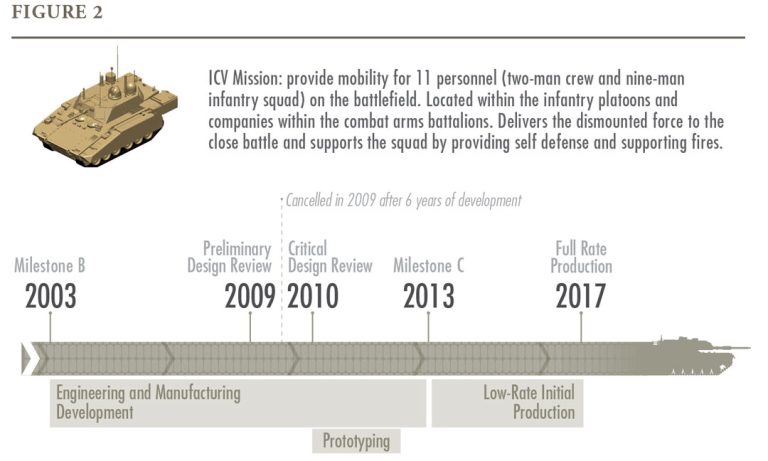
One attempt at a Bradley replacement was the Infantry Carrier Vehicle (ICV), part of a family of manned ground vehicles within the planned Future Combat Systems program. (See Figure 2) Future Combat Systems entered the acquisition framework as an official program of record at milestone B to begin engineering and manufacturing development (EMD) efforts in 2003 with a planned milestone C (low-rate initial production) in 2009, later shifted to 2013. The 10-year time frame for technology development, design, prototyping and engineering and manufacturing development was similar to the Bradley program and other efforts of similar complexity and risk. However, the Infantry Carrier Vehicle effort (along with the entire Future Combat Systems program) was canceled in 2009.

Defense acquisition experts have referenced Future Combat Systems as an example of everything wrong with defense acquisition—a canceled program that wasted billions of dollars and delivered no capability to warfighters. A 374-page 2012 RAND Corp. report, “Lessons From the Army’s Future Combat Systems Program,” highlighted hundreds of lessons from different aspects of the program, including requirements management, program management, contracting and technology management.

INFANTRY CARRIER VEHICLE: One attempt at a Bradley replacement was the Infantry Carrier Vehicle (ICV). It was part of the ill-fated Future Combat Systems program and canceled in 2009. (Graphic by USAASC)

The Future Combat Systems program attempted to integrate critical technologies using a system-of-systems management approach. The program started as a Defense Advanced Research Projects Agency effort contracted through other-transaction authority (OTA) with Boeing and its industry partners. The OTA incentivized Boeing to get the Army to an approved milestone B and establish a baseline for the formal program of record as quickly as possible.

Boeing and the Army achieved a successful milestone B in 2003. The OTA also enabled Boeing to become the lead system integrator for the Future Combat Systems program. Despite warnings from the Government Accountability Office (GAO) in a 2004 report titled “Defense Acquisitions: The Army’s Future Combat Systems’ Features, Risks, and Alternatives,” which warned of immature technologies and lack of adequate funding, the Army marched forward. The Future Combat Systems program was canceled in 2009 primarily for being unaffordable, overly ambitious from a technology maturity standpoint (integration of too many critical technologies with low maturity), overly complex from a program management standpoint (the system-of-systems approach), and for failing to reflect current emerging threat requirements from conflicts in Iraq and Afghanistan.

Future Combat Systems can be studied with a behavioral acquisition lens. The Army did not appreciate the effects of the planning fallacy bias, and the result was a gap between plans and outcomes. The Army built an unrealistic “insider view” of a program, with detailed plans for implementation, to gain program-of-record approval. These detailed plans enhanced the Army’s perception of control over the program and confidence in its success that were unwarranted when the full context of the program was considered.

The effects of the planning fallacy are not unique to the Infantry Carrier Vehicle effort within Future Combat Systems or to Army acquisition programs in general. A 2015 GAO report titled “Defense Acquisitions: Joint Action Needed by DOD and Congress to Improve Outcomes,” highlighted that program managers (PMs) are incentivized to develop acquisition strategies focused on program approval at the milestone review but not acquisition strategies that could later be executed and deliver capabilities.

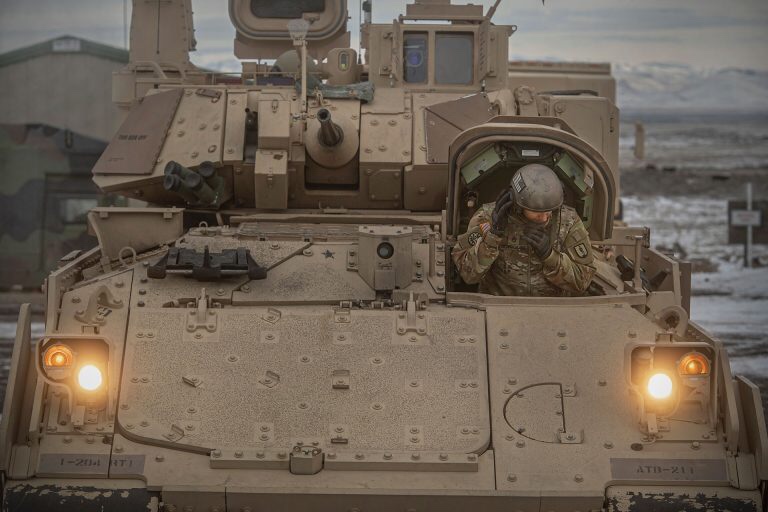
MOVING OUT: Idaho Army National Guard Staff Sgt. Daniel Bistriceanu checks his communications equipment before moving out to fuel up a Bradley Fighting Vehicle. The Army has been trying to replace the Bradley since the early 2000s because of its size, weight and power constraints. (Photo by Thomas Alvarez, Idaho Army National Guard)

It is ironic that the planning fallacy has roots in what are perceived to be good management practices. Program planning efforts tend to reinforce idealized perceptions of control, resulting in PMs typically thinking they have more control over outcomes than they have in reality. The planning fallacy creates biased expectations that will impact the cost, schedule and performance baseline over the course of most programs.

Future Combat Systems was also hampered by overoptimism bias—the tendency to see the world through “rose-colored glasses” or expect positive outcomes even when not justified. The Army’s “can do” mentality, combined with the general observation that the program management field generally rewards optimistic individuals, led to a Future Combat Systems Infantry Carrier Vehicle program plan that was overly optimistic. In this case, the Army underestimated the technical maturity level of the critical technologies, the complexity of the development effort and the difficulty in transforming the way the mechanized infantry fights (concept of operations as well as tactics, techniques and procedures).

Recency bias is the widely recognized bias wherein recent data are given disproportionate emphasis in making judgments. Recency bias occurs when individuals process large amounts of information and rely on intuition. This helps them sort through the information but also introduces biases and leads to suboptimal decisions.

Future Combat Systems was plagued with recency bias from its inception—specifically from the tendency to incorporate as many of the latest acquisition reform initiatives as possible.

The program was initiated by leveraging a Defense Advanced Projects Research Agency effort. Future Combat Systems chose the innovative, non-Federal Acquisition Regulation (FAR)-based contracting approach with the use of an OTA. Finally, the program incorporated the use of a contractor to act as the lead system integrator as well as a system-of-systems approach (rather than separate programs).

The use of any one of these recent acquisition reform initiatives would have been a significant shift in acquisition management, but the Army felt obligated to incorporate multiple initiatives, despite the availability of more appropriate, less risky acquisition management approaches like a longer incremental development.

Finally, Future Combat Systems was saddled with a difficulty in making trade-offs. The trade-off bias is central to program management, particularly trade-offs among program cost, schedule and performance that form the acquisition program baseline.

Decision theory has proposed rational methodologies for making trade-offs by confronting them systematically, typically through some version of cost-benefit analysis. But the models based on rationality bump up against the realities of the complex defense acquisition environment.

Typically, rational, reason-based models make conflicting choices easier to evaluate. By constructing reasons, individuals turn difficult-to-reconcile characteristics of options into a problem that is more comprehensible.

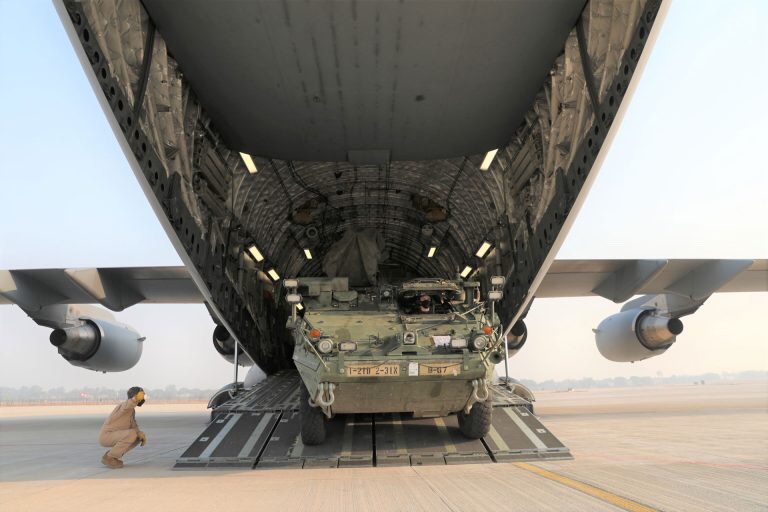
ROLLING ALONG: A U.S. Army Stryker infantry carrier vehicle rolls off a C-17 cargo plane in India Feb. 1, 2021. (Photo by Staff Sgt. Joseph Tolliver, 1-2 Stryker Brigade Combat Team)

Furthermore, it is likely that reason-based choice may be even more difficult when groups are making decisions, reflecting the fact that programs involve numerous stakeholders and significant resources, and that decisions have to be justified and approved by oversight groups.

Therefore, while individuals typically choose using rational models, groups may prefer reasons based on social, organizational or political dynamics.

The Future Combat Systems operational requirements document approved by the Army Requirements Oversight Council and the Joint Requirements Oversight Council was 475 pages long and contained hundreds of key performance parameters, key system attributes, and additional performance attributes, leading to thousands of design specifications for the Infantry Carrier Vehicle. The vehicle simply had too many requirements placed on it, making the trade-offs of performance, cost and schedule beyond the cognitive capability of individual PMs and Army leaders and too difficult for the Army from an organizational perspective. Basically, all the requirements were treated as important—too difficult to trade off.

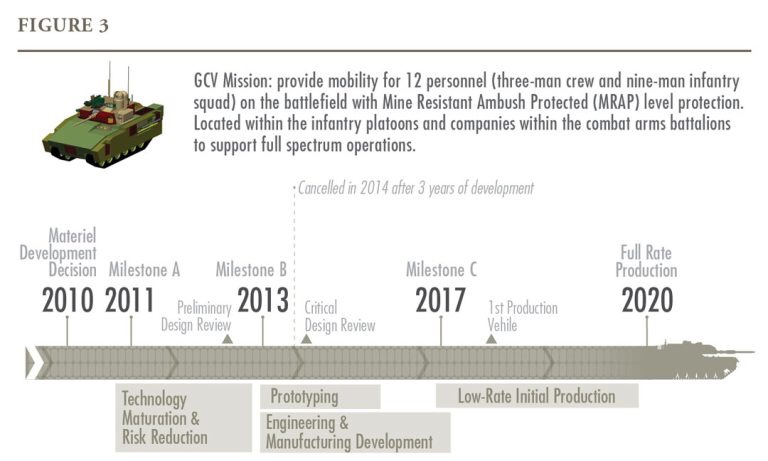
After cancellation of Future Combat Systems in 2009, the Army embarked on the Ground Combat Vehicle (GCV) program (see Figure 3) to replace the Bradley. All resources that had been supporting the oversight and management of the development of a family of FCS-manned ground vehicles (including the Infantry Carrier Vehicle) were now applied to the development of the Ground Combat Vehicle. This program achieved a materiel-development decision in 2010 and milestone A in 2011 to award technical maturation and risk reduction contracts to industry.

GROUND COMBAT VEHICLE: Ground Combat Vehicle (GCV) also attempted to replace the Bradley. In 2014, the Army canceled the program because the vehicle was going to be too big and heavy and had too many requirements. (Graphic by USAASC)

The same two industry partners that were teamed together in the Future Combat Systems Infantry Carrier Vehicle program now competed against each other in a technical maturation and risk reduction phase for the Ground Combat Vehicle. The program had an aggressive schedule to get to milestone C within six years of milestone A—influenced by planning fallacy and overoptimism bias like the Infantry Carrier Vehicle program. The Army began the Ground Combat Vehicle program and awarded firm fixed price-type research and development contracts to BAE Systems and General Dynamics for designs and prototypes. The new vehicle’s requirements called for a heavy reliance on mature commercial technologies. In an example of recency bias, Better Buying Powerinitiatives strongly encouraged the use of firm fixed-price research and development contracts despite the lack of appropriateness based on the level of system integration complexity and risk.

The Ground Combat Vehicle requirements included a mixture from the Bradley, the Future Combat Systems Infantry Carrier Vehicle, the recently fielded Mine Resistant Ambush Protected vehicles, and the M1A2 Abrams tank. Based on the GCV requirements, the program office, industry competitors and the research, development and engineering center at the U.S. Army Tank-automotive and Armaments Command (TACOM) determined that the GCV would weigh between 50 and 70 tons—nearing the weight of the 72-ton M1A2 Abrams tank and almost twice as heavy as the Bradley or the planned 30-ton Infantry Carrier Vehicle. The GCV had force protection, survivability and lethality requirements for a mechanized infantry vehicle that more resembled an armored tank.

In subsequent reviews with Army senior leaders, the potential weight of the Ground Combat Vehicle and excessive requirements were highlighted. However, the Army pushed ahead and approved the requirements—heavily affected by a difficulty in making trade-offs. The technical maturation and risk reduction contracts seemed to be based primarily on a need to protect the planned and programmed resources from the old Future Combat Systems Manned Ground Vehicles program (schedule-driven). In 2014, three years into the development effort, the Army canceled the Ground Combat Vehicle program because the vehicle was going to be too big and heavy and had an excessive number of requirements.

In recent years, after several failed attempts of initiating the Next Generation Combat Vehicle because of aggressive requirements and a lack of interest by industry, the Army is trying again—this time calling the Bradley replacement the Optionally Manned Fighting Vehicle.

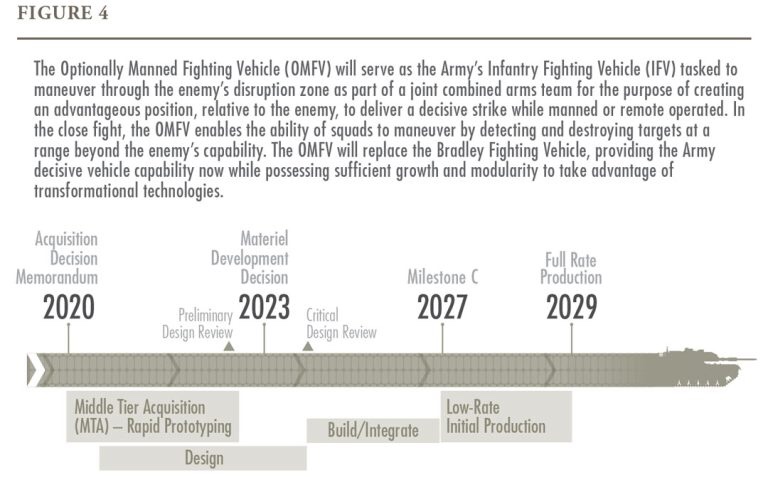
The Optionally Manned Fighting Vehicle program plan is presented in Figure 4. The program is leveraging the newly established middle tier of acquisition pathway and begins not with a milestone A or B, but with an acquisition decision memorandum from the milestone decision authority. After the prototyping phase, a materiel-development decision will continue the design effort and start build and integration efforts. The program plan specifically avoids using the technical maturation and risk reduction and engineering and manufacturing development phases of a major-capability acquisition. Again, as with the Ground Combat Vehicle program schedule, the Army plans to achieve the milestone C within seven years of program initiation. Interestingly, the program uses the terms “characteristics of need” to describe the requirements to competing contractors rather than more traditional terms like key performance parameters.

OPTIONALLY MANNED FIGHTING VEHICLE: The Optionally Manned Fighting Vehicle (OMFV) program leverages the newly established middle tier of acquisition but is susceptible to the same behavior acquisition biases that contributed to the failures of the predecessor Bradley replacement vehicles. (Graphic by USAASC)

The Optionally Manned Fighting Vehicle program is susceptible to the same behavior acquisition biases (planning fallacy, overoptimism bias, recency bias, and difficulty in making trade-offs) as contributed to the failures of the predecessor Bradley-replacement acquisition efforts. How can the design and development of a mechanized infantry vehicle be optimized for troop transport and protection, lethality and remote autonomous operations simultaneously? Unfortunately, the answer is that it can’t—this will require difficult requirement trade-offs to avoid the planning fallacy and overoptimism bias. A vehicle that is optimized to protect the crew and dismounted troops being transported would be an inefficient combat vehicle for lethal autonomous operations (too big and heavy).

It appears that recency bias has also played a significant role in the Optionally Manned Fighting Vehicle program planning. Is the Army more interested in riding the autonomous vehicle hype wave? Or does the Army have other priorities like proving that major-capability acquisition can be done differently or innovatively in the newly established Army Futures Command?

The Optionally Manned Fighting Vehicle acquisition strategy leverages the middle-tier of acquisition pathway to avoid forming a program of record to enter the engineering and manufacturing development phase after a successful milestone B. The Optionally Manned Fighting Vehicle program will use middle-tier authorities to rapidly prototype vehicles for experimentation and demonstration and then establish a formal acquisition program of record at milestone C to enter low-rate initial production. For requirements, the Army initiated the Optionally Manned Fighting Vehicle program with a general characteristics of need document to avoid the approval of an initial capability document.

The exact opposite strategy has been recommended by the GAO for more than three decades for major defense acquisition programs—knowledge-based acquisition strategies with incremental development. Defense acquisition programs have routinely rushed to production decisions without well-defined requirements, complete detailed design drawings, fully mature technologies and mature manufacturing processes, and without demonstrating production-representative systems in an operationally relevant environment. The Optionally Manned Fighting Vehicle program is attempting to do in a middle tier of acquisition rapid prototyping effort what a major defense acquisition program achieves in a formal engineering and manufacturing development effort—a classic “schedule-driven” rush to failure with suboptimal decision-making that appears to be dominated by biases similar to those biases that plagued previous attempts to replace and modernize the infantry combat vehicles.

CONCLUSION

The behavioral biases of planning fallacy, overoptimism, recency and trade-offs difficulty have contributed to repeated failures in the Army infantry combat vehicle acquisition programs. Figure 5 summarizes the behavioral biases observed in the Future Combat Systems Infantry Carrying Vehicle, the Ground Combat Vehicle and the Optionally Manned Fighting Vehicle programs. Acquisition management has been highlighted on the GAO’s high-risk list for excessive waste and mismanagement for the past three decades. Notable programs have failed to deliver capability and have failed to meet performance, cost and schedule management targets. The reasons for program failure vary from ill-defined requirements, immature technologies, integration challenges, poor cost and schedule estimating, and the acceptance of too much development risk.

But the effect that the behavioral biases have in poor decision-making may be an even bigger contributor to acquisition program failures—the true root causes. The better acquisition professionals understand the effect of these systemic behavioral biases, the better DOD can mitigate the risks of program failures. The key is a better understanding of the people within big “A” defense acquisition.

ROBERT F. MORTLOCK, Ph.D., Col., USA (Ret.) managed defense systems development and acquisition efforts for the last 15 of his 27 years in the U.S. Army. He is now a professor of the practice and principal investigator of the Acquisition Research Program, teaching defense acquisition sciences and program management at the Naval Postgraduate School. He holds a Ph.D. in chemical engineering from the University of California, Berkeley, an MBA from Webster University, an M.S. in national resource strategy from the Industrial College of the Armed Forces, and a B.S. in chemical engineering from Lehigh University. He holds Level III certifications in program management, test and evaluation, and engineering, as well as the Professional Engineering, Project Management Professional and Program Management Professional credentials. His most recent column for Army AL&T appeared in the Summer 2021 issue.

Read the full article in the Spring 2022 issue of Army AL&T magazine.

Subscribe to Army AL&T – the premier source of Army acquisition news and information.

For question, concerns, or more information, contact us here.

Health equity: A framework for the epidemiology of care – McKinsey

Posted by timmreardon on 03/22/2022
Posted in: Uncategorized. Leave a comment

March 21, 2022 | Article

By Anas El Turabi, Anjali Menon, Lucy Pérez, and Gila Tolub

Pharmaceutical and life sciences companies can unlock new opportunities, help underserved patients, and build a cycle of trust.

DOWNLOADS

 Article (8 pages)

Chances are, you’ve been hearing a lot about health equity. In the months and years ahead, you’ll probably hear more: beyond the obvious benefits to patients, health equity is an enormous opportunity for almost every pharmaceutical and life sciences company. Social factors can significantly affect the epidemiology of disease, often in ways that are not readily apparent. Companies can identify these social determinants across different markets, map how they affect different groups, identify which health conditions are undertreated or underfunded, and pinpoint when intervention is most effective.

The findings of a rigorous health equity analysis—the groups that bear a disparate burden, the health conditions treated inadequately, and the oppor­tunities to invest more effectively—will vary from region to region. But the framework for a health equity analysis is the same, and can therefore be repeated across regions. The value proposition from approaching health equity in a robust way is compelling globally, particularly in large, advanced economies.

There is also a values proposition: the benefits to patients and the holistic impact on society. Many studies find that higher levels of trust in doctors and treatments are associated with better health outcomes. Significant research that does not disaggregate outcomes among levels of economic advantage nonetheless supports the assertion that the relationship between trust and health outcomes applies to all groups.1 Greater trust among disadvantaged communities can therefore be expected to contribute to better health outcomes for their members and to drive, in turn, a virtuous cycle—from higher-quality data to more expansive problem solving to better-targeted approaches, and to greater collaboration throughout the health­care ecosystem (Exhibit 1). A cycle of trust is particularly important to achieve better and more rapid diagnoses, which can be the greatest “unlock” in the epidemiology of care.

Health equity is a virtuous cycle.

In this article, we’ll present a framework for pharma­ceutical and life sciences companies to approach health equity, to recognize its limits, and to sharpen their investment decisions. We’ll also suggest steps a variety of players can take across communities to make the impact even greater.

Definitions and opportunities

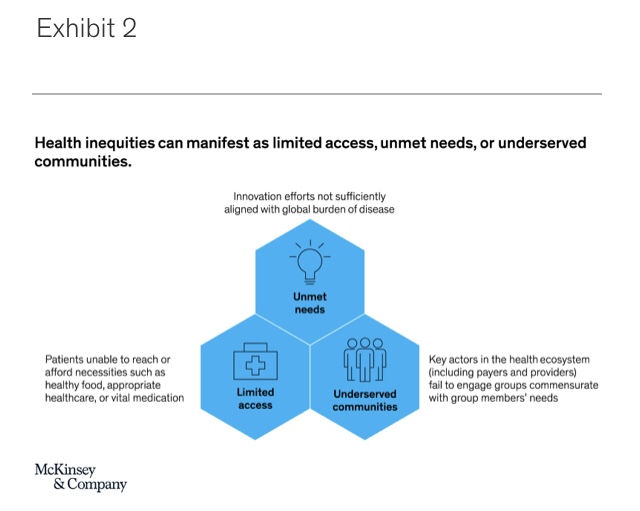
The first step is to define key terms and to keep those definitions constant across different markets. As a general principle, disadvantaged groups vary from region to region—for example, Black people in the United States and people of Turkish descent in Germany have health outcomes different from those of each country’s majority.2 We should also expect diseases to spread differently in different social contexts; the progression of health conditions can be intricately complex, and health inequities can manifest themselves as limited access, unmet needs, or underserved communities (Exhibit 2). Unclear terms can make precise analysis even harder. Health equity is not the same as health disparity or disease burden, and the differences are not academic.

Health inequities can manifest as limited access, unmet needs, or  underserved communities.

Keeping terms constant

Although different institutions may define the term in subtly different ways (see sidebar, “Defining health equity”), health equity means, as a foundational matter, that everyone in a given country or region has the opportunity to be as healthy as possible, regardless of social determinants. Health disparities are differences in health outcomes among groups in a given region: for example, there is a disparity in COVID-19 mortality rates—the disease is more likely to be fatal for people older than 70. Health or disease burden is the distribution of a given disease or health condition among different populations within a given area. In the United States, for instance, the disease burden for cystic fibrosis is borne primarily by White people, that for sickle cell disease overwhelmingly by Black people.

Defining health equity

Although the core concepts of health equity are fundamentally similar across different organizations and institutions, exact definitions can differ.

The World Health Organization defines health equity as “the absence of unfair and avoidable or remediable differences in health among population groups defined socially, economically, demographically, or geographically.” The US Centers for Disease Control and Prevention (CDC) says that “Health equity is achieved when every person has the opportunity to ‘attain his or her full health potential’ and no one is ‘disadvantaged from achieving this potential because of social position or other socially determined circumstances.’” And the National Center for Biotechnology Information (NCBI), also located in the United States, calls health equity “the principle underlying a commitment to reduce—and, ultimately, eliminate—disparities in health and in its determinants, including social determinants.”

Each of these definitions prominently includes social disparities. Social differences have evolved over years and often centuries but can change as societies themselves evolve. Thus it is important not only to embed the principle of health equity in organizations and keep it as a guiding star but also to continually correct course. The goal is to ensure that all people, regardless of social determinants, have a fair and abiding opportunity to realize their full health potential.

It is a fact of the human condition that different diseases spread unevenly among many different populations. Not all differences are matters of fairness, at least insofar as the definition of “fair” is reflected in different social outcomes. Breast cancer, for example disproportionally affects people born as biological women, just as hemophilia, a sex-linked recessive disorder, overwhelmingly affects people born as biological men.

Other burdens are unfair and socially determined, but not treatable by therapeutics. The European conquest of lands previously populated solely by Native Americans, for example, has had a continuing effect over time: Native Americans get a poorer education, live in worse housing, and drink dirtier water than other segments of society. Likewise, the island of Hispaniola (Haiti in the west, the Dominican Republic in the east), with its long and often tragic past, is divided by a border as superficial as a pen stroke but also by differences in culture and history that run far deeper. The average life expectancy for people in Haiti is under 66 years; for people in the Dominican Republic, it is more than six-and-a-half years higher. Such different outcomes—which are unfair by any definition—can be improved and, it’s to be hoped, eventually surmounted. But they can’t be solved (at least primarily) by pills, vaccines, or therapies.

Be focused . . . and curious

Because doctors, hospitals, and drugs are so closely related to health outcomes, people tend to overestimate both their authority and their importance. The provision of healthcare services, including doctors and drugs, typically explains only about 20 percent of the health of populations3 as measured by standards such as quality-adjusted life years (QALYs) and disability-adjusted life years (DALYs). Doctors and drugs are typically not the major determinants of health; factors such as clean water, clean air, and good nutrition are far more important in the aggregate. For pharmaceutical and life sciences players seeking to unlock health equity opportunities, one of the most important simplifiers for investing in health equity is therefore to think about burdens amenable to vaccines, therapeutics, or diagnostics, and to ask frankly about your organization’s expertise, the markets it may be missing, and, what the data say.

Data-driven solutions

It’s easy to be data driven—if there are quality data. But often there aren’t. Indeed, too many managers assume that there is some easily obtainable document or database that displays health burdens, in a precise and sortable way, by disease and population group. Yet why should there be? A consistent, comprehensive initiative to track global disease burdens was launched only in 2010. It’s an initiative to celebrate, to be grateful for, and to support. It’s also a work in progress, and not something that would or could come into being immediately and completely. The first step for a CEO or brand president is therefore to be relentlessly curious about data. Ask your teams what your company really has and how well they really know the burdens of a given disease.

The gaps in what we actually know, as compared with what we’ve arrived at through estimates and best guesses, can be profound. The majority of births and deaths in sub-Saharan Africa, for example, are not officially registered.4 Even in developed regions, including Western Europe and the United States, some populations can be significantly undercounted. These may be the very people most at risk, even if many of them are insured. Since we lack definitive information about how many patients overall are living with stage IV lung cancer in, for instance, Germany, identifying how many of them are of Turkish descent is even more challenging.

What’s more, the geographical rounding up that goes into measuring, on a consolidated basis, a disease or health condition by country or regional market can obscure the large disparities that may exist among the consolidated regions.5 In the United States, focusing on the national average of effective medical interventions for heart valve disease, for example, can frustrate efforts to identify compelling disparities among different regions and different states, counties, and cities—and even different hospitals in the same city. Sometimes, subsets can be on the order of millions of people, an overwhelming majority of whom are already insured and who live in close proximity to doctors or other health providers. Finally, even the way diseases are identified can be a form of guesswork or reflect unconscious or socialized bias. Women, for example, often have heart attack symptoms different from those of men, so women are at higher risk of misdiagnosis.6

Mapping the opportunity

Once teams have taken account of gaps in the data—and have invested to fill those gaps or at least to make more informed estimates—they can map opportunities in a revelatory way. This, in fact, is the stuff of “ah-hah moments.” One such moment comes when companies identify areas, in a market they already serve, where people are not receiving an existing therapy or medicine. Another comes from identifying populations with a health need a company could address, if only it knew that a treatment that it has already developed could be expanded to help those populations.

One useful approach is to think about whose problems a company is looking to solve. Protein supplements, for example, are often designed and developed by (and marketed to) men. Yet women, too, need protein and lose significant muscle mass as they age. Artificial hearts are a miracle of modern medicine—but one developed about ten years ago was too big for women. In large part, such problems exist because companies begin their knowledge journey by thinking that they are trying to solve a specific group’s problems. Even if they succeed, they may miss opportunities to help even more people and to tap new markets.

Of course, it’s natural for companies to focus on segments, to drill into subsegments, and to refine treatments to capture subsegments of those subsegments. But it’s also helpful to step back. Take a five-year audit. Whose problems has the company been solving? Who has it been missing? Data and a wider perspective help a company to better identify unmet needs and to compare the populations that have benefited more from its R&D spending and pipeline development with those that have benefited less.

That approach opens up the possibility of discovering significant white spaces. Is there a condition that does not have an effective intervention or has a set of patients who aren’t being included? Is there a condition that is being underfunded when the impact of investing in a medicine or therapy could be just as high, if not even higher, than the returns achieved from a similar medicine or therapy that the company is already developing or providing?

For example, hepatocellular carcinoma, among the most common cancers in Egypt (a country of more than 100 million people), currently has no adjuvant therapies on the market. Endometriosis, a condition in which tissue similar to the lining of the uterus grows in other parts of a woman’s body, affects about 10 percent of all women of reproductive age around the world but lacks more efficacious, nonhormonal treatments. Sickle cell disease, which disproportionally affects Black Americans, is three times more prevalent than cystic fibrosis, which disproportionally affects White Americans. Yet cystic fibrosis receives about 3.5 times more funding (in federal expenditures) and 75 times more foundation funding than sickle cell disease.7

Why epidemiology of care is the greatest unlock

Once companies have identified a white space—the gap between a need and their allocated resources—they can begin to play a distinctive role. The greatest unlock is addressing unwarranted variations in how patients are treated—the epidemiology of care. With sophisticated digital tools, advanced analytics, and relentless critical thinking, care gaps can now be mapped across the patient journey, taking into account what may be critical differences that affect different social groups.

Capabilities exist not only to consider everything that should happen in patient care and to map what effective treatments look like at each step but also to quantify them, at the level of individual patients and physicians. It is possible, as well, to measure what did not happen: how many patients are not receiving the right treatments, how many are receiving a late diagnosis, the percentage of patients receiving less effective therapies, the percentage who don’t receive follow-up scans, and more. In many cases, it is feasible to map and visualize these opportunities within a given city, or even within specific institutions.

In the United States, sophisticated extrapolations can often supplement ready data to allow for detailed analyses of the race and ethnicity of a patient, and almost always the gender. It’s also possible to extrapolate factors such as wealth and social level of deprivation, based on an area in which a doctor is practicing. This enables teams to develop both a more granular and a more comprehensive understanding of where the wrong outcomes are happening, and to whom. One study, for example, revealed that for a certain type of breast cancer, Black women had a lower likelihood of being prescribed the optimal therapy.8 That’s perhaps not surprising, particularly with overall averages.

Yet studies have also showed that racial differences in treatment and outcomes can vary significantly by geography. In some regions, outcomes are essentially the same for White and Black women, but there is a pronounced disparity in certain counties. Using appropriate real-world data, life sciences companies can measure and track these disparities with considerable geographic specificity, which allows both for more targeted interventions and a deeper understanding of the factors at work. Often, these factors lie at the intersection of multiple variables, such as race, socioeconomic conditions, and historical trends.

As patterns emerge across social groups and geographies, companies can zero in for more effective interventions—sometimes, even before a failure unfolds—to ensure that treatments are provided at (or at least closer to) the diagnosis stage and to avoid the effects of what can happen if they aren’t. In assessments of the epidemiology of care, the greatest opportunities for better health outcomes often come early. Depending upon the disease, getting to the right diagnosis quickly can have outsize effects on health outcomes.

The greatest opportunities for better health outcomes often come early. Depending upon the disease, getting to the right diagnosis quickly can have outsize effects on health outcomes.

Conversely, failing to make the right diagnosis, or sometimes even delaying it by an incremental period of time, will have cascading effects not only with respect to the initial condition but also from secondary and tertiary consequences that can result from misdiagnoses or delays. For example, the blood cancer multiple myeloma, which is more than twice as likely to strike Black as White Americans, can lead to severe kidney problems and, in turn, to heart failure.9 Doctors and health providers can forestall those consequences if the disease is diagnosed early but must be proactive to make the right diagnosis quickly. The consequences of delay increase in a nonlinear way.

Acting for health equity

Recognizing the importance of health equity and identifying opportunities to promote it are essential first steps but hardly the end of the journey. Players across the pharmaceutical and life sciences value chain can think about partnering both at the industry and community levels and begin to create a virtuous cycle that improves the epidemiology of care.

Industry engagement

Pharmaceutical and life sciences companies are well-positioned to advance health equity and to realize better outcomes for more patients, to reduce health system costs, and to innovate more—and more profitably. Although the social determinants of health (SDOH) are hyperlocal, pharmaceutical products are among the few constants across geographies.

The industry, which is already beginning to act collaboratively, can build on its momentum by taking several steps. For starters, companies can institute uniform industry standards to identify and track unmet needs—a move that will help calibrate R&D investments against the global disease burden. It will also galvanize the industry and other ecosystem players (such as governments and nongovernmental organizations) to fill gaps, and provide regulatory support for key initiatives. In addition, companies can agree on common metrics to track clinical trials and determine how well they match the underlying epidemiology of disease and develop codes of AI conduct to address the needs of different subpopulations.

In addition, individual companies or groups of companies can share their unique capabilities by partnering in specific regions. Abdul Latif Jameel Health and Butterfly Network, for example, are partnering to bring an advanced ultrasound device to underserved people across the Middle East, North Africa, and India. Best Buy Health, Boston Children’s Hospital, Alphabet, Microsoft, Validi, and others have joined the Health Equity and Access Leadership (HEAL) Coalition to mitigate health disparities through technology.

Empower community pull

Unfairness impedes good health; it’s unrealistic to expect that people will seek out health solutions if they distrust medicines and providers. In the United States, 5 percent of White adults report that they have been treated unfairly while receiving healthcare—compared with 19 percent of Hispanic adults and 20 percent of Black adults. These differences reflect historical inequities. Yet companies can foster trust from underserved groups and create community pull by highlighting inequity forthrightly and considering medicines and healthcare access holistically.

Consider the case of diabetes—a disease twice as likely to kill non-Hispanic Blacks as non-Hispanic Whites. Researchers have found that “satisfied patients work as ‘customer evangelists,’ spreading the good word about appropriate and timely diabetes care modalities in the family and community.”10 US Supreme Court justice Sonia Sotomayor, for example, who is of Puerto Rican descent, lives with Type 1 diabetes. She has been among the most passionate and committed activists for sticking to a treatment regimen. Her voice, together with a chorus of others, helps educate populations, generate community pull, and improve health outcomes.


Health equity is a compelling opportunity—and a challenge that pharmaceutical and life sciences players, both individually and collectively, are uniquely positioned to address. By following a defined approach that relentlessly follows the data and by working together, organizations can not only meet significant unmet needs but also create a cycle of trust in underserved communities for even better outcomes.

Article link; https://www.mckinsey.com/industries/life-sciences/our-insights/health-equity-a-framework-for-the-epidemiology-of-care?

ABOUT THE AUTHOR(S)

Anas El Turabi is a partner in McKinsey’s Waltham office; Anjali Menon is a consultant in the New Jersey office; Lucy Pérez is a senior partner in the Boston office; and Gila Tolub is a partner in the Tel-Aviv office.

DOD’s New Software Modernization Strategy Comes as Kessel Run Prepares for Major Milestone – GovCIO

Posted by timmreardon on 03/21/2022
Posted in: Uncategorized. Leave a comment

Kessel Run, DOD’s first software factory, is about to help one air combat command unit move all operations to a software environment designed via DevSecOps.

Kate Macri

Fri, 03/04/2022 – 20:43

The Defense Department announced a new software modernization strategy Feb. 8 to organize software development efforts throughout the department in line with current “software factory” efforts, such as Kessel Run, which are based on the DevSecOps philosophy of software development.

DOD’s new approach, which calls for a “department-wide software factory ecosystem,” will not only improve IT efficiency dramatically but also improve accuracy and response times, potentially resulting in more saved lives and less IT bloat and costs.

The announcement comes as Kessel Run, a software factory supporting the U.S. Air Force (USAF), is on the brink of reaching its first minimum viable capability release (MVCR1) for KRADOS, a suite of software applications designed to replace the 609th Air Operations Center’s Theater Battle Core Management Systems (TBCMS).

Kessel Run OpsC2 Product Line Chief Col. James Lotspeich said the goal of the MVCR1 milestone is to shift the 609th AOC’s reliance off of TBCMS and the Master Air Attack Planning Toolkit (MAAP-TK) entirely.

“It’s a big deal. A goal is to fully deprecate TBMCS in time, but for now, the 609th will be trading some inefficiencies for other improvements until we hit our milestone past MVCR1,” Lotspeich said in a statement to GovCIO Media & Research. “Before spring ends in 2022 with MVCR1, 609th will be able to plan, monitor and execute the Air Tasking Order/Air Combat Order (ATO/ACO) using only KRADOS for day-to-day operations with multi-tenant user bases and logically separated data and environments.”

Kessel Run currently has training plans for four KRADOS applications, as relayed by Lotspeich:

  • Spacer, “an air space management tool that coordinates and deconflicts air spaces within a set area of responsibility;”
  • MaiTai, which allows commanders to see available assets in a secure manner;
  • Slapshot, which builds the Master Air Attack Plan (MAAP) and supports global users in the Combat Operations Division (COD); and
  • Jigsaw, an interface that helps tank planners “save time, fuel and lives.”

According to Lotspeich, the Jigsaw application in KRADOS has saved DOD $500 million in fuel costs and is also used by NATO partners.

DOD’s software modernization strategy will make achievements like Kessel Run’s KRADOS the standard across all military service branches, potentially saving the department billions of dollars in IT costs each year.

“Kessel Run is more than a software factory,” Col. Brian Beachkofski, Kessel Run’s commander and CEO, told GovCIO Media & Research in a statement. “Kessel Run is a DevSecOps unit whose responsibilities are the full scope of DevSecOps. Our model is the right construct to implement the vision for the memo: ‘deliver resilient software capability at the speed of relevance.’ Our support during Operation Allied Refuge and the evacuation of Kabul shows why that full scope leads directly to operating at the speed of relevance.”

DOD’s memo outlining the new software modernization strategy describes a DevSecOps, Agile approach to software delivery that learns and responds to DOD mission needs in real-time. 

Beachkofski said one of Kessel Run’s goals is to train airmen to be savvy software engineers to help close the tech talent gap at DOD and help the department shift to a DevSecOps mindset in a sustainable way.

Beachkofski’s vision aligns with comments from Hannah Hunt, Chief Product and Innovation Officer at Army Futures Command, last fall (Army Futures Command is a software factory serving the U.S. Army).

“Kessel Run’s focus on talent acquisition has centered not on recruiting from the private sector, but rather bringing private sector learnings to the Air Force and encouraging servicemen to adopt them,” Beachkofski said. “This has been designed with the intent of building a skill and knowledge base within the Air Force itself.”

DOD also emphasizes the need for improved software supply chain security in the memo describing the new strategy.

Kessel Run Chief Security Officer Brandon Johns said Kessel Run “applauds” recent moves within DOD toward adopting “Software Bills of Materials” (SBOMs) to document every line of code in the software supply chain, but believes DOD should still prepare for breaches despite best efforts to prevent them.

A DevSecOps approach can help with that.

“We build a system that provides us with telemetry and visibility so that we can detect the anomalies that indicate when a product, service, or user isn’t behaving as expected,” Johns told GovCIO Media & Research in a statement. “This allows us early and vital alerting so that we can respond and ensure mission completion.”

DOD’s software modernization strategy positions the department to follow in Kessel Run’s footsteps, but Beachofski said DOD’s definition of a software factory “is slightly out of step” with their definition of DevSecOps. Instead of launching new software factories to release software, Beachofski believes DOD should focus on deploying more DevSecOps units throughout the department to foster Agile culture.

“We need more DevSecOps units and not software factories,” he said. “Kessel Run was founded as a pathfinder to see what works and allow the wider community to benefit from our lessons learned. This is the chance to realize that our differential impact to fielded users at the 609th AOC is directly related to our implementation of DevSecOps and our structure mirroring our strategy. There is an opportunity to use the current focus on DevSecOps to do what we did for cyber operations and combine the required authorities into a single organization that is responsible for all of DevSecOps.”

Article link: https://governmentciomedia.com/dods-new-software-modernization-strategy-comes-kessel-run-prepares-major-milestone

Statement by President Biden on our Nation’s Cybersecurity – WH.GOV

Posted by timmreardon on 03/21/2022
Posted in: Uncategorized. Leave a comment

MARCH 21, 2022

https://www.whitehouse.gov/briefing-room/statements-releases/

This is a critical moment to accelerate our work to improve domestic cybersecurity and bolster our national resilience.  I have previously warned about the potential that Russia could conduct malicious cyber activity against the United States, including as a response to the unprecedented economic costs we’ve imposed on Russia alongside our allies and partners. It’s part of Russia’s playbook. Today, my Administration is reiterating those warnings based on evolving intelligence that the Russian Government is exploring options for potential cyberattacks.

From day one, my Administration has worked to strengthen our national cyber defenses, mandating extensive cybersecurity measures for the Federal Government and those critical infrastructure sectors where we have authority to do so, and creating innovative public-private partnerships and initiatives to enhance cybersecurity across all our critical infrastructure. Congress has partnered with us on these efforts — we appreciate that Members of Congress worked across the aisle to require companies to report cyber incidents to the United States Government.

My Administration will continue to use every tool to deter, disrupt, and if necessary, respond to cyberattacks against critical infrastructure. But the Federal Government can’t defend against this threat alone. Most of America’s critical infrastructure is owned and operated by the private sector and critical infrastructure owners and operators must accelerate efforts to lock their digital doors. The Department of Homeland Security’s Cybersecurity and Infrastructure Security Agency (CISA) has been actively working with organizations across critical infrastructure to rapidly share information and mitigation guidance to help protect their systems and networks

If you have not already done so, I urge our private sector partners to harden your cyber defenses immediately by implementing the best practices we have developed together over the last year. You have the power, the capacity, and the responsibility to strengthen the cybersecurity and resilience of the critical services and technologies on which Americans rely. We need everyone to do their part to meet one of the defining threats of our time — your vigilance and urgency today can prevent or mitigate attacks tomorrow.

Article link: https://www.whitehouse.gov/briefing-room/statements-releases/2022/03/21/statement-by-president-biden-on-our-nations-cybersecurity/

The Dalai Lama on Why Leaders Should Be Mindful, Selfless, and Compassionate – HBR

Posted by timmreardon on 03/20/2022
Posted in: Uncategorized. Leave a comment

by The Dalai Lama with Rasmus Hougaard

February 20, 2019

Summary.   The Dalai Lama shares his observations on leadership and describes how our “strong focus on material development and accumulating wealth has led us to neglect our basic human need for kindness and care.” He offers leaders three recommendations. First, to be mindful: “When we’re under the sway of anger or attachment, we’re limited in our ability to take a full and realistic view of the situation.” Also, to be selfless: “Once you have a genuine sense of concern for others, there’s no room for cheating, bullying, or exploitation; instead you can be honest, truthful, and transparent in your conduct.” And finally, to be compassionate: “When the mind is compassionate, it is calm and we’re able to use our sense of reason practically, realistically, and with determination.”close

Over the past nearly 60 years, I have engaged with many leaders of governments, companies, and other organizations, and I have observed how our societies have developed and changed. I am happy to share some of my observations in case others may benefit from what I have learned.

Leaders, whatever field they work in, have a strong impact on people’s lives and on how the world develops. We should remember that we are visitors on this planet. We are here for 90 or 100 years at the most. During this time, we should work to leave the world a better place.

What might a better world look like? I believe the answer is straightforward: A better world is one where people are happier. Why? Because all human beings want to be happy, and no one wants to suffer. Our desire for happiness is something we all have in common.

But today, the world seems to be facing an emotional crisis. Rates of stress, anxiety, and depression are higher than ever. The gap between rich and poor and between CEOs and employees is at a historic high. And the focus on turning a profit often overrules a commitment to people, the environment, or society.

I consider our tendency to see each other in terms of “us” and “them” as stemming from ignorance of our interdependence. As participants in the same global economy, we depend on each other, while changes in the climate and the global environment affect us all. What’s more, as human beings, we are physically, mentally, and emotionally the same.

Look at bees. They have no constitution, police, or moral training, but they work together in order to survive. Though they may occasionally squabble, the colony survives on the basis of cooperation. Human beings, on the other hand, have constitutions, complex legal systems, and police forces; we have remarkable intelligence and a great capacity for love and affection. Yet, despite our many extraordinary qualities, we seem less able to cooperate.

In organizations, people work closely together every day. But despite working together, many feel lonely and stressed. Even though we are social animals, there is a lack of responsibility toward each other. We need to ask ourselves what’s going wrong.

I believe that our strong focus on material development and accumulating wealth has led us to neglect our basic human need for kindness and care. Reinstating a commitment to the oneness of humanity and altruism toward our brothers and sisters is fundamental for societies and organizations and their individuals to thrive in the long run. Every one of us has a responsibility to make this happen.

What can leaders do?

Be mindful

Cultivate peace of mind. As human beings, we have a remarkable intelligence that allows us to analyze and plan for the future. We have language that enables us to communicate what we have understood to others. Since destructive emotions like anger and attachment cloud our ability to use our intelligence clearly, we need to tackle them.

Fear and anxiety easily give way to anger and violence. The opposite of fear is trust, which, related to warmheartedness, boosts our self-confidence. Compassion also reduces fear, reflecting as it does a concern for others’ well-being. This, not money and power, is what really attracts friends. When we’re under the sway of anger or attachment, we’re limited in our ability to take a full and realistic view of the situation. When the mind is compassionate, it is calm and we’re able to use our sense of reason practically, realistically, and with determination.

Be selfless

We are naturally driven by self-interest; it’s necessary to survive. But we need wise self-interest that is generous and cooperative, taking others’ interests into account. Cooperation comes from friendship, friendship comes from trust, and trust comes from kindheartedness. Once you have a genuine sense of concern for others, there’s no room for cheating, bullying, or exploitation; instead, you can be honest, truthful, and transparent in your conduct.

Be compassionate

The ultimate source of a happy life is warmheartedness. Even animals display some sense of compassion. When it comes to human beings, compassion can be combined with intelligence. Through the application of reason, compassion can be extended to all 7 billion human beings. Destructive emotions are related to ignorance, while compassion is a constructive emotion related to intelligence. Consequently, it can be taught and learned.

The source of a happy life is within us. Troublemakers in many parts of the world are often quite well-educated, so it is not just education that we need. What we need is to pay attention to inner values.

The distinction between violence and nonviolence lies less in the nature of a particular action and more in the motivation behind the action. Actions motivated by anger and greed tend to be violent, whereas those motivated by compassion and concern for others are generally peaceful. We won’t bring about peace in the world merely by praying for it; we have to take steps to tackle the violence and corruption that disrupt peace. We can’t expect change if we don’t take action.

Peace also means being undisturbed, free from danger. It relates to our mental attitude and whether we have a calm mind. What is crucial to realize is that, ultimately, peace of mind is within us; it requires that we develop a warm heart and use our intelligence. People often don’t realize that warmheartedness, compassion, and love are actually factors for our survival.

Buddhist tradition describes three styles of compassionate leadership: the trailblazer, who leads from the front, takes risks, and sets an example; the ferryman, who accompanies those in his care and shapes the ups and downs of the crossing; and the shepherd, who sees every one of his flock into safety before himself. Three styles, three approaches, but what they have in common is an all-encompassing concern for the welfare of those they lead.

Article link: https://hbr-org.cdn.ampproject.org/c/s/hbr.org/amp/2019/02/the-dalai-lama-on-why-leaders-should-be-mindful-selfless-and-compassionate

  • The Dalai Lama is the spiritual leader of the Tibetan People. He was awarded the Nobel Peace Prize in 1989 and the U.S. Congressional Gold Medal in 2007. Rasmus Hougaard is the founder and managing director of Potential Project, a global leadership and organizational development firm, and the coauthor of the new book, The Mind of the Leader: How to Lead Yourself, Your People, and Your Organization for Extraordinary Results. He has created an app that will help you develop mindfulness, selflessness, and compassion in your leadership

Market Research for VA Supply Chain Modernization – Webinar – 21 March 2022

Posted by timmreardon on 03/18/2022
Posted in: Uncategorized. Leave a comment

Please share with friends and colleagues that might have an interest in Market Research for VA Supply Chain Modernization – part 3

Greetings,

You are invited to a Zoom webinar.
When: Mar 21, 2022 01:00 PM Eastern Time (US and Canada)
Topic: Market Research for VA Supply Chain Modernization – Part 3

Register in advance for this webinar:
https://us02web.zoom.us/webinar/register/WN_RZgFjt5JS6aU5ehv2xNxjg

After registering, you will receive a confirmation email containing information about joining the webinar.


Webinar Speakers

Ross A. Davidson (Associate Executive Director, Office of Facilities Planning Office of Construction and Facilities Management @Department of Veterans affairs)
Mr. Davidson serves as the principal advisor to the Executive Director, CFM on planning, architectural, engineering, and estimating disciplines, and assists and manages the development and maintenance of VA A/E quality standards for VA’s built environment; State Nursing Home Grant and Homeless Grant Programs’ facility quality control; cost estimating; and value engineering, and historic preservation and National Environmental Policy Act (NEPA) compliance issues.
Mr. Davidson is a retired U.S. Army Colonel with an extensive and successful background of service.

Mr. Davidson has a Bachelor of Architecture from the University of Notre Dame, a Master of Urban Design, a Master of Urban Planning, and a Graduate Certificate in Real Estate Development from the University of Michigan, and Master of Strategic Studies from the U.S Army War College. He is a Design Build Institute of America (DBIA) professional and Fellow with the Health Facility Institute.

Matthew J. Manning (Assistant Director, HCA Acquisition Division Office of Mission Support @Veterans Benefits Administration)

Vincent S. Calabrese (National Program Manager, Customer Service Consolidated Mail Outpatient Pharmacy National Office @Department of Veterans Affairs)

Michael Parrish (Principal Executive Director for the Office of Acquisition, Logistics, and Construction (OALC). Head of Contracts. @Department of Veterans Affairs)
Mr. Parrish has over 35 years of senior leadership experience in military, government, corporate, and non-profit organizations. After graduating in 1985 with a Bachelor’s Degree in Mechanical Engineering from the U.S. Military Academy, Mr. Parrish served for 14 years on active duty and 21 years in the in the U.S. Army Reserves where he held various leadership positions of increasing responsibility as an Army Aviator, serving as an Air Operations Officer during Desert Storm and culminating as a member of the Army Acquisition Corps. Mr. Parrish has been Chairman & CEO of several publicly traded companies and was founder and CEO for several start-ups. Mr. Parrish holds a Master’s Degree in Aeronautical and Astronautical Engineering from Stanford University and an MBA with honors from the Wharton School at the University of Pennsylvania.

Joe Grace, Captain USN (Retired) (President and CEO (Moderator for this event) @Grace and Associates)
Captain Joe Grace, USN (Retired), is the President and CEO of Grace & Associates. Mr. Grace is a graduate of the United States Naval Academy, a former nuclear submarine officer, and earned his MBA from the University of New Orleans. During his active and reserve military career, he worked a variety of military assignments, including his final tour as the Chief Information Officer for Navy Medicine. Mr. Grace has worked for multiple companies and held many positions in industry. He is a serial entrepreneur, venture construction leader and long time business owner. He now works as a connector between industry and government, with an emphasis on Military Health and the Department of Veterans Affairs. His many roles include Moderator, Facilitator, a key trusted advisor to leadership and a mentor to industry and government. As an entrepreneur, Mr. Grace has started many technology-based companies and taken three public. Grace & Associates holds no government contracts

Dr. Angela Billups (Executive Director, Office of Acquisition and Logistics @Department of Veterans Affairs)
Dr. Angela Billups was appointed as the Executive Director, Office of Acquisition and Logistics at the Department of Veterans Affairs (VA) on November 26, 2018. As the Executive Director of one of the largest acquisition and logistics programs in the Federal government, Dr. Billups manages and oversees the development and implementation of policies and procedures for department-wide acquisition and logistics programs supporting all VA facilities and the VA Acquisition Academy in Frederick, Maryland. She is the primary advisor to the Chief Acquisition Officer and to the Secretary of Veterans Affairs for matters related to enterprise business strategies and acquisition management. Dr. Billups also serves as the VA Senior Procurement Executive and VA Suspension and Debarment Official. Dr. Billups is a seasoned acquisition professional with years of experience advising and assisting senior officials, government and industry, with the goal of helping them realize the acquisition life cycle.

Greg McLean (Special Projects Manager @Department of Veterans Affairs)
Gregory “Greg” McLean Special Project Manager Reported to APS (on detail) in May 2020. Gregory McLean is Vice-Chancellor of the VA Acquisition Academy (VAAA) Program Management (PM) School, where he oversees the training of VA program managers. The Program Management curriculum is intended to ensure that VA has the most qualified program managers and includes competency assessment, classroom and online learning, coaching and mentoring, on-the-job qualification development, assignment-specific courses, training toward Federal Acquisition Certification in Program/Project Management (FAC-P/PM), and continuing education. Mr. McLean previously served as Director of Program Management Policy in the Department of Veterans Affairs Office of Policy and Planning. Mr. McLean has more than 22 years of industry and Government experience, including developing and implementing national training and certification programs for major and critical acquisition initiatives.

Phillip Christy (Deputy Executive Director, Office of Acquisition, Logistics, and Construction (OALC) @Department of Veterans Affairs)
Mr. Christy serves as an advisor to OALCs Principal Executive Director on acquisition, logistics, and construction issues. His responsibilities include the day to day operational management of OALCs three major organizational elements: the Office of Acquisition and Logistics, the Office of Procurement, Acquisition and Logistics and the Office of Construction and Facilities Management. Mr. Christy is a retired U.S. Army Medical Service Corps Officer, and he served in multiple senior acquisition, construction and logistics positions during his 20-year career. Mr. Christy is a native of Renton, Washington. He holds an Executive Juris Doctorate in Health Law from the Concord University of Law, a Master of Science in Health Care Administration from Central Michigan University, and a Bachelor of Arts in Spanish and Business from Washington State University

Posts navigation

← Older Entries
Newer Entries →
  • Search site

  • Follow healthcarereimagined on WordPress.com
  • Recent Posts

    • Heeding the pope’s call to ensure AI protects human dignity – MIT Sloan Management 06/01/2026
    • Association between Wealth and Mortality in the United States and Europe – New England Journal of Medicine 05/30/2026
    • U.S. Health Care from a Global Perspective, 2026 – The Commonwealth Fund 05/30/2026
    • Anthropic co-founder Chris Olah’s remarks on Pope Leo XIV’s encyclical “Magnifica humanitas” 05/28/2026
    • Magnifica_Humanitas – Full English 05/26/2026
    • Pope Leo XIV to launch his first encylical, a document on artificial intelligence, with Anthropic’s co-founder – PBS 05/24/2026
    • Quantum Computing is Approaching A Critical “Prove It” Phase 05/22/2026
    • Hidden Prices, Broken Promises: Why Health Care Transparency Is a Matter of Justice – Sanders Institute 05/15/2026
    • The Very Uncertain Future of Arms Control – Bulletin of the Atomic Scientists 05/13/2026
    • Now Available: Expanded and Enhanced International Health Care System Profiles – Commonwealth Fund 05/13/2026
  • Categories

    • Accountable Care Organizations
    • ACOs
    • AHRQ
    • American Board of Internal Medicine
    • Big Data
    • Blue Button
    • Board Certification
    • Cancer Treatment
    • Data Science
    • Digital Services Playbook
    • DoD
    • EHR Interoperability
    • EHR Usability
    • Emergency Medicine
    • FDA
    • FDASIA
    • GAO Reports
    • Genetic Data
    • Genetic Research
    • Genomic Data
    • Global Standards
    • Health Care Costs
    • Health Care Economics
    • Health IT adoption
    • Health Outcomes
    • Healthcare Delivery
    • Healthcare Informatics
    • Healthcare Outcomes
    • Healthcare Security
    • Helathcare Delivery
    • HHS
    • HIPAA
    • ICD-10
    • Innovation
    • Integrated Electronic Health Records
    • IT Acquisition
    • JASONS
    • Lab Report Access
    • Military Health System Reform
    • Mobile Health
    • Mobile Healthcare
    • National Health IT System
    • NSF
    • ONC Reports to Congress
    • Oncology
    • Open Data
    • Patient Centered Medical Home
    • Patient Portals
    • PCMH
    • Precision Medicine
    • Primary Care
    • Public Health
    • Quadruple Aim
    • Quality Measures
    • Rehab Medicine
    • TechFAR Handbook
    • Triple Aim
    • U.S. Air Force Medicine
    • U.S. Army
    • U.S. Army Medicine
    • U.S. Navy Medicine
    • U.S. Surgeon General
    • Uncategorized
    • Value-based Care
    • Veterans Affairs
    • Warrior Transistion Units
    • XPRIZE
  • Archives

    • June 2026 (1)
    • May 2026 (12)
    • April 2026 (4)
    • March 2026 (9)
    • February 2026 (6)
    • January 2026 (8)
    • December 2025 (11)
    • November 2025 (9)
    • October 2025 (10)
    • September 2025 (4)
    • August 2025 (7)
    • July 2025 (2)
    • June 2025 (9)
    • May 2025 (4)
    • April 2025 (11)
    • March 2025 (11)
    • February 2025 (10)
    • January 2025 (12)
    • December 2024 (12)
    • November 2024 (7)
    • October 2024 (5)
    • September 2024 (9)
    • August 2024 (10)
    • July 2024 (13)
    • June 2024 (18)
    • May 2024 (10)
    • April 2024 (19)
    • March 2024 (35)
    • February 2024 (23)
    • January 2024 (16)
    • December 2023 (22)
    • November 2023 (38)
    • October 2023 (24)
    • September 2023 (24)
    • August 2023 (34)
    • July 2023 (33)
    • June 2023 (30)
    • May 2023 (35)
    • April 2023 (30)
    • March 2023 (30)
    • February 2023 (15)
    • January 2023 (17)
    • December 2022 (10)
    • November 2022 (7)
    • October 2022 (22)
    • September 2022 (16)
    • August 2022 (33)
    • July 2022 (28)
    • June 2022 (42)
    • May 2022 (53)
    • April 2022 (35)
    • March 2022 (37)
    • February 2022 (21)
    • January 2022 (28)
    • December 2021 (23)
    • November 2021 (12)
    • October 2021 (10)
    • September 2021 (4)
    • August 2021 (4)
    • July 2021 (4)
    • May 2021 (3)
    • April 2021 (1)
    • March 2021 (2)
    • February 2021 (1)
    • January 2021 (4)
    • December 2020 (7)
    • November 2020 (2)
    • October 2020 (4)
    • September 2020 (7)
    • August 2020 (11)
    • July 2020 (3)
    • June 2020 (5)
    • April 2020 (3)
    • March 2020 (1)
    • February 2020 (1)
    • January 2020 (2)
    • December 2019 (2)
    • November 2019 (1)
    • September 2019 (4)
    • August 2019 (3)
    • July 2019 (5)
    • June 2019 (10)
    • May 2019 (8)
    • April 2019 (6)
    • March 2019 (7)
    • February 2019 (17)
    • January 2019 (14)
    • December 2018 (10)
    • November 2018 (20)
    • October 2018 (14)
    • September 2018 (27)
    • August 2018 (19)
    • July 2018 (16)
    • June 2018 (18)
    • May 2018 (28)
    • April 2018 (3)
    • March 2018 (11)
    • February 2018 (5)
    • January 2018 (10)
    • December 2017 (20)
    • November 2017 (30)
    • October 2017 (33)
    • September 2017 (11)
    • August 2017 (13)
    • July 2017 (9)
    • June 2017 (8)
    • May 2017 (9)
    • April 2017 (4)
    • March 2017 (12)
    • December 2016 (3)
    • September 2016 (4)
    • August 2016 (1)
    • July 2016 (7)
    • June 2016 (7)
    • April 2016 (4)
    • March 2016 (7)
    • February 2016 (1)
    • January 2016 (3)
    • November 2015 (3)
    • October 2015 (2)
    • September 2015 (9)
    • August 2015 (6)
    • June 2015 (5)
    • May 2015 (6)
    • April 2015 (3)
    • March 2015 (16)
    • February 2015 (10)
    • January 2015 (16)
    • December 2014 (9)
    • November 2014 (7)
    • October 2014 (21)
    • September 2014 (8)
    • August 2014 (9)
    • July 2014 (7)
    • June 2014 (5)
    • May 2014 (8)
    • April 2014 (19)
    • March 2014 (8)
    • February 2014 (9)
    • January 2014 (31)
    • December 2013 (23)
    • November 2013 (48)
    • October 2013 (25)
  • Tags

    Business Defense Department Department of Veterans Affairs EHealth EHR Electronic health record Food and Drug Administration Health Health informatics Health Information Exchange Health information technology Health system HIE Hospital IBM Mayo Clinic Medicare Medicine Military Health System Patient Patient portal Patient Protection and Affordable Care Act United States United States Department of Defense United States Department of Veterans Affairs
  • Upcoming Events

Blog at WordPress.com.
healthcarereimagined
Blog at WordPress.com.
  • Subscribe Subscribed
    • healthcarereimagined
    • Join 153 other subscribers
    • Already have a WordPress.com account? Log in now.
    • healthcarereimagined
    • Subscribe Subscribed
    • Sign up
    • Log in
    • Report this content
    • View site in Reader
    • Manage subscriptions
    • Collapse this bar

Loading Comments...