healthcarereimagined

Envisioning healthcare for the 21st century

  • About
  • Economics

Every Child Counts!

Posted by timmreardon on 04/13/2022
Posted in: Uncategorized. Leave a comment

Lorraine and Joyce, of Every Child Counts, Inc., delivered 152.3 lbs. of non-perishable food items to Janet, our Food Services Community Engagement Manager. The generous donation is in keeping with the organization’s mission, “To improve the lives of children from birth to 18 years old.” #everychildcounts #fooddonations #foodinsecurity #chestereastside

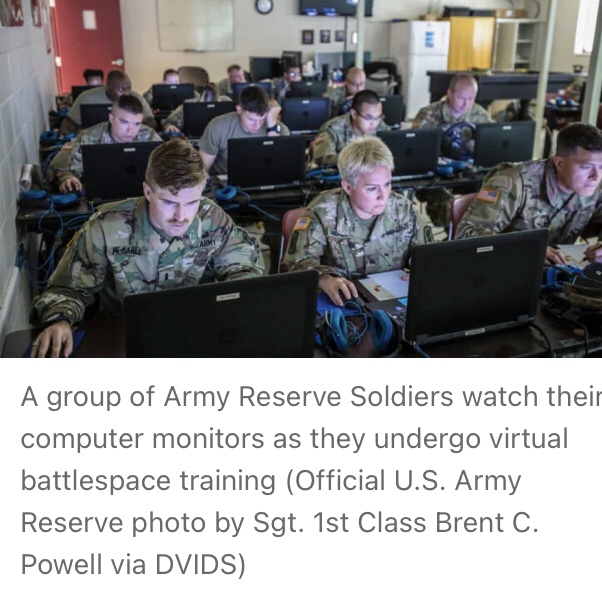
To Aid Digital Transformation, Army Eyes ‘One Cloud’ And Faster Acquisition – Breaking Defense

Posted by timmreardon on 04/12/2022
Posted in: Uncategorized. Leave a comment

By Theresa Hitchens on October 13, 2021 at 3:17 PM

AUSA: The Army is looking to create a unified cloud environment as a key piece of its new Army Digital Transformation Strategy (ADTS) aimed at centralizing its vast numbers of computer systems, data standards, cloud capabilities and cybersecurity procedures. And to that end, the service also is seeking to expand its use of non-traditional acquisition authorities, top officials explained today.

The strategy represents “a shift in terms of us starting to do things more at an enterprise, centralized level,” Raj Iyer, the Army’s chief information officer (CIO), told reporters in the margin of the annual Association of the United States Army (AUSA) trade show. “The Army in the past has always executed traditional IT in a very decentralized way — we let every command do their own thing. And that’s all led to a lot of silos of excellence over the years. Now, if you look at the requirements for multi-domain operations, that model doesn’t work anymore.”

RELATED: ‘Global By Nature’: Generals Say Unified Network Is ‘Operational Imperative’

The CIO office’s press to unify its “enterprise and tactical clouds” — and accelerate migration of data to that new cloud architecture in a standardized way — thus is a major focus of the ADTS.

“For cloud migration, it’s key that the office of CIO establishes the standards to do that migration,” stressed Brig. Gen. Matt Easley during the press roundtable. “We can’t allow every program office to go out and move to a cloud environment of their own their own design. We have to tell them the data standards we want them to use, the architecture standards, the cybersecurity standards on how we want them connected, and how to fuse that data to make that data usable and visible to the rest of the force.”

The service sees its multi-pronged $15 billion digital modernization effort as a top priority, the officials said, because it underpins the Army’s ability to plug and play into DoD’s Joint All Domain Command and Control (JADC2) strategy. Markowitz said the service has been working closely with the Joint Staff’s J6 directorate for Command, Control, Communications, & Computers/Cyber, Lt. Gen. Dennis Crall. In particular, this involves using contingency operations, such as the Afghanistan evacuation, and exercises, including Project Convergence, designed to figure out how to share Army information and data with the Combatant Commands, he said.

RELATED: DISA Head: DoD Working To Modernize ICAM, C2, Data Use

“We’re trying to experiment in real time with ongoing operations or exercises, kind of building a data foundation for a Combatant Command level, and for the Army’s interest we really want to make sure that data structure of how information flows is common across all Combatant Commands,” he said.

Mixing ‘Colors Of Money’

Iyer said that the ADTS also represents a shift in how the service works to encourage innovation and bring in industry partners, he said, including changing its acquisition approach.

While the Army, like all the services, faces challenges due to resource constraints, with his $15 billion annual budget, Iyer said, “money is not the problem” in implementing the digital transformation. It does mean having to divest its multiple individual data centers to invest instead in creating “one cloud.” A bigger issue is figuring out how to reform how the Army approaches budgeting.

Iyer said he has been talking with congressional staffers about how the Army can have more flexibility in the Planning, Programming, Budgeting and Execution (PPBE) process, and in how it funds digitization and cybersecurity  across “colors of money” — that is, separate budget pots for research and development, procurement and operations and maintenance.

“We are absolutely in favor of some reform, especially when it comes to how we budget for digital, and then cyber quite frankly, because our cyber threats are changing and evolving all the time. The way the PPBE process works is that you plan for something five years in advance, and then you program for it, and then you wait and five years later you get the money to execute. But we know how fast technology changes, we know how fast the the threats in the cyberspace are changing. And so, it’s a question about the flexibility the process to be able to do things.”

And while Congress has given the Defense Department more ability to use non-traditional acquisition tools, such as Broad Agency Announcements and Other Transaction Authorities,the Army up to now has been a bit cautious on how it applied them to software development, digitization and cybersecurity, David Markowitz, the service’s chief data officer, said during the roundtable.

“I’m not sure we’ve used the pilot authorities to the extent folks in Congress wanted us to. We’re a little slower than the Air Force, they’re a little more aggressive on these,” he said.

That’s in part because service leaders are still struggling a bit to understand exactly what is going on internally with investments.

“We have to do the internal work. Let’s be honest, we have difficulty seeing across the large scope of the Army how money is being spent in the digital area, and particularly on cyber security,” he added.

Article link: https://breakingdefense-com.cdn.ampproject.org/c/s/breakingdefense.com/2021/10/to-aid-digital-transformation-army-eyes-one-cloud-and-faster-acquisition/amp/

READ MORE AT BREAKING DEFENSE →

TOPICS

Army, Army Digital Transformation Strategy, AUSA 2021, cloud, cloud computing, cybersecurity, JADC2, Other Transaction Authority, Planning Programming Budgeting & Execution (PPBE), PPBE, Raj Iyer

QUANTUM INFORMATION SCIENCE – AFRL

Posted by timmreardon on 04/11/2022
Posted in: Uncategorized. Leave a comment

Quantum information science applies the best understanding of the sub-atomic world—quantum theory—to generate new knowledge and technologies. Quantum will revolutionize Air and Space Force operations.

The U.S. military is leading the acceleration of quantum research and development as first adopters for this fundamental technology to move the ball forward. Quantum will lead to technologies that will transform the war-fighting domain in revolutionary and unprecedented ways.

AFRL QUANTUM LABS

AFRL conducts and sponsors research across the globe, including in our laboratories in New York and New Mexico.

READ MORE ›

ULTRACOLD ATOMS

AFRL’s Quantum Sensing & Timing (QST) group seeks to take advantage of Nobel-Prize winning cold-atoms physics and related techniques to develop solutions for critical DoD problems in positioning, navigation and timing.

READ MORE ›

PHOTONIC MICROCOMBS

Photonic integrated circuits (PICs) will play a key role in transitioning quantum-enabled technologies beyond the laboratory. Our team investigates novel photonic components including microcombs and PIC-compatible laser sources.

READ MORE ›

LEVITATED OPTOMECHANICS

AFRL’s Quantum Sensing & Timing (QST) group seeks to use optically-levitated nanoparticles to develop solutions for critical problems in navigation and communication. The focus is on employing cutting-edge physics to develop sensors that are functional in a wide variety of situations.

READ MORE ›

ATOMIC CLOCKS & TIMING

AFRL’s Quantum Sensing & Timing (QST) group looks into the development of advanced atomic clocks to further improve time measurements and investigates ways to use and distribute the precise time.

READ MORE ›

TRAPPED IONS

AFRL’s trapped ion team investigates quantum mechanics and quantum information science with the long-term goal of constructing a quantum network made for processing and transmitting quantum information.

READ MORE ›

QUANTUM ALGORITHMS

The AFRL Quantum Algorithms group explores the design and application of quantum algorithms across research topics such as quantum optimization, algorithms, and quantum machine learning. The team also utilizes noisy, intermediate-scale quantum (NISQ) devices.

READ MORE ›

INTEGRATED PHOTONICS AND PHOTON QUBITS

The mission of the AFRL’s Quantum Information Processing Group is to generate, manipulate/process, distribute and analyze quantum entanglement both locally and distributed over processing nodes in a quantum network consisting of photon-based and memory-based quantum bits.

READ MORE ›

SUPERCONDUCTING & HYBRID QUANTUM SYSTEMS

The superconducting and hybrid quantum systems team at Rome Labs seeks to develop novel superconducting architectures and cross-modality quantum interface hardware as building blocks for use in quantum networking nodes.

READ MORE ›

STRATEGIC ATOMIC NAVIGATION DEVICES AND SYSTEMS (SANDS)

Archive Content | The SANDS program invested in Quantum Timing and Sensing components to improve the DoD’s Position, Navigation and Timing (PNT) warfighting capability.

READ MORE ›

Article link: https://afresearchlab.com/technology/quantum/

Why People Get Away with Being Rude at Work – HBR

Posted by timmreardon on 04/11/2022
Posted in: Uncategorized. Leave a comment

by 

  • Shannon G. Taylor,
  • Donald H. Kluemper,
  • W. Matthew Bowler,
  • Jonathon R. B. Halbesleben

July 10, 2019

Summary.   People who experience workplace rudeness report lower engagement, suffer more mental and physical health problems, and are more likely to burn out and quit their jobs. But while some research has indicated leaders take reports of bad behavior seriously, get the facts, and punish offenders, a new series of studies paints a much bleaker picture. First, researchers show that victims of rudeness were largely perceived by their manager as perpetrators of rude behavior. And the employees who were reported as being rude to others weren’t seen that way by their manager under two conditions: when they had a tight relationship with the boss or were high performers. Second, victims of rudeness were perceived as performing considerably worse by research participants than employees who hadn’t been mistreated, regardless of the employees’ actual performance. To address this, leaders must become more aware of their biases and how to prevent them from affecting their decision making.close

Bad behavior at work can have very real consequences. People who experience workplace rudeness, for example, report lower engagement, suffer more mental and physical healthproblems, and are more likely to burn out and quit their jobs. And nearly all of us are affected by rudeness and other types of workplace misbehavior, like interrupting and exclusion: Estimates suggest 98% of employees are on the receiving end over the course of a year.

Given bad behavior’s prevalence and impact, surely leaders take reports of it seriously, get the facts, and punish offenders, right? Some scholars have noted that, when information about misbehavior surfaces, savvy leaders know better than to blame the messenger. Unfortunately, our research paints a picture that is much bleaker.

We set out to investigate how people in positions of power view victims and perpetrators of workplace misbehavior. We first studied an organization that operates a chain of casual dining restaurants. We gave each employee a list of the names of every other employee who worked in their restaurant, and asked them to report who they were rude to and who was rude to them. We then asked managers to evaluate the behavior of each employee. Across the five restaurants we studied, 149 of the 169 employees (88%) and 13 of the 14 managers (93%) participated. Notably, those employees who reported being victims of rudeness were largely perceived by their managers as perpetrators of rude behavior. And the employees who were reported as being rude to others weren’t seen that way by their managers under two conditions: they had a tight relationship with the boss or were high performers.

To determine whether our findings applied outside of this organization, we enlisted the help of our undergraduate students. We asked them to recruit working adults from among their friends and family so that we could survey employees and managers from a wide variety of industries, organizations, and jobs. Employees reported in an online survey how frequently they experienced and engaged in rude behavior at work, and they provided the name and email address of their manager, who then rated the employee’s behavior in a separate online survey. We anonymized and tracked 372 leader-follower pairs from an assortment of professions, including office workers, mechanics, dental hygienists, plumbers, nurses, and many others. Sure enough, we found the same results. It seems leaders in all sorts of work settings fall prey to this bias when evaluating their employees’ behavior.

These two studies were telling, but they had an important limitation: Because employees who experience rudeness may also be rude themselves, as our earlier research has shown, bosses who blame victims might actually be evaluating these employees accurately. That is, these victims might also be perpetrators. If so, leaders’ evaluations might not be biased after all.

To rule out this possibility, we conducted two experiments to separate employees’ experiences of rudeness from their acts of rudeness. We recruited working professionals from our MBA courses and from online forums like LinkedIn. We instructed participants to imagine that they had been promoted into a management position and had been asked by their supervisor to assess their subordinates after observing them on the job over the past few weeks. We then presented participants with 10 fictitious employee profiles and asked them to conduct their assessments carefully. Some of the employees to be rated had experienced rudeness and had also behaved rudely. One such profile looked like this:

Chris has been with the organization almost 2 years and has a little more than 5 years of work experience. Chris appears to be a poor performer: sometimes late to work, doesn’t always work hard, not very knowledgeable on the job. Chris uses sarcasm that offends others, stares at others disapprovingly, and is cranky and short with coworkers. Coworkers sometimes avoid consulting with Chris when they would normally be expected to, make offensive jokes about Chris, and treat Chris as unimportant.

Other employees had been mistreated but had never mistreated others, like this one:

Alex has been with the company for about 2 years and has 6 years of work experience. Alex appears to be a very good performer at work: never tardy, puts forth a lot of effort, knowledgeable of core job tasks. You have not observed Alex making inappropriate comments toward coworkers, and Alex seems to be polite and courteous toward others when you’re around. However, coworkers sometimes intentionally “speak over” Alex, one was found reading Alex’s personal email, and others often roll their eyes at Alex.

We also included some profiles where the employee hadn’t been mistreated:

Taylor has 6 years of work experience and joined the company about 2 years ago. Taylor seems like an exceptional performer: arrives on schedule, works diligently, knowledgeable on the job. Taylor appears to address others in a professional manner at all times and does not give others hostile looks, stares, or sneers. Coworkers appear to be polite toward Taylor and treat Taylor with dignity and respect.

When we crunched the numbers, we found that participants perceived victims as having engaged in misbehavior. And by presenting participants with clear information that some employees did not behave rudely (like Alex), we were able to demonstrate that victims are blamed for their mistreatment even when they’ve done nothing wrong.

It gets worse: We also wanted to see if leaders’ bias toward victims extended to their assessments of the victims’ job performance, even when we provided concrete information about whether the employee was a high performer (like Alex) or a low performer (like Chris). It does: Victims of rudeness were perceived as performing considerably worse on the job than employees who hadn’t been mistreated, regardless of the employees’ actual performance. As performance ratings often have a substantial impact on compensation and promotion decisions, our results show that victims of workplace mistreatment can be adversely impacted in several other important ways, adding insult to injury.

So, how can leaders combat bias when evaluating employees? We recommend leaders receive training similar to that undergone by judges and arbitrators, who are taught to distinguish between relevant and irrelevant information. Homing in on job-relevant behaviors, whether during interviews or performance appraisals, can effectively reduce subjectivity and enhance decision accuracy. But because unrelated contextual and personal factors can influence the outcome — even among highly skilled judicial decision makers — training should also increase leaders’ awareness of the forces that may be influencing their decisions. Organizations might take a page from the Federal Judicial Center, which runs a program — as part of what is affectionately referred to as “baby judge school” — that does just that: It trains new judicial appointees to become more aware of their biases and prevent those biases from affecting their decision making.

Given the central role leaders play as decision makers in the workplace, it’s critical that they assess employee behavior fairly and accurately. To our dismay, our study discovered a tendency on the part of managers to blame employees for the mistreatment they experience. For those leaders responsible for evaluating others at work, we hope our research reminds you to be more judicious.

Article link: https://hbr.org/2019/07/why-people-get-away-with-being-rude-at-work?

  • Shannon G. Taylor is an associate professor of management at the University of Central Florida. His research focuses on leadership and workplace mistreatment.
  • DKDonald H. Kluemper is an associate professor in the department of managerial studies and co-director of the Institute for Leadership Excellence and Development at the University of Illinois at Chicago. He conducts research on personality, leadership, and workplace mistreatment.
  • WBW. Matthew Bowler is an associate professor in the Spears School of Business at Oklahoma State University. His research interests include leadership, social networks, and employee performance.
  • JHJonathon R. B. Halbesleben is the HealthSouth Chair of Health Care Management and Senior Associate Dean of the Culverhouse College of Commerce at the University of Alabama. His research focuses on employee stress and health

Market Research for VA Supply Chain Modernization – Close Out – Action Plan for Industry

Posted by timmreardon on 04/10/2022
Posted in: Uncategorized. Leave a comment

Tuesday, 12 April 2022, 1:00 PM EST

These webinars cover the topic of Market Research for VA Supply Chain Modernization. They are designed to create a dialogue between Industry and the Department of Veterans Affairs.

The last in this webinar series:

Register Here

Stay involved • Engage in the dialogue. Make a difference!

Description:

The VA Market Research is designed to provide an overview of key areas that were assessed during the VA Supply Chain Management Assessment (SCMA). The objective of SCMA phase I was to assess and document the current state of VA SC. This does not mean SC has been properly defined, just notionally what VA has been referring to as the VA SC. The VA is working with outcomes for SCMA Phase I to identify and document the as-is state, summarize observations for improvements, and they are in the process of reviewing various documents included in the VA SCMA repository.

A high level overview of SCMA Phase I will be provided by key VA staff (Administrations and VA Central Offices) in each of these sessions. The information in the VA SCMA repository can be shared as part of the VA Market Research, Phase II (some exceptions may apply). 

Industry support is required to assure VA is conducting quality marketresearch to collect information from the industry partners with expertise in SC Management and to collect proven best practices, lessons learned, and various programmatic methodologies that can be applied to inform the VA Comprehensive SCM Strategy (quality data based business practices and targeted recommendations based on VA mission areas) along with path forward to assess the information received from industry.

Background – and updated information:

(for all official VA postings and documentation visit sam.gov)

The VA received numerous requests to clarify next steps and have extended the response dates for Industry Submissions. This is a follow up webinar to communicate next steps.

The Department of Veterans Affairs (VA) completed 5 Market Research (MR) sessions providing industry an overview of various areas that are being analyzed as part of the VA Supply Chain Management (SCM) Assessment. These MR sessions were very successful with over 250 potential industry partners attending each session. These sessions began on March 4th and continued through March 31st. Recordings of these sessions can be found on sam.gov: https://sam.gov/opp/2aff4a971b704ba28bf572221b143c25/view

Now that the MR sessions are completed, The VA is requesting feedback from potential Industry Partners related to modernizing and transforming the Supply Chain. As described in sam.gov, Industry’s feedback should address various aspects of the current marketplace conditions and provide areas that should be considered by VA as notional SCM solutions and approaches that will inform the development of a VA SCM Strategy which can be sustained over many years. As described in sam.gov, the VA has requested that industry inputs be in the form of (1) Targeted SCM Capabilities Presentations and/or (2) SCM White Paper(s). The VA is offering two options for participation to maximize industry input. See SAM.GOV for details.

The response due dates have been extended to the 18th of April, 2022. However, please check Sam.gov for all official VA information and documentation. This update is for informational purposes only for those receiving this email. The purpose of this webinar is for the VA to additionally communicate next steps. 

When: Apr 12, 2022 01:00 PM Eastern Time (US and Canada)

The goals of this discussion will be to allow leadership from the U.S. Department of Veterans Affairs to share their strategy and vision for Supply Chain Modernization. Industry will have a chance to listen and pose recorded questions to Acquisition, Supply Chain and Program Offices. 

• The landscape of “Supply Chain Modernization” and the potential planned scope of the initiative; the problem to be solved and the complex opportunity that the VA is asking industry to address. This includes a review of all options in support of the VA mission and requirements.


• The VA leadership will discuss their acquisition approach and invite industry input and questions. The VA is considering a Statement of Objectives (SOO) vs. a Statement of Work (SOW).

• The VA desires to work with industry to provide for the best solutions and approaches to modernization. What does industry need to be able to offer their services?


• Topics for this Close Out Session will be covering how Industry will engage, set up follow on meetings and how the VA is moving forward on this modernization endeavor.

Moderated by: Joe Grace, Captain, USN (Retired), CEO, Grace and Associates

Opening Speakers Include: Michael D. Parrish, Dr. Angela Billups, Phil Christy, Greg McLean,

Webinar Speakers

Michael Parrish

Principal Executive Director for the Office of Acquisition, Logistics, and Construction (OALC). Head of Contracts.@Department of Veterans Affairs

Mr. Parrish has over 35 years of senior leadership experience in military, government, corporate, and non-profit organizations. After graduating in 1985 with a Bachelor’s Degree in Mechanical Engineering from the U.S. Military Academy, Mr. Parrish served for 14 years on active duty and 21 years in the in the U.S. Army Reserves where he held various leadership positions of increasing responsibility as an Army Aviator, serving as an Air Operations Officer during Desert Storm and culminating as a member of the Army Acquisition Corps. Mr. Parrish has been Chairman & CEO of several publicly traded companies and was founder and CEO for several start-ups. Mr. Parrish holds a Master’s Degree in Aeronautical and Astronautical Engineering from Stanford University and an MBA with honors from the Wharton School at the University of Pennsylvania.

Phillip Christy

Deputy Executive Director, Office of Acquisition, Logistics, and Construction (OALC) @Department of Veterans Affairs

Mr. Christy serves as an advisor to OALCs Principal Executive Director on acquisition, logistics, and construction issues. His responsibilities include the day to day operational management of OALCs three major organizational elements: the Office of Acquisition and Logistics, the Office of Procurement, Acquisition and Logistics and the Office of Construction and Facilities Management. Mr. Christy is a retired U.S. Army Medical Service Corps Officer, and he served in multiple senior acquisition, construction and logistics positions during his 20-year career. Mr. Christy is a native of Renton, Washington. He holds an Executive Juris Doctorate in Health Law from the Concord University of Law, a Master of Science in Health Care Administration from Central Michigan University, and a Bachelor of Arts in Spanish and Business from Washington State University.
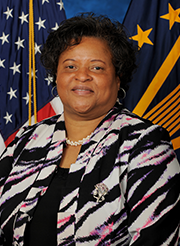
Dr. Angela Billups

Executive Director, Office of Acquisition and Logistics@Department of Veterans Affairs

Dr. Angela Billups was appointed as the Executive Director, Office of Acquisition and Logistics at the Department of Veterans Affairs (VA) on November 26, 2018. As the Executive Director of one of the largest acquisition and logistics programs in the Federal government, Dr. Billups manages and oversees the development and implementation of policies and procedures for department-wide acquisition and logistics programs supporting all VA facilities and the VA Acquisition Academy in Frederick, Maryland. She is the primary advisor to the Chief Acquisition Officer and to the Secretary of Veterans Affairs for matters related to enterprise business strategies and acquisition management. Dr. Billups also serves as the VA Senior Procurement Executive and VA Suspension and Debarment Official. Dr. Billups is a seasoned acquisition professional with years of experience advising and assisting senior officials, government and industry, with the goal of helping them realize the acquisition life cycle.

Joe Grace, Captain USN (Retired)

President and CEO – Moderator for this series on Supply Chain Modernization @Grace and Associates, LLC.

Joe Grace, Captain, USN (Retired), is the President and CEO of Grace & Associates. Mr. Grace is a graduate of the United States Naval Academy, a former nuclear submarine officer, and earned his MBA from the University of New Orleans. During his active and reserve military career, he worked a variety of military assignments, including his final tour as the Chief Information Officer for Navy Medicine. Mr. Grace has worked for multiple companies and held many positions in industry. He is a serial entrepreneur, venture construction leader and long time business owner. He now works as a connector between industry and government, with an emphasis on Military Health and the Department of Veterans Affairs. His many roles include Moderator, Facilitator, a key trusted advisor to leadership and a mentor to industry and government. As an entrepreneur, Mr. Grace has started many technology-based companies and taken three public. Grace & Associates holds no government contracts

Gregory McLean

Special Projects eManager @Department of Veterans Affairs

Gregory “Greg” McLean Special Project Manager Reported to APS (on detail) in May 2020. Gregory McLean is Vice-Chancellor of the VA Acquisition Academy (VAAA) Program Management (PM) School, where he oversees the training of VA program managers. The Program Management curriculum is intended to ensure that VA has the most qualified program managers and includes competency assessment, classroom and online learning, coaching and mentoring, on-the-job qualification development, assignment-specific courses, training toward Federal Acquisition Certification in Program/Project Management (FAC-P/PM), and continuing education. Mr. McLean previously served as Director of Program Management Policy in the Department of Veterans Affairs Office of Policy and Planning. Mr. McLean has more than 22 years of industry and Government experience, including developing and implementing national training and certification programs for major and critical acquisition initiatives.

Please join us for this important discussion

12 April 2022, 1:00 PM EST.

Check SAM.GOV for information.

15 Tech Leaders On The ‘Next Big Thing’ In Cybersecurity – Forbes

Posted by timmreardon on 04/10/2022
Posted in: Uncategorized. Leave a comment

Apr 4, 2022,01:15pm EDT

The cybersecurity landscape constantly evolves. Hackers are always upping their game, so it’s essential for businesses—and especially tech leaders— to constantly monitor cybersecurity news and update their data protection systems. Knowing about the “next big thing” in cybersecurity—even if it’s only a potential threat—helps organizations prepare and protect their and their customers’ data.

Full cybersecurity awareness must cover both offense and defense. It’s essential for stakeholders to have an understanding of both new and emerging threats and the latest developments in defensive tools and strategies. Here, 15 industry experts from Forbes Technology Council discuss recent developments in industrial and business cybersecurity every organization’s leadership team should be aware of, and why they’re so important.

1. Encryption Key Management

Encryption key management is a persistent challenge. With the rapid rise of API key authentication, developers need to be diligent in taking care when it comes to where and how they store these keys. Attackers are continuously scouring code repositories, HTML source code, and mobile and desktop apps to uncover the API credentials needed to compromise applications and their data. – Chris Wysopal, Veracode

2. Blockchain Vulnerabilities

I think cryptocurrency and nonfungible token marketplaces are prime targets for cyber threats right now. Where the money goes, so will the bad actors. There is a misconception that blockchain-based technologies are inherently secure. They are not. Use the highest version of transport layer security, be careful what third parties you rely on, and hire security experts to help your business. – Caroline McCaffery, ClearOPS

3. Increased Vulnerability From Systems Integration

Security is critical in two respects: guarding internal secrets and safeguarding sensitive, personal customer data. As more of our systems become integrated with and reliant upon partners, the links between systems become weak points in our security chain. – Yona Shtern, Hapbee

4. Insider Threats

A good insider threat program can protect your company from hackers. Malicious insiders are most often motivated by financial gain. Those who steal trade secrets and intellectual property might be selling it to a foreign government or a competitor or moonlighting by using it to sell their own services on the side for some extra income. A disgruntled employee might attempt sabotage. – Ben Allen, Allen Forensics, Inc.

5. Data Localization And Data Sovereignty

Keeping up with the changing cybersecurity landscape is a never-ending struggle. One major issue that has not been addressed quite as strongly is data localization and data sovereignty. Businesses and leaders will need to be able to ensure that their data is not decrypted outside of specific, well-defined policy domains. Security features will need to be augmented with better data controls around where and when data is decrypted. – Ali Shaikh,Graphiant

6. Quantum Cryptography

Encryption is a cybersecurity measure that protects data through unique codes. Quantum cryptography, which applies quantum mechanics principles to data encryption and transmission, is the “next big thing” in cybersecurity. It prevents hackers from accessing and stealing sensitive data that’s been encrypted using current algorithms. Businesses and tech leaders should embrace quantum cryptography to protect their data, applications and more. – Vivian Lyon, Plaza Dynamics

7. Alternatives To Data Encryption

Encryption has been the “duct tape” for data and cybersecurity for a long time, making it the default answer. But encryption for data at rest is not a viable solution any longer. The more data-driven business becomes, the more encrypted data needs to be decrypted and accessed. This leaves data vulnerable. Look at other options, such as hashing and tokenization—especially for the cloud. – James Beecham, ALTR

8. Embedded Security And Risk Management Teams

Security and risk management teams should be working as embedded partners within product and engineering organizations, not simply reviewing and acting as gatekeepers after something has been built. Involving your security teams in product development and engineering processes will yield much better results with regard to the security posture of your products. – Travis Heinstrom, Goldman Sachs

9. Privacy By Design

Companies react to changes in privacy and security, but they should anticipate these changes as much as possible. Integrating privacy by design principles at the beginning of product development, rather than as a reaction to a breach lawsuit or new law, will put companies in a better place to minimize breach effects and attract customers. –Elena Elkina, Aleada Consulting

10. Mobile Device Management And Remote Team Training

With the remote work revolution in full swing, your team needs to be better prepared than ever before to detect and properly handle an array of phishing and ransomware attacks. Effective mobile device management protocols, secure remote internet access and strong awareness training will go a long way toward protecting against data breaches, which most commonly occur as a result of human error. – Rashad Nasir,ThinkCode

11. Vulnerabilities From Reliance On Open-Source Software

Whether directly or indirectly, your business relies on open-source software, and the supply chain for these dependencies is critically vulnerable. In the wake of global security events (such as the recent Log4j vulnerability), businesses everywhere are realizing their tool chains for software supply chain observability and security are lacking. This is an urgent and still rapidly growing problem. – Avi Press,Scarf

12. SaaS Security Risks

Software as a service security risks abound in many organizations. At best, companies have single sign-on and multifactor authentication in place, but the secure configuration of SaaS applications has been a blind spot for many security teams even though sensitive data is stored in these applications. The responsibility to configure them falls on the organizations that use them, not the SaaS providers, and I expect this to become a more prominent message in the near future. – Jerich Beason, Epiq

13. A Shift Away From On-Premises Security Solutions

Don’t bring an on-premises solution to a cloud fight! Attackers are agile and adaptive, and on-premises point solutions cannot keep up with the pace. Threat actors are taking advantage of simple things: unpatched and vulnerable systems, open ports and services, easy-to-guess passwords, and so on. The next big thing is not a new security feature; it’s how security services and products are delivered. –Etay Maor, Cato Networks

14. ‘Shadow Data’ Systems

Traditional data security solutions have focused on encryption and tokenization, but with the broad adoption of multicloud infrastructures, data protection has become more complicated. For example, lifting and shifting apps into the cloud results in “shadow data’’ systems that evade typical data scanning and controls. New approaches are needed to provide discovery and protection of cloud assets. – Rehan Jalil, Securiti.ai

15. Automated Data Protection

Successful cyberattacks are inevitable, so we must look beyond encryption to scalable automated data protection platforms that not only encrypt data but automatically fragment and scatter it across multiple separate storage locations. This way, the data can be automatically reassembled or “reconstituted” by authorized users and applications but is valueless to cybercriminals. – Greg Salvato,TouchPoint One

Article link: https://www.forbes.com/sites/forbestechcouncil/2022/04/04/15-tech-leaders-on-the-next-big-thing-in-cybersecurity/amp/

Departing DoD software boss says success or failure boils down to leadership – Federal News Network

Posted by timmreardon on 04/08/2022
Posted in: Uncategorized. Leave a comment

Jared Serbu

When the Defense Department created the new position of Chief Software Officer early last year, it was DoD’s first attempt to get a single official to ride herd over a vast enterprise that ranges from mainframes still running COBOL to DevSecOps pipelines to classified weapons systems, and everything in between.

For Jason Weiss, DoD’s first-ever CSO, there are at least a couple of big takeaways from having accepted that challenge: One is that there are a lot of pockets of the department where world-class software engineering is happening. Another is that what’s holding DoD back isn’t a lack of skill or dedication within its workforce, but rather, a lot of bureaucratic structures and habits that just aren’t compatible with modern software development.

Weiss, who will step down from his DoD job on Apr. 15 in order to return to the private sector, said he’s concluded there are two main factors that lead to successful software projects inside the department. Both have to do with leadership.

In cases where the military services have managed to implement modern software design practices, they’ve involved senior-ranking leaders who both “speak software,” and have the organizational savvy to maintain political support for what they’re up to.

“They understand the nuances of software and things like containerization and orchestration of containers, and they can bridge the gap between the engineer who’s actually doing the work as an individual contributor and the various oversight communities,” Weiss said in an interview for Federal News Network’s On DoD. “The second part is how suave that particular leader might be understanding that they need to create a groundswell of support, and fundamentally recognize when it’s time to compromise on something and add a little bit of overhead that might slow the process down in the name of moving things forward.”

But there are far too many programs that never even approach the point of compromising over small changes that lead to small delays.

Instead, they’re locked into acquisition mindsets that were originally designed for large hardware procurements: a list of requirements that must be met, and different colors of money for each phase of a system’s development.

Both of those concepts are terrible for software, which, unlike physical products, can be changed and updated in days or weeks.

“We have trouble reducing things into bite-sized tasks,” Weiss said. “We want to look at a set of requirements and say that all of these requirements need to be met, and as an organization, we’re not capable of effectively prioritizing them and recognizing that just because something has been deprioritized doesn’t mean that it’s not still a valid requirement. It just means that the warfighter has said, ‘Hey, I need this first and foremost, and I need this other thing second.’”

Congress has given DoD some room to experiment with using a single color of money for software development efforts. But lawmakers have only approved eight programs for what’s called the Software and Digital Technology Pilot Program; they declined DoD’s request to add several more in the 2022 appropriations bill.

Across the rest of the department, budgeteers, program managers and program executive officers still need to find ways to wedge software development into a funding system that was meant for carriers and tanks, with separate accounts for R&D, procurement and sustainment phases.

“When we look at the historical scaffolding that was put in place around the way the DoD procures systems, it was by and large hardware-centric, because you only want to create a keel on a ship once,” Weiss said. “But with software, it’s more like, ‘Oh gosh, that algorithm isn’t exactly what I need, I need to pivot that.’ That can be done in a two-week sprint. And I think that is fundamental to eliminating the color of money issue around software. And that conclusion was further codified with the ‘software is never done’ study from the Defense Innovation Board. Software is never done, so it never actually goes into sustainment.”

One of Weiss’s main tasks during his tenure as DoD CSO was to help develop what was originally supposed to be an update to the department’s cloud strategy, but was eventually renamed with a new moniker: the DoD Software Modernization Strategy.

Officials have said the new name reflects a realization that it needs to use cloud as a means to an end, rather than migrating systems just for the sake of migrating systems.

The new strategy makes a big deal out of the software factories that have started to permeate DoD, now 30 and counting, and aims to eventually reduce the policy barriers that are preventing the agile methodologies they’re using from just being the norm across the department.

Weiss said the quality of work he’s seen from those factories is top-notch.

“The ones I communicate with on a regular basis put out some amazing code — it’s state of the art, and it’ll rival anybody out there,” he said. “But I think it’s also important to recognize that in all of those cases, the industrial base plays a key role. This isn’t just government coders writing government code.”

In most cases, with the software factories — at least so far — contributions have tended to come from a lot of small businesses, with traditional Defense contractors playing a only supporting or coordinating role. Weiss said DoD will need to be careful about tailoring its relationships with vendors in ways that acknowledge that’s likely to continue to be the case, while also keeping the large prime contractors involved.

“With Platform One, there is no obvious prime contractor supporting it — it’s a large number of smaller vendors. And when they are onboarded, they’re actually paired with programmers from other organizations so that there is redundancy around that ecosystem,” Weiss said. “What’s important is understanding that we’re still going to need the hardware and the investments the large primes have made in highly-specialized labs, which justify their rates that they submit to the government. We still need that capability. So it’s going to be important for DoD and the industrial base to come together to find that correct balance between them, because we need both. It has to be a both-and conversation, not an either-or conversation.”

Weiss said another conclusion from his tenure is that his successors are going to need to have more authority in DoD’s organizational structure if they hope to make modern software practices more widespread.

He said Congress should seriously consider making the position a Senate-confirmed job, considering the amount of work that needs to be done to reform DoD’s practices.

“When you look at the amount of coordination that has to occur for something like a directive-type memorandum — and the time spent on that for something that’s relatively trivial — having an ‘honorable’ title to be able to go straight to a different organization and agree at that level is going to be vital,” he said. “I had very little influence in organizations outside of the DoD CIO, which is where my billet sat. That’s important, because the CIO can only give software a fractional bit of attention. They’re responsible for spectrum, they’re responsible for desktop services, they’re responsible for budget certification. That’s just the nature of the job.”

Article link: https://federalnewsnetwork-com.cdn.ampproject.org/c/s/federalnewsnetwork.com/on-dod/2022/04/departing-dod-software-boss-says-success-or-failure-boils-down-to-leadership/?

REBOOT THE DEFENSE INNOVATION ECOSYSTEM – War on the Rocks

Posted by timmreardon on 04/07/2022
Posted in: Uncategorized. Leave a comment

SHANDS PICKETT APRIL 7, 2022

The venture capital model of investment is predicated on a high failure rate, justified by massive returns on a small number of successes. Yet prestigious, venture-capital-backed defense tech startups are failing more than even this model can tolerate. The overwhelming majority of defense tech startups are terminally stuck in the Valley of Death, and venture capital bets on defense tech startups aren’t paying off. Soon, the best venture capital firms will stop investing in the federal market, and the newly rebuilt bridges between Silicon Valley and DC will collapse.

There has been only one major initial public offering (IPO) in the defense market’s recent past — Palantir in 2020 — and that’s a hugely negative signal to venture capital firms about the value of the market. As the head of federal deployments at Scale, I’ve witnessed this dynamic from a front-row seat. Scale is an artificial intelligence startup with both market-leading commercial technologies and production-level federal government contracts. Unfortunately for the startup industry and the U.S. Department of Defense, that makes Scale the exception, not the rule.

While we can’t predict the future, asymmetric technology capabilities (especially those using machine learning) will certainly challenge our traditional defense advantages across domains. The defense community must treat innovation seriously to build the most contingency-ready defense industrial base possible. Katherine Boyle from Andreessen Horowitz neatly summarized the key issues in a tweet storm. She’s right — venture capital firms aren’t seeing the returns on investment to justify bets even on dual-use technologies in the public sector, let alone pure defense tech startups, and time is running out.

Because they are pre-IPO, defense tech startups don’t report their financials publicly. This makes it impossible to holistically assess the health of the defense tech startup ecosystem. But I speak with defense tech stakeholders every day — from founders and CEOs to business development managers and engineers. Though these are limited and anecdotal data points, I see that companies have four primary paths: become a Palantir, exit by acquisition, leave the public sector market, or languish as a zombie company. Let’s review each of these:

So far, there is only one Palantir, and Palantir’s success as a pathfinder launched a thousand defense tech ships. None of those newer entrants have gone public, although SpaceX and Dataminr are close. Palantir’s path to IPO was famously protracted, even for a company that promised to help the U.S. government mitigate intelligence failures in an exploding post-9/11 defense market. Despite those strong tailwinds, Palantir had to fight their own customers for years (including suing the Army) to win key public sector market segments and finally IPO.

What about an exit by acquisition? This can work for defense tech startups with a product that fills a specific gap in the portfolio of a much larger business. Successful exit by acquisition (usually dual-use, not pure defense tech companies) examples include Wickr (now AWS), Expanse (now Palo Alto Networks), and the public sector side of Hivemapper (now Palantir). While sometimes acceptable to venture capital firms depending on the deal terms, acquisitions are usually not an optimal outcome.

Relatedly, a company can leave the public sector market quietly to double down on commercial work. If you ask the CEOs of these businesses, they’ll say they’re still in the public sector — though they’ve dramatically reduced or even eliminated their federal teams. Many tech startups interested in the defense market win Small Business Innovation Research work via defense innovation framework entities like the Defense Innovation Unit, SOFWERX, or AFWERX and then issue excited press releases about entering the defense market. AFWERX alone awarded 1,436 pilot contracts in FY20. Pilot wins feel real to startups, and so they invest in building defense-specific teams and technologies. As their pilots move to conclusion, the reality sets in that pilots rarely transition to production-level contracts, and boards and investors apply pressure on the company’s executive team to cut their losses and focus on commercial work.

Then there is death by zombification. A company can simply just hang around until someone stops paying the web hosting fees. I don’t know exactly how many companies on the Dcode website are zombies, but I would bet the number is substantial. These are defense tech startups that are out of investment runway (i.e., they’re broke). I could name a few confirmed zombies here, but that would damage any chance they have of ever coming back to life. This is where most defense tech startups are headed, and that would be acceptable to venture capital firms if there were only more successes.

I concur with Josh Wolfe of Lux Capital that the problem is grave, but I disagree that we need “to get the big ‘primes’ — as the country’s leading defense contractors are known — out of the way.” America needs Lockheed Martin’s aircraft factories, Huntington Ingalls’ shipyards, and the other primes because national security requires many forms of resilience. As an example, Raytheon produces the Javelin used to great effect in Ukraine today. It’s also unlikely that venture capital firms will back a startup to produce critical but controversial technologies such as intercontinental ballistic missiles. However, large primes have trouble attracting the best talent. Few software engineers who graduate from top-tier computer science programs want to work for the large primes. Software engineers prefer startups, where they have access to the latest technology, can build or grow their own teams, and are able to gain valuable equity in the business.

Partnerships between the traditional primes and tech startups are vital and are the first of four key ways to reboot the Department of Defense’s approach to innovation. This is not a comprehensive set of recommendations, which would fill many pages, but it is a summary of the most important.

The four approaches needed to successfully reboot:

  1. Incentivize and enforce the commercial item preference for software at the subcontract level.

Robust, high technology readiness-level commercial capabilities exist for nearly the full range of the Department of Defense’s technology requirements, from damage assessments to autonomy. These commercial technologies are not reaching the Department of Defense, since large defense primes traditionally operate those programs. Large primes should be rewarded for effectively integrating commercial technologies — and taking on the associated compliance challenges — in the contract award decision evaluation factors (per the Federal Acquisition Regulations part 15.304).

  1. Protect contracting officers and program managers and reward them for taking smart risks.

We don’t need to wait for the findings of the Commission on Planning, Programming, Budgeting, and Execution Reform to begin fixing this problem — we must introduce incentives and protections for contracting officials who are warranted with the stewardship of taxpayer dollars now. This is non-controversial, and Heidi Shyu, the undersecretary for research and engineering at the Defense Department, has publicly and repeatedly made this same point. Contracting officers and program managers are rarely rewarded for creative thinking in fostering a robust defense technology ecosystem — but they are certainly punished in the form of limited career trajectories if even a smart bet doesn’t pan out.

  1. Streamline the Defense Counterintelligence and Security Agency facility clearance process. 

The Defense Counterintelligence and Security Agency’s mission is vital to the nation. They are charged with overseeing the National Industrial Security Program to ensure that the defense industry properly safeguards the classified information in their possession while working for the U.S. government. Yet, the process to obtain a facility clearance — basically a security clearance for a company — to perform classified work undermines that mission: it makes our country less safe because the facility clearance process acts as a moat keeping out the companies who can bring best-in-class technologies to bear for defense. The facility clearance process can take years to complete depending on a startup’s organizational structure and investors, and it imposes onerous compliance and reporting burdens on very lean teams. The Department of Defense needs American innovation inside its classified networks and should find ways to bring non-traditional defense contractors into that ecosystem.

  1. Pick defense tech startup production contract winners on a regular basis.

Through both the Federal Acquisition Regulations and mechanisms like Other Transaction Authorities, the U.S. government has the ability to award large production contracts to tech startups. Anduril recently won a $1 billion-ceiling counter-unmanned aerial systems contract with the U.S. Special Operations Command. This is an example of what right looks like — but a healthy defense tech startup ecosystem requires ten or more of these types of awards per fiscal year. Consistent, predictable, annually recurring revenue from the U.S. government helps give companies the solid financials they need to IPO.

Critical voices on the Hill, like Rep. Ken Calvert, understand that the defense tech ecosystem is failing. Rep. Calvert’s $100 million warfighter innovation fund is a critical step in rebooting that innovation ecosystem. Still, the Department of Defense needs to do more, and Congress should be a strategic investor and partner with the defense innovation sector.

Competition with China is not the only risk to U.S. national security. Unforeseeable threats will emerge as global dynamics evolve, and new technologies erode the gap between commercial solutions and national technical means. The Department of Defense needs America’s leading technologists on its side. It’s not a luxury or theater, but a necessity to maintain defense agility. Warfighters, analysts, and decision-makers require fielded, cutting-edge capabilities now. They don’t need one Palantir, they need 30 Palantirs working in partnership with them to shape the future of U.S. national security.

Article link: https://warontherocks.com/2022/04/reboot-the-defense-innovation-ecosystem/

Shands Pickett leads federal deployments for Scale AI, Inc. (a late-stage AI company and a top 3 global data startup worth $7.4 billion). Previously, he created and led the national security business development team for another startup, Premise Data Corp. He served on two theater deployments to Afghanistan as part of the U.S. Army Human Terrain System.

Image: DepositPhotos

How Health IT Upgrades are Transforming the Military Health System – MHS

Posted by timmreardon on 04/06/2022
Posted in: Uncategorized. Leave a comment

Top military health officials recently highlighted the importance of maintaining premium care for patients at a time when information technology systems are changing rapidly across the Military Health System.

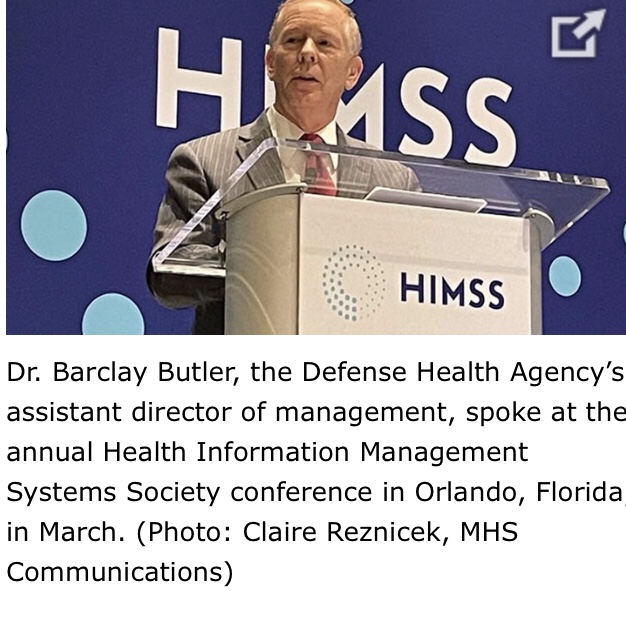
Speaking at the Health Information Management Systems Society conference in Orlando, Florida, in March, Dr. Barclay Butler, the Defense Health Agency’s assistant director of management, spoke about the intricacies of institutional transformation, especially standardization and consolidation.

“This transformation changes everything,” Butler said. “Everything except the care of our patients.”

Butler said the DHA is placing a high priority on protecting staff from burnout while focusing on their goals and patient care.

Following Dr. Butler’s presentation was a briefing from Lance Scott, the program manager for the Defense Medical Information Exchange program, and Crystal Baum, the Joint Health Information Exchange product owner for the Federal Electronic Health Record Modernization Office.

They talked about optimizing and expanding the joint health information exchange. They highlighted specific programs underway such as the effort to use natural language processing to make searching easier for providers. They also talked about the retirement of older software systems and what that really looks like in practice.

The conference’s second day featured a panel discussion on “Experiencing, Enhancing, and Evolving Federal Electronic Health Records.” Experts talked about how systems like MHS GENESIS foster innovation and improve responsiveness.

Pat Flanders, DHA’s chief information officer and the deputy assistant director for information operations, said that often there are the “haves and the have-nots when it comes to [Military Treatment Facilities], and the smaller MTFs wonder why they don’t have access to the same systems and opportunities. A standardized electronic health record bridges that gap.”

Meanwhile, Holly Joers, program executive officer for Defense Healthcare Management Systems, said deploying the standardized electronic health records is a team effort. “Our success as a team relies on doing this with commanders on the ground,” she said. “Not to them or for them. But with them.”

Flanders recalled his own military retirement as a difficult process involving a three-month search to locate his health records. In the future, however, Flanders said he hopes others will be able to complete that same process by just checking a box on the computer.

The conference’s second day concluded with Army Lt. Gen. Ron Place, the DHA’s director, providing keynote remarks and a briefing entitled, “Clear and Present Danger.” Place began by noting that human beings aren’t perfect, but technology can be a solution to reduce human error. “Done right, health IT can make doing the right thing the easy thing,” said Place.

The director closed his remarks by reminding the audience that the single most important factor that determines whether an injured or wounded service member survives isn’t the talented combat surgeon or doctor back home, but “the skills of the medics and corpsmen who treat the fallen soldier, sailor, airman, or Marine on the battlefield [where] technology, communication and rapid evacuation may not be available.”

Place emphasized that although “we utilize technology to train our medical teams and to outfit our home stations, deployed hospitals and clinics … our most important tool is the medic or the corpsman stepping out into the unknown, unafraid, with the skills gained through training and experience – the sets and reps needed to hone those skills.

The final day of DHA engagement at the HIMSS conference closed with motivational words from Dr. Brian Lein, the DHA’s assistant director for healthcare administration.

Lein provided a frank and illuminating brief on “Developing the Military Medical Digital Patient Experience.” He issued a stark reminder for all those working within the MHS. “There’s no other healthcare system in the world that has our mission. We have to focus on readiness first,” Lein said.

While discussing the future of digital health care in the era of COVID-19 and the use of electronic health records, he declared “we cannot optimize until we standardize.”

Article link: https://health.mil/News/Articles/2022/04/05/How-Health-IT-Upgrades-are-Transforming-the-Military-Health-System

Top Military Health Care Leader Looks to the Future of Medicine – MHS

Posted by timmreardon on 04/05/2022
Posted in: Uncategorized. Leave a comment

Years ago, surgeons removed patients’ gall bladders by making a large incision and cutting through abdominal muscles. If the procedure went well, the patient went home about 10 days later.

Fortunately, those days are over. Thanks to new medical technology, today most gall bladder patients can go home the same day of their surgery. Typically they’re eating and back to their daily routine in three to five days.

Health care has come a long way in recent years, thanks to technology, innovation and unexpected challenges like the COVID-19 pandemic. Dr. Brian Lein, the Defense Health Agency’s assistant director of healthcare administration, cited the gall bladder example and pointed to an array of advancements in surgical techniques when he spoke at a recent presentation on the role of military hospitals and clinics in the next decade.

“Facing almost three years of a global pandemic has completely reshaped how it is that we do medicine,” he said. Lein spoke at a virtual event hosted by AMSUS, the Society of Federal Health Officials, on Feb. 23.

The explosion of capabilities includes robots in the operating room, the expansion of virtual health care and virtual encounters, remote patient monitoring and artificial intelligence, he said.

At the same time, the COVID-19 pandemic has made the entire Military Health System more flexible and agile, more receptive to change and innovation.

For example, “we know patients recover better at home,” he said. “You’re sleeping in your own bed. You’re eating your own food. You’re not tripping over stuff going to your bathroom because you’ve walked to that bathroom for the last 30 years. And you have one nurse taking care of you, so there’s no concern about different kinds of medications or medication errors.”

Lein’s role at DHA involves planning and managing health care facilities as well as implementing changes that affect health care delivery and administration. He foresees a “huge increase in a mixture between what used to be purely inpatient care to what is now often outpatient care.”

For example, he explained “we are at the very infancy of artificial intelligence and machine learning.” Those technologies are never going to replace physicians. But they are going to augment physicians’ abilities to do their job, he said.

“They’re going to help make decisions for me. They’re going to advise me on the best recommendations that are out there based upon gathering of millions upon millions of data points that I may not even be aware of as the provider taking care of a patient,” he said.

“Now, that doesn’t mean that we should ever take away the face-to-face encounters with our patients,” Lein said. “As a provider, I can tell you, I pick up on a lot of things when I have patients in the office, so we can never take that away.”

But for most visits that only require medication refills and routine checks, he said, increasing the use of virtual encounters might be better for everyone involved.

Recalling his experience as a surgeon, Lein said he would operate on someone and send them home, but need to see them again soon afterward to make sure they were progressing as expected.

“Often their spouse had to put them in the car. They were uncomfortable riding in the backseat of the car because the seatbelt hurts. And then they get in to see me and all I do is look at them and say: ‘Hey, you’re good to go. Come back and see me in a couple of weeks.'”

Doctors don’t need to do that anymore, he said. “We’ve learned over the course of COVID that a lot of the consultations that we need don’t necessarily need to be face-to-face.”

However, “what will never change in the military [hospitals and clinics] is our responsibility for readiness, the readiness of the soldiers, sailors, airmen, Marines and guardians on the installations that we support, and the readiness of the medical force that works in those military [hospitals and clinics],” he said. “That’s been a hallmark of military [hospitals and clinics] since they were first established.”

As he looks toward the future, Lein said the Military Health System will make sure that the core functions of the military hospitals prioritize the readiness of individuals.

“What we considered ready versus non-ready 10 years ago has markedly changed based upon health care delivery, health care options, and innovations,” he said.

“We’ve got to change with the times.”

Article link: https://health.mil/News/Articles/2022/03/23/Top-Military-Health-Care-Leader-Looks-to-the-Future-of-Medicine

Posts navigation

← Older Entries
Newer Entries →
  • Search site

  • Follow healthcarereimagined on WordPress.com
  • Recent Posts

    • Heeding the pope’s call to ensure AI protects human dignity – MIT Sloan Management 06/01/2026
    • Association between Wealth and Mortality in the United States and Europe – New England Journal of Medicine 05/30/2026
    • U.S. Health Care from a Global Perspective, 2026 – The Commonwealth Fund 05/30/2026
    • Anthropic co-founder Chris Olah’s remarks on Pope Leo XIV’s encyclical “Magnifica humanitas” 05/28/2026
    • Magnifica_Humanitas – Full English 05/26/2026
    • Pope Leo XIV to launch his first encylical, a document on artificial intelligence, with Anthropic’s co-founder – PBS 05/24/2026
    • Quantum Computing is Approaching A Critical “Prove It” Phase 05/22/2026
    • Hidden Prices, Broken Promises: Why Health Care Transparency Is a Matter of Justice – Sanders Institute 05/15/2026
    • The Very Uncertain Future of Arms Control – Bulletin of the Atomic Scientists 05/13/2026
    • Now Available: Expanded and Enhanced International Health Care System Profiles – Commonwealth Fund 05/13/2026
  • Categories

    • Accountable Care Organizations
    • ACOs
    • AHRQ
    • American Board of Internal Medicine
    • Big Data
    • Blue Button
    • Board Certification
    • Cancer Treatment
    • Data Science
    • Digital Services Playbook
    • DoD
    • EHR Interoperability
    • EHR Usability
    • Emergency Medicine
    • FDA
    • FDASIA
    • GAO Reports
    • Genetic Data
    • Genetic Research
    • Genomic Data
    • Global Standards
    • Health Care Costs
    • Health Care Economics
    • Health IT adoption
    • Health Outcomes
    • Healthcare Delivery
    • Healthcare Informatics
    • Healthcare Outcomes
    • Healthcare Security
    • Helathcare Delivery
    • HHS
    • HIPAA
    • ICD-10
    • Innovation
    • Integrated Electronic Health Records
    • IT Acquisition
    • JASONS
    • Lab Report Access
    • Military Health System Reform
    • Mobile Health
    • Mobile Healthcare
    • National Health IT System
    • NSF
    • ONC Reports to Congress
    • Oncology
    • Open Data
    • Patient Centered Medical Home
    • Patient Portals
    • PCMH
    • Precision Medicine
    • Primary Care
    • Public Health
    • Quadruple Aim
    • Quality Measures
    • Rehab Medicine
    • TechFAR Handbook
    • Triple Aim
    • U.S. Air Force Medicine
    • U.S. Army
    • U.S. Army Medicine
    • U.S. Navy Medicine
    • U.S. Surgeon General
    • Uncategorized
    • Value-based Care
    • Veterans Affairs
    • Warrior Transistion Units
    • XPRIZE
  • Archives

    • June 2026 (1)
    • May 2026 (12)
    • April 2026 (4)
    • March 2026 (9)
    • February 2026 (6)
    • January 2026 (8)
    • December 2025 (11)
    • November 2025 (9)
    • October 2025 (10)
    • September 2025 (4)
    • August 2025 (7)
    • July 2025 (2)
    • June 2025 (9)
    • May 2025 (4)
    • April 2025 (11)
    • March 2025 (11)
    • February 2025 (10)
    • January 2025 (12)
    • December 2024 (12)
    • November 2024 (7)
    • October 2024 (5)
    • September 2024 (9)
    • August 2024 (10)
    • July 2024 (13)
    • June 2024 (18)
    • May 2024 (10)
    • April 2024 (19)
    • March 2024 (35)
    • February 2024 (23)
    • January 2024 (16)
    • December 2023 (22)
    • November 2023 (38)
    • October 2023 (24)
    • September 2023 (24)
    • August 2023 (34)
    • July 2023 (33)
    • June 2023 (30)
    • May 2023 (35)
    • April 2023 (30)
    • March 2023 (30)
    • February 2023 (15)
    • January 2023 (17)
    • December 2022 (10)
    • November 2022 (7)
    • October 2022 (22)
    • September 2022 (16)
    • August 2022 (33)
    • July 2022 (28)
    • June 2022 (42)
    • May 2022 (53)
    • April 2022 (35)
    • March 2022 (37)
    • February 2022 (21)
    • January 2022 (28)
    • December 2021 (23)
    • November 2021 (12)
    • October 2021 (10)
    • September 2021 (4)
    • August 2021 (4)
    • July 2021 (4)
    • May 2021 (3)
    • April 2021 (1)
    • March 2021 (2)
    • February 2021 (1)
    • January 2021 (4)
    • December 2020 (7)
    • November 2020 (2)
    • October 2020 (4)
    • September 2020 (7)
    • August 2020 (11)
    • July 2020 (3)
    • June 2020 (5)
    • April 2020 (3)
    • March 2020 (1)
    • February 2020 (1)
    • January 2020 (2)
    • December 2019 (2)
    • November 2019 (1)
    • September 2019 (4)
    • August 2019 (3)
    • July 2019 (5)
    • June 2019 (10)
    • May 2019 (8)
    • April 2019 (6)
    • March 2019 (7)
    • February 2019 (17)
    • January 2019 (14)
    • December 2018 (10)
    • November 2018 (20)
    • October 2018 (14)
    • September 2018 (27)
    • August 2018 (19)
    • July 2018 (16)
    • June 2018 (18)
    • May 2018 (28)
    • April 2018 (3)
    • March 2018 (11)
    • February 2018 (5)
    • January 2018 (10)
    • December 2017 (20)
    • November 2017 (30)
    • October 2017 (33)
    • September 2017 (11)
    • August 2017 (13)
    • July 2017 (9)
    • June 2017 (8)
    • May 2017 (9)
    • April 2017 (4)
    • March 2017 (12)
    • December 2016 (3)
    • September 2016 (4)
    • August 2016 (1)
    • July 2016 (7)
    • June 2016 (7)
    • April 2016 (4)
    • March 2016 (7)
    • February 2016 (1)
    • January 2016 (3)
    • November 2015 (3)
    • October 2015 (2)
    • September 2015 (9)
    • August 2015 (6)
    • June 2015 (5)
    • May 2015 (6)
    • April 2015 (3)
    • March 2015 (16)
    • February 2015 (10)
    • January 2015 (16)
    • December 2014 (9)
    • November 2014 (7)
    • October 2014 (21)
    • September 2014 (8)
    • August 2014 (9)
    • July 2014 (7)
    • June 2014 (5)
    • May 2014 (8)
    • April 2014 (19)
    • March 2014 (8)
    • February 2014 (9)
    • January 2014 (31)
    • December 2013 (23)
    • November 2013 (48)
    • October 2013 (25)
  • Tags

    Business Defense Department Department of Veterans Affairs EHealth EHR Electronic health record Food and Drug Administration Health Health informatics Health Information Exchange Health information technology Health system HIE Hospital IBM Mayo Clinic Medicare Medicine Military Health System Patient Patient portal Patient Protection and Affordable Care Act United States United States Department of Defense United States Department of Veterans Affairs
  • Upcoming Events

Blog at WordPress.com.
healthcarereimagined
Blog at WordPress.com.
  • Subscribe Subscribed
    • healthcarereimagined
    • Join 153 other subscribers
    • Already have a WordPress.com account? Log in now.
    • healthcarereimagined
    • Subscribe Subscribed
    • Sign up
    • Log in
    • Report this content
    • View site in Reader
    • Manage subscriptions
    • Collapse this bar

Loading Comments...