healthcarereimagined

Envisioning healthcare for the 21st century

  • About
  • Economics

Quantum Sensors—Unlike Quantum Computers—Are Already Here – Nextgov

Posted by timmreardon on 06/28/2022
Posted in: Uncategorized. Leave a comment

By CHRIS JAY HOOFNAGLE AND SIMSON GARFINKEL JUNE 28, 2022 08:44 AM ET

And they’re improving at a rate that demands urgent attention.

Much ink has been spilled about quantum computers, particularly in overblown claims that quantum cryptanalysis will someday shred today’s encryption techniques. But their simpler cousins—quantum sensors—are here now and improving at a rate that demands urgent attention.

Quantum sensors use the smallest amounts of energy and matter to detect and measure tiny changes in time, gravity, temperature, pressure, rotation, acceleration, frequency, and magnetic and electric fields. They’ve been commercially available in various forms for more than a half-century; think of a magnetic resonance imaging, or MRI, machine, which tracks flips in the magnetic spin of individual hydrogen atoms to peer into a body. But recent progress in the field suggests that such sensors will soon bring a revolution in measurement and signals intelligence—possibly by making it far easier to detect submarines, spacecraft, and underground facilities.

Strategists must understand the new capabilities that quantum sensing will provide and start planning countermeasures today. Here are three examples that help explain why.

Measuring time

Ultra-precise timekeeping is the most important quantum-sensing achievement to date, for it adds precision to all other forms of sensing. For instance, it allows us to make repeated observations and combine them, an approach that is sometimes called “super resolution.” Think of the way today’s photographers take four or eight photos of the same scene and then combine the images using software. Better timing allows the same kind of thing with all kinds of measurements.

The atomic clocks of the 1970s that underlie the Global Positioning System and its attendant revolution—and miniaturized atomic clock are becoming commercially available. Microsemi Corporation, for example, sells a 35-gram “space chip scale atomic clock.” Laboratories are working on even better timing technology that promises to be just as transformative. In 2018, NIST announced a breakthrough: a clock based on a lattice of ytterbium atoms so sensitive that it wouldn’t drift more than a second in 10 billion years.

Location, location, location

Beyond making super-accurate GPS, quantum sensors can measure the shape and gravitational field of Earth to within a centimeter. Such sensing can be useful both for mapping out underground mineral resources and for precisely calculating the trajectories of ballistic missiles and other munitions.

Militaries have long sought ways to get extremely precise location data without using easily jammed GPS-type signals at all. Quantum positioning sensors track minute changes to rotation and acceleration, using Newton’s laws (adjusted for relativity) to accurately infer changes to location over time. Because they do not depend on signals from satellites or ground stations, they work anywhere—indoors, underground or underwater—and resist jamming. Defense contractors are starting to make portable QPS packages that could fit into weapons.

Related articles

Critical Update: To Bridge Quantum’s Valley of Death, Labs Need Funding and Workforce

Back to the Future: Protecting Against Quantum Computing

Seeing through walls and water

Advances in quantum radar and sonar research have rattled some policymakers because they may allow enemies to detect stealthy aircraft and warships and to distinguish legitimate radar targets from decoys.

Quantum radar would work by generating billions of “entangled” photon pairs, sending one photon from each pair into the search area while retaining the other in memory. “Signal” photons reflected back to the sensor are then compared to their “idler” mates, revealing information about airborne objects. Unlike conventional radar, such sensors promise to be largely immune to jamming and even detection by an adversary. In space, where photons are less likely to be scattered, quantum radar might be used to detect ballistic missiles, discover adversaries’ secret satellites, and spot and track tiny-but-still-dangerous space junk. There are engineering challenges, but theoreticians believe these are surmountable, and recent developmentssuggest approaches that could produce practical results.

Quantum sensing’s threat to the status quo is more dire underwater. The Chinese military has reportedly developed next-generation, sonar-like systems that can detect submarines and even underground objects. Other publications describe how Chinese scientists used precise measurement of time and location to fly a magnetometer over a field and detect buried iron balls based on their perturbations of the Earth’s magnetic field.

Such devices should eventually be able to detect the existence of underground tunnels or structures, and even the movement of military matériel or drugs through such tunnels. They might also allow the detection and tracking of America’s previously all-but-undetectable ballistic missile submarines and thereby destabilize nuclear deterrence.

Conclusion

The importance of quantum sensors has largely eluded policymakers, even though the technology has been improving for decades. Part of the reason is surely the hype surrounding quantum computers, whose challenges to practicability include their need to be shielded from interacting with the rest of the universe until its computation is complete. But quantum sensors, which put this extreme sensitivity to use, are here today and rapidly getting better.

The coming decades will be defined by greater reliance on measurement and sensing intelligence, brought about by electromagnetic and gravimetric quantum sensors that can see through barriers. Militaries may soon find it impossible to hide matériel and current secrecy strategies, such as using underground facilities, may be rendered ineffective.

Security policymakers must keep their eye on quantum sensing advances and their implications. And they must ask what it will mean when this technology leaves intelligence and military agencies and becomes in reach of law enforcement agencies, private companies, and wealthy individuals.

Article link: https://www.nextgov.com/ideas/2022/06/quantum-sensorsunlike-quantum-computersare-already-here/368681/

Chris Jay Hoofnagle is Professor of Law in Residence at the University of California, Berkeley, School of Law. Simson Garfinkel is a Senior Data Scientist at the U.S. Department of Homeland Security, a part-time teacher at The George Washington University, and a member of the Association for Computing Machinery’s US Technology and Policy Committee. They are co-authors of Law and Policy for the Quantum Age (Cambridge University Press, 2022). The views presented in this article do not reflect the policy of the Department of Homeland Security or the U.S. government.

How Agile Thinking Has Helped Federal Programs Excel – Forbes

Posted by timmreardon on 06/28/2022
Posted in: Uncategorized. Leave a comment

Jeff ShupackForbes Councils Member

Forbes Technology CouncilCOUNCIL POST| Membership (fee-based)

Jun 28, 2022,07:15am EDT

Jeff Shupack is the President of Advisory Practice at Project & Team.

You don’t usually see innovation happening first in government; that’s typically the bailiwick of private industry. But in the case of the General Services Administration, great strides have been made in using agile methodologies to modernize applications and integrate flexible architecture—progress that sets a high bar for any corporate entity.

Agile software development was also the mantra for Nicolas Chaillan, the former Chief Software Officer of the Air Force and Space Force. Innovation and agile development in software is a better use of taxpayer dollars than a typical waterfall-type acquisition and development process, Chaillan has explained.

Despite some stumbles or stubbornness along the way, the federal government is starting to take on a leadership role in the use of agile business practices to improve effectiveness while accomplishing business goals.

Agile methodologies enable organizations to maintain higher ground and accelerate their competitive positioning. Indeed, there are several government initiatives that pit agencies competitively against each other. One of those is the Federal IT Acquisition Reform Act (FITARA), which we’ll look at shortly. The takeaway, however, is that agencies that have chosen to adopt agile practices routinely do better than their peers.

Let’s take a nuts and bolts look at the GSA project we addressed at the outset. In a project very near completion (anticipated to wrap in the Fiscal Year 2022), GSA used agile methodologies in a program that has seen no cost overruns and is projected to meet its approved budget.

FITARA And TMF

GSA is absolutely leading the way as the government sees an increasing convergence of two federal initiatives—FITARA and the Technology Modernization Fund (TMF). By proactively taking advantage of one, the agency finds itself well-positioned to offer success stories for both.

For context, the TMF is an innovative funding vehicle that gives agencies additional ways to deliver services to the American public more quickly while improving the security of sensitive systems and data and making more efficient use of taxpayer dollars.

TMF was born out of the Modernizing Government Technology Act of 2017 to ensure project success for federal tech programs. So far, TMF has amassed $175 million through the annual budget process and $1 billion through the American Rescue Plan to fund modernization projects.

FITARA is a bit longer in the tooth, having been passed by Congress in December 2014 in what was the first major overhaul of Federal information technology (IT) in nearly two decades. Each year in April, agencies score themselves against a list of requirements, with the Office of Management and Budget scorecarding the results a month or so later.

Lately, agencies have found themselves treading water in FITARA compliance. Last year, 18 of 24 agencies saw no improvement in their scores, with two having slipped below their previous rankings. Only GSA received an A-plus score amidst a sea of Cs and Bs.

The less-than-stellar agency performance in FITARA has led lawmakers and CIOs alike to posit that perhaps the program would benefit from somewhat of an overhaul, concentrating more on cybersecurity and getting assistance from TMF. (TMF has become a way for agencies to improve their cybersecurity and achieve IT modernization goals as well.)

It remains to be seen whether TMF will help all agencies over the FITARA hump, but as we’ve said, GSA, in particular, offers a glowing example of success in the use of agile practices for IT modernization and reform. Let’s take a closer look at how GSA has emerged as the poster child for responsible and effective digital transformation.

GSA’s Agile Application Modernization

GSA’s account of how it succeeded in modernizing its applications is brief and well worth reading and can be found in TMF’s publicly available overview. 

In essence, in 2018, the organization needed to modernize 88 IT applications to integrate them with other systems. The agency received an investment from TMF of nearly $10 million, allowing GSA to take on all its modernization needs at once, from software to hardware.

There are two takeaways to understanding how GSA succeeded in its modernization mission.

1. The agency adopted a cross-functional solutions team to implement best-in-class agile methodologies.

2. They created a set of “playbooks” to standardize how databases will be transformed and how data is to be migrated from now on. (As a bonus, GSA has made these playbooks available to other agencies in similar positions.)

The result of the effort is a comprehensive initiative that’s on track to come in on time and within budget.

This, of course, is the goal of every agile project in any industry. The proper application of agile practices typically allows organizations to improve performance and create an easier pathway to scaling their operations.

In fact, GSA’s success story is at the heart of what digital transformation can and should be. Agile methodologies and best practices create repeatable processes that can continually adjust to the demands of the ever-shifting digital landscape. It’s also an example of how innovative thinking can make use of existing initiatives to improve performance across more than one set of enterprise requirements.

GSA succeeded because agency personnel understood that they were not just overhauling IT systems. They were actually upending years of inflexible attitudes toward business processes and replacing them with a culture of “continuous learning.”

Cross-functional solutions teams, like those in GSA’s account, are essential to an environment of continuous learning. The individuals on the teams are free to create new and innovative ways to address problems without the stress and fatigue that can often come with an organizational mandate to “get creative.”

Of course, there’s much more to creative learning and digital transformation, and we’ll unpack aspects of the process throughout these commentaries. The question now becomes, what lessons can your organization learn from the GSA’s experience? How can you apply agile processes to your own business goals to continually learn how to navigate the waters of digital transformation?

Article link: https://www.forbes.com/sites/forbestechcouncil/2022/06/28/how-agile-thinking-has-helped-federal-programs-excel/amp/


Forbes Technology Council is an invitation-only community for world-class CIOs, CTOs and technology executives. Do I qualify?

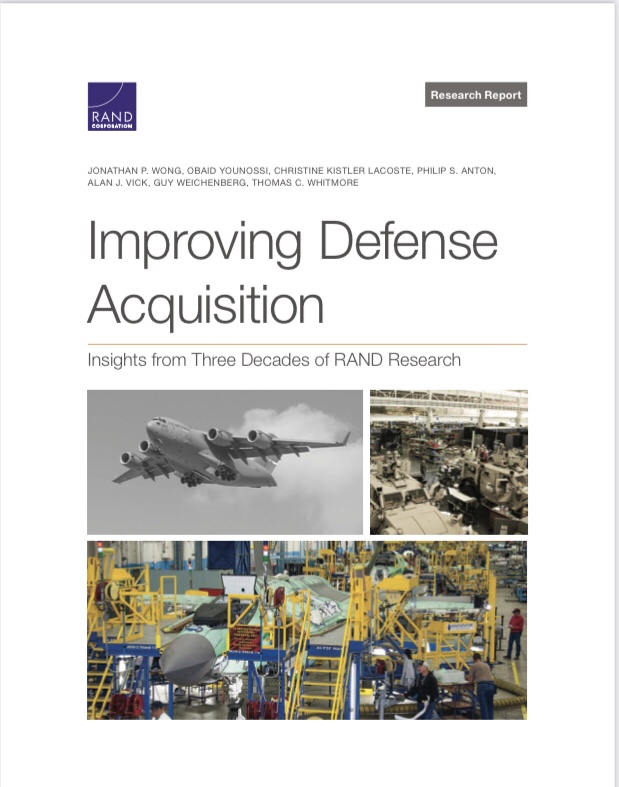
Improving Defense Acquisition – RAND

Posted by timmreardon on 06/26/2022
Posted in: Uncategorized. Leave a comment

Insights from Three Decades of RAND Research

by Jonathan P. Wong, Obaid Younossi, Christine Kistler LaCoste, Philip S. Anton, Alan J. Vick, Guy Weichenberg, Thomas C. Whitmore

  • Related Topics: 
  • Military Acquisition and Procurement, 
  • Military Budgets and Defense Spending, 
  • Military Technology, 
  • United States Department of Defense
  • Citation
  • Synopsis(print-friendly)
  • Embed
  • View related products
  • Share on Facebook
  • Share on Twitter
  • Share on LinkedIn

Download

DOWNLOAD EBOOK FOR FREE

Full Document

PDF file1.3 MB

Technical Details »

Research Summary

PDF file0.1 MB

Technical Details »

Purchase

Research Questions

  1. What are the overarching trends that affect the DoD acquisition system?
  2. What challenges does DoD’s acquisition of weapon systems face?
  3. What insights can RAND research offer on how to confront these challenges?

Improving the U.S. Department of Defense (DoD) acquisition system — the management and development processes by which the department acquires, develops, and sustains weapon systems, automated information systems, and services — has been an issue of sustained interest to policymakers since the beginning of the military establishment. Numerous actions have been initiated and implemented over decades to rein in the increasing life-cycle costs and to ensure a timely delivery of these systems to meet U.S. security needs. In this report, researchers describe overarching trends that affect the defense acquisition system, outline challenges in DoD’s defense acquisition process, and suggest improvements that might help address those challenges. The study is informed by open-source documents and insights from publicly available RAND Corporation research on defense acquisition, especially reports published since 1986, when a similar review of RAND research was published.

Key Findings

Four overarching trends affect the defense acquisition system

  • Geopolitical changes have widened the threat landscape; in addition to a resurgent Russia, growing Chinese economic and military power poses new threats to U.S. interests, while Islamic extremism remains a potent force.
  • Globalization has altered the economic and technological landscape, creating new opportunities, as well as challenges, for DoD.
  • The United States has changing national priorities: Defense issues remain important, but domestic policy issues compel policymakers to prioritize attention and resources.
  • Advancing commercial technologies are creating new challenges and opportunities for an acquisition system that was not designed to import and adapt technologies developed outside the traditional defense industrial base.

The trends are linked to the following eight challenges for DoD’s acquisition system

  • Responding to evolving missions.
  • Leveraging a changing defense industrial base.
  • Accommodating interoperability.
  • Building in cybersecurity.
  • Planning for technology refresh and insertion.
  • Rebuilding the acquisition workforce.
  • Managing the acquisition cost of systems.
  • Aligning incentives, organizations, and processes to acquisition goals.

Recommendations

  • To achieve desirable acquisition outcomes, acquisition strategies, organizational roles and responsibilities, and reporting structures must be tailored to the unique characteristics of each program. There is no one-size-fits-all approach that works with every program, and attempts to force programs into a single paradigm lead to problems and inefficiencies.
  • It is important to broaden and plan for the defense industrial base. An inclusive industrial base must be better engaged to fully exploit its innovation potential and must be focused on sustaining key parts of the defense industrial base.
  • The acquisition workforce must be properly sized, trained, and incentivized to make the smart decisions that flexible acquisition approaches and partnering productively with industry entail.
  • DoD needs to continue improving its ability to track and analyze important attributes of the acquisition system. Broadly improving acquisition data collection and analysis would help DoD evaluate the effects of major changes in acquisition policy and better plan for the long term.

Article link: https://www.rand.org/pubs/research_reports/RRA1670-1.html

Russia-linked actors may be behind an explosion at a liquefied natural gas plant in Texas

Posted by timmreardon on 06/26/2022
Posted in: Uncategorized. Leave a comment

June 26, 2022 By Pierluigi Paganini

A Russian hacking group may be responsible for a cyber attack against a liquefied natural gas plant in Texas that led to its explosion on June 8.

The explosion took place at the Freeport Liquefied Natural Gas (Freeport LNG) liquefaction plant and export terminal on Texas’ Quintana Island. The June 8 incident will have a lasting impact on Freeport LNG’s operations.

Preliminary investigations suggested that the incident resulted from the overpressure and rupture of a segment of an LNG transfer line, leading to the rapid flashing of LNG and the release and ignition of the natural gas vapor cloud.

At this time it is not clear why the safety mechanisms in place did not prevent the explosion. Experts speculate a cyber attack may have turned off the industrial safety controls at the natural gas facility.

ICS malware like TRITON, which experts associated with Russia-linked APT group XENOTIME, has offensive capabilities to shut down industrial safety controls and cause extensive damages to industrial facilities.

“On March 24 the U.S. Department of Justice brought charges against four Russian nationals suspected of using TRITON malware in cyber attacks on behalf of the Russian government between 2012 and 2018. That same day, the FBI issued an advisory warning that TRITON malware tools still remain a major threat to industrial systems around the world.” reported the American Military News website.

The Washington Times national security writer Tom Rogan confirmed that the explosion at the Freeport LNG facility could be consistent with a hacking campaign conducted by APT groups like XENOTIME.

Rogan added that the company does have in place the Operation Technology/Industrial Control Systems network detection systems.

At this time, Freeport LNG denied the theory that sees a cyber attack as the root cause of the incident. 

“Unless Freeport LNG has OT/ICS network detection systems deployed appropriately and has completed a forensics investigation, a cyberattack cannot be ruled out,” Rogan wrote.

“Two more sources who spoke with Rogan said that around the time of Russia launched its invasion of Ukraine, a cyber unit of Russia’s GRU military intelligence service conducted targeting-reconnaissance operations against Freeport LNG.” continues the American Military News

Article link: https://securityaffairs.co/wordpress/132608/security/liquefied-natural-gas-plant-texas-explosion.html?

A national patient ID is essential for patient safety – STAT

Posted by timmreardon on 06/26/2022
Posted in: Uncategorized. Leave a comment

By Wylecia Wiggs Harris and Tom CoxJune 22, 2022

Misidentifying patients can have tragic consequences.

Numerous catastrophic cases and near misses have been collected by Patient ID Now, a coalition of health care organizations we are affiliated with that is dedicated to advancing a nationwide patient identification and matching strategy.

In one example from the Patient ID Now website, a woman had a routine mammogram, but never received the results. Assuming that no news was good news, she mentioned the mammogram to her doctor months later during her annual physical. That conversation led to the discovery that her results had been misfiled in the chart of a deceased patient who shared her name. The mammogram showed cancer which, during the one-year delay, had become terminal.

This story is not an outlier.

There’s far more than anecdotal evidence that patient misidentification is a serious and widespread problem in U.S. health care. A Government Accountability Office report found that 45% of large hospitals reported difficulty accurately identifying patients through electronic health information. A report from Pew Charitable Trusts notes that accurately matching patients to their medical records can be as low as 80% within a single care setting, and as low as 50% among organizations that shared electronic health information.

This epidemic of misidentification is rooted in the lack of a national patient identification strategy.

Today, a hospital’s or clinic’s ability to accurately identify the patients it serves often hinges on a precarious patchwork of Social Security numbers, phone numbers, driver’s licenses, and home addresses that strains under the weight of an increasingly mobile population with health information scattered across multiple care settings.

Covid-19 has underscored that patient identification is an increasing issue for public health. During the pandemic, there were reports of patients not receiving Covid-19 test results, or receiving the wrong results, because of misidentification. And many received vaccinations outside of their usual doctor’s office at pop-up and pharmacy locations, adding complexities about updating medical records.

Progress toward a national patient identification strategy has been hindered for more than two decades because of a rider inserted into the federal budgetthat prohibits federal funds from being used to develop a unique health identifier standard.

The history of this annual rider dates back to 1996, when Congress passed, and President Bill Clinton signed, the Health Insurance Portability and Accountability Act. One of HIPAA’s many goals was to aid the transition from paper to electronic records, and it called for developing a unique identifier. Rep. Ron Paul (R-Tex.), Congress’s leading libertarian at the time, saw such an identifier as government intrusion into private health care and inserted language into the federal budget that barred the government from spending any money to develop a unique identifier. That ban has been in place ever since.

Bipartisan support for repealing this ban has been growing in Congress, with the House of Representatives removing the language from its Labor, Health and Human Services, Education, and Related Agencies appropriations bill for three years, and the Senate removing the language for the first time from its draft Labor-HHS bill released for fiscal year 2022.

Final negotiations, however, resulted in the ban being reinserted to the 2022 budget, continuing the provision that stifles progress to improve patient safety and privacy. President Biden signed the budget into law earlier this year. Just last month, the Patient ID Now Coalition continued the push to remove the rider from the 2023 fiscal year appropriations bill in a letter to House appropriators and Senate appropriators that was signed by 119 industry stakeholders.

The health care community has a responsibility to do everything possible to protect the people and communities it serves. To fulfill this mission, it needs to move forward with serious discussions regarding the shape, scale, and cost of a national patient identification strategy, one that ensures the safety of patients and the privacy and security of their personal and medical information.

This national strategy could include a number of solutions that have been proposed, including, but not limited to, a unique patient identifier; biometrics; standardization of demographic elements such as home address or telephone number; or various algorithms, and would require a number of considerations to be taken into account.

As the Patient ID Now coalition proposed in its Framework for a National Strategy on Patient Identity, a national strategy should increase patient match rates, protect patient privacy and security, support interoperability, and improve standardization of health data, data quality, and health equity. To get there, the federal government would need to bring in stakeholders from across health care and public health to address these issues.

This isn’t just a bureaucratic issue. In addition to enhancing safety and reducing health care costs, a national patient identification strategy would empower patients. Recent federal regulations, such as the provisions prohibiting information blocking in the 21st Century Cures Act, give consumers greater ability to store, aggregate, use, and share their health information using apps of their choice. Improving patient identification would make it easier for complete and accurate health records to follow individuals wherever they go and allow them to better control who can access and share their personal health information.

Congress must finally address this outdated ban to make true progress toward solving one of health care’s most enduring problems. Health care has spent the better part of 20 years investing in an interoperable, value-based, patient-centric ecosystem. A national strategy for patient identification is essential for connecting the fragmented health care system, while making it safer and more efficient for patients and health providers.

Article link: https://www.statnews.com/2022/06/22/national-patient-id-essential-patient-safety/?

Wylecia Wiggs Harris is CEO of the American Health Information Management Association (AHIMA), a global nonprofit association of health information professionals. Tom Cox is president of Experian Health, a provider of health care software solutions. AHIMA and Experian Health are members of Patient ID Now.

Empathetic customer experience helps build trust in government – Federal News Network

Posted by timmreardon on 06/26/2022
Posted in: Uncategorized. Leave a comment

Since it surfaced in the 1990s, the federal service-to-the-citizen movement has continuously evolved. New technologies keep making new services possible and, as in the private sector, moving the expectations of customers and constituents.

Customer experience has emerged as the latest iteration. Embodied in the current President’s Management Agenda, customer experience (CX) embodies all of the ways in which a constituent might interact with a federal agency. An earlier concentration on web transactions has expanded into omni-channel thinking. Constituents want reach agencies in person, on the telephone, by email or live chat, or digitally. This means systems and processes must share backend access to data connected to an individual, for example a taxpayer. Or to a transaction, the tax return itself.

“It is this that seamless experience of interacting through tax administration, that is really taxpayer experience for us,” said Kenneth Corbin, the chief taxpayer experience officer at the IRS. He spoke as part of a Federal News Network panel entitled, Better Customer Experience Builds Trust in Government. Corbin added, “That seamless experience is being able to choose how you interact with the Internal Revenue Service, whether you interact in person, whether you call us on toll free and talk with one of our customer service representatives, or of course, interact with us digitally online through irs.gov.”

Maintaining the trust of the nine million veterans it serves is foundational to CX work at the Veterans Affairs Department. Barbara Morton, the VA’s deputy chief veterans experience officer, detailed “three core elements that we have tried to focus on and hardwire into our business operations.” They start with a customer journey approach to veterans’ interactions, and add measurements of effectiveness of those iterations. “And thirdly,” Morton said, “and most importantly, perhaps, they must be emotionally resonant for the veteran. There must be empathy in everything we do, in every interaction we have.”

It might sound surprising coming from the Office of Management and Budget, but officials there consider empathy an important CX element across the government.

“I always say we have to lead with empathy,” said Andy Lewandowski, the digital experience advisor to the federal chief information officer. “The basic purpose of customer experience delivery, and of human centered design, is to put ourselves in our customers’ shoes.”

Steven Boberski, the senior business development executive for the puvlic sector at Genesys, said that cybersecurity is an important CX consideration, given the sensitive and personally identifiable data that agencies deal with. He recommended use of FedRAMP-approved vendors in the chain of technology for public-facing services.

Boberski said that while mapping the customer’s journey is critical, it’s also critical to retain and consolidate data from each step of a given customer’s encounter.

“To provide empathy from the federal perspective,” Boberski said, means “knowing exactly where that citizen has been in their journey with the agency.” For example, the agency should be able to say, “We can see from the data that you’ve called in multiple times. You’ve tried an email. We have a record of where you’ve been, perhaps we can see that you’ve tried to file your taxes, or you’ve tried to renew something or create a new claim.”

“Knowing where they’ve been in a customer journey is very important,” Boberski added.

Given the challenges of great CX, agencies must take care to integrate the data sources and applications they have and bend them towards CX.

“If we were to design a federal service or agency from scratch, the technologists would probably start by implementing a single customer relationship management system,” Lewandoski said. “That is not the reality in most of our federal agencies and programs today.”

He added, “So the challenge that agencies have from a technology standpoint, is to make sure that those systems are talking to each other.” And that information is stored securely yet available to shared programs.

“And,” Lewandowski said, “that those systems are fundamentally mapping themselves in the backstage, as I like to say, to the front stage experience that customers have when they interact with government.”

Learning objectives:

  • Defining Customer Experience from an Agency Perspective
  • Relevant Tools for Enhancing Customer Experience
  • Customer Experience with Secure Interactions

Article link: https://federalnewsnetwork.com/cme-event/federal-insights/better-customer-experience-builds-trust-in-government/?readmore=1

House lawmakers ask Army: Who’s in charge of massive modernization program? – Breaking Defense

Posted by timmreardon on 06/24/2022
Posted in: Uncategorized. Leave a comment

By Andrew Eversden on June 24, 2022 at 6:31

WASHINGTON: House lawmakers want clarity about who is in charge of the Army’s broad modernization effort after a directive from the service, which appeared to suggest a realignment of the acquisition enterprise, caused confusion on Capitol Hill.

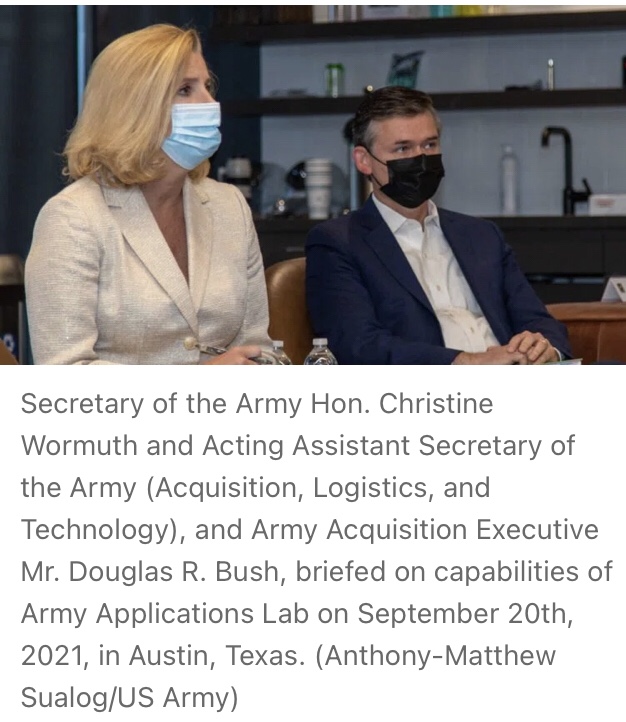
The May 3 directive signed by Army Secretary Christine Wormuth, first reported by Breaking Defense, gave primary oversight of the Army’s research, development and acquisition efforts to the assistant secretary of the Army for acquisition, logistics and technology (ASA(ALT)) — a decision viewed by some lawmakers as downgrading Army Futures Command, the office seen as leading the service’s broad modernization effort.

Wormuth previously told lawmakers that the directive itself was only meant to “clarify” acquisition roles. Under the directive, the commanding general of Army Futures Command was told to coordinate with the ASA(ALT) on research, development and acquisition.

Apparently not mollified by Wormuth’s prior explanation, lawmakers added an amendment to the House Armed Services Committee’s fiscal 2023 National Defense Authorization Act asking for additional insight into the roles within the Army’s acquisition enterprise, while threatening to nullify the recent directive if the Army doesn’t produce answers.

The HASC NDAA, passed by the committee overnight, requires the Army to submit a “plan that comprehensively defines the roles and responsibilities of officials and organizations of the Army with respect to the force modernization efforts of the Army.” If the Army fails to send the report to Capitol Hill within 180 days of the HASC NDAA becoming law, Wormuth’s directive will have “no force or effect.”

The HASC NDAA amendment, added by Rep. Mikie Sherrill, D-N.J., states that the plan must identify the Army official who holds “primary responsibility for the force modernization efforts” and specify the roles, responsibilities and authorities of that official. The plan must also “clearly define” the roles, responsibilities and authorities of Army Futures Command and ASA(ALT), as well as any other officials and organizations, with regards to modernization.

Congress is closely watching the issue because the Army is spending billions on a massive, long-term modernization effort that will see the service buying new helicopters, ground vehicles, air defense systems and more. Army Futures Command oversees eight cross-functional teams that lead the development of the modernization programs.

A spokesperson for the Army told Breaking Defense May 3, the day the directive came down, that previous directives relating to Futures Command had “the unintended consequence of creating ambiguity” and that the memo in question “eliminates that ambiguity with clearly defined roles.”

However, the changes have not been straightforward to lawmakers. Throughout several hearings in front of Senate and House committees in May, Wormuth was continuously asked if the Army was downgrading AFC within the service.

“We are not downgrading Army Futures Command,” Wormuth told the House appropriators on May 17. “There have been some ambiguities in the previous directive that talked about the relationships between army futures command and the assistant secretary for acquisition, and this directive was just trying to clean up some of that ambiguity.

Article link: https://breakingdefense-com.cdn.ampproject.org/c/s/breakingdefense.com/2022/06/house-lawmakers-ask-army-whos-in-charge-of-massive-modernization-program/amp/

VA Electronic Record System ‘Not Yet Stable Enough’ for Planned Rollouts – Nextgov

Posted by timmreardon on 06/23/2022
Posted in: Uncategorized. Leave a comment

By AARON BOYDJUNE 23, 2022 12:50 PM ET

The Boise Veterans Affairs Medical Center now plans to deploy the Cerner Millennium system a month later than originally planned, with the year’s remaining rollouts pushed to 2023.

The Veterans Affairs Department will be delaying future rollouts of the Cerner Millennium electronic health record system amid ongoing technical issues and a pending inspector general report detailing significant patient harm as a result.

The commercial EHR system was first deployed at Mann-Grandstaff VA Medical Center in Spokane, Washington in October 2020, after several delays. Following yet more delays while the incoming administration reviewed the program, the system was deployed at additional medical centers in the northwest in March of this year and in Ohio in May. But persistent outages—including at least 11 in the last three months—and technical issues have led to worsening care for veterans, prompting VA leadership to reevaluate the rollout schedule.

In an internal VA email distributed Wednesday and obtained by Nextgov, officials told staff an upcoming deployment at Boise VA Medical Center originally scheduled for this week—June 25—is now set for July 23.

“These additional few weeks will give Boise time to complete important staff training, give Oracle Cerner the time to finish the site’s scheduling grids, and ensure provisioning of staff,” the email states, noting, “This decision was made with input from [Veterans Health Administration] stakeholders, including site and [Veterans Integrated Services Networks] leadership.”

Similarly, the planned deployments at Puget Sound VA Health Care System set for August and VA Portland Health Care System set for November are being pushed out at least until March and April of next year, respectively, as VA and Cerner work to strengthen the system.

“In evaluating Puget Sound’s and Portland’s readiness for deployment, VA made the decision that, at this point, the system wasn’t yet stable enough to support current large-site deployments,” the note to employees states. “The date was changed to give Oracle Cerner additional time to put important system enhancements in place and make the necessary improvements to ensure system stability, consistently securing the 99.9% uptime Service Level Agreement.”

After Boise in July, the next deployment will now be Ann Arbor, Michigan in January—originally planned to go live this year—along with medical centers in Battle Creek and Saginaw.

“Therefore, there will be a period of six months between the deployment in Boise in July and the next deployment in Ann Arbor in January,” officials wrote. “During this short interim, we will not be idle; there is much work to do as we head into the busy schedule during the 2023 calendar year.”

Eleven Outages in Three Months

Various parts of the Cerner Millennium system running at VA medical centers have gone down or otherwise been out of service at least 11 times from April to June, according to documents obtained by Nextgov detailing each incident.

The severity of incidents ranged from limited access to dental records on May 10; a 1-hour downtime on May 1 that prevented clinicians from checking in or discharging patients; a nearly 7-hour outage of the PowerChart module on April 26 that prevented clinicians from updating patient charts; and multiple nationwide outages that knocked the entire system offline for extended periods.

After an outage in April prevented clinicians from accessing the systems for nearly three hours, VA officials told Nextgov there was no evidence at that time the outage led to any patient harm.

During such downtimes, clinic leadership submit “trouble tickets,” in which they note incidents that led to undue patient harm and can suggest a likely cause—such as an EHR outage.

“From what we know now, there haven’t been any reported to us,” Adirim said at the time. “The two outages … we are not aware, nor has it been reported to us that there has been any harm to patients.”

When prompted, Adirim clarified that reports might have been filed but those have yet to be fully investigated.

“There might have been reports but there were no patient safety incidents that we’re aware of,” she said.

A review by the VA Inspector General is said to include proof that previous outages and issues have harmed veterans in at least 148 cases, according to details in a draft document reported by the Spokane-based Spokesman-Review.

Further, that report states VA leadership was made aware of ongoing issues and risk to patients in October 2021 but opted to continue with additional rollouts.

The IG has yet to release the report publicly

“Although we are still waiting for the VA’s Office of Inspector General to release its report … the draft findings raised in media coverage over the weekend are seriously troubling and contradict what we have heard from VA officials during public testimony,” Chair of the House Committee on Veterans’ Affairs Mark Takano, D-Calif., and Technology Modernization Subcommittee Chair Frank Mrvan, D-Ind., said in a statement Wednesday.

The congressmen noted they previously asked VA to delay rollouts at major facilities and asked for additional information about patient safety.

“We have already begun discussions with VA on the performance of Cerner and requested an official briefing on the forthcoming report,” they said. “Once released, we will be reviewing the findings closely in order to determine if there are any contractual or legal repercussions of these draft findings.”

VA medical center staff also expressed their frustrations with the system in a November 2021 survey, with two-thirds of employees at Mann-Grandstaff saying they were considering quitting over the system.

A representative from Oracle, which recently purchased Cerner and its EHR business, told Nextgov their team is working with VA on the structural and technical changes needed to shore up the system.

“Since acquiring Cerner just two weeks ago, Oracle engineers have already been on the ground making technical and operational changes, with an emphasis on patient safety, to ensure the system exceeds the expectations of providers, patients and the VA,” Deborah Hellinger, Oracle senior vice president of global corporate communications, said in an email Thursday. “We intend to bring substantially more resources to this program and deliver a modern, state-of-the-art electronic health system that will make the VA the industry standard. We have a contractual and moral obligation to deliver the best technology possible for our nation’s veterans, and we intend to do so.”

Article link: https://www.nextgov.com/it-modernization/2022/06/va-electronic-record-system-not-yet-stable-enough-planned-rollouts/368528/

The Power and Pitfalls of AI for US Intelligence – Wired

Posted by timmreardon on 06/22/2022
Posted in: Uncategorized. Leave a comment

Artificial intelligence use is booming, but it’s not the secret weapon you might imagine.

ALEXA O’BRIENJun 21, 2022 4:14

From cyber operations to disinformation, artificial intelligence extends the reach of national security threats that can target individuals and whole societies with precision, speed, and scale. As the US competes to stay ahead, the intelligence community is grappling with the fits and starts of the impending revolution brought on by AI.

The US intelligence community has launched initiatives to grapple with AI’s implications and ethical uses, and analysts have begun to conceptualize how AI will revolutionize their discipline, yet these approaches and other practical applications of such technologies by the IC have been largely fragmented.

As experts sound the alarm that the US is not prepared to defend itself against AI by its strategic rival, China, Congress has called for the IC to produce a plan for integration of such technologies into workflows to create an “AI digital ecosystem” in the 2022 Intelligence Authorization Act.

The term AI is used for a group of technologies that solve problems or perform tasks that mimic humanlike perception, cognition, learning, planning, communication, or actions. AI includes technologies that can theoretically survive autonomously in novel situations, but its more common application is machine learning or algorithms that predict, classify, or approximate empiric-like results using big data, statistical models, and correlation.

While AI that can mimic humanlike sentience remains theoretical and impractical for most IC applications, machine learning is addressing fundamental challenges created by the volume and velocity of information that analysts are tasked with evaluating today.

At the National Security Agency, machine learning finds patterns in the mass of signals intelligence collects from global web traffic. Machine learning also searches international news and other publicly accessible reporting by the CIA’s Directorate of Digital Innovation, responsible for advancing digital and cyber technologies in human and open-source collection, as well as its covert action and all-source analysis, which integrates all kinds of raw intelligence collected by US spies, whether technical or human. An all-source analyst evaluates the significance or meaning when that intelligence is taken together, memorializing it into finished assessments or reports for national security policymakers.

In fact, open source is key to the adoption of AI technologies by the intelligence community. Many AI technologies depend on big data to make quantitative judgments, and the scale and relevance of public data cannot be replicated in classified environments.

Capitalizing on AI and open source will enable the IC to utilize other finite collection capabilities, like human spies and signals intelligence collection, more efficiently. Other collection disciplines can be used to obtain the secrets that are hidden from not just humans but AI, too. In this context, AI may supply better global coverage of unforeseen or non-priority collection targets that could quickly evolve into threats.

Meanwhile, at the National Geospatial-Intelligence Agency, AI and machine learning extract data from images that are taken daily from nearly every corner of the world by commercial and government satellites. And the Defense Intelligence Agency trains algorithms to recognize nuclear, radar, environmental, material, chemical, and biological measurements and to evaluate these signatures, increasing the productivity of its analysts.

In one example of the IC’s successful use of AI, after exhausting all other avenues—from human spies to signals intelligence—the US was able to find an unidentified WMD research and development facility in a large Asian country by locating a bus that traveled between it and other known facilities. To do that, analysts employed algorithms to search and evaluate images of nearly every square inch of the country, according to a senior US intelligence official who spoke on background with the understanding of not being named.

While AI can calculate, retrieve, and employ programming that performs limited rational analyses, it lacks the calculus to properly dissect more emotional or unconscious components of human intelligence that are described by psychologists as system 1 thinking.

AI, for example, can draft intelligence reports that are akin to newspaper articles about baseball, which contain structured non-logical flow and repetitive content elements. However, when briefs require complexity of reasoning or logical arguments that justify or demonstrate conclusions, AI has been found lacking. When the intelligence community tested the capability, the intelligence official says, the product looked like an intelligence brief but was otherwise nonsensical.

Such algorithmic processes can be made to overlap, adding layers of complexity to computational reasoning, but even then those algorithms can’t interpret context as well as humans, especially when it comes to language, like hate speech.

AI’s comprehension might be more analogous to the comprehension of a human toddler, says Eric Curwin, chief technology officer at Pyrra Technologies, which identifies virtual threats to clients from violence to disinformation. “For example, AI can understand the basics of human language, but foundational models don’t have the latent or contextual knowledge to accomplish specific tasks,” Curwin says.

“From an analytic perspective, AI has a difficult time interpreting intent,” Curwin adds. “Computer science is a valuable and important field, but it is social computational scientists that are taking the big leaps in enabling machines to interpret, understand, and predict behavior.”

In order to “build models that can begin to replace human intuition or cognition,” Curwin explains, “researchers must first understand how to interpret behavior and translate that behavior into something AI can learn.”

Although machine learning and big data analytics provide predictive analysis about what might or will likely happen, it can’t explain to analysts how or why it arrived at those conclusions. The opaquenessin AI reasoning and the difficulty vetting sources, which consist of extremely large data sets, can impact the actual or perceived soundness and transparency of those conclusions.

Transparency in reasoning and sourcing are requirements for the analytical tradecraft standards of products produced by and for the intelligence community. Analytic objectivity is also statuatorically required, sparking calls within the US government to update such standards and laws in light of AI’s increasing prevalence.

Machine learning and algorithms when employed for predictive judgments are also considered by some intelligence practitioners as more art than science. That is, they are prone to biases, noise, and can be accompanied by methodologies that are not sound and lead to errors similar to those found in the criminal forensic sciences and arts.

“Algorithms are just a set of rules, and by definition are objective because they’re totally consistent,” says Welton Chang, cofounder and CEO of Pyrra Technologies. With algorithms, objectivity means applying the same rules over and over. Evidence of subjectivity, then, is the variance in the answers.

“It’s different when you consider the tradition of the philosophy of science,” says Chang. “The tradition of what counts as subjective is a person’s own perspective and bias. Objective truth is derived from consistency and agreement with external observation. When you evaluate an algorithm solely on its outputs and not whether those outputs match reality, that’s when you miss the bias built in.”

Depending on the presence or absence of bias and noise within massive data sets, especially in more pragmatic, real-world applications, predictive analysis has sometimes been described as “astrology for computer science.” But the same might be said of analysis performed by humans. A scholar on the subject, Stephen Marrin, writes that intelligence analysis as a discipline by humans is “merely a craft masquerading as a profession.”

Analysts in the US intelligence community are trained to use structured analytic techniques, or SATs, to make them aware of their own cognitive biases, assumptions, and reasoning. SATs—which use strategies that run the gamut from checklists to matrixes that test assumptions or predict alternative futures—externalize the thinking or reasoning used to support intelligence judgments, which is especially important given the fact that in the secret competition between nation-states not all facts are known or knowable. But even SATs, when employed by humans, have come under scrutiny by experts like Chang, specifically for the lack of scientific testing that can evidence an SAT’s efficacy or logical validity.

As AI is expected to increasingly augment or automate analysis for the intelligence community, it has become urgent to develop and implement standards and methods, which are both scientifically sound and ethical for law enforcement and national security contexts. While intelligence analysts grapple with how to match AI’s opacity to the evidentiary standards and argumentation methods required for the law enforcement and intelligence contexts, the same struggle can be found in understanding analysts’ unconscious reasoning, which can lead to accurate or biased conclusions.

Article link: https://www-wired-com.cdn.ampproject.org/c/s/www.wired.com/story/ai-machine-learning-us-intelligence-community/amp

The 15 Diseases of Leadership, According to Pope Francis – HBR

Posted by timmreardon on 06/21/2022
Posted in: Uncategorized. Leave a comment

Particularly relevant given January 6th and the state of political discourse in Congress and at all levels of government.

by Gary Hamel April 14, 2015

Pope Francis has not tried to hide his desire to radically reform the administrative structures of the Catholic Church, which he sees as imperious and insular. The Church is, essentially, a bureaucracy, full of good-hearted but imperfect people – not much different than any organization, making the Pope’s counsel relevant for leaders everywhere. Pope Francis’s 2014 address of the Roman Curia can be translated into corporate-speak. It identifies 15 “diseases” of leadership that can weaken the effectiveness of any organization. These diseases include excessive busyness that neglects the need for rest, and mental and emotional “petrification” that prevents compassion and humility. The Pope also warns against poor coordination, losing a sense of community by failing to work together. A set of questions corresponding to the 15 diseases can help you determine if you are a “healthy” leader.close

Pope Francis has made no secret of his intention to radically reform the administrative structures of the Catholic church, which he regards as insular, imperious, and bureaucratic. He understands that in a hyper-kinetic world, inward-looking and self-obsessed leaders are a liability.

Last year, just before Christmas, the Pope addressed the leaders of the Roman Curia — the Cardinals and other officials who are charged with running the church’s byzantine network of administrative bodies. The Pope’s message to his colleagues was blunt. Leaders are susceptible to an array of debilitating maladies, including arrogance, intolerance, myopia, and pettiness. When those diseases go untreated, the organization itself is enfeebled. To have a healthy church, we need healthy leaders.

Through the years, I’ve heard dozens of management experts enumerate the qualities of great leaders. Seldom, though, do they speak plainly about the “diseases” of leadership. The Pope is more forthright. He understands that as human beings we have certain proclivities — not all of them noble. Nevertheless, leaders should be held to a high standard, since their scope of influence makes their ailments particularly infectious.

The Catholic Church is a bureaucracy: a hierarchy populated by good-hearted, but less-than-perfect souls. In that sense, it’s not much different than your organization. That’s why the Pope’s counsel is relevant to leaders everywhere.

With that in mind, I spent a couple of hours translating the Pope’s address into something a little closer to corporate-speak. (I don’t know if there’s a prohibition on paraphrasing Papal pronouncements, but since I’m not Catholic, I’m willing to take the risk.)

Herewith, then, the Pope (more or less):

____________________

The leadership team is called constantly to improve and to grow in rapport and wisdom, in order to carry out fully its mission. And yet, like any body, like any human body, it is also exposed to diseases, malfunctioning, infirmity. Here I would like to mention some of these “[leadership] diseases.” They are diseases and temptations which can dangerously weaken the effectiveness of any organization.

  1. The disease of thinking we are immortal, immune, or downright indispensable, [and therefore] neglecting the need for regular check-ups. A leadership team which is not self-critical, which does not keep up with things, which does not seek to be more fit, is a sick body. A simple visit to the cemetery might help us see the names of many people who thought they were immortal, immune, and indispensable! It is the disease of those who turn into lords and masters, who think of themselves as above others and not at their service. It is the pathology of power and comes from a superiority complex, from a narcissism which passionately gazes at its own image and does not see the face of others, especially the weakest and those most in need. The antidote to this plague is humility; to say heartily, “I am merely a servant. I have only done what was my duty.”
  2. Another disease is excessive busyness. It is found in those who immerse themselves in work and inevitably neglect to “rest a while.” Neglecting needed rest leads to stress and agitation. A time of rest, for those who have completed their work, is necessary, obligatory and should be taken seriously: by spending time with one’s family and respecting holidays as moments for recharging.
  3. Then there is the disease of mental and [emotional] “petrification.” It is found in leaders who have a heart of stone, the “stiff-necked;” in those who in the course of time lose their interior serenity, alertness and daring, and hide under a pile of papers, turning into paper pushers and not men and women of compassion. It is dangerous to lose the human sensitivity that enables us to weep with those who weep and to rejoice with those who rejoice! Because as time goes on, our hearts grow hard and become incapable of loving all those around us. Being a humane leader means having the sentiments of humility and unselfishness, of detachment and generosity.
  4. The disease of excessive planning and of functionalism. When a leader plans everything down to the last detail and believes that with perfect planning things will fall into place, he or she becomes an accountant or an office manager. Things need to be prepared well, but without ever falling into the temptation of trying to eliminate spontaneity and serendipity, which is always more flexible than any human planning. We contract this disease because it is easy and comfortable to settle in our own sedentary and unchanging ways.
  5. The disease of poor coordination. Once leaders lose a sense of community among themselves, the body loses its harmonious functioning and its equilibrium; it then becomes an orchestra that produces noise: its members do not work together and lose the spirit of camaraderie and teamwork. When the foot says to the arm: ‘I don’t need you,’ or the hand says to the head, ‘I’m in charge,’ they create discomfort and parochialism.
  6. There is also a sort of “leadership Alzheimer’s disease.” It consists in losing the memory of those who nurtured, mentored and supported us in our own journeys. We see this in those who have lost the memory of their encounters with the great leaders who inspired them; in those who are completely caught up in the present moment, in their passions, whims and obsessions; in those who build walls and routines around themselves, and thus become more and more the slaves of idols carved by their own hands.
  7. The disease of rivalry and vainglory. When appearances, our perks, and our titles become the primary object in life, we forget our fundamental duty as leaders—to “do nothing from selfishness or conceit but in humility count others better than ourselves.” [As leaders, we must] look not only to [our] own interests, but also to the interests of others.
  8. The disease of existential schizophrenia. This is the disease of those who live a double life, the fruit of that hypocrisy typical of the mediocre and of a progressive emotional emptiness which no [accomplishment or] title can fill. It is a disease which often strikes those who are no longer directly in touch with customers and “ordinary” employees, and restrict themselves to bureaucratic matters, thus losing contact with reality, with concrete people.
  9. The disease of gossiping, grumbling, and back-biting.This is a grave illness which begins simply, perhaps even in small talk, and takes over a person, making him become a “sower of weeds” and in many cases, a cold-blooded killer of the good name of colleagues. It is the disease of cowardly persons who lack the courage to speak out directly, but instead speak behind other people’s backs. Let us be on our guard against the terrorism of gossip!
  10. The disease of idolizing superiors. This is the disease of those who court their superiors in the hope of gaining their favor. They are victims of careerism and opportunism; they honor persons [rather than the larger mission of the organization]. They think only of what they can get and not of what they should give; small-minded persons, unhappy and inspired only by their own lethal selfishness. Superiors themselves can be affected by this disease, when they try to obtain the submission, loyalty and psychological dependency of their subordinates, but the end result is unhealthy complicity.
  11. The disease of indifference to others. This is where each leader thinks only of himself or herself, and loses the sincerity and warmth of [genuine] human relationships. This can happen in many ways: When the most knowledgeable person does not put that knowledge at the service of less knowledgeable colleagues, when you learn something and then keep it to yourself rather than sharing it in a helpful way with others; when out of jealousy or deceit you take joy in seeing others fall instead of helping them up and encouraging them.
  12. The disease of a downcast face. You see this disease in those glum and dour persons who think that to be serious you have to put on a face of melancholy and severity, and treat others—especially those we consider our inferiors—with rigor, brusqueness and arrogance. In fact, a show of severity and sterile pessimism are frequently symptoms of fear and insecurity. A leader must make an effort to be courteous, serene, enthusiastic and joyful, a person who transmits joy everywhere he goes. A happy heart radiates an infectious joy: it is immediately evident! So a leader should never lose that joyful, humorous and even self-deprecating spirit which makes people amiable even in difficult situations. How beneficial is a good dose of humor! …
  13. The disease of hoarding. This occurs when a leader tries to fill an existential void in his or her heart by accumulating material goods, not out of need but only in order to feel secure. The fact is that we are not able to bring material goods with us when we leave this life, since “the winding sheet does not have pockets” and all our treasures will never be able to fill that void; instead, they will only make it deeper and more demanding. Accumulating goods only burdens and inexorably slows down the journey!
  14. The disease of closed circles, where belonging to a clique becomes more powerful than our shared identity. This disease too always begins with good intentions, but with the passing of time it enslaves its members and becomes a cancer which threatens the harmony of the organization and causes immense evil, especially to those we treat as outsiders. “Friendly fire” from our fellow soldiers, is the most insidious danger. It is the evil which strikes from within. As it says in the bible, “Every kingdom divided against itself is laid waste.”
  15. Lastly: the disease of extravagance and self-exhibition. This happens when a leader turns his or her service into power, and uses that power for material gain, or to acquire even greater power. This is the disease of persons who insatiably try to accumulate power and to this end are ready to slander, defame and discredit others; who put themselves on display to show that they are more capable than others. This disease does great harm because it leads people to justify the use of any means whatsoever to attain their goal, often in the name of justice and transparency! Here I remember a leader who used to call journalists to tell and invent private and confidential matters involving his colleagues. The only thing he was concerned about was being able to see himself on the front page, since this made him feel powerful and glamorous, while causing great harm to others and to the organization.

Friends, these diseases are a danger for every leader and every organization, and they can strike at the individual and the community levels.

____________________

So, are you a healthy leader? Use the Pope’s inventory of leadership maladies to find out. Ask yourself, on a scale of 1 to 5, to what extent do I . . .

  • Feel superior to those who work for me?
  • Demonstrate an imbalance between work and other areas of life?
  • Substitute formality for true human intimacy?
  • Rely too much on plans and not enough on intuition and improvisation?
  • Spend too little time breaking silos and building bridges?
  • Fail to regularly acknowledge the debt I owe to my mentors and to others?
  • Take too much satisfaction in my perks and privileges?
  • Isolate myself from customers and first-level employees?
  • Denigrate the motives and accomplishments of others?
  • Exhibit or encourage undue deference and servility?
  • Put my own success ahead of the success of others?
  • Fail to cultivate a fun and joy-filled work environment?
  • Exhibit selfishness when it comes to sharing rewards and praise?
  • Encourage parochialism rather than community?
  • Behave in ways that seem egocentric to those around me?

As in all health matters, it’s good to get a second or third opinion. Ask your colleagues to score you on the same fifteen items. Don’t be surprised if they say, “Gee boss, you’re not looking too good today.” Like a battery of medical tests, these questions can help you zero in on opportunities to prevent disease and improve your health. A Papal leadership assessment may seem like a bit of a stretch. But remember: the responsibilities you hold as a leader, and the influence you have over others’ lives, can be profound. Why not turn to the Pope — a spiritual leader of leaders — for wisdom and advice?

  • Gary Hamel is a visiting professor at London Business School and the founder of the Management Lab. He is a coauthor of Humanocracy: Creating Organizations as Amazing as the People Inside Them (Harvard Business Review Press, 2020).

Article link: https://hbr.org/2015/04/the-15-diseases-of-leadership-according-to-pope-francis

Posts navigation

← Older Entries
Newer Entries →
  • Search site

  • Follow healthcarereimagined on WordPress.com
  • Recent Posts

    • Are AI Tools Ready to Answer Patients’ Questions About Their Medical Care? – JAMA 03/27/2026
    • How AI use in scholarly publishing threatens research integrity, lessens trust, and invites misinformation – Bulletin of the Atomic Scientists 03/25/2026
    • VA Prepares April Relaunch of EHR Program – GovCIO 03/19/2026
    • Strong call for universal healthcare from Pope Leo today – FAN 03/18/2026
    • EHR fragmentation offers an opportunity to enhance care coordination and experience 03/16/2026
    • When AI Governance Fails 03/15/2026
    • Introduction: Disinformation as a multiplier of existential threat – Bulletin of the Atomic Scientists 03/12/2026
    • AI is reinventing hiring — with the same old biases. Here’s how to avoid that trap – MIT Sloan 03/08/2026
    • Fiscal Year 2025 Year In Review – PEO DHMS 02/26/2026
    • “𝗦𝗼𝗰𝗶𝗮𝗹 𝗠𝗲𝗱𝗶𝗮 𝗠𝗮𝗻𝗶𝗽𝘂𝗹𝗮𝘁𝗶𝗼𝗻 𝗳𝗼𝗿 𝗦𝗮𝗹𝗲” – NATO Strategic Communications COE 02/26/2026
  • Categories

    • Accountable Care Organizations
    • ACOs
    • AHRQ
    • American Board of Internal Medicine
    • Big Data
    • Blue Button
    • Board Certification
    • Cancer Treatment
    • Data Science
    • Digital Services Playbook
    • DoD
    • EHR Interoperability
    • EHR Usability
    • Emergency Medicine
    • FDA
    • FDASIA
    • GAO Reports
    • Genetic Data
    • Genetic Research
    • Genomic Data
    • Global Standards
    • Health Care Costs
    • Health Care Economics
    • Health IT adoption
    • Health Outcomes
    • Healthcare Delivery
    • Healthcare Informatics
    • Healthcare Outcomes
    • Healthcare Security
    • Helathcare Delivery
    • HHS
    • HIPAA
    • ICD-10
    • Innovation
    • Integrated Electronic Health Records
    • IT Acquisition
    • JASONS
    • Lab Report Access
    • Military Health System Reform
    • Mobile Health
    • Mobile Healthcare
    • National Health IT System
    • NSF
    • ONC Reports to Congress
    • Oncology
    • Open Data
    • Patient Centered Medical Home
    • Patient Portals
    • PCMH
    • Precision Medicine
    • Primary Care
    • Public Health
    • Quadruple Aim
    • Quality Measures
    • Rehab Medicine
    • TechFAR Handbook
    • Triple Aim
    • U.S. Air Force Medicine
    • U.S. Army
    • U.S. Army Medicine
    • U.S. Navy Medicine
    • U.S. Surgeon General
    • Uncategorized
    • Value-based Care
    • Veterans Affairs
    • Warrior Transistion Units
    • XPRIZE
  • Archives

    • March 2026 (8)
    • February 2026 (6)
    • January 2026 (8)
    • December 2025 (11)
    • November 2025 (9)
    • October 2025 (10)
    • September 2025 (4)
    • August 2025 (7)
    • July 2025 (2)
    • June 2025 (9)
    • May 2025 (4)
    • April 2025 (11)
    • March 2025 (11)
    • February 2025 (10)
    • January 2025 (12)
    • December 2024 (12)
    • November 2024 (7)
    • October 2024 (5)
    • September 2024 (9)
    • August 2024 (10)
    • July 2024 (13)
    • June 2024 (18)
    • May 2024 (10)
    • April 2024 (19)
    • March 2024 (35)
    • February 2024 (23)
    • January 2024 (16)
    • December 2023 (22)
    • November 2023 (38)
    • October 2023 (24)
    • September 2023 (24)
    • August 2023 (34)
    • July 2023 (33)
    • June 2023 (30)
    • May 2023 (35)
    • April 2023 (30)
    • March 2023 (30)
    • February 2023 (15)
    • January 2023 (17)
    • December 2022 (10)
    • November 2022 (7)
    • October 2022 (22)
    • September 2022 (16)
    • August 2022 (33)
    • July 2022 (28)
    • June 2022 (42)
    • May 2022 (53)
    • April 2022 (35)
    • March 2022 (37)
    • February 2022 (21)
    • January 2022 (28)
    • December 2021 (23)
    • November 2021 (12)
    • October 2021 (10)
    • September 2021 (4)
    • August 2021 (4)
    • July 2021 (4)
    • May 2021 (3)
    • April 2021 (1)
    • March 2021 (2)
    • February 2021 (1)
    • January 2021 (4)
    • December 2020 (7)
    • November 2020 (2)
    • October 2020 (4)
    • September 2020 (7)
    • August 2020 (11)
    • July 2020 (3)
    • June 2020 (5)
    • April 2020 (3)
    • March 2020 (1)
    • February 2020 (1)
    • January 2020 (2)
    • December 2019 (2)
    • November 2019 (1)
    • September 2019 (4)
    • August 2019 (3)
    • July 2019 (5)
    • June 2019 (10)
    • May 2019 (8)
    • April 2019 (6)
    • March 2019 (7)
    • February 2019 (17)
    • January 2019 (14)
    • December 2018 (10)
    • November 2018 (20)
    • October 2018 (14)
    • September 2018 (27)
    • August 2018 (19)
    • July 2018 (16)
    • June 2018 (18)
    • May 2018 (28)
    • April 2018 (3)
    • March 2018 (11)
    • February 2018 (5)
    • January 2018 (10)
    • December 2017 (20)
    • November 2017 (30)
    • October 2017 (33)
    • September 2017 (11)
    • August 2017 (13)
    • July 2017 (9)
    • June 2017 (8)
    • May 2017 (9)
    • April 2017 (4)
    • March 2017 (12)
    • December 2016 (3)
    • September 2016 (4)
    • August 2016 (1)
    • July 2016 (7)
    • June 2016 (7)
    • April 2016 (4)
    • March 2016 (7)
    • February 2016 (1)
    • January 2016 (3)
    • November 2015 (3)
    • October 2015 (2)
    • September 2015 (9)
    • August 2015 (6)
    • June 2015 (5)
    • May 2015 (6)
    • April 2015 (3)
    • March 2015 (16)
    • February 2015 (10)
    • January 2015 (16)
    • December 2014 (9)
    • November 2014 (7)
    • October 2014 (21)
    • September 2014 (8)
    • August 2014 (9)
    • July 2014 (7)
    • June 2014 (5)
    • May 2014 (8)
    • April 2014 (19)
    • March 2014 (8)
    • February 2014 (9)
    • January 2014 (31)
    • December 2013 (23)
    • November 2013 (48)
    • October 2013 (25)
  • Tags

    Business Defense Department Department of Veterans Affairs EHealth EHR Electronic health record Food and Drug Administration Health Health informatics Health Information Exchange Health information technology Health system HIE Hospital IBM Mayo Clinic Medicare Medicine Military Health System Patient Patient portal Patient Protection and Affordable Care Act United States United States Department of Defense United States Department of Veterans Affairs
  • Upcoming Events

Blog at WordPress.com.
healthcarereimagined
Blog at WordPress.com.
  • Subscribe Subscribed
    • healthcarereimagined
    • Join 153 other subscribers
    • Already have a WordPress.com account? Log in now.
    • healthcarereimagined
    • Subscribe Subscribed
    • Sign up
    • Log in
    • Report this content
    • View site in Reader
    • Manage subscriptions
    • Collapse this bar
 

Loading Comments...