healthcarereimagined

Envisioning healthcare for the 21st century

  • About
  • Economics

$400 Million Breakthrough: ASML’s New High-NA Machine Set to Transform Chipmaking – Techovedas

Posted by timmreardon on 05/29/2025
Posted in: Uncategorized.

By KUMAR PRIYADARSHI

MAY 29, 2025

INTERNATIONAL, SEMICONDUCTOR NEWS

Introduction

The semiconductor industry has reached a pivotal moment with ASML’s unveiling of its $400 million High-NA (High Numerical Aperture) chipmaking machine. 

This technological marvel promises to revolutionize how the world’s most advanced microchips are manufactured. 

By enabling unprecedented precision and speed in chip production, ASML’s latest innovation sets a new standard for the entire semiconductor supply chain. 

As the demand for smaller, faster, and more efficient chips skyrockets across industries like AI, smartphones, and data centers, this breakthrough machine could be the key to unlocking the next era of computing power.

Key Highlights:

$400 million per unit: ASML’s High NA is the world’s most expensive chipmaking machine.

Only 5 shipped so far: Intel, TSMC, and Samsung are early adopters.

Twice the reliability: Intel reports significant yield and throughput improvements.

Global assembly footprint: Modules come from the U.S., Germany, and the Netherlands.

EUV exclusivity: ASML is the only company globally producing EUV systems.

/techovedas.com/asml-makes-history-first-high-na-300m-euv-litho-scanner-shipped-to-intel-resolution-upto-8-nm/

A Colossal Machine Changing the Chipmaking Landscape

Standing larger than a double-decker bus, the High NA systemconsists of four modules built across the U.S. (California and Connecticut), Germany, and the Netherlands. 

The final assembly and testing occur in Veldhoven before being disassembled again for delivery. It takes seven Boeing 747s or 25 trucks to transport a single machine.

Only five High NA units have been delivered so far, with the first commercial installation at Intel’s Oregon fab in 2024. 

ASML expects adoption to expand to all its EUV customers, including Micron, SK Hynix, Rapidus, and others.

What Makes High NA Special?

ASML’s High NA builds on its EUV $400 million legacy by increasing the numerical aperture — the size of the lens opening used to project light onto silicon wafers. A larger aperture allows smaller, more precise patterns to be etched in fewer steps, improving chip performance and reducing production time.

According to ASML’s EVP of Technology Jos Benschop, the two primary benefits of High NA are:

  • “Shrink”: Fit more transistors onto a single wafer.
  • Faster throughput and higher yield by avoiding multiple patterning.

Intel reported producing 30,000 wafers with High NA and noted the tool is twice as reliable as ASML’s earlier EUV machines. Samsung claimed a 60% reduction in cycle time, indicating the potential for faster chips and lower costs.

The Physics Behind the Process

ASML’s High NA continues to use 13.5nm EUV light, made by firing 50,000 tin droplets per secondwith a powerful laser, creating plasma hotter than the sun. This light is projected through precision mirrors — the flattest surfaces on Earth — crafted by German optics partner Zeiss.

Because EUV is absorbed by all known materials, the entire lithography process happens in a vacuum, with light bounced and focused using specialized mirrors before reaching the silicon wafer.

Compared to ASML’s older DUV (Deep Ultraviolet) systems that use 193nm light and compete with Nikon and Canon, EUV — and now High NA — allows chipmakers to continue scaling down transistors in line with Moore’s Law.

A Risk That Paid Off

Developing EUV technology took over 20 years and was once considered an impossible endeavor. 

“We barely made it… It’s been a very risky investment because there was no guarantee the technology would work.”ASML CEO Christophe Fouquet recalled,

Since proving EUV’s viability in 2018, ASML has cornered the global market. In 2024, the company sold 44 EUV machinesat prices starting from $220 million. DUV sales, while lower-tech, remained strong at 374 units, with China being a key buyer.

Geopolitics and U.S. Export Controls

Despite booming global demand, U.S. export restrictions prevent ASML from selling its EUV machines to China. This ban, originating during Donald Trump’s presidency, remains in effect. China still buys DUV systems, which accounted for 49% of ASML’s sales in Q2 2024, driven by a backlog of orders.

Fouquet expects that figure to return to the historical norm of 20–25% in 2025. However, ASML is bracing for uncertainties, especially as Trump’s new tariff plans could disrupt its 800-part global supply chain. Each High NA machine involves imports and exports between the U.S., Germany, the Netherlands, and Asia.

//techovedas.com/7-major-takeaways-from-asml-q2-fy24-earnings-report-analysis/#google_vignette

Power Efficiency and AI Demands

High NA is not just about precision. It also tackles energy concerns in an AI-driven future. Fouquet warned, 

“If we don’t improve the power efficiency of our AI chips, training models could consume the world’s energy by 2035.”

ASML has reduced energy consumption per wafer by 60% since 2018, a crucial milestone as chipmakers seek sustainable growth amid rising demand for compute power.

ASML Expands U.S. Presence

Though headquartered in the Netherlands, ASML is deepening its U.S. footprint. In 2024, 17% of ASML’s sales came from the U.S., a figure expected to grow with new fabs under construction by Intel in Ohio and Arizona.

Of ASML’s 44,000 global employees, 8,500 are U.S.-based, spread across 18 offices. Fouquet called Intel a “very critical” partner for America’s goal of semiconductor independence— even as TSMC remains aheadin advanced manufacturing.

techovedas.com/intel-launches-first-u-s-apprenticeship-program-for-manufacturing-facility-technicians/

Outlook

ASML’s $400 million High NA system represents a technological leap that could reshape the global semiconductor landscape. With only a handful of companies able to afford it, and only ASML able to build it, the tool solidifies the company’s monopoly on advanced chip lithography.

Yet, challenges remain — from geopolitical tensions and tariffsto energy efficiency and production scalability.

For now, ASML’s High NA machine is not just a feat of engineering; it’s the centerpiece of the battle for semiconductor supremacy.

Article link: https://techovedas.com/400-million-breakthrough-asmls-new-high-na-machine-set-to-transform-chipmaking/


Insights from Nuclear History for AI Governance – RAND

Posted by timmreardon on 05/28/2025
Posted in: Uncategorized.

Benjamin Boudreaux, Gregory Smith, Edward Geist, Leah Dion

EXPERT INSIGHTS Published May 21, 2025

Click to access RAND_PEA3652-1.pdf

There have been multiple proposals for the international governance of artificial intelligence (AI) that draw from the existing nuclear governance regimes. In this paper, the authors analyze lessons from the history of nuclear stability and draw analogies to building international governance of AI. The authors analyze two major episodes in nuclear governance, the failure of the Baruch Plan and the success of the Non-Proliferation Treaty, to understand what factors led to the failure or success of these governance initiatives. The authors also identify the challenges that proposals for global AI governance face that might complicate building a regime similar to the nuclear nonproliferation one. This paper is intended for those interested in potential models for global governance of AI that draw on past global governance efforts, such as nuclear nonproliferation.

VA Plans to Rollout Its EHR in ‘Waves,’ Program Chief Says – GovCIO

Posted by timmreardon on 05/20/2025
Posted in: Uncategorized.

FRI, 05/16/2025 

Written by: Jordan McDonald

VA takes a new approach to its electronic health record deployment, following a proposed $2 billion White House funding boost.

What VA Needs Before EHRM Rollout Resumes
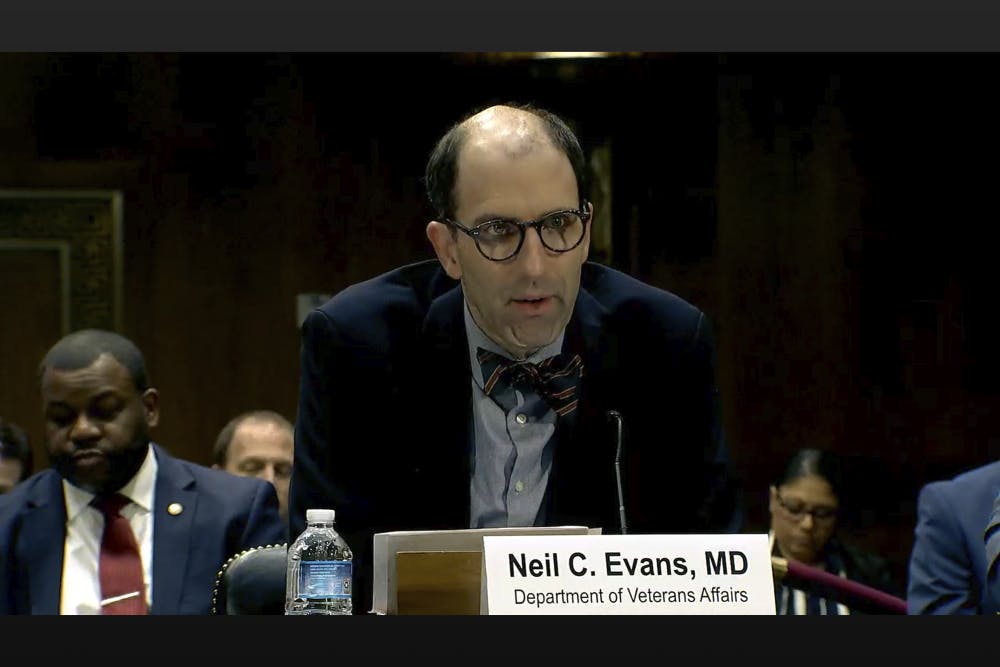
PHOTO CREDIT:Dr. Neil Evans, acting program executive director for VA EHRM-IO, testifying during the March 15, 2023 Senate Committee of Veterans Affairs Hearing. 

The Department of Veterans Affairs targets a new approach to its electronic health record modernization deployment, moving away from individual site rollouts and instead “implementing waves of medical centers, multiple medical centers at one time, based on the relationships between those medical centers,” Dr. Neil Evans, acting executive program director of VA’s Electronic Health Record Modernization Integration Office, told GovCIO Media & Research in a recent interview.

Implementing the EHR in ‘Waves’

The rollout has been in a reset phase since April 2023, following reports that the system struggled with accuracy, enterprise standardization and reliability of data. Currently, the modern EHR is in place at six sites throughout the VA, with the most recent deployment occurring in March 2024 at the Lovell Federal Health Care Center in North Chicago.

The VA announced in Dec. 2024 that it would restart the rollout at four sites in Ann Arbor, Battle Creek, Detroit and Saginaw, with Michigan following in mid-2026. It also announced it will roll out the EHR at nine additional sites spread between Ohio, Indiana and Alaska.

VA plans to use the “wave” deployment approach Evans described when it resumes rollout in Detroit, Ann Arbor, Saginaw and Battle Creek, Michigan in 2026, since the four sites are integrated together and patients often receive specialty care at one facility or primary care at another.

“Going forward, implementing and choosing a schedule that really captures those natural pre-existing relationships, we believe, is an important part of the successful path forward, and that was also partly how we chose the sites that we chose,” Evans said.

VA’s EHR Program Sees Proposed Budget Boost

VA’s dormant but much-anticipated electronic health record modernization program could receive a jolt in funding from the Trump Administration in 2026. The White House’s proposed discretionary budget for FY 2026 calls for an increase of nearly $2.2 billion in funding for the EHR program, saying an accelerated rollout of the program is a “top priority effort.”

The proposed budget also plans to streamline much of the agency’s over 1000 IT systems, which it claims are “decades old” and “duplicative.” It pauses procurement of new systems and directs the U.S. Department of Government Efficiency Service to conduct a full review of the agency’s IT systems alongside the VA.

“There’s testing that we do, where we have to test every build to make sure it’s going to work properly when we go live with it. There’s infrastructure work that we need to do to make sure that our IT networks have been upgraded sufficiently to support the new technologies,” Evans said.

Learning from Federal Partners

As agencies like National Oceanic and Atmospheric Administration, Defense Department and Coast Guard work toward their electronic health record modernization goals, Evans said the VA is learning from their experience and from private sector partners as well.

“We’re not alone in going through an EHR transformation. The scale of what we’re doing in VA is significant, but the experience itself is not entirely unique. We are always open to learning, and have learned quite a bit from our federal partners, and actually from our non federal partners,” Evans said.

Evans emphasized that even after the EHR is rolled out across the country, work will need to be done to continually improve and refine the system to work for both patients and clinicians alike.

“We need to deploy the system, but we need to continue to optimize the system to meet the needs. Technology continues to mature. What we can accomplish using health information technologies is going to continue to improve as new capabilities, artificial intelligence and others, are introduced,” Evans said.

Article link: https://govciomedia.com/va-plans-to-rollout-its-ehr-in-waves-program-chief-says/

Artificial intelligence is now everyone’s business – MIT Sloan

Posted by timmreardon on 05/14/2025
Posted in: Uncategorized.
Why It Matters

AI is a tool to get things done. To use it properly and generate value, organizations need the right capabilities — including a good understanding of data.

Artificial intelligence is getting all the buzz in the business world. But people often talk about “doing” AI without realizing that it’s just a tool for getting things done — a costly and complex tool.

“Like any tool, it creates no value unless it’s used properly,” said Barbara H. Wixom, a principal research scientist at the MIT Center for Information Systems Research. “AI is advanced data science, and you need to have the right capabilities in order to work with it and manage it properly.”

In a new research briefing, Wixom and CISR research fellow Cynthia M. Beathoutline three principles for implementing AI projects: Build the right capabilities, involve stakeholders from across the organization, and focus on realizing value. 

An important theme linking the three principles is data monetization, which is also the topic of the recent book “Data Is Everybody’s Business,” by Wixom, Beath, and Leslie Owens.

AI requires “supercharged” data monetization

In simple terms, data monetization is converting data into financial returns. Datasets could be sold to third parties, studied to improve processes, or used to create new business opportunities. 

Seeing a return on investment from AI requires a “supercharged” data monetization strategy, Wixom said. There’s significant cost associated with the infrastructure, capabilities, and talent needed to get AI initiatives off the ground. And any enterprise that builds AI into a product — even if it’s something relatively simple, such as a customer service chatbot — must bear the associated legal and ethical responsibilities. 

“So many missteps can occur,” Wixom said. “What we care about in the AI conversation is helping organizations embrace AI technology in a way that improves financial health.”

For example, many knowledge workers are using generative AI tools, such as ChatGPT, to write emails, create presentations, or pull key takeaways from meeting transcripts. 

These conveniences shouldn’t be conflated with value, Wixom said. “If you invest millions of dollars in the capability to use AI in a sustaining way, is email productivity going to drive millions of dollars in value?” Wixom asked. “You need to know what your company needs.”

The CISR research briefing includes the example of CarMax, which used ChatGPT to aggregate data from customer reviews and other information sources to write summaries for 50,000 used cars listed on its website. A task that would have taken years to complete and required hundreds of content writers was accomplished in a matter of hours, the company’s chief information and technology officer said last year.

Below are more details on the researchers’ three principles aimed at guiding enterprise AI investments that generate value: 

1. Invest in practices that build AI capabilities. 

Successful AI use depends on advanced capabilities in data science, data management, data platforms, and acceptable data use. 

Organizations may be tempted to forgo these investments if they purchase an off-the-shelf AI tool or have one custom-built for them. However, Wixom said it’s even more important for these organizations to build these capabilities to avoid running into trouble downstream.

“You have to understand the technology enough to trust it,” she said. “You don’t have to know the exact way neural networks work, but you do need to know how data scientists validate them — and you need to know what you don’t know.”

2. Involve all stakeholders in the AI journey. 

Organizations [must] embrace AI technology in a way that improves financial health.

Barbara H. WixomPrincipal Research Scientist, CISRShare 

Roles and titles differ among organizations, but the people who use AI tools, develop products, or offer solutions should be considered key stakeholders. Involving a variety of stakeholders in initiatives can help those without a background in data science better understand what AI can do, how much it costs, and how long it takes.

The CISR research briefing looked at the Australian Taxation Office, where business users provided regular feedback to data scientists about how AI models were performing. This helped all stakeholders understand how AI models made decisions, and it ensured that models had more positive benefits and fewer negative consequences. After implementing the models, which predicted tax-filing behaviors and offered nudges to citizens who needed to update work-related claims, the agency saw 113 million Australian dollars ($74 million) in changed claim amounts. 

3. Focus on realizing value from AI.

In “Data is Everybody’s Business,” Wixom and her co-authors spell out five steps in the value creation cycle. Wixom explains them in the context of a common example in healthcare: predicting which patients in a hospital are at high risk of falling, and intervening to prevent it from happening.

  • Data. This comes from multiple sources, such as a medical history from electronic health records and current data from medical devices at the bedside.
  • Insight. This is where AI enters the picture to analyze data assets and predict who faces a high risk of a fall. Preventable falls are frequently linked to worse outcomes and higher costs of care.
  • Action. Here, insights inform changes to best practices. For example, a hospital may update its policies and send alerts to the nearest nurse when an at-risk patient starts to move in the bed — a sign that they may be trying to get up.
  • Value creation. In this scenario, the new policies result in fewer preventable falls, increased patient satisfaction, and shorter patient stays. 
  • Value monetization. This occurs when the changes can be linked to tangible value creation. It may manifest as a reduced cost of care, which benefits hospitals compensated under performance-based contracts. It could also mean that fewer staff members are needed in a given unit.

A tough road from creation to monetization

Organizations need to plan out the five steps of value creation before any AI project commences, Wixom said. That will help executives see exactly what it will take to achieve returns on investment.

Monetization is the most difficult step. Many organizations get to value creation but are halted there. In a hospital, for example, additional revenue or reduced staffing costs may never materialize.

“You have to find a way to pay for this,” Wixom said. “Otherwise, you can’t sustain the investments, and then you have to pull the plug.”

Yet all isn’t lost if there are meaningful outcomes, such as a reduction in preventable falls, that don’t achieve monetization. In most cases, an organization now has the building blocks — data, insight, and action — to take on additional AI projects down the road. And it has experience successfully selling AI to stakeholders by focusing on what it can get done.

But without monetization, “AI will end up being a tool that sits on a shelf,” Wixom said. “You need to be talking about AI along with specific initiatives and the outcomes you want to achieve using it. And those outcomes need to be compelling for your organization.”

FOR MORE INFO

Sara BrownSenior News Editor and Writersbrown1@mit.edu

Article link: https://mitsloan.mit.edu/ideas-made-to-matter/artificial-intelligence-now-everyones-business?

JPMorganChase just Open Letter to their third party suppliers, and sounded the AI security alarm!

Posted by timmreardon on 04/28/2025
Posted in: Uncategorized.

JPMorganChase just released an Open Letter to their third party suppliers, and sounded the AI security alarm!

The financial giant sees what others are missing:

Companies rushed to deploy AI without understanding the consequences. The mandate was clear: innovate or die. But JP Morgan’s latest security assessment reveals that:

  • 78% of enterprise AI deployments lack proper security protocols
  • Most companies can’t explain how their AI makes decisions
  • Security vulnerabilities have increased 3x since mass AI adoption

The problem? Speed > security.

JP Morgan’s CTO Pat Opet put it bluntly: “We’re seeing organizations deploy systems they fundamentally don’t understand.” The financial sector is particularly vulnerable – with trillions at stake.

What JP Morgan recommends:

→ Implement AI governance frameworks before deployment
→ Conduct regular red team exercises against AI systems
→ Establish clear model documentation standards
→ Create dedicated AI security response teams

JP Morgan itself has invested $2B in AI security measures while slowing certain deployments.

The hard truth:

The AI security debt is growing faster than our ability to pay it down. Companies that prioritize security now will emerge as leaders. Those that don’t may not survive the coming AI security reckoning.

An open letter to third-party suppliers

By Patrick Opet, Chief Information Security Officer

The modern ‘software as a service’ (SaaS) delivery model is quietly enabling cyber attackers and – as its adoption grows – is creating a substantial vulnerability that is weakening the global economic system.

  • Software providers must prioritize security over rushing features. Comprehensive security should be built in or enabled by default.
  • We must modernize security architecture to optimize SaaS integration and minimize risk.
  • Security practitioners must work collaboratively to prevent the abuse of interconnected systems.

There is a growing risk in our software supply chain and we need your action

SaaS has become the default and is often the only format in which software is now delivered, leaving organizations with little choice but to rely heavily on a small set of leading service providers, embedding concentration risk into global critical infrastructure. While this model delivers efficiency and rapid innovation, it simultaneously magnifies the impact of any weakness, outage, or breach, creating single points of failure with potentially catastrophic systemwide consequences. Historically, software was distributed across diverse environments, each with unique security practices, inherently limiting the scale of any single breach. Today, an attack on one major SaaS or PaaS provider can immediately ripple through its customers. This fundamental shift demands our collective immediate attention.

At JPMorganChase, we’ve seen the warning signs firsthand. Over the past three years, our third-party providers experienced a number of incidents within their environments. These incidents across our supply chain required us to act swiftly and decisively, including isolating certain compromised providers, and dedicating substantial resources to threat mitigation.

Security must be prioritized

Risks extend beyond concentration alone. Fierce competition among software providers has driven prioritization of rapid feature development over robust security. This often results in rushed product releases without comprehensive security built in or enabled by default, creating repeated opportunities for attackers to exploit weaknesses. The pursuit of market share at the expense of security exposes entire customer ecosystems to significant risk and will result in an unsustainable situation for the economic system.

Security architecture must be modernized

Most critically, SaaS models are fundamentally reshaping how companies integrate services and data—a subtle yet profound shift eroding decades of carefully architected security boundaries. In the traditional model, security practices enforced strict segmentation between a firm’s trusted internal resources and untrusted external interactions using protocol termination, tiered access, and logical isolation. External interaction layers like APIs and websites were intentionally separated from a company’s core backend systems, applications, and data that powered them.

Modern integration patterns, however, dismantle these essential boundaries, relying heavily on modern identity protocols (e.g., OAuth) to create direct, often unchecked interactions between third-party services and firms’ sensitive internal resources. As a generic example, an AI-driven calendar optimization service integrating directly into corporate email systems through “read only roles” and “authentication tokens” can no doubt boost productivity when functioning correctly. Yet, if compromised, this direct integration grants attackers unprecedented access to confidential data and critical internal communications.

In practice, these integration models collapse authentication (verifying identity) and authorization (granting permissions) into overly simplified interactions, effectively creating single-factor explicit trust between systems on the internet and private internal resources. This architectural regression undermines fundamental security principles that have proven durability.

This problem is getting worse not better

Further compounding the risks are specific vulnerabilities intrinsic to this new landscape: inadequately secured authentication tokens vulnerable to theft and reuse; software providers gaining privileged access to customer systems without explicit consent or transparency; and opaque fourth-party vendor dependencies silently expanding this same risk upstream. Critically, the explosive growth of new value-bearing services in data management, automation, artificial intelligence, and AI agents amplifies and rapidly distributes these risks, bringing them directly to the forefront of every organization.

This weakness is known to attackers who are now actively targeting trusted integration partners—Microsoft Threat Intelligence recently authored a blog post that Chinese state actors were shifting tactics to target “common IT solutions like remote management tools and cloud applications to gain initial access” to their downstream customers.

Call to action

We stand at a critical juncture. Providers must urgently reprioritize security, placing it equal to or above launching new products. ‘Secure and resilient by design’ must go beyond slogans—it requires continuous, demonstrable evidence that controls are working effectively, not simply relying on annual compliance checks. Customers should be afforded the benefit of secure by default configurations, transparency to risks, and management of the controls they need to operate safely within a SaaS delivery model. The ecosystem must address trustworthy integration. There are some solutions available today, like confidential computing, customer self-hosting, and bring your own cloud, which all give organizations stronger controls to protect their data while enabling them to benefit from SaaS solutions.  

We must establish new security principles and implement robust controls that enable the swift adoption of cloud services while protecting customers from their providers’ vulnerabilities. Traditional measures like network segmentation, tiering, and protocol termination were durable in legacy principles but may no longer be viable today in a SaaS integration model. Instead, we need sophisticated authorization methods, advanced detection capabilities, and proactive measures to prevent the abuse of interconnected systems.

The most effective way to begin change is to reject these integration models without better solutions. I hope you’ll join me in recognizing this challenge and responding decisively, collaboratively, and immediately.

Patrick Opet, Chief Information Security Officer, JPMorganChase

Article link: https://www.jpmorgan.com/technology/technology-blog/open-letter-to-our-suppliers

The 15 Diseases of Leadership, According of to Pope Francis – HBR

Posted by timmreardon on 04/22/2025
Posted in: Uncategorized.

By Gary Hamel

Apr 14, 2015

Pope Francis has made no secret of his intention to radically reform the administrative structures of the Catholic church, which he regards as insular, imperious, and bureaucratic. He understands that in a hyper-kinetic world, inward-looking and self-obsessed leaders are a liability.

Last year, just before Christmas, the Pope addressed the leaders of the Roman Curia — the Cardinals and other officials who are charged with running the church’s byzantine network of administrative bodies. The Pope’s message to his colleagues was blunt. Leaders are susceptible to an array of debilitating maladies, including arrogance, intolerance, myopia, and pettiness. When those diseases go untreated, the organization itself is enfeebled. To have a healthy church, we need healthy leaders.

Through the years, I’ve heard dozens of management experts enumerate the qualities of great leaders. Seldom, though, do they speak plainly about the “diseases” of leadership. The Pope is more forthright. He understands that as human beings we have certain proclivities — not all of them noble. Nevertheless, leaders should be held to a high standard, since their scope of influence makes their ailments particularly infectious.

The Catholic Church is a bureaucracy: a hierarchy populated by good-hearted, but less-than-perfect souls. In that sense, it’s not much different than your organization. That’s why the Pope’s counsel is relevant to leaders everywhere.

With that in mind, I spent a couple of hours translating the Pope’s address into something a little closer to corporate-speak. (I don’t know if there’s a prohibition on paraphrasing Papal pronouncements, but since I’m not Catholic, I’m willing to take the risk.)

Herewith, then, the Pope (more or less):

____________________

The leadership team is called constantly to improve and to grow in rapport and wisdom, in order to carry out fully its mission. And yet, like any body, like any human body, it is also exposed to diseases, malfunctioning, infirmity. Here I would like to mention some of these “[leadership] diseases.” They are diseases and temptations which can dangerously weaken the effectiveness of any organization.

  1. The disease of thinking we are immortal, immune, or downright indispensable, [and therefore] neglecting the need for regular check-ups. A leadership team which is not self-critical, which does not keep up with things, which does not seek to be more fit, is a sick body. A simple visit to the cemetery might help us see the names of many people who thought they were immortal, immune, and indispensable! It is the disease of those who turn into lords and masters, who think of themselves as above others and not at their service. It is the pathology of power and comes from a superiority complex, from a narcissism which passionately gazes at its own image and does not see the face of others, especially the weakest and those most in need. The antidote to this plague is humility; to say heartily, “I am merely a servant. I have only done what was my duty.”
  2. Another disease is excessive busyness. It is found in those who immerse themselves in work and inevitably neglect to “rest a while.” Neglecting needed rest leads to stress and agitation. A time of rest, for those who have completed their work, is necessary, obligatory and should be taken seriously: by spending time with one’s family and respecting holidays as moments for recharging.
  3. Then there is the disease of mental and [emotional] “petrification.” It is found in leaders who have a heart of stone, the “stiff-necked;” in those who in the course of time lose their interior serenity, alertness and daring, and hide under a pile of papers, turning into paper pushers and not men and women of compassion. It is dangerous to lose the human sensitivity that enables us to weep with those who weep and to rejoice with those who rejoice! Because as time goes on, our hearts grow hard and become incapable of loving all those around us. Being a humane leader means having the sentiments of humility and unselfishness, of detachment and generosity.
  4. The disease of excessive planning and of functionalism. When a leader plans everything down to the last detail and believes that with perfect planning things will fall into place, he or she becomes an accountant or an office manager. Things need to be prepared well, but without ever falling into the temptation of trying to eliminate spontaneity and serendipity, which is always more flexible than any human planning. We contract this disease because it is easy and comfortable to settle in our own sedentary and unchanging ways.
  5. The disease of poor coordination. Once leaders lose a sense of community among themselves, the body loses its harmonious functioning and its equilibrium; it then becomes an orchestra that produces noise: its members do not work together and lose the spirit of camaraderie and teamwork. When the foot says to the arm: ‘I don’t need you,’ or the hand says to the head, ‘I’m in charge,’ they create discomfort and parochialism.
  6. There is also a sort of “leadership Alzheimer’s disease.” It consists in losing the memory of those who nurtured, mentored and supported us in our own journeys. We see this in those who have lost the memory of their encounters with the great leaders who inspired them; in those who are completely caught up in the present moment, in their passions, whims and obsessions; in those who build walls and routines around themselves, and thus become more and more the slaves of idols carved by their own hands.
  7. The disease of rivalry and vainglory. When appearances, our perks, and our titles become the primary object in life, we forget our fundamental duty as leaders—to “do nothing from selfishness or conceit but in humility count others better than ourselves.” [As leaders, we must] look not only to [our] own interests, but also to the interests of others.
  8. The disease of existential schizophrenia. This is the disease of those who live a double life, the fruit of that hypocrisy typical of the mediocre and of a progressive emotional emptiness which no [accomplishment or] title can fill. It is a disease which often strikes those who are no longer directly in touch with customers and “ordinary” employees, and restrict themselves to bureaucratic matters, thus losing contact with reality, with concrete people.
  9. The disease of gossiping, grumbling, and back-biting.This is a grave illness which begins simply, perhaps even in small talk, and takes over a person, making him become a “sower of weeds” and in many cases, a cold-blooded killer of the good name of colleagues. It is the disease of cowardly persons who lack the courage to speak out directly, but instead speak behind other people’s backs. Let us be on our guard against the terrorism of gossip!
  10. The disease of idolizing superiors. This is the disease of those who court their superiors in the hope of gaining their favor. They are victims of careerism and opportunism; they honor persons [rather than the larger mission of the organization]. They think only of what they can get and not of what they should give; small-minded persons, unhappy and inspired only by their own lethal selfishness. Superiors themselves can be affected by this disease, when they try to obtain the submission, loyalty and psychological dependency of their subordinates, but the end result is unhealthy complicity.
  11. The disease of indifference to others. This is where each leader thinks only of himself or herself, and loses the sincerity and warmth of [genuine] human relationships. This can happen in many ways: When the most knowledgeable person does not put that knowledge at the service of less knowledgeable colleagues, when you learn something and then keep it to yourself rather than sharing it in a helpful way with others; when out of jealousy or deceit you take joy in seeing others fall instead of helping them up and encouraging them.
  12. The disease of a downcast face. You see this disease in those glum and dour persons who think that to be serious you have to put on a face of melancholy and severity, and treat others—especially those we consider our inferiors—with rigor, brusqueness and arrogance. In fact, a show of severity and sterile pessimism are frequently symptoms of fear and insecurity. A leader must make an effort to be courteous, serene, enthusiastic and joyful, a person who transmits joy everywhere he goes. A happy heart radiates an infectious joy: it is immediately evident! So a leader should never lose that joyful, humorous and even self-deprecating spirit which makes people amiable even in difficult situations. How beneficial is a good dose of humor! …
  13. The disease of hoarding. This occurs when a leader tries to fill an existential void in his or her heart by accumulating material goods, not out of need but only in order to feel secure. The fact is that we are not able to bring material goods with us when we leave this life, since “the winding sheet does not have pockets” and all our treasures will never be able to fill that void; instead, they will only make it deeper and more demanding. Accumulating goods only burdens and inexorably slows down the journey!
  14. The disease of closed circles, where belonging to a clique becomes more powerful than our shared identity. This disease too always begins with good intentions, but with the passing of time it enslaves its members and becomes a cancer which threatens the harmony of the organization and causes immense evil, especially to those we treat as outsiders. “Friendly fire” from our fellow soldiers, is the most insidious danger. It is the evil which strikes from within. As it says in the bible, “Every kingdom divided against itself is laid waste.”
  15. Lastly: the disease of extravagance and self-exhibition. This happens when a leader turns his or her service into power, and uses that power for material gain, or to acquire even greater power. This is the disease of persons who insatiably try to accumulate power and to this end are ready to slander, defame and discredit others; who put themselves on display to show that they are more capable than others. This disease does great harm because it leads people to justify the use of any means whatsoever to attain their goal, often in the name of justice and transparency! Here I remember a leader who used to call journalists to tell and invent private and confidential matters involving his colleagues. The only thing he was concerned about was being able to see himself on the front page, since this made him feel powerful and glamorous, while causing great harm to others and to the organization.

Friends, these diseases are a danger for every leader and every organization, and they can strike at the individual and the community levels.

____________________

So, are you a healthy leader? Use the Pope’s inventory of leadership maladies to find out. Ask yourself, on a scale of 1 to 5, to what extent do I . . .

  • Feel superior to those who work for me?
  • Demonstrate an imbalance between work and other areas of life?
  • Substitute formality for true human intimacy?
  • Rely too much on plans and not enough on intuition and improvisation?
  • Spend too little time breaking silos and building bridges?
  • Fail to regularly acknowledge the debt I owe to my mentors and to others?
  • Take too much satisfaction in my perks and privileges?
  • Isolate myself from customers and first-level employees?
  • Denigrate the motives and accomplishments of others?
  • Exhibit or encourage undue deference and servility?
  • Put my own success ahead of the success of others?
  • Fail to cultivate a fun and joy-filled work environment?
  • Exhibit selfishness when it comes to sharing rewards and praise?
  • Encourage parochialism rather than community?
  • Behave in ways that seem egocentric to those around me?

As in all health matters, it’s good to get a second or third opinion. Ask your colleagues to score you on the same fifteen items. Don’t be surprised if they say, “Gee boss, you’re not looking too good today.” Like a battery of medical tests, these questions can help you zero in on opportunities to prevent disease and improve your health. A Papal leadership assessment may seem like a bit of a stretch. But remember: the responsibilities you hold as a leader, and the influence you have over others’ lives, can be profound. Why not turn to the Pope — a spiritual leader of leaders — for wisdom and advice?

Article link: https://hbr.org/2015/04/the-15-diseases-of-leadership-according-to-pope-francis

Gary Hamel is a visiting professor at London Business School and the founder of the Management Lab. He is a coauthor of Humanocracy: Creating Organizations as Amazing as the People Inside Them(Harvard Business Review Press, 2020).

We need to focus on the AI harms that already exist – MIT Technology Review

Posted by timmreardon on 04/21/2025
Posted in: Uncategorized.

Fears about potential future existential risk are blinding us to the fact AI systems are already hurting people here and now.

October 30, 2023

This is an excerpt from Unmasking AI: My Mission to Protect What Is Human in a World of Machines by Joy Buolamwini, published on October 31 by Random House. It has been lightly edited. 

The term “x-risk” is used as a shorthand for the hypothetical existential risk posed by AI. While my research supports the idea that AI systems should not be integrated into weapons systems because of the lethal dangers, this isn’t because I believe AI systems by themselves pose an existential risk as superintelligent agents. 

AI systems falsely classifying individuals as criminal suspects, robots being used for policing, and self-driving cars with faulty pedestrian tracking systems can already put your life in danger. Sadly, we do not need AI systems to have superintelligence for them to have fatal outcomes for individual lives. Existing AI systems that cause demonstrated harms are more dangerous than hypothetical “sentient” AI systems because they are real. 

Related Story

Joy Buolimwini

Joy Buolamwini: “We’re giving AI companies a free pass”

The pioneering AI researcher and activist shares her personal journey in a new book, and explains her concerns about today’s AI systems.

One problem with minimizing existing AI harms by saying hypothetical existential harms are more important is that it shifts the flow of valuable resources and legislative attention. Companies that claim to fear existential risk from AI could show a genuine commitment to safeguarding humanity by not releasing the AI tools they claim could end humanity. 

I am not opposed to preventing the creation of fatal AI systems. Governments concerned with lethal use of AI can adopt the protections long championed by the Campaign to Stop Killer Robots to ban lethal autonomous systems and digital dehumanization. The campaign addresses potentially fatal uses of AI without making the hyperbolic jump that we are on a path to creating sentient systems that will destroy all humankind.

Though it is tempting to view physical violence as the ultimate harm, doing so makes it easy to forget pernicious ways our societies perpetuate structural violence. The Norwegian sociologist Johan Galtung coined this term to describe how institutions and social structures prevent people from meeting their fundamental needs and thus cause harm. Denial of access to health care, housing, and employment through the use of AI perpetuates individual harms and generational scars. AI systems can kill us slowly.

Given what my “Gender Shades” research revealed about algorithmic bias from some of the leading tech companies in the world, my concern is about the immediate problems and emerging vulnerabilities with AI and whether we could address them in ways that would also help create a future where the burdens of AI did not fall disproportionately on the marginalized and vulnerable. AI systems with subpar intelligence that lead to false arrests or wrong diagnoses need to be addressed now. 

When I think of x-risk, I think of the people being harmed now and those who are at risk of harm from AI systems. I think about the risk and reality of being “excoded.” You can be excoded when a hospital uses AI for triage and leaves you without care, or uses a clinical algorithm that precludes you from receiving a life-saving organ transplant. You can be excoded when you are denied a loan based on algorithmic decision-making. You can be excoded when your résumé is automatically screened out and you are denied the opportunity to compete for the remaining jobs that are not replaced by AI systems. You can be excoded when a tenant-screening algorithm denies you access to housing. All of these examples are real. No one is immune from being excoded, and those already marginalized are at greater risk.

This is why my research cannot be confined just to industry insiders, AI researchers, or even well-meaning influencers. Yes, academic conferences are important venues. For many academics, presenting published papers is the capstone of a specific research exploration. For me, presenting “Gender Shades” at New York University was a launching pad. I felt motivated to put my research into action—beyond talking shop with AI practitioners, beyond the academic presentations, beyond private dinners. Reaching academics and industry insiders is simply not enough. We need to make sure everyday people at risk of experiencing AI harms are part of the fight for algorithmic justice.

Read our interview with Joy Buolamwini here. 

Article link: https://www.technologyreview.com/2023/10/30/1082656/focus-on-existing-ai-harms/?

Five Takeaways from HIMSS 25 – FEHRM

Posted by timmreardon on 04/18/2025
Posted in: Uncategorized.

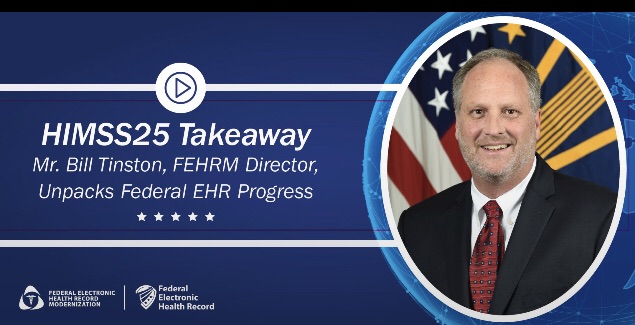
Check out the Five Takeaways from #HIMSS25 to watch #FEHRM Director William Tinston share the latest about the #FederalEHR and what’s ahead in the evolving #healthcare landscape. https://lnkd.in/em_PSw6y.

Article link: https://www.linkedin.com/posts/fehrm_himss25-fehrm-federalehr-activity-7319009213454708736-3Y_N?

Information Integrity in the AI Age – United Nations

Posted by timmreardon on 04/15/2025
Posted in: Uncategorized.

AI technologies have had an undeniable impact on the information landscape.

If deployed responsibly, AI can facilitate access to accurate, reliable information, foster free expression, and contribute to healthy and vibrant information ecosystems.

But how do we make this vision a reality?

The UN Security Council took up these questions in a recent informal meeting on “Harnessing safe, inclusive and trustworthy AI for the maintenance of international peace and security.”

One of the focus areas of the meeting was AI’s impact on information integrity.

Two key risks were highlighted:

1. The role of AI in curating and creating information, and people’s growing reliance on this technology to shape their understanding of the world.

At present, tech companies continue to integrate AI into our everyday applications at breakneck speed but genAI tools cannot uniformly be relied on as sources of accurate information.

Ongoing studies and testing show that they frequently do not distinguish between rigorous science on the one hand and dirty data or outright nonsense on the other.

And yet, people are increasingly accessing this convenient and flawed data without being equipped to assess its veracity or reliability. This can contribute to a deeply concerning trend: thelack of trust in any information source and in the information ecosystem more broadly.

People just don’t know what is real and what to believe.

At pivotal societal moments and especially in fragile settings, this can feed into instability and unrest, sometimes with disastrous consequences.

We are, in effect, guinea pigs in an information experiment in which the resilience of our societies is being put to the test.

2. The misuse of AI in facilitating the creation and dissemination of false and hateful information at scale.

This can affect the peace and security of communities and countries.

GenAI tools have made it immeasurably easier for a broad range of actors to spread false claims for financial or strategic gain.

It now costs next to nothing to quickly and easily create a flood of convincing lies and hate, with minor human intervention.

To target specific groups and individuals, actors draw on our personal data that has been sold as part of the advertising supply chain.

Tactics like this can trigger diplomatic crises, incite unrest, and undermine understanding of realities on the ground.

AI-generated deep fake images, audio and video have been weaponized in conflicts from Ukraine, to Gaza, to Sudan.

We’re also now seeing AI used openly and explicitly to generate content designed to undermine social cohesion.

Content that demonises or dehumanises women, refugees, migrants, and minorities.

Content that is anti-Semitic, Islamophobic, racist and xenophobic.

The UN has experienced grave impacts on our missions and priorities.

Peace and humanitarian operations are targeted with false and hateful narratives, negatively affecting the safety and security of UN personnel and making the tasks of implementing their mandates harder.

In turn, this is impacting communities small and large, jeopardizing their stability.

What are some of the concrete steps needed to address these areas of risk?

The UN system has been ramping up efforts.

This includes the 3R approach:

research, risk assessment and response.

Through research we can better understand information risks in complex, multiplatform, multilingual environments.

Our work includes outreach with affected communities to hear and understand their perceptions and concerns.

UN entities then assess the risk posed to UN mandate delivery and thematic priorities.

We use this insight to design appropriate mitigation and response measures.

Most immediately, this means quick and proactive communication to address information voids.

This can be done through our own channels and also via coalitions with community leaders, influencers and civil society groups.

Of course, these efforts require resources, including for skills training and technology.

We also continue to support the efforts of the international community, including through our work to implement the UN Global Principles for Information Integrity.

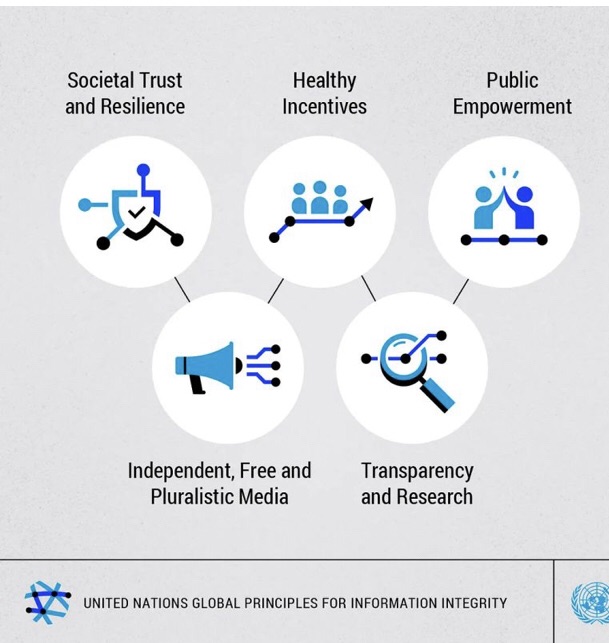
The Principles provide a framework for action to strengthen the information ecosystem — and are a resource to UN member countries in meeting the commitments agreed in the Global Digital Compact.

The Principles contain recommendations for a wide range of stakeholders around five pillars: societal trust and resilience; healthy incentives; public empowerment; independent, free and pluralistic media; and transparency and research.

The United Nations Global Principles for Information Integrity

Three key recommendation areas are highlighted below.

1. Countries play a central role in shaping information spaces, beginning with obligations to respect, protect and promote human rights, in particular the right to freedom of expression.

This means that regulatory measures to address information integrity comply with applicable international law and are carried out with the full participation of civil society.

Freedom of expression requires not only that people are able to express their views, but that they are able to seek and receive ideas and information of all kinds.

It is exponentially harder to do this when you’re in a polarized, opaque information environment crowded with lies and hate.

In such a landscape, guardrails allow for more free speech, not less, and protect people who feel unsafe in online spaces, giving voice to those otherwise silenced.

Guardrails can help enable inclusive access to information.

And they can support and encourage innovation and help foster public trust in fast-emerging AI technologies.

There is growing awareness among the communities the UN serves that the sooner guardrails are established, the less the risk for us all.

2. Information integrity is not possible without a free, independent and pluralistic media.

Professional journalism requires considerable investment. Yet the advertising-driven business model which long supported independent media has drastically eroded.

AI has prompted new concerns. Quality journalism is being scraped and summarized or used to train AI without permission or compensation.

GenAI search summaries replacing standard search results can reduce web traffic to news sites, further affecting revenue streams.

Many news outlets, particularly at the local level, just can’t compete. For them it is not just a matter of relevance. It is a matter of survival.

The result is news deserts. The vacuum is filled by AI-generated articles or downgraded versions of journalistic content, or malicious content imitating news.

This can be particularly destabilising in conflict and crisis zones.

Responses must therefore urgently support sustainable business models for public interest media.

They must also ensure better protection for media workers, along with researchers, academics and civil society, who are under attack around the world.

3. There is an urgent global need for public empowerment in the information ecosystem, including through measures to boost resilience.

Media and digital literacy skills can allow people to navigate information spaces safely and effectively.

Countries can prioritize the literacy needs of groups in vulnerable and marginalized situations — who are often those most adversely affected by information risks.

They can also undertake literacy efforts around specific problems related to AI, keeping up with new and emerging technologies

Public awareness must improve around online rights, how AI works, and how personal data is used.

The urgency of the challenge requires multi stakeholder coalitions with collaborations between countries to support capacity building and increase global resilience.

This is the only viable path to an information ecosystem in which AI innovation is harnessed for information integrity, human rights and international peace and security.

The text above is adapted from a briefing to the Security Council by Charlotte Scaddan, Senior Adviser on Information Integrity, UN Global Communications

Article link: https://medium.com/we-the-peoples/information-integrity-in-the-ai-age-51494645e765

Indian Health Service – John’s Hopkins

Posted by timmreardon on 04/13/2025
Posted in: Uncategorized.

The Indian Health Service (IHS) is a federally mandated health system providing care to approximately 2.6 million American Indian and Alaska Native people across 574 federally recognized Tribes. Many IHS facilities are in rural or remote areas, often providing the only available healthcare. Unlike other American health systems, IHS is not a benefit or entitlement – it is the product of treaties between the United States and sovereign Tribal Nations.

In FY2023, IHS spent approximately $4,078 per person on care, compared to a national average expenditure of $14,570 per person. Despite challenges, including aging facilities and staffing shortages, IHS delivers remarkable care. Staffed by dedicated Native and allied physicians, nurses, public health workers, and technicians, these facilities are models of resilience. They frequently incorporate traditional healers and language keepers into care delivery, finding innovative ways to meet complex health needs.

Federal decisions, like those discussed by Health Secretary Robert F. Kennedy Jr. during his “Make America Healthy Again” tour, directly impact the resources and policies that shape the IHS and its ability to serve Tribal communities effectively. Additional resources at IHS, combined with the cultivation and empowerment of Indigenous healthcare professionals and Tribal leadership, could be transformative. We hope that the pleas from our tribal members resonated with Secretary Kennedy and leads to meaningful support for IHS.

Read the New York Times article https://bit.ly/RFKonNavajo.

NativesDoingTheirPart #NativeAmericanHealth #IndigenousHealth #NativeAmerican #AmericanIndian #AlaskanNative #HealthyTribes #IndigenousPeople #NativeHealth #TribalHealth

Secretary Kennedy The New York Times CDC Indian Country Today Indian Health Service Johns Hopkins Bloomberg School of Public Health National Indian Health Board National Native News Native News Online Urban Indigenous Collective Urban Indian Health Institute Johns Hopkins Department of International Health

Posts navigation

← Older Entries
Newer Entries →
  • Search site

  • Follow healthcarereimagined on WordPress.com
  • Recent Posts

    • WHAT A QUBIT IS AND WHAT IT IS NOT. 01/25/2026
    • Governance Before Crisis We still have time to get this right. 01/21/2026
    • On the Eve of Davos: We’re Just Arguing About the Wrong Thing 01/18/2026
    • Are AI Companies Actually Ready to Play God? – RAND 01/17/2026
    • ChatGPT Health Is a Terrible Idea 01/09/2026
    • Choose the human path for AI – MIT Sloan 01/09/2026
    • Why AI predictions are so hard – MIT Technology Review 01/07/2026
    • Will AI make us crazy? – Bulletin of the Atomic Scientists 01/04/2026
    • Decisions about AI will last decades. Researchers need better frameworks – Bulletin of the Atomic Scientists 12/29/2025
    • Quantum computing reality check: What business needs to know now – MIT Sloan 12/29/2025
  • Categories

    • Accountable Care Organizations
    • ACOs
    • AHRQ
    • American Board of Internal Medicine
    • Big Data
    • Blue Button
    • Board Certification
    • Cancer Treatment
    • Data Science
    • Digital Services Playbook
    • DoD
    • EHR Interoperability
    • EHR Usability
    • Emergency Medicine
    • FDA
    • FDASIA
    • GAO Reports
    • Genetic Data
    • Genetic Research
    • Genomic Data
    • Global Standards
    • Health Care Costs
    • Health Care Economics
    • Health IT adoption
    • Health Outcomes
    • Healthcare Delivery
    • Healthcare Informatics
    • Healthcare Outcomes
    • Healthcare Security
    • Helathcare Delivery
    • HHS
    • HIPAA
    • ICD-10
    • Innovation
    • Integrated Electronic Health Records
    • IT Acquisition
    • JASONS
    • Lab Report Access
    • Military Health System Reform
    • Mobile Health
    • Mobile Healthcare
    • National Health IT System
    • NSF
    • ONC Reports to Congress
    • Oncology
    • Open Data
    • Patient Centered Medical Home
    • Patient Portals
    • PCMH
    • Precision Medicine
    • Primary Care
    • Public Health
    • Quadruple Aim
    • Quality Measures
    • Rehab Medicine
    • TechFAR Handbook
    • Triple Aim
    • U.S. Air Force Medicine
    • U.S. Army
    • U.S. Army Medicine
    • U.S. Navy Medicine
    • U.S. Surgeon General
    • Uncategorized
    • Value-based Care
    • Veterans Affairs
    • Warrior Transistion Units
    • XPRIZE
  • Archives

    • January 2026 (8)
    • December 2025 (11)
    • November 2025 (9)
    • October 2025 (10)
    • September 2025 (4)
    • August 2025 (7)
    • July 2025 (2)
    • June 2025 (9)
    • May 2025 (4)
    • April 2025 (11)
    • March 2025 (11)
    • February 2025 (10)
    • January 2025 (12)
    • December 2024 (12)
    • November 2024 (7)
    • October 2024 (5)
    • September 2024 (9)
    • August 2024 (10)
    • July 2024 (13)
    • June 2024 (18)
    • May 2024 (10)
    • April 2024 (19)
    • March 2024 (35)
    • February 2024 (23)
    • January 2024 (16)
    • December 2023 (22)
    • November 2023 (38)
    • October 2023 (24)
    • September 2023 (24)
    • August 2023 (34)
    • July 2023 (33)
    • June 2023 (30)
    • May 2023 (35)
    • April 2023 (30)
    • March 2023 (30)
    • February 2023 (15)
    • January 2023 (17)
    • December 2022 (10)
    • November 2022 (7)
    • October 2022 (22)
    • September 2022 (16)
    • August 2022 (33)
    • July 2022 (28)
    • June 2022 (42)
    • May 2022 (53)
    • April 2022 (35)
    • March 2022 (37)
    • February 2022 (21)
    • January 2022 (28)
    • December 2021 (23)
    • November 2021 (12)
    • October 2021 (10)
    • September 2021 (4)
    • August 2021 (4)
    • July 2021 (4)
    • May 2021 (3)
    • April 2021 (1)
    • March 2021 (2)
    • February 2021 (1)
    • January 2021 (4)
    • December 2020 (7)
    • November 2020 (2)
    • October 2020 (4)
    • September 2020 (7)
    • August 2020 (11)
    • July 2020 (3)
    • June 2020 (5)
    • April 2020 (3)
    • March 2020 (1)
    • February 2020 (1)
    • January 2020 (2)
    • December 2019 (2)
    • November 2019 (1)
    • September 2019 (4)
    • August 2019 (3)
    • July 2019 (5)
    • June 2019 (10)
    • May 2019 (8)
    • April 2019 (6)
    • March 2019 (7)
    • February 2019 (17)
    • January 2019 (14)
    • December 2018 (10)
    • November 2018 (20)
    • October 2018 (14)
    • September 2018 (27)
    • August 2018 (19)
    • July 2018 (16)
    • June 2018 (18)
    • May 2018 (28)
    • April 2018 (3)
    • March 2018 (11)
    • February 2018 (5)
    • January 2018 (10)
    • December 2017 (20)
    • November 2017 (30)
    • October 2017 (33)
    • September 2017 (11)
    • August 2017 (13)
    • July 2017 (9)
    • June 2017 (8)
    • May 2017 (9)
    • April 2017 (4)
    • March 2017 (12)
    • December 2016 (3)
    • September 2016 (4)
    • August 2016 (1)
    • July 2016 (7)
    • June 2016 (7)
    • April 2016 (4)
    • March 2016 (7)
    • February 2016 (1)
    • January 2016 (3)
    • November 2015 (3)
    • October 2015 (2)
    • September 2015 (9)
    • August 2015 (6)
    • June 2015 (5)
    • May 2015 (6)
    • April 2015 (3)
    • March 2015 (16)
    • February 2015 (10)
    • January 2015 (16)
    • December 2014 (9)
    • November 2014 (7)
    • October 2014 (21)
    • September 2014 (8)
    • August 2014 (9)
    • July 2014 (7)
    • June 2014 (5)
    • May 2014 (8)
    • April 2014 (19)
    • March 2014 (8)
    • February 2014 (9)
    • January 2014 (31)
    • December 2013 (23)
    • November 2013 (48)
    • October 2013 (25)
  • Tags

    Business Defense Department Department of Veterans Affairs EHealth EHR Electronic health record Food and Drug Administration Health Health informatics Health Information Exchange Health information technology Health system HIE Hospital IBM Mayo Clinic Medicare Medicine Military Health System Patient Patient portal Patient Protection and Affordable Care Act United States United States Department of Defense United States Department of Veterans Affairs
  • Upcoming Events

Blog at WordPress.com.
healthcarereimagined
Blog at WordPress.com.
  • Subscribe Subscribed
    • healthcarereimagined
    • Join 153 other subscribers
    • Already have a WordPress.com account? Log in now.
    • healthcarereimagined
    • Subscribe Subscribed
    • Sign up
    • Log in
    • Report this content
    • View site in Reader
    • Manage subscriptions
    • Collapse this bar
 

Loading Comments...