healthcarereimagined

Envisioning healthcare for the 21st century

  • About
  • Economics

NSA Releases Future Quantum-Resistant (QR) Algorithm Requirements for National Security Systems – NSA

Posted by timmreardon on 09/09/2022
Posted in: Uncategorized. Leave a comment

PRESS RELEASE | Sept. 7, 2022

The National Security Agency (NSA) released the “Commercial National Security Algorithm Suite 2.0” (CNSA 2.0) Cybersecurity Advisory (CSA) today to notify National Security Systems (NSS) owners, operators and vendors of the future quantum-resistant (QR) algorithms requirements for NSS — networks that contain classified information or are otherwise critical to military and intelligence activities.

A cryptanalytically-relevant quantum computer (CRQC) would have the potential to break public-key systems (sometimes referred to as asymmetric cryptography) that are used today. Given foreign pursuits in quantum computing, now is the time to plan, prepare and budget for a transition to QR algorithms to assure sustained protection of NSS and related assets in the event a CRQC becomes an achievable reality.

“This transition to quantum-resistant technology in our most critical systems will require collaboration between government, National Security System owners and operators, and industry,” said Rob Joyce, Director of NSA Cybersecurity. “Our hope is that sharing these requirements now will help efficiently operationalize these requirements when the time comes.”

The Director of NSA is the National Manager for NSS and therefore issues guidance for NSS. The algorithms in CNSA 2.0 are an update to those in the currently required Commercial National Security Algorithm Suite (now referred to as CNSA 1.0) listed in CNSSP 15, Annex B (released in 2016). The CNSA 2.0 algorithms have been analyzed as secure against both classical and quantum computers, and they will eventually be required for NSS.

NSA’s CNSA 2.0 algorithm selections were based on the National Institute of Standards and Technology’s (NIST) recently announced selections for standardization for quantum-resistant cryptography, but there are neither final standards nor FIPS-validated implementations available yet.

NSA urges NSS owners and operators to pay attention to NIST selections and to the future requirements outlined in CNSA 2.0, while CNSA 1.0 compliance continues to be required in the interim.

“We want people to take note of these requirements to plan and budget for the expected transition, but we don’t want to get ahead of the standards process,” said Joyce.

NSS owners and operators should not deploy QR algorithms on mission networks until they have been vetted by NIST and National Information Assurance Partnership (NIAP) as required in CNSSP-11.There will be a transition period, and NSA will be transparent about NSS transition requirements.

For additional information, the CNSA 2.0 CSA is accompanied by a cybersecurity information sheet (CSI), “The Commercial National Security Algorithm Suite 2.0 and Quantum Computing FAQ.” This CSI provides updated answers to quantum-related FAQs that were previously published on NSA’s website.

Article link: https://www.nsa.gov/Press-Room/News-Highlights/Article/Article/3148990/nsa-releases-future-quantum-resistant-qr-algorithm-requirements-for-national-se/

Review the advisory here.

Review the FAQ here.

Visit our full library for more cybersecurity information and technical guidance.


WITH 5G, AI AT THE EDGE PROMISES A COMPUTE EVERYWHERE FUTURE – MIT Tech Review

Posted by timmreardon on 09/07/2022
Posted in: Uncategorized. Leave a comment

From the factory floor to delivery robots, innovation is moving fast with real-time data processing.

Luxury auto maker Audi is driving full-throttle toward Industry 4.0, using AI inference and computer vision on the factory floor with autonomous robot welders that can react in real time and fix issues that may arise when welding the frame of a car. That’s just one example of how the company is moving toward realizing its ultimate vision of creating smart factories with a scalable and flexible platform that will enable data analytics, communications and processing at the edge, powered by 5G.

In the past, welding required a lot of manual intervention and inspection to ensure sufficient quality, says Nick McKeown, senior vice president and general manager of the network and edge group at Intel, which is working with Audi. Now, with cameras reviewing the quality of the weld the need for human intervention has greatly decreased.

“If you want, or need to process data in real time, you actually have to bring the compute to the data, to the point of data creation and data consumption.”

Sandra Rivera

“Edge computing is taking the technology resources we’ve been developing over many years for the computing industry and using them to analyze and process data at the edge”, McKeown says. The concept of edge computing is storing data closer to where it is generated and used—like the factory floor–instead of in the cloud, which means it can be processed in real or near real time.

“If you want, or need to process data in real time, you actually have to bring the compute to the data, to the point of data creation and data consumption”, explains Sandra Rivera, executive vice president and general manager of the datacenter and AI group at Intel. Not having to move large amounts of data enhances security, and increases reliability while reducing latency. And because data is kept more private there is an additional layer of data sovereignty available when needed, adds McKeown.

GROWING OPPORTUNITIES FOR 5G AT THE EDGE

As telecommunication operators continue rolling out 5G infrastructure, “there are opportunities that start to emerge because the data rate, the latency, the control that you have over the 5G network means that we can start to use it for applications that we would not have previously thought suitable for a cellular technology,” McKeown says.

In the Audi factory example, controlling a robot arm in real time requires either a cable, a wire, an ethernet cable that connects to it to guarantee connectivity, the data rate that is needed, and the low latency control—or it has to be replaced with a wireless link, he says.

“Now imagine that robot is moving around. You really don’t want a wire trailing around on the floor for other robots to trip over. You’d really like it to be a wireless link”, McKeown says. “And the problem is, wi-fi hasn’t really gotten there just yet in terms of the quality that you would want. What 5G, in particular private 5G, offers is a much more reliable, much lower latency, much more controlled-by-software experience.”

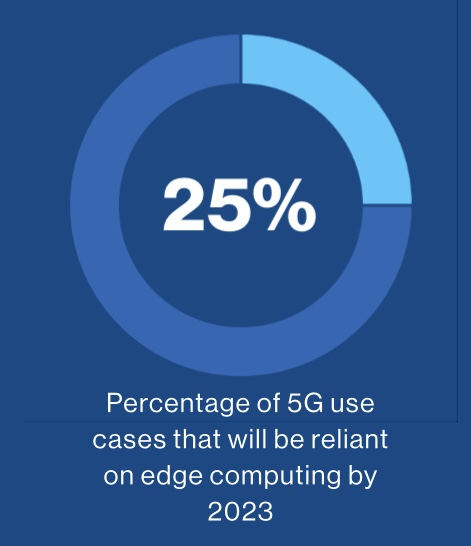
According to a recent Gartner report, “Predicts 2022: The Distributed Enterprise Drives Computing to the Edge”, 5G is the fastest growing segment in the wireless network infrastructure market—and global revenue will likely reach $23.2 billion in 2022. Gartner has further predicted that by 2025, more than 50% of enterprise-generated data will be processed outside a traditional centralized data center or cloud.

Deploying AI applications at the edge with 5G has the potential to generate new revenue sources—and position AI as standard bearer for 5G. Opportunities range across industries including smart manufacturing, smart cities, rich media, enhanced retail logistics, and automated warehouses, among others.

KEEPING AN EYE ON OBSTACLES

Because AI is a highly compute-intensive process it is critical to have the right infrastructure optimized for the unique demands of AI workloads at the edge. Another consideration says Rivera is that “Computing takes power. And we know that we have to work within restricted power envelopes when we’re deploying on the edge and also computing on small form factor devices, or in areas where you have a hostile environment,” Rivera notes.

“Every day, every week, I see a number of different use cases that our customers or their customers have put in place that we would never have thought of.”

Nick McKeown

For example, if wireless infrastructure is deployed across the globe, that connectivity will exist in both the coldest and the hottest places on earth, she says. “We design and develop our products on our own, as well as together with customers, for much more power-efficient types of platforms to address that particular set of issues.”

There’s always more work to do, because there’s always more computing people want to do on an ever-limited power budget, Rivera says.

“The other big limitation we see is in legacy applications,” she adds. In the case of deploying internet of things (IoT) devices, there is such a broad range of market segments each customer’s environment and individual needs have to be considered.

“Our challenge is, how do we give application developers an easy way to migrate and integrate AI into their legacy applications? When we look at how to do that, first of all, we have to understand that vertical and work closely with customers.”

THE POSSIBILITIES ARE ENDLESS

The combination of AI and 5G will transform the enterprise and accelerate economic growth, as 5G networks provide the backbone, scalable bandwidth, and remote compute resources to process increasing volumes of data that will fuel the proliferation of AI.

If someone had told McKeown a few years ago there would be smart delivery bots in cities and towns being driven by autonomous vehicles that would walk down sidewalks, climb stairs, and deliver right to someone’s door, he would have said that might happen maybe 15 or 20 years from now. Yet, those applications are being tested and rolled out right now.

And that’s just one visible example we will see. That automation and control is happening in warehouses and in factories because of sensors and actuators running on a 5G network. The combination is going to create “a sort of a Cambrian explosion of new ideas” that if we were to try to predict, we would get wrong, McKeown says.

Whatever we think is going to happen by combining new IoT applications with public and private 5G, as well as AI and machine learning at the edge, “will actually shock us”, he says. “And that’s because it’s the wild pioneering west, and it’s wonderful, it’s exciting, it’s terrifying, it’s growing, it’s expanding. Every day, every week, I see a number of different use cases that our customers or their customers have put in place that we would never have thought of.”

Intel technologies may require enabled hardware, software or service activation. No product or component can be absolutely secure. Your costs and results may vary. Performance varies by use, configuration and other factors.

Article link: https://www.technologyreview.com/2022/04/13/1049529/with-5g-ai-at-the-edge-promises-a-compute-everywhere-future/?

VA’s expectations for Cerner: A ‘digital veteran’s platform,’ change management and seamless interoperability – Fierce Healthcare

Posted by timmreardon on 09/05/2022
Posted in: Uncategorized. Leave a comment

As the Department of Veterans Affairs looks to finalize its contract with Cerner, the agency has laid out some comprehensive expectations for the EHR vendor that emphasize change management and interoperability.

Documents released by the VA last week outlined some specific requirements for Cerner, which was tapped to overhaul the agency’s EHR system in June. The rollout is expected to cost at least $10 billion and is poised to consume the next decade.

Last week, Politico reported that the final contract, which VA officials expected to complete by the end of November, was held up because of lingering interoperability concerns from Secretary David Shulkin, M.D.

RELATED: Secretary Shulkin on Cerner integration: ‘This is a new VA’

Unsurprisingly, interoperability and data exchange make up a significant part of the VA’s focus. A performance work statement (PWS) finalized by VA officials in October states that the EHR system will “become the authoritative source of clinical data” for the 168-hospital system to support “improved population health, patient safety, and quality of care provided by VA.” Although the impetus of the sole-source contract was to better align the VA with the Department of Defense, the agency clearly expects Cerner to improve information exchange with community health providers.

The PWS features specific requirements for Cerner, including an interoperability plan delivered to the VA each year. At minimum, Cerner’s solution must be able to do the following:

  • Allow the VA to release and consume a veteran’s “complete longitudinal health record” with DOD and community partners
  • Share interactive care plans
  • Share URL-based images with community and academic partners’ systems
  • Connect with interoperable networks like eHealth Exchange, CareQuality, CommonWellHealth Alliance, Direct Trust and the National Association for Trusted Exchange
  • Allow providers to collaborate via secure email within the EHR workflow.

Within two years of awarding the contract, the VA also expects Cerner to:

  • Connect with the DOD and community providers to provide a referral management solution
  • Notify providers when a veteran is admitted, discharged or transferred
  • Identify and manage veterans at a high risk for suicide.

The VA also referenced its “digital health platform/digital veteran’s platform,” a project that has been in the works for several years. The agency calls on Cerner to “work in good faith” to integrate EHR data into the platform, including through an “API gateway.”

RELATED: VA’s EHR transition could take up to a decade

The PWS makes numerous references to organizational change management, an issue that Shulkin has repeatedly emphasized as a critical aspect of the EHR deployment. The VA wants Cerner to provide localized and national change management strategy using credentialed clinicians, change management specialists and project managers.

The PWS states that Cerner will also be responsible for identifying change management “hot spots” and pain points that might hinder adoption, and conduct site assessments to determine readiness.

Article link: https://www.fiercehealthcare.com/ehr/va-cerner-wishlist-interoperability-digital-health-platform-change-management

US Army to Create Offensive Cyber Capabilities Office – TheDefensePost

Posted by timmreardon on 09/01/2022
Posted in: Uncategorized. Leave a comment

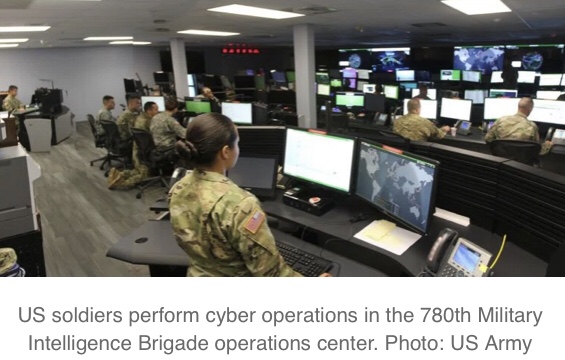
The US Army has announced that it will create an office next year dedicated to overseeing the country’s offensive cyber and space capabilities.

Offensive cyber refers to cyberspace operations intended to project power through application of force in or through cyberspace.

Called the Program Manager Cyber and Space, the office will be responsible for testing and fielding cutting-edge equipment, such as aerial jamming pods, biometric information systems, and battlefield navigation tools.

Establishing a new office is reportedly an important move due to increasing workloads and demands related to cyber and space.

“Because we’ve seen mission growth in that area, we’re going to spin off,” Mark Kitz from the Program Executive Office for Intelligence, Electronic Warfare and Sensors said.

The new cyber and space office will be led by a colonel.

Last month, the US Army announced the establishment of a “triad” that will combine space, cyber, and special operations capabilities to conceptualize effective battlefield strategies for modern warfare.

Article link: https://www-thedefensepost-com.cdn.ampproject.org/c/s/www.thedefensepost.com/2022/09/01/us-army-offensive-cyber-office/amp/

Top Five Characteristics of Successful Digital Transformation Leaders – Gartner

Posted by timmreardon on 09/01/2022
Posted in: Uncategorized. Leave a comment

August 30, 2022 Contributor: Lori Perri

CIOs must possess five key characteristics to lead and deliver on digital transformation.

In short:

  • CIOs must rethink their role as digital leaders, due to workplace disruptions and ongoing changes to business, operating and IT delivery models.
  • When CIOs deal with uncertainty and change, they are more effective business leaders.
  • Digital transformation requires technology leaders to reinvent their approach, rather than simply respond or react to business requirements.

As CIOs face ever-expanding responsibilities in their roles, they must remain effective in dealing with uncertainty and change. Digital not only disrupts business, it also transforms leadership. Gartner research shows that successful digital business initiatives demand paradigm shifts in technology leadership and new ways of thinking and approaching challenges.

Download Now: The IT Roadmap for Digital Business Transformation

“CIOs know they must function with flexibility and agility to thrive in the dynamic world. The realities of a disrupted workplace, business model transformations, operating model changes and IT delivery model changes, all force fundamental shifts in the activities and responsibilities of the given role of a CIO,” says Apoorva Chhabra, principal analyst at Gartner. “All of this also creates opportunities for the CIOs to expand their executive leadership.”

Top 5 Leadership Characteristics to Succeed as a Digital Transformation Leader

How to be a successful digital leader: Five characteristics to adopt

Business transformation can be accelerated or derailed depending on how effective leaders are at transforming themselves. Executive technology leadership must anticipate digital opportunities and threats, use technology to adapt to changing conditions, and find leverage and value from disruption. To become an effective digital CIO, it is important to understand and adopt these five characteristics:

No. 1: Neophilia: A Tendency to Like Anything New; Love of Novelty

Neophiliacs are naturally curious and attracted to new things. They seek to explore and find new ways to create value.

Neophiliacs welcome varying ideas from others that shift from the past, a key component of any successful digital transformation. A neophiliac asks, “What do we want to achieve?” rather than “What have we got?”, rejecting current assumptions. The ultimate objective drives solutions to seemingly complex problems.

Effective digital CIOs also embrace innovation. They tend to have a high degree of creativity, defined as the ability to connect seemingly unrelated areas.

See Playbook: Recession Advice for IT

No. 2: Develop New Opportunities: Invent, but Also Copy

Digital leaders don’t necessarily invent and innovate all the time. In reality, successful digital leaders appreciate exactly where their organizations need to be different, where they can copy and where they should improvise.

Successful digital leaders are selective, doubling down on particular areas that deliver a greater advantage, acceleration or value contribution. In areas where they do not see any clear advantage, digital leaders are comfortable copying and improvising based on already established methods. Ineffective leaders lack focus, and tend to be all over the place with innovation.

No. 3: Pioneer New Opportunities: Look Beyond Industry Boundaries

This leadership characteristic is personified by what Gartner labels “digital dragons,” who actively seek value beyond any specific industry and create whole new industries as they redefine value in any industry they pursue. Strategies and digital adoption plans are often made only as a result of a market disruption mindset.

Effective digital leaders see threats that aren’t necessarily distinct, and make decisions while maintaining a clear vision of their industry’s future, as opposed to considering the industry static or  unchanging.

No. 4: Seek New Value Creation Opportunities: Never Consider Digital to Be the Outcome 

Successful digital leaders understand that digital is a means, not an end, and that simply making something digital does not necessarily increase its value. It may actually decrease it. 

Digital technology tools either change the way people work, or change the products and services provided, whether through extending the life cycle of a product, adding digital features or providing goods as a service.

Consider the logic behind the product/service’s value proposition before implementing digital tools. Ask how the digital offering drives the business outcomes of customer centricity, greater market share and revenue enhancement. Use digital to boost your value proposition such as on-demand services, hyperpersonalization, dynamic pricing and real-time applications.

No. 5: Focus on Technology-Driven Opportunities: Geek Out on Technology

A successful leader possesses a deep understanding of the technology underlying their business. It’s challenging to get value out of technology if you don’t understand what it does or doesn’t do.

CIOs need to enable a technology-enriched environment, where learning is engaging, collaborative and customized. They should follow —geek out on — technology as a passion, as well as an essential way to stay innovative and relevant in the crowded and competitive business spaces.

Article link: https://www.gartner.com/en/articles/top-five-characteristics-of-successful-digital-transformation-leaders?

Changing Company Culture Requires a Movement, Not a Mandate – HBR

Posted by timmreardon on 09/01/2022
Posted in: Uncategorized. Leave a comment
  • Bryan Walker
  • Sarah A. Soule

June 20, 2017

Summary. Culture is like the wind. It is invisible, yet its effect can be seen and felt. When it is blowing in your direction it makes for smooth sailing. When it is blowing against you, everything is more difficult. For organizations seeking to become more adaptive and innovative, culture change is often the most challenging part of the transformation. But culture change can’t be achieved through top-down mandate. It lives in the collective hearts and habits of people and their shared perception of “how things are done around here.” Culture change needs to happen through a movement, not a mandate. To create a movement in your organization, start by framing the issue in terms that stir emotion and incite action; then mobilize more supporters by demonstrating quick wins. Broadcast these wins to an even wider audience by leveraging employees’ social networks, and using symbolism and pockets of innovation to keep momentum going. It’s important to start with actions, not new mission statements or company structures, because culture change only happens when people take action. Show people the change you want to see.

Culture is like the wind. It is invisible, yet its effect can be seen and felt. When it is blowing in your direction, it makes for smooth sailing. When it is blowing against you, everything is more difficult.

For organizations seeking to become more adaptive and innovative, culture change is often the most challenging part of the transformation. Innovation demands new behaviors from leaders and employees that are often antithetical to corporate cultures, which are historically focused on operational excellence and efficiency.

But culture change can’t be achieved through top-down mandate. It lives in the collective hearts and habits of people and their shared perception of “how things are done around here.” Someone with authority can demand compliance, but they can’t dictate optimism, trust, conviction, or creativity.

At IDEO, we believe that the most significant change often comes through social movements, and that despite the differences between private enterprises and society, leaders can learn from how these initiators engage and mobilize the masses to institutionalize new societal norms.

Dr. Reddy’s: A Movement-Minded Case Study

One leader who understands this well is G.V. Prasad, CEO of Dr. Reddy’s, a 33-year-old global pharmaceutical company headquartered in India that produces affordable generic medication. With the company’s more than seven distinct business units operating in 27 countries and more than 20,000 employees, decision making had grown more convoluted and branches of the organization had become misaligned. Over the years, Dr. Reddy’s had built in lots of procedures, and for many good reasons. But those procedures had also slowed the company down.

Prasad sought to evolve Dr. Reddy’s culture to be nimble, innovative, and patient-centered. He knew it required a journey to align and galvanize all employees. His leadership team began with a search for purpose. Over the course of several months, the Dr. Reddy’s team worked with IDEO to learn about the needs of everyone, from shop floor workers to scientists, external partners, and investors. Together they defined and distilled the purpose of the company, paring it down to four simple words that center on the patient: “Good health can’t wait.”

But instead of plastering this new slogan on motivational posters and repeating it in all-hands meetings, the leadership team began by quietly using it to start guiding their own decisions. The goal was to demonstrate this idea in action, not talk about it. Projects were selected across channels to highlight agility, innovation, and customer centricity. Product packaging was redesigned to be more user-friendly and increase adherence. The role of sales representatives in Russia was recast to act as knowledge hubs for physicians, since better physicians lead to healthier patients. A comprehensive internal data platform was developed to help Dr. Reddy’s employees be proactive with their customer requests and solve any problems in an agile way.

At this point it was time to more broadly share the stated purpose — first internally with all employees, and then externally with the world. At the internal launch event, Dr. Reddy’s employees learned about their purpose and were invited to be part of realizing it. Everyone was asked to make a personal promise about how they, in their current role, would contribute to “good health can’t wait.” The following day Dr. Reddy’s unveiled a new brand identity and website that publicly stated its purpose. Soon after, the company established two new “innovation studios” in Hyderabad and Mumbai to offer additional structural support to creativity within the company.

Prasad saw a change in the company culture right away:

After we introduced the idea of “good health can’t wait,” one of the scientists told me he developed a product in 15 days and broke every rule there was in the company. He was proudly stating that! Normally, just getting the raw materials would take him months, not to mention the rest of the process for making the medication. But he was acting on that urgency. And now he’s taking this lesson of being lean and applying it to all our procedures.

What Does a Movement Look Like?

To draw parallels between the journey of Dr. Reddy’s and a movement, we need to better understand movements.

We often think of movements as starting with a call to action. But movement research suggests that they actually start with emotion — a diffuse dissatisfaction with the status quo and a broad sense that the current institutions and power structures of the society will not address the problem. This brewing discontent turns into a movement when a voice arises that provides a positive vision and a path forward that’s within the power of the crowd.

What’s more, social movements typically start small. They begin with a group of passionate enthusiasts who deliver a few modest wins. While these wins are small, they’re powerful in demonstrating efficacy to nonparticipants, and they help the movement gain steam. The movement really gathers force and scale once this group successfully co-opts existing networks and influencers. Eventually, in successful movements, leaders leverage their momentum and influence to institutionalize the change in the formal power structures and rules of society.

Practices for Leading a Cultural Movement 

Leaders should not be too quick or simplistic in their translation of social movement dynamics into change management plans. That said, leaders can learn a lot from the practices of skillful movement makers.

Frame the issue. Successful leaders of movements are often masters of framing situations in terms that stir emotion and incite action. Framing can also apply social pressure to conform. For example, “Secondhand smoking kills. So shame on you for smoking around others.”

In terms of organizational culture change, simply explaining the need for change won’t cut it. Creating a sense of urgency is helpful, but can be short-lived. To harness people’s full, lasting commitment, they must feel a deep desire, and even responsibility, to change. A leader can do this by framing change within the organization’s purpose — the “why we exist” question. A good organizational purpose calls for the pursuit of greatness in service of others. It asks employees to be driven by more than personal gain. It gives meaning to work, conjures individual emotion, and incites collective action. Prasad framed Dr. Reddy’s transformation as the pursuit of “good health can’t wait.”

Demonstrate quick wins. Movement makers are very good at recognizing the power of celebrating small wins. Research has shown that demonstrating efficacy is one way that movements bring in people who are sympathetic but not yet mobilized to join.

When it comes to organizational culture change, leaders too often fall into the trap of declaring the culture shifts they hope to see. Instead, they need to spotlight examples of actions they hope to see more of within the culture. Sometimes, these examples already exist within the culture, but at a limited scale. Other times, they need to be created. When Prasad and his leadership team launched projects across key divisions, those projects served to demonstrate the efficacy of a nimble, innovative, and customer-centered way of working and of how pursuit of purpose could deliver outcomes the business cared about. Once these projects were far enough along, the Dr. Reddy’s leadership used them to help communicate their purpose and culture change ambitions.

Harness networks. Effective movement makers are extremely good at building coalitions, bridging disparate groups to form a larger and more diverse network that shares a common purpose. And effective movement makers know how to activate existing networks for their purposes. This was the case with the leaders of the 1960s civil rights movement, who recruited members through the strong community ties formed in churches. But recruiting new members to a cause is not the only way that movement makers leverage social networks. They also use social networks to spread ideas and broadcast their wins.

Leadership at Dr. Reddy’s did not hide in a back room and come up with their purpose. Over the course of several months, people from across the organization were engaged in the process. The approach was built on the belief that people are more apt to support what they have a stake in creating. And during the organization-wide launch event, Prasad invited all employees to make the purpose their own by defining how they personally would help deliver “good health can’t wait.”

Create safe havens. Movement makers are experts at creating or identifying spaces within which movement members can craft strategy and discuss tactics. Such spaces have included beauty shops in the Southern U.S. during the civil rights movement, Quaker work camps in the 1960s and 1970s, the Seneca Women’s Encampment of the 1980s and early 1990s. These are spaces where the rules of engagement and behaviors of activists are different from those of the dominant culture. They’re microcosms of what the movement hopes will become the future.

The dominant culture and structure of today’s organizations are perfectly designed to produce their current behaviors and outcomes, regardless of whether those outcomes are the ones you want. If your hope is for individuals to act differently, it helps to change their surrounding conditions to be more supportive of the new behaviors, particularly when they are antithetical to the dominant culture. Outposts and labs are often built as new environments that serve as a microcosm for change. Dr. Reddy’s established two innovation labs to explore the future of medicine and create a space where it’s easier for people to embrace new beliefs and perform new behaviors.

Embrace symbols. Movement makers are experts at constructing and deploying symbols and costumes that simultaneously create a feeling of solidarity and demarcate who they are and what they stand for to the outside world. Symbols and costumes of solidarity help define the boundary between “us” and “them” for movements. These symbols can be as simple as a T-shirt, bumper sticker, or button supporting a general cause, or as elaborate as the giant puppets we often see used in protest events.

Dr. Reddy’s linked its change in culture and purpose with a new corporate brand identity. Internally and externally, the act reinforced a message of unity and commitment. The entire company stands together in pursuit of this purpose.

The Challenge to Leadership

Unlike a movement maker, an enterprise leader is often in a position of authority. They can mandate changes to the organization — and at times they should. However, when it comes to culture change, they should do so sparingly. It’s easy to overuse one’s authority in the hopes of accelerating transformation.

It’s also easy for an enterprise leader to shy away from organizational friction. Harmony is generally a preferred state, after all. And the success of an organizational transition is often judged by its seamlessness.

In a movements-based approach to change, a moderate amount of friction is positive. A complete absence of friction probably means that little is actually changing. Look for the places where the movement faces resistance and experiences friction. They often indicate where the dominant organizational design and culture may need to evolve.

And remember that culture change only happens when people take action. So start there. While articulating a mission and changing company structures are important, it’s often a more successful approach to tackle those sorts of issues after you’ve been able to show people the change you want to see.

  • BWBryan Walker is a Partner and Managing Director at IDEO San Francisco.
  • SSSarah A. Soule is the Morgridge Professor of Organizational Behavior an Senior Associate Dean for Academic Affairs at the Stanford Graduate School of Business. She studies organizational theory, social movements, and political sociology including topics like gender bias in the craft beer industry and the impact of women’s protest on congressional attention.

Article link: https://hbr.org/2017/06/changing-company-culture-requires-a-movement-not-a-mandate?

Executive Order on Promoting Competition in the American Economy

Posted by timmreardon on 08/31/2022
Posted in: Uncategorized. Leave a comment


JULY 09, 2021PRESIDENTIAL ACTIONS

By the authority vested in me as President by the Constitution and the laws of the United States of America, and in order to promote the interests of American workers, businesses, and consumers, it is hereby ordered as follows:

Section 1.  Policy.  
    A fair, open, and competitive marketplace has long been a cornerstone of the American economy, while excessive market concentration threatens basic economic liberties, democratic accountability, and the welfare of workers, farmers, small businesses, startups, and consumers.
     The American promise of a broad and sustained prosperity depends on an open and competitive economy.  For workers, a competitive marketplace creates more high-quality jobs and the economic freedom to switch jobs or negotiate a higher wage.  For small businesses and farmers, it creates more choices among suppliers and major buyers, leading to more take-home income, which they can reinvest in their enterprises.  For entrepreneurs, it provides space to experiment, innovate, and pursue the new ideas that have for centuries powered the American economy and improved our quality of life.  And for consumers, it means more choices, better service, and lower prices. 
     Robust competition is critical to preserving America’s role as the world’s leading economy.
     Yet over the last several decades, as industries have consolidated, competition has weakened in too many markets, denying Americans the benefits of an open economy and widening racial, income, and wealth inequality.  Federal Government inaction has contributed to these problems, with workers, farmers, small businesses, and consumers paying the price.
     Consolidation has increased the power of corporate employers, making it harder for workers to bargain for higher wages and better work conditions.  Powerful companies require workers to sign non-compete agreements that restrict their ability to change jobs.  And, while many occupational licenses are critical to increasing wages for workers and especially workers of color, some overly restrictive occupational licensing requirements can impede workers’ ability to find jobs and to move between States.
     Consolidation in the agricultural industry is making it too hard for small family farms to survive.  Farmers are squeezed between concentrated market power in the agricultural input industries — seed, fertilizer, feed, and equipment suppliers — and concentrated market power in the channels for selling agricultural products.  As a result, farmers’ share of the value of their agricultural products has decreased, and poultry farmers, hog farmers, cattle ranchers, and other agricultural workers struggle to retain autonomy and to make sustainable returns.
     The American information technology sector has long been an engine of innovation and growth, but today a small number of dominant Internet platforms use their power to exclude market entrants, to extract monopoly profits, and to gather intimate personal information that they can exploit for their own advantage.  Too many small businesses across the economy depend on those platforms and a few online marketplaces for their survival.  And too many local newspapers have shuttered or downsized, in part due to the Internet platforms’ dominance in advertising markets.
     Americans are paying too much for prescription drugs and healthcare services — far more than the prices paid in other countries.  Hospital consolidation has left many areas, particularly rural communities, with inadequate or more expensive healthcare options.  And too often, patent and other laws have been misused to inhibit or delay — for years and even decades — competition from generic drugs and biosimilars, denying Americans access to lower-cost drugs.
     In the telecommunications sector, Americans likewise pay too much for broadband, cable television, and other communications services, in part because of a lack of adequate competition.  In the financial-services sector, consumers pay steep and often hidden fees because of industry consolidation.  Similarly, the global container shipping industry has consolidated into a small number of dominant foreign-owned lines and alliances, which can disadvantage American exporters.
     The problem of economic consolidation now spans these sectors and many others, endangering our ability to rebuild and emerge from the coronavirus disease 2019 (COVID-19) pandemic with a vibrant, innovative, and growing economy.  Meanwhile, the United States faces new challenges to its economic standing in the world, including unfair competitive pressures from foreign monopolies and firms that are state-owned or state-sponsored, or whose market power is directly supported by foreign governments.
     We must act now to reverse these dangerous trends, which constrain the growth and dynamism of our economy, impair the creation of high-quality jobs, and threaten America’s economic standing in the world. 
     This order affirms that it is the policy of my Administration to enforce the antitrust laws to combat the excessive concentration of industry, the abuses of market power, and the harmful effects of monopoly and monopsony — especially as these issues arise in labor markets, agricultural markets, Internet platform industries, healthcare markets (including insurance, hospital, and prescription drug markets), repair markets, and United States markets directly affected by foreign cartel activity.
     It is also the policy of my Administration to enforce the antitrust laws to meet the challenges posed by new industries and technologies, including the rise of the dominant Internet platforms, especially as they stem from serial mergers, the acquisition of nascent competitors, the aggregation of data, unfair competition in attention markets, the surveillance of users, and the presence of network effects.
     Whereas decades of industry consolidation have often led to excessive market concentration, this order reaffirms that the United States retains the authority to challenge transactions whose previous consummation was in violation of the Sherman Antitrust Act (26 Stat. 209, 15 U.S.C. 1 et seq.) (Sherman Act), the Clayton Antitrust Act (Public Law 63-212, 38 Stat. 730, 15 U.S.C. 12 et seq.) (Clayton Act), or other laws.  See 15 U.S.C. 18; Standard Oil Co. v. United States, 221 U.S. 1 (1911). 
     This order reasserts as United States policy that the answer to the rising power of foreign monopolies and cartels is not the tolerance of domestic monopolization, but rather the promotion of competition and innovation by firms small and large, at home and worldwide.
     It is also the policy of my Administration to support aggressive legislative reforms that would lower prescription drug prices, including by allowing Medicare to negotiate drug prices, by imposing inflation caps, and through other related reforms.  It is further the policy of my Administration to support the enactment of a public health insurance option.
     My Administration further reaffirms the policy stated in Executive Order 13725 of April 15, 2016 (Steps to Increase Competition and Better Inform Consumers and Workers to Support Continued Growth of the American Economy), and the Federal Government’s commitment to the principles that led to the passage of the Sherman Act, the Clayton Act, the Packers and Stockyards Act, 1921 (Public Law 67-51, 42 Stat. 159, 7 U.S.C. 181 et seq.) (Packers and Stockyards Act), the Celler-Kefauver Antimerger Act (Public Law 81-899, 64 Stat. 1125), the Bank Merger Act (Public Law 86-463, 74 Stat. 129, 12 U.S.C. 1828), and the Telecommunications Act of 1996 (Public Law 104-104, 110 Stat. 56), among others.   

Sec. 2.  The Statutory Basis of a Whole-of-Government Competition Policy. 
     (a)  The antitrust laws, including the Sherman Act, the Clayton Act, and the Federal Trade Commission Act (Public Law 63-203, 38 Stat. 717, 15 U.S.C. 41 et seq.), are a first line of defense against the monopolization of the American economy.
     (b)  The antitrust laws reflect an underlying policy favoring competition that transcends those particular enactments.  As the Supreme Court has stated, for instance, the Sherman Act “rests on the premise that the unrestrained interaction of competitive forces will yield the best allocation of our economic resources, the lowest prices, the highest quality and the greatest material progress, while at the same time providing an environment conducive to the preservation of our democratic political and social institutions.”  Northern Pac. Ry. Co. v. United States, 356 U.S. 1, 4 (1958).
     (c)  Consistent with these broader policies, and in addition to the traditional antitrust laws, the Congress has also enacted industry-specific fair competition and anti-monopolization laws that often provide additional protections.  Such enactments include the Packers and Stockyards Act, the Federal Alcohol Administration Act (Public Law 74-401, 49 Stat. 977, 27 U.S.C. 201 et seq.), the Bank Merger Act, the Drug Price Competition and Patent Term Restoration Act of 1984 (Public Law 98-417, 98 Stat. 1585), the Shipping Act of 1984 (Public Law 98-237, 98 Stat. 67, 46 U.S.C. 40101 et seq.) (Shipping Act), the ICC Termination Act of 1995 (Public Law 104-88, 109 Stat. 803), the Telecommunications Act of 1996, the Fairness to Contact Lens Consumers Act (Public Law 108-164, 117 Stat. 2024, 15 U.S.C. 7601 et seq.), and the Dodd-Frank Wall Street Reform and Consumer Protection Act (Public Law 111-203, 124 Stat. 1376) (Dodd-Frank Act).
     (d)  These statutes independently charge a number of executive departments and agencies (agencies) to protect conditions of fair competition in one or more ways, including by:
          (i)    policing unfair, deceptive, and abusive business practices;
          (ii)   resisting consolidation and promoting competition within industries through the independent oversight of mergers, acquisitions, and joint ventures;
          (iii)  promulgating rules that promote competition, including the market entry of new competitors; and
          (iv)   promoting market transparency through compelled disclosure of information.
     (e)  The agencies that administer such or similar authorities include the Department of the Treasury, the Department of Agriculture, the Department of Health and Human Services, the Department of Transportation, the Federal Reserve System, the Federal Trade Commission (FTC), the Securities and Exchange Commission, the Federal Deposit Insurance Corporation, the Federal Communications Commission, the Federal Maritime Commission, the Commodity Futures Trading Commission, the Federal Energy Regulatory Commission, the Consumer Financial Protection Bureau, and the Surface Transportation Board.
     (f)  Agencies can influence the conditions of competition through their exercise of regulatory authority or through the procurement process.  See 41 U.S.C. 1705.
     (g)  This order recognizes that a whole-of-government approach is necessary to address overconcentration, monopolization, and unfair competition in the American economy.  Such an approach is supported by existing statutory mandates.  Agencies can and should further the polices set forth in section 1 of this order by, among other things, adopting pro‑competitive regulations and approaches to procurement and spending, and by rescinding regulations that create unnecessary barriers to entry that stifle competition.

Sec. 3.  Agency Cooperation in Oversight, Investigation, and Remedies. 
     (a)  The Congress frequently has created overlapping agency jurisdiction in the policing of anticompetitive conduct and the oversight of mergers.  It is the policy of my Administration that, when agencies have overlapping jurisdiction, they should endeavor to cooperate fully in the exercise of their oversight authority, to benefit from the respective expertise of the agencies and to improve Government efficiency.
     (b)  Where there is overlapping jurisdiction over particular cases, conduct, transactions, or industries, agencies are encouraged to coordinate their efforts, as appropriate and consistent with applicable law, with respect to:
          (i)    the investigation of conduct potentially harmful to competition;
          (ii)   the oversight of proposed mergers, acquisitions, and joint ventures; and
          (iii)  the design, execution, and oversight of remedies.
     (c)  The means of cooperation in cases of overlapping jurisdiction should include, as appropriate and consistent with applicable law:
          (i)    sharing relevant information and industry data;
          (ii)   in the case of major transactions, soliciting and giving significant consideration to the views of the Attorney General or the Chair of the FTC, as applicable; and
          (iii)  cooperating with any concurrent Department of Justice or FTC oversight activities under the Sherman Act or Clayton Act.
     (d)  Nothing in subsections (a) through (c) of this section shall be construed to suggest that the statutory standard applied by an agency, or its independent assessment under that standard, should be displaced or substituted by the judgment of the Attorney General or the Chair of the FTC.  When their views are solicited, the Attorney General and the Chair of the FTC are encouraged to provide a response to the agency in time for the agency to consider it in advance of any statutory deadline for agency action.

Sec. 4.  The White House Competition Council.  
    (a)  There is established a White House Competition Council (Council) within the Executive Office of the President.
     (b)  The Council shall coordinate, promote, and advance Federal Government efforts to address overconcentration, monopolization, and unfair competition in or directly affecting the American economy, including efforts to:
          (i)    implement the administrative actions identified in this order;
          (ii)   develop procedures and best practices for agency cooperation and coordination on matters of overlapping jurisdiction, as described in section 3 of this order;
          (iii)  identify and advance any additional administrative actions necessary to further the policies set forth in section 1 of this order; and
          (iv)   identify any potential legislative changes necessary to further the policies set forth in section 1 of this order.
     (c)  The Council shall work across agencies to provide a coordinated response to overconcentration, monopolization, and unfair competition in or directly affecting the American economy.  The Council shall also work with each agency to ensure that agency operations are conducted in a manner that promotes fair competition, as appropriate and consistent with applicable law.
     (d)  The Council shall not discuss any current or anticipated enforcement actions.
     (e)  The Council shall be led by the Assistant to the President for Economic Policy and Director of the National Economic Council, who shall serve as Chair of the Council.
     (f)  In addition to the Chair, the Council shall consist of the following members:
          (i)     the Secretary of the Treasury;
          (ii)    the Secretary of Defense;
          (iii)   the Attorney General;
          (iv)    the Secretary of Agriculture;
          (v)     the Secretary of Commerce;
          (vi)    the Secretary of Labor;
          (vii)   the Secretary of Health and Human Services;
          (viii)  the Secretary of Transportation;
          (ix)    the Administrator of the Office of Information and Regulatory Affairs; and
          (x)     the heads of such other agencies and offices as the Chair may from time to time invite to participate.
     (g)  The Chair shall invite the participation of the Chair of the FTC, the Chair of the Federal Communications Commission, the Chair of the Federal Maritime Commission, the Director of the Consumer Financial Protection Bureau, and the Chair of the Surface Transportation Board, to the extent consistent with their respective statutory authorities and obligations.
     (h)  Members of the Council shall designate, not later than 30 days after the date of this order, a senior official within their respective agency or office who shall coordinate with the Council and who shall be responsible for overseeing the agency’s or office’s efforts to address overconcentration, monopolization, and unfair competition.  The Chair may coordinate subgroups consisting exclusively of Council members or their designees, as appropriate.
     (i)  The Council shall meet on a semi-annual basis unless the Chair determines that a meeting is unnecessary.
     (j)  Each agency shall bear its own expenses for participating in the Council.

Sec. 5.  Further Agency Responsibilities.  
     (a)  The heads of all agencies shall consider using their authorities to further the policies set forth in section 1 of this order, with particular attention to:
          (i)   the influence of any of their respective regulations, particularly any licensing regulations, on concentration and competition in the industries under their jurisdiction; and
          (ii)  the potential for their procurement or other spending to improve the competitiveness of small businesses and businesses with fair labor practices.
     (b)  The Attorney General, the Chair of the FTC, and the heads of other agencies with authority to enforce the Clayton Act are encouraged to enforce the antitrust laws fairly and vigorously.
     (c)  To address the consolidation of industry in many markets across the economy, as described in section 1 of this order, the Attorney General and the Chair of the FTC are encouraged to review the horizontal and vertical merger guidelines and consider whether to revise those guidelines.
     (d)  To avoid the potential for anticompetitive extension of market power beyond the scope of granted patents, and to protect standard-setting processes from abuse, the Attorney General and the Secretary of Commerce are encouraged to consider whether to revise their position on the intersection of the intellectual property and antitrust laws, including by considering whether to revise the Policy Statement on Remedies for Standards-Essential Patents Subject to Voluntary F/RAND Commitments issued jointly by the Department of Justice, the United States Patent and Trademark Office, and the National Institute of Standards and Technology on December 19, 2019.
     (e)  To ensure Americans have choices among financial institutions and to guard against excessive market power, the Attorney General, in consultation with the Chairman of the Board of Governors of the Federal Reserve System, the Chairperson of the Board of Directors of the Federal Deposit Insurance Corporation, and the Comptroller of the Currency, is encouraged to review current practices and adopt a plan, not later than 180 days after the date of this order, for the revitalization of merger oversight under the Bank Merger Act and the Bank Holding Company Act of 1956 (Public Law 84-511, 70 Stat. 133, 12 U.S.C. 1841 et seq.) that is in accordance with the factors enumerated in 12 U.S.C. 1828(c) and 1842(c).
     (f)  To better protect workers from wage collusion, the Attorney General and the Chair of the FTC are encouraged to consider whether to revise the Antitrust Guidance for Human Resource Professionals of October 2016.
     (g)  To address agreements that may unduly limit workers’ ability to change jobs, the Chair of the FTC is encouraged to consider working with the rest of the Commission to exercise the FTC’s statutory rulemaking authority under the Federal Trade Commission Act to curtail the unfair use of non-compete clauses and other clauses or agreements that may unfairly limit worker mobility.
      (h)  To address persistent and recurrent practices that inhibit competition, the Chair of the FTC, in the Chair’s discretion, is also encouraged to consider working with the rest of the Commission to exercise the FTC’s statutory rulemaking authority, as appropriate and consistent with applicable law, in areas such as:
          (i)    unfair data collection and surveillance practices that may damage competition, consumer autonomy, and consumer privacy;
          (ii)   unfair anticompetitive restrictions on third-party repair or self-repair of items, such as the restrictions imposed by powerful manufacturers that prevent farmers from repairing their own equipment;
          (iii)  unfair anticompetitive conduct or agreements in the prescription drug industries, such as agreements to delay the market entry of generic drugs or biosimilars;
          (iv)   unfair competition in major Internet marketplaces;
          (v)   unfair occupational licensing restrictions;
          (vi)   unfair tying practices or exclusionary practices in the brokerage or listing of real estate; and
          (vii)  any other unfair industry-specific practices that substantially inhibit competition.
     (i)  The Secretary of Agriculture shall:
           (i)    to address the unfair treatment of farmers and improve conditions of competition in the markets for their products, consider initiating a rulemaking or rulemakings under the Packers and Stockyards Act to strengthen the Department of Agriculture’s regulations concerning unfair, unjustly discriminatory, or deceptive practices and undue or unreasonable preferences, advantages, prejudices, or disadvantages, with the purpose of furthering the vigorous implementation of the law established by the Congress in 1921 and fortified by amendments.  In such rulemaking or rulemakings, the Secretary of Agriculture shall consider, among other things:
               (A)  providing clear rules that identify recurrent practices in the livestock, meat, and poultry industries that are unfair, unjustly discriminatory, or deceptive and therefore violate the Packers and Stockyards Act;
               (B)  reinforcing the long-standing Department of Agriculture interpretation that it is unnecessary under the Packers and Stockyards Act to demonstrate industry-wide harm to establish a violation of the Act and that the “unfair, unjustly discriminatory, or deceptive” treatment of one farmer, the giving to one farmer of an “undue or unreasonable preference or advantage,” or the subjection of one farmer to an “undue or unreasonable prejudice or disadvantage in any respect” violates the Act;
               (C)  prohibiting unfair practices related to grower ranking systems — systems in which the poultry companies, contractors, or dealers exercise extraordinary control over numerous inputs that determine the amount farmers are paid and require farmers to assume the risk of factors outside their control, leaving them more economically vulnerable;
               (D)  updating the appropriate definitions or set of criteria, or application thereof, for undue or unreasonable preferences, advantages, prejudices, or disadvantages under the Packers and Stockyards Act; and
               (E)  adopting, to the greatest extent possible and as appropriate and consistent with applicable law, appropriate anti-retaliation protections, so that farmers may assert their rights without fear of retribution;
          (ii)   to ensure consumers have accurate, transparent labels that enable them to choose products made in the United States, consider initiating a rulemaking to define the conditions under which the labeling of meat products can bear voluntary statements indicating that the product is of United States origin, such as “Product of USA”;
          (iii)  to ensure that farmers have greater opportunities to access markets and receive a fair return for their products, not later than 180 days after the date of this order, submit a report to the Chair of the White House Competition Council, with a plan to promote competition in the agricultural industries and to support value-added agriculture and alternative food distribution systems through such means as:
               (A)  the creation or expansion of useful information for farmers, such as model contracts, to lower transaction costs and help farmers negotiate fair deals;
               (B)  measures to encourage improvements in transparency and standards so that consumers may choose to purchase products that support fair treatment of farmers and agricultural workers and sustainable agricultural practices;
               (C)  measures to enhance price discovery, increase transparency, and improve the functioning of the cattle and other livestock markets;
               (D)  enhanced tools, including any new legislative authorities needed, to protect whistleblowers, monitor agricultural markets, and enforce relevant laws;
                 (E)  any investments or other support that could bolster competition within highly concentrated agricultural markets; and
                 (F)  any other means that the Secretary of Agriculture deems appropriate;
          (iv)   to improve farmers’ and smaller food processors’ access to retail markets, not later than 300 days after the date of this order, in consultation with the Chair of the FTC, submit a report to the Chair of the White House Competition Council, on the effect of retail concentration and retailers’ practices on the conditions of competition in the food industries, including any practices that may violate the Federal Trade Commission Act, the Robinson-Patman Act (Public Law 74-692, 49 Stat. 1526, 15 U.S.C. 13 et seq.), or other relevant laws, and on grants, loans, and other support that may enhance access to retail markets by local and regional food enterprises; and
          (v)    to help ensure that the intellectual property system, while incentivizing innovation, does not also unnecessarily reduce competition in seed and other input markets beyond that reasonably contemplated by the Patent Act (see 35 U.S.C. 100 et seq. and 7 U.S.C. 2321et seq.), in consultation with the Under Secretary of Commerce for Intellectual Property and Director of the United States Patent and Trademark Office, submit a report to the Chair of the White House Competition Council, enumerating and describing any relevant concerns of the Department of Agriculture and strategies for addressing those concerns across intellectual property, antitrust, and other relevant laws.
     (j)  To protect the vibrancy of the American markets for beer, wine, and spirits, and to improve market access for smaller, independent, and new operations, the Secretary of the Treasury, in consultation with the Attorney General and the Chair of the FTC, not later than 120 days after the date of this order, shall submit a report to the Chair of the White House Competition Council, assessing the current market structure and conditions of competition, including an assessment of any threats to competition and barriers to new entrants, including:
          (i)    any unlawful trade practices in the beer, wine, and spirits markets, such as certain exclusionary, discriminatory, or anticompetitive distribution practices, that hinder smaller and independent businesses or new entrants from distributing their products;
          (ii)   patterns of consolidation in production, distribution, or retail beer, wine, and spirits markets; and
          (iii)  any unnecessary trade practice regulations of matters such as bottle sizes, permitting, or labeling that may unnecessarily inhibit competition by increasing costs without serving any public health, informational, or tax purpose.
     (k)  To follow up on the foregoing assessment, the Secretary of the Treasury, through the Administrator of the Alcohol and Tobacco Tax and Trade Bureau, shall, not later than 240 days after the date of this order, consider:
          (i)    initiating a rulemaking to update the Alcohol and Tobacco Tax and Trade Bureau’s trade practice regulations;  
          (ii)   rescinding or revising any regulations of the beer, wine, and spirits industries that may unnecessarily inhibit competition; and
          (iii)  reducing any barriers that impede market access for smaller and independent brewers, winemakers, and distilleries.
     (l)  To promote competition, lower prices, and a vibrant and innovative telecommunications ecosystem, the Chair of the Federal Communications Commission is encouraged to work with the rest of the Commission, as appropriate and consistent with applicable law, to consider:
          (i)    adopting through appropriate rulemaking “Net Neutrality” rules similar to those previously adopted under title II of the Communications Act of 1934 (Public Law 73-416, 48 Stat. 1064, 47 U.S.C. 151 et seq.), as amended by the Telecommunications Act of 1996, in “Protecting and Promoting the Open Internet,” 80 Fed. Reg. 19738 (Apr. 13, 2015);
          (ii)   conducting future spectrum auctions under rules that are designed to help avoid excessive concentration of spectrum license holdings in the United States, so as to prevent spectrum stockpiling, warehousing of spectrum by licensees, or the creation of barriers to entry, and to improve the conditions of competition in industries that depend upon radio spectrum, including mobile communications and radio-based broadband services;
          (iii)  providing support for the continued development and adoption of 5G Open Radio Access Network (O-RAN) protocols and software, continuing to attend meetings of voluntary and consensus-based standards development organizations, so as to promote or encourage a fair and representative standard-setting process, and undertaking any other measures that might promote increased openness, innovation, and competition in the markets for 5G equipment;
          (iv)   prohibiting unjust or unreasonable early termination fees for end-user communications contracts, enabling consumers to more easily switch providers;
          (v)    initiating a rulemaking that requires broadband service providers to display a broadband consumer label, such as that as described in the Public Notice of the Commission issued on April 4, 2016 (DA 16–357), so as to give consumers clear, concise, and accurate information regarding provider prices and fees, performance, and network practices;
          (vi)   initiating a rulemaking to require broadband service providers to regularly report broadband price and subscription rates to the Federal Communications Commission for the purpose of disseminating that information to the public in a useful manner, to improve price transparency and market functioning; and
          (vii)  initiating a rulemaking to prevent landlords and cable and Internet service providers from inhibiting tenants’ choices among providers.
     (m)  The Secretary of Transportation shall:
          (i)    to better protect consumers and improve competition, and as appropriate and consistent with applicable law:
               (A)  not later than 30 days after the date of this order, appoint or reappoint members of the Advisory Committee for Aviation Consumer Protection to ensure fair representation of consumers, State and local interests, airlines, and airports with respect to the evaluation of aviation consumer protection programs and convene a meeting of the Committee as soon as practicable;
               (B)  promote enhanced transparency and consumer safeguards, as appropriate and consistent with applicable law, including through potential rulemaking, enforcement actions, or guidance documents, with the aims of:
                     (1)  enhancing consumer access to airline flight information so that consumers can more easily find a broader set of available flights, including by new or lesser known airlines; and
                     (2)  ensuring that consumers are not exposed or subject to advertising, marketing, pricing, and charging of ancillary fees that may constitute an unfair or deceptive practice or an unfair method of competition;
               (C)  not later than 45 days after the date of this order, submit a report to the Chair of the White House Competition Council, on the progress of the Department of Transportation’s investigatory and enforcement activities to address the failure of airlines to provide timely refunds for flights cancelled as a result of the COVID-19 pandemic;
               (D)  not later than 45 days after the date of this order, publish for notice and comment a proposed rule requiring airlines to refund baggage fees when a passenger’s luggage is substantially delayed and other ancillary fees when passengers pay for a service that is not provided;
               (E)  not later than 60 days after the date of this order, start development of proposed amendments to the Department of Transportation’s definitions of “unfair” and “deceptive” in 49 U.S.C. 41712; and
               (F)  not later than 90 days after the date of this order, consider initiating a rulemaking to ensure that consumers have ancillary fee information, including “baggage fees,” “change fees,” and “cancellation fees,” at the time of ticket purchase;
          (ii)   to provide consumers with more flight options at better prices and with improved service, and to extend opportunities for competition and market entry as the industry evolves:
               (A)  not later than 30 days after the date of this order, convene a working group within the Department of Transportation to evaluate the effectiveness of existing commercial aviation programs, consumer protections, and rules of the Federal Aviation Administration;
               (B)  consult with the Attorney General regarding means of enhancing effective coordination between the Department of Justice and the Department of Transportation to ensure competition in air transportation and the ability of new entrants to gain access; and
               (C)  consider measures to support airport development and increased capacity and improve airport congestion management, gate access, implementation of airport competition plans pursuant to 49 U.S.C. 47106(f), and “slot” administration;
          (iii)  given the emergence of new aerospace-based transportation technologies, such as low-altitude unmanned aircraft system deliveries, advanced air mobility, and high-altitude long endurance operations, that have great potential for American travelers and consumers, yet also the danger of early monopolization or new air traffic control problems, ensure that the Department of Transportation takes action with respect to these technologies to:
               (A)  facilitate innovation that fosters United States market leadership and market entry to promote competition and economic opportunity and to resist monopolization, while also ensuring safety, providing security and privacy, protecting the environment, and promoting equity; and
               (B)  provide vigilant oversight over market participants.
     (n)  To further competition in the rail industry and to provide accessible remedies for shippers, the Chair of the Surface Transportation Board (Chair) is encouraged to work with the rest of the Board to:
          (i)    consider commencing or continuing a rulemaking to strengthen regulations pertaining to reciprocal switching agreements pursuant to 49 U.S.C. 11102(c), if the Chair determines such rulemaking to be in the public interest or necessary to provide competitive rail service;
          (ii)   consider rulemakings pertaining to any other relevant matter of competitive access, including bottleneck rates, interchange commitments, or other matters, consistent with the policies set forth in section 1 of this order;
          (iii)  to ensure that passenger rail service is not subject to unwarranted delays and interruptions in service due to host railroads’ failure to comply with the required preference for passenger rail, vigorously enforce new on-time performance requirements adopted pursuant to the Passenger Rail Investment and Improvement Act of 2008 (Public Law 110-423, 122 Stat. 4907) that will take effect on July 1, 2021, and further the work of the passenger rail working group formed to ensure that the Surface Transportation Board will fully meet its obligations; and
          (iv)   in the process of determining whether a merger, acquisition, or other transaction involving rail carriers is consistent with the public interest under 49 U.S.C. 11323-25, consider a carrier’s fulfillment of its responsibilities under 49 U.S.C. 24308 (relating to Amtrak’s statutory rights).
     (o)  The Chair of the Federal Maritime Commission is encouraged to work with the rest of the Commission to:
          (i)    vigorously enforce the prohibition of unjust and unreasonable practices in the context of detention and demurrage pursuant to the Shipping Act, as clarified in “Interpretive Rule on Demurrage and Detention Under the Shipping Act,” 85 Fed. Reg. 29638 (May 18, 2020);
          (ii)   request from the National Shipper Advisory Committee recommendations for improving detention and demurrage practices and enforcement of related Shipping Act prohibitions; and
          (iii)  consider further rulemaking to improve detention and demurrage practices and enforcement of related Shipping Act prohibitions.
     (p)  The Secretary of Health and Human Services shall:
          (i)     to promote the wide availability of low-cost hearing aids, not later than 120 days after the date of this order, publish for notice and comment a proposed rule on over-the-counter hearing-aids, as called for by section 709 of the FDA Reauthorization Act of 2017 (Public Law 115-52, 131 Stat. 1005);
          (ii)    support existing price transparency initiatives for hospitals, other providers, and insurers along with any new price transparency initiatives or changes made necessary by the No Surprises Act (Public Law 116-260, 134 Stat. 2758) or any other statutes;
          (iii)   to ensure that Americans can choose health insurance plans that meet their needs and compare plan offerings, implement standardized options in the national Health Insurance Marketplace and any other appropriate mechanisms to improve competition and consumer choice;
          (iv)    not later than 45 days after the date of this order, submit a report to the Assistant to the President for Domestic Policy and Director of the Domestic Policy Council and to the Chair of the White House Competition Council, with a plan to continue the effort to combat excessive pricing of prescription drugs and enhance domestic pharmaceutical supply chains, to reduce the prices paid by the Federal Government for such drugs, and to address the recurrent problem of price gouging;
          (v)     to lower the prices of and improve access to prescription drugs and biologics, continue to promote generic drug and biosimilar competition, as contemplated by the Drug Competition Action Plan of 2017 and Biosimilar Action Plan of 2018 of the Food and Drug Administration (FDA), including by:
               (A)  continuing to clarify and improve the approval framework for generic drugs and biosimilars to make generic drug and biosimilar approval more transparent, efficient, and predictable, including improving and clarifying the standards for interchangeability of biological products;
               (B)  as authorized by the Advancing Education on Biosimilars Act of 2021 (Public Law 117-8, 135 Stat. 254, 42 U.S.C. 263-1), supporting biosimilar product adoption by providing effective educational materials and communications to improve understanding of biosimilar and interchangeable products among healthcare providers, patients, and caregivers;
               (C)  to facilitate the development and approval of biosimilar and interchangeable products, continuing to update the FDA’s biologics regulations to clarify existing requirements and procedures related to the review and submission of Biologics License Applications by advancing the “Biologics Regulation Modernization” rulemaking (RIN 0910-AI14); and
               (D)  with the Chair of the FTC, identifying and addressing any efforts to impede generic drug and biosimilar competition, including but not limited to false, misleading, or otherwise deceptive statements about generic drug and biosimilar products and their safety or effectiveness;
          (vi)    to help ensure that the patent system, while incentivizing innovation, does not also unjustifiably delay generic drug and biosimilar competition beyond that reasonably contemplated by applicable law, not later than 45 days after the date of this order, through the Commissioner of Food and Drugs, write a letter to the Under Secretary of Commerce for Intellectual Property and Director of the United States Patent and Trademark Office enumerating and describing any relevant concerns of the FDA; 
          (vii)   to support the market entry of lower-cost generic drugs and biosimilars, continue the implementation of the law widely known as the CREATES Act of 2019 (Public Law 116-94, 133 Stat. 3130), by:
               (A)  promptly issuing Covered Product Authorizations (CPAs) to assist product developers with obtaining brand-drug samples; and
               (B)  issuing guidance to provide additional information for industry about CPAs; and
          (viii)  through the Administrator of the Centers for Medicare and Medicaid Services, prepare for Medicare and Medicaid coverage of interchangeable biological products, and for payment models to support increased utilization of generic drugs and biosimilars.
     (q)  To reduce the cost of covered products to the American consumer without imposing additional risk to public health and safety, the Commissioner of Food and Drugs shall work with States and Indian Tribes that propose to develop section 804 Importation Programs in accordance with the Medicare Prescription Drug, Improvement, and Modernization Act of 2003 (Public Law 108-173, 117 Stat. 2066), and the FDA’s implementing regulations.
     (r)  The Secretary of Commerce shall:
          (i)    acting through the Director of the National Institute of Standards and Technology (NIST), consider initiating a rulemaking to require agencies to report to NIST, on an annual basis, their contractors’ utilization activities, as reported to the agencies under 35 U.S.C. 202(c)(5);
          (ii)   acting through the Director of NIST, consistent with the policies set forth in section 1 of this order, consider not finalizing any provisions on march-in rights and product pricing in the proposed rule “Rights to Federally Funded Inventions and Licensing of Government Owned Inventions,” 86 Fed. Reg. 35 (Jan. 4, 2021); and
          (iii)  not later than 1 year after the date of this order, in consultation with the Attorney General and the Chair of the Federal Trade Commission, conduct a study, including by conducting an open and transparent stakeholder consultation process, of the mobile application ecosystem, and submit a report to the Chair of the White House Competition Council, regarding findings and recommendations for improving competition, reducing barriers to entry, and maximizing user benefit with respect to the ecosystem.
     (s)  The Secretary of Defense shall:
          (i)    ensure that the Department of Defense’s assessment of the economic forces and structures shaping the capacity of the national security innovation base pursuant to section 889(a) and (b) of the William M. (Mac) Thornberry National Defense Authorization Act for Fiscal Year 2021 (Public Law 116-283, 134 Stat. 3388) is consistent with the policy set forth in section 1 of this order;
          (ii)   not later than 180 days after the date of this order, submit to the Chair of the White House Competition Council, a review of the state of competition within the defense industrial base, including areas where a lack of competition may be of concern and any recommendations for improving the solicitation process, consistent with the goal of the Competition in Contracting Act of 1984 (Public Law 98-369, 98 Stat. 1175); and
          (iii)  not later than 180 days after the date of this order, submit a report to the Chair of the White House Competition Council, on a plan for avoiding contract terms in procurement agreements that make it challenging or impossible for the Department of Defense or service members to repair their own equipment, particularly in the field.
     (t)  The Director of the Consumer Financial Protection Bureau, consistent with the pro-competition objectives stated in section 1021 of the Dodd-Frank Act, is encouraged to consider:
          (i)   commencing or continuing a rulemaking under section 1033 of the Dodd-Frank Act to facilitate the portability of consumer financial transaction data so consumers can more easily switch financial institutions and use new, innovative financial products; and
          (ii)  enforcing the prohibition on unfair, deceptive, or abusive acts or practices in consumer financial products or services pursuant to section 1031 of the Dodd-Frank Act so as to ensure that actors engaged in unlawful activities do not distort the proper functioning of the competitive process or obtain an unfair advantage over competitors who follow the law.
     (u)  The Director of the Office of Management and Budget, through the Administrator of the Office of Information and Regulatory Affairs, shall incorporate into its recommendations for modernizing and improving regulatory review required by my Memorandum of January 20, 2021 (Modernizing Regulatory Review), the policies set forth in section 1 of this order, including consideration of whether the effects on competition and the potential for creation of barriers to entry should be included in regulatory impact analyses.
     (v)  The Secretary of the Treasury shall:
          (i)   direct the Office of Economic Policy, in consultation with the Attorney General, the Secretary of Labor, and the Chair of the FTC, to submit a report to the Chair of the White House Competition Council, not later than 180 days after the date of this order, on the effects of lack of competition on labor markets; and
          (ii)  submit a report to the Chair of the White House Competition Council, not later than 270 days after the date of this order, assessing the effects on competition of large technology firms’ and other non‑bank companies’ entry into consumer finance markets.

Sec. 6.  General Provisions. 
     (a)  This order shall be implemented consistent with applicable law and subject to the availability of appropriations.
     (b)  Where not already specified, independent agencies are encouraged to comply with the requirements of this order.
     (c)  Nothing in this order shall be construed to impair or otherwise affect:
          (i)   the authority granted by law to an executive department or agency, or the head thereof; or
          (ii)  the functions of the Director of the Office of Management and Budget relating to budgetary, administrative, or legislative proposals.
     (d)  This order is not intended to, and does not, create any right or benefit, substantive or procedural, enforceable at law or in equity by any party against the United States, its departments, agencies, or entities, its officers, employees, or agents, or any other person.

JOSEPH R. BIDEN JR.

EO link: https://www.whitehouse.gov/briefing-room/presidential-actions/2021/07/09/executive-order-on-promoting-competition-in-the-american-economy/

CISA Seeks Software Engineers to Build New Registrar for .Gov Domain – Nextgov

Posted by timmreardon on 08/31/2022
Posted in: Uncategorized. Leave a comment

By MARIAM BAKSHAUGUST 31, 2022 02:09 PM ET

The agency is taking new hiring authorities out for a spin in the recruitment effort to make state and local government websites more secure

The Cybersecurity and Infrastructure Security Agency is looking for cybersecurity talent to work in-house on managing and expanding use of the .gov address—the top level domain reserved for government entities.

“This won’t actually be once in a lifetime! I expect this to be the first of several engineering/design/product hires to in-source this work to government leads,” CISA Technologist Cameron Dixon wrote Tuesday in tweets about the new and coming vacancies CISA recently posted to USAJobs.

CISA took over management of the .gov domain from the General Services Administration last spring under the Dotgov Act of 2020. The law requires the federal government to make space freely available on the domain for state, local, tribal and territorial governments, in the interest of them reaping benefits such as two-factor authentication and other security measures.

“The power of free is on display, but it’s also evidence of what happens when a security-critical asset is treated like one and marketed properly,” Dixon, who will be working with the new recruits, said in April, touting 20% growth in CISA’s domain approval over the year.

CISA is now using the Department of Homeland Security’s new Cyber Talent Management System—which has gotten off to a slow start—and related power to lure high-demand software engineers into the .gov program.

Dixon cited the department’s new authorities in explaining an approach to qualification and compensation that seeks to determine and prioritize merit over government tenureand other traditional evaluation methods. There is no degree requirement to qualify for the job, for example. 

Other perks include a pay range of $128,250 to $141,750 per year, depending on experience and expertise, and complete geographic flexibility. There is also no security clearance requirement—which can slow or kill applications—but candidates will have to undergo a standard background investigation and pass a drug test.

Article link: https://www.nextgov.com/it-modernization/2022/08/cisa-seeks-software-engineers-build-new-registrar-gov-domain/376564/

DIU’s director tried to overcome a calcified defense innovation system. It beat him. Now what? – Breaking Defense

Posted by timmreardon on 08/30/2022
Posted in: Uncategorized. Leave a comment

By Bill Greenwalt on August 29, 2022 at 2:20 PM

Everyone in Washington seems to agree the Pentagon needs to change how it does acquisition — and yet, the system never seems to change. The latest to exit DC after trying is Mike Brown, who retires this week as the head of the department’s commercial technology office. In a new op-ed, Bill Greenwalt of AEI argues that Brown may have been doomed from the start, and wonders whether DoD really is ready for acquisition modernization.

This upcoming Friday is Michael Brown’s last day as the Director of the Defense Innovation Unit (DIU). Over his four-year term, the former Symantec CEO was given a hard lesson in the ways of Washington.

Tasked with trying to access the tantalizing fruits of Silicon Valley for DoD, Brown made slow but steady progress, as outlined in the group’s annual reports [PDF]. These victories were hard earned, considering DIU was actively undermined from its inception seven years ago. It has suffered from a lack of funding and flexibility that limited non-traditional experimentation and the scaling of technologies, an acquisition bureaucracy stuck in a 1970s mindset, and monopolistic entrenched defense companies supported by government advocates who continue to put up roadblocks to the emergence of any SpaceX-like new entrants that could threaten existing weapons franchises.

And yet, Brown was able to do enough that when the Biden administration came into office, he was nominated for the department’s top acquisition job — only to have to withdraw when the Inspector General’s office said that ruling on an incredibly thin complaintfilled by an ex-DIU employee could take up to a year to investigate.

In his waning days of his government service, Breaking Defense published an interview with Brown in which he described “a critical lack of support from Pentagon leadership” that hindered his ability to bring new innovation into the Pentagon. That statement should set off alarm bells for anyone who believes reform is needed at the department.

DoD leadership seems to believe that rather than effectively use DIU, it can continue to conduct “innovation theater” and check the box on its non-traditional private sector outreach through misguided efforts such as a singular focus on the Small Business Innovative Research (SBIR) program. The just-under $2 billion that DoD spends on SBIR in miniscule, thinly spread tranches is a trifling amount compared to the $400 billion that venture capitalists have recently spent on innovation, the $150 billion in “dry powder” that is still waiting to be invested, or the $1.8 trillion private equity industry that is a barely tapped resource for DoD. Those multi-trillion-dollar sources of finance and innovative companies are what DIU was established in the first place to leverage, but unfortunately it looks like DoD would rather spend its time on low-end $100,000 SBIR projects that rarely, if ever, transition into useful capability.

RELATED: Lawmakers propose changes to SBIR as program renewal deadline nears

The exasperated throwing in of the towel by Brown should be a wakeup call after his years of frustration dealing with a system that is just not conducive to change. The lack of champions to disrupt the status quo is demoralizing, and the resulting costs to US national security will be profound and immense.

Here’s the important thing: this was not how 2022 was supposed to unfold. DoD was given broad acquisition authorities in 2015 and 2016 through the leadership of the Senate and House Armed Services Committees — Sens. John McCain and Jack Reed, and Reps. Mac Thornberry and Adam Smith — specifically so that new capabilities could be developed and deployed to counter our growing defense technological inferiority. I should know: as a key staffer for McCain during these negotiations, I had a front-row seat as we crafted the language.

The establishment of DIU was a complementary effort to these reforms. Established by then-Defense Secretary Ash Carter in 2015, DIU (then DIUx) would be the bridge to the creative destruction, decentralization, and the innovation incentives residing in the non-defense portion of the private sector. It was no accident that DIU reported directly to the secretary, in order to escape the torrent of bureaucracy and corrupting influences that underline the defense acquisition system. In hindsight, DIU was probably given a death sentence several years later when Secretary Jim Mattis moved it from a direct report to being under the Undersecretary for Research and Engineering (R&E).

Now, the downgrade in importance of DIU seems to be continuing, with the current Pentagon’s approach to finding a new DIU director that speaks volumes about how the organization is currently valued.

An absolutely nonsensical formal notice and application process, reminiscent of how to fill a GS-9 analyst position, was recently announced by R&E to fill the spot. Past DIU directors were individually recruited by the administration and hired using the Highly Qualified Expert exemption to federal personnel rules. No substantive CEO type is going to fill out an SF-171 equivalent or send in his or her resume to apply for a government job. It’s enough to make one wonder if the convoluted search process isn’t set up specifically so that the types of people that will respond are precisely the ones who will be uniquely unqualified for the job. It boggles the mind that the Biden administration doesn’t know a single good Silicon Valley veteran that it can reach out to directly and entice into serving.

All of this has consequences. DoD, through its neglect, is turning its back on the disruptive opportunities from the commercial and non-traditional innovation sector. We are not innovating at speed, and the forces of the acquisition status quo are winning. Rather than go where the innovation is, DoD is doubling down on a bureaucratic, risk-averse, and time-intensive system that puts us at greater risk to being outmaneuvered if China continues to embrace commercial technologies and dominate advanced manufacturing.

RELATED: Pentagon’s tech chief promises stronger budget, support for DIU

In light of the Department’s actions, our last best hope may reside in Chinese President Xi Jinping’s own shift away from the private sector to favor his party bureaucracy and bring back communistic state planning and control. If he moves quickly in that direction, it could then level the playing field by destroying innovation on the Chinese side as well. Needless to say, wishing for the Chinese to become better communists should not be the default US defense innovation strategy.

Secretary Carter had a good idea with DIU, but he and his successors underestimated what it would really take to partner with Silicon Valley and non-traditional commercial industries and never expended the political capital to overcome the inevitable countervailing forces to reform. The takeaway, unless dramatic change occurs: If you are an innovative, non-traditional venture capital backed company, it is time to recognize that you will never be able to compete and scale up in the defense market because of DoD practices. So why bother? It’s not about acquisition or contracting authorities any longer. Congress reformed those. Now, it’s about DoD culture, using those authorities, and a history of not encouraging competition.

For now, we can only thank Mike Brown for his service and wish he would have had a dozen like-minded political appointees and military leaders supporting him over the years. A great opportunity was missed. The Pentagon can’t afford more such mistakes.

Bill Greenwalt, long the top Republican acquisition policy expert on the SASC, also served as deputy defense undersecretary for industrial policy. A member of the Breaking Defense Board of Contributors, he’s now a fellow at the American Enterprise Institute.

Article link: https://breakingdefense-com.cdn.ampproject.org/c/s/breakingdefense.com/2022/08/dius-director-tried-to-overcome-a-calcified-defense-innovation-system-it-beat-him-now-what/amp/

A Dangerous WebMapping Racially and Ethnically Motived Violent Extremism – RAND

Posted by timmreardon on 08/29/2022
Posted in: Uncategorized. Leave a comment

by Heather J. Williams, Luke J. Matthews, Pauline Moore, Matthew A. DeNardo, James V. Marrone, Brian A. Jackson, William Marcellino, Todd C. Helmus

  • Related Topics:
  • Domestic Terrorism,
  • Global Security,
  • Network Analysis,
  • Social Media Analysis,
  • Terrorism Threat Assessment,
  • Violent Extremism

According to the U.S. Intelligence Community, racially and ethnically motivated violent extremists are among the most lethal domestic violent extremists and the “most likely to conduct mass-casualty attacks against civilians.”[1]

Key Takeaways

  • The United States is overwhelmingly responsible for REMVE discourse online.
  • Although global coordination is important and there are lessons to be learned from international partners, the primary need is for robust national strategies to counter REMVE, foremost inside the United States.
  • Unlike U.S. counter-jihadist strategies, a counter-REMVEstrategy that focuses on organizations or individuals likely will not work because the REMVEmovement is diffuse and leaderless.
  • Security mechanisms—namely law enforcement and intelligence tools—will not be sufficient to deal with the REMVE movement in the United States. Intervention strategies will need to be multifaceted because of the scale and complex nature of far-right extremism and its intersections with protected civil rights.
  • Compared with the broad deplatforming approaches used to counter jihadist activity online, a more-targeted approach to deplatforming, potentially combined with counter-REMVEmessaging interventions, might be viable and at least partially effective in preventing radicalization and violence.

Racially and Ethnically Motivated Violent Extremism: The Basics

Racially and ethnically motivated violent extremism (REMVE) refers to a loosely organized movement of individuals and groups that espouse some combination of racist, anti-Semitic, xenophobic, Islamophobic, misogynistic, and homophobic ideology. REMVE actors see their race or ethnicity under threat and promote the use of or engage in violence against a given population group. The majority of REMVE actors are motivated by cultural nationalism or White supremacy—beliefs that Caucasian or “Aryan” peoples represent superior races, and that “White culture” is superior to other cultures. Many REMVE actors also are motivated by White nationalism, which overlaps with White supremacy: Adherents espouse the belief that the White race is superior to others, and White nationalism emphasizes defining a country or region by White racial identity and promoting the interests of White people exclusively and at the expense of non-White populations.

More-common terms related to REMVEinclude far-right extremism, right-wing terrorism, radical right, or extreme right, which are used more frequently in literature and by other countries. Although these terms are not synonymous, they are used somewhat interchangeably and often without precise definitions. These terms also can be applied to political parties and movements that participate in political systems and do not engage in violence directly, particularly in Europe, where many parliamentary systems have formal far-right parties that participate in elections.

The U.S. State Department commissioned the RAND Corporation to produce a comprehensive network analysis of the White Identity Terrorist Movement (WITM) and REMVE in response to a congressional requirement from the 2021 National Defense Authorization Act.[2] The analysis—which sought to identify key actors, organizations, and supporting infrastructure and the relationships and interactions between them—is intended to inform a U.S. government strategy to counter REMVE.

REMVE Characteristics

  • Focused on violence by non-state actors
  • Often xenophobic, anti-Semitic, racist, misogynistic, and homophobic
  • Often motivated by White supremacy

What the Existing Literature Says

About Unifying Factors

  • Although race or identity can be unifying concepts, REMVE actors typically are far from homogenous—they have disparate networks, political parties, and groups that are active within national borders.
  • Accelerationism—a concept supporting the total collapse of the current system as a necessary precursor to a new extreme-right sociopolitical reality—has fostered an operational alliance among otherwise ideologically diverse far-right adherents.
    • Most of the accelerationist chatter that appears on such platforms as Telegram is inspirational in nature rather than organized; this chatter is meant to encourage lone actors to take whatever actions are necessary to hasten violence and the collapse of the status quo.

About Trends

  • Although right-wing extremism has been increasing both online and offline, the movement is largely online. There are more-limited instances of offline activity and violence.
  • There has been a shift toward a post-organizational landscape that is made up of decentralized networks of small cells and lone actors.

About Transnational Dynamics

  • Internationalization of the REMVEmovement has accelerated across the West in recent years; online messaging and social media platforms contribute to the spread of far-right extremist ideologies. However, much of the far-right discourse in online conversations stays within national boundaries.
  • REMVE concerns are generally local and domestically focused, although online REMVE actors in different countries share many of the same sentiments, especially about anti-immigration tropes.

About Recruitment

  • Mainstreaming—for example, sharing messages on Twitter that mingle extremist views with mainstream messages (e.g., using hashtags) or that normalize extremist perspectives using humor or satire—is the most common recruitment tactic.
  • In-person recruitment activities often are centered around festivals, concerts, and other events, such as those related to the mixed martial arts scene.

About Training

  • In the United States, REMVE groups conduct both field-based paramilitary training and online security training. Some groups encourage their members to seek organized, professional training; this includes urging group members to join the U.S. military.
  • Both Russia and Ukraine have attracted extremists interested in training. Neo-Nazis (who are mostly Russian, but some are American) have trained and fought with militias, such as the Azov Battalion, in Ukraine. The Russian Imperial Movement organizes training through its armed wing, the Imperial Legion.

About Fundraising

  • Most funding is obtained through legal, public means. Major funding sources (both in dollar amount and number of organizations and transactions) include crowdfunding, private donations, and commercial activities. How much revenue groups are raising and what portion of those revenues—and from what sources—go toward violent activities remain poorly researched.
  • Little evidence exists of extensive funding of REMVE causes through trafficking or criminal activity. The groups themselves are not sanctioned or labeled as terrorist organizations and thus are not inherently illegal.
Charlottesville, Copyright 2017, Fights, Guns, Injuries, Lee Park, Nazis, Police, Political Rally, Politics, Protests, Rodney Dunning, Unite the Right, Violence, White Nationalists

Photo by Rodney Dunning/Flickr

Analysis of Online REMVE Networks

RAND researchers analyzed over 27 million sampled messages across six social media platforms and from over 2 million users around the world, and they developed a network map with groups of relatively well-connected individuals (i.e., network communities). They assessed the size of these network communities, the interconnections among them both within and across platforms, the content of their discussions (including potentially violent sentiment and mentions of White supremacist organizations), and the locations of users.

Networks Are Dominated by Users in the United States

The authors sampled messages using key terms connected to White supremacy and xenophobia. They translated the keyword “white genocide” into 20 languages common in Europe.

Across the six social media platforms that RAND researchers examined, Twitter REMVE communities are the largest. Twitter also provides direct information about user-supplied locations, and most Twitter REMVEnetwork communities appear to be dominated by users in the United States. Furthermore, most geolocated network connections on Twitter are within single countries and have little observed transnational network connectivity. The authors considered whether this was true for networks generally by looking at social network comparators of general religious discourse or specifically Christian discourse on Twitter and found that these trends—dominated by users in the United States and within-country focused—were particularly true for REMVE networks.

Fringe and Niche Platform Content Is More Indicative of Violence

The authors used a published technique that determines dark triad psychometric scores using social media word-use patterns. The dark triad is a set of personality traits (Machiavellianism, narcissism, and psychopathy) that has been shown through survey research to correlate with violent behaviors. The researchers found that user groups on platforms that are considered more fringe and niche generally exhibited higher dark triad scores than did user groups on more-mainstream platforms, such as Twitter. Twitter, on average, has less severe dark triad language, but it still has an incredibly high number of users. Twitter’s highest-scoring dark triad community has more than 300,000 individual users; this is a larger number of users than all the users of REMVE-heavy fringe platforms combined (i.e., Gab, Stormfront, Telegram).

Some Communities Are Likely Shifting Platforms

The authors analyzed lexical similarities among platforms to identify when communities might shift to or interact with platforms with more-permissive content rules. This helped them understand how communities might (1) reconstitute themselves if deplatformed by mainstream social media platforms or (2) push newcomers to more-extreme and explicit centers of discourse.

Lexical similarities of a community on Gab suggest that it overlapped with the approximately 300,000-member Twitter community with the highest dark triad scores. On Gab, more-hardcore REMVEdiscourse is readily observable because Gab does not engage in any content moderation. The authors found that Reddit communities also exhibited high levels of dark triad scores, and subreddits (conversation threads) that made more mention of dedicated White supremacy organizations tended to have more network connections than those without such mentions. Thus, despite content moderation efforts on mainstream platforms, such as Twitter and Reddit, REMVE communities appear to be sustained by and even interacting with communities on more-fringe platforms that have more-extreme content.

German-Language Content on Telegram

Language usage allows for inferences even when direct location data is unavailable. The authors found nearly all the content on each platform was in English, except for on Telegram, where content was mostly in English but approximately 29 percent was in German. This is highly suggestive of a strong German national presence on that particular platform, which could be related to Telegram’s general popularity in Germany and the appeal of a platform that more effectively conceals locations, given Germany’s strict hate-speech laws.

Country-Specific Analyses

In consultation with the State Department, researchers identified ten countries that they assessed on REMVE trends: Australia, Canada, Denmark, Germany, New Zealand, Norway, Sweden, Russia, Ukraine, and the United Kingdom. Canada and the United Kingdom were selected because these countries featured prominently in the network analysis—after the United States, they had the highest number of geolocated REMVE users among the countries examined in the study. Germany and the Nordic states of Denmark, Norway, and Sweden were chosen because they are European countries where REMVE is known to be of concern and interest. Australia and New Zealand are countries where REMVEhistorically has not been an issue of major concern despite White nationalist sentiment in both countries; however, these threats are seen as growing in these countries. Russia was selected because of its role in producing and proliferating REMVE material and providing haven to REMVE groups, and Ukraine was selected because of the country’s potential to attract REMVE-oriented foreign fighters. Overarching lessons from these case studies are presented in the following sections.

The REMVE Threat

Nationalist, White supremacist, anti-Semitism, xenophobic, anti-Muslim, and anti-immigrant sentiment are all motivating factors for far-right extremism in the studied countries. In many of these countries, there are formalized far-right parties to which proponents of these sentiments might gravitate. These parties operate on the margin, which keeps them out of the political and sociocultural mainstream. But their presence as acknowledged political parties also works to keep them nonviolent.

Major Attacks

Across the studied countries, there have been few lethal attacks, and those that have occurred mostly have been perpetrated by lone actors. The authors did note that reliable data on attacks were not available for all countries.

National Efforts

Except in Russia, the studied countries have broadly scoped counter-extremism efforts in place. In addition to more-punitive measures, such as hate speech laws and bans on REMVE groups, many countries are using more–socially based prevention strategies, such as immigrant integration programs and community engagement initiatives that are aimed at preventing radicalization.

Study Methods

The analytic approach centered on two key activities:

  • A review of the existing literature on REMVE: specifically, material related to European countries, Australia, Canada, New Zealand, and the United States. Sources had to be published between 2016 and 2021 and address contemporary trends, which the authors defined as occurring in the past ten years.
  • A new analysis of REMVE social connections and discourse on six social media platforms: Reddit, Twitter, Gab, Ruqqus, Telegram, and Stormfront.

The research team drew on material from both the literature review and the network analysis to develop ten country-specific case studies, which could offer lessons for U.S. policymakers.

Notes

  • [1] Office of the Director of National Intelligence, Domestic Violent Extremism Poses Heightened Threat in 2021, Washington, D.C., March 1, 2021, p. 1.
  • [2] Public Law 116-283, William M. (Mac) Thornberry National Defense Authorization Act for Fiscal Year 2021, January 1, 2021. Although the 2021 National Defense Authorization Act refers to both WITM and REMVE, this brief uses the latter term because the use of WITM is relatively uncommon and it is no longer used in government.
  • REPORTMapping White Identity Terrorism and Racially or Ethnically Motivated Violent ExtremismJun 7, 2022 Heather J. Williams, Luke J. Matthews, et al.

Article link: https://www.rand.org/pubs/research_briefs/RBA1841-1.html?

Posts navigation

← Older Entries
Newer Entries →
  • Search site

  • Follow healthcarereimagined on WordPress.com
  • Recent Posts

    • Are AI Tools Ready to Answer Patients’ Questions About Their Medical Care? – JAMA 03/27/2026
    • How AI use in scholarly publishing threatens research integrity, lessens trust, and invites misinformation – Bulletin of the Atomic Scientists 03/25/2026
    • VA Prepares April Relaunch of EHR Program – GovCIO 03/19/2026
    • Strong call for universal healthcare from Pope Leo today – FAN 03/18/2026
    • EHR fragmentation offers an opportunity to enhance care coordination and experience 03/16/2026
    • When AI Governance Fails 03/15/2026
    • Introduction: Disinformation as a multiplier of existential threat – Bulletin of the Atomic Scientists 03/12/2026
    • AI is reinventing hiring — with the same old biases. Here’s how to avoid that trap – MIT Sloan 03/08/2026
    • Fiscal Year 2025 Year In Review – PEO DHMS 02/26/2026
    • “𝗦𝗼𝗰𝗶𝗮𝗹 𝗠𝗲𝗱𝗶𝗮 𝗠𝗮𝗻𝗶𝗽𝘂𝗹𝗮𝘁𝗶𝗼𝗻 𝗳𝗼𝗿 𝗦𝗮𝗹𝗲” – NATO Strategic Communications COE 02/26/2026
  • Categories

    • Accountable Care Organizations
    • ACOs
    • AHRQ
    • American Board of Internal Medicine
    • Big Data
    • Blue Button
    • Board Certification
    • Cancer Treatment
    • Data Science
    • Digital Services Playbook
    • DoD
    • EHR Interoperability
    • EHR Usability
    • Emergency Medicine
    • FDA
    • FDASIA
    • GAO Reports
    • Genetic Data
    • Genetic Research
    • Genomic Data
    • Global Standards
    • Health Care Costs
    • Health Care Economics
    • Health IT adoption
    • Health Outcomes
    • Healthcare Delivery
    • Healthcare Informatics
    • Healthcare Outcomes
    • Healthcare Security
    • Helathcare Delivery
    • HHS
    • HIPAA
    • ICD-10
    • Innovation
    • Integrated Electronic Health Records
    • IT Acquisition
    • JASONS
    • Lab Report Access
    • Military Health System Reform
    • Mobile Health
    • Mobile Healthcare
    • National Health IT System
    • NSF
    • ONC Reports to Congress
    • Oncology
    • Open Data
    • Patient Centered Medical Home
    • Patient Portals
    • PCMH
    • Precision Medicine
    • Primary Care
    • Public Health
    • Quadruple Aim
    • Quality Measures
    • Rehab Medicine
    • TechFAR Handbook
    • Triple Aim
    • U.S. Air Force Medicine
    • U.S. Army
    • U.S. Army Medicine
    • U.S. Navy Medicine
    • U.S. Surgeon General
    • Uncategorized
    • Value-based Care
    • Veterans Affairs
    • Warrior Transistion Units
    • XPRIZE
  • Archives

    • March 2026 (8)
    • February 2026 (6)
    • January 2026 (8)
    • December 2025 (11)
    • November 2025 (9)
    • October 2025 (10)
    • September 2025 (4)
    • August 2025 (7)
    • July 2025 (2)
    • June 2025 (9)
    • May 2025 (4)
    • April 2025 (11)
    • March 2025 (11)
    • February 2025 (10)
    • January 2025 (12)
    • December 2024 (12)
    • November 2024 (7)
    • October 2024 (5)
    • September 2024 (9)
    • August 2024 (10)
    • July 2024 (13)
    • June 2024 (18)
    • May 2024 (10)
    • April 2024 (19)
    • March 2024 (35)
    • February 2024 (23)
    • January 2024 (16)
    • December 2023 (22)
    • November 2023 (38)
    • October 2023 (24)
    • September 2023 (24)
    • August 2023 (34)
    • July 2023 (33)
    • June 2023 (30)
    • May 2023 (35)
    • April 2023 (30)
    • March 2023 (30)
    • February 2023 (15)
    • January 2023 (17)
    • December 2022 (10)
    • November 2022 (7)
    • October 2022 (22)
    • September 2022 (16)
    • August 2022 (33)
    • July 2022 (28)
    • June 2022 (42)
    • May 2022 (53)
    • April 2022 (35)
    • March 2022 (37)
    • February 2022 (21)
    • January 2022 (28)
    • December 2021 (23)
    • November 2021 (12)
    • October 2021 (10)
    • September 2021 (4)
    • August 2021 (4)
    • July 2021 (4)
    • May 2021 (3)
    • April 2021 (1)
    • March 2021 (2)
    • February 2021 (1)
    • January 2021 (4)
    • December 2020 (7)
    • November 2020 (2)
    • October 2020 (4)
    • September 2020 (7)
    • August 2020 (11)
    • July 2020 (3)
    • June 2020 (5)
    • April 2020 (3)
    • March 2020 (1)
    • February 2020 (1)
    • January 2020 (2)
    • December 2019 (2)
    • November 2019 (1)
    • September 2019 (4)
    • August 2019 (3)
    • July 2019 (5)
    • June 2019 (10)
    • May 2019 (8)
    • April 2019 (6)
    • March 2019 (7)
    • February 2019 (17)
    • January 2019 (14)
    • December 2018 (10)
    • November 2018 (20)
    • October 2018 (14)
    • September 2018 (27)
    • August 2018 (19)
    • July 2018 (16)
    • June 2018 (18)
    • May 2018 (28)
    • April 2018 (3)
    • March 2018 (11)
    • February 2018 (5)
    • January 2018 (10)
    • December 2017 (20)
    • November 2017 (30)
    • October 2017 (33)
    • September 2017 (11)
    • August 2017 (13)
    • July 2017 (9)
    • June 2017 (8)
    • May 2017 (9)
    • April 2017 (4)
    • March 2017 (12)
    • December 2016 (3)
    • September 2016 (4)
    • August 2016 (1)
    • July 2016 (7)
    • June 2016 (7)
    • April 2016 (4)
    • March 2016 (7)
    • February 2016 (1)
    • January 2016 (3)
    • November 2015 (3)
    • October 2015 (2)
    • September 2015 (9)
    • August 2015 (6)
    • June 2015 (5)
    • May 2015 (6)
    • April 2015 (3)
    • March 2015 (16)
    • February 2015 (10)
    • January 2015 (16)
    • December 2014 (9)
    • November 2014 (7)
    • October 2014 (21)
    • September 2014 (8)
    • August 2014 (9)
    • July 2014 (7)
    • June 2014 (5)
    • May 2014 (8)
    • April 2014 (19)
    • March 2014 (8)
    • February 2014 (9)
    • January 2014 (31)
    • December 2013 (23)
    • November 2013 (48)
    • October 2013 (25)
  • Tags

    Business Defense Department Department of Veterans Affairs EHealth EHR Electronic health record Food and Drug Administration Health Health informatics Health Information Exchange Health information technology Health system HIE Hospital IBM Mayo Clinic Medicare Medicine Military Health System Patient Patient portal Patient Protection and Affordable Care Act United States United States Department of Defense United States Department of Veterans Affairs
  • Upcoming Events

Blog at WordPress.com.
healthcarereimagined
Blog at WordPress.com.
  • Subscribe Subscribed
    • healthcarereimagined
    • Join 153 other subscribers
    • Already have a WordPress.com account? Log in now.
    • healthcarereimagined
    • Subscribe Subscribed
    • Sign up
    • Log in
    • Report this content
    • View site in Reader
    • Manage subscriptions
    • Collapse this bar
 

Loading Comments...