healthcarereimagined

Envisioning healthcare for the 21st century

  • About
  • Economics

Why It’s Time For A Regulatory Refresh On Digital Identity – Forbes

Posted by timmreardon on 10/19/2022
Posted in: Uncategorized. Leave a comment

Greg Kidd Forbes Councils Member

Forbes Technology CouncilCOUNCIL POST| Membership (fee-based)

Oct 19, 2022,06:15am EDT

Greg Kidd, CEO and co-founder of Hard Yaka.

One of the most essential elements of participation in today’s information-based world is an individual’s digital identity. It’s the key that unlocks the world’s social and economic potential.

For all the utility and necessity of establishing our identities in the digital era, however, our current systems for doing so are overly complicated, often insecure and inherently exclusionary. As a result, the U.S. has fallen far behind other countries, including the U.K., Estonia and Sweden.

With these models in mind, regulators, particularly financial regulators, can foster the necessary innovation for modernizing America’s outdated identity systems. Updating U.S. regulations will provide clarity that will encourage private sector to leverage emerging technologies that already exist.

Broad-based digital identity reform would modernize our economic infrastructure and have immediate benefits for innovation. Over the long term, it would significantly improve our nation’s financial security and our ability to include the most economically vulnerable of our citizens. We know this, and we have the technological frameworks to get there. We just need our financial regulators to take up this challenge.

The Need For A Regulatory Refresh

A secure, reliable system of identity, at its core, is a two-way permission to act. It provides assurances for both sides of a transaction that they can know and trust one another, enabling us to shop, interact and work online, globally at any time.

The cost of inaction on this isn’t trivial. The U.S. represents 97% of all global identity records stolen. In 2020 alone, there were over 1,000 reported data breaches, compromising 155.8 million individuals—nearly half the U.S. population.

The situation is worse for the most vulnerable. Around one in ten Americans (11%) do not have a government-issued photo ID; numbers that disproportionately include people of color and low-income populations. In fact, one in four Black adults has no current government-issued photo ID. Similarly, just over one-third of American adults say they have a valid and unexpired U.S. passport (37%)—about the same percentage as those who have never had a passport at all (38%). Another one in five Americans (20%) has an expired or invalid passport. Just one in five Americans with a household income under $50,000 (21%) has a valid passport.

This means that even as our culture is taking important steps toward social justice and inclusion, the analog, legacy systems of establishing identity are excluding many from important systems, with a higher burden on the least privileged.

This was made crystal clear during the Covid-19 pandemic when some of the most vulnerable people were denied aidbecause they couldn’t prove their identities remotely.

What A Digital Identity System Might Look Like

Financial regulators play an outsized role in fostering the necessary innovation for modernizing America’s outdated identity systems.

Take the U.S. Treasury’s Financial Crimes Enforcement Network (FinCEN) Customer Identification Program (CIP) rule, which has only been minimally updated since 2003. Two decades ago, the requirements for proving identity were rooted in an analog face-to-face world. Today, financial institutions looking to digital technologies to enhance identity assurance are forced to navigate a web of uncertainty. Many are deterred, choosing to maintain the status quo, imposing significant costs on consumers, businesses and society at large.

Instead, they should follow the lead of the Financial Action Task Force, which sets international anti-money laundering standards, and eliminate all guidance suggesting that remote onboarding is necessarily more risky than face-to-face onboarding. Here a few ways to do so: 

1. Reduce the bureaucracy needed for one financial institution to place reliance on CIP conducted by another, helping make portable identity solutions more feasible.

2. Set standards for user-controlled verified identity solutions.

3. Promote private sector experimentation with digital identity solutions, including through the use of regulator-sponsored innovation programs.

Innovators can also help make it easier for financial institutions to adopt innovative solutions that involve portable identity by providing financial institutions with strong documentation about why solutions both meet their compliance obligations and provide equivalent or better assurance than traditional methods.

Swift action from U.S. regulators, along with innovators better meeting the needs of financial institutions, would have the following tangible benefits:

1. Enhanced Verification Standards. Digital identity solutions provide flexible tools for more robust verification processes relative to traditional onboarding methods. At the same time, customers have greater peace of mind knowing that their data is less vulnerable to being compromised.

2. Increased Financial Inclusion. A 2019 study by the FDIC found that 7.1 million homes in the U.S. (5.4%) were unbanked (meaning nobody in the household had a savings or checking account), including 14% of Black households, 12% of Latino households and over 16% of American Indian or Native Alaskan households. Similarly, 30% of people who live in low-income areas do not have a credit record. Digital identity solutions can provide the underbanked who lack traditional identifying documentation or credit history a clearer path toward inclusion in the regulated financial sector.

3. Increased Trust. Emerging digital identity solutions allow individuals to quickly and conveniently authenticate themselves without compromising their personal information.

4. Enhanced Security. Solutions that leverage the growing array of biometric tools available thanks to widespread smartphone adoption are also far more resilient to established forms of identity theft or fraud.

5. Simplified Onboarding. Modern identity solutions make onboarding simple, approachable and secure for customers, improving customer experience and improving industry competition.

Digital identity modernization is ultimately a win-win scenario. Financial institutions and customers benefit from existing technological advances that make the system simpler and more secure while expanding access and reach. Regulators benefit from better policy outcomes with the aid of more effective digital solutions.

We have the technological frameworks to get there. What we need is the will of regulators—both to update and amend rules while also supporting existing innovation programs and actively engaging with digital identity providers already operating in the financial services space.


Forbes Technology Council is an invitation-only community for world-class CIOs, CTOs and technology executives. Do I qualify?

Article link: https://www.forbes.com/sites/forbestechcouncil/2022/10/19/why-its-time-for-a-regulatory-refresh-on-digital-identity/amp/


Paper-Based Government Forms Cost Federal Agencies $37.8B – Nextgov

Posted by timmreardon on 10/19/2022
Posted in: Uncategorized. Leave a comment

By ALEXANDRA KELLEYOCTOBER 18, 2022 11:40 AM ET

A report from the U.S. Chamber of Commerce underscored the environmental and consumer need for a digital government services modernization.

Work optimization and waste reduction are the two key factors behind the federal government’s need to update its digital services, with a new report from the Chamber of Commerce outlining the financial and operational benefits that come with modernization. 

Published by the lobbying group’s Technology Engagement Center, the report, titled “Government Digitization: Transforming Government to Better Serve Americans,” debuted on Monday. It captures the volume of government forms federal agencies rely on to provide government services.

These government processes include drivers’ license and passport applications and renewals, social security card applications, and health record access, among others.

“Increased government digitization doesn’t just mean saved time and money, it also means providing greater accountability and access to underserved communities when it comes to utilizing government services,” U.S. Chamber Technology Engagement Center Vice President Jordan Crenshaw said in prepared remarks. 

In total, there are 9,858 unique government forms used to access various services, and 106 billion such forms are processed annually, according to the report.

This culminates in about 10.5 billion hours American citizens spend filling out federal forms, which in turn use 2.25 million trees to create. Collecting and processing common government services using the current paper methods costs the federal government over $38.7 billion, based on statistics from June 2022.

The Department of Treasury stood out as having the highest number of unique forms at 1,838. Trailing the agency are the Department of Health and Human Services, the Department of Agriculture and the Department of Commerce.  

“Digitization will enable government agencies to cut costs, increase efficiency and reduce waste every day,” the report said. 

The Chamber encouraged Congress to conduct oversight examinations to see what paper processes can be digitized. A part of this process would ideally include lawmakers analyzing where to find funding to support IT modernization efforts. 

Researchers at the Chamber told Nextgovthat the digitization process could be supported by technologies like cloud computing, which enables better data streamlining and protection; blockchain softwares, which can track supply chain data; and artificial intelligence, which facilitates rapid data-based decision-making.

Experts within the Technology Engagement Center noted that this funding can potentially come from the Technology Modernization Fund, along with other avenues for similar modernization updates at the state level available via the American Rescue Plan.

Article link: https://www.nextgov.com/it-modernization/2022/10/paper-based-government-forms-cost-federal-agencies-378b/378566/

How We’re Bringing the Power of Quantum Computing to Medical Research – Cleveland Clinic

Posted by timmreardon on 10/19/2022
Posted in: Uncategorized. Leave a comment

Cleveland Clinic is a Founding Partner in Quantum Innovation Hub

Cleveland Clinic has been selected as a founding partner and the leading healthcare system in a new initiative meant to spur collaboration and innovation in the quantum computing industry.

Based in Greater Washington D.C., the nonprofit development organization Connected DMV and a coalition of partners are developing the new Life Sciences and Healthcare Quantum Innovation Hub. Its purpose is to prepare the healthcare sector for the burgeoning quantum era and to align with key national and global efforts in life sciences and quantum technologies.

The U.S. Department of Commerce’s Economic Development Administration has awarded more than $600,000 to Connected DMV for development of the Hub. This will include formation of a collaborative of at least 25 organizations specializing in quantum technology and end-use applications.

Cleveland Clinic was invited to join the Quantum Innovation Hub because of its work to advance medical research through quantum computing. As the lead healthcare system in the coalition, Cleveland Clinic will help define quantum’s role in the future of healthcare and educate other health systems on the technology’s possibilities.

Quantum’s potential

Quantum computing is a radically different approach to information processing and data analysis. It is based on the principles of quantum physics, which describe how subatomic particles behave. By manipulating and measuring the actions of quantum particles, quantum computers can in theory solve problems too massive and complex for traditional computers, which are bound by the laws of classical physics. Quantum computers are still in an early phase of development, but they have the potential to advance medical research.

 “We believe quantum computing holds great promise for accelerating the pace of scientific discovery,” says Lara Jehi, MD, MHCDS, Cleveland Clinic’s Chief Research Information Officer. “As an academic medical center, research, innovation and education are integral parts of Cleveland Clinic’s mission. Quantum, AI [artificial intelligence] and other emerging technologies have the potential to revolutionize medicine. We look forward to working with partners across healthcare and life sciences to solve complex medical problems and change the course of diseases like cancer, heart conditions and neurodegenerative disorders.”

Collaborating with IBM

Last year, Cleveland Clinic announced a 10-year partnership with IBM to establish the Discovery Accelerator, a joint center focused on easing traditional bottlenecks in medical research through innovative technologies such as quantum computing, the hybrid cloud and artificial intelligence.

The partnership combines Cleveland Clinic’s medical expertise with the technology expertise of IBM, including the company’s leadership in quantum technology. IBM is installing the first private-sector on-premises Quantum System One computer in the United States on Cleveland Clinic’s main campus.

The Discovery Accelerator will allow Cleveland Clinic to contribute to Connected DMV’s hub by advancing the pace of discovery, using the IBM quantum computer in areas such as drug design, deciphering complex biological processes and developing personalized disease therapies.

Scaling up

The hub will be part of Connected DMV’s Potomac Quantum Innovation Center initiative, which aims to:

  • Accelerate investment in, and research and development of, quantum computing.
  • Develop an equitable and scalable talent pipeline to work in quantum computing.
  • Increase collaboration among the public sector, academia, industry, community and investors to accelerate the value of quantum computing.

“Innovation is always iterative, and requires sustained collaboration between research, development and technology, and the industries that will benefit from the value generated,” says George Thomas, Chief Innovation Officer of Connected DMV and the leader of the Potomac Quantum Innovation Center initiative.

“Quantum has the potential to have a substantive impact on our society in the near future,” Thomas says. “The Life Sciences and Healthcare Quantum Innovation Hub will serve as the foundation for sustained focus and investment to accelerate and scale our path into the era of quantum.”

Article link: https://consultqd.clevelandclinic.org/how-were-bringing-the-power-of-quantum-computing-to-medical-research/?

How Government CIOs Can Realize the True Potential of Robotic Process Automation – Gartner

Posted by timmreardon on 10/16/2022
Posted in: Uncategorized. Leave a comment

February 16, 2022

Contributor: Robert Snow

Many government CIOs over- or underestimate the potential of robotic process automation (RPA). These strategies improve the chances of success.

In short:

  • The hype around robotic process automation (RPA) can result in government CIOs understating its potential or overpromising its benefits.
  • Common pitfalls include underestimating the total cost of ownership of RPA-based solutions and neglecting alternative and effective automation tools.
  • To realize the true promise of RPA, adopt a structured approach to automation, establish a shared center of excellence to manage automation as a whole (not just as RPA) and pilot simple use cases with a clear return on investment to demonstrate value.

The popularity and use of robotic process automation (RPA) is expanding across governments around the world. Used more and more to perform mundane manual tasks, remove keying errors and reduce processing times, RPA ultimately frees up staff to focus on activities of higher value. 

Gartner expects that by 2024, 75% of governments will have at least three hyperautomation initiatives launched or underway, and RPA is a critical part of the modernization journey. You can help smooth the way by preemptively addressing potential blind spots in strategy. 

“Government business leaders tend to overhype or misunderstand the role of robotic process automation and end up underestimating the total cost of ownership (TCO) of RPA-based solutions,” says Dean Lacheca,Senior Director Analyst at Gartner. “There’s also a tendency to focus too narrowly on RPA rather than the wider topic of hyperautomation, which results in government communities of practice (COPs) and centers of excellence (COEs) not fully examining the automation tools and approaches needed for an effective hyperautomation strategy.”

Download now: Accelerate Digital for Future-Ready Government

Deploying RPA in digital government

Robotic process automation offers government organizations from all tiers and segments opportunities to streamline administration and optimize government processes. The ROI ranges from improved citizen experience to improved data quality — and the freeing up of the workforce to focus on more value-added activities.

Robotic Process Automation Opportunities Across Government

Three ways to realize the true potential of RPA in government:

In the 2021 Gartner Digital Transformation Divergence Across Government Sectors Survey, 19% of government respondents said are already using RPA, with a further 33% indicating they intend to deploy RPA in the next two years. RPA’s popularity stems mostly from the operational efficiencies delivered, its ability to deliver benefits quickly and its use in automating legacy system processes.

To balance and quantify the “speed to value” benefits against total cost of ownership, improve your chances of success with the following three strategies.

1. Adopt a structured approach to automation that reviews processes and identifies a roadmap

The low cost of entry makes a business case for implementing RPA relatively obvious, but the total cost of ownership often becomes a challenge, especially for CIOs using RPA as a means to extend the life of legacy applications.

While RPA may look at first like a quick fix for an underlying problem, core legacy risks and technical debt remain. To better address this issue, take a structured approach, treating RPA as part of a larger suite of tools that augment or automate processes. Make clear whether RPA is being used as a productivity tool or an interim step on a longer modernization initiative — which also helps to manage stakeholders’ expectations. 

2. Establish a shared automation COE that includes RPA 

Government agencies increasingly use COPs and COEs to ensure the full realization of the benefits of automation tools such as RPA. As supported processes become increasingly complex, COEs and COPs help establish new controls that ensure the appropriate security, management and orchestration for automation solutions.

Automation solutions are not one-size-fits-all, and while there is always pressure to deliver better ROI, it’s never a good idea to simply scale the volume of scripts or bots as each one has its own maintenance and utilization costs. Even where an infrastructure is in place under an existing license, there may be limited skilled resources available to maximize ROI.

3. Pilot RPA on straightforward tasks with a clear ROI

Hype around RPA creates the false perception — especially among non-IT people — that it’s a simple way to deliver process efficiency targets. This distracts from the reality of how RPA is best used and what its benefits really are.

The proven benefits of government process automation and augmentation include increased efficiency, which helps to free the workforce to take on more productive work, fewer errors (and, as a result, increased data quality), and an improved citizen experience through faster processing time and reduced double handling.

A big part of your role in RPA is to demystify and position it correctly with government decision makers. Aim to identify specific RPA use cases that are not overly complex, possess structured data and have simple processing paths. 

Such use cases help you engender a better understanding of RPA tools and demonstrate some early benefits to the business. Also, these use cases will be an important part of a realistic change management process, and they can be an effective tool to gain support and manage expectations.

Take inspiration from RPA in action

With the growing popularity of RPA, examples abound of its tangible benefits to government organizations. A U.S. State of Federal RPA Report from November 2020 noted that preliminary results from the 23 programs assessed showed “the annualized hours saved by automations deployed increased from 285,651 to 848,336, a 195% increase.” The December 2021 report said the “federal RPA community has reduced over 1.4 million hours (and counting) of low-value work across the [U.S.] government to date.”

Regardless of mission or purpose, internal functions like finance,procurement, payroll and HR can all benefit from RPA’s ability to optimize tasks and processes. Scale will be the factor that influences the value of the benefits, but larger departments or organizations with significant procurement will reap most value.

Article link; https://www.gartner.com/en/articles/3-ways-for-government-cios-to-realize-the-true-potential-of-robotic-process-automation?

How ‘Cultural Artifacts’ Impede DOD’s Ability to go Big on AI – Nextgov

Posted by timmreardon on 10/15/2022
Posted in: Uncategorized. Leave a comment

By LAUREN C. WILLIAMSJUNE 1, 2022

Pushing AI to the battlefield to help commanders make more informed decisions also means confronting the Defense Department’s worst enemy: the budget process.

The Defense Department has many predicaments to untangle when it comes to adopting emerging, and existing, technologies from workforce to acquisition. But when it comes to artificial intelligence, cultural and budget issues are the largest obstacles to widespread implementation, officials say.

“Implementation is the key to successful transformation” but is also “extraordinarily challenging” because it cuts across nearly everything the Defense Department does such as educating the workforce, acquisition,” Marine Corps Lt. Gen. Michael Groen, the outgoing director of the Defense Department’s Joint Artificial Intelligence Center, said during a keynote at the Atlantic Council event on May 26.

Groen continued saying that “cultural artifacts” from policy to budget execution accounted for 85% of the Defense Department’s broad implementation of artificial intelligence.

“Those cultural artifacts, whether that’s policy, whether that’s dealing with service budgets and service budget execution, getting authorization to operate on networks, ATO, networks and network policy, network security. The role of the department in all of those things, the relationship of the department with the services becomes a key conversation,” Groen said. 

Moving past those entrenched cultural dynamics means being willing to share capabilities, he said.

Margarita Konaev, a security and defense fellow at the Atlantic Council and Georgetown University’s Center for Security and Emerging Technology, described the Defense Department’s implementation of AI was like “working on a common goal but, unfortunately, on parallel tracks” and that improving alignment means investing in safe, reliable, secure, trusted AI that is battle-tested. 

“You will hear a lot about the urgency of implementing AI, magnified by the strategic competition with China, the changing nature of warfare, and the massive promise that AI has. That is all absolutely true and correct. But rushing towards the operational deployment of untested technologies that have not been effectively verified or assured…will end up being counterproductive,” Konaev said. 

Jaime Fitzgibbon, program manager for the Defense Innovation Unit’s AI and machine learning portfolio, said pushing AI to the battlefield to help commanders make more informed decisions also means confronting the Defense Department’s worst enemy: the budget process. 

“The capability is there…even DIU has pushed out prototypes that could help get that information that’s critical for decision-making up to the senior leaders, but…our budgetary cycles, you have to plan it five years ago, when the technology or even the data feed wasn’t around two years ago,” she said. 

Fitzgibbon said that conundrum is DOD’s “own worst enemy” and “everyone has a role in the problem and the solution,” which could include making funds available further down the command chain, perhaps even to the unit level, as some military needs are not communicated up to senior leaders. 

“And putting in an unfunded request that doesn’t get fulfilled for two years still doesn’t answer that capability challenge,” Fitzgibbon said.

Article link: https://www.nextgov.com/emerging-tech/2022/06/how-cultural-artifacts-impede-dods-ability-go-big-ai/367590/

Nobel-winning Quantum Weirdness Undergirds an Emerging High-tech Industry, Promising Better Ways of Encrypting Communications and Imaging Your Body – Nextgov

Posted by timmreardon on 10/14/2022
Posted in: Uncategorized. Leave a comment

By NICHOLAS PETERS The ConversationOCTOBER 13, 2022

Welcome to the world of quantum computing.

Unhackable communications devices, high-precision GPS and high-resolution medical imaging all have something in common. These technologies – some under development and some already on the market all rely on the non-intuitive quantum phenomenon of entanglement.

Two quantum particles, like pairs of atoms or photons, can become entangled. That means a property of one particle is linked to a property of the other, and a change to one particle instantly affects the other particle, regardless of how far apart they are. This correlation is a key resource in quantum information technologies.

For the most part, quantum entanglement is still a subject of physics research, but it’s also a component of commercially available technologies, and it plays a starring role in the emerging quantum information processing industry.

PIONEERS

The 2022 Nobel Prize in Physics recognized the profound legacy of Alain Aspect of France, John F. Clauser of the U.S. and Austrian Anton Zeilinger’s experimental work with quantum entanglement, which has personally touched me since the start of my graduate school career as a physicist. Anton Zeilinger was a mentor of my Ph.D. mentor, Paul Kwiat, which heavily influenced my dissertation on experimentally understanding decoherence in photonic entanglement.

Decoherence occurs when the environment interacts with a quantum object – in this case a photon – to knock it out of the quantum state of superposition. In superposition, a quantum object is isolated from the environment and exists in a strange blend of two opposite states at the same time, like a coin toss landing as both heads and tails. Superposition is necessary for two or more quantum objects to become entangled.

ENTANGLEMENT GOES THE DISTANCE

Quantum entanglement is a critical element of quantum information processing, and photonic entanglement of the type pioneered by the Nobel laureates is crucial for transmitting quantum information. Quantum entanglement can be used to build large-scale quantum communications networks.

On a path toward long-distance quantum networks, Jian-Wei Pan, one of Zeilinger’s former students, and colleagues demonstrated entanglement distribution to two locations separated by 764 miles (1,203 km) on Earth via satellite transmission. However, direct transmission rates of quantum information are limited due to loss, meaning too many photons get absorbed by matter in transit so not enough reach the destination.

Entanglement is critical for solving this roadblock, through the nascent technology of quantum repeaters. An important milestone for early quantum repeaters, called entanglement swapping, was demonstrated by Zeilinger and colleagues in 1998. Entanglement swapping links one each of two pairs of entangled photons, thereby entangling the two initially independent photons, which can be far apart from each other.

QUANTUM PROTECTION

Perhaps the most well known quantum communications application is Quantum Key Distribution (QKD), which allows someone to securely distribute encryption keys. If those keys are stored properly, they will be secure, even from future powerful, code-breaking quantum computers.

How quantum encryption keeps secrets safe.

While the first proposal for QKD did not explicitly require entanglement, an entanglement-based version was subsequently proposed. Shortly after this proposal came the first demonstration of the technique, through the air over a short distance on a table-top. The first demonstrations of entangement-based QKD were published by research groups led by Zeilinger, Kwiat and Nicolas Gisin were published in the same issue of Physical Review Letters in May 2000.

These entanglement-based distributed keys can be used to dramatically improve the security of communications. A first important demonstration along these lines was from the Zeilinger group, which conducted a bank wire transfer in Vienna, Austria, in 2004. In this case, the two halves of the QKD system were located at the headquarters of a large bank and the Vienna City Hall. The optical fibers that carried the photons were installed in the Vienna sewer system and spanned nine-tenths of a mile (1.45 km).

ENTANGLEMENT FOR SALE

Today, there are a handful of companies that have commercialized quantum key distribution technology, including my group’s collaborator Qubitekk, which focuses on an entanglement-based approach to QKD. With a more recent commercial Qubitekk system, my colleagues and I demonstrated secure smart grid communications in Chattanooga, Tennessee.

Quantum communications, computing and sensing technologies are of great interest to the military and intelligence communities. Quantum entanglement also promises to boost medical imaging through optical sensing and high-resolution radio frequency detection, which could also improve GPS positioning. There’s even a company gearing up to offer entanglement-as-a-service by providing customers with network access to entangled qubits for secure communications.

There are many other quantum applications that have been proposed and have yet to be invented that will be enabled by future entangled quantum networks. Quantum computers will perhaps have the most direct impact on society by enabling direct simulation of problems that do not scale well on conventional digital computers. In general, quantum computers produce complex entangled networks when they are operating. These computers could have huge impacts on society, ranging from reducing energy consumption to developing personally tailored medicine.

Finally, entangled quantum sensor networks promise the capability to measure theorized phenomena, such as dark matter, that cannot be seen with today’s conventional technology. The strangeness of quantum mechanics, elucidated through decades of fundamental experimental and theoretical work, has given rise to a new burgeoning global quantum industry.

Article link: https://www.nextgov.com/ideas/2022/10/nobel-winning-quantum-weirdness-undergirds-emerging-high-tech-industry-promising-better-ways-encrypting-communications-and-imaging-your-body/378244/

Nicholas Peters, Joint Faculty, University of Tennessee

This article is republished from The Conversation under a Creative Commons license. Read the original article.

More Than Half of People are Frustrated by Digital Government Services, Survey Finds – Nextgov

Posted by timmreardon on 10/14/2022
Posted in: Uncategorized. Leave a comment

By KIRSTEN ERRICKOCTOBER 13, 2022 02:56 PM ET

The report found that 46% of respondents would be more likely to use digital technology to access government services if the technology was easier to use.

People want an easy-to-use digital government customer service experience, according to an Accenture report released Wednesday, as more than half of respondents found it frustrating to access government services.

According to the report, people want their government service experiences to be simple, secure and have a human element. Specifically, respondents said it should be simple and easy for people to get the help they need, governments should strengthen security practices and there should be a balance between human and digital interactions.

In particular, the report found that most people complained about lengthy and confusing processes when it comes to public services. Only 36% of people said that government agency processes and interactions are intuitive and 41% said that government processes are clear and understandable. Notably, 46% of respondents said they would be more likely to use digital technology to access government services if the technology was easier to use.

“The best step forward to improve customer experiences is to establish simple and secure processes so people can get what they need on the first try,” Eyal Darmon, Accenture’s global public sector customer engagement lead, said in a press release. “If people—the customers—can quickly get easy questions answered via straightforward online, phone or in-person services, this frees up government workers to focus on more challenging customer service questions.”

For example, Accenture pointed to the importance of using everyday language. Specifically, “a U.S. state human services agency relabeled a link in its website navigation from ‘apply for unemployment insurance’ to ‘apply for unemployment payments.’ The switch to everyday language made it easier for people to access the service and begin the process of getting help.”

Respondents were also concerned about governments using their personal data, particularly about agencies’ abilities to secure their information and appropriately use it. For instance, only 49% of people surveyed are confident that agencies are using their data for the purpose they say they are using it. Additionally, at least 43% of people are more likely to use digital technology for government services if they were more confident in data security and privacy.

The report also looked at government workers’ perceptions of customer service. It found that about a third of government workers regularly receive cybersecurity and data security training.

“Continuous education and training on cybersecurity could help increase government workers’ and customers’ confidence in digital government services,” Darmon said. “Cyber-security should always be front-and-center as an ongoing priority.”

But usability also had an influence over whether respondents would share more of their data overall. Specifically, 53% of respondents stated that they would share more personal data with government agencies if it meant more convenient and efficient government services.

The survey found that most people interact with governments once or twice a year, so, according to Accenture, “there aren’t chances to ‘practice’ getting comfortable with interfaces or processes, so experiences should be intuitive to resolve issues the first time. Otherwise, people keep trying until they get what they need, which adds frustration for them and expense for agencies. This dynamic can also affect people’s confidence in government services.”

Additionally, the report highlighted an increasing desire for more digital interaction with respondents’ respective governments. However, according to the report, access can be a challenge for some people who lack high-speed internet at home. 

The survey provided five areas that governments can improve to help create better customer experiences, with both short- and long-term goals and plans. The first is to deploy digital tools with intention, conducting strategic practices like an experience assessment and a standard digital approach, while expanding offerings. According to the report, governments should also: invite public input for the development and design process; provide more workforce education and training; develop strong partnerships; and clearly communicate to build people’s confidence, awareness and understanding of available government programs and services, while working to expand access and reach. 

The report is based on survey findings from North America, Europe and Asia-Pacific. Accenture surveyed 5,500 consumers and 3,000 public workers from March to April of this year in Australia, Canada, France, Germany, Italy, Japan, Singapore, Spain, the United Kingdom and the United States.

Article link: https://www.nextgov.com/it-modernization/2022/10/over-half-people-are-frustrated-digital-government-services-survey-finds/378395/

FACT SHEET: Biden-⁠Harris Administration Delivers on Strengthening America’s Cybersecurity

Posted by timmreardon on 10/12/2022
Posted in: Uncategorized. Leave a comment

The Biden-Harris Administration has brought a relentless focus to improving the United States’ cyber defenses, building a comprehensive approach to “lock our digital doors” and take aggressive action to strengthen and safeguard our nation’s cybersecurity, including:

  • Improving the cybersecurity of our critical infrastructure.  Much of our Nation’s critical infrastructure is owned and operated by the private sector.  The Administration has worked closely with key sectors – including transportation, banking, water, and healthcare – to help stakeholders understand cyber threats to critical systems and adopt minimum cybersecurity standards.  This includes the introduction of multiple performance-based directives by the Transportation Security Administration (TSA) to increase cybersecurity resilience for the pipeline and rail sectors, as well as a measure on cyber requirements for the aviation sector. Through the President’s National Security Memorandum 8 on Improving Cybersecurity for Critical Infrastructure Control Systems, we are issuing cybersecurity performance goals that will provide a baseline to drive investment toward the most important security outcomes.  We will continue to work with critical infrastructure owners and operators, sector by sector, to accelerate rapid cybersecurity and resilience improvements and proactive measures.
  • Ensuring new infrastructure is smart and secure.  President Biden’s Bipartisan Infrastructure Law is an investment to modernize and strengthen our Nation’s infrastructure.  The Administration is ensuring that these projects, such as expanding the Nation’s network of electric-vehicle charging stations, are built to endure, meeting modern standards of safety and security, which includes cyber protections.  Investments in digital security through the Bipartisan Infrastructure Law (BIL) will also bring high-speed internet to underserved parts of the country, bridging the digital divide as well. Also the BIL, the Administration launched a first-of-its-kind cybersecurity grant program specifically for state, local, and territorial (SLT) governments across the country. The State and Local Cybersecurity Grant Program will provide $1 billion in funding to SLT partners over four years, with $185 million available for fiscal year 2022, to support SLT efforts to address cyber risk to their information systems and critical infrastructure.
  • Strengthening the Federal Government’s cybersecurity requirements, and raising the bar through the purchasing power of government.  Through the President’s Executive Order on Improving the Nation’s Cybersecurity, issued in May 2021, President Biden raised the bar for all Federal Government systems by requiring impactful cybersecurity steps, such as multifactor authentication.  The Administration also issued a strategy for Federal zero trust architecture implementation, as well as budget guidance to ensure that Federal agencies align resources to our cybersecurity goals. We are also harnessing the purchasing power of the Federal Government to improve the cybersecurity of products for the first time, by requiring security features in all software purchased by the Federal Government, which improves security for all Americans.
  • Countering ransomware attacks to protect Americans online.  In 2021, the Administration established the International Counter-Ransomware Initiative (CRI), bringing together partners from around the globe to address the scourge of ransomware.  The White House will host international partners October 31-November 1 to accelerate and broaden this joint work.  This group has raised collective resilience, engaged the private sector, and disrupted criminal actors and their infrastructure.  The United States has made it harder for criminals to move illicit money, sanction a series of cryptocurrency mixers used regularly by ransomware actors to collect and “clean” their illicit earnings.  A number of cyber criminals have also been successfully extradited to the United States to face justice for these crimes.
  • Working with allies and partners to deliver a more secure cyberspace.  In addition to launching the International Counter Ransomware Initiative, the Administration has established cyber dialogues with a breadth of allies and partners to build collective cybersecurity, formulate coordinated response, and develop cyber deterrence.  We are taking this work to our most vital alliances – for example, establishing a new virtual rapid response mechanism at NATO to ensure Allies can effectively and efficiently offer each other support in response to cyber incidents.
  • Imposing costs on and strengthening our security against malicious actors. The Biden-Harris Administration has not hesitated to respond forcefully to malicious cyber actors when their actions threaten American or our partner’s interests.  In April of 2021, we sanctioned Russian cyber actors affiliated with the Russian intelligence services in response to the SolarWinds attack.  We worked with allies and partners to attribute a destructive hack of the Viasat system at the beginning of Russia’s war in Ukraine. 
  • Implementing internationally accepted cyber norms.  The Administration is committed to ensuring internationally negotiated norms are implemented to establish cyber “rules of the road.” More recently, we worked with international partners to call out Iran’s counter-normative attack on Albanian government systems and impose costs on Tehran for this act.
  • Developing a new label to help Americans know their devices are secure. This month, we will bring together companies, associations and government partners to discuss the development of a label for Internet of Things (IoT) devices so that Americans can easily recognize which devices meet the highest cybersecurity standards to protect against hacking and other cyber vulnerabilities.  By developing and rolling out a common label for products that meet by U.S. Government standards and are tested by vetted and approved entities, we will help American consumers easily identify secure tech to bring into their homes.  We are starting with some of the most common, and often most at-risk, technologies — routers and home cameras — to deliver the most impact, most quickly.
  • Building the Nation’s cyber workforce and strengthening cyber education.  The White House hosted a National Cyber Workforce and Education Summit, bringing together leaders from government and from across the cyber community. At the Summit, the Administration announced a 120-Day Cybersecurity Apprenticeship Sprint to help provide skills-based pathways into cyber jobs. With momentum from the Summit, the Administration continues to work with partners throughout society on building our Nation’s cyber workforce, improving skills-based pathways to good-paying cyber jobs, educating Americans so that they have the skills to thrive in our increasingly digital society, and improving diversity, equity, inclusion, and accessibility (DEIA) in the cyber field.
  • Protecting the future – from online commerce to national secrets — by developing quantum-resistant encryption.  We all rely on encryption to help protect our data from compromise or theft by malicious actors.  Advancements in quantum computing threaten that encryption, so this summer the National Institute of Standards and Technology (NIST) announced four new encryption algorithms that will become part of NIST’s post-quantum cryptographic standard, expected to be finalized in about two years.  These algorithms are the first group of encryption tools that are designed to withstand the assault of a future quantum computer, which could potentially crack the security used to protect privacy in the digital systems we rely on every day, such as online banking and email software.
  • Developing our technological edge through the National Quantum Initiative and issuance of National Security Memorandum-10 (NSM-10) on Promoting United States Leadership in Quantum Computing While Mitigating Risks to Vulnerable Cryptographic Systems. This initiative has more than doubled the United States Government’s research and development (R&D) investment in quantum technology, creating new research centers and workforce development programs across the country. NSM-10 prioritizes U.S. leadership in quantum technologies by advancing R&D efforts, forging critical partnerships, expanding the workforce, and investing in critical infrastructure; will move the Nation to quantum-resistant cryptography; and protects our investments, companies, and intellectual property as this technology develops so that the United States and our allies can benefit from this new field’s advances without being harmed by those who would use it against us.

Article link: https://www.whitehouse.gov/briefing-room/statements-releases/2022/10/11/fact-sheet-biden-harris-administration-delivers-on-strengthening-americas-cybersecurity/

The Little Things That Make Employees Feel Appreciated – HBR

Posted by timmreardon on 10/12/2022
Posted in: Uncategorized. Leave a comment
  • Kerry Roberts Gibson,
  • Kate O’Leary,
  • Joseph R. Weintraub

January 23, 2020

Summary.   

Most companies run some kind of employee-recognition programs, but often they fall flat, wasting resources. Many become just another box for managers to check or are seen as elite opportunities for a favored few, leaving the rest of the workforce feeling left out. Meanwhile, a lot of individual managers also fail to adequately express appreciation, mistakenly assuming that reports know how they feel or struggling to balance gratitude with developmental feedback. In focus groups and interviews, however, employees reveal that making them feel valued and recognized isn’t all that complicated: It mostly comes down to a lot of small, commonsense practices.

Imagine this scenario: An employee named Rowen arrives at work on his 10-year anniversary and finds a gift card with a sticky note on his desk. The note is from his manager, acknowledging his anniversary. Realizing it didn’t even include a thank-you or a congratulations, Rowen rolls his eyes.

While most companies run employee-recognition programs of some sort, all too often they produce reactions like Rowen’s. Instead of giving people a meaningful sense of appreciation, they become just another box for managers to check and are completely disconnected from employees’ accomplishments. Some companies try to make programs more relevant by giving specific awards to individuals who’ve, say, created and led an important new initiative, “embodied” the organization’s values in their behavior, or had a significant impact. Yet that approach has problems too: Awards can be seen as an elite opportunity for a chosen few — and leave the majority of the workforce feeling left out and overlooked.

If managers could make a far broader group of employees feel appreciated, the benefits would be considerable. Adam Grant and Francesca Gino have found that when people experience gratitude from their manager, they’re more productive. Another researcherrecently found that teams perform tasks better when their members believe that their colleagues respect and appreciate them.

But in our combined 50-plus years of working to improve organizations, we’ve observed that many managers struggle to make employees feel that their talents and contributions are noticed and valued. To explore this problem, we recently took a deep dive within an organization to see how organizational efforts to show appreciation and gratitude were perceived. In that project we engaged with both employees and managers through focus groups, survey questions, and learning sessions. And what we discovered was that even though bosses feel it’s challenging to show their staff appreciation, the employees think it’s actually pretty simple.

The Gap Between Managers and Employees

Our discussions surfaced notable gaps between managers’ and employees’ perceptions. First, there was a stark difference between how much managers appreciated employees and how appreciated employees felt. We speculate that the illusion oftransparency, or people’s tendency to overestimate how visible their emotions are to others, explains this: Managers incorrectly assumed employees knew how they felt about them.

Second, many managers reported that communicating appreciation seemed really complicated. Some had trouble balancing it with developmental feedback and feared sending mixed messages to employees. Some were concerned that their efforts to offer appreciation to all employees would be routinized and seen as impersonal and meaningless. Employees, on the other hand, did not see this as a complex task and quickly and clearly articulated the precise ways managers could effectively express appreciation. Here’s what they told us managers needed to do:

1. Touch base early and often.While regularly taking time to say hello to employees and check in with them might seem like an unnecessary drain on your productivity, these interactions are actually valuable points of connection for your employees (and for you). They prevent your staff from feeling invisible. One of the employees in our focus groups told us that simply hearing “Good morning” or “How are you?” from his department manager would have been as meaningful as formal recognition. If you create routines that allow your employees to share stories with you about what they’re doing or working on, you can make them feel “known” by you — and stay in the loop on what’s happening within your organization.

2. Give balanced feedback. Employees want to know both what they’re doing well and where they can improve. In our discussions they reported time and again that receiving feedback — positive and developmental — was one of the key things that made them feel valued. As one employee explained, receiving praise from her manager was meaningful, but because she never got improvement-oriented suggestions, she questioned how valid the positive feedback was. Meanwhile, some employees who received only critical feedback seemed to give up, because they felt they could never do anything right.

The trick is to avoid giving both types of feedback at once. When managers try the common sandwich technique, stuffing negative feedback between two layers of positive feedback, employees just get confused. In our experience, the people who needed the developmental feedback most tended to only hear the positive things their manager said, and the people who performed well left remembering more of the negative comments. So be sure to clearly separate out the positive feedback from the developmental feedback.

3. Address growth opportunities. Employees want to know what the future holds for their careers. When managers take time to explicitly discuss growth potential or provide opportunities and “stretch” assignments, employees interpret it as evidence that they’re valued. Conversely, when managers neglect to address people’s development, employees take it as a sign that they are not.One employee told us, “My manager is constantly recognizing my work, and I know that she sees that I go over and above. The issue is that she doesn’t fight to get me new and greater opportunities.”

4. Offer flexibility. Whether managers gave people the option to work remotely or even simply suggested someone come in late the day after working extra hours, employees were quick to interpret it as an important signal of trust and appreciation. One employee told us that he felt the flexible work schedule his manager offered him was “a huge recognition.”

5. Make it a habit. Simply taking a few minutes to tell your employee specifically what you value about their contributions can have a tremendous impact. Try to build it into your regular routines, perhaps by spending the first 15 minutes of your week writing a personal thank-you note or starting your team meetings with shout-outs briefly acknowledging accomplishments of individual team members. The range of options are almost limitless. Some managers we spoke to gave food and gift cards as tangible expressions of their appreciation; others made it a point to visit with each of their reports daily. The idea isn’t to create an automatic system for thanking employees, however; it’s more about giving yourself permission to express your appreciation in a way that feels natural to you.

 Mistakes to Avoid 

Employees were equally clear about the ways in which managers communicated a lack of appreciation for them. Here are some common things managers get wrong:

1. Expressions of gratitude that are inauthentic or sweeping generalizations. Appreciation needs to be specific and genuine. While employees were enthusiastic about the variety of ways in which gratitude can be expressed, they were not moved by empty or offhanded gestures. There’s a big difference between yelling a thank-you on your way out the door versus sitting down with someone to describe the things you value about their work and its positive effect on the team or organization.

Meaningful expressions of appreciation were often described as timely, relevant, and sincere, and expressions that come off as hollow may actually be worse than no thanks at all. Managers also need to tread carefully when recognizing everyone on a team. Sometimes a group’s performance is not a reflection of equal contributions from all its members, and you run the risk of alienating high performers if everyone receives the same recognition.

2. Neglecting standard company procedures. Many busy managers feel that procedures like annual reviews, quarterly check-ins, and nominating employees for awards are a waste of time. But to employees, they’re important milestones that provide clues about their progress and performance. When a manager skips them, employees often infer that they, not the procedure, are what the manager doesn’t value. If you’re going to deviate from the organization’s rulebook, at the very least you need to be explicit with your employees about why, or they might conclude that your inaction is a statement about them.

3. Letting employees feel isolated from coworkers or the larger organization. For managers, it’s much easier to see how the contributions of each person fit with the work of others, but employees often lack that insight. When managers highlight how employees use one another’s work within their department or across others, it sets the stage for appreciation to spread throughout the organization.

4. Sudden or unexplained shifts in your appreciation practices. If you haven’t been focused on showing your employees appreciation, don’t overcompensate for it; chances are, they’ll see your efforts as insincere. Instead, let them know that you’re working on developing your gratitude skills as a leader. Take time to ask how they’d like to be recognized. Some may enjoy being thanked publicly, while others will bristle at the idea. The key is to know your employees’ individual preferences.

Making Appreciation Easy and Contagious

The best part of appreciation is that it’s free and doesn’t consume a lot of time. Anyone at any level can offer appreciation. It can be directed toward an employee, a colleague, or a boss. But when leaders get involved in the effort, a culture of appreciation spreads more quickly.

One thing that helps is getting together with other managers to discuss gratitude strategies that have worked well (or haven’t). If you’re a manager, consider partnering with one or more peers to exchange ideas and create accountability for your efforts.

At the end of the day, building a culture of appreciation comes down mostly to a lot of small commonsense practices: Not taking your people for granted. Remembering to say thank-you in a personal and sincere way. Making it clear that you’re interested in your employees’ growth and in them as individuals.

Start by expressing more gratitude to those around you and see what happens. You might be surprised at what a big difference the little things can make.

Article link: https://hbr.org/2020/01/the-little-things-that-make-employees-feel-appreciated?

  • Kerry Roberts Gibson is an assistant professor in the Management Division at Babson College.
  • Kate O’Leary is the director of compensation, rewards, and client engagement in the Office of Human Resources at Babson College.  
  • Joseph R. Weintraub is professor of management at Babson College, where he is the founder and director of the Babson Coaching for Leadership and Teamwork Program. He is a coauthor of The Coaching Manager: Developing Top Talent in Business and The Coaching Organization: A Strategy for Developing Leaders.

Technology Business Management:OMB and GSA Need to Strengthen Efforts to Lead Federal Adoption

Posted by timmreardon on 10/11/2022
Posted in: Uncategorized. Leave a comment

GAO-22-104393 Published: Sep 29, 2022. Publicly Released: Sep 29, 2022.

Fast Facts

In 2017, the government began implementing the Technology Business Management framework to help federal agencies better manage their IT resources.

This framework includes a standard set of categories that agencies are required to use in their annual IT budget requests. These categories group related IT expenses together, which could provide greater insight into the costs and values of IT resources. It could also enable government-wide comparisons of IT spending.

However, we found that OMB currently requires agencies to only implement half of this framework. We recommendedthat OMB require agencies to implement the full framework.

Hands typing on a laptop keyboard.

Skip to HighlightsHighlights

What GAO Found

The Office of Management and Budget (OMB) and General Services Administration (GSA) have taken steps to lead government-wide Technology Business Management adoption, but progress and results are limited.

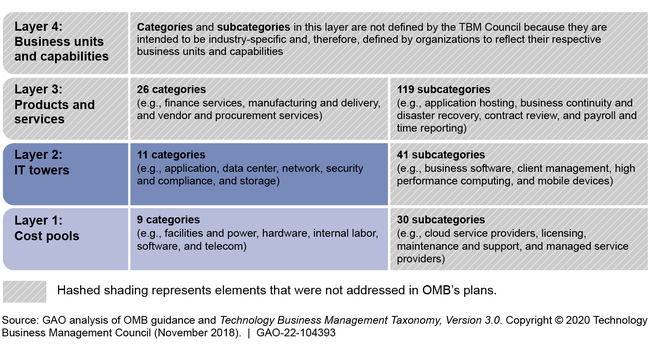
  • OMB’s initial 2017 plans for government-wide adoption required agencies to report IT spending using categories in the first two layers. OMB continued to require reporting of these two layers in subsequent plans. However, 5 years after establishing initial plans, OMB had not expanded on requirements to include the rest of the taxonomy—the categories in layers 3 and 4, and subcategories for all layers (see figure).

Extent That the Office of Management and Budget’s (OMB) Plans Addressed Elements of the Technology Business Management Taxonomy Version 3.0

Extent That the Office of Management and Budget's (OMB) Plans Addressed Elements of the Technology Business Management Taxonomy Version 3.0
  • OMB and GSA assisted agency efforts to implement the Technology Business Management framework by, for example, developing implementation guidance and a maturity model assessment tool. However, OMB and GSA have not assessed agency maturity. Further, they have not analyzed the quality of agencies’ data reported in the first two layers.
  • OMB and GSA released agency-reported data on the federal government’s IT Dashboard (layers 1 and 2), but did not disclose that about $31 billion in fiscal year 2021 investments were excluded. Further, they have not analyzed inconsistencies in fiscal year 2022 data, or addressed use of benchmarking that would enable spending comparisons to organizations of similar size or mission.

OMB and GSA officials maintain that Technology Business Management implementation continues to be a priority. Nevertheless, until OMB establishes documented plans and agency expectations for the remainder of the taxonomy, uncertainty will cloud agency efforts. Further, the continuing absence of OMB direction could prevent the federal government from fully achieving intended benefits such as optimizing IT spending.

Why GAO Did This Study

The government has faced longstanding challenges in IT management and spending transparency. In 2017, OMB announced its intention to improve insights into IT spending through government-wide adoption of the Technology Business Management Council’s framework.

This framework provides a standard taxonomy that is organized into four layers (cost pools, IT towers, products and services, and business units and capabilities) intended to show an organization’s total IT spending from different perspectives. These four layers are comprised of spending categories and subcategories.

GAO was asked to report on Technology Business Management implementation. GAO’s objective was to identify progress OMB and GSA have made in the government-wide adoption effort. To do so, GAO analyzed and compared plans against relevant criteria, such as Technology Business Management Council guidance. It also analyzed data, as reported by agencies for fiscal years 2021 and 2022, and interviewed relevant officials.

Skip to Recommendations

Recommendations

GAO is making seven recommendations to OMB and GSA, including establishing requirements for completing the remainder of the taxonomy, assessing maturity of agencies’ implementation, and addressing benchmarking use. As discussed in the report, GAO incorporated suggested OMB and GSA revisions for two of the seven recommendations; the agencies had no comments on the remaining five.

Recommendations for Executive Action

Office of Management and Budget The Director of OMB should direct the Federal CIO to establish plans and time frames for government-wide TBM adoption that address the remaining elements of the taxonomy (third layer, fourth layer, and subcategories). (Recommendation 1) 

Open

When we confirm what actions the agency has taken in response to this recommendation, we will provide updated information.Office of Management and Budget The Director of OMB should direct the Office of Federal Financial Management and Budget Review Division to work with GSA’s TBM program management office to determine appropriate next steps for updating budget object classification codes to better align agencies’ financial management systems with the TBM taxonomy. (Recommendation 2) 

Open

When we confirm what actions the agency has taken in response to this recommendation, we will provide updated information.Office of Management and Budget The Director of OMB should direct the Federal CIO to work with GSA to establish an approach for assessing the maturity of agencies’ TBM implementation. (Recommendation 3) 

Open

When we confirm what actions the agency has taken in response to this recommendation, we will provide updated information.Office of Management and Budget The Director of OMB should direct the Federal CIO to require all agencies to complete and submit the TBM maturity model assessment tool to OMB and GSA. (Recommendation 4) 

Open

When we confirm what actions the agency has taken in response to this recommendation, we will provide updated information.Office of Management and Budget The Director of OMB should direct the Federal CIO to ensure that known limitations in the TBM data for fiscal year 2021 are publicly disclosed on the IT Dashboard. (Recommendation 5) 

Open

When we confirm what actions the agency has taken in response to this recommendation, we will provide updated information.Office of Management and Budget The Director of OMB should direct the Federal CIO to analyze inconsistencies in agency-reported TBM data to determine why agencies are reporting differences between their TBM and IT portfolio spending data. (Recommendation 6) 

Open

When we confirm what actions the agency has taken in response to this recommendation, we will provide updated information.General Services Administration The Administrator of General Services should direct the Office of Government-wide Policy’s Director of IT Data Transparency to ensure that TBM benchmarking functionality is developed for the IT Dashboard. (Recommendation 7) 

Open

When we confirm what actions the agency has taken in response to this recommendation, we will provide updated information.

SEE ALL 7 RECOMMENDATIONS

Highlights Page (1 page)

Full Report

Full Report (37 pages)

Accessible PDF (42 pages)

Article link: https://www.gao.gov/products/gao-22-104393

Posts navigation

← Older Entries
Newer Entries →
  • Search site

  • Follow healthcarereimagined on WordPress.com
  • Recent Posts

    • Are AI Tools Ready to Answer Patients’ Questions About Their Medical Care? – JAMA 03/27/2026
    • How AI use in scholarly publishing threatens research integrity, lessens trust, and invites misinformation – Bulletin of the Atomic Scientists 03/25/2026
    • VA Prepares April Relaunch of EHR Program – GovCIO 03/19/2026
    • Strong call for universal healthcare from Pope Leo today – FAN 03/18/2026
    • EHR fragmentation offers an opportunity to enhance care coordination and experience 03/16/2026
    • When AI Governance Fails 03/15/2026
    • Introduction: Disinformation as a multiplier of existential threat – Bulletin of the Atomic Scientists 03/12/2026
    • AI is reinventing hiring — with the same old biases. Here’s how to avoid that trap – MIT Sloan 03/08/2026
    • Fiscal Year 2025 Year In Review – PEO DHMS 02/26/2026
    • “𝗦𝗼𝗰𝗶𝗮𝗹 𝗠𝗲𝗱𝗶𝗮 𝗠𝗮𝗻𝗶𝗽𝘂𝗹𝗮𝘁𝗶𝗼𝗻 𝗳𝗼𝗿 𝗦𝗮𝗹𝗲” – NATO Strategic Communications COE 02/26/2026
  • Categories

    • Accountable Care Organizations
    • ACOs
    • AHRQ
    • American Board of Internal Medicine
    • Big Data
    • Blue Button
    • Board Certification
    • Cancer Treatment
    • Data Science
    • Digital Services Playbook
    • DoD
    • EHR Interoperability
    • EHR Usability
    • Emergency Medicine
    • FDA
    • FDASIA
    • GAO Reports
    • Genetic Data
    • Genetic Research
    • Genomic Data
    • Global Standards
    • Health Care Costs
    • Health Care Economics
    • Health IT adoption
    • Health Outcomes
    • Healthcare Delivery
    • Healthcare Informatics
    • Healthcare Outcomes
    • Healthcare Security
    • Helathcare Delivery
    • HHS
    • HIPAA
    • ICD-10
    • Innovation
    • Integrated Electronic Health Records
    • IT Acquisition
    • JASONS
    • Lab Report Access
    • Military Health System Reform
    • Mobile Health
    • Mobile Healthcare
    • National Health IT System
    • NSF
    • ONC Reports to Congress
    • Oncology
    • Open Data
    • Patient Centered Medical Home
    • Patient Portals
    • PCMH
    • Precision Medicine
    • Primary Care
    • Public Health
    • Quadruple Aim
    • Quality Measures
    • Rehab Medicine
    • TechFAR Handbook
    • Triple Aim
    • U.S. Air Force Medicine
    • U.S. Army
    • U.S. Army Medicine
    • U.S. Navy Medicine
    • U.S. Surgeon General
    • Uncategorized
    • Value-based Care
    • Veterans Affairs
    • Warrior Transistion Units
    • XPRIZE
  • Archives

    • March 2026 (8)
    • February 2026 (6)
    • January 2026 (8)
    • December 2025 (11)
    • November 2025 (9)
    • October 2025 (10)
    • September 2025 (4)
    • August 2025 (7)
    • July 2025 (2)
    • June 2025 (9)
    • May 2025 (4)
    • April 2025 (11)
    • March 2025 (11)
    • February 2025 (10)
    • January 2025 (12)
    • December 2024 (12)
    • November 2024 (7)
    • October 2024 (5)
    • September 2024 (9)
    • August 2024 (10)
    • July 2024 (13)
    • June 2024 (18)
    • May 2024 (10)
    • April 2024 (19)
    • March 2024 (35)
    • February 2024 (23)
    • January 2024 (16)
    • December 2023 (22)
    • November 2023 (38)
    • October 2023 (24)
    • September 2023 (24)
    • August 2023 (34)
    • July 2023 (33)
    • June 2023 (30)
    • May 2023 (35)
    • April 2023 (30)
    • March 2023 (30)
    • February 2023 (15)
    • January 2023 (17)
    • December 2022 (10)
    • November 2022 (7)
    • October 2022 (22)
    • September 2022 (16)
    • August 2022 (33)
    • July 2022 (28)
    • June 2022 (42)
    • May 2022 (53)
    • April 2022 (35)
    • March 2022 (37)
    • February 2022 (21)
    • January 2022 (28)
    • December 2021 (23)
    • November 2021 (12)
    • October 2021 (10)
    • September 2021 (4)
    • August 2021 (4)
    • July 2021 (4)
    • May 2021 (3)
    • April 2021 (1)
    • March 2021 (2)
    • February 2021 (1)
    • January 2021 (4)
    • December 2020 (7)
    • November 2020 (2)
    • October 2020 (4)
    • September 2020 (7)
    • August 2020 (11)
    • July 2020 (3)
    • June 2020 (5)
    • April 2020 (3)
    • March 2020 (1)
    • February 2020 (1)
    • January 2020 (2)
    • December 2019 (2)
    • November 2019 (1)
    • September 2019 (4)
    • August 2019 (3)
    • July 2019 (5)
    • June 2019 (10)
    • May 2019 (8)
    • April 2019 (6)
    • March 2019 (7)
    • February 2019 (17)
    • January 2019 (14)
    • December 2018 (10)
    • November 2018 (20)
    • October 2018 (14)
    • September 2018 (27)
    • August 2018 (19)
    • July 2018 (16)
    • June 2018 (18)
    • May 2018 (28)
    • April 2018 (3)
    • March 2018 (11)
    • February 2018 (5)
    • January 2018 (10)
    • December 2017 (20)
    • November 2017 (30)
    • October 2017 (33)
    • September 2017 (11)
    • August 2017 (13)
    • July 2017 (9)
    • June 2017 (8)
    • May 2017 (9)
    • April 2017 (4)
    • March 2017 (12)
    • December 2016 (3)
    • September 2016 (4)
    • August 2016 (1)
    • July 2016 (7)
    • June 2016 (7)
    • April 2016 (4)
    • March 2016 (7)
    • February 2016 (1)
    • January 2016 (3)
    • November 2015 (3)
    • October 2015 (2)
    • September 2015 (9)
    • August 2015 (6)
    • June 2015 (5)
    • May 2015 (6)
    • April 2015 (3)
    • March 2015 (16)
    • February 2015 (10)
    • January 2015 (16)
    • December 2014 (9)
    • November 2014 (7)
    • October 2014 (21)
    • September 2014 (8)
    • August 2014 (9)
    • July 2014 (7)
    • June 2014 (5)
    • May 2014 (8)
    • April 2014 (19)
    • March 2014 (8)
    • February 2014 (9)
    • January 2014 (31)
    • December 2013 (23)
    • November 2013 (48)
    • October 2013 (25)
  • Tags

    Business Defense Department Department of Veterans Affairs EHealth EHR Electronic health record Food and Drug Administration Health Health informatics Health Information Exchange Health information technology Health system HIE Hospital IBM Mayo Clinic Medicare Medicine Military Health System Patient Patient portal Patient Protection and Affordable Care Act United States United States Department of Defense United States Department of Veterans Affairs
  • Upcoming Events

Blog at WordPress.com.
healthcarereimagined
Blog at WordPress.com.
  • Subscribe Subscribed
    • healthcarereimagined
    • Join 153 other subscribers
    • Already have a WordPress.com account? Log in now.
    • healthcarereimagined
    • Subscribe Subscribed
    • Sign up
    • Log in
    • Report this content
    • View site in Reader
    • Manage subscriptions
    • Collapse this bar
 

Loading Comments...