healthcarereimagined

Envisioning healthcare for the 21st century

  • About
  • Economics

How to create, release, and share generative AI responsibly – MIT Technology Review

Posted by timmreardon on 04/27/2023
Posted in: Uncategorized.

Companies including OpenAI and TikTok have signed up to a new set of guidelines designed to help them be more transparent around generative AI.

By Melissa Heikkila February 27, 2023

A group of 10 companies, including OpenAI, TikTok, Adobe, the BBC, and the dating app Bumble, have signed up to a new set of guidelines on how to build, create, and share AI-generated content responsibly. 

The recommendations call for both the builders of the technology, such as OpenAI, and creators and distributors of digitally created synthetic media, such as the BBC and TikTok, to be more transparent about what the technology can and cannot do, and disclose when people might be interacting with this type of content.

The voluntary recommendations were put together by the Partnership on AI (PAI), an AI research nonprofit, in consultation with over 50 organizations. PAI’s partners include big tech companies as well as academic, civil society, and media organizations. The first 10 companies to commit to the guidance are Adobe, BBC, CBC/Radio-Canada, Bumble, OpenAI, TikTok, Witness, and synthetic-media startups Synthesia, D-ID, and Respeecher. 

“We want to ensure that synthetic media is not used to harm, disempower, or disenfranchise but rather to support creativity, knowledge sharing, and commentary,” says Claire Leibowicz, PAI’s head of AI and media integrity. 

One of the most important elements of the guidelines is a pact by the companies to include and research ways to tell users when they’re interacting with something that’s been generated by AI. This might include watermarks or disclaimers, or traceable elements in an AI model’s training data or metadata. 

Regulation attempting to rein in potential harms relating to generative AI is still lagging behind. The European Union, for example, is trying to include generative AI in its upcoming AI law, the AI Act, which could include elements such as disclosing when people are interacting with deepfakes and obligating companies to meet certain transparency requirements.

Related Story

Europe's AI Act concept

A quick guide to the most important AI law you’ve never heard of

The European Union is planning new legislation aimed at curbing the worst harms associated with artificial intelligence.

While generative AI is a Wild West right now, says Henry Ajder, an expert on generative AI who contributed to the guidelines, he hopes they will offer companies key things they need to look out for as they incorporate the technology into their businesses.

Raising awareness and starting a conversation around responsible ways to think about synthetic media is important, says Hany Farid, a professor at the University of California, Berkeley, who researches synthetic media and deepfakes. 

But “voluntary guidelines and principles rarely work,” he adds. 

While companies such as OpenAI can try to put guardrails on technologies they create, like ChatGPT and DALL-E, other players that are not part of the pact—such as Stability.AI, the startup that created the open source image-generating AI model Stable Diffusion—can let people generate inappropriate images and deepfakes.

“If we really want to address these issues, we’ve got to get serious,” says Farid. For example, he wants cloud service providers and app stores such as those operated by Amazon, Microsoft, Google, and Apple, which are all part of the PAI, to ban services that allow people to use deepfake technology with the intent to create nonconsensual sexual imagery. Watermarks on all AI-generated content should also be mandated, not voluntary, he says. 

Another important thing missing is how the AI systems themselves could be made more responsible, says Ilke Demir, a senior research scientist at Intel who leads the company’s work on the responsible development of generative AI. This could include more details on how the AI model was trained, what data went into it, and whether generative AI models have any biases. 

The guidelines have no mention of ensuring that there’s no toxic content in the data set of generative AI models. “It’s one of the most significant ways harm is caused by these systems,” says Daniel Leufer, a senior policy analyst at the digital rights group Access Now. 

The guidelines include a list of harms that these companies want to prevent, such as fraud, harassment, and disinformation. But a generative AI model that always creates white people is also doing harm, and that is not currently listed, adds Demir.

Farid raises a more fundamental issue. Since the companies acknowledge that the technology could lead to some serious harms and offer ways to mitigate them, “why aren’t they asking the question ‘Should we do this in the first place?’”

Article link: https://www.technologyreview.com/2023/02/27/1069166/how-to-create-release-and-share-generative-ai-responsibly/?

Americans deserve government tech that delivers – Fedscoop

Posted by timmreardon on 04/26/2023
Posted in: Uncategorized.

GSA Administrator Robin Carnahan explains how her agency is committed to ensuring government technology works for everyone and taking responsibility when things go wrong.

BYROBIN CARNAHAN. APRIL 24, 2023

As we emerge from the pandemic, millions more Americans have come to rely on digital delivery of services, including those from government. They expect publicly funded technology and websites that they can trust. They want interactions to be simple, streamlined, and secure. And that’s exactly what they deserve. 

At the U.S. General Services Administration, which I lead, our Technology Transformation Services (TTS) works across government to help federal agencies meet that expectation. This work represents an essential component of what has always been GSA’s core mission: helping government deliver efficiently and cost-effectively for the American people. In other words, providing a strong digital infrastructure that gives the public what they need is a natural evolution of GSA’s long-standing work to deliver value through federal acquisitions and real estate.

As we do this work, we’re guided by some fundamental principles. We believe government websites should work for all Americans, including vulnerable communities. We believe government technology should be developed for the public benefit, not private gain, and that individuals – not corporations – should control access to their own sensitive information. 

Above all, we believe that accessible, equitable, and secure digital infrastructure – developed for the public by an accountable government – is vital to delivering the services Americans need, when they need them.

Our commitment to accountability also means owning up to mistakes and taking responsibility when we fail to meet the high standards taxpayers expect and deserve. 

For example, over a year ago, GSA leadership found out that Login.gov, a secure sign-on service operated out of TTS, had been representing that it was compliant with a technology standard when, in fact, it wasn’t.

Misrepresentations like that are unacceptable, and we spent the last year working to bolster trust and transparency with Login.gov customers, to strengthen oversight and management controls, and to take other steps to prevent something like that from happening again. This included alerting the Inspector General, putting in place new leadership, and improving the Login.gov product offering. As a result, Login.gov is now stronger than ever — offering enhanced anti-fraud controls, 24×7 bilingual customer support, and in-person identity verification at over 18,000 U.S. Postal Service Post Office locations nationwide.

We know there is still work to be done to restore trust with our customers and the public, and I’m committed to seeing that work through and to delivering secure, effective, and accessible digital services to the millions of people we serve. 

The ability of the American people to securely and equitably interact with their government online is critically important, and we are committed to making sure government technology works for everyone, including those who need it the most.

That’s why we’re working in a comprehensive way to strengthen and expand our technology programs so they can deliver even more effectively for the American people.

We established a new Technology Law Division within the Office of the General Counsel to support programs like Login.gov. We’re strengthening the leadership team TTS-wide, hiring a new TTS director in December and, this month, a new deputy director and a new senior adviser for operations. And we’re ramping up our efforts to deliver impactful, lasting solutions that save money for taxpayers and help agency partners deliver excellent customer experiences for the American people — from veterans seeking healthcare to seniors accessing Social Security benefits to farmers and ranchers needing consistent and streamlined information. 

After all, technological advances in areas like artificial intelligence make it more important than ever that our government recruits talented, dedicated technologists to thoughtfully and responsibly buy, build, and oversee government technology in ways that are consistent with our values and serve the public interest.

Turning away from that responsibility is not an option, and this administration will continue to scale up its commitment to technology modernization as we prepare for the future. 

Robin Carnahan currently serves as Administrator of the U.S. General Services Administration.

Article link: https://fedscoop.com/americans-deserve-government-tech-that-delivers/

4 Business Approaches to Blockchain – MIT Sloan

Posted by timmreardon on 04/26/2023
Posted in: Uncategorized.

Blockchain is considered an essential underpinning of emerging innovations like Web3. Yet some early adopters of the distributed ledger technology have experienced high-profile failures over the past 18 months, most notably in cryptocurrency and early enterprise applications.

As companies wonder where to begin, a new research briefing from the MIT Center for Information Systems Research outlines four business approaches to blockchain:

• Wait and see. This approach is suitable for companies in highly regulated industries that are risk-averse. These businesses are often content to leave early experimentation to others until there is clarity around profitability, regulations, and other market forces.
• Experiment. An exploratory path enables companies to try out blockchain-based products and services on a small scale without risk to mission-critical operations.
• Provide targeted offerings. This approach goes beyond experimentation to expand blockchain into targeted areas — typically those that aren’t mission critical.
• Go all in. This is the preferred route of startups or industry disruptors committed to building new businesses based on decentralized blockchain-enabled products and services.

When it comes to building new business opportunities, 80% of companies succeed in ideating and incubating new ideas, but only 16% successfully scale them, according to research by innovation advisory firm Change Logic.

Writing recently in MIT Sloan Management Review, Change Logic’s Andy Binns and Christine Griffin shared insights from their study of 30 successful and unsuccessful corporate ventures. They found that most successful companies follow a “scaling path” that provides leaders with a language and structure to reach their innovation goals.

Scaling paths comprise a clarity of ambition; an understanding of assets needed to access the customers, capabilities, and capacity the new business requires; and a willingness to use a variety of techniques to assemble those assets into a coherent strategy for attaining scale.

This approach to scaling helps leaders of new ventures learn and iterate as they go, adding new options and eliminating those that become dead ends, the authors write.

“Scaling is both art and science, and with the help of a scaling path, it can be managed with the same level of discipline and success that we have come to expect of ideation and incubation,” they conclude.

Minority households in the U.S. face significant hurdles when trying to buy a home. Government figures show that in the second quarter of 2022, the homeownership rate for white households was 75%, compared with 45% for Black households.

It will take “a big pivot” to close a gap that large and persistent, said Edward Golding, executive director of the the MIT Golub Center for Finance and Policy. “We really do have to make fundamental changes.”

Toward that end, the Golub Center and the MIT Department of Urban Studies and Planning recently hosted a lecture series on creating more equality in the U.S. housing market. Some ideas offered by experts in civil rights, lending, and government:

• Modify underwriting requirements to account for the effects of past discrimination and racism.  • Involve a wider variety of banks, such as regional banks and those that are part of the Federal Home Loan Bank System, in government home loan programs.

• Prioritize community reinvestment in the Deep South, a region one local lender characterized as “capital-starved” and lacking philanthropic giving and major banks.

• Create public banks managed by the government to build community wealth and bring more affordable housing to underserved markets.

Article link: https://www.linkedin.com/pulse/4-business-approaches-blockchain-mit-sloan-school-of-management

The Low-Tech Side of Biden’s Push to Improve the ‘Life Experiences’ with Government – Nextgov

Posted by timmreardon on 04/26/2023
Posted in: Uncategorized.

By AARON BOYDAPRIL 25, 2023

Agencies are approaching the White House’s mandate with an eye for getting important information and access to as many people as possible.

While the Biden administration’s biggest customer experience—or CX—effort to date is being led by technologists in the Office of Management and Budget, the nine “Life Experience” projects are, for the most part, decidedly low-tech.

The administration is pursuing major improvements to the way Americans interact with the government, beginning with nine projects across five “life experiences,” with a focus on improving that customer interaction without regard for traditional barriers and siloes erected around agencies.

“Technology underpins everything we do as the federal government,” Federal Chief Information Officer Clare Martorana told Nextgov in an interview. However, “it isn’t necessarily the individual piece of software or the code we’re shipping. It comes down to how are we bringing all of these people along on the journey: both our vendor partners—the external people that are helping us build technology—but also our federal employees—making sure that they have the right knowledge and training—and building off of the best practices … that [the U.S. Digital Service] drives across government.”

Those efforts are only tangentially related to technology and, of the nine projects at the center of the Life Experience CX program, only four of them have any meaningful technology component.

That is a feature of most of these projects, not a bug.

“How do we ensure that as we’re building out solutions we’re building them in a way that it’s accessible and addresses everybody in the population and does so equitably—not just the most tech savvy people with the newest phones and the fastest broadband,” USDS Administrator Mina Hsiang told Nextgov.

“We all have different degrees of technological access, technological literacy and engagement with a bunch of other aspects of the economy that affect how we appear in technological spaces,” such as a person’s credit history—or lack thereof—Hsiang noted. “All of these things affect your access to different tools as they’re developed.”

For example, under the program targeted toward families with children in the 0-5 age range, only one of three projects relies on technology: a pilot to create a text messaging service that state-run programs can use to inform families of available benefits and send reminders about upcoming deadlines.

While the program promises to help families who are most in need of these benefits, not all have access to a cell phone or the necessary broadband service to take advantage. That said, cell phone access among low-income Americans is incredibly high. A 2021 Pew survey found 97% of Americans had a cell phone—a number that held across multiple low-income brackets, including people making less than $30,000, $30,000-$49,999 and $50,000-$74,999

The 0-5 program doesn’t have the resources or authority to provide cell phones and service to those without, officials told Nextgov, but that doesn’t mean those people will be left without help.

“All three of our portfolio projects under 0-5 are designed to be responsive to feedback we heard directly from families,” said Maya Mechenbier, project lead at USDS for the 0-5 projects. “We asked about modes of communication and support in which we could support families through this life experience—and modes of communication that fit into their lives. So, meeting families where they are.”

For the majority, the best mode of communication is SMS, which sparked creation of the U.S. Notify program through the General Services Administration’s Public Benefits Studio.

But the 0-5 program wanted to ensure they reached everyone, prompting the other two low-tech projects: offering a physical newborn supply kit with things every family needs in the early days after a baby is born and creating a “benefits bundle” that social workers can help tailor to each family’s unique needs.

Even the choice to use SMS was guided by the preference toward low-tech. For example, email and other similar forms of digital communication require smart phones or computers and reliable broadband access, which can all create more barriers for low-income families. SMS—while still technically digital—offered the lowest-tech option.

“The theme here is that it doesn’t have to be too scary or too complicated,” one 0-5 program official told Nextgov.

“[If] I’m an individual who has just experienced a natural disaster or just lost my job, I don’t care about what the different agencies are and the programs at different agencies and which ones I might be eligible for. I have a need,” Hsiang said. “One of the interesting challenges for us to work through is how do we make those appear more seamless to the user.”

While in some cases that might mean creating a better website, fine-tuning an app or gathering better data for analytics, people and processes always come into play.

“I haven’t found a technology problem in government that we hadn’t solved many years ago in the private sector,” Martorana said. “We have policy, budget, legacy IT challenges, people who are unfamiliar with modern technology in [an] agency and haven’t had the opportunity to be trained or be exposed. … It’s as much the people and the process needing to change. It’s why I think this EO is one of the most significant things from this administration—in addition to equity.”

Martorana also stressed the importance of continuing improvement work long after these specific projects have wrapped—particularly when it comes to the technology components.

null

“If you’re not shipping code every day, every week, you have to build the discipline out to be able to achieve that,” she said. “Otherwise, you get so disconnected from your customer that you have to put customer demands on a backlog.”

Support from the top

Where there is a technology component, the administration is sending support from USDS—a group designed to parachute into other agencies to help with particularly complex or challenging IT deployments.

The group has a mixed success rate. It was established after a team of industry technologists joined the Obama administration to fix the healthcare.gov portal and has had successful offshoots at the Veterans Affairs Department andDefense Department; meanwhile at other agencies—like the Small Business Administration—the engagements have been less successful.

For these CX projects, Hsiang said USDS can act as a bridge between siloed federal agencies.

“To a certain extent, we’re inventing a path forward. One of our capabilities is that we can work between agencies,” she said. “We can help bring agencies together and help provide some of that connective tissue and work through the complex questions.”

But the biggest support provided by USDS is institutional knowledge from folks who have done these things before—though usually from outside government.

“Obviously, USDS doesn’t have enough people to deploy to every single agency that has anything that they want to do in CX. But we really are focused on supporting agencies and helping provide capacity for major programs and consultations in areas where that’s helpful,” Hsiang said. “[We’re] bringing the expertise and folks who have done it in the past.”

The Federal CIO’s Office is helping with financial support, primarily through the Technology Modernization Fund, a central account managed by OMB and the General Services Administration from which agencies can borrow—or be granted—funds for impactful IT modernization projects.

The TMF Board set aside $100 million for CX projects, for which OFCIO is hoping the nine projects will apply.

“They are all eligible to apply,” Martorana confirmed. “We’ve been strongly encouraging them to apply. But each individual agency takes their own time in the process.”

Meanwhile, OMB is also working to connect agencies—through these nine projects and other CX efforts—going through similar experiences or working through similar problems.

“We don’t have to start at every agency on a blank piece of paper,” Martorana said. “That is why it’s really important that we’re writing these playbooks down.”

If these nine projects are successful, Martorana and Hsiang hope those playbooks will be the ignition for an explosion of CX programs throughout government.

“A lot of what we want to do is tell stories of how this can be successful,” Hsiang said. “The more that we have worked on this and we have agencies and programs where we have done this and it has gone well … it de-risks it and it makes it something that feel[s] like you can take it on.”

Barbara Morton, Veterans Affairs’ deputy chief veterans experience officer and lead for the Transitioning to Civilian Life project—who has been working on her agency’s customer experience issues since 2016—sees similar potential here.

Morton said, from her perspective, there are two main goals for the project:

“First and foremost, really responding to the pain points that we hear from transitioning servicemembers. We know in VA, data shows us that roughly half of transitioning servicemembers don’t engage with VA. … We’re curious why might that be,” she told Nextgov.

But there is a secondary potential benefit, as well.

“I love this as a pretty juicy, giant proof of concept,” she said. “To step outside of just the VA space, as well, and apply human-centered design insights and see how we can create solutions that cut across different agencies and bust the barriers—the siloes—of bureaucracy. … Understanding that for us—the collective ‘us’ in government—to be able to be what the people want us to be: Really give those services and support.”

She added that the aim is to understand how government as a whole can provide services “in a more human-centered way, rather than any of us feeling more like transactions.”

And that includes improving services for those who are not tech-savvy or tech-enabled.

“I do understand the concept of, ‘You want to provide as much bang for your buck with the resources you have,’ and maybe the digital option would be the most popular or the most widely utilized,” Morton said. “But that can’t eliminate our need and duty, frankly—and our opportunity—to think about the functional equivalent non-digital solution as well.”

This is the first in a multipart series exploring the Biden administration’s push to improve citizens’ experiences with government. The series will take a deeper dive on several projects mentioned in this article.

Article link: https://www.nextgov.com/cxo-briefing/2023/04/low-tech-side-bidens-push-improve-life-experiences-government/385564/

.

CHIPS for America Outlines Vision for the National Semiconductor Technology Center – NIST

Posted by timmreardon on 04/25/2023
Posted in: Uncategorized.
Semiconductor R&D Strategy is Part of President Biden’s Investing in America Agenda to Advance U.S. Competitiveness and Technological Leadership

April 25, 2023

Today, the U.S. Department of Commerce’s National Institute of Standards and Technology (NIST) released a paper outlining its vision and strategy for a National Semiconductor Technology Center (NSTC), a key component of the research and development program established by President Biden’s CHIPS and Science Act. Congress appropriated funds for the creation of a national center to support and extend U.S. leadership in semiconductor research, design, engineering, and advanced manufacturing and strengthen U.S. competitiveness.  

The paper, “A Vision and Strategy for the National Semiconductor Technology Center,” lays out how the NSTC will accelerate America’s ability to develop the chips and technologies of the future to safeguard America’s global innovation leadership. The vision and strategy paper describes the center’s mission, core programs, and other features. In addition to creating and sponsoring research programs, the NSTC will work with academic and industry partners to create affiliated technical centers around the country, fostering a network of research and innovation that is unprecedented in scale, breadth, and focus. The NSTC will lay the groundwork for good jobs that will grow a domestic semiconductor workforce.  

“The NSTC will be an ambitious public-private consortium where government, industry, customers, suppliers, educational institutions, entrepreneurs, and investors will come together to innovate, connect, and solve problems,” said U.S. Secretary of Commerce Gina Raimondo. “Most importantly, the NSTC will ensure that the U.S. leads the way in the next generation of semiconductor technologies which can enable major new advances in areas that will advance our economic and national security. While the manufacturing incentives of the CHIPS Act will bring semiconductor manufacturing back to the U.S., a robust R&D ecosystem led by the NSTC will keep it here.” 

The NSTC’s programs are intended for the entire ecosystem: fabless companies, research institutions, community colleges, state and local governments, national labs, foundries, integrated device manufacturers, equipment vendors, materials suppliers, labor unions, and investors. The NSTC aims to fulfill the unmet needs of the sector with member services such as access to emerging materials and process technologies, digital assets and design tools, a chiplet stockpile, and incubation support for startups. It also will offer the opportunity for participation in industry grand challenges, road mapping and standards activities, and workforce training and technical exchange programs. 

As outlined in the strategy paper, the NSTC has three high-level goals:  

  1. Extend America’s leadership in semiconductor technology. Designing, prototyping, and piloting the latest semiconductor technology in America will provide the foundation for future applications and industries and strengthen the domestic semiconductor manufacturing ecosystem. 
  2. Reduce the time and cost of moving from design idea to commercialization. The NSTC will leverage shared facilities and expertise for designing, prototyping, manufacturing, packaging, and scaling of semiconductors and related products that provide innovators in the U.S. with critical capabilities to advance economic and national security.  
  3. Build and sustain a semiconductor workforce development ecosystem. The NSTC will serve as a coordinating body and center of excellence to scale the technical workforce, including scientists, engineers, and technicians. The NSTC workforce programs will support expanding recruiting, training, and retraining for the semiconductor ecosystem, including reaching groups that are traditionally under-represented in the industry. 

“The National Semiconductor Technology Center is designed to drive innovation and speed the transfer of new technologies to market,” said Under Secretary of Commerce for Standards and Technology and NIST Director Laurie E. Locascio. “This center will give the U.S. semiconductor industry an enduring technological lead and help develop a skilled workforce capable of manufacturing the world’s most advanced devices.” 

In addition to establishing a center for research, administration, and operations, the NSTC will establish technical centers by expanding and improving research facilities across the country or by building new, advanced facilities. Inventors and entrepreneurs, start-ups and established businesses, chipmakers, materials and equipment suppliers, educators and trainees can all collaborate on NSTC programs. The NSTC is designed to address the real-world technical challenges of the semiconductor industry and provide immediate and hands-on knowledge transfer and training to participants. 

Extensive feedback from stakeholders made clear that the NSTC must address a wide variety of issues for a great diversity of stakeholders. It is essential that the NSTC is viewed throughout the ecosystem as neutral, trusted, and science driven.   

The Secretary of Commerce, in collaboration with the Secretary of Defense, will establish the NSTC through the creation of a public-private consortium as required by the Act.  

Federal consortia are frequently managed by nonprofit entities. The Department anticipates the creation of a new, purpose-built, independent, nonprofit entity with the requisite neutrality, expertise, leadership, and capacity to serve as the operator of the NSTC consortium.   

As a first step, the Department will issue in the April 26, 2023, Federal Register a call for nominations to join a committee that will select a board of trustees. The board of trustees will form a non-profit entity that the Department anticipates will serve as the operator for the NSTC. To be alerted to the call for nominations in the Federal Register, subscribe to the CHIPS email list here. 

Learn more by reading the full text of “A Vision and Strategy for the National Semiconductor Technology Center,” which is available at https://www.chips.gov along with a fact sheet. 

About CHIPS for America  

CHIPS for America is part of President Biden’s economic plan to invest in America, stimulate private sector investment, create good-paying jobs, make more in the United States, and revitalize communities left behind. CHIPS for America includes the CHIPS Program Office, responsible for manufacturing incentives, and the CHIPS Research and Development (R&D) Office, responsible for R&D programs. Both offices sit within the National Institute of Standards and Technology (NIST) at the Department of Commerce. NIST promotes U.S. innovation and industrial competitiveness by advancing measurement science, standards, and technology in ways that enhance economic security and improve our quality of life. NIST is uniquely positioned to successfully administer the CHIPS for America program because of the bureau’s strong relationships with U.S. industries, its deep understanding of the semiconductor ecosystem, and its reputation as fair and trusted. Visit https://www.chips.gov to learn more.  

Article link: https://www.nist.gov/news-events/news/2023/04/chips-america-outlines-vision-national-semiconductor-technology-center

New federal service delivery model focuses on people and problems, not bureaucratic silos – FCW

Posted by timmreardon on 04/25/2023
Posted in: Uncategorized.

By NATALIE ALMSMARCH 3, 2023

The White House envisions applications for services like food assistance, Medicaid and other benefits taking 20 minutes, with enrollment coming after just 24 hours.

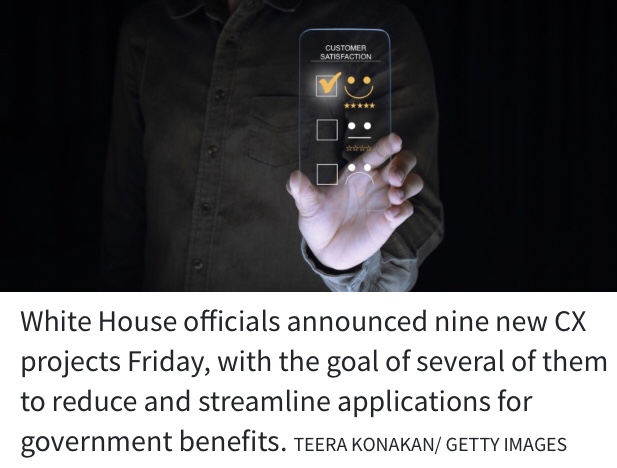
The White House announced nine projects on Friday that agencies are undertaking as part of its effort to reorganize how the government delivers services by focusing on citizens’ experiences. 

The projects, which range from piloting newborn supply kits to guidelines for trauma-informed government disaster communications, are part of the Biden administration’s ongoing focus on improving customer experience, or how individuals perceive and experience their interactions with government. 

The administration has been focusing on retooling five specific experiences where people often interact with the government, including financial shock and retirement, as part of its CX strategy.

Many of the new projects announced Friday involve efforts to decrease the number of applications individuals have to submit for government benefits and streamlining those applications, in part, by making data more accessible across programs.

The effort is a “new model for how the federal government should better design and deliver services to Americans,” the White House said in its announcement of the new projects.

Related articles

The CX executive order turns one

For federal CX to work, Congress, the White House and agencies need ‘fundamental’ change, report says

White House, agencies still sorting out who will pay for cross-agency service delivery work

Agencies overseeing efforts to improve the benefits process around low-income families having a child or seeking early childhood resources will be piloting a “benefit bundle,” for example, that would connect families to available services like Medicaid through personalized case management. 

Some projects will require agencies to share information across government data silos and navigate legal authorities around that data and challenges to tech procurement.

One effort under the umbrella of facing a financial shock looks to “improve automated benefit determinations… by improving underlying federal data infrastructure.” The idea is that government agencies can use back-end data to determine applicants’ incomes, and eligibility, on their behalf. 

The initial focus will be on reviewing legal authorities to reuse income data across Medicaid, the Supplemental Nutrition Assistance Program and the Temporary Assistance for Needy Families programs. The project leads will also be looking at prototyping income verification and potential guidance on the reuse of income data across programs.

Another project centers on a goal for Americans seeking services like food assistance, Medicaid and other means-tested benefits to be able to apply in 20 minutes and enroll in 24 hours.

Accomplishing this, though, will start with a close look at how the government does and could purchase tech for multi-benefit delivery and potentially even new procurement solutions, according to Friday’s announcement.

An additional group of agencies will be looking to build out a methodology for how to measure the “psychological, learning and time costs” of applying for, maintaining and getting disaster assistance – a project that will also deliver a toolkit for other agencies to get their own measurements of administrative burden in other programs. 

Having standard measures of administrative burden in government programs – something some in the academic space are also looking into already – could help agencies dismantle that burden.

Another project announced Friday is a pilot of text message reminders about enrollment and renewal deadlines in government benefit programs, something the General Services Administration recently also announced a new service for.

The other two projects are a digital solution to help military service members transition to civilian life and an outreach model for individuals nearing retirement. 

The specific endeavors under this life experience work come after research done by multi-disciplinary teams with service designers, policy experts, program staff and evaluation staff that got feedback from members of the public on how they experience government in these specific life moments, according to the White House. 

As for how the work is being paid for, agencies working on the projects are pooling funding using an authority granted by Congress in the fiscal 2016 appropriations package that allows them to transfer money for work related to cross-agency priority goals, according to an Office of Management and Budget official.

The White House also released a progress update on Friday on the work being done to implement the executive order on customer experience across agencies with specific projects on self-service channels, online forms and rolls, streamlining enrollment in government programs and more.

Article link: https://fcw.com/digital-government/2023/03/white-house-announces-next-steps-life-experience-projects/383591/

VA Pauses Future EHR Deployments Under ‘Larger Program Reset’ – Nextgov

Posted by timmreardon on 04/24/2023
Posted in: Uncategorized.

The Department of Veterans Affairs said it plans to delay future rollouts of the new EHR system until it is confident that the software “is highly functioning at current sites and ready to deliver for veterans and VA clinicians at future sites.”

The Department of Veterans Affairs announced on Friday that it is halting additional rollouts of its new Oracle Cerner electronic health record system as part of “a larger program reset” to address issues plaguing the software’s deployment at VA medical facilities.

In a press release, VA said that future deployments of the multi-billion dollar software would be halted as the department works to “prioritize improvements at the five sites that currently use the new EHR.”

“Additional deployments will not be scheduled until VA is confident that the new EHR is highly functioning at current sites and ready to deliver for veterans and VA clinicians at future sites,” VA added. “This readiness will be demonstrated by clear improvements in the clinician and veteran experience; sustained high performance and high reliability of the system itself; improved levels of productivity at the sites where the EHR is in use; and more.”

VA announced last October that it was delaying future rollouts of the new EHR system until June 2023 to conduct an “assess and address period” that would “correct outstanding issues—especially those that may have patient safety implications—before restarting deployments at other VA medical centers.” Earlier this month, the department announced that it would be extending its operational pause by holding off on the software’s deployment at the VA Saginaw Healthcare System in Michigan that was scheduled for June.

Cerner—which was acquired by Oracle in June 2022—won a $10 billion contract in 2018 to replace VA’s legacy system, known as the Veterans Health Information Systems and Technology Architecture, or VistA. The rollout of the new EHR software, however, has been slowed by patient safety issues, performance and technical concerns and cost overruns since first going live at the Mann-Grandstaff VA Medical Center in Spokane, Washington in 2020.

A report issued last July by the VA Inspector General’s office found that the Oracle Cerner software deployed at Mann-Grandstaff had inadvertently routed over 11,000 veterans’ clinical orders to an “unknown queue” without alerting clinicians, which resulted in “multiple events of patient harm.” And, just last month, VA officials informed Congress that the EHR system—which has been deployed at just five facilities across the department’s national network of 171 medical centers—was found to have contributed to the deaths of four veterans. 

The latest pause in the new system’s deployment comes as VA and Oracle Cerner continue to hold negotiations about the program’s contract. VA officials previously expressed a willingness to delay additional software rollouts at medical facilities until the ongoing negotiations are concluded. The current contract is set to expire on May 16, and VA Secretary Denis McDonough previously told lawmakers during a House hearing last month that he needed “to see what happens in this contract before we make a decision about where we go next anyway, because the contract may not be what we need.” 

VA’s press release noted that it is working with Oracle Cerner on “an amended contract that will increase Oracle Cerner’s accountability to deliver a high-functioning, high-reliability, world-class EHR system.”

“We’ve heard from veterans and VA clinicians that the new electronic health record is not meeting expectations—and we’re holding Oracle Cerner and ourselves accountable to get this right,” McDonough said in a statement about the department’s latest rollout delay. “This reset period will allow us to focus on fixing what’s wrong, listening to those we serve and laying the foundation for a modern electronic health record that delivers for veterans and clinicians.” 

The department added, however, that the planned March 2024 deployment of the new EHR system at the Captain James A. Lovell Federal Health Care Center in Chicago “will continue as planned,” noting that the facility is “the only fully-integrated VA and Department of Defense health care system.” The VA’s EHR system is designed to be interoperable with DOD’s Cerner-developed EHR system, known as MHS Genesis.

In a joint statement, Rep. Mike Bost, R-Ill.—chair of the House Veterans’ Affairs Committee—and Rep. Matt Rosendale, R-Mont.—chair of the House Veterans’ Affairs Subcommittee on Technology Modernization—said they supported McDonough’s decision “in the strongest possible terms.”

“Millions of veterans and VA employees should be encouraged that VA and Oracle Cerner are taking concrete steps to address the many flaws that we, this committee and others have been sounding the alarm on for months,” they added. “Together, they share the burden of demonstrating whether the EHR system and this project are capable of wholesale improvement. Make no mistake, this is a question of if, not when.”

The leaders of the House and Senate Veterans’ Affairs committees have all introduced separate bills this year to address challenges with the EHR system’s deployment. During a House Veterans’ Affairs Oversight and Investigation Subcommittee hearing this week, bipartisan House lawmakers signaled that they were beginning to coalesce behind two legislative proposals—one from Bost, and another from Sen. Jon Tester, D-Mont., who chairs the Senate Veterans’ Affairs Committee—that would bolster VA’s oversight and accountability of the Oracle Cerner software’s deployment moving forward. 

Oracle, meanwhile, has continued to stress its efforts to rectify technical and performance issues with the EHR software, including maintaining a public-facing dashboard to track the progress it has made on system enhancements. 

Mike Sicilia, executive vice president for industries at Oracle, said in a statement that the company “is proud to continue working together with VA to modernize its electronic health record system,” and remained committed to providing VA “with an EHR that exceeds expectations.”

“We support VA’s plan to improve the operation of the EHR at the current sites and take the necessary time to institute governance, change management and standardization changes to ensure the success of future VA deployments, similar to what DOD did a few years ago,” he added. “DOD’s modernization is now nearly complete, on time and on budget. We will continue to closely coordinate with VA to provide enhancements and updates to the EHR.”

Article link: https://www.nextgov.com/it-modernization/2023/04/va-pauses-future-ehr-deployments-under-larger-program-reset/385493/

Brain images just got 64 million times sharper – Duke University

Posted by timmreardon on 04/23/2023
Posted in: Uncategorized.

by Duke University

Magnetic resonance imaging (MRI) is how we visualize soft, watery tissue that is hard to image with X-rays. But while an MRI provides good enough resolution to spot a brain tumor, it needs to be a lot sharper to visualize microscopic details within the brain that reveal its organization.

In a decades-long technical tour de force led by Duke’s Center for In Vivo Microscopy with colleagues at the University of Tennessee Health Science Center, University of Pennsylvania, University of Pittsburgh and Indiana University, researchers took up the gauntlet and improved the resolution of MRI leading to the sharpest images ever captured of a mouse brain.

Coinciding with the 50th anniversary of the first MRI, the researchers generated scans of a mouse brain that are dramatically crisper than a typical clinical MRI for humans, the scientific equivalent of going from a pixelated 8-bit graphic to the hyper-realistic detail of a Chuck Close painting.

A single voxel of the new images—think of it as a cubic pixel—measures just 5 microns. That’s 64 million times smaller than a clinical MRI voxel.

Although the researchers focused their magnets on mice instead of humans, the refined MRI provides an important new way to visualize the connectivity of the entire brain at record-breaking resolution. The researchers say new insights from mouse imaging will in turn lead to a better understanding of conditions in humans, such as how the brain changes with age, diet, or even with neurodegenerative diseases like Alzheimer’s.

Loading video
Duke MRI images entire mouse brain at resolution 64 million times better than clinical MRI, offering hope of understanding Parkinson’s, Alzheimer’s and other diseases. Credit: Duke Center for In Vivo Microscopy

“It is something that is truly enabling. We can start looking at neurodegenerative diseases in an entirely different way,” said G. Allan Johnson, Ph.D., the lead author of the new paper and the Charles E. Putman University Distinguished professor of radiology, physics and biomedical engineering at Duke.

Johnson’s excitement is a long time coming. The team’s new work, appearing April 17 in the Proceedings of the National Academy of Sciences, is the culmination of nearly 40 years of research at the Duke Center for In Vivo Microscopy.

Over the four decades, Johnson, his engineering graduate students and his many collaborators at Duke and afar refined many elements that, when all combined, made the revolutionary MRI resolution possible.

Some of the key ingredients include an incredibly powerful magnet (most clinical MRIs rely on a 1.5 to 3 Tesla magnet; Johnson’s team uses a 9.4 Tesla magnet), a special set of gradient coils that are 100 times stronger than those in a clinical MRI and help generate the brain image, and a high-performance computer equivalent to nearly 800 laptops all cranking away to image one brain.

After Johnson and his team “scan the daylights out of it,” they send off the tissue to be imaged using a different technique called light sheet microscopy. This complementary technique gives them the ability to label specific groups of cells across the brain, such as dopamine-issuing cells to watch the progression of Parkinson’s disease.

The team then maps the light sheet pictures, which give a highly accurate look at brain cells, onto the original MRI scan, which is much more anatomically accurate and provides a vivid view of cells and circuits throughout the entire brain.

With this combined whole brain data imagery, researchers can now peer into the microscopic mysteries of the brain in ways never possible before.

One set of MRI images shows how brain-wide connectivity changes as mice age, as well as how specific regions, like the memory-involved subiculum, change more than the rest of the mouse’s brain.

Another set of images showcases a spool of rainbow-colored brain connections that highlight the remarkable deterioration of neural networks in a mouse model of Alzheimer’s disease.

The hope is that by making the MRI an even higher-powered microscope, Johnson and others can better understand mouse models of human diseases, such as Huntington’s disease, Alzheimer’s, and others. And that should lead to a better understanding of how similar things function or go awry in people.

“Research supported by the National Institute of Aging uncovered that modest dietary and drug interventions can lead to animals living 25% longer,” Johnson said. “So, the question is, is their brain still intact during this extended lifespan? Could they still do crossword puzzles? Are they going to be able to do Sudoku even though they’re living 25% longer? And we have the capacity now to look at it. And as we do so, we can translate that directly into the human condition.”

Article link: https://medicalxpress-com.cdn.ampproject.org/c/s/medicalxpress.com/news/2023-04-brain-images-million-sharper.amp

Electronic Health Record Modernization:VA Needs to Address Change Management Challenges, User Satisfaction, and System Issues – GAO

Posted by timmreardon on 04/22/2023
Posted in: Uncategorized.

GAO-23-106685Published: Mar 15, 2023. Publicly Released: Mar 15, 2023.

Fast Facts

Veterans Affairs is in the process of replacing its IT system used to maintain veterans’ health records—and has deployed its new system to a few locations.

We testified that the new system has presented issues for some users. For example, many users said that they weren’t adequately trained to use the new system. Users also said that the new system had decreased morale and job satisfaction and increased burnout among VA staff.

The VA hasn’t established goals to assess user satisfaction with its new IT system.

Highlights

What GAO Found

The Department of Veterans Affairs (VA) organizational change management activities for the Electronic Health Record Modernization (EHRM) program were partially consistent with seven leading practices and not consistent with one leading practice (see table).

Extent to Which the Electronic Health Record Modernization (EHRM) Program’s Activities Were Consistent with Organizational Change Management Leading Practices

Developing a vision for change

Partially consistent

Identifying and managing stakeholders

Partially consistent

Communicating effectively

Partially consistent

Assessing the readiness for change

Partially consistent

Increasing workforce skills and competencies

Not consistent

Identifying and addressing potential barriers to change

Partially consistent

Establishing targets and metrics for change

Partially consistent

Assessing the results of change

Partially consistent

Source: GAO analysis of Department of Veterans Affairs (VA) data. | GAO-23-106685

Legend: Consistent – VA provided evidence that it conducted organizational change management activities mostly consistent with leading practices. Partially consistent – VA provided evidence that it conducted organizational change management activities consistent with some of the leading practice criteria, but some key parts were not followed. Not consistent – VA did not provide sufficient evidence that it followed leading practices.

Until the program fully implements the eight leading practices for change management, future deployments are at risk of continuing change management challenges. These challenges hinder effective use of the new electronic health record (EHR) system, impede users’ knowledge of new workflows, and limit the utility of system improvements.

Most users have expressed dissatisfaction with the new system. VA’s 2021 and 2022 surveys showed that users were not satisfied with the system’s performance or training. About 6 percent (120 of 2,066) of users agreed that the system enabled quality care. In addition, about 4 percent (92 of 2,074) of users agreed that the system made them as efficient as possible. Further, VA has not established targets (i.e., goals) to assess user satisfaction. Until it does so, VA lacks a basis for determining when satisfaction has sufficiently improved for the system to be deployed at additional sites. Such a basis helps ensure that the system is not deployed prematurely, which could risk patients’ safety.

VA did not adequately identify and address system issues. Specifically, VA did not ensure that trouble tickets for the new EHR system were resolved within timeliness goals. It subsequently worked with the contractor to reduce the number of tickets that were over 45 days old. Nevertheless, the overall number of open tickets has steadily increased since 2020. Accordingly, it is critical that system issues be resolved in a timely manner. Additionally, although VA has assessed the system’s performance at two sites, as of January 2023, it had not conducted an independent operational assessment. Without such an independent assessment, VA will be limited in its ability to (1) validate that the system is operationally suitable and effective, and (2) identify, track, and resolve key operational issues.

Why GAO Did This Study

VA uses the Veterans Health Information Systems and Technology Architecture (VistA), which includes the department’s legacy EHR system, to provide health care to its patients. In June 2017, VA initiated the EHRM program to replace VistA because it is technically complex, costly to maintain, and does not fully support the need to exchange health data with other organizations. Specifically, VA began to acquire the same EHR system DOD was acquiring. VA has reported obligating about $9.42 billion on EHRM from fiscal year 2018 through the first quarter of fiscal year 2023.

GAO was asked to testify on its recently completed review to determine the extent to which VA has (1) used organizational change management strategies for the EHRM program consistent with leading practices, (2) assessed satisfaction with the new system, and (3) identified and addressed EHR system issues. GAO identified leading change management practices and evaluated VA’s activities against these practices. It also reviewed results of surveys that VA conducted to determine users’ satisfaction with the new EHR, conducted interviews with selected users, and interviewed officials on user satisfaction goals. Further, GAO analyzed system trouble ticket data and compared them to VA’s service level agreement with its contractor.Skip to Recommendations

Recommendations

GAO made 10 recommendations to VA to address change management, user satisfaction, system trouble ticket, and independent operational assessment deficiencies. VA concurred with the recommendations.

Full Report

Highlights Page (1 page)

Full Report (34 pages)Accessible PDF (35 pages)

GAO Contacts

Carol C. Harris

Director

HarrisCC@gao.gov

(202) 512-4456Office of Public Affairs

Chuck Young

Managing Director

youngc1@gao.gov

(202) 512-4800

Article link: https://www.gao.gov/products/gao-23-106685

Quantum computing poised to transform healthcare – Healthcare Finance News

Posted by timmreardon on 04/22/2023
Posted in: Uncategorized.
While the hardware still has catching up to do, quantum-based machine learning is already outperforming classical models.

Jeff Lagasse, Associate Editor

CHICAGO – Quantum computing reached a milestone in 2022 when a 400-plus qubit machine was demonstrated at a time when experts were questioning the feasibility of even a 100 qubit system. The question is no longer whether quantum computing will speed up applications in the world of healthcare – it’s now a matter of when.

A qubit (or quantum bit) is the basic unit of information in quantum computing. The number of qubits matters, because the more qubits, the more computing power can grow exponentially. In terms of healthcare, this has emerging possibilities in the realm of machine learning.

The quantum community has discovered problems that can’t be handled with classical machine learning, but are efficiently solvable on quantum computers. That means it’s only a matter of time before the technology has real-world value.

Dr. Frederik Floether, lead quantum and deputy CEO of QuantumBasel, and Numan Laanait, senior director of engineering at Elevance Health, told an audience at the HIMSS23 global conference in Chicago Wednesday that quantum computers are based on a model entirely different than that of its classical counterparts.

“It’s not the difference between CPU and GPU,” said Laanait. “The entire computational model is different. The part that’s relevant is, in a classical computer, if you increase the number of bits by a factor of 10, the amount of information you can process increases by a factor of 10. In quantum computing, it increases by 1,000, and it increases exponentially with the number of quantum bits.”

According to Floether, that’s the reason why there’s such excitement around the technology: Quantum is the only computational model that can be exponentially faster than classical computers.

“The journey is a continuous one,” he said. “Considering that this is such a fundamentally different technology, it requires time to build those skills, build those solutions and get into a quantum state of mind.”

A sign of growing maturity in the field, they said, is that major companies and smaller players alike now have road maps. Intel, Microsoft and IBM are some of the heavy hitters with quantum plans. They’re planning to scale the technology. IBM in particular has hit every one of its milestones and is projected to have a 4,000 qubit machine in the coming years. 

“These machines are so complex that you cannot simulate them classically,” said Laanait. “They’re already past that threshold.”

At this point, not every problem can be solved in a quantum manner. It’s critical, said Floether, to do careful mapping between potential use cases. Current problems at which quantum computing currently excels include processing data with a complex structure, simulation and optimization.

Where quantum computing can really shine is in kernel-based machine learning. A kernel, a math function applied to data, can allow people to see more structure in their data. 

“If you were to project it to an even higher function, you’d see even more structure, even more patterns in your data,” said Laanait. “With quantum computers you can go to a million kernels.”

The software is one thing. But that software doesn’t have much value unless it has the hardware that can run it, and that’s where the technology still has some catching up to do. But as the tech gets better, the data will get better.

To date, said Floether, health data is about 60% to 80% accurate in terms of data classification in classical models. The early results on quantum computing are powerful, showing the ability to outperform classical results.

“Considering the youth of the technology, this is very promising,” said Floether.

Additional developments are needed to match best-in-class machine learning, said Laanait, including larger feature dimensionality and noise resiliency. But he said the healthcare industry is already on the cusp of quantum computing being the mainstay, and the industry needs to jump on the technology as soon as possible.

“Nobody can do quantum computing alone, but you have to start now,” said Laanait.

Article link: https://www.healthcarefinancenews.com/news/quantum-computing-poised-transform-healthcare

Posts navigation

← Older Entries
Newer Entries →
  • Search site

  • Follow healthcarereimagined on WordPress.com
  • Recent Posts

    • VA Prepares April Relaunch of EHR Program – GovCIO 03/19/2026
    • Strong call for universal healthcare from Pope Leo today – FAN 03/18/2026
    • EHR fragmentation offers an opportunity to enhance care coordination and experience 03/16/2026
    • When AI Governance Fails 03/15/2026
    • Introduction: Disinformation as a multiplier of existential threat – Bulletin of the Atomic Scientists 03/12/2026
    • AI is reinventing hiring — with the same old biases. Here’s how to avoid that trap – MIT Sloan 03/08/2026
    • Fiscal Year 2025 Year In Review – PEO DHMS 02/26/2026
    • “𝗦𝗼𝗰𝗶𝗮𝗹 𝗠𝗲𝗱𝗶𝗮 𝗠𝗮𝗻𝗶𝗽𝘂𝗹𝗮𝘁𝗶𝗼𝗻 𝗳𝗼𝗿 𝗦𝗮𝗹𝗲” – NATO Strategic Communications COE 02/26/2026
    • Claude Can Now Do 40 Hours of Work in Minutes. Anthropic Says Its Safety Systems Can’t Keep Up – AJ Green 02/19/2026
    • Agentic AI, explained – MIT Sloan 02/18/2026
  • Categories

    • Accountable Care Organizations
    • ACOs
    • AHRQ
    • American Board of Internal Medicine
    • Big Data
    • Blue Button
    • Board Certification
    • Cancer Treatment
    • Data Science
    • Digital Services Playbook
    • DoD
    • EHR Interoperability
    • EHR Usability
    • Emergency Medicine
    • FDA
    • FDASIA
    • GAO Reports
    • Genetic Data
    • Genetic Research
    • Genomic Data
    • Global Standards
    • Health Care Costs
    • Health Care Economics
    • Health IT adoption
    • Health Outcomes
    • Healthcare Delivery
    • Healthcare Informatics
    • Healthcare Outcomes
    • Healthcare Security
    • Helathcare Delivery
    • HHS
    • HIPAA
    • ICD-10
    • Innovation
    • Integrated Electronic Health Records
    • IT Acquisition
    • JASONS
    • Lab Report Access
    • Military Health System Reform
    • Mobile Health
    • Mobile Healthcare
    • National Health IT System
    • NSF
    • ONC Reports to Congress
    • Oncology
    • Open Data
    • Patient Centered Medical Home
    • Patient Portals
    • PCMH
    • Precision Medicine
    • Primary Care
    • Public Health
    • Quadruple Aim
    • Quality Measures
    • Rehab Medicine
    • TechFAR Handbook
    • Triple Aim
    • U.S. Air Force Medicine
    • U.S. Army
    • U.S. Army Medicine
    • U.S. Navy Medicine
    • U.S. Surgeon General
    • Uncategorized
    • Value-based Care
    • Veterans Affairs
    • Warrior Transistion Units
    • XPRIZE
  • Archives

    • March 2026 (6)
    • February 2026 (6)
    • January 2026 (8)
    • December 2025 (11)
    • November 2025 (9)
    • October 2025 (10)
    • September 2025 (4)
    • August 2025 (7)
    • July 2025 (2)
    • June 2025 (9)
    • May 2025 (4)
    • April 2025 (11)
    • March 2025 (11)
    • February 2025 (10)
    • January 2025 (12)
    • December 2024 (12)
    • November 2024 (7)
    • October 2024 (5)
    • September 2024 (9)
    • August 2024 (10)
    • July 2024 (13)
    • June 2024 (18)
    • May 2024 (10)
    • April 2024 (19)
    • March 2024 (35)
    • February 2024 (23)
    • January 2024 (16)
    • December 2023 (22)
    • November 2023 (38)
    • October 2023 (24)
    • September 2023 (24)
    • August 2023 (34)
    • July 2023 (33)
    • June 2023 (30)
    • May 2023 (35)
    • April 2023 (30)
    • March 2023 (30)
    • February 2023 (15)
    • January 2023 (17)
    • December 2022 (10)
    • November 2022 (7)
    • October 2022 (22)
    • September 2022 (16)
    • August 2022 (33)
    • July 2022 (28)
    • June 2022 (42)
    • May 2022 (53)
    • April 2022 (35)
    • March 2022 (37)
    • February 2022 (21)
    • January 2022 (28)
    • December 2021 (23)
    • November 2021 (12)
    • October 2021 (10)
    • September 2021 (4)
    • August 2021 (4)
    • July 2021 (4)
    • May 2021 (3)
    • April 2021 (1)
    • March 2021 (2)
    • February 2021 (1)
    • January 2021 (4)
    • December 2020 (7)
    • November 2020 (2)
    • October 2020 (4)
    • September 2020 (7)
    • August 2020 (11)
    • July 2020 (3)
    • June 2020 (5)
    • April 2020 (3)
    • March 2020 (1)
    • February 2020 (1)
    • January 2020 (2)
    • December 2019 (2)
    • November 2019 (1)
    • September 2019 (4)
    • August 2019 (3)
    • July 2019 (5)
    • June 2019 (10)
    • May 2019 (8)
    • April 2019 (6)
    • March 2019 (7)
    • February 2019 (17)
    • January 2019 (14)
    • December 2018 (10)
    • November 2018 (20)
    • October 2018 (14)
    • September 2018 (27)
    • August 2018 (19)
    • July 2018 (16)
    • June 2018 (18)
    • May 2018 (28)
    • April 2018 (3)
    • March 2018 (11)
    • February 2018 (5)
    • January 2018 (10)
    • December 2017 (20)
    • November 2017 (30)
    • October 2017 (33)
    • September 2017 (11)
    • August 2017 (13)
    • July 2017 (9)
    • June 2017 (8)
    • May 2017 (9)
    • April 2017 (4)
    • March 2017 (12)
    • December 2016 (3)
    • September 2016 (4)
    • August 2016 (1)
    • July 2016 (7)
    • June 2016 (7)
    • April 2016 (4)
    • March 2016 (7)
    • February 2016 (1)
    • January 2016 (3)
    • November 2015 (3)
    • October 2015 (2)
    • September 2015 (9)
    • August 2015 (6)
    • June 2015 (5)
    • May 2015 (6)
    • April 2015 (3)
    • March 2015 (16)
    • February 2015 (10)
    • January 2015 (16)
    • December 2014 (9)
    • November 2014 (7)
    • October 2014 (21)
    • September 2014 (8)
    • August 2014 (9)
    • July 2014 (7)
    • June 2014 (5)
    • May 2014 (8)
    • April 2014 (19)
    • March 2014 (8)
    • February 2014 (9)
    • January 2014 (31)
    • December 2013 (23)
    • November 2013 (48)
    • October 2013 (25)
  • Tags

    Business Defense Department Department of Veterans Affairs EHealth EHR Electronic health record Food and Drug Administration Health Health informatics Health Information Exchange Health information technology Health system HIE Hospital IBM Mayo Clinic Medicare Medicine Military Health System Patient Patient portal Patient Protection and Affordable Care Act United States United States Department of Defense United States Department of Veterans Affairs
  • Upcoming Events

Blog at WordPress.com.
healthcarereimagined
Blog at WordPress.com.
  • Subscribe Subscribed
    • healthcarereimagined
    • Join 153 other subscribers
    • Already have a WordPress.com account? Log in now.
    • healthcarereimagined
    • Subscribe Subscribed
    • Sign up
    • Log in
    • Report this content
    • View site in Reader
    • Manage subscriptions
    • Collapse this bar
 

Loading Comments...