healthcarereimagined

Envisioning healthcare for the 21st century

  • About
  • Economics

Biden-⁠Harris Administration Announces National Standards Strategy for Critical and Emerging Technology – WH.GOV

Posted by timmreardon on 05/07/2023
Posted in: Uncategorized.
  1. HOME
  2. BRIEFING ROOM
  3. STATEMENTS AND RELEASES

Today, the Biden-Harris Administration released the United States Government’s National Standards Strategy for Critical and Emerging Technology (Strategy), which will strengthen both the United States’ foundation to safeguard American consumers’ technology and U.S. leadership and competitiveness in international standards development.

Standards are the guidelines used to ensure the technology Americans routinely rely on is universally safe and interoperable. This Strategy will renew the United States’ rules-based approach to standards development. It also will emphasize the Federal Government’s support for international standards for critical and emerging technologies (CETs), which will help accelerate standards efforts led by the private sector to facilitate global markets, contribute to interoperability, and promote U.S. competitiveness and innovation.

The Strategy focuses on four key objectives that will prioritize CET standards development:

  • Investment: Technological contributions that flow from research and development are the driving force behind new standards. The Strategy will bolster investment in pre-standardization research to promote innovation, cutting-edge science, and translational research to drive U.S. leadership in international standards development. The Administration is also calling on the private sector, universities, and research institutions to make long-term investments in standards development.
  • Participation: Private sector and academic innovation fuels effective standards development, which is why it’s imperative that the United States to work closely with industry and the research community to remain ahead of the curve. The U.S. Government will engage with a broad range of private sector, academic, and other key stakeholders, including foreign partners, to address gaps and bolster U.S. participation in CET standards development activities.
  • Workforce: The number of standards organizations has grown rapidly over the past decade, particularly with respect to CETs, but the U.S. standards workforce has not kept pace. The U.S. Government will invest in educating and training stakeholders — including academia, industry, small- and medium-sized companies, and members of civil society — to more effectively contribute to technical standards development.
  • Integrity and Inclusivity: It is essential for the United States to ensure the standards development process is technically sound, independent, and responsive to broadly shared market and societal needs. The U.S. Government will harness the support of like-minded allies and partners around the world to promote the integrity of the international standards system to ensure that international standards are established on the basis of technical merit through fair processes that will promote broad participation from countries across the world and build inclusive growth for all.

Putting the Strategy into Practice

The U.S. private sector leads standards activities globally, through standard development organizations (SDOs), to respond to market demand, with substantial contributions from the U.S. Government, academia, and civil society groups. The American National Standards Institute (ANSI) coordinates the U.S. private sector standards activities, while the National Institute of Standards and Technology (NIST) coordinates Federal Government engagement in standards activities. Industry associations, consortia, and other private sector groups work together within this system to develop standards to solve specific challenges. To date, this approach has fostered an effective and innovative standards system that has supercharged economic growth and worked for people of all nations.

The CHIPS and Science Act of 2022 (Pub. L. 117–167) provided $52.7 billion for American semiconductor research, development, manufacturing, and workforce development. The legislation also codifies NIST’s role in leading information exchange and coordination among Federal agencies and communication from the Federal Government to the U.S. private sector. This engagement, coupled with the CHIPS and Science Act’s investments in pre-standardization research, will drive U.S. influence and leadership in international standards development. NIST provides a portal with resources and standards information to government, academia, and the public; updates on the U.S. Government’s implementation efforts for the Strategy will also be posted to that portal.

The United States Government has already made significant commitments to leading and coordinating international efforts outlined in the Strategy.  The United States has joined like-minded partners in the International Standards Cooperation Network, which serves as a mechanism to connect government stakeholders with international counterparts for inter-governmental cooperation.  Additionally, the U.S.-EU Trade and Technology Council launched a Strategic Standardization Information mechanism to enable transatlantic information sharing. 

Many U.S. Government agencies have already demonstrated their commitment to the Strategy through their actions and partnerships. Examples include: 

  • The National Science Foundation has updated its proposal and award policies and procedures to incentivize participation in standards development activities. 
  • The Department of State, NIST, the Department of Commerce, the Federal Communications Commission (FCC), the National Security Agency (NSA), the Office of the U.S. Trade Representative, USAID and other agencies engage in multilateral fora, such as the International Telecommunication Union, the Quad, the U.S.-EU Trade and Technology Council, the G7, and the Asia-Pacific Economic Cooperation, to share information on standards and CETs.
  • The National Telecommunications and Information Administration (NTIA) administers the Public Wireless Supply Chain Innovation Fund, a $1.5 billion grant program funded by the CHIPS and Science Act of 2022 that aims to catalyze the research, development, and adoption of open, interoperable, and standards-based networks. 
  • The Department of Defense engages with ANSI and the private sector in collaborative standards activities such as Global Supply Chain Security for Microelectronics and the Additive Manufacturing Standards Roadmap, as well as with the Alliance for Telecommunications Industry Solutions and the 3rd Generation Partnership Project (3GPP).
  • The United States Agency for International Development and ANSI work together through a public-private partnership to support the capacity of developing countries in areas of standards development, conformity assessment, and private sector engagement.
  • The Environmental Protection Agency SmartWay program works closely with the International Organization for Standardization (ISO) to standardize greenhouse gas accounting for freight and passenger transportation, providing a global framework for credible, accurate calculation and evaluation of transportation-related climate pollutants.
  • NTIA, NIST, and the FCC coordinate U.S. Government participation in 3GPP and work with the Alliance for Telecommunications Industry Solutions to ensure participation by international standards delegates at North American-hosted 3GPP meetings.
  • The FCC’s newly established Office of International Affairs is managing efforts across the FCC to ensure expert participation in international standards activities, such as 3GPP and the Internet Engineering Task Force, in order to promote U.S. leadership in 5G and other next-generation technologies.
  • The Department of Transportation supports development of voluntary consensus technical standards via multiple cooperative efforts with U.S.-domiciled and international SDOs.
  • The U.S. Department of Energy (DOE), though partnerships with the private sector and the contributions of technical experts at DOE and its 17 National Laboratories, contributes to standards efforts in multiple areas ranging from hydrogen and energy storage to biotechnology and high-performance computing.
  • The Department of the Treasury’s Office of Financial Research leads and contributes to financial data standards development work for digital identity, digital assets, and distributed ledger technology in ISO and ANSI.

The actions laid out in the Strategy align with principles set forth in the National Security Strategy, the National Cybersecurity Strategy, and ANSI’s United States Standards Strategy, and will not only protect the integrity of standards development, but will ensure the long-term success of the United States’ innovation.

Article link: https://www.whitehouse.gov/briefing-room/statements-releases/2023/05/04/fact-sheet-biden-harris-administration-announces-national-standards-strategy-for-critical-and-emerging-technology/

What is Web3 and how could it change the internet? – WEF

Posted by timmreardon on 05/07/2023
Posted in: Uncategorized.

30 years after its launch, the world wide web now connects 1.7 billion websites

Learn more about the future of the web: http://ow.ly/Vyoq50OgW6q

@CERN

Adrian Ma

Assistant Professor, Journalism, Toronto Metropolitan University

  • Web3 is envisioned to be a “decentralized web ecosystem,” in which users can retain ownership of their data.
  • Its blockchain-based infrastructure would usher in the era of the “token economy”, say experts.
  • Web3 and Web 3.0 – in which a collection of websites would be linked together at the data level – are often mixed up, explains The Conversation.

The rapid growth of cryptocurrencies and virtual non-fungible tokens have dominated news headlines in recent years. But not many may see how these modish applications connect together in a wider idea being touted by some as the next iteration of the internet — Web3.

There are many misconceptions surrounding this buzzy (and, frankly, fuzzy) term, including the conflation of Web3 with Web 3.0. Here’s what you need to know about these terms.

What is Web3?

Since Web3 is still a developing movement, there’s no universal agreement among experts about its definition. Simply put, Web3 is envisioned to be a “decentralized web ecosystem,” empowering users to bypass internet gatekeepers and retain ownership of their data.

This would be done through blockchain; rather than relying on single servers and centralized databases, Web3 would run off of public ledgers where data is stored on computer networks that are chained together.

A decentralized Web3 would fundamentally change how the internet operates — financial institutions and tech companies would no longer need to be intermediaries of our online experiences.

As one business reporter put it:

“In a Web3 world, people control their own data and bounce around from social media to email to shopping using a single personalized account, creating a public record on the blockchain of all of that activity.” 

Web3’s blockchain-based infrastructure would open up intriguing possibilities by ushering in the era of the “token economy.” The token economy would allow users to monetize their data by providing them with tokens for their online interactions. These tokens could offer users perks or benefits, including ownership stakes in content platforms or voting rights in online communities.

To better understand Web3, it helps to step back and see how the internet developed into what it is now.

Web 1.0: The ‘read-only’ web

Computer scientist Tim Berners-Lee is credited with inventing the world wide web in 1989, which allowed people to hyperlink static pages of information on websites accessible through internet browsers.

Berners-Lee was exploring more efficient ways for researchers at different institutions to share information. In 1991, he launched the world’s first website, which provided instructions on using the internet.

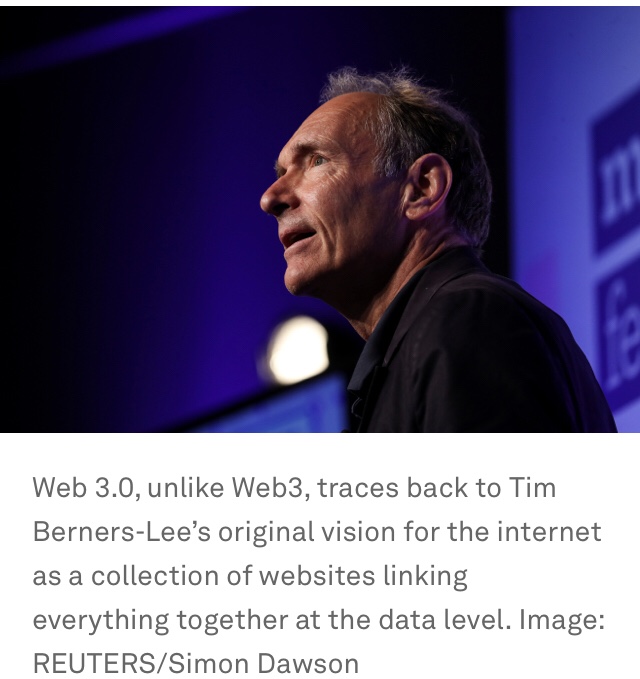
Web 3.0, unlike Web3, traces back to Tim Berners-Lee’s original vision for the internet as a collection of websites linking everything together at the data level. Image: REUTERS/Simon Dawson

These basic “read-only” websites were managed by webmasters who were responsible for updating users and managing the information. In 1992, there were 10 websites. By 1994, after the web entered the public domain, there were 3,000.

When Google arrived in 1996 there were two million. Last year, there were approximately 1.2 billion websites, although it is estimated only 17 per cent are still active.

Web 2.0: The social web

The next major shift for the internet saw it develop from a “read-only web” to where we are currently — a “read-write web.” Websites became more dynamic and interactive. People became mass participants in generating content through hosted services like Wikipedia, Blogger, Flickr and Tumblr.

The idea of “Web 2.0” gained traction after technology publisher Tim O’Reilly popularized the term in 2004.

Later on, social media platforms like Facebook, YouTube, Twitter and Instagram and the growth of mobile apps led to unparalleled connectivity, albeit through distinct platforms. These platforms are known as walled gardens because their parent companies heavily regulate what users are able to do and there is no information exchange between competing services.

Tech companies like Amazon, Google and Apple are deeply embedded into every facet of our lives, from how we store and pay for our content to the personal data we offer (sometimes without our knowledge) to use their wares.

Web3 vs. Web 3.0

This brings us to the next phase of the internet, in which many wish to wrest back control from the entities that have come to hegemonize it.

The terms Web3 and Web 3.0 are often used interchangeably, but they are different concepts.

Web3 is the move towards a decentralized internet built on blockchain. Web 3.0, on the other hand, traces back to Berners-Lee’s original vision for the internet as a collection of websites linking everything together at the data level.

Our current internet can be thought of as a gigantic document depot. Computers are capable of retrieving information for us when we ask them to, but they aren’t capable of understanding the deeper meaning behind our requests.

Information is also siloed into separate servers. Advances in programming, natural language processing, machine learning and artificial intelligence would allow computers to discern and process information in a more “human” way, leading to more efficient and effective content discovery, data sharing and analysis. This is known as the “semantic web” or the “read-write-execute” web.

In Berners-Lee’s Web 3.0 world, information would be stored in databases called Solid Pods, which would be owned by individual users. While this is a more centralized approach than Web3’s use of blockchain, it would allow data to be changed more quickly because it wouldn’t be distributed over multiple places.

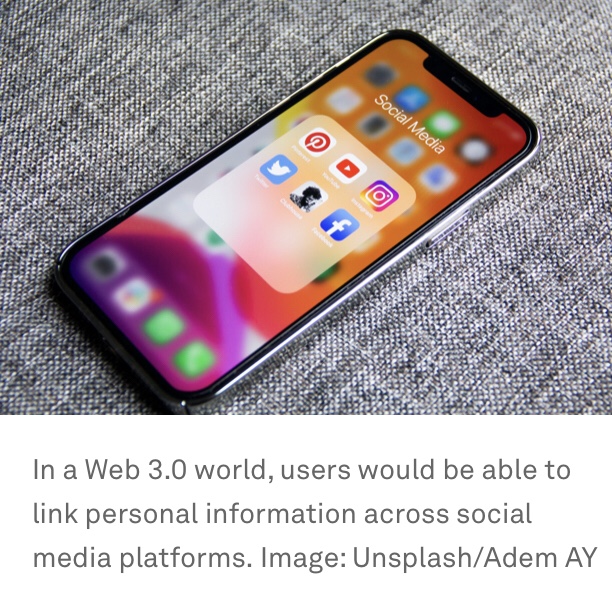
It would allow, for example, a user’s social media profiles to be linked so that updating the personal information on one would automatically update the rest.

The next era of the internet

Web3 and Web 3.0 are often mixed up because the next era of the internet will likely feature elements of both movements — semantic web applications, linked data and a blockchain economy. It’s not hard to see why there is significant investment happening in this space.

Have you read?
  • Can the internet really change how the world is run?
  • Video: How will the tactile internet change the world?
  • Web3: The hype and how it can transform the internet

But we’re just seeing the tip of the iceberg when it comes to the logistical issues and legal implications. Governments need to develop new regulations for everything from digital asset sales taxation to consumer protections to the complex privacy and piracy concerns of linked data.

There are also critics who argue that Web3, in particular, is merely a contradictory rebranding of cryptocurrency that will not democratize the internet. While it’s clear we’ve arrived at the doorstep of a new internet era, it’s really anyone’s guess as to what happens when we walk through that door.

Article link: https://www.weforum.org/agenda/2023/03/what-is-web3-and-how-could-it-change-the-internet?

Pentagon Proposes Widening DIB Cybersecurity Program – MeriTalk

Posted by timmreardon on 05/07/2023
Posted in: Uncategorized.

BY: JOHN CURRAN

MAY 3, 2023 1:39 PM

The Defense Department (DoD) today issued a proposed revision to the existing eligibility criteria for its voluntary Defense Industrial Base (DIB) Cybersecurity Program that, if enacted, would greatly expand the number of DIB companies that can participate in the program that shares cybersecurity threat intelligence and other security assistance to the private sector firms who do business with DoD.

“These revisions will allow a broader community of defense contractors to benefit from bilateral information sharing as when this proposed rule is finalized all defense contractors who are subject to mandatory cyber incident reporting will be able to participate,” DoD said in Federal Register notice filed today.

The Pentagon is seeking public comment on the proposed revision by June 20. “DoD is also proposing changes to definitions and some technical corrections for readability,” the agency said.

The DIB Cybersecurity Program aims to improve the ability of companies to safeguard DoD information that resides on, or transits, DIB unclassified information systems. “The program encourages greater threat information sharing to complement mandatory aspects of DoD’s DIB cybersecurity activities which are contractually mandated” through Defense Federal Acquisition Regulation Supplement (DFARS) rules, according to DoD.

The program is part of a larger DoD effort to protect information handled by DIB companies “by understanding and sharing information, building security partnerships, implementing long-term risk management programs, and maximizing efficient use of resources,” DoD said in the Federal Register notice.

Speaking today at the AFCEA TechNet Cyber conference in Baltimore, Diedra Padgett, deputy director, Defense Industrial Base (DIB) Operations Directorate within the DoD CIO office, said the program now has more than 1,300 companies participating, and is continuing to grow.

The proposed revisions could attract thousands more participants.

In announcing the proposed revision to the program, Padgett said, “this is exciting, it’s out there for public review.”

“We do this to continue to move forward to reduce cyber risk and to bolster cybersecurity,” she said.

“This has been a long fought-battle for years in the making, and I’m glad to say that we’re getting there,” Padgett said.

DoD Mum on CMMC Status 

Padgett said today she could not discuss any aspect of upcoming rules related to the agency’s Cybersecurity Maturity Model Certification (CMMC) requirements for DIB companies.

“DoD is unable to address any substantive aspects of the forthcoming CMMC 32 CFR rule or rule documents to include the potential policy and implementation related topics under the rulemaking process until it’s complete,” she said. “The Office of Management and Budget and the Information and Regulatory Affairs Office … is the authority on the timeline in the status of that rulemaking.”

Article link: https://www.meritalk.com/articles/pentagon-proposes-widening-dib-cybersecurity-program/

White House announces $140 million A.I. hub investment ahead of meeting with Google, OpenAI

Posted by timmreardon on 05/04/2023
Posted in: Uncategorized.

PUBLISHED THU, MAY 4 2023 8:26 AM EDTUPDATED 4 HOURS AGO

Emma Kinery @EMMAKINERY

KEY POINTS 

  • As AI becomes more ubiquitous, the White House promised it would release guidelines for use by government agencies.
  • AI developers are also expected to agree to have their products reviewed at the upcoming DEF CON cybersecurity conference in August.
  • Funding for the proposed research hubs will come from the National Science Foundation and will bring the total number of AI research institutes to 25 across the country.

The White House announced it would invest $140 million to create seven artificial intelligence research hubs and released new guidance on AI.

The developments come ahead of Vice President Kamala Harris’ meeting with executives from Google’s parent company, Alphabet; Anthropic; Microsoft, and OpenAI on Thursday.

It’s part of the Biden administration’s aim to curtail security risks associated with AI as the technology rapidly develops and to impress on pioneering companies that they can help reduce harm early on. OpenAI is the creator of the widely used AI tool ChatGPT — bolstered by an investment from Microsoft. Anthropic is another leading startup.

In a statement after the meeting, Harris stressed the importance of this partnership moving forward.

“As I shared today with CEOs of companies at the forefront of American AI innovation, the private sector has an ethical, moral and legal responsibility to ensure the safety and security of their products,” Harris said. “And every company must comply with existing laws to protect the American people.”

As AI becomes more ubiquitous, the White House on Thursday promised it would release guidelines for use by government agencies. AI developers are also expected to agree to have their products reviewed at the upcoming DEF CON cybersecurity conference in August.

Funding for the proposed research hubs will come from the National Science Foundation and will bring the total number of AI research institutes to 25 across the country.

Artificial intelligence has already begun to disrupt everyday life with a deluge of fake images and videos and robot-penned text, prompting concerns ranging from national security to misinformation. The influence is being felt in American politics, as well: Republicans last week released an AI-generated video in response to President Joe Biden’s reelection bid.

Biden himself has said “it remains to be seen” if AI is dangerous, adding last month “it could be.”

“Tech companies have a responsibility, in my view, to make sure their products are safe before making them public,” the president said in April ahead of a meeting with his Council of Advisors on Science and Technology.

Speaking to reporters after the meeting at the daily press briefing, White House press secretary Karine Jean-Pierre confirmed that the president has been “extensively briefed” on ChatGPT and said he sees both opportunity and risk in AI.

She said it was a “frank” discussion that included topics such as “the need for companies to be more transparent with policymakers, the public and others about their AI systems, in particular the importance of being able to evaluate, verify and validate the safety, security and the efficacy system; and the need to ensure AI systems are secure from malicious actors and attacks,” Jean-Pierre said. 

“You have four CEOs here meeting with the president and the vice president, that shows how seriously we take it,” she said.

The White House has made addressing AI a priority. Last year the administration released a “Blueprint for an AI Bill of Rights” and later outlined the creation of a National AI Research Resource.

In February Biden signed an executive order aimed to prevent bias and discrimination in the technologies from their inception.

Article link: https://www-cnbc-com.cdn.ampproject.org/c/s/www.cnbc.com/amp/2023/05/04/white-house-announces-ai-hub-investment.html

Micro Keynote – Quantum Computing – AFCEA International

Posted by timmreardon on 05/04/2023
Posted in: Uncategorized.

5 surefire ways to derail a digital transformation (without knowing it)

Posted by timmreardon on 05/03/2023
Posted in: Uncategorized.

Opinion

02 May 2023 7 mins

Leading complex, interrelated digitive initiatives is challenging enough without setting back your strategy by falling prey to these common DX leadership mistakes.

Despite the best of intentions, CIOs and their organizations often struggle to deliver business outcomes from digital transformation strategies. According to research firm Gartner, 89% of corporate boards say digital is embedded in all business growth strategies, but only 35% of organizations are on track to achieve digital transformation goals. And while KPMG reportsthat 72% of CEOs have aggressive digital investment strategies, McKinsey details a harsh reality that 70% of transformations fail.

Stats such as these raise the question: How can CIOs and digital transformation leaders better recognize failure signs and proactively address issues?

My experience leading many digital transformations is that failures stem from a series of derailments, many of which are inadvertent. Even if digital transformation leaders avoid outright failure, these derailments delay initiatives, create avoidable organizational stress, and often yield underwhelming business outcomes.

Five years ago, I shared that the No. 1 reason digital transformations fail is that executives fail to recognize that digital initiatives are bottom-up transformations that require change across the organization. Employees must understand the why behind digital strategies and have incentives to participate in transformation initiatives. CIOs like to say, “Digital transformation is a journey,” but I believe leaders must strive to lead transformation as a core organizational competency.

CIOs can’t be involved in every strategic discussion or dive into every initiative’s details, but there are several high-level signs that indicate a digital transformation may be destined to underperform, especially as CIOs add initiatives. In my experience assessing digital transformations, the following five are the most common. 

1. Prioritize too many initiatives without a shared vision

“One of the most common ways to derail digital transformation efforts is ignoring the importance of a clear strategy and defined goals,” says Arturo Garcia, CEO of DNAMIC.

CIOs must communicate strategy and goals when making investment cases and garnering support from the CEO, executives, and the board. As challenging as it is to get to a yes, it’s what comes next that often derails digital transformations at the very start.

CIOs must facilitate a discussion on priorities. Having too many number-one priorities sets unrealistic expectations with business stakeholders and stresses team leaders. Worse is when prioritized initiatives don’t have a documented shared vision, including a definition of the customer, targeted value propositions, and achievable success criteria.

When I survey transformation leaders and their teams, I privately ask each person three questions: What’s your top priority, why is it important, and how many other initiatives are also taking up your time? The risk of derailments increases as I hear inconsistent answers or too many conflicting priorities.

2. Neglect to set collaboration and communication principles

Digital transformations can start with one initiative, defined goals, and a dedicated team. But CIOs are under pressure to accelerate and find digital transformation force multipliers. That means growing the number of leaders and teams that can plan innovations and deliver transformative impacts.   

“Innovation does not happen in isolation: It occurs when organizations encourage and nurture it, often with processes to enable nontraditional ways of thinking, working, and the space to try out ideas in a safe environment,” says Hasmukh Ranjan, CIO of AMD.

Here’s how I spot derailments: Ask initiative leaders to share access to their roadmaps, agile backlogs, collaboration tools, stakeholder communications, and internal documentation. I seek information completeness, communication consistency, and ease-of-use factors. When CIOs struggle to grow beyond one transformation initiative, the root cause is often gaps in collaboration and communication principles.

3. Customize solutions to meet everyone’s requirements

Many organizations use agile methodologies when planning and executing digital transformation and assign multidisciplinary teams to manage releases, sprints, and backlogs. But are product managers developing market- and customer-driven roadmaps and prioritized backlogs? Unfortunately, many digital transformation initiatives succumb to stakeholders dominating priorities with neverending wishlists and poorly defined requirements.

One recent study shows that only 50% follow a product-centric operating model focusing on customer centricity and delivering delightful customer experiences. “Companies that leverage high-quality data, center their enterprise around responsible risk-taking, and organize around products are the most likely to experience profitable growth from their digital transformation journey,” says Anant Adya, EVP of Infosys Cobalt.

Subject matter experts and internal stakeholders should be contributors to priorities and requirements, not decision-makers or backlog dictators. Digital transformations derail when CIOs miss the opportunity to establish and communicate product management responsibilities for creating and evolving market- and customer-driven roadmaps.

4. Underinvest in developing digital trailblazers

In its 2023 State of Digital Transformation report, TEKSystems found that 48% of tech and business decision-makers report needing to revise the nature of their organization’s talent base, and another 34% acknowledge needing new types of talent. “Organizations can derail their digital transformation journey by failing to map out goals, objectives, and tactics prior to launch and not valuing the right mix of IT and business stakeholders in the planning stages,” says Ricardo Madan, senior vice president at TEKSystems.

CIOs invest in skills development, and HR usually offers leadership development programs, but these approaches often don’t address the knowledge and skills needed to lead digital transformation initiatives.

Digital trailblazers, including product managers, program managers, architects, agile delivery managers, and data scientists, need specialized learning programs and coaching to build their confidence in handling transformation responsibilities. Derailments can happen when transformation leaders seize up when negotiating priorities, fail to facilitate decisions on requirements, or struggle when handling conflicts or blow-up moments. Digital trailblazers face many people challenges when guiding employees through a transformation, and CIOs should identify coaches and development programs to prepare their leaders.

5. Drive KPIs and data-driven decisions without a data strategy

Building digital products, improving customer experiences, developing the future of work, and encouraging a data-driven culture are all common digital transformation themes. Leaders should define new KPIs and OKRsthat help people understand the objectives and recognize how their work contributes to the organization’s transformation goals.

But there are common pitfalls, such as selecting the wrong KPIs, monitoring too many metrics, or not addressing poor data quality. “Having bad data, or an inability to realize the value and take action from data, is a surefire way for a digital transformation project to go south quickly, says Dwaine Plauche, senior manager of product marketing at AspenTech. “Without useful, contextual data that can be scaled and used throughout the organization, digital transformation efforts may simply become one-off  projects that get stalled at the pilot phase, leading C-suite leaders to believe the technology was a failure or the investment was a waste.”

This derailment stems from having no defined data strategy or having one not aligned with digital transformation objectives.

Consider how it looks to nontechnical executives when every digital transformation initiative has customized dashboards, different KPIs, and metrics with underlying data quality issues. Instead of initiatives telling a cohesive story, it leaves results open to interpretation and challenges. The data strategy should include guidelines on the types of KPIs, standards for dashboarding metrics, and responsibilities for improving data quality.

The five derailments I focus on here fall within the CIO’s responsibilities to address. They are important for CIOs leading multiple transformation initiatives to deliver against several business strategies. The practices that worked when digital transformations started small with one initiative must evolve into a digital culture and a transformation operating model. It’s in this transition where increasing derailments can lead to digital transformation failures.

Isaac Sacolick, President of StarCIO, a digital transformation learning company, guides leaders on adopting the practices needed to lead transformational change in their organizations. He is the author of Digital Trailblazer and the Amazon bestseller Driving Digitaland speaks about agile planning, devops, data science, product management, and other digital transformation best practices. Sacolick is a recognized top social CIO, a digital transformation influencer, and has over 900 articles published at InfoWorld, CIO.com, his blog Social, Agile, and Transformation, and other sites.

The opinions expressed in this blog are those of Isaac Sacolick and do not necessarily represent those of IDG Communications, Inc., its parent, subsidiary or affiliated companies.

Article link: https://www-cio-com.cdn.ampproject.org/c/s/www.cio.com/article/475054/5-surefire-ways-to-derail-a-digital-transformation-without-knowing-it.html/amp/

Breaking technical debt’s vicious cycle to modernize your business – McKinsey

Posted by timmreardon on 05/01/2023
Posted in: Uncategorized.

April 25, 2023 | Article

By Aamer Baig, Sven Blumberg, Arun Gundurao, and Basel Kayyali

Develop data-driven insights to build a strategy for paying down the tech debt that stands in the way of business modernization.

A large B2B business faced an agonizing quandary: its leadership team was considering dozens of modernization initiatives that could bring a $2 billion margin expansion opportunity. But 70 percent of them depended on technology that would cost a staggering $400 million—much higher than expected. The reason for such a high price tag? Its tech stack had become massively complex after years of building quick workarounds and one-off solutions to favor speed over good design for the long term.

This reality forced the company to ratchet back its investment to about $300 million and walk away from 25 percent of the potential margin expansion. Cutting back on these tech initiatives had a compounding effect, though, because the unaddressed issues would continue to fester and undermine future projects. That became painfully clear two and a half years later when the team was able to complete only half of the planned work because of ongoing technical issues.

This example is all too typical across businesses today. As much as 71 percent of the impact from business transformations depends on technology, according to our research (Exhibit 1). This is particularly concerning given that so many companies need to modernize if they are to remain competitive.

While many companies understand the importance of technology in meeting their strategic goals, the silent killer of technology modernization efforts—technical debt—often stands in their way. Technical debt is basically the “tax” a company pays on any development to redress existing technology issues, and it accounts for about 40 percent of IT balance sheets, according to our research. Companies pay an additional 10 to 20 percent to address tech debt on top of the costs of any project.1 Some 30 percent of CIOs we surveyed believe that more than 20 percent of their technical budget ostensibly dedicated to new products is diverted to resolving issues related to tech debt.

As such, the benefits of paying down technical debt can be game changing. They include: freeing up engineers to spend as much as 50 percent more of their time working on value-generating products and services; reducing costs by cutting back on time needed to manage complexities; and improving uptime and resiliency. Cutting back tech debt is the key to becoming tech forward: a company where technology is an engine for continual growth and productivity.

So how can organizations begin paying down their technical debt? It starts with insights—knowing which aspects of technical debt are most tied to value offers a path into a more strategic approach to resolving technical debt.

A closer look: Technical debt’s vicious cycle

Technical debt is the result of a range of practices. These can include making temporary fixes that inevitably become permanent, not updating solutions that become outdated, favoring fast technology delivery over long-term benefits, or implementing one-off solutions to meet business priorities. Many of these decisions make sense at the time and are necessary. But complexity builds, and future projects become more difficult. This vicious downward cycle translates into an enormous cost for the business in the form of lost opportunities and wasted resources (Exhibit 2).

These layers of tech debt create a huge drag on any business transformation effort—it’s like trying to run while pulling an increasingly heavy anchor behind you. CIOs estimate that tech debt amounts to 20 to 40 percent of the value of their entire technology estate (before depreciation), according to our research.2Companies in the bottom 20th percentile in terms of tech debt severity are 40 percent more likely to have incomplete or canceled IT modernizations than those in the top 20 percent.

Escaping this vicious cycle is not easy. Knowing where and how to start is a serious challenge. A poorly sequenced approach can easily result in time and money spent without much change to the tech debt profile. The business side of the house may be overwhelmed by the task and want to delegate the problem to IT, but both sides will need to work together to identify solutions that allow the organization to compete and build value.

Article link: https://www.mckinsey.com/capabilities/mckinsey-digital/our-insights/breaking-technical-debts-vicious-cycle-to-modernize-your-business?

Oracle’s plan to build national health records database ‘going great,’ Feinberg says – HealthcareDive

Posted by timmreardon on 04/29/2023
Posted in: Uncategorized.

Oracle Health Chairman David Feinberg sat down with Healthcare Dive at HIMSS to give an update on the Cerner-Oracle integration.

Published April 21, 2023

Rebecca Pifer

David Feinberg has worn multiple hats in his three decades in healthcare, including chief executive of major health systems UCLA and Geisinger and leader of Google Health. Most recently, Feinberg stepped up as CEO of EHR company Cerner in 2021, as the vendor looked to reorient from a focus on legacy EHR systems to becoming a software-as-a-service business.

A few months after Feinberg started, Cerner announced it was being acquiredby software giant Oracle, for $28.3 billion, as Oracle looked to expand its cloud business in the hospital market.

Healthcare Dive chatted with Feinberg — now chairman of Oracle Health — at the HIMSS conference in Chicago about the company’s integration, Oracle’s progress in creating a national health records database and Cerner’s plan to help auto-adjudicate payment disputes between payers and providers.

This interview has been lightly edited for clarity and brevity.

HEALTHCARE DIVE: Oracle closed its buy of Cerner in June, calling it an anchor asset as Oracle elbows further into the healthcare space. How has the integration gone?

DAVID FEINBERG: It’s gone way better than I thought. My bias is oftentimes technology companies think those of us in healthcare are not really sophisticated, and if we did things their way things would get better. Oracle has been the exact opposite. So the integration has been pretty smooth. I think part of the reason is that two-thirds of the people at Oracle are there via acquisition, so Oracle knows how to do this.

I think there’s great excitement for what Oracle can bring from a technology standpoint, coupled with Cerner’s long-standing history of partnering with health systems around the world. The timing just feels right.

When the deal closed, Oracle said it planned to focus the unit on medical software usability and voice-enabled user interfaces, and would expand Cerner’s business to more countries. Can you give me an update on these priorities?

FEINBERG: I remember those three things being listed. It’s more now. Our vision is to create a cloud-enabled health platform that brings all kinds of information together to make individuals and communities healthier around the world. That includes the electronic health record, and Oracle’s human capital management, enterprise resource planning, supply chain management, claims processing, clinical trials — so we have a platform that normalizes data and then tees it up for whoever needs it, a mom taking care of kids at home, or a government looking at public health issues.

Oracle founder Larry Ellison announced Oracle plans to build a health records database to link the thousands of separate hospital databases. How is this going?

FEINBERG: It’s going great. We have a new product we just launched called Seamless Exchange. A clinician gets a new patient, and this patient has records from multiple places. With one click, we take all of that information and we make a longitudinal story of that patient. In all that, there’s a lot of duplicate information — it may say 40 times that you had a knee surgery. So we de-duplicate it. And if that information’s from a trusted source, like another health system I trust, it automatically writes it into the record for me.

To Larry’s vision of everybody having their records available in a secure way, no one wants all their medical records, because I don’t want to see 900 times the same cholesterol level that I had drawn. So the first step in getting to that vision is organizing disparate data sets and making them accessible and useful, and it’s EHR agnostic through an API.

What are the next steps?

FEINBERG: I don’t ever want to be more visionary than Larry Ellison. But I think it’s even broader than what he’s saying. Because not only do I want my whole electronic health data, I want all information that’s applicable to my health. That includes social determinants, that includes claims processing, so many other pieces of information — like, if there’s a claim on me, but not a documented note, that shows I had a cardiac ablation. So it’s more than just your EHR information from multiple sources, it’s multiple sources of information that pertain to your health.

How will Oracle pull that additional data?

FEINBERG: Oracle Financial Services processes 80% or 90% of the world’s credit card transactions. All that is is an agreement between the merchants and the banks to let Oracle be in the middle and make that transaction happen. In healthcare, there’s so much friction between the payer and the provider. So they agree on a contract, and a patient comes in and gets care. The coding takes place on the provider side, it goes over to the payer side, and they deny. Why did that happen? They each interpreted the contract a little differently. That never happens with a credit card.

Article link: https://www.healthcaredive.com/news/david-feinberg-cerner-oracle-health-records-database/648262/

Cybersecurity Still ‘High Risk’ in GAO’s Book After Over 25 years – Nextgov

Posted by timmreardon on 04/27/2023
Posted in: Uncategorized.

By NATALIE ALMSAPRIL 21, 2023

The management of the government’s IT acquisitions and operations is also on the Government Accountability Office’s biennial high risk list update this year, as it has been since 2015.

The Government Accountability Office released its biennial list of government operations considered high risk on Thursday.

Cybersecurity is on the list, as it has been since 1997. Comptroller General Gene Dodaro told lawmakers Thursday that, “The federal government is still not operating at a pace commensurate with the evolving threat.”

There are over 850 open recommendations from GAO related to cybersecurity – which Dodaro called out as an area needing significant attention – that haven’t been implemented, including 52 of 133 recommendations deemed high priority for agency and department heads by GAO.

Cybersecurity is one of 34 areas considered to be high risk. The list also includes other tech-related areas. NASA has improved its acquisition management, for example, but still has work to do, as do the departments of Defense, Veterans Affairs and Energy. 

The Department of Homeland Security’s IT and Financial Management and DOD business systems modernization are also called out on the list.

In terms of cybersecurity, the White House released a new national cybersecurity strategy in March. 

But Dodaro emphasized the importance of the forthcoming implementation plan promised by the administration, listing off unanswered questions – “Who’s responsible for what? How much money do we need? How are we going to measure performance and improvements in those areas?”

Other cybersecurity challenges delineated in the report include “fully developing” privacy management programs in agencies and securing the government’s own systems and those of critical infrastructure sectors.

“I don’t think the federal government really knows the preparedness of many of these important sectors of our economy as much as they should, in terms of the electricity grid, the communications networks, the financial markets and many other areas,” said Dodaro of critical infrastructure cybersecurity. “There needs to be much more partnership between the federal government and the private sector in this area.”

GAO witnesses also talked with lawmakers about shortages in the cybersecurity workforce, something the White House’s Office of the National Cyber Director is working on a plan to address.

The management of the government’s IT acquisitions and operations has also been on the list for eight years, although GAO noted that OMB and agencies have actually made progress on implementing these recommendations since the last update, with 73% fully implemented.

Still, “this is kind of a vexing problem,” said Dodaro. “A lot of these systems weren’t built with security and so it’s complicating our ability [in the] cybersecurity area. The cost is expensive. There are efforts to try to replace them, but they often fail because of lack of discipline [and] IT management issues.”

GAO says that 15 federal agencies haven’t implemented recommendations around the role and authorities of their chief information officers, although there have been improvements in “aligning the CIO with agency leadership,” said Nick Marinos, managing director of GAO’s IT and cybersecurity team. That gives them “the ability to see across a federal agency where IT dollars are being spent,” he said.

Planning around the tech workforce and modernizing or replacing legacy systems are also areas that have open recommendations, and there’s also an unrealized push from GAO for Congress to formalize the federal CIO position.

“Having a strong federal CIO presence would allow that individual to bring federal agencies to the table… to know not only are they spending money wisely, but if there are opportunities to leverage that buying power,” said Marinos. “And then the other side of it is ultimately to hold CIOs accountable and federal agency heads accountable towards those CIOs as well.”

Sixteen high risk areas total saw improvements since 2021, said Dodaro. Two topics – the 2020 Decennial Census and the Pension Benefit Guaranty Corporation – were removed from the list completely, and one added – management of the federal prison system. 

GAO also added the Department of Health and Human Services’ leadership and coordination during health emergencies, as well as the unemployment system to the list in 2022.

In terms of what it takes to make progress, Dodaro wrote in his testimony that, “it has typically involved three essential elements: congressional action or oversight, commitment from top leaders at agencies and active involvement by the Office of Management and Budget.”

Article link: https://www.nextgov.com/cybersecurity/2023/04/cybersecurity-still-high-risk-gaos-book-after-over-25-years/385473/

The Computer Comes to Marketing (1960)

Posted by timmreardon on 04/27/2023
Posted in: Uncategorized.

Posts navigation

← Older Entries
Newer Entries →
  • Search site

  • Follow healthcarereimagined on WordPress.com
  • Recent Posts

    • VA Prepares April Relaunch of EHR Program – GovCIO 03/19/2026
    • Strong call for universal healthcare from Pope Leo today – FAN 03/18/2026
    • EHR fragmentation offers an opportunity to enhance care coordination and experience 03/16/2026
    • When AI Governance Fails 03/15/2026
    • Introduction: Disinformation as a multiplier of existential threat – Bulletin of the Atomic Scientists 03/12/2026
    • AI is reinventing hiring — with the same old biases. Here’s how to avoid that trap – MIT Sloan 03/08/2026
    • Fiscal Year 2025 Year In Review – PEO DHMS 02/26/2026
    • “𝗦𝗼𝗰𝗶𝗮𝗹 𝗠𝗲𝗱𝗶𝗮 𝗠𝗮𝗻𝗶𝗽𝘂𝗹𝗮𝘁𝗶𝗼𝗻 𝗳𝗼𝗿 𝗦𝗮𝗹𝗲” – NATO Strategic Communications COE 02/26/2026
    • Claude Can Now Do 40 Hours of Work in Minutes. Anthropic Says Its Safety Systems Can’t Keep Up – AJ Green 02/19/2026
    • Agentic AI, explained – MIT Sloan 02/18/2026
  • Categories

    • Accountable Care Organizations
    • ACOs
    • AHRQ
    • American Board of Internal Medicine
    • Big Data
    • Blue Button
    • Board Certification
    • Cancer Treatment
    • Data Science
    • Digital Services Playbook
    • DoD
    • EHR Interoperability
    • EHR Usability
    • Emergency Medicine
    • FDA
    • FDASIA
    • GAO Reports
    • Genetic Data
    • Genetic Research
    • Genomic Data
    • Global Standards
    • Health Care Costs
    • Health Care Economics
    • Health IT adoption
    • Health Outcomes
    • Healthcare Delivery
    • Healthcare Informatics
    • Healthcare Outcomes
    • Healthcare Security
    • Helathcare Delivery
    • HHS
    • HIPAA
    • ICD-10
    • Innovation
    • Integrated Electronic Health Records
    • IT Acquisition
    • JASONS
    • Lab Report Access
    • Military Health System Reform
    • Mobile Health
    • Mobile Healthcare
    • National Health IT System
    • NSF
    • ONC Reports to Congress
    • Oncology
    • Open Data
    • Patient Centered Medical Home
    • Patient Portals
    • PCMH
    • Precision Medicine
    • Primary Care
    • Public Health
    • Quadruple Aim
    • Quality Measures
    • Rehab Medicine
    • TechFAR Handbook
    • Triple Aim
    • U.S. Air Force Medicine
    • U.S. Army
    • U.S. Army Medicine
    • U.S. Navy Medicine
    • U.S. Surgeon General
    • Uncategorized
    • Value-based Care
    • Veterans Affairs
    • Warrior Transistion Units
    • XPRIZE
  • Archives

    • March 2026 (6)
    • February 2026 (6)
    • January 2026 (8)
    • December 2025 (11)
    • November 2025 (9)
    • October 2025 (10)
    • September 2025 (4)
    • August 2025 (7)
    • July 2025 (2)
    • June 2025 (9)
    • May 2025 (4)
    • April 2025 (11)
    • March 2025 (11)
    • February 2025 (10)
    • January 2025 (12)
    • December 2024 (12)
    • November 2024 (7)
    • October 2024 (5)
    • September 2024 (9)
    • August 2024 (10)
    • July 2024 (13)
    • June 2024 (18)
    • May 2024 (10)
    • April 2024 (19)
    • March 2024 (35)
    • February 2024 (23)
    • January 2024 (16)
    • December 2023 (22)
    • November 2023 (38)
    • October 2023 (24)
    • September 2023 (24)
    • August 2023 (34)
    • July 2023 (33)
    • June 2023 (30)
    • May 2023 (35)
    • April 2023 (30)
    • March 2023 (30)
    • February 2023 (15)
    • January 2023 (17)
    • December 2022 (10)
    • November 2022 (7)
    • October 2022 (22)
    • September 2022 (16)
    • August 2022 (33)
    • July 2022 (28)
    • June 2022 (42)
    • May 2022 (53)
    • April 2022 (35)
    • March 2022 (37)
    • February 2022 (21)
    • January 2022 (28)
    • December 2021 (23)
    • November 2021 (12)
    • October 2021 (10)
    • September 2021 (4)
    • August 2021 (4)
    • July 2021 (4)
    • May 2021 (3)
    • April 2021 (1)
    • March 2021 (2)
    • February 2021 (1)
    • January 2021 (4)
    • December 2020 (7)
    • November 2020 (2)
    • October 2020 (4)
    • September 2020 (7)
    • August 2020 (11)
    • July 2020 (3)
    • June 2020 (5)
    • April 2020 (3)
    • March 2020 (1)
    • February 2020 (1)
    • January 2020 (2)
    • December 2019 (2)
    • November 2019 (1)
    • September 2019 (4)
    • August 2019 (3)
    • July 2019 (5)
    • June 2019 (10)
    • May 2019 (8)
    • April 2019 (6)
    • March 2019 (7)
    • February 2019 (17)
    • January 2019 (14)
    • December 2018 (10)
    • November 2018 (20)
    • October 2018 (14)
    • September 2018 (27)
    • August 2018 (19)
    • July 2018 (16)
    • June 2018 (18)
    • May 2018 (28)
    • April 2018 (3)
    • March 2018 (11)
    • February 2018 (5)
    • January 2018 (10)
    • December 2017 (20)
    • November 2017 (30)
    • October 2017 (33)
    • September 2017 (11)
    • August 2017 (13)
    • July 2017 (9)
    • June 2017 (8)
    • May 2017 (9)
    • April 2017 (4)
    • March 2017 (12)
    • December 2016 (3)
    • September 2016 (4)
    • August 2016 (1)
    • July 2016 (7)
    • June 2016 (7)
    • April 2016 (4)
    • March 2016 (7)
    • February 2016 (1)
    • January 2016 (3)
    • November 2015 (3)
    • October 2015 (2)
    • September 2015 (9)
    • August 2015 (6)
    • June 2015 (5)
    • May 2015 (6)
    • April 2015 (3)
    • March 2015 (16)
    • February 2015 (10)
    • January 2015 (16)
    • December 2014 (9)
    • November 2014 (7)
    • October 2014 (21)
    • September 2014 (8)
    • August 2014 (9)
    • July 2014 (7)
    • June 2014 (5)
    • May 2014 (8)
    • April 2014 (19)
    • March 2014 (8)
    • February 2014 (9)
    • January 2014 (31)
    • December 2013 (23)
    • November 2013 (48)
    • October 2013 (25)
  • Tags

    Business Defense Department Department of Veterans Affairs EHealth EHR Electronic health record Food and Drug Administration Health Health informatics Health Information Exchange Health information technology Health system HIE Hospital IBM Mayo Clinic Medicare Medicine Military Health System Patient Patient portal Patient Protection and Affordable Care Act United States United States Department of Defense United States Department of Veterans Affairs
  • Upcoming Events

Blog at WordPress.com.
healthcarereimagined
Blog at WordPress.com.
  • Subscribe Subscribed
    • healthcarereimagined
    • Join 153 other subscribers
    • Already have a WordPress.com account? Log in now.
    • healthcarereimagined
    • Subscribe Subscribed
    • Sign up
    • Log in
    • Report this content
    • View site in Reader
    • Manage subscriptions
    • Collapse this bar
 

Loading Comments...