

This week, President Biden signed a landmark Executive Order on the Safe, Secure, and Trustworthy Development and Use of Artificial Intelligence. As the United States takes action to realize the tremendous promise of AI while managing its risks, the federal government will lead by example and provide a model for the responsible use of the technology. As part of this commitment, today, ahead of the UK Safety Summit, Vice President Harris will announce that the Office of Management and Budget (OMB) is releasing for comment a new draft policy on Advancing Governance, Innovation, and Risk Management for Agency Use of Artificial Intelligence. This guidance would establish AI governance structures in federal agencies, advance responsible AI innovation, increase transparency, protect federal workers, and manage risks from government uses of AI.
Every day, the federal government makes decisions and takes actions that have profound impacts on the lives of Americans. Federal agencies have a distinct responsibility to identify and manage AI risks because of the role they play in our society. OMB’s proposed guidance builds on the Blueprint for an AI Bill of Rightsand the AI Risk Management Framework by mandating a set of minimum evaluation, monitoring, and risk mitigation practices derived from these frameworks and tailoring them to context of the federal government. In particular, the guidance provides direction to agencies across three pillars:
Strengthening AI Governance
To improve coordination, oversight, and leadership for AI, the draft guidance would direct federal departments and agencies to:
Advancing Responsible AI Innovation
To expand and improve the responsible application of AI to the agency’s mission, the draft guidance would direct federal agencies to:
Managing Risks from the Use of AI
To ensure that agencies establish safeguards for safety- and rights-impacting uses of AI and provide transparency to the public, the draft guidance would:
AI is already helping the government better serve the American people, including by improving health outcomes, addressing climate change, and protecting federal agencies from cyber threats. In 2023, federal agencies identified over 700 waysthey use AI to advance their missions, and this number is only likely to grow. When AI is used in agency functions, the public deserves assurance that the government will respect their rights and protect their safety.
Some examples of where AI has already been successfully deployed by the Federal government include:
The draft guidance takes a risk-based approach to managing AI harms to avoid unnecessary barriers to government innovation while ensuring that in higher-risk contexts, agencies follow a set of practices to strengthen protections for the public. AI is increasingly common in modern life, and not all uses of AI are equally risky. Many are benign, such as auto-correcting text messages and noise-cancelling headphones. By prioritizing safeguards for AI systems that pose risks to the rights and safety of the public—safeguards like AI impact assessments, real-world testing, independent evaluations, and public notification and consultation—the guidance would focus resources and attention on concrete harms, without imposing undue barriers to AI innovation.
This announcement is the latest step by the Biden-Harris Administration to advance the safe, secure, and trustworthy development and use of AI, and it is a major milestone for implementing President Biden’s AI Executive Order. The proposed guidance would establish the specific leadership, milestones, and transparency mechanisms to drive and track implementation of these practices. With the current rapid pace of technological development, bold leadership in AI is needed. With this draft guidance, the government is demonstrating that it can lead in AI and ensure that the technology benefits all.
Make your voice heard
To help ensure public trust in the applications of AI, OMB is soliciting public comment on the draft guidance until December 5th, 2023.
Learn more
Read the draft guidance: WH.gov
Submit a public comment: regulations.gov
See the full scope of AI actions from the Biden-Harris Administration: AI.gov
Quick guide on submitting public comments: Link to PDF

Task Force Lima continues to gain momentum across a variety of pursuits in its ambitious, 18-month plan to ensure the Pentagon can responsibly adopt, implement and secure powerful, still-maturing generative artificial intelligence technologies.
Department of Defense leadership formed that new hub in August within the Chief Digital and AI Office’s (CDAO) Algorithmic Warfare Directorate. Its ultimate mission is to set and steer the enterprise’s path forward with the emerging field of generative AI and associated large language models, which yield (convincing but not always correct) software code, images and other media following human prompts.
Such capabilities hold a lot of promise, but also complex challenges for the DOD — including many that remain unseen.
“Task Force Lima has three phases: the ‘learn phase,’ an ‘accelerate phase’ and a ‘guide phase.’ The ‘learn phase’ is where we are performing, for lack of a better word, inventories of what is the demand signal for generative AI across the department. That includes projects that are ongoing, to projects that we think should go forward, to projects that we would like to learn more about. And so, we submitted that as an inquiry to the department — and we’ve received a volume of use cases around 180 that go into many different categories and into many different mission areas,” Task Force Lima Mission Commander Navy Capt. M. Xavier Lugo told DefenseScoop.
In a recent interview, the 28-year Naval officer-turned AI acceleration lead, briefed DefenseScoop about what’s to come with those under-review use cases, a recent “Challenge Day,” and future opportunities and events the task force is planning.
During his first interview with DefenseScoop back in late September, Lugo confirmed that the task force would be placing an explicit emphasis on enabling generative AI in “low-risk mission areas.”
“That is still the case. However, some of what has evolved from that is they’re not all theoretical. For some of these use cases, there are units that have already started working with those particular technologies and they’re integrating [them] into their workflows. That’s when we’re going to switch from the ‘learn phase’ into the ‘accelerate phase,’ which is where we will partner with the use cases that are ongoing,” Lugo told DefenseScoop in the most recent interview.
At a Pentagon press briefing about the state of AI last week, Deputy Defense Secretary Kathleen Hicks confirmed that the department launched Task Force Lima because it is “mindful of the potential risks and benefits offered by large language models” (LLMs) and other associated generative AI tools.
“Candidly, most commercially available systems enabled by large language models aren’t yet technically mature enough to comply with our DOD ethical AI principles — which is required for responsible operational use. But we have found over 180 instances where such generative AI tools could add value for us with oversight like helping to debug and develop software faster, speeding analysis of battle damage assessments, and verifiably summarizing texts from both open-source and classified datasets,” Hicks told reporters.
The deputy secretary noted that “not all of these use cases” that the task force is exploring are notional.
Some Defense Department components started looking at generative AI even before ChatGPT and similar products “captured the world’s attention,” she said. And a few department insiders have “even made their own models,” by isolating and fine-tuning foundational models for a specific task with clean, reliable and secure DOD data.
“While we have much more evaluating to do, it’s possible some might make fewer factual errors than publicly available tools — in part because, with effort, they can be designed to cite their sources clearly and proactively. Although it would be premature to call most of them operational, it’s true that some are actively being experimented with and even used as part of people’s regular workflows — of course, with appropriate human supervision and judgment — not just to validate, but also to continue improving them,” Hicks said.
Lugo offered an example of those more non-theoretical generative AI use cases that have already been maturing within DOD.
“As you can imagine, the military has a lot of policies and publications, [tactics, techniques, and procedures, or TTPs], and all sorts of documentation out there for particular areas — let’s say in the human resources area, for example. So, one of those projects would be how do I interact with all those publications and policies that are out there to answer questions that a particular person may have on how to do a procedure or a policy?” he told DefenseScoop.
Among its many responsibilities, one that the CDAO leadership has charged Task Force Lima with is coming up with acceptability criteria and a maturity model for each use case or groups of use cases encompassing generative AI.
“So, if we say we need an acceptability criteria of a particular value for a capability of summarization for LLMs, let’s say just as an example, then we need a model that matches that and that has that type of maturity in that particular capability. This is analogous to the self-driving vehicle maturity models and how you can have a different level of maturity in a self-driving vehicle for different road conditions. So, in our case the road conditions will be our acceptability criteria, and the model being able to meet that acceptability will be that maturity model,” Lugo explained.
Soon, the Lima team will start collecting information needed to inform its specific deliverables, including new test-and-evaluation frameworks, mitigation techniques, risk assessments and more.
“That output that we get during the ‘accelerate phase’ will be the input for the ‘guide phase,’ which is our last phase where we compile the deliverables to the CDAO Council so they can then make a determination into policy,” Lugo explained.
The task force does not have authority to officially publish guidance on generative AI deployments in DOD, but members previously made recommendations to the CDAO’s leadership that were approved to advise defense components in their efforts. The task force drafted that interim LLM guidance, but due to its classification level it has not been disseminated widely.
“That guidance [included that] any service can publish its own guidance that is more restrictive than the one that [the Office of the Secretary of Defense] publishes,” Lugo said.
The Navy offered its version of interim guardrails on generative AI and LLMs in September. Shortly after that, the Space Force transmitted a memo that put a temporary pause on guardians’ use of web-based generative AI tools like ChatGPT for its workforce — specifically citing data security concerns.
“Did I learn about the Space Force guidance before it went out? Yes. Would I have had any reason to try to modify that? No,” Lugo told DefenseScoop.
“Space Force — like any other service — has the right to pursue guidance that is even more restrictive than the guidance that is provided by the policy. So, I just want to be clear that they have autonomy to publish their own guidance. At Task Force Lima, we are coordinating with the services — and they understand our viewpoints, and we understand our viewpoints, and there is no conflict on viewpoints here,” he added.
And although it might make sense for one military branch to ban certain uses on a non-permanent basis to address data and security concerns, Lugo noted that doesn’t mean the task force should not be cautiously experimenting with models that are publicly accessible, in order to learn more about them.
In his latest interview with DefenseScoop, the task force chief also stated that his team is “not trying to do this in a vacuum.”
“We are definitely not only working with DOD, but we are working with industry and academia — and actually any organization that is interested in generative AI, they can reach out to us. There’s plenty of work, and there’s plenty of areas of involvement,” Lugo said.
“Also, I want to make sure that just because we are interacting with industry, that doesn’t take us out of the industry-agnostic, technology-agnostic hat. I am always ensuring that we keep that, because that’s what keeps us as an honest broker of this technology,” he added.
Lugo’s currently leading a core team of roughly 15 personnel. But he’s also engaging with a still-growing “expanded team” of close to 500 points of contacts associated with the task force’s activities and aims. To him, those officials are essentially on secondary duty, or a support function to his unit.
“We’re getting more people interested. Now, those 500 people — I’ve got everything from people watching from the bleachers, to personnel saying, ‘Hey, put me in coach!’ So, I’ve got a broad spectrum,” Lugo said.
Nearly 250 people attended a recent “Challenge Day” that the CDAO hosted to connect with industry and academic partners about the challenges associated with implementing generative AI within the DOD.
“There’s a lot of interest in the area, but there’s not that many companies in it. So what we saw was that it’s not just the normal names that you would hear on a day to day basis — but there’s also a lot of companies interested in integrating models. There’s companies that are not necessarily known for LLMs or generative AI, but they are known for other types of integration in the data space and in the AI space. So that was good, because that means that there’s a good pool of talent that will be working on the challenges that we have submitted to industry,” Lugo said.
According to Lugo, the cadre has received more than 120 responses to the recent request for informationreleased to the public to garner input on existing generative AI use cases and critical technical obstacles that accompany its emergence.
The RFI is about learning “what are the insights out there, what are the approaches to solving these particular challenges that we have. And as we compile that information, we will then go ahead and do a more formal solicitation through the proper processes,” he said.
On Nov. 30, industry and academic partners will have an additional opportunity this year to meet with Task Force Lima at the CDAO Industry Day. And down the line during the CDAO’s first in-person symposium — which is set to take place Feb. 20-22 in Washington — an entire track will be dedicated to Task Force Lima and generative AI.
Attendee registration opened in October, and the office is now accepting submissions for potential speakers at that event.
“I’m very optimistic that the challenges that we have submitted will be addressed — and hopefully corrected — by some innovative techniques,” Lugo told DefenseScoop.
Article link: https://www.linkedin.com/posts/defensescoop_inside-task-force-limas-exploration-of-180-activity-7127423756221718528-byMQ?
NOVEMBER 7, 2023 05:00 AM ET

A new report found that it is easy to buy personal data on U.S. servicemembers online, where it can cost as little as one cent to obtain records through data brokers.
Conducted by researchers at Duke University, the study Data Brokers and the Sale of Data on U.S. Military Personnel examined the availability of sensitive data for U.S. military personnel, including names, home addresses, emails and specific branch information being sold on third-party data-broker platforms.
After scraping or buying data from hundreds of data broker sites, researchers explored how freely available military service information could pose national security threats.
Researchers found only minimal identity verification protocols when buying potentially sensitive data online.
“We found a lack of robust controls when asking some data brokers about buying data on the U.S. military and when actually purchasing data from some data brokers, such as identity verification, background checks or detective controls to ascertain our intended uses for the purchased data,” the report reads.
Researchers were able to purchase demographic characteristics including religious practices, health information and financial data of thousands of both active-duty members and veterans. Some datasets available for sale were so specific that they could list the office of service, such as the U.S. Marine Corps and Pentagon Force Protection Agency.
While the U.S. has grappled with the absence of federal law governing data broker practices, the report places unregulated data sales online into a national security context.
“The inconsistencies of controls when purchasing sensitive, non-public, individually identified data about active-duty members of the military and veterans extends to situations in which data brokers are selling to customers who are outside of the United States,” the report reads.
The report concluded with policy recommendations focused on passing legislation that would bring regulatory guardrails to online user data privacy.
Despite multiple efforts, Congress has still not managed to pass a national data privacy law. Lawmakers chimed in following the release of the report, with Sen. Ron Wyden, D-Ore., reiterating the call for comprehensive privacy legislation.
“The researchers findings should be a sobering wake-up call for policy makers that the data broker industry is out of control and poses a serious threat to U.S. national security,” Wyden said in an emailed statement to Nextgov/FCW. “As I have been warning for years, consumer privacy is a national security issue. The United States needs a comprehensive solution to protect Americans’ data from unfriendly nations rather than focusing on ineffective Band-Aids like banning TikTok.”
On the House side, Rep. Frank Pallone, D-N.J., echoed Wyden’s national security concerns.
“These findings are yet another terrible example of the harms posed by the data broker industry and underscore the need to pass comprehensive national privacy legislation and regulate data brokers,” Pallone said in a statement. “Congress needs to pass legislation that minimizes the amount of information that can be collected on Americans, cracks down on the abuses of data brokers and provides consumers with the tools they need to protect their information.”
Article link: https://www.nextgov.com/cybersecurity/2023/11/data-active-duty-servicemembers-available-purchase-online-report-says/391811/
November 06, 2023

Summary.
Traditional project management skills, such as project governance or project management methodology, aren’t sufficient to meet changing organizational needs. Gartner recently surveyed 373 project management leaders to identify the “next generation” skills — from organizational awareness to financial acumen — that have a disproportionate impact on performance. They also identified three future-focused project manager roles: the teacher, the fixer, and the orchestrator — all of which highlight the uniquely human aspects of project management that go beyond performing discrete, repetitive tasks.
The future of the project manager role has been hotly debated as a number of trends shift organizational dynamics:
Two popular agile reference manuals — the Scrum Guide and SAFe Reference Guide — omit the project manager role altogether.
Yet, a recent global Gartner survey suggests that project manager is actually expected to be one of the fastest-growing project management office (PMO) roles across the next two to three years. If project managers aren’t going anywhere, how can they continue to provide value in a changing context?
Project managers have a decisive role to play in this new environment, where autonomous delivery teams must address complex challenges, such as overcoming organizational silos, managing hidden interdependencies, and realizing cross-team efficiencies. While AI offers promising benefits for project management, machines will never be able to replicate the uniquely human aspects of the job, such as relationship building and stakeholder management.
However, traditional project manager skills, such as project governance and project management methodology, won’t be sufficient to deliver on these changing organizational needs. Gartner predicts that by 2026, two-thirds of project managers’ skills and roles will be redesigned to meet the needs of their new operating context.
To understand the skills today’s project managers need to succeed, we surveyed 373 project management leaders and identified 10 “next-generation” skills that have a disproportionate impact on performance. Project managers proficient in these skills were found to be 1.4 times more effective at achieving key business and functional outcomes. What’s more, our research found these skills were far more impactful than organizational tenure or formal project management certifications. The next-generation skills include:
Organizational awareness, cross-functional collaboration, and customer centricity are especially important in the context of agile and product-centric delivery, where the nature of work involves bridging organizational silos and delivering enterprise-wide value. For example, creating and maintaining a mobile app requires coordination across many different business units and internal functions like finance and supply chain in order to provide a seamless customer experience. Project managers are at the intersection of a growing number of customers and stakeholders. As such, they must operate with a wider purview and more strategically to maximize business value.
Moreover, data acumen and digital adoption are two skills that we expect will only become more critical over time. We’ve arrived at a juncture where the rate at which organizations are amassing data and the rate of technological advancements are outpacing the average employee’s capacity to leverage them.
Gartner has identified three critical roles project managers can play to meet organizations’ future needs: teacher, fixer, and orchestrator. At times, project managers may need to play a mix of roles at the same time to meet the needs of different parts of the organization.
A teacher project manager helps bolster the competencies distributed delivery teams need to succeed. They’re particularly skilled in coaching and motivating individuals and teams; project management processes and frameworks; and adopting new technologies. They also have strong communication skills that enable them to effectively coach stakeholders on a wide variety of complex concepts, for example, regulatory and compliance activities.
This style of project manager is particularly valuable for organizations with product owners who are relatively immature in their role. Organizations without a strict 1-to-1 ratio of product owners to delivery teams can also benefit from teacher project managers who can more easily move across multiple teams to ensure they adopt an uncompromising focus on shared accountability and enterprise outcomes, rather than arguing over local ownership or outputs.
Organizations that need support identifying, resolving, and mitigating challenges in workflows and complex portfolios can benefit from the fixer project manager role.
Fixer project managers are adept at cross-functional collaboration, decision-making, and financial acumen. The fixer can creatively address complex problems, identify and manage risks at both a project and a cross-portfolio level, and operate in complex portfolios.
Organizations that are undergoing digital business transformation or shifting operating models can reap benefits from the fixer project manager. So, too, can organizations with a significant amount of cross-silo dependency who see delivery execution suffering from a lack of engagement and alignment with business partners.
Enterprise digital transformation initiatives need project managers who can manage high levels of complexity and support delivery teams in a resource-constrained environment. Orchestrator project managers are true stewards of the organization’s resources and insights, ensuring that delivery of work is aligned and correctly prioritized.
Orchestrator project managers are expertly skilled at data acumen, customer centricity and organizational awareness. They collate diverse information and insights, align it with strategic imperatives, and translate into executable actions. The orchestrator also has strong organizational awareness and cross-functional stakeholder management skills, with specific experience operating in significantly complex portfolios, especially those with dispersed stakeholders.
The organizations that most benefit from the orchestrator focus on customer-facing initiatives. Organizations that are challenged by capacity management or resourcing decisions across silos can also gain significant advantages.
Developing project managers to exhibit a different set of skills and play new roles won’t happen overnight. To set project managers up for success in today’s environment, organizations need to invest in training and development initiatives that focus on the 10 next-generation skills.
What’s notable about the next-generation skills is not that they’re new in and of themselves; rather, it’s that they collectively highlight the uniquely human aspects of project management that go beyond performing discrete, repetitive project management tasks.
Yes, project managers still need to know how to create business cases and generate reports. However, it’s their sound judgment in decision making — whether that involves people, data, or technology — and their ability to make an impact beyond themselves through their coaching and relationship building that truly differentiates the next-generation project manager.
Article link: https://hbr.org/2023/11/what-the-next-generation-of-project-management-will-look-like?
The new strategy was produced by the Chief Digital and AI Office (CDAO) and unveiled by Deputy Defense Secretary Kathleen Hicks on Thursday.
BYBRANDI VINCENT NOVEMBER 2, 2023
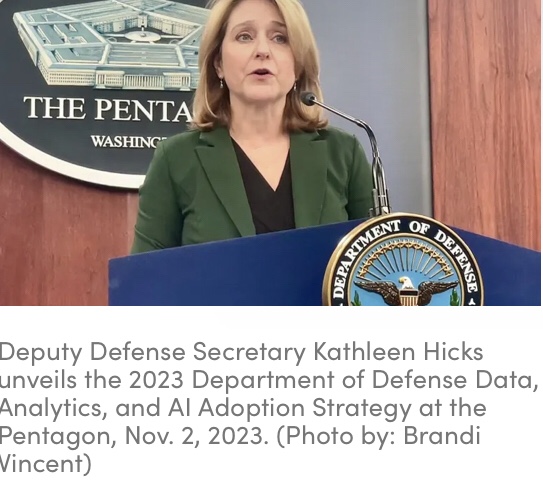
Pentagon leaders released a new, long-awaited strategic plan that revamps and redefines how U.S. military and defense components adopt and deploy crucial data, analytics and AI capabilities — particularly as they prepare for higher-tech conflicts down the line.
The 2023 Department of Defense Data, Analytics, and AI Adoption Strategy was produced by the Chief Digital and AI Office (CDAO) and unveiled by Deputy Defense Secretary Kathleen Hicks at a Pentagon press briefing on Thursday.
“Increasingly over the last dozen years, advances in machine learning have heralded and accelerated new generations of AI breakthroughs — with much of the innovation happening outside of the DOD and government. And so our task in DOD is to adopt these innovations wherever they can add the most military value,” she told reporters.
Senior CDAO officials, including its chief Craig Martell, have been teasingthis newly launched strategy — which was slated for publication by the end of the summer — repeatedly in recent months.
It follows two foundational guiding documents meant to drive AI use across the DOD. The first enterprise-wide AI strategy was launched in 2018, and Pentagon officials disseminated the first revised version in 2021.
This new 26-page AI adoption strategy “not only builds on DOD’s prior AI and data strategies — but also includes updates to account for recent industry advances in federated environments, decentralized data management, generative AI and more,” Hicks said.
She confirmed the department’s hope that this updated guidance will help all components and services speedily realize critical unfolding AI-aligned efforts, including those related to Joint All-Domain Command and Control (JADC2) and the new Replicator initiative, which aims to counter China by fielding thousands of autonomous systems in multiple domains within the next 2 years.
The strategy includes sections spotlighting new key outcomes the department is eyeing to enable with AI, the associated goals officials will pursue and the high-priority areas where they plan to fully embrace these rapidly evolving technologies. Specific goals listed involve removing policy barriers, investing in interoperable and federated infrastructure, improving data management and growing AI talent, among others.
“The state of AI in DOD is not a short story, nor is it static. We must keep doing more — safely and swiftly — given the nature of strategic competition with the [People’s Republic of China], our pacing challenge. At the same time, we benefit from a national position of strength. And our own uses grow stronger every day, and we will be keeping up the momentum ensuring we make the best possible use of AI technology responsibly and at speed,” Hicks said.
During a call with reporters following Hicks’ briefing, Martell also echoed this intention of Pentagon leadership to keep a flexible and fluid approach when it comes to unleashing AI and machine learning for the military in the coming years.
“Technologies evolve. Things are going to change next week, next year, next decade — and what wins today might not win tomorrow. Rather than identify a handful of AI-enabled warfighting capabilities that will beat our adversaries, our strategy outlines the approach to strengthening the organizational environment within which people can continuously deploy data analytics capabilities for enduring decision advantage,” Martell explained.
He and other officials on the call told reporters that the CDAO team is crafting new “iterative” implementation guidance that will accompany the strategy. They expect to release it in the next few months.
That plan will look a bit different from traditional implementation guides, Martell said, because “each of the services have wildly different needs, they’re at wildly different points in their journey and they have wildly different infrastructure.”
Notably, this refreshed strategy also comes as DOD leadership is heeding warnings from top technology and national security experts about the dire need for the U.S. military to be “AI-ready” by 2025.
During the Pentagon press briefing, Hicks told DefenseScoop that the 2023 AI adoption strategy marks “a key piece of how we get there.”
Another major contributing element to DOD becoming AI-ready to match its adversaries in that time frame, in her view, is on-time congressional appropriations and predictable resourcing to advance ongoing work.
“Absent any predictability in our funding streams, it’s very hard for us to be able to project [DOD’s AI readiness] with accuracy,” Hicks told DefenseScoop.
Article link: https://defensescoop.com/2023/11/02/pentagon-redefines-its-overarching-plan-to-accelerate-data-and-ai-adoption/?

Researchers from Tsinghua University, China, have developed an all-analog photoelectronic chip that combines optical and electronic computing to achieve ultrafast and highly energy-efficient computer vision processing, surpassing digital processors.
Computer vision is an ever-evolving field of artificial intelligence focused on enabling machines to interpret and understand visual information from the world, similar to how humans perceive and process images and videos.
It involves tasks such as image recognition, object detection, and scene understanding. This is done by converting analog signals from the environment into digital signals for processing by neural networks, enabling machines to make sense of visual information. However, this analog-to-digital conversion consumes significant time and energy, limiting the speed and efficiency of practical neural network implementations.
The proposed all-analog photoelectronic chip, as detailed in the research, addresses this limitation by combining photonic and electronic computing in a single chip, offering a groundbreaking solution for high-speed and energy-efficient visual data processing. The findings of the study are published in Nature, along with a Research Briefing summarizing the work.
Dr. Jiamin Wu, one of the authors of the study, explained to Phys.org why they focused on the hardware side of things, saying, “Our team, motivated by enhancing the real-world impact of AI advancements, has long been dedicated to developing efficient hardware solutions for AI execution.”
Combining optical and electronic analog computing modules in the study is a pivotal aspect as it allows the researchers to harness the benefits of both light (in the form of photons) and electrons in an all-analog manner.
In doing so, the researchers have addressed the practical limitations of photonic (light-based) computing, such as the complicated implementation of optical nonlinearity, considerable power consumption of ADCs, and vulnerability to noises and system errors.
“An optical computing module that implements a diffractive neural network is first used to extract information and reduce data dimensionality in a highly parallel way,” explained Dr. Wu. This process is highly efficient and allows information to be extracted from high-resolution light fields.
“The output of the optical computing module is then received by a photodiode array to generate light-induced photocurrents. These are directly used for further computation in the electronic analog domain,” he continued. This seamless conversion allows for the creation of intricate network structures, enhancing overall task performance.
The module further analyzes the light-generated electric currents. Notably, it doesn’t require converting analog signals into digital ones. This flexibility in electronic circuits enables adaptive and reconfigurable training methods, which are essential for real-world performance improvements.
The researchers were able to successfully design an integrated photoelectronic processor called an “all-analog chip combining electronic and light computing,” or ACCEL.
“By utilizing the intrinsic nonlinearity of photoelectric effect and data processing in the analog electronic field without analog-to-digital conversion, the proposed all-analog photoelectronic chip achieves energy efficiency and computing speed that are several orders of magnitude higher than those of state-of-the-art digital processor,” said Dr. Wu.
The researchers conducted a series of tests to test the ACCEL’s classification accuracies in various tasks, including recognizing handwritten numbers, distinguishing clothing items, and interpreting cursive writing.
It displayed the ability to classify high-resolution images within 72 nanoseconds, a feat that defies the limits of conventional processing. Astonishingly, the ACCEL consumes 4 million times less energy than a top-of-the-line GPU, even though it is more than 3,000 times faster.
But the ACCEL chip doesn’t stop there. Its adaptability extends to incoherent light sources, making it a versatile solution with applications beyond the expected.
“Compared to high-performance GPUs, our all-analog photoelectronic chip is three orders of magnitude faster and six orders of magnitude more energy-efficient. This makes it suitable for high-speed processing in applications like industrial assembly lines and autonomous driving.”
“Moreover, thanks to its exceptional computing efficiency and minimal energy demands, our chip could bring a new era for portable systems such as wearable devices for health monitoring, where the system is traditionally powered by a battery and the life-span of the device has been severely constrained due to the limited energy source,” said Dr. Wu.
The researchers acknowledge that while the all-analog photoelectronic demonstrated high power and efficiency, there’s still room for improvement.
“Though the ACCEL achieved fast computing speed and high energy efficiency, there is still room for the improvement of the processing capability of this chip,” explained Dr. Wu.
In the future, the researchers hope to explore more efficient architectures with photoelectronic computing to handle more extensive computer vision tasks and extend this technology to new artificial intelligence algorithms like large language models (LLMs).
This ongoing research aims to push the boundaries of analog photonic technology for future advancements.
Article link: https://techxplore-com.cdn.ampproject.org/c/s/techxplore.com/news/2023-10-future-ai-hardware-scientists-unveil.amp

By ROSS WILKERSOCTOBER 30, 2023 02:38 PM ET
The General Services Administration has given industry its first draft of a potential 10-year, $919.7 million blanket purchase agreement for acquiring supply chain risk illumination software tools and related analytic support services.
GSA envisions the Supply Chain Risk Illumination Professional Tools and Services, or SCRIPTS, BPA as helping the agency bolster its ability to mitigate the risks of fraud, abuse and other adversaries’ actions against supply chains the U.S. government relies on.
Nov. 14 is the due date for questions and comments on the draft request for quotes. An industry day is scheduled for Dec. 12, and registration closes on Nov. 8, GSA said in a Friday notice to Sam.gov.
The security and stability of supply chains has been front-and-center over the past three years for essentially all sectors including public sector, given the well-documented shortages of people and parts needed to make products and systems.
While the situation has shown more improvement over recent months, GSA’s unveiling of this SCRIPTS BPA is an indication that the government wants to better position itself for responding to and helping mitigate future disruptions.
GSA designed the BPA as being available to both defense and civilian agencies seeking new illumination tools to evaluate vendors, build up cyber hygiene and gain visibility into foreign investments that may present risks to supply chains.
SCRIPTS will be a multiple-award contract with an initial five-year base period followed by a single option for five additional years. A portion of the BPA will be set aside for small businesses.
GSA will compete the BPA through its Multiple Award Schedules program for acquiring commercially oriented products and services.
The agency also encourages parties that are interested in participating in the SCRIPTS BPA to submit an e-offer via the FASt Lane process no later than Dec. 31.
Article link: https://washingtontechnology.com/contracts/2023/10/gsa-previews-its-plan-919m-supply-chain-monitoring-software-buy/391614/
Two studies find “self-supervised” models, which learn about their environment from unlabeled data, can show activity patterns similar to those of the mammalian brain.
Anne Trafton | MIT News
Publication Date: October 30, 2023
To make our way through the world, our brain must develop an intuitive understanding of the physical world around us, which we then use to interpret sensory information coming into the brain.
How does the brain develop that intuitive understanding? Many scientists believe that it may use a process similar to what’s known as “self-supervised learning.” This type of machine learning, originally developed as a way to create more efficient models for computer vision, allows computational models to learn about visual scenes based solely on the similarities and differences between them, with no labels or other information.
A pair of studies from researchers at the K. Lisa Yang Integrative Computational Neuroscience (ICoN) Center at MIT offers new evidence supporting this hypothesis. The researchers found that when they trained models known as neural networks using a particular type of self-supervised learning, the resulting models generated activity patterns very similar to those seen in the brains of animals that were performing the same tasks as the models.
The findings suggest that these models are able to learn representations of the physical world that they can use to make accurate predictions about what will happen in that world, and that the mammalian brain may be using the same strategy, the researchers say.
“The theme of our work is that AI designed to help build better robots ends up also being a framework to better understand the brain more generally,” says Aran Nayebi, a postdoc in the ICoN Center. “We can’t say if it’s the whole brain yet, but across scales and disparate brain areas, our results seem to be suggestive of an organizing principle.”
Nayebi is the lead author of one of the studies, co-authored with Rishi Rajalingham, a former MIT postdoc now at Meta Reality Labs, and senior authors Mehrdad Jazayeri, an associate professor of brain and cognitive sciences and a member of the McGovern Institute for Brain Research; and Robert Yang, an assistant professor of brain and cognitive sciences and an associate member of the McGovern Institute. Ila Fiete, director of the ICoN Center, a professor of brain and cognitive sciences, and an associate member of the McGovern Institute, is the senior author of the other study, which was co-led by Mikail Khona, an MIT graduate student, and Rylan Schaeffer, a former senior research associate at MIT.
Both studies will be presented at the 2023 Conference on Neural Information Processing Systems (NeurIPS) in December.
Modeling the physical world
Early models of computer vision mainly relied on supervised learning. Using this approach, models are trained to classify images that are each labeled with a name — cat, car, etc. The resulting models work well, but this type of training requires a great deal of human-labeled data.
To create a more efficient alternative, in recent years researchers have turned to models built through a technique known as contrastive self-supervised learning. This type of learning allows an algorithm to learn to classify objects based on how similar they are to each other, with no external labels provided.
“This is a very powerful method because you can now leverage very large modern data sets, especially videos, and really unlock their potential,” Nayebi says. “A lot of the modern AI that you see now, especially in the last couple years with ChatGPT and GPT-4, is a result of training a self-supervised objective function on a large-scale dataset to obtain a very flexible representation.”
These types of models, also called neural networks, consist of thousands or millions of processing units connected to each other. Each node has connections of varying strengths to other nodes in the network. As the network analyzes huge amounts of data, the strengths of those connections change as the network learns to perform the desired task.
As the model performs a particular task, the activity patterns of different units within the network can be measured. Each unit’s activity can be represented as a firing pattern, similar to the firing patterns of neurons in the brain. Previous work from Nayebi and others has shown that self-supervised models of vision generate activity similar to that seen in the visual processing system of mammalian brains.
In both of the new NeurIPS studies, the researchers set out to explore whether self-supervised computational models of other cognitive functions might also show similarities to the mammalian brain. In the study led by Nayebi, the researchers trained self-supervised models to predict the future state of their environment across hundreds of thousands of naturalistic videos depicting everyday scenarios.
“For the last decade or so, the dominant method to build neural network models in cognitive neuroscience is to train these networks on individual cognitive tasks. But models trained this way rarely generalize to other tasks,” Yang says. “Here we test whether we can build models for some aspect of cognition by first training on naturalistic data using self-supervised learning, then evaluating in lab settings.”
Once the model was trained, the researchers had it generalize to a task they call “Mental-Pong.” This is similar to the video game Pong, where a player moves a paddle to hit a ball traveling across the screen. In the Mental-Pong version, the ball disappears shortly before hitting the paddle, so the player has to estimate its trajectory in order to hit the ball.
The researchers found that the model was able to track the hidden ball’s trajectory with accuracy similar to that of neurons in the mammalian brain, which had been shown in a previous study by Rajalingham and Jazayeri to simulate its trajectory — a cognitive phenomenon known as “mental simulation.” Furthermore, the neural activation patterns seen within the model were similar to those seen in the brains of animals as they played the game — specifically, in a part of the brain called the dorsomedial frontal cortex. No other class of computational model has been able to match the biological data as closely as this one, the researchers say.
“There are many efforts in the machine learning community to create artificial intelligence,” Jazayeri says. “The relevance of these models to neurobiology hinges on their ability to additionally capture the inner workings of the brain. The fact that Aran’s model predicts neural data is really important as it suggests that we may be getting closer to building artificial systems that emulate natural intelligence.”
Navigating the world
The study led by Khona, Schaeffer, and Fiete focused on a type of specialized neurons known as grid cells. These cells, located in the entorhinal cortex, help animals to navigate, working together with place cells located in the hippocampus.
While place cells fire whenever an animal is in a specific location, grid cells fire only when the animal is at one of the vertices of a triangular lattice. Groups of grid cells create overlapping lattices of different sizes, which allows them to encode a large number of positions using a relatively small number of cells.
In recent studies, researchers have trained supervised neural networks to mimic grid cell function by predicting an animal’s next location based on its starting point and velocity, a task known as path integration. However, these models hinged on access to privileged information about absolute space at all times — information that the animal does not have.
Inspired by the striking coding properties of the multiperiodic grid-cell code for space, the MIT team trained a contrastive self-supervised model to both perform this same path integration task and represent space efficiently while doing so. For the training data, they used sequences of velocity inputs. The model learned to distinguish positions based on whether they were similar or different — nearby positions generated similar codes, but further positions generated more different codes.
“It’s similar to training models on images, where if two images are both heads of cats, their codes should be similar, but if one is the head of a cat and one is a truck, then you want their codes to repel,” Khona says. “We’re taking that same idea but applying it to spatial trajectories.”
Once the model was trained, the researchers found that the activation patterns of the nodes within the model formed several lattice patterns with different periods, very similar to those formed by grid cells in the brain.
“What excites me about this work is that it makes connections between mathematical work on the striking information-theoretic properties of the grid cell code and the computation of path integration,” Fiete says. “While the mathematical work was analytic — what properties does the grid cell code possess? — the approach of optimizing coding efficiency through self-supervised learning and obtaining grid-like tuning is synthetic: It shows what properties might be necessary and sufficient to explain why the brain has grid cells.”
The research was funded by the K. Lisa Yang ICoN Center, the National Institutes of Health, the Simons Foundation, the McKnight Foundation, the McGovern Institute, and the Helen Hay Whitney Foundation.
Article link: https://news.mit.edu/2023/brain-self-supervised-computational-models-1030
The directive is part of an executive order on the “Safe, Secure, and Trustworthy Development and Use of Artificial Intelligence.”
OCTOBER 30, 2023

President Biden on Monday signed an executive order that, among other things, would require the Department of Defense to conduct a pilot aimed at finding ways to use AI to protect national security networks.
The EO on the “Safe, Secure, and Trustworthy Development and Use of Artificial Intelligence,” gives the Pentagon 180 days to conduct the pilot.
The secretary of defense and the secretary of homeland security “shall, consistent with applicable law, each develop plans for, conduct, and complete an operational pilot project to identify, develop, test, evaluate, and deploy AI capabilities, such as large-language models, to aid in the discovery and remediation of vulnerabilities in critical United States Government software, systems, and networks,” the directive states.
Within the next 270 days, the two secretaries must each deliver a report to the White House on the results of actions taken “pursuant to the plans and operational pilot projects … including a description of any vulnerabilities found and fixed through the development and deployment of AI capabilities and any lessons learned on how to identify, develop, test, evaluate, and deploy AI capabilities effectively for cyber defense,” according to the EO.
The Defense Department has already set up a group known as Task Force Lima to look at potential use cases for generative AI tools such as large language models. More broadly, the Pentagon’s Chief Digital and AI Office is focused on helping deploy artificial intelligence capabilities across the department. A number of other DOD agencies and offices are also involved in artificial intelligence and cybersecurity efforts, and it wasn’t immediately clear which DOD organizations will execute the pilot that Biden directed.
Biden highlighted cybersecurity concerns during remarks at the White House on Monday before he signed the order.
“In the wrong hands, AI can make it easier for hackers to exploit vulnerabilities in the software that makes our society run. That’s why I’m directing the Department of Defense and Department of Homeland Security — both of them — to develop game-changing cyber protections that will make our computers and our critical infrastructure more secure than it is today,” he said.
Additionally, in the next six months the Pentagon chief must also deliver a report about ways to fix “gaps in AI talent” related to national defense, including recommendations for addressing challenges in the DOD’s ability to hire certain noncitizens; streamlining processes for certain noncitizens to access classified information through “Limited Access Authorization” at department labs; the appropriate use of enlistment authority under 10 U.S.C. 504(b)(2) for experts in artificial intelligence and other critical and emerging technologies; and ways that DOD and DHS can “enhance the use of appropriate authorities for the retention of certain noncitizens of vital importance to national security,” according to the directive.
Meanwhile, White House officials have been tasked with overseeing the development of a national security memorandum that will provide guidance to the Pentagon, intelligence community and other relevant agencies on the continued adoption of AI capabilities for national security missions, including as it relates to AI assurance and risk-management practices for use cases that “may affect the rights or safety of United States persons and, in appropriate contexts, non-United States persons,” per the EO.
Notably, the memo will also include directives to address the potential adversarial use of AI systems “in ways that threaten the capabilities or objectives of the Department of Defense or the Intelligence Community, or that otherwise pose risks to the security of the United States or its allies and partners.”
That document is expected to be delivered to the president within the next 270 days.
Article link: https://defensescoop.com/2023/10/30/biden-tasks-pentagon-to-carry-out-new-ai-pilot-for-cyber-defense/?
 healthcarereimagined