healthcarereimagined

Envisioning healthcare for the 21st century

  • About
  • Economics

Generative AI research from MIT Sloan

Posted by timmreardon on 12/24/2023
Posted in: Uncategorized.


by

Sara Brown

 Dec 18, 2023

Why It Matters

New work from MIT Sloan researchers shows how generative AI can be deployed in the enterprise today.Share 

In the year since OpenAI introduced the ChatGPT chatbot, generative artificial intelligence has burst into the public consciousness and jumped to the top of most corporate agendas.

Most companies and business leaders are still finding their way with this new technology, from understanding more about how generative AI works and how it will affect businesses and workers to anticipating how it will be regulated. There is also growing emphasis on how to make sure it is used responsibly.

Researchers at MIT Sloan have been examining generative AI and the best ways to use it in the enterprise. Here’s what they’ve found.

AI and workers 

Inexperienced workers stand to benefit the most from generative AI, according to research by MIT Sloan associate professor Danielle Li, MIT Sloan PhD candidate Lindsey Raymond, and Stanford University professor Erik Brynjolfsson, PhD ’91.

The researchers found that contact center agents with access to a conversational assistant saw a 14% boost in productivity, with the largest gains impacting new or low-skilled workers.

“Generative AI seems to be able to decrease inequality in productivity, helping lower-skilled workers significantly but with little effect on high-skilled workers,” Li said. “Without access to an AI tool, less-experienced workers would slowly get better at their jobs. Now they can get better faster.”

Generative AI can boost highly skilled workers’ productivity too, according to a research paper co-authored by MIT Sloan professor Kate Kellogg — though it has to be introduced the right way.

It is not always obvious to highly skilled knowledge workers which of their everyday tasks could easily be performed by AI, the researchers found. To introduce generative AI to highly skilled workers and boost productivity, organizations should establish a culture of accountability, reward peer training, and encourage role reconfiguration.

And MIT Sloan professor John J. Horton notes that several factors have to be in place for a human-AI interaction to be worthwhile. He recommends that leaders consider four points before swapping in AI for human labor: how much time the task will take without assistance, how much the employee performing a task is paid, whether AI is capable of performing the task correctly, and how easy it is for humans to determine whether the AI output is accurate. 

Generative AI could also help people get hired. Job applicants who were randomly assigned algorithmic assistance with their resumes — such as suggestions to improve spelling and grammar — were 8% more likely to be hired, according to an experiment conducted by Horton, MIT Sloan PhD student Emma van Inwegen, and MIT Sloan PhD student Zanele Munyikwa.

“If you take two identical workers with the same skills and background, the one with the better-written resume is more likely to get hired,” van Inwegen said. “The takeaway is that employers actually care about the writing in the resume — it’s not just a correlation.” That means that AI assistance can be a useful tool for those hoping to get hired, she said.

Using AI to the best advantage 

It’s time for everyone in your organization to understand generative AI, according to MIT Sloan senior lecturer George Westerman. In a webinar, he outlined early use cases, such as summarizing documents, creating personalized shopping experiments, and writing code. Generative AI is the latest in a line of advanced analytics tools, he noted, which vary in how much data and domain expertise is needed to use them, whether their results are repeatable, and how easy it is to understand how they generate results.

For businesses, using work generated by AI will depend in part on how consumers perceive that work. With this in mind, MIT Sloan senior lecturer and research scientist Renee Richardson Gosline and Yunhao Zhang SM ’20, PhD ’23, a postdoctoral fellow at the Psychology of Technology Institute, studied how people perceive work created by generative AI, humans, or some combination of the two.

They found that when people knew a product’s source, they expressed a positive bias toward content created by humans. Yet at the same time, and contrary to the traditional idea of “algorithmic aversion,” people did not express a negative bias toward AI-generated content when they knew how it was created. In fact, when respondents were not told how content was created, they preferred AI-generated content.

RELATED ARTICLES

The legal issues presented by generative AI 10 startups harnessing the power of AIThird-party AI tools pose risks for organizations

Users can make the most of generative AI by using it in concert with external tools to answer complex questions and execute actions. MIT Sloan professor of the practice Rama Ramakrishnan looked at how to use ChatGPT as an agent to do things like search the web, order groceries, purchase plane tickets, or send emails.

And businesses that find success with generative AI will also harness human-centric capabilities, such as creativity, curiosity, and compassion, according to MIT Sloan senior lecturer Paul McDonagh-Smith. The key is figuring out how humans and machines can best work together, resulting in humans’ abilities being multiplied, rather than divided, by machines’ capabilities, McDonagh-Smith said during a webinar.

AI policy 

It’s time to talk about how to rechart the course of technology so it complements human capabilities, according to MIT economists Daron Acemoglu and Simon Johnson. In their new book, “Power and Progress: Our Thousand-Year Struggle Over Technology and Prosperity,” they decry the economic and social damage caused by the concentrated power of business and show how the tremendous computing advances of the past half century can become empowering and democratizing tools.

“Society and its powerful gatekeepers need to stop being mesmerized by tech billionaires and their agenda,” they write in an excerpt from the book. “Debates on new technology ought to center not just on the brilliance of new products and algorithms but also on whether they are working for the people or against the people.”

In a policy memo co-authored with MIT professor David Autor, Acemoglu and Johnson suggested five policies that could steer AI implementation in a direction that complements humans and augments their skills. These include equalizing tax rates on employing workers and owning equipment or algorithms, updating Occupational Safety and Health Administration rules to create safeguards against worker surveillance, and creating an AI center of expertise within government.

When President Joe Biden issued an executive order in October on AI safety and security, one part of it addressed using content labels to identify content generated by artificial intelligence. A new working paper co-authored by MIT Sloan professor David Rand looked at the right terms to use for those labels. The researchers found that people associated certain terms, such as “AI generated” and “AI manipulated,” most closely with content created using AI. Conversely, the labels “deepfake” and “manipulated” were most associated with misleading content, whether AI created it or not.

Article link: https://mitsloan.mit.edu/ideas-made-to-matter/generative-ai-research-mit-sloan?

At NeurIPS, what’s old is new again – Amazon

Posted by timmreardon on 12/20/2023
Posted in: Uncategorized.

MACHINE LEARNING

At NeurIPS, what’s old is new again

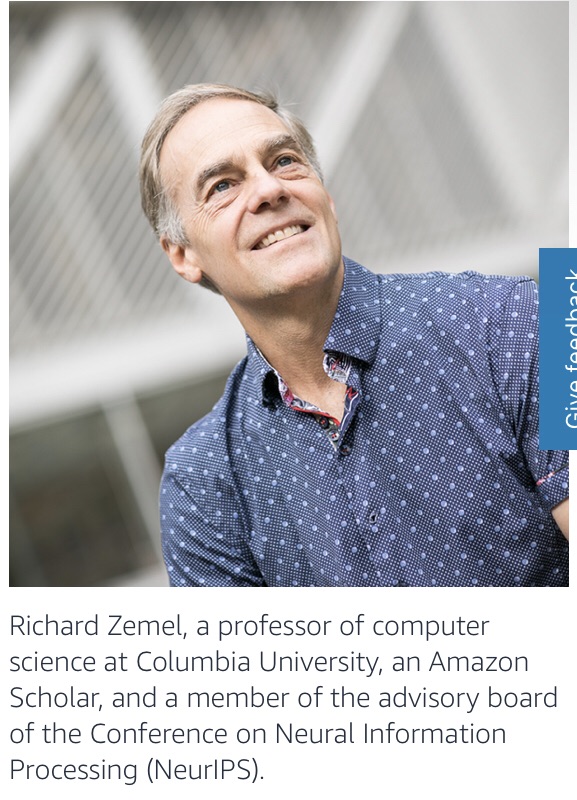
Amazon Scholar and NeurIPS advisory board member Richard Zemel on what robustness and responsible AI have in common, what AI can still learn from neuroscience, and the emerging topics that interest him most.

By Larry Hardesty

December 13, 2023

Share

The current excitement around large language models is just the latest aftershock of the deep-learning revolution that started in 2012 (or maybe 2010), but Columbia professor and Amazon Scholar Richard Zemel was there before the beginning. As a PhD student at the University of Toronto in the late ’80s and early ’90s, Zemel wrote his dissertation on representation learning in unsupervised machine learning systems for Geoffrey Hinton, one of the three “godfathers of deep learning”.

Zemel is also on the advisory board of the main conference in the field of deep learning, the Conference on Neural Information Processing (NeurIPS), which takes place this week. His breadth of experience gives him a rare perspective on the field of deep learning — both how far it’s come and where it’s going.

“It’s come a very long way in some sense, in terms of the scope of problems that are relevant and the whole real-world applicability of it,” Zemel says. “But a lot of the same problems still exist. There are just many more facets than there used to be.”

For example, Zemel says, take the concept of robustness, the ability of a machine learning model to maintain performance when the data it sees at inference time differs from the data it was trained on, because of noise, drift in the data distribution, or the like.

“One of the original neural-net applications was ALVINN, the automated land vehicle in a neural network, in the late ’80s,” Zemel says. “It was a neural net that had 29 hidden units, and it was an answer to DARPA’s self-driving challenge. It was a big success for neural nets at the time.

“Robustness came up there because they were worried about the car going off the road, and they didn’t have any training examples of that. They worked out how to augment the data with those kinds of training examples. So thirty years ago, robustness was seen as an important question, and some ideas came up.”

Today, data augmentation remains one of the main ways to ensure robustness. But as Zemel says, the problem of robustness has new facets.

Neural attentive circuits.16x9.png

Related content

NeurIPS: Why causal-representation learning may be the future of AI

“For instance, we can consider algorithmic fairness as a form of robustness,” he says. “It’s robustness with respect to particular groups. A lot of the methods that are used for that are methods that have also been developed for robustness, and vice versa. For example, they’re formulated as trying to develop a prediction that has some invariance properties. And it could be that you’re not just developing a prediction: in the deep-learning world, you’re trying to develop a representation that has these properties. The final layer of representation should be invariant. Think of multiclass object recognition: anything that has a label of class K should have a very similar kind of distribution over representations, no matter what environment it comes from.”

With generative-AI models, Zemel says, evaluating robustness becomes even more difficult. In practice, the most common machine learning model has, until recently, been the classifier, which outputs the probabilities that a given input belongs to each of several classes. One way to gauge a classifier’s robustness is to determine whether its predicted probabilities — its confidence in its classifications — accurately reflects its performance on data. If the model is overconfident, it probably won’t generalize well to new settings.

But with generative AI models, there’s no such confidence metric to appeal to.

“If now the system is busy writing sentences, what does the uncertainty mean?” Zemel asks. “How do you talk about uncertainty? The whole question about building robust, properly confident, responsible systemsbecomes that much harder in the in the era where generative models are actually working well.”

The neural analogy

NeurIPS was first held in 1986, and in the early years, the conference was as much about neuroscientists using computational tools to model the brain as about computer scientists using brain-like models to do computation.

“The neural part of it has been drowned out by the engineering side of things,” Zemel says, “but there’s always been a lively interest in it. And there’s been some loose — and not so loose — inspiration that has gone that way.”

Today’s generative-AI models, for instance, are usually transformer models, whose signature component is the attention mechanism that decides which aspects of the input to focus on when generating outputs.

Amazon Scholars Michael I. Jordan and Michael Kearns and Amazon distinguished scientist Bernhard Scholkopf NeurIPS Amazon Science.jpg

Related content

NeurIPS luminaries on the future of AI

“Some of that work actually has its roots in cognitive science and to some extent in neuroscience,” Zemel says. “Neuroscience and cognitive science have studied attention for a long time now, particularly spatial attention: what do you focus on when viewing a scene? We have also been considering spatial attention in our models. About a decade ago, we were working on image captioning, and the idea was that when the system was generating the text for the caption, you could see what part of the image it was attending to. When it was entering the next word, it was focusing on some part of the image.

“It’s a little different than the attention in the transformers, where they took it a step further, as one layer can attend to activities in another layer of a network. It’s a similar idea, but it was a natural deep-learning version — learning applied to that same idea.”

Recently, Zemel says, computer scientists seem to be showing a renewed interest in what neuroscience and cognitive science have to teach them.

“I think it’s coming back as people try to scale up the systems and make them work with less data, or as the models become bigger and bigger, and it’s very inefficient and sometimes impossible to back-propagate through the whole system,” he says. “Brains have interesting structure at different scales. There are different kinds of neurons that have different functions, and we don’t really have that in our neural nets. And there’s no clear place where there’s short-term memory and long-term memory that are thought to be important parts of the brain. Maybe there are ways of getting that kind of architectural scaffolding structure that could be useful in improving neural nets and improving machine learning.”

New frontiers

As Zemel considers the future of deep learning, two areas of research strike him as particularly intriguing.

Mike Jordan.jpg

Related content

ICASSP: Michael I. Jordan’s “alternative view on AI”

“One of them is this area called mechanistic interpretability,” he says. “Can you both understand and affect what’s going on inside these systems? One way of demonstrating that you understand what’s going on is to make some change and predict what that change is. I’m not talking about understanding what a particular unit or a particular neuron does. It’s more like, we’d like to be able to make this change to the generative model; how do we achieve that without adding new data or post hoc processing? Can you actually go in and change how the network behaves?

“The other one is this idea that we talked about: can we add inductive biases, add structure to the system, add some sort of knowledge — it could be a logic, it could be a probability —to enable these systems to become much more efficient, to learn with less data, with less energy? There are just so many problems that are now open and unsolved that I think it’s a great time to be doing research in the area.”

Article link: https://www.amazon.science/blog/at-neurips-whats-old-is-new-again?

The top 10 MIT Sloan articles of 2023

Posted by timmreardon on 12/19/2023
Posted in: Uncategorized.


by Zach Church Nov 27, 2023

Why It MattersArtificial intelligence is everywhere. But it’s humble leadership that leads our list.Share

What ideas and insights were people drawn to this year? The following list outlines the most-read articles from MIT Sloan’s Ideas Made to Matter team to date in 2023.

  1. MIT Sloan professor emeritus Edgar Schein, a social psychologist who practiced his own tenets of humble leadership and humble inquiry, died at age 94. In his memory, we shared five of his most enduring management ideas.
  2. Neural net pioneer Geoffrey Hinton, who left Google in the spring, believes that it’s time to confront the existential dangers of artificial intelligence.
  3. Nurturing happiness takes work, but doing it right can lead to greater productivity and stronger relationships.
  4. In a new book, MIT professor Yossi Sheffi examines supply chain complexity, artificial intelligence, and the future of work. One case study? The incredible journey of the ordinary banana.
  5. Algorithmic writing assistance can help jobseekers find and fix spelling, grammatical, and usage errors in their resumes. Employers approve, research from MIT Sloan PhD candidate Emma van Inwegen shows.
  6. Workers with the least experience have the most to gain from generative AI, according to a new study.
  7. Data-literate leaders understand data well enough to make their best decisions, drive literacy throughout their organizations, and create a culture of trust in data.
  8. Walking meetings, intermittent fasting, and an “anytime vacation” policy: Here’s how seven leaders manage stress, burnout, and their employees’ well-being.
  9. Generative AI can boost worker productivity, but organizations must first establish a culture of accountability, reward peer training, and encourage role reconfiguration.
  10. A new book from MIT Sloan professor Yasheng Huang details China’s economic rise — and now, its fall.

Article link: https://mitsloan.mit.edu/ideas-made-to-matter/top-10-mit-sloan-articles-2023?

How to wire your organization to excel at problem-solving – MIT Sloan

Posted by timmreardon on 12/15/2023
Posted in: Uncategorized.


by Gene Kim & Steven Spear

Nov 21, 2023

Why It Matters

A new book from MIT Sloan’s Steven Spear provides leaders with a blueprint for designing, sustaining, and improving their organization’s sociotechnical systems.

If leaders want to better understand their organization’s performance, they should look to their employees and how they do their work.

Organizations succeed when they design their processes, routines, and procedures to encourage employees to problem-solve and contribute to a common purpose, write MIT Sloan senior lecturer Steven Spear and Gene Kim in their new book, “Wiring the Winning Organization.”

“When people have difficulty doing their work easily and well, despite investing their best time and energy to support the larger effort, we shouldn’t expect the enterprise as a whole to perform well either,” Spear and Kim write. “This is an organization that has not been wired to win.”

In this excerpt from their book, they outline the three collaborative layers of an organization and suggest three mechanisms leaders can engage to hone employees’ problem-solving skills.

The excerpt has been edited and condensed for clarity and length.

++++++

All organizations are sociotechnical systems — people working with other people, engaging (sometimes complex) technology to accomplish what they are collaborating on. Regardless of domain, collaborative problem-solving occurs on three distinct layers, where people focus their attention and express their experience, training, and creativity:

  • Layer 1 contains the technical, scientific, and engineered objects that people are trying to study, create, or manipulate. These may be molecules in drug development, code in software development, physical parts in manufacturing, or patient injuries or illnesses in medical care. For people in Layer 1, their expertise is around these technical objects (i.e., their structure and behavior), and their work is expressed through designing, analyzing, fabricating, fixing, repairing, transforming, creating, and so forth.
     
  • Layer 2 contains the scientific, technical, or engineered tools and instrumentation through which people work on Layer 1 objects. These may be the devices that synthesize medicinal compounds in drug development, the development tools and operational platforms in software development, technologies that transform materials in manufacturing, or the technologies to diagnose and treat patients’ illnesses and injuries. Layer 2 capabilities include the operation, maintenance, and improvement of these tools and instruments. These first two layers are the “technical” part of a sociotechnical system.
     
  • Layer 3 contains the social circuitry. This is the overlay of processes, procedures, norms, and routines — the means by which individual efforts are expressed and integrated through collaboration toward a common purpose. This is the “socio” part of a sociotechnical system.

Danger zones and winning zones for solving really difficult problems

Leaders manage the social circuitry (Layer 3) that determines whether their organizations get dismal or great outcomes. How this circuitry is designed and operated dictates the conditions in which people can solve difficult problems, continually generate great and new ideas, and put them into impactful practice. Certain conditions make it more difficult to solve problems or generate new and useful ideas. We call that the danger zone. Other conditions make getting good answers easier. We call that the winning zone.

In the danger zone, problems are complex, with many factors affecting the system at once, and their relationships are highly intertwined. Hazards are many and severe, risks of failure are high, and costs of failure can be catastrophic. Systems in the danger zone are difficult to control, and there are limited, if any, opportunities to repeat experiences, so feedback-based learning is difficult if not outright impossible.

In contrast, leaders enable much more advantageous conditions in the winning zone. Problems have been reframed so they are simpler to address. The hazards and risks have been reduced so failures are less costly, especially during design, development, testing, and practice. Problem-solving has been shifted into slower-moving situations, where the pace of experiences can be better controlled. Opportunities to learn by experience or experimentation are increased to allow more iteration. And finally, there is much more clarity about where and when to focus problem-solving efforts, because it is obvious when problems are occurring, so attention is given to containing and solving them.

When we leave ourselves and our colleagues in the danger zone, it becomes extremely difficult to develop and design products and services and to develop and operate systems through which we collaborate and by which we coordinate. In fact, in such conditions, given the complexity and pace of the environment, it’s often difficult to even recognize that significant problems are occurring and that they must be addressed to avert disaster.

In contrast, when we change our experiences so they happen in the winning zone, generating good answers to difficult problems is much easier, because people are better able to put their capabilities to best use. We can move ourselves from the danger zone to the winning zone using the three mechanisms of slowification, simplification, and amplification.

Let’s take a closer look at defining each of these mechanisms:

  • Slowification makes it easier to solve problems by pulling problem-solving out of the fast-paced and often unforgiving realm of performance (i.e., operations or execution). This shifting of Layer 3 problem-solving into planning and practice allows people to engage in deliberative, reflective experientially and experimentally informed reasoning rather than having to constantly react with whatever habits, routines, and legacy approaches have already been ingrained.
     
  • Simplification makes the problems themselves easier to solve by reshaping them. Large problems are deliberately broken down into smaller, simpler ones through a combination of three techniques: incrementalization, modularization, and linearization. By doing so, we partition complex problems with many interacting factors into many smaller problems. These problems have fewer interacting factors, making them easier to solve. Furthermore, Layer 1 (technical object) problem-solving can be done in parallel, with less need for Layer 3 coordination, increasing independence of action.
     
  • Amplification makes it obvious there are problems and makes it clear whether those problems have been seen and solved. Mechanisms are built into Layer 3 (social circuitry) to amplify that little things are amiss, drawing attention to them early and often. This focuses attention on containing and resolving small and local glitches before they have a chance to become large and systemically disruptive.

Ideally, an organization will have the latitude to do all three: slow things down to make problem-solving easier, partition big problems into smaller ones that are simpler to solve, and amplify problems so they’re addressed sooner and more often. Even if we cannot do all three, doing two or even one still brings us closer to the winning zone, making it easier for us to take situations about which we know too little and can do too little and convert them into situations in which we know enough and can do enough.

Excerpted from “Wiring the Winning Organization: Liberating Our Collective Greatness through Slowification, Simplification, and Amplification,” by Gene Kim and Steven J. Spear. © 2023 Gene Kim and Steven J. Spear. Reprinted by permission of IT Revolution. All rights reserved.

Article link: https://mitsloan.mit.edu/ideas-made-to-matter/how-to-wire-your-organization-to-excel-problem-solving?

Top secret info-sharing: DIA info chief sees modernizing JWICS as top priority in 2024 – Breaking Defense

Posted by timmreardon on 12/15/2023
Posted in: Uncategorized.

By Jaspreet Gill on December 12, 2023 at 4:50 PM

DoDIIS 2023 — Modernizing the Joint Worldwide Intelligence Communication System, the government’s network for hosting top secret and sensitive compartmented information, is leading the priorities of the Defense Intelligence Agency’s chief information officer over the next year. 

Speaking at the Department of Defense Intelligence Information System, or DoDIIS, conference, DIA CIO Doug Cossa said that JWICS, a system that dates back to the Gulf War and is used by the agency to store confidential intelligence, was developed during a time where DIA was challenged to figure out a way to transmit secure voice and video to the Pentagon.

“Flashforward where we are today and how that system has evolved, we have over a million users that depend on that for transmitting top secret information,” Cossa said. 

Cossa has been vocal about the need for JWICS modernization for years. In 2021, he said DIA was investing significantly in the system and was focused on updating equipment, building out cyber security tools and optimizing use cases for JWICS.

Most recently, the spotlight was put on JWICS when 21-year-old Massachusetts Air National Guard cyber transport systems apprentice Jack Teixeira allegedly leakedhundreds of classified documents on social media platform Discord. On Monday, the Air Force released findings of its investigation into Texiera’s unauthorized disclosure of the documents and found, in part, that his access to JWICS “enabled him to view intelligence content and analysis that reside on” classified systems.

IT Modernization And Connectivity

Following JWICS modernization, Cossa said his other priorities included improving DIA’s information technology workforce and modernizing DoD intelligence information systems, an area that DIA “divested significantly from” in 2013. 

He said that DIA’s shared desktop environment, which the agency has worked on with the National Geospatial Agency, now has more than 70,000 users, which “aides in the integration in how we share intelligence.” Next on his priorities is increasing international connectivity.

“If there’s anything that the recent crises that I’ve seen as CIO during my tenure here — whether it be the Afghanistan retrograde, Russia-Ukraine crisis, and now the Israel-Hamas conflict — all depended and still depend on our interactions and our intelligence sharing with international partners,” Cossa said. “COVID obviously was a significant shock to our system. … That really knocked us off course and focused us to recalibrate how we work day in and day out.”

Part of that adjustment included transitioning DIA’s software development and IT capabilities to the “unclassified fabric,” he added, which he referred to as the capability delivery pipeline, another priority area for his office in the coming year. Cossa described the unclassified pipeline as a place where DIA can deliver software onto secret and top secret networks.

“As we think about where we are in the world today… we’re wondering, how are we going to compete with countries like China that are now fighting for world dominance?” he said. “We are living in more chaotic times than ever with crises around the world and we realize that everything is at stake to include our national security. As we think about the future, we are, as technologists, on the frontline to respond.”

Article link: https://breakingdefense-com.cdn.ampproject.org/c/s/breakingdefense.com/2023/12/top-secret-info-sharing-dia-info-chief-sees-modernizing-jwics-as-top-priority-in-2024/?amp=1

The Government Is Now the Hottest Tech Employer in Town

Posted by timmreardon on 12/13/2023
Posted in: Uncategorized.

After a year of massive cuts, the tech job market is so unstable that the US government has come to be seen as an appealing, innovative employer.

Tech companies have laid off some 400,000 people worldwide in 2022 and 2023, according to Layoffs.fyi, a site that tracks tech industry job losses. With the market yet to right itself, and some people reexamining the role big tech firms play in society, public sector roles, complete with perks like pensions and a warm, fuzzy do-good feeling, are suddenly proving popular.

“This is a great nexus point where the need and capacity is out there,” says Keith Wilson, the talent engagement manager with US Digital Response, a nonprofit that helps governments with digital expertise. “We’re trying to help these state and local governments learn how to hire better for technical roles.”

Case in point: The US Department of Veterans Affairs, which has hired 1,068 people into tech jobs over the past year, meeting its hiring goal, says Nathan Tierney, chief people officer for the department. To do so, the agency adjusted pay to narrow the gap between government and private sector roles, resulting in an average salary increase of $18,000—and nearly all workers across the department got raises.

It also reworked its application and recruiting strategies; rather than wait for workers to come to the hiring website, it went to find them at LinkedIn Live events and conferences. The department also advertises remote roles, and it is setting up hubs for workers in cities where tech workers congregate, like Seattle, Austin, and Charlotte. “I want to hire highly skilled folks,” Tierney says. “We have an opportunity to capitalize on that.”

There’s a lot of work to do. Red tape and slow processes shroud government work. And keeping pace with the private sector, where hiring strategies and salaries move fast, has traditionally been hard for governments. Then, once hired, those employees may face similar roadblocks when it comes to innovating in their jobs. Still, there’s movement by local and federal US government branches to bring in new talent

In 2021, US president Joe Biden signed a $1 trillion infrastructure law. It included $1 billion in cybersecurity grants for state and local governments, along with additional money for federal agencies to spend on cybersecurity. This influx of cash comes as the tech sector slumps

And interest in government jobs among tech workers remains strong. In late October, more than 3,000 people registered for a Tech to Gov career event, held by the Tech Talent Project, a nonprofit that helps the US government recruit for tech roles. One thousand more had signed up for a waiting list.

“It’s not just layoffs—what I have definitely seen is folks pausing in the tech sector,” says Jennifer Anastasoff, executive director at Tech Talent Project. “This has been a moment where folks have started pausing and started thinking about where they can make the most difference.”

A federal tech job portal had 107 openings as of mid-November. The salaries range from around $40,000 to nearly $240,00. The Office of Personnel Management, the human resources arm of the federal government, made a pitch to laid-off tech workers earlier this year, hoping to scoop up some 22,000 people into public sector tech roles. That office did not respond to emails seeking updates on the hiring process for tech jobs. But smaller government agencies around the country have made strides in luring high-profile private sector workers.

New York recently hired a former high-ranking employee from Blue Cross Blue Shield of Massachusetts to serve as the state’s first chief customer experience officer. Shelby Switzer took a job as the director of Baltimore’s new Digital Services Team earlier this year. Three new employees were hired underneath Switzer—all from the private sector. The group’s first project was to modernize permitting; instead of going to several offices in person to obtain permits for events and street closures, people can now apply online. It seems simple, but for the local government, that’s a huge deal.

One of those benefits came in hiring a UX designer, says Switzer. “Having somebody who is the expert in thinking about the usability of services in technology is just totally new.” But working in government can mean one tech team is trying to innovate while stuck in a bigger, slow-moving pool. “There is a ton of organizational inertia,” Switzer says. “Government wasn’t really designed to be efficient.”

These kinds of small changes are hard to come by in government, but there’s a trend to more cities and states making investments in tech infrastructure. In early November, in Pennsylvania, the Commonwealth Office of Digital Experience, or CODE PA, launched a system that lets residents, businesses, charities, and schools look up if they are eligible for a refund after paying for a permit, license, or certification, and then request a refund.

Pennsylvania is investing big in tech and AI under Josh Shapiro, its new governor. It hired Amaya Capellán, who moved from Comcast to the Pennsylvania government this year, trading corporate life for the role of Pennsylvania’s chief information officer. Some initial priorities for Capellán include finding ways for governments to use generative AI and updating permitting and licensing.

Capellán says people may be realizing that tech companies are treating them as replaceable, pushing them to reconsider roles in tech. “It’s really inspiring to think about the kind of ways you can affect people’s lives for good.”

Article link: https://www.wired.com/story/tech-jobs-government-layoffs/

Physicists ‘entangle’ individual molecules for the first time, hastening possibilities for quantum computing – Phys.org

Posted by timmreardon on 12/13/2023
Posted in: Uncategorized.

by Princeton University

For the first time, a team of Princeton physicists have been able to link together individual molecules into special states that are quantum mechanically “entangled.” In these bizarre states, the molecules remain correlated with each other—and can interact simultaneously—even if they are miles apart, or indeed, even if they occupy opposite ends of the universe. This research was recently published in the journal Science.

“This is a breakthrough in the world of molecules because of the fundamental importance of quantum entanglement,” said Lawrence Cheuk, assistant professor of physics at Princeton University and the senior author of the paper. “But it is also a breakthrough for practical applications because entangled molecules can be the building blocks for many future applications.”

These include, for example, quantum computers that can solve certain problems much faster than conventional computers, quantum simulators that can model complex materials whose behaviors are difficult to model, and quantum sensors that can measure faster than their traditional counterparts.

“One of the motivations in doing quantum science is that in the practical world, it turns out that if you harness the laws of quantum mechanics, you can do a lot better in many areas,” said Connor Holland, a graduate student in the physics department and a co-author on the work.

The ability of quantum devices to outperform classical ones is known as “quantum advantage.” And at the core of quantum advantage are the principles of superposition and quantum entanglement. While a classical computer bit can assume the value of either 0 or 1, quantum bits, called qubits, can simultaneously be in a superposition of 0 and 1.

The latter concept, entanglement, is a major cornerstone of quantum mechanics and occurs when two particles become inextricably linked with each other so that this link persists, even if one particle is light years away from the other particle. It is the phenomenon that Albert Einstein, who at first questioned its validity, described as “spooky action at a distance.”

Since then, physicists have demonstrated that entanglement is, in fact, an accurate description of the physical world and how reality is structured.

“Quantum entanglement is a fundamental concept,” said Cheuk, “but it is also the key ingredient that bestows quantum advantage.”

But building quantum advantage and achieving controllable quantum entanglement remains a challenge, not least because engineers and scientists are still unclear about which physical platform is best for creating qubits.

In the past decades, many different technologies—such as trapped ions, photons, and superconducting circuits, to name only a few—have been explored as candidates for quantum computers and devices. The optimal quantum system or qubit platform could very well depend on the specific application.

Until this experiment, however, molecules had long defied controllable quantum entanglement. But Cheuk and his colleagues found a way, through careful manipulation in the laboratory, to control individual molecules and coax them into these interlocking quantum states.

They also believed that molecules have certain advantages—over atoms, for example—that made them especially well-suited for certain applications in quantum information processing and quantum simulation of complex materials. Compared to atoms, for example, molecules have more quantum degrees of freedom and can interact in new ways.

“What this means, in practical terms, is that there are new ways of storing and processing quantum information,” said Yukai Lu, a graduate student in electrical and computer engineering and a co-author of the paper. “For example, a molecule can vibrate and rotate in multiple modes. So, you can use two of these modes to encode a qubit. If the molecular species is polar, two molecules can interact even when spatially separated.”

Nonetheless, molecules have proven notoriously difficult to control in the laboratory because of their complexity. The very degrees of freedom that make them attractive also make them hard to control or corral in laboratory settings.

Cheuk and his team addressed many of these challenges through a carefully thought-out experiment. They first picked a molecular species that is both polar and can be cooled with lasers. They then laser-cooled the molecules to ultracold temperatures, where quantum mechanics takes center stage.

Individual molecules were then picked up by a complex system of tightly focused laser beams, so-called “optical tweezers.” By engineering the positions of the tweezers, they were able to create large arrays of single molecules and individually position them into any desired one-dimensional configuration. For example, they created isolated pairs of molecules and defect-free strings of molecules.

Next, they encoded a qubit into a non-rotating and rotating state of the molecule. They were able to show that this molecular qubit remained coherent; that is, it remembered its superposition. In short, the researchers demonstrated the ability to create well-controlled and coherent qubits out of individually controlled molecules.

To entangle the molecules, they had to make the molecule interact. By using a series of microwave pulses, they were able to make individual molecules interact with one another in a coherent fashion.

By allowing the interaction to proceed for a precise amount of time, they were able to implement a two-qubit gate that entangled two molecules. This is significant because such an entangling two-qubit gate is a building block for both universal digital quantum computing and for simulation of complex materials.

The potential of this research for investigating different areas of quantum science is large, given the innovative features offered by this new platform of molecular tweezer arrays. In particular, the Princeton team is interested in exploring the physics of many interacting molecules, which can be used to simulate quantum many-body systems where interesting emergent behavior, such as novel forms of magnetism, can appear.

“Using molecules for quantum science is a new frontier, and our demonstration of on-demand entanglement is a key step in demonstrating that molecules can be used as a viable platform for quantum science,” said Cheuk.

In a separate article published in the same issue of Science, an independent research group led by John Doyle and Kang-Kuen Ni at Harvard University and Wolfgang Ketterle at the Massachusetts Institute of Technology achieved similar results.

“The fact that they got the same results verifies the reliability of our results,” Cheuk said. “They also show that molecular tweezer arrays are becoming an exciting new platform for quantum science.”

Article link: https://phys.org/news/2023-12-physicists-entangle-individual-molecules-hastening.html

ISO TC 215 ON HEALTH INFORMATICS DEVELOPS INTERNATIONAL STANDARD ON INTEROPERABILITY OF PUBLIC HEALTH EMERGENCY PREPAREDNESS AND RESPONSE INFORMATION SYSTEMS

Posted by timmreardon on 12/12/2023
Posted in: Uncategorized.

The Federal Electronic Health Record Modernization Office, along with ISO – International Organization for Standardization and Centers for Disease Control and Prevention Division of Readiness and Response Science, is proud to publish a new standard that helps countries better prepare for national and international public #health emergencies. The standard helps collect, manage and predict public health emergency preparedness and response. It’s a global game-changer for managing pandemics, outbreaks, toxic exposure and hazardous events. Read more about it at https://lnkd.in/e7qBWWwP. #healthinteroperabilty #healthdatastandards #ISO #GlobalHealthEngagement

ANSI SERVES AS ISO TC 215 SECRETARIAT

In an effort to assure better preparedness for national and international public health emergencies, the International Organization for Standardization (ISO) Technical Committee (TC) 215, Health Informatics, has developed a newly released standard that provides business requirements, terminology, and vocabulary for public health emergency preparedness and response (PH EPR) information systems. The standard is applicable to emergencies that encompass emerging pathogens, including COVID-19, chemical and nuclear accidents, environmental disasters, criminal acts, and bioterrorism.

The international standard, ISO 5477:2023, is relevant to policy makers, regulators, project planners, and management of PH EPR information systems, PH EPR data analysts, and informaticians, and may also be of interest to stakeholders including incident managers, PH educators, standards developers, and academia.

The American National Standards Institute (ANSI), the U.S. member body to ISO, currently serves as the ISO/TC 215 secretariat and U.S. Technical Advisory Group (TAG) Administrator.

About International Standard ISO 5477

Information that drives a decision-making process is the most critical asset during all phases of PH emergencies. To that end, PH EPR information systems play a critical role in fulfilling major PH emergency response functions, including plans and procedures; physical infrastructure; information and communication technology (ICT) infrastructure; information systems and standards; and human resources.

The standard sets forth business rules for PH EPR information systems, and includes an informative framework for mapping existing semantic interoperability standards for emergency preparedness and response to PH EPR information systems. The document, which included input from 34 nations, was developed based on concepts and methodology described in: 

  • The World Health Organization (WHO) Framework for a Public Health Operations Centre and Supporting WHO Handbooks A and C
  • ISO/IEC 25012, Software engineering: Software product Quality Requirements and Evaluation (SQuaRE)
  • ISO 30401, Knowledge management systems requirements
  • ISO 13054, Knowledge management of health information standards
  • ISO 22300, Security and resilience vocabulary
  • ISO 22320, Security and resilience emergency management guidelines for incident management
  • ISO 1087, Terminology work and terminology science

“This standard is designed to engage all global stakeholders involved in responding to public health emergencies. It fosters collaboration among participants committed to advancing the Global Health Security Agenda through enhanced information exchange,” said Dr. Nikolay Lipskiy, health scientist, Centers for Disease Control and Prevention (CDC), and project leader. “Our primary objective is to reduce barriers to information interoperability, thus improving critical data timeliness and usability. We anticipate that this pioneering standard will pave the way for additional documents focusing on more specific aspects in the near future.”

“It is crucial to acknowledge the invaluable contributions of the participants in our standard development team, with special recognition to the Federal Electronic Health Record Modernization (FEHRM) office,” added Dr. Lipskiy. “Their dedicated efforts have significantly elevated the quality and impact of this standard, demonstrating a collective commitment to advancing global public health infrastructure.”

About the U.S. TAG to ISO/TC 215, Health Informatics

The U.S. TAG to ISO TC 215, Health Informatics, represents national interests on health information technology (HIT) and health informatics standards at ISO. ANSI administers the U.S. TAG to ISO TC 215 to coordinate national standards activities for existing and emerging health sectors. The U.S. TAG is guided by the ANSI cardinal principles of consensus, due process, and openness.

The scope of ISO TC 215, and consequently of the U.S. TAG, is standardization in the field of health informatics, to facilitate capture, interchange, and use of health-related data, information, and knowledge to support and enable all aspects of the health system.

Article link: https://www.ansi.org/standards-news/all-news/2023/12/12-7-23-iso-tc-215-interoperability-phepr-information-systems

Related news:

ISO TC 215 Health Informatics Develops Technical Report on Digital Therapeutics Health Software Systems

Making a Positive Impact with Health Informatics

‘It seemed like a good idea at the time.’

Posted by timmreardon on 12/11/2023
Posted in: Uncategorized.

Sometimes the things we do with technology are like smoking on an airplane. ‘It seemed like a good idea at the time.’

Take, for example, the use of AI in predicting criminal behavior. Guilty as charged! I used to do that for the Dutch police, with great success, and everybody involved thought it was a good idea and a fair compromise between fundamental rights and societal benefits. We were right then, but we would be wrong now! The AI Act forbids it.
Similarly, we once heralded data as the “new oil,” eagerly linking personal data across marketing databases to forecast human behavior. Only later did we realize the potential harm, prompting the introduction of GDPR to protect personal data.

The just passed(!) European AI Act represents a similar milestone. It reflects a growing understanding that we must more cautiously regulate certain technologies. 
I must say it scares me a little bit to think of future AI initiatives that later ‘seemed like a good idea at the time’. Autonomous weapons? Multi-purpose household robots? Computers doing all the programming? Fingers crossed for our world. May it all work out great!

About the AI act: just like with every step of this work, it is unfortunately a puzzle to find out exactly what was agreed upon, and we’ll need to wait a few more months for the full text.

Since my focus is on engineering and cyber security: the Act requires high-risk systems to ensure cyber security and also to undergo adversarial testing, with some exceptions. This will require security standards to be ready for use. I happen to be working in CEN/CENELEC on this, supported by the OWASP AI Exchange at owaspai.org. Wish us luck, or better yet, join the AI Exchange or join CEN/CENELEC through your national Standardization organization.

For a good overview of the AI Act news, see https://lnkd.in/gcVFWA2g

From the source: https://lnkd.in/gzmxeudD

With the press release: https://lnkd.in/gpN3jzVF

ai #aisecurity OWASP® Foundation

Software Improvement Group

Article link: https://www.linkedin.com/posts/robvanderveer_ai-aisecurity-activity-7139372087177068544-EUNg?

AI: EU agrees landmark deal on regulation of artificial intelligence – BBC News

Posted by timmreardon on 12/10/2023
Posted in: Uncategorized.

9 December 2023

European Union officials have reached a provisional deal on the world’s first comprehensive laws to regulate the use of artificial intelligence.

After 36 hours of talks, negotiators agreed rules around AI in systems like ChatGPT and facial recognition.

The European Parliament will vote on the AI Act proposals early next year, but any legislation will not take effect until at least 2025. 

The US, UK and China are all rushing to publish their own guidelines.

The proposals include safeguards on the use of AI within the EU as well as limitations on its adoption by law enforcement agencies.

Consumers would have the right to launch complaints and fines could be imposed for violations.

EU Commissioner Thierry Breton described the plans as “historic”, saying it set “clear rules for the use of AI”.

He added it was “much more than a rulebook – it’s a launch pad for EU start-ups and researchers to lead the global AI race”.

European Commission President Ursula von der Leyen said the AI Act would help the development of technology that does not threaten people’s safety and rights.

In a social media post, she said it was a “unique legal framework for the development of AI you can trust”.

The European Parliament defines AI as software that can “for a given set of human-defined objectives, generate outputs such as content, predictions, recommendations or decisions influencing the environments they interact with”.

ChatGPT and DALL-E are examples of what is called “generative” AI. These programs learn from vast quantities of data, such as online text and images, to generate new content which feels like it has been made by a human.

So-called “chatbots” – like ChatGPT – can have text conversations. Other AI programs like DALL-E can create images from simple text instructions.

Article link: https://www-bbc-com.cdn.ampproject.org/c/s/www.bbc.com/news/world-europe-67668469.amp

Posts navigation

← Older Entries
Newer Entries →
  • Search site

  • Follow healthcarereimagined on WordPress.com
  • Recent Posts

    • WHAT A QUBIT IS AND WHAT IT IS NOT. 01/25/2026
    • Governance Before Crisis We still have time to get this right. 01/21/2026
    • On the Eve of Davos: We’re Just Arguing About the Wrong Thing 01/18/2026
    • Are AI Companies Actually Ready to Play God? – RAND 01/17/2026
    • ChatGPT Health Is a Terrible Idea 01/09/2026
    • Choose the human path for AI – MIT Sloan 01/09/2026
    • Why AI predictions are so hard – MIT Technology Review 01/07/2026
    • Will AI make us crazy? – Bulletin of the Atomic Scientists 01/04/2026
    • Decisions about AI will last decades. Researchers need better frameworks – Bulletin of the Atomic Scientists 12/29/2025
    • Quantum computing reality check: What business needs to know now – MIT Sloan 12/29/2025
  • Categories

    • Accountable Care Organizations
    • ACOs
    • AHRQ
    • American Board of Internal Medicine
    • Big Data
    • Blue Button
    • Board Certification
    • Cancer Treatment
    • Data Science
    • Digital Services Playbook
    • DoD
    • EHR Interoperability
    • EHR Usability
    • Emergency Medicine
    • FDA
    • FDASIA
    • GAO Reports
    • Genetic Data
    • Genetic Research
    • Genomic Data
    • Global Standards
    • Health Care Costs
    • Health Care Economics
    • Health IT adoption
    • Health Outcomes
    • Healthcare Delivery
    • Healthcare Informatics
    • Healthcare Outcomes
    • Healthcare Security
    • Helathcare Delivery
    • HHS
    • HIPAA
    • ICD-10
    • Innovation
    • Integrated Electronic Health Records
    • IT Acquisition
    • JASONS
    • Lab Report Access
    • Military Health System Reform
    • Mobile Health
    • Mobile Healthcare
    • National Health IT System
    • NSF
    • ONC Reports to Congress
    • Oncology
    • Open Data
    • Patient Centered Medical Home
    • Patient Portals
    • PCMH
    • Precision Medicine
    • Primary Care
    • Public Health
    • Quadruple Aim
    • Quality Measures
    • Rehab Medicine
    • TechFAR Handbook
    • Triple Aim
    • U.S. Air Force Medicine
    • U.S. Army
    • U.S. Army Medicine
    • U.S. Navy Medicine
    • U.S. Surgeon General
    • Uncategorized
    • Value-based Care
    • Veterans Affairs
    • Warrior Transistion Units
    • XPRIZE
  • Archives

    • January 2026 (8)
    • December 2025 (11)
    • November 2025 (9)
    • October 2025 (10)
    • September 2025 (4)
    • August 2025 (7)
    • July 2025 (2)
    • June 2025 (9)
    • May 2025 (4)
    • April 2025 (11)
    • March 2025 (11)
    • February 2025 (10)
    • January 2025 (12)
    • December 2024 (12)
    • November 2024 (7)
    • October 2024 (5)
    • September 2024 (9)
    • August 2024 (10)
    • July 2024 (13)
    • June 2024 (18)
    • May 2024 (10)
    • April 2024 (19)
    • March 2024 (35)
    • February 2024 (23)
    • January 2024 (16)
    • December 2023 (22)
    • November 2023 (38)
    • October 2023 (24)
    • September 2023 (24)
    • August 2023 (34)
    • July 2023 (33)
    • June 2023 (30)
    • May 2023 (35)
    • April 2023 (30)
    • March 2023 (30)
    • February 2023 (15)
    • January 2023 (17)
    • December 2022 (10)
    • November 2022 (7)
    • October 2022 (22)
    • September 2022 (16)
    • August 2022 (33)
    • July 2022 (28)
    • June 2022 (42)
    • May 2022 (53)
    • April 2022 (35)
    • March 2022 (37)
    • February 2022 (21)
    • January 2022 (28)
    • December 2021 (23)
    • November 2021 (12)
    • October 2021 (10)
    • September 2021 (4)
    • August 2021 (4)
    • July 2021 (4)
    • May 2021 (3)
    • April 2021 (1)
    • March 2021 (2)
    • February 2021 (1)
    • January 2021 (4)
    • December 2020 (7)
    • November 2020 (2)
    • October 2020 (4)
    • September 2020 (7)
    • August 2020 (11)
    • July 2020 (3)
    • June 2020 (5)
    • April 2020 (3)
    • March 2020 (1)
    • February 2020 (1)
    • January 2020 (2)
    • December 2019 (2)
    • November 2019 (1)
    • September 2019 (4)
    • August 2019 (3)
    • July 2019 (5)
    • June 2019 (10)
    • May 2019 (8)
    • April 2019 (6)
    • March 2019 (7)
    • February 2019 (17)
    • January 2019 (14)
    • December 2018 (10)
    • November 2018 (20)
    • October 2018 (14)
    • September 2018 (27)
    • August 2018 (19)
    • July 2018 (16)
    • June 2018 (18)
    • May 2018 (28)
    • April 2018 (3)
    • March 2018 (11)
    • February 2018 (5)
    • January 2018 (10)
    • December 2017 (20)
    • November 2017 (30)
    • October 2017 (33)
    • September 2017 (11)
    • August 2017 (13)
    • July 2017 (9)
    • June 2017 (8)
    • May 2017 (9)
    • April 2017 (4)
    • March 2017 (12)
    • December 2016 (3)
    • September 2016 (4)
    • August 2016 (1)
    • July 2016 (7)
    • June 2016 (7)
    • April 2016 (4)
    • March 2016 (7)
    • February 2016 (1)
    • January 2016 (3)
    • November 2015 (3)
    • October 2015 (2)
    • September 2015 (9)
    • August 2015 (6)
    • June 2015 (5)
    • May 2015 (6)
    • April 2015 (3)
    • March 2015 (16)
    • February 2015 (10)
    • January 2015 (16)
    • December 2014 (9)
    • November 2014 (7)
    • October 2014 (21)
    • September 2014 (8)
    • August 2014 (9)
    • July 2014 (7)
    • June 2014 (5)
    • May 2014 (8)
    • April 2014 (19)
    • March 2014 (8)
    • February 2014 (9)
    • January 2014 (31)
    • December 2013 (23)
    • November 2013 (48)
    • October 2013 (25)
  • Tags

    Business Defense Department Department of Veterans Affairs EHealth EHR Electronic health record Food and Drug Administration Health Health informatics Health Information Exchange Health information technology Health system HIE Hospital IBM Mayo Clinic Medicare Medicine Military Health System Patient Patient portal Patient Protection and Affordable Care Act United States United States Department of Defense United States Department of Veterans Affairs
  • Upcoming Events

Blog at WordPress.com.
healthcarereimagined
Blog at WordPress.com.
  • Subscribe Subscribed
    • healthcarereimagined
    • Join 153 other subscribers
    • Already have a WordPress.com account? Log in now.
    • healthcarereimagined
    • Subscribe Subscribed
    • Sign up
    • Log in
    • Report this content
    • View site in Reader
    • Manage subscriptions
    • Collapse this bar
 

Loading Comments...