healthcarereimagined

Envisioning healthcare for the 21st century

  • About
  • Economics

Fixing Healthcare Requires Netflix-Like Disruption – CIO

Posted by timmreardon on 12/17/2013
Posted in: Health Care Costs, Health Care Economics, Integrated Electronic Health Records, Quality Measures. Tagged: Brenner, Camden, Camden New Jersey, Health care industry, Health care reform, Jeffrey Brenner, Rushika Fernandopulle, United States. Leave a comment

From: www.cio.com   Article link:

http://www.cio.com/article/744399/Fixing_Healthcare_Requires_Netflix_Like_Disruption?source=CIONLE_nlt_insider_2013-12-10

Healthcare is broken. No one disputes that. No one lacks perspective on how to fix it, either. The challenge, though, is disrupting a system that makes more money treating sickness than it does preventing it. Technology and innovation can play a part, but so can flipping the entire care model on its head.

Fixing Healthcare Requires Netflix-Like Disruption

Brian Eastwood,    CIO

December 09, 2013

“I need to see a doctor.”

For centuries, that has been the lament of the sick, the wounded and the troubled. As advances in modern medicine help people live longer, surviving conditions that in the past would have killed them, more and more people say that every day.

To Fix Healthcare, Organizations Must Be Disruptive

Over time, this has placed tremendous strain on the healthcare industry. This is true in all parts of the world — but perhaps nowhere more so than the United States, where healthcare spending will approach $2.8 trillion in 2013 and reports that the yearly rate of increase is falling counts as “good” news.

There’s no shortage of ideas about how to fix what the Institute of Medicine deemed the quality chasm back in 2001. The federal government is encouraging providers to use electronic health records (and penalizing those who don’t), requiring a switch to the ICD-10 code set to identify diseases and treatments for billing purposes, establishing state-run health information exchanges to better share patient data, and implementing broad-based healthcare reform aimed at phasing out the lucrative fee-for-service payment model.

Analysis: Why Healthcare Providers Aren’t Happy With EHR Systems Also: Accountable Care Organizations Face Daunting IT Task, Deadlines

However well-intended, such initiatives, so far, aren’t yet working. More than one speaker at last week’s MIT Innovations in Healthcare Conference described healthcare in the United States as “embarrassing,” while another half-jokingly thanked the audience for letting its tax dollars fund the care of dual-eligible, frequent-flier patients in Camden, N.J. — one of whom made 113 emergency room visits in a single year.

The conference, a joint product of MIT’s Sloan School of Management and its Industrial Liaison Program, covered a wide range of topics, from entrepreneurship and academia’s role in innovation to patient engagement and data analytics. As the event progressed, though, a common theme did emerge — perhaps patients don’t need to see a doctor right away, or even at all, to solve many of their health problems.

Healthcare Facing ‘Blockbuster Video Moment’

Dr. Jeffrey Brenner, executive director and co-founder of the Camden Coalition of Healthcare Providers, says healthcare is at its “Blockbuster Video moment.” The industry faces a Netflix-like disruption. Healthcare can either point to patients who begrudgingly continue to visit the nation’s volume-based, fee-for-service hospitals and call them satisfied, much like customers wandering the aisles of a video store on a weekend night, or it can embrace change before the bubble bursts.

Brenner’s healthcare delivery organization aims to do nothing more than bend the cost curve in one of the nation’s poorest cities. (He’s the one who thanked taxpayers for their support.) A 9-year analysis of the city’s three hospitals ERs showed that most visits involved low-income mothers and their children in need of care but unable to get appointments with a physician. The hospitals happily oblige; treating head colds is more profitable and easier than addressing more complicated conditions, as there are no referrals or consultations to manage.

Healthcare’s bubble stems from an industry with too many hospital beds, too many machines doing too many unnecessary tests, and too many specialists earning too much money and enjoying too much influence, Brenner says. There’s isn’t a shortage of doctors, he continues, but, rather, too many.

As Brenner sees it, healthcare needs half as many doctors, twice as many nurses and three times as many health coaches. Rushika Fernandopulle, co-founder and CEO of Iora Health, agrees.

Iora Health, with practices in four states, emphasizes the importance of team-based care. Each day begins with a practice-wide huddle; a doctor may lead one day, the secretary the next. There are no offices or “reserved” parking spaces. Practices have up to four times as many health coaches as physicians. Empathy drives decisions; physicians, nurses and caregivers are essentially asked to treat each patient like their own mother, Fernandopulle says.

Why do we need a dramatically different approach to healthcare? As Fernandopulle put it, you don’t build an airplane by putting wings on a ship. You build an airplane.”

Empowered Healthcare Employees Make Better Decisions

Such an approach isn’t limited to small practices. Kaiser Permanente, an integrated delivery network that operates in nine states, has been regarded as an agent of change for 70 years, says John August, associate director of the Healthcare Transformation Project at Cornell University Institute of Labor Relations. (August previously served as Executive Director of the Coalition of Kaiser Permanente Unions.)

Such an approach isn’t limited to small practices. Kaiser Permanente, an integrated delivery network that operates in nine states, has been regarded as an agent of change for 70 years, says John August, associate director of the Healthcare Transformation Project at Cornell University Institute of Labor Relations. (August previously served as Executive Director of the Coalition of Kaiser Permanente Unions.)

Faced with the threat of strikes in the early 1990s, Kaiser responded by creating a labor-management partnership through which employees help determine performance-based outcomes. Such empowerment convinces employees that they are, in fact, part of the solution, August says. Once such solution: The proactive office encounter, in which a receptionist analyzes patients’ records while they wait for an appointment and schedules them for preventive screenings they would otherwise miss.

Related: 12 Ways to Improve the Healthcare User Experience

The process is admittedly one filled with fear and failure, August says — understandably, some receptionists were reluctant to tell unknowing patients they needed cancer screenings. That’s all the more reason to make sure everyone in the office goes through the disruptive process together.

Every Bill for Hospitalization ‘Cost of Missed Opportunity’ to Do Better

It is, indeed, a disruptive process. Healthcare today approaches each office visit with what Brenner calls a “one-size-fits-all hammer” — whether an office visit is an annual physical or a post-operation follow-up, it’s unlikely to last more than 15 minutes. Clearly, this doesn’t serve patient’s needs.

It costs a lot of money, too. Recurrent hospitalizations for predictable complications relate to chronic health bring aggregated costs to the system, says Dr. Robert J. Master, CEO of the Boston-based Commonwealth Care Alliance. Put another way, $11,000 for a hospitalization represents the “cost of a missed opportunity.”

Fixing this means transferring risk to a clinical body that’s help accountable for patient care, Master continues. This, in turn, means redesigning the healthcare delivery system into one with interdisciplinary clinical teams who provide care in multiple locations; individualized care plans that promote home and community care; an attitude that views “primary care” as a concept, not a facility, and 24-7 availability in all settings, at all times.

More From MIT: 6 Innovations That Will Change Healthcare

Yes, it’s hard — but since 2004, the Commonwealth Care Alliance’s senior care program, with 100 interdisciplinary teams working across 33 facilities, has seen half as many “expected hospitalizations” as similar fee-for-service organizations, Master says. “If it works right, the perception is more services, but costs are mitigated.”

‘Locked Knowledge Base’ Leave Costly Healthcare Routines in Place

In today’s environment, though, Kaiser and Commonwealth Care are the exception and not the rule. By providing greater incentives for treating sickness than not preventing it, and by doing so for so long, healthcare has made it increasingly difficult to challenge the cultural, political and financial forces that stifle innovation, says Dr. Heidi L. Behforouz, director of the Prevention and Access to Care and Treatment (PACT) Project at Boston’s Brigham and Women’s Hospital. “We have a lot of innovations,” she says. “The problem is finding the systems that accommodate them.”

Partners HealthCare is another such system, having rolled out an iPad app that asks patients a variety of health, wellness and quality of life questions. Patients see the data as a gauge, like a speedometer, highlighting their values or scores and comparing them to the norm. On the back end, the data is normalized, helping Partners quantify, trend, aggregate and compare data sets, says Dr. Gary L. Gottlieb, president and CEO of Partners HealthCare.

But most of modern medicine is defined by the “locked knowledge base,” with information of all kinds — training, educational, clinical and financial — kept in silos, says Lincoln C. Chen, president of the China Medical Board.

With no link between knowledge and the training cost associated with gaining it, restrictions on task shifting remain in place. That means receptionists can’t recommend a preventive screening, health coaches can’t call a patient at home and stitches cost more than $500 apiece.

Until this change happens, Chen says, patients will continue to say, “I need to see a doctor” — and the healthcare system will intuitively respond without acknowledging that each appointment only exacerbates the imbalances in the system.

Brian Eastwood is a senior editor for CIO.com. He primarily covers healthcare IT. You can reach him on Twitter @Brian_Eastwood or via email. Follow everything from CIO.com on Twitter @CIOonline, Facebook, Google + and LinkedIn.

The Paper vs. Data Problem – HHS

Posted by timmreardon on 12/13/2013
Posted in: Health Care Costs, Health Care Economics, Integrated Electronic Health Records, Quality Measures. Tagged: Business, Cloud computing, Cloud storage, Greg Arnette, http://www.cloudtweaks.com/2013/11/cloud-infographic-paper-vs-big-data-in-us-healthcare/, Infographic, IPad, Software as a service, Sonian. Leave a comment

The Paper vs. Data Problem - HHS

Cloud Infographic: Paper Vs Big Data In US Healthcare
by cloudtweaks on November 26, 2013
in Accounting, Business, Cloud Computing, Computing, Healthcare, Host, Images, Infographic, IT, SaaS, Security, Storage, Technology

Cloud Infographic: Paper Vs Big Data In US Healthcare

The healthcare industry has been making its move toward technology, putting iPads and tablets into the hands of healthcare professionals and now, the latest big move has been adopting the concept of cloud computing to organize, share data and protect patient information and healthcare data from being tampered with or lost. Some might be wondering why medical professionals have waited this long to “hop on the cloud.” Perhaps the healthcare industry wasn’t ready before but they are definitely ready now. Greg Arnette, CTO of Sonian, a company that creates cloud-based technologies for businesses says that the healthcare industry has needed a more resilient network that is more up-to-speed than the average hospital’s IT network can offer. The most enticing part of a cloud computing system is the consistency in speed, uptime and its price tag.

“Cloud storage,” says Arnette, “can cost as little as 10 cents a month for ‘fast’ storage.”… Read article

There will undoubtedly be many more areas of concern moving forward. The good news is that much of this can be prevented. Proper training, Research, Data Storage, File Management, Privacy etc… are a number of key areas to focus on.

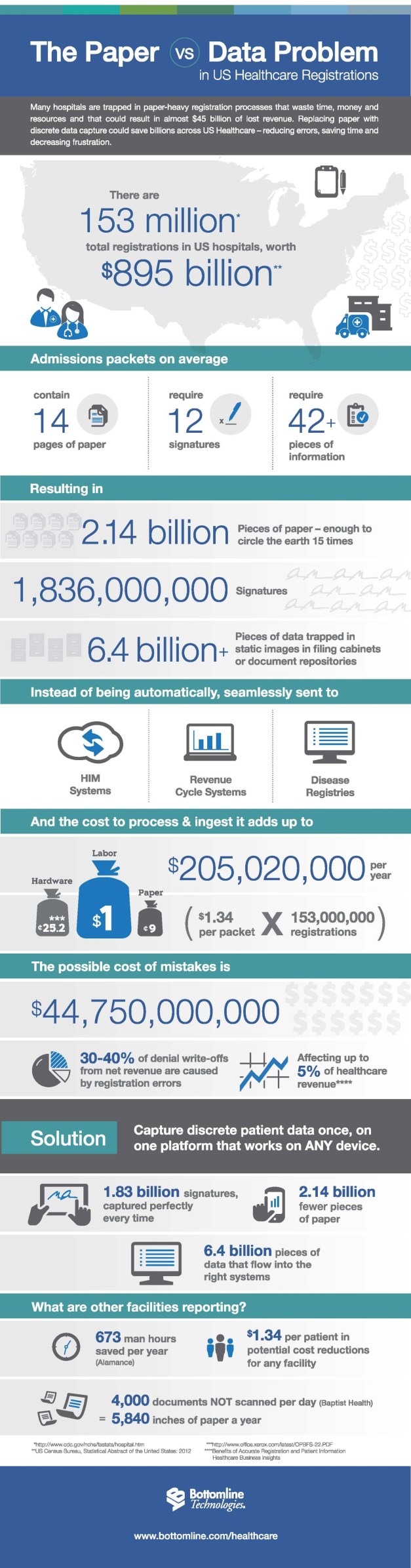
Included is a timely infographic by Bottomline Technologies which indicates that hospitals could save up to $45 Billion per year by switching from traditional paper based registrations to cloud based data storage services. It’s something to certainly ponder.

There’s an “enormous opportunity” to take costs out of the process “by actually fixing the revenue cycle,” – Healthcare IT News

Posted by timmreardon on 12/09/2013
Posted in: Health Care Costs, Health Care Economics, Integrated Electronic Health Records, Quality Measures. Tagged: Allscripts, Business, ICD-10, John Hoyt, MEDITECH, Piper Jaffray, RCM, Regional county municipality. Leave a comment

Mike Miliard is Managing Editor at Healthcare IT News. Mike covers topics such as health information exchange, privacy and security, analytics and ICD-10. Follow Mike on Twitter @MikeMiliardHITN.

Revenue cycle ripe for radical change

‘I don’t mean by incremental process improvements. I mean blowing it up.’

December 9, 2013

Article link: http://www.healthcareitnews.com/news/revenue-cycle-ripe-radical-change

“I’m surprised that we continue to see the status quo in revenue cycle management,” says Sean Wieland, managing director and senior research analyst at Piper Jaffray.
“Healthcare is the only industry that has a revenue cycle with a designated subsector of companies that manage it,” he explains.
Worse, “It costs 20 to 30 cents on the dollar to cross a trade in healthcare – to take the money from the buyer of healthcare, the self-insured employer, and put it into the pockets of the providers of healthcare,” says Wieland.
“If any other industry had a revenue cycle like that, we’d all be living like the Amish,” he says. “Wall Street crosses a trade for fractions of a penny.”
There’s an “enormous opportunity” to take costs out of the process “by actually fixing the revenue cycle,” says Wieland. “And by fixing I don’t mean by incremental process improvements. I mean blowing it up. And really rethinking the process of how we go about getting doctors and hospitals paid.”
Given all the advances in health information technology over the past decade, it’s disheartening that the “kabuki theater we call revenue cycle is still happening today,” says Weiland. “But I think over the next 10 years we’re going to see some radical improvements.”
On the ambulatory side, “I’m looking at companies that provide disruptive technologies in revenue cycle to really change the landscape there,” he says. “Namely athenahealth.”
On the inpatient side, “what’s going to force that change” is health systems vertically integrating risk into their models, says Wieland. “Taking that risk from the payers and putting it on their books, by definition that disrupts the revenue cycle because there won’t need to be one. The premium dollar will go to the health system and they’ll have to manage that cost.”
In the meantime, it’s clear that healthcare organizations are dissatisfied with their RCM options. And any changes in the near future do look to be incremental.
KLAS released a report this past month titled, “2013 Revenue Cycle Perception – Providers’ Wish List: Integration, Single-Source, Reform.”
That last word is telling. As healthcare enters its patient-centered, payment-bundled era, hospitals and physicians are looking for a shakeup.
“RCM integration with both inpatient EMR and ambulatory EMR/patient accounting is at the forefront of their minds as most look to establish an enterprise-wise revenue cycle strategy that supports today’s value-based models of care including things like episode-of-care billing, family billing, and bundled payments,” writes the report’s author, Lois Krotz, strategic operations director at KLAS.
While such a holistic approach to integration is critical in most providers’ opinions, few RCM suites are able to offer it, according to the study.
For instance, 77 percent of providers “believe patient accounting and practice management integration is important and critical to their revenue cycle environment,” but just 14 percent of vendors offer the capability.
“Cerner, Epic, GE, and Siemens all have integrated PA/PM solutions, but adoption levels and experience vary,” she adds. “LSS is not integrated but rather is tightly interfaced with MEDITECH, with high satisfaction. McKesson and Allscripts don’t currently have integrated PA/PM offerings.”
According to KLAS, 78 percent of providers say inpatient EHR integration is their key concern; 41 percent say it’s ambulatory integration.
And to judge by the revenue cycle directors interviewed for the report, many of them are unhappy, and aren’t holding out much hope for a positive change..
“The integration and functionality we get with our current solution is terrible, and there isn’t a viable solution in the near future for us to consider,” says one. “We lack the overall confidence that our vendor can pull things off and offer a workable solution, which has pushed us to look elsewhere.”
“With all the ICD-10, accountable care, and other changes coming, we know something needs to change here,” says another.
That’s a sentiment that was echoed by John Hoyt, executive vice president of HIMSS Analytics, in the June 2013 print issue of Healthcare IT News.
“There’s a new future for revenue cycle,” he said. “We’ve been nipping away at trying to save money in Medicare for years, but we need fundamental change, and we all know it. And it’s coming in the form of ACOs or bundled payments and this type of thing.”
Put simply, said Hoyt, “The revenue cycle systems we’ve had, for the past 10 years, are not prepared to do that.”
New capabilities are on the way. But not just yet.
“The vendors are telling us that they’re preparing, and they’re looking at revenue cycle redesigns to take into account bundled payments and ACO reimbursements,” said Hoyt. In the meantime, most providers have other things to invest in before they splurge on next-generation RCM systems, he said. “They’re not going to buy them until they’ve gotten all they can get out of meaningful use.”
After that? “We think there’s going to be a boom”

[See also: RCM market expected to grow by leaps]

Care coordination software key to realizing the value of HIE – Healthcare IT News

Posted by timmreardon on 12/09/2013
Posted in: Health Care Costs, Health Care Economics, Integrated Electronic Health Records, Quality Measures. Tagged: Clinical decision support system, Electronic health record, Health Information Exchange, Health information technology, HIE, Patient, Physician, Population health. Leave a comment

Lori Evans Bernstein, President of GSI Health

December 6, 2013

Hospital systems and accountable care organizations are demanding tools to better manage population health.  A major challenge healthcare organizations face is choosing health information technology solutions that place clinical value, care coordination and patient outcomes first.

A traditional health information exchange (HIE) assembles clinical data from a variety of disparate sources and presents it to users. These traditional systems are necessary but not sufficient to support care coordination and population health.  Care Coordination software is essential to realizing the value of health information exchange.  Here’s why:

  • Data overload: An HIE summary may contain too much data and, paradoxically, not enough information. There are plenty of relevant details, but the information must be actionable and intelligently organized in order to support clinical programs and workflow among care team partners.
  • Lack of meaningful context: A traditional HIE system may not provide the clinical workflow context to the information to appropriately guide the next steps in care coordination. Care teams need this context applied to the information via workflow friendly applications provided by care coordination software.

Care coordination software can make HIE more valuable, giving it more currency to help providers track and manage patients as they move through the delivery system, including: dynamic management of care transitions, care planning, referral management, clinical decision support and medication reconciliation. Here’s how:

  1. It applies clinical relevance and workflow context to the information: Care coordination software condenses and reconciles the data from different sources and formats into customized summaries that each provider sets up, presenting the details most relevant to their role as a care manager, primary care physician, specialist and other team members. Behind the scenes, the platform automatically applies logic to the information and feeds it to the relevant applications and users in support of care coordination. For example, a primary care physician is alerted to hospital discharge and can immediately view/update a care plan, manage referrals, reconcile medication list and initiate additional services or communications with other providers.
  2. Puts the power in the hands of the user: A care coordination software platform helps manage population health through efficient clinical decision support.  For example, according to established clinical protocols, upon hospital discharge a patient is required to visit the primary care physician within seven days. The care providers would be prompted if the patient has not followed the care instructions. The clinical protocols or care steps operate behind the scenes while the platform watches for any deviation from the protocols.
  3. Uses collaborative tools to reconcile information and streamline communication: Care coordination software can increase the efficiency of processes such as medication reconciliation as patients receive care among multiple settings. For example, the care manager can survey the patient’s full medication record in order to create a care coordination summary of medications excluding old information that’s no longer relevant and including new information in real-time providing timely updates. This helps the care team to be able to quickly know the top line issues facing their sickest and most costly patients.  The physician can quickly review the care manager’s actions and click to confirm the medication reconciliation.

Care coordination software is essential to realizing the value of health information exchange. Organizations and delivery systems need data presented in more actionable and more valuable formats through workflow friendly applications to improve care coordination and manage population health to improve patient outcomes.

Topics: Health Information Exchange (HIE), Quality and Safety, Clinical Decision Support (CDS)

An effective eye drug is available for $50. But many doctors choose a $2,000 alternative. – Washington Post

Posted by timmreardon on 12/09/2013
Posted in: Health Care Costs, Health Care Economics, Integrated Electronic Health Records, Quality Measures. Tagged: Avastin, Bevacizumab, Dan Keating, Food and Drug Administration, Genentech, Lucentis, Medicare, Ranibizumab. Leave a comment

By  Peter Whoriskey and Dan Keating, Published: December 7

The two drugs have been declared equivalently miraculous. Tested side by side in six major trials, both prevent blindness in a common old-age affliction. Biologically, they are cousins. They’re even made by the same company.

But one holds a clear price advantage.

Avastin costs about $50 per injection.

Lucentis costs about $2,000 per injection.

Doctors choose the more expensive drug more than half a million times every year, a choice that costs the Medicare program, the largest single customer, an extra $1 billion or more annually.

LUCENTIS%20Product%20Shot1386367811

Spending that much may make little sense for a country burdened by ever-
rising health bills, but as is often the case in American health care, there is a certain economic logic: Doctors and drugmakers profit when more-costly treatments are adopted.

Genentech, a division of the Roche Group, makes both products but reaps far more profit when it sells the more expensive drug. Although Lucentis is about 40 times as expensive as Avastin to buy, the cost of producing the two drugs is similar, according to scientists familiar with the drugs and the industry.

Doctors, meanwhile, may benefit when they choose the more expensive drug. Under Medicare repayment rules for drugs given by physicians, they are reimbursed for the average price of the drug plus 6 percent. That means a drug with a higher price may be easier to sell to doctors than a cheaper one. In addition, Genentech offers rebates to doctors who use large volumes of the more expensive drug.

“Genentech continues to maintain that Lucentis is the most appropriate medicine,” the company said in a statement, adding that it costs “significantly” more to make and is tailored for use in the eye. The drug “has made an immense impact.”

Many ophthalmologists, however, are skeptical that it provides any added value over the cheaper alternative.

“Lucentis is Avastin — it’s the same damn molecule with a few cosmetic changes,” said J. Gregory Rosenthal, a Toledo ophthalmologist who, outraged by the price, co-founded a group called Physicians for Clinical Responsibility to protest its use. “Yet Americans are paying a billion dollars every year for no good reason — unless you count making Genentech rich.”

The story of Genentech’s two drugs, Lucentis and Avastin, began with a scientific marvel — a breakthrough in biology that, thanks to the vast budgets of U.S. entitlement programs, has produced enormous financial returns.

Those profits have yielded benefits. By paying for such drugs without regard to cost, the Medicare system has helped stimulate investment in medical research that contributes to the development of more lifesaving technologies.

But the flow of cash also pushes up the health-care costs that are projected to deplete federal budgets. For while Genentech has aggressively marketed the more expensive drug and sought to restrict the use of the cheaper one, critics say, Medicare has been powerless to do anything but pay up.

That’s because over the past seven years, despite pleas from the Food and Drug Administration and doctors groups, Genentech has maintained the barriers that make it harder for doctors to use the cheaper drug.

Avastin was not originally intended for use in the eye, and the company has refused encouragement from the FDA to seek official approval for using it to treat eye ailments, according to unpublished internal FDA documents. This forces doctors to use it “off-
label,” or in ways not specified on the medicine’s label.

The company also packages the drug, which was approved for cancer in 2004, in doses far too big for use in ophthalmology, meaning that the drugs must be repackaged by other companies for use in the eye, raising the risk of contamination.

Genentech has argued that Avastin may pose a greater danger of severe side effects than does Lucentis, although independent scientists say such worries are unsupported by the six trials that have been conducted.

In a statement, the company said that it has not sought FDA approval of the cheaper drug for use in the eye because it has already developed one drug for the ailment known as wet age-
related macular degeneration, or wet AMD.

“Genentech continues to maintain that Lucentis is the most appropriate medicine for wet AMD as supported by clinical and other scientific data,” the statement said.

“We specifically designed Lucentis for use in the eye and to clear quickly from the bloodstream after leaving the eye to potentially minimize side effects,” the statement said. “The two medicines were designed for different purposes and, we believe, may have different systemic and ocular safety profiles when used in the eye.”

Genentech defended its pricing by noting that the Roche Group spends $9 billion annually on research and development.

“The price of Lucentis supports the research and development of new potential medicines, including the 92 percent of drugs that never make it to patients,” the company said. “We re-invest a larger portion of our revenue into clinical research than most pharmaceutical companies. Genentech believes it is in the best interest of patients to continue to focus our efforts in ophthalmology on discovering and developing new potential medicines for other serious diseases of the eye.”

Most doctors, however, prefer to use the cheaper drug. Despite the company’s position, U.S. doctors have been using Avastin in about 56 percent of such cases, according to Medicare data analyzed by The Washington Post. In the most recent survey by the American Society of Retinal Specialists, about 61 percent of doctors preferred using Avastin for macular degeneration, with the rest of the market split between Lucentis and Eylea, a new drug made by Regeneron that is almost as expensive as Lucentis.

Because so many doctors continue to use Lucentis, Genentech has rung up more than $1 billion in U.S. sales of the drug for four years running. Roughly 80 percent of U.S. sales are paid for by Medicare and its beneficiaries.

The rising cost of U.S. entitlement programs such as Medicare has prompted outrage in Congress, but it is Congress that has made it difficult in this case and others for Medicare to limit such expenses.

To begin with, the Medicare agency is blocked from seeking better drug prices by negotiating directly with the drug companies, as health agencies in other countries do. Authorities in Britain, for example, have negotiated a price of about $1,100 per dose of Lucentis, and in the Netherlands a dose sells for about $1,300.

Moreover, in cases in which two equivalent options are available, such as  Lucentis and Avastin, Medicare is forbidden from restricting payment to the amount of the less costly alternative. After it sought to do so in 2009, a federal appeals court said it lacked that authority.

It’s often difficult, of course, to know when two drugs are equivalent. When the debate over the two drugs and their pricing erupted more than six years ago, Genentech asserted that its more expensive new drug was superior. At the time, it was hard to show otherwise. No one had tested them in side-by-side comparisons.

Since then, the six randomized clinical trials involving more than 3,000 patients have found the drugs to be largely equivalent.

Yet in 2012, the Medicare program and its beneficiaries spent $1.2 billion on Lucentis, according to The Post’s analysis of Medicare data.

Medicare officials said they have no choice but to pay the bill when a doctor prefers to use Lucentis.

“We do not have the authority to dictate treatment based on cost,” Tami Holzman, a spokeswoman for the Centers for Medicare and Medicaid Services, said in a statement. “Under current law, Medicare must cover treatment that is deemed reasonable and medically necessary by a physician or other provider.”

Pharmaceutical firms argue that this is the way it should be.

The industry’s main lobbying group, known as PhRMA, opposes allowing the government to negotiate prices with companies — a process it calls “price controls” — and similarly opposes attempts by Medicare to pursue a policy of paying only for the least costly alternative.

The industry has spent more than any other in the United States to have its voice heard in Washington. Over the past 15 years, the pharmaceutical industry has far outstripped any other in the money it has devoted to lobbying, according to data from the Center for Responsive Politics. Drug companies spent a total of $2.7 billion over that time.

“Proposals to change this system by imposing price controls or only giving patients access to treatments deemed the ‘least costly alternative’ by Medicare would have severe unintended consequences,” Matthew Bennett, a senior vice president at PhRMA, said in a statement.

Such proposals could discourage medical progress, he said. Moreover, because every patient responds differently to a treatment, it may be difficult for the government to set rules for coverage.

“The cheapest option on average is not always the best option for many patients,” he said.

What’s the right price for a miracle?

Every year, about 200,000 people in North America are diagnosed with wet age-related macular degeneration, a chronic disease characterized by abnormal blood vessels that leak blood or fluid into the retina.

Sufferers lose clarity in the center of their field of vision, and among older people it has long been the leading cause of blindness.

Then came Avastin and Lucentis.

Both are the outgrowth of pioneering work done by Napoleone Ferrara, a Sicily-born molecular biologist.

Ferrara studied at the University of California at San Francisco and joined Genentech in 1988. First assigned to the company’s efforts to develop a hormone called Relaxin, Ferrara devoted his discretionary research to a theory that blood vessel growth could cause cancer and other illnesses.

Over several years, Ferrara and his collaborators identified a protein called VEGF that causes blood vessel growth. They then linked that protein to cancer and macular degeneration. Finally, they developed an “anti-VEGF” drug that would attack VEGF, halting the harmful blood vessel growth.

The first anti-VEGF drug was Avastin, which won approval from the FDA in 2004 for the treatment of colorectal cancer.

Lucentis followed. It is a stripped-down version of the same molecule, and it can likewise attack VEGF and bind more closely to it. It won FDA approval in 2006.

“People weren’t sure that VEGF would prove particularly important, but sometimes in science, you just follow your own ideas,” said Ferrara, now a distinguished professor at the University of California at San Diego School of Medicine. “The magnitude of the benefit of these drugs far exceeded our expectations.”

The company spent almost $1.4 billion on the development of Lucentis, which included 18 clinical trials, a Genentech vice president testified to Congress in 2011.

The company appears to have recovered those costs and quite a bit more.

In the first 2 1/2 years, it sold $2.1 billion worth of Lucentis in the United States alone. Another Swiss company, Novartis, in partnership with Genentech, sells billions more overseas.

Much of that is profit.

The company will not disclose how much it costs to manufacture a dose of Lucentis, saying only that it costs “significantly” more to make than Avastin. But scientists knowledgeable about manufacturing drugs of this kind say that the costs of making Lucentis are not much different from those of making Avastin.

Indeed, some scientists said that some aspects of Lucentis make it cheaper to produce.

The Avastin process begins with growing a culture from mammalian cells taken from the ovary of the Chinese hamster.

The Lucentis process begins with growing cultures of the common bacteria E. coli, and these are easier to produce.

The subsequent purification process with bacteria may be more complicated, but “production in bacteria is cheaper than in mammalian cells for several reasons,” said Hervé Watier, a medical professor at the University of Tours in France who has studied the drugs.

While there are some “drawbacks” to the bacteria production method, Watier said, “the financial result still remains in favor of bacteria.”

“I think the difference in cost in producing them is very modest. They cost almost the same, from what I can tell,” Ferrara said.

If so, Genentech is making a lot on each dose. The manufacturing costs may account for 10 percent or less of the price of a Lucentis dose, according to a conservative calculation generated with industry experts.

The company declined to reveal how much it is making from Lucentis above the drug’s manufacturing costs.

“Lucentis and Avastin are not the same medicine and should not be treated, nor represented, as if they are,” the company said in a statement.

After the development of Lucentis in the early 2000s, it was the only drug known to have such effects.

It seemed to be in a class by itself and seemed poised to win even more in sales than it gathers today.

But then Philip J. Rosenfeld, a Miami ophthalmologist, made a discovery.

Rosenfeld was lead investigator on some of the Lucentis trials that Genentech had conducted, and he recognized how effective it could be.

After reading the research that some Genentech scientists had published, he realized that Avastin and Lucentis were derived from the same antibody and thus were functionally equivalent.

“I realized they would perform in the same way,” he said.

Under a university-approved research program, he’d also learned that Avastin, injected into a patient’s arm as is done with cancer patients, had the same effects as Lucentis. The trouble was, since the Avastin was going into the entire body, a large dose was needed, and that could produce dangerous side effects. He calculated that a much smaller dose injected into the eye would be just as effective as Lucentis.

In May 2005, Rosenfeld had a patient who was quickly losing her vision. A retired nurse in her 60s, she’d lost the use of one eye already, and none of the available remedies could slow the disease’s progression.

Rosenfeld knew that Lucentis could help her, but it would be another year or more before the FDA would approve it.

With the patient’s permission, he injected her eye with a small dose of Avastin — one milligram — and ordered her back the next week.

“We were astounded by the results,” he said.

The billion-dollar drug Lucentis was about to be beaten to market, and by one of Genentech’s own products.

In July 2005, Genentech held what amounted to a coming-out party for its new drug.

At the annual meeting of the American Society of Retinal Specialists, the company presented several detailed studies showing how effective it was in treating macular degeneration. With hundreds of ophthalmologists crowded into the room, speakers for Genentech described the marvel of Lucentis.

“Our jaws were on the floor,” recalled Daniel F. Martin, chairman of the Cole Eye Institute at the Cleveland Clinic.

Right after, Rosenfeld presented his Avastin experiment on one patient.

“Phil showed one case report — no animal studies, no randomized trials,” Martin said. “But after this meeting, every ophthalmologist on the planet was injecting it. The therapeutic effect was so powerful.”

Because Lucentis had yet to win FDA approval and couldn’t be sold, ophthalmologists quickly embraced Avastin, which had been approved the year before, albeit as a cancer remedy.

When Lucentis did go on sale, Genentech’s blockbuster drug already had a competitor. How could the company convince doctors and hospitals that Lucentis had any major advantage over Avastin?

Over and over again, it sought to discourage the use of Avastin by raising concerns about its safety.

They told doctors that Avastin was not approved by the FDA for use in the eye — Lucentis was. They reminded doctors that if the repackaging firms cutting Avastin into smaller doses were careless, infection could be introduced. And despite the lack of conclusive evidence on the point, they said that Avastin patients might suffer more adverse events than Lucentis patients.

Sometimes, senior FDA officials said, these warnings stretched the truth.

In October 2007, the company announced a move that would severely restrict the supply of Avastin for ophthalmology: It would no longer sell the drug to the repackaging firms that were cutting it into eye-appropriate doses.

The company’s president of product development at that time, Susan Desmond-Hellmann, explained in a letter that Lucentis was already available. Moreover, she said that during a routine FDA inspection of the company’s Avastin manufacturing facility, “concerns were raised by inspectors related to the ongoing ocular use of Avastin because it is not designed, manufactured or approved for this use.”

An FDA ophthalmology official, Wiley A. Chambers, told colleagues that the company had misconstrued the agency’s position.

That routine FDA inspection at a Genentech plant, Chambers told his colleagues, was unrelated to the intrinsic safety of Avastin in ophthalmology. Instead, it showed that Avastin had been contaminated by glass particles, a danger that could have harmed cancer patients or eye patients.

“Genentech has found a way to blame FDA for their decision to limit the distribution of Avastin,” Wiley wrote to colleagues in an e-mail. “The manufacturing problem at their facility that resulted in glass in their product would be an issue for either the on-label oncology indications or the off-label ophthalmology indications.”

Genentech said in a statement: “We have never sought to restrict the ability of physicians to prescribe Avastin as they see fit for their patients. . . . Genentech did not blame the FDA and took the decision independently.”

Eventually, after ophthalmologists and their professional societies strenuously objected to Genentech’s move to limit Avastin sales — they even threatened lawsuits to make sure the flow of Avastin continued — Genentech backed down and continued to provide the drug to the repackaging firms.

About the same time, Genentech asked the FDA for permission to change the Avastin label to instruct doctors that it was not to be used for eyes. The FDA said there was no evidence to support such a change to the label.

The FDA believed “there was no safety-related basis adequately justifying that labeling change,” according to an internal agency e-mail, and the label was not changed.

Today, millions of doses of Avastin have been administered successfully. Six randomized clinical trials around the world, beginning with one called Comparison of AMD Treatments Trials, have found its effectiveness equivalent to that of Lucentis. After the CATT study, the National Institutes of Health issued a news release headlined, “Study finds Avastin and Lucentis are equally effective in treating age-related macular degeneration.”

The effort was funded by the NIH because Genentech had refused to test the drugs itself and, in a break from industry custom, had refused to provide the drugs to government researchers. An internal company document described the strategy of not performing a test or contributing the drugs as “in the interests of shareholders and the interests of patients,” according to a Senate Aging Committee investigation memo from 2008.

Because it had developed Lucentis, the company said, “there was no need to invest substantial resources and years of clinical development to explore the safety and efficacy of another medicine.”

Since the CATT study, five more head-to-head trials have been conducted. They also found Avastin just as effective as Lucentis.

“There have now been six randomized clinical studies that show no difference in the major areas of safety concern — deaths, heart attacks and stroke,” said Martin, the Cleveland Clinic doctor who also led the CATT trial.

Indeed, Genentech has acknowledged that the drugs are similarly effective. But the company has argued that Avastin may be dangerous when used in eyes.

“The emerging data consistently show differences in safety — particularly in systemic serious adverse events — between Lucentis and Avastin,” Anthony P. Adamis, global head of ophthalmology at Genentech, said in an interview.

These differences are “biologically plausible,” Adamis said, because studies have shown that Avastin remains in the blood longer.

The main basis for Genentech’s safety argument is a finding in the CATT trial that has not reappeared in any of the following five trials and that some scientists involved regard mainly as a curiosity.

The incidence of what are known as serious adverse events — a catchall category that includes hospitalizations for any reason — was slightly higher in the Avastin group: 40 percent vs. 32 percent. The adverse events included broken bones and urinary tract infections.

“The majority of the adverse events would be difficult to imagine being caused by the drug,” Martin said. Martin noted that while small, probably random effects favored Lucentis in some cases and in others they favored Avastin. Neither should be viewed as conclusively related to the drug, he said.

It is very difficult for such trials to detect differences in rare safety events. To do so, a trial might need more than 10,000 patients. Running a trial of that size could cost billions of dollars.

To look for effects in large numbers of patients, researchers often turn to Medicare claims records, examining how patients fared on the treatments in question. It is this kind of review that Lesley H. Curtis, a Duke University medical professor, performed, looking at 146,000 patient claims.

After fully adjusting for patient and provider characteristics, Curtis and her colleagues found that there was no difference in the safety profiles in the drugs.

“In conclusion, we found no evidence of increased risks of mortality, myocardial infarction, bleeding, or stroke,” their research paper said.

The other danger to using Avastin, however, has attracted a lot of publicity in recent years.

The fact that the drug needs to be repackaged into smaller doses introduces an element of risk because it opens the possibility that the drug could be tainted during the repackaging process. (Genentech says because the FDA has not approved it for use in the eye, the company cannot legally distribute Avastin in doses appropriate for the eye.

Indeed, in three cases that made the news — in South Florida, Nashville and Los Angeles — just such a problem has arisen. Several patients reportedly suffered vision loss as a result.

“I’ve never used Avastin because of the potential for contamination,” Warren L. Herron Jr., a Pensacola, Fla., ophthalmologist, said after a morning in which he did 11 eye injections. “Is it a rare thing? Yes, it’s a rare thing. But I can’t stand the idea of ever telling my patients that they can no longer see because I used a tainted drug.

“Besides,” he said, “I don’t think the extra money being spent for Lucentis is totally wasted because it’s going into research and development.”

But as Herron noted, the likelihood of contamination is negligible. Globally, hundreds of thousands of injections are doled out every year without trouble, making the risk of contamination in repackaging smaller than the risks that doctors routinely ignore when deciding on a treatment.

Whether a patient gets Avastin, Lucentis or the new drug Eylea depends on an array of factors. Some doctors use only one of the drugs; some let their patients choose; many decisions are guided by whether the patient’s insurance covers the entire cost or just a portion; and some doctors may consider how much they earn with each drug.

John Thompson, a Baltimore ophthalmologist who is president of the American Society of Retinal Specialists, noted that most doctors use Avastin and that even more would do so if the company sought FDA approval for using it in eyes and packaged it in appropriate doses.

“If Genentech decided to get FDA approval and make Avastin available in small quantities for the eye,” he said, “the American Society of Retinal Specialists would applaud.”

WHAT KIND OF IT DO WE NEED FOR VALUE-BASED HEALTHCARE? – HIE Watch

Posted by timmreardon on 12/06/2013
Posted in: Integrated Electronic Health Records, Quality Measures. Tagged: Electronic health record, Health Information Exchange, Health information technology, Health maintenance organization, Managed care, Medicare, Patient, United States. Leave a comment

Source: Robert Rowley, MD, GroupMD     Date: Dec 4, 2013    e-mail to a friend

Article link: http://www.hiewatch.com/perspective/what-kind-it-do-we-need-value-based-healthcare

The trend toward value-based payment is gaining momentum. Except for efforts around managed care, where a fixed capitated fee is paid to risk-taking organizations for a defined population of patients, fee-for-service has been at the core of how we do business in healthcare. What kind of health IT tools do we need for the new direction?

Traditional Medicare, based on a fee-for-service model, has experienced cost escalation year-over-year. One way of mitigating this faster-than-inflation escalation of Medicare costs was the Sustainable Growth Rate (SGR) formula, which ratchets down the dollars-per-unit of service to partly offset the growth in units of service that are billed by healthcare providers. That would have meant that each year, Medicare payment rates would have been lowered – with the adverse outcome that more doctors would refuse to participate in Medicare, and access to enrollees would be more limited.

Each year, Congress has come up with last-minute postponements in SGR, with the results that the SGR formula is seen by many as a fundamentally broken process.

Against this backdrop, the recent news that both houses of Congress are intending to work together to scrap the broken SGR formula, and replace it with a more permanent solution is very significant. Notable among the key points on the SGR discussion is to “improve the physician payment system to reward value over volume, ensuring beneficiaries and taxpayers receive value for the money spent.”

Value based pay for performance


Simultaneous to this shift in federal circles toward a more value-centered method of paying for healthcare, similar shifts are being seen in the managed care market. In California, HMO care has mainly been deployed through large, sophisticated risk-taking medical groups and IPAs (the “delegated model”), where these groups receive fixed payments from HMO insurers and assume responsibility for rendering quality healthcare. Since 2001, the Integrated Healthcare Association (IHA) – a consortium of HMO insurers, hospital systems and medical groups – has set criteria for evaluating and measuring performance, and has facilitated a pay-for-performance (P4P) method where good-performing groups get paid a bonus by health plans over-and-above their base capitation rates. This is a business model for quality.

Since the inception of P4P, the focus has been mainly of measuring and improving quality. However, for a number of reasons, this has not bent the cost-escalation curve. Now, the IHA is moving toward a new methodology, referred to as Value Based P4P, where the rewards are not just based on quality and other measures, but also on the total cost of care (hospital, outpatient, ancillary and pharmacy costs). Medical groups that participate in the IHA are looking at how to re-tool themselves to take on this new challenge.

What kinds of health IT do we need?


Clearly, these two examples of major system changes (there are other examples, to be sure) illustrate the growing momentum toward a healthcare delivery system that needs to measure and be accountable for quality, while keeping track of the total cost of healthcare delivered. It is a fundamental paradigm shift that runs underneath the headlines.

We have come a long way in moving healthcare documentation from paper to electronic platforms in the past several years. In 2007 somewhere around 7 percent of ambulatory doctors’ offices used electronic health records (EHRs), and most of them were closely associated with institutions and medical centers that provided them. In 2013, over 50 percent of doctors in the U.S. were using certified EHR systems.

Moving from paper to EHRs has been a significant step forward. However, health data remains largely siloed, residing within the institutions that created them. There has certainly been consolidation – linking hospitals with community physicians (mostly through local community health information exchange mechanisms), and creating “enterprise charts” for patients within unified delivery systems. But we still have a long way to go.

The two main areas where modern health IT will be needed for the changes toward value-based reimbursement might be thought of as these:

  1. Tools to measure the health status of populations. This is a combination of Clinical Quality Measures (CQMs), which are population-based measures showing how different providers are faring with respect to managing their patients’ conditions, and Clinical Decision Support (CDS), which are patient-specific prompts letting the provider know what recommended things are due at the time of service. These tools need to measure cost as well as quality.

  2. Tools that facilitate care collaboration. As healthcare delivery becomes more accountable, it must become more collaborative. There need to be tools that support real-time communication between healthcare providers, allowing conversations to take place that have access to shared, universal patient data. Further, patients need to be able to participate in these conversations, and give proper consent for access to their data.

To elaborate a bit more on the second point: a collaboration platform is more than just a shared patient record (though, certainly, a shared patient record is part of it). A universal PHR (Personal Health Record), though a step in the right direction, is still currently a library that one needs to go to in order to pull data that is in there (and whose usefulness is a function of the number of subscribing inputs).

Collaboration is more real-time, more dynamic. It needs to be a mobile-first technology, more than a web-first one. It needs to be able to capture bits of conversation back and forth between care team members (including the patient), sharing cumulative patient data. That data is populated by the conversation content as it accumulates, in addition to EHR data pulled from each participating provider.

Conclusions

How we pay for healthcare is changing. The fee-for-service approach, a hallmark of U.S. healthcare traditionally, is being phased into a system that pays for value over volume. We see this in some major trends – the discussion at the federal level of replacing the broken SGR formula with something more value-oriented, and the shift in managed care toward Value Based P4P.

The technology needs for this new paradigm will be different. Of course, we need health data to be on electronic platforms. These platforms will evolve to serve the institutions that deploy them, and will contain CQM and CDS capabilities, as well as cost-visualization capabilities that include all areas where cost is generated (hospital, outpatient, pharmacy and ancillary) – such systems will show you “what you have done,” somewhat retrospectively.

Just as important (arguably, even more important) are technologies that facilitate care collaboration. This is patient-oriented, provider-driven, cross-institutional, mobile-first, nimble and data-centered. Such systems will show you “what you are doing,” not in retrospect, but in real-time and going-forward. Needless to say, this is where my current interest is focused.

Robert Rowley is a co-founder and chief medical officer of GroupMD; this blog originally appeared at robertrowleymd.com.

The Road toward Fully Transparent Medical Records – NEJM

Posted by timmreardon on 12/05/2013
Posted in: Integrated Electronic Health Records, Quality Measures. Tagged: Beth Israel Deaconess Medical Center, Geisinger Health System, Harborview Medical Center, Health care provider, Health Insurance Portability and Accountability Act, Mayo Clinic, Robert Wood Johnson Foundation, Veterans Health Administration. 1 Comment

Article link: http://www.nejm.org/doi/full/10.1056/NEJMp1310132

Jan Walker, R.N., M.B.A., Jonathan D. Darer, M.D., M.P.H., Joann G. Elmore, M.D., M.P.H., and Tom Delbanco, M.D.

December 4, 2013DOI:  10.1056/NEJMp1310132

Forty years ago, Shenkin and Warner argued that giving patients their medical records “would lead to more appropriate utilization of physicians and a greater ability of patients to participate in their own care.”1 At that time, patients in most states could obtain their records only through litigation, but the rules gradually changed, and in 1996 the Health Insurance Portability and Accountability Act entitled virtually all patients to obtain their records on request. Today, we’re on the verge of eliminating such requests by simply providing patients online access. Thanks in part to federal financial incentives,2 electronic medical records are becoming the rule, accompanied increasingly by password-protected portals that offer patients laboratory, radiology, and pathology results and secure communication with their clinicians by e-mail.

One central component of the records, the notes composed by clinicians, has remained largely hidden from patients. But now OpenNotes, an initiative fueled primarily by the Robert Wood Johnson Foundation, is exploring the effects of providing access to these notes.3 Beginning in 2010, at Beth Israel Deaconess Medical Center (which serves urban and suburban Boston), Geisinger Health System (in rural Pennsylvania), and Harborview Medical Center (Seattle’s safety-net hospital), more than 100 primary care doctors volunteered to invite 20,000 of their patients to read their notes securely online.4

Although only a small minority of these doctors’ patients used the portals, the initial findings were striking. At the end of a year, four of five patients had read the notes, and among those who responded to a survey, large majorities reported having better recall and understanding of their care plans and feeling more in control of their health care. Moreover, two thirds of patients who were taking medications reported improved adherence. Doctors reported little effect on their work lives and were surprised by how few patients appeared troubled by what they read. Although the notes were not formally evaluated, the majority of doctors reported not modifying their tone or content. A minority, however, reported changing the way they addressed four potentially charged topics: cancer, mental health, substance abuse, and obesity. After the first year, 99% of the patients surveyed wanted “open notes” to continue, 85% of the patients indicated that ready access would be important for their future choice of a provider or system, and no doctors chose to discontinue the practice.

Despite limitations in the sample, the findings persuaded our three institutions to implement open notes broadly. Leading health care organizations, including M.D. Anderson Cancer Center, Mayo Clinic, and the Veterans Health Administration, are doing so also, many others are in the planning stages, and clinicians are experimenting within their practices.5

Early adopters are learning that implementation means more than simply mailing notes or visit summaries or having patients log on to a portal. For starters, the knowledge that patients (and often their families) will have access to records affects the intent and sometimes the content of clinical documentation. Writing accurately about a suspicion of cancer, for instance, can be difficult for clinicians who don’t want to worry patients unnecessarily, and addressing character disorders or cognitive dysfunction in ways that are useful to patients, consulting providers, and others who use the records requires carefully considered words. These challenges are compounded by today’s electronic records, in which the story weaving together social, familial, cultural, and medical contributors to the patient’s health and illness often disappears, obscured by templates. A boon to billers, quality assessors, and researchers, such records can become formulaic and susceptible to data-entry errors. Moreover, they’re often filled with copied-and-pasted information that buries the essential narrative under voluminous repetitive text.

As open notes spread at our institutions, clinicians are expressing widely varied preferences. Some want the option to hide notes, or portions of notes, from patients or families, and some want ways to communicate with colleagues privately. Some worry that “watered-down” notes will obscure important medical details, and mental health professionals appear to be divided about the effects of sharing their notes with patients. Overall, our experience suggests that doctors initially feel safest when they can choose what patients can see, but as they evaluate feedback from patients and colleagues and learn to discuss choices with their patients, their preconceived limits tend to fade away. Ideally, both patients and providers should be able to set preferences about sharing information, but current health information systems can’t handle such nuance.

As patients become familiar with medical records and clinical notes, they consider new opportunities and risks. Some say they have become more careful about what information they share with clinicians, and some ask for more control over access to their information. Providers are experimenting with strategies that help patients protect their privacy with regard to mental health, sexual function, suspected abuse, or other sensitive topics. And though family caregivers may find that reading notes improves their understanding of care plans and reduces stress, it’s a complex task to establish separate proxy access based on patients’ preferences about who gets to see what.

As transparent practice evolves, it’s impossible to predict how much patients may stray from long-standing conventions. Portals afford patients secure access to their information, and doctor–patient confidentiality remains undisturbed. But patients’ attitudes toward privacy may change as online access allows them to share documents, including notes. A third of patients in the OpenNotes study expressed concern about privacy, but more than one in five shared a note with others who could clarify meanings, offer clinical insights or second opinions, or — for those participating in the patient’s care — improve their own knowledge. Indeed, some patients may choose to post their providers’ progress notes on Facebook, Twitter, medical forums, and other social media, potentially exposing clinicians to public scrutiny and crowd-fueled praise or criticism.

Among the institutional adopters we’ve encountered, most have opened access to notes written primarily by ambulatory care doctors. We expect that patients and families will find other notes useful, too, including those from nurse practitioners, physician assistants, case managers, social workers, pharmacists, rehabilitation specialists, and others. And health care systems will probably expand open notes to inpatient hospital services, recuperative and rehabilitation centers, long-term care facilities, home care, and other settings. Although nearly 90% of the patients we surveyed indicated that they would want inpatient notes to be accessible, offering access during stays in acute care hospitals would be particularly complex, since a patient’s status may fluctuate, multiple clinicians may offer opinions, and plans may change frequently.

Regardless of the setting, open notes can help improve patient safety by allowing contributions from patients and families who may catch questionable statements or clinically important mistakes in notes or find lapses in follow-up that need to be rectified. Indeed, the very existence of an environment in which patients are encouraged to identify potential errors may increase patients’ trust. But policies and processes for amending records remain in flux and vary widely among record systems and practice settings.

Despite the challenges, nearly 2 million Americans already have access to notes, and we anticipate that open records will become the standard of care, accompanied by electronic tools that explain medical terminology and abbreviations, translate notes into different languages, and adjust for health-literacy levels. Given that more than half the patients we surveyed wanted to add comments to their doctors’ notes and approximately a third wanted to approve what was written, we expect that patients will soon share in generating content such as family and social histories and descriptions of their subjective experiences with illness. Indeed, we believe that ultimately notes will be signed by both patients and providers, as they become the foundations for planning care, monitoring the course of health and illness, and evaluating care processes and outcomes.

Shenkin and Warner predicted that increasing patient engagement through transparent medical records would contribute to improvements in health, care, and costs. As open notes continue to spread, and strategies and safeguards evolve, we expect that both patients and providers will benefit from the wisdom of their proposal.

Disclosure forms provided by the authors are available with the full text of this article at NEJM.org.

This article was published on December 4, 2013, at NEJM.org.

Source Information

From the Division of General Medicine and Primary Care, Beth Israel Deaconess Medical Center and Harvard Medical School, Boston (J.W., T.D.); Geisinger Health System, Danville, PA (J.D.D.); and Harborview Medical Center, University of Washington School of Medicine, Seattle (J.G.E.).

Future of Quality Measurement – CMS

Posted by timmreardon on 12/05/2013
Posted in: Integrated Electronic Health Records, Quality Measures. Tagged: Centers for Medicare and Medicaid Services, Chief Medical Officer, CMS, Electronic health record, Health information technology, Medicaid EHR Incentive Program, Medicare, Quality management. Leave a comment

Article link: http://www.cms.gov/eHealth/ListServ_FutureQualityMeasurement.html

By Dr. Patrick Conway, Chief Medical Officer, Director of the Center for Clinical Standards and Quality

Quality improvement is a priority for CMS and one of the goals of the Medicare and Medicaid EHR Incentive Programs. The meaningful use of health information technology (health IT) can improve quality measurement, data collection, and reporting. At CMS, we believe that, by improving quality measurement, we will improve health care quality and outcomes.

In order to be successful, the implementation of quality measurement needs to be easy for providers in their routine practice to capture as part of the clinical workflow. With the implementation of the Medicare and Medicaid EHR Incentive Programs, CMS has taken steps to minimize the burden of data collection for providers.

Reducing the Burden of Data Collection Currently, eligible professionals must submit clinical quality measures (CQMs) under CMS programs to obtain payment incentives, fulfill public reporting requirements, or avoid payment penalties. Some eligible professionals participate in as many as three CMS quality programs:

1. Physician Quality Reporting System (PQRS) for Medicare 2. Physician Value-Based Payment Modifier for Medicare 3. Medicare and Medicaid EHR Incentive Programs

CMS has aligned some of the reporting requirements for these programs starting in 2014 to reduce the burden of data collection. Individual eligible professionals and group practices will be able to report once on a single set of clinical quality measures and satisfy some of the various requirements of all three programs.

Improving Quality Measurement Although there are currently many endorsed quality measures, there are few measures in areas like care coordination and patient engagement. The goal is to identify important measures, discontinue using those of little value, and construct measures into a portfolio that meet the needs of payers, policymakers, and the public.
Measurement Improvement Roadmap CMS, with the Department of Health and Human Services and the National Quality Forum, has developed a roadmap to improve meaningful quality measurements, and align the private and public health care sectors. Our strategies to improve the future of quality measurement will:

• Reduce the number of complex clinical data requirements and/or consider how data elements for a given measure will be captured as part of routine clinical workflow early in the measure development process,

• Establish automated systems to collect patient-reported outcomes and experiences that reach patients where they are (e.g., mobile, text), and

• Increase interoperability and the ability to move data throughout the health care system securely.

Advancing through eHealth We know that quality measurement is critical for advancing the nation’s health care system. The CMS eHealth initiative, through programs like the PQRS and the Medicare and Medicaid EHR Incentive Programs, will continue to find ways to implement quality measurement programs that reduces the burden of data collection for providers in order to achieve the ultimate goal of improving health care quality and outcomes.

For More Information For more information on quality measures and CMS’ roadmap for improvement, visit www.cms.gov/qualitymeasures.

To Make Hospitals Less Deadly, a Dose of Data – NY Times

Posted by timmreardon on 12/05/2013
Posted in: Integrated Electronic Health Records. Tagged: California, Debra L. Ness, Hospital, Methicillin-resistant Staphylococcus aureus, National Partnership for Women & Families, Patient safety, Patient safety organization, United States. Leave a comment
By TINA ROSENBERG
Fixes December 4, 2013, 11:00 am

Fixes

Fixes looks at solutions to social problems and why they work.

Article link:http://opinionator.blogs.nytimes.com/2013/12/04/to-make-hospitals-less-deadly-a-dose-of-data/?_r=0

Going to the hospital is supposed to be good for you. But in an alarming number of cases, it isn’t. And often it’s fatal. In fact it is the most dangerous thing most people will do.

Available statistics on hospital safety don’t tell the public what they need to know to make informed decisions.

Until very recently, health care experts believed that preventable hospital error caused some 98,000 deaths a year in the United States — a figure based on 1984 data. But a new report from the Journal of Patient Safety using updated data holds such error responsible for many more deaths — probably around some 440,000 per year. That’s one-sixth of all deaths nationally, making preventable hospital error the third leading cause of death in the United States. And 10 to 20 times that many people suffer nonlethal but serious harm as a result of hospital mistakes.

Most of us decide which hospital to go to (that is, when we get to decide) with zero data about hospital safety. Information, however, is gradually reaching the public, and it can do more that just help us choose wisely. When patients can judge hospitals on their safety records, hospitals will become safer. Just as publishing health care prices will drive them down, publishing safety information will drive hospital safety up. In theory, finding this information shouldn’t be a problem. Hospitals began to track errors seriously around 2000. The federal government’s Centers for Medicare and Medicaid Services began collecting information on hospital quality in 2003, and since 2005 has been posting information on the website Hospital Compare. Many states have their own websites.

Other organizations compile this information as well, such as Consumers Union’s Consumer Reports (subscription required), which scores hospitals on their safety and the quality of care. The Leapfrog Group, which represents employer purchasers of health care, scores hospitals on safety measures. (The hospital ranking site probably most familiar to readers, U.S. News’ Best Hospitals rankings, describes its mission as a very different one — to help patients with very difficult problems choose hospitals.)

All of these groups measure different things, which is why a hospital can rank near the top on one list and near the bottom on another. Most groups make money by charging hospitals to use their logo and ratings in their publicity. Consumer Reports is an exception — it doesn’t allow hospitals to advertise its rankings.

“There is no longer a question of whether or not people have a right to information about quality, and that hospitals should be transparent and accountable,” said Debra L. Ness, the president of the National Partnership for Women and Families. Ness is on the board of the National Quality Forum, the organization that sets standards for evaluating health care safety and quality. “It’s not so much any longer a debate about whether — it’s more about how.”

But so far, the answer to the question of how is “slowly.” There is a big advance coming — Hospital Compare plans to begin reporting on rates of MRSA (or methicillin-resistant Staphylococcus aureus, a drug-resistant bacteria) and C-diff (Clostridium difficile) infections this month. These are dangerous, high-prevalence infections — crucial safety issues to track. But they are an exception on Hospital Compare. Much of what the public wants to know isn’t there — and a lot of what’s there isn’t meaningful.

What’s your hospital’s rate of surgical site infection? You can find out if you live in California or Pennsylvania — states that collect exhaustive information on hospital infections and post it. The rest of us are out of luck. Hospital Compare will tell you only about colon surgery or abdominal hysterectomy — no knee replacement, heart bypass or any other surgery. How often does your local hospital leave a foreign object (like a surgical sponge) inside a patient? Or administer the wrong type of blood? Or allow a patient to develop a serious bed sore or a blood clot? Hospital Compare is now listing only old data for these errors, and has stopped updating those measures on the site.

Lobbyists have fought efforts to make hospital safety data more complete.

What about the hospital’s record at preventing re-admission in the 30 days after discharge? We can find that out for Medicare patients (the data comes from Medicare claims), but not for the rest of us. “Hospital Compare has a lot of bells and whistles but underneath it is nothing,” said Leah Binder, the chief executive of The Leapfrog Group. “Most hospitals are rated as average on every measure, and most measures are not things of great interest. We’re further along, but we’re really in the dark ages on reporting information in a way the public can use.”

Measuring hospital safety is hard. Comparison, of course, requires everyone to be using the same measures — so how to reconcile the many variations hospitals use? And how do we know a measurement actually tells us what we think it does?

It’s easiest to measure how often hospitals carry out processes that are recognized to be best practice, such as whether the patient got treatment to prevent blood clots after certain types of surgery, or whether the patient’s temperature was kept steady in the operating room. Hospitals track such processes for their own internal quality controls.

This kind of process information dominates Hospital Compare and some of the independent rating organizations. (U.S. News’ rankings lean heavily on a hospital’s reputation, which earns it heavy criticism.)

But tracking processes doesn’t produce the kind of information patients need. Hospitals are doing so well on these measures they are topping out, offering no way to compare them. Some of the measures are only loosely related to patient outcomes. For example, Hospital Compare shows that the national average for the practice of discontinuing prophylactic antibiotics within 24 hours after surgery is 97 percent. Top marks — but there is little evidence showing that this practice is linked to fewer surgical site infections. And it’s outcomes that count.

Why doesn’t Hospital Compare list more outcomes? Hospitals argue — and they are right — that it is much more expensive and technically difficult to develop outcome measures than process measures. “We need measures that have scientific reliability and validity,” said Nancy Foster, the American Hospital Association’s vice president of quality and patient safety policy. “Hospitals need the engagement of medical staff. If medical staff doesn’t find the data credible then you lose them — they won’t be there in the quality improvement. “

But at times it seems as if hospitals aren’t trying very hard. They like to report process measures on which they score well. But with 440,000 deaths from hospital error per year, their record is poor on key safety outcomes. This somewhat dampens their enthusiasm for public reporting. And what hospitals want matters a lot. “At the end of the day, the providers have to implement this,” said Ness. “There has to be a reasonable amount of buy-in for it to work well.”

Related
More From Fixes

Read previous contributions to this series.

“If you just looked at Hospital Compare’s process measures, you’d assume that all hospitals in this country are doing extremely well,” said Binder. “This is misleading to the public because of the politics behind the scene of the website. Lobbyists for providers have been very effective at making sure what gets reported doesn’t have much teeth.”

Hospital Compare chooses what to display mainly using guidelines set by the National Quality Forum, which was established in 1999 in response to a government commission on consumer protection in health care. At the Quality Forum, groups representing health care consumers — patients and the corporations who pay for health care — are represented on all committees, and they hold a guaranteed majority on the most important committee. But patients can’t match the clout of the providers. “Hospitals are ever-present in this work,” said Lisa McGiffert, who is director of the Safe Patient Project at the Consumers Union and has been a consumer representative on several Quality Forum committees. “They have lobbyists all over Congress and administration folks. They outnumbered us on the committees that I have been on at N.Q.F. When I was on the infections committee I was rolled over constantly.”

In a December 2011 meeting, the Measurement Application Partnership, a committee run by the Quality Forum, voted — over the objection of consumer and purchaser representatives — not to endorse reporting on several different serious hospital errors that were already on Hospital Compare. Hospital Compare then stopped updating data on air embolism, sponges or instruments left in a patient, serious bed sores and blood clots, among other events.

No one thought the raw data was unfair to hospitals — the data probably undercounted the number of hospital errors, said Foster. But hospitals argued that in some cases, the per-hospital numbers were so small the differences between hospitals might have been random, a conclusion supported by an independent review. (Hospitals have fought changes that would make reporting more complete — so it takes chutzpah to argue that the numbers are too small to publish.) “We agree with the concept,” Foster said. “But the way the measures are executed makes them very unreliable and, we believe, invalid. You don’t know that what you are looking at is an accurate representation of a hospital’s performance.”

Advocates for health care consumers argued that it didn’t matter — just knowing the number of errors was important. “Do you as an American have the right to know if the hospital down the street left an object in a patient?” said Binder. “That information has now been taken out of the hands of the consumer by lobbyists. We should always tilt towards transparency.”

Poor or irrelevant data keeps patients from finding the information they need. Another problem is that the data that’s there isn’t presented in a way people can easily use.

Hospital Compare cuts very thick slices. There’s below average, above average and average, which is the score of the vast majority of hospitals. And most patients simply don’t know about Hospital Compare. That’s not the government’s fault, but it does illustrate the need for translator organizations such as Consumer Reports — which has five categories, not three — and Leapfrog, which issues letter grades, with more detail available for those who want it.

Leapfrog’s twice-yearly data release gets a lot of coverage. McGiffert said that when Consumer Reports first came out with ratings for central-line and surgical site infections, some hospitals protested that the data was wrong. But it was the same data hospitals had submitted for state reports. “We were using data that had already been on state websites, but nobody had paid attention to it,” she said. “Agencies are never going to do a media push when they publish these.”

That media push reaches more patients, and it forces hospitals to focus on safety. “These are a major factor in getting hospitals’ attention,” said McGiffert. She said that hospitals in states that required public reporting were far more likely to adopt quality-improvement practices.

Binder said that except for advances in doctors’ using computers to enter treatment orders, hospital safety records, as a group, are not improving. This is hardly surprising. What gets measured gets done, and many aspects of safety are still not even measured. The Journal of Patient Safety study found 210,000 “detectable” deaths per year — the number they eventually fixed on of 440,000 reflected the estimate that half or two-thirds of all such deaths are never counted. “That’s a big range,” said Binder. “It sounds so high, but what more frightening is that we still don’t know. Nobody’s counting the bodies.”

Tags:

Accidents and Safety, antibiotics, Consumer Protection, Consumer Reports, Deaths (Fatalities), Hospitals, Surgery and Surgeons

Join Fixes on Facebook and follow updates on twitter.com/nytimesfixes. To receive e-mail alerts for Fixes columns, sign up here.


Tina Rosenberg

Tina Rosenberg won a Pulitzer Prize for her book “The Haunted Land: Facing Europe’s Ghosts After Communism.” She is a former editorial writer for The Times and the author, most recently, of “Join the Club: How Peer Pressure Can Transform the World” and the World War II spy story e-book “D for Deception.”

How technology will revolutionize medical training – KevinMD

Posted by timmreardon on 12/04/2013
Posted in: Integrated Electronic Health Records, Uncategorized. Tagged: Coursera, Education, Health, IBM, Medicine, Physician, Residency, Watson. Leave a comment

Paul Bergl, MD | Education | December 3, 2013

Article link: http://www.kevinmd.com/blog/2013/12/technology-revolutionize-medical-training.html

Recently, I attended the annual AAMC meeting where the question, “What will medical education look like in 2033?” was asked in a session called “Lightyears Beyond Flexner.”

After this thought-provoking session, I too pondered academic medicine’s fate. I would like to share my reflections in this forum.

Without question, technology stood out as a major theme in this conference. And for good reason: clearly it is already permeating every corner of our academic medical lives. But as technology outpaces our clinical and educational methods, how exactly will it affect our practices in providing care and in training physicians?

Our educational systems will evolve in ways we cannot predict. But in reality, the future is already here as transformations are already afoot. MOOCs — massive open online course for the uninitiated — like Coursera are already providing higher education to the masses and undoubtedly will supplant lectures in med schools and residencies. In a “flipped classroom” era, MOOCs will empower world renowned faculty to teach large audiences. Meanwhile, local faculty can mentor trainees and model behaviors and skills for learners.

Dr. Shannon Martin, a junior faculty at my institution, has proposed the notion of a “flipped rounds“ in the clinical training environment, too. In this model, rounds include clinical work and informed discussions; reading articles as a group or having a “chalk talk” are left out of the mix. In addition, medical education will entail sophisticated computer animations, interactive computer games for the basic sciences, and highly intelligent simulations.

Finally, the undergraduate and graduate curricula will have more intense training in the social sciences and human interaction. In a globalized and technologized world, these skills will be at a premium.

But why stop at flipped classrooms or even flipped rounds? Flipped clinical experiences are coming soon too.

Yes, technology will revolutionize the clinical experience as well. Nowadays, we are using computers mainly to document clinical encounters and to retrieve electronic resources. In the future, patients will enter the exam room with a highly individualized health plan generated by a computer. A computer algorithm will review the patient’s major history, habits, risk factors, family history, biometrics, previous lab data, genomics, and pharmacogenomic data and will synthesize a prioritized agenda of health needs and recommended interventions.

Providers will feel liberated from automated alerts and checklists and will have more time to simply talk to their patients. After the patient leaves the clinic, physicians will then stay connected with patients through social networking and e-visits. Physicians will even receive feedback on their patient’s lives through algorithms that will process each patient’s data trail: how often they are picking up prescriptions, how frequently they are taking a walk, how many times they buy cigarettes in a month. And of course, computers will probably even make diagnoses some day, as IBM’s Watson or the Isabel app aspire to do.

Yet even if Watson or Isabel succeeds in skilled clinical diagnosis, these technologies will not render physicians obsolete. No matter how much we digitize our clinical and educational experiences, humans will still crave the contact of other humans. We might someday completely trust a computer to diagnose breast cancer for us, but would anyone want a computer to break the bad news to our families? Surgical robots might someday drive themselves, but will experienced surgeons and patients accede ultimate surgical authority to a machine? A computer program might automatically track our caloric intake and physical activities, but nothing will replace a motivating human coach.

With all of these changes, faculty will presumably find time for our oft-neglected values. Bedside teaching will experience a renaissance and will focus on skilled communication. Because the Google generation of residents and students will hold all of the world’s knowledge in the palm of their hands, they will look to faculty to be expert role models. Our medical educators will be able to create a truly streamlined, ultra-efficient learning experience that allows more face-to-face experiences with patients and trainees alike.

So where is academic medicine headed beyond Flexner? Academic physicians will remain master artists, compassionate advisers, and a human face for the increasingly digitized medical experience.

Paul Bergl is an internal medicine physician who blogs at Insights on Residency Training, a part of Journal Watch.

Posts navigation

← Older Entries
Newer Entries →
  • Search site

  • Follow healthcarereimagined on WordPress.com
  • Recent Posts

    • Why opinion on AI is so divided – MIT Technology Review 04/14/2026
    • The Global Healthcare System Is Broken. Japan Fixed It for $4,100 Per Person. 04/10/2026
    • When Not to Use AI – MIT Sloan 04/01/2026
    • There are more AI health tools than ever—but how well do they work? – MIT Technology Review 03/30/2026
    • Are AI Tools Ready to Answer Patients’ Questions About Their Medical Care? – JAMA 03/27/2026
    • How AI use in scholarly publishing threatens research integrity, lessens trust, and invites misinformation – Bulletin of the Atomic Scientists 03/25/2026
    • VA Prepares April Relaunch of EHR Program – GovCIO 03/19/2026
    • Strong call for universal healthcare from Pope Leo today – FAN 03/18/2026
    • EHR fragmentation offers an opportunity to enhance care coordination and experience 03/16/2026
    • When AI Governance Fails 03/15/2026
  • Categories

    • Accountable Care Organizations
    • ACOs
    • AHRQ
    • American Board of Internal Medicine
    • Big Data
    • Blue Button
    • Board Certification
    • Cancer Treatment
    • Data Science
    • Digital Services Playbook
    • DoD
    • EHR Interoperability
    • EHR Usability
    • Emergency Medicine
    • FDA
    • FDASIA
    • GAO Reports
    • Genetic Data
    • Genetic Research
    • Genomic Data
    • Global Standards
    • Health Care Costs
    • Health Care Economics
    • Health IT adoption
    • Health Outcomes
    • Healthcare Delivery
    • Healthcare Informatics
    • Healthcare Outcomes
    • Healthcare Security
    • Helathcare Delivery
    • HHS
    • HIPAA
    • ICD-10
    • Innovation
    • Integrated Electronic Health Records
    • IT Acquisition
    • JASONS
    • Lab Report Access
    • Military Health System Reform
    • Mobile Health
    • Mobile Healthcare
    • National Health IT System
    • NSF
    • ONC Reports to Congress
    • Oncology
    • Open Data
    • Patient Centered Medical Home
    • Patient Portals
    • PCMH
    • Precision Medicine
    • Primary Care
    • Public Health
    • Quadruple Aim
    • Quality Measures
    • Rehab Medicine
    • TechFAR Handbook
    • Triple Aim
    • U.S. Air Force Medicine
    • U.S. Army
    • U.S. Army Medicine
    • U.S. Navy Medicine
    • U.S. Surgeon General
    • Uncategorized
    • Value-based Care
    • Veterans Affairs
    • Warrior Transistion Units
    • XPRIZE
  • Archives

    • April 2026 (3)
    • March 2026 (9)
    • February 2026 (6)
    • January 2026 (8)
    • December 2025 (11)
    • November 2025 (9)
    • October 2025 (10)
    • September 2025 (4)
    • August 2025 (7)
    • July 2025 (2)
    • June 2025 (9)
    • May 2025 (4)
    • April 2025 (11)
    • March 2025 (11)
    • February 2025 (10)
    • January 2025 (12)
    • December 2024 (12)
    • November 2024 (7)
    • October 2024 (5)
    • September 2024 (9)
    • August 2024 (10)
    • July 2024 (13)
    • June 2024 (18)
    • May 2024 (10)
    • April 2024 (19)
    • March 2024 (35)
    • February 2024 (23)
    • January 2024 (16)
    • December 2023 (22)
    • November 2023 (38)
    • October 2023 (24)
    • September 2023 (24)
    • August 2023 (34)
    • July 2023 (33)
    • June 2023 (30)
    • May 2023 (35)
    • April 2023 (30)
    • March 2023 (30)
    • February 2023 (15)
    • January 2023 (17)
    • December 2022 (10)
    • November 2022 (7)
    • October 2022 (22)
    • September 2022 (16)
    • August 2022 (33)
    • July 2022 (28)
    • June 2022 (42)
    • May 2022 (53)
    • April 2022 (35)
    • March 2022 (37)
    • February 2022 (21)
    • January 2022 (28)
    • December 2021 (23)
    • November 2021 (12)
    • October 2021 (10)
    • September 2021 (4)
    • August 2021 (4)
    • July 2021 (4)
    • May 2021 (3)
    • April 2021 (1)
    • March 2021 (2)
    • February 2021 (1)
    • January 2021 (4)
    • December 2020 (7)
    • November 2020 (2)
    • October 2020 (4)
    • September 2020 (7)
    • August 2020 (11)
    • July 2020 (3)
    • June 2020 (5)
    • April 2020 (3)
    • March 2020 (1)
    • February 2020 (1)
    • January 2020 (2)
    • December 2019 (2)
    • November 2019 (1)
    • September 2019 (4)
    • August 2019 (3)
    • July 2019 (5)
    • June 2019 (10)
    • May 2019 (8)
    • April 2019 (6)
    • March 2019 (7)
    • February 2019 (17)
    • January 2019 (14)
    • December 2018 (10)
    • November 2018 (20)
    • October 2018 (14)
    • September 2018 (27)
    • August 2018 (19)
    • July 2018 (16)
    • June 2018 (18)
    • May 2018 (28)
    • April 2018 (3)
    • March 2018 (11)
    • February 2018 (5)
    • January 2018 (10)
    • December 2017 (20)
    • November 2017 (30)
    • October 2017 (33)
    • September 2017 (11)
    • August 2017 (13)
    • July 2017 (9)
    • June 2017 (8)
    • May 2017 (9)
    • April 2017 (4)
    • March 2017 (12)
    • December 2016 (3)
    • September 2016 (4)
    • August 2016 (1)
    • July 2016 (7)
    • June 2016 (7)
    • April 2016 (4)
    • March 2016 (7)
    • February 2016 (1)
    • January 2016 (3)
    • November 2015 (3)
    • October 2015 (2)
    • September 2015 (9)
    • August 2015 (6)
    • June 2015 (5)
    • May 2015 (6)
    • April 2015 (3)
    • March 2015 (16)
    • February 2015 (10)
    • January 2015 (16)
    • December 2014 (9)
    • November 2014 (7)
    • October 2014 (21)
    • September 2014 (8)
    • August 2014 (9)
    • July 2014 (7)
    • June 2014 (5)
    • May 2014 (8)
    • April 2014 (19)
    • March 2014 (8)
    • February 2014 (9)
    • January 2014 (31)
    • December 2013 (23)
    • November 2013 (48)
    • October 2013 (25)
  • Tags

    Business Defense Department Department of Veterans Affairs EHealth EHR Electronic health record Food and Drug Administration Health Health informatics Health Information Exchange Health information technology Health system HIE Hospital IBM Mayo Clinic Medicare Medicine Military Health System Patient Patient portal Patient Protection and Affordable Care Act United States United States Department of Defense United States Department of Veterans Affairs
  • Upcoming Events

Blog at WordPress.com.
healthcarereimagined
Blog at WordPress.com.
  • Subscribe Subscribed
    • healthcarereimagined
    • Join 153 other subscribers
    • Already have a WordPress.com account? Log in now.
    • healthcarereimagined
    • Subscribe Subscribed
    • Sign up
    • Log in
    • Report this content
    • View site in Reader
    • Manage subscriptions
    • Collapse this bar
 

Loading Comments...