healthcarereimagined

Envisioning healthcare for the 21st century

  • About
  • Economics

Lawmakers scold DoD for medical records failure – Army Times

Posted by timmreardon on 04/07/2014
Posted in: Uncategorized. Leave a comment

By Patricia Kime   Apr. 3, 2014 – 06:13PM
Staff writer

http://www.armytimes.com/article/20140403/NEWS/304030061/Lawmakers-scold-DoD-medical-records-failure

House lawmakers who hold the Pentagon’s purse strings berated the Defense Department on Thursday for failing to develop a joint electronic medical records system with the Veterans Affairs Department — an effort that has cost more than $1 billion since 2008 while producing scant results.

The 2008 Defense Authorization Act ordered DoD and VA to create a joint system for health records that would seamlessly follow troops throughout their lives, starting with boot camp and proceeding through separation from service and potential treatment by VA and civilian providers.

But last year, the two departments abandoned that initiative, originally estimated to cost $28 billion, in favor of a less expensive system based on existing technology that would coordinate communication between each other’s records as well as those in civilian hospitals.

But while DoD and VA can now view digital medical files at major VA polytrauma facilities and some DoD medical centers, as well as exchange real-time data on a limited basis, efforts toward a completely interoperable system have proceeded slowly.

“It’s enormously frustrating. It makes us angry. … This is way beyond the claims backup VA has. It’s pretty damn important,” said Rep. Rodney Frelinghuysen, R-N.J., chairman of the House Appropriations Committee’s defense panel.

“We fought a world war in four years. We’re talking interoperability of electronic medical records from 2008 to 2017, and I’m appalled,” said Rep. Pete Visclosky, D-Ind., the panel’s senior Democrat.

Dr. Jonathan Woodson, assistant secretary of defense for health affairs, said the current coordination effort is akin to technology for cellphones, which comes from different manufacturers and operates on separate systems but “all talk to each other.”

The key, Woodson said, is figuring out the standardized way of handling the data — a problem being worked by DoD, VA and the Health and Human Services Department.

“This is a national problem,” Woodson said. “It’s exactly why we have taken the task of working it with the commercial market.”

The Pentagon has issued two contract solicitations for its future health records system, which is scheduled to have initial operating capability by 2017 and full capability by 2023. The estimated cost just for DoD’s portion of the system is $11 billion.

VA uses the Veterans Health Information Systems and Technology Architecture, or VistA, and has made its code available to commercial developers for public use. It has pressed DoD to use that system, but defense officials have balked.

VA Secretary Eric Shinseki said in March that he wants VistA to be among the systems competing for the DoD records system contract. Since VistA’s code is available for commercial use, an outside company could pitch a proposal to DoD based on VA’s software.

DoD’s $496 billion fiscal 2015 budget includes $47.4 billion for health care, including $9.2 million for data interoperability with VA and other health care providers.

In addition to concerns over electronic medical records, House appropriators quizzed the service surgeons general and Woodson about the Pentagon’s proposed overhaul of the Tricare system.

The Pentagon proposal would combine the three major existing Tricare plans — Prime, Standard and Extra — into a single system with a fee structure based on where beneficiaries get their medical care.

Panel members expressed concerns about whether the proposal goes far enough to save money — Rep. Jim Moran, D-Va., for example, asked why the plan would not require working-age retirees to pay more for their health care — while others, including Visclosky, expressed concern about an increased cost burden on junior enlisted families.

But ultimately, the panel did not present a united opinion on the Tricare fee issue.

After the hearing, Frelinghuysen said the Tricare proposals first must be reviewed by the House Armed Services Committee, which drafts the annual defense authorization bill. “We’ll look to them to see what markers they put down on the issue,” he said.


Staff writer Leo Shane contributed to this report.

The Boom Continues: Dissecting HIMSS14 – Forbes

Posted by timmreardon on 04/02/2014
Posted in: Uncategorized. Leave a comment

Article link: http://www.forbes.com/sites/gregcaressi/2014/04/01/the-boom-continues-dissecting-himss14/?utm_content=buffer30976&utm_medium=social&utm_source=twitter.com&utm_campaign=buffer

If attendance at the annual Health Information Management Systems Society (HIMSS) conference is a barometer of the state of the health IT industry, then the sector continues to grow at a rapid pace, but is starting to converge. HIMSS 2014 set a new record for attendance, with close to 38,000 participants. If that’s not significant enough, over 1,200 health related IT companies exhibited in the cavernous 50,000 square foot exhibit hall. Even some of the relatively new companies to enter the market claimed large spaces in the exhibition hall, validating the willingness of venture capital and angel investor money to both launch and fund these ventures.

This event is choreographed to display the grandeur of the health information technology revolution driving healthcare reform in America and the massive formation of the digital tools responsible for transforming the healthcare industry, all under one big top.  While it could be argued that this year’s HIMSS event lacked a new dominant theme, and that the message across nearly every booth was population health management and analytics, it was clear that despite political haggling and partisan politics, health IT continues to be one of the clear winners in the transformation of healthcare.

If you think of the main exhibit hall as an ecosystem, at the apex of the food chain stood the dominant EHR providers: Epic, Cerner, Allscripts and McKesson. Emerging quickly in numbers to challenge this hierarchy are the many and adaptable population health management (PHM) companies. Deep in the peripheral tributaries of the exhibit hall were emerging raptors, small in stature this year, but positioned to evolve quickly (or die), including healthcare analytics companies, optimization consultants and care coordination platforms. The idea-to-market timeline continues to shrink for new and innovative solutions – a far cry from the decades of application theory and beta testing for electronic health records. We see this all too critical acceleration in product development as a very strong driver for continued health IT business initiatives and company launches, as well as future 3rd party investments.

What sense can we make from the maze of exhibitors, EHR vendors, PHM technology companies, health IT start-ups, clinical management technologies, and volume-driven to value-based conversion entities? Now more than ever before, there are unique and compelling opportunities for health IT business development for the immediate and long term time frames. Growth in the opportunities to apply technology and to change the business of care delivery exist, with plenty of room for expansion, which will come as the healthcare industry pivots and explores new approaches to provide comprehensive care to defined populations.

Additionally, we see a coming “applification” of healthcare; a dawning of an insatiable need for functionality, with more companies bringing forth application development programs for care coordination, patient engagement and analytics. There is a natural adaptation that will seize upon this need and work tirelessly to find that “sweet spot” for providers and payers to digitally link to patients, thus creating an umbilicus for shared health information that flows in near real-time, bi-directionally and is secure. This is on the horizon, and we can expect steps toward this reality in the very near future.

The collective message, strategy or axiom to learn from HIMSS14 is one of appreciation for the forces at work to bring about change. Make no mistake, there are many and they are of significant power to push the industry forward, rapidly. Government agencies such as CMS and the Office of the National Coordinator (ONC) are scrambling to stimulate, harness, guide and govern this phenomenon. 

The question post-HIMSS14 is: In a world of declining growth in revenues from traditional RVU-based sources, how will organizations continue to pay for these needed IT support solutions that are becoming required elements of survival for healthcare providers?  Early adopters of the ACO model are already seeing that the level of investment required to create the infrastructure needed to support the care collaboration is higher than expected and ongoing.  Meanwhile, targets will likely become harder to hit, revenues will become more and more restrained, and simple gains in efficiencies could become harder to find.

The value over the next few years, and the differentiator among the thousands of health IT vendors who exist today and those that will survive into the future will be based on two things

  • the flexibility of the tools to adapt to the changing targets of analytics to come as new data sources are brought into the mix, and,
  • the ability of the vendor to help health care organizations use these tools to change the way they do business (i.e., change care delivery processes)

Vendors who can do the former are likely to be the favorites of the largest healthcare providers, who will be early adopters and who will lead in the march toward implementation of big data analytics. Vendors who can do the latter may be those that help the widest range of provider organizations to survive to participate in HIMSS24.

Patrick Riley, Connected Health Senior Industry Analyst, Frost & Sullivan, contributed to this blog post.

When Big Data Marketing Becomes Stalking – Scientific American

Posted by timmreardon on 04/01/2014
Posted in: Big Data, Health IT adoption, Healthcare Delivery, Healthcare Informatics, Mobile Healthcare, National Health IT System. Leave a comment

Data brokers cannot be trusted to regulate themselves

Mar 18, 2014 |By Kate Crawford
 digital shake down
Credit: Skip Sterling
 Article link: http://www.scientificamerican.com/article/when-big-data-marketing-becomes-stalking1/
Many of us now expect our online activities to be recorded and analyzed, but we assume that the physical spaces we inhabit are different. The data-broker industry does not see it that way. To it, even the act of walking down the street is a legitimate data set to be captured, catalogued and exploited. This slippage between the digital and physical matters not only because of privacy concerns—it also raises serious questions about ethics and power.

The Wall Street Journal recently published an article about Turnstyle, a company that has placed hundreds of sensors throughout businesses in downtown Toronto to gather signals from smartphones as they search for open Wi-Fi networks. The signals are used to uniquely identify phones as they move from street to street, café to cinema, work to home. The owner of the phone need not connect to any Wi-Fi network to be tracked; the entire process occurs without the knowledge of most phone users. Turnstyle anonymizes the data and turns them into reports that it sells back to businesses to help them “understand the customer” and better tailor their offers.

Prominent voices in the public and private sectors are currently promoting boundless data collection as a way of minimizing threats and maximizing business opportunities. Yet this trend may have unpleasant consequences. Mike Seay, an OfficeMax customer, recently received a letter from the company that had the words “Daughter Killed in Car Crash” following his name. He had not shared this information with OfficeMax. The company stated that it was an error caused by a “mailing list rented through a third-party provider.”

Clearly, this was a mistake, but it was a revealing one. Why was OfficeMax harvesting details about the death of someone’s child in the first place? What limits, if any, will businesses set with our data if this was deemed fair game? OfficeMax has not explained why it bought the mailing list or how much personal data it contains, but we know that third-party data brokers sell all manner of information to businesses—including, as Pam Dixon, executive director of the World Privacy Forum, testified before the U.S. Senate last December, “police officers’ home addresses, rape sufferers…, genetic disease sufferers,” as well as suspected alcoholics and cancer and HIV/AIDS patients.

In the absence of regulation, there have been some attempts to generate an industry code of practice for location-technology companies. One proposal would have companies de-identify personal data, limit the amount of time they are retained, and prevent them from being used for employment, health care or insurance purposes. But the code would only require opt-out consent—that is, giving your details to a central Web site to indicate that you do not want to be tracked—when the information is “not personal.”

The trouble is, almost everything is personal. “Any information that distinguishes one person from another can be used for re-identifying anonymous data,” wrote computer scientists Arvind Narayanan, now at Princeton University, and Vitaly Shmatikov of the University of Texas at Austin in a 2010 article in Communications of the ACM. This includes anonymous reviews of products, search queries, anonymized cell-phone data and commercial transactions. The opt-out-via-our-Web-site model also compels customers to volunteer yet more information to marketers. And it is not clear that self-regulation will ever be sufficient. Most industry models of privacy assume that individuals should act like businesses, trading their information for the best price in a frictionless market where everyone understands how the technology works and the possible ramifications of sharing their data. But these models do not reflect the reality of the deeply unequal situation we now face. Those who wield the tools of data tracking and analytics have far more power than those who do not.

A narrow focus on individual responsibility is not enough: the problem is systemic. We are now faced with large-scale experiments on city streets in which people are in a state of forced participation, without any real ability to negotiate the terms and often without the knowledge that their data are being collected.

SCIENTIFIC AMERICAN ONLINE

Comment on this article at ScientificAmerican.com/apr2014

This article was originally published with the title “Big Data Stalking.”

ABOUT THE AUTHOR(S)

Kate Crawford is a principal researcher at Microsoft Research, a visiting professor at the Massachusetts Institute of Technology Center for Civic Media and a senior fellow at New York University’s Information Law Institute.

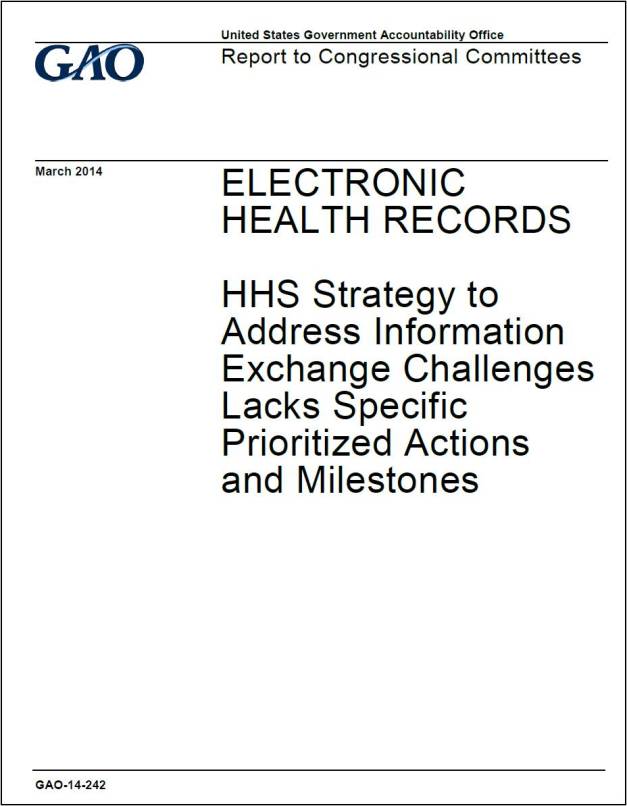
ELECTRONIC HEALTH RECORDS – GAO Report to Congressional Committees March 2014

Posted by timmreardon on 03/25/2014
Posted in: GAO Reports, Health Care Costs, Health IT adoption, Healthcare Delivery, Innovation, Integrated Electronic Health Records. Leave a comment

661846 – HHS HIEELECTRONIC HEALTH RECORDS - GAO Report to Congressional Committees March 2014

HHS Strategy to Address Information Exchange Challenges Lacks Specific Prioritized Actions and Milestones

EHR rethink may reduce unneeded tests – HealthcareIT News

Posted by timmreardon on 03/25/2014
Posted in: Health IT adoption, Healthcare Delivery, Innovation, Integrated Electronic Health Records, Lab Report Access, National Health IT System, Patient Centered Medical Home, Quality Measures. Leave a comment

Could subtle psychological cues lead to better medical decision-making?

Mike Miliard, Managing Editor

COLUMBIA, MO | February 17, 2014

Article link: http://www.healthcareitnews.com/news/ehr-redesign-could-reduce-unneeded-tests

When it comes to America’s healthcare costs, spiraling ever upward, one of the main culprits is unnecessary testing.
Victoria Shaffer
Victoria Shaffer

Some 130 oft-overused screenings and treatments should be curtailed, according to the two-dozen organizations affiliated with the American Board of Internal Medicine Foundation’s “Choosing Wisely” campaign.

Indeed, as Scientfic American pointed out in its article about that initiative, the Instiute of Medicine estimates that $750 billion – three-quarters of a trillion dollars! – was spent on unnecessary services and excessive administrative costs in 2009.

“We are, I hope, at a turning point in American health care where we’re realizing you want to have the right health care, not just more health care,” Baylor College of Medicine pediatrics professor Virginia Moyer told the magazine.

Well, not quite yet. Many thousands of docs are all too happy to order excessive lab work and imaging – and defensive medicine may be a big reason why. As Doug Campos-Outcalt, a Phoenix, Ariz.-based family physician, told Kaiser Health News, “Nobody ever gets sued for ordering unnecessary tests.”

Or what if that wasn’t the reason? What if reducing these excesses is a bit easier to explain, if a bit more deeply rooted?

Victoria Shaffer, assistant professor of health sciences in the University of Missouri School of Health Professions, has been working on research related to the psychological roots of how physicians make decisions.

With a degree in quantitative psychology, Shaffer says she’s long been interested in studying human judgement in decision-making.

Specifically, she’s keen on what makes clinical decisions tick – those made by both doctors and patients in the exam room. Her research is “essentially taking a broad range of academic research in psychology and applying it to specific judgements from the physician and patient perspective,” she says.

One of Shaffer’s recent projects has shed some interesting light on what drives physicians to order tests – and suggests that the reasons may be more subconscious than we may have thought.

In a study first published in Health Psychology, Shaffer, working with Adam Probst, a human factors engineer at Dallas-based Baylor Scott & White Health, and Raymond Chan, MD, a pediatrician at Children’s Mercy Hospitals and Clinics in Kansas City, Mo., took a look at how the lab tests from which a doctor could choose are presented in electronic medical systems.

Shaffer and her team studied how docs picked lab tests using three different designs of order set lists. The first was an opt-in version with no tests pre-selected, as is found on most electronic health records. The second was an opt-out version, in which physicians had to de-select lab tests that weren’t clinically relevant. The third had just a few tests pre-selected, based on experts’ recommendations.

Can You Trust What’s In Your Electronic Medical Record? – Forbes

Posted by timmreardon on 03/25/2014
Posted in: Global Standards, Health IT adoption, Healthcare Delivery, Integrated Electronic Health Records, National Health IT System, Patient Centered Medical Home. 2 Comments

Article link: http://www.forbes.com/sites/paulhsieh/2014/02/24/electronic-medical-record/

Paul Hsieh Contributor

It isn’t often that a doctor is mistaken about how many feet his patient has.

But that’s the mistake this young doctor made by relying too heavily on an erroneous electronic medical record. According to Dr. Richard Gunderman:

An intern recently presented a newly admitted patient on morning rounds, reporting that the patient was “status post BKA (below the knee amputation).” “How do you know?” the attending physician inquired. “It has been noted on each of the patient’s prior three discharge notes,” replied the intern, looking up from his computer screen. “Okay,” responded the attending physician. “Let’s go see the patient.”

When the team arrived in the patient’s room, they made a surprising discovery. The patient had two feet and ten toes. Where did the history of BKA come from? It turned out that four hospitalizations ago, the voice recognition dictation system had misunderstood DKA (diabetic ketoacidosis) as BKA, and none of the physicians who reviewed the chart had detected the error. It had now become a permanent part of the electronic medical record — as if written in stone.

Fortunately, this error could be easily corrected. But the intern’s mistake highlights a growing problem with government-mandated electronic medical records. Doctors are spending more time in front of computer screens and less time with actual patients. This affects how doctors interact with patients. Inevitably, errors creep into their patients’ charts. Prudent patients should be aware of this trend and take steps to ensure the accuracy of their medical records.

The HITECH (Health Information Technology for Economic and Clinical Health) Act of 2009 essentially mandates that physicians and hospitals adopt electronic records by 2014, or face penalties in the form of reduced Medicare/Medicaid payments.

At first glance, adopting electronic medical records (EMRs) would seem a no-brainer for doctors and hospitals. After all, electronic records are the norm for many successful businesses, assisting with sales, inventory, and billing. In theory, electronic medical records should allow doctors to work more efficiently. But in practice, many doctors are finding that EMRs hinder their ability to practice good medicine.

A recent study from Northwestern University found that, “physicians with [EMRs] in their exam rooms spend one-third of their time looking at computer screens, compared with physicians who use paper charts who only spent about 9% of their time looking at them.” According to Enid Montague, PhD, first author of the study, “When doctors spend that much time looking at the computer, it can be difficult for patients to get their attention… It’s likely that the ability to listen, problem-solve and think creatively is not optimal when physicians’ eyes are glued to the screen.”

New York Times health writer Dr. Pauline Chen similarly described that young doctors in training are so busy filling out obligatory electronic forms, they spend only 8 minutes per patient each day. As a result, they cut corners:

When finally in a room with patients, they try to [rush through interviews] by limiting or eliminating altogether gestures like sitting down to talk, posing open-ended questions, encouraging family discussions or even fully introducing themselves.

As Dr. Chen noted, the bad habits they learn in training will carry over to when they become independent practitioners.

(Some doctors are coping with this problem by hiring “scribes” — additional clerical people to enter data into the computer, while the physician converses with the patient. But this requires physicians or hospitals to hire additional personnel. As the New York Times noted, “In most industries, automation leads to increased efficiency, even employee layoffs. In health care, it seems, the computer has created the need for an extra human in the exam room.” The “solution” of scribes doesn’t eliminate the inefficiency caused by electronic medical records — it merely shifts the problem elsewhere.)

Electronic medical record (courtesy Wikimedia Commons).

One source of error in electronic medical records is when doctors spend insufficient time with patients. According to Dr. Elizabeth Toll, another source of errors is perverse payment incentives coupled with physician sloppiness. In her words, “The records are full of lies”:

The EMR was designed to demonstrate the pieces of the record that you have to attend to in order to bill at a certain level. If you just enter a few questions and you only enter part of the exam, and you only add medicines and you only do this or that, you can only be reimbursed a certain amount. But if you asked about, for instance, the family history, the surgical history and the social history, then you have all the elements to charge more. So there’s an incredible temptation to just push, push, push and bring forward everything from the previous notes without re-asking the questions.

This creates a huge problem: The records are full of lies. They’re full of things that [physicians] have said they’ve done but truly haven’t. The patient has been in eighth grade for three years. The patients are divorced, but in the record they’re still married. The patient used to work as a nurse and now works as a librarian, but it hasn’t been changed in the record because people are giving quick, push-button answers to save time, and they don’t update the info. You can see this as you go through small things in the social history but also in [clinical histories]. Yesterday, someone sent me a letter about an amputee patient he sent to a podiatrist. He got a report back on both the patient’s feet. This patient only has one foot.

Even when doctors are conscientious, EMRs don’t eliminate medical errors. They merely change the kinds of errors made. For example, EMRs eliminate the problem of doctors’ illegible handwriting on prescriptions. Instead, physicians might (and sometimes do) accidentally click on the wrong medication on the menu.

(Note: EMRs are not inherently bad. A well-designed EMR can add tremendous value to many medical practices. But the choice of whether and when to purchase an EMR should be left up to each individual hospital and medical group. The government should not be pressuring doctors into adopting EMRs any more than it should pressure citizens into purchasing smartphones they might not need. But that’s a topic worthy of a separate column.)

So how can patients protect themselves from errors in their electronic medical records? I recommend four simple steps:

1) Get a copy of your own medical records at regular intervals and review it thoroughly. This is especially important if you’ve had recent major surgery or developed a serious new medical condition (such as a new diagnosis of cancer). If you find an error, contact the appropriate hospital or doctor’s office and ask that it be corrected.

2) Make sure you understand all your prescription medications. The most common errors in electronic medical records involve patient medications (either a wrong medication or a wrong dose). Discuss each medication with your doctor and/or pharmacist until you understand why you are taking it, the proper dose, how often, for how long, and what side effects to look out for.

3) Whenever you undergo laboratory or radiology testing, request a copy of the results for your own personal files. Most radiology offices will gladly burn a CD of your radiology imaging tests for you (either for free or for a small fee). That way, you can review the results at your leisure or seek second opinions at your discretion.

4) Whenever you have a doctor’s appointment, consider bringing a small voice recorder to record any discussions. (Many smartphones also have a voice recorder app.) Most doctors are glad to let patients record their conversations, so they can replay them when they get home or go over them with family members unable to attend.

Electronic medical records can be powerful tools when designed properly and used wisely. And errors certainly occurred in the era of paper records. But electronic medical records can create new risks for patients. Prudent patients will want to ensure their own records are accurate. Someday, your life may depend on your diligence.

When technology is a barrier to care – Fierce HeathIT

Posted by timmreardon on 03/25/2014
Posted in: Global Standards, Health IT adoption, Healthcare Delivery, Healthcare Informatics, Integrated Electronic Health Records, National Health IT System. Leave a comment

Are doctors suffering at the hands of the Herzberg principle–which says that the best way to discourage workers is to subject them to policies and procedures that don’t make sense?

Improve doc satisfaction by taking the headache out of health IT
March 21, 2014 | By Ashley Gold
Read more: When technology is a barrier to care – FierceHealthIT http://www.fiercehealthit.com/story/when-technology-barrier-care/2014-03-21#ixzz2wzgnJPce

An article in the Atlantic explores how changes in the healthcare payment model, health IT and the doctor-patient relationship are discouraging docs.

“It is easy for many healthcare leaders to forget that doctors go into medicine not because they enjoy entering data into complex electronic health records and ensuring that their employer gets paid for everything they do, but because they want to make good diagnoses, prescribe appropriate treatments and help patients,” the article states.

Building on our first review of multi-ology, multi-site, vendor neutral solutions, this webinar will look to the specifics of more advanced VNA solutions. The webinar will begin with a summary overview of how to transform rigid departmental information silos into fluid, consolidated, information sharing systems. Join us and our IBM partner to learn how to get started with a VNA. Register Now!

 Paul Weygandt, M.D., an orthopedic surgeon, told the Atlantic that contemporary medicine has let too many “intermediaries”–financing, technology and practice structure–get between patients and doctors, and too much time is focused on generating revenue over quality.

Technology is made with engineers in mind, not doctors, Weygandt says. It’s often reported that doctors and nurses are left out of the design phase of building new technology.

One example of this is the need to give nurses a seat at the health IT development table, since they actually know what’s necessary to achieve optimal patient care. In particular, Elizabeth “Betty” Jordan, R.N., an assistant professor at the University of South Florida College of Nursing, told FierceHealthIT in a recent interview. Nurses are often given demonstrations on IT tools that already exist–including tablets and other monitoring devices–but are not given the opportunity to join in on such conversations during the technology planning and development stages.

This is where doctors’ input would come in handy. Of course, new technology can help doctors practice better medicine, but change isn’t easy, Weygandt notes.

“Every innovation should be tested not just to see if it increases revenue or cuts costs,” he says, “but also to ensure that it enhances the doctor-patient relationship.”

In another example of docs’ attention being diverted by technology, doctors who use electronic health records in the exam room spend about one-third of their time looking at the screen, which might detract from patient communication, according to research from Northwestern University.

However, in summer 2012, it was reported that eighty percent of physicians in a MedPage Today survey say technology has improved communication with their patients.

To learn more:
– read the article in the Atlantic

Related Articles:
AMA: Computers in exam room don’t have to be disruptive
EHRs call for tech etiquette in the exam room
80% of docs say technology improves provider-patient communication
Docs using clinical decision support tools seen as less capable
mHealth13: Technology knowledge key to telehealth deployment
Telemedicine allows for effective care of Parkinson’s patients
HIT from a nurse’s perspective: Put us at the development table

Read more: When technology is a barrier to care – FierceHealthIT http://www.fiercehealthit.com/story/when-technology-barrier-care/2014-03-21#ixzz2wzgGgNrB
Subscribe at FierceHealthIT

Why Doctors Still Use Pen and Paper – The Atlantic

Posted by timmreardon on 03/25/2014
Posted in: Global Standards, Health IT adoption, Healthcare Delivery. Leave a comment

The healthcare reformer David Blumenthal explains why the medical system can’t move into the digital age.

James FallowsMar 19 2014, 9:06 PM ET
Alváro Dominquéz

The health-care system is one of the most technology-dependent parts of the American economy, and one of the most primitive. Every patient knows, and dreads, the first stage of any doctor visit: sitting down with a clipboard and filling out forms by hand.

David Blumenthal, a physician and former Harvard Medical School professor, was from 2009 to 2011 the national coordinator for health information technology, in charge of modernizing the nation’s medical-records systems. He now directs The Commonwealth Fund, a foundation that conducts health-policy research. Here, he talks about why progress has been so slow, and when and how that might change.

James Fallows: From the lay public’s point of view, medical records seem incredibly backward. Is the situation any better than it looks?

David Blumenthal: It’s on the way to getting better. But we still have a long way to go. The reason why the medical profession has been so slow to adopt technology at the point of contact with patients is that there is an asymmetry of benefits.

From the patient’s perspective, this is a no-brainer. The benefits are substantial. But from the provider’s perspective, there are substantial costs in setting up and using the systems. Until now, providers haven’t recovered those costs, either in payment or in increased satisfaction, or in any other way. Ultimately, there are of course benefits to the professional as well. It’s beyond question that you become a better physician, a better nurse, a better manager when you have the digital data at your fingertips. But the costs are considerable, and they have fallen on people who have no economic incentive to make the transition. The benefits of a more efficient practice largely accrue to people paying the bills. The way economists would describe this is that the medical marketplace is broken.

JF: This is a subset of the general brokenness of the medical marketplace, right?

DB: Yes. There are many problems that come from the brokenness of the health-care market. To put it another way, if the medical market functioned like the car industry or the computer industry or the service industry, with true competition based on quality and price, providers would have adopted electronic records long ago. I’m not advocating pure market competition in health care. But there are many ways in which the medical marketplace should work better, and this is one of them.

JF: What’s the best thought-experiment example of medical-marketplace incentives working the right way? The VA?

DB: When the benefits of using better technology are “internalized,” as the economists would say, there has been much more rapid, complete, and effective adoption of electronic medical records. So, the VA: the benefits are internalized, because the VA has to live within a budget. In private health-care organizations like Kaiser or the Geisinger plan in Pennsylvania, or the Group Health Cooperative in Puget Sound, electronic medical records were adopted decades ago, and are widely used and highly effective. You don’t need a thought experiment to find living, breathing examples of what happens when the incentives work right.

JF: What’s the connection between the electronic-records effort you directed and the larger Obamacare strategy?

DB: This may be a Beltway detail, but the law that I implemented was not in the Affordable Care Act. It was actually part of the earlier and much maligned stimulus bill. The hope was that promoting medical records would lay the groundwork for a more efficient health-care system, and thereby make universal coverage more affordable to the country—

JF: And—

DB: And you’re about to ask whether it did.

JF: Yes.

DB: It would have. And it will. But it needs time to realize its potential.

“If the medical market functioned like the car industry … providers would have adopted electronic records long ago.”

I think the parallel is the time it took from when computerization became prevalent in other industries to the time when worker productivity improved. We are only three years into the process of making digital information widely available in health care. And health care is an extraordinarily complex, knowledge-intensive industry. If you want a thought experiment, you could ask yourself how good modern medicine is when physicians and nurses know nothing at all about the patient. So information is absolutely the critical resource in health care, more important than steel in making cars. When you change the way information is used and collected in medicine, you change everything about the way work is done. It is an enormously disruptive process within the health-care system. It takes time to accommodate. In places like Kaiser and Geisinger, electronic medical records are already making a big impact. But that is mostly because those organizations started using them a long time ago.

JF: What about when you switch from too little technology in the patient experience to too much? When the doctor is staring at a laptop rather than looking at you?

DB: This is a transition issue. Most physicians’ offices, and I’ve been in a lot of them, are set up so that when the physician looks at the screen, he or she can’t look at the patient. Often they have their back to the patient. That is because no one has given a lot of thought to how to maximize the ergonomic quality of inserting this technology into the office.

That will come. I also think that voice-recognition technology is going to be an enormous relief both to the physician and to the patient, because the physician will be able to talk to a machine rather than typing into it. Those technologies are improving—as you can tell from your smartphone—and as they do, a lot of this ergonomic problem will go away.

JF: In the broadest sense, what difference will better information technology make in our lives and health?

DB: Fundamentally, every medical record is a tool for collecting information: the information a physician collects when looking at you in a physical examination; the results of lab tests. The constant automatic information collection is going to increase, whether it’s your phone monitoring your heart rate or your scale sending information about your weight to your health provider, or the contact lenses Google wants to market that measure blood glucose levels.

They all are sources of information about your health and well-being. And the challenge we face collectively, inside the health-care establishment and outside it, is how to take all this information, separate what’s useful from what’s not, and then apply it to improve the decisions of patients and care providers.

<div><a href=”http://pubads.g.doubleclick.net/gampad/jump?iu=%2F4624%2FTheAtlanticOnline%2Fchannel_technology&t=by%3Djames-fallows%26iss%3D201404%26title%3Dwhy-doctors-still-use-pen-and-paper%26src%3Dmag%26type%3Dtech%26pos%3Din-article&sz=300×185&c=681816786&tile=3″ title=””><img src=”http://pubads.g.doubleclick.net/gampad/ad?iu=%2F4624%2FTheAtlanticOnline%2Fchannel_technology&t=by%3Djames-fallows%26iss%3D201404%26title%3Dwhy-doctors-still-use-pen-and-paper%26src%3Dmag%26type%3Dtech%26pos%3Din-article&sz=300×185&c=681816786&tile=3″ alt=”” /></a></div>

This is a generic problem in society. We have lots of information, and we don’t always know what to do with it. Your doctor, your nurse, is not prepared to process the information they already have. It’s already overwhelming. And adding more in will just make it even more anxiety-provoking and overwhelming. That is, in a sense, the big data challenge facing health care in the future.

This will move us into a field that is taking shape right now, that of analytics. It will help us take these data and turn them into diagnostic information—into recommendations a physician can give a patient or that patients can get directly, online.

That’s where the future lies, and of course people want the benefit of it right now. Before, there was no market to make this sort of analytic product. Now that we have a growing electronic infrastructure for health information, there is a surge of traditional capitalist interest in turning that information into valuable knowledge, and selling it back to patients and doctors. That will happen. But it could never have happened until we got the data into digital form.

The Looming Interoperability Identity Crisis

Posted by timmreardon on 03/16/2014
Posted in: Blue Button, Global Standards, Health IT adoption, Healthcare Delivery, Healthcare Security, Integrated Electronic Health Records, National Health IT System. Leave a comment
March 12, 2014 | Anthony Brino, Associate Editor
http://www.govhealthit.com/news/interoperability-grows-identity-crisis-looms

While the U.S. continues digitizing its healthcare industry, a huge challenge is arising: not only securing those systems but verifying identities.

With a steady stream of HIPAA-covered data breaches continuing over the past few years, not to mention the debacle of Target’s recent customer financial information loss, some argue that current identity security approaches just aren’t adequate — especially considering that criminal attacks on hospitals are increasing substantially.

“Protecting sensitive personal information with passwords is akin to building a massive stone fortress and then securing the front door with the kind of lock I use to keep my two-year-old out of my bathroom,” said Jeremy Grant, a senior advisor on identity management at the National Institute of Standards and Technology, heading up the National Strategy for Trusted Identities in Cyberspace.

April 2014 marks three years since the Obama Administration launched the NSTIC, a public-private initiative aimed at spurring the private sector to increase privacy, security and trust in online transactions across industries.

Speaking at a public hearing held by the federal Health IT Standards Committee’s Privacy and Security Workgroup, Grant argued that while there has been progress in a number of pilots — with six of 12 relating to healthcare — the private sector, particularly health organizations, need to start agreeing on standards.

[See also: EHR incentive payments soar toward $22 billion.]

The National Strategy “will only succeed if sectors in need of better identity solutions step forward and demonstrate a willingness to roll up their sleeves in support of the collaborative effort,” said Grant, the former chief development officer at ASI Government.

Personal health record sharing options like the Blue Button will only work “if patients have an easy way to assert that they really are themselves online,” Grant explained.

Though not the only layer of security needed, identity is perhaps the most important and difficult, Grant argued. Identity solutions “can’t simply be secure,” he said; they have “to be easy to use, or else users won’t bother.”

Grant urged the Private and Security Work Group to bring a message back to the rest of the Health IT Standards Committee and the broader health and health IT communities: Even though standards may not be as mature or technologies as widely-available as some would hope, don’t wait.

“If the Workgroup or the broader health sector are of the view that this marketplace will soon be created while everybody sits back and watches,” Grant continued, “I believe folks are going to be waiting for a long time.”

Bringing that vision of secure and accessible identification technology to reality is going to take a lot of work, though.

“Privacy and Interoperability are among our most pressing concerns and they often conflict in the real world,” argued Thomas Sullivan, MD, the chief strategy officer at the e-prescribing company DrFirst, and a past president of the Massachusetts Medical Society. “There are far too many examples of unnecessary redundancy in IDP and identity management of both providers and patients,” leading to “higher costs, inefficiency, errors, fraud and frustration throughout the industry.”

The problem can manifest in multiple ways for patients and providers. Sullivan offered two examples.

For patients who decide what providers to share their information with, there is great privacy, yes, but also a “risk of danger and harm” if the information is incomplete or not shared in the event of emergencies.

[See also: ONC eyes EHR ‘shades of grey’ in behavioral health, LTPAC realms.]

For providers controlling identity attributes of patients, there are administrative efficiencies and “a certain element of patient safety added since it is easier to discover aggregate data that may bear on treatment decisions.” At the same time, “the patient loses a certain element of control regarding data sharing and thus, perhaps [there will be] less privacy protection,” Sullivan said.

Now, some see the solution to those identity and security problems as one with few risks, albeit with lingering controversy: a national patient identifier system.

While “some members have proposed that as one of several solutions, I’m sure we’re not trying to provide a national ID for all patients,” Sullivan said, referring to the Identity Ecosystem Steering Group he is also a member of. “Back when the HIPAA debate took place, it was clear we would not have a national patient identifier until Congress acted. But we are looking at ways to identity-proof patients and providers and to make those attributes a lot more usable.”

Indeed, the Healthcare Information and Management Systems Society (the parent organization of HIMSS Media, publisher of Government Health IT), the American Health Information Management Association and others are pushing a new idea as an alternative to a national patient ID system — a national patient matching system, options for which HIMSS in collaboration with HHS innovation fellows are currently exploring.

Whatever the outcome of those or other standards efforts, practitioners like Sullivan are just glad to see the problem of identity management starting to be addressed.

“It’s pretty rare that a physician would agree with anyone on anything,” he said, “but I completely agree that we need to collaborate more between commerce and HHS.”

Related articles: 

State insurance exchanges fighting for survival

Federal panel approves MU Stage 3 recommendations

ICD-10: The day after

An HIE OF ONE – HIE Watch

Posted by timmreardon on 03/06/2014
Posted in: Uncategorized. Leave a comment
AN ‘HIE OF ONE’
SOURCE: CHRISTOPHER RASMUSSEN, CENTER FOR DEMOCRACY & TECHNOLOGY DATE: MAR 6, 2014
Article link: http://www.hiewatch.com/perspective/hie-one

Patient management of their own health information is a much discussed topic in health IT. Patients with the power to access their health information and actively direct its flow have the tools to take charge of their health care and make more informed decisions. A great example of this is a patient who downloads her hospital discharge summary and electronically sends it to both her primary care physician and her adult daughter who helps her manage her condition.

Nikolai Kirienko, a patient advocate (@nikolaikirienko) and co-director of Chronology.MD has referred to this concept as patients becoming a “Health Information Exchange (HIE) of One.” A successful implementation of the HIE of One concept is the Blue Button program. Originally implemented by the VA and since expanded to TRICARE and Medicare, Blue Button provides the patient with a simple online button to view and download their health information. An updated version of Blue Button, known as Blue Button Plus, will provide patients with the ability to transmit health records to a provider or caregiver and to set automatic downloads or uploads into a mobile app or a personal health record tool.

Some private sector organizations have begun to offer the original Blue Button functionality to their patients. But what about the rest of us? When will we all have the capacity to be HIEs of One?

HIPAA has always given patients the right to obtain copies of their health information, and once patients have this information, they can share it with whomever they please. Congress improved on this right inHITECH by requiring HIPAA-covered entities to provide patients with an electronic copy of their electronic health information and to have that digital copy directly transmitted to a third party – such as a personal health record, a mobile health app, or a health provider or family member. The Office for Civil Rights (OCR), which oversees HIPAA, released final rules last January implementing this right. Patients who want to have their health information directly transmitted to a third party must submit that request in writing (which can be electronic). OCR also clarified that if a patient wants to receive their digital information via a mechanism that is convenient for them but is not secure (such as by unsecure e-mail), the patient has the right to receive their health information in the format they want.

While these changes to HIPAA’s patient access rights are welcome and prioritize the needs of patients, the regulators fell short of creating the ideal environment for facilitating patient HIEs of One. Providers are still permitted to take up to 30 days (and in some cases, up to 60 days) to provide a patient with access to electronic health information, and this timeframe also applies to the direct transmission of this data (per patient request). This is hardly fast enough to permit the patient to meaningfully exchange their current health information with others.

Beginning in 2014, the federal Meaningful Use program will enable some of us to have much more timely ability to electronically view, download and transmit our digital health data. For example, physicians participating in the Meaningful Use program (and using Certified EHR Technology) will have to provide patients with the ability to view, download and transmit (V/D/T) relevant health data within 4 business days. In addition, hospitals participating in the program must provide patients with their discharge summaries within 36 hours.

That timeframe comes much closer to enabling patients to be HIEs of One. It is the case, however, that fewer patients will be impacted by these new Meaningful Use Requirements. The Meaningful Use Requirements only require that 50% of patients be offered and more than 5% of patients use the V/D/T capabilities. But it’s a great start to building the movement.

Regulators may need to tie up a few loose ends. For example, the EHR 2014 Certification Requirements should be checked to ensure they are consistent with the new final HIPAA regulations. Since a patient’s request to transmit data to a third party must be in writing, certification criteria should specify a standard or require a functionality for capturing this information. Health care providers offering these capabilities to patients also would benefit from specific guidance from regulators about how to deploy the V/D/T capabilities consistent with both HIPAA and Meaningful Use requirements. Finally, when there is more experience with deployment of Blue Button and Meaningful Use, there will be a more hospitable climate for revising the baseline HIPAA rules, so that all patients have the capability to take control of their health care.

Christopher Rasmussen is a policy analyst at the Center for Democracy & Technology, which originally published this blog post.

Login

       or

register

       to post comments

Posts navigation

← Older Entries
Newer Entries →
  • Search site

  • Follow healthcarereimagined on WordPress.com
  • Recent Posts

    • The Global Healthcare System Is Broken. Japan Fixed It for $4,100 Per Person. 04/10/2026
    • When Not to Use AI – MIT Sloan 04/01/2026
    • There are more AI health tools than ever—but how well do they work? – MIT Technology Review 03/30/2026
    • Are AI Tools Ready to Answer Patients’ Questions About Their Medical Care? – JAMA 03/27/2026
    • How AI use in scholarly publishing threatens research integrity, lessens trust, and invites misinformation – Bulletin of the Atomic Scientists 03/25/2026
    • VA Prepares April Relaunch of EHR Program – GovCIO 03/19/2026
    • Strong call for universal healthcare from Pope Leo today – FAN 03/18/2026
    • EHR fragmentation offers an opportunity to enhance care coordination and experience 03/16/2026
    • When AI Governance Fails 03/15/2026
    • Introduction: Disinformation as a multiplier of existential threat – Bulletin of the Atomic Scientists 03/12/2026
  • Categories

    • Accountable Care Organizations
    • ACOs
    • AHRQ
    • American Board of Internal Medicine
    • Big Data
    • Blue Button
    • Board Certification
    • Cancer Treatment
    • Data Science
    • Digital Services Playbook
    • DoD
    • EHR Interoperability
    • EHR Usability
    • Emergency Medicine
    • FDA
    • FDASIA
    • GAO Reports
    • Genetic Data
    • Genetic Research
    • Genomic Data
    • Global Standards
    • Health Care Costs
    • Health Care Economics
    • Health IT adoption
    • Health Outcomes
    • Healthcare Delivery
    • Healthcare Informatics
    • Healthcare Outcomes
    • Healthcare Security
    • Helathcare Delivery
    • HHS
    • HIPAA
    • ICD-10
    • Innovation
    • Integrated Electronic Health Records
    • IT Acquisition
    • JASONS
    • Lab Report Access
    • Military Health System Reform
    • Mobile Health
    • Mobile Healthcare
    • National Health IT System
    • NSF
    • ONC Reports to Congress
    • Oncology
    • Open Data
    • Patient Centered Medical Home
    • Patient Portals
    • PCMH
    • Precision Medicine
    • Primary Care
    • Public Health
    • Quadruple Aim
    • Quality Measures
    • Rehab Medicine
    • TechFAR Handbook
    • Triple Aim
    • U.S. Air Force Medicine
    • U.S. Army
    • U.S. Army Medicine
    • U.S. Navy Medicine
    • U.S. Surgeon General
    • Uncategorized
    • Value-based Care
    • Veterans Affairs
    • Warrior Transistion Units
    • XPRIZE
  • Archives

    • April 2026 (2)
    • March 2026 (9)
    • February 2026 (6)
    • January 2026 (8)
    • December 2025 (11)
    • November 2025 (9)
    • October 2025 (10)
    • September 2025 (4)
    • August 2025 (7)
    • July 2025 (2)
    • June 2025 (9)
    • May 2025 (4)
    • April 2025 (11)
    • March 2025 (11)
    • February 2025 (10)
    • January 2025 (12)
    • December 2024 (12)
    • November 2024 (7)
    • October 2024 (5)
    • September 2024 (9)
    • August 2024 (10)
    • July 2024 (13)
    • June 2024 (18)
    • May 2024 (10)
    • April 2024 (19)
    • March 2024 (35)
    • February 2024 (23)
    • January 2024 (16)
    • December 2023 (22)
    • November 2023 (38)
    • October 2023 (24)
    • September 2023 (24)
    • August 2023 (34)
    • July 2023 (33)
    • June 2023 (30)
    • May 2023 (35)
    • April 2023 (30)
    • March 2023 (30)
    • February 2023 (15)
    • January 2023 (17)
    • December 2022 (10)
    • November 2022 (7)
    • October 2022 (22)
    • September 2022 (16)
    • August 2022 (33)
    • July 2022 (28)
    • June 2022 (42)
    • May 2022 (53)
    • April 2022 (35)
    • March 2022 (37)
    • February 2022 (21)
    • January 2022 (28)
    • December 2021 (23)
    • November 2021 (12)
    • October 2021 (10)
    • September 2021 (4)
    • August 2021 (4)
    • July 2021 (4)
    • May 2021 (3)
    • April 2021 (1)
    • March 2021 (2)
    • February 2021 (1)
    • January 2021 (4)
    • December 2020 (7)
    • November 2020 (2)
    • October 2020 (4)
    • September 2020 (7)
    • August 2020 (11)
    • July 2020 (3)
    • June 2020 (5)
    • April 2020 (3)
    • March 2020 (1)
    • February 2020 (1)
    • January 2020 (2)
    • December 2019 (2)
    • November 2019 (1)
    • September 2019 (4)
    • August 2019 (3)
    • July 2019 (5)
    • June 2019 (10)
    • May 2019 (8)
    • April 2019 (6)
    • March 2019 (7)
    • February 2019 (17)
    • January 2019 (14)
    • December 2018 (10)
    • November 2018 (20)
    • October 2018 (14)
    • September 2018 (27)
    • August 2018 (19)
    • July 2018 (16)
    • June 2018 (18)
    • May 2018 (28)
    • April 2018 (3)
    • March 2018 (11)
    • February 2018 (5)
    • January 2018 (10)
    • December 2017 (20)
    • November 2017 (30)
    • October 2017 (33)
    • September 2017 (11)
    • August 2017 (13)
    • July 2017 (9)
    • June 2017 (8)
    • May 2017 (9)
    • April 2017 (4)
    • March 2017 (12)
    • December 2016 (3)
    • September 2016 (4)
    • August 2016 (1)
    • July 2016 (7)
    • June 2016 (7)
    • April 2016 (4)
    • March 2016 (7)
    • February 2016 (1)
    • January 2016 (3)
    • November 2015 (3)
    • October 2015 (2)
    • September 2015 (9)
    • August 2015 (6)
    • June 2015 (5)
    • May 2015 (6)
    • April 2015 (3)
    • March 2015 (16)
    • February 2015 (10)
    • January 2015 (16)
    • December 2014 (9)
    • November 2014 (7)
    • October 2014 (21)
    • September 2014 (8)
    • August 2014 (9)
    • July 2014 (7)
    • June 2014 (5)
    • May 2014 (8)
    • April 2014 (19)
    • March 2014 (8)
    • February 2014 (9)
    • January 2014 (31)
    • December 2013 (23)
    • November 2013 (48)
    • October 2013 (25)
  • Tags

    Business Defense Department Department of Veterans Affairs EHealth EHR Electronic health record Food and Drug Administration Health Health informatics Health Information Exchange Health information technology Health system HIE Hospital IBM Mayo Clinic Medicare Medicine Military Health System Patient Patient portal Patient Protection and Affordable Care Act United States United States Department of Defense United States Department of Veterans Affairs
  • Upcoming Events

Blog at WordPress.com.
healthcarereimagined
Blog at WordPress.com.
  • Subscribe Subscribed
    • healthcarereimagined
    • Join 153 other subscribers
    • Already have a WordPress.com account? Log in now.
    • healthcarereimagined
    • Subscribe Subscribed
    • Sign up
    • Log in
    • Report this content
    • View site in Reader
    • Manage subscriptions
    • Collapse this bar
 

Loading Comments...