healthcarereimagined

Envisioning healthcare for the 21st century

  • About
  • Economics

The Importance of a Nonpartisan Surgeon General – Richard H. Carmona, M.D.

Posted by timmreardon on 10/20/2014
Posted in: EHR Interoperability, Emergency Medicine, Global Standards, Health Care Costs, Health Care Economics, Health IT adoption, Health Outcomes, Healthcare Delivery, Healthcare Informatics, Healthcare Security, Innovation, Integrated Electronic Health Records, Lab Report Access, Military Health System Reform, Mobile Healthcare, National Health IT System, Open Data, Patient Centered Medical Home, Patient Portals, PCMH, Primary Care, Public Health, Quadruple Aim, Quality Measures, U.S. Surgeon General. Leave a comment

Richard H. Carmona, M.D.
17th Surgeon General of the United States; President, Canyon Ranch Institute

Posted: 10/18/2014 11:38 am EDT

The Ebola crisis has metastasized to the United States, and the media and numerous government and private spokespeople are attempting to educate and calm the American public while not inflaming or confusing the situation.

A single credible, trusted, nonpartisan voice is what is needed to educate and reassure America and the world.

Jesse L. Steinfeld

Recently, Surgeon General Jesse Steinfeld, the 11th surgeon general of the United States, passed away. His obituary heralded his many significant accomplishments as surgeon general and commander of the United States Public Health Service Commissioned Corp, one of the seven uniformed services of the United States. What was particularly striking and concerning and voiced in his obituaries and commentary about his life were references to Surgeon General Steinfeld having to fight and battle various individuals, groups and entities in order to promulgate health policy that would benefit the public he served.

This prompted me to review the obituaries and commentary about other surgeons general who passed away in the last decade, including Surgeons General William Stewart (10th), Julius Richmond (12th), and C. Everett “Chick” Koop (13th).

These surgeons general were extraordinary public servants who served selflessly in increasingly embattled positions. Like Surgeon General Steinfeld, their obituaries and press commentary were often punctuated with adjectives such as “fighting,” “combative,” “battling entrenched political interests,” “adversarial maneuvering and stressful attempts to take out or eliminate the surgeon general.”

These descriptors often sounded as if the surgeons general were officers in a combat unit battling hostile adversaries as they attempted to survive in an increasingly partisan battlefield. The sad truth is they were. And in some cases the surgeons general succumbed to the lethal wounds of political warfare where resuscitation is rarely possible. [1] Warfare that public health professionals are stilling battling today.

Surgeons general of the Army, Navy, Air Force, and U.S. Public Health Service were always career uniformed officers who merited consideration for promotion and advancement by their seniority, accomplishments, demonstrated leadership, education, and training. The White House would receive recommendations from the respective uniformed service chiefs and the president would then recommend names to the Senate for confirmation as a surgeon general with the rank of vice admiral or lieutenant general, depending on the service.

This tried and true process, over a century old, still exists in the all of the uniformed services except for the U.S. Public Health Service.

Since the late 1960s and early 1970s [1,2], various political administrations have gone outside of the USPHS to identify and nominate candidates who were believed to be more politically aligned with the political party in power at the time. By doing so, they demean the service of career USPHS officers who are qualified but who are passed over due to attempts to align science with desired political platforms.

Interestingly, these attempts at prospectively attempting to identify politically-aligned surgeons general nominees have usually failed and caused frustration for leaders in both political parties over the years, since all surgeons general come to understand that you are the doctor of the nation and not the surgeon general of the Republican or Democratic party [3]. In addition, those outside nominees, if confirmed, are immediately promoted to vice admiral even though some have no military or uniformed service experience. This process is offensive to all career officers who selflessly sacrifice throughout a long uniformed service career to merit consideration for promotion as an admiral and Surgeon General.

This politically motivated action also diminishes the credibility of the Office of the Surgeon General. It is also apparent that not every physician is capable of being Surgeon General. [3] An example would be the current nominee for United States Surgeon General who is very early in his professional career, with great potential but without significant progressive leadership experience or specific public health education or in-depth experience with complex policy, global, and public health issues. However, he was the co-founder of Doctors for America, a partisan organization supporting President Obama.

In a recently published book, Surgeon General’s Warning by Mike Stobbe4, he painfully discusses the gradual political demise of the United States Surgeon General and suggests that therefore, it may be time to end the position. As much as I appreciated Mr. Stobbe’s scholarly work, my review of it leads me to a very different conclusion. We should actually act to strengthen the Office of the Surgeon General by protecting it from political manipulation. In our hyper-partisan political world characterized by gridlock and great political poetic license in the interpretation of science to support preconceived political biases, who will have the responsibility to speak scientific truth to power? Who will provide the scientifically based “informed consent” to the American public and at times, the world?

Eliminating or allowing further diminishment of the Office of the Surgeon General to occur is not in the best interest of the American public, although it may benefit politicians.

In July 2007, I joined Surgeons General Koop and Satcher to testify before a congressional committee investigating the attempts at politicization of the Office of the Surgeon General5. Three Surgeons General serving four separate presidents, from the very liberal to the ultraconservative administrations, all testified on the issues challenging them during their tenures. The Surgeon General testimonies were remarkably similar and a clear bipartisan indictment of the attempts to manipulate science and diminish the Office of the Surgeon General. Unfortunately, Congress took no action on this unprecedented testimony that they themselves had requested.

Due to the aforementioned experience and testimony, I recommended significant changes to the Office of the Surgeon General in publications and presentations [3]. They are as follows:

• Return to nominating the United States Surgeon General from the cadre of career USPHS officers based on merit and core competencies and not politics or patronage, just as the U.S. Army, Navy, and Air Force do.

• The Office of the Surgeon General should have a separate budget that is free of political interference and be legislatively protected, a model like the Federal Reserve Chief.

• The United States Surgeon General, on an annual basis, should be mandated to give a public State of the Nation’s Health and Global Health address which is based on current scientific facts so that prudent national policy may then be generated by the President and Congress and political leadership can then be held accountable for their actions or inactions.

The United States Surgeon General should still be held accountable by the chain of command, as are all uniformed service Surgeons General; however, accountability should be based on honesty, integrity, leadership and the unwavering pursuit of scientific truth — and not on political partisanship.

It is clear that our nation needs and deserves a strong, qualified, and nonpartisan Surgeon General who resides in a protected and well-funded Office of the Surgeon General. The people we have the privilege to serve deserve no less.

—

Bibliography
1 Bell, H, Surgeons General: Defenders of Public Health, The New Physician, Jan-Feb. 2001,Vol. 51,Issue 1
2Mullan, F, Plagues and Politics: The Story of the United States Public Health Service, Basic Books Inc., 1989
3Carmona, R, The Trauma of Politics: A Surgeon General’s Perspective, Journal of Trauma and Acute Care Surgery, 2012 Aug, 73(2):314-318
4Stobbe, M, Surgeon General’s Warning, How Politics Crippled the Nation’s Doctor, University of Ca. Press, 2014

Follow Richard H. Carmona, M.D. on Twitter: http://www.twitter.com/DrRichCarmona

Article link: http://www.huffingtonpost.com/richard-h-carmona-md/post_8476_b_5993190.html?utm_hp_ref=tw

More:
Richard Carmona, Surgeon General, President, Congress, Office of the Surgeon General, Mike Stobbe, Public Health, Bipartisanship


Pollyanna ONC highlights interoperability mistakes made in the past – FierceEMR

Posted by timmreardon on 10/17/2014
Posted in: Accountable Care Organizations, Data Science, EHR Interoperability, Global Standards, Health Care Costs, Health Care Economics, Health IT adoption, Health Outcomes, Healthcare Delivery, Healthcare Informatics, Healthcare Security, Innovation, Integrated Electronic Health Records, Lab Report Access, Military Health System Reform, Mobile Healthcare, National Health IT System, ONC Reports to Congress, Open Data, Patient Centered Medical Home, Patient Portals, PCMH, Primary Care, Quadruple Aim, Quality Measures, U.S. Air Force Medicine, U.S. Army Medicine, U.S. Navy Medicine, Veterans Affairs. Leave a comment

October 15, 2014 | By Marla Durben Hirsch
marlapic

I presume that I’m not the only person who finds the occasional disconnect between the Office of the National Coordinator for Health IT’s blog posts and the real data behind them amusing.

In the latest example, ONC and the U.S. Department of Health and Human Services’ annual report to Congress highlights the progress that has been made in electronic health record adoption but is candid about the barriers hampering data sharing, such as lack of standardization of EHRs, unchanged provider practice patterns, and the low priority that providers not eligible for Meaningful Use incentive payments place on interoperability. The report then outlines how the agencies plan to address the problem, which includes guidance, rules, programs and their new interoperability roadmap.

“The current lack of interoperability among data resources for EHRs is a major impediment to the unencumbered exchange of health information and the development of a robust health data infrastructure,” the report states.

But you’d think everything is rosy if you only read ONC’s blog post about the report. All you hear about is the “significant increases” in data exchange and EHRs and ONC’s accomplishments. The only indication that something is amiss is ONC’s reference to setting a “new course” as it navigates a future after the HITECH Act, specifically its implementation of the new 10 year nationwide roadmap to interoperability.

This is hardly the first time that an ONC’s blog post has skewed data to its benefit. The agency is positively Pollyanna-like. I understand and respect that. ONC has worked hard, and now that funding is running out for its programs, it needs to refocus if it’s going to sustain itself.

And the more fleshed out interoperability roadmap, shared this week, and is a well thought out document. It calls for a collaborative effort to improve data sharing. It details goals for individuals, providers, the population and the public. It seeks to provide identity matching, increase trust in the protection of the shared information, and more EHR testing. It contains a whopping nine guiding principles.

But it begs some of the same questions that we’ve posed before. What went wrong that now causes us to need a new course? Were the barriers to data sharing avoidable or inevitable? Why was there little call for collaboration and identity matching previously? Why weren’t EHRs tested more for interoperability before being certified and put on the market? And why isn’t there more trust among stakeholders that would encourage increased data sharing?

And is the new roadmap the best one to use?

It’s all too easy these days–particularly with our polarized politics–to lay blame on others when an initiative or concept falls short. ONC doesn’t necessarily need to be forced into throwing itself under the bus when it comes to interoperability disappointments. It’s not the only entity to blame.

But clearly some mistakes have been made, as alluded to in the report to Congress. Moreover, the industry has already spent a tremendous amount of time, money and energy on interoperability. We should acknowledge what mistakes were made and learn from them, not pretend that they don’t exist. This isn’t a second bite at the apple; this is a correction.

At least this time it appears that more stakeholders are being allowed to draw the map. – Marla (@MarlaHirsch and @FierceHealthIT)

Article link: http://www.fierceemr.com/story/pollyanna-onc-highlights-interoperability-mistakes-made-past/2014-10-15

Related Articles:
ONC interoperability road map draft outlines governance, certification standards goals
Feds, states successfully pilot exchange of behavioral health data
EHR research needs to be more meaningful
EHR interoperability: Fix the potholes or find a new path?
Stage 2 certified EHRs not ready for interoperability
ONC: Interoperability up, but barriers remain
Feds dropped the ball on interoperability acceleration

The Grim Reality of Digital Health Today – Huffington Post

Posted by timmreardon on 10/16/2014
Posted in: Accountable Care Organizations, ACOs, Big Data, Blue Button, Data Science, Emergency Medicine, Genetic Data, Global Standards, Health Care Costs, Health Care Economics, Health IT adoption, Health Outcomes, Healthcare Delivery, Healthcare Informatics, Healthcare Security, HIPAA, Innovation, Integrated Electronic Health Records, Lab Report Access, Military Health System Reform, Mobile Healthcare, National Health IT System, NSF, Open Data, Patient Centered Medical Home, Patient Portals, PCMH, Primary Care, Quadruple Aim, Quality Measures, Rehab Medicine, U.S. Air Force Medicine, U.S. Army Medicine, U.S. Navy Medicine, Uncategorized, Veterans Affairs, Warrior Transistion Units, XPRIZE. Leave a comment

By Anna McCollister-Slipp
2014-10-14-AnnaMcCollisterSlipp-thumb
Anna McCollister-Slipp is co-founder of Galileo Analytics, a visual data exploration and advanced data analytics company focused on democratizing access to and understanding of complex health data. She is a member of the judging panel for the $10M Qualcomm Tricorder XPRIZE.

The digital health revolution has failed… so far. The industry that has grown up around it — to cheer it on and promote its potential — is thriving. But while those who organize conferences, found coalitions and work as consultants gain acclaim, write books and give TED talks, patients and physicians wait for the promise of the digital health revolution to become a reality.

We’re tired of waiting.

For those of us with chronic disease, a digital health revolution is the best chance we have. We need it to succeed. We’re desperate for innovation that works. We have experienced tremendous developments and intuitively grasp the potential, but when we peruse the app store and download a few, their usefulness rates as “meh” at best.

We stare longingly at Apple’s new Health app on our iPhones, only to discover it can’t access our data. So back we go to tracking our information on multi-page printouts, or Post-It notes, or in our heads. We receive our lab results via fax, phone, in the mail, or if our doctors are willing to take the risk — via email. We see news stories detailing the government’s investment in the digitization of health and are awed that so much money and discussion can produce such limited results.

In the past five years, we have committed $33 billion taxpayer dollars to digitize our nation’s health care data. The need was unquestionable, and the potential gains are tremendous. However, the system that has emerged has essentially replicated — in digital form — the acute care-focused health system that has been failing us for decades as we grapple with the growth in chronic disease.

Few of the hospitals receiving government incentive payments to install digital health tools are willing or able to incorporate the data generated by a patient’s personal medical device into that patient’s electronic health records, even for data-intensive diseases like diabetes.

At the same time, according to StartUp Health, since 2010, we have invested nearly $13 billion in mobile and digital health ventures aimed at building apps to promote health. But those who could most benefit from these new tools — those with chronic disease — aren’t using them. In fact, most of the “health” apps available to date are for those who are healthy.

A 2013 IMS Institute study showed that of the nearly 44,000 “health” apps in the app store, less than half were legitimately related to health. Of those that were, most were focused on prevention or wellness, with fewer than 2,000 aimed at individuals with a diagnosis. And of those that were downloaded, few were used regularly. A separate study by Research2Guidance, which looked at diabetes apps, was even more damning. Despite numerous surveys citing diabetes as the ultimate example of a disease that will benefit from mobile health, only 1.2 percent of diabetes patients with smart phones use digital health apps because of the need to manually input data.

It’s not that we aren’t tracking our information — we are. A recent Pew study shows that while most Americans living with chronic illness track certain health metrics related to their disease, 41 percent use a pencil and paper, while 43 percent say they track of things “in their head.” (Both of which tend to work better than most health apps available today.)

Life with Digital Dysfunction

So how does this all play out? Let’s use me as an example: Like many patients with Type 1 Diabetes, I have a number of co-morbid diseases, complications and diagnoses. Each day, I take 15 medications. I use eight medical devices (four that are prescription, four that are not). Two devices are literally attached to my body 24/7, and the rest are never far from of reach. In 2013, I saw 13 different physicians and had a total of 63 doctor’s appointments. I had multiple blood draws tracking more than 100 lab values — all the while being sure to eat right, get plenty of sleep, and do several forms of exercise.

How much of this did I manage digitally? Not much. I’m swimming in data that could be helpful, but that data is mostly inaccessible. All of my devices generate data in one form or another: my continuous glucose monitor generates glucose levels every five minutes, 24/7. My insulin pump records the dosage of my insulin and stores the data for months. My blood glucose meter stores the glucose measures I take between five to 10 times a day, and my fitness tracker, digital scale, heart rate monitor and blood pressure cuff all generate electronic, structured data that could be easily combined into a single timeline to illuminate important patterns that could help me manage my health. It could be helpful, but it isn’t. Accessing the data stores is clumsy at best. I can’t even download my CGM data to my Apple computer — the software only works on Windows. Even when I can access the data, the process takes hours, and combining it manually for most people is impossible.

And it isn’t just about the devices. I receive most of my medical care at a large, academic health institution located less than five miles from where our nation’s health IT policy is generated, but I still can’t access my electronic health record online or communicate with my physicians electronically. And, the hospital’s IT department refuses to give my endocrinologist access to the free software required to download my CGM data on his computer.

Despite the fact that the major diagnostic labs in the country have been sharing data electronically with physicians for years, the only way I can get my lab results is through emails from my physicians who choose to risk a HIPAA violation to give me the information I need to manage my health. None of my physicians use electronic scheduling, despite the fact that secure online scheduling tools have been available for years. And only one permits me to request prescription refills electronically.

Now here’s the good news: All of this is fixable. The technology part is easy. We know how to make this work, but we lack the societal will to make it happen. The government can do much to push the system along, but device manufacturers, technology companies and hospitals need to do the rest. We spend billions to find breakthrough cures for the future, yet fail to follow through on the “easy” wins that can take us so far today.

Curing disease is difficult. Making data streams accessible and interoperable is not.

Article link: http://www.huffingtonpost.com/x-prize-foundation/the-grim-reality-of-digit_b_5984580.html?utm_hp_ref=tw

Visit XPRIZE at xprize.org, follow us on Facebook, Twitter and Google+, and get our Newsletter to stay informed.

Follow XPRIZE on Twitter: http://www.twitter.com/xprize

$77 million investment in new health records technology has Alameda Health System struggling to pay its bills – Contra Costa Times

Posted by timmreardon on 10/15/2014
Posted in: Health Care Costs, Health Care Economics, Health IT adoption, Health Outcomes, Healthcare Delivery, Healthcare Informatics, Healthcare Security, Innovation, Integrated Electronic Health Records, Military Health System Reform, Mobile Healthcare, National Health IT System, Open Data, Patient Centered Medical Home, Patient Portals, PCMH, Quadruple Aim, Quality Measures, Rehab Medicine, U.S. Air Force Medicine, U.S. Army Medicine, U.S. Navy Medicine, Uncategorized, Veterans Affairs. Leave a comment

OAKLAND — The Alameda Health System thought a $77 million investment in new health records technology would transform an old chart-pushing public hospital bureaucracy into a state-of-the-art electronic medical network.

What administrators got, instead, was a mounting financial crisis with the new electronic system one of several culprits.

“To put it simply, we have run out of cash, we have maxed out our credit lines with the county of Alameda,” said James Lugannani, one of the newest members of the hospital board of trustees, speaking to fellow trustees this month. “Now, time is of the essence.”

Lugannani, whose day job is as a financial adviser, is expected to join outgoing CEO Wright Lassiter III on Monday morning in asking for help from Alameda County government to stanch a financial hole by restructuring and delaying payment of a long-term debt owed to the county.

Health care executives, including Lassiter, have said hiccups in the implementation of a new Siemens Soarian electronic records system by Pennsylvania-based Siemens Healthcare are not the sole cause of the hospital network’s current woes, but the IT troubles play a big part in the cash flow crisis affecting Highland Hospital in Oakland and other hospitals and clinics run by the consortium. Other reasons for the liquidity problems are delayed reimbursements from the federal government and the system’s recent takeover of two hospitals in San Leandro and Alameda, administrators have said.

The consortium formerly known as the Alameda County Medical Center signed a 2011 contract with Siemens Healthcare for its suite of Soarian software that shares patient records electronically and processes medical bills.

The investment was propelled by the 2009 federal stimulus law that gives money to hospitals that improve their technology and penalizes those that did not begin switching to better technology by 2012.

Siemens says the software it delivered to the East Bay hospitals is not the problem.

“The systems are operating at AHS within the parameters of the initial project scope and there is no malfunction within the technology,” said a written statement sent by the company Thursday.

But “the activation did not go as well as planned,” Alameda Health System’s Chief Information Officer Dave Gravender reported to the hospital board of trustees earlier this year.

He was explaining billing problems involving the Soarian Financials system that went live in July 2013.

Gravender did not return calls for comment this week. Neither did Mark Zielazinski, who was chief information officer when the Siemens contract was signed but left for Marin General Hospital in 2012.

A former interim information chief, Howard Landa, who is also a urologist and the chief medical information officer, did agree to speak but was later instructed to decline a scheduled interview.

“AHS doesn’t really feel that it has anything to add to the conversation,” said Jennifer DuBois of AMF Media Group, the network’s public relations consultant.

In an interview last month, the health system’s newly hired chief financial officer, David Cox, said the IT problems are complicated and significant, affecting about $50 million in operating expenses that otherwise could have been used to pay down debt.

In a nutshell, he said, “the system makes it difficult to collect the right information that you need to bill a claim and makes it hard to identify what kinds of errors are occurring. …. It’s very disjointed right now. A lot of mistakes are being made.”

The health system board authorized another $1.5 million contract with Siemens this month for its consultants to help work through the problems with hospital staff.

This newspaper filed a public records request with the Alameda Health System on July 9 for all of its contracts and contract change orders with Siemens. None of the information has been provided.

How much the health system has spent on the new electronic health record system is unclear.

In his report earlier this year, Gravender said the total capital and operating budgets for the project amount to $77.1 million, which includes both the Siemens Soarian launch and separate technology from NextGen Healthcare, another Pennsylvania company.

Several current and former Highland physicians said the problems with the new electronic records system are not just with reimbursements but also affecting patient referrals and safety.

One physician said lab results get posted into the new Siemens clinical system, but doctors are not electronically notified of the results.

“There’s not a single part of the hospital — inpatient, outpatient, ER — that has fully functional (electronic health records),” said the doctor, who asked that her name not be used because of job security concerns.

Other employees said the problems are improving as the hospital works through the bugs. Electronic record system mishaps have plagued hospitals around the country in recent years, especially those such as Alameda Health System that waited for the federal incentive deadlines to invest in modern records-sharing technology.

Those IT problems are now feeding into deeper fiscal and cultural conflicts between hospital administrators and Alameda County government.

The health system split off from the county in 1998 but still depends heavily on funding from the county, including a long-standing line of credit that allows the hospital system flexibility in balancing its cash payments.

The debt was supposed to be reduced to $110 million by June and to $30 million by June 2018. As of the end of September, however, the debt was $173 million, said Alameda County Deputy Auditor Steve Manning.

“It’s owed to the county. I want to make sure it gets paid,” Manning said.

Lassiter, who is stepping down as chief executive officer in December after nearly a decade at the helm, has sought to transform the hospital system so that it can compete with corporate giants Kaiser Permanente and Sutter Health in attracting East Bay patients who now have more insurance choices under President Barack Obama’s health care reform law. That vision was one reason the consortium recently acquired San Leandro Hospital and Alameda Hospital.

Alameda County officials, however, want the public hospital system to more directly and openly embrace its historic role as a safety net for the poor and uninsured.

Now that the hospital consortium says it is losing money and looking to delay its debt payments, the county is likely to demand a more powerful role in overseeing the hospital system’s future.

The Bay Area News Group and New America Media collaborated on this story. Matt O’Brien is a staff writer for the Bay Area News Group. Contact him at 510-208-6429. Viji Sundaram is the health reporter for New America Media. Bay Area News Group staff writer Thomas Peele also contributed to this report.

Article link: http://www.contracostatimes.com/contra-costa-times/ci_26706026/77-million-investment-new-health-records-technology-has

Privia Health, Aledade Aim To Put Doctors Back In The Driver’s Seat – Forbes

Posted by timmreardon on 10/15/2014
Posted in: Accountable Care Organizations, ACOs, Global Standards, Health Care Costs, Health Care Economics, Health IT adoption, Health Outcomes, Healthcare Delivery, Healthcare Informatics, Healthcare Security, Innovation, Integrated Electronic Health Records, National Health IT System, Open Data, Patient Centered Medical Home, PCMH, Primary Care, Quadruple Aim. Leave a comment

While running a wellness program in the Washington D.C. area, Jeff Butler repeatedly heard doctors question their ability to keep their private practice afloat in the midst of health care reform. “They were saying hospitals want to buy us, we don’t want to be employees, but we know with reform I have to be part of something larger,” says Butler, founder and CEO of Privia Health, a physician practice management company.

The shift from fee for service to payment based on keeping patients healthy and out of the hospital demands a level of technological and financial sophistication that eludes many small practices. As a result, more than half of physicians are now employed by hospitals, which are looking to bolster their network of doctors as they form accountable care organizations (ACOs) to coordinate patient care and comply with new payment models.

To provide doctors with an alternative that gives them greater control over decision-making, companies such as Privia and Aledade have emerged. They are forming physician-led ACOs, stitched from practices as small as one doctor. “They need capital, I can get capital; they need IT, I can get IT,” says Farzad Mostashari, founder and chief executive of Aledade, which launched this past June with funding from Venrock. Few are better placed than Mostashari, an internist who formerly oversaw the implementation of electronic health records while in government.

Doctors are motivated to remain autonomous. Out of 360 Medicare ACOs, more than half are led by physicians, and some have already reported stunning results. Still, they tend to be smaller than hospital ACOs.

Since its launch a year and a half ago, more than 200 health care providers composed mainly of primary care physicians have joined the Arlington, Va.-based Privia Medical Group, and its ACO Privia Quality Network. They get a piece of equity in the group, but turn over billing to Privia which also levies a management fee.

The group’s success hinges on managing the health of its patients while lowering costs below a benchmark to capture savings. Privia shares those savings with Medicare, and commercial health plans. It is striking partnerships with hospitals, pharmacies and labs to coordinate care, or make sure a patient has picked up a prescription. It also plans to wade into riskier arrangements where it stands to lose money if it underestimates the cost of managing its patient population, or fails to improve outcomes. “That’s why being the most capitalized was important for us,” says Butler who raised $400 million in September from a group of investors led by a Goldman Sachs affiliate. “You cannot get into these relationships with health plans without having a serious balance sheet behind you.” While revenue now comes predominantly from fee for service, Butler expects that to change by 2017, as Privia expands outside the mid-Atlantic area to New York, Florida, Texas, and Atlanta.

To meet quality measures set by Medicare, Privia deploys cloud-based electronic health records from athenahealth across all of its practices, and uses a combination of that vendor’s analytics and its own. Butler says the data is encouraging. For example, Privia scores higher than the norm on the percentage of diabetes patient taking the hemoglobin A1C test on a regular basis to see how well they’re managing blood sugar levels. Hospitalization is 20% lower than the average in its area.

Article link: http://www.forbes.com/sites/zinamoukheiber/2014/10/13/privia-health-aledade-aim-to-put-doctors-back-in-the-drivers-seat/

With Electronic Medical Records, Doctors Read When They Should Talk – NY Times

Posted by timmreardon on 10/14/2014
Posted in: Big Data, Blue Button, Data Science, Emergency Medicine, Global Standards, Health Care Costs, Health Care Economics, Health IT adoption, Health Outcomes, Healthcare Delivery, Healthcare Informatics, Healthcare Security, Helathcare Delivery, Innovation, Integrated Electronic Health Records, Lab Report Access, Military Health System Reform, Mobile Healthcare, National Health IT System, Open Data, Patient Centered Medical Home, Patient Portals, PCMH, Quadruple Aim, Quality Measures, Rehab Medicine, U.S. Air Force Medicine, U.S. Army Medicine, U.S. Navy Medicine, Uncategorized, Veterans Affairs, Warrior Transistion Units. Leave a comment

By Abigail Zuger, M.D.
October 13, 2014 5:06 pmOctober 13, 2014 5:06 pm

ebola-tmagArticle

A pedestrian wears a surgical mask as he crosses the street in front of Texas Health Presbyterian Hospital.

Credit Nathan Hunsinger/The Dallas Morning News

Hard Cases

Dr. Abigail Zuger on the everyday ethical issues doctors face.

Will history someday show that the electronic medical record almost did the great state of Texas in?

We do not really know whether dysfunctional software contributed to last month’s debacle in a Dallas emergency room, when some medical mind failed to connect the dots between an African man and a viral syndrome and sent a patient with deadly Ebola back into the community. Even scarier than that mistake, though, is the certainty that similar ones lie in wait for all of us who cope with medical information stored in digital piles grown so gigantic, unwieldy and unreadable that sometimes we wind up working with no information at all.

We are in the middle of a simmering crisis in medical data management. Like computer servers everywhere, hospital servers store great masses of trivia mixed with valuable information and gross misinformation, all cut and pasted and endlessly reiterated. Even the best software is no match for the accumulation. When we need facts, we swoop over the surface like sea gulls over landfill, peck out what we can, and flap on. There is no time to dig and, even worse, no time to do what we were trained to do — slow down, go to the source, and start from the beginning.

On the hospital wards, mixed messages abound. A couple of months ago, I was on the receiving end of a furious, expletive-laden outburst from one sick patient, the printable fraction of which ran, “Can’t you people read?”

This man had by then recounted the long story of his bad leg to three separate teams of doctors and nurses. I was the 14th interrogator by my count, and despite my standard opening gambit (“I know you’ve been over this before”) I was the one to flip his switch: The patient ordered me and my team out of his room and pulled the covers over his head.

Who can blame him for assuming that in this day and age, once told, his story needed only to be retweeted. But medical care requires dialogue. Although we plucked some information from the glut of words in his chart and cobbled together a plan, we didn’t do him justice, not by a long shot.

The fact is that even if all the redundant clinical information sitting on hospital servers everywhere were error-free, and even if excellent software made it all reasonably accessible, doctors and nurses still shouldn’t be spending their time reading.

The first thing medical students learn is the value of a full history taken directly from the patient. The process takes them hours. Experience whittles that time down by a bit, but it always remains a substantial chunk that some feel is best devoted to more lucrative activities.

Enter various efficiency-promoting endeavors. One of the most durable has been the multipage health questionnaire for patients to complete on a clipboard before most outpatient visits. Why should the doctor expensively scribble down information when the patient can do a little free secretarial work instead?

Alas, beware the doctor who does not review that questionnaire with you very carefully, taking an active interest in every little check mark. It turns out that the pathway into the medical brain, like most brains, is far more reliable when it runs from the hand than from the eye. Force the doctor to take notes, and the doctor will usually remember. Ask the doctor to read, and the doctor will scan, skip, elide, omit and often forget.

The same problem dogs other efforts to reduce the doctor’s mundane history-taking responsibilities. For instance: Why not leave it to the nursing staff to ask all those dull questions about smoking, drinking, social activities and recent travel? They will write it all down. The doctors will review.

And then the next thing you know, that unimportant background information explodes all over the nightly news, because the doctors failed to review, or failed to remember what they reviewed, and key travel details simmered unnoticed in the bowels of some user-unfriendly electronic medical record.

Over and over again we are forced to admire the old traditions. As we tell the students, it’s not that complicated. You say hello, you sit down, and you have a conversation.

A few months after our expletive-spewing patient got better and went home, our team went to see a more cooperative young man admitted to the hospital with a fever. This one had gotten sick after a camping trip in California, and the words “camping” and “California” were repeated over and over again in his chart, escalating into the general conviction that he had come down with a serious fungal infection that can be acquired from the soil in some parts of Southern California.

If this patient had refused to talk to us, we might have been tempted to treat him for that infection, which would have been a big mistake. Fortunately, he politely led us through his entire hike, which proved to have skirted the habitat of this fungus by hundreds of miles. We could tell his other doctors to stop focusing on his travels and pay attention to his heart murmur instead, the real clue to his problems.

Like good police work, good medicine depends on deliberate, inefficient, plodding, expensive repetition. No system of data management will ever replace it.

Article link: http://well.blogs.nytimes.com/2014/10/13/with-electronic-medical-records-doctors-read-when-they-should-talk/?_php=true&_type=blogs&_php=true&_type=blogs&_php=true&_type=blogs&smid=tw-share&_r=2&

A version of this article appears in print on 10/14/2014, on page D1 of the NewYork edition with the headline: Repeating the Mistakes of History.

Improving Care: Priorities to Improve Electronic Health Record Usability – American Medical Association

Posted by timmreardon on 10/13/2014
Posted in: Blue Button, Data Science, DoD, Emergency Medicine, Genetic Data, Global Standards, Health Care Costs, Health Care Economics, Health IT adoption, Health Outcomes, Healthcare Delivery, Healthcare Informatics, Healthcare Security, Innovation, Integrated Electronic Health Records, Military Health System Reform, Mobile Healthcare, National Health IT System, Patient Portals, Quadruple Aim, Quality Measures, Rehab Medicine, U.S. Air Force Medicine, U.S. Army Medicine, U.S. Navy Medicine, Uncategorized, Veterans Affairs, Warrior Transistion Units. Leave a comment

AMA

AMA Calls for Design Overhaul of Electronic Health Records to Improve Usability – American Medical Association

Posted by timmreardon on 10/13/2014
Posted in: Blue Button, Data Science, DoD, Emergency Medicine, Genetic Data, Global Standards, Health Care Costs, Health Care Economics, Health IT adoption, Health Outcomes, Healthcare Delivery, Healthcare Security, Innovation, Integrated Electronic Health Records, Military Health System Reform, Mobile Healthcare, National Health IT System, Open Data, Patient Centered Medical Home, Patient Portals, PCMH, Quadruple Aim, Quality Measures. Leave a comment

Sept. 16, 2014

Champions reboot of technology to help physicians take better care of patients

CHICAGO – Building on its landmark study with RAND Corp. confirming that discontent with electronic health records (EHRs) is taking a significant toll on physicians, the American Medical Association (AMA) today called for solutions to EHR systems that have neglected usability as a necessary feature. Responding to the urgent physician need for better designed EHR systems, the AMA today released a new frameworkPDF FIle outlining eight priorities for improving EHR usability to benefit caregivers and patients.

“Physician experiences documented by the AMA and RAND demonstrate that most electronic health record systems fail to support efficient and effective clinical work,” said AMA President-elect Steven J. Stack, M.D. “This has resulted in physicians feeling increasingly demoralized by technology that interferes with their ability to provide first-rate medical care to their patients.”

While AMA/RAND findings show physicians generally expressed no desire to return to paper record keeping, physicians are justly concerned that cumbersome EHR technology requires too much time-consuming data entry, leaving less time for patients. Numerous other studies support these findings, including a recent survey by International Data Corporation that found 58 percent of ambulatory physicians were not satisfied with their EHR technology, “most office-based providers find themselves at lower productivity levels than before the implementation of their EHR” and that “workflow, usability, productivity, and vendor quality issues continue to drive dissatisfaction.”

“Now is the time to recognize that requiring electronic health records to be all things to all people – regulators, payers, auditors and lawyers – diminishes the ability of the technology to perform the most critical function – helping physicians care for their patients,” said Dr. Stack. “Physicians believe it is a national imperative to reframe policy around the desired future capabilities of this technology and emphasize clinical care improvements as the primary focus.”

To leverage the power of EHRs for enhancing patient care, improving productivity, and reducing administrative costs, the AMA framework outlines the following usability priorities along with related challenges:
•Enhance Physicians’ Ability to Provide High-Quality Patient Care
•Support Team-Based Care
•Promote Care Coordination
•Offer Product Modularity and Configurability
•Reduce Cognitive Workload
•Promote Data Liquidity
•Facilitate Digital and Mobile Patient Engagement
•Expedite User Input into Product Design and Post-Implementation Feedback

These priorities were developed with the support of an external advisory committee comprised of practicing physicians, as well as noted experts, researchers and executives in the field of health information technology.

Despite numerous usability issues, physicians are mandated to use certified EHR technology to participate in the federal government’s EHR incentive programs. Unfortunately, the very incentives intended to drive widespread EHR adoption have exacerbated and, in some instances, directly caused usability issues. The AMA has called for the federal government to acknowledge the challenges physicians face and abandon the all-or-nothing approach for meeting meaningful use standards. Moreover, federal certification criteria for EHRs need to allow vendors to better focus on the clinical needs of their physician customers.

The AMA recognizes that not all EHR usability issues are directly related to software design itself. Some issues are a result of institutional policies, regulations, and sub-optimal implementation and training. The AMA will continue to move aggressively on these fronts, including empowering physicians to work with vendors and other to develop and implement more usable products.

To advance these goals, the AMA plans to utilize the eight usability priorities to lead EHR improvements for physicians, vendors, federal and state policymakers, institutions and health care systems and researchers, which could ultimately lead to greater professional satisfaction for physicians. Through these efforts, the AMA hopes to advance the delivery of high-quality and affordable health care to improve the health of the nation.

# # #

Editor’s Note: The following selection of quotes has been drawn from the AMA/RAND research report and members of the AMA’s external advisory committee on EHR usability.

AMA/RAND Research Report
Factors Affecting Physician Professional Satisfaction and Their Implications for Patient Care, Health Systems, and Health Policy

“Electronic health record usability, however, represents a unique and vexing challenge to physician professional satisfaction. Few other service industries are exposed to universal and substantial incentives to adopt such a specific, highly regulated form of technology, one that our findings suggest has not yet matured.”

Gary Botstein, M.D.
AMA Advisory Committee on EHR Physician Usability
Decatur, Georgia

“The ultimate measure of a well-designed electronic health record is how it helps physicians take better care of patients. It is critical that enhancing quality patient care is the first priority of an electronic health record and data collection is second. Particularly for physicians in solo and small practices, digital data collection has become overwhelming and interferes with and detracts from time with patients.”

John Mattison, M.D.
AMA Advisory Committee on EHR Physician Usability
Southern California

“Data liquidity is critical to optimal patient safety and quality outcomes, especially as it supports a complete health record, and is essential for safe transitions between different care providers.”

Christine Sinsky, MD
AMA Advisory Committee on EHR Physician Usability
Dubuque, Iowa

“The designs of many electronic health records do not meet the needs of physicians and too often detract from valuable time with patients. As a practicing physician, my desire is that EHRs will help me focus on patient care. They can do this by providing concise, context sensitive and real time data that is uncluttered by extraneous information. This will help in eliminating the current information overload and unnecessary administrative data entry that is overwhelming today’s physicians and interfering with patient care.”

Steven Steinhubl, MD
AMA Advisory Committee on EHR Physician Usability
La Jolla, California

“Given the rapid growth of digital technology in health care, whether for health and wellness, or the management of chronic illness, a comprehensive health information technology strategy must include interoperability between a patient’s mobile technology, telehealth technology, and the electronic health record.”

Raj Ratwani, PhD
AMA Advisory Committee on EHR Physician Usability
Washington, DC

“User-Centered Design (UCD) is critical to advancing electronic health record usability to meet the cognitive and workflow needs of physicians. While some electronic health record vendors have implemented UCD, their results have been inconsistent and many others do not utilize UCD.”

Article link: http://www.ama-assn.org/ama/pub/news/news/2014/2014-09-16-solutions-to-ehr-systems.page
# # #

Media Contact:
Robert J. Mills
AMA Media & Editorial
(312) 464-5970

Doctors, hospitals rethinking electronic medical records mandated by 2009 law – Washington Examiner

Posted by timmreardon on 10/13/2014
Posted in: Blue Button, Data Science, DoD, Emergency Medicine, Global Standards, Health Care Costs, Health Care Economics, Health IT adoption, Health Outcomes, Healthcare Delivery, Healthcare Informatics, Healthcare Security, Innovation, Integrated Electronic Health Records, Lab Report Access, Military Health System Reform, Mobile Healthcare, National Health IT System, Open Data, Patient Centered Medical Home, Patient Portals, PCMH, Quadruple Aim, Quality Measures. Leave a comment

By Richard Pollock | October 10, 2014 | 5:00 am

A revolt is brewing among doctors and hospital administrators over electronic medical records systems mandated by one of President Obama’s early health care reforms.

The American Medical Association called for a “design overhaul” of the entire electronic health records system in September because, said AMA president-elect Steven Stack, electronic records “fail to support efficient and effective clinical work.”

That has “resulted in physicians feeling increasingly demoralized by technology that interferes with their ability to provide first-rate medical care to their patients,” Stack said.

Congress approved the Health Information Technology for Economic and Clinical Health Act in 2009, which mandated the health care industry to undertake a massive digitization of patient medical records.

More than 75 percent of all physicians now use some type of electronic records system, up from 18 percent in 2001, according to the Office of the National Coordinator for Health Information Technology at the U.S. Department of Health and Human Services.

In a report sent to Congress Thursday, the office also said hospital adoption of at least a basic electronic records system has increased from 12 percent in 2009 to 59 percent this year.

The concept of digitizing patient records where they can be accessed in real-time by multiple health care providers is popular, but a lengthening list of problems with its implementation is prompting increasingly vocal complaints.

The complaints focus on poorer quality care for patients and fewer medical reports while immense new financial burdens are imposed on medical providers. In addition, the new digitized system leaves millions of people vulnerable to hacker attacks.

Obama referred to studies showing the program would save the country $81 billion, but that claim has all but vanished as costs have escalated, billing errors have increased and there are new worries about medical fraud.

Early signs of a budding rebellion among doctors appeared in a study done last year by the Rand Corp. for the AMA.

Many of the responding physicians said they spend too much time looking at computer screens instead of the patients they are examining.

“The intensity of the problems with electronic health records was something we did not anticipate,” said Mark W. Friedberg, a senior scientist with Rand, who managed the study.

Doctors reported “being concerned that they weren’t picking up on everything they needed to pick up on to give good patient care,” Friedberg said.

The programs “were not terribly well-designed in terms of limiting the amount of time the physician was forced to look at the computer rather than the patient,” he said.

The same worries are expressed on KevinMD.com, an Internet site used by thousands of doctors.

Putting computers in the examination room “forces providers to spend more time than ever staring at a computer screen and clicking checkboxes with a mouse to satisfy onerous billing and administrative requirements that do little to help patients,” said Kevin Pho, an internist who runs the site.

“In the end, electronic medical records are made to satisfy regulations,” Pho said.

Pho was also critical of the software powering the electronic medical records systems, saying “it takes me over 50 mouse clicks, all while scrolling through dozens of screens, to document a straightforward office visit for a sinus infection.”

Routine tasks have become more complicated as a result, Pho said. “Refilling a single prescription electronically, which I do over a hundred times a day, takes over 10 clicks,” he said.

Pho cited a study published earlier this year by the American Journal of Emergency Medicine that found doctors in community hospitals average spending 44 percent of their time in front of a computer and only 28 percent in direct patient care.

The title of the study cited by Pho was “4000 Clicks: A productivity analysis of electronic medical records in a community hospital ED.”

Similarly, the Rand study said “poor EHR usability, time-consuming data entry, interference with face-to-face patient care, inefficient and less fulfilling work content, inability to exchange health information, and degradation of clinical documentation were prominent sources of professional dissatisfaction.”

Friedberg said one of the most common complaints he heard concerned the “degradation of clinical documentation.”

He said the software forces physicians to use rigid templates that can mislead other care providers about patient conditions and treatment, thus raising doubts about electronically transmitted diagnostic and treatment notes.

“A lot of text is ‘auto populated’ into the medical record. If you just click a box, it will document that you did an entire examination,” he said.

“Doctors don’t trust each other’s notes anymore in many cases because they see identical, replicated, huge blocks of text in these notes, and they know probably all those questions weren’t actually asked,” he said.

“Once you know there’s some false information in the record, why do you have faith in it? Is any of it true?” Friedberg said.

Obama promised that the use of computers would ease communications between doctors about their patients, but administration officials didn’t anticipate that vendors would sell unique software systems that can’t “talk” to each other.

As a result, doctors increasingly resort to sharing medical records by fax, defeating the entire purpose of the electronic program, he said.
Friedberg’s findings were confirmed today by Thursday’s HHS report to Congress. “In 2013, only 14 percent of physicians shared patient information with any providers outside of the organization,” the federal office reported.
Studies promised major savings with the new system, but all doctors and hospitals have seen is red ink.

Doctors were reporting a “negative return on investment” for deploying an electronic medical records program, according to Health Affairs, an industry trade publication in March 2013. The losses per doctor averaged $43,743.00, Health Affairs said.

Hospital administrators are having similar problems. At Maine’s 600-bed Medical Center in Portland, Me., CEO Richard Peterson told employees that inaccurate digital billing cost the hospital $13.4 million, according to a July 23, 2013, Healthcare IT News report.

“The launch of the shared electronic health records has had some unintended financial consequences,” Petersen said, adding that “we’ve been unable to accurately charge for the services we provide. This lack of charge capture is hurting our financial picture.”

Relying solely on electronic records can also endanger hospital patients when computers crash.

In January of this year, an IT network failure shut down for three days the electronic health record system at a three-hospital health system in Stuart, Fla., according to a Jan. 28 Healthcare IT report.

The same report stated that health records were inaccessible for a full day due to a network failure at the 24-hospital Sutter system in California.

Cyber-security fears that electronic records are vulnerable to hacking were confirmed in August when hackers hit the Franklin, Tenn.,-based Community Health Systems network of 206 hospitals in 29 states.

Records for 4.5 million patients were potentially compromised in the attack.

“That case was not an anomaly,” said Lillian Ablon, a technology and policy researcher who oversees cybersecurity issues at Rand. “They could commit identity theft and medical fraud. They could submit fraudulent insurance claims to get money.”

Other risks were involved as well, according to Ablon: “It means they could get into a medical network and access other pieces of the network where financial data is stored or other sensitive data.”

Article link: http://washingtonexaminer.com/article/2554622

Doctors Find Barriers to Sharing Digital Medical Records – NY Times

Posted by timmreardon on 10/06/2014
Posted in: Big Data, Blue Button, Data Science, DoD, Emergency Medicine, Genetic Data, Global Standards, Health Care Costs, Health Care Economics, Health IT adoption, Health Outcomes, Healthcare Delivery, Healthcare Informatics, Healthcare Security, Innovation, Integrated Electronic Health Records, Military Health System Reform, Mobile Healthcare, National Health IT System, Patient Centered Medical Home, Patient Portals, Quadruple Aim, Quality Measures, U.S. Air Force Medicine, U.S. Army Medicine, U.S. Navy Medicine, Veterans Affairs. Leave a comment

By JULIE CRESWELLSEPT. 30, 2014
EPIC 1
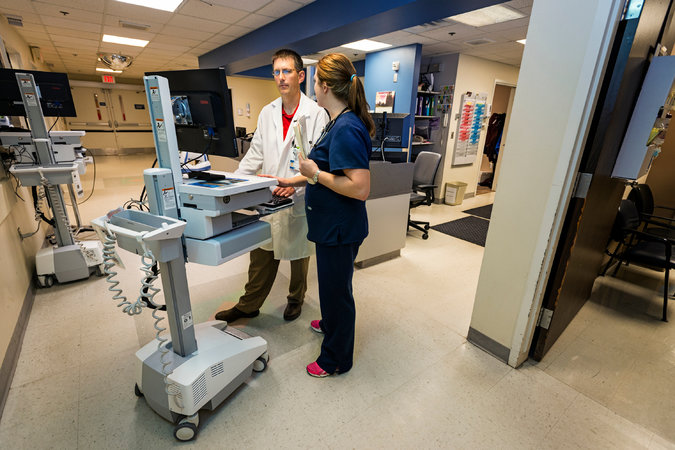
Dr. Jeffery O’Tool and Lizzie Wittrock, a registered nurse, use the electronic record system at UnityPoint Health-St. Luke’s Hospital in Sioux City, Iowa. The hospital’s 18-month old system still cannot be used to send records to another hospital two miles away. Credit Aaron C. Packard for The New York Times

As a practicing ear, nose and throat specialist in Ahoskie, N.C., Dr. Raghuvir B. Gelot says that little has frustrated him more than the digital record system he installed a few years ago.

The problem: His system, made by one company, cannot share patient records with the local medical center, which uses a program made by another company.

The two companies are quick to deny responsibility, each blaming the other.

Regardless of who is at fault, doctors and hospital executives across the country say they are distressed that the expensive electronic health record systems they installed in the hopes of reducing costs and improving the coordination of patient care — a major goal of the Affordable Care Act — simply do not share information with competing systems.

The issue is especially critical now as many hospitals and doctors scramble to install the latest versions of their digital record systems to demonstrate to regulators starting Wednesday that they can share some patient data. Those who cannot will face reductions in Medicare reimbursements down the road.

EPIC 2
The Epic Systems headquarters in Verona, Wis. The company’s systems hold the health records of nearly half of all Americans. Credit Andy Manis for The New York Times

On top of that, leading companies in the industry are preparing to bid on a Defense Department contract valued at an estimated $11 billion. A primary requirement is that the winning vendor must be able to share information, allowing the department to digitally track the medical care of 9.6 million beneficiaries around the globe.

The contract is the latest boon to an industry that taxpayers have heavily subsidized in recent years with over $24 billion in incentive payments to help install electronic health records in hospitals and physicians’ offices.

While most providers have installed some kind of electronic record system, two recent studies have found that fewer than half of the nation’s hospitals can transmit a patient care document, while only 14 percent of physicians can exchange patient data with outside hospitals or other providers.

“We’ve spent half a million dollars on an electronic health record system about three years ago, and I’m faxing all day long. I can’t send anything electronically over it,” said Dr. William L. Rich III, a member of a nine-person ophthalmology practice in Northern Virginia and medical director of health policy for the American Academy of Ophthalmology.

Dr. Gelot, the ear, nose and throat specialist, uses a system made by Practice Fusion. His local medical center, Vidant Roanoke-Chowan Hospital, relies on a program built by Epic Systems.

There is no evidence that either company does a better or worse job of sharing information. But Epic and its enigmatic founder, Judith R. Faulkner, are being denounced by those who say its empire has been built with towering walls, delberately built not to share patient information with competing systems.

Almost 18 months after an Epic system was installed at UnityPoint Health-St. Luke’s hospital in Sioux City, Iowa, physicians there still cannot transmit a patient care document to doctors two miles south at Mercy Medical Center, which uses a system made by another major player in the field, the Cerner Corporation.

Where interconnectivity between systems does occur, it often happens with steep upfront connecting charges or recurring fees, creating what some see as a digital divide between large hospital systems that have money and technical personnel and small, rural hospitals or physician practices that are overwhelmed, financially and technologically.

The University of California Davis Health System has 22 specialists installing the technology so that doctors can share patient data between its Epic system and other internal systems, like the hemodynamic monitors in its critical care unit, or with some non-Epic systems outside the hospital.

“We’re a huge organization, so we can absorb those costs,” said Michael Minear, the chief information officer at the U.C. Davis Health System. “Small clinics and physician offices are going to have a harder time.”

Separately, through its maintenance contracts and other agreements, Epic charges a fee to send data to some non-Epic systems.

Epic is not alone in charging various fees, nor is there evidence that its fees are more expensive than its peers. But the barrier created by these types of charges “affects the small and rural providers much more significantly,” Morgan Honea, executive director of the Colorado Regional Health Information Organization, a public health information exchange, said in recent policy hearings in Washington.

While nearly all of the leading companies in this area have come under fire for their inability to easily share information, Epic faced some of the strongest attacks this summer.

A research report from the RAND Corporation described Epic as a “closed” platform that made it “challenging and costly for hospitals” to interconnect with the clinical or billing software of other companies. Shortly after, Representative Phil Gingrey, a Georgia Republican and a doctor, assailed the company in public hearings in Washington for the same shortfalls.

Executives at Epic rejected the criticism, labeling it as “vendors throwing smoke screens,” but for the first time, the company hired a Washington lobbying firm to improve its image.

Epic argues that its customers — some of the biggest hospitals in the country — share more records than any other. In interviews with nearly 200 providers for a study that will be released in early October, executives at the research firm Klas said Epic’s scores were “as good or better than most of the other vendors” in its ability to share information with other systems.

Moreover, at the request of Epic executives, several customers, including the Cedars-Sinai Health System in Los Angeles, the Yale New Haven Health System, and New York’s Mount Sinai Hospital, sent emails to The New York Times saying they were able to share records through Epic.

The office’s spokesman added that achieving interoperability “requires stakeholders to come together and agree on policy-related issues like who can access information and for what purpose.”

Dr. Gelot says he hopes interoperability comes sooner rather than later.

“The systems can’t communicate, and that becomes my problem because I cannot send what is required and I’m going to have a 1 percent penalty from Medicare,” Dr. Gelot said. “They’re asking me to do something I can’t control.”

Correction: October 3, 2014

An article on Wednesday about the difficulties faced by medical providers in sharing information through electronic health record systems described incorrectly the recipients of medical care through the Defense Department. There are 9.6 million beneficiaries, including retirees and dependents of military personnel; that number does not represent solely active-duty military personnel.

Article link: http://www.nytimes.com/2014/10/01/business/digital-medical-records-become-common-but-sharing-remains-challenging.html?_r=1

A version of this article appears in print on October 1, 2014, on page B1 of the New York edition with the headline: Doctors Hit a Snag in the Rush to Connect. Order Reprints|Today’s Paper|Subscribe

Recent Comments

Steve the Commoner
3 days ago
Our pediatric office installed electronic records in 2010 and have yet to receive a fraction of our Affordable Health Care reimbursements. …

James Igoe
3 days ago
Blame the medical profession in general; doctor’s have often set up proprietary systems.It was obvious from the beginning, that doctor’s…

SDK
3 days ago
I’ve read many of the regulations on Meaningful Use and they are incredibly detailed — describing exactly what IT providers who want to…

See All Comments

A sort of Microsoft of the Midwest, built on a sprawling campus on nearly 1,000 acres of farmland near Madison, Wis., the privately held Epic has emerged as a leader in the race to digitize patient medical records. Its systems hold the health records of nearly half the country.

Continue reading the main story Continue reading the main story

Continue reading the main story

The explosion in demand under the technology incentive plan has been a windfall for Epic. Ms. Faulkner is estimated to be worth $2.3 billion.

In a rare interview, Ms. Faulkner said the industry made great strides this year and noted that Epic’s customers were sending increasing numbers of records each month.

She and other company executives argued that the company was actually one of the first to create rules around sharing information and a platform to do so.

In 2005, when it became clear to her that the government was not prepared to create a set of rules around interoperability, Ms. Faulkner said, her team began writing the code for Care Everywhere. Initially seen as a health information exchange for its own customers, Care Everywhere today connects hospitals all over the country as well as to various public health agencies and registries.

“Let’s say a patient is coming from U.C.L.A. and going to the University of Chicago, an Epic-to-Epic hospital. Boom. That’s easy,” Ms. Faulkner said. “These are hospitals that have agreed to the Rules of the Road, a legal contract, that says the other organization is going to take good care of the data.”

Careful in her choice of words, Ms. Faulkner offered muted criticism of regulators for, essentially, failing to create what she did — a contract to help providers connect to one another and a way to authenticate that only the correct person could view the patient information.

“I’m not sure why the government doesn’t want to do some of the things that would be required for everybody to march together,” she said.

Regulators responded that interoperability was a “top priority” and that they recently set out a 10-year vision and agenda to achieve it, in an emailed statement from the Office of the National Coordinator for Health Information Technology.
Continue reading the main story
343

Comments

Posts navigation

← Older Entries
Newer Entries →
  • Search site

  • Follow healthcarereimagined on WordPress.com
  • Recent Posts

    • The Global Healthcare System Is Broken. Japan Fixed It for $4,100 Per Person. 04/10/2026
    • When Not to Use AI – MIT Sloan 04/01/2026
    • There are more AI health tools than ever—but how well do they work? – MIT Technology Review 03/30/2026
    • Are AI Tools Ready to Answer Patients’ Questions About Their Medical Care? – JAMA 03/27/2026
    • How AI use in scholarly publishing threatens research integrity, lessens trust, and invites misinformation – Bulletin of the Atomic Scientists 03/25/2026
    • VA Prepares April Relaunch of EHR Program – GovCIO 03/19/2026
    • Strong call for universal healthcare from Pope Leo today – FAN 03/18/2026
    • EHR fragmentation offers an opportunity to enhance care coordination and experience 03/16/2026
    • When AI Governance Fails 03/15/2026
    • Introduction: Disinformation as a multiplier of existential threat – Bulletin of the Atomic Scientists 03/12/2026
  • Categories

    • Accountable Care Organizations
    • ACOs
    • AHRQ
    • American Board of Internal Medicine
    • Big Data
    • Blue Button
    • Board Certification
    • Cancer Treatment
    • Data Science
    • Digital Services Playbook
    • DoD
    • EHR Interoperability
    • EHR Usability
    • Emergency Medicine
    • FDA
    • FDASIA
    • GAO Reports
    • Genetic Data
    • Genetic Research
    • Genomic Data
    • Global Standards
    • Health Care Costs
    • Health Care Economics
    • Health IT adoption
    • Health Outcomes
    • Healthcare Delivery
    • Healthcare Informatics
    • Healthcare Outcomes
    • Healthcare Security
    • Helathcare Delivery
    • HHS
    • HIPAA
    • ICD-10
    • Innovation
    • Integrated Electronic Health Records
    • IT Acquisition
    • JASONS
    • Lab Report Access
    • Military Health System Reform
    • Mobile Health
    • Mobile Healthcare
    • National Health IT System
    • NSF
    • ONC Reports to Congress
    • Oncology
    • Open Data
    • Patient Centered Medical Home
    • Patient Portals
    • PCMH
    • Precision Medicine
    • Primary Care
    • Public Health
    • Quadruple Aim
    • Quality Measures
    • Rehab Medicine
    • TechFAR Handbook
    • Triple Aim
    • U.S. Air Force Medicine
    • U.S. Army
    • U.S. Army Medicine
    • U.S. Navy Medicine
    • U.S. Surgeon General
    • Uncategorized
    • Value-based Care
    • Veterans Affairs
    • Warrior Transistion Units
    • XPRIZE
  • Archives

    • April 2026 (2)
    • March 2026 (9)
    • February 2026 (6)
    • January 2026 (8)
    • December 2025 (11)
    • November 2025 (9)
    • October 2025 (10)
    • September 2025 (4)
    • August 2025 (7)
    • July 2025 (2)
    • June 2025 (9)
    • May 2025 (4)
    • April 2025 (11)
    • March 2025 (11)
    • February 2025 (10)
    • January 2025 (12)
    • December 2024 (12)
    • November 2024 (7)
    • October 2024 (5)
    • September 2024 (9)
    • August 2024 (10)
    • July 2024 (13)
    • June 2024 (18)
    • May 2024 (10)
    • April 2024 (19)
    • March 2024 (35)
    • February 2024 (23)
    • January 2024 (16)
    • December 2023 (22)
    • November 2023 (38)
    • October 2023 (24)
    • September 2023 (24)
    • August 2023 (34)
    • July 2023 (33)
    • June 2023 (30)
    • May 2023 (35)
    • April 2023 (30)
    • March 2023 (30)
    • February 2023 (15)
    • January 2023 (17)
    • December 2022 (10)
    • November 2022 (7)
    • October 2022 (22)
    • September 2022 (16)
    • August 2022 (33)
    • July 2022 (28)
    • June 2022 (42)
    • May 2022 (53)
    • April 2022 (35)
    • March 2022 (37)
    • February 2022 (21)
    • January 2022 (28)
    • December 2021 (23)
    • November 2021 (12)
    • October 2021 (10)
    • September 2021 (4)
    • August 2021 (4)
    • July 2021 (4)
    • May 2021 (3)
    • April 2021 (1)
    • March 2021 (2)
    • February 2021 (1)
    • January 2021 (4)
    • December 2020 (7)
    • November 2020 (2)
    • October 2020 (4)
    • September 2020 (7)
    • August 2020 (11)
    • July 2020 (3)
    • June 2020 (5)
    • April 2020 (3)
    • March 2020 (1)
    • February 2020 (1)
    • January 2020 (2)
    • December 2019 (2)
    • November 2019 (1)
    • September 2019 (4)
    • August 2019 (3)
    • July 2019 (5)
    • June 2019 (10)
    • May 2019 (8)
    • April 2019 (6)
    • March 2019 (7)
    • February 2019 (17)
    • January 2019 (14)
    • December 2018 (10)
    • November 2018 (20)
    • October 2018 (14)
    • September 2018 (27)
    • August 2018 (19)
    • July 2018 (16)
    • June 2018 (18)
    • May 2018 (28)
    • April 2018 (3)
    • March 2018 (11)
    • February 2018 (5)
    • January 2018 (10)
    • December 2017 (20)
    • November 2017 (30)
    • October 2017 (33)
    • September 2017 (11)
    • August 2017 (13)
    • July 2017 (9)
    • June 2017 (8)
    • May 2017 (9)
    • April 2017 (4)
    • March 2017 (12)
    • December 2016 (3)
    • September 2016 (4)
    • August 2016 (1)
    • July 2016 (7)
    • June 2016 (7)
    • April 2016 (4)
    • March 2016 (7)
    • February 2016 (1)
    • January 2016 (3)
    • November 2015 (3)
    • October 2015 (2)
    • September 2015 (9)
    • August 2015 (6)
    • June 2015 (5)
    • May 2015 (6)
    • April 2015 (3)
    • March 2015 (16)
    • February 2015 (10)
    • January 2015 (16)
    • December 2014 (9)
    • November 2014 (7)
    • October 2014 (21)
    • September 2014 (8)
    • August 2014 (9)
    • July 2014 (7)
    • June 2014 (5)
    • May 2014 (8)
    • April 2014 (19)
    • March 2014 (8)
    • February 2014 (9)
    • January 2014 (31)
    • December 2013 (23)
    • November 2013 (48)
    • October 2013 (25)
  • Tags

    Business Defense Department Department of Veterans Affairs EHealth EHR Electronic health record Food and Drug Administration Health Health informatics Health Information Exchange Health information technology Health system HIE Hospital IBM Mayo Clinic Medicare Medicine Military Health System Patient Patient portal Patient Protection and Affordable Care Act United States United States Department of Defense United States Department of Veterans Affairs
  • Upcoming Events

Blog at WordPress.com.
healthcarereimagined
Blog at WordPress.com.
  • Subscribe Subscribed
    • healthcarereimagined
    • Join 153 other subscribers
    • Already have a WordPress.com account? Log in now.
    • healthcarereimagined
    • Subscribe Subscribed
    • Sign up
    • Log in
    • Report this content
    • View site in Reader
    • Manage subscriptions
    • Collapse this bar
 

Loading Comments...