healthcarereimagined

Envisioning healthcare for the 21st century

  • About
  • Economics

The ABIM Foundation, Choosing Wisely®, and the $2.3 Million Condominium – Dr. Wes

Posted by timmreardon on 12/18/2014
Posted in: American Board of Internal Medicine. Leave a comment

Tuesday, December 16, 2014

Is it “medically professional” for a non-profit organization to use physician testing fees to “choose wisely” a $2.3 million luxury condominium complete with a chauffeur-driven BMW 7-series town car? In my view, obviously not. To most people such an action would conjure up images of hypocrisy, waste, and corruption.

Yet, after a review of public and tax records, it appears to me this is exactly what has happened.

Background

In 1999 for reasons that are unclear, the American Board of Internal Medicine (ABIM), itself a tax-exempt 501 (c) (3) independent non-profit physician evaluation organization domiciled in Iowa, created a second non-profit tax-exempt 501 (c) (3) organization, the ABIM Foundation (Foundation), to first define and later promote the term “medical professionalism.” Both the ABIM and the Foundation share a common address in Pennsylvania and common officers:

“The American Board of Internal Medicine (ABIM) is related to the ABIM Foundation (Foundation) in that The Foundation is the sole voting member of the ABIM. As such, the two organizations share a common president, a common CFO, and a common senior vice president whose base salaries are allocated between ABIM and The Foundation based on the time spent by each executive.”
To define “medical professionalism,” the new Foundation enlisted other members of the non-profit world including the ABIM, the paid “directors” of the Foundation, the Robert Wood Johnson Foundation, the American College of Physicians-American Society of Internal Medicine and the European Federation of Internal Medicine. The group was chaired by Troy Brennan, MD, JD a paid “Director” of the Foundation who was also President and CEO of Brigham and Women’s Physician Organization at the time. (He later became the Chief Medical Officer of Aetna in 2006, and now serves as the Executive Vice President and Chief Medical Officer of CVS Caremark). In 2002 this group published a white paper entitled “Medical Professionalism in the New Millenium: A Physician Charter” without peer review in the Annals of Internal Medicine (here) and The Lancet (here). At least the Annals editor, Harold C. Sox, MD mustered the courage to express concerns about the manuscript in his introductory remarks to his readers:

“The introduction contains the following premise: Changes in the health care delivery systems in countries throughout the industrialized world threaten the values of professionalism. The document conveys this message with chilling brevity. The authors apparently feel no need to defend this premise, perhaps because they believe that it is a universally held truth. The authors go further, stating that the conditions of medical practice are tempting physicians to abandon their commitment to the primacy of patient welfare. These are very strong words. Whether they are strictly true for the profession as a whole is almost beside the point. Each physician must decide if the circumstances of practice are threatening his or her adherence to the values that the medical profession has held dear for many millennia.”
The paper centered on three fundamental principles that the authors claimed defined “medical professionalism:” (1) the primacy of patient welfare, (2) patient autonomy, and a new concept, (3) the principle of social justice – that is, “the medical profession must promote justice in the health care system, including the fair distribution of health care resources.” With this definition, physicians could no longer just be unwavering patient advocates concerned with the “primacy of their patient’s welfare,” they had also had to serve the financial needs of The System of medicine lest they be labeled “medically unprofessional.”

Ten years later after accumulating some $76 million in assets, the Foundation began their hard-to-disagree-with “Choosing Wisely®” campaign to encourage physicians and providers to question the value of medical testing in an effort to eliminate unnecessary tests and procedures. The campaign has grown to include 70 societies and some non-physician organizations, including Consumer Reports, AARP, SEIU, and Univision among others. As part of the campaign, monetary grants from the Robert Wood Johnson Foundation are awarded to institutions willing to “educate practicing physicians about the recommendations from specialty societies, and building physician communication skills to facilitate conversations with their patients about the care they need.”

The Money Trail

So how did the ABIM Foundation accumulate all that money? Reviewing public tax records of the ABIM and its Foundation reveals a significant portion of the Foundation’s revenues came directly from the ABIM. Recall that ABIM receives 97% of its annual revenues from physician certification (62%) and re-certification fees (35%), with only 14% of these fees going toward physician examination development. In 2007 and 2008 alone, cash grants from the ABIM to its Foundation of $7 million and $6 million respectively were issued. The public records disclosed that $17,360,000 from the ABIM were made to its Foundation in the 7 years ending 6/30/2008. As a three-time participant in the ABIM certification process (candidate #127308), I can attest that to the best of my knowledge physicians were never made aware of this use of the testing fees they paid the ABIM.

The Luxury Condominium

210Wash1

Street View, “The Ayer Buidling,” 210 W. Washington Square

So why did the ABIM Foundation need all this cash from physicians? We can’t be certain, but the Foundation disclosed in their 2008 Form 990 that a portion of the money they received from the ABIM via physicians fees was used to purchase a 2,579 square foot 3-bedroom luxury condominium (Unit #11NW, in the “Ayer” Building, 210 W. Washington Square, Philadelphia) in December 2007 for $2.3 million. The luxury property borders Washington Square Park of the most historic areas of Philadelphia, across the street from the Tomb of the Unknown Revolutionary War Soldier and the Eternal Flame. The condominium building previously advertised a chauffeur driven Mercedes Benz S-series town car (more pictures here).

Since then, the Foundation has reported “condominium expenses” totaling $850,340 from December 2007 through June 30, 2013 (FY 2008: $42,522, FY 2009: $164,460, FY 2010: 161,957, FY 2011: $165,982, FY 2012: $161,980, FY 2013: $153,439 (most of these reported as “program service expenses”)). In my view, these expenses were accrued while the ABIM appears to have been on an inherently unsustainable financial course from 2001 to 2012 with its net asset or fund balances on 6/30/2002 beginning with a negative balance of $10,762,954 and growing to a negative balance of $43,150,390 ending 6/30/2013. Meanwhile, over the same period its shadow organization, the ABIM Foundation fund balance was $73,841,719 on 6/30/2013.

It should be noted that in the year of the condominium purchase the President and CEO of the ABIM, Christine Cassel, MD, earned $484,883 from the ABIM and $161,627 from the Foundation. Dr. Cassel continues to serve as President and CEO of the National Quality Forum despite a history of other seemingly conflicted financial dealings. Other executives of ABIM that year included F. Daniel Duffy, MD who served as Executive Vice President of the ABIM earning $379,915 from the ABIM, and Cary Sennett, MD, PhD who served as Senior Vice President earning $185,122 from the ABIM and $185,122 from the Foundation and now serves as a Vice President of Anthem, Inc., formerly Wellpoint. That year Dr. Richard Baron, the current President and CEO of the ABIM and Foundation, served as the secretary/treasurer of the ABIM Board earning $59,729 until 7/1/2008 when he became an unpaid Director of the Board. By comparison, according to one reliable source, the median general internal medicine physician salary in the U.S. was $205,441 in 2009.

More Questions

Reviewing the public record on when and where the ABIM Foundation was actually created discloses another discrepancy. We observe that the Foundation has recorded on their tax returns as being founded in 1999 with its “legal domicile” in Iowa, like the ABIM. However, a search for the organization in Iowa comes up empty, while a search in Pennsylvania Department of State (screen shot here) shows the Foundation was actually created in Pennsylvania in 1989. Which is correct?

We should note that non-profits are not required to file financial statements with the state of Iowa, while Pennsylvania requires them. This raises uncomfortable questions. Is the Foundation’s Iowa domicile sheltering the sources and uses of its funds? Why does a non-profit promoting “medical professionalism” need to accumulate this much revenue? Is this how the Foundation demonstrates their “medical professionalism” to the public? To whom is the ABIM and Foundation “accountable?” Anyone?

My Call to the ABIM

On 4 December 2014 I contacted the ABIM and requested an explanation regarding the condominium, the ongoing condominium expenses, and the discrepancy of the ABIM Foundation domicile and founding date. Richard Baron, MD, the current President and CEO of the ABIM returned my call and explained the following:

1.Dr. Baron stated that the condominium was purchased as a “investment property” and part of the investment portfolio of the Foundation. He mentioned that real estate holdings were not uncommon with other similar non-profits. The condominium was used for several purposes, including housing ABIM personnel who resided out of state and returned to Philadelphia for meetings, by contractors (for instance, to house an IT team from India), and for off-site retreats and meetings with the Communications Group of the ABIM, for instance. He noted that when ABIM members use the Foundation’s condominium, the Foundation is paid $150/night from the ABIM (compared to the “usual” Philadelphia hotel rate of about $190/night) and there was cash flow to the Foundation from the ABIM for the use of their facility.

2.After revelations of the luxury condominium were disclosed at a 2 Dec 2014 Pennsylvania Medical Society town hall meeting, Dr. Baron mentioned in passing that the ABIM was putting the condominium up for sale. I asked Dr. Baron the name of the listing agent and the price. He stated he could not comment because “the paperwork was not in order” and the those details had not been finalized because they were advised that the real estate market would be better in the Spring.

3.When asked about the high ongoing condominium expenses and the discrepancy about the ABIM Foundation’s creation date and domicile, Dr. Baron could not immediately respond but sent this follow-up e-mail 4 Dec 2014 at 2:39PM (CST):
“Hi Dr. Fischer (sic)-

Attached please find the breakdown of the condo expenses. As I explained the depreciation $$ are a required reporting artifact for the condo as a business investment. The other costs are covered by the condo usage fees.

Regarding the 1989/1999 question – In 1999 ABIM Foundation became a separate operating foundation.

Thanks,

Rich

Richard J. Baron, MD
MACP
President and Chief Executive Officer
American Board of Internal Medicine”

4.In closing, Dr. Baron expressed his willingness to be open to further questions.

5.Today I learned that the condominium is now listed with the following description:
“Extremely Spacious Three Bedroom, 3.5 Bath Home at the Ayer Condominium. Tremendous Entertaining Space. 11’7’’ ceiling heights. Bulthaup b-3 kitchen system, Miele and Subzero Appliances. Huge windows with northwest views. High floor offering stupendous sunsets. Gorgeous stone bathrooms. Abundant closet space. One garage parking space included. Concierge, doormen, valets, gym, chauffeur driven BMW 7-Series.” (More details here.)

I never received a clear answer to my ABIM Foundation domicile discrepancy.

Larger Implications

Sadly, the medical profession has become a house divided. On one side are many non-clinical physicians who have become far removed from patient care and are firmly embedded in the non-profit, academic, and public policy circles making handsome salaries while seeing little problem with coercing their colleagues to pay fees to support their various economic, policy, or personal agendas. In the words of my colleague Jordan Grumet, MD: “they talk about ‘accountability’ as if they are the ones in the ICU having the family meetings. They pray at the altar of ‘quality’ yet fail to define the specifics of such a term. They resent ‘over treatment’ but never have suffered the consequences of not doing enough.”

On the other side are the physicians buried in the work-a-day world of patient care, busy doing the best they can for their patients in our increasingly complicated health care system, working as “excellent sheep” as they do their difficult job and try not to rock the boat. While such a dichotomy is not unique to medicine (look to education, the public service sector, and politics, for instance), is ignoring this new reality useful to our profession? Might the unintended consequences of these unaccountable non-profit organizations and revolving-door employment practices with government and business interests be causing unimaginable harm to the integrity and credibility of our profession while simultaneously wasting valuable resources?

It is a shame that most physicians, particularly younger doctors saddled with exorbitant training debt and concerns of job acquisition and job security, are not in a position to protest the actions of the ABIM and its sycophants, particularly since their ability to practice medicine is increasingly tied to these ABIM board certification and their new perpetual maintenance of certification payments. But this is the point, isn’t it? Regulatory capture. As these younger doctors gain experience and awaken to the realities of their new health care arena that is increasingly dominated by unaccountable organizations led by non-clinical members of our own profession, we risk creating cynicism in our ranks and physicians who must be more concerned with passing a test than providing direct patient care. Even worse, we risk promoting ourselves, career or cause over the complicated needs of our patients as the divide grows ever deeper. As a result, the brittle credibility and hard-earned trust with our patients is squandered beyond repair. In my opinion, this is what we risk when we have corruption within.

Is this what our profession and the public wants?

I can only hope that practicing US physicians and the public will demand a full accounting of the ABIM and their Foundation’s entire financial dealings and non-transparent co-mingling of funds. I hope that Congress decides to investigate the ABIM’s role in including their MOC program as a physician quality reporting measure in the Affordable Care Act (see pages 365 and 963) to determine its legitimacy in light of these findings. Furthermore, an investigation into possible violations of federal policy on the protection of human subjects (in this case practicing physicians involved in direct patient care) regarding the American Board of Medical Specialties’ requirement for practice and patient survey collection for Part IV of their trademarked Maintenance of Certification® program that the ABIM helps conduct should occur, especially in light of lack of informed consent afforded to physicians regarding how the fees and data they collect are used.

It is time we hold the non-clinical members of our own profession that lead these organizations accountable to all physicians and the public at large. Until this occurs, physician-members of every ABIM subspecialty organization that profits from educational content provided to the ABIM should divest themselves and work to create their own, more credible, simplified and transparent life-long learning pathways. The American Association of Clinical Endocrinologists has already set a good example. While I understand that refusing to buck the coercion created by the multimillion dollar ABIM and its Foundation will be difficult, our credibility as stewards of our patients’ best interests and the preservation of the integrity of our profession demands nothing less.

-Wes

Acknowledgement

I am indebted to Charles P. Kroll, CPA for his invaluable assistance collecting tax records of the ABIM and ABIM Foundation before 2007 and assisting in the understanding of the nuances of not-for-profit accounting methods. Mr. Kroll provided forensic accounting analysis to the Minnesota attorney general’s office during the Medica-Allina scandal and testified at the Minnesota Senate hearing on the matter.


Article link: http://drwes.blogspot.com/2014/12/the-abim-foundation-choosing-wisely-and.html?utm_content=bufferd82da&utm_medium=social&utm_source=twitter.com&utm_campaign=buffer

Stop Wasting Doctors’ Time – Board-Certification Has Gone Too Far – NY Times

Posted by timmreardon on 12/18/2014
Posted in: Accountable Care Organizations, American Board of Internal Medicine, Board Certification, Healthcare Delivery, Healthcare Informatics, Healthcare Security, National Health IT System, Patient Centered Medical Home, Primary Care, Quadruple Aim. Tagged: Board Certification. Leave a comment

16Ofri-articleLarge

John Patrick Thomas

By DANIELLE OFRI
December 15, 2014

IT’S hard to believe that another 10 years have passed, but the proof is the 11-volume stack of medical review books at my bedside. It’s time for the decennial rite of cramming a thousand pages of facts for an eight-hour-long multiple choice test.

Doctors are licensed by their states to practice medicine, but they’re also expected to be “board-certified” in their particular field — surgery, obstetrics, pediatrics, etc. This certification comes from the professional organization of each field. In my case, it’s the American Board of Internal Medicine.

It used to be that you tackled those monstrous board exams just once after residency. Then you went into practice and never looked at a No. 2 pencil again. But in 1990, the boards decided that doctors should recertify every 10 years. This seemed reasonable, given how much medicine changes. Over time, though, the recertification process has become its own industry. The exam has been supplemented with a growing number of maintenance-of-certification, or M.O.C., requirements. Some are knowledge-based exercises, but many are “practice assessments” meant to improve care in your own practice that end up being just onerous paperwork. And the recertification process and associated materials cost doctors thousands of dollars.

This year the internal medicine board announced that doctors who didn’t participate would be publicly tagged as “not meeting M.O.C. requirements.” Many jobs require board-certification, so a number of doctors felt that this tactic amounted to extortion. More than 19,000 signed a petition in protest. They complained that the specialty boards are monopolies that control who can practice medicine and use this power to compel compliance and exorbitant fees. Worse, they argued that the recertification process might not even be effective.

It may seem obvious that continuing education would benefit doctors and patients, but in medicine we’ve often learned the hard way that things that seem intuitive (think estrogen replacement therapy) may turn out to have little benefit or to even be harmful.

Two recent studies in The Journal of the American Medical Association are the first to seriously evaluate the role of M.O.C. in physician quality and medical costs. They compared doctors certified just before the 1990 change (who were grandfathered in for life and not required to recertify) and their colleagues who certified just after 1990. One study looked at costs and the other at quality (as measured by patients’ glucose levels, blood pressure, colon cancer screening rates and the use of medication for heart disease). The studies differed in methodology but the upshot was that patients’ medical outcomes were no better and overall costs were only marginally lower in the recertifying group (2.5 percent).

All that effort, in other words, didn’t seem to make doctors better. Many doctors are rallying around these findings to call for a wholesale dismantling of the recertification system.

But others are using the data to ask how recertification can be made meaningful. Just because these studies didn’t show an effect doesn’t mean one doesn’t exist. Recertification may benefit certain subsets of patients, such as those with less common illnesses who aren’t numerous enough to influence study results.

Some parts of the recertification process are useful. The practice questions in the review books, for example, exercise muscles we don’t use every day. They re-emphasize important points, remind us about conditions that we see less often and, best of all, are open-book, much like real life. When there is a complex patient in clinical practice, no doctor relies just on memory; we look up the information, check a journal or consult a colleague. To rely solely on memory, especially for rarer illnesses or complicated patients, would be malpractice.

Which is why the huge exam that culminates each decade of recertification should be abolished. Memorizing reams of information to be regurgitated in a “secure testing center” is a waste of time and resources, and does not reflect how medicine is practiced.

Most doctors agree with having some sort of process that updates and refreshes medical knowledge. But the process has become unmanageable. Let’s strip away the archaic exam and the paperwork-heavy practice assessments. A periodic, modest-size, open-book test that incorporates relevant knowledge and updates would be more reasonable.

There is much more to the science, art and practice of medicine than medical knowledge. But it is the one aspect we can easily assess on a profession-wide scale. Open-book, self-paced tests are the best way to keep knowledge current. The act of searching for answers — whether from journals, textbooks, databases or colleagues — is itself the knowledge. All the rest is busy work and red tape.

Danielle Ofri, an associate professor at N.Y.U. and internist at Bellevue Hospital, is the author of “What Doctors Feel: How Emotions Affect the Practice of Medicine.”

Article link: http://mobile.nytimes.com/2014/12/16/opinion/board-certification-has-gone-too-far.html?referrer=&_r=2

Why is medical IT so bad? – KevinMD

Posted by timmreardon on 12/17/2014
Posted in: Big Data, Blue Button, Data Science, EHR Interoperability, Global Standards, Health Care Costs, Health Care Economics, Health IT adoption, Health Outcomes, Healthcare Delivery, Healthcare Informatics, Healthcare Security, Innovation, Integrated Electronic Health Records, Mobile Healthcare, National Health IT System, Quadruple Aim, Quality Measures. Leave a comment

James C. Salwitz, MD | Tech | November 1, 2014
shutterstock_139655147
A 57-year-old doctor I know is retiring to teach at a local junior college. He is respected, enjoys practicing medicine and is beloved by his patients; therefore, I was surprised. While he is frustrated by the complexity of health insurance, tired by the long hours and angered by defensive medicine, the final straw is that he can not stand the world of the EMR.

As an electronic medical record junkie, I would quit if I had to practice without a computerized information system. These programs are a dramatic improvement over the paper and pen way of keeping records. Still, I understand the onerous problems. Data entry is clumsy, painful and takes hours. Information is stored in a nearly random manner, not much better than papers tossed into a cardboard box. Every EMR program is different and none share vital patient data. Training is lousy, access is non-intuitive, support is spotty, costs are high and any gains seem to be countered by poorly timed system crashes.

Unhappy to lose a physician from our medical community, I find myself musing about what has gone wrong with a critical technology that has such shining potential. Computer systems fly giant aircraft around the world without incident, handle trillions of dollars of financial trade without a penny lost and allow hundreds of millions to tweet, Facebook or blog. Why is medical IT so bad?

The major problem with EMRs, as they are conceived and as they presently exist, is that they are round pegs in square holes. They are designed to gather and store information; shiny electronic file cabinets, and they are built around the primary function of billing; grinding out ICD-9 and CPT codes. That would be fine if that was what doctors actually do with their time and if making money was the primary goal of practicing medicine. However, surprise, surprise, what doctors really do is treat patients. EMRs often hinder, not assist, the giving of medical care.

A physician’s normal function is to interface between objective biology and the complexity of each human life. Often called “the art” of medicine, it is the act of bridging science to individual reality. Ask questions; test; collect information. Attempt to organize by creating of a list of possibilities, a differential diagnosis. Assimilate, screen and sift that data until you reach a final diagnosis. Then, implement therapy using science and the results of research, with compassion, patience and the skill of a teacher.

A functional electronic health delivery system would assist in this systematic decision process, actively participating in the query and analysis, adding scientific knowledge and observations based on state-of-the art recommendations. Help the doctor build the differential. Recommend testing or therapeutic alternatives. The EMR should be aligned with the doctor’s goals, which are the patient’s health.

The GPS in my car is first rate. Data input is verbal and flawless. It tells speed, direction, and continuously adjusts recommendations based on my progress and traffic impediments. It even throws in alerts about the weather. In other words, the GPS not only stores data, it tells me what to do with it, and is constantly updated by events far beyond my windshield, which I have not yet considered. Someday soon, that GPS will actually drive my car.

A health computational system should have, at a minimum, the functionality of that GPS. Easy data entry and access. Flawless expanding storage. Clear output. Actionable recommendations and observations, based not only on the patient, but on the science of medicine. An EMR should be updated continuously by clinical information such as labs, vital signs and tests, as well as the most recent scientific discoveries, even if they are made halfway around the world, delivering at the bedside the vast resources of big data. Help me care for the patient by complementing my work.

As the practice of medicine becomes logarithmically more complex with the expanding potential of genomic or personalized medicine, advanced information technology will be vital. No doctor will be able to assimilate an individual patient’s genome and thousands of actionable variables into a differential diagnosis or comprehensive treatment. The key will be real-time EMR support.

To date no one has taken the potential or complexity of EMRs seriously. The assumption is that these systems can be built by cottage industries, with the result that there are hundreds of rudimentary programs, all grossly inadequate. The average GPS is far more functional.

This slowly expanding area of IT research is called translational bioinformatics, but there have been relatively few dollars invested by the NIH in the basic science. Data input remains primitive. We have no backbone on which to create a national network to maintain and track individual records. There is no integration with decision making software or connection to research troves. Medicine relies on the doctor to connect the myriad dots, even as he or she is up at midnight, typing elementary progress notes into elementary office systems.

Doctors need and desire help in taking care of their patients, but instead they have a tool designed for secretaries and insurance auditors. We must readdress the goals of clinical IT to improve, empower and give medical care. The future of our patients and the future of health, depend on it. No amount of frustration and burned out physicians will force patient lives into slots built for dollars.

James C. Salwitz is an oncologist who blogs at Sunrise Rounds.

Image credit: Shutterstock.com

Article link: http://www.kevinmd.com/blog/2014/11/medical-bad.html

Two Words That Kill Innovation – HBR

Posted by timmreardon on 12/17/2014
Posted in: Genetic Data, Global Standards, Health Care Costs, Health Care Economics, Health IT adoption, Health Outcomes, Healthcare Delivery, Healthcare Informatics, Healthcare Security, Innovation, Integrated Electronic Health Records, National Health IT System, Quadruple Aim. Leave a comment

by Roger Martin

December 9, 2014
DEC14_09
Over the past 50 years, management practices have become ever more scientific and quantitative. Managing by the numbers, using business analytics and leveraging Big Data are all considered to be unalloyed goods, indicative of enlightened management. Without question, data and analytics have their roles and their benefits. But they have a really important dark side too, and when managers don’t see that dark side, they accidentally kill innovation.

The implicit logic behind the scientific management doctrine is that you must prove — analytically, and in advance — that a decision is correct before making it. To be clear, it is not the explicit doctrine — few managers think this themselves, but they’re swayed by their training to be scientifically analytical. This works productively for most of their everyday decisions. They analyze the pattern of sales per square foot in their stores and make the bottom quartile stores look more like the top quartile stores. They analyze their warehousing costs and shift the locations of their hubs. They analyze their assembly line and optimize the throughput. But when genuine innovation is required, there’s a problem. As the clever early 20th century American pragmatist philosopher Charles Sanders Peirce pointed out — not about business but about the world in general — it is not possible to prove analytically that a new idea is a good one in advance. Why? It’s pretty simple when you think about it. There is no data about how a genuinely new idea will interact with the world in advance of said new idea actually interacting with the world. Therefore there is no way to prove it will work in advance.

This creates a real problem for managers who believe that their job in life is to make sure that a decision should be made only when there is analytical proof that it is the right decision. It causes them to ask for something that cannot be delivered. When an innovator comes to them with an idea, they say, “Prove it.” These are the two managerial words that are most deadly to innovation.

The great irony is that the managers who give this instruction — prove it before I agree to do it — think that they are simply being rigorous managers. They are sure that any innovation problem has nothing to do with them. Rather, it’s the people they’re managing who aren’t executing properly on their innovation program.

They are oblivious to the fact that they are setting a standard that’s impossible to meet. They will complain about their organizations failing to come up with ‘compelling innovations.’ They will hire innovation consultants to bring ‘new thinking’ to the organization — but later declare that the consultants haven’t brought any “winning concepts.”

But the fact is that it’s the managers who are the problem. When they utter the words “prove it,” they kill innovation while doing exactly what they think they should be doing. It is very sad to watch. The innovators throw up their hands because they know in their hearts that the only way to prove an innovative idea in advance is to make it un-innovative. The managers who cause the problem spend their time looking for culprits other than themselves.

To change this dynamic, managers need to distinguish between when they are honing and refining an existing system and when they are attempting to create something genuinely new. In the former situations, it is totally fine to come in with analytical guns blazing. In the latter, they need to put away the guns and take an entirely different approach. Here, they need to borrow from the design thinking toolbox by engaging in prototyping. Try innovative ideas, but do so in small ways without a lot of up front investment. Generate data through experimentation rather than assuming that there is pre-existing data to be harvested. Iterative experimentation will migrate the solution to an ever more compelling state — and spin off new data along the way.

In this way, the modern manager can be both analytical and innovative, leading innovation rather than accidentally squelching it.

Roger Martin (www.rogerlmartin.com) is the Premier’s Chair in Productivity and Competitiveness and Academic Director of the Martin Prosperity Institute at the Rotman School of Management at the University of Toronto in Canada. He is the co-author of Playing to Win: How Strategy Really Works and of the Playing to Win Strategy Toolkit. For more information, including events with Roger, click here.

Article link:https://hbr.org/2014/12/two-words-that-kill-innovation?utm_campaign=Socialflow&utm_source=Socialflow&utm_medium=Tweet

VA Turns to IBM Watson to Improve Veteran Care – Nextgov

Posted by timmreardon on 12/17/2014
Posted in: Big Data, Data Science, Health Care Costs, Health Care Economics, Health IT adoption, Health Outcomes, Healthcare Delivery, Healthcare Informatics, Healthcare Security, Innovation, Integrated Electronic Health Records, Military Health System Reform, Public Health, Quadruple Aim, Quality Measures, Veterans Affairs. Leave a comment

By Frank Konkel

December 15, 2014

IBM nextgov-medium

IBM’s Watson technology – first made famous in 2011 after besting human competitors on the television game show “Jeopardy” – is now turning its computing power toward improving veterans’ health care.

The Department of Veterans Affairs announced today a two-year pilot program with the company worth $6.8 million, signaling the agency’s intent to assess innovative and emerging technologies that could benefit the 8.3 million veterans requiring care each year.

IBM’s Watson technology “will ingest hundreds of thousands of Veterans Health Administration documents, medical records and research papers” and distill information and knowledge to clinicians in near real-time, according to IBM.

During the pilot, Watson will base clinical decisions on realistic simulations of patient encounters – not on actual patient encounters – providing a test-bed for how computers might handle patient care decisions.

“Physicians can save valuable time finding the right information needed to care for their patients with this sophisticated and advanced technology,” said Carolyn M. Clancy, VA’s interim undersecretary for health, in a statement. “A tool that can help a clinician quickly collect, combine and present information will allow them to spend more time listening and interacting with the veteran.”

IBM will support VA care providers in one of the agency’s data centers located in Austin, Texas.

If the pilot program is successful, it could show how cognitive computing systems can distill complex data sets — such as electronic health records, which are made up of large sets of both structured and unstructured data — into useful information.

The Defense Department recently accepted bids for a revamped version of its electronic health records system contract that could eclipse $11 billion in value. IBM is one of the bidders on that contract, and while the contract language doesn’t require cognitive computing capabilities, a Watson-like capability would be something IBM could integrate into its platform should it win the award.

“IBM designed Watson to help solve some of the world’s greatest challenges, and I’m humbled to be working with VA in helping them, including enhancing treatment efforts for PTSD,” said Anne Altman, general manager for IBM’s federal practice.

By Frank Konkel

December 15, 2014

http://www.nextgov.com/health/health-it/2014/12/va-wants-ibm-watson-come-ways-improve-veteran-care/101316/

The Odd Math of Medical Tests: One Scan, Two Prices, Both High – NY Times

Posted by timmreardon on 12/16/2014
Posted in: Health Care Costs, Health Care Economics, Health IT adoption, Health Outcomes, Healthcare Delivery, Quadruple Aim, Quality Measures, Uncategorized. Leave a comment

ECHO00-articleLarge

An echocardiogram Len Charlap underwent in 2013. It showed a thick, damaged valve that was preventing blood (in color) from flowing adequately from the main pumping chamber of his heart, top, to the rest of his body.

By ELISABETH ROSENTHAL

December 15, 2014

PRINCETON, N.J. — Len Charlap, a retired math professor, has had two outpatient echocardiograms in the past three years that scanned the valves of his heart. The first, performed by a technician at a community hospital near his home here in central New Jersey, lasted less than 30 minutes. The next, at a premier academic medical center in Boston, took three times as long and involved a cardiologist.

And yet, when he saw the charges, the numbers seemed backward: The community hospital had charged about $5,500, while the Harvard teaching hospital had billed $1,400 for the much more elaborate test. “Why would that be?” Mr. Charlap asked. “It really bothered me.”

Testing has become to the United States’ medical system what liquor is to the hospitality industry: a profit center with large and often arbitrary markups. From a medical perspective, blood work, tests and scans are tools to help physicians diagnose and monitor disease. But from a business perspective, they are opportunities to bring in revenue — especially because the equipment to perform them has generally become far cheaper, smaller and more highly mechanized in the past two decades.

And echocardiograms, ultrasound pictures of the heart, are enticing because they are painless and have no side effects — unlike CT scans, blood draws, colonoscopies or magnetic resonance imaging tests, where concerns about issues like radiation and discomfort may be limiting. Though the machines that perform them were revolutionary and expensive when they first came into practice in the 1970s, the costs have dropped considerably. Now, there are even pocket-size devices that sell for as little as $5,000 and suffice for some types of examinations.

“Old technology should be like old TVs: The price should go down,” said Dr. Naoki Ikegami, a health systems expert at Keio University School of Medicine in Tokyo, who is also affiliated with the University of Pennsylvania’s business school. “One of the things about the U.S. health care system is that it defies the laws of economics, and of gravity. Once the price is high, it just stays there.”

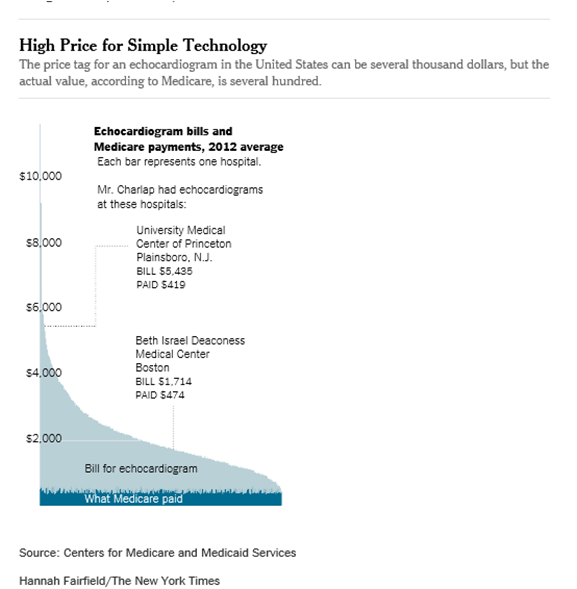
With pricing uncoupled from the actual cost of business, large disparities have evolved. The five hospitals within a 15-mile radius of Mr. Charlap’s home here charge an average of about $5,200 for an echocardiogram, according to an analysis of Medicare’s database. The seven teaching hospitals in Boston, affiliated with Harvard, Tufts and Boston University, charge an average of about $1,300 for the same test. There are even wide variations within cities: In Philadelphia, prices range from $700 to $12,000.

Echo Picture1

Dr. David Wiener, the chairman of the advocacy committee of the American Society of Echocardiography, acknowledged the wide price disparities but said he did not believe they were greater than those for other health care services and procedures. He attributed the variations to multiple factors, including how many hospitals and doctors perform the procedure, state regulations and the need to subsidize poorly reimbursed services.

In other countries, regulators set what are deemed fair charges, which include built-in profit. In Belgium, the allowable charge for an echocardiogram is $80, and in Germany, it is $115. In Japan, the price ranges from $50 for an older version to $88 for the newest, Dr. Ikegami said.

Because Mr. Charlap, 76, is on Medicare, which is aggressive in setting rates, he paid only about $80 toward the approximately $500 fee Medicare allows. But many private insurers continue to reimburse generously for echocardiograms billed at thousands of dollars, said Dr. Seth I. Stein, a New York physician who researches data on radiology. Hospitals pursue patients who are uninsured or underinsured for those payments, he added.

ECHO7-superJumbo

Len Charlap, 76, at home in Princeton, N.J. He underwent two echocardiograms in 2012 and 2013, which differed in cost by more than $4,000.

Jessica Kourkounis for The New York Times

And American doctors, clinics and hospitals tend to order lots of tests. “It’s one of the most lucrative revenue streams they have,” said Dr. Eric J. Topol, a cardiologist at Scripps Health in San Diego who studies echocardiography. “At many hospitals, the threshold for ordering an echocardiogram is the presence of a heart.”

A Miraculous Advance

Mr. Charlap’s internist required his first echocardiogram because he was scheduled for elective cataract surgery at the University Medical Center of Princeton at Plainsboro. The echocardiography professional society specifically advises against ordering the test for preoperative assessment of patients with no history or symptoms of heart disease.

Using sound waves transmitted through a wandlike device applied to the chest, echocardiograms show the heart’s walls in motion, the tiny valves flipping open and closed and the blood streaming through them. They can be vital before surgery in patients with weak hearts, because general anesthesia and blood loss during surgery can bring out otherwise silent problems.

http://int.nyt.com/data/videotape/finished/2014/12/1418336419/echo_web-320.mp4

Mr. Charlap had no cardiac symptoms and took long daily walks with his dog. Cataract surgery involves only local numbing, not general anesthesia.

But health considerations are not the only factor driving the use of echocardiograms in America. In Britain’s National Health Service, all echocardiograms are done in hospitals without charge. There are about 250 echocardiogram centers in the country, said Dr. John Chambers, a cardiologist at St. Thomas’ Hospital in London who studies echocardiography.

By contrast, in the United States, buying an echocardiogram machine is a good investment for an entrepreneurial practice. The number of echocardiograms ordered by cardiologists in the United States rose 90 percent from 1999 to 2008, according to a 2012 study. There are far more places to get one in New Jersey than in all of Britain, according to the Intersocietal Accreditation Commission, which accredits medical facilities.

While M.R.I. scanners are large and cost many millions of dollars, even high-end echocardiogram machines are generally rolled around on wheels and cost under $300,000 — about one-third of the price three decades ago when adjusted for inflation. Laptop-size systems cost $30,000 to $100,000 — used machines even less — and are suitable for all but the most complicated cases.

Al Lojewski, the general manager of cardiovascular ultrasound at GE Healthcare, the world’s biggest maker of ultrasound machines, said the miniaturization of electronics and the addition of processing power had led to much-higher-quality images and more precise calculations. “We provide new enhancements every year,” he said.

But, like new features on an iPhone, they may be irrelevant for many people. “It’s a stable technology that hasn’t changed much in decades,” Dr. Topol said. But new options can result in more testing anyway.

“Someone might feel, ‘I bought the expensive new machine and this patient is insured, so I might as well use it,’ ” said Dr. Barry S. Lindenberg, a cardiologist in Schenectady, N.Y. “We have to be honest, there are abuses.”

Three years ago, the echocardiography group helped develop guidelines for appropriate use of the test. “We all recognized what we needed to do,” said Dr. R. Parker Ward, a cardiologist at the University of Chicago, who helped write the guidelines. He noted that noncardiologists ordered many of the unneeded exams, and that new applications, such as screening cancer patients for early warning signs of heart damage caused by chemotherapy, might expand the use of the tests.

While academic hospitals have led the call for more targeted use of echocardiograms, not all doctors comply, and “it’s a black hole what’s going on in offices,” said Dr. Rory B. Weiner, a professor at Harvard Medical School. There is not even a good estimate of how many of the procedures are performed in the United States, although it is clearly in the tens of millions annually.

The profit margin on the test is impossible to calculate because purchase prices for the machines are secret. GE declined to provide price information for its machines in the United States or other countries. Nor would it reveal how many machines it sold in the United States, other than to say that one-third of its global sales — $330 million out of $1.1 billion — were in this country.

A Boom of Low-Cost Scans

The Sakakibara Heart Institute, one of Tokyo’s finest private clinics, performs about 60 echocardiograms a day, or 16,000 a year.

As in the United States, doctors and hospitals in Japan are paid each time they deliver a service. (Japanese patients’ co-payments vary from 10 to 30 percent.) Perhaps predictably, as in the United States, doctors there order lots of tests.

In Japan, doctors’ visits tend to be brief, but patients expect to leave with a prescription — a drug or a scan. Ultrasounds, a technology developed in Japan, are a favorite. “We test everyone; we can grasp many things with this test,” said Dr. Keitaro Mahara, the director of echocardiography at the institute. “It’s harmless, so the patients can receive it repeatedly.”

ECHO3-articleLarge

A technician performing an echocardiogram at Sakakibara Memorial Hospital in Tokyo.

Kentaro Takahashi for The New York Times

Claims data shows that Japanese patients received 6.6 million echocardiograms last year, about five times the rate per capita in Britain.

Despite Japan’s fondness for testing, its health spending is about $4,000 a year a person, or 9.6 percent of gross domestic product. By contrast, the United States spends more than $9,000 per person annually, more than 17 percent of G.D.P., although some studies indicate that health care spending is leveling off.

The difference is in part because Japan decides the value of each test and medicine, sets a price and demands that it decrease over time.

When a new technology appears, a panel of policy makers and doctors determine the value based on the degree of improvement it offers. When M.R.I. scans became available, the panel declared them twice as effective as CT scans. But because the new equipment cost eight times more than a CT scanner, few clinics were buying. Manufacturers quickly slashed the price.

The prices of medicines and tests are automatically reviewed and reduced by the panel every two years, and can drop more than 30 percent. “Hospitals need to invest in machines, but after that, they don’t need to spend much to keep doing the tests,” said Dr. Toshiaki Iizuka, a health economist at the University of Tokyo.

In the United States, Medicare has similarly tried to prevent overuse by reducing payments for echocardiograms performed in doctors’ offices by an average of 40 percent since 2009, to only $92 today. But the result has not been fewer tests. Instead, testing has migrated to hospital outpatient departments, where higher payments for the same test prevail. And doctors can make up any shortfall by raising charges for commercially insured patients, leading to bills like the $5,500 one for Mr. Charlap’s echocardiogram.

Why Such Stubborn Prices?

New Jersey had the second-highest charges for echocardiograms in the nation in 2012, 8.4 times Medicare’s approved rate.

In a statement, the hospital in Princeton that performed Mr. Charlap’s first, more expensive echocardiogram noted that “the vast majority of customers” paid much less than the listed prices. It added that its pricing reflected the need to offset losses because many programs, including Medicare, reimburse less than the cost of delivering services.

But that cost must cover some expenses in the United States not found in other medical systems.

The area around Princeton has had a spate of new hospital building in the past five years. The University Medical Center of Princeton at Plainsboro, which has no connection to Princeton University, cost more than $500 million to build and has a curving atrium decorated with artwork from the hospital’s permanent collection. “It was like a luxurious museum,” Mr. Charlap said.

Hospitals and doctors in the United States also spend far more on administrative costs than those in any other country. Even for a relatively simple test like an echocardiogram, commercial insurers often demand preapproval, and a host of middlemen and staffers are involved, driving up costs.

Although medical groups cite malpractice lawsuits for the high prices in the United States, some studies suggest that is not a major factor. California, which caps malpractice liability for noneconomic damages, has the highest average charges in the country for outpatient echocardiograms, according to a recent study in the Journal of the American College of Radiology.

ECHO4-superJumbo

New hand-held echocardiogram machines can be used for basic screening, potentially reducing costs.

Sandy Huffaker for The New York Times

What did predict price in a region, according to the analysis? The more machines, the higher the bills. “You would think increased competition would cause price to go down, but it’s the opposite,” said Dr. Stein, the study’s author, who was then a student at Temple University School of Medicine.

A year after his first echocardiogram, Mr. Charlap had another, at Harvard’s Beth Israel Deaconess Medical Center, that showed he needed a valve replacement. Though he now feels better than ever, the valve needs monitoring. How to do it?

The newest miniature echocardiogram machines fit into a doctor’s white-coat pocket and, placed on the chest during an office exam, provide a snapshot of the heart. No longer do physicians have to listen for subtle clicks and whooshes through a stethoscope. Even primary care doctors in training can use the devices, which sell for well under $10,000, to detect basic heart problems with a few hours of instruction, according to studies.

Such machines are being widely used in other countries and in pilot programs at some medical schools, but they are receiving a lukewarm welcome in the United States. Mr. Charlap’s internist has not used one on him.

“It brings $350,000 imaging technology to the bedside as a screening test, at almost no cost,” said Dr. Topol, who added that it would be useful on hospital rounds. “But it’s not being embraced because of our model of payment.”

Article link: http://mobile.nytimes.com/2014/12/16/health/the-odd-math-of-medical-tests-one-echocardiogram-two-prices-both-high.html?referrer=&_r=1

Report: Providers Should Integrate Unique Device Identifiers Into EHRs – iHealthBeat

Posted by timmreardon on 12/09/2014
Posted in: Blue Button, Data Science, EHR Interoperability, Global Standards, Health Care Costs, Health Care Economics, Health IT adoption, Health Outcomes, Healthcare Delivery, Healthcare Informatics, Healthcare Security, Innovation, Integrated Electronic Health Records, Lab Report Access, Military Health System Reform, Mobile Healthcare, National Health IT System, Patient Centered Medical Home, Patient Portals, PCMH, Primary Care, Quadruple Aim, Quality Measures. Leave a comment

Monday, December 8, 2014

Integrating unique device identifiers into electronic health record systems could improve medical device safety and make recall efforts easier, according to a Brookings Institution report released Friday, Politico’s “Morning eHealth” reports (Gold, “Morning eHealth,” Politico, 12/8).

Background

In July 2012, FDA released a proposed rule to create a UDI system to track medical devices. Such a system would allow FDA officials to electronically track medical tools and promptly recall any devices that could jeopardize patient safety.

FDA in September 2012 issued a report that outlined the agency’s approach to improving its post-market surveillance system for medical devices, including the creation of a UDI system (iHealthBeat, 9/3).

Details of Report

The report aims to advise providers on how to adopt and integrate UDIs to improve patient safety, research and analytics, according to EHR Intelligence.

Specifically, the report outlines key steps to integrating UDIs into:
•Provider systems;
•Administrative transactions; and
•Patient-directed tools.

The report focuses on high-risk devices, but the authors note that all medical devices affecting patient care can benefit from tracking UDIs.

The report states, “Recording UDIs at the point of care in EHRs and in claims data could significantly enhance the nation’s ability to conduct medical device safety surveillance and manage recalls.”

In addition, the authors write that using UDIs could help to:
•Determine devices’ long-term quality and performance;
•Efficiently identify and communicate device safety concerns;
•Improve reimbursement transparency;
•Make supply chain processes more efficient and accurate; and
•Streamline premarket device approval.

Recommendations

In the report, the authors recommend:
•Conducting studies to showcase the benefits of UDI use;
•Including UDIs in claims details for high-risk, implantable devices;
•Incorporating UDIs into EHR systems and personal health records;
•Increasing outreach about UDIs through collaborations between advocacy groups, FDA and providers; and
•Using UDIs across supply chain, clinical and revenue cycle processes to obtain the highest return on investment.

The authors also recommend including UDIs in Stage 3 requirements of the meaningful use program. Under the 2009 economic stimulus package, health care providers who demonstrate meaningful use of certified EHRs can qualify for Medicaid and Medicare incentive payments (Bresnick, EHR Intelligence, 12/5).

Article link: http://www.ihealthbeat.org/articles/2014/12/8/report-providers-should-integrate-unique-device-identifiers-into-ehrs

Why So Many New Tech Companies Are Getting into Health Care – HBR

Posted by timmreardon on 12/09/2014
Posted in: EHR Interoperability, Emergency Medicine, Global Standards, Health Care Costs, Health Care Economics, Health IT adoption, Health Outcomes, Healthcare Delivery, Healthcare Informatics, Healthcare Security, Innovation, Integrated Electronic Health Records, Lab Report Access, Military Health System Reform, Mobile Healthcare, National Health IT System, Patient Centered Medical Home, Patient Portals, PCMH, Primary Care, Public Health, Quadruple Aim, Quality Measures, U.S. Air Force Medicine, U.S. Army Medicine, U.S. Navy Medicine, U.S. Surgeon General, Veterans Affairs. Leave a comment

by Bob Kocher, MD and Bryan Roberts

December 8, 2014
DEC_08_466399579

A flood of new health care IT companies has been pouring into the U.S. health care market. The cause of this torrent: the recognition that as market and regulatory forces alter incentives in health care, IT companies will play a powerful role in combating the overemployment and declining productivity that has plagued this industry and in helping providers improve the quality of care.

The dam broke in September 2007, when Athenahealth went public, the price of its shares jumping by 97% on the first day. Since then, the company’s value has risen to $5 billion. Athenahealth proved to entrepreneurs, software engineers, and investors that the health care sector is fertile ground for creating large technology-services companies that use a subscription-based business model to offer software as a service (SaaS).

Despite its size and growth rate, the health care sector was long considered an impenetrable, or at least an unattractive, target for IT innovation — the entrepreneurial equivalent of Siberia. Athenahealth broke the ice by proving that it could sell SaaS efficiently to small physician businesses, get doctors to accept off-premises software, and achieve the ratios of customer-acquisition costs to long-term value that other sectors already enjoy.

As Athenahealth accomplished its goals, several larger forces have dramatically widened the scope of opportunity in the sector:
•The Great Recession led to a loss of 8.8 million U.S. jobs and big declines in demand throughout the economy (including health care services) — yet health care employment grew by 7.2%. That reality increased awareness that a decline in labor productivity was driving much of the excessive spending in health care.
•The American Recovery and Reinvestment Act of 2009 included the Health Information Technology for Economic and Clinical Health (HITECH) Act, a $25.9 billion program to give doctors and hospitals incentives to adopt electronic health records. EHR adoption has now grown to nearly 80% of office-based physicians and 60% of hospitals, fueling many successful software start-ups, such as ZocDoc, Health Catalyst, and Practice Fusion.
•The Affordable Care Act (ACA) requires that an enormous amount of data on cost and quality be made freely available. In addition, digital health applications, mobile phones, and wearable sensors, as well as breakthroughs in genomics, are creating truly big data sets in health care. These data contribute to greater market efficiency, more consumer-oriented products and services, and clinical care that is evidence-based and personalized.
•The ACA has led to a proliferation of risk-based (rather than fee-for-service) payment models. For example, providers in accountable care organizations are rewarded for generating annual savings, and providers who use bundled payments get a fixed budget for an end-to-end course of treatment. Effectively responding to these changing economic incentives will increase reliance on software that helps providers manage population risk, understand costs and trends, and engage patients.

These macro-level developments set the stage for other SaaS companies to follow Athenahealth’s lead in enormously improving labor productivity and quality of care.

Within the next decade, software tools will eliminate thousands, perhaps millions, of jobs in hospitals, insurance companies, insurance brokerages, and human resources departments. Not the jobs of people who actually provide care — but those of administrative middlemen, whose dead weight contributes to economic loss. Here are five examples:

1.Digital insurance markets, combined with ACA-enacted regulatory changes such as guaranteed issue and community rating, make it possible to price and sell health plans to anyone immediately. These developments will decimate the armies of brokers who act as intermediaries between customers and insurance services.

2.Price transparency, digital insurance products, and tools such as reference pricing make it possible to generate an exact price and instantly collect payment for a health care service. As a result, revenue cycle managers in hospitals and claims adjudicators in insurance companies will be displaced.

3.The inevitable shift to the cloud will render obsolete the costly, insecure data centers that most doctors and hospitals are now building, staffing, and running.

4.Adopting self-serve mobile applications will eliminate the forms, faxes, and excess staffing at many call centers, thereby improving satisfaction for everyone in the process.

5.Centralized clearinghouses that share information across organizations and state lines will eventually replace the byzantine, paper-based process of credentialing doctors, tracking continuing medical education, and keeping licenses up-to-date. That means smaller staffs in hospitals’ medical affairs divisions, health plans, medical boards, and state and local health departments.

Given that wages account for 56% of all health care spending, improvements in labor productivity could generate enormous value. Simply reducing administrative costs could yield an estimated $250 billion in savings per year.

As compelling as the prospective labor efficiencies are, the benefits of SaaS extend beyond direct labor costs. Easier access to data on physician quality, specialization, and adherence to evidence-based care will better match patients with doctors who provide high-quality, efficient services, thereby averting health complications for their patients. Moreover, software can help bring relevant clinical guidelines and personalized risk scores to patients and clinicians as they improve care plans, engage in shared decision making, and avoid duplicative services. Such efficiencies will, in turn, enhance how patients perceive and experience the care they receive. SaaS companies can trumpet all of these advantages, not just the employment savings they yield.

To seize on the new opportunities in the health care sector, SaaS companies can take these steps:
•Attack economic inefficiencies in order to generate immediate, tangible customer return on investment. Witness how Castlight Health’s transparency tools are generating annual savings for employers and employees. And be clear about the source of the ROI, given that in most cases the revenue comes from another health care stakeholder who may be able to undermine the business.
•Focus on building in network effects so that improvements made by one user enhance the product’s value for current and future users, just as Athenahealth does when it rapidly disseminates changes in payment rules at one provider to all other providers. Most SaaS businesses in health care IT cannot protect their intellectual property; so it is important to continually augment the value of the product to achieve scale.
•Use software-enabled service models, rather than pure SaaS. For example, Grand Rounds’ software not only recommends an expert doctor for a patient but also collects, organizes, digitizes, and summarizes the patient’s records — and then books the appointment for the patient. In effect, the software makes it easier for patients to adhere to high-quality, cost-effective care, thereby enhancing the overall ROI for the product.

It took Athenahealth a decade, from 1997 to 2007, to go public on the strength of its SaaS model. It took Castlight Health only six years, from 2008 to 2014, to do the same. Now an array of highly valued healthcare SaaS companies, each worth more than $100 million, is emerging. They include Zenefits, Grand Rounds, Doctor on Demand, Omada Health, Health Catalyst, Doximity, and Evolent Health. Indeed, Zenefits is one of the fastest-growing SaaS companies ever, regardless of industry, surpassing $500 million in enterprise value in its first year.

The success of SaaS companies in health care is thanks, in part, to an influx of leaders from other sectors. They bring with them teams of technical talent that deliver consumer and enterprise software faster, better, and more cheaply than many legacy health care IT companies can do. Witness ZocDoc, founded by first-time entrepreneurs from McKinsey; Grand Rounds, founded by Owen Tripp, who cofounded Reputation.com; Zenefits, founded by Parker Conrad, who cofounded SigFig; and Doctor on Demand, founded by Adam Jackson, who cofounded Driverside (just to name a few). This type of cross-pollination is an essential ingredient of innovative change.

The barriers between health care IT companies and IT in other industries are clearly coming down, and we expect the number of sector disruptions and billion-dollar companies to swell. As each innovation wave generates more data, disruption-cycle times will shorten, thereby forcing all players in the health care ecosystem to address inefficiency as they compete on quality and value creation. Those who fail to act will be washed away by the tide that lifts all other boats to greater productivity.

Article link: https://hbr.org/2014/12/why-so-many-tech-companies-are-getting-into-health-care?utm_campaign=Socialflow&utm_source=Socialflow&utm_medium=Tweet

It’s Absurd That Health Care Costs Are So Confusing – HBR

Posted by timmreardon on 12/01/2014
Posted in: Accountable Care Organizations, Data Science, DoD, Global Standards, Health Care Costs, Health Care Economics, Health IT adoption, Health Outcomes, Healthcare Delivery, Healthcare Informatics, Healthcare Security, Innovation, Integrated Electronic Health Records, Open Data, Patient Centered Medical Home, Patient Portals, PCMH, Primary Care, Public Health, Quadruple Aim. Leave a comment

by Jeanne Pinder

November 26, 2014

NOV14_26_1007198914
People are shopping for health care. And it’s not always pretty.

Here’s an anecdote from one of our ClearHealthCosts community members, who spent $3,200 on an MRI:

“I paid the whole thing and then found out I could have had it done for half the price only blocks away. My first foray into individual insurance — and it sucked.”

That’s someone who learned the hard way that prices can vary wildly in health care. An MRI: $300 or $6,221? A cardio stress test: $100 or $2,500? It’s your money, and your health, and you have a right to know.

Our mission at ClearHealthCosts.com has been to expose pricing disparities as people shop for health care. But back in 2011, when I decided to build a website that would reveal what stuff actually costs in the health care marketplace, people said it couldn’t be done:

“Powerful forces will put you out of business.”

“Nobody cares what things cost in health care.”

“The Affordable Care Act will make it all irrelevant.”

They were wrong.

Three years later, a consumer revolution is taking place. People are demanding control over health expenses and treatments, trying to manage out-of-pocket costs and confusing bills, and seeking the care they need at prices they can afford.

The Affordable Care Act is in place, the Supreme Court has ruled, the botched rollout of HealthCare.gov is no longer sucking up attention — so the political chatter has died down. People are now focused on the practical next steps as they cope with real bills in real time.

Insight Center
Innovating for Value in Health Care

Sponsored by Medtronic
A collaboration of the editors of Harvard Business Review and the New England Journal of Medicine, exploring best practices for improving patient outcomes while reducing costs.

At ClearHealthCosts.com, we’re partnering with KQED public radio in San Francisco and with KPCC/Southern California Public Radio in Los Angeles on PriceCheck — a crowdsourcing project to create a large database of cash and self-pay prices that are specific to named providers.

The initiative, funded by the John S. and James L. Knight Foundation, allows our community members to survey the cash prices we have collected and invites them to add their own information — total charged price, what their insurance paid, and how much they spent out-of-pocket — as well as descriptions of their experiences. With this project, we are giving people a voice and a sense of agency as they confront the problem of price disparity — and we’re enabling them to join with each other and with us to find a solution.

Here’s what some of our community members told us on PriceCheck:

“I was told a procedure would be $1,850. I have a $7,500 deductible. So I talked to the office [manager], who said if I paid up front and agreed not to report the procedure to Blue Cross, that it would be $580.”

“I have insurance, but it’s not very good …. My daughter will need an MRI again next year, and thanks to your organization and what I learned on NPR, I will shop around next year and maybe just pay cash.”

“Worked with billing for several weeks to work down price. Goes to show the price isn’t the price….” [billed at $1,407, paid $900]

People who thought they had good insurance tell us stories of wildly inflated bills and ruinous coinsurance for things like a simple gall-bladder operation. People are putting away their insurance cards and paying cash to get a lower price. They have bills to share and stories to tell, and they want to help others who face the same challenges.

A Solution for the Present — and for the People

At ClearHealth Costs, we’re journalists who believe that sunlight is the best disinfectant. Here’s the way our process works:

We collect cash or self-pay rates from providers on 30 to 35 “shoppable” procedures, such as MRIs, cardio stress tests, and walk-in clinic visits. Our survey methodology elicits consistent apples-to-apples prices every time. We tell providers who we are and what we’re doing, and we ask them for their cash or self-pay prices. If they have questions, we point them to the site. Most tell us the prices; some, though, say they do not give prices over the phone, or give prices only to patients.

Once we have the prices, we juxtapose them with corresponding Medicare reimbursement rates, where applicable, because they are the closest thing to a benchmark price. We’ve also found a growing number of providers that list their prices online. Some providers now come to us and ask to be in our system. One trade group is even discussing the possibility of surveying its members about prices to add to our database.

Why don’t we use “average” prices? Because you can’t act on those numbers. No one goes to a provider and says, “The average price for a colonoscopy in New York is $1,500, and that’s what I’d like to pay.” Plus, average prices vary greatly, depending on the underlying data.

What about “charge master” prices? You know, those lists of every billable service that a provider offers? We don’t use them because they’re notional or aspirational. And most providers have a cash rate that’s very different from the charge master price. We prefer to gather data that people can actually use.

We have to get health care prices under control. Many solutions have been suggested: price fixing, reference pricing, a single-payer system (which still seems politically unpalatable to much of the nation). The debates will rage on.

What hasn’t been tried is full-on transparency. In the spirit of the Sixties, it’s power to the people. My friend Dave deBronkart — known as ePatient Dave, the patient engagement advocate — and I talk often about the civil rights movement, the rise of feminism, and the experience of fighting for changes that were hard but inevitable, because they were so undeniably right.

People should always ask about prices, and providers and payers should always reveal them. All of them. Charged prices, paid prices, coinsurance. Up front, before the point of service, for anything shoppable. Yes, it’s hard, but do it anyway. Then that $6,221 MRI can be compared with the one for $300.

If you want the $6,221 MRI, you should have it — but you should pay for it, not me, not my employer, not my government. If you want the $300 test, it’s yours. If you want to buy your prescription for $150, go ahead. But you should also know that if you walk two blocks, you can get it for $17. (Yes, these are real numbers.) And you shouldn’t need to be a detective to discover this.

Once cost transparency is a matter of course, quality metrics that are clear and useful will come to the fore. And as the non-emergency, modest-ticket marketplace is transformed, people will also start to approach the emergency, big-ticket items as cost-conscious consumers.

Transparent markets benefit consumers, as providers compete to win business and healthy market forces produce benefits for suppliers. Witness how the markets for airline tickets, cars, and real estate were transformed by technology and transparency. Like it or not, health care is close behind.

Those at the forefront will be rewarded: Transparency shines a radiant light on good services at reasonable prices. Those who offer only partial transparency will do so at their peril. The internet hates when people lie and keep secrets.

People are shopping for health care. It’s time to acknowledge that — and celebrate it.

Article link: https://hbr.org/2014/11/its-absurd-that-health-care-costs-are-so-confusing?utm_campaign=Socialflow&utm_source=Socialflow&utm_medium=Tweet

eHealth Initiative roadmap calls for alignment of HIT regulatory efforts – FierceHealthIT

Posted by timmreardon on 11/25/2014
Posted in: Accountable Care Organizations, ACOs, Big Data, Blue Button, Data Science, EHR Interoperability, Emergency Medicine, Global Standards, Health Care Costs, Health Care Economics, Health IT adoption, Health Outcomes, Healthcare Delivery, Healthcare Informatics, Healthcare Security, Innovation, Integrated Electronic Health Records, Lab Report Access, Military Health System Reform, National Health IT System, Patient Portals, PCMH, Primary Care, Public Health, Quadruple Aim, Quality Measures. Leave a comment

November 13, 2014 | By Dan Bowman

Interoperability and Meaningful Use efforts need to be aligned with other healthcare regulatory and industry initiatives, according to the eHealth Initiative, which on Thursday unveiled its 2020 roadmap for transforming health IT.

The roadmap, which eHealth Initiative CEO Jennfier Covich Bordenick calls “a framework for discussion about core technology issues,” includes priorities for three areas: business and clinical motivators, interoperability and data access and use. In particular, she says, the private sector’s role must grow in order for health IT to move forward.

“We are heading into a world where healthcare data needs to be exchanged, shared and analyzed, not simply pushed from place to place,” Bordenick says in the document. “Similarly, we are developing a 2020 roadmap that requires sharing, analysis and above all, collaboration.”

Compared to the Office of the National Coordinator for Health IT’s interoperability roadmap, which will be available for public comment in January, the eHealth Initiative calls its plan “much broader,” but acknowledges that there is overlap between the two efforts to ensure synchronicity.

The roadmap specifically calls for an extension of time between Stages 2 and 3 of the Meaningful Use program, and also says that compliance with ICD-10 by next October is mandatory. The adoption of standards and open architecture also is encouraged for interoperability to evolve, as is the adoption of “approaches reflecting cross-industry IT trends” such as REST and FHIR.

Additionally, the roadmap says that Meaningful Use, despite its importance, is not a “sufficient lever” to ensure interoperability throughout healthcare.

A survey published in September from Premier and the eHealth Initiative concluded that poor interoperability is a significant barrier for accountable care organization success.

“We envision a high-performing healthcare system centered around the patient, where all those engaged in patient care are linked together in a secure and interoperable environment,” the roadmap says.

The roadmap also looks to kick-start conversations about how to solve several privacy and security challenges in healthcare today, including data security, appropriate data sharing, granular data control, data provenance and data matching.

To learn more:
– read the roadmap (.pdf)

Article link: http://www.fiercehealthit.com/story/ehealth-initiative-roadmap-calls-alignment-hit-regulatory-efforts/2014-11-13?utm_medium=nl&utm_source=internal

Posts navigation

← Older Entries
Newer Entries →
  • Search site

  • Follow healthcarereimagined on WordPress.com
  • Recent Posts

    • The Global Healthcare System Is Broken. Japan Fixed It for $4,100 Per Person. 04/10/2026
    • When Not to Use AI – MIT Sloan 04/01/2026
    • There are more AI health tools than ever—but how well do they work? – MIT Technology Review 03/30/2026
    • Are AI Tools Ready to Answer Patients’ Questions About Their Medical Care? – JAMA 03/27/2026
    • How AI use in scholarly publishing threatens research integrity, lessens trust, and invites misinformation – Bulletin of the Atomic Scientists 03/25/2026
    • VA Prepares April Relaunch of EHR Program – GovCIO 03/19/2026
    • Strong call for universal healthcare from Pope Leo today – FAN 03/18/2026
    • EHR fragmentation offers an opportunity to enhance care coordination and experience 03/16/2026
    • When AI Governance Fails 03/15/2026
    • Introduction: Disinformation as a multiplier of existential threat – Bulletin of the Atomic Scientists 03/12/2026
  • Categories

    • Accountable Care Organizations
    • ACOs
    • AHRQ
    • American Board of Internal Medicine
    • Big Data
    • Blue Button
    • Board Certification
    • Cancer Treatment
    • Data Science
    • Digital Services Playbook
    • DoD
    • EHR Interoperability
    • EHR Usability
    • Emergency Medicine
    • FDA
    • FDASIA
    • GAO Reports
    • Genetic Data
    • Genetic Research
    • Genomic Data
    • Global Standards
    • Health Care Costs
    • Health Care Economics
    • Health IT adoption
    • Health Outcomes
    • Healthcare Delivery
    • Healthcare Informatics
    • Healthcare Outcomes
    • Healthcare Security
    • Helathcare Delivery
    • HHS
    • HIPAA
    • ICD-10
    • Innovation
    • Integrated Electronic Health Records
    • IT Acquisition
    • JASONS
    • Lab Report Access
    • Military Health System Reform
    • Mobile Health
    • Mobile Healthcare
    • National Health IT System
    • NSF
    • ONC Reports to Congress
    • Oncology
    • Open Data
    • Patient Centered Medical Home
    • Patient Portals
    • PCMH
    • Precision Medicine
    • Primary Care
    • Public Health
    • Quadruple Aim
    • Quality Measures
    • Rehab Medicine
    • TechFAR Handbook
    • Triple Aim
    • U.S. Air Force Medicine
    • U.S. Army
    • U.S. Army Medicine
    • U.S. Navy Medicine
    • U.S. Surgeon General
    • Uncategorized
    • Value-based Care
    • Veterans Affairs
    • Warrior Transistion Units
    • XPRIZE
  • Archives

    • April 2026 (2)
    • March 2026 (9)
    • February 2026 (6)
    • January 2026 (8)
    • December 2025 (11)
    • November 2025 (9)
    • October 2025 (10)
    • September 2025 (4)
    • August 2025 (7)
    • July 2025 (2)
    • June 2025 (9)
    • May 2025 (4)
    • April 2025 (11)
    • March 2025 (11)
    • February 2025 (10)
    • January 2025 (12)
    • December 2024 (12)
    • November 2024 (7)
    • October 2024 (5)
    • September 2024 (9)
    • August 2024 (10)
    • July 2024 (13)
    • June 2024 (18)
    • May 2024 (10)
    • April 2024 (19)
    • March 2024 (35)
    • February 2024 (23)
    • January 2024 (16)
    • December 2023 (22)
    • November 2023 (38)
    • October 2023 (24)
    • September 2023 (24)
    • August 2023 (34)
    • July 2023 (33)
    • June 2023 (30)
    • May 2023 (35)
    • April 2023 (30)
    • March 2023 (30)
    • February 2023 (15)
    • January 2023 (17)
    • December 2022 (10)
    • November 2022 (7)
    • October 2022 (22)
    • September 2022 (16)
    • August 2022 (33)
    • July 2022 (28)
    • June 2022 (42)
    • May 2022 (53)
    • April 2022 (35)
    • March 2022 (37)
    • February 2022 (21)
    • January 2022 (28)
    • December 2021 (23)
    • November 2021 (12)
    • October 2021 (10)
    • September 2021 (4)
    • August 2021 (4)
    • July 2021 (4)
    • May 2021 (3)
    • April 2021 (1)
    • March 2021 (2)
    • February 2021 (1)
    • January 2021 (4)
    • December 2020 (7)
    • November 2020 (2)
    • October 2020 (4)
    • September 2020 (7)
    • August 2020 (11)
    • July 2020 (3)
    • June 2020 (5)
    • April 2020 (3)
    • March 2020 (1)
    • February 2020 (1)
    • January 2020 (2)
    • December 2019 (2)
    • November 2019 (1)
    • September 2019 (4)
    • August 2019 (3)
    • July 2019 (5)
    • June 2019 (10)
    • May 2019 (8)
    • April 2019 (6)
    • March 2019 (7)
    • February 2019 (17)
    • January 2019 (14)
    • December 2018 (10)
    • November 2018 (20)
    • October 2018 (14)
    • September 2018 (27)
    • August 2018 (19)
    • July 2018 (16)
    • June 2018 (18)
    • May 2018 (28)
    • April 2018 (3)
    • March 2018 (11)
    • February 2018 (5)
    • January 2018 (10)
    • December 2017 (20)
    • November 2017 (30)
    • October 2017 (33)
    • September 2017 (11)
    • August 2017 (13)
    • July 2017 (9)
    • June 2017 (8)
    • May 2017 (9)
    • April 2017 (4)
    • March 2017 (12)
    • December 2016 (3)
    • September 2016 (4)
    • August 2016 (1)
    • July 2016 (7)
    • June 2016 (7)
    • April 2016 (4)
    • March 2016 (7)
    • February 2016 (1)
    • January 2016 (3)
    • November 2015 (3)
    • October 2015 (2)
    • September 2015 (9)
    • August 2015 (6)
    • June 2015 (5)
    • May 2015 (6)
    • April 2015 (3)
    • March 2015 (16)
    • February 2015 (10)
    • January 2015 (16)
    • December 2014 (9)
    • November 2014 (7)
    • October 2014 (21)
    • September 2014 (8)
    • August 2014 (9)
    • July 2014 (7)
    • June 2014 (5)
    • May 2014 (8)
    • April 2014 (19)
    • March 2014 (8)
    • February 2014 (9)
    • January 2014 (31)
    • December 2013 (23)
    • November 2013 (48)
    • October 2013 (25)
  • Tags

    Business Defense Department Department of Veterans Affairs EHealth EHR Electronic health record Food and Drug Administration Health Health informatics Health Information Exchange Health information technology Health system HIE Hospital IBM Mayo Clinic Medicare Medicine Military Health System Patient Patient portal Patient Protection and Affordable Care Act United States United States Department of Defense United States Department of Veterans Affairs
  • Upcoming Events

Blog at WordPress.com.
healthcarereimagined
Blog at WordPress.com.
  • Subscribe Subscribed
    • healthcarereimagined
    • Join 153 other subscribers
    • Already have a WordPress.com account? Log in now.
    • healthcarereimagined
    • Subscribe Subscribed
    • Sign up
    • Log in
    • Report this content
    • View site in Reader
    • Manage subscriptions
    • Collapse this bar
 

Loading Comments...