healthcarereimagined

Envisioning healthcare for the 21st century

  • About
  • Economics

The Monetization of Health Data – Health IT Outcomes

Posted by timmreardon on 08/07/2015
Posted in: Uncategorized. Leave a comment

Guest Column | July 21, 2015

By Rudy Richman, VP of Sales and Marketing, Privacy Analytics

375_250-dataWe’re currently witnessing an explosion of digital health applications and software that is producing rapidly growing volumes of consumer and patient information. As a result, healthcare organizations are sitting on large stores of data that have significant value beyond the primary clinical use for which it was collected.

This data, shared responsibly, can be used to help solve some of healthcare’s most challenging problems. It can play a critical role in driving innovative research, deriving key insights and gaining new knowledge that can lead to faster and better treatments and cures for a wide range of health conditions and diseases. Other uses of the data include clinical trials transparency, quality and safety measurement, public health, payment, provider certification or accreditation, marketing, and other business applications.

For many of these uses, the data may be monetized by data custodians. Data monetization is exactly what it sounds like – making money by selling the data to another organization, or selling reports based on the data. The simple truth is our personal information is being collected, analyzed, bought, and sold on an increasingly routine basis. According to Gartner, 30 percent of all businesses will be monetizing their information assets by 2016.

Safely Managing Health Data Monetization

A large number of health and healthcare organizations share and monetize data. They include federal and state public health agencies, pharmaceutical companies, hospitals and healthcare providers, academic medical centers, cancer and birth registries, medical device manufacturers, insurance companies, EMR vendors, and health information exchange organizations.

Health data cannot, and should not, be sold or exchanged without proper consideration into what it will be used for. And it’s necessary to understand what personal identifiers exist in the data to know what could put individual patient privacy at risk.

The HIPAA Privacy Rule, by establishing national standards, requires safeguards to protect personal health information and sets conditions on how it is used. The Health Information Technology for Economic and Clinical Health (HITECH) Act strengthened the enforcement of HIPAA. It requires authorization from each individual in a data set for any sale of Protected Health Information (PHI). While this addresses important privacy concerns, it’s not always possible for health organizations to secure consent from each individual in a large data set – because they’ve moved, trauma or sensitivity of the event, or are deceased – and unless all patients consent the results of any analysis may be put into question.

Unable to sell PHI without the consent of all patients, research efforts could be severely hampered. However, there is a way to achieve HIPAA compliance, share and monetize data, and still protect patient privacy. Under HIPAA, properly de-identified data is no longer considered PHI and therefore can be shared and monetized without consent.

There are two general approaches to de-identification, the “list” approach and the “statistical” approach, exemplified by the methods stipulated in the HIPAA Privacy Rule: Safe Harbor and Expert Determination. Safe Harbor specifies 18 elements that need to be removed or modified – 16 of those are direct identifiers, such as name and social security number, while two are quasi-identifiers that provide elements of dates or geography. Safe Harbor also includes a caveat that requires there be no clear or direct knowledge that anything else in the data could be used to re-identify individuals.

Whereas Safe Harbor is a one-size-fits all approach, Expert Determination requires an assessment of risk given a specific context. Based on the level of risk, direct identifiers and quasi-identifiers can be removed or modified so that the data retains value for research and analysis.

It’s important to note that proper data de-identification is not the same as data masking. While commonly used masking techniques hide or remove direct identifiers, this still leaves risk from the quasi-identifiers. There is legal risk for non-compliance with HIPAA, financial risk from fines and lawsuits due to a data breach, and the reputational risk of losing patient trust when they learn that PHI was being shared or monetized inappropriately. Not to mention that masking to remove PHI can strip away the value of the data, rendering it less useful for research and analysis, and therefore a less valuable commodity for monetary gain.

Only one of these methods provides the most utility and value of the data while still protecting privacy, and that is de-identification. The de-identification of data is more sophisticated and leads to better results because responsible expert determination methodology and tools are used to manage the risks associated with the specific use of the data. Legal compliance is also satisfied when consistent de-identification standards and effective risk management procedures are used to protect patient privacy.

For data to be considered de-identified, the context of the data release is analyzed through a risk assessment. This assessment analyzes the type and content of the data, what type of organization is receiving the data and how they will use it, as well as how the data will be protected through physical and policy measures. All these factors are considered to determine the risk of re-identification, and the data is then adjusted accordingly to provide a data set with the lowest level of risk for the highest level of use. Remember, once the data is no longer considered PHI, it is no longer covered under HIPAA.

As demand for data sharing and monetization grows, so do concerns about privacy and risk. The good news is that privacy can be easily addressed by using the right approach. Responsible de-identification is a reputable, HIPAA-compliant solution to safely monetizing the data that health and healthcare organizations have at their disposal.

Article link: http://www.healthitoutcomes.com/doc/the-monetization-of-health-data-0001?sectionCode=Articles&templateCode=Single&user=2423280&source=nl:43544&utm_source=et_6231164&utm_medium=email&utm_campaign=HCIT_2015-07-30&utm_term=0009EE33-ABCE-4D02-9B3C-4F32FFAA82BE&utm_content=The%2b%2527Monetization%2527%2bOf%2bHealth%2bData

About The Author

Rudy Richman is the Vice President of Sales and Marketing for Privacy Analytics, where he is responsible for the development, implementation and execution of strategies that deliver expert determination de-identification methodology and products to the marketplace. He uses his extensive market knowledge, business experience and leadership skills to design multi-faceted programs and provide strategic guidance to both established and emerging companies in technology, healthcare and other industries seeking to efficiently scale and monetize their assets.


VA Secretary: Open source is the only way to operate – FierceGovernmentIT

Posted by timmreardon on 08/07/2015
Posted in: Uncategorized. Leave a comment

July 30, 2015 | By Molly Bernhart Walker

Veterans Affairs Department Secretary Bob McDonald voiced his support for open source technology July 30, as he outlined a broad reform plan that includes streamlining information technology and taking a more “holistic” look at customer service.

“We have over 200 databases with customer information. That means if you want to change your address, you have to go to at least nine places to change your address at VA,” said McDonald during a morning keynote July 30 at a conference in Bethesda, Md.

“We want to go to one data backbone, one data inventory,” he said.

McDonald also lamented that the department has 900 1-800 phone numbers for veterans. He’d like to consolidate that down to a single contact line.

McDonald told attendees at the OSERHA Open Source Summit that VA also has hundreds of websites – 14 of which require a username and password login for vets.

“We’re going to be going to a unified digital experience for all veterans,” said McDonald.

All of these digital technologies will be open source, he added.

“There’s no other way to operate in our opinion than open source. And we’re counting on all of you to make that happen. We’re going to be open source and we want to have crowd-sourced innovation,” said McDonald.

Article link:http://www.fiercegovernmentit.com/story/va-secretary-open-source-only-way-operate/2015-07-30?utm_medium=nl&utm_source=internal

Related Articles: 
VA releases long-awaited plan to reform department, veteran engagement
DHS report makes recommendations for greater open source software use in government
VA won’t abandon VistA, says Warren

FDA Unveils Precision Medicine Platform – Healthcare IT News

Posted by timmreardon on 08/07/2015
Posted in: Uncategorized. Leave a comment

dna-feature“PrecisionFDA will supply an environment where the community can test, pilot, and validate new approaches.”

August 5, 2015

The U.S. Food and Drug Administration on Wednesday revealed that it is working to build a software platform for precision medicine and an informatics community around it.

FDA’s Office of Health Informatics, in fact, contracted with DNAnexus, to create open source cloud-based software for sharing genomic information.

Dubbed precisionFDA, the platform can be used to evaluate bioinformatics workflows and essentially crowdsource reference data sets, according to DNAnexus, which describes itself as a cloud-based genome informatics and data management company.

President Obama’s Precision Medicine Initiative will necessitate that fashion of collaboration, Taha Kass-Hout, MD, FDA’s chief health informatics officer and FDA policy advisor David Litwack wrote in a blog post.

“To begin to realize this new vision, precisionFDA is designed to develop the necessary standards. PrecisionFDA will supply an environment where the community can test, pilot, and validate new approaches,” Kass-Hout and Litwack wrote, providing as example of the opportunity for developers, research, and others to not only share but also cross-validate test results against reference materials.

When the precisionFDA beta opens, slated for December of 2015, users will be able to access independent work areas for software code or data that can either be kept private or shared with whomever the contributor chooses. The public space will host tools including a wiki, open access reference genomic data models and analytics.

“We believe precisionFDA will help us advance the science around the accuracy and reproducibility of next generation sequencing-based tests, and in doing so, will advance consumer safety,” Kass-Hout and Litwack noted.

Tom Sullivan, Editor-in-Chief, Healthcare IT News

Article link: http://www.healthcareitnews.com/news/fda-building-open-precision-medicine-platform

Medicine Is Going Through A Revolution — With Doctors’ Help – Forbes

Posted by timmreardon on 08/07/2015
Posted in: Uncategorized. Leave a comment

It is only after a revolution concludes that one can clearly look back and fully understand what triggered the revolution. External factors such as technology shifts can create the conditions for a revolution where it may not have been possible before. A generation that has a different worldview than their elders may not accept that status quo. From what I’m observing, I believe we are seeing a revolution’s first phase happen before our eyes.

I’m convinced that the only way there will be a true revolution in healthcare is if there is a partnership between clinicians and individual citizens (aka patients/consumers/people). One without the other isn’t sufficient to unseat deeply entrenched systems. However, I feel doctors will play a unique role in catalyzing the revolution (not to say that clinicians of all types won’t play important roles as well). As I’ve been a Johnny Appleseed of sorts chronicling the far-reaching and transformational work of doc-entrepreneurs, it feeds my optimism that it’s possible to overcome the “Preservatives” who have 3 trillion reasons to protect the status quo.

For those of us who have seen how much better the system can work when goals are properly aligned, it’s “good news” that doctor burnout and dissatisfaction is at an all-time high (see The Quadruple Aim: A Square Deal for Clinicians for more). Why? Dissatisfaction is the seed corn for change and revolution. Make no mistake. There is extremely high level of dissatisfaction amongst a large chunk of doctors who yearn for change. The contrast between those inside of flawed versus optimized care delivery and payment models is stark. One the one hand, I have heard and seen docs who are seeing 30-50 patients a day, dealing with unwieldy/outdated EHRs optimized for billing (vs. care) and getting more bureaucracy thrown on top of an already-flawed model. On the other hand, it’s breathtaking when I visit clinics like CareMore, ChenMed, Iora Health, Qliance, Vera Whole Health and others where the clinicians and patients are both extremely satisfied.

In the video below, Dr. Zubin Damania powerfully captures the sorts of internal dialogue doctors have had one by one with themselves.

When people would talk about their careers or their lives, the ones that were most passionate and were loving what they did always aroused in me an unease. It was almost an anger or jealousy and I would see them and go, “Why is he so happy and fulfilled and doing what he loves to do and I’m doing everything I’m supposed to do but I feel empty?” On the other side of this waking up and being who I am suddenly, I felt like, “Oh my god, that’s me now.”

I suspect all the doctor entrepreneurs/leaders I’ve highlighted below had some similar internal discussions. This is how revolutions begin. By no means is it limited to young doctors but typically it’s the young who foment revolutions and they are then joined by those older than them. As you can see in the picture accompanying this article after the post-Velvet Revolution celebration, it’s all ages who celebrate. It’s worth noting that the Velvet Revolution was triggered by a crackdown on students.

Medical-student-doctor-die-inHarvard Medical School students stage a die-in. Photo from Tamara Rodriguez Reichberg, Harvard Medical School student

Ignoring Exponential Growth Has Devastating Consequences for Incumbents

Skeptics may say that these revolutionary practice models are a drop in the bucket and in most places, it’s business as usual. That is true just as it was true that the newspaper business looked fantastic in the late 1990s and early 2000s while digital media was going from tiny to small. However, the mistakes made by newspapers and their Zero Sum Game thinking were happening simultaneous to startups getting funding that would ultimately crush the most profitable portions of the newspaper business, not to mention create new sectors far bigger than the newspaper industry. Sadly (for the newspapers), they could have owned, invested or partnered with these players yet most arrogantly dismissed them.

Those startups were easy to ignore or diminish just as incumbent providers are blind to the exponential growth and funding (figures in parentheses) that organizations such as Aledade ($34.5M), Alignment Healthcare ($125M), Iora Health ($48.3M) and One Medical ($116.5M) are receiving. Further, other revolutionary organizations have already been acquired. CareMore was acquired for $800M by WellPoint and and HealthCare Partners was acquired for $4.4B by DaVita. It’s worth noting that the acquisitions weren’t by traditional providers. Rather, it was deep-pocketed players seeing an easy mark in soft oligopolistic health systems.

Not unlike digital media startups of the late 1990s and early 2000s, the next generation care delivery organizations are focused on adding value and scaling their business and not particularly focused on the incumbent organizations. Yet, the byproduct of their rapid growth and optimization is they devastate the incumbent’s bread and butter business. One of those CEOs of the aforementioned organizations said they observe that at least 50% of the care their patients had been receiving before moving into their model was waste. Or worse, it was harmful. In other words, it’s like shooting fish in a barrel to remove the waste while improving outcomes. They reduce hospital days, ER visits and unnecessary surgeries by nipping issues in the bud before they blow up. Note that each of those items are the profitable lines of business for health systems.

Change Starts at Home

Never doubt that a small group of thoughtful, committed citizens can change the world; indeed, it’s the only thing that ever has. – Margaret Mead

I put my family where my mouth is and convinced my folks to move into one of these revolutionary practices. They had been going to a well-regarded, large multi-specialty group in Seattle. However, the care they got was typical of our misaligned healthcare system. When my father was diagnosed with a significant chronic condition, he received a couple prescriptions from a specialist and told to check back in 6 months with the doctor. His PCP had no idea he’d been diagnosed with a significant condition. Meanwhile, his world came crashing down and a huge amount of anxiety and stress was thrust on him — surely, not the best “prescription” for his condition.

While it’s rarely easy to get someone to change their doctor, let alone a senior who has a significant condition, I ultimately prevailed in convincing my parents to make the move. Six months into being in Iora Health’s Medicare Advantage program, the change is dramatic. So much so that my dad told me last weekend he’d be happy to be a testimonial for them.

Creating the New Ecosystem

You never change things by fighting the existing reality. To change something, build a new model that makes the existing model obsolete. Buckminster Fuller

In their own way, each of the doctors listed below is contributing to building the new ecosystem and ignoring the Preservatives who are wedded to the status quo. As mentioned above, there are non-physician clinicians and individual citizens having a big impact but I focus on doc-entrepreneurs and intrapreneurs here.

  • Dr. Rajaie Batniji co-founded Collective Health in the belief they could help employees receive better care and coverage than what many experience with incumbent health plans
  • Dr. Steven Eisenberg for adding love & music to #oncology and humanity to medicine (h/t Bunny Ellerin)
  • The late Dr. Tom Ferguson coined the term e-patient many years before others were focused on equipped, enabled, empowered and engaged patients. This is a whitepaper (PDF) finished by his colleagues after his untimely passing.
  • Dr. Rushika Fernandopulle founded Iora Health to restore humanity to healthcare. They have proven to take on the most challenging patient populations and achieve outstanding outcomes and even take on individuals not addressed by the new health law with the support of a Nobel Prize winner.
  • Dr. Paul Grundy has led IBM’s transformation in healthcare shifting their thinking from healthcare as a soft benefits item left to HR to something that is a critical supply chain cost and source of competitive advantage.
  • Dr. Rob Lamberts showed how an independent family physician can strike out on their own and provide better care and be more professionally satisfied
  • Dr. Risa Lavizzo-Mourey is leading the Robert Wood Johnson Foundation spearheading their major re-focus on creating a Culture of Health that is impacting communities throughout the country.
  • Dr. Harry Leider is leading Walgreens retail clinic and telehealth expansionthat promises to reach half of the country by the end of the year.
  • Dr. Geraldine McGinty for her work creating innovative radiology payment models & spearheading payment reform (h/t Bunny Ellerin)
  • Dr. Farzad Mostashari described Aledade’s goals as follows: ”It’s to help independent primary care doctors re-design their practices, and re-magine their future. It’s to put primary care back in control of health care, with 21st century data analytics and technology tools. It’s to support them with people who will stand beside them, with no interests other than theirs in mind.”
  • Dr. Stan Schwartz saw what Dr. Keith Smith was doing and has been creating a true transparent medical network and making that available to employers  — both doctors and patients are saved from excruciating amounts of bureaucracy in a very appealing economic model to both parties. It’s also the first Health Rosetta item to be delineated.
  • Dr. Danny Sands co-founded the Society for Participatory Medicine while practicing and famously taking care of ePatient Dave.
  • Four years ago, I observed how doctors such as Wendy Sue Swanson, Natasha Burgert & Howard Luks were doing something similar to how Sal Khan had “flipped the classroom”. This led to the Robert Wood Johnson Foundation initiating a major program called Flip the Clinic to improve outcomes and participation by patients.
  • Dr. Mike Sevilla for using #hcsm to educate, elucidate and save family medicine #FMRevolution (h/t Bunny Ellerin)
  • Dr. Eric Topol has written and spoken extensively about how central the patient will be as a participant in their care compared to traditional practices. He highlights how the smartphone is the equivalent of the Gutenberg Press for medicine
  • Dr. Bryan Vartabedian is showing other doctors how to be a “public” physician & the impact that can have on outcomes
  • Dr. Sheldon Zinberg founded CareMore creating a national leader in treating the frail elderly.

By no means is the list above complete. Add your comment below on a revolutionary doctor that has inspired you. Let us know what they are doing. Whether it is private practice, venture-backed startups, public health or health benefits, each doctor is contributing to the revolution. In their own way, they are fostering a Velvet Medical Revolution.

Dave Chase: Entrepreneur (2 exits), prof. speaker, new venture advisor, intrapreneur (2 $1B+ businesses), author & aspiring documentarian.

Article link: http://www.forbes.com/sites/davechase/2015/08/05/medicines-velvet-revolution/


The Health Care Industry Needs to Start Taking Women Seriously – HBR

Posted by timmreardon on 06/26/2015
Posted in: Uncategorized. Leave a comment

MAY15_28_health_b

What is the greatest impediment preventing Americans from getting good health care? Surprisingly, it’s not the cost of care. Instead, according to new research from the Center for Talent Innovation (CTI), the fundamental issue is the health care industry’s failure to develop a nuanced understanding of, and commitment to, women as consumers and decision makers.

According to our report The Power of the Purse: Engaging Women Decision Makers for Healthy Outcomes, which was based on a multi-market survey of 9,218 respondents in the U.S., UK, Germany, Japan, and Brazil, health care consumers are overwhelmingly female and have huge unmet needs. For women, time is at a premium — 77% don’t do what they know they should do to stay healthy because, according to 62%, they lack the time. Women are swimming in health information but don’t know which sources to believe: 53% think they can get the best health information online while only 31% of these women trust online sources. Not only are women starved for resources, but they don’t trust the professionals who try to serve them. Of the women surveyed, 78% don’t fully trust their insurance provider, 83% don’t fully trust the pharmaceutical company that makes their medicine, and 35% don’t fully trust their physician.

Without the time, information, and trusted relationships that inform good decision making, we found more than half (58%) of women surveyed lack confidence in their ability to make good health care decisions for themselves and their families.

These findings should be a huge cause for concern among all players in the health care industry. Women account for a significant chunk of the market. Fifty-nine percent of women in our multi-market sample are making health care decisions for others. That number shoots up to 94% among working mothers with kids under 18. These women set the health and wellness agenda for themselves and their families, choose treatment regimens, and hire and fire doctors, pharmacists, and insurance providers. Given the influence of these consumers, you would expect that the health care industry would be supporting them with tools and services. Yet, strapped for time themselves, many doctors focus on patients to the exclusion of the decision maker accompanying them to the exam room; drug trials continue to ignore sex differences in medical trials and the impact that may have on dosage; and much information about insurance policies continues to be confusing and, at times, opaque.

The good news: By engaging this market segment and rebuilding trust, health care companies can have a first-mover advantage. They must first develop gender smarts with customers and exhibit the behaviors women seek, as decision makers, to serve their needs. As part of our study, we uncovered the behaviors that make the biggest difference in building trust and satisfaction with women:
•Doctors can foster dialogue and provide clear communication. Reporting test results in an understandable way, openly discussing preventative care, and proactively managing the health of women and those they make decisions for, as well as providing them with information that help them make those decisions, all go a long way toward creating a trusted partnership.
•Insurance companies can provide the coverage women want by making preventative care affordable, making it easy to find doctors in-network, and by providing easy, friendly, informative customer service. These seem like no-brainers, but in our interviews and focus groups, women continually report these provisions absent in their own relationships with insurance providers.
•Pharmaceutical companies can win trust by ensuring that clear and comprehensive information accompanies prescriptions and is available both online and by telephone, and by providing gender- and ethnic-specific drug recommendations.

Next, health care companies can see an instant benefit from both putting women in positions of leadership and encouraging them to use their personal experiences and perspectives to shape their approach. After all, women comprise 88% of the health care workforce — but only 4% of health care CEOs. In our report, we uncovered story after story of female health care professionals who use their personal experiences as a family health decision maker to inform their work. Those who have found their way to leadership positions, or who work within forward-thinking organizations, have achieved incredible connections to the female market.

Consider Cleveland Clinic family doctor Lili Lustig, who felt ignored by the physicians treating her mother’s illness and now uses that experience to inform her own approach with patients and female decision makers in the low-income neighborhood where she works. “I am so driven to make a difference, because I understand their frustrations and desires to be taken seriously,” Lustig says. If a patient visits with a family member, she makes sure to treat both with dignity.

Or consider Meredith Ryan-Reid, MetLife senior vice president and mother of two, who draws upon a standout customer service experience she had when she ordered supplies from Diapers.com to inform her contributions at work. After all, it’s directly relevant as MetLife works to ensure its customer service operation is sensitive to the time limits, information needs, and confidence of its accident and critical illness customers — the majority of whom are women.

“It is so complicated for the health care industry to move to a new model,” says Lynn O’Connor Vos, CEO of Grey Health care Group. “Understanding the role and importance of [these female decision makers] can really help get us there faster.”

The more health care companies elevate and amplify women inside their organizations — and build trust with them externally — the better positioned they are to become truly consumer-centric. The roles women play in the lives of others lend a multiplier effect. Their role as decision maker is not receiving the notice or respect it deserves, which is why we have named the women in this market segment the “Chief Medical Officers” of their families. Developing a keen understanding of these women’s wants and needs in health care, and using that understanding at every stage of product development and commercial relations, will help companies uncover and leverage huge market opportunities as well as surprise and delight their customers.

Carolyn Buck Luce is executive in residence at Center for Talent Innovation and senior managing director at Hewlett Consulting Partners. She is an adjunct professor at Columbia’s Graduate School of International and Public Affairs and was previously the Global Pharmaceutical Sector Leader at Ernst & Young LLP.

Julia Taylor Kennedy, vice president and senior fellow at the Center for Talent Innovation, drives qualitative research and writing for CTI. A seasoned producer and interviewer, she also hosts a Carnegie Council for Ethics in International Affairs podcast called Impact: Where Business and Ethics

Article Link: https://hbr.org/2015/05/the-health-care-industry-needs-to-start-taking-women-seriously?utm_campaign=Socialflow&utm_source=Socialflow&utm_medium=Tweet

Top 10 Companies Pushing Innovation In Digital Health – WT VOX

Posted by timmreardon on 06/26/2015
Posted in: Health IT adoption, Health Outcomes, Healthcare Delivery, Mobile Health, Mobile Healthcare, National Health IT System, Precision Medicine, Quadruple Aim, Triple Aim, Uncategorized, Value-based Care. Leave a comment

There are many reasons why the digital technologies hope to improve patient care as well as the state of healthcare itself. They include improving efficiencies, patient safety, and cost. We selected the Top 10 companies doing super innovative research and offering revolutionary services in digital health.

Alexander Sommer

digital-health-top-10-710x434

Note: These 10 are listed in a random order and not by any ranking.

1. Medisafe

MediSafe helps people integrate healthier behaviour into their daily lives with cloud-synced mobile medication management system.

MediSafe’s app and cloud-synced database allows family and friends to aid in the medical care of a loved one by being alerted as to whether or not an ageing father or mother, for instance, has taken their medication. This has significantly boosted prescription compliance: Last year, MediSafe revealed that Type 2 diabetic users of its technology boasted adherence rates of at least 26% higher than standard rates for long-term therapies.

2. Ginger.io

Ginger.io app uses sensor data collected through the phone and self-reported information to identify people who may need help.

Ginger.io‘s apps track the way patients use their phones—like patterns in communication and location—and employ a number of algorithms to alert caregivers to changes that may indicate symptoms or crises. The technology is currently being rolled out in Cincinnati Children’s Hospital and in North Carolina, through the provider network Novant. To date, Ginger.io has collected more than 6 million data points from patients, which will help the company refine its technology as its customer base grows.

3. Setpoint Medical

SetPoint Medical is dedicated to treating patients with debilitating inflammatory diseases using proprietary implantable neuromodulation devices.

Some of the most chronic diseases—such as rheumatoid arthritis, diabetes, and multiple sclerosis—are due to some form of inflammation. SetPoint‘s technology consists of a tiny implant in the vagus nerve of the neck that, when activated, helps reduce the inflammatory reflex—the physiological response that controls inflammation—via a pathway discovered by the company’s cofounder. SetPoint Medical, whose aim is to offer cheaper and less risky therapies for inflammatory diseases, is currently involved in clinical trials.

4. IBM

IBM Watson won Jeopardy! in 2011. Now, the advanced cognitive system is reading and analysing vast amounts of industry data, and answering even bigger questions.

There’s no denying that Big Blue’s Watson supercomputer holds promise to improve health care administration and, more crucially, cancer treatment. Its medical rollout began with insurance and provider giant WellPoint (to conduct administrative reviews) and at Memorial Sloan Kettering, where it is learning the finer points of cancer treatment from the world’s premier oncologists. By tapping into a nearly inexhaustible well of data to keep abreast of recent studies and trials, the computer will be able to give practitioners the keen edge of artificial intelligence to boost patient care.

5. Proteus Digital Health

Proteus Digital Health is working to create a new category of products and services with the potential to significantly improve the effectiveness of existing pharmaceutical treatments.

This summer, Proteus Digital Health announced that it raised $52 million, bringing its Series G investment round to more than $172 million. Proteus develops products it calls “digital medicines,” like its Helius digital health feedback system, which integrates regular pharmaceuticals with ingestible sensors. When swallowed, the sensor communicates the time of ingestion to a wearable patch, which also captures physiological responses and detects heart rate, activity, and rest. The system sends the information to a mobile device, then to health care providers or caregivers. Proteus is partnering with Otsuka Pharmaceutical and Novartis to develop and commercialise further digital medicines.

6. Doximity

Doximity is an online social networking service for U.S. physicians. Launched in March 2011, Doximity has over 400,000 verified physician members

Doximity, the “LinkedIn for doctors,” has been steadily gaining momentum since its launch in 2011. The company in late April announced that it had taken a new $54 million round of funding, bringing its total up to $81 million. Doctors are using Doximity to exchange secure (HIPAA-friendly) messages about patients, send digital faxes, peruse profiles of specialists and general practitioners, stay in touch with friends from medical school, and even gain accreditation for their medical education.

Doximity’s Jeff Tangney says his company has seen its revenues quadruple thus far in 2014 compared to the same period in 2013. Tangney says his company is focused on growing membership now, but an IPO could be one eventuality for his company. He points out that it depends in large part on the market’s appetite for digital health IPOs in the next year.

7. Lift Labs

The stabilising handle includes built-in sensors, a computer, and motors that help to sense and counteract hand tremors.

Lift Labs, which makes a spoon designed to cancel the effects of tremors caused by neurodegenerative diseases, was acquired by Google for an undisclosed amount. Lift has also developed two apps — Lift Pulse and Lift Stride — to measure tremors and to help people with Parkinson’s disease prevent shuffling while walking. Members of the Lift Labs team joined Google X, where they will continue to develop Liftware and other technologies and tools.

8. Perfint Healthcare

Perfint Healthcare is a world leader in planning and targeting solutions for image guided interventional procedures

Perfint Healthcare makes new technology, specifically robots for oncologists — doctors who specialise in cancer treatment. MAXIO is a robot assistant that was designed to help doctors with cancer diagnostics, treatment, and surgery. The robot is more accurate than a human in detecting exactly where a needle should be inserted into a tumour, for instance. Robio is another robot that helps target tumour treatment or therapy, and helps with drainage, biopsies, and pain management.

9. CliniOps

CliniTrial provides a host of innovative features such as Intelligent edit checks, workflow based design, and integration capabilities

CliniOps is a company trying to digitise and transform clinical trials to make them more efficient. It’s an application that automates electronic document submission and sends reminders to patients participating in the trial. It does checks on patients, who can upload photos and videos to show progress, using a tablet application, and then uploads the information to the cloud. This way, it can analyse trends and problems with the research in real-time, rather than waiting until the end of the trial.

10. Evolent Health

Evolent Health helps progressive health care systems lead, build and own the path to value-based care.

Evolent Health became popular right around the time when the Affordable Care Act went into effect, and it’s still rapidly growing. The company sells software, advisory services, and information technology to hospitals and healthcare providers. The technology they use is called “Identifi” and it gathers and crunches relevant data about patients so that doctors can better treat them at lower costs.

Honourable Mention: Apple

Apple has announced “ResearchKit”, a software framework made for medical research. More specifically, ResearchKit is a solution for making iOS devices with HealthKit into tools for diagnosis. There are 5 apps  that will allow people to contribute towards research of different diseases.

Texas Puts Brakes On Telemedicine — And Teladoc Cries Foul – NPR

Posted by timmreardon on 06/26/2015
Posted in: Uncategorized. Leave a comment

June 02, 2015 3:38 AM ET

Lauren Silverman
NPR Telemed

On a recent trip to Chicago, Patti Broyles felt like she was looking at the world from the bottom of a fish bowl.

“This weather was really cold and rainy and I had a lot of pressure in my sinus areas,” Broyles says.

Since she was nowhere near her primary care doctor in Dallas, she called Teladoc, the largest telemedicine provider in the U.S., for advice. Patients whose employers or insurers have deals with the Dallas-based company can call any time and be connected with a physician on duty within minutes.

“The rules, as they’re written today, only allow a physician who has seen a patient in person to interact with them remotely. That’s basically saying you can’t go shop anywhere else.”

Jason Gorevic, CEO, Teladoc

Broyles says the doctor on the call gave her a prescription for antibiotics that soon cleared up her sinus infection.

Jason Gorevic, Teladoc’s chief executive officer, says such encounters use familiar technology, “whether it’s your cellphone, your laptop that has a webcam built in to it, or simply the phone.”

In Texas, hundreds of employers offer Teladoc’s services to more than 2 million employees, Gorevic says.

But new rules from the Texas Medical Board could make it a lot harder for people like Broyles to get antibiotics that way. In response to the board’s restrictions, Teladoc has filed a lawsuit that accuses the medical board of artificially limiting supply and increasing prices.

“No one would think, if they showed up at their doctor’s office, they would go back to a room, have the doctor stand on one side of the door, they would stand on the other, tell the doctor their symptoms and the doctor would slip a prescription out from under the door. No one would think that was good care.”

Mari Robinson, executive director, Texas Medical Board

“The rules, as they’re written today, only allow a physician who has seen a patient in person to interact with them remotely,” Gorevic says. “That’s basically saying you can’t go shop anywhere else.”

The rules do allow for certain exceptions that would permit a physician to diagnose or prescribe medications via phone or video. It would be OK, for example, if the patient were at a medical clinic, or another health care worker were with the patient and could do a sort of surrogate exam. There’s also an exemption for remote mental health visits.

Mari Robinson, executive director of the Texas Medical Board, says the rules aren’t meant to stifle competition. They’re meant to ensure patient safety.

“How can a physician make an accurate diagnosis when they have no objective diagnostic data?” Robinson asks. “All they have is what the patient has told them.

And that’s not enough information, she says.

“No one would think if they showed up at their doctor’s office they would go back to a room, have the doctor stand on one side of the door, they would stand on the other, they would tell the doctor their symptoms and the doctor would slip a prescription out from under the door. No one would think that was good care,” says Robinson. “That is exactly the same as doing it over the telephone or over some system where a physician can’t get objective diagnostic information.”

But Dallas health care attorney Brenda Tso says that if you peek behind the curtain, the strict rules aren’t just about patient safety.

“Doctors are trying to protect their practice from telemedicine, basically,” she says.

Still, Tso says she thinks Teladoc’s motivations are also financial.

The medical board is not suggesting that telemedicine should be completely stopped, Tso says. “That would be stupid. And nobody is saying that. Now, what the Texas Medical Board and the doctors are saying [is], ‘Well, we should use it in a limited sense, as long as it doesn’t affect the standard of care.’ ”

While the Texas Medical Board doesn’t think it’s good practice for patients to be sending photos, videos and text messages to unfamiliar doctors, attorney Rene Quashie points out that other states permit all those activities.

“If you look at states like Virginia, Maryland and New Mexico, they have laws and regulations that really facilitate the greater use of telemedicine,” Quashie says. “Texas is not one of those states.”

He says that maybe especially in a state like Texas, where 200 counties are considered medically underserved, and more than a dozen counties have just one primary care doctor — there’s a larger role for telemedicine.

“There’s a huge underinsured population in Texas,” Quashie says. “Even people who have insurance, sometimes have problems accessing care. So we’re balancing access to care along with patient safety issues — misdiagnosis and over-prescription. But we also want to allow companies to innovate in this space.”

Access to doctors is the main reason insurer Blue Shield partnered with Teladoc in California. Executive Vice President Janet Widmann says that, initially, telemedicine was meant to help rural members reach specialists.

“Now there’s quite a bit of interest from our members in having the convenience of a telehealth visit. Folks want that,” she says.

By next year, 800,000 of the Blue Shield of California’s 3.5 million members will be able to use Teladoc.

In Texas, the medical board has already received more than 200 comments on the change of rules. It says key players, such as the Texas Medical Association, support the stringent regulations. Teladoc points out, on the other hand, that the vast majority of the comments were in opposition. The new rules governing virtual visits were supposed to go into effect June 3rd, but have been delayed until the case goes to trial.

This story is part of NPR’s reporting partnership with local member stations and Kaiser Health News.

Blue Cross’ $71 Billion Shift From Fee-For-Service Medicine Escalates – Forbes

Posted by timmreardon on 06/26/2015
Posted in: Health Care Costs, Health Care Economics, Health Outcomes, Healthcare Delivery, Healthcare Outcomes, Quadruple Aim, Triple Aim, Uncategorized, Value-based Care. Tagged: Triple Aim. Leave a comment

Jun 2, 2015 @ 8:00 AM

Bruce Japsen ,

The nation’s Blue Cross and Blue Shield plans say they have increased to more than $71 billion annually the amount of money they are spending on value-based care that rewards better outcomes and coordination of treatment rather than volume of medical services provided.

In escalating their shift away from fee-for-service medicine, the nation’s 37 Blue Cross and Blue Shield companies said today they increased spending on value-based care by 9% to more than $71 billion in 2013 from the year earlier, according to a new report by the Blue Cross and Blue Shield Association.

The trade group said its member plans saved more than $1 billion through programs that “emphasize prevention, wellness and coordinated care while reducing costly duplication and waste in care delivery.”

Blue Cross and Blue Shield companies, which include the likes of Anthem (ANTM) and Health Care Service Corp., say they are building into their contracts with doctors and hospitals a variety of value-based initiatives that include “accountable care organizations (ACOs), patient-centered medical homes, pay-for-performance programs and episode-based payment programs.”

Article link: http://www.forbes.com/sites/brucejapsen/2015/06/02/blue-cross-71-billion-shift-from-fee-for-service-medicine-escalates/?ss=pharma-healthcare&utm_medium=referral&utm_source=pulsenews

50 hospitals charge uninsured more than 10 times cost of care, study finds – Washington Post

Posted by timmreardon on 06/26/2015
Posted in: Accountable Care Organizations, ACOs, Health Care Costs, Health Care Economics, Health Outcomes, Healthcare Delivery, National Health IT System, Patient Centered Medical Home, Primary Care, Quadruple Aim, Uncategorized. Leave a comment

Top 50 Overcharge Hospitals

List: http://www.washingtonpost.com/graphics/health/hospital-price-gouging/

Fifty hospitals in the United States are charging uninsured consumers more than 10 times the actual cost of patient care, according to research published Monday.

All but one of the facilities are owned by for-profit entities and the largest number of hospitals — 20 — are in Florida. For the most part, researchers said, the hospitals with the highest markups are not in pricey neighborhoods or big cities, where the market might explain the higher prices.

Topping the list is North Okaloosa Medical Center, a 110-bed facility in the Florida Panhandle about an hour outside of Pensacola. Uninsured patients are charged 12.6 times the actual cost of patient care.

Community Health Systems operates 25 of the hospitals on the list. Hospital Corporation of America operates 14 others.

“They are price-gouging because they can,” said Gerard Anderson, a professor at the Johns Hopkins Bloomberg School of Public Health, co-author of the study in Health Affairs. “They are marking up the prices because no one is telling them they can’t.”

He added: “These are the hospitals that have the highest markup of all 5,000 hospitals in the United States. This means when it costs the hospital $100, they are going to charge you, on average, $1,000.”

[Is one of the hospitals near you? Explore the list.]

The researchers said other consumers who could face those high charges are patients whose hospitals are not in their insurance company’s preferred network of providers, patients using workers’ compensation and those covered by automobile insurance policies.

Carepoint Health-Bayonne Med­ical Center in Bayonne, N.J., for example, also charges rates 12.6 times the actual cost of patient care. State law limits the maximum that hospitals can charge uninsured patients to 115 percent, a spokesman said.

By comparison, the researchers said, a typical U.S. hospital charges 3.4 times the cost of patient care.

Officials representing the 50 hospitals disputed the findings, saying that they provide significant discounts to uninsured and underinsured patients.

Understanding hospital pricing and charges is one of the most frustrating experiences for consumers and health-care professionals. It is virtually impossible to find out ahead of time from the hospital how much a procedure or stay is going to cost. Once the bill arrives, many consumers have difficulty deciphering it.

Most hospital patients covered by private or government insurance don’t pay full price because insurers and programs such as Medicare negotiate lower rates for their patients. But millions of Americans who don’t have insurance don’t have anyone to negotiate for them. They are most likely to be charged full price. As a result, uninsured patients, who are often the most vulnerable, face skyrocketing medical bills that can lead to personal bankruptcy, damaged credit scores or avoidance of needed medical care.

Researchers said the main factors leading to overcharging are the lack of market competition and the fact that the federal government does not regulate prices that health-care providers can charge. Only two states, Maryland and West Virginia, set hospital rates.

In the United States, hospitals have the chargemaster, a lengthy list of the hospital’s prices for every procedure performed and for every item used during those procedures, such as the cost of one Tylenol tablet or a box of gauze.

To determine the size of markups, researchers used what Medicare allows for the costs of care. That includes direct patient costs, such as emergency-room care, and indirect costs such as administration. It does not include private doctors’ costs.

Using data for all Medicare-certified hospitals between May 2012 and April 30, 2013, researchers tallied up total charges, then divided them by the patient care costs, which they defined as total costs Medicare agrees to pay.

“For-profit players appear to be better players in this price-gouging game,” said Ge Bai, an assistant accounting professor at Washington and Lee University and a study co-author.

Carepoint Health, which owns the Bayonne hospital and two others in Hudson County, N.J., said charge-pricing affects less than 7 percent of its total patient interactions. Without it or adequate reimbursements, “our safety-net hospitals risk closure,” a spokesman said. Urban hospitals receive lower reimbursements than suburban ones, a spokesman said.

Officials at Community Health Systems of Franklin, Tenn. and Hospital Corporation of America, based in Nashville, said hospital charges rarely reflect what consumers actually pay. They said their hospitals offer significant discounts to uninsured patients and charity care for those who qualify. Community Health Systems said in a statement that it provided $3.3 billion in charity care, discounts and other uncompensated care for consumers last year. It also noted that several of its hospitals were not owned by CHS at the time the data were reported.

HCA said in a statement that its uninsured patients are eligible for free care through its charity care program or they receive discounts that are similar to discounts that patients covered by a private insurance plan receive.

The Federation of American Hospitals, which represents for-profit hospitals, said the listed hospitals provided nearly $450 million in uncompensated care in 2012 alone. Including the discounts “would have had a significant effect on the charge-to-cost-ratio reported, and therefore the implications of the study’s results,” it said in a statement.

It makes little economic sense to “mark something up 10 times what it actually costs and then give a discount,” Anderson said. “Clearly they expect someone to pay these inflated prices.”

He noted that the cost of workers’ compensation and auto insurance polices are higher in the states where hospital charges are unregulated because companies have to pay the higher rates.

Lena H. Sun is a national reporter for The Washington Post, focusing on health.

Article link: http://www.washingtonpost.com/graphics/health/hospital-price-gouging/

Strengthening health care’s supply chain: A five-step plan – McKinsey&Company

Posted by timmreardon on 05/07/2015
Posted in: Uncategorized. Leave a comment

Strengthening health care’s supply chain: A five-step plan

Dramatically changing the sector’s inefficient supply chain may eliminate the dangers posed by counterfeiting and medication errors.

September 2013 | byThomas Ebel, Erik Larsen, and Ketan Shah

The manufacturing of pharmaceuticals and medical devices is becoming increasingly complex. Companies are expanding their product portfolios to meet rapidly changing markets and lengthening product life cycles. Emerging economies want more affordable products. Quality and compliance issues are rising because products are more complex and regulatory scrutiny is stricter. And the number of drug recalls is increasing. Yet the supply chain remains fragmented and incomplete, with weaknesses that put patients at risk, cost billions in value, and lessen the health-care sector’s ability to take on the challenges it faces. (For more, see our video interview with McKinsey director Katy George on how improving the health-care supply chain will benefit companies across the industry.)

Video – click to view

Rethinking health-care supply chains 

Rethinking health-care supply chains

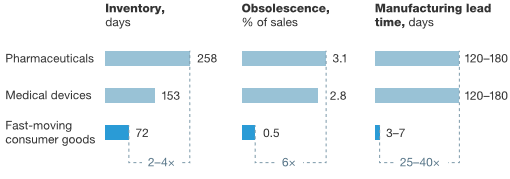
The good news is that models do exist to strengthen and improve the health-care supply chain. We believe that by learning from the experience of industries such as fast-moving consumer goods (FMCG), the health-care sector could cut production lead times and obsolescence, while manufacturers, distributors, hospitals, and pharmacies could carry significantly smaller inventories (Exhibit 1). Improving the health-care supply chain also could give millions of people around the world access to safer and more affordable health care, reduce costs, and provide new revenue sources for manufacturers.

Exhibit 1

Operational metrics suggest huge opportunities

SVG_HealthcareSupplyChains_ex1

 Our research identified five specific capabilities that can have a dramatic impact on performance and bottom lines:
  • better segmentation of products, markets, and customers
  • greater agility, to reduce costs and increase flexibility
  • measurement and benchmarking
  • alignment with global standards
  • collaboration across the health-care value chain

Now, we recognize that transforming supply chains isn’t easy. In our experience, limited improvement efforts yield poor results, while comprehensive, integrated efforts are complex. But the payoff can be significant. Supply chains now account for nearly 25 percent of pharmaceutical costs and more than 40 percent of medical-device costs. The annual spending is so vast—about $230 billion on pharmaceuticals and $122 billion on devices—that even minor efficiency gains could free up billions of dollars for investments elsewhere. In fact, if the sector adopted straightforward advances well established in other industries, we estimate that total costs (from the supply chain and external areas, such as patient care) could fall by $130 billion.

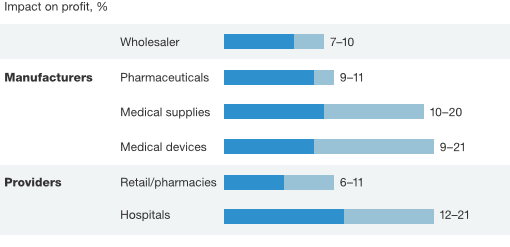
Industry research, together with our own experience serving clients, has revealed opportunities to boost profitability throughout the value chain. The improvement from better-performing supply chains would range from about 6 percent for retailers to 20 percent for hospitals and producers of devices and medical supplies (Exhibit 2).

Exhibit 2

Opportunities from the transformation of supply chains can be found across the whole value chain

SVG_HealthcareSupplyChains_ex2

Easing shortages, improving safety

The cost of the shortcomings of today’s supply chain is substantial. Since 2005, drug shortages have nearly tripled in the United States and added more than half a billion dollars in costs for hospitals worldwide. Supply issues also create opportunities for counterfeiters and gray-market vendors, threatening patient safety and cutting into the revenues of legitimate companies. Supply-chain security breaches are increasing by an average of more than 33 percent every year, rising not only in emerging markets such as China, India, and Brazil but also in the developed world.

In addition, medication errors in the developed world occur in roughly 10 to 20 percent of all inpatient hospital admissions. About 1 in 10,000 patients admitted dies from adverse drug events, which, we estimate, add $20 billion to $90 billion in costs to the health-care system globally. Better supply-chain processes are central to increasing patient safety. We estimate that adopting a common global data standard and upgrading supply-chain processes could slash counterfeiting in half, returning $15 billion to $30 billion in revenue (by 2016) to legitimate companies for reinvestment in further improvements to patient care.

Building a new health-care supply chain

A typical Asian laptop manufacturer can accept an order on a Monday and deliver a pallet of freshly assembled customized computers to a European customer little more than a week later. In contrast, a typical pharmaceutical manufacturer has a lead time of about 75 days. How can medical-device and pharmaceutical manufacturers close the gap? Of the five comprehensive transformations we have identified, three can be accomplished internally. Two others—alignment and collaboration—are potentially the most powerful but require a company to work together with its customers, suppliers, and even competitors. Here’s what must be done.

Internal factors

1. Segmentation. Many pharmaceutical and medical-device companies come close to running one-size-fits-all supply chains. In practice, however, there can be significant differences in profitability, value per unit of weight, demand, the importance of a drug or device to patients, a customer’s cost to serve, and service expectations. Forcing products with such varied characteristics through a single set of supply-chain processes creates multiple inefficiencies, such as high inventories for some products while others are in short supply, the use of expensive air freight when slower surface modes would do, or a need to reschedule production campaigns hastily to meet urgent delivery requirements. Leading companies tackle these problems by intelligently segmenting their supply chains according to the characteristics of products and the requirements of customers. They then develop forecasting, production, and distribution strategies for each category.

2. Agility. This means more than just being fast when there’s an emergency; it means building an operating model that can better respond to demand shifts and customer wishes—at the same or even reduced cost. As we mentioned, the replenishment lead time from pharmaceutical plants to distribution centers is 75 days, on average. But leading companies in sectors such as fast-moving consumer goods take a fraction of that time, often without additional investments. Companies must better align the production cycle with the patterns of patient demand and increase the low frequency of their manufacturing processes. The average stock-keeping unit (SKU) is packaged every two to three months; only about 10 percent are packaged every two weeks or less.

An agile supply-chain model also requires stability in production, replenishment, and visibility. Many health-care companies need to make deliveries from third parties and in-house plants more reliable and to upgrade their sales- and operations-planning capabilities to the standards of the fast-moving-consumer-goods industry. The necessary improvements include a more disciplined cross-functional process, a better understanding of demand-and-supply scenarios and of underlying assumptions, more effective communication, and transparency on potential supply issues and bottlenecks.

3. Measurement. Health-care companies need to increase the transparency of their costs, including manufacturing, transport, warehousing, inventory holding, staff, and obsolescence—moves that could cut operational costs and optimize route-to-market approaches and product portfolios. Improvements are also needed in structural drivers or capabilities: responsiveness, manufacturing frequency, reliability of supply, and stability are mostly not systematically measured or managed across the network. Consumer-goods companies are clearly more advanced: they watch metrics such as the manufacturing-frequency index to measure the share of SKUs that are produced with high frequency. Finally, companies must standardize metrics across countries and plants. Commercially available benchmarking tools and approaches provide rough guidance for high-level opportunities in services, costs, and inventories, but not fully comparable results or tangible recommendations on how to capture value.

External factors

While internal optimization can deliver better service at lower cost, companies have even more to gain from optimizing externally. To do so, they must align processes and improve collaboration.

4. Alignment. Manufacturers of fast-moving consumer goods use point-of-sale information from retail customers to build production plans. The grocery industry, for example, has created billions of dollars in value by adopting standard barcodes. To build a cost-effective supply chain, the health-care sector could align around a single set of global standards that support data interchange, processes, and capabilities. Doing so may increase efficiency and patient safety by making it harder for counterfeiters to operate, by reducing medication errors, and by improving recall processes.

5. Collaboration. While the use of common standards is part of the challenge, supply-chain partners must find ways to collaborate more effectively to reap the full benefit. Barriers to improvement are often cultural rather than technical—transactional relationships must be transformed into something more ambitious. In our experience observing successful collaboration projects, six essential steps can make the difference between a productive collaboration and a frustrating one: companies must collaborate in areas where they have a solid footing; agree on sophisticated benefit-sharing models; select partners for the potential value of the collaboration, as well as their capabilities and willingness to act as a team; dedicate resources to the collaboration and involve senior leadership in it; jointly manage performance and measure impact; and start out with a long-term perspective.

At a recent meeting of senior supply-chain executives in the pharmaceutical and medical-device industries, we asked attendees which of these five supply-chain changes offered the greatest opportunity. More than 70 percent specified improved collaboration.

Transforming the health-care supply chain can do much more than improve the bottom line. By embracing the challenge of supply-chain leadership, pharmaceutical and medical-device companies can provide safer, more affordable access to products that enhance or even save the lives of people across the world.

For more on this research, download the full report, Building new strengths in the health-care supply chain (PDF–871KB). You can find further information on the topic of standardization by downloading the related report Strength in unity: The promise of global standards in health care (PDF–3.3MB).

About the authors

Thomas Ebel is a principal in McKinsey’s Düsseldorf office; Erik Larsen is an associate principal in the Chicago office, where Ketan Shah is a principal.

The authors would like to acknowledge the contributions of Katy George and Drew Ungerman to this article.

Article link: http://www.mckinsey.com/insights/health_systems_and_services/strengthening_health_cares_supply_chain_a_five_step_plan?p=1

Posts navigation

← Older Entries
Newer Entries →
  • Search site

  • Follow healthcarereimagined on WordPress.com
  • Recent Posts

    • The Global Healthcare System Is Broken. Japan Fixed It for $4,100 Per Person. 04/10/2026
    • When Not to Use AI – MIT Sloan 04/01/2026
    • There are more AI health tools than ever—but how well do they work? – MIT Technology Review 03/30/2026
    • Are AI Tools Ready to Answer Patients’ Questions About Their Medical Care? – JAMA 03/27/2026
    • How AI use in scholarly publishing threatens research integrity, lessens trust, and invites misinformation – Bulletin of the Atomic Scientists 03/25/2026
    • VA Prepares April Relaunch of EHR Program – GovCIO 03/19/2026
    • Strong call for universal healthcare from Pope Leo today – FAN 03/18/2026
    • EHR fragmentation offers an opportunity to enhance care coordination and experience 03/16/2026
    • When AI Governance Fails 03/15/2026
    • Introduction: Disinformation as a multiplier of existential threat – Bulletin of the Atomic Scientists 03/12/2026
  • Categories

    • Accountable Care Organizations
    • ACOs
    • AHRQ
    • American Board of Internal Medicine
    • Big Data
    • Blue Button
    • Board Certification
    • Cancer Treatment
    • Data Science
    • Digital Services Playbook
    • DoD
    • EHR Interoperability
    • EHR Usability
    • Emergency Medicine
    • FDA
    • FDASIA
    • GAO Reports
    • Genetic Data
    • Genetic Research
    • Genomic Data
    • Global Standards
    • Health Care Costs
    • Health Care Economics
    • Health IT adoption
    • Health Outcomes
    • Healthcare Delivery
    • Healthcare Informatics
    • Healthcare Outcomes
    • Healthcare Security
    • Helathcare Delivery
    • HHS
    • HIPAA
    • ICD-10
    • Innovation
    • Integrated Electronic Health Records
    • IT Acquisition
    • JASONS
    • Lab Report Access
    • Military Health System Reform
    • Mobile Health
    • Mobile Healthcare
    • National Health IT System
    • NSF
    • ONC Reports to Congress
    • Oncology
    • Open Data
    • Patient Centered Medical Home
    • Patient Portals
    • PCMH
    • Precision Medicine
    • Primary Care
    • Public Health
    • Quadruple Aim
    • Quality Measures
    • Rehab Medicine
    • TechFAR Handbook
    • Triple Aim
    • U.S. Air Force Medicine
    • U.S. Army
    • U.S. Army Medicine
    • U.S. Navy Medicine
    • U.S. Surgeon General
    • Uncategorized
    • Value-based Care
    • Veterans Affairs
    • Warrior Transistion Units
    • XPRIZE
  • Archives

    • April 2026 (2)
    • March 2026 (9)
    • February 2026 (6)
    • January 2026 (8)
    • December 2025 (11)
    • November 2025 (9)
    • October 2025 (10)
    • September 2025 (4)
    • August 2025 (7)
    • July 2025 (2)
    • June 2025 (9)
    • May 2025 (4)
    • April 2025 (11)
    • March 2025 (11)
    • February 2025 (10)
    • January 2025 (12)
    • December 2024 (12)
    • November 2024 (7)
    • October 2024 (5)
    • September 2024 (9)
    • August 2024 (10)
    • July 2024 (13)
    • June 2024 (18)
    • May 2024 (10)
    • April 2024 (19)
    • March 2024 (35)
    • February 2024 (23)
    • January 2024 (16)
    • December 2023 (22)
    • November 2023 (38)
    • October 2023 (24)
    • September 2023 (24)
    • August 2023 (34)
    • July 2023 (33)
    • June 2023 (30)
    • May 2023 (35)
    • April 2023 (30)
    • March 2023 (30)
    • February 2023 (15)
    • January 2023 (17)
    • December 2022 (10)
    • November 2022 (7)
    • October 2022 (22)
    • September 2022 (16)
    • August 2022 (33)
    • July 2022 (28)
    • June 2022 (42)
    • May 2022 (53)
    • April 2022 (35)
    • March 2022 (37)
    • February 2022 (21)
    • January 2022 (28)
    • December 2021 (23)
    • November 2021 (12)
    • October 2021 (10)
    • September 2021 (4)
    • August 2021 (4)
    • July 2021 (4)
    • May 2021 (3)
    • April 2021 (1)
    • March 2021 (2)
    • February 2021 (1)
    • January 2021 (4)
    • December 2020 (7)
    • November 2020 (2)
    • October 2020 (4)
    • September 2020 (7)
    • August 2020 (11)
    • July 2020 (3)
    • June 2020 (5)
    • April 2020 (3)
    • March 2020 (1)
    • February 2020 (1)
    • January 2020 (2)
    • December 2019 (2)
    • November 2019 (1)
    • September 2019 (4)
    • August 2019 (3)
    • July 2019 (5)
    • June 2019 (10)
    • May 2019 (8)
    • April 2019 (6)
    • March 2019 (7)
    • February 2019 (17)
    • January 2019 (14)
    • December 2018 (10)
    • November 2018 (20)
    • October 2018 (14)
    • September 2018 (27)
    • August 2018 (19)
    • July 2018 (16)
    • June 2018 (18)
    • May 2018 (28)
    • April 2018 (3)
    • March 2018 (11)
    • February 2018 (5)
    • January 2018 (10)
    • December 2017 (20)
    • November 2017 (30)
    • October 2017 (33)
    • September 2017 (11)
    • August 2017 (13)
    • July 2017 (9)
    • June 2017 (8)
    • May 2017 (9)
    • April 2017 (4)
    • March 2017 (12)
    • December 2016 (3)
    • September 2016 (4)
    • August 2016 (1)
    • July 2016 (7)
    • June 2016 (7)
    • April 2016 (4)
    • March 2016 (7)
    • February 2016 (1)
    • January 2016 (3)
    • November 2015 (3)
    • October 2015 (2)
    • September 2015 (9)
    • August 2015 (6)
    • June 2015 (5)
    • May 2015 (6)
    • April 2015 (3)
    • March 2015 (16)
    • February 2015 (10)
    • January 2015 (16)
    • December 2014 (9)
    • November 2014 (7)
    • October 2014 (21)
    • September 2014 (8)
    • August 2014 (9)
    • July 2014 (7)
    • June 2014 (5)
    • May 2014 (8)
    • April 2014 (19)
    • March 2014 (8)
    • February 2014 (9)
    • January 2014 (31)
    • December 2013 (23)
    • November 2013 (48)
    • October 2013 (25)
  • Tags

    Business Defense Department Department of Veterans Affairs EHealth EHR Electronic health record Food and Drug Administration Health Health informatics Health Information Exchange Health information technology Health system HIE Hospital IBM Mayo Clinic Medicare Medicine Military Health System Patient Patient portal Patient Protection and Affordable Care Act United States United States Department of Defense United States Department of Veterans Affairs
  • Upcoming Events

Blog at WordPress.com.
healthcarereimagined
Blog at WordPress.com.
  • Subscribe Subscribed
    • healthcarereimagined
    • Join 153 other subscribers
    • Already have a WordPress.com account? Log in now.
    • healthcarereimagined
    • Subscribe Subscribed
    • Sign up
    • Log in
    • Report this content
    • View site in Reader
    • Manage subscriptions
    • Collapse this bar
 

Loading Comments...