healthcarereimagined

Envisioning healthcare for the 21st century

  • About
  • Economics

The True Cost of an Expensive Medication – The Atlantic

Posted by timmreardon on 09/25/2015
Posted in: Uncategorized. Leave a comment

It was supposed to be a miracle, but now it’s what keeps Laura Bush, a nurse-practitioner near Albuquerque, awake at night.

There’s a drug called Sovaldi that works astonishingly well to cure people with the liver disease Hepatitis C. The rub? It costs $1,000 per day for all 12 weeks of treatment.

Bush’s clinic, First Choice Community Healthcare, is a federally qualified health center in the rural town of Los Lunas, New Mexico, which means she sees a disproportionate number of patients who are uninsured, underinsured, and on Medicaid, the government insurance program for the poor. In other words, they can’t afford Sovaldi.

The state’s Medicaid program rations access to Sovaldi and other blockbuster Hep C drugs to only the sickest patients. Even with those limitations, the drugs will likely cost the state an estimated $140 million this year. At various points since Sovaldi became available last year, Bush said, Medicaid has required her to perform risky liver biopsies on patients to prove how sick they are, or wait until patients have late-stage liver disease before they can be eligible for coverage. Each day, Bush juggles seeing patients with writing appeal letters and filing pre-authorizations that are often denied.

“Imagine if you went to get your mammogram, and they said, ‘you’ve got this [lump] here, but we’re not going to do anything about it until it gets bigger,’” Bush told me recently. “How would you take that, as a patient?”

“At the end you die not knowing who you are, you’re malnourished, and you’re bleeding to death.”

With enough paperwork and tenacity, for a while Bush was able to secure free doses of Sovaldi directly from its manufacturer, Gilead Sciences. But that strategy, too, has become tougher in recent months after Gilead limited the types of patients who could receive free drugs.

New Mexico health-care workers aren’t the only ones struggling to secure these new treatments for their patients. Other states also require patients to be in late-stage liver disease, get urine drug screens, or prove abstinence from drugs and alcohol before they’ll consider covering them. Hep C patients commonly find themselves being forced to get sicker before they can get better.

Hep C is a liver disease transmitted by blood. It’s most common among baby boomers, most of whom contracted it through blood transfusions or by using contaminated needles to inject drugs. Left untreated, Hep C attacks the liver and can lead to cancer or liver failure.

Sovaldi costs $84,000 for a 12-week course of treatment, or about $1,000 per pill. It’s a great drug, working nearly 90 percent of the time and with few side effects. Sovaldi and the similarly pricey Harvoni, also made by Gilead, are a big improvement over older cures like interferon, which was only effective about half the time and whose side effects—rashes, fever, and nausea—were sometimes described as worse than the disease itself.

If state governments were to pay for Sovaldi or Harvoni for all of the Hep C patients on their Medicaid and prison rolls, the total bill would have been $55 billion. Most state Medicaid programs, therefore, are sharply limiting access to them. An August study in the Annals of Internal Medicine found that most states were only making these new drugs available to Medicaid patients who had advanced fibrosis, or liver scarring. Two-thirds required urine drug tests for drugs and alcohol before they would cover the medication. These measures, the study notes, are inconsistent with the recommendations of prominent health organizations and FDA guidelines.

Liver Disease Required for Medicaid Coverage of Sovaldi
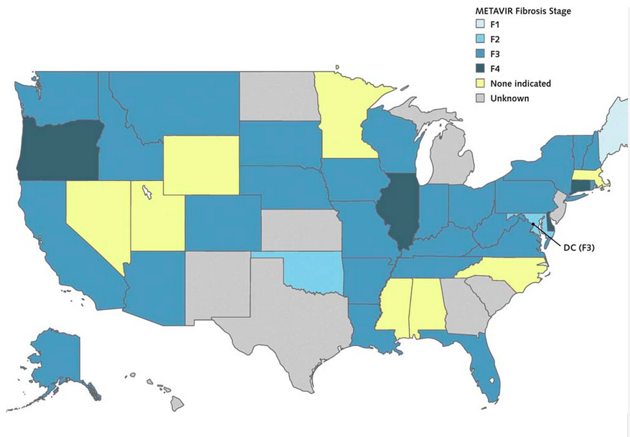
Sofaldi

State Medicaid programs, meanwhile, feel their hands are tied. “The states can’t afford it,” said Matt Salo, executive director of the National Association of State Medicaid Directors. “If we were to pony up for [Sovaldi], we would spend as much on this one drug as we would for all other drugs in the entire program. We don’t have the luxury of having a state legislature saying, ‘You want 5 to 10 percent more [money] this year? Cool, here’s your money.’ Many state legislatures are saying, ‘You’ve got to save, because revenues are down.’”

* * *

Martin Shkreli, the 32-year-old head of Turing Pharmaceuticals, stoked Internet outrage this week when it was reported that he raised the price of the 62-year-old anti-parasite drug Daraprim to $750 per tablet, from $13.50. Then he defended himself, Gekko-style, by saying, “I am a capitalist who plays to win.”

On Wednesday, he said he’ll lower the price to an undisclosed amount, but not before the parasite-free-organs-are-for-closers attitude drew widespread attention to the rising cost of prescription drugs. The prices of existing medications for everything from tuberculosis to blood pressure have rocketed up in recent years after the drugs were acquired by pharmaceutical companies.

“[Daraprim] is such a perfect, crystalline example of everything that can be done, given the lack of rationality in the system, and the total bankruptcy of the justifications for high drug prices in the first place,” Peter B. Bach, director of the center for health policy and outcomes at Memorial Sloan Kettering Cancer Center in New York, told the Washington Post.

But price hikes on existing drugs represent just a small part of America’s overall prescription-cost woes. Drug companies are regularly churning out new medications to treat everything from cholesterol to cancer. The $84,000 Sovaldi is practically nothing, for example, compared to Solirism, a $700,000-per-year drug that treats a rare blood disease, or Naglazyme, a $500,000 treatment for a rare skeletal disorder. The difference is that unlike drugs that only a few hundred Americans will ever need, Sovaldi could completely change the lives of the roughly three million Hep C sufferers in the U.S.

If, that is, their insurers would pay for it.

“I will at all costs try to get you the medication.”

Drug makers have long justified their high prices by saying it’s the only way they can recoup their investment into research and development. Then again, pharmaceutical companies have some of the largest profit margins in the health-care industry.

In an emailed statement, a Gilead spokeswoman responded to questions about Sovaldi’s price by saying, “unlike treatment for other chronic diseases, Sovaldi offers a cure … at a price that significantly reduces Hepatitis C treatment costs and delivers significant savings to the healthcare system over the long-term.”

Together, Sovaldi and Harvoni generated $12.4 billion in sales for Gilead last year. The company’s CEO, John C. Martin, is a billionaire. Gilead’s revenues doubled last year, and as the New York Times wrote, the company “now is faced with figuring out what to do with all the cash it is generating.”

* * *

Last year, New Mexico’s Human Services Department issued a rule that required patients to show that they have Stage 3 or Stage 4 liver fibrosis before Medicaid will cover them for drugs like Sovaldi.

In Stage 4, the liver is “hard as a rock,” Sanjeev Arora, a University of New Mexico physician, told the Albuquerque Journal. “Treating someone for Hepatitis C after they have developed cirrhosis is a little bit like closing the barn door after the horse has left.” While they wait to develop cirrhosis, Hep C patients face a higher risk of developing depression, nerve pain, and lymphoma.

When low-income Hep C patients come to see Bush, she’ll assure them that she wants to see them cured. “I will at all costs try to get you the medication,” she says.

If the person doesn’t have cirrhosis, she asks them to write a letter describing why they need Sovaldi. She’ll fill out a prior authorization and send it to Medicaid. If Medicaid denies the request, as she says often happens, she appeals. And on it goes.

Those who don’t get the medication can die “some of the worse deaths I’ve ever seen,” Bush said. People with end-stage liver disease vomit blood, feel confused, and turn yellow and bloated. “At the end you die not knowing who you are, your belly looks 12 months pregnant, you’re malnourished, and you’re bleeding to death,” she said.

Bush currently has about 20 patients waiting to get Sovaldi. One man doesn’t yet have cirrhosis, but he has trouble swallowing. His insurance won’t cover Sovaldi, which is a single-pill regimen, but will pay for a different treatment that requires taking multiple pills. Bush is worried he’ll choke.

Previously, Gilead sometimes provided free Sovaldi treatments to poor people who had been denied access to the drug by their insurer. But in July, the company changed its criteria and now only extends that offer to people who are uninsured. In the statement to The Atlantic, the Gilead spokeswoman said that the change was a response to insurers who were refusing to pay for Sovaldi. The assistance program “was designed to help uninsured patients with the most need, and changes are necessary to remain true to that mission,” she said.

Sovaldi’s story is not unique in America, but it is a uniquely American story. Other countries rigorously regulate the prices of prescription drugs, just as American cities set the rates of public utilities. In Germany, for example, the insurance-like “sickness funds” negotiate with both physician groups and drug manufacturers to determine the costs of all treatments. In the U.S., meanwhile, drug makers can simply name their price.

Sometimes, all of her attempts fail, and Bush has to tell her patients she can’t get one of these miracle pills for them. “I have one patient who got so upset because she thought I was blocking her ability to get the meds,” Bush said. “She came to me and said, ‘no one wants to give me the medications because I’m poor.’”

That woman finally did receive the drug, Bush said. It took seven months.

Article link: http://www.theatlantic.com/health/archive/2015/09/an-expensive-medications-human-cost/407299/

The MHS: Meeting Imperatives for Future Success – AMSUS Health

Posted by timmreardon on 09/04/2015
Posted in: Uncategorized. Leave a comment
Published on Jan 5, 2015

Dr. Jonathan Woodson, Assistant Secretary of Defense (Health Affairs), Plenary, Military Medicine: An Indispensable Instrument of National Security 2015 and Beyond, 3 December 2014

Transforming Healthcare for Veterans – AMSUS Healthcare

Posted by timmreardon on 09/04/2015
Posted in: Uncategorized. Leave a comment

Published on Dec 18, 2014

Clancy
Dr. Carolyn Clancy, Interim Under Secretary for Health for the Department of Veterans Affairs, Plenary, Major Transition in VHA: The Blueprint for Excellence, 3 December 2014.

Integrated Health Care System: Supporting a 21st Century Medically Ready/Ready Medical Force – AMSUS Health 2014

Posted by timmreardon on 09/04/2015
Posted in: Uncategorized. Leave a comment

Published on Feb 6, 2015

Friday 5 December 2014, Military Health System, Integrated Health Care System: Supporting a 21st Century Medically Ready/Ready Medical Force by MG Richard Thomas, MD and Ms. Mary Kaye Justis

Medical Modernization: Matching Requirements to Demand Signal – AMSUS Health 2014

Posted by timmreardon on 09/04/2015
Posted in: Uncategorized. Leave a comment

Published on Feb 6, 2015

Thursday 4 December 2014, Military Health System, Medical Modernization: Matching Requirements to Demand Signal by David Smith, MD, DASD Force Health Protection & Readiness

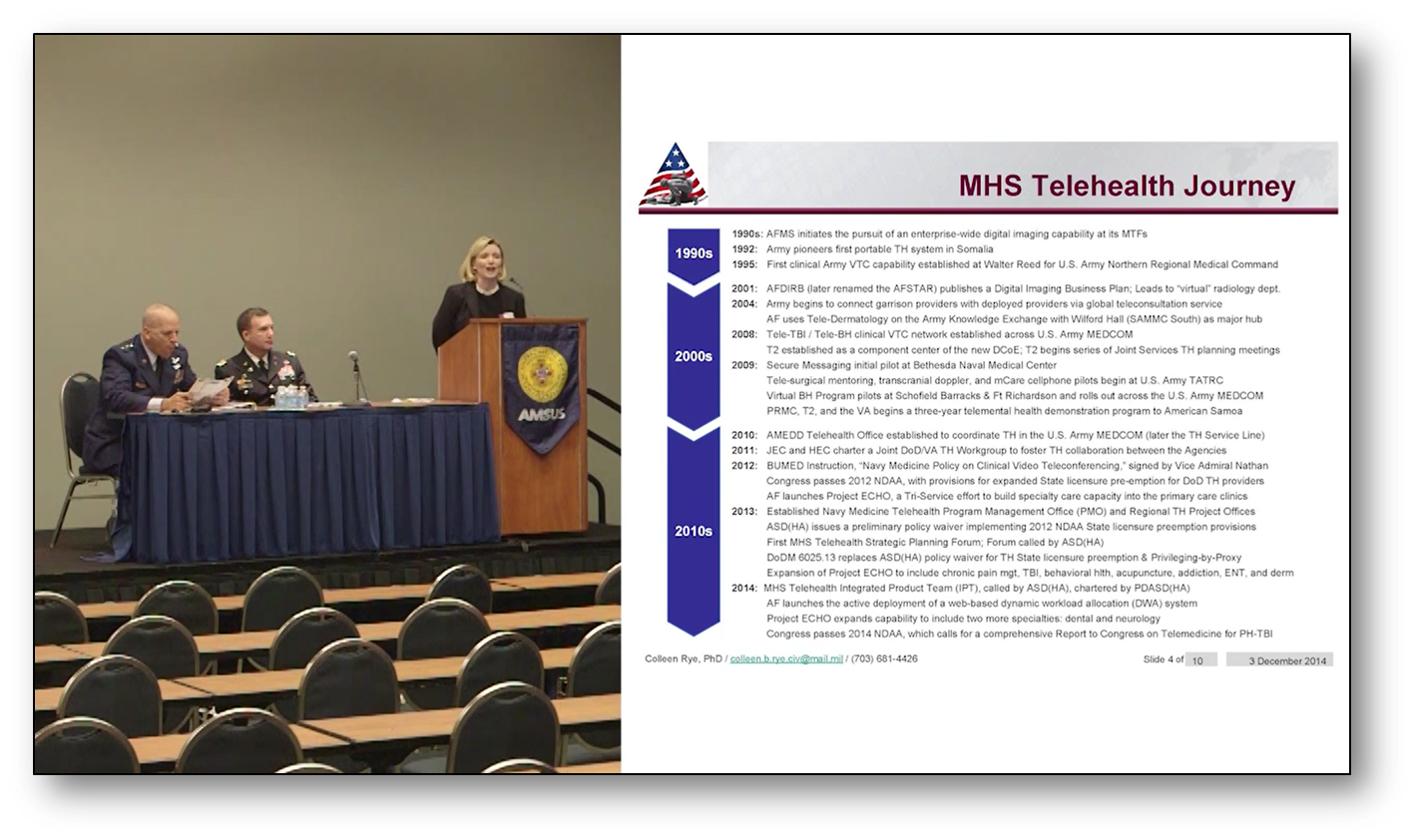
Telehealth: Global Reach…Global Care – AMSUS 2014

Posted by timmreardon on 09/04/2015
Posted in: Uncategorized. Leave a comment

Wednesday 3 December 2014, Military Health System, Telehealth: Global Reach…Global Care by Colleen Rye, PhD and COL Daniel Kral

Telehealth

Will Medical Scribes Limit Innovation in HIM, EHR Documentation? – HealthIT Analytics

Posted by timmreardon on 09/04/2015
Posted in: Uncategorized. Leave a comment

How will the rise of medical scribes impact EHR documentation, health information management, and data governance?

By Jennifer Bresnick on January 05, 2015

It’s no secret that EHR documentation has been a major pain point for physicians since the very beginning of the EHR Incentive Programs.  Poorly designed software, a lack of familiarity with technology, the added burden of reporting for meaningful use and other quality initiatives, and a general sense that laptops are a significant obstacle in the patient-provider relationship have left a number of physicians apprehensive of using EHRs.  Some physicians are so fed up with the EHR time suck that they have turned to medical scribes to do the heavy keyboard work instead.

While this initially seems like the perfect way to improve efficiency, not everyone is convinced that EHR documentation produced by these scribes – credentialed data entry experts who typically do not hold a medical license – will be a positive development for the EHR industry.  A team of experts from CHRISTUS Health in Texas, led by George A. Gellert, MD, MPH, MPA, argue in a JAMA viewpoint article that scribes are just a temporary bandage for a much deeper wound: the inability of the EHR vendor community to produce software that allows physicians to do their own documentation without losing minutes or hours each day on data entry.

With the rise of data analytics pressuring the healthcare industry to produce consistently clean, complete, and accurate documentation, the focus on data governance has never been stronger.  Medical scribes may not be allowed to create documentation independently of their supervising physician, according to The Joint Commission, and CMS may frown upon the notion of scribes being able to enter orders using CPOE systems, but they still create an added layer of interference between the physician and the chart, which may increase the potential for human error.

population health management and chronic disease management

“With problems associated with EHRs so substantial—and physicians’ experiences using medical scribes so positive—are there any risks engendered by the rise of a medical scribe industry and its potential for becoming integral to US health care delivery?” Gellert asks. “Despite scribes’ reported value, this industry should be viewed as what it is: a workaround or adaptation to the suboptimal state of today’s EHRs.”

Gellert fears that the rise of medical scribes may lead EHR developers to push innovation off their lists of top priorities, leading the industry to “a deceleration and possibly stagnation in EHR technological improvement.”  Relying on scribes to do the dirty work of EHR documentation may also lead physicians to relax their view of what their helpers should or should not do, and might even lead to scribes operating outside of their purview as the lines blur.  After all of the progress the industry has made towards utilizing electronic data for quality initiatives and clinical analytics, will scribes push the healthcare ecosystem back into the ignoble mire of lackadaisical documentation and inadequate data governance?

Not according to physicians who use them.  A 2013 study at the United Heart and Vascular Clinic in Minnesota found that medical scribes cut down patient consult prep time by one third and saved close to $2500 per patient in direct and indirect costs, says study author Dr. Alan J. Bank.

“To me, it doesn’t make economic sense to have a doctor who’s getting paid a good salary and has all the training to be sitting there typing or filling out forms,” Bank told EHRintelligence.  “Someone else can do it just as well or better.  And a lot of physicians are getting worn out.  They’re just getting tired.  But if we made things easier for physicians and took some of the paperwork away, it would be better for everybody.  As doctors, we want to take care of patients.  We don’t want to be typists.”

Medical scribes may indeed be a workaround for software that does not adequately meet a physician’s needs, but even Gellert admits that after years of EHR vendors competing for a white hot market of meaningful use hopefuls, the industry has not been able to conquer its data governance and health information management challenges.  “Even after a decade of use, some EHRs and CPOE may not compete with the speed of a paper checklist, and may never,” he writes, but maintains that physician pressure on the commercial market, if applied consistently and firmly, will lead to heretofore unseen leaps in EHR innovation.

But while the industry is waiting for these improvements to be made, should they suffer with the potential for financial losses, the rampant dissatisfaction, and the risk of burnout that is reducing an already inadequate number of physicians operating in a rapidly changing industry?  Or can medical scribes provide a useful stopgap and necessary support to physicians on the brink of calling it quits?  Gellert believes that once a physician uses a scribe to relieve the pressure, it’s only a matter of time before that scribe becomes indispensable, despite the risks and perhaps despite the eventual availability of improved technology.  The risk is simply too high to justify the short-term benefits, he says.

“The answer to today’s inadequate EHRs is not scribe support,” he concludes. “The use of scribes can pose potential risks to patients if they are allowed to enter orders into the EHR, and the risk of use creep is high. The medical scribe industry may impede the technological evolution of EHR products by undermining market demand for needed improvement, and it is unlikely that scribes will be used only as a temporary solution. The rise of the medical scribe industry should not be a substitute for much-needed EHR innovation and transition to more highly effective and more functionally efficient EHR systems.”

Article link:http://healthitanalytics.com/news/will-medical-scribes-limit-innovation-in-him-ehr-documentation/

Telemedicine Can’t Help the People Who Need it the Most – Wired

Posted by timmreardon on 09/04/2015
Posted in: Uncategorized. Leave a comment

physician using laptop in hospital

For people living in Wyoming or South Dakota or rural Virginia, a trip to the cardiologist isn’t a simple undertaking. “They’re taking a whole day off work to drive 150 miles, go the appointment, and drive 150 miles home,” says Deanna Larson, senior vice president at Avera Health. That’s why Avera, which runs a network of over a hundred clinics and hospitals in the upper midwest, has invested in telemedicine, allowing doctors to pop into rural clinics by video from hundreds of miles away.

Telemedicine has been a buzzword for years now, but the rural communities that could benefit most from it also have the least access to fast and reliable Internet—an obvious prerequisite. That’s not for lack of political effort. The Federal Communications Commission has been responsible for helping connect rural healthcare facilities since the Telecommunications Reform Act of 1996. The Internet has changed since then: Bulky desktops have shrunk to pocket iPhones and 56 kpbs dial ups have been superseded by 35 Mbps connections—nearly 10,000 times faster. The 20-year-old law, even after a few revisions, has struggled to keep up.

Telemedicine infrastructure is lagging on two fronts. First, many rural clinics have Internet access that is still too slow and unreliable. Second, telemedicine is increasingly moving from the clinic into the home, with at-home monitoring and mobile apps. Here, the facts on the ground are even worse: According to the FCC’s 2015 Broadband Progress Report, 55 million Americans still do not have access to broadband speed Internet access, which includes more than half of rural Americans.

The FCC’s rural health care program can give out $400 million every year to link up rural health facilities. “It’s never reached anywhere near that limit,” says Jonathan Linkous, CEO of the American Telemedicine Association. In 2013, the rural health care program paid out $159 million. Linkous chalks up it up the program’s complex bureaucracy, which the overworked staff members at rural clinics don’t have time to navigate.

Rural clinics do have usually have broadband connections now, but they can be T1 lines, which top out at just 1.544 Mbps. (In comparison, Comcast offers cable Internet up to 150 Mbps in the San Francisco area.) Avera requires its facilities to have a T1 line, and it lays lines for ones that do not, like for a facility in remote Montana. That’s fast enough for a video consult, but it’s not necessarily enough for, say, an electronic intensive care unit, in which healthcare professionals remotely monitor patients who need critical care. “There are significant rural areas that still do not have the speed necessary to do the telemedicine they would like,” says Alan Morgan, CEO of the National Rural Health Association.

Tap or Swipe for the Doctor

As broadbroad in rural health facilities is still lagging behind, mobile health apps are blowing the problem wide open. “If you’re still providing broadband to brick and mortar, you’re going to where healthcare used to be,” says Linkous. “More and more, you have to get beyond the traditional walls of hospitals and clinics.”

In 2014, for example, the University of Mississippi Medical Center began a pilot program that sent 85 patients with uncontrolled diabetes home with a tablet. The tablet kept track of blood glucose levels and sent real-time data back to a team of doctors. The first six months of the study have been promising: The diabetes patients lost weight and reported getting their diabetes under control.

But for programs like this diabetes pilot to work, patients need reliable Internet access at home. That’s not a given, with half of rural Americans still lacking broadband-level speeds. And if you’ve ever driven across the country, you’ve certainly driven through vast tracts of land without cell phone access. The FCC and the US Department of Agriculture both have programs dedicated to promoting rural broadband—modeled after the 20th century push for rural telephone service. But the programs haven’t been as widely successful yet. The USDA’s Rural Utilities Service, especially, has come under fire for spending money in all the wrong places.

One bright spot is the FCC’s recently proposed changes to its Lifeline program, says Linkous. Lifeline has given millions of low-income Americans a $9.25 per month subsidy to pay for a mobile or landline phone, and the FCC is now considering broadening the program to include broadband. WIRED readers, of all people, can probably get behind universal Internet access—but the FCC’s decision could actually help make that real.

Article link: http://www.wired.com/2015/08/telemedicine-cant-help-people-need/

EHRs far from interoperable — still – Healthcare IT News

Posted by timmreardon on 08/14/2015
Posted in: Uncategorized. Leave a comment

New research finds interoperability capabilities in EHRs evolving too slowly

BOSTON | July 28, 2015

interoperability_road_signs_2The most valued patient data resides in the EHR, yet EHRs are architected to perpetuate data silos. Because of the lack of interoperability, healthcare providers can’t achieve true care coordination.

To date, EHR vendors have turned a blind eye to this critical flaw, and according to a new report from Boston-based Chilmark Research, there is no sign they will change anytime soon.

The rapid expansion of value-based reimbursement is exposing unmet needs for active coordination – care, financial and administrative – within and between healthcare organizations, say Chilmark executives in a news release announcing the findings.

“Most EHR vendors regard their core clinical systems as comprehensive and inviolable – few readily admit that provider needs are have long outstripped existing EHR feature sets and ongoing development efforts,” Chilmark researchers conclude in the report.

At the same time, they note, healthcare end-users have elevated expectations based on consumer-facing application ecosystems or “app stores” – built on the technical foundation of open APIs in a cloud-based environment.

The EHR market is ripe for the development of an application ecosystem to rapidly extend functional capabilities and remedy usability deficiencies, they say. But first it needs open APIs and a Platform-as-a-Service for developers.

The research found that independent software vendors have mixed opinions about the capabilities offered by EHR vendors.

“Some survive, and even thrive, but always at the sufferance of major EHR vendors,” the report asserts. “Others survive in the shadows, taking pains not to attract any attention from EHR vendors for fear of being shut out.”

The report characterizes the interoperability capabilities of prominent EHR vendors. Current technology interfaces that provide data after the fact, non-disclosure agreements, data access fees, and the lack of reasonable software tools for developers are all obstacles to the development of extensions for developers.

Open APIs as solution

The report describes how the leading candidate for open APIs in healthcare – HL7 Fast Healthcare Interoperability Resources, or FHIR – is being implemented by EHR vendors. This new technology offers the most potential to provide real-time access to data across applications and organizations and may ultimately give rise to Platform as a Service-based ecosystems, according to Chilmark Research analyst Brian Murphy, lead author of the report.

[See also: Epic defends interoperability bona fides.]

“Open APIs will ultimately form the basis for the interoperable health records that patients and providers are demanding,” Murphy said in a statement. “The work being done by the major vendors to support FHIR is only the beginning. In the next year, we expect healthcare technology contributors – IT vendors, payers, health information organizations and others to move beyond endorsement to actual implementations.”

As Murphy sees it, FHIR APIs will eventually replace much of the data exchange technology painstakingly assembled over the last 30 years with modern ideas of open, distributed computing. Programmers will access data where it lives rather than where it has been staged, leading to rapid improvements in IT functionality, usability and genuine choice in applications to use.

[See also: Everyone backs interoperability, but… and ONC calls for interoperability by 2017.]

The report concludes that the healthcare market is “quite ready” for API-driven extensions to clinical and financial applications.

Leading IT vendors will need to API-enable their core products if they wish to foster a PaaS ecosystem that accelerates their ability to address unmet needs of end users, Murphy concludes.

“EHR vendors are better positioned than any other HIT vendors to become true platform vendors as they are still at the center of physician workflow, hold the keys to clinical patient data, and still command the lion’s share of IT resources and subsequently attention from HCO C-suites,” he says. “This is their opportunity to lose if they fail to innovatively create a true ecosystem around their offering.”

The report provides a snapshot of several EHR vendors’ interoperability capabilities, or lack thereof, as well as a review of their nascent API programs.

A similar report, to be published in late 2015, will provide a similar analysis of what other IT vendors serving the healthcare sector are doing to enable their own PaaS strategy. This second report will also include an analysis of how other well-known providers of interoperability solutions (i.e. CommonWell and the Sequoia Project (formerly HealtheWay)) are contributing to the development of a more platform-centric approach that can deliver an application ecosystem to healthcare.

Article link: http://www.healthcareitnews.com/news/ehrs-far-interoperable-still

Leidos Wins Massive Pentagon Health Care Records Contract – Nextgov

Posted by timmreardon on 08/07/2015
Posted in: Uncategorized. Leave a comment

By Frank Konkel July 29, 2015

EHR nextgov-mediumThe Pentagon today awarded its years-in-the-making multibillion contract to upgrade its electronic health records system, to defense IT firm Leidos, which partnered with electronic health record vendor Cerner and Accenture Federal.

The Defense Healthcare Management Systems Modernization contract’s base value is $4.3 billion over 10 years, with an expected 18-year lifecycle value of $9 billion, and will put Leidos in charge of building a next-generation health records system responsible for DOD’s 9.6 million beneficiaries.

Eventually, the software will be deployed at more than 1,200 sites and across 56 inpatient hospitals and medical centers. The final cost estimate is down from the initial $11 billion over the project’s life cycle.

In a briefing with reporters Wednesday morning, Frank Kendall, undersecretary of defense for acquisition, technology and logistics, called the contract award an “important step in the acquisition of a modern health care system for DOD.”

“It’s not the final step by any means; we have a lot of work ahead of us, but this is the culmination of two years of work to get here,” he said. “We have taken the time to do this job right.”

The highly competitive contract initially saw six initial bids narrowed down to three by February: IBM and partner Epic Systems; Computer Sciences Corp., with HP and EHR developer Allscripts; and the Leidos-led team all in the running.

Work under the contract, which DOD began conceptualizing in 2013, will begin with deploying and field testing software to ensure its security and operational capabilities across eight locations in the Pacific Northwest by the end of 2016. DOD’s target, Kendall said, is to have the health records platform “interoperable and running” across all sites by 2022.

“That’s our baseline,” he said. “We are going to refine that based on the award and initial technical discussion. We’d like to go more quickly.”

Kendall, speaking alongside Dr. Jonathan Woodson, assistant secretary of defense for health affairs, and Chris Miller, the program executive officer of the Defense Healthcare Management Systems, said the contract award took in consideration both interoperability and cybersecurity.

Miller acknowledged public and congressional criticism in recent years over an inability for the current DOD health records systems to share health records with the Department of Veterans Affairs. DOD’s current health records systems, the Armed Forces Health Longitudinal Technology Application, or AHLTA, was developed by Leidos when it was known as SAIC.

Miller said DOD will “comprehensively test the product” and dig “deep into security and interoperability both with VA and the private sector” before deploying it. He told reporters DOD and VA have made major interoperability improvements over the past two years.

“The DOD and VA are interoperable today electronically,” Kendall said. “We send over a million pieces of data a day to VA. We have interoperability we’ll be certifying to the Congress here very shortly. We want to sustain that and enhance that with this new system.”

Kendall said DOD wants interoperability not only with VA but also with commercial providers. “Interoperability was a fundamental consideration,” he added.

The Pentagon is also concerned about cybersecurity, he said.

“We wanted to make sure we took adequate steps to protect the information that will be on this system, as well as the privacy of health care information,” Kendall told reporters.

In a statement, Leidos spokeswoman Jennifer Gephart said the company is “honored” to work on the contract.

“Our team stands ready to lean forward with the DOD to implement a world class electronic health records system,” she said.

When reached for comment, both competing systems integrators also provided Nextgov comment.

“Today, CSC learned of DOD’s decision regarding the Defense Healthcare Management System Modernization contract award,” said CSC spokesperson Heather Williams. “While this is not the outcome we anticipated, we’ll receive a debrief and evaluate our options.”

IBM spokesperson Clint Roswell told Nextgov: “We are very disappointed by today’s announcement and firmly believe that our proposal, along with our combined expertise, would provide the U.S. Department of Defense with the most innovative technology platform to best serve our military families now and into the future.”

He added, “We stand ready to help the Defense Department in this endeavor.”

Either company could potentially file a bid protest within 10 days of the contract award. Bid protests are not uncommon with contracts of this magnitude – the scope of the deal is on par with some of DOD’s weapons systems – but Kendall said if a protest is filed, he believes DOD followed the rules.

“We think we’re in a good position; we followed the rules put in place,” said Kendall, noting DOD had “viable bidders in the end” that resulted in “a clear best-value solution for us.”

“We’re hoping there is not a protest,” Kendall said. “We’re prepared to deal with it if there is.”

Article link: http://www.nextgov.com/defense/2015/07/breaking-leidos-wins-massive-pentagon-health-care-records-contract/118710/?oref=nextgov_today_nl

Posts navigation

← Older Entries
Newer Entries →
  • Search site

  • Follow healthcarereimagined on WordPress.com
  • Recent Posts

    • The Global Healthcare System Is Broken. Japan Fixed It for $4,100 Per Person. 04/10/2026
    • When Not to Use AI – MIT Sloan 04/01/2026
    • There are more AI health tools than ever—but how well do they work? – MIT Technology Review 03/30/2026
    • Are AI Tools Ready to Answer Patients’ Questions About Their Medical Care? – JAMA 03/27/2026
    • How AI use in scholarly publishing threatens research integrity, lessens trust, and invites misinformation – Bulletin of the Atomic Scientists 03/25/2026
    • VA Prepares April Relaunch of EHR Program – GovCIO 03/19/2026
    • Strong call for universal healthcare from Pope Leo today – FAN 03/18/2026
    • EHR fragmentation offers an opportunity to enhance care coordination and experience 03/16/2026
    • When AI Governance Fails 03/15/2026
    • Introduction: Disinformation as a multiplier of existential threat – Bulletin of the Atomic Scientists 03/12/2026
  • Categories

    • Accountable Care Organizations
    • ACOs
    • AHRQ
    • American Board of Internal Medicine
    • Big Data
    • Blue Button
    • Board Certification
    • Cancer Treatment
    • Data Science
    • Digital Services Playbook
    • DoD
    • EHR Interoperability
    • EHR Usability
    • Emergency Medicine
    • FDA
    • FDASIA
    • GAO Reports
    • Genetic Data
    • Genetic Research
    • Genomic Data
    • Global Standards
    • Health Care Costs
    • Health Care Economics
    • Health IT adoption
    • Health Outcomes
    • Healthcare Delivery
    • Healthcare Informatics
    • Healthcare Outcomes
    • Healthcare Security
    • Helathcare Delivery
    • HHS
    • HIPAA
    • ICD-10
    • Innovation
    • Integrated Electronic Health Records
    • IT Acquisition
    • JASONS
    • Lab Report Access
    • Military Health System Reform
    • Mobile Health
    • Mobile Healthcare
    • National Health IT System
    • NSF
    • ONC Reports to Congress
    • Oncology
    • Open Data
    • Patient Centered Medical Home
    • Patient Portals
    • PCMH
    • Precision Medicine
    • Primary Care
    • Public Health
    • Quadruple Aim
    • Quality Measures
    • Rehab Medicine
    • TechFAR Handbook
    • Triple Aim
    • U.S. Air Force Medicine
    • U.S. Army
    • U.S. Army Medicine
    • U.S. Navy Medicine
    • U.S. Surgeon General
    • Uncategorized
    • Value-based Care
    • Veterans Affairs
    • Warrior Transistion Units
    • XPRIZE
  • Archives

    • April 2026 (2)
    • March 2026 (9)
    • February 2026 (6)
    • January 2026 (8)
    • December 2025 (11)
    • November 2025 (9)
    • October 2025 (10)
    • September 2025 (4)
    • August 2025 (7)
    • July 2025 (2)
    • June 2025 (9)
    • May 2025 (4)
    • April 2025 (11)
    • March 2025 (11)
    • February 2025 (10)
    • January 2025 (12)
    • December 2024 (12)
    • November 2024 (7)
    • October 2024 (5)
    • September 2024 (9)
    • August 2024 (10)
    • July 2024 (13)
    • June 2024 (18)
    • May 2024 (10)
    • April 2024 (19)
    • March 2024 (35)
    • February 2024 (23)
    • January 2024 (16)
    • December 2023 (22)
    • November 2023 (38)
    • October 2023 (24)
    • September 2023 (24)
    • August 2023 (34)
    • July 2023 (33)
    • June 2023 (30)
    • May 2023 (35)
    • April 2023 (30)
    • March 2023 (30)
    • February 2023 (15)
    • January 2023 (17)
    • December 2022 (10)
    • November 2022 (7)
    • October 2022 (22)
    • September 2022 (16)
    • August 2022 (33)
    • July 2022 (28)
    • June 2022 (42)
    • May 2022 (53)
    • April 2022 (35)
    • March 2022 (37)
    • February 2022 (21)
    • January 2022 (28)
    • December 2021 (23)
    • November 2021 (12)
    • October 2021 (10)
    • September 2021 (4)
    • August 2021 (4)
    • July 2021 (4)
    • May 2021 (3)
    • April 2021 (1)
    • March 2021 (2)
    • February 2021 (1)
    • January 2021 (4)
    • December 2020 (7)
    • November 2020 (2)
    • October 2020 (4)
    • September 2020 (7)
    • August 2020 (11)
    • July 2020 (3)
    • June 2020 (5)
    • April 2020 (3)
    • March 2020 (1)
    • February 2020 (1)
    • January 2020 (2)
    • December 2019 (2)
    • November 2019 (1)
    • September 2019 (4)
    • August 2019 (3)
    • July 2019 (5)
    • June 2019 (10)
    • May 2019 (8)
    • April 2019 (6)
    • March 2019 (7)
    • February 2019 (17)
    • January 2019 (14)
    • December 2018 (10)
    • November 2018 (20)
    • October 2018 (14)
    • September 2018 (27)
    • August 2018 (19)
    • July 2018 (16)
    • June 2018 (18)
    • May 2018 (28)
    • April 2018 (3)
    • March 2018 (11)
    • February 2018 (5)
    • January 2018 (10)
    • December 2017 (20)
    • November 2017 (30)
    • October 2017 (33)
    • September 2017 (11)
    • August 2017 (13)
    • July 2017 (9)
    • June 2017 (8)
    • May 2017 (9)
    • April 2017 (4)
    • March 2017 (12)
    • December 2016 (3)
    • September 2016 (4)
    • August 2016 (1)
    • July 2016 (7)
    • June 2016 (7)
    • April 2016 (4)
    • March 2016 (7)
    • February 2016 (1)
    • January 2016 (3)
    • November 2015 (3)
    • October 2015 (2)
    • September 2015 (9)
    • August 2015 (6)
    • June 2015 (5)
    • May 2015 (6)
    • April 2015 (3)
    • March 2015 (16)
    • February 2015 (10)
    • January 2015 (16)
    • December 2014 (9)
    • November 2014 (7)
    • October 2014 (21)
    • September 2014 (8)
    • August 2014 (9)
    • July 2014 (7)
    • June 2014 (5)
    • May 2014 (8)
    • April 2014 (19)
    • March 2014 (8)
    • February 2014 (9)
    • January 2014 (31)
    • December 2013 (23)
    • November 2013 (48)
    • October 2013 (25)
  • Tags

    Business Defense Department Department of Veterans Affairs EHealth EHR Electronic health record Food and Drug Administration Health Health informatics Health Information Exchange Health information technology Health system HIE Hospital IBM Mayo Clinic Medicare Medicine Military Health System Patient Patient portal Patient Protection and Affordable Care Act United States United States Department of Defense United States Department of Veterans Affairs
  • Upcoming Events

Blog at WordPress.com.
healthcarereimagined
Blog at WordPress.com.
  • Subscribe Subscribed
    • healthcarereimagined
    • Join 153 other subscribers
    • Already have a WordPress.com account? Log in now.
    • healthcarereimagined
    • Subscribe Subscribed
    • Sign up
    • Log in
    • Report this content
    • View site in Reader
    • Manage subscriptions
    • Collapse this bar
 

Loading Comments...