healthcarereimagined

Envisioning healthcare for the 21st century

  • About
  • Economics

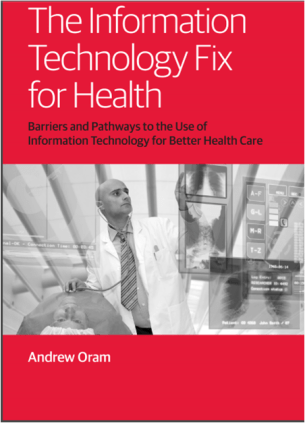
O’Reilly Studies Health IT: The Information Technology Fix – EMR & HIPAA

Posted by timmreardon on 07/15/2016
Posted in: Uncategorized. Leave a comment

Orielly

O’Reilly Media specializes in books, courses and online services in technical innovation. This week, it released a new, comprehensive study on IT in Healthcare: The Information Technology Fix for Health (PDF). It’s written by O’Reilly editor Andrew Oram, who frequently writes on healthcare IT’s trends and issues. Oram takes on four basic, health IT areas in this cogent review:

  • Devices, sensors, and patient monitoring
  • Using data: records, public data sets, and research
  • Coordinated care: teams and telehealth
  • Patient empowerment

In doing so, he brings a sound knowledge of health IT current technology and issues. He also brings a rare awareness that health IT often forgets its promise to combine modern tools with an intimate doctor patient relationship:

In earlier ages of medicine, we enjoyed a personal relationship with a doctor who knew everything about us and our families—but who couldn’t actually do much for us for lack of effective treatments. Beginning with the breakthroughs in manufacturing antibiotics and the mass vaccination programs of the mid-twentieth century, medicine has become increasingly effective but increasingly impersonal. Now we have medicines and machinery that would awe earlier generations, but we rarely develop the relationships that can help us overcome chronic conditions.

Health IT can restore the balance, allowing us to make better use of treatments while creating beneficial relationships. Ideally, health IT would bring the collective intelligence of the entire medical industry into the patient/clinician relationship and inform their decisions—but would do so in such a natural way that both patient and clinician would feel like it wasn’t there. P. 4-5.

Article link: http://www.emrandhipaa.com/carl/2014/04/07/oreilly-studies-health-it-the-information-technology-fix/?utm_source=ReviveOldPost&utm_medium=social&utm_campaign=ReviveOldPost

Patient can’t always access complete medical records, doctors say – Reuters

Posted by timmreardon on 07/03/2016
Posted in: Uncategorized. Leave a comment

by Lisa Rapaport

23 May 2016

(Reuters Health) – Technology makes it possible for patients to access medical records online, but a thicket of legal issues may still keep people from always seeing everything in their chart, some doctors say.

The Health Insurance Portability and Accountability Act (HIPAA) gives U.S. patients the right to access their medical records and control who else has access to the information, physicians note in an essay in the Annals of Internal Medicine.

But in reality, the contents of electronic records may be limited by doctors’ concerns about disputes with patients about what the records say, fear of malpractice litigation, and questions about how much information to give certain individuals like minors and people with mental illness, these physicians argue.

“I think the default should be for patients to have complete access to their electronic medical records, and the benefits would likely greatly outweigh any harm,” said lead author Dr. Bryan Lee of Altos Eye Physicians in Los Altos, California, and the University of Washington in Seattle.

As patients increasingly read their medical records, they will disagree with content, find errors and request changes, Lee and colleagues point out. While doctors may have the final say over what they add to records, patients may want to add information of their own, and the legal status of patient-created content is unclear.

In another point of legal murkiness, parents generally have control over minors’ medical records and can prevent children from accessing online notes. Providers can deny parents access if they suspect abuse or think parental involvement isn’t in a child’s best interest – but this, too, is an area where laws vary and liability concerns may color doctors’ decisions, the authors argue.

With mental illness, HIPAA prevents patients from accessing psychotherapy notes in some circumstances, but some state laws allow broader access to these records, the authors note.

While patients can benefit from access to records in most cases, there are some exceptions, and psychotherapy notes may be one of them, said Ann Kutney-Lee, a health policy researcher at the University of Pennsylvania School of Nursing in Philadelphia, in email to Reuters Health.

“There are certain clinical situations where providing access may cause more harm to the patient than good – e.g. psychotherapy notes for a patient that is suicidal,” said Kutney-Lee, who wasn’t involved in the essay.

For many patients, though, reviewing records may make them more proactive about their health, said Daniel Walker, a family medicine researcher at Ohio State University in Columbus who wasn’t involved in the study.

“It can make them feel more a part of the healthcare experience, and empower them to engage in shared decision making,” Walker said by email.

Preventing errors is another big advantage of electronic records, said Dr. Dean Sittig, a researcher at the University of Texas Health Science Center in Houston who wasn’t involved in the essay.

“Without an electronic health record, it is very difficult if not impossible to check whether the right medications were given at the right time, to the right patients,” Sittig said by email.

SOURCE: bit.ly/1i46lF7 Annals of Internal Medicine, online May 23, 2016.

Article link: http://www.reuters.com/article/us-health-hipaa-charts-idUSKCN0YE2PY

“Examining the Progress and Challenges in Modernizing Information Technology at the Department of Veterans Affairs” – Senate Hearing

Posted by timmreardon on 06/25/2016
Posted in: Uncategorized. Leave a comment

http://www.veterans.senate.gov/hearings/it-hearing-06222016

VAhearing

VA officials discuss commercial EHR replacement, IT costs with lawmakers – FierceHealthcare

Posted by timmreardon on 06/25/2016
Posted in: Uncategorized. Leave a comment

vaseal

Officials with the Department of Veterans Affairs, testifying in front of a Senate committee Wednesday, indicated that the agency likely will turn to the private sector to replace its aging homegrown electronic health record system.

At the hearing of the Senate’s Committee on Veterans’ Affairs, VA CIO LaVerne Council said she cringes when she thinks about how old the current system is because, at the end of the day, it constitutes working with something to which few people can relate.

“I have a lot of respect for the VistA product, but [it] is a 40-year-old product,” said Council, who called 40 to 50 years “ancient” in the world of IT.

VA Under Secretary for Health David Shulkin added that looking at a commercial product is likely the way to go, but it must be done in a way that incorporates the agency’s “ability to integrate with community providers and all of the unique needs of veterans.”

Both Council and Shulkin tried to assuage concerns raised by lawmakers that its projects would be a financial black hole, with the latter telling Connecticut Sen. Richard Blumenthal that he shared his impatience. But Blumenthal said technology issues, such as interoperability between the EHR systems of the VA and the Department of Defense, have been hurdles for as long as he’s served in the senate, six years. In February 2013, both agencies nixed a plan to create a joint EHR.

“Every time we’ve raised the issue [of interoperability], we’ve been assured that it’s been solved,” Blumenthal said. “Then we come back and ask the same question. The decades of unsuccessful attempts to establish an electronic health record system compatible across the VA and the Department of Defense have caused hundreds of millions of taxpayer dollars to be wasted in efforts that have been abandoned.”

Sen. Jon Tester (D-Mont.) called for more accountability, saying that it blows his mind how much money is going out the door only for issues to continue.

Council said the VA continues to work very closely with both the DoD and the Office of the National Coordinator for Health IT to ensure all EHR efforts are in sync with one another.

However, Sen. Patty Murray (D-Wash.), echoing the sentiments of her skeptical colleagues, said she’s tired of hearing about how well the VA and the DoD are working together.

“I wish you the best, but we really do need results,” she told Council.

To learn more:
– watch the full hearing

Article link: http://www.fiercehealthcare.com/ehr/va-officials-discuss-commercial-ehr-replacement-it-costs-lawmakers?utm_medium=nl&utm_source=internal&mrkid=946651?utm_medium=nl&utm_source=internal&mrkid=946651&mkt_tok=eyJpIjoiTXpNMFpqWTBZVGc1TlRSbSIsInQiOiIzOVRBck1VK0VjM0lxMW40eTZ3UFJwaytyeWd1XC9pTXFGTWNORlZrWmE1Q0xGZExBMFdVMHpYdzlKcHlYNDR5Uk5wOCtPM0Z6clF4WFAxNmtLb0NqVzF1RXl1TTZDSDV3ekZONGZUVXRieE09In0%3D

Ensuring Medical Readiness in the Future – HASC

Posted by timmreardon on 06/21/2016
Posted in: Uncategorized. Leave a comment

Lawmakers Want Review of VA’s VistA Modernization Efforts – Nextgov

Posted by timmreardon on 06/21/2016
Posted in: Uncategorized. Leave a comment

councilThe top tech official at the Veteran Affairs Department raised eyebrows earlier this year when she said the agency needed to “take a step back” from a planned upgrade of its long-running electronic health records system, known as VistA.

At the time, VA was putting together a business case for various options for the future of “VistA Evolution” and CIO LaVerne Council told lawmakers “we have not made up our minds” about what direction to take with the upgrade.

Now, the two top members of a House Oversight and Government Reform subcommittee that handles federal IT management issues want a government watchdog to step in and review VA’s plans.

“Given the significance of VA’s electronic health record information system to the performance of its health care mission, and in light of VA’s repeated attempts to modernize VistA, the subcommittee is requesting information on the efforts to modernize VistA,” wrote Reps. Will Hurd, R-Texas, chairman of the IT Operations subcommittee, and Robin Kelly, D-Ill., the ranking member, in a May 27 letter to the head of the Government Accountability Office.

The lawmakers want GAO to conduct a study of the VistA modernization effort, including a history of past attempts to modernize the home-grown EHR system, which dates back to the 1980s and consists of more than 100 different computer applications. The letter requests a cost breakdown of those previous efforts, “the key contractors that have been involved” and VA’s current plans and estimated costs for modernizing the system.

VA doctors and nurses still rate the home-grown IT system highly, though critics contend it is inefficient and outdated. An independent report last fall by the MITRE Corps said VA’s in-house system was “in danger of becoming obsolete.”

<a href=”http://pubads.g.doubleclick.net/gampad/jump?sz=300×300&c=826421024&iu=%2F617%2Fnextgov.com%2Fsection_health%2Fcontent%2Fpid_128765&t=noscript%3Dtrue%26referring_domain%3DTyped%252FBookmarked%26pos%3Dinjector%26level%3D0″> <img src=”http://pubads.g.doubleclick.net/gampad/ad?sz=300×300&c=826421024&iu=%2F617%2Fnextgov.com%2Fsection_health%2Fcontent%2Fpid_128765&t=noscript%3Dtrue%26referring_domain%3DTyped%252FBookmarked%26pos%3Dinjector%26level%3D0″/> </a>

There have been numerous attempts over the years to upgrade the system, including an ill-fated effort between VA and DOD begun in 2011 to develop a fully integrated EHR system to be shared by both.

In February 2013, faced with ballooning cost estimates, officials backed away from plans for a fully integrated joint system. Instead, the departments decided to continue upgrading their respective systems to make them more interoperable.

Later that year, VA unveiled a new plan to upgrade its legacy system — a modernization effort known as VistA Evolution. But the agency requested less funding for development of the system in its most recent budget request, calling into question the system’s long-term future.

“Everyone says it’s like tapping the brakes,” Council said in a Q&A with FCW last month. “That’s not how we see it.”

The last phase of the VistA Evolution effort runs through 2018, Council said — and that’s still the plan. But she said VA needs to come up with “the next digital health platform,” for the long-term future.

Pentagon IG: Timeline for New Electronic Health Records System ‘May be Unrealistic’ – Nextgov

Posted by timmreardon on 06/21/2016
Posted in: Uncategorized. Leave a comment

Genesis

The Defense Department’s inspector general isn’t sure the Pentagon’s $9 billion electronic health records system will reach initial operating capability on schedule later this year.

In an audit released Tuesday, the IG reported the Defense Healthcare Management System Modernization program, which will replace DOD’s legacy military health systems, met requirements and had an approved acquisition strategy.

However, the department’s “mandated execution schedule may not be realistic” for meeting an initial operational capability by December 2016, the report concluded.

The full audit has not been released publicly. The IG released a summary of the report on its website. Nextgov has filed a Freedom of Information Act request to obtain the full report.

Last summer, DOD awarded a multibillion contract to Leidos and electronic health records developer, Cerner, to upgrade the department’s electronic health records system using commercial software.

Frank Kendall, undersecretary of defense for acquisition, technology and logistics, told reporters at the time DOD planned to deploy and field test software across eight locations in the Pacific Northwest by the close of 2016.

<a href=”http://pubads.g.doubleclick.net/gampad/jump?sz=300×300&c=878369434&iu=%2F617%2Fnextgov.com%2Fsection_defense%2Fcontent%2Fpid_128738&t=noscript%3Dtrue%26referring_domain%3DTyped%252FBookmarked%26pos%3Dinjector%26level%3D0″> <img src=”http://pubads.g.doubleclick.net/gampad/ad?sz=300×300&c=878369434&iu=%2F617%2Fnextgov.com%2Fsection_defense%2Fcontent%2Fpid_128738&t=noscript%3Dtrue%26referring_domain%3DTyped%252FBookmarked%26pos%3Dinjector%26level%3D0″/> </a>

Further adding to the deadline pressure, the 2014 National Defense Authorization Act demands DOD and the Veterans Affairs Department work to achieve “seamless electronic sharing of medical health data” between both agencies by Dec. 31.

The IG said contracting officials have identified risks and impacts to cost, schedule and performance. But that may not matter because interfacing with legacy systems is challenging, the IG said.

“While the DHMSM program office has identified risks and mitigation strategies, it is still at risk for obtaining an EHR system by the December 2016 initial operational capability date because of the risks and potential delays involved in developing and testing the interfaces needed to interact with legacy systems, ensuring the system is secure against cyberattacks, and ensuring the fielded system works correctly and that users are properly trained,” the audit concluded.

The Pentagon IG recommends the program office perform a schedule analysis to determine whether a December 2016 initial rollout is still achievable and to report to Congress quarterly on the program.

The office neither agreed nor disagreed with the IG’s findings, but stated it was confident it “will achieve initial operational capability later this year in accordance with the National Defense Authorization Act.”

DOD’s initial timeline for the project has the agency operating the new health records system across all systems by 2022.

Article link: http://www.nextgov.com/defense/2016/06/pentagon-ig-timeline-new-electronic-health-records-system-may-be-unrealistic/128738/?oref=nextgov_healthit_nl

Pentagon: ‘Innovation is a National Security Imperative’ – Nextgov

Posted by timmreardon on 06/21/2016
Posted in: Uncategorized. Leave a comment

Innovation

Glynnis Jones/Shutterstock.com

It only takes one word to explain why the Defense Department is so keen on Silicon Valley: innovation.

“Innovation is truly a national security imperative,” Claire Grady, DOD’s director of defense procurement and acquisition policy, said this week at the ACT-IAC Acquisition Excellence event in Washington.

DOD will account for some $274 billion in spending this year, Grady said, with $154 billion toward services – some of which she said were duplicative and likely could have had better outcomes.

Despite the largest budget of any government agency, DOD still struggles to modernize its aging technology infrastructure while simultaneously prepping for a new era of connectivity often called the Internet of Things.

Prior to Defense Secretary Ash Carter’s first visit to Silicon Valley in 2015, a Pentagon chief hadn’t stopped by the valley for 20 years. If the quest for innovation could hold the keys to DOD’s most important technological riddles, its top officials have now made three visits to the West Coast tech hub and set up shop.

“We at DOD tend to keep things longer than anybody would,” Grady said. “How do we keep them current to meet emerging threats? We really need to take advantage of emerging technologies.”

Article link: http://m.nextgov.com/emerging-tech/emerging-tech-blog/2016/03/pentagon-innovation-national-security-imperative/126972/

How EHRs, Interoperability, And Workflow Are Helping (And Hurting) Healthcare – Health IT Outcomes

Posted by timmreardon on 06/21/2016
Posted in: Uncategorized. Leave a comment

TeleTracking President Michael Gallup is leading his company’s transformation from a patient flow automation company to a real-time, automated operations management provider for healthcare organizations. Driving this transformation is his aptitude for identifying the needs of healthcare organizations across the continuum of care and his ability to unify TeleTracking’s various business components to provide broad operational efficiencies, cost savings, and revenue generation as a counterbalance to healthcare reform cutbacks.

HIT 1

Gallup took time recently to talk with Health IT Outcomes about EHRs, interoperability, and workflows and how these three hot-button topics are improving outcomes and, at the same time, hindering healthcare.

Q: Many providers bought an EHR so they could attest for Meaningful Use and didn’t spend time making sure it was the right solution for their needs and, as a result, are suffering from an EHR hangover. What can be done to remedy this unfortunate outcome?

Gallup: The pressure was intense to quickly find an EHR vendor because of the money involved. The irony is the rush only really secured seed money and the bulk of the cost to implement an EHR was/is on the shoulders of the provider, including the burden of managing the interoperability of their technologies. This last component, unfortunately to date, has been marred by varying degrees of information blocking whether that has been performed explicitly, or more subtly through cost prohibitive interface builds.

In situations like that, it is understandable health systems would want to extract as much functionality as they possible can out of their EHR. While combining the functionality of disparate systems often seems logical, to avoid the challenges of interoperability, it doesn’t come without tradeoffs — including domain expertise and role-based functionality that is exclusive to each vendor.

Also worth at least considering are the implications on innovation and competition. Take for example the ongoing events in Connecticut where concerns grow amidst the belief that one EHR vendor is now the de facto health information exchange (HIE) for the entire state. The ONC warns about this very thing in a report to the Senate concerning information blocking by vendors to control referrals and boost market share for providers; sometimes at triple the cost of a given procedure.

The onus is on us as vendors to make the exchange and interfacing of data as seamless as possible. For that reason, TeleTracking has an open integration philosophy where we welcome collaboration with other vendors. We have standard interfaces with over 80 HIT applications and offer standard services for interfacing across a large set of technologies.

Q: In addition to EHRs and interoperability, workflow was a topic heard over and over at HIMSS. Why do you think workflow is taking on such importance? Has it always been this way, or is this a new emphasis?

Gallup: Two things are converging. One, the industry realizes process efficiency is vital to survival as it is to any high performing organization. Two, enabling and automating workflow can have a transformative impact on productivity and the broader patient experience.

Automation used to be taboo in healthcare because it conjured up visions of assembly lines. Obviously if every patient were the same in biology, diagnosis, and treatment healthcare could in fact run in that way. However, each patient remains unique in their situation and needs. The key here is how technologies have emerged to help us manage the variabilities specific to each patient’s need.

Looking specifically at patient flow, the core operational process around the patient journey has an incalculable impact on both time and productivity despite these variabilities. The data at our fingertips today enables healthcare leaders to act as change agents in managing process and flow.

TeleTracking has evolved over the years because we’ve been able to apply what we’ve learned in to a much broader set of needs — delivering enterprise visibility, sophisticated data sets, process redesign — needed for efficiency improvement across the care continuum. The potential impact includes greater patient access, more timely care, fewer ED delays, shortened length of stay, and overall a more satisfying patient and caregiver experience.

Q: What are some measurable outcomes that can be achieved by improving workflow?

Gallup: Access to timely quality care is what drives us. There are tens, if not hundreds, of thousands of hospital beds that sit empty on any given day in America. Meanwhile, the average wait time for an admitted ED patient remains more than four hours, and some estimate close to half a million patients will wait more than 24 hours this year. Patients are boarded, EDs go on diversion, and visibility of patient flow across the care continuum remains largely fragmented.

A recent example can be seen in a study conducted by the RAND Corporation, who profiled Health First, a health system based in Florida. In that study they found a 27 percent increase in total patient admissions in conjunction with a 19 percent decrease in average length of stay. One hospital in Ohio saw their left without being seen rate go from 7.39 percent to 1.82 percent while ambulance diversion hours went from 154 to 9.4, all in a two-month period. That same health system reduced hallway boarding by 4,000 hours. An Oklahoma health system was able to increase their community outreach and accept 36 percent more patient transfers from external referral sources. Knowing the impact of operational efficiencies, we continue to work with clients across North America and the United Kingdom to drive similar results in improving patient throughput, reducing wait times, and increasing overall patient access.

Q: Who within a healthcare system is best tasked with improving workflow and why?

Gallup: It comes from both front line caregivers as well as senior leadership. You need adoption of best practices from those closest to patient care; the ones who will ultimately work within the workflows and processes put in place. But you also can’t ignore the significance of a strong executive champion to rally the organization behind the vision and purpose for something as broad reaching as patient flow. None of those can happen without bringing to bear actionable data and real-time visibility to enable positive change in the organization.

Typical roles we often see (though certainly not an exhaustive list) include Chief Operating Officers, Nurse Executives, VPs of Patient Access, Directors and Managers of Patient Flow, Patient Logistics, Patient Access, and Emergency Services.

Q: There are different definitions of interoperability — how do you define it and how is it more than dumping data into an HIE?

Gallup: The focus has been on moving patient records from one place to another, and so most of the discussions seem to center around HIEs, referring physicians and the like. But there are a number of touchpoints where operational and clinical information cross paths. Because hospital departments in and of themselves can be siloed, this remains one of the biggest roadblocks to operational improvement — the stunted flow of information across the patient journey. When you create a stream of data that can only be dipped into by a very few professionals within a closed system, you are essentially enabling that siloed behavior. That runs counter to our philosophy that information sharing is the basis for improved performance and efficiency.

It’s clear to us and many hospital administrators that hospitals function much more efficiently when clinical and operational systems can talk to each other. Based on the current outcomes of our 900 clients, we think operational automation, synchronized with clinical data, could free up nearly $150 billion for U.S. health systems in productivity and increased patient care. That’s why we remain strong advocates for interoperability.

We encourage leaders in our industry to look beyond just HIEs as a source of data exchange. We’re really talking about cross-functional interoperability, essentially making the clinical and operational side part of the same “whole.”

Q: The road to interoperability has been, at times, slow going. Who will ultimately drive true interoperability and what will it take to get there?

Gallup: As the ones who provide products and services to the industry, vendors will continue to truly drive interoperability. That said, providers and those who deliver patient care also play a role in championing these efforts.

But so far, the interoperability debate has focused on the EHR. Looking ahead, for the sake of providers and the safety of their patients, we call on all healthcare IT vendors to seek true integrations, going beyond simple interfaces that can carry a cost for providers to maintain. The burden, as in other industries, should be placed upon the vendors to work together for the betterment of healthcare, ultimately creating a safer environment for the patient. The goal is about not only providing the appropriate diagnosis and treatment, but also in getting patients access to that care in the timeliest manner possible. As clinical and operational platforms come together, we envision interoperability becoming more than just sharing patient data. We see platforms bound together to deliver the right information, at the right time, in the right place and with the right resources, for the sake of the patient.

It’s our hope that this cooperation becomes commonplace throughout the industry, helping make the U.S. healthcare system fully deliver to both patients and providers.

Q: What barriers stand in the way of improved patient access and what can be done to overcome them?

Gallup: Fragmented patient journey across the care continuum; lack of communication and information sharing between departments and units; poor patient flow into the system due to inefficient referral, transfer, admit, and placement processes; bed scarcity due to poor patient flow through the system; operating room backups; timely patient discharges (in order to get new patients admitted), and lack of real-time visibility into intake processes

The biggest obstacle to landing at O’Hare airport is the other planes ahead of you, which are circling because there are still planes at the gate. Without real-time information, patients stack up at the hospital “gates.” Eventually, that means some patients can’t get in the front door.

Seeing the hospital from 30,000 feet means you can see the problem areas where operations get bogged down. And if you can see them, you can start to fix them. Our operational platform gives hospital personnel that aerial view and the means to do something about those problems. We put the entire hospital online so every function can be seen, noted and modified if need be. That means care can be delivered better and faster, which ultimately means better access to all.

Article link: http://www.healthitoutcomes.com/doc/how-ehrs-interoperability-and-workflow-are-helping-and-hurting-healthcare-0001?vm_tId=1924815&user=0009EE33-ABCE-4D02-9B3C-4F32FFAA82BE&utm_source=et_6231164&utm_medium=email&utm_campaign=HCIT_06-16-2016&utm_term=0009EE33-ABCE-4D02-9B3C-4F32FFAA82BE&utm_content=How+EHRs%2c+Interoperability%2c+And+Workflow+Are+Helping+(And+Hurting)+Healthcare

Prioritize Speed At The Department Of Defense – Forbes

Posted by timmreardon on 04/23/2016
Posted in: Uncategorized. Leave a comment

Guest post written by

General Norton A. Schwartz, USAF (ret.) and Maurice R. Greenberg

Mr. Schwartz is president & CEO of Business Executives for National Security. Mr. Greenberg is chairman & CEO of C.V. Starr.

DOD Speed

The Department of Defense has failed to efficiently manage time, to the potential detriment of our military readiness. (Photographer: Rich Clement/Bloomberg)

Remember that time is money. In his oft repeated aphorism Benjamin Franklin reminds his reader that the proper management of time is directly related to success. Two centuries later, consulting guru George Stalk further refined Franklin’s axiom, observing “…as a strategic weapon, time is the equivalent of money, productivity, quality, even innovation.”

The Department of Defense would be wise to embrace the strategic potential of speed. Proper time management can enable rapid adaptation and innovation, thereby allowing the U.S. to maintain its strategic edge over its peers. Unfortunately, the Department has failed to efficiently manage time, to the potential detriment of our military readiness.

Readiness is generally defined as the ability to project and employ the right forces, with the right capability, at the right time. However, even as the private sector continues to innovate at a breakneck pace, the Department’s current testing, development and acquisition bureaucracy is proving too slow to deliver advanced capability appropriate for warfare in the 21st century. What is true of operational planning – the imperative to out-cycle one’s enemy – is just as true in areas of management and organization.

Successful segments of the private sector understand that time is a resource to be capitalized. The goal of delivering “in-time” capability to the market is to gain an advantage over competitors. The Department understands this concept in principle as evidenced by the Defense Innovation Initiative and Third Offset Strategy. However, the mechanisms are not in place to achieve desired outcomes.

Three critical requirements are necessary 

Companies that have thrived in the modern age have done so because they understand the need for strong leadership to implement three critical requirements necessary to achieve the speed and effectiveness required to compete successfully: efficient processes; properly aligned incentives; and a culture that accepts failure.

The first requirement is a process that allows for rapid acquisition and fielding. Private industry maintains agility in large part by creating governance structures that are event-based and designed with a bias for action. The Defense Acquisition Management System is event-based, but those events are punctuated by a byzantine series of milestone reviews and decision points. Efficient processes also require enabling authorities and policies. Oversight is important, but so is a process that is engineered for speed and iterative decision-making. Complexity is to be avoided while consistency is to be maximized. In government today, Continuing Resolutions and the application of year-to-year accounts such as Overseas Contingency Operations do nothing to encourage timely adaption.

Properly aligned incentives

The second requirement is properly aligned incentives. Whether a defense acquisition professional, staff member or political leader, the incentives are to say no. In the private sector, incentives are applied at both the individual and programmatic level; helping to build an overall culture in which calculated risk is tolerated and even encouraged. Incentives are promoted through a reward system that allows for an enterprising and exceptional individual to be promoted. This is a culture with a streak of venture capitalism.

In early 2013, Netflix responded to an increasingly crowded streaming marketplace by shifting its business model from content curator to content creator. In undertaking such a fundamental shift, Netflix assumed the additional risk associated with a large entertainment studio. As fellow high-tech entrepreneur Mark Zuckerberg has stated, “in a world that is changing really quickly, the only strategy that is guaranteed to fail is not taking risks.”

Article link: http://www.forbes.com/sites/realspin/2016/04/13/prioritize-speed-at-the-department-of-defense/#6d51cb0b729f


Posts navigation

← Older Entries
Newer Entries →
  • Search site

  • Follow healthcarereimagined on WordPress.com
  • Recent Posts

    • The Global Healthcare System Is Broken. Japan Fixed It for $4,100 Per Person. 04/10/2026
    • When Not to Use AI – MIT Sloan 04/01/2026
    • There are more AI health tools than ever—but how well do they work? – MIT Technology Review 03/30/2026
    • Are AI Tools Ready to Answer Patients’ Questions About Their Medical Care? – JAMA 03/27/2026
    • How AI use in scholarly publishing threatens research integrity, lessens trust, and invites misinformation – Bulletin of the Atomic Scientists 03/25/2026
    • VA Prepares April Relaunch of EHR Program – GovCIO 03/19/2026
    • Strong call for universal healthcare from Pope Leo today – FAN 03/18/2026
    • EHR fragmentation offers an opportunity to enhance care coordination and experience 03/16/2026
    • When AI Governance Fails 03/15/2026
    • Introduction: Disinformation as a multiplier of existential threat – Bulletin of the Atomic Scientists 03/12/2026
  • Categories

    • Accountable Care Organizations
    • ACOs
    • AHRQ
    • American Board of Internal Medicine
    • Big Data
    • Blue Button
    • Board Certification
    • Cancer Treatment
    • Data Science
    • Digital Services Playbook
    • DoD
    • EHR Interoperability
    • EHR Usability
    • Emergency Medicine
    • FDA
    • FDASIA
    • GAO Reports
    • Genetic Data
    • Genetic Research
    • Genomic Data
    • Global Standards
    • Health Care Costs
    • Health Care Economics
    • Health IT adoption
    • Health Outcomes
    • Healthcare Delivery
    • Healthcare Informatics
    • Healthcare Outcomes
    • Healthcare Security
    • Helathcare Delivery
    • HHS
    • HIPAA
    • ICD-10
    • Innovation
    • Integrated Electronic Health Records
    • IT Acquisition
    • JASONS
    • Lab Report Access
    • Military Health System Reform
    • Mobile Health
    • Mobile Healthcare
    • National Health IT System
    • NSF
    • ONC Reports to Congress
    • Oncology
    • Open Data
    • Patient Centered Medical Home
    • Patient Portals
    • PCMH
    • Precision Medicine
    • Primary Care
    • Public Health
    • Quadruple Aim
    • Quality Measures
    • Rehab Medicine
    • TechFAR Handbook
    • Triple Aim
    • U.S. Air Force Medicine
    • U.S. Army
    • U.S. Army Medicine
    • U.S. Navy Medicine
    • U.S. Surgeon General
    • Uncategorized
    • Value-based Care
    • Veterans Affairs
    • Warrior Transistion Units
    • XPRIZE
  • Archives

    • April 2026 (2)
    • March 2026 (9)
    • February 2026 (6)
    • January 2026 (8)
    • December 2025 (11)
    • November 2025 (9)
    • October 2025 (10)
    • September 2025 (4)
    • August 2025 (7)
    • July 2025 (2)
    • June 2025 (9)
    • May 2025 (4)
    • April 2025 (11)
    • March 2025 (11)
    • February 2025 (10)
    • January 2025 (12)
    • December 2024 (12)
    • November 2024 (7)
    • October 2024 (5)
    • September 2024 (9)
    • August 2024 (10)
    • July 2024 (13)
    • June 2024 (18)
    • May 2024 (10)
    • April 2024 (19)
    • March 2024 (35)
    • February 2024 (23)
    • January 2024 (16)
    • December 2023 (22)
    • November 2023 (38)
    • October 2023 (24)
    • September 2023 (24)
    • August 2023 (34)
    • July 2023 (33)
    • June 2023 (30)
    • May 2023 (35)
    • April 2023 (30)
    • March 2023 (30)
    • February 2023 (15)
    • January 2023 (17)
    • December 2022 (10)
    • November 2022 (7)
    • October 2022 (22)
    • September 2022 (16)
    • August 2022 (33)
    • July 2022 (28)
    • June 2022 (42)
    • May 2022 (53)
    • April 2022 (35)
    • March 2022 (37)
    • February 2022 (21)
    • January 2022 (28)
    • December 2021 (23)
    • November 2021 (12)
    • October 2021 (10)
    • September 2021 (4)
    • August 2021 (4)
    • July 2021 (4)
    • May 2021 (3)
    • April 2021 (1)
    • March 2021 (2)
    • February 2021 (1)
    • January 2021 (4)
    • December 2020 (7)
    • November 2020 (2)
    • October 2020 (4)
    • September 2020 (7)
    • August 2020 (11)
    • July 2020 (3)
    • June 2020 (5)
    • April 2020 (3)
    • March 2020 (1)
    • February 2020 (1)
    • January 2020 (2)
    • December 2019 (2)
    • November 2019 (1)
    • September 2019 (4)
    • August 2019 (3)
    • July 2019 (5)
    • June 2019 (10)
    • May 2019 (8)
    • April 2019 (6)
    • March 2019 (7)
    • February 2019 (17)
    • January 2019 (14)
    • December 2018 (10)
    • November 2018 (20)
    • October 2018 (14)
    • September 2018 (27)
    • August 2018 (19)
    • July 2018 (16)
    • June 2018 (18)
    • May 2018 (28)
    • April 2018 (3)
    • March 2018 (11)
    • February 2018 (5)
    • January 2018 (10)
    • December 2017 (20)
    • November 2017 (30)
    • October 2017 (33)
    • September 2017 (11)
    • August 2017 (13)
    • July 2017 (9)
    • June 2017 (8)
    • May 2017 (9)
    • April 2017 (4)
    • March 2017 (12)
    • December 2016 (3)
    • September 2016 (4)
    • August 2016 (1)
    • July 2016 (7)
    • June 2016 (7)
    • April 2016 (4)
    • March 2016 (7)
    • February 2016 (1)
    • January 2016 (3)
    • November 2015 (3)
    • October 2015 (2)
    • September 2015 (9)
    • August 2015 (6)
    • June 2015 (5)
    • May 2015 (6)
    • April 2015 (3)
    • March 2015 (16)
    • February 2015 (10)
    • January 2015 (16)
    • December 2014 (9)
    • November 2014 (7)
    • October 2014 (21)
    • September 2014 (8)
    • August 2014 (9)
    • July 2014 (7)
    • June 2014 (5)
    • May 2014 (8)
    • April 2014 (19)
    • March 2014 (8)
    • February 2014 (9)
    • January 2014 (31)
    • December 2013 (23)
    • November 2013 (48)
    • October 2013 (25)
  • Tags

    Business Defense Department Department of Veterans Affairs EHealth EHR Electronic health record Food and Drug Administration Health Health informatics Health Information Exchange Health information technology Health system HIE Hospital IBM Mayo Clinic Medicare Medicine Military Health System Patient Patient portal Patient Protection and Affordable Care Act United States United States Department of Defense United States Department of Veterans Affairs
  • Upcoming Events

Blog at WordPress.com.
healthcarereimagined
Blog at WordPress.com.
  • Subscribe Subscribed
    • healthcarereimagined
    • Join 153 other subscribers
    • Already have a WordPress.com account? Log in now.
    • healthcarereimagined
    • Subscribe Subscribed
    • Sign up
    • Log in
    • Report this content
    • View site in Reader
    • Manage subscriptions
    • Collapse this bar
 

Loading Comments...