healthcarereimagined

Envisioning healthcare for the 21st century

  • About
  • Economics

JAMA Forum: Public Reporting of Surgical Outcomes: Surgeons, Hospitals, or Both?

Posted by timmreardon on 10/02/2017
Posted in: Uncategorized. Leave a comment

JAMABy Ashish K. Jha, MD, MPH on August 24, 2017

Nearly 3 decades ago, David Axelrod, MD, then commissioner of the New York State Department of Health (DOH), became concerned by the nearly 5-fold variation in cardiac surgery mortality rates across New York hospitals. Out of this concern, the DOH released the first public reports of surgical outcomes to the New York Times, labeling the performance of hospitals on cardiac surgical mortality rates across the state. After learning that individual surgeon mortality rates were also available, the Long Island–based Newsday sought release of the mortality rates of individual surgeons. The state demurred, arguing that data were less reliable at the surgeon level. Newsday quickly filed a Freedom of Information Act lawsuit to obtain the information and eventually prevailed in court, partly on the argument that patients generally choose surgeons, not hospitals.

This debate—whether it is best to report data on the hospital level only or whether to also report on individual surgeons—continues to this day. The evidence on whether the public or payers use these data to select high performers suggests that for the most part, they do not. But we do know that hospitals and physicians are paying attention. And there is widespread hope that with increasing consumerism in health care and with more patients paying out of pocket for their care, they will increasingly look for these kinds of reports.

That’s part of the reason public reporting is now so pervasive. While public reporting continues to become more common, how to report—whether to include only institutions or to also report on individual physicians—remains controversial. This debate was recently renewed when ProPublica, a highly regarded independent and nonprofit investigative journalist group, used national Medicare data to publish complication rates for hospitals and individual surgeons. It was their decision to name individual surgeons that was most controversial.

Criticism of Surgeon-Level Reporting

Critics of individual surgeon reporting have made a series of important arguments against the practice, each of which is worthy of consideration. And as more states and the federal government continue their efforts towards public reporting, these arguments against naming individual surgeons are gaining traction. But I believe that a careful examination of the literature indicates that moving away from surgeon-level reporting would be a critical mistake.

One common argument is that volumes of surgery for individual surgeons may be too low to be reliable. Small sample sizes can be a problem, but there are ways to address this issue. First, as New York State has done with cardiac surgery, one can aggregate performance across multiple years, thus substantially increasing sample size. Second, given that total volume of similar surgeries is also related to performance on a given surgery, (for example, a surgeon’s performance on esophagectomy improves with the number of other similar surgeries she performs) , one could use a surgeon’s performance across a range of procedures to increase sample size. Finally, publicly reported data could and should be presented with confidence intervals, to highlight the level of imprecision so that those reading the report are aware of the statistical limitations.

Critics of naming individual surgeons also argue that the practice would increase the likelihood that surgeons will avoid the hardest cases, thus reducing access to surgical care for the sickest patients. This is an important concern that has been voiced widely. However, the evidence on the extent to which this occurs is weak and anecdotal. Quite a few studies have tried to examine whether publicly reporting individual surgeon data leads to sicker patients not receiving care, and most have failed to find an effect. And to the extent that a few studies have found a reduction in access, these have been transient, with access returning to baseline within a couple of years of the reporting program.

Finally, and possibly most importantly, people who oppose reporting findings for individual surgeons have argued that much of medical care is now delivered in teams, and that each of the team members matters. They argue that naming an individual surgeon puts undue emphasis on that surgeon when the team’s performance is paramount. This argument is understandable; the importance of team work on surgical care is increasingly recognized. As the leader of the team, the surgeon plays a unique and outsized role, responsible for ensuring effective communication and well-delineated roles among team members, and for fostering a culture that supports team members speaking up when things have gone wrong. So when we publicly report a surgeon’s performance, we are essentially reporting on his or her surgical team’s performance.

Beyond Team Work

But even beyond team work, the empirical evidence of the importance of the individual surgeon’s role is overwhelming. Landmark studies have shown that within the same institution, there are large variations in outcomes across surgeons. Why might this be the case? It’s because outcomes of surgical care are influenced by a multitude of factors for which the judgment, skills, and capabilities of individual surgeons matter immensely.

Possibly the most consequential decision—whether to do the surgery at all—is undertaken primarily by the surgeon. Careful case selection—ensuring that the patient undergoing the procedure is likely to benefit—is critical to good surgical care, and reporting outcomes only at the institutional level would fail to capture the results of that judgment.

A second critical step in determining outcomes is the surgical technique itself. Recent studies have shown that there are large differences in basic surgical capabilities (from dissecting to cutting to suturing), and that highly skilled surgeons have dramatically better outcomes than less-skilled ones. The surgeon’s hands still matter. There are likely other factors that matter as well, but the empirical evidence is clear: picking the right surgeon is at least as important as picking the right hospital.

And that brings us to what is probably the most important reason to report data on individual surgeons: it’s information that patients want. When people seek advice on where to go for surgical care, they ask about the best surgeon for them. Telling the public that the surgeon doesn’t matter, that only the choice of  hospital matters, is neither useful nor accurate. And it won’t work, because for patients, undergoing surgery creates deep anxiety, and trusting the judgment of an individual surgeon is paramount. Consumers would reject reports that only showcase institution-level data because they would find it less useful.

High Stakes

Publicly reporting on outcomes of individual surgeons is a high-stakes endeavor. We know from studies that some surgeons stopped practicing or moved away as a result of the New York State cardiac surgery reporting. There are still lingering fears that surgeons will turn away risky patients, although most surgeons have enough professionalism that they are unlikely to deny someone life-saving care just because it might hurt their rankings. But these fears mean we need to work harder at risk adjustment, and possibly create safe harbors for cases that are the highest risk.

But the surgeon remains critically important to surgery, and suggesting that what matters is the institution, not the individual, is both empirically inaccurate and unlikely to resonate with patients. We must address the challenges that come with individual surgeon-level reporting—not shy away from doing it. We must expand our efforts to report performance publicly, including for individual surgeons, not curtail them. Because if the goal is to improve surgical care, we must ensure that the person most influential in the process remains accountable for its outcome.

Article link: https://newsatjama.jama.com/2017/08/24/jama-forum-public-reporting-of-surgical-outcomes-surgeons-hospitals-or-both/?linkId=42813778

***

About the author: Ashish K. Jha, MD, MPH, is K. T. Li Professor of International Health and Health Policy at the Harvard T. H. Chan School of Public Health and a practicing internist at the Veterans Affairs Boston Healthcare System. He received his doctor of medicine from Harvard Medical School and was trained in internal medicine at the University of California, San Francisco. He received his master’s in public health from Harvard School of Public Health. Dr Jha’s major research interests lie in improving the quality and costs of health care. His work has focused on 4 primary areas—public reporting, pay for performance, health information technology, and leadership—and the roles they play in fixing the US health care system. (Image: Aubrey LaMedica/Harvard T.H. Chan School of Public Health)

About The JAMA Forum: JAMA has assembled a team of leading scholars, including health economists, health policy experts, and legal scholars, to provide expert commentary and insight into news that involves the intersection of health policy and politics, economics, and the law. Each JAMA Forum entry expresses the opinions of the author but does not necessarily reflect the views or opinions of JAMA, the editorial staff, or the American Medical Association. More information is available here and here.
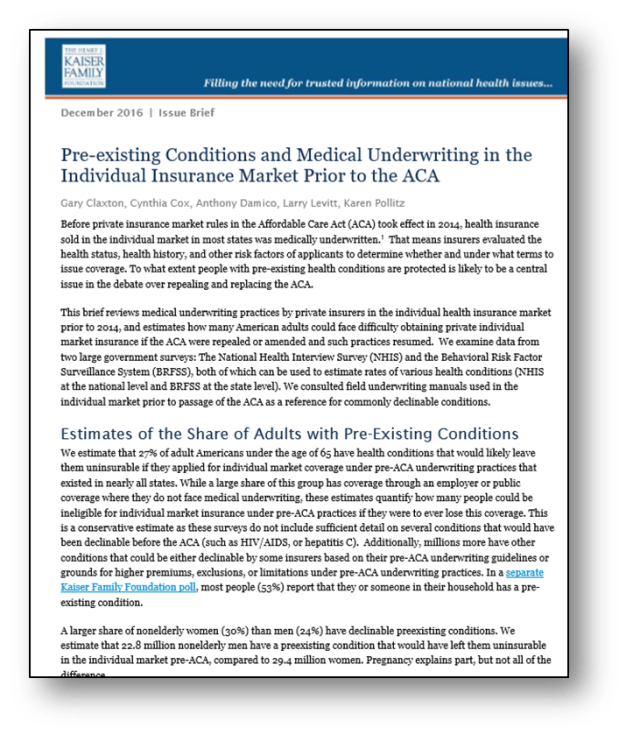
 

Pre-existing Conditions and Medical Underwriting in the Individual Insurance Market Prior to the ACA – Commonwealth Fund

Posted by timmreardon on 09/29/2017
Posted in: Uncategorized. Leave a comment

Commonweatlh1

Article link: http://www.kff.org/health-reform/issue-brief/pre-existing-conditions-and-medical-underwriting-in-the-individual-insurance-market-prior-to-the-aca/?utm_campaign=KFF-2016-December-Pre-Existing-Condition-Data-Note&utm_content=60741450&utm_medium=social&utm_source=twitter

Selling Health Insurance Across State Lines Is Unlikely to Lower Costs or Improve Choice – Commonwealth Fund

Posted by timmreardon on 09/29/2017
Posted in: Uncategorized. Leave a comment

Wednesday, April 5, 2017

Sabrina CorletteKevin Lucia

By Sabrina Corlette and Kevin Lucia

Toplines

  • Interstate sale of health insurance is unlikely to increase competition
  • Insurers can already sell insurance across state lines and so far it hasn’t lower costs or improved care

In the wake of the failure of the legislative effort to repeal and replace the Affordable Care Act (ACA), the fate of another of the president’s health care priorities is unclear. In his first congressional address, President Trump articulated five principles for health care reform. His fifth and last called for giving “Americans the freedom to purchase health insurance across state lines,” a reform that, in his words, would create “a truly competitive national marketplace that will bring cost way down and provide far better care.” This concept was not in the House reconciliation bill (the “American Health Care Act” or AHCA) to repeal and replace key provisions of the ACA, but President Trump may be able to use his regulatory authority to promote the cross-border sales of health insurance.

The president has the authority to act on his own thanks in part to the ACA. That law includes a provision encouraging “health care choice compacts,” whereby an insurer could establish itself in one state and sell health insurance to consumers in multiple other states without having to follow those states’ laws and regulations. However, under President Obama, the U.S. Department of Health and Human Services (HHS) never published regulations enabling these cross-state sales.

While the ACA provision encourages states to enter into cross-state regulatory agreements in order to facilitate interstate sales, under Trump’s campaign and several congressional proposals, the federal government would effectively override states’ authority to regulate their markets. In the absence of legislative action, there is nothing preventing HHS Secretary Tom Price from issuing the required regulations and working with states to develop standards for interstate sales. In fact, several states already allow cross-state sales.

The Theory Behind Policies to Allow the Sale of Insurance “Across State Lines”

Health insurance has traditionally been regulated by states, which, until the ACA established a set of essential health benefits and other minimum consumer protections, meant that there was significant state variation in the rules governing insurance companies and the health plans that they sell. Some states have had numerous requirements mandating coverage of certain benefits, such as autism treatment, diabetes screening, or mammograms, while others have taken a hands-off approach to benefit design. Similarly, before the ACA prohibited charging women or people with preexisting conditions more for their coverage, some states limited insurers’ flexibility in setting premiums based on characteristics of enrollees while others did not.

The concept of selling insurance across state lines, which dates back to the 1990s, was borne out of frustration with the variation in state regulation. Proponents contend that if an insurance company were allowed to operate by the rules of just one state but sell plans in multiple states, they could lower the price of their plans, giving consumers new and more affordable choices.

When Theory Collides with Reality

While the frustration with the costs of our current health care system is well-founded, proposals to allow cross-state sales will do nothing to encourage greater competition or address the underlying drivers of health care costs. Just like politics, health insurance is local. Today’s health plans essentially provide enrollees with access to a local network of doctors and hospitals at a discounted price. According to many insurance experts, the primary barrier for an insurer looking to enter a new market is not the state’s regulations, it’s the cost of building up a provider network at discounted prices.

To date, six states have enacted laws to allow cross-state sales: Georgia, Kentucky, Maine, Rhode Island, Washington, and Wyoming. Yet none of these states has had a single new insurer enter its market because of its law. When asked about their laws, state officials and insurance industry experts in those states agreed that establishing a competitive provider network is the primary barrier to new market entrants. They also observed that the sheer complexity of how insurance products are developed, priced, and regulated makes it difficult to establish a single cross-state framework for consumer protection.

At the same time, there is a significant risk that if the ACA’s insurance reforms are repealed, and Congress enacts legislation to mandate cross-state sales, it could lead to adverse selection in many states. Without a federal minimum standard of protections, some multistate insurers with national or regional networks could take advantage of the exemption from a state’s standards for benefit design, premium rating, and other consumer protections. This would enable them to attract younger and healthier enrollees than local insurers who must comply with their state’s laws. This, in turn, could threaten the long-term viability of local insurers, increase premiums, and reduce consumers’ choices.

Looking Ahead

Across-state-lines legislation pending in Congress would effectively force states to allow interstate sales. However, if President Trump wishes to fulfill his campaign promise to encourage health insurance to be sold across state lines, he need look no further than current law and his own HHS Secretary. He is likely to find—as six states have already found—that cross-state sales will do nothing to improve consumers’ choices or lower premiums.

Article link: http://www.commonwealthfund.org/publications/blog/2017/apr/selling-health-insurance-across-state-lines#/utm_source=selling-health-insurance-across-state-lines&utm_medium=Twitter&utm_campaign=Health%20Coverage


To learn more, see our explainer Essential Facts About Health Reform Alternatives: Allowing Insurance Sales Across State Lines.

DoD Leaders Announce TRICARE Interim Final Rule Changes – DoD News

Posted by timmreardon on 09/29/2017
Posted in: Uncategorized. Leave a comment

WASHINGTON, Sept. 28, 2017 — DoD leaders announced the Interim Final Rule that charts the way forward for transforming TRICARE, the military’s health care system.

Navy Vice Adm. (Dr.) Raquel Bono, the director of the Defense Health Agency, speaks at the Healthcare Information and Management System Society

 
Interim Final Rule

DoD leaders have announced the Interim Final Rule that charts the way forward for transforming TRICARE, the military’s health care system. Pictured here, Navy Vice Adm. (Dr.) Raquel Bono, the director of the Defense Health Agency, speaks at the Healthcare Information and Management System Society in Las Vegas, March 3, 2016. DoD photo
Download Download Image Link Image details page

The transition goes into effect Jan. 1, said Tom McCaffery, the acting assistant secretary of defense for health affairs.

“We are at a really important point in time for our beneficiaries and the overall military health system in terms of changes and reforms,” McCaffery said during a recent phone interview with reporters.

TRICARE Transition

The changes grew out of the National Defense Authorization Act last year that mandated the transition to TRICARE managed care contracts. This, added to all the changes happening in general in the health care field, “makes for one of the most significant health care transitions for our beneficiaries in decades,” he said.

The changes make sense for the health care system’s 9.4 million beneficiaries, McCaffery said.

The rule implements TRICARE Select — the new preferred provider organization-style benefit established by congress that incorporates TRICARE standard and TRICARE extra, said Navy Vice Adm. (Dr.) Raquel Bono, the director of the Defense Health Agency.

“The rule also sets up an automatic enrollment process, so on January 1 beneficiaries in Prime will automatically be enrolled in Prime or automatically be enrolled in Select if they are enrolled in Standard or Extra,” she said.

Open Season

The agency will establish an annual open season enrollment period that beneficiaries can participate in each year to choose their health care plans, Bono said. The open season will run much like the Federal Employee Health Benefit program works and will be held at the same time.

The rule also outlines the rules for qualifying “life events” that allow beneficiaries to make changes that need to occur outside the open season, Bono said. Qualifying life events trigger a 90-day opportunity to enroll in or change TRICARE purchased care coverage for the rest of the calendar year. These include changes to marital status, births, adoptions, changes in service status, and so on.

Bono said 2018 will be a transition year. “During that time, enrollment changes will be available throughout the year as beneficiaries adjust to the new process,” she said. “We will also be broadening access for beneficiaries by setting out the requirements that at least 85 percent of our beneficiaries have access to network providers in TRICARE Select.”

Switching Program Administration

The agency will switch administration of the program from the fiscal year to the calendar year to streamline the combined changes mandated by the National Defense Authorization Act and the new contracts for beneficiaries, Bono said.

Included in the rule for TRICARE Prime beneficiaries are new requirements for timely appointments and new access to care, Bono said. “For Select beneficiaries seeking care within our broader network, it offers access to no cost preventive services now available to Prime enrollees,” the admiral said.

The rule also means a conversion from the current cost share from a percentage to a fixed dollar amount, she said.

This is the start of the process, McCaffery said.

“We recognize that our work is not done,” he said. “The interim final rule is an important step in the whole process we will need to have continued, [with a] very intense focus until the formal transition takes place January 1, and for months afterward.”

Article link: https://www.defense.gov/News/Article/Article/1328573/dod-leaders-announce-tricare-interim-final-rule-changes/

(Follow Jim Garamone on Twitter: @GaramoneDoDNews)

Despite deregulation, we won’t let EHR makers run wild, ONC chief promises – Healthcare IT News

Posted by timmreardon on 09/25/2017
Posted in: Uncategorized. Leave a comment

New criteria for vendors are meant to ease burdens and ultimately pass cost-savings down to the hospitals and systems that buy electronic health record software, Donald Rucker says.

ONC

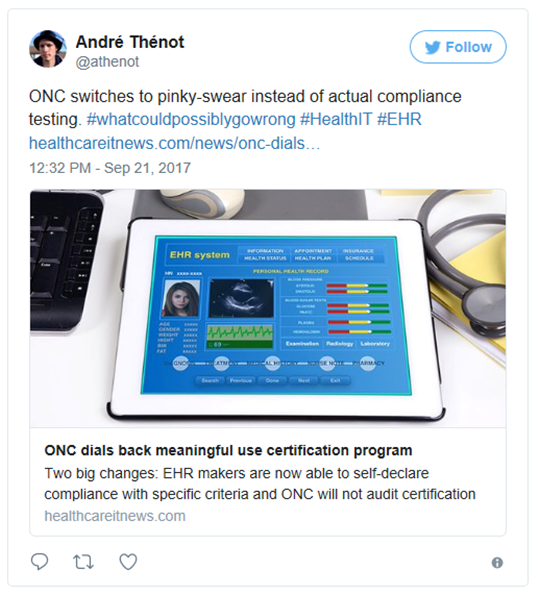
The Office of the National Coordinator for Health IT’s plans to change the ONC Health IT Certification Program has sparked some important questions. Wouldn’t allowing vendors to now simply say they’re in compliance, rather than prove it in an ONC-Authorized Testing Laboratory, pave the way for EHR vendors to essentially flout the rules? And what’s to prevent more certification problems such as the eClinicalWorks $155 million settlement?

Or as Andre Thenot tweeted Thursday, “ONC switches to pinky-swear instead of actual compliance testing. #whatcouldpossiblygowrong.”

ONC1

But National Coordinator Donald Rucker, MD, said ONC wasn’t sacrificing any of its regulatory oversight but was simply doing what it could to reduce the hoop-jumping required of vendors so they could better allocate their resources to more usable and interoperable products.

“What we’re trying to do here is make things as smooth as possible in the regulatory process,” Rucker said Thursday during a call with reporters. “We’re not changing the certification requirements, per se. We’re doing a little bit of streamlining on the process. So that will hopefully, in part, reduce vendors costs – and in a market economy over time some of those savings come down to providers.”

With the new rules, compliance requirements remain the same as ever, according to ONC. But now, rather than vendors having to put in the work to demonstrate, for instance, a relatively simple functionality such as CPOE for medications to a test lab, they can simply affirm that their product does that task, while focusing more of their time and energy on innovation.

But didn’t the eClinicalWorks case show that sometimes a verbal promise isn’t good enough? And that sometimes more stringent testing – showing, not telling – is necessary?

Rucker doesn’t think so.

“The reality is that these are very public products,” he said. “They have user bases who immediately know if something is working or not working. If a CPOE doesn’t go through, these things are known almost instantaneously. So the vast bulk of the oversight is provided by those using the product. This has to be looked at in the broader context of use. That’s where the data was coming from in prior enforcement actions.”

Actually, he said the eClinicalWorks case is “a perfect example that what we have in place in fact does work.”

The discrepancies with eCW’s products were first “noted by end-users,” he said. That case was ultimately investigated further thanks to reactive surveillance – not the randomized surveillance that would be reduced as part of these new rules.

ONC still fully intends to take an aggressive approach to reactive surveillance. In fact, just this past month it updated its Health IT Feedback Form, making it easier and more intuitive for providers to approach the agency with complaints or concerns about their products.

“Our experience is that people will report if there are issues with their product,” said Rucker.

He emphasized that all certification criteria are still in place and enforceable. And he said he didn’t see much changing for ONC-Authorized Certification Bodies and ONC-Authorized Testing Laboratories.

The self-declarable criteria are all relatively basic functionalities, after all. Those that require conformance testing to interoperability standards are still being affirmed by ONC-ATLs.

“There are a lot of things that are still being tested,” he said. And even for those criteria that are now self-declarable, “you still have to know how to solve the equation. It doesn’t change what you have to learn.”

In other words, even with the new rules, when a product is certified, the vendor is attesting that it does what it’s supposed to do. If that’s later found out not to be the case, either by an ACB or through subsequent reactive surveillance, ONC will take action – correcting where there is a non-conformity or even decertifying a given product.

The bulk of certified technologies “do exactly what is asked of them from the certification criteria,” said Rucker. “Building medical software is a highly iterative process. And there are many inputs on this. Because these foundations tend to be so heavily used – minute in, minute out – things become obvious relatively rapidly.”

The aim here, said Rucker, is to “increase the operational efficiency of the vendors to the extent that we can. Because those (testing) costs are all eventually, sooner or later, borne by the providers purchasing the products.”

Twitter: @MikeMiliardHITN
Email the writer: mike.miliard@himssmedia.com

Article link: http://www.healthcareitnews.com/news/despite-deregulation-we-wont-let-ehr-makers-run-wild-onc-chief-promises

Kaiser Health Tracking Poll – September 2017: What’s Next for Health Care? – Kaiser Family Foundation

Posted by timmreardon on 09/25/2017
Posted in: Uncategorized. Leave a comment
KEY FINDINGS:
  • The September Kaiser Health Tracking Poll, fielded largely prior to the most recent Republican effort to repeal the 2010 health care law, finds three-fourths of the public saying it is important for Congress to work on reauthorizing funding for the State Children’s Health Insurance Program (CHIP), which provides health care coverage for uninsured children. Democrats prioritize reauthorizing CHIP funding and stabilizing the ACA marketplaces, with at least eight in ten saying each is an important priority for Congress to work on now. These are also the highest-ranking priorities among independents, with about seven in ten saying the same about both reauthorizing CHIP and stabilizing the marketplaces. Republicans, on the other hand, are more likely to prioritize continuing efforts to repeal and replace the ACA, with 71 percent saying that is important for Congress to do now.
  • In general, Republicans are more likely to want Republicans in Congress to focus on repeal efforts than on improving the way the Affordable Care Act (ACA) is working (66 percent v. 28 percent), while most Democrats want Democrats in Congress to focus on improving the way the ACA is working (52 percent) rather than trying to pass a national health care plan (43 percent). A majority of independents want Democrats and Republicans in Congress to focus their efforts on improving the way the ACA is working rather than focusing on either a national health care plan or repealing the ACA.
  • Half of the public thinks the ACA marketplaces are “collapsing.” One proposed step Congress could take to stabilize the markets and control costs for people who purchase their own plans is to guarantee cost-sharing reduction (CSR) payments to insurance companies. The Trump Administration has said they may stop making these payments, which has led to insurance companies saying they may raise premiums or stop participating in the marketplaces. Two-thirds of the public – including majorities of Democrats and independents – say Congress should guarantee the CSR payments in order to help stabilize the insurance market while about three in ten of the overall public and about half of Republicans (53 percent) say these payments constitute bailouts to the insurance companies and should be stopped. Overall, about seven in ten Americans are not confident that President Trump and Congress will be able to work together to make improvements to the ACA marketplaces.
  • Overall views of the ACA are once again divided, with 46 percent expressing a favorable view and 44 percent expressing an unfavorable view. While overall favorability increased over the past year, this month finds a return to a divided public that characterizes most of the last seven years.
  • This month’s Kaiser Health Tracking Poll examines public support for a variety of competing health care policies aimed at improving or replacing the 2010 health care law, including plans to allow people to “buy in” to Medicaid or Medicare.

After the Senate failed to pass a bill to repeal parts of the 2010 Affordable Care Act (ACA) in late-July, some lawmakers have turned their attention to various competing national health policy issues, including efforts to stabilize the ACA marketplaces, proposals to create a single-payer health care system, and the reauthorization of funding for the State Children’s Health Insurance Program (CHIP), while some have continued to focus on repealing and replacing the ACA. This month’s Kaiser Health Tracking Poll examines how Americans are prioritizing the competing health care issues as well as their attitudes toward possible changes to the current health care system.

What Should Congress Work on Now?

Congress has a number of competing priorities for the month of September, and when asked about several of the issues they may address this month, a large majority of the public see reauthorizing funding for CHIP and passing legislation to stabilize the ACA marketplaces as important priorities for Congress to work on now. Specifically, three-fourths of the public (75 percent) say it is “extremely” or “very” important for Congress to work on reauthorizing funding for CHIP, the program which provides health care coverage for uninsured children. This is followed by seven in ten (69 percent) who say the same about passing legislation to stabilize the ACA marketplaces in order to minimize premium increases and encourage more insurers to offer health plans. Fewer, but still about half, say it is “extremely” or “very” important for Congress to work on reforming the tax code, which may cut taxes for some individuals (49 percent), or work on continuing efforts to repeal and replace the 2010 health care law (47 percent).

Link to full article: http://www.kff.org/health-reform/poll-finding/kaiser-health-tracking-poll-september-2017-whats-next-for-health-care/?utm_campaign=KFF-2017-September-Tracking-Poll&utm_content=60710675&utm_medium=social&utm_source=twitter

The HITECH Era in Retrospect The HITECH Era in Retrospect – NJEM

Posted by timmreardon on 09/24/2017
Posted in: Uncategorized. Leave a comment

John D. Halamka, M.D., and Micky Tripathi, Ph.D.

At a high level, the Health Information Technology for Economic and Clinical Health (HITECH) Act of 2009 accomplished something miraculous: the vast majority of U.S. hospitals and physicians are now active users of electronic health record (EHR) systems. No other sector of the U.S. economy of similar size (one sixth of the gross domestic product) and complexity (more than 5000 hospitals and more than 500,000 physicians) has undergone such rapid computerization.

Along the way, however, we lost the hearts and minds of clinicians. We overwhelmed them with confusing layers of regulations. We tried to drive cultural change with legislation. We expected interoperability without first building the enabling tools. In a sense, we gave clinicians suboptimal cars, didn’t build roads, and then blamed them for not driving. Burdensome requirements imposed costs on providers and vendors without offering sustained benefit. These deficiencies were manifested in five key areas: usability, workflow, innovation, interoperability, and patient engagement.

The Centers for Medicare and Medicaid Services (CMS) and the Office of the National Coordinator for Health Information Technology (ONC) set ambitious requirements for “meaningful use” of health information technology (IT) to ensure that Medicare and Medicaid would get value from their large investment on a fixed timeline. But in the absence of business and clinical drivers for change (HITECH predated the Affordable Care Act by more than a year), meaningful use came to be used as a de facto vehicle for transforming health care delivery — a purpose for which, as a technology investment program, it was not adequate.

This approach led to complex requirements that stressed processes more than outcomes, telling providers not only what they should do with their EHRs but also how they should use them. For example, quality measurement added data collection requirements that had a substantial negative effect on usability with little return; performance was not connected with payments. Providers bristled at externally imposed process-oriented requirements that dictated their user experience without a corresponding change in reimbursement policies or clinical best practices.

This challenging situation became untenable for daily practice workflow when meaningful use was added to other disconnected regulatory requirements, including the International Classification of Diseases, 10th Revision (ICD-10), the Omnibus Rule of the Health Information Portability and Accountability Act (HIPAA), and new payment models from commercial and government accountable care organization (ACO) programs.

Soon physicians were expected to provide high-quality and empathic care in a 12-minute visit while weaning themselves from paper based workflows, entering the numerous structured data elements required for meaningful use, rolling out new HIPAA privacy notices, implementing security protections for new electronic data, learning and incorporating new ICD-10 billing codes, and convincing their patients to use patient portals and secure e-mail, all while avoiding safety and malpractice issues. Instead of being a gift horse that reduced clinician burden, the EHR became an expensive Trojan horse loaded with an array of new regulatory requirements.

It wasn’t just the providers who suddenly faced an avalanche of requirements. EHR vendors seeking to innovate had to meet complex certification requirements, administered by ONC-authorized testing companies, that imposed not only direct costs, but large opportunity costs as well. Development resources had to be diverted to programming of complex certification requirements to meet the technical, functional, and workflow requirements of meaningful use, which left little available capacity for innovation and product development based on user experience.

Over time, providers and vendors began to perceive meaningful use as yet another check-the-box compliance program. Furthermore, meaningful use set unrealistic expectations for interoperability. Though it did not specify a nationwide patient matching strategy, create a nationwide directory of provider electronic addresses, forge a single set of consent or privacy guidelines, or define governance for deciding who could exchange what for various purposes, it set requirements with the assumption that interoperability could somehow skip over such essentials.

Instead of recognizing the work that needed to be done on these foundational items, some policymakers invented the myth of “information blocking” as the root cause for lack of data flow. Our 50-plus combined years in the health IT industry have taught us that when technology, policy, and business needs are aligned, data flow.

As health care organizations have moved to value-based purchasing, they are finding that data sharing is a business imperative. The needs of care management are now creating genuine demand for interoperability services, such as “pushing” data to support referrals and transitions and “pulling” data for unscheduled visits such as emergency care. The meaningful use program did not stress any outcome from data sharing. Instead, it required a specific technology and set a process goal: adopt secure e-mail and count the number of messages sent. Many organizations set up “dead letter boxes” to send secure e-mail and comply with the requirement without ensuring that any clinical benefit was provided.

Today, the private sector is meeting burgeoning demand for interoperability with nationwide, standards-based networks that solve key issues such as patient matching, provider directories, uniform consent and privacy policies, data governance, common contracts, and well-defined business cases. Such networks include Carequality, CommonWell, DirectTrust, Epic’s CareEverywhere, and Surescripts at the national level, as well as regionally focused health information exchange networks such as those in Indiana, Maine, Maryland, and Massachusetts.

They also now include record sharing with government entities such as the Department of Defense (DOD), the Department of Veterans Affairs (VA), and the Social Security Administration (SSA). Standards obviously play a key role in interoperability, and meaningful use has done much to accelerate the implementation of vocabulary standards such as SNOMED-CT (Systematized Nomenclature of Medicine — Clinical Terms), LOINC (Logical Observation Identifiers Names and Codes), and RxNorm, which have been widely adopted. Emerging open standards such as FHIR (Fast Healthcare Interoperability Resources), based on modern Internet conventions, are being embraced by the industry and are attracting companies and developers from outside health care to build innovative business models and technology platforms that are already reshaping the industry.

In terms of patient engagement, early attempts such as Blue Button (allowing patients to download text files of parts of their records) were well-intended efforts that ultimately did little to engage patients. One success of meaningful use was creating an imperative, and mechanisms, for giving patients access to their medical records, albeit through unwieldy, EHR-tethered patient portals.

If we want patients to be engaged to help reduce the burden of care coordination, care plan tracking, and communication, we need modern tools that enable patients to interact with their providers using devices and workflows that are already part of their daily lives. Many companies are now offering such tools. HITECH has played an invaluable role in accelerating the adoption of EHRs throughout the country.

We believe that now is the time to step back and recalibrate the role of the federal government on the basis of lessons learned. First, requirements related to meaningful use and the MeritBased Incentive Payment System (MIPS) introduced by CMS could be dramatically simplified to focus on interoperability and a streamlined set of outcome-oriented quality measures.

Second, EHR certification could focus exclusively on interoperability capabilities by setting up a public test server and reporting on EHR vendors’ success in reading and writing medical records on it.

Third, interoperability could be encouraged by market action rather than by regulation. The ONC, CMS, DOD, VA, SSA, and other federal agencies could actively encourage private-sector networks to connect with each other using open industry standards, much as wireless and automated-teller networks have done.

Finally, we could offer incentives for the adoption of open industry application programming interface (API) standards, such as FHIR, for provider– patient, provider–provider, provider–payer, and payer–patient interactions. The HITECH era was an important catalyst for EHR adoption, and the industry benefited from government intervention. If the post-HITECH era can return control of the agenda to customers, developers, and multi-stakeholder collaborations, we should be able to recapture the hearts and minds of our clinicians.

Disclosure forms provided by the authors are available at NEJM.org.

From Beth Israel Deaconess Medical Center and Harvard Medical School, Boston (J.D.H.), and the Massachusetts eHealth Collaborative, Waltham (M.T.) — both in Massachusetts.
DOI: 10.1056/NEJMp1709851 Copyright © 2017 Massachusetts Medical Society.

Article link: http://www.nejm.org/doi/pdf/10.1056/NEJMp1709851

High-Reliability Health Care: Getting There from Here – The Joint Commission

Posted by timmreardon on 09/24/2017
Posted in: Uncategorized. Leave a comment

Article link: https://www.jointcommission.org/assets/1/6/Chassin_and_Loeb_0913_final.pdfHRO2


Health care and high reliability: a cautionary tale – Joint Commission

Posted by timmreardon on 09/24/2017
Posted in: Uncategorized. Leave a comment

HRO


https://player.vimeo.com/video/148549647

Tuesday, August 21, 2012

Joint Commission President Mark R. Chassin, M.D., FACP, M.P.P., M.P.H., discusses how far away health care is from high reliability and The Joint Commission’s efforts to accelerate high reliability.

5th International High Reliability Organizing Conference
Oakbrook Terrace, Illinois
May 21, 2012

Article link: https://www.jointcommission.org/multimedia/dr-chassin-keynote-hro-conference/


View Video Transcript

Health Care Providers Can Use Design Thinking to Improve Patient Experiences – HBR

Posted by timmreardon on 09/02/2017
Posted in: Uncategorized. Leave a comment

Sharon H. Kim

  • Christopher G. Myers
  • Lisa Allen


August 31, 2017

HBR1a

A hospital administrator recently talked to us about an issue that is all too common for patients: missed medical appointments. The story was about a woman named Mary (a pseudonym), a patient with a painful chronic condition who continually failed to keep her regular appointments. In an effort to better understand the problem at hand, the administrator tried to put herself in Mary’s shoes, and asked about her experience: Was there an issue with transportation? Did she need other appointment reminders aside from the paper letter mailed to her home and the standard phone call?

Slowly, Mary began to reveal the reasons why she never made it to her appointments. Her journey to the hospital was quite daunting. For starters, her painful physical condition required her to arrange door-to-door assistance and special transportation. Everyone involved had to be on the same page for her to make it to her appointment on time, and coordinating the logistics was onerous and stressful.

Mary faced an additional set of challenges once she got to the hospital. Mary sought care at a large academic medical center with multiple entrances and towers; at times she was expected to travel long distances due to the sheer size of the facility. She worried that she wouldn’t be able to find someone to push her in a wheelchair, or that she might get lost. Simply thinking about the various hurdles of this journey made Mary anxious to the point of talking herself out of going at all.

Each year approximately 3.6 million people miss or put off medical appointments due to transportation issues, leading to annual costs for health care providers in the billions of dollars. Missed medical appointments, or “no-shows,” often create several operational challenges as well, from difficulties rescheduling clinical staff to interference with patient care and treatment. While the consequences of missed appointments have been widely studied, the specific reasons patients fail to show up are not always as clear. But until we understand these reasons, we won’t be able to solve the problems. This is where paying closer attention to the entire patient experience — from what happens before people get to the hospital to what happens after they leave — can help.

Many leading hospitals are starting to focus more on understanding the patient experience to solve these kinds of problems, as well as to improve overall patient experience and to lower costs. Yet it’s not always easy to get key stakeholders to consider nonclinical aspects of this type of work.

One of the most promising approaches for understanding patients’ experiences has been design thinking, a creative, human-centered problem-solving approach that leverages empathy, collective idea generation, rapid prototyping, and continuous testing to tackle complex challenges. Unlike traditional approaches to problem solving, design thinkers take great efforts to understand patients and their experiences before coming up with solutions. This thorough understanding of patients (for example, those who regularly miss appointments) is what guides the rest of the process. And because design thinking involves continuously testing and refining ideas, feedback is sought early and often, especially from patients.

Design thinking has already taken hold in health care, leading to the development of new products and the improved design of spaces. Yet it remains underused in addressing other important challenges, such as patient transportation, communication issues between clinicians and patients, and differential treatment of patients due to implicit bias, to name just a few. If more leaders embrace design thinking, they can leverage a deeper understanding of patients to solve such problems, achieving better clinical outcomes, improved patient experience, and lower costs along the way.

Designing a Patient-Centered Experience

How might design thinking be applied to the persistent and costly problem of no-shows? In Mary’s case, she couldn’t explain her concerns through the standard patient experience survey, which is initiated after an appointment and which comprises general questions focused on the medical visit. Were it not for the hospital administrator’s initiative to ask Mary what was going on, her concerns may have gone both unnoticed and unaddressed.

This tailored, human-centered approach of problem solving is the foundation of design thinking. Hospitals versed in design thinking would identify this general challenge and then assign a team or task force (ideally a multidisciplinary one) to spend weeks or even a few months studying the patients it affects. The team would use qualitative research methods, such as surveys, focus groups, and observations, to better understand people’s experiences. They would seek out patterns and aim to define the real problem at hand. For instance, a team investigating several no-shows would quickly see that many cases do not necessarily involve a patient’s forgetfulness or time management. They’d find that the issue faced by patients like Mary is often more socioemotional than organizational.

After this phase, the team would brainstorm possible solutions, and then begin rapid prototyping to test them. Depending on the proposed solution, a prototype could be anything from a physical mock-up to a skit or a flowchart. For example, if the team wanted to design a screening process to identify individuals with transport-related concerns, they could design a simple computerized simulation that illustrates how that process might look and feel to both patients and staff. Once created, this prototype would be tested by relevant stakeholders and perhaps even outside parties to collect critical feedback. Often, the feedback indicates when or how to modify solutions, or whether to go back and gather more information. The result is a solution focused on what will most help the patient.

Addressing a Broader Spectrum of Patient Challenges

There are already a few promising examples of design thinking being used to create a better experience for patients. For instance, the department of obstetrics and gynecology at Mayo Clinic used design thinking to reimagine prenatal care. They wanted to better meet the expectations and needs of expectant mothers, who desired a greater emphasis on the emotional experience of pregnancy, rather than just the clinical side of it. Through interviews with and observations of local expectant mothers, the design thinking team learned that it was extremely important for these women to have a sense of community. So the department created online care communities, facilitated by nurses and other pregnancy advisers. The result was an overall improvement in how prepared and empowered these expectant mothers felt.

At Johns Hopkins Hospital, elements of the design thinking process are embedded in the hospital’s approach to improving care. To provide the human touch that is necessary to improve the patient experience, we have a team of coaches, trained in the importance of empathy in clinical settings, that teaches caregivers how to partner with patients and be more present with them. For instance, coaches teach clinical staff how to reject a patient’s request when necessary (for example, when asked for more pain medication) while still projecting a caring message. On the patient side, we have a team of advocates that visit people facing unusually difficult circumstances, such as having to endure a long wait without food or water before surgery. Advocates offer support by connecting them to the right staff members or simply by listening to their concerns. Advocates support patients and encourage them to be engaged in their own care. This often involves identifying what matters to them and their loved ones and, above all, recognizing the patient as a whole person, not as a condition or an illness.

Design thinking can be used to address challenges in a variety of domains related to the patient experience. Consider reimagining the emergency-room waiting experience. Because care is prioritized based on the severity of a patient’s condition, wait times are difficult to predict. Patients and their families often spend hours waiting to be seen and treated. Design thinking may uncover new ways of helping patients feel comfortable and safe during such long waits. An approach that starts with investigating the patients’ perspectives, including their greatest pain points, may give administrators ideas for how to make the emergency room experience more bearable.

It’s every health care leader’s mission to improve patient experiences. Design thinking is a useful process for doing so, as it requires decision makers to empathize with patients, think creatively, prototype, and continually test solutions to these problems. The answers to problems like no-shows start with getting to know Mary and patients like her.

Article link: https://hbr.org/2017/08/health-care-providers-can-use-design-thinking-to-improve-patient-experiences?utm_campaign=hbr&utm_source=twitter&utm_medium=social

Sharon H. Kim, Ph.D., is an assistant professor of management for the Johns Hopkins Carey Business School and associate faculty at Armstrong Institute of Patient Safety and Quality. Her research explores creativity in the workplace, and she teaches design thinking for health care leaders.


Christopher G. Myers is an assistant professor at the Johns Hopkins University Carey Business School and Armstrong Institute for Patient Safety & Quality. His research explores organizing processes that support individual learning, development, and innovation in dynamic work environments.


Lisa Allen, Ph.D., is the Chief Patient Experience Officer for Johns Hopkins Medicine. In this role she has oversight and responsibility for enhancing and continually improving the overall experience of patients and families by coaching, utilization of best practices, transparency, reporting, and system collaboration.

Posts navigation

← Older Entries
Newer Entries →
  • Search site

  • Follow healthcarereimagined on WordPress.com
  • Recent Posts

    • The Global Healthcare System Is Broken. Japan Fixed It for $4,100 Per Person. 04/10/2026
    • When Not to Use AI – MIT Sloan 04/01/2026
    • There are more AI health tools than ever—but how well do they work? – MIT Technology Review 03/30/2026
    • Are AI Tools Ready to Answer Patients’ Questions About Their Medical Care? – JAMA 03/27/2026
    • How AI use in scholarly publishing threatens research integrity, lessens trust, and invites misinformation – Bulletin of the Atomic Scientists 03/25/2026
    • VA Prepares April Relaunch of EHR Program – GovCIO 03/19/2026
    • Strong call for universal healthcare from Pope Leo today – FAN 03/18/2026
    • EHR fragmentation offers an opportunity to enhance care coordination and experience 03/16/2026
    • When AI Governance Fails 03/15/2026
    • Introduction: Disinformation as a multiplier of existential threat – Bulletin of the Atomic Scientists 03/12/2026
  • Categories

    • Accountable Care Organizations
    • ACOs
    • AHRQ
    • American Board of Internal Medicine
    • Big Data
    • Blue Button
    • Board Certification
    • Cancer Treatment
    • Data Science
    • Digital Services Playbook
    • DoD
    • EHR Interoperability
    • EHR Usability
    • Emergency Medicine
    • FDA
    • FDASIA
    • GAO Reports
    • Genetic Data
    • Genetic Research
    • Genomic Data
    • Global Standards
    • Health Care Costs
    • Health Care Economics
    • Health IT adoption
    • Health Outcomes
    • Healthcare Delivery
    • Healthcare Informatics
    • Healthcare Outcomes
    • Healthcare Security
    • Helathcare Delivery
    • HHS
    • HIPAA
    • ICD-10
    • Innovation
    • Integrated Electronic Health Records
    • IT Acquisition
    • JASONS
    • Lab Report Access
    • Military Health System Reform
    • Mobile Health
    • Mobile Healthcare
    • National Health IT System
    • NSF
    • ONC Reports to Congress
    • Oncology
    • Open Data
    • Patient Centered Medical Home
    • Patient Portals
    • PCMH
    • Precision Medicine
    • Primary Care
    • Public Health
    • Quadruple Aim
    • Quality Measures
    • Rehab Medicine
    • TechFAR Handbook
    • Triple Aim
    • U.S. Air Force Medicine
    • U.S. Army
    • U.S. Army Medicine
    • U.S. Navy Medicine
    • U.S. Surgeon General
    • Uncategorized
    • Value-based Care
    • Veterans Affairs
    • Warrior Transistion Units
    • XPRIZE
  • Archives

    • April 2026 (2)
    • March 2026 (9)
    • February 2026 (6)
    • January 2026 (8)
    • December 2025 (11)
    • November 2025 (9)
    • October 2025 (10)
    • September 2025 (4)
    • August 2025 (7)
    • July 2025 (2)
    • June 2025 (9)
    • May 2025 (4)
    • April 2025 (11)
    • March 2025 (11)
    • February 2025 (10)
    • January 2025 (12)
    • December 2024 (12)
    • November 2024 (7)
    • October 2024 (5)
    • September 2024 (9)
    • August 2024 (10)
    • July 2024 (13)
    • June 2024 (18)
    • May 2024 (10)
    • April 2024 (19)
    • March 2024 (35)
    • February 2024 (23)
    • January 2024 (16)
    • December 2023 (22)
    • November 2023 (38)
    • October 2023 (24)
    • September 2023 (24)
    • August 2023 (34)
    • July 2023 (33)
    • June 2023 (30)
    • May 2023 (35)
    • April 2023 (30)
    • March 2023 (30)
    • February 2023 (15)
    • January 2023 (17)
    • December 2022 (10)
    • November 2022 (7)
    • October 2022 (22)
    • September 2022 (16)
    • August 2022 (33)
    • July 2022 (28)
    • June 2022 (42)
    • May 2022 (53)
    • April 2022 (35)
    • March 2022 (37)
    • February 2022 (21)
    • January 2022 (28)
    • December 2021 (23)
    • November 2021 (12)
    • October 2021 (10)
    • September 2021 (4)
    • August 2021 (4)
    • July 2021 (4)
    • May 2021 (3)
    • April 2021 (1)
    • March 2021 (2)
    • February 2021 (1)
    • January 2021 (4)
    • December 2020 (7)
    • November 2020 (2)
    • October 2020 (4)
    • September 2020 (7)
    • August 2020 (11)
    • July 2020 (3)
    • June 2020 (5)
    • April 2020 (3)
    • March 2020 (1)
    • February 2020 (1)
    • January 2020 (2)
    • December 2019 (2)
    • November 2019 (1)
    • September 2019 (4)
    • August 2019 (3)
    • July 2019 (5)
    • June 2019 (10)
    • May 2019 (8)
    • April 2019 (6)
    • March 2019 (7)
    • February 2019 (17)
    • January 2019 (14)
    • December 2018 (10)
    • November 2018 (20)
    • October 2018 (14)
    • September 2018 (27)
    • August 2018 (19)
    • July 2018 (16)
    • June 2018 (18)
    • May 2018 (28)
    • April 2018 (3)
    • March 2018 (11)
    • February 2018 (5)
    • January 2018 (10)
    • December 2017 (20)
    • November 2017 (30)
    • October 2017 (33)
    • September 2017 (11)
    • August 2017 (13)
    • July 2017 (9)
    • June 2017 (8)
    • May 2017 (9)
    • April 2017 (4)
    • March 2017 (12)
    • December 2016 (3)
    • September 2016 (4)
    • August 2016 (1)
    • July 2016 (7)
    • June 2016 (7)
    • April 2016 (4)
    • March 2016 (7)
    • February 2016 (1)
    • January 2016 (3)
    • November 2015 (3)
    • October 2015 (2)
    • September 2015 (9)
    • August 2015 (6)
    • June 2015 (5)
    • May 2015 (6)
    • April 2015 (3)
    • March 2015 (16)
    • February 2015 (10)
    • January 2015 (16)
    • December 2014 (9)
    • November 2014 (7)
    • October 2014 (21)
    • September 2014 (8)
    • August 2014 (9)
    • July 2014 (7)
    • June 2014 (5)
    • May 2014 (8)
    • April 2014 (19)
    • March 2014 (8)
    • February 2014 (9)
    • January 2014 (31)
    • December 2013 (23)
    • November 2013 (48)
    • October 2013 (25)
  • Tags

    Business Defense Department Department of Veterans Affairs EHealth EHR Electronic health record Food and Drug Administration Health Health informatics Health Information Exchange Health information technology Health system HIE Hospital IBM Mayo Clinic Medicare Medicine Military Health System Patient Patient portal Patient Protection and Affordable Care Act United States United States Department of Defense United States Department of Veterans Affairs
  • Upcoming Events

Blog at WordPress.com.
healthcarereimagined
Blog at WordPress.com.
  • Subscribe Subscribed
    • healthcarereimagined
    • Join 153 other subscribers
    • Already have a WordPress.com account? Log in now.
    • healthcarereimagined
    • Subscribe Subscribed
    • Sign up
    • Log in
    • Report this content
    • View site in Reader
    • Manage subscriptions
    • Collapse this bar
 

Loading Comments...