healthcarereimagined

Envisioning healthcare for the 21st century

  • About
  • Economics

Kaiser Health Tracking Poll – October 2017: Open Enrollment and the ACA Marketplaces – Kaiser Health News

Posted by timmreardon on 10/23/2017
Posted in: Uncategorized. Leave a comment
KEY FINDINGS:
  • The October Kaiser Health Tracking Poll focuses on the Affordable Care Act’s (ACA) marketplaces as the November 1st open enrollment period approaches, amidst a period of uncertainty on the future of the individual market. The majority of the public think it is more important for President Trump and Congress to work on legislation to stabilize the marketplaces rather than continue efforts to repeal and replace the 2010 health care law (66 percent vs. 29 percent). There are distinct differences by party with the majority of Democrats (85 percent) and independents (67 percent) saying legislation to stabilize the marketplaces is more important while about half of Republicans (51 percent) say it is more important for lawmakers to continue efforts to repeal and replace the 2010 health care law.

    Poll: Most want Congress to continue cost-sharing reduction payments as part of bipartisan marketplace deal

  • One proposed step Congress could take to stabilize the markets and control costs for people who purchase their plans on their own is to guarantee payments to insurance companies that help cover the cost of deductibles and copayments for lower-income Americans (known commonly as ‘cost-sharing reduction’ (CSR) payments). The Trump Administration has announced they will stop making these payments. While initially the majority of Republicans (55 percent) say these payments should be stopped, when asked whether they support Congress guaranteeing the funds to continue the CSR payments when the proposal is included in a bipartisan compromise that would give states more flexibility in the types of plan sold in their state’s marketplace, a majority of the public (69 percent) – including roughly equal shares of Democrats (69 percent), independents (70 percent), and Republicans (68 percent) – support such a compromise.
  • Overall favorability of the ACA increased over the past month with about half (51 percent) of the public holding favorable views of the ACA while 40 percent hold an unfavorable view of the 2010 law. This is five percentage points higher than the share of the public who held favorable attitudes last month (46 percent), and more similar to the share measured in August.

Politics and the ACA Marketplaces

This month’s Kaiser Health Tracking Poll, which was conducted prior to President Trump’s executive order on the Affordable Care Act and the most recent statements from the Trump administration regarding CSR payments, examines the public’s attitudes towards the ACA marketplaces, before the next open enrollment period beginning on November 1st.

The majority of the public think it is more important for President Trump and Congress to work on legislation to stabilize the marketplaces in order to minimize premiums increases and encourage more insurers to participate in the marketplaces than continue efforts to repeal and replace the 2010 health care law (66 percent vs. 29 percent). There are distinct differences by party with the majority of Democrats (85 percent) and independents (67 percent) saying legislation to stabilize the marketplaces is more important while about half of Republicans (51 percent) say it is more important for lawmakers to continue efforts to repeal and replace the 2010 health care law.

Read more:

Article link: https://www.kff.org/health-reform/poll-finding/kaiser-health-tracking-poll-october-2017-open-enrollment-and-the-aca-marketplaces/?utm_campaign=KFF-2017-October-Tracking-Poll-ACA&utm_content=62026583&utm_medium=social&utm_source=twitter

Eric Topol draws line in sand: Patients own their medical data – Healthcare IT News

Posted by timmreardon on 10/16/2017
Posted in: Uncategorized. Leave a comment

The renowned author and physician-scientist highlights the hurdles to sharing data with patients and asserts that giving patients their records could save lives.

By Jessica Davis    October 13, 2017

Doctor showing digital tablet to patient in clinic

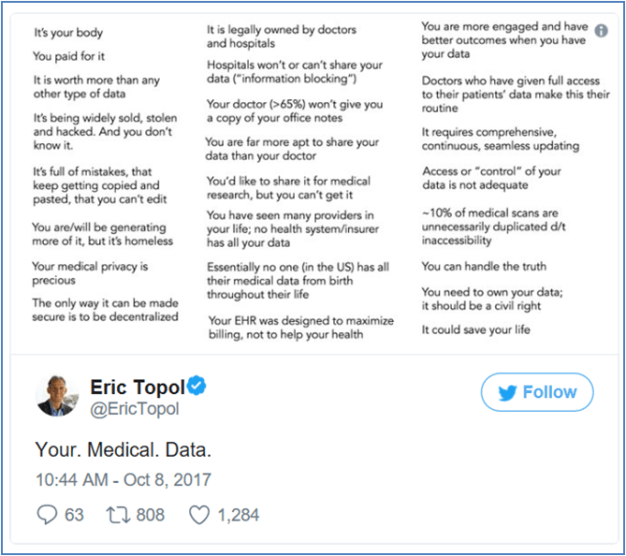
In a firm, bulleted-list, notable author and physician-scientist Eric Topol, MD, sparked a Twitter debate on his insights about the barriers to giving patients their medical record — and why the shift needs to happen.

“Hospitals won’t or can’t share your data… Your doctor (more than 65 percent) won’t give you a copy of your office notes,” Topol tweeted. “Access or ‘control’ of your data is not enough.”

Topol2

The tweet has been shared about 775 times and liked by more than 1,200 users.
It also sparked further conversations that expanded on patient rights to own their medical data, which included moving beyond a patient-centered record.

“Hence, [it’s] important not to lose out and just be patient-centered,” tweeted Amir Hannan, MD, chair of Association of Greater Manchester Local Medical Committees. “[It] needs to be jointly managed and supported with coaching too.”

The debate of data ownership has been a hot-button topic for years. Topol, along with Katherine A. Mikk and Harry A. Sleeper of Mitre’s Open Health Services, discussed how to shift medical data ownership to the patient in a Sept. 25 JAMA article.

To accomplish the shift, the authors laid out three essential steps: establish common data elements, provide patients with a ‘data receipt’ and manage ownership through data use agreement contracts.

In Aug., Epic Systems CEO Judy Faulkner asserted that the EHR giant fully supports patient access to their entire record — something the company has supported for the last 10 years. But the barrier is with translating EHR medical terms into patient-friendly language.

As part of the 21st Century Cures Act, the language may require a patient’s EHR data to be transmitted in a way that would be easy to understand.

Article link: http://www.healthcareitnews.com/news/eric-topol-draws-line-sand-patients-own-their-medical-data

Twitter: @JessieFDavis
Email the writer: jessica.davis@himssmedia.com


Visible and Useful Patient Data in an Era of Interoperability Failure – Hospital EMR & EHR

Posted by timmreardon on 10/16/2017
Posted in: Uncategorized. Leave a comment

Posted on October 13, 2017 I Written By Janae Sharp

Healthcare as a Human Right. Physician Suicide Loss Survivor. Janae writes about Artificial Intelligence, Virtual Reality, Data Analytics, Engagement and Investing in Healthcare. twitter: @coherencemed

Health record interoperability and patient data is a debated topic in Health IT. Government requirements and business interests create a complex exchange about who should own data and how it should be used and who should profit from patient data. Many find themselves asking what the next steps in innovation are. Patient data, when it is available, is usually not in a format that is visible and useful for patients or providers. The debate about data can distract from progress in making patient data visible and useful.

Improvements in HealthIT will improve outcomes through better data interpretation and visibility. Increasing the utility of health data is a needed step. Visibility of patient data has been a topic of debate since the creation of electronic health records. This was highlighted in a recent exchange between former vice president Joe Biden and Judy Faulkner, CEO of Epic Systems.

Earlier this year at the Cancer Moonshoot, Faulkner expressed her skepticism about the usefulness of allowing patients access to their medical records. Biden replied, asking Faulkner for his personal health data.

Faulkner was quick to retort, questioning why Mr. Biden wanted his records, and reportedly responded “Why do you want your medical records?” There are a thousand pages of which you understand 10.”

My interpretation of her response-“You don’t even know what you are asking. Do not get distracted by the shiny vendor trying to make money from interpreting my company’s data”
As reported in Politico Biden–and really, I think that man can do no wrong, responded, “None of your business.”

In the wake of the Biden Faulkner exchange, the entire internet constituency of Health IT and patient records had an ischemic attack. Since this exchange we’ve gone on to look at interoperability in times of crisis. We’ve had records from Houston and Puerto Rico and natural disasters. The importance of sharing data and the scope of useful data is the same.

During what I call the beginning of several months of research about the state of interoperability I started reading about the Biden and Faulkner exchange. This was not the first time I had been reading extensively about patient data and if EHR and EMR data is useful. It just reminded me of the frustrations I’ve heard for years about EHR records being useless. Like many of us, I disappeared down the rabbit hole of tweets about electronic health records for a full day. Patient advocates STILL frustrated by the lack of cooperation between EHR and EMR vendors found renewed vigor; they cited valid data. Studies were boldly thrown back and the exchange included some seriously questionable math and a medium level of personal attack.

Everyone was like, Are we STILL on this problem where very little happens and it’s incredibly complex? How? How do we still not have a system that makes patient data more useful? Others were like, Obviously it doesn’t make sense because A) usefulness in care, and B) money.

Some argued that patients just want to get better. Others pointed out that acting like patients were stupid children not only causes a culture of contempt for providers and vendors alike, but also kills patients. Interestingly, Christina Farr CNBC reported that the original exchange may have been more civil than originally interpreted.
My personal opinion: Biden obviously knew we needed to talk about patient rights, open data, and interoperability more. It has had more coverage since then. I don’t know Faulkner, but it sounds like a lot of people on Twitter don’t feel like she is very cooperative. She sounds like a slightly savage businesswoman, which for me is usually a positive thing. I met Peter from Epic who works with interoperability and population health and genomics and he was delightful.

Undeniably, there is some validity to Judy’s assertion that the data would not be useful to Biden; EHR and EMR data, at least in the format available from the rare cooperative vendors, is not very useful. They are a digital electronic paper record. I am willing to bet Biden–much as I adore the guy–didn’t even offer a jump drive on which to store his data. The potential of EHR data visualization to improve patient outcomes needs more coverage. Let’s not focus on the business motivations of parties that don’t want to share their data, let’s look at potential improvements in data usefulness.

It was magic because I had just had a conversation about data innovation with Dr. Michael Rothman. An early veteran in the artificial intelligence field, Dr. Rothman worked in data modeling before the AI winter of the 80s and the current resurgence in investment and popularity. He predates the current buzz cycle of blockchain and artificial intelligence everything. With many data scientists frustrated by an abandonment of elegant, simple solutions in favor of venture capital and sexy advertising vaporware, it is timely to look at tools that improve outcomes.

In speaking with Dr. Rothman, I was surprised by the cadence of his voice, he asked me what I knew about the history of artificial intelligence, and I asked him to tell his data story. He started by outlining the theory of statistical modeling and data dump in neural net modeling. His company, PeraHealth, represents part of the solution for making EMR and EHR data useful to clinicians and patients.

The idea that data is going to give you the solution is, in a sense, slightly possible but extremely unlikely. If you look at situations where people have been successful, there is a lot of human ingenuity that goes into selecting and transforming the variables into meaningful forms before building the neural network or deep learning algorithm. Without a framework of understanding, a lot of EHR data is simply a data dump that lacks clinical knowledge or visualization to provide appropriate scaffolding.  You do need ingenuity, and you do need the right data. There are so many problems and complexities with data that innovation and ingenuity is lagging behind with healthIT.
The question is – is the answer you are looking for in the input data? If you have the answer in the data, you will be able to provide insights based on it. Innovation in healthcare predictions and patient records will come from looking at data sets that are actually predictive of health.

Dr. Rothman’s work in healthcare started with a medical error. His mother had valve replacement surgery and came through in good shape. Although initially she was recovering quickly, she started to deteriorate after a few days. And the problem was that the system made it difficult to see.  Each day she was evaluated.  Each day her condition was viewed as reasonable given her surgery and age.  What they couldn’t see was that each day she was getting worse.  They couldn’t see the trend.  She was discharged and returned to the ED 4-days later and died.

As a scientist, he recognized that the hospital staff didn’t have everything they needed to avoid an error like this. He approached the hospital CEO and asked for permission to help them solve the problem. Dr. Rothman explained, I didn’t feel that the doctors had given poor medical care, this was a failure of the system.

The hospital CEO did something remarkable. They shared their data. In a safe system they allowed an expert in data science to come in to see what he could find in their patient records, rather than telling him he probably wouldn’t understand the printout. The hospital was an early adopter of EHR records, so they were able to look at a long history of data to find what was being missed. Using vital signs, lab tests, and importantly, an overlooked source of data, nursing notes, Dr. Rothman (and his brother) found a way to synthesize a unified score, a single number which captures the overall condition of the patient, a single number which was fed from the EMR and WOULD show a trend.  There is an answer if you include the right data.

Doctors and nurses look at a myriad of data and synthesize it, to reach an understanding.  Judy is right that a layman looking at random pieces of data will not likely gain much understanding, BUT they may.  And with more help they might.  Certainly, they deserve a chance to look.  And certainly, the EMR and EHR companies have an obligation to present the data in some readable form.

Patients should be demanding data, they should be demanding hospitals give them usable care and normalize data based on their personal history to help save their lives.
Based on this experience, Michael and Steven built the Rothman Index, a measure of patient health based on analytics that visualizes data found in EHRs. They went on to found PeraHealth, which enables nursing kiosks to show the line and screens to see if any patients decline. In some health systems, an attending physician can get an alert about patients in danger. The visualization from the record isn’t just a screen by the patient, it is also on the physicians and nurses’ screens and includes warnings. Providers have time to evaluate what is wrong before it is too late. The data in the health record is made visual and can be a tool for providers.

EMR-EHR

Visualization of Patient Status with the Rothman Index and Perahealth

Is Perahealth everywhere? Not yet. For every innovation and potential improvement there is a period of time where slow adopters wait and invest in sure bets. Just like interoperable data isn’t an actuality in a system that desperately needs it, this is a basic step toward improving patient outcomes. Scaling implementation of an effective data tool is not always clear to hospital CMIO and CEO teams.  The triage of what healthIT solution a healthcare system chooses to implement is complex. Change also requires strong collaborative efforts and clear expectations. Often, even if hospital systems know something provides benefits to patients, they don’t have the correct format to implement the solution. They need a strategy for adoption and a strong motivation. It seems that the strongest motivations are financial and outcomes based. The largest profit savings with the minimum effort usually takes adoption precedent. This should also be aligned with end users- if a nurse uses the system it needs to improve their workflow, not just give them another task.

One of the hospitals that is successfully collaborating to make patient data more useful and visual is Houston Methodist. I spoke to Katherine Walsh, Chief Nursing Officer from Houston Methodist about their journey to use EHR data with Perahealth. She explained it to me- Data is the tool, without great doctors and nurses knowing the danger zone, it doesn’t help. This reminded me of Faulkner’s reaction that not all patient data is useful. Clinical support should be designed around visible data to give better care. Without a plan, data is not actionable. Katherine explained that when nurses could see that the data was useful, they also had to make sure their workflow included timely records. When EHR data is actually being used in the care of patients, suddenly data entry workflow changes. When nurses and doctors can see that their actions are saving lives, they are motivated.

EMR-EHR 1

The process to change their workflow and visualize patient data did not happen overnight. In the story of Houston Methodist’s adoption of Perahealth, Walsh said they wanted to make sure they helped doctors and nurses understand what the data meant.  “We put large screens on all the units- you can immediately see the patients that are at risk- it’s aggregated by the highest risk factor.” If you are waiting for someone to pull this data up on their desktop, you are waiting for them to search something. But putting it on the unit where you can see it makes it much easier to round, and makes it much easier to get a sense of what is going on. You can always identify what and who is at risk because it’s on a TV screen. The Houston Methodist team showed great leadership in nursing informatics, improving outcomes and using an internal strategy for implementation.

They normalize the variants for each person- a heart rate of 40 for a runner might be normal- then on the next shift 60 seems normal- then at 80 it also seems normal- you can tell them when you want an alert. To help with motivation, Walsh needed to make the impact of PeraHealth visual. They hung 23 hospital gowns around a room, representing the patients they had saved using the system.

The future of electronic health records will be about creating usable data, not just a data dump of fields. It is transforming EHRs from a cost hemorrhage to a life-saving tool through partnerships. Physicians don’t want another administrative task or another impersonal device. Nurses don’t want to go through meaningless measures and lose track of patients during shift changes. Show them the success they’ve had and let the data help them give great care.

Hospital administrators don’t want another data tool that doesn’t improve patient outcomes but has raised capital on vaporware. Creators don’t want more EHR companies that don’t know how to work with agile partners to create innovation.

The real ingenuity is in understanding – what data do you need? What data do patients need? Who can electronic healthcare record companies partner with to bridge the data divide?

We can bridge the gap of electronic health records that aren’t legible or useful to patients and create tools to save lives. Tools like those from PeraHealth are the result of a collaborative effort to take the data we have and synthesize it and visualize it and let care providers SEE their patients.  This saves lives.

Without this, the data is there, it’s just not usable.

Don’t just give the patients their data, show them their health.

Article link: http://www.hospitalemrandehr.com/2017/10/13/visible-and-useful-patient-data-in-an-era-of-interoperability-failure/



EHRs in the era of MACRA – AMA

Posted by timmreardon on 10/16/2017
Posted in: Uncategorized. Leave a comment

Barbara L. McAneny, MD

While it’s been a long—and sometimes rocky—road implementing electronic health records (EHRs), there’s no question that they’re here to stay. Their role is increasingly important under the Medicare Access and CHIP Reauthorization Act (MACRA), which is transforming the payment model and impacting the way we practice medicine.

This new era of Medicare payment is changing how we capture and report patient data, particularly as it relates to requirements under the new Quality Payment Program (QPP). Accounting for 25 percent of a practice’s Merit-based Incentive Payment System (MIPS) score, the Advancing Care Information (ACI) category replaces the former EHR Incentive Payment Program, commonly known as “Meaningful Use.”

Many EHRs allow for the storage and management of charts, remote access to patient data and e-prescribing, but many widely available EHR platforms do not offer the flexibility to exchange data with or interpret data from other systems. The medical community can contribute to the evolution of EHRs by partnering with vendors to improve EHRs, advocating for policymakers to develop effective health IT policy, and collaborating with physicians, institutions and health care systems to create effective institutional health IT policies.

Related Coverage
Time is ticking to participate in MACRA 2017

The AMA has worked with the Centers for Medicare & Medicaid Services (CMS) to ensure flexibility in the transition to MACRA and to ease the data requirements and administrative burden that can so easily detract from patient care. Under the 2017 Pick Your Pace approach, physicians may choose to report on a single quality measure this year and avoid a penalty. The AMA’s “one patient, one measure, no penalty” provides guidance and resources to help physicians successfully participate in MIPS.


That said, we should be planning for our future technology needs now. Engagement with data capture, sharing and reporting requirements earlier in our transition under MACRA will allow us the time to determine if, and how, our current EHRs meet the needs of our practices. As we plan, we should think about compliance and data management in the context of advancing practice efficiency.

The AMA MACRA page offers additional information on the ACI category of the QPP, as well as broad resources and advice for physicians seeking to successfully participate in 2017.

Article link: https://wire.ama-assn.org/practice-management/ehrs-era-macra

More on this

  • Last call for MIPS reporting: 6 steps to be prepared
  • Customizable MIPS tool helps physicians build QPP strategy
  • Many physicians, still fuzzy on details, feel unprepared for QPP
  • Avoid MIPS penalties in 2019: What physicians need to know

While Trump Moves To Dismantle Health Law, Public Favors Repair – KHN

Posted by timmreardon on 10/13/2017
Posted in: Uncategorized. Leave a comment

By Jordan Rau October 13, 2017

President Donald Trump has collided with a wave of public disagreement by moving to strip the Affordable Care Act of provisions intended to keep insurance prices stable.

In a poll conducted before Trump’s Thursday announcement of unilateral changes to the law, 71 percent of the public said they preferred the administration try to make the law work rather than to hasten replacement by encouraging its failure. Even Republicans, by a small margin, favored a more conciliatory approach to the law, according to the poll from the Kaiser Family Foundation. (Kaiser Health News is an editorially independent program of the foundation.)

khn1

Trump took the opposite tact Thursday, in the wake of Congress’ failure to replace the 2010 law. He announced two actions that are likely to disrupt the insurance markets for people who buy their policies on their own rather than through their employers.

First, he ordered the government to allow associations of small employers or other membership groups to band together and offer their own insurance that would not have to provide all the types of coverage required under the health law. That same executive order also directs officials to loosen rules for low-cost, short-term health insurance.

Trump argues these changes would give consumers cheaper coverage options, while many health care experts fear it could shift insurance markets back toward their pre-ACA configuration, when healthy people paid less but people with medical conditions often found coverage unaffordable.

Second, Trump ordered the government to stop paying insurers subsidies that allowed low-income people to avoid out-of-pocket medical costs that otherwise this year can be as high as $7,150 for individuals and $14,300 for families. Those insurance subsidies, technically known as cost-sharing reductions, or CSRs, had been embroiled in a legal and political battle between former President Barack Obama and Republicans over whether Congress had authorized the president to pay them.

The foundation’s poll, conducted Oct. 5-10, found that 60 percent of the public thought Congress should guarantee that these payments continue. A majority of Republicans, however, considered them bailouts of insurance companies and thought they should cease.

The poll found that 69 percent of the public favored broader bipartisan congressional compromise to continue the payments — as most Democrats desire — in exchange for allowing states to have greater (but unspecified) flexibility in what kind of plans could be sold on their marketplaces, as Republicans generally favor. Sens. Lamar Alexander (R-Tenn.) and Patty Murray (D-Wash.) have been trying to forge a deal to stabilize insurance markets that could draw support from both parties. The poll found that support for a compromise was equally strong among independents and members of both political parties.

The poll found no such comity in the views of most other issues relating to the health law. Democrats overwhelmingly want Trump and Congress to work together to stabilize the marketplaces, while Republicans by a narrow margin prefer lawmakers resuscitate efforts to replace the law. A majority of Republicans (56 percent) are confident Trump and Congress can work together on improving health care, while only 1 in 7 Democrats (14 percent) think so. Independents leaned toward the Democrats’ skepticism.

Even before Trump’s actions Thursday, 66 percent of Democrats thought his approach was undermining the insurance markets, but only 12 percent of Republicans thought so. Among independents, 41 percent thought Trump was hurting the markets.

The poll found similar partisan divides on many of the other current debates over the law, including whether the government should fine people who do not obtain insurance and whether the federal government should spend less on advertisements encouraging people to sign up for coverage.

The federal enrollment period for 2018 coverage begins Nov. 1 and runs through Dec. 15.

The telephone poll included 1,215 adults. Its margin of error is plus or minus 3 percentage points for the full sample.

Article link: https://khn.org/news/while-trump-moves-to-dismantle-health-law-public-favors-repair/

Categories: Cost and Quality, Insurance, Repeal And Replace Watch, The Health Law

Tags: KFF, Polls, Subsidies, Trump Administration

jrau@kff.org | @JordanRau

Three Characteristics of a Winning Digital Strategy – MIT Sloan

Posted by timmreardon on 10/13/2017
Posted in: Uncategorized. Leave a comment

The right digital strategy needs to be specific to your organization, but a good one will always have these three traits.

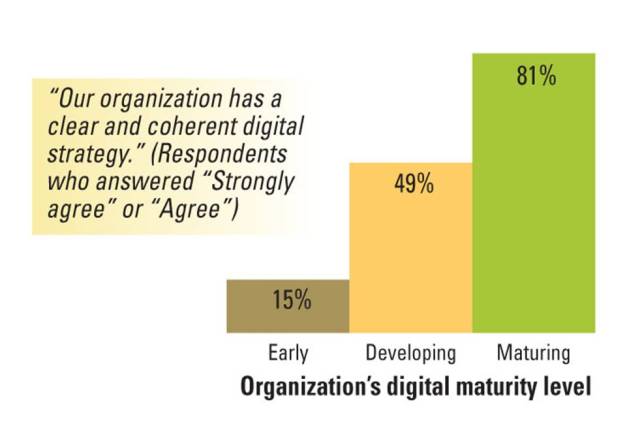
Three years of research consistently highlights the single biggest predictor of a company’s digital maturity as the existence of a clear and coherent digital strategy. In 2015, MIT Sloan Management Review’s collaborative research with Deloitte found that more than 80% of respondents who rated their companies as digitally maturing said that their organizations had a clear and coherent digital strategy, a sentiment felt by less than 20% of respondents from less digitally mature companies.

Sloan1a

Given the central importance of strategy to digital maturity, you may be surprised to learn that this article is not going to help you or your company develop a digital strategy. Developing an effective digital strategy is something that must be tailored to the organization and involves a careful assessment of the competitive environment, your organization’s capabilities and resources, the state of relevant technology, and a host of other possible variables.

Entire books have been written on particular types of digital strategies, and many of these are quite good. For example, George Westerman, Didier Bonnet, and Andrew McAfee offer a nice treatment of how large companies are using digital to gain strategic advantage. David Rogers of Columbia University penned a volume on how leaders should update their thinking for a digital age. Marshall Van Alstyne and his colleagues wrote a book just for strategies for platform businesses. I can even recommend my colleague John Gallaugher’s textbook as perhaps the most consistently up-to-date discussion of digital strategy out there — he updates the material yearly.

Given the diversity represented in these texts alone, there are likely many different digital strategies that may be effective in a given setting. Digital tools can be used in many different “right” — and surprising — ways to add value to an organization.

Despite the many differences between the nature of digital strategy at digitally maturing companies, our research demonstrates that these strategies still share a number of common characteristics. Understanding these shared characteristics can help ensure that your company’s digital strategy — whatever it may be — is on the right track.

Think Long(er) Term

Digitally maturing companies tend to think on a longer time horizon when developing their strategy. Maturing companies are roughly twice as likely as early and developing companies to look five or more years out when completing this exercise. Although the past decade has seen widespread digital disruption with the rise of social media, mobile platforms, and analytics, new digital disruptions are coming over the next decade that will be at least as disruptive — such as virtual reality, artificial intelligence, and increased automation. Developing a digital strategy is not a “one-and-done” effort; it continues to evolve in step with technological innovations.

Yet even a time horizon of five years may not be long enough. Deloitte’s John Hagel lamented that most companies don’t look far enough ahead when thinking about digital strategy. Instead of the one- to three-year time frame that most companies use for digital strategy, Hagel advocates using a 10- to 20-year time frame — at least at times. In our own research, we found that the vast majority of companies are not thinking on this long time frame. Yet more and more leaders are recognizing that such a long view is necessary. For example, Walmart Stores Inc. recognized that it needed to start its digital transformation now, because what customers will want 10 years from now will be radically different than what they want today.

Effectively Communicate Digital Strategy to Employees

Second, while our research clearly demonstrates that top management support is indispensable when executing digital strategy, so is getting buy-in from lower-level managers and frontline employees.

These managers can serve as effective sensors for unintended barriers to or implications of your digital strategy. For example, when Volvo Car Corp. began innovating with connected cars, it led a number of other changes to its management, contracting, and partnering to support the type of innovation the company was cultivating. Cross-functional connections and knowledge sharing were key. Without strong communication across all levels of the organization, top managers may not be aware when changes are necessary to help the digital strategy reach its goals.

Non-executive leaders can also serve as valuable first responders, helping to tackle problems that may occur with respect to executing your digital strategy. Thus, once this strategy has been effectively communicated to them, they should be given some latitude to act when they identify issues. One of the working hypotheses for our 2018 research is that more digitally mature companies push decision-making further down into the organizational hierarchy to enable the organization to respond faster to digital trends.

Make Digital Strategy Core to the Business

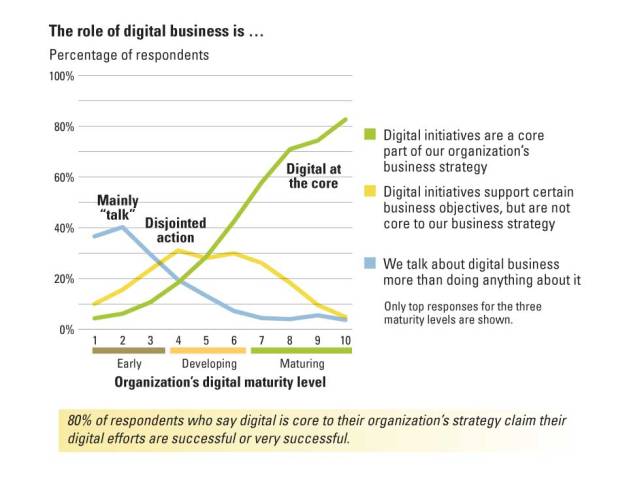
Lastly, digital strategy in the most advanced companies typically involves their core business. In contrast, respondents from less digitally mature companies indicate either that their organization talks more about digital business than acts on it or that it thinks of digital business strategy as a collection of one-off initiatives that does little to affect the core business.

Sloan1

This response continues a theme that we’ve seen manifest in our research across the years of the study: Digital strategy isn’t just thinking of new initiatives that enable organizations to do business in the same way but slightly more efficiently. Instead, it involves fundamentally rethinking how one does business in light of all of the digital trends occurring both inside and outside the organization. It involves identifying potential new services, sources of revenue, and ways of interacting with employees.

Yet effective digital strategy also involves treating these new possibilities as both an opportunity for your company and a threat. This technological infrastructure is also available to your established competitors or new startups, who may beat you to the punch for offering these new services or revenue streams and hurt your ability to compete. Keeping digital strategy as a core component of your overall strategy includes continuous observation of the competitive landscape, as well as ongoing experimentation to determine how your organization can leverage the strategic opportunities provided by ever-evolving technologies.

Article link: http://sloanreview.mit.edu/article/three-characteristics-of-a-winning-digital-strategy/

About the Author

Gerald C. (Jerry) Kane is a professor of information systems at the Carroll School of Management at Boston College and the MIT Sloan Management Review guest editor for the Digital Business Initiative. He can be reached at gerald.kane@bc.edu and on Twitter @profkane.

State Department to Use Blockchain in Reorganization – MeriTalk

Posted by timmreardon on 10/12/2017
Posted in: Uncategorized. Leave a comment

By: Morgan Lynch                                                                                                   Oct 11, 2017

statejpg

The State Department is seeking to use blockchain technology to improve its IT platforms and to restructure the agency.

“Protecting our cyber infrastructure and providing resilient and relevant technology to the women and men of the State Department and USAID [U.S. Agency for International Development] is crucial to helping them do their jobs efficiently all around the world, 24 hours a day,” John J. Sullivan, deputy secretary of State, said at the George C. Marshall Center Blockchain Forum on Oct. 10.

The State Department is integrating blockchain into its agency reorganization effort, which was mandated by the White House in March. The reorganization plan seeks to reduce the workforce, save Federal money, and maximize employee productivity.

“We’re interested to learn whether blockchain technology could have direct applications to many of the key features of our proposed redesign plan–for example, in maximizing the impact and accountability of foreign assistance,” Sullivan said. “Two major challenges in foreign assistance that blockchain technology could address are, first, corruption, fraud, or misappropriation of funds and, second, inefficiencies within the aid delivery process itself.”

This forum discussed the use of blockchain-based aid-tracking systems that could bring more transparency to where foreign assistance funds come from, and where they end up.

Representatives from the State Department participated in breakout sessions in order to learn how blockchain can affect cybersecurity, encryption of data, immutable records, and decentralized networks.

Sullivan said that he is interested in developing partnerships with private companies that will help the agencies use blockchain effectively.
“Through these partnerships, we can take advantage of the creativity, unique capacity, and resources of all sectors to advance our diplomacy and development objectives,” Sullivan said. “Nowhere is this partnership more relevant than with the new technologies that are quickly evolving. But we’re certainly hopeful that the State Department and the Federal government can leverage this technology to make us more efficient and better able to serve the American people.”
Sullivan said that blockchain technology is estimated to grow to more than $40 billion by 2022.

The State Department has observed the effect that blockchain technology has had over various countries, including Estonia, where the government uses blockchain to offer digital IDs. Also, the Georgian government launched a program to register land titles using a private blockchain, the United Arab Emirates has started to use blockchain to make Dubai paperless by 2020, Singapore has opened a center for blockchain technology, and the U.N. is working with companies to create blockchain pilot projects that help refugees by developing economic identities and delivering humanitarian aid more efficiently.

“So blockchain technology is on the move around the world,” Sullivan said. “It is, therefore, essential that we better understand this cutting-edge technology, as it becomes more ubiquitous in our economy.”

Sullivan said that the Federal government is looking for ways that blockchain can strengthen national security, and promote economic prosperity.
“In particular, we’re excited about the many ways blockchain technology could also increase transparency and accountability here at the State Department and across the Federal government,” Sullivan said. “In the simplest terms, we’re always open to exploring new ways to perform government functions more efficiently and effectively.”

Article link: https://www.meritalk.com/articles/state-department-to-use-blockchain-in-agency-reorganization

US State Department Seeks Blockchain Boost Amid $10Billion Reboot

Posted by timmreardon on 10/12/2017
Posted in: Uncategorized. Leave a comment

Oct 12, 2017 at 10:00 UTC by Aaron Stanley

The U.S. agency that oversees foreign affairs is looking seriously at blockchain.

That’s according to John Sullivan, U.S. Deputy Secretary of State, who encouraged the State Department and its private sector partners to embrace the technology as a way to “advance diplomacy and development objectives” at the Blockchain@State forum held Tuesday in Washington, D.C.

Speaking to an audience comprised of other government agencies, members of the private sector and non-profits, Sullivan went so far as to suggest blockchain could be a key part of the massive restructuring of the department proposed by Secretary of State Rex Tillerson, who leads the agency.

Sullivan told attendees:

“This forum has implications for our ongoing redesign efforts. We’re interested to learn whether blockchain technology can have direct applications to many of the key features of our proposed redesign.”

Tillerson first proposed the redesign, which seeks to save as much as $10 billion over five years, in September. And while Sullivan acknowledged blockchain isn’t a “panacea” to the agency’s problems, he emphasized that he’s keen to see the technology used to improve internal processes and capture efficiency gains.

The forum explored numerous ways in which blockchains might improve core agency mandates such as administering foreign aid, promoting democracy and improving governance and political institutions in U.S.-allied countries.

With that, Sullivan (who was appointed by President Donald Trump and sworn in this May) urged the agency and its stakeholders to think hard about how the technology could be deployed in a diplomatic context to strengthen national security and promote greater economic prosperity.

Identity is in

And at least some industry participants are taking Sullivan’s encouragement to heart.

For instance, Joseph Lubin, founder and CEO of ConsenSys, the New York-based blockchain development firm that co-sponsored the event, argued that a blockchain-based self-sovereign identity scheme could have an immediate and far-reaching impact toward the agency’s goals, especially those that have to do with humanitarian aid.

Lubin told CoinDesk:

“Once people own their own identity, then they’re less enthralled to their governments and less subject to adverse situations like natural disasters and wars. So, if someone is ejected from their country, if they’ve already established self-sovereign identity they can reconstitute their life.”

Other speakers at the event agreed, with Ashish Gadnis, CEO of BanQu, a provider of identity and financial services in developing countries, highlighting the importance of end users owning, controlling and possibly monetizing their personal data.

“All the aid we give to refugees is one-sided. This means that they are recipients of transactions from people like us, yet … they don’t exist because they don’t own or control their own data,” Gadnis said.

Sullivan also gave credence to the idea that blockchain could combat pervasive challenges in the area of foreign aid distribution such as corruption, fraud and the misappropriation of funds. He continued, saying these same challenges might not only be solved in aid distribution, but also in other areas, such as eliminating the corruption in government’s control over land title registries in the developing world.

While the concept of a blockchain-based self-sovereign identity has been a favorite of the industry, it’s a particularly hard problem to fix – one that some believe depends on how advanced smart contract technology becomes, another area Lubin called attention to.

In his mind, constructing international frameworks and treaties using smart contracts could serve as a means to combat the “free rider” problems associated with agreements like the United Nations or NATO, both of which deal with member countries frequently failing to fulfill their financial commitments with little consequence.

U.S. wakes up

Yet, the State Department’s forum comes amid increasing interest by government agencies throughout the world to understand and harness the technology. While some governments have moved to ban cryptocurrency and the tools that have come from it, most are taking a more open-minded approach.

“Blockchain technology is on the move around the world, so it is, therefore, essential that we better understand this cutting-edge technology as it becomes more ubiquitous in our economy,” Sullivan said, highlighting ongoing distributed ledger projects in Estonia, Georgia, Dubai and Singapore.

Sullivan’s bullish remarks, coupled with growing interest from the State Department and other agencies within the U.S. government, are being well-received by the blockchain community.

Not only was ConsenSys a presence at the forum, but distributed ledger consortium R3, enterprise blockchain firm BitFury and a handful of industry startups were in attendance.

“We’re particularly excited that the U.S. is waking up, big time, and realizing that this is a transformative technology,” said Lubin, adding that he hopes the country will emerge as a critical agent in advancing the technology worldwide.

Lubin said:

“There are other smaller players who are embracing this technology strongly, but we do want to see America get out in front of this and transform society with it.”

Article link: https://www.coindesk.com/us-state-department-seeks-blockchain-boost-amid-10-billion-reboot/

China sprints ahead in CRISPR therapy race – AFHSB/Science

Posted by timmreardon on 10/11/2017
Posted in: Uncategorized. Leave a comment

Dennis Normile

Science  06 Oct 2017:
Vol. 358, Issue 6359, pp. 20-21
DOI: 10.1126/science.358.6359.20

Summary

CRISPR, the wildly popular genome-editing research tool, was invented in the West, but it is speeding toward potential human applications in China. Last week, the Chinese team that sparked a worldwide debate in 2015 when it reported the first use of CRISPR to edit a human embryo’s genome notched another first. In early embryos, they showed that a new CRISPR variant, which chemically modifies rather than cuts DNA, can correct the mutation causing a debilitating blood disease. But the most striking evidence of progress in China can be found on the clinicaltrials.gov database: Of the 10 listed trials of CRISPR in patients, nine are in China, where streamlined safety and ethical reviews have given researchers a head start. Three of the groups confirmed to Science that they are infusing cancer patients with their own immune cells modified using CRISPR.

Article link: http://science.sciencemag.org/content/358/6359/20

Senators ask GAO for recommendations on unique patient identifiers – Healthcare IT News

Posted by timmreardon on 10/11/2017
Posted in: Uncategorized. Leave a comment

At the same time, Regenstrief has launched a five-year effort that it hopes can help solve the problem.

By Bernie Monegain  October 06, 2017

IDs


The complicated and elusive issue of patient matching is about to get a boost with the Government Accountability Office, which is poised to launch a study of the topic and offer recommendations.

Several healthcare IT organizations have tackled the issue of patient matching, but with no concrete results to show for it to date.

The most recent group to make an effort on the complicated issue is Regenstrief Institute. Last August Regenstrief won a $1.7 million grant over five years to take a crack at the complicated matter.

[Also: Regenstrief wins $1.7 million AHRQ grant to tackle the elusive patient ID puzzle]

The GAO work comes at the behest of a provision in the 21st Century Cures Act, and the five senators behind it have asked the GAO for its advice.

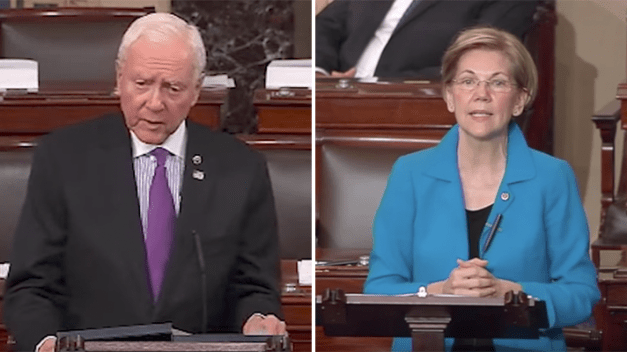
In the Oct. 3 letter to the GAO, Sens. Elizabeth Warren, Orrin Hatch, Sheldon Whitehouse, Tammy Baldwin and Bill Cassidy asked for “clear recommendations for steps that federal agencies – specifically ONC – could take to develop improved patient matching methods.”

The senators also asked the GAO to provide data on the prevalence of patient data mismatches and the costs and risks associated with these mismatches.

[Also: Patient matching strategy gains ground with support from Congress]

They also point out that patient misidentification can lead to inadequate, inappropriate, and costly care and, in the worst cases, patient harm or death.

In 1996, when HIPAA was signed into law, it required the creation of patient identifiers and other uniform standards for electronic data transmission to improve reliability of health information, the senators note in their letter.

However, Congress later barred the Department of Health and Human Services from spending funds to develop a unique patient identifier system.

As a result, the development of patient identifiers are often proprietary and unique to specific health systems, instead of one identifier that travels with a patient from provider to provider, they added.

Article link:

Twitter: @Bernie_HITN
Email the writer: bernie.monegain@himssmedia.com


Posts navigation

← Older Entries
Newer Entries →
  • Search site

  • Follow healthcarereimagined on WordPress.com
  • Recent Posts

    • The Global Healthcare System Is Broken. Japan Fixed It for $4,100 Per Person. 04/10/2026
    • When Not to Use AI – MIT Sloan 04/01/2026
    • There are more AI health tools than ever—but how well do they work? – MIT Technology Review 03/30/2026
    • Are AI Tools Ready to Answer Patients’ Questions About Their Medical Care? – JAMA 03/27/2026
    • How AI use in scholarly publishing threatens research integrity, lessens trust, and invites misinformation – Bulletin of the Atomic Scientists 03/25/2026
    • VA Prepares April Relaunch of EHR Program – GovCIO 03/19/2026
    • Strong call for universal healthcare from Pope Leo today – FAN 03/18/2026
    • EHR fragmentation offers an opportunity to enhance care coordination and experience 03/16/2026
    • When AI Governance Fails 03/15/2026
    • Introduction: Disinformation as a multiplier of existential threat – Bulletin of the Atomic Scientists 03/12/2026
  • Categories

    • Accountable Care Organizations
    • ACOs
    • AHRQ
    • American Board of Internal Medicine
    • Big Data
    • Blue Button
    • Board Certification
    • Cancer Treatment
    • Data Science
    • Digital Services Playbook
    • DoD
    • EHR Interoperability
    • EHR Usability
    • Emergency Medicine
    • FDA
    • FDASIA
    • GAO Reports
    • Genetic Data
    • Genetic Research
    • Genomic Data
    • Global Standards
    • Health Care Costs
    • Health Care Economics
    • Health IT adoption
    • Health Outcomes
    • Healthcare Delivery
    • Healthcare Informatics
    • Healthcare Outcomes
    • Healthcare Security
    • Helathcare Delivery
    • HHS
    • HIPAA
    • ICD-10
    • Innovation
    • Integrated Electronic Health Records
    • IT Acquisition
    • JASONS
    • Lab Report Access
    • Military Health System Reform
    • Mobile Health
    • Mobile Healthcare
    • National Health IT System
    • NSF
    • ONC Reports to Congress
    • Oncology
    • Open Data
    • Patient Centered Medical Home
    • Patient Portals
    • PCMH
    • Precision Medicine
    • Primary Care
    • Public Health
    • Quadruple Aim
    • Quality Measures
    • Rehab Medicine
    • TechFAR Handbook
    • Triple Aim
    • U.S. Air Force Medicine
    • U.S. Army
    • U.S. Army Medicine
    • U.S. Navy Medicine
    • U.S. Surgeon General
    • Uncategorized
    • Value-based Care
    • Veterans Affairs
    • Warrior Transistion Units
    • XPRIZE
  • Archives

    • April 2026 (2)
    • March 2026 (9)
    • February 2026 (6)
    • January 2026 (8)
    • December 2025 (11)
    • November 2025 (9)
    • October 2025 (10)
    • September 2025 (4)
    • August 2025 (7)
    • July 2025 (2)
    • June 2025 (9)
    • May 2025 (4)
    • April 2025 (11)
    • March 2025 (11)
    • February 2025 (10)
    • January 2025 (12)
    • December 2024 (12)
    • November 2024 (7)
    • October 2024 (5)
    • September 2024 (9)
    • August 2024 (10)
    • July 2024 (13)
    • June 2024 (18)
    • May 2024 (10)
    • April 2024 (19)
    • March 2024 (35)
    • February 2024 (23)
    • January 2024 (16)
    • December 2023 (22)
    • November 2023 (38)
    • October 2023 (24)
    • September 2023 (24)
    • August 2023 (34)
    • July 2023 (33)
    • June 2023 (30)
    • May 2023 (35)
    • April 2023 (30)
    • March 2023 (30)
    • February 2023 (15)
    • January 2023 (17)
    • December 2022 (10)
    • November 2022 (7)
    • October 2022 (22)
    • September 2022 (16)
    • August 2022 (33)
    • July 2022 (28)
    • June 2022 (42)
    • May 2022 (53)
    • April 2022 (35)
    • March 2022 (37)
    • February 2022 (21)
    • January 2022 (28)
    • December 2021 (23)
    • November 2021 (12)
    • October 2021 (10)
    • September 2021 (4)
    • August 2021 (4)
    • July 2021 (4)
    • May 2021 (3)
    • April 2021 (1)
    • March 2021 (2)
    • February 2021 (1)
    • January 2021 (4)
    • December 2020 (7)
    • November 2020 (2)
    • October 2020 (4)
    • September 2020 (7)
    • August 2020 (11)
    • July 2020 (3)
    • June 2020 (5)
    • April 2020 (3)
    • March 2020 (1)
    • February 2020 (1)
    • January 2020 (2)
    • December 2019 (2)
    • November 2019 (1)
    • September 2019 (4)
    • August 2019 (3)
    • July 2019 (5)
    • June 2019 (10)
    • May 2019 (8)
    • April 2019 (6)
    • March 2019 (7)
    • February 2019 (17)
    • January 2019 (14)
    • December 2018 (10)
    • November 2018 (20)
    • October 2018 (14)
    • September 2018 (27)
    • August 2018 (19)
    • July 2018 (16)
    • June 2018 (18)
    • May 2018 (28)
    • April 2018 (3)
    • March 2018 (11)
    • February 2018 (5)
    • January 2018 (10)
    • December 2017 (20)
    • November 2017 (30)
    • October 2017 (33)
    • September 2017 (11)
    • August 2017 (13)
    • July 2017 (9)
    • June 2017 (8)
    • May 2017 (9)
    • April 2017 (4)
    • March 2017 (12)
    • December 2016 (3)
    • September 2016 (4)
    • August 2016 (1)
    • July 2016 (7)
    • June 2016 (7)
    • April 2016 (4)
    • March 2016 (7)
    • February 2016 (1)
    • January 2016 (3)
    • November 2015 (3)
    • October 2015 (2)
    • September 2015 (9)
    • August 2015 (6)
    • June 2015 (5)
    • May 2015 (6)
    • April 2015 (3)
    • March 2015 (16)
    • February 2015 (10)
    • January 2015 (16)
    • December 2014 (9)
    • November 2014 (7)
    • October 2014 (21)
    • September 2014 (8)
    • August 2014 (9)
    • July 2014 (7)
    • June 2014 (5)
    • May 2014 (8)
    • April 2014 (19)
    • March 2014 (8)
    • February 2014 (9)
    • January 2014 (31)
    • December 2013 (23)
    • November 2013 (48)
    • October 2013 (25)
  • Tags

    Business Defense Department Department of Veterans Affairs EHealth EHR Electronic health record Food and Drug Administration Health Health informatics Health Information Exchange Health information technology Health system HIE Hospital IBM Mayo Clinic Medicare Medicine Military Health System Patient Patient portal Patient Protection and Affordable Care Act United States United States Department of Defense United States Department of Veterans Affairs
  • Upcoming Events

Blog at WordPress.com.
healthcarereimagined
Blog at WordPress.com.
  • Subscribe Subscribed
    • healthcarereimagined
    • Join 153 other subscribers
    • Already have a WordPress.com account? Log in now.
    • healthcarereimagined
    • Subscribe Subscribed
    • Sign up
    • Log in
    • Report this content
    • View site in Reader
    • Manage subscriptions
    • Collapse this bar
 

Loading Comments...