healthcarereimagined

Envisioning healthcare for the 21st century

  • About
  • Economics

Americans’ Confidence in Their Ability to Pay for Health Care Is Falling – Commonwealth Fund

Posted by timmreardon on 07/02/2018
Posted in: Uncategorized. Leave a comment

CommonwealthxSurvey shows only about half of Americans would have money to pay for an unexpected medical bill of $1000.

May 10, 2018 Sara R. Collins, Munira Z. Gunja, Michelle M. Doty, and Herman K. Bhupal

Toplines

One-quarter of adults say health care has become harder to afford, new survey finds

Survey shows only about half of Americans would have money to pay for an unexpected medical bill

President Trump is expected to soon address the nation about the rising cost of prescription drugs. But Americans are worried about more than drug prices. New findings from the Commonwealth Fund Affordable Care Act Tracking Survey show that consumers’ confidence in their ability to afford all their needed health care continues to decline.

Last week, we reported that the survey indicated a small but significant increase in the uninsured rate among working-age adults since 2016. In this post, we look at people’s views of the affordability of their health care. The Affordable Care Act Tracking Survey is a nationally representative telephone survey conducted by SSRS that tracks coverage rates among 19-to-64-year-olds, and has focused in particular on the experiences of adults who have gained coverage through the marketplaces and Medicaid. The latest wave of the survey was conducted between February and March 2018.1

Findings

Confidence in Ability to Afford Health Care Continues to Decline

In each wave of the survey, we’ve asked respondents whether they have confidence in their ability to afford health care if they were to become seriously ill. In 2018, 62.4 percent of adults said they were very or somewhat confident they could afford their health care, down from a high of nearly 70 percent in 2015 (Table 1). Only about half of people with incomes less than 250 percent of poverty ($30,150 for an individual) were confident they could afford care if they were to become very sick, down from 60 percent in 2015 and about 20 percentage points lower than the rate for adults with higher incomes. There were also significant declines in confidence among young adults, those ages 50 to 64, women, and people with health problems. Declines were significant among both Democrats and Republicans.

Commonwealthw1

Read more: https://www.commonwealthfund.org/blog/2018/americans-confidence-their-ability-pay-health-care-falling


Proposed CMS interoperability requirements split industry groups – Healthcare IT News

Posted by timmreardon on 07/01/2018
Posted in: Uncategorized. Leave a comment

While Intel, Beth Israel Deaconess and others threw their support behind the CMS proposed plan to make interoperability mandatory for Medicaid and Medicare billing, AHA and other stakeholders slammed the proposal as “premature” and “duplicative.”

By Jessica Davis

June 28, 2018

HITNx2

A proposed Centers for Medicare and Medicaid Services rule that would mandate data sharing for organizations participating in the program has split the industry into a wide debate that questions what’s needed to get healthcare providers to share necessary patient information.

Proposed in April, the proposed rule would mandate providers share patients’ discharge information and other relevant information as part of the conditions of participation. Stakeholders had until June 26 to give feedback on the proposal, and there are a wide range of supporters and protestors on both sides of the argument.

Unhappy stakeholders

The American Hospital Association is staunchly against the proposed rule and is concerned about how compliance would be measured. The group also highlighted the difficulties in sharing medical data with post-acute providers.

AHA officials said those groups weren’t provided the resources or incentives to adopt health IT and the “requirement would put another unfunded mandate on these organizations.”

“Such a requirement would only be workable if all facilities were afforded the same opportunity to acquire certified EHRs that actually conformed to standards that enable the kind of interoperability CMS envisions,” the group wrote.

[Also: Next-gen interoperability: AI, blockchain, FHIR and open source analytics]

CHIME officials said CMS is taking the wrong approach: “Simply imposing regulatory requirements that make electronic data exchange a condition for providers to receive Medicare payment does not address the root issues at play.”

Instead, CMS needs to address the ongoing challenges surrounding interoperability, and “importantly too, a distinction must be drawn between speeding and increasing data exchange among providers and achieving a true state of interoperability. The two should not be conflated.”

The Electronic Health Record Association echoed those opinions, and officials said that CMS first needs to address information blocking and wait for the 21st Century Cures mandates are complete.

“It is additionally unclear how interoperability expectations in the conditions of participation would be evaluated and audited, but it seems likely that evaluation and auditing of these items would generate additional hospital burden.”

Also opposing the rule was the American Medical Informatics Association, which sent in 38 pages of comments. Although the group is “generally supportive of the balance envisioned” by the rule, officials wonder whether the proposed standard would actually help information blocking.

AMIA officials said they think that providers do want to share information, but it “isn’t occurring consistently.” As a result, CMS should first handle the information blocking rule before it modifies the conditions of participation.

“We recommend CMS focus its inquiry on provider-to-patient information flows and calibrate its policies to ensure that all entities receiving Medicare funds provide patients 24x7x365 access to their information in a persistent manner and without special effort,” the group wrote.

“We find the concept of ‘medically necessary information’ somewhat abstract and very context-dependent,” they added.

Those in favor

Those in support of the rule argued that the technology makes data sharing possible and enforcing data sharing as a condition of participation will force providers to improve care coordination.

HIMSS was among the supporters that feel CMS should explore “all available policy levers to promote interoperability,” and those include revising the conditions of participation. Further, officials suggested CMS modify the Trusted Exchange Framework and Common Agreement to help organizations meet those requirements.

A group of 50 organizations, including ACOs, health information exchanges, Intel, Beth Israel Deaconess and others sent a letter, voiced support of the proposed rule, calling on CMS to more aggressively promote interoperability and health information exchange.

“Now is the moment for a focused and rigorous effort to liberate the data currently available in the healthcare system to enable patients and their providers seamlessly access and share all their digital health information,” the groups wrote.

“We believe the time is right to move past the current rigid and siloed system into one prepared to take advantage of all the opportunities made available in our digital age,” they continued.

The supporters also said the data sharing policy would be a tremendous benefit to millions of patients and stressed that discharged information should not only be required, but share within 24-hours. But the groups said that it’s important for CMS to allow providers to meet those requirements over time.

CMS plans to review all provided stakeholder comments when it develops its regulatory proposals and guidance.

Article link: https://www.healthcareitnews.com/news/proposed-cms-interoperability-requirements-split-industry-groups

Twitter: @JessieFDavis
Email the writer: jessica.davis@himssmedia.com

Topics:

Government & Policy, Interoperability

Drop in U.S. life expectancy is an ‘indictment of the American health care system’ – STAT

Posted by timmreardon on 06/28/2018
Posted in: Uncategorized. Leave a comment

By David Blumenthal

January 4, 2018

birthday candle

The economy may be growing and the stock market booming, but Americans are dying younger — living shorter lives than previous generations and dying earlier than their counterparts around the world.

It is easy to place the blame squarely on our nation’s opioid epidemic, but if we do that we miss seeing the abysmal new life expectancy data from the Centers for Disease Control and Prevention for what they are — an indictment of the American health care system.

According to the CDC, the average life expectancy at birth in the U.S. fell by 0.1 years, to 78.6, in 2016, following a similar drop in 2015. This is the first time in 50 years that life expectancy has fallen for two years running. In 25 other developed countries, life expectancy in 2015 averaged 81.8 years.

There’s no question that a big culprit is the opioid epidemic, which contributed significantly to an increase in death rates for Americans aged 15 to 64 years. At first glance, substance abuse would seem more a social and economic problem than one of health care, and there is no question that socioeconomics are a major player in causing the so-called deaths of despair associated with substance abuse.

But, we cannot let our health care system off too easily.

Related:
Life expectancy in the U.S. is falling — and drug overdose deaths are soaring

The epidemic of drug abuse and overdose deaths has not affected other developed countries the way it has ours. With 4 percent of the world’s population, the U.S. accounts for 27 percent of the world’s overdose deaths. The European Union, with a population of 507 million, reported 6,800 overdose deaths in 2014, compared to 47,055 in the U.S. That disparity exists even though many other developed countries have faced even greater economic challenges than we have. In 2016, France and Spain had unemployment rates of 10.1 and 19.6 percent, respectively, compared to 4.9 percent in the U.S.

Why has it been it so much worse here? One reason is that the U.S. doesn’t have strong social safety nets that buffer the effects of recessions and job loss as other nations do. Another reason is the way the U.S. health care system functions.

The profitability of drugs in the United States, a result of sky-high and skyrocketing drug prices, has made the aggressive marketing and sale of new prescription opioids an almost irresistible temptation for American pharmaceutical companies. Bombarded by clever advertising, U.S. physicians have, in turn, become quicker on the draw in prescribing opioids than physicians in other developed nations. The role of pharma is most clearly illustrated in the case of Purdue Pharma, which has been sued thousands of times over OxyContin, a prescription painkiller. The company settled one case for $600 million after the federal government accused it of making false claims about the drug’s risk of addiction and denying its potential to be abused. A raft of new suits by cities and states claiming that drug companies have profited from a product they knew to be dangerous are now pending.

The opioid epidemic is not the only area in which the U.S. health system lags. In 2015, life expectancy at age 65 in the U.S. ranked 26th among the 37 members of the Organization for Economic Cooperation and Development, which includes most developed nations. It is widely accepted that the accessibility and quality of medical services strongly affect life expectancy among the elderly and elderly Americans fall behind their counterparts overseas when it comes to being able to get and afford the health care they need.

This may seem surprising given that Americans over 65 enjoy universal health insurance coverage under Medicare. But as valuable as Medicare is, it provides far less protection against the cost of illness, and far less access to services, than do most other Western countries. In a recent cross-national survey, U.S. seniors were more likely to report having three or more chronic illnesses than their counterparts in 10 other high-income countries. At the same time, they were four times more likely than seniors in countries such as Norway and England to skip care because of costs. Medicare, it turns out, is not very good insurance compared to what’s available in most of the western world.

We are the wealthiest nation on earth, but far from the healthiest, and things are getting worse, not better. The CDC report is yet another call to action for fundamental health system change that should include, among other things, reforming our pharmaceutical markets and making good health insurance available to all Americans. These need to be urgent priorities in 2018 for a government that should care as much about the health of Americans as their wealth.

Article link: https://www.statnews.com/2018/01/04/life-expectancy-us-health-care/

David Blumenthal, M.D., is president of the Commonwealth Fund.

About the Author

David Blumenthal
@DavidBlumenthal
facebook.com/commonwealthfund/

VA tackles interoperability, massive data stores with open FHIR API project – Healthcare IT News

Posted by timmreardon on 06/28/2018
Posted in: Uncategorized. Leave a comment

Veterans Health Affairs’ director of standards and interoperability warns that FHIR is not a cure all, just one valuable asset in a tech toolbox.

By Jessica Davis

June 19, 2018
HITN1y

BOSTON — The U.S. Department of Veterans Affairs over the last year has made a pointed shift to modernize the agency: First with the announcement to replace its legacy EHR with Cerner in June 2017 and next with several platforms to boost transparency and telemedicine efforts.

But the launch of its open API project in March – once dubbed Lighthouse and now called the VA API Developer Sandbox – is zeroed in on interoperability and modernization. Led by University of Pittsburgh Medical Center Chief Innovation Officer Rasu Shrestha, the project has grown with dozens of other hospitals joining the effort.

To Ken Rubin, director of standards and interoperability for the Veterans Health Affairs Office of Knowledge Based Systems, the VA has some pretty tremendous data challenges that it hopes the API project and FHIR can tackle.

[Also: FHIR and Open APIs are here to stay – but are they ready for prime time?]

For each patient, the VA can have up to 150 years of data, Rubin explained. But another issue is the increase of consumer-based and direct care and the expansion of care for veterans into the private sector.

“About 50 percent of veterans’ care happens within the VA. Those numbers vary, but the bottom line is that there’s a huge amount of care happening outside the VA,” Rubin said at HL7’s DevDays on Tuesday.

“So even if we solve interoperability within the VA, we’ve only solved half of the problem,” he added.

The VA also is working to be self-organizing when it comes to data, as it automates and transitions its workflows. Especially as there’s “a huge spectrum of data that comes back to the VA” from the private sector, the agency needs to do a better job of orchestrating that data transfer and ensuring the next step of care “can pick up and carry that ball forward.”

Rubin also expressed concern about the idea that FHIR is a cure-all for interoperability. While it’s great for getting data on an individual patient, it’s limited when it comes to aggregating data from the system to determine a set of behaviors.

“FHIR is a great tool, but it’s not the only tool,” Rubin said. “Don’t use FHIR as a hammer to pound screws. Use FHIR in areas where it needs to grow.”

“It’s not about picking a version: The VA will always have to support other systems until there’s ubiquity across the sector,” Rubin added. “Bear that in mind: We’re only addressing a piece of the puzzle.”

IT is often seen as a drag to productivity, which is a problem the VA is trying to solve by leaning on private sector developers and providers to share data and develop apps to make that data usable, Rubin explained.

“We can’t do it alone. We want to engage the ecosystem, that’s why we’re here. We believe in where FHIR is going and it’s an essential tool in the toolbox,” Rubin said. “Availability of data is critically important, but the body of medical data grows every month – you won’t be able to keep pace. Knowledge is critically important to data and processing interoperability.”

Article link: https://www.healthcareitnews.com/news/va-tackles-interoperability-massive-data-stores-open-fhir-api-project

Twitter: @JessieFDavis
Email the writer: jessica.davis@himssmedia.com

Topics:

Analytics, Government & Policy, Interoperability, Mobile, Telehealth

AT&T, Time Warner, and the Future of Health Care – Commonwealth Fund

Posted by timmreardon on 06/26/2018
Posted in: Uncategorized. Leave a comment
Commonwealthx

June 21, 2018
David Blumenthal, M.D.
Commonwealth - ATT

Toplines

Policymakers and private actors should not interpret a federal court’s AT&T and Time Warner ruling as an unconditional green light for vertical integration in health care


The need for change in the U.S. health care system is obvious, but whether vertical integration is the change we need remains to be determined

The recent federal district court ruling allowing the merger of AT&T and Time Warner — a case of so-called vertical integration — will likely encourage similar unions throughout the U.S. economy, including in health care. Nevertheless, a close look at the court’s decision, and at the wide variety of vertical health care mergers under way, suggests that policymakers and private actors should not interpret the court’s ruling as an unconditional green light for vertical integration in health care, or any other sector.

Vertical integration typically involves the combination of entities operating on different parts of a supply chain in the production of a particular product. Manufacturers of tires, for example, are part of the supply chain that results in a finished automobile. Similarly, ambulatory physician services are sometimes seen as an input on the supply chain of more advanced hospital services. The acquisition of physician practices by hospitals is often characterized as vertical integration.

Some antitrust experts question whether the analogy between manufactured products and health care delivery is accurate. Independent physicians, for example, often work within hospitals and help to produce their “products.” Nevertheless, there are clear differences between mergers across the same types of health care organizations, like hospitals, and those between different types of providers, like physicians and hospitals.

The AT&T/Time Warner case was the first time in 40 years that the government has taken a proposed vertical integration to court, and many commentators have noted that antitrust theory with respect to vertical integration could use some updating. In the meantime, however, Judge Richard Leon’s 172-page opinion seems to have relied on traditional antitrust considerations: would the merger increase or decrease competition, and thereby increase or decrease consumer welfare? His ruling rested heavily on what he viewed as the government’s failure to supply evidence that the merger would have adverse effects. In other words, if the government had produced more convincing data, the ruling could have gone the other way.

Judge Leon’s ruling may be appealed and, if so, may not stand. But if it does, what are its implications for vertical integration in health care? Simply put, the facts matter. And unfortunately, the facts about vertical integration in health care are obscure, and likely to vary enormously according to the details of the merger and from market to market.

Evidence on the effects of horizontal health care mergers has grown considerably in recent years, and generally shows that they increase prices. But studies of vertical health care mergers are much less common. Perhaps the most relevant experience concerns long-standing integrated health systems, such as Kaiser Permanente, Intermountain, Geisinger, and a handful of similar organizations.

Widely regarded as industry leaders in quality and efficiency, these systems seem to demonstrate the benefits of vertical integration: they are able to coordinate services across different types of providers, and, when incentives encourage it, they can easily substitute less expensive services (e.g., ambulatory care) for more expensive ones (e.g., hospital care). However, whether the experiences of these integrated systems are generalizable to the current flock of mergers is unclear. Each of these venerable organizations has a unique history and culture that have shaped its performance over decades.

Studies of vertical integration will have to take into account the type of merger under consideration. The most common type of vertical integration seems to be the acquisition of physician groups — both primary care and specialty — by hospitals. Between 2012 and 2016, the number of hospital-employed U.S. physicians increased from 95,000 to 155,000.

But health care is witnessing a variety of other types of vertical integration. Insurers are buying physician groups, as in the case of UnitedHealth Group’s acquisition of parts of DaVita’s physician network. Drug store chains are buying insurers, as in the case of CVS’s purchase of Aetna. And integrated health systems like Partners HealthCare are proposing to buy insurers like Harvard Pilgrim Health Care.

The effects of these varied mergers will depend on the types of services being combined and the markets affected. From both a societal and legal standpoint, the facts matter.

For example, it turns out that the CVS-Aetna merger includes an important horizontal union between Part D health plans owned independently by CVS and Aetna. Part D health plans provide drug coverage to Medicare beneficiaries. In recent testimony before the California Department of Insurance, economist Richard Scheffler showed that in a number of markets, the merger of these Part D plans would significantly reduce competition, and thereby, could potentially increase the prices of drug coverage for Medicare patients. Fear of consolidation among Part D plans has caused the American Medical Association to oppose CVS’s acquisition of Aetna.

Adding to the uncertainty surrounding these questions is the unique nature of the health market, in which governments are the largest purchasers and consumers often don’t know the prices or value of the products they buy. Traditional competition in local markets sometimes results in radically increasing prices and costs, as providers pile on new technologies and facilities and compete for star physicians in an effort to attract customers. And many parts of health care already have a high degree of consolidation that limits price competition.  The result is a level of dysfunction that has created an almost universal cry for radical disruption of the status quo.

Health care is a conundrum on many levels, and how and whether to regulate vertical integration among its varied components may turn out to be another one. The need for change is obvious. Whether vertical integration is the change we need, and how the courts will treat it, remain to be determined.

Article link: https://www.commonwealthfund.org/blog/2018/att-time-warner-and-future-health-care

AHA ‘strongly opposes’ interoperability as a Medicare requirement – FierceHealthcare

Posted by timmreardon on 06/26/2018
Posted in: Uncategorized. Leave a comment

by Evan Sweeney | Jun 25, 2018

Fierce1

The American Hospital Association (AHA) has come out against a policy floated by the Centers for Medicare & Medicaid Services (CMS) to make interoperability a requirement to bill Medicare and Medicaid.

In a proposed hospital payment rule issued in April, CMS included a request for information regarding a revision to hospital Conditions of Participation (CoP) and Medicaid Conditions for Coverage (CfC) that would require hospitals to share data electronically with other hospitals, community providers and patients “if possible.”

In comments (PDF) submitted to CMS, the AHA said it “strongly opposes creating additional CoPs/CfCs to promote interoperability of health information.”

“The AHA strongly supports the creation of an efficient and effective infrastructure for health information exchange,” the nation’s largest hospital advocacy grout wrote in their letter. “This is central to the efforts of hospitals and health systems to provide high-quality coordinated care, support new models of care and engage patients in their health.

“However, we do not believe a new mandate tied to CoPs is the right mechanism to advance health information exchange,” the group added.

RELATED: CMS floats proposal tying medical records sharing to Medicare participation

CoPs are viewed as a far heftier regulatory stick, and hospitals are resistant to additional requirements that have huge repercussions for noncompliance. CMS Administrator Seema Verma has made interoperability one of her primary objectives, rolling out new initiatives this year aimed at getting data in front of patients.

AHA said the rule unfairly targets one set of actors in the healthcare ecosystem and that new requirements could have “unfortunate consequences for some hospitals and communities.”

RELATED: CMS launches new initiatives to expand patient access to health data, plans ‘complete overhaul’ of Meaningful Use

The group argued that it’s premature to consider building interoperability into CoPs or Medicaid’s CfCs until the barriers to data sharing have been fully addressed, noting that post-acute care providers, in particular, are often behind the curve with EHR implementation.

AHA also argued that compliance would be difficult for surveyors to measure, and providers can deliver care safely without interoperability.

“Instead, the AHA urges CMS to focus its attention on resolving problems created by the lack of a fully implemented exchange framework, adoption of common standards and incentives for EHR and other IT vendors to adhere to standards,” AHA said, pointing to the Trusted Exchange Framework and Common Agreement (TEFCA) release by the Office of the National Coordinator for Health IT earlier this year.

AHA also said it opposes the use of Stage 3 requirements in fiscal year 2019, a transition included in the proposed rule that would require hospitals to upgrade their EHR systems. The group was largely supportive of the agency’s proposal to rebrand the Meaningful Use program as “Promoting Interoperability” and altered its scoring system.

AHA wasn’t the only organization opposed to building interoperability into CoPs. The College of Health Information Management Executives (CHIME) said in a letter to CMS that new regulations are unnecessary, and that CMS should let existing policies such as data blocking and TEFCA to “take root” before implementing more stringent requirements.

Likewise, the American Medical Informatics Association (AMIA) said the data blocking rules “will be sufficient in stemming the nefarious aspects of information blocking, especially for provider-to-provider exchange” and recommended CMS implement those policies before moving on to Medicare and Medicaid requirements.

Comments were still filtering in on Monday ahead of the midnight deadline.

Article link: https://www.fiercehealthcare.com/tech/aha-cms-conditions-participation-interoperability-medicare-medicaid

What hospitals need to improve patient experience: Real-time point of care data – Healthcare IT News

Posted by timmreardon on 06/25/2018
Posted in: Uncategorized. Leave a comment

Beyond HCAHPS: CXOs are looking for technology to offer better patient experience as a competitive differentiator.

By Mike Miliard

June 22, 2018

HITN1

At the HIMSS Patient Engagement and Experience Summit earlier this year, Adrienne Boissy, chief experience officer at the Cleveland Clinic, said hospitals have a lot of work to do when it comes to managing the patient experience.

“We have to design for what matters most – not just for our patients, but for our clinicians,” said Boissy, to help create “not just a human experience, but humane. We must digitize moments that can be, and humanize moments that must be.”

Increasingly hospitals are cognizant that developing better patient experience is essential – not just for the obvious quality and safety reasons, but as a key competitive differentiator. And they’re learning that better and more easily accessible data is key to making that happen.

A new report from Chilmark Research polled a group of healthcare chief experience officers, chief quality officers and directors of patient experience. It found that they’re under pressure to develop data models to capture patient experience data for quality performance scores, and are looking for real-time, rather than retrospective, data to help them adjust their care delivery as needed.

However, they are likely to need help putting this plan into action, according to the latest report from Chilmark Research.

All of the CXOs interviewed for the report say they collect patient experience data for the purposes of Hospital Consumer Assessment of Healthcare Providers and Systems, or HCAHPS scores, but only a handful say they have technology at the point-of-care to collect experience data in real-time or near-real-time.

“Healthcare organizations recognize the importance of collecting data about the patient experience at the point of care, both to address issues that an individual patient might be facing and to identify problems within a department or business unit,” said the report’s author, Chilmark Research Analyst Brian Eastwood, in a statement.

“To get buy-in from executive leadership as well as front-line staff, CXOs need to align the use of point-of-care survey solutions with short- and long-term strategies for improving the overall patient experience, whether it means boosting HCAHPS scores, addressing operational challenges, or aligning with industry best practices.”

When choosing point-of-care survey vendors – Chilmark lists Allen Technologies, Bivarus, Care Analytics, EveryPatient, HealthStream, Humm Systems, MyRounding, Mytonomy, Opinionmeter, Patient Wisdom Phreezia, Survey Monkey and Yorn – hospitals should pay close attention to the platform, its functionality and usability, said Eastwood.

For instance one basic functionality would allow providers to “mitigate a bad experience shortly after discharge, if not while a patient is admitted,” he wrote. “More advanced analysis will aggregate these instances into a recommended action item for best practice or protocol improvement.”

In addition, the report found that most CXOs are looking for platforms that are “extensible enough to be leveraged by as many inpatient and outpatient departments as possible,” and that can integrate with electronic health records and business intelligence tools.

As for usability and UX, Eastwood said it’s important that health systems be able to repeatedly test the system in clinical settings to get the best performance for their patients. He noted that such point-of-care technology is “meant to obtain insight from as many patients as possible. This means end users will come from all walks of life: Young and old, urban and rural, sick and well, high-income and low-income, tech-savvy and laggard, and so on.

“Continually testing the UX will help HCOs as well as vendors understand how different demographics respond to the survey – everything from the best workflow to the right style for the buttons to what colors get the highest response rate,” he explained.

Article link: https://www.healthcareitnews.com/news/what-hospitals-need-improve-patient-experience-real-time-point-care-data#gs.bMkE6D0

Twitter: @MikeMiliardHITN
Email the writer: mike.miliard@himssmedia.com

Topics:

Clinical, Financial/Revenue Cycle Management, Patient Engagement, Quality and Safety, Workflo

Amazon-Berkshire-JPMorgan Health Venture Takes Aim at Middlemen – Bloomberg

Posted by timmreardon on 06/25/2018
Posted in: Uncategorized. Leave a comment

https://www.bloomberg.com/news/videos/2018-06-24/amazon-berkshire-jpmorgan-health-venture-takes-aim-at-middlemen-video

  • Venture seeks to improve care and cost efficiency for workers
  • CEO’s goal: ‘Take some of the middlemen out of the system’

Bloomberg1

he health venture established by Amazon.com Inc., Berkshire Hathaway Inc. and JPMorgan Chase & Co. will take aim at intermediaries in the health-care system as a part of a broad effort to reduce wasteful spending, the venture’s newly named chief executive officer said.

The still-unnamed business will initially seek to develop ways to improve care for the more than 1 million individuals who get health insurance from the three firms. Over time, the venture will make those innovations available freely to other companies, meaning that if it’s successful, its effects could be felt more broadly among the more than 150 million people in the U.S. who get their health insurance through work.

“My job for them is to figure out ways that we’re going to drive better outcomes, better satisfaction with care and better cost efficiency with new models that can be incubated for all,” Atul Gawande, the Harvard surgeon and journalist who was named last week to run the initiative, said Saturday at an Aspen Institute event.

Gawande, 52, starts July 9 at the Boston-based business, which is independent of the three firms that established it and not intended to generate profits. The companies have collectively said little about what the venture will do since announcing it in January, prompting broad speculation about its plans for upending health care.

Gawande said the venture will seek to target three kinds of waste in the health-care system: administrative costs, high prices, and improper health-care usage. He didn’t say which intermediaries the venture might target, or what its plans are.

Attacking Costs

“One source of waste is our very high administrative costs,” he said during a conversation with journalist Judy Woodruff at the Spotlight Health event. “There are a lot of middlemen in the system, and there have to be solutions that simplify that, take some of the middlemen out of the system.”

When the venture was announced, investors sent shares of health insurers, pharmacy-benefits managers and distributors lower, worried that the initiative would pressure their profits. Gawande’s remarks at the event are the most detailed to date about his plans and may confirm some of those concerns.

The biggest U.S. pharmacy-benefits managers are CVS Health Corp., Express Scripts Holding Co. and UnitedHealth Group Inc.’s OptumRx unit. UnitedHealth is the biggest U.S. health insurer, and other large carriers include Cigna Corp., Aetna Inc. and Anthem Inc.

The health industry has been reconfiguring itself, too. CVS late last year announced a deal to acquire Aetna, and Cigna in March agreed to buy Express Scripts.

Gawande also said the venture has a long time horizon, echoing past remarks from Berkshire CEO Warren Buffett and JPMorgan CEO Jamie Dimon. He raised questions about the future role of employers in the U.S. health-care system, as workers increasingly move between jobs or work in many smaller roles that don’t provide insurance in the gig economy.

“Tying how you get your health to your place of employment is going to become less and less tenable as fewer and fewer people are getting coverage through their employment,” he said. Gawande supports government-guaranteed health insurance for all.

“Even though I’m going to work for a bunch of employers, employer-based care is broken,” Gawande said

Article link: https://www.bloomberg.com/news/articles/2018-06-24/amazon-berkshire-jpmorgan-health-venture-takes-aim-at-middlemen

With Great Power Comes Great Responsibility: Medicare Advantage’s Newfound Supplemental Benefit Flexibility – Commonwealth Fund

Posted by timmreardon on 06/22/2018
Posted in: Uncategorized. Leave a comment

Commonwealthx

June 7, 2018 
Billy Wynne and Max Horowitz


Senior couple talking with doctor.

Toplines

  • CMS has granted Medicare Advantage plans more flexibility than ever to offer non-medical services outside of traditional Medicare
  • A combination of higher potential payment and fewer restrictions on extra benefits for MA plans next year should lead to greater scrutiny of plans by CMS

The Centers for Medicare and Medicaid Services (CMS) recently made a series of interrelated policy changes to give Medicare Advantage (MA) plans more flexibility than ever to offer additional services outside of traditional Medicare. Known as supplemental benefits, these services have historically included items like dental, vision, and hearing. By allowing plans to offer an even wider and more tailored array of services, CMS expects that plans will be better positioned to attract members and meet beneficiary needs.

In its announcement of rates and policies for 2019, CMS notified plans that it would expand the scope of permitted services to include things like nonskilled in-home workers, portable wheelchair ramps, and other assistive devices. CMS also issued rules that give plans the ability to target supplemental benefits at certain subsets of enrolled populations. Previously, plans were required to offer such benefits uniformly to all plan participants. Under this new category of benefits a plan could, for example, decide to offer enrollees with diabetes more frequent foot exams with lower cost-sharing.

Moreover, beginning in 2020, CMS will create a third category of “chronic” supplemental benefits, allowing plans to focus services like nonemergency transportation toward individual chronically ill beneficiaries. This new category is the result of CHRONIC Act provisions enacted as part of the Bipartisan Budget Act of 2018. In sum, over the next two years, CMS will widen the scope of generally available supplemental benefits, permit benefits targeted at certain enrollee populations, and allow plans to offer a broader range of services to individual chronically ill members under certain circumstances.

How Will More MA Plan Flexibility Impact the Medicare Program?

In addition to these newfound flexibilities around supplemental benefits, MA plans are also poised to receive a substantial increase in revenue next year. The confluence of higher rates and less restrictions on extra benefits should lead to greater scrutiny on plans by CMS. As these benefits are implemented, the agency will need to ensure that new benefits actually improve outcomes and are allocated in an equitable way. For example, CMS’ review of benefit design will need to ensure that high-cost enrollees are not being excluded in favor of healthier patients and that eligibility is based on objective, measurable medical criteria. Another important question is what happens when a patient has begun to rely on these new services if plans encounter a less favorable rate environment and cease to offer them.

At a recent hearing, Senator Ron Wyden (D-Ore.), the Ranking Member of the Senate Finance Committee, lauded the bipartisan passage of the CHRONIC Act, which he said began the transition of Medicare from an “acute care” to a “chronic care” program. The CHRONIC Act reflects an important recognition among policymakers of the changing demographics in the Medicare population and the corresponding need to align federal dollars to best meet evolving beneficiary needs. With roughly 20 million enrollees, Medicare Advantage plans are on the front lines of this transition, and with the newfound freedoms provided by CMS’s recent actions, all eyes will be on them.

Article link: https://www.commonwealthfund.org/blog/2018/great-power-comes-great-responsibility-medicare-advantages-newfound-supplemental-benefit

10 Reasons Why Employers — And New Ventures — Won’t ‘Disrupt’ U.S. Healthcare – FORBES

Posted by timmreardon on 06/22/2018
Posted in: Uncategorized. Leave a comment
Dan Munro , Contributor I write about the intersection of healthcare innovation and policy. Opinions expressed by Forbes Contributors are their own.

www.forbes.com

6 mins read
Forbes - Gwande1

Earlier this year, industry titans Amazon, Berkshire Hathaway and JP Morgan Chase (ABC) announced a partnership that would incubate a separate, non-profit entity aimed squarely at healthcare. Given the seed stage of the collaboration, the announcement was necessarily vague but it did reference an intent to address healthcare for their employees, improve employee satisfaction and reduce costs. Earlier this week, the partnership announced the selection of noted surgeon, best-selling author, and public health researcher Dr. Atul Gawande as the CEO of the unnamed entity. It’s a bold marketing step to be sure – and I have nothing but respect and admiration for Dr. Gawande – but whether they’re employers or new ventures, they won’t disrupt the fiscal burden of healthcare.

The trajectory of the ABC entity is still unknown, of course, but like other high-profile announcements before it, I think it’s really targeting a fairly traditional group purchasing business model. At least that was the implication that CEO James Dimon gave to nervous healthcare banking clients at JPMorgan shortly after the press release hit this last January.

In fact, there are a number of these group purchasing entities already in existence – and some have been around for decades. With about 12 million members, Kaiser Permanente is arguably the largest and they often operate as a non-profit because the fiscal benefits should logically accrue to member companies and not the entity itself. As with other group-focused healthcare initiatives, all of this will likely have a positive effect on ABC’s one-million plus employees, but it won’t make systemic changes to our tiered – and expensive – healthcare system as a whole. Here are the top 10 reasons why this latest venture – or really any group of employers – can’t fundamentally change or ‘disrupt’ U.S. healthcare.

    1. Employer Sponsored Insurance (ESI) isn’t the product of intelligent system design. In fact, there’s no clinical, fiscal or moral argument to support this unique financing model at all. It’s quite literally an accident of WWII history and America is the only industrialized country that uses employment as the governing entity for health benefits. We could have changed this accidental system design decades ago, but we never did.
    2. Whatever the business of private industry (either privately held or publicly traded), unless they are literally in the business of healthcare, the vast majority have no specific healthcare domain expertise – nor should they seek to acquire it because it will never be a true focus or core competency. ABC may purchase (or build) component elements of that domain expertise for their employees, but any of those fiscal benefits won’t auto-magically accrue to other companies – and let’s not forget – at least some of those other companies are direct competitors to Amazon, Berkshire and/or Chase.
    3. Unlike Medicare or Medicaid, ESI (and commercial insurance more broadly) supports inelastic healthcare pricing because it is literally whatever the market will bear based on group purchasing dynamics. This is also why Obamacare health plans are entirely dependent on a laundry list of subsidies. As individuals, few Americans can afford unsubsidized Obamacare plans outright. This also makes it entirely pointless to go through a lengthy legislative repeal process because it’s relatively easy to simply cripple Obamacare outright. Just remove the fiscal subsidies – which is exactly what’s happened (or planned).
    4. The larger the employer (or group), the larger the fiscal benefit to the individual employer because of the group dynamic. That’s a compelling argument in favor of merger mania (leading to mega groups of millions of employees), but any of those effects don’t just ‘trickle-down’ to small employers. In fact, new business models (some with enviable ‘unicorn’ status in the ‘sharing economy’) are designed to ignore health insurance or health benefits outright. They may funnel employees to group-purchasing options – but that’s a marketing slight-of-hand to avoid the messy complexities and fiscal burden of managing ESI outright.
    5. Like most other employment functions, ESI — and the employment process known as open-enrollment — is arbitrarily tied to our annual tax calendar, but that has no correlation or applicability to how healthcare actually works. We should all contribute (through taxation) to our healthcare system, of course, but a period of ‘open enrollment’ (with a very specific number of days) serves no clinical or moral purpose (other than to continually monitor for pre-existing conditions and possible coverage denial).
    6. While big commercial titans capture all the headlines for many industry innovations (including high-profile healthcare initiatives like the ABC one), about 52% of private industry (either privately held or publicly traded) are made up of companies with less than 500 employees. Each of these employers is effectively its own ‘tier’ of coverage and benefits. That works to support tiered (highly variable pricing) but the only purpose of that is to maximize revenue and profits for participants in the healthcare industry.
    7. Big employers are notorious for binge (and purge) cycles of headcount that results in a constant churning of employees. Today, the average employment tenure at any one company is just over 4 years. Among the top tech titans — companies like Google, Oracle, Apple, Microsoft and yes, Amazon – average employment tenure is less than 2 years. This constant churning of benefit plans and provider networks is totally counter-productive because it supports fragmented, episodic healthcare – not coordinated, long-term or preventative healthcare. Insurance companies tried to tackle this – only to be penalized when those efforts (which led to healthier members) were delivered straight to their competitors at the next employer.
    8. ESI represents a 4th party — the employer – in the management of a complex benefit over a long period of time. That function is administratively difficult for even 3-party systems (payer, provider and patient) in other parts of the world. So why do we need a 4th party at all? We don’t.
    9. ESI is heavily subsidized through local, state and federal tax exclusions. While this hasn’t been studied at great depth, it’s not a trivial amount. By some estimates, the local, state and federal tax exclusions combined amount to about $600 billion per year – which makes tax exclusions tied to ESI the 2nd largest entitlement behind Medicare. It’s effectively corporate welfare specifically designed to support expensive healthcare pricing.
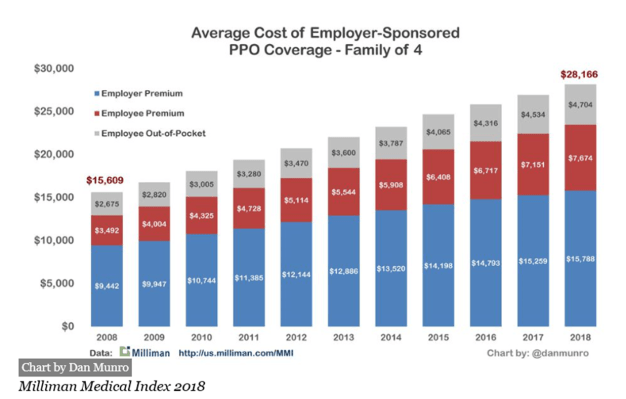
    10. The employer contribution to ESI is significant – typically over 55% of the cost for PPO coverage (family of 4) – but this also helps employers keep wages artificially depressed. In fact, in recent years, the galloping cost of healthcare has tilted unequally to employees – and shifted away from employers. The days of ‘sharing’ those annual cost increases equally are clearly over.

The combined effect of ESI – again, uniquely American – is the most expensive healthcare system on planet earth and one of the biggest systemic flaws behind this ever-growing expense is ESI. As a distinctly separate flaw (I call it Healthcare’s Pricing Cabal), actual pricing originates elsewhere, of course, but employers really have no ceiling on what they will pay – especially for smaller (under 500) employer groups. This year – 2018 – America will spend more than $11,000 per capita – just on healthcare and the average cost of PPO coverage through an employer for an American family of four is now over $28,000 – per year.

Forbes - 1

Milliman Medical Index 2018

Employers love to complain openly and often about the high-cost of healthcare, but they also benefit from the corporate welfare of tax exclusions and depressed wages. The only evidence we need to see their reluctance to systemic change is their strong opposition to the Cadillac Tax because it was the one tax proposal (through the Affordable Care Act) that was specifically designed to cap the tax exclusion on very rich (Cadillac) benefits. The Kaiser Family Foundation has a compelling graphic on the long term and corrosive effect of ESI.

Forbes - 2

Kaiser/HRET Survey of Employer-Sponsored Health Benefits

Don’t get me wrong, employers could band together and lobby to change the tax code to end the fiscal perversion of ESI – but they won’t. They love to complain about high costs – but collectively, they are as culpable as large providers who work jointly to propel prices ever higher – with no end in sight.

Which brings us full-circle back to the announcement of Dr. Gawande as the CEO of the new ABC healthcare (non-profit) venture. As a writer, health policy expert and surgeon, Dr. Gawande’s credentials are impeccable and I’ve faithfully read much of what he’s written for The New Yorker. One of my all-time favorite articles – among many – is the Commencement Address he gave at Harvard Medical School just over 7 years ago. It’s a true classic — and worth reading — often. It was translated for publication in The New Yorker (where he frequently writes) and remains online here: Cowboys and Pit Crews

I’ve often quoted a passage from Dr. Gawande’s address because it encapsulates the very real dilemma faced by practicing physicians and healthcare professionals the world over – from that day to this.

The core structure of medicine—how health care is organized and practiced—emerged in an era when doctors could hold all the key information patients needed in their heads and manage everything required themselves. One needed only an ethic of hard work, a prescription pad, a secretary, and a hospital willing to serve as one’s workshop, loaning a bed and nurses for a patient’s convalescence, maybe an operating room with a few basic tools. We were craftsmen. We could set the fracture, spin the blood, plate the cultures, administer the antiserum. The nature of the knowledge lent itself to prizing autonomy, independence, and self-sufficiency among our highest values, and to designing medicine accordingly. But you can’t hold all the information in your head any longer, and you can’t master all the skills. No one person can work up a patient’s back pain, run the immunoassay, do the physical therapy, protocol the MRI, and direct the treatment of the unexpected cancer found growing in the spine. I don’t even know what it means to “protocol” the MRI. Dr. Atul Gawande – Harvard Medical School Commencement – May, 2011

It would be safe to say — without reservation — that I am a real Gawande fan, but the fundamental question remains. How much can a single private venture – however well-funded or staffed – change a fundamentally flawed system design? In effect – to change our whole system of ‘cowboys’ to ‘pit crews?’

Unless and until Dr. Gawande can change the tax code, any fiscal benefits of the new ABC venture will be nominal – around the edges of healthcare – and not at the core. What fiscal benefits there are will absolutely accrue to the member companies, but Dr. Gawande is no miracle worker and he has no magic wand against the trifecta of accidental system design that keeps pricing spiraling ever upward. That trifecta is actuarial math, ESI, and the transient nature of health benefits delivered at scale through literally thousands of employers. Commercial (or private) ventures of every stripe and size can certainly lobby for legislation to change the moral morass of tiered pricing through employers, but they can’t end it.

The bad things [in] the U.S. health care system are that our financing of health care is really a moral morass in the sense that it signals to the doctors that human beings have different values depending on their income status. For example, in New Jersey, the Medicaid program pays a pediatrician $30 to see a poor child on Medicaid. But the same legislators, through their commercial insurance, pay the same pediatrician $100 to $120 to see their child. How do physicians react to it? If you phone around practices in Princeton, Plainsboro, Hamilton – none of them would see Medicaid kids. Uwe Reinhardt (1937 – 2017) – Economics Professor at the Woodrow Wilson School of Public and International Affairs at Princeton


 Article link: https://www.forbes.com/sites/danmunro/2018/06/21/10-reasons-why-employers-and-new-ventures-wont-disrupt-u-s-healthcare/#74ea8f521011

Posts navigation

← Older Entries
Newer Entries →
  • Search site

  • Follow healthcarereimagined on WordPress.com
  • Recent Posts

    • When Not to Use AI – MIT Sloan 04/01/2026
    • There are more AI health tools than ever—but how well do they work? – MIT Technology Review 03/30/2026
    • Are AI Tools Ready to Answer Patients’ Questions About Their Medical Care? – JAMA 03/27/2026
    • How AI use in scholarly publishing threatens research integrity, lessens trust, and invites misinformation – Bulletin of the Atomic Scientists 03/25/2026
    • VA Prepares April Relaunch of EHR Program – GovCIO 03/19/2026
    • Strong call for universal healthcare from Pope Leo today – FAN 03/18/2026
    • EHR fragmentation offers an opportunity to enhance care coordination and experience 03/16/2026
    • When AI Governance Fails 03/15/2026
    • Introduction: Disinformation as a multiplier of existential threat – Bulletin of the Atomic Scientists 03/12/2026
    • AI is reinventing hiring — with the same old biases. Here’s how to avoid that trap – MIT Sloan 03/08/2026
  • Categories

    • Accountable Care Organizations
    • ACOs
    • AHRQ
    • American Board of Internal Medicine
    • Big Data
    • Blue Button
    • Board Certification
    • Cancer Treatment
    • Data Science
    • Digital Services Playbook
    • DoD
    • EHR Interoperability
    • EHR Usability
    • Emergency Medicine
    • FDA
    • FDASIA
    • GAO Reports
    • Genetic Data
    • Genetic Research
    • Genomic Data
    • Global Standards
    • Health Care Costs
    • Health Care Economics
    • Health IT adoption
    • Health Outcomes
    • Healthcare Delivery
    • Healthcare Informatics
    • Healthcare Outcomes
    • Healthcare Security
    • Helathcare Delivery
    • HHS
    • HIPAA
    • ICD-10
    • Innovation
    • Integrated Electronic Health Records
    • IT Acquisition
    • JASONS
    • Lab Report Access
    • Military Health System Reform
    • Mobile Health
    • Mobile Healthcare
    • National Health IT System
    • NSF
    • ONC Reports to Congress
    • Oncology
    • Open Data
    • Patient Centered Medical Home
    • Patient Portals
    • PCMH
    • Precision Medicine
    • Primary Care
    • Public Health
    • Quadruple Aim
    • Quality Measures
    • Rehab Medicine
    • TechFAR Handbook
    • Triple Aim
    • U.S. Air Force Medicine
    • U.S. Army
    • U.S. Army Medicine
    • U.S. Navy Medicine
    • U.S. Surgeon General
    • Uncategorized
    • Value-based Care
    • Veterans Affairs
    • Warrior Transistion Units
    • XPRIZE
  • Archives

    • April 2026 (1)
    • March 2026 (9)
    • February 2026 (6)
    • January 2026 (8)
    • December 2025 (11)
    • November 2025 (9)
    • October 2025 (10)
    • September 2025 (4)
    • August 2025 (7)
    • July 2025 (2)
    • June 2025 (9)
    • May 2025 (4)
    • April 2025 (11)
    • March 2025 (11)
    • February 2025 (10)
    • January 2025 (12)
    • December 2024 (12)
    • November 2024 (7)
    • October 2024 (5)
    • September 2024 (9)
    • August 2024 (10)
    • July 2024 (13)
    • June 2024 (18)
    • May 2024 (10)
    • April 2024 (19)
    • March 2024 (35)
    • February 2024 (23)
    • January 2024 (16)
    • December 2023 (22)
    • November 2023 (38)
    • October 2023 (24)
    • September 2023 (24)
    • August 2023 (34)
    • July 2023 (33)
    • June 2023 (30)
    • May 2023 (35)
    • April 2023 (30)
    • March 2023 (30)
    • February 2023 (15)
    • January 2023 (17)
    • December 2022 (10)
    • November 2022 (7)
    • October 2022 (22)
    • September 2022 (16)
    • August 2022 (33)
    • July 2022 (28)
    • June 2022 (42)
    • May 2022 (53)
    • April 2022 (35)
    • March 2022 (37)
    • February 2022 (21)
    • January 2022 (28)
    • December 2021 (23)
    • November 2021 (12)
    • October 2021 (10)
    • September 2021 (4)
    • August 2021 (4)
    • July 2021 (4)
    • May 2021 (3)
    • April 2021 (1)
    • March 2021 (2)
    • February 2021 (1)
    • January 2021 (4)
    • December 2020 (7)
    • November 2020 (2)
    • October 2020 (4)
    • September 2020 (7)
    • August 2020 (11)
    • July 2020 (3)
    • June 2020 (5)
    • April 2020 (3)
    • March 2020 (1)
    • February 2020 (1)
    • January 2020 (2)
    • December 2019 (2)
    • November 2019 (1)
    • September 2019 (4)
    • August 2019 (3)
    • July 2019 (5)
    • June 2019 (10)
    • May 2019 (8)
    • April 2019 (6)
    • March 2019 (7)
    • February 2019 (17)
    • January 2019 (14)
    • December 2018 (10)
    • November 2018 (20)
    • October 2018 (14)
    • September 2018 (27)
    • August 2018 (19)
    • July 2018 (16)
    • June 2018 (18)
    • May 2018 (28)
    • April 2018 (3)
    • March 2018 (11)
    • February 2018 (5)
    • January 2018 (10)
    • December 2017 (20)
    • November 2017 (30)
    • October 2017 (33)
    • September 2017 (11)
    • August 2017 (13)
    • July 2017 (9)
    • June 2017 (8)
    • May 2017 (9)
    • April 2017 (4)
    • March 2017 (12)
    • December 2016 (3)
    • September 2016 (4)
    • August 2016 (1)
    • July 2016 (7)
    • June 2016 (7)
    • April 2016 (4)
    • March 2016 (7)
    • February 2016 (1)
    • January 2016 (3)
    • November 2015 (3)
    • October 2015 (2)
    • September 2015 (9)
    • August 2015 (6)
    • June 2015 (5)
    • May 2015 (6)
    • April 2015 (3)
    • March 2015 (16)
    • February 2015 (10)
    • January 2015 (16)
    • December 2014 (9)
    • November 2014 (7)
    • October 2014 (21)
    • September 2014 (8)
    • August 2014 (9)
    • July 2014 (7)
    • June 2014 (5)
    • May 2014 (8)
    • April 2014 (19)
    • March 2014 (8)
    • February 2014 (9)
    • January 2014 (31)
    • December 2013 (23)
    • November 2013 (48)
    • October 2013 (25)
  • Tags

    Business Defense Department Department of Veterans Affairs EHealth EHR Electronic health record Food and Drug Administration Health Health informatics Health Information Exchange Health information technology Health system HIE Hospital IBM Mayo Clinic Medicare Medicine Military Health System Patient Patient portal Patient Protection and Affordable Care Act United States United States Department of Defense United States Department of Veterans Affairs
  • Upcoming Events

Blog at WordPress.com.
healthcarereimagined
Blog at WordPress.com.
  • Subscribe Subscribed
    • healthcarereimagined
    • Join 153 other subscribers
    • Already have a WordPress.com account? Log in now.
    • healthcarereimagined
    • Subscribe Subscribed
    • Sign up
    • Log in
    • Report this content
    • View site in Reader
    • Manage subscriptions
    • Collapse this bar
 

Loading Comments...