healthcarereimagined

Envisioning healthcare for the 21st century

  • About
  • Economics

Once Its Greatest Foes, Doctors Are Embracing Single-Payer – Kaiser Health News

Posted by timmreardon on 08/08/2018
Posted in: Uncategorized. Leave a comment


KHN1x1

When the American Medical Association — one of the nation’s most powerful health care groups — met in Chicago this June, its medical student caucus seized an opportunity for change.

Though they had tried for years to advance a resolution calling on the organization to drop its decades-long opposition to single-payer health care, this was the first time it got a full hearing. The debate grew heated — older physicians warned their pay would decrease, calling younger advocates naïve to single-payer’s consequences. But this time, by the meeting’s end, the AMA’s older members had agreed to at least study the possibility of changing its stance.

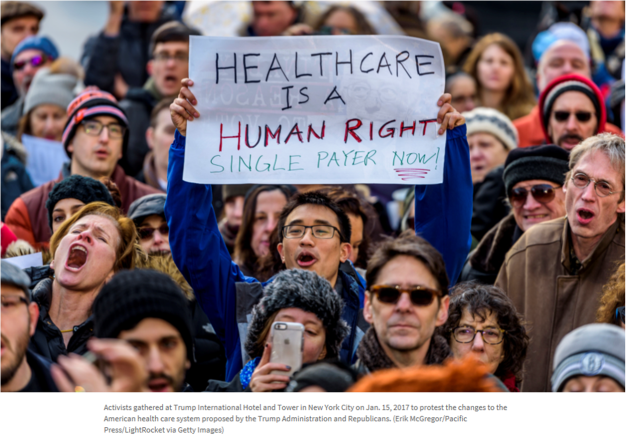
“We believe health care is a human right, maybe more so than past generations,” said Dr. Brad Zehr, a 29-year-old pathology resident at Ohio State University, who was part of the debate. “There’s a generational shift happening, where we see universal health care as a requirement.”

The ins and outs of the AMA’s policymaking may sound like inside baseball. But this year’s youth uprising at the nexus of the medical establishment speaks to a cultural shift in the medical profession, and one with big political implications.

Amid Republican attacks on the Affordable Care Act, an increasing number of Democrats — ranging from candidates to established Congress members — are putting forth proposals that would vastly increase the government’s role in running the health system. These include single-payer, Medicare-for-all or an option for anyone to buy in to the Medicare program. At least 70 House Democrats have signed on to the new “Medicare-for-all” caucus.

Organized medicine, and previous generations of doctors, had for the most part staunchly opposed to any such plan. The AMA has thwarted public health insurance proposals since the 1930s and long been considered one of the policy’s most powerful opponents.

But the battle lines are shifting as younger doctors flip their views, a change that will likely assume greater significance as the next generation of physicians takes on leadership roles. The AMA did not make anyone available for comment.

Many younger physicians are “accepting of single-payer,” said Dr. Christian Pean, 30, a third-year orthopedic surgery resident at New York University.

In prior generations, “intelligent, motivated, quantitative” students pursued medicine, both for the income and because of the workplace independence — running practices with minimal government interference, said Dr. Steven Schroeder, 79, a longtime medical professor at the University of California-San Francisco.

In his 50 years of teaching, students’ attitudes have changed: “The ‘Oh, keep government out of my work’ feeling is not as strong as it was with maybe older cohorts,” said Schroeder. “Students come in saying, ‘We want to make a difference through social justice. That’s why we’re here.’”

Though “single-payer” health care was long dismissed as a left-wing pipe dream, polling suggests a slim majority of Americans now support the idea — though it is not clear people know what the term means.

A full single-payer system means everyone gets coverage from the same insurance plan, usually sponsored by the government. Medicare-for-all, a phrase that gained currency with the presidential campaign of Sen. Bernie Sanders (I-Vt.), means everyone gets Medicare, but, depending on the proposal, it may or may not allow private insurers to offer Medicare as well. (Sanders’ plan, which eliminates deductibles and expands benefits, would get rid of private insurers.)

Meanwhile, lots of countries achieve universal health care — everyone is covered somehow — but the method can vary. For example, France requires all citizens purchase coverage, which is sold through nonprofits. In Germany, most people get insurance from a government-run “public option,” while others purchase private plans. In England, health care is provided through the tax-funded National Health System.

American skeptics often use the phrase “socialized medicine” pejoratively to describe all of these models.

“Few really understand what you mean when you say single-payer,” said Dr. Frank Opelka, the medical director of quality and health policy for the American College of Surgeons, which opposes such a policy. “What they mean is, ‘I don’t think the current system is working.’”

But the willingness to explore previously unthinkable ideas is evident in young doctors’ ranks.

Recent surveys through LinkedIn, recruiting firm Merritt Hawkins and trade publication NEJM Catalyst indicate growing support. In the March NEJM survey, 61 percent of 607 respondents said single-payer would make it easier to deliver cost-effective, quality health care.

Delving further, that survey data shows support is stronger among younger physicians, said Dr. Namita Mohta, a hospitalist at Brigham and Women’s Hospital and clinical editor at NEJM Catalyst.

But it’s unclear whether these findings reflect young doctors’ feelings about the policy or whether they are tapping in to broader frustrations with the American health system.

Much like the general public, doctors often use terms like single-payer, Medicare-for-all and universal health care interchangeably.

“Our younger generation is less afraid to come out and say we want universal health care,” said Dr. Anna Yap, 26, an emergency medicine resident at UCLA, who served as a medical student delegate to the AMA until this past June. “But how? It’s different in what forms we see.”

Younger doctors also pointed to growing concern about how best to keep patients healthy. They cited research that broadly suggests having health insurance tracks with better health outcomes.

“Medical students, I would say, are very interested in public health and improving social determinants of health — one of them being access to health insurance,” said Dr. Jerome Jeevarajan, 26, a neurology resident at the University of Texas-Houston, referring to non-medical factors that improve health, such as food or housing.

Some of the shift in opinion has to do with the changing realities of medical practice. Doctors now are more likely to end up working for large health systems or hospitals, rather than starting individual practices. Combined with the increasing complexity of billing private insurance, many said, that means contracting with the government may feel like less of an intrusion.

The debate is, at this point, still theoretical. Republicans — who control all branches of the federal government — sharply oppose single-payer. Meanwhile, single-state efforts in California, Colorado and New York have fallen flat.

Also, doctors represent only one part of the sprawling health care industrial complex. Other health care interests — including private insurance, the drug industry and hospital trade groups — have been slower to warm to catchphrases like single-payer or universal health care, all of which would likely mean a drop in income.

But increasingly physicians seem to be switching sides in the debate, and young physicians want to be part of the discussion.

“There’s tremendous potential … to be at the table if single-payer becomes a significant part of the political discourse, and create a system that is more equitable,” Pean said.

Article link:https://khn.org/news/once-its-greatest-foes-doctors-are-embracing-single-payer/

Providers turn to information governance to overcome RCM challenges – HealthData Management

Posted by timmreardon on 08/07/2018
Posted in: Uncategorized. Leave a comment
By Gienna Shaw      Published August 06 2018, 7:38am EDT

At Sharp Healthcare in San Diego, data is worth more than all of the organization’s physical assets combined—an estimated $40 billion. It has hundreds of data and personal health information sources. And 24 different systems—each with different structures, interfaces and users—touch the revenue cycle.

The organization already had a dedicated master patient index department that had been cleaning up patient data for a long time. But it needed to go further with an enterprise-wide system to manage information-based assets irrespective of format.

That means specifying “decision rights and an accountability framework to ensure appropriate behavior in the valuation, creation, storage, use, archiving and deletion of information,” according to one frequently-cited definition put forth by Gartner, a healthcare research and consulting firm Gartner. “It includes the processes, roles and policies, standards and metrics that ensure the effective and efficient use of information in enabling an organization to achieve its goals.”

“Having a better, cleaner data set really did translate into better patient care, better patient information and quicker response times,” says Lori Moore, Sharp’s director of data governance. “Think about how many accidents happen inside of hospitals … You know that better patient data is going to save lives, [and] it gave us an opportunity to move the dial on what we could do with our data by first cleaning it.”

Further, says Kathy Downing, vice president of information governance at the American Health Information Management Association (AHIMA), organizations that invest in information governance will have a competitive advantage both short-term and long-term, because they’ll have the “agility and ability to make business decisions based on that trusted data.” Organizations that don’t invest in information governance, she warns, will be left in the dust by others.

“It’s probably one of the most difficult practices that all of healthcare faces,” Moore says. “Healthcare comes with a set of complications that directly affects people in a profound way. Data governance is very difficult but worthwhile—and it pays you back in spades.”

Master the patient data

One function of Sharp’s data governance program office is master-data management, which includes the master lists of patients, providers, locations and organizations. It has a direct impact on revenue, payer relationships, patient billing, which in turn affects the patient experience.

Take, for example, insurance verification. It’s not unusual to find that a payer has a different name for a patient than Sharp does, says Gerilynn Sevenikar, vice president of revenue cycle for Sharp. “That creates a conflict for us. We want the integrity of our patient file to be as sure and as true as possible. But if I submit that claim with what I know to be the legal name of a patient, it will get rejected.”

Sharp has worked to solve that problem in a more efficient way than in the past. The old way: Create a temporary patient identification record for the sole purpose of billing. Staff would update information in the patient record to match the payer’s record, send the bill, then go back into the patient record to change it back to what they knew was the correct information. It wasn’t just inefficient and time-consuming: Changing a record repeatedly only introduces more opportunities for human error.

So Sharp added a field on encounter records with the payer’s version of the patient’s information. That allowed the organization to maintain its own records and meet the payer’s needs.

The change didn’t reduce initial rejections because of a mismatched name. It eliminated them.

And that’s a perfect example of how data governance, a subset of information governance, can pay off for an organization. “It’s OK to have multiple names attached to a single patient as long as you’re defining them separately and using them consistently,” Moore says.

HDM1.jpg


Gauge data quality

From email address to legal name, and date of birth to whether or not a patient is still living, ensuring data accuracy is no easy task. “I’d love to tell you that we have pristine, gorgeous clearwater data,” Moore says. “But medical data is human-created and therefore inherently flawed.”

At Sharp, the front desk asks for a patient’s email address every time a patient checks in. Email is great for sending appointment reminders, but it also helps the revenue cycle: Sharp uses it to gather demographic and insurance information before the patient arrives, further reducing rejected claims.

The organization also embarked on a record cleanup, identifying parameters to determine whether a patient is likely deceased, for example. A check of the records found 8 percent of patients in just one of the organization’s electronic health records were identified as being 120 years or older, so they started there and furthered narrowed the definition by looking at how long it had been since that patient was treated. “Deactivating records gives us a much cleaner view of our patient population and master patient index,” Sevenikar says.

Identify stewards

Sharp’s data governance office also has a policy and procedures arm, which manages roles, responsibilities and data stewardship.

“Standardization of policy and procedure is probably one of the hardest things we do,” Moore says. “We are tackling that through a new data stewardship structure, which will have representation from all of our major stakeholders. They have not only a voice but also a responsibility.”

Data stewards represent their department or their group or their organization’s needs for the collective, but when there is, say, a data quality issue, they also have a responsibility to remediate it in their system. They need to be responsible for good data care, quality and practices in their “hometown,” Moore says. “You can’t have a voice without having that responsibility.”

When looking for data stewards, Downing says, start with business process data owners, such as compliance officers, corporate legal staff or chief medical information officers.

Find a springboard

“Cleaning up patient data [is] massive, and finding a place to start is really hard,” Moore says. But you don’t have to do it all at once, she adds. “Just start somewhere. You don’t need a dedicated resource. If you can’t get a full program, that’s OK,” Moore says. “You’re probably closer to data governance than you think you are.”

Downing agrees. “I never want people to feel like they’re starting at ground zero. Right now, every organization is doing some sort of data governance whether they’re calling it that or not,” she says. She suggests taking stock of what policies are already in place, building on existing programs and tapping into existing workgroups, especially multidisciplinary committees that are already looking at information management or electronic records systems. “We really need that coordination and planning to execute on these data governance initiatives,” she says.

“Just start somewhere. You don’t need dedicated resources. If you can’t get a full program, that’s OK,” Moore says. “You’re probably closer to data governance than you think you are. Find your window and go through.”

“Decide what you’re going to focus on and build your roadmap; otherwise, it feels like this is a project that is never going to end,” Downing adds.

Rebranded initiative

Sometimes, opportunities to improve information governance arise organically. The University of Washington is preparing to implement a single electronic health record across its various settings, which include four hospitals, a physician group, and several community clinics and urgent care centers. UW Medicine is part of an AHIMA information governance pilot program and recently rebranded its HIM department to the more encompassing Department of Enterprise Records and Health Information.

“We were already doing information governance, but it wasn’t as broad as we needed it to be,” says Sally Beahan, the department’s senior director. The new name “better describes the work we do, because it’s all records across the organization, not just medical records.”

The department falls under revenue cycle and reports up to the CFO. But it’s also working closely with the IT side of the house. “When I think of data management I think of something unique and data-driven,” says Christine Taylor, director of information governance and integrity.

“But we’re about content—it doesn’t matter what format that content is in. We’re talking about integrity in the authentic record … We hope to help IT come up with some of those standards for data management.”

As it began the journey to a single EHR, UW Medicine took the opportunity to standardize documents and approaches for tasks such as patient matching. “We’re finding ways to collaborate across functional units within the medical center so we can come to some standard approach to patient identity,” Taylor says.

The UW team takes a grassroots approach to outreach and collaboration, looking for opportunities to describe how good information governance could have helped avoid a problem, for example. “We’ve been planting those seeds without being condescending or to say ‘we should have known that,’ ” Taylor says. “But to say ‘this won’t happen when we have good governance.’ ”

Successful communication requires collaboration, explaining why it’s important and customizing messaging, Beahan says. Some stakeholders might not respond to talk about obligations under the public records act, for example. But most will understand the importance of minimizing risk, complying with laws and better managing records. “Telling a horror story or two is helpful,” she adds.

“What we’ve learned is you have to say something several times, several different ways,” Taylor says. “We might have to describe why many different ways on many different levels, in a way that appeals to the individual.”

Measure the payoff

Sometimes the ROI of information and information and data governance is intuitive—it just makes sense. Fewer denials means less time spent re-submitting claims. Having up-to-date emails and eliminating out-of-date records saves the cost of paper and postage. More accurate data means better data analytics, which leads to better care for patients, which leads to fewer adverse events, costly readmissions or duplicate diagnostic tests.

Still, it isn’t always easy to quantify the financial return on investment.

For UW Medicine’s information governance team, they have promised—and plan to deliver—greater efficiency, higher productivity and reduced administrative burden and manual tasks. Time, after all, is money.

“It allows us to turn some of these traditional ways of looking at things on their head,” Taylor says. “It’s a different path to take to create efficiencies and increase productivity. We want to do what’s best for patients and for budgets.”

Article link: https://www.healthdatamanagement.com/news/providers-turn-to-information-governance-to-overcome-rcm-challenges

Estimating the Effects of a Single-Payer Proposal in New York State – RAND

Posted by timmreardon on 08/07/2018
Posted in: Uncategorized. Leave a comment

by Jodi L. Liu, Chapin White, Sarah A. Nowak, Asa Wilks, Jamie Ryan, Christine Eibner


Randxx1

Report link: https://healthcarereimagined.net/wp-content/uploads/2018/08/rand_rb10027.pdf

23andMe’s Pharma Deals Have Been the Plan All Along – Wired

Posted by timmreardon on 08/06/2018
Posted in: Uncategorized. Leave a comment


Wiredx                Casey Chin
Since the launch of its DNA testing service in 2007, genomics giant 23andMe has convinced more than 5 million people to fill a plastic tube with half a teaspoon of saliva. In return for all that spit (and some cash too), customers get insights into their biological inheritance, from the superficial—do you have dry earwax or wet?—to mutations associated with disease. What 23andMe gets is an ever-expanding supply of valuable behavioral, health, and genetic information from the 80 percent of its customers who consent to having their data used for research.

So last week’s announcement that one of the world’s biggest drugmakers, GlaxoSmithKline, is gaining exclusive rights to mine 23andMe’s customer data for drug targets should come as no surprise. (Neither should GSK’s $300 million investment in the company). 23andMe has been sharing insights gleaned from consented customer data with GSK and at least six other pharmaceutical and biotechnology firms for the past three and a half years. And offering access to customer information in the service of science has been 23andMe’s business plan all along, as WIRED noted when it first began covering the company more than a decade ago.

But some customers were still surprised and angry, unaware of what they had already signed (and spat) away. GSK will receive the same kind of data pharma partners have generally received—summary level statistics that 23andMe scientists gather from analyses on de-identified, aggregate customer information—though it will have four years of exclusive rights to run analyses to discover new drug targets. Supporting this kind of translational work is why some customers signed up in the first place. But it’s clear the days of blind trust in the optimistic altruism of technology companies are coming to a close.

“I think we’re just operating now in a much more untrusting environment,” says Megan Allyse, a health policy researcher at the Mayo Clinic who studies emerging genetic technologies. “It’s no longer enough for companies to promise to make people healthy through the power of big data.” Between the fall of blood-testing unicorn Theranos and Facebook’s role in the 2016 election attacks, “I think everything from here on out will be subject to much higher levels of public scrutiny,” Allyse says.

23andMe maintains that transparency is a core tenet of the company. “I think a really important distinction to make is that 23andMe operates under an independent ethical review board that oversees all of our research,” says Emily Drabant Conley, 23andMe’s vice president of business development, who oversaw the announcement of the GSK deal. “The guidelines we follow are essentially the same as what other research institutions follow.” So they should apply to any of the analyses GSK might want to run on 23andMe data, like a PheWAS, which connects constellations of symptoms and conditions across many people with a single genetic mutation they all share.

Yet they’re not identical. Researchers point out that medical and academic institutions will often assign someone to walk through consent documents with potential study participants, to make sure they understand all the risks and benefits. With 23andMe, that process is distilled into a number of screens and boxes to click through.

“If you read the documents carefully, all the information is there,” says Kayte Spector-Bagdady, a lawyer and bioethics researcher at the University of Michigan who has reviewed 23andMe’s customer policies. “They really do disclose it all. The challenge is that people don’t read it.”

To register a DNA kit on 23andMe, customers are required to accept the company’s privacy policy and terms and conditions, which together disclose what data 23andMe collects, how it’s protected, and how it can be used and shared. Then customers are given the option to participate in 23andMe research. A lengthy document explains what that entails, and if they click a green box at the bottom saying “I DO GIVE CONSENT,” then the majority of their data—their genetic profile plus any information they enter into surveys or authorize 23andMe to import—can be used for research in de-identified and aggregated form.

It’s a lot of fine print that looks like a lot of other fine print people on the internet click through every day—to browse, buy, watch, and listen online. “They’re so used to sharing data that they may not realize it’s just going in the front end and out the backend,” says Spector-Bagdady.

23andMe customers can withdraw consent at any time, but it may take up to 30 days for their requests to go into effect. And any data shared prior to that date can’t be clawed back from any third parties that might be using it. Deleting your data entirely is even harder—nearly impossible, as Bloomberg reporter Kristen Brown reported, because federal laws require clinical laboratories to keep de-identified DNA test results on file for a minimum of 10 years.

It’s also worth pointing out that 23andMe can, in theory, unilaterally change those terms and conditions and privacy policies at any time, says Katherine Drabiak, a legal expert in health law and research ethics at the University of South Florida. As a commercial enterprise, it’s not bound by the same obligations as medical professionals. 23andMe doesn’t have to take an oath to act in the interest of consumers or to promote their well being.

There’s a tension between the way 23andMe portrays itself as a health company, and simultaneously wants to be treated like every other tech company that makes its money from big data, says Allyse. “You can’t have it both ways. That’s why we have HIPAA, it’s why we have all these regulations that say health information is privileged information that can’t be commodified.”

But 23andMe, with its hybrid model, has been commodifying health and genetic data for years as it wades further into the field of drug discovery. In 2015, Forbes reported that the company had inked its first pharmaceutical company deal with Genentech, for $10 million up front, and up to $50 million if its data turned out to be useful for developing Parkinson’s treatments. Pfizer signed a data-sharing agreement of its own shortly after. That was back when 23andMe had data from only 650,000 consented individuals in its proprietary database. Its critics were unsure of the value of that information, self-reported as it was (and still is). But as the database has grown to the millions, differences in how customers interpret survey questions matter less and less to the company’s potential research partners, according to Spector-Bagdady.
“The hypothesis of this company was to circumvent medical records and just self-report,” Wojcicki told a room full researchers at an event on 23andMe’s campus in May. “Anyone can go get genomes. What’s really hard is phenotypic data.”

To get that kind of health and behavioral information, 23andMe is continually pushing surveys out to its customers. A few questions here, a few questions there; it’s kind of like going on a first date every time you log on. And people love talking about themselves. “We specialize in capturing phenotypic data on people longitudinally—on average 300 data points on each customer,” Wojcicki said. “That’s the most valuable by far.”
GSK’s $300 million investment, which 23andMe says is separate from the research collaboration, gives a good sense of just how valuable. Besides publicly disclosed deals with Genentech and Pfizer, 23andMe has also partnered with Lundbeck, Janssen, Biogen, and Alynlam Pharmaceuticals to share genetic analyses run on deidentified customer data. According to Drabant Conley, those prior collaborations will continue unchanged. But for the next four years—five if GSK decides it wants to extend the deal—23andMe won’t be entering into any new partnerships focused on drug target discovery.
The GSK collaboration also offers 23andMe an opportunity to more seriously test its theory that its data will deliver cures faster than the traditional medical research model. In 2015 the company hired Richard Scheller, a pharmaceutical industry veteran, to spin out an in-house therapeutics division based in South San Francisco. Since then, the group has identified 10 drug targets from 23andMe customer data, all of which are in various stages of pre-clinical development. Now, with the papers signed, 23andMe will work with GSK to decide which of the 10 they will jointly move toward human trials.
Even as it is adding an additional revenue stream in drug development, 23andMe’s future success is still dependent on growing its database with customers willing to participate in research. And that will mean staying in the public’s good graces. On Tuesday, a number of genetic testing companies, including 23andMe, pledged to protect customer privacy under a new set of voluntary guidelines they drafted in collaboration with Washington, DC-based nonprofit, Future of Privacy Forum. However, the new best practices won’t impact any of 23andMe’s medical research because there are no restrictions on the use or release of de-identified data.
“It’s largely a meaningless gesture,” says Allyse. “But the fact is that they felt they needed to make the gesture.”

Article link: https://www.wired.com/story/23andme-glaxosmithkline-pharma-deal/

Pentagon to Increase Health Records Contract Ceiling By Another Billion – Nextgov

Posted by timmreardon on 08/01/2018
Posted in: Uncategorized. Leave a comment


Nextgov - EHR

July 24, 2018

The increase includes looping the Coast Guard into the contract, as well as additional capabilities.

The Defense Department plans to raise the ceiling of the contract for overhauling its outdated electronic health record system by an estimated $1.1 billion, agency officials said Tuesday.

The MHS Genesis contract with Cerner Corp. and systems integrator Leidos is currently valued at $4.3 billion with a total contract lifecycle value of $9 billion if all options are exercised.

The department will officially announce the decision on Tuesday in a justification and approval on FedBizOpps, and the revised contract will likely be finalized in the coming months, officials said.

The announcement comes two months after the Pentagon revealed major setbacks in the MHS Genesis rollout and the department’s director of operational test and evaluation called the platform “neither operationally effective nor operationally suitable.”

Stacy Cummings, program executive officer for Defense Healthcare Management Systems, told reporters the Pentagon expanded the contract include the Coast Guard in the project and also gain additional capabilities that were specified in the original contract.

Veterans Affairs Department in May signed a deal with Cerner to implement the same platform as the Pentagon, which included features that weren’t in the Defense contract. The revised deal would bridge that gap, Cummings said.

“A standard electronic health record baseline for the Department of Defense, Department of Veterans Affairs and U.S. Coast Guard will enable more efficient, highly reliable, safe and quality care,” she said.

The Pentagon temporarily suspended the MHS Genesis rollout in February after it generated more than 14,000 help tickets, including hundreds of incidents that could have led to patient deaths. Initial tests found platform could only perform about 56 percent of the 197 tasks used to measure the system’s performance, according to a report released in May.

Field tests at three military health facilities went so poorly the testing agency canceled plans to test at a fourth location, but as of July 13 the platform was up and running at all four sites, Cummings said. The agency is still troubleshooting the platform at the initial facilities, but the overall adoption’s shown “measurable success,” she added, noting the backlog of help tickets has fallen significantly since the May report.

Cummings said the department plans to publish a second evaluation report by the end of the year.

She also announced the four locations that will be part of next wave of MHS Genesis deployment: Naval Air Station Lemoore, Travis Air Force Base, U.S. Army Health Clinic Presidio of Monterey in California and Mountain Home Air Force Base in Idaho.

The Pentagon is also working closely with VA to make sure both agencies stay abreast of each other’s issues and don’t slow down project timelines, Cummings said. She added she thinks both groups stand to benefit by taking advantage of each other’s work.

VA officials said adopting Genesis would enable seamless interoperability between the two agencies, but tech leaders said setbacks at the Pentagon “don’t bode well” for the VA rollout. Earlier this month, VA created a special office to manage the implementation of Genesis and lawmakers also stood up a new subcommittee to oversee the project.

Though its addition to larger Pentagon contract is still pending, the Coast Guard in April announced it would adopt MHS Genesis after years of unsuccessful projects—and millions wasted—trying to build its own system.

Article link: https://www.nextgov.com/it-modernization/2018/07/pentagon-increase-health-records-contract-ceiling-another-billion/150010/


VA is Rethinking Its Entire Online Presence – Nextgov

Posted by timmreardon on 08/01/2018
Posted in: Uncategorized. Leave a comment

Nextgov - z

July 31, 2018 03:18 PM ET

The Veterans Affairs Department wants to know what it would take to create a one-stop online shop for veteran services.

The Veterans Affairs Department is looking for a team of developers to consolidate its far-flung agency websites into a single, user-friendly online portal.

The vendor would lead a complete redesign of the agency’s primary website, VA.gov, which would include building a new content management system within the VA Enterprise Cloud and migrating content from existing sites to the new platform, according to the request for information. The group would also be responsible for mapping the site’s new structure, optimizing its search functions and working with agency officials to make regular improvements.

The overhaul comes as part of the VA Digital Modernization Strategy, an agencywide effort to streamline online services and make it easier for veterans to navigate the benefits process. The initial contract would run for 12 months, with an option to extend an additional 12 months.

“VA is committed to dramatically upgrading its user-facing digital tools, becoming the first federal agency to deliver a digital experience on par with the private sector,” officials wrote in the RFI.

Today, VA’s online presence is organized in a similar way to the VA itself—veterans need to seek out different websites for benefits, health care, cemetery services and other products. In effect, that means vets need to understand the agency’s bureaucratic structure to access its services.

In recent years, the agency has attempted to make this digital maze easier to navigate. Led by executive director Marcy Jacobs, the Digital Service at VA has revamped online applications, connected portals to vast troves of patient data and given a thorough makeover to vets.gov, a site where veterans can apply for benefits and track claims.

“What we hear consistently from veterans is ‘I’m confused and I don’t understand why the VA doesn’t act like one organization,’” Jacobs told Nextgov in a June conversation. “[We’re] really trying to change the conversation with the veteran and make it easier for them to interact with the VA.”

Now through the broader VA.gov redesign, VA intends to bring all its veteran-facing sites—vets.gov, myhealth.va.gov, ebenefits.va.gov and explore.va.gov—under the umbrella of the main site. Once completed, the site would act as a one-stop shop for all veteran services.

The new content management system must also support a variety of application program interfaces, or APIs, which will allow third parties to build applications that run on VA data and services. Last week, the agency began soliciting separate vendors to build an API management platform.

The agency plans to launch the first version of the revamped VA.gov on Veterans’ Day, according to the RFI. The vendor is expected to update the site every two to three weeks.

Responses are due Aug. 3.

Article link: https://www.nextgov.com/it-modernization/2018/07/va-rethinking-its-entire-online-presence/150177/

Trump nominates EY cybersecurity exec as new VA CIO – Healthcare IT News

Posted by timmreardon on 07/31/2018
Posted in: Uncategorized. Leave a comment

If confirmed, James Paul Gfrerer will work closely with ONC’s Genevieve Morris on the Cerner EHR modernization project.

EY!

By Jessica Davis July 30, 2018  10:13 AM

President Donald Trump nominated James Paul Gfrerer as Department of Veterans Affairs assistant secretary for information and technology late Friday.

Currently, Gfrerer serves as an executive director with Ernst and Young, with a focus on cybersecurity. Prior to EY, he served in the Marine Corps for more than 20 years and was a Department of Defense Detailee to the Department of State.

Gfrerer led the program’s interagency portfolios in cybersecurity and counterterrorism for three years.

According to the organizational chart, Gfrerer would also serve as Chief Information Officer. If confirmed, it would give the agency its first permanent CIO since Laverne Council stepped down in March 2017.

Acting CIO Scott Blackburn stepped down in April 2018, and former Trump campaigner Camilo Sandoval has filled the role in the interim. Sandoval has been surrounded by negative reports, including that he conspired to have former VA Secretary David Shulkin, MD, fired.

The VA recently launched its Office of Electronic Health Record Modernization led by Deputy National Coordinator Genevieve Morris. Morris will work closely with the VA CIO on the $16 billion Cerner EHR project to replace the agency’s legacy EHR.

Last week, Robert Wilkie was confirmed as the new VA Secretary and will be sworn in on Monday. Wilkie said the EHR project will be a top priority of his office, which is expected to go-live by 2020 in the Pacific Northwest.

Twitter: @JessieFDavis
Email the writer: jessica.davis@himssmedia.com

Article link: https://www.healthcareitnews.com/news/trump-nominates-ey-cybersecurity-exec-new-va-cio

Topics:

Electronic Health Records (EHR, EMR), Government & Policy, Privacy & Security

Physician groups call for tech changes to MIPS – Health Data Management

Posted by timmreardon on 07/30/2018
Posted in: Uncategorized. Leave a comment

The American College of Surgeons and American Medical Association want to see the Merit-Based Incentive Payment System promote the utilization of technology other than electronic health records.

MIPS includes Promoting Interoperability (PI) reporting requirements—formerly Advancing Care Information (ACI)—which are designed to promote patient engagement and electronic exchange of information using certified EHRs. The Centers for Medicare and Medicaid Services now calls the ACI performance category PI, an effort to focus on interoperability, improve flexibility and relieve provider burden.

Also See: MIPS is a growing regulatory burden for practices

However, according to Frank Opelka, MD, medical director of quality and health policy at the American College of Surgeons, PI remains the most frustrating aspect of the MIPS program for many providers.

“The category is focused too narrowly on the EHR and less on the advancement of broadly applied patient digital health information from all data sources as the original name of Advancing Care Information implies,” Opelka testified on Thursday before a House committee. “In implementing MIPS, CMS should have a laser focus on making sure that a complete view of a patient’s digital health information is available to physicians, in a useful, standardized form, when it matters most.”

Opelka pointed out that “a patient’s longitudinal care profile rarely exists in a single EHR” and that “physicians need a digital health information environment which represents the patient with enabling information from EHRs, smartphones, iPads, tablets and other available sources.”

Likewise, testifying on behalf of the American Medical Association, David Barbe, MD, AMA’s immediate past president, told lawmakers that the physician group would like to see CMS change PI reporting requirements to “attestation alone and develop new measures that utilize not only certified electronic health records, but also technology that builds on certified EHRs.”

Opelka made the case that CMS is no longer subsidizing the adoption of EHR systems and that the agency “should take this opportunity” to refocus the “original goals of using technology, and more specifically digital health information at the patient level, to improve care and lessen the focus on EHRs alone.”

He offered that PI “should focus on who is using digital health information to build a more complete patient record that is available to patients and physicians at the point of care, and how they are using this information to improve the quality and efficiency of care.”

The goal, Opelka said, should be an interoperable digital patient medical record that includes more than just EHRs but across smart devices and clinical registries for activities such as decision support, machine learning, and artificial intelligence.

“There is so much more we can do for quality and for lowering costs by leveraging digital information,” he concluded. “We have to stop thinking of EHRs and think beyond them.”

Article link: https://www.healthdatamanagement.com/news/physician-groups-call-for-tech-changes-to-mips

The State of Personal Connected Health Interoperability, Pt. 1 – HIMSS

Posted by timmreardon on 07/30/2018
Posted in: Uncategorized. Leave a comment
July 02, 2018
HIMSS - x


https://www.himss.org/library/podcasts/episode-57-state-personal-connected-health-interoperability-pt-1


Internet Pioneer Stuart Brand once said “On the one hand information wants to be expensive because it’s so valuable. The right information in the right place just changes your life. On the other hand, information wants to be free, because the cost of getting it out is getting lower and lower all the time. So you have these two fighting against each other.” That thirty-year-old phrase is an eerily prescient commentary on the state of health data interoperability today in 2018.

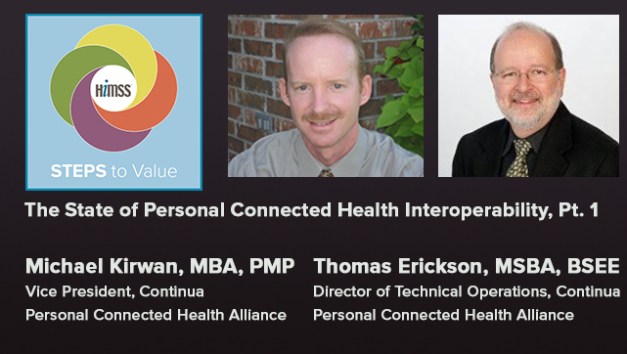
Welcome to Steps to Value, the people process and technology podcast from HIMSS. In this episode, we explore the state of personal connected health interoperability with Michael Kirwan, Vice President and Thom Erickson, Director, Technical Operations for Continua. We talk about the role of the Continua Design Guidelines in creating secure, interoperable health data exchange for personal health devices. We discuss the importance of standards in driving effective health data interoperability, and the challenges across the globe for healthcare systems trying to achieve interoperability that positively impacts clinical and operational outcomes.This Episode’s Guests:

Michael Kirwan, MBA, PMP
Vice President, Continua
Personal Health Connected Alliance
Connect with MichaelThomas Erickson, MSBA, BSEE
Director of Technical Operations, Continua
Personal Health Connected Alliance
Connect with ThomContinua Design Guidelines

The Continua Design Guidelines are only open implementation framework for authentic, end-to-end interoperability of personal connected health devices and systems. The guidelines are based on common international standards and are built on four key principles: Unity, Benevolent, Inclusive, Holistic. Learn more about the Continua Design Guidelines here.Personal Connected Health Alliance

The Personal Connected Health Alliance (PCHAlliance) aims to make health and wellness an effortless part of daily life. The PCHAlliance, a non-profit organization formed by HIMSS, believes that health is personal and extends beyond healthcare. The Alliance mobilizes a coalition of stakeholders to realize the full potential of personal connected health. PCHAlliance members are a vibrant ecosystem of technology and life sciences industry icons and innovative, early-stage companies along with governments, academic institutions, and associations from around the world. Learn more about the PCHAlliance here.

Test results: Glaxo pays 23andMe $300M, will use 4 million customers’ genetic data – Philadelphia Inquirer

Posted by timmreardon on 07/27/2018
Posted in: Uncategorized. Leave a comment

Updated: July 25, 2018 — 10:21 AM EDT

23andMe
by Joseph N. DiStefano, Staff Writer @PhillyJoeD | JoeD@phillynews.com

If you’ve ever wondered what the mail-away gene-testing service 23andMe was doing with all the personal and family bio-information collected from its five million customers, here’s one answer: Sharing it with GlaxoSmithKline, the British drug giant with major U.S. research labs in Collegeville and sales offices in South Philly’s Navy Yard, so Big Pharma can target and treat your genetic defects, boosting sales and profits.

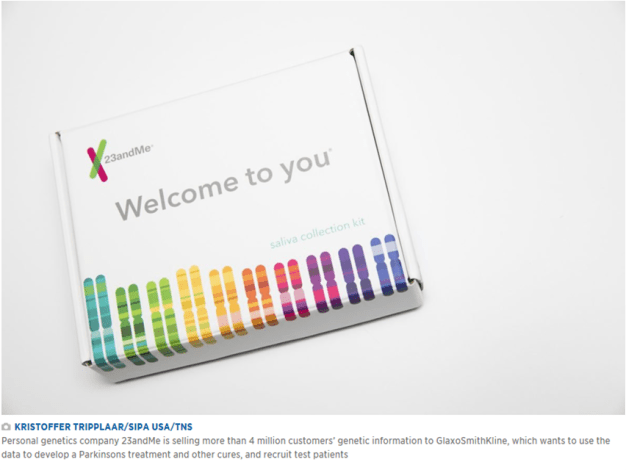
Glaxo said Wednesday it has agreed to invest $300 million in 23andMe, the Mountain View, Calif., gene-testing company best known for its retail gene reports designed to suggest where your ancestors hail from. The company says more than four-fifths of 23andMe customers — or over 4 million people — agreed when they signed up with the service to let their data be used for research, and now Glaxo’s going to use it.

Anticipating privacy concerns that people who sent samples to 23andMe will be identified as subject to genetic diseases, the companies stressed in their joint statement that they “have stringent security protections in place when it comes to collecting, storing, and transferring information about research participants,” including data encryption. The information will be “aggregated and de-identified” for Glaxo; only 23andMe would know customers’ identities or contact them, said Glaxo spokeswoman Mary Anne Rhyne.

The deal raised immediate questions from medical ethicists and scholars. For example, what are the limits on the use of DNA samples when customers consent, asked Jon Merz, a lawyer and professor of medical ethics and health policy at Penn. “Arguably, the companies should be transparent about the terms of the arrangement — who owns what, who gets what, and whether the subjects, as a population, get anything of value” from giving their information.

Merz added in an email, “Expensive new targeted ‘personalized’ treatments may be of benefit to those who can afford them.”

Other concerns include the disclosure of sensitive information in contacts and solicitations, and who owns a customer’s information after they die.

Glaxo said in a statement that it plans “an exclusive four-year collaboration that will focus on research and development of innovative new medicines and potential cures, using human genetics as the basis.” Glaxo plans to put “23andMe’s large-scale genetic resources” collected from its “consenting” customers, together with GSK’s own science and marketing, to “discover novel drug targets” for “serious unmet medical needs.”

“We are excited about this unique collaboration, as we know that drug targets with genetic validation have a significantly higher chance of ultimately demonstrating benefit for patients and becoming medicines,” said Hal Barron, president of research and development and chief scientific officer at Glaxo. “Partnering with 23andMe, an organization whose vision and capabilities are transforming the understanding of how genes influence health, will help to shift our research and development organization to be ‘driven by genetics,’ and increase the impact GSK can have on patients.”

“Many” 23andMe customers have asked for “cures or treatments” for genetic diseases, 23andMe CEO and cofounder Anne Wojcicki said in a statement. “By leveraging the genetic and phenotypic information provided by consenting 23andMe customers and combining it with GSK’s incredible expertise and resources in drug discovery, we believe we can more quickly make treating and curing diseases a reality.”

Glaxo and 23andMe say the drug company will use the genetic data to “improve target selection” for “precision” medicines; learn more about genetic “pathways and mechanisms” for disease; and “support identification of patient subgroups that are more likely to respond to targeted treatments.”

The four-million-plus customers who agreed to let their data be used “could help enable the discovery of a significant number of novel associations from a diverse range of people, which would not otherwise be possible,” Glaxo added. It will “allow more effective identification and recruitment of patients for clinical studies” by helping identify “patients with a particular disease” or with genes prone to specific conditions. That will help speed up clinical research, the company said.

The deal allows Glaxo to extend the relationship for a fifth year. For its part, 23andMe says it already has “a portfolio of early stage therapeutic research programs across a wide range of disease indications that will be assessed for inclusion.”

To that program, Glaxo plans to add its LRRK2 inhibitor, which it hopes to develop to treat Parkinson’s disease. “Together, GSK and 23andMe are expected to more effectively target and rapidly recruit patients with defined LRRK2 mutations” for the Parkinson’s therapy development. The companies will initially split costs.

Article link: http://www.philly.com/philly/blogs/inq-phillydeals/test-results-23andme-sells-4-million-customers-genetic-data-to-glaxo-for-300m-20180725.html


Posts navigation

← Older Entries
Newer Entries →
  • Search site

  • Follow healthcarereimagined on WordPress.com
  • Recent Posts

    • When Not to Use AI – MIT Sloan 04/01/2026
    • There are more AI health tools than ever—but how well do they work? – MIT Technology Review 03/30/2026
    • Are AI Tools Ready to Answer Patients’ Questions About Their Medical Care? – JAMA 03/27/2026
    • How AI use in scholarly publishing threatens research integrity, lessens trust, and invites misinformation – Bulletin of the Atomic Scientists 03/25/2026
    • VA Prepares April Relaunch of EHR Program – GovCIO 03/19/2026
    • Strong call for universal healthcare from Pope Leo today – FAN 03/18/2026
    • EHR fragmentation offers an opportunity to enhance care coordination and experience 03/16/2026
    • When AI Governance Fails 03/15/2026
    • Introduction: Disinformation as a multiplier of existential threat – Bulletin of the Atomic Scientists 03/12/2026
    • AI is reinventing hiring — with the same old biases. Here’s how to avoid that trap – MIT Sloan 03/08/2026
  • Categories

    • Accountable Care Organizations
    • ACOs
    • AHRQ
    • American Board of Internal Medicine
    • Big Data
    • Blue Button
    • Board Certification
    • Cancer Treatment
    • Data Science
    • Digital Services Playbook
    • DoD
    • EHR Interoperability
    • EHR Usability
    • Emergency Medicine
    • FDA
    • FDASIA
    • GAO Reports
    • Genetic Data
    • Genetic Research
    • Genomic Data
    • Global Standards
    • Health Care Costs
    • Health Care Economics
    • Health IT adoption
    • Health Outcomes
    • Healthcare Delivery
    • Healthcare Informatics
    • Healthcare Outcomes
    • Healthcare Security
    • Helathcare Delivery
    • HHS
    • HIPAA
    • ICD-10
    • Innovation
    • Integrated Electronic Health Records
    • IT Acquisition
    • JASONS
    • Lab Report Access
    • Military Health System Reform
    • Mobile Health
    • Mobile Healthcare
    • National Health IT System
    • NSF
    • ONC Reports to Congress
    • Oncology
    • Open Data
    • Patient Centered Medical Home
    • Patient Portals
    • PCMH
    • Precision Medicine
    • Primary Care
    • Public Health
    • Quadruple Aim
    • Quality Measures
    • Rehab Medicine
    • TechFAR Handbook
    • Triple Aim
    • U.S. Air Force Medicine
    • U.S. Army
    • U.S. Army Medicine
    • U.S. Navy Medicine
    • U.S. Surgeon General
    • Uncategorized
    • Value-based Care
    • Veterans Affairs
    • Warrior Transistion Units
    • XPRIZE
  • Archives

    • April 2026 (1)
    • March 2026 (9)
    • February 2026 (6)
    • January 2026 (8)
    • December 2025 (11)
    • November 2025 (9)
    • October 2025 (10)
    • September 2025 (4)
    • August 2025 (7)
    • July 2025 (2)
    • June 2025 (9)
    • May 2025 (4)
    • April 2025 (11)
    • March 2025 (11)
    • February 2025 (10)
    • January 2025 (12)
    • December 2024 (12)
    • November 2024 (7)
    • October 2024 (5)
    • September 2024 (9)
    • August 2024 (10)
    • July 2024 (13)
    • June 2024 (18)
    • May 2024 (10)
    • April 2024 (19)
    • March 2024 (35)
    • February 2024 (23)
    • January 2024 (16)
    • December 2023 (22)
    • November 2023 (38)
    • October 2023 (24)
    • September 2023 (24)
    • August 2023 (34)
    • July 2023 (33)
    • June 2023 (30)
    • May 2023 (35)
    • April 2023 (30)
    • March 2023 (30)
    • February 2023 (15)
    • January 2023 (17)
    • December 2022 (10)
    • November 2022 (7)
    • October 2022 (22)
    • September 2022 (16)
    • August 2022 (33)
    • July 2022 (28)
    • June 2022 (42)
    • May 2022 (53)
    • April 2022 (35)
    • March 2022 (37)
    • February 2022 (21)
    • January 2022 (28)
    • December 2021 (23)
    • November 2021 (12)
    • October 2021 (10)
    • September 2021 (4)
    • August 2021 (4)
    • July 2021 (4)
    • May 2021 (3)
    • April 2021 (1)
    • March 2021 (2)
    • February 2021 (1)
    • January 2021 (4)
    • December 2020 (7)
    • November 2020 (2)
    • October 2020 (4)
    • September 2020 (7)
    • August 2020 (11)
    • July 2020 (3)
    • June 2020 (5)
    • April 2020 (3)
    • March 2020 (1)
    • February 2020 (1)
    • January 2020 (2)
    • December 2019 (2)
    • November 2019 (1)
    • September 2019 (4)
    • August 2019 (3)
    • July 2019 (5)
    • June 2019 (10)
    • May 2019 (8)
    • April 2019 (6)
    • March 2019 (7)
    • February 2019 (17)
    • January 2019 (14)
    • December 2018 (10)
    • November 2018 (20)
    • October 2018 (14)
    • September 2018 (27)
    • August 2018 (19)
    • July 2018 (16)
    • June 2018 (18)
    • May 2018 (28)
    • April 2018 (3)
    • March 2018 (11)
    • February 2018 (5)
    • January 2018 (10)
    • December 2017 (20)
    • November 2017 (30)
    • October 2017 (33)
    • September 2017 (11)
    • August 2017 (13)
    • July 2017 (9)
    • June 2017 (8)
    • May 2017 (9)
    • April 2017 (4)
    • March 2017 (12)
    • December 2016 (3)
    • September 2016 (4)
    • August 2016 (1)
    • July 2016 (7)
    • June 2016 (7)
    • April 2016 (4)
    • March 2016 (7)
    • February 2016 (1)
    • January 2016 (3)
    • November 2015 (3)
    • October 2015 (2)
    • September 2015 (9)
    • August 2015 (6)
    • June 2015 (5)
    • May 2015 (6)
    • April 2015 (3)
    • March 2015 (16)
    • February 2015 (10)
    • January 2015 (16)
    • December 2014 (9)
    • November 2014 (7)
    • October 2014 (21)
    • September 2014 (8)
    • August 2014 (9)
    • July 2014 (7)
    • June 2014 (5)
    • May 2014 (8)
    • April 2014 (19)
    • March 2014 (8)
    • February 2014 (9)
    • January 2014 (31)
    • December 2013 (23)
    • November 2013 (48)
    • October 2013 (25)
  • Tags

    Business Defense Department Department of Veterans Affairs EHealth EHR Electronic health record Food and Drug Administration Health Health informatics Health Information Exchange Health information technology Health system HIE Hospital IBM Mayo Clinic Medicare Medicine Military Health System Patient Patient portal Patient Protection and Affordable Care Act United States United States Department of Defense United States Department of Veterans Affairs
  • Upcoming Events

Blog at WordPress.com.
healthcarereimagined
Blog at WordPress.com.
  • Subscribe Subscribed
    • healthcarereimagined
    • Join 153 other subscribers
    • Already have a WordPress.com account? Log in now.
    • healthcarereimagined
    • Subscribe Subscribed
    • Sign up
    • Log in
    • Report this content
    • View site in Reader
    • Manage subscriptions
    • Collapse this bar
 

Loading Comments...