healthcarereimagined

Envisioning healthcare for the 21st century

  • About
  • Economics

The fax of life – Why American medicine still runs on fax machines – Vox

Posted by timmreardon on 01/15/2019
Posted in: Uncategorized. Leave a comment

When you walk into the Arlington Women’s Center, you see a spacious waiting room with artwork on the wall, maroon chairs, and a friendly receptionist sitting at the front desk.

The obstetrics and gynecology practice serves a high-income suburb of Washington, DC. Framed photographs on the wall advertise the center’s physicians who’ve made lists of the city’s best doctors. It’s a modern, upscale doctor office.

Listen to the podcast version of this story: It’s time to face the fax

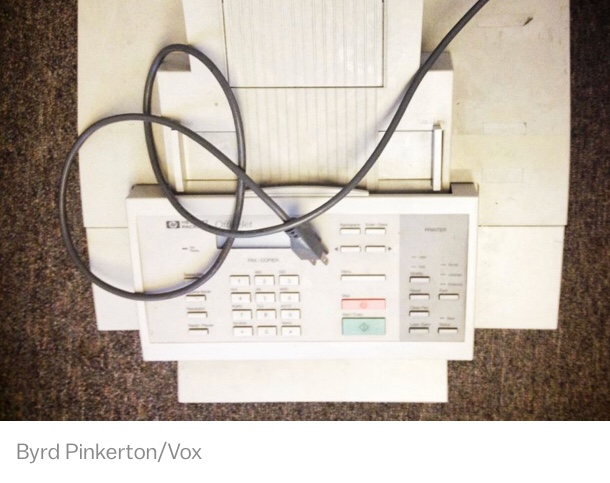
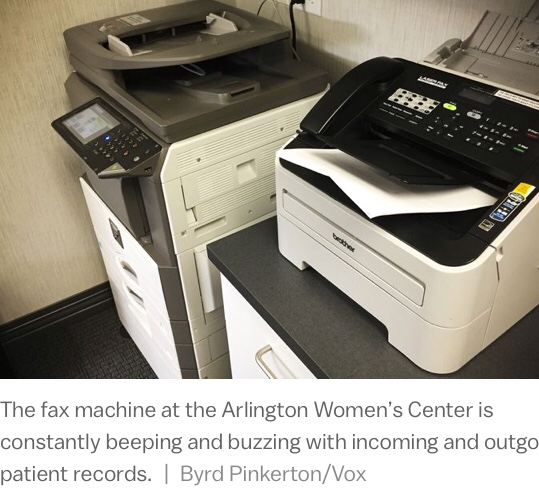
But when it needs to share patient records, it turns to an outdated technology: the fax machine. 

“The pages get jammed up so you end up with half-pages that come out at the other end,” says Amanda Rohn, an OB-GYN at Arlington Women’s Center, “or you get blank pages that don’t actually have the information you need.”
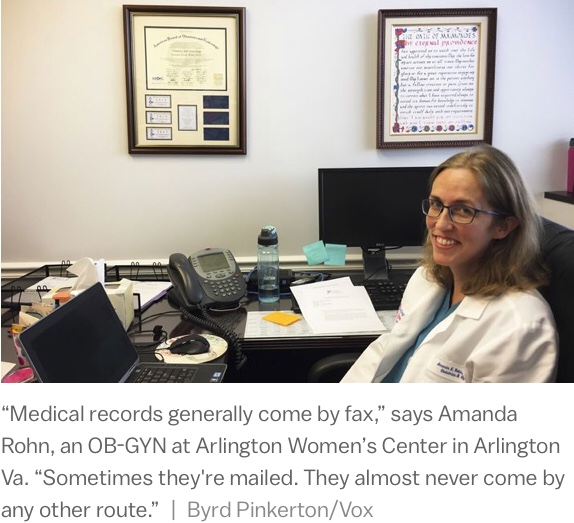
The clinic has digitized its own patient data. But its electronic system can’t connect with other clinics’ records. So when doctors want to retrieve records from another office — an ultrasound for a pregnant patient, for example — they have to turn to the fax.

Most women at the Arlington Women’s Center get their ultrasounds at a radiology office that is in the same building, just a floor below. It also has a digital record. But the two systems don’t connect. So they use a Rube Goldberg-esque analog method for sharing data: Print out pages of one record, fax it, and then scan those pages into the other digital system. 

“We have a medical records department who goes through all the incoming faxes, sorts them for which doctor they go to, and then I have a folder where they put my results in,” Rohn says, pointing to a pink file folder on her desk. “If we were all on the same system, I’d be able to see everybody’s results, but since we’re not, there has to be some way they get to me.”

Most industries abandoned the fax machine in the 1990s, and for good reason. Fax machines are terrible at sending data. Busy signals interfere. Printouts are blurry. And sometimes faxes go to the wrong place entirely.
One medical worker recalled a fax fiasco from the 1990s when he practically sent medical records to the moon. “The FBI called about a half-hour later and asked how I got the number,” he said. “I told them that I was faxing Minnesota. They told me I had faxed NASA.”

In the medical sector, the fax is as dominant as ever. It is the cockroach of American medicine: hated by doctors and medical professionals but able to survive — even thrive — in a hostile environment. By one private firm’s estimate, the fax accounts for about 75 percent of all medical communication. It frustrates doctors, nurses, researchers, and entire hospitals, but a solution is evasive.

At Rohn’s obstetrics practice, no one has contacted NASA by mistake, but they’ve had real problems. Lately, doctors have taken to hand-delivering the most important records. 

“We used to fax the labor and delivery records, but they didn’t get them or they were misplacing them,” says Hilda Moreno, who manages the office’s medical records. “We kept getting calls like, did you send this? And we’d say we did. So we started printing them out.”

Obama tried to force the health sector to go digital. But he didn’t make the systems talk. 

The story of the fax machine’s dominant role in medicine is also the story of a government incentive program that badly misread the economics of American health care. 

The Obama administration spent upward of $30 billion encouraging American hospitals and doctor offices to switch from paper to electronic records. The program was a wild success, in one respect. The number of hospitals using electronic records grew from 9 percent in 2008 to 83 percent in 2015, a huge change in less than a decade.

But the program didn’t account for a critical need: sharing. Hospital and doctor offices generally remain unable to transfer electronic information to other hospitals and doctor offices. Billions of dollars later, they are left printing out documents and faxing them. And so the fax machine remains medicine’s dominant method of communication.

“MEDICAL RECORDS GENERALLY COME BY FAX. SOMETIMES THEY’RE MAILED. THEY ALMOST NEVER COME BY ANY OTHER ROUTE.”

Obama officials believed competing health systems would volunteer to share patient data. They now admit that was naive.

“We don’t expect Amazon and Walmart to share background on their customers, but we do expect competing hospital system to do so,” says David Blumenthal, who coordinated health policy for the Obama administration from 2011 to 2013. “Those institutions consider that data proprietary and an important business asset. We should never have expected it to occur naturally, that these organizations would readily adopt information exchange.”

The stimulus package that President Obama signed into law in February 2009 included a 53-page section called the HITECH Act (an acronym for its much clunkier full name: the Health Information Technology for Economic and Clinical Health).

The small part of the massive stimulus bill included more than $30 billion to spend incentivizing doctors to adopt digital records. The law directed a small, little-known government agency — the Office of the National Coordinator for Health Information Technology (ONC) — to develop a program to distribute the money.

“It was quite small and had modest operational responsibilities,” says Blumenthal. 

The agency historically subsisted on a meager budget with a few dozen staffers. All of a sudden, it had a multibillion-dollar budget and pressure from the White House to spend that money quickly. The Obama administration hoped this infusion of money would help drag the country out of the 2008 recession. 

“The White House looked at these billions of dollars and they saw an opportunity to stimulate the economy,” Blumenthal says. “We did have pressure from the White House to get the money out the door.”

Blumenthal’s team had to move quickly, and decided to focus on getting doctors to adopt electronic records. Once doctors started using electronic records, the thinking at the time went, they would naturally start using more digital forms of communication like secure email. 

“Our philosophy was, you’ve got to have the information in bits and bytes before you can start sending those down the internet to someplace else,” Blumenthal says. 

Farzad Mostashari, who took over Blumenthal’s position in 2013, recalls the ambitions similarly. “The real goal at the time was, hey, let’s get folks off of paper and onto electronic health records,” he says. 

ONC came up with “meaningful use” standards, a checklist of benchmarks that doctor and hospital offices would need to hit in order to receive a small slice of that $30 billion incentive fund. If doctors and hospitals were able to meet these criteria, they’d get bonus payments from the federal government. 

All available data suggests that the meaningful use incentives hugely increased the adoption of electronic medical records. A recent paper in the journal Health Affairs compared the adoption of digital records among hospitals (which qualified for these incentive payments) and nursing homes (which didn’t get the bonuses).

It found that the facilities eligible for the bonus payments adopted digital records at a much faster pace than those without much incentive.

“We now have data to suggest the majority of electronic health record adoption was because of the HITECH Act,” says Julia Adler-Milstein, the lead author of that study and an associate professor at the University of California San Francisco School of Medicine. “We would not have seen those double-digit percentage point increases without it.”

If you can now log in to a patient portal at your doctors’ office to schedule a visit, see results of a test, or send a message to your physician, that is likely the result of the HITECH Act. 

But if you’ve ever become frustrated trying to get one doctor to talk to another, that is the Obama administration’s legacy too. 

“The fax machine is still a major part of medical communication”

Rohn works on that Virginia hospital campus I mentioned earlier. And for years, she’s had a front-row seat to the Obama administration’s struggle to digitize American medicine.

The 36-year-old received an undergraduate degree in engineering and initially planned to pursue a career in programming. “It turned out that I didn’t like spending all my time looking at a computer screen,” she said. “I really wanted to spend my time interacting more directly with people.”

Rohn went back to medical school and in 2013 completed a residency in obstetrics and gynecology at the University of Pennsylvania. She began cold-calling OB-GYN practices that had openings in the DC area, where her husband already had a job. 

Office after office told her the same thing: Stop calling us. Just fax us your résumé. 

“The fax machine is still a major part of medical communication,” she says. “It’s crazy that I was sending my CV by fax machine in 2013.”

Rohn began sending unsolicited faxes with her résumé to OB-GYN practices, and, amazingly, it worked. One of her faxes went to Arlington Women’s Center, where she works today.
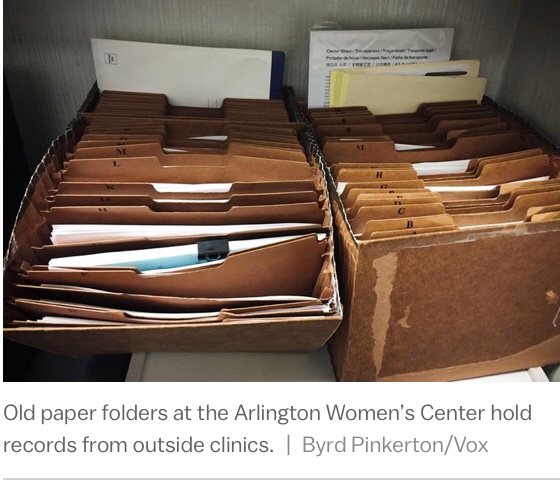
When Rohn was a resident, she used a lot more paper records. When she saw patients in the hospital after surgery or a delivery, she would handwrite notes in a paper chart.

She started her job just as billions of federal incentive dollars were flowing to get doctors to switch to digital records. Her clinic digitized just before her arrival in 2013. Now, instead of scribbling patient notes in handwriting, she types them into her electronic record.

She can order most lab results through the electronic record, too, after a lengthy effort to connect her office’s digital system with the laboratory they work with most frequently.

“I can see each encounter the patient has had in our clinic, so I can look back and see when my colleague saw this patient last year, read her notes, know what they talk about,” Rohn says. 

It’s when she wants to communicate with other offices that things get tricky. The hospital where most of her patients deliver uses Epic, the medical records company with the largest market share in the United States. Rohn’s office uses a smaller company called NextGen.

Each day, Rohn comes into the office to a pink folder on her desk labeled “prenatal labs” that contains a stack of faxes from other offices she needs to enter into the electronic record.

When Rohn’s patients are close to giving birth, at 36 weeks pregnant, she or another doctor hand-delivers their medical records to the labor and delivery department. It’s not a great system.

“Sometimes we can’t find the records because someone has misfiled it or someone never sent it,” Rohn says. “Or they’re not that far along yet in pregnancy if they deliver prematurely.”

Rohn is a highly trained professional. She spent four years at top-ranked medical school and more years after that as a resident learning how to deliver babies, perform surgeries, and help patients through pregnancy.

But because of America’s disconnected medical system, she spends a significant amount of time transcribing medical records and hand-delivering them around her hospital. This is time when she could be using her medical expertise to see more patients or have longer visits. Instead, she’s managing paperwork.

And this wastes her patients’ time too. Sometimes Rohn will have appointments to discuss an abnormal Pap smear but won’t be sent the actual results that show what is abnormal.

“So then I’m seeing someone in consultation for abnormal Pap smear and I don’t know what result was, and we have to decide do we do the test again today when you might not actually need it,” she says. 

There are financial incentives to keep using the fax machine 

It turns out there are strong economic incentives for doctors to keep patient information to themselves — and even stronger incentives for electronic medical records not to play nicely with each other. 

While patients might want one hospital to exchange information with another hospital, those institutions have little incentive to do so. A shared medical record, after all, makes it easier to see a different doctor. A walled garden — where records only get traded within one hospital system — can encourage patients to stick with those providers.

“When you want competing entities to share information, you have to realize that they’re sharing things that could help their competitors,” says Blumenthal. 

The program that Blumenthal helped build required hospitals to have the ability to share information, but it didn’t mandate that they do so frequently or make the process especially easy. Most hospitals made a rational business decision and did not invest in technologies that would make it easier for competitors to siphon off patients. 

Competitive pressure between the companies that sell electronic record makers themselves only made things worse. The electronic record makers don’t have much incentive to connect well with other records, when they’d rather just convert that hospital on a different electronic platform into one of their own customers.

“WHEN YOU WANT COMPETING ENTITIES TO SHARE INFORMATION, YOU HAVE TO REALIZE THAT THEY’RE SHARING THINGS THAT COULD HELP THEIR COMPETITORS”

“If [electronic record vendors] expended all that time and effort to make it so anyone could plug into any other system, it’s reducing the advantage of staying on your particular network,” Mostashari says. 

This is especially true for larger electronic medical record companies, which want to sell the advantages of joining a record that is used in lots of doctor offices. “You want to make it easier for people to say, ‘Hey, if you’re on [our electronic record], look how awesome it is! You can talk to any user, anywhere in the country,” he argues. 

In short, economics gave hospitals plenty of reasons not to connect their records with other hospitals — to stick with a clunky technology, like fax, that makes it hard to transmit information. And the government didn’t give any incentives to connect — it stopped at digitizing medicine, falling short of the interoperability that patients actually want. 

How do you actually kill the fax machine?

Mostashari came away from his time in Washington believing a fix would require more government intervention — namely, outlawing faxing in American medicine. He argues that doctors won’t leave the fax until there is an expiration date, a moment when the government forces them to use secure email instead. 

“I think if we want to kill the fax, we need to schedule a funeral,” he says. “I think you need a pull and you also need a push.”

The Trump administration, however, will take a different approach. Donald Rucker now runs the Office of the National Coordinator for Health Information Technology, and did not take kindly to the federal mandate proposal. 

“All of the thousands of regulations that have piled on have the net effect of preventing us as individuals from controlling our data, from shopping for care, or having vaguely cost-effective care to shop for,” Rucker said. 

He argues that better-designed electronic records will go a long way toward allowing data to transfer more freely. He also cited a new provision in a recent health care law, the 21st Century Cures Act, that requires electronic records to exchange data with other records in a way that requires “no special effort.” What “no special effort” means isn’t yet clear, and will likely be defined in future regulations.

“I THINK IF WE WANT TO KILL THE FAX, WE NEED TO SCHEDULE A FUNERAL”

The verdict is still out on whether the Trump administration’s approach can work — or whether, eventually, a more heavy-handed mandate will be needed to actually kill the fax.

But we do know this: As long as the fax sticks around, it is bad for doctors and bad for patients.

Article link: https://www.vox.com/health-care/2017/10/30/16228054/american-medical-system-fax-machines-why

V.A. Seeks to Redirect Billions of Dollars Into Private Care – NYT

Posted by timmreardon on 01/14/2019
Posted in: Uncategorized. Leave a comment

https://www.nytimes.com/by/jennifer-steinhauer

WASHINGTON — The Department of Veterans Affairs is preparing to shift billions of dollars from government-run veterans’ hospitals to private health care providers, setting the stage for the biggest transformation of the veterans’ medical system in a generation.
Under proposed guidelines, it would be easier for veterans to receive care in privately run hospitals and have the government pay for it. Veterans would also be allowed access to a system of proposed walk-in clinics, which would serve as a bridge between V.A. emergency rooms and private providers, and would require co-pays for treatment.

Veterans’ hospitals, which treat seven million patients annually, have struggled to see patients on time in recent years, hit by a double crush of returning Iraq and Afghanistan veterans and aging Vietnam veterans. A scandal over hidden waiting lists in 2014 sent Congress searching for fixes, and in the years since, Republicans have pushed to send veterans to the private sector, while Democrats have favored increasing the number of doctors in the V.A.

If put into effect, the proposed rules — many of whose details remain unclear as they are negotiated within the Trump administration — would be a win for the once-obscure Concerned Veterans for America, an advocacy group funded by the network founded by the billionaire industrialists Charles G. and David H. Koch, which has long championed increasing the use of private sector health care for veterans

Leading agile transformation: The new capabilities leaders need to build 21st-century organizations – McKinsey

Posted by timmreardon on 01/08/2019
Posted in: Uncategorized. Leave a comment


mckinseyww1

Report link: https://healthcarereimagined.net/wp-content/uploads/2019/01/leading-agile-transformation.pdf

Leading agile transformation: The new capabilities leaders need to build 21st-century organizations – McKinsey

Posted by timmreardon on 01/08/2019
Posted in: Uncategorized. Leave a comment

By Aaron De Smet, Michael Lurie, and Andrew St. George 

mckinseyw1

www.mckinsey.com

To build and lead an agile organization, it’s crucial that senior leaders develop new mind-sets and capabilities to transform themselves, their teams, and the organization.

For many organizations, surviving and thriving in today’s environment depends on making a fundamental transformation to become more agile. Those making the transition successfully are achieving substantive performance and health improvements: enhanced growth, profitability, customer satisfaction, and employee engagement.

More than any other factor, the key to a successful agile transformation is for leaders, particularly senior leaders, to develop substantially new mind-sets and capabilities. This article summarizes our guide, Leading agile transformation: The new capabilities leaders need to build 21st-century organizations (PDF–765KB), to readying leaders for agile transformations.

The agile story

Before we dive deep, it’s useful to take a broader view of agile, and particularly what sets agile organizations apart from traditional ones.

Characteristics of traditional and agile organizations

Simply put, the dominant traditional organization model evolved primarily for stability in a well-known environment. It is based on the idea of an organization as a machine, with a static, siloed, structural hierarchy that operates through linear planning and control to execute one or very few business models.

Agile1 organizations, viewed as living systems, have evolved to thrive in an unpredictable, rapidly changing environment. These organizations are both stable and dynamic. They focus on customers, fluidly adapt to environmental changes, and are open, inclusive, and nonhierarchical; they evolve continually and embrace uncertainty and ambiguity. Such organizations, we believe, are far better equipped than traditional ones for the future.

While there are many different forms of enterprise agility, they share some common trademarks. We have identified and enumerated these in a related article, “The five trademarks of agile organizations.”

Leadership in agile organizations

This new kind of agile organization requires a fundamentally different kind of leadership. Recent research confirms that leadership and how leadership shapes culture are the biggest barriers to—and the biggest enablers of—successful agile transformations.

Organizations must therefore begin by both extending and transcending the competencies that made their leaders successful in the past. Leaders need three new sets of capabilities for agile transformations. First, they must transform themselves to evolve new personal mind-sets and behaviors. Second, they need to transform their teams to work in new ways. Third, it’s essential to build the capabilities to transform the organization by building agility into the design and culture of the whole enterprise.

Transforming yourself

To fully transform yourself, several shifts will be necessary—and leaders will need to make these changes in a disciplined way.

Shifting from reactive to creative mind-sets

Changing our mind-set—or adjusting it to the new context—is no easy task, but developing this “inner agility” is essential in releasing our potential to lead an agile transformation.

Reactive, or socialized, mind-sets are an outside-in way of experiencing the world based on reacting to circumstances and other people. Creative, or self-authoring, mind-sets are an inside-out way of experiencing the world based on creating our reality through tapping into our authentic selves, our core passion and purpose.

Research shows that most adults spend most time “in the reactive,” particularly when challenged, and as a result, traditional organizations are designed to run on the reactive.2 To build and lead agile organizations, however, leaders must make a personal shift to run primarily “in the creative.”

There are three fundamental reactive-to-creative mind-set shifts we have found critical to foster the culture of innovation, collaboration, and value creation at the heart of agile organizations:

  • From certainty to discovery: fostering innovation. A reactive mind-set of certainty is about playing not to lose, being in control, and replicating the past. Today, leaders need to shift to a creative mind-set of discovery, which is about playing to win, seeking diversity of thought, fostering creative collision, embracing risk, and experimenting.
  • From authority to partnership: fostering collaboration. Traditional organization design tends towards siloed hierarchies based on a reactive mind-set of authority. The relationship between leaders and teams is one of superior to subordinate. Designed for collaboration, agile organizations employ networks of autonomous teams. This requires an underlying creative mind-set of partnership, of managing by agreement based on freedom, trust, and accountability.
  • From scarcity to abundance: fostering value creation. In stable markets, companies maximize their shares at the expense of others. This win–lose approach reflects a reactive mind-set of scarcity, based on an assumption of limited opportunities and resources. Today’s markets, however, evolve continually and rapidly. To deliver results, leaders must view markets with a creative mind-set of abundance, which recognizes the unlimited resources and potential available to their organizations and enables customer-centricity, entrepreneurship, inclusion, and cocreation.

A disciplined approach

While these mind-set shifts might be new and require a significant “letting go” of old beliefs and paradigms, collectively, they form a very disciplined approach to leadership. And because of inherent autonomy and freedom, leadership in agile organizations comes from a self-disciplined approach—leading not in fear of punishment or sanction but in service of purpose and passion.

Transforming your teams

Next, it’s important to learn how to help teams work in new and more effective ways.

Help teams work in agile ways

How might leaders help teams work in new and more agile ways? And what does this new way of working require of leaders? There are three essential leadership requirements that follow from all agile ways of working.

First, leaders must learn to build teams that are small, diverse, empowered, and connected. Second, leaders must allow and encourage agile teams to work in rapid cycles to enable them to deliver greater value more efficiently and more quickly. Third, leaders must keep agile teams focused on the external or internal customer and on creating value for customers, by understanding and addressing their unmet, and potentially even unrecognized, needs.

Embrace design thinking and business-model innovation

We have found that in addition to being able to lead in this new agile way of working, it is important for leaders to understand the key elements of two other relatively new disciplines: design thinking and business-model innovation.

Originating in industrial and other forms of design, design thinking is a powerful approach to developing innovative customer solutions, business models, and other types of systems. This begins with understanding the entire customer experience at each stage of the customer journey.

In organizations that are agile, each team is viewed as a value-creating unit, or as a “business.” These teams pursue business-model innovation at every opportunity, seeking new ways to meet the needs of their internal or external customers and deliver more value to employees, investors, partners, and other stakeholders.

Transforming your organization

Here, leaders must learn how to cocreate an agile organization purpose, design, and culture.

Purpose: Find the north star

The first distinctive organization-level skill leaders need to develop is the ability to distill a clear, shared, and compelling purpose—a north star—for their organization. Rather than the traditional executive-team exercise, in agile organizations, leaders must learn to sense and draw out the organization’s purpose in conversation with people across the enterprise.

Design: Apply the principles and practices of agile organization design

The second organization-level skill leaders need to develop is the ability to design the strategy and operating model of the organization based on agile-organization principles and practices. Most senior leaders of traditional companies have a well-honed skill set in this area that reflects traditional organization design as a relatively concentrated, static system: one or a very limited number of major businesses, each with a long-established business model, typically coexisting somewhat uneasily with a set of corporate functions.

To design and build an agile organization, leaders need a different set of skills based on a different understanding of organizations. They must learn to design their organization as a distributed, continually evolving system. Such an organization comprises a network of smaller empowered units, with fewer layers, greater transparency, and leaner governance than a traditional model. More specifically, leaders must learn how to disaggregate existing large businesses into a more granular portfolio; transform corporate functions into a lean, enabling backbone; and attract a wide range of partners into a powerful ecosystem.

Culture: Shape an agile organizational culture

The third organization-level skill leaders need to develop is the ability to shape a new culture across the organization, based on the creative mind-sets of discovery, partnership, and abundance and their associated behaviors.

Given the openness and freedom people experience in an agile organization, culture arguably plays an even more important role here than in traditional organizations. To shape this culture, leaders must learn how to undertake a multifaceted culture-transformation effort that centers on their own capabilities and behaviors. This includes the following steps:

  • role modeling new mind-sets and behaviors authentically
  • fostering understanding and conviction in a highly interactive way, through sharing stories and being inspired by the energy and ideas of frontline teams
  • building new mind-sets and capabilities across the organization, including among those who do not formally manage people, and weaving learning into the fabric of daily activity to become true learning organizations
  • implementing reinforcement mechanisms in the agile organization design

An agile approach to developing leaders

Many organizations start their agile pilots in discrete pockets. Initially, at least, they can build agile-leadership capabilities there. But to scale agility through an organization successfully, top leaders must embrace its precepts and be willing to enhance their own capabilities significantly. Eventually, a full agile transformation will need to encompass building the mind-sets and capabilities of the entire senior leadership across the enterprise. To do this in an agile way, five elements are essential:

  1. Build a cadre of enterprise agility coaches, a new kind of deeply experienced expert able to help leaders navigate the journey, supported by a leadership-transformation team.
  2. Get the top team engaged in developing its own capabilities early on, as all senior leaders will take their cue from the executive team.
  3. Create an immersive leadership experience (anything from a concentrated effort over three or four days to a learning journey over several months) to introduce the new mind-sets and capabilities, and roll it out to all senior leaders.
  4. Invite leaders to apply their learning in practice, both in agile-transformation initiatives already under way and through launching new organizational experiments.
  5. Roll out the leadership capability building at an agile tempo, with quarterly pauses to review the leadership experiences, experiments, and culture shifts over the past 90 days, and then finalize plans and priorities for the next 90 days.

Agile transformation is a high priority for an increasing number of organizations. More than any other factor, the key enabler to a successful agile transformation is to help leaders, particularly senior leaders, develop new mind-sets and capabilities. Doing so in an agile way will enable the organization to move faster, drive innovation, and both adapt to and shape its changing environment.

Download Leading agile transformation: The new capabilities leaders need to build 21st-century organizations, the full report on which this article is based (PDF–765KB).

About the author(s)

Aaron De Smet is a senior partner in McKinsey’s Houston office, Michael Lurie is a senior expert in the Southern California office, and Andrew St George is an adviser to the firm and associate fellow of Said Business School, Oxford University.

The authors wish to thank Wouter Aghina, Karin Ahlback, Andre Andreazzi, Christopher Handscomb, Johanne Lavoie, and Christopher Paquette for their contributions to this article.


5 Myths of Change Management for IT Modernization – Booz Allen Hamilton

Posted by timmreardon on 01/04/2019
Posted in: Uncategorized. Leave a comment

Written by Juli Dixon, Andrew Mason, and Ben Marglin

bah1

Managing change means understanding what it is—and isn’t

Successful IT modernization initiatives are often more dependent on an organization’s culture and ability to absorb change than they are on the selection and implementation of the right technology. Yet, some federal organizations think of change management initiatives almost as an afterthought to technical delivery. A comprehensive change management strategy should be an integral part of any IT modernization effort—it’s a critical part of the overall culture and vision of any modernization plan.
Here are five key myths about organizational change management in IT modernization efforts—and the reality.

Myth No. 1: We focus all our change management efforts on the end users. They’re the ones who need it most.
The Reality: Change management efforts should address the entire stakeholder community. From your delivery teams and business units to your IT group, anyone who’s helping execute the work should be part of your change management strategy. They all need to work together to ensure proper adoption of new technology and ultimate success of the IT modernization initiative.
Myth No. 2: We don’t need executive leadership to help drive our IT modernization initiatives. We can handle this on our own.
The Reality: A change champion gives your IT modernization initiative the vital authority and support it needs to succeed. From communicating a vision to connecting the IT modernization efforts to the mission, an executive sponsor should be actively engaged—articulating just how important the initiative is to the greater stakeholder community. Without an executive champion, your change management initiatives may not be prioritized effectively, resulting in implementation breakdown.
Myth No. 3: Change management means communications and training, plain and simple.
The Reality: Change management involves a variety of activities—including training and communications—but also many others. Stakeholder analysis, performance management, policy development, business process reengineering, marketing efforts, workforce impacts, and organization analysis are all vital capabilities to ensure the IT modernization effort is successful.
Myth No. 4: We engage once the technical team is ready to deploy, and once we’ve completed that, our job is done. External agencies now own it and are responsible for their own activities associated with the new application.
The Reality: Change management starts with initial planning of an IT modernization initiative and goes throughout (and likely beyond) the full lifecycle of technical delivery—it takes a sustained effort over time. For IT modernization efforts that affect a large stakeholder community, you should engage with change management workstreams all along the way, from initial planning to post-implementation.
Myth No. 5: It’s difficult to measure the success of your change management activities during an IT modernization effort. It’s a lot of “soft” stuff that’s hard to measure and understand if it has been helpful.
The Reality: Leaders and teams are quick to claim victory in the deployment of solutions without taking the time to find out what’s working and what’s not. There are lots of ways to approach performance management to identify how and where the change efforts are impacting an IT modernization initiative, and ultimately the mission or business of the agency itself. Measures and metrics should be established and used to help with data-driven decision making around the success of change management. Common examples are user adoption of new technology, but other examples include measuring the success of communications, business process and/or workforce adjustments, stakeholder feedback, and many others.

The Bottom Line
As federal agencies look to move forward with IT modernization initiatives, they should build in change management as a key component to their plans. All too often, it’s an overlooked piece of the puzzle, or agencies feel that they don’t need to invest in change management (or the first to get cut when budgets are tight). Agencies are making large investments in new technology to drive their missions forward, and they should also look to invest (a relatively small amount) in change management to drive to successful outcomes.

Article link: https://www.boozallen.com/s/insight/blog/5-myths-of-change-management-for-it-modernization.html

Virtual health and the Military Health System (MHS VH) – AMSUS

Posted by timmreardon on 01/02/2019
Posted in: Uncategorized. Leave a comment

During a discussion of virtual health and the Military Health System (MHS VH) at #AMSUS2018, current virtual health activities in federal health were mapped out to show where duplication of efforts make the MHS VH non-standardized and less efficient.

AMSUS1

AMSUS link: https://twitter.com/AMSUS/status/1080466651018158080/photo/1

What to know before purchasing a next-gen ambulatory EHR – Healtcare IT News

Posted by timmreardon on 12/27/2018
Posted in: Uncategorized. Leave a comment

Executives from Epic, Allscripts, athenahealth, eClinicalWorks and Greenway reveal what business decision makers should expect from their forthcoming software and cloud-based services.

By Bill Siwicki December 17, 2018

Evaluating healthcare reports

Electronic health record systems are the backbone of ambulatory practices today and need to be designed and tailored to meet the specific needs of physicians. Ambulatory EHRs are tasked with streamlining workflows, improving care and helping to trim costs. And like every technology, ambulatory EHRs are evolving, changing in different ways to meet the constantly transforming healthcare marketplace.

It’s up to physician group practices, health systems that own numerous group practices, and other ambulatory healthcare organizations to stay abreast of change to make sure they are getting the most out of their EHRs, and to make sure that they don’t fall behind technologically in a highly competitive industry.

Ambulatory EHR experts at both provider and vendor organizations have a wide variety of informed opinions and helpful insights as to where the technology is headed next so that ambulatory healthcare provider organizations can best prepare for where they need to be in the years ahead. And they share their expertise here, as well as in a checklist of both evolutionary changes coming soon and ways organizations can future-proof in advance of such changes and in a case study of an ambulatory EHR in action.

Connectivity backbone

But to understand where ambulatory EHRs are headed, it’s important to first understand where things stand today. EHR experts have lists of components that they believe make up a high-quality ambulatory EHR now.

Among ambulatory provider organizations in the top 5 percent that have attested for meaningful use, Epic, Allscripts and athenahealth are the top EHRs for solo practitioners and for group practices with 2 to 25 physicians, according to research from HIMSS Analytics. Epic, Allscripts and Cerner come out on top for group practices with 26 or more physicians.

[Case study: How one medical group uses its EHR to tackle three big goals and here’s a checklist:10 steps for future-proofing your ambulatory EHR investment] 

An ambulatory EHR should have the power to connect communities, providing clinicians immediate analysis and insights to initiate meaningful change, said Allscripts CEO Paul Black.

“Think of it as a practice’s backbone technology that significantly and positively impacts patient care delivery and outcomes,” Black said. “To achieve these results, it is critical for the EHR to have the capability to customize workflows, and coordinate and deliver primary and specialized care.”

Clinicians want to take great care of patients while staying independent and financially viable. They do not need complicated systems that create as many headaches as they solve.

“Clinical and financial functionality is important,” Black said. “Fundamental components such as e-prescribing, mobile access and robust, flexible clinical features will help practices deliver quality patient care, combined with powerful financial and administrative support.”

Optimizing decision-making

A comprehensive chart is critical to an ambulatory EHR, one that provides enough information to optimize clinical decision making and care planning and prevents the need to repeat tests or the risk of potentially doing harm, for example, administering a medication for which the patient has a severe allergy.

“EHRs need to employ effective clinical documentation tools that allow clinicians to capture patients’ current condition/disease states, both delivered and planned care, and satisfy regulatory requirements seamlessly,” said athenahealth Director of Ambulatory Services Jasmine Gee. “This frees up clinicians to do less administrative work and spend quality time with more patients.”

Another must-have for ambulatory EHRs is computerized physician order entry – effective CPOE tools enable easy order entry (for instance, labs, imaging, referrals, etc.) and present information to physicians that drives more effective ordering decisions, Gee added.

“And EHRs must be offering, embracing and actively improving interoperability,” she said. “The ability for the clinician to construct a 360-degree view of a patient’s clinical information, regardless of where care has been delivered, is only possible if the EHR proactively searches for and consolidates information across both traditional and non-traditional data repositories.”

“Today’s EHR must offer doctors methods to connect with patients outside of the walls of the office to help them stay healthy.”

Girish Navani, eClinicalWorks

And fundamental to any ambulatory EHR are tools that help providers better understand each patient’s needs, more accurately gauge risk, and promote more effective treatment and improved outcomes, said Girish Navani, CEO and co-founder of eClinicalWorks.

“Specifically, tools for interoperability to improve outcomes and the transmission of data, population health to analyze critical health information, and patient engagement services to virtually connect the patient and providers,” Navani said. “These tools are crucial to establishing expanded intelligence and creating inferences that improve care outcomes.”

State of the art

Ambulatory EHRs today are marked by a variety of top features and functions, the state of the art from which the technology will grow into the future.

“Capabilities enabled by technology are emerging with most EHRs able to provide some level of access to patients and providers to participate and collaborate during the care cycle,” said Robert Van Tuyl, CIO of Easter Seals of the Bay Area, which uses athenahealth’s ambulatory EHR. “Patient portals for access to at least a subset of their electronic medical record, scheduling appointments, and participation at a beginning level of remote care, is possible today.”

On another note, standards like FHIR are emerging for the exchange of electronic medical records between providers, but a lack of adoption and/or willingness to share this data efficiently and effectively with outpatient healthcare providers still is creating challenges to implementing fully integrated care.

Elsewhere, today’s EHRs should offer not just methods and tools to make a doctor’s office more efficient, but ways for doctors to connect with patients more meaningfully, said Navani of eClinicalWorks.

“Providers are moving from the traditional fee-for-service to more of a value-based care, forcing EHRs to cater to the evolving needs and changes with modules to better manage quality programs,” he said. “Today’s EHR must offer doctors methods to connect with patients outside of the walls of the office to help them stay healthy. The connection will allow providers to be successful at the different quality programs they participate in, such as reminder services, portals, and other patient engagement tools that are directly integrated into the EHR.”

How doctor’s work

Today’s ambulatory EHRs should work the way physicians work, said Richard Atkin, CEO of health IT vendor Greenway Health. If EHRs give physicians time back and improve their quality of life, they can focus on providing the best quality care to patients; EHRs today should provide added value to ambulatory practices and serve as a one-stop-shop system, Atkin added.

“The collective data recorded in the EHR should be in a discrete format and suggest preventative steps that can be taken – additional office visits, exams, tests – to give the patient the best chance of achieving the highest quality of care,” he said. “While business intelligence and automation features like this are common in other industries, they’re only now becoming mainstream in healthcare.”

In addition, EHRs that support patient portals and messaging systems are a must-have today in the age of healthcare consumerism, he added.

Allscripts CEO Paul Black said the state of the art in ambulatory EHRs today includes four components: mobility, the cloud, comprehensiveness and data sharing.

“Mobility gives you what you need, when and where you need it,” he said. “The cloud reduces total cost of ownership while improving scalability and security. A comprehensive solution integrates practice management and patient engagement. And data sharing delivers a single, shared patient record.”

The future of ambulatory EHRs

So where are ambulatory EHRs evolving toward? What will be the features and functions of tomorrow that group practice physicians can’t live without? Ambulatory EHR experts point in many directions, from artificial intelligence to genomics and more.

“Ambulatory service providers are in the unique position to provide comprehensive integrated care management and care coordination across a spectrum of services,” said Van Tuyl of Easter Seals of the Bay Area. “The ability for cloud-based ambulatory EHRs to ingest data from multiple data sources including medical devices and consumer health activity devices and provide a longitudinal view of services provided and care-team interactions will be key to integrating more advanced technologies like artificial intelligence and machine learning to reach better outcomes and efficiencies across the healthcare system.”

Patient engagement through mobile apps for managing health and wellness could be the driving force to making personal medical records a reality with which EHRs will need to exchange data, he added. Consumer-facing apps like Apple Health Records could provide availability of near-real-time data from a variety of trusted devices to augment and enrich medical records that reside within traditional electronic medical records, he said.

“It is critical for the EHR to have the capability to customize workflows, and coordinate and deliver primary and specialized care.”

Allscripts CEO Paul Black

In the future, EHRs will not just track a patient’s adherence to his or her care plan but also alert providers when a patient is missing certain elements or when specific steps of the plan have not been completed, said Atkin of Greenway Health. Machine learning will be more commonplace in EHRs, guiding the provider and suggesting medications or care plans based on additional patient data and information stored in the system, he added.

“Genomics will also unlock new possibilities for personalization and wellness in healthcare, allowing provider organizations to design transformational experiences for patients,” Atkin said. “Additionally, behavioral health and socioeconomic factors will become important elements. For example, a patient may not be coming to doctor appointments as recommended because he or she lives in an underprivileged area without transportation. This ultimately tells providers that overall community changes need to be made in order for patient outcomes to improve.”

Offering different choices

Looking ahead, EHRs will also be capable of evaluating the financial implications of clinical decisions and giving a set of different choices – such as various treatment options and drug prices – to improve the patient experience, meet their rising expectations and reduce costs even more, Atkin said.

And next-generation EHRs should be more advanced in the way they receive information, leveraging voice recognition to cut down the administrative process of entering data even more, he added. This will have even bigger benefits as providers work to spend more time with patients and less on documentation, he said.

Artificial intelligence will be a critical element in the evolution of ambulatory EHRs. Incorporating machine learning capabilities to learn physician treatment patterns, for example.

“It can pre-populate information based on these patterns and deliver preference reminders,” said Allscripts’ Black. “It’s constantly surveilling trends by user, organization and region to create opportunities for more efficiency. Plus, the power of artificial intelligence surfaces information relevant to the encounter in real time, which helps improve quality and immediate interaction with the patient.”

Ultimately, this reduces the amount of time spent on documentation, helping address the problems of EHR fatigue and physician burnout, he added.

In addition, more and more vendors will have open IT systems. Open architecture makes it easy to create apps, share data and upgrade individual components of a platform.

“When we add true vendor-agnostic interoperability, we enable providers to seamlessly communicate and exchange data with any trusted system and use that data to make better informed decisions at the point of care and beyond,” Black said.

On the horizon, EHR makers will incorporate EHR-agnostic precision medicine and genomic capabilities within their workflow, Black said.

“These types of capabilities,” he added, “should capture and store genomic data from a range of sources, harmonize clinical knowledge and genomic research to identify relevant information, and then push the resulting insights to the point of care to better determine the most effective regimen for the patient.”

Article link: https://www.healthcareitnews.com/news/what-know-purchasing-next-gen-ambulatory-ehr


Data Demands Still Tax Physicians – Healthcare IT Today

Posted by timmreardon on 12/27/2018
Posted in: Uncategorized. Leave a comment
December 26, 2018 Anne Zieger

Though most medical groups have invested heavily in health IT, particularly EHRs, most are still struggling to manage the data necessary for running the practice. Sure, Meaningful Use incentives helped them get the technology in the door, squeezing the best performance out of it calls for institutional and financial resources that many can’t afford.

As a result. new survey results underscoring the difficulty practices face in managing data came as little surprise to me.  The survey, which was sponsored by Geneia, found that 89% of responding physicians felt that the “business and regulation of healthcare” has had a negative effect on the practice of medicine.

Fifty-two percent of those responding were ambivalent about the impact of EHRs in their workplace. This included 21% who had a positive view and 22% a negative view of the role of EHRs.

In addition, while 96% of respondents said that they believe that EHRs should integrate better with technology systems used by the office and insurance providers, 57% said that their EHRs don’t integrate these systems. Meanwhile, more than two-thirds of respondents said they didn’t have the staff and resources needed to analyze and use EHR data efficiently.

Seventy-nine percent of respondents said they’d like to use an integrated EHR analytics tool to access predictive and reporting on existing data. Also, many said they’d like to have population health tools available to identify high-risk patients, find patients who need proactive screenings or monitoring and stratify patients into low-, rising- and high-risk categories.

Also, 68% said they need advanced analytics tools to be successful under value-based care arrangements, with 64% of population health users reporting that they think they such tools can help them assess patient history and needs more efficiently.

As things stand, however, these physicians don’t seem to be getting enough IT bang for their buck. Virtually all (96%) reported that the amount of time they spend on data input and reporting has grown over the last 10 years, and they’re having trouble keeping up with the pace. Also, 86% agreed that “the heightened demand for data reporting to support quality metrics and the business side of healthcare has diminished my joy in practicing medicine.”

Ideally, the technology will rise to meet this need, as Geneia clearly hopes to do. The researchers found that 44% of surveyed physicians public data and analytics tools could help improve quality performance, Medicare star ratings and HEDIS reporting.

Unfortunately for physicians, no technology can make it dead simple to report on quality measures that vary widely from payer to accrediting body to ACO contract. Seeing to it that those data requests are standardized is a business issue they’ll need to confront regardless of how technology platforms play out. Still, putting better risk management tools into providers’ hands can at least help physicians improve outcomes for patients.

Article link: https://www.healthcareittoday.com/2018/12/26/data-demands-still-tax-physicians/

Can technology restore humanity to healthcare? – Healthcare IT News

Posted by timmreardon on 12/19/2018
Posted in: Uncategorized. Leave a comment

With EHR frustrations at a boiling point and physician burnout at epidemic levels, it’s time to rethink the way IT is designed, developed and deployed to better enable a human touch, says one clinician.

By Mike MiliardDecember 07, 2018

HIT News

“At its core, technology would seem to be the antithesis of humanity,” said Dr. Chris Derienzo, chief quality officer at Asheville, North Carolina-based Mission Health System. “It doesn’t feel, it doesn’t think and it can’t see the humanity of the person in front of it,” he explained.”
Ask physicians how the feel about electronic health records, or read Atul Gawande’s recent New Yorker feature, “Why Doctors Hate Their Computers,” and it’s apparent that most healthcare professionals’ relationship with technology is ambivalent at best.
“It’s tempting to say there’s no way we can build or leverage technology in order to restore some humanity to the practice of medicine,” said Derienzo. “But I think that’s fundamentally a wrong assumption.”
At HIMSS19 in Orlando, in one of the new TED Talk-style SPARK Sessions, titled “Humanity and Technology in Medicine: Antithetic or Symbiotic?” Derienzo will explain why.
The reason technology seems to pull us away from people, rather than bring us together, mostly boils down to “how we’ve designed it and what we’ve designed,” Derienzo said. But rethinking both of those, IT could be repositioned in a way where it enhances, rather than detracts, from the clinician and patient experience.
With funny personal anecdotes and real-life case studies, he’ll show how technology, properly deployed, can restore joy to healthcare – helping burnt-out physicians better engage person to person, enabling them to practice at the top of their license and use their skills to solve complex challenges
“If we focus on the right types of technology, and we build it right, then we can actually use it to empower people to do more of the things that only people can do in healthcare,” said Derienzo.
How technology is designed, and what it’s used for, plays a big role in how well it is liked by its end-users. Consider tech that’s intentionally created connect people, such as telemedicine. “We see much more positive reaction to it.”
EHRs, on the other hand, were not designed with joy in mind. They were developed under certain conditions, with necessary check-the-box functionalities related to regulatory compliance and billing capture.
And they were “based on a world where we took what we did on paper then did the same thing on computers,” said Derienzo. They effectively ignored a lot of the human factor elements for how to design a way to document and record care electronically.”
But EHRs are only one challenge, he said. “Our monitors are another. How we use algorithms is another very important one.”
Derienzo predicts that “our electronic documentation will evolve drastically over the next few years as we move away from this built environment and toward a world where human factors matter a whole lot more.”
In the meantime, he sees one technology doing a lot to return humanity to healthcare. One that may seem ironic, to say the least, given the trepidations many have about its potential to disrupt and displace: artificial intelligence.
“AI stands positioned to be one of the core technological advances that allows us to return humanity to healthcare,” he said.
For example, he explained, “we’ve built a machine learning model at Mission Health and we’ve now gotten it fully up and running. Its purpose is to help risk-stratify patient who are case managers need to focus on. To serve them, not only by a ranked-ordered list but a concept as to why our model thinks they may be at a high risk of being readmitted.”
That’s a fairly AI application, “but its purpose is to pull out things that people don’t have to be doing so now my care manager team can spend less time wondering who to focus on and more time actually focusing on people,” said Derienzo.
Ditto with radiology, he said: “I don’t think that reading a thousand normal chest X-rays brings radiologist a ton of joy. But doing the really complex work – is it this, is it that? – is what they enjoy. How do we bring the expertise and brains of these terrific musculoskeletal and neuroradiologists tp the things we actually need them to be doing? That is how something like AI can actually empower humans.
The practice of medicine is an ancient art, and one that’s long depended on the power of human interaction, he explained.
“At one point that was all we had – other than leeches and bloodletting, all we had was the ability to interact with our patients one on one and be human with them,” said Derienzo.
“We’ve vastly improved our ability to care since then, but in some ways we’ve lost an appreciate for that aspect of a clinician patient relationship,” he explained. “My fervent hope is that once we get this right, we’ll actually be returning, somewhat, to a place where it’s that person to person relationship that’s the most valuable part of our day.”
Chris Derienzo’s HIMSS19 SPARK session, “Humanity and Technology in Medicine: Antithetic or Symbiotic?” is scheduled for Tuesday, February 12, from 3-3:30 p.m. in room W300.

Article link: https://www.healthcareitnews.com/news/can-technology-restore-humanity-healthcare
Topics: Artificial Intelligence, Clinical, Electronic Health Records (EHR, EMR)

Intelligent Machines – Nine charts that really bring home just how fast AI is growing – MIT Technology Review

Posted by timmreardon on 12/19/2018
Posted in: Uncategorized. Leave a comment

Artificial intelligence is booming in Europe, China, and the US, but it’s still a very male industry.

by Will Knight  December 12, 2018

MIT 1 aicharts

With so much hype surrounding artificial intelligence today, it can be difficult to know where things actually stand. Fortunately, a report (.pdf) issued by a group of AI policy researchers today collates a range of data that helps capture the state of the AI boom.
Recommended for You

The authors, from MIT, Stanford, and Harvard as well as nonprofits including OpenAI, look at investments, hiring, papers and patents, and even mentions of AI at government meetings. Here are some take-aways.

1. AI is being commercialized at a dizzying pace.

MIT Ai Chart 2

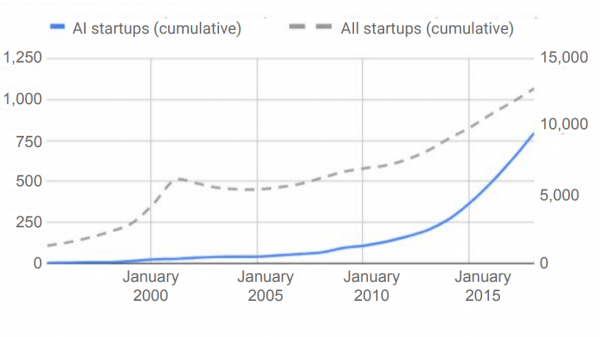
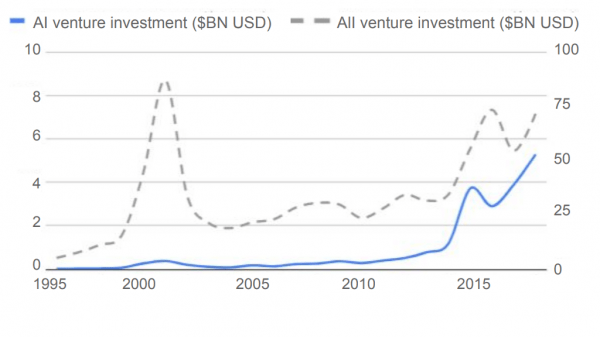
The amount of money being poured into AI startups is remarkable. The number of AI startups (top) is shown on the left, compared with total startups on the right. AI investment (below) is shown on the left, compared with total investments on the right. This speaks to huge opportunities to use machine learning in different industries, but also to a market that is hyped and overheated.

MIT AI Chart 3

2. The focal points are China and the US, but also Europe.

Much has been made of China’s rising AI prowess (see “China’s AI awakening”) and its growing rivalry with the US. As the data shows, Europe is also a huge hub of AI activity. But it seems that three main centers of power are emerging.

MIT AI Chart 4

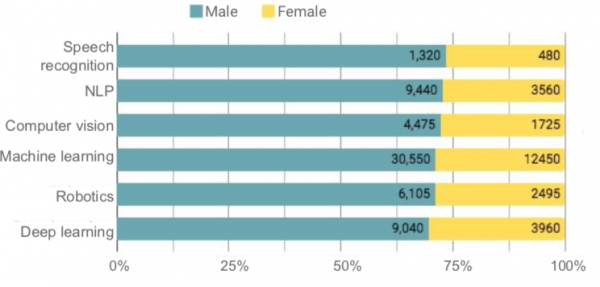
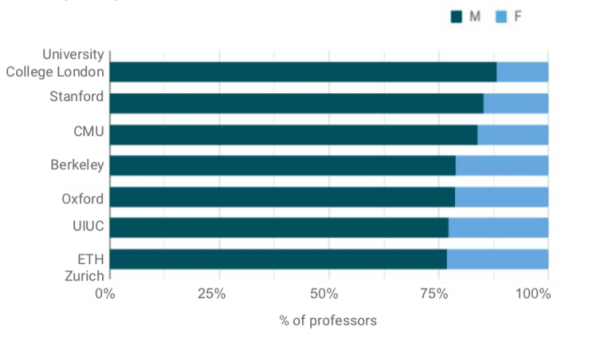
3. There are still far more men in the field than women.

MIT AI Chart 5

Many researchers have pointed to the inadequate number of women and racial minorities in AI research. The new report offers some data to back that up, showing a shortage of women among applicants for AI-related jobs (top) and as a percentage of people in AI teaching roles (bottom).

MIT AI Chart 6

4. The state of the art is improving fast.

MIT AI Chart 7

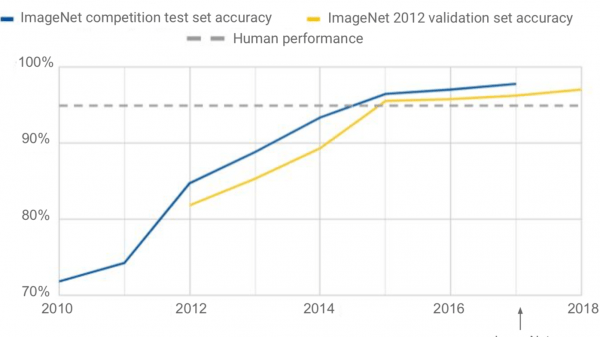
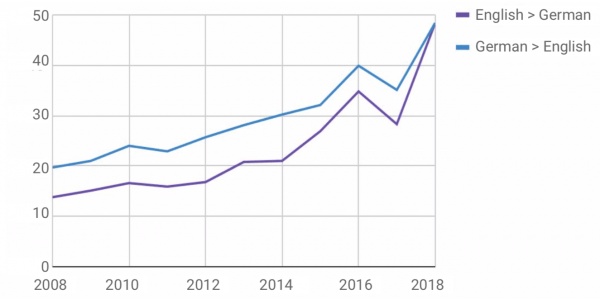
The report includes several measures of technical progress, including the accuracy of object recognition in images, measured against average human performance (top), and the accuracy of machine translations of news articles, measured using a score assigned by human judges (bottom). These don’t mean that the field is getting closer to developing a human-level AI, but they show how key techniques have been honed in recent years.

MIT AI Chart 8

5. Artificial intelligence is a political issue.

MIT AI Chart 9

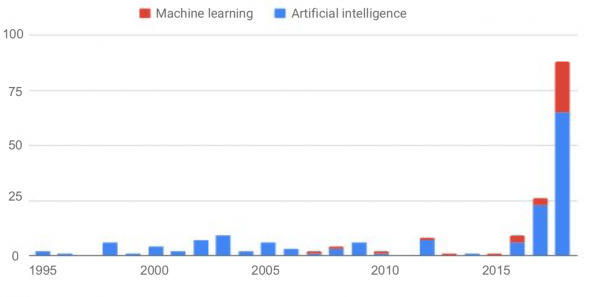
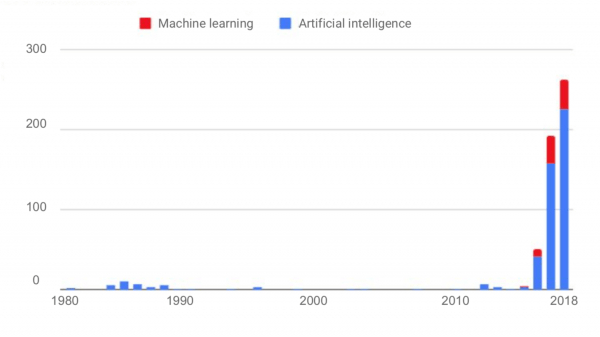
Mentions of artificial intelligence and machine learning in the US Congress (above) and the UK Parliament (below) have exploded in the past few years. This reflects a growing awareness of the technology’s economic and strategic importance (see “Canada and France propose an international panel on AI”).

MIT AI Chart 10

For more info, and to find the data itself, check out the AI Index site.

Article link: https://www.technologyreview.com/s/612582/data-that-illuminates-the-ai-boom/

Posts navigation

← Older Entries
Newer Entries →
  • Search site

  • Follow healthcarereimagined on WordPress.com
  • Recent Posts

    • When Not to Use AI – MIT Sloan 04/01/2026
    • There are more AI health tools than ever—but how well do they work? – MIT Technology Review 03/30/2026
    • Are AI Tools Ready to Answer Patients’ Questions About Their Medical Care? – JAMA 03/27/2026
    • How AI use in scholarly publishing threatens research integrity, lessens trust, and invites misinformation – Bulletin of the Atomic Scientists 03/25/2026
    • VA Prepares April Relaunch of EHR Program – GovCIO 03/19/2026
    • Strong call for universal healthcare from Pope Leo today – FAN 03/18/2026
    • EHR fragmentation offers an opportunity to enhance care coordination and experience 03/16/2026
    • When AI Governance Fails 03/15/2026
    • Introduction: Disinformation as a multiplier of existential threat – Bulletin of the Atomic Scientists 03/12/2026
    • AI is reinventing hiring — with the same old biases. Here’s how to avoid that trap – MIT Sloan 03/08/2026
  • Categories

    • Accountable Care Organizations
    • ACOs
    • AHRQ
    • American Board of Internal Medicine
    • Big Data
    • Blue Button
    • Board Certification
    • Cancer Treatment
    • Data Science
    • Digital Services Playbook
    • DoD
    • EHR Interoperability
    • EHR Usability
    • Emergency Medicine
    • FDA
    • FDASIA
    • GAO Reports
    • Genetic Data
    • Genetic Research
    • Genomic Data
    • Global Standards
    • Health Care Costs
    • Health Care Economics
    • Health IT adoption
    • Health Outcomes
    • Healthcare Delivery
    • Healthcare Informatics
    • Healthcare Outcomes
    • Healthcare Security
    • Helathcare Delivery
    • HHS
    • HIPAA
    • ICD-10
    • Innovation
    • Integrated Electronic Health Records
    • IT Acquisition
    • JASONS
    • Lab Report Access
    • Military Health System Reform
    • Mobile Health
    • Mobile Healthcare
    • National Health IT System
    • NSF
    • ONC Reports to Congress
    • Oncology
    • Open Data
    • Patient Centered Medical Home
    • Patient Portals
    • PCMH
    • Precision Medicine
    • Primary Care
    • Public Health
    • Quadruple Aim
    • Quality Measures
    • Rehab Medicine
    • TechFAR Handbook
    • Triple Aim
    • U.S. Air Force Medicine
    • U.S. Army
    • U.S. Army Medicine
    • U.S. Navy Medicine
    • U.S. Surgeon General
    • Uncategorized
    • Value-based Care
    • Veterans Affairs
    • Warrior Transistion Units
    • XPRIZE
  • Archives

    • April 2026 (1)
    • March 2026 (9)
    • February 2026 (6)
    • January 2026 (8)
    • December 2025 (11)
    • November 2025 (9)
    • October 2025 (10)
    • September 2025 (4)
    • August 2025 (7)
    • July 2025 (2)
    • June 2025 (9)
    • May 2025 (4)
    • April 2025 (11)
    • March 2025 (11)
    • February 2025 (10)
    • January 2025 (12)
    • December 2024 (12)
    • November 2024 (7)
    • October 2024 (5)
    • September 2024 (9)
    • August 2024 (10)
    • July 2024 (13)
    • June 2024 (18)
    • May 2024 (10)
    • April 2024 (19)
    • March 2024 (35)
    • February 2024 (23)
    • January 2024 (16)
    • December 2023 (22)
    • November 2023 (38)
    • October 2023 (24)
    • September 2023 (24)
    • August 2023 (34)
    • July 2023 (33)
    • June 2023 (30)
    • May 2023 (35)
    • April 2023 (30)
    • March 2023 (30)
    • February 2023 (15)
    • January 2023 (17)
    • December 2022 (10)
    • November 2022 (7)
    • October 2022 (22)
    • September 2022 (16)
    • August 2022 (33)
    • July 2022 (28)
    • June 2022 (42)
    • May 2022 (53)
    • April 2022 (35)
    • March 2022 (37)
    • February 2022 (21)
    • January 2022 (28)
    • December 2021 (23)
    • November 2021 (12)
    • October 2021 (10)
    • September 2021 (4)
    • August 2021 (4)
    • July 2021 (4)
    • May 2021 (3)
    • April 2021 (1)
    • March 2021 (2)
    • February 2021 (1)
    • January 2021 (4)
    • December 2020 (7)
    • November 2020 (2)
    • October 2020 (4)
    • September 2020 (7)
    • August 2020 (11)
    • July 2020 (3)
    • June 2020 (5)
    • April 2020 (3)
    • March 2020 (1)
    • February 2020 (1)
    • January 2020 (2)
    • December 2019 (2)
    • November 2019 (1)
    • September 2019 (4)
    • August 2019 (3)
    • July 2019 (5)
    • June 2019 (10)
    • May 2019 (8)
    • April 2019 (6)
    • March 2019 (7)
    • February 2019 (17)
    • January 2019 (14)
    • December 2018 (10)
    • November 2018 (20)
    • October 2018 (14)
    • September 2018 (27)
    • August 2018 (19)
    • July 2018 (16)
    • June 2018 (18)
    • May 2018 (28)
    • April 2018 (3)
    • March 2018 (11)
    • February 2018 (5)
    • January 2018 (10)
    • December 2017 (20)
    • November 2017 (30)
    • October 2017 (33)
    • September 2017 (11)
    • August 2017 (13)
    • July 2017 (9)
    • June 2017 (8)
    • May 2017 (9)
    • April 2017 (4)
    • March 2017 (12)
    • December 2016 (3)
    • September 2016 (4)
    • August 2016 (1)
    • July 2016 (7)
    • June 2016 (7)
    • April 2016 (4)
    • March 2016 (7)
    • February 2016 (1)
    • January 2016 (3)
    • November 2015 (3)
    • October 2015 (2)
    • September 2015 (9)
    • August 2015 (6)
    • June 2015 (5)
    • May 2015 (6)
    • April 2015 (3)
    • March 2015 (16)
    • February 2015 (10)
    • January 2015 (16)
    • December 2014 (9)
    • November 2014 (7)
    • October 2014 (21)
    • September 2014 (8)
    • August 2014 (9)
    • July 2014 (7)
    • June 2014 (5)
    • May 2014 (8)
    • April 2014 (19)
    • March 2014 (8)
    • February 2014 (9)
    • January 2014 (31)
    • December 2013 (23)
    • November 2013 (48)
    • October 2013 (25)
  • Tags

    Business Defense Department Department of Veterans Affairs EHealth EHR Electronic health record Food and Drug Administration Health Health informatics Health Information Exchange Health information technology Health system HIE Hospital IBM Mayo Clinic Medicare Medicine Military Health System Patient Patient portal Patient Protection and Affordable Care Act United States United States Department of Defense United States Department of Veterans Affairs
  • Upcoming Events

Blog at WordPress.com.
healthcarereimagined
Blog at WordPress.com.
  • Subscribe Subscribed
    • healthcarereimagined
    • Join 153 other subscribers
    • Already have a WordPress.com account? Log in now.
    • healthcarereimagined
    • Subscribe Subscribed
    • Sign up
    • Log in
    • Report this content
    • View site in Reader
    • Manage subscriptions
    • Collapse this bar
 

Loading Comments...