healthcarereimagined

Envisioning healthcare for the 21st century

  • About
  • Economics

DoD, VA establish office to improve EHR coordination – Healthcare IT News

Posted by timmreardon on 06/14/2019
Posted in: Uncategorized. Leave a comment

By Nathan Eddy June 13, 2019 11:50 AM

The Federal Electronic Health Record Modernization office will replace the current Interagency Program Office.

HITNy1

The Department of Defense and the Veterans Affairs department announced the creation of a special office to help centralize decision-making as the VA makes a multi-billion dollar electronic health records upgrade.

WHAT HAPPENED
The Federal Electronic Health Record Modernization (FEHRM) office will replace the current Interagency Program Office, headed by Lauren Thompson.

WHY IT MATTERS
“This management model creates a centralized structure for interagency decisions related to EHR modernization, accountable to both the VA and the DoD Deputy Secretaries,” FCW reported Thompson as saying during her testimony at a June 12 hearing of the Subcommittee on Technology Modernization of the House Veterans Affairs Committee.

Ranking member of the subcommittee Rep. Jim Banks (R-Ind.) noted during the hearing that lack of interoperability and clear management had been a continuing struggle, and it remains unclear if the new office will help keep the transition on schedule.

Plans were also revealed to implement a pilot program that will see all veterans receive a unique ID number to help track individuals’ medical records after they leave service.

THE LARGER TREND
The announcement comes as the VA department wrangles with a $16 billion implementation of the Cerner electronic health records system, which is slated to go live across care sites by 2028, but the lack of interoperability between DoD and VA remains a major stumbling block.

While progress is being made, the sheer vastness of the task – 1,700 sites, training of 300,000 VA employees and aggregation of decades of clinical data – delays in decision making and workflow difficulties have been challenges.

The VA signed a contract with Cerner in 2018 to replace the department’s 40-year-old legacy Veterans Integrated System Technology Architecture (Vista) healthcare records technology over the next 10 years with the Cerner system, which is currently in the pilot phase at DoD.

However, an array of major challenges with the DoD’s EHR modernization came to light last spring, with many IT, training and workflow hiccups reportedly causing inaccurate prescriptions, misdirected patient referrals and other complaints that clinicians said could put patient safety at risk.

Further complicating matters was the first House VA Subcommittee on Technology Modernization hearing, held in September 2018, which revealed that officials and congressional members are not on the same page when it comes to governance and EHR interoperability.

In January, the Senate confirmed James Gfrerer, a former marine and cybersecurity executive at Ernst & Young, to head the VA’s IT department — a position that has been without a permanent leader for the past two years.

The VA has also partnered with Microsoft with the aim of improving how veterans living in rural areas can access the VA’s online services and benefits.

Article link: https://www.healthcareitnews.com/news/dod-va-establish-office-improve-ehr-coordination

Nathan Eddy is a healthcare and technology freelancer based in Berlin.

Email the writer: nathaneddy@gmail.com
Twitter: @dropdeaded209


Strategy For and With AI – MIT Sloan Management Review

Posted by timmreardon on 06/12/2019
Posted in: Uncategorized. 1 Comment

A company’s strategy is defined by its key performance indicators. Artificial intelligence can help determine which outcomes to measure, how to measure them, and how to prioritize them.

Many executives, intent on understanding and exploiting AI for their companies, travel to Silicon Valley to acquaint themselves with the technology and its many promises. These pilgrimages have grown so common that tours now exist to facilitate inside peeks at innovative startups. Buoyed by hype and smatterings of algorithmic knowledge, returning executives share a common goal: determining what products, services, and processes AI can enhance or inspire to sharpen competitive edges. They believe a comprehensive strategy for AI is essential for success.

That well-intentioned belief is off the mark. A strategy for AI is not enough. Creating strategy with AI matters as much — or even more — in terms of exploring and exploiting strategic opportunity. This distinction is not semantic gamesmanship; it’s at the core of how algorithmic innovation truly works in organizations. Real-world success requires making these strategies both complementary and interdependent. Strategies for novel capabilities demand different managerial skills and emphases than strategies with them.

Machine learning pioneers — Amazon, Google, Alibaba, and Netflix come to mind — have learned that separating strategies for developing disruptive capabilities from strategies deployed with those capabilities invariably leads to diminished returns and misalignments. Not incidentally, these organizations are intensely data- and analytics-driven. Their leaders rely heavily on metrics to define, communicate, and drive strategy. This reliance on quantitative measures has increased right along with their growing investment in AI capabilities.

Our research strongly suggests that in a machine learning era, enterprise strategy is defined by the key performance indicators (KPIs) leaders choose to optimize. (See “About the Analysis.”) These KPIs can be customer centric or cost driven, process specific or investor oriented. These are the measures organizations use to create value, accountability, and competitive advantage. Bluntly: Leadership teams that can’t clearly identify and justify their strategic KPI portfolios have no strategy.

In data-rich, digitally instrumented, and algorithmically informed markets, AI plays a critical role in determining what KPIs are measured, how they are measured, and how best to optimize them. Optimizing carefully selected KPIs becomes AI’s strategic purpose. Understanding the business value of optimization is key to aligning and integrating strategies for and with AI and machine learning. KPIs create accountability for optimizing strategic aspirations. Strategic KPIs are what smart machines learn to optimize. We see this with Amazon, Alibaba, Facebook, Uber, and assorted legacy enterprises seeking to transform themselves.

These principles have sweeping and disruptive implications. As “accountable optimization” becomes an AI-enabled business norm, there is no escaping analytically enhanced oversight. Boards of directors and members of the C-suite will have a greater fiduciary responsibility to articulate which KPIs matter most — and why — to shareholders and stakeholders alike. Transformative capabilities transform responsibilities. You are what your KPIs say you are.

About the Analysis

This article draws on results from a 2018 survey of 3,225 business executives, managers, and analysts from companies based in 107 countries and 20 industries. To complement our survey analysis, we conducted 30- to 60-minute interviews with 17 executives and academics about the role of KPIs as a leadership tool. Some related findings were published in the 2018 MIT SMR report “Leading With Next-Generation Key Performance Indicators.” This article extends that discussion by drawing out the implications of machine learning and AI for both identifying and optimizing strategic metrics.

Distinct Complements


Historical context and precedent are important: Blending strategy for and strategy with is hardly unique to AI and machine learning. John D. Rockefeller’s Standard Oil, for example, dominated the petroleum market not just because the company had an effective strategy for capitalizing on the nascent railroad industry’s emerging capabilities but also because it allowed those capabilities — logistical powers of transport and delivery — to shape its broader strategy. By ruthlessly exploiting scale and acquiring and designing fuel tank cars, Standard Oil consistently reaped disproportionate returns from a rapidly expanding physical network.1

More recently, incumbents grasped that they urgently needed a strategy for the internet to compete with disruptive born-digital startups. But those organizations discovered — sooner or later — that their strategies for the internet were contingent upon the success of their strategies with the internet. Retailers, for example, commonly use internet-based omnichannel strategies to compete on customer experience. They might start by building strong relationships with shoppers online, for example, but when those same customers go to physical store locations, geofencing apps alert the company to their imminent arrival. Staff is then primed to help facilitate customer pickups. These seamless experiences blend strategy with and for the internet.

Creating an enterprise strategy for developing or applying a capability is not organizationally, culturally, or operationally the same as cultivating a strategy with that capability. These activities are complements. A strategy for sustainability (such as lowering one’s carbon footprint or reducing waste) should not be divorced from having a sustainable overall strategy enabling the business to operate in thriving communities. Similarly, a strategy for AI shouldn’t be viewed as a substitute for creating a strategy with AI.

Where Opportunity Lies

What, then, does strategy with AI pragmatically mean? Like any corporate strategy, it expresses what enterprise leaders deliberately seek to emphasize and prioritize over a given time frame. Strategies articulate how and why an organization expects to succeed in its chosen market. These aspirations might involve, for example, superior customer experience and satisfaction, increased growth or profitability, greater market share, or agile fast-followership when rivals out-innovate the company.

Whatever the specific strategy, virtually all organizations create corresponding measures to characterize and communicate desirable strategic outcomes. Those metrics — be they KPIs, objectives and key results (OKRs), or a Balanced Scorecard — are how organizations hold humans and algorithms accountable. For public companies, strategic KPIs typically respect and reflect investor concerns; for private equity, strategic KPIs might be calibrated to maximize a sale price or facilitate an IPO. Data-driven systems, enhanced by machine learning, convert these aspirations into computation. World-class organizations can no longer meaningfully discuss optimizing strategic KPIs without embracing machine learning (ML) capabilities.

Uber, for example, runs hundreds of ML models to optimize its ride-sharing platform and food-delivery business. Uber has made enormous investments in its machine learning capabilities and implementations. Whether it enjoys an abundance of available cars on call or relies on relatively few, its ability to estimate accurate arrival times for customer and driver alike is essential to how it competes in the marketplace.

“Accurate ETAs are critical to a positive user experience,” observes Jeremy Hermann, who heads Uber’s machine learning platform, “and these metrics are fed into myriad other internal systems to help determine pricing and routing. However, ETAs are notoriously difficult to get right.”2

Yet, so many critical outcomes are dependent on robust ETA analytics — rider and driver expectations, fares, food pickup and delivery — that ETA is a core Uber metric. Hermann notes, “Uber’s Map Services team developed a sophisticated segment-by-segment routing system that is used to calculate base ETA values. These base ETAs have consistent patterns of errors. The Map Services team discovered they could use a machine learning model to predict these errors and then use the predicted error to make a correction. As this model was rolled out city by city (and then globally … ), we have seen a dramatic increase in the accuracy of the ETAs, in some cases reducing average ETA error by more than 50%.”3 [emphasis added]

Simply celebrating effective and globally scalable machine learning models misses the larger point. Uber cannot deliver on operational or strategic aspirations without reliably delivering on its ETA KPI. Chaotic ETA outcomes would prevent Uber from being a “low cost” or “best value” provider of mobility/delivery services. Technical, organizational, or operational changes that might threaten ETA outcomes are counterproductive. Uber must marginalize or minimize KPIs that might conflict or compete with effective ETA prediction.

Clarifying those constraints is crucial. In the words of Harvard Business School’s Michael Porter, “The essence of strategy is choosing what not to do.”4 Once those guardrails are established, identifying and minimizing unwelcome consequences becomes as important as promoting the outcomes you want. The essential takeaway here is that prioritizing KPIs — ranking them according to what matters most and what the organization must learn the best — is essential to enterprise strategy. In an always-on big data world, your system of measurement is your strategy.

Determining the optimal “metrics mix” for key enterprise stakeholders becomes an executive imperative. Are customer-centric strategies, for example, better optimized via customer lifetime value (CLV) or balanced blends of earnings before interest, taxes, depreciation, and amortization (EBITDA) and net promoter score? For what customer segments should profitability be privileged over satisfaction or loyalty? As algorithms get smarter, leaders must have the courage to explore how best to answer these questions. AI makes that feasible, affordable, and desirable.5

This optimization imperative, our research suggests, demands a rigorous rethinking of the metrics chosen to define desirable (and undesirable) strategic outcomes. When machine learning measures management and manages measurement, metrics don’t just reflect strategy but drive it. Achieving KPI outcomes (and suggesting new KPIs) is what smart machines need to do — and need to learn to do.

AI is not just about building products, services, or processes. Leaders need to recognize that AI must be primarily about enhancing the formulation and execution of strategy. To the extent that KPIs are essential to formulating and communicating strategy, strategy is quintessentially a system of measurement. Our research shows that AI transforms the strategist’s choices about which KPIs to optimize and how to optimize them. Strategy is about optimizing KPIs with AI/ML.

Looking Forward and Backward

Machine learning profoundly changes how to approach optimizing leading and lagging KPIs. McDonald’s has a multipart growth plan explicitly combining the two types of indicators. A key strategic aspiration is to once again be a family destination that appeals to parents. A lagging indicator is more visits by families with kids under the age of 13. A leading indicator is any evidence of becoming “a place I’m happy to bring my children,” says McDonald’s global chief marketing officer Silvia Lagnado.

Reliably measuring “happy place to bring my children” is methodologically challenging. Customer surveys are limited to those who fill them out, a source of selection bias. Machine learning-based sentiment analysis improves on this approach: It can classify large volumes of geotagged Twitter data and other data sets to correlate neighborhood-level well-being with comments about fast-food locations. A group of University of Utah academics developed a blueprint for this type of ML application.6 Such machine learning mashups are becoming standard practice in academic and business research.

With machine learning, McDonald’s can more effectively pursue high-priority KPIs. Marketers exploring in-store promotions with family-oriented advertising and menu options might improve family traffic but will fail if those promotions produce store conditions that annoy parents. Maximizing sales or revenues cannot come at that cost. Striking a productive balance between those measures is what optimization means. That’s what McDonald’s machines need to learn to serve up.

Not coincidentally, in March 2019, McDonald’s announced its $300 million acquisition of Israel-based Dynamic Yield, which uses machine learning and big data to make personalized recommendations. McDonald’s says it intends to use the company’s tools to customize the drive-thru experience by creating dynamic digital menu boards that recommend menu items based on local demographics, previous orders, weather, and time of day, among other factors.

GoDaddy, the multibillion-dollar web-hosting and internet registry innovator, is also embracing leading as well as lagging data-driven KPIs. Since 2016, the Scottsdale, Arizona-based company’s market value has grown more than 2.5X in no small part due to its dual commitment to strategic KPIs and machine learning. “We’re very excited about the prospect of using the large data sets that we have,” observes GoDaddy COO Andrew Low Ah Kee, “[to] train a model to solve and optimize against [customer] lifetime value as opposed to solving for transactional period revenue.”7

Low Ah Kee’s essential insight is that leaders have the duty and responsibility to pick which time horizons and “objective functions” to optimize. GoDaddy’s emphasis on customer lifetime value (which anticipates future revenues, costs, and loyalty in addition to capturing past purchase behavior) reduces short-termism and threats to customer experience quality, he asserts. “We see in our customer base, when we help our customers succeed, the lifetime value it brings to us is significantly higher than for people whom we approach with just a transactional view,” he notes. “As you start to extend the time horizon, I think the degree of [organizational] misalignment tends to go down.” It’s easier to miss long-term goals if the focus is on short-term tactics.

Learning What to Optimize

Optimizing known KPIs is important but not strategically sufficient. When appropriately trained, machine learning models can learn to identify and recommend novel or emergent KPIs. That is, machines can “learn to discover” enterprise KPIs on their own, without expert guidance. This is the difference between supervised and unsupervised learning. GE Healthcare CMO Glenn Thomas explains that his data science teams are “actually boiling out the KPIs from the data rather than setting the KPIs to be measured.”

Making Smarter Trade-Offs

We argue that strategy is best understood and experienced as how the business invests in, manages, and prioritizes its KPI portfolio. KPIs and the relationships between them are the critical strategic units of analysis. Strategic success means the company’s machines learn to optimize KPI portfolio returns.

To be clear, optimization in this context does not mean maximization. On the contrary, it means computationally learning to advance toward desired strategic outcomes through carefully calculated and calibrated KPI trade-offs. Understanding trade-offs among and between competing — and complementary — KPIs is essential. Simply optimizing individual KPIs by priority or rank ignores their inherent interdependence. For any KPI portfolio, identifying and calculating how best to weight and balance individual KPIs becomes the strategic optimization challenge. (See “Key Performance Indicators and Ethical Strategy.”)

Key Performance Indicators and Ethical Strategy

Google’s YouTube division introduced two new internal metrics in the past two years for gauging how well videos are performing, according to people familiar with the company’s plans. One tracks the total time people spend on YouTube, including comments they post and read (not just the clips they watch). The other is a measurement called “quality watch time,” a squishier statistic with a noble goal: to spot content that achieves something more constructive than just keeping users glued to their phones.

Even as “yield management” machine learning models for airlines, hotels, and other travel-related businesses algorithmically improve, strategic challenges sharpen: How can revenue-enhancement KPIs be optimized in the context of customer satisfaction and net promoter score KPIs? Do loyal customers deserve preferential rates or service bundles relative to typical customers? Learning to optimize for “best customers” draws on different data sets and expectations than learning to optimize for typical or average customers. What does an optimal balance between loyal customers and asset monetization margins look like? Smart machines can learn to strike that balance, but preemptively minimizing human insight and oversight seems foolish.

Similarly, high-frequency algorithmic traders may seek to maximize the frequency of profitable trades and/or maximize hourly, daily, or weekly profits. Yet, at the same time, they may wish to avoid or minimize the risk of regulatory intervention. One KPI maximizes profit (or “profits per trade” or “profits per trading strategy”) while another signals that the company’s trading patterns are unlikely to trigger an external review. Again, smart machines can learn to strike that balance. What is the risk appetite, not for particular trades but for particular regulators?

Every organization confronts this clash and conflict of strategic prioritization. No right answer exists. That said, some KPIs deliver disproportionate value and insight into helping company leaders better — or more optimally — achieve their strategic aspirations. Weighting these measures and metrics lends itself to machine learning applications. They facilitate alignment between local optima and the desired global optimum. Consequently, there can be no meaningful discussion about “optimal” strategic trade-offs in a KPI portfolio without a machine learning/AI capability.

The Essential Role of Data

There is no enterprise strategy for or with AI without an enterprise strategy for — and with — data. It is the essential ingredient for machine learning and dynamic optimization. As the Uber, McDonald’s, and GoDaddy examples affirm, optimizing strategic KPIs — ETAs, happy families, CLV — is contingent upon data volume, velocity, variety, and quality.

That makes data governance key. Organizations must invest in recognizing which data might enhance or elevate their KPIs — and which data will help their machines learn. Digital processes and platforms that combine and analyze data, siloed and scattered, empower the company’s artificial intelligentsia.

Technology titans and a growing number of legacy companies embrace comprehensive data strategies and practices. They explicitly, ruthlessly, and relentlessly manage data as an asset. This, as much as their technical prowess, sets them apart operationally and culturally. They employ chief data officers, data scientists, and data wranglers, holding people and processes accountable for getting value from data. Increasingly, much of that value comes from how quickly, accurately, and reliably that data trains machines.

Unfortunately, crisp and clear alignment between enterprise data governance and strategic AI initiatives remains elusive. A recent Forbes Insights CXO survey on AI and machine learning revealed that three out of four top executives declared AI a core component of their digital transformation plans. However, only 11% of the surveyed executives said their companies have begun implementing an enterprisewide data strategy, and only 2% said they have a serious “data governance” process in place.8

These findings, unhappily consistent with our own, suggest that successful and sustainable implementations of AI/ML-enabled optimization strategies are unlikely until data is explicitly treated as an asset. Organizations need effective data platforms and processes to enable effective machine learning platforms and processes. Ironically (even perversely), many companies have enormous amounts of timely, relevant, and valuable data for strategic AI efforts but lack the commitment and competence to harness it. Their data doesn’t inform their KPIs or their strategy. An unwillingness or inability to use strategic KPIs to prioritize or align data assets with strategic outcomes further undermines their AI aspirations. These gaps render strategies for/with AI impotent.

Like Rockefeller’s railroads and the internet, artificial intelligence and machine learning represent enormously powerful strategic capabilities. They computationally transform the economics of optimization for business. Appropriately developed and deployed, they can literally learn how to create more value for more customers at lower cost and with greater speed. A strategy for AI matters less than clearly articulating the strategic aspirations, goals, and outcomes that leaders wish to optimize. Machine learning, like transportation and communication, is a means to an end. What needs to be transported? What needs to be communicated? What needs to be optimized? Artificial intelligence and machine learning can, in principle and practice, offer actionable answers to these questions. The true strategic opportunity and impact of these technologies is the chance to rethink and redefine how the enterprise optimizes value for itself and its customers.

About the Authors

David Kiron (@davidkiron1) is the executive editor of MIT Sloan Management Review. Michael Schrage is a research fellow at the MIT Sloan School of Management’s Initiative on the Digital Economy.

Article link: https://sloanreview.mit.edu/article/strategy-for-and-with-ai/

As cybersecurity threats change, so must hospitals – Healthcare IT News

Posted by timmreardon on 06/08/2019
Posted in: Uncategorized. Leave a comment

By Benjamin Harris June 07, 2019 11:28 AM

A new assessment of cybersecurity threats highlights consumers’ growing role and predicts things will get worse before they get better.

HCITN

Never before has the healthcare industry been so vulnerable on so many fronts. As consumers interact with online health data and even create their own, hospitals both need to cater to a larger connected presence as well as provide a larger attack surface on the internet.

What happened?

Many machines run legacy software, including operating systems that are at or near the end of their lives. And even as consumers directly acknowledge these fears and claim some responsibility in protecting their data, they admit to knowing little about the state of their health data or their rights to it.

All of these scenarios and more are outlined in a new threat assessment from Morphisec, a cybersecurity firm.

Why it matters?

The report finds that the number of consumers accessing their health data online has grown to 42 percent, a significant jump from the previous year. Additionally, patients are using their smartphones and other devices to generate their own health data, which can be shared with a practitioner.

Internet of Things connected devices often can’t operate within the same security parameters that other devices do. As they continue to explode as a device class in healthcare settings, they present new vulnerabilities as well. These new forms of digital connection between patient and provider create new attack surfaces in a network, as well as enlarge ones that already exist.

While many consumers responded that they felt they had a shared responsibility to protect their data, the report notes that it still is the responsibility of the provider to secure data. Many consumers struggle with this, with nearly half responding that they felt their smartphones were “nearly as secure” as hospital data networks.

Consumers still have a hard time being engaged on their health data safety and while over half of the U.S. population has been exposed to some form of data breach, close to the same amount polled did not know whether their data had ever been compromised.

What is the trend?

Hospitals need to go above and beyond in their preparedness and response to cyber threats.

Large data breaches are becoming the norm and when targets include large national companies, the effects of an attack can be felt everywhere. Furthermore, every player in the security ecosystem – from vendor to practitioner to patient – needs to have a stake in maintaining the security of healthcare data.

On the record

“With nearly 90 percent of health organization CIOs indicating they purchase cybersecurity software to comply with HIPAA, rather than to reduce threat risk, consumers have a right to be worried about the cyber defenses protecting their health data,” said Tom Bain, vice president of security strategy at Morphisec. “Merely checking the box that cybersecurity defenses meet HIPAA requirements isn’t enough to protect healthcare organizations today from advanced and zero-day attacks from FIN6 and other sophisticated attackers.”

Benjamin Harris is a Maine-based freelance writer and former new media producer for HIMSS Media.
Twitter: @BenzoHarris.

Article link: https://www.healthcareitnews.com/news/cybersecurity-threats-change-so-must-hospitals

NIH touts potential of IT to address healthcare disparities – Health Data Management

Posted by timmreardon on 06/04/2019
Posted in: Uncategorized. Leave a comment
By Greg Slabodkin  Published June 03 2019, 12:12am EDT

Health information technology remains an untapped opportunity with great promise for reducing disparities in healthcare delivery and outcomes in the clinical environment.
That’s the contention of 12 original research papers and five editorials and commentaries published in the June supplement to the journal Medical Care.

The supplement, supported with funding from the National Institute on Minority Health and Health Disparities, is based in part on presentations made at an NIMHD-funded workshop in collaboration with the National Science Foundation and the National Health IT Collaborative for the Underserved.

“Health IT tools such as EHRs, patient portals, patient-monitored health behaviors and clinical decision support (CDS) systems may yield population health benefits for underserved populations by enhancing patient engagement, improving implementation of clinical guidelines, promoting patient safety and reducing adverse outcomes,” according to an editorial by NIMHD Director Eliseo Pérez-Stable, MD, with NIMHD Health Scientist Administrator Beda Jean-Francois and NIMHD Chief of Staff Courtney Ferrell Aklin.

HDMx

The authors contend that “EHRs should provide a platform for improved documentation of social determinants of health using standardized terminology and methods of ascertainment,” while the “availability of real-time actionable patient data, clinical care coordination and decision support enabled by health IT tools may also reduce disparities in quality of care for underserved populations.”

For example, an observational study published in the Medical Care June supplement shows how an EHR-based model—developed by researchers at Boston Medical Center—was able to gather social determinants of health information to screen primary care patients for unmet needs.

The model leverages a one-page screener that patients fill out in the waiting room before their appointment, and—based on that input—the EHR prompts providers to address any SDOH concerns raised by patients during the appointments.

Also See: Boston Medical Center implements SDOH screening tool in EHR

“The potential is great in actually helping to decrease health disparities if it’s done correctly,” observes Courtney Ferrell Aklin, chief of staff at NIMHD. “The opportunity is there, but we need to make sure that we’re mindful of how we go about using healthcare IT and ensure that we are using it for the benefit of all.”

While African Americans and Latinos have a higher rate of use of mobile technology than their white counterparts, she notes that minorities lag behind when it comes to the use of patient portals in EHRs.

“As a result, we could see an increase in health disparities instead,” adds Aklin. “What we haven’t done is the research to have enough data to figure out how to mitigate those efforts.”

More research is needed to “investigate the potential unintended consequences of health technologies, such as identifying barriers that prevent the uptake and engagement with EHRs by medically underserved patients, develop effective approaches and models to deliver CDS in safety net clinical settings, and implement and evaluate the best models for the inclusion and utility of social determinants of health in order to advance health equity for racial and ethnic populations,” according to Aklin and her colleagues.

Article link: https://www.healthdatamanagement.com/news/nih-touts-potential-of-it-to-address-healthcare-disparities


How to nurture innovation, from Silicon Valley to Bengaluru – World Economic Forum

Posted by timmreardon on 05/27/2019
Posted in: Uncategorized. Leave a comment

WEF1x

This article is part of the World Economic Forum Annual Meeting
What do Silicon Valley, Helsinki, Dubai, Shenzhen, Bengaluru and Singapore have in common? They each represent cities or regions with successful innovation ecosystems. They act as magnets for global talent, attracting innovative companies that help shape the future. None of them would have flourished without successful partnerships between public and private sector stakeholders. The world recognizes the need to create more such successful ecosystems, but they must support inclusive and sustainable growth.

Firms have always been forced to compete for survival in global environments, so it’s not surprising that innovation has always been high on the corporate agenda. More recently, regional and city governments have prioritized innovation ecosystems too, as they have come to understand their economic and social benefits. Leaders in the public and private sectors appreciate not only the economic value that innovation ecosystems create, but more importantly the social value they foster from job creation and the provision of avenues for attracting and retaining talent.

While innovation ecosystems or clusters are not a new phenomenon, recent exponential trends in technological progress – digital, biological and physical – have proven to be important drivers for conscious efforts in creating more of them. The success of Silicon Valley in particular has generated envy across the world, inspiring many different geographies to emulate it.

One example is New York City, which aimed to future-proof its economic leadership by building a Silicon Valley-inspired, technology-driven innovation ecosystem. Fueled by the ambition of Mayor Bloomberg, the city held a global competition in 2011 to attract a major technology university that could act as a talent anchor for a vibrant innovation ecosystem. Competition winner Cornell University has now established Cornell Tech on Roosevelt Island, in collaboration with Israel’s Technion.

Cornell Tech’s success has been bolstered by the many novel ways the university operates and interacts with key regional stakeholders, both private and public. For example, top research professors at Cornell Tech are required to spend part of their teaching time in local middle schools. Private firms can also rent space on the Cornell Tech campus in which to base their innovation labs, deepening collaboration with talented faculty and students.

Have you read?

Companies have a new skill to master – innovation

How Africa can rebuild its scientific talent and return to the pinnacle of innovation

Why social design is a north star for entrepreneurs

Silicon Savannah is a tech innovation ecosystem in sub-Saharan Africa, and it’s one of the fastest-growing in the emerging markets. Companies including Intel, IBM and Microsoft have invested more than $1 billion to support the growth of more than 200 start-ups. One interesting difference to other ecosystems is that Silicon Savannah companies aren’t focused on helping you park your car or fold your laundry, but instead on solving real problems where market solutions have failed.

Tech company BRCK is connecting off-the-grid schools to the internet using solar-powered routers and tablets. AB3D is turning electronic waste into affordable 3D printers that build artificial limbs. The runaway success of mobile money firm Mpesa, as well as regional governments’ significant investment in a new undersea fibre optic cable, have provided cheap reliable broadband. Average speeds in eastern Africa are faster than in the US. This has been a major contributor to the growth of Silicon Savannah. Its continued success will be predicated not on replicating Silicon Valley, but on leveraging its specific competitive advantages and focusing on its differentiating strengths.

As innovation ecosystems play an important role in creating economic and social value, we must ask if our current ecosystems have successfully addressed the most pressing issue on the global agenda: supporting inclusive and sustainable growth. The answer is not that heartening, in most cases. Despite the outstanding success of innovation ecosystems in areas such as Silicon Valley and Boston, swathes of the US, especially rural areas, remain largely untouched.

Brookings Institution has shown that since the financial crisis of 2008, 72% of the gains in US employment have accrued to the country’s top 53 metropolitan areas. The urban-rural chasm has contributed to the rise of populist political ideologies, not just in the US but also in many other developed markets such as France, Italy and the UK. The benefits of success are often not shared equally within the regions that serve as homes for these ecosystems – consider the high rents and house prices in Silicon Valley and Boston that have made living unaffordable for many.

We serve as the Co-Chairs of the World Economic Forum’s Global Future Council on Innovation Ecosystems, which seeks to provide insights on how to promote inclusive and sustained global growth. Initial discussions among the group have identified the following four key areas of focus.

1. New financing vehicles to provide not just patient capital, but capital that emphasizes inclusivity, as well as profitability.

2. Inclusive procurement, broadening the procurement base and levelling the playing field for innovators. Procurement strategies should be outcome-focused and support inclusive, sustainable growth.

3. Ecosystem mapping, creating a framework to show the connections between the different stakeholders of an innovation ecosystem. This would enable and support new entrants, making the system more inclusive and sustainable.

4. The acceleration of new ecosystems, especially inclusive innovation ecosystems in some of the more challenging areas of our world. Lessons and good practices in this context need to be documented and shared.

There are overlaps between the themes listed above and the areas of expertise and interest of many attendees at the World Economic Forum Annual Meeting 2019 in Davos. We invite fellow participants to reach out and collaborate with us in helping developing innovation ecosystems that are inclusive and support sustainable growth. This is our common endeavor, and we have to succeed together.

Article link: https://www.weforum.org/agenda/2019/01/how-to-make-innovation-ecosystems-future-proof/

Written by

Kanini Mutooni, Director for Investment and ICT, USAID East Africa Trade and Investment Hub

Soumitra Dutta, Professsor of Operations, Technology and Information Management, Cornell SC Johnson College of Business

The views expressed in this article are those of the author alone and not the World Economic Forum.

Software Acquisition And Practices Report – Defense Innovation Board

Posted by timmreardon on 05/23/2019
Posted in: Uncategorized. Leave a comment


SWAP.png

Report Overview and Explanation link: https://innovation.defense.gov/Meetings/videoid/666809/dvpcc/false/#DVIDSVideoPlayer11069


Defense Innovation Board Holds Quarterly Public Meeting Part 1

Posted by timmreardon on 05/23/2019
Posted in: Uncategorized. Leave a comment

https://www.dvidshub.net/video/666809/defense-innovation-board-holds-quarterly-public-meeting-part-1

DIB2


Leadership and innovation – McKinsey Quarterly

Posted by timmreardon on 05/19/2019
Posted in: Uncategorized. Leave a comment


McKi4By Joanna Barsh, Marla M. Capozzi, and Jonathan Davidson
McKinsey research reveals a wide gap between the aspirations of executives to innovate and their ability to execute. Organizational structures and processes are not the solution.

Like short skirts, innovation has traditionally swung into and out of fashion: popular in good times and tossed back into the closet in downturns. But as globalization tears down the geographic boundaries and market barriers that once kept businesses from achieving their potential, a company’s ability to innovate—to tap the fresh value-creating ideas of its employees and those of its partners, customers, suppliers, and other parties beyond its own boundaries—is anything but faddish. In fact, innovation has become a core driver of growth, performance, and valuation.

Our research bears out this point. More than 70 percent of the senior executives in a survey we recently conducted say that innovation will be at least one of the top three drivers of growth for their companies in the next three to five years. Other executives see innovation as the most important way for companies to accelerate the pace of change in today’s global business environment. Leading strategic thinkers are moving beyond a focus on traditional product and service categories to pioneer innovations in business processes, distribution, value chains, business models, and even the functions of management.

Our research also shows that most executives are generally disappointed in their ability to stimulate innovation: some 65 percent of the senior executives we surveyed were only “somewhat,” “a little,” or “not at all” confident about the decisions they make in this area. What explains the gap between the leaders’ aspirations and execution? Even starting to build an organization in which innovation plays a central role is often far more frustrating than most executives ever imagine it to be. Many of those who mimic the approaches of the most successful practitioners have found that path to be ineffective. Sustaining innovation to create real value at scale—the only kind of innovation that has a significant financial impact—is even harder.

There are no best-practice solutions to seed and cultivate innovation. The structures and processes that many leaders reflexively use to encourage it are important, we find, but not sufficient. On the contrary, senior executives almost unanimously—94 percent—say that people and corporate culture are the most important drivers of innovation.

Our experience convinces us that a disciplined focus on three people-management fundamentals may produce the building blocks of an innovative organization. A first step is to formally integrate innovation into the strategic-management agenda of senior leaders to an extent that few companies have done so far. In this way, innovation can be not only encouraged but also managed, tracked, and measured as a core element in a company’s growth aspirations. Second, executives can make better use of existing (and often untapped) talent for innovation, without implementing disruptive change programs, by creating the conditions that allow dynamic innovation networks to emerge and flourish. Finally, they can take explicit steps to foster an innovation culture based on trust among employees. In such a culture, people understand that their ideas are valued, trust that it is safe to express those ideas, and oversee risk collectively, together with their managers. Such an environment can be more effective than monetary incentives in sustaining innovation.

This list of steps is not exhaustive. Still, given the limited time and means—as well as the short-term performance pressures that executives constantly face—pursuing innovation with anything other than existing talent and resources often isn’t an option. These three fundamentals are a practical starting point to improve an organization’s chances of stimulating and sustaining innovation where it matters most—among a company’s people.

Leading innovation

While senior executives cite innovation as an important driver of growth, few of them explicitly lead and manage it. About one-third say that they manage innovation on an ad hoc basis when necessary. Another third manage innovation as part of the senior-leadership team’s agenda. How can something be a top priority if it isn’t an integrated part of a company’s core processes and of the leadership’s strategic agenda and—above all—behavior?

According to 19 percent of the senior executives, neither growth nor innovation is part of the strategic-planning process, which focuses solely on budgeting and forecasting. Just under half indicated that innovation is integrated into the process informally. Only 27 percent said that innovation is fully integrated into it. But these executives feel more confident about their decisions on innovation and say that they have implemented ways to protect it and to ensure that it gets the right talent.

In a separate survey of 600 global business executives, managers, and professionals, the respondents pointed to leadership as the best predictor of innovation performance.1 Those who described their own organization as more innovative than other companies in its industry rated its leadership capabilities as “strong” or “very strong.”2 Conversely, those who believed that the ability of their own organization to innovate was below average rated its leadership capabilities as significantly lower and, in some cases, as poor.

As with any top-down initiative, the way leaders behave sends strong signals to employees. Innovation is inherently associated with change and takes attention and resources away from efforts to achieve short-term performance goals. More than initiatives for any other purpose, innovation may therefore require leaders to encourage employees in order to win over their hearts and minds. Our sample of 600 managers and professionals indicated that the top two motivators of behavior to promote innovation are strong leaders who encourage and protect it and top executives who spend their time actively managing and driving it. Indeed, senior executives believe that paying lip service to innovation but doing nothing about it is the most common way they inhibit it. The failure of executives to model innovation—encouraging behavior, such as risk taking and openness to new ideas, places second. Rewarding nothing but short-term performance and maintaining a fear of failure also make it to the top of the respondents’ list of inhibitors.

Holding leaders accountable for encouraging innovation makes a big difference. Thirty percent of the senior executives in the survey were accountable for it, through formal targets or metrics, in their performance reviews. They were more likely than the broader group of respondents to view innovation as one of the primary growth drivers, to manage it formally as part of the leadership team or through an innovation council, and to learn from their failures to achieve it.

Our research implies that most senior executives do not actively encourage and model innovative behavior. If they did, they could give employees the support needed to innovate. They can also take a number of other practical steps to advance innovation.
Define the kind of innovation that drives growth and helps meet strategic objectives. When senior executives ask for substantial innovation in the gathering of consumer insights, the delivery of services, or the customer experience, for example, they communicate to employees the type of innovation they expect. In the absence of such direction, employees will come back with incremental and often familiar ideas.
Add innovation to the formal agenda at regular leadership meetings. We observe this approach among leading innovators. It sends an important signal to employees about the value management attaches to innovation.

Set performance metrics and targets for innovation. Leaders should think about two types of metrics: the financial (such as the percentage of total revenue from new products) and the behavioral. What metrics, for example, would have the greatest effect on how people work? One company required that 20 percent of its revenue come from products launched within the past three years. Another established targets for potential revenues from new ideas in order to ensure that they would be substantial enough to affect its performance. Leaders can also set metrics to change ingrained behavior, such as the “not invented here” syndrome, by requiring 25 percent of all ideas to come from external sources.

Senior executives say that the top three ways they spend time making decisions about innovation involve determining what types or strategies to focus on, who gets to work on the resulting projects, and how to commercialize the fruits. Few spend time on targets, metrics, and budgets for innovation. That is telling, since executives whose companies do have such targets and metrics feel the greatest confidence in their decisions.

Designing innovation networks

Chances are your organization has some people who are passionate about innovation and others who feel uncomfortable about any topic related to change. Recent academic research finds that differences in individual creativity and intelligence matter far less for innovation than connections and networks—for example, networked employees can realize their innovations and make them catch on more quickly.3

Since new ideas seem to spur more new ideas, networks generate a cycle of innovation. Furthermore, effective networks allow people with different kinds of knowledge and ways of tackling problems to cross-fertilize ideas. By focusing on getting the most from innovation networks, leaders can therefore capture more value from existing resources, without launching a large-scale change-management program.

Social-network analysis can help executives to diagnose existing networks in order to ascertain their characteristics, such as the frequency of collaboration and the degree of cross-functional interactions among members, and to identify people who broker information and knowledge. This kind of information can also serve an essential role in the creation of effective innovation networks by clarifying the mind-sets of individuals and groups.

In one company, for example, we found three groups with distinct perspectives on innovation. One believed that the company was innovative, but the other two, with 57 percent of its employees, thought that it wasn’t—indeed, that it was actually bureaucratic, slow moving, inefficient, and stressful. A separately developed network map highlighted the company’s hierarchical structure but also showed that cross-functional departments were well connected.

When we combined the analysis of personal perspectives on innovation with the network map, we found opportunities for improvement. Paradoxically, the analysis revealed that those employees, largely middle managers, with the most negative attitude toward innovation were also the most highly sought after for advice about it. In effect, they served as bottlenecks to the flow of new ideas and the open sharing of knowledge. A further analysis of the people in this group highlighted their inability to balance new ideas with current priorities and to behave as leaders rather than supervisors. We have observed that middle managers pose similar challenges in many organizations.
Senior management used this analysis to create a network of middle managers who were encouraged to generate newer and bigger ideas. Members of the network regularly discussed new ideas with senior executives, and these ideas were evaluated collectively by mutually agreed-upon criteria.

Shaping innovation networks is both an art and a science. Any network is unpredictable and, in the end, impossible to control. Focusing on the replacement of one or two ineffective members has less impact than establishing the conditions for vibrant networks and taking advantage of the connections through which they flourish.
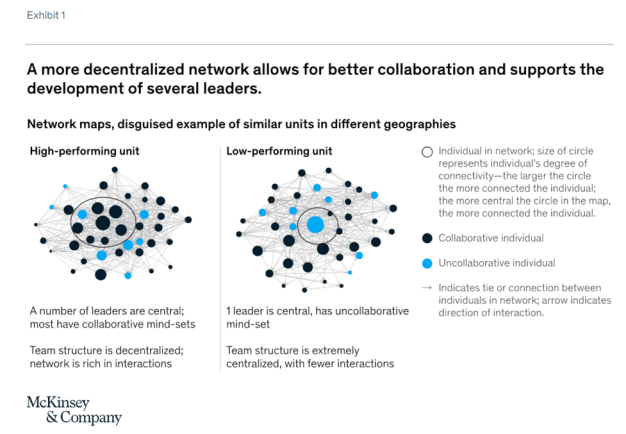
Making networks more decentralized is another way to improve collaboration and performance (Exhibit 1). Consider the case of two geographically separate units that undertake the same activities. A larger leadership group with an open and positive mind-set is a distinguishing feature of the higher-performing unit. Its information network is also more decentralized, with a larger number of connections. Hierarchy is still evident in the higher-performing unit, but its information and knowledge network is more distributed, and more of the members participate actively. The lower-performing unit has just one leader, who controls most of the interactions and has a negative mind-set about openness and collaboration, and there are far fewer connections. The network design is more centralized.

McKI1

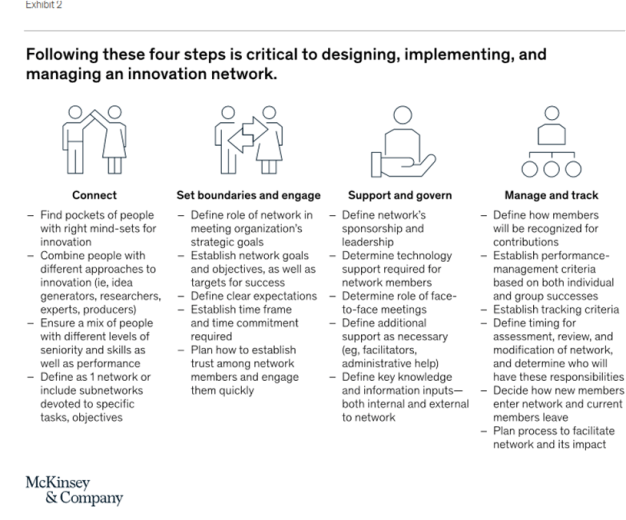
The four critical steps in designing, implementing, and managing an innovation network are presented in Exhibit 2. In addition, executives can fine-tune the network’s goals by identifying the appropriate mix and balance of employees. Innovation networks, like cross-functional teams, require different skills and attitudes. In our experience, they include combinations of several archetypes:

  • Idea generators prefer to come up with ideas, believe that asking the right questions is more important than having the right answers, and are willing to take risks on high-profile experiments.
  • Researchers mine data to find patterns, which they use as a source of new ideas. They are the most likely members of the network to seek consumer insights and to regard such insights as a primary input.
  • Experts value proficiency in a single domain and relish opportunities to get things done.
  • Producers orchestrate the activities of the network. Others come to them for new ideas or to get things done. Producers are also the most likely members of the network to be making connections across teams and groups.
McKi2

This kind of staffing is clearly an inexact science. A team or network in need of more ideas might get additional idea generators to fill the gap. If the challenge is commercializing the right ideas, management might opt to add producers and experts. In our survey of professionals, respondents who regarded their companies as more innovative than competitors in the same industry were also more likely to work for companies that had larger numbers of producers.

Cultures of trust

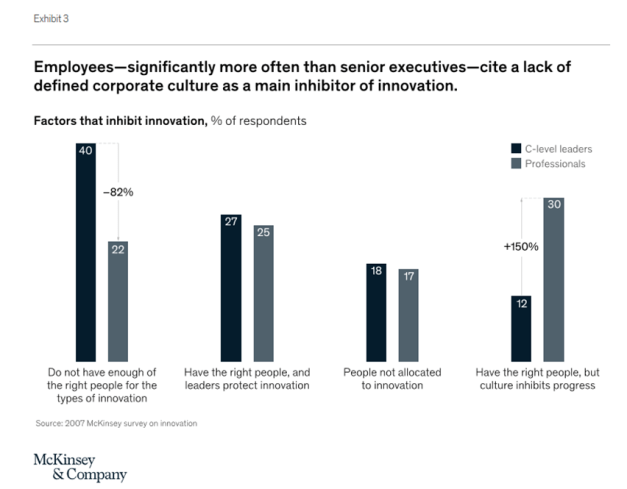
Senior executives say that making top talent available for projects to meet innovation goals is their single biggest challenge in this area. Some 40 percent of them also believe that they do not have enough of the right kinds of talent for the innovation projects they pursue. A different view emerges from below, however. Employees are more likely to believe that their organizations have the right talent but that the corporate culture inhibits them from innovating (Exhibit 3). We, for our part, believe that defining and creating the right kind of culture, however elusive, greatly increases the prospects for successful and sustained innovation (see sidebar, “Many paths to success”).

McKi3

Managers and employees broadly agree about the attitudes, values, and behavior that promote innovation. Topping the list, in our research, were openness to new ideas and a willingness to experiment and take risks. In an innovative culture, employees know that their ideas are valued and believe that it is safe to express and act on those ideas and to learn from failure. Leaders reinforce this state of mind by involving employees in decisions that matter to them. Respondents to our survey of 600 executives and managers indicated that trust and engagement were the mind-sets most closely correlated with a strong performance on innovation. In the same survey, 46 percent of the professionals surveyed said that they were far more likely to seek out a trusted colleague than an expert or manager to get new ideas and feedback on their own ideas.

There is also widespread agreement about the cultural attributes that inhibit innovation: a bureaucratic, hierarchical, and fearful environment. Such cultures often starve innovation of resources and use incentives intended to promote short-term performance and an intolerance of failure. Only 28 percent of the senior executives in the survey said that they are more likely to focus on the risks of innovation than on the opportunities, but only 38 percent said that they actively learn from innovation failures and encourage the organization to do so as well. Even more alarmingly, only 23 percent of the employees believe that their organizations encourage them to learn from failure. To make a corporate culture friendlier to innovation, managers must acquire new skills to engage and lead the staff. Many fall under the heading of leadership skills, such as coaching (as opposed to ordering) subordinates and facilitating collaboration across silos.

Corporate-wide change programs not only are daunting and time consuming but also often have only a limited impact. Our experience helping companies to change and become more innovative suggests that they can make progress without such programs. We have described a number of leadership role-modeling and formal organizational mechanisms to promote innovation. When top management reinforces them with commitment and energy to build capabilities for specific tasks, the combination can yield impressive results. Top teams can help build a more innovative culture in several ways:

  1. Embrace innovation as a top team. It’s not enough for the CEO to make innovation a personal goal and to attend meetings on innovation regularly. Members of the top team must agree that promoting it is a core part of the company’s strategy, reflect on the way their own behavior reinforces or inhibits it, and decide how they should role-model the change and engage middle management.
  2. Turn selected managers into innovation leaders. Identify managers who already act, to some degree, as network brokers and improve their coaching and facilitation skills so that they can build the capabilities of other people involved in innovation efforts more effectively. The goal: making networks more productive.
  3. Create opportunities for managed experimentation and quick success. Not surprisingly, this approach is typically the best way to start any change effort in large organizations. Quick success matters even more with innovation: people need to see results and to participate in the change. To get going quickly and learn along the way, select an innovation theme or topic area and then create small project teams. While you try out topics and ideas, test the most effective leadership and organizational approaches for your organization. The goal isn’t to get it right the first time but to move quickly to give as many influential employees as possible a positive experience of innovation, even if a project doesn’t generate profits immediately. A positive experience will make all the difference in building the organization’s capabilities and confidence.

Innovation is a big idea with a big potential. But it is wise to approach it in small steps, implementing just one or a few of the ideas we propose and building from there. For many companies, the initial steps on this value-creating journey are the most critical of all.

Article link: https://www.mckinsey.com/business-functions/strategy-and-corporate-finance/our-insights/leadership-and-innovation

About the author(s)

Joanna Barsh is a director in McKinsey’s New York office, Marla Capozzi is an associate principal in the Boston office, and Jonathan Davidson is a director in the London office.

Sidebar: Many paths to success: Excerpts from a McKinsey online discussion on innovation

To learn more about how innovation is managed at companies where it is a priority, we identified senior executives who, in our fall survey, had described their company that way and invited them to join an online discussion. One major topic was how leadership groups manage innovation. Discussion participants describe a wide variety of approaches to innovation ownership, the degree to which it is part of their leadership agenda, how to motivate innovators, and how innovation-related performance metrics are applied to leaders and to innovators.

One company has a structured approach to managing innovation that includes the whole leadership team: “We take very good care that the innovation topics are on our watch list and recur as important topics in our regular meetings…Our leadership team starts the day with the discussion of innovation. Some topics are discussed over months again and again to check if our first decision on it is still OK or if we need to make a change.” An executive at another company says, “There is a split [on our leadership team] between abstract thinkers and pragmatic operators. The pragmatists understand the value of reaching for new/creative solutions, but want measurable improvements. In our company, that balance seems to be effective in guiding the conversation.” And a third says there is “very little sustained discussion” among leaders at his organization, adding, “Innovation [is] generally handled by one or two leaders while the rest focus on operations.”

There isn’t even agreement on whether innovation should be discussed formally. One executive says, “Innovation can be seen as another thing on the corporate agenda or as streamlined into business as usual, as one of many avenues for agenda-setting initiatives. The latter approach tends to work better for us, by keeping innovation active and real as opposed to [being] a separate thing.” Another says, “There are quarterly meetings internally to see how the businesses are performing versus their innovation targets and there are meetings every six months to dissect the innovation pipeline.” In contrast, another participant says that, at his company, leaders generally have “lengthy, informal discussions” about innovation, while another says, “We do not plan specific times to spend on innovation as an executive team.”

Several participants actually caution against too much discussion. One explains, “Ten percent of our time is well spent driving innovation and 10 percent of our time is lost in the debate about whether new ideas are innovations or product enhancements.” Another says, “Our discussions are quite lively!…That said, we recognize the potential to dive into rat holes or digress into too much detail. We try to be careful to keep our discussion on track and meaningful…All talk and no action is not a recipe for success!”

Beyond the leadership team, discussion participants stress the importance of ensuring that innovation is clearly understood and employees are engaged, to varying degrees, throughout the organization. A senior executive explains, “We are trying to get the communication [about innovation’s importance] to originate from the employees themselves. We can speak about it a lot but we want the conversation to continue after the meeting, without us around.” Another participant sums up the risk companies face when the whole organization isn’t engaged with innovation: “When colleagues complain or resist innovation the spark will be snuffed out.”

But executives are dubious about how much they can really do. Many agree that getting everyone to innovate isn’t realistic. One executive says that, at his company, “Mentoring people into becoming more open-minded is a long process. We sometimes find it’s a necessary investment not so much to make them innovators but to get them to accept innovation and prevent them from becoming innovation anti-champions.” Another observes, “Some [business unit leaders] realize the importance of being innovative and spend considerable time to generate new ideas. Others find it quite difficult and frustrating, especially those who have worked in the company for many years. One of our greatest challenges is to make the process constantly evolving.”

In managing innovators, one of the biggest challenges for many companies is measuring the contributions of these people. Companies’ practices vary particularly widely here. One executive says, “We do not have specific innovation targets. We do have continuous improvement targets [for business units] that clearly generate innovation. We are good and getting better at moving thoughts to plans to projects to production.” Another says, “Innovation is part of our key factors for success. So you cannot be successful if you do not manage innovation right. Ultimately this translates in sales and EBIT1 or targets to develop new markets. But it is true that I can hardly remember any specific innovation target in our target portfolio.” A third has an even stronger view: “I see innovation to be evaluated in long-term business success. Hard criteria—for example, time spent on innovation thinking—is not feasible in my eyes.”

At another participant’s company, the approach is quite different: “The leadership team has a target to achieve around innovation, the results are measured, and actions are taken to achieve the results on a quarterly basis.”

And at yet another company, innovation targets are used throughout the organization. This company’s executive explains that, in the short term, her company uses an “internal point system, which might be weak and in some way subjective.” But, she adds, “On a long-term view, we try to replace people who don’t take part in our permanent innovation process and tell people to look for another company to work for.”

2020 Appropriations Bill Devotes $1.6B to VA EHR Modernization – EHR Intelligence

Posted by timmreardon on 05/19/2019
Posted in: Uncategorized. Leave a comment

A House Appropriations Military Construction bill includes $1.6 billion in funding to continue the VA EHR modernization project.

By Kate Monica

EHR Intelligence

May 13, 2019 – The House Appropriations Military Construction bill for 2020 will allot $1.6 billion to the VA EHR modernization project, up from $1.1 billion in 2019.
VA’s new EHR system will be built on a Cerner platform to enable seamless health data exchange with the Department of Defense (DoD), which uses the Cerner-supported MHS GENESIS system.

“The bill contains $1.6 billion to continue implementation of the VA electronic health record system,” wrote the House Appropriations committee. “This will ensure the implementation of the contract creating an electronic record system for VA that will be interoperable with the system being developed for DOD.”

“These two identical systems will ensure our veterans get proper care, with timely and accurate medical data transferred between the VA, DOD, and the private sector,” the committee continued. “The bill also continues GAO oversight of this program to ensure that the EHR system is implemented in timely manner.”

VA signed the $10 billion EHR implementation contract with Cerner to replace its homegrown legacy VistA system in 2018.

In addition to enabling interoperability with DoD, VA plans to continually add new capabilities and EHR functionality to the Cerner system to ensure veterans, VA care providers, and community care providers have access to all health IT tools necessary to deliver high-quality care in an ever-evolving digitized healthcare system.

“This bill honors our commitment to the men and women in our armed services, to our veterans, and to the tens of thousands of military families who sacrifice every day for our nation,” said House Appropriations Committee Chairwoman Nita Lowey.

“We are also upholding our promise to America’s veterans by increasing funding for key priorities including healthcare access for women veterans, suicide prevention, benefits, and homeless assistance, so that those who served receive the care and resources they have more than earned,” Lowey continued.

The 2020 appropriations bill will also put $1.5 billion toward military family housing construction and maintenance and $80.4 billion toward VA medical care.

“This bill provides robust funding to support and improve the quality of life for servicemembers and their families, and continues the fight against Russian aggression and emerging threats in the Middle East and North Africa,” said House Appropriations Subcommittee on Military Construction, Veterans Affairs and Related Agencies Chairwoman Debbie Wasserman Schultz.

The bill also highlights the need for increased oversight and accountability over DoD and VA spending.

“Several provisions are included to keep these agencies on track and to address problems that have wasted money and hurt critical services,” wrote the committee.

Improving oversight throughout the VA EHR modernization process is top of mind among several policymakers as the project continues.

In April, Senators John Tester (D-MT) and Marsha Blackburn (R-TN) introduced a bill intended to establish a third-party oversight committee to monitor the EHR modernization project.

The VA Electronic Health Record Advisory Committee Act is designed to help VA maintain transparency and stay on task as it carries out its $16 billion commercial EHR implementation.

“The new electronic health record system is too important to veterans’ health care for the VA to get wrong,” said Tester, ranking member of the Senate Veterans’ Affairs Committee. “Our bill will create another layer of accountability and oversight of the process to make sure the VA roll-out does right by the nine million veterans who will rely on this system.”

The oversight committee would include 11 members who would operate separately from VA and DoD. Committee members would include medical professionals, IT and interoperability specialists, and veterans currently receiving care through VA.

Article link: https://ehrintelligence.com/news/2020-appropriations-bill-devotes-1.6b-to-va-ehr-modernization

A weather tech startup wants to do forecasts based on cell phone signals – MIT Technology Review

Posted by timmreardon on 05/02/2019
Posted in: Uncategorized. Leave a comment

ClimaCell claims its service, which taps into millions of wireless devices, is 60% more accurate than traditional forecasting methods.

climacell

by Douglas Heaven
Apr 30

On April 14 more snow fell on Chicago than had been the case in nearly 40 years. Weather services didn’t see the heavy accumulation coming: they forecast one or two inches at worst. But when the late-winter snowstorm hit, it caused widespread disruption, dumping enough snow that airlines had to cancel more than 700 flights across the city’s airports.

One airline did better than most, however. Instead of relying on the usual weather forecasts, it listened to ClimaCell—a Boston-based “weather tech” startup that claims it can predict the weather more accurately than anyone else. According to the company, its correct forecast of the severity of the Chicago snowstorm allowed the airline to better manage its schedules and minimize losses stemming from delays and diversions.

Founded in 2015, ClimaCell has spent the last few years developing the technology and business relationships that allow it to tap into millions of signals from cell phones and other wireless devices around the world. It uses the quality of those signals as a proxy for local weather conditions, such as precipitation and air quality. It also analyzes images from street cameras. It is offering subscribers a weather forecasting service that it touts as 60% more accurate than those of existing providers such as the National Oceanic and Atmospheric Administration (NOAA).

The internet of weather
The approach makes sense, in principle. Other forecasters use proxies, such as radar signals. But by using information from millions of everyday wireless devices, ClimaCell claims it has a far more fine-grained view of most of the globe than other forecasters get from the existing network of weather sensors, which range from ground-based devices to satellites. (ClimaCell taps into those, too.)

The company has now opened a new research center in Boulder, Colorado, where it is developing a new mathematical model that turns cell phone observations into weather data that can be plugged into a simulation. The more accurate your picture of the weather today, the more accurate your forecast for tomorrow.

The model can be tweaked to focus on the region, the type of weather, and the frequency of updates a subscriber wants. That would help renewable-energy companies know how much sunshine is going to hit their solar panels or how much wind will hit their turbines, for example. Better forecasting lets power providers match up supply and demand.

“There’s always a need for better forecasting,” says weather scientist Ken Mylne at the Met Office, the UK’s national weather service. “It’s impossible to do perfect forecasts, but we keep trying to narrow that gap between impossibility and perfection.”

The Met Office is also looking at new ways to measure current weather conditions. The latest version of its simulation, launched in March, uses data from aircraft radar systems, which can provide information about the temperature and humidity of the air that aircraft pass through. “It’s given a significant improvement in forecast quality,” says Mylne.

Yet making use of things like radar and wireless signals is not easy. Mylne says you can’t just put that data straight into the simulation; you have to translate your observation into the most likely weather conditions that fit it. “There is weather information in those signals, but it’s quite deeply buried,” he explains. “Exactly how you use that data is very challenging.”

Mylne thinks that what ClimaCell is doing is a good idea in principle. But he’d like to see many rigorous comparisons with other forecasters in different locations and over several months before he is convinced the technique is as accurate as ClimaCell claims.

Tim Palmer at the University of Oxford in the UK would also like to see more comparisons with other forecasters. “It’s difficult to make a clear judgment on whether they’re doing anything useful or not,” he says. “All weather services are looking for new data, and it’s quite difficult to add value. There’s already an enormous amount of information.”

A spokesperson for NOAA said the organization welcomes new techniques from the private sector but declined to comment on the specifics of ClimaCell’s approach.

In ClimaCell’s favor, Luke Peffers, who heads the startup’s research team in Boulder, has a lot of experience in measuring weather conditions. Before joining the company, he worked for the US government carrying out forensic analyses of the atmosphere to check whether nuclear test bans were being violated. He did that by looking for signs of radiation in the weather. 

ClimaCell says it has also performed retrospective simulations for periods of one to 10 years that compare favorably with observations made by others. And it says it tested its model in Israel for a three-month period during heavy floods. “We did a terrific job compared to the Israel Meteorological Service’s rain gauges,” Peffers says.

As well as providing bespoke weather updates to businesses, ClimaCell is interested in collaborating with national forecasters. It is also keen to keep tapping into new sources of data. With more and more devices being connected to the internet, the number of wireless signals is increasing. As the company likes to put it, “Everything is a weather sensor.”

Article link: https://www.technologyreview.com/s/613445/a-weather-tech-startup-wants-to-do-forecasts-based-on-cell-phone-signals/

Posts navigation

← Older Entries
Newer Entries →
  • Search site

  • Follow healthcarereimagined on WordPress.com
  • Recent Posts

    • When Not to Use AI – MIT Sloan 04/01/2026
    • There are more AI health tools than ever—but how well do they work? – MIT Technology Review 03/30/2026
    • Are AI Tools Ready to Answer Patients’ Questions About Their Medical Care? – JAMA 03/27/2026
    • How AI use in scholarly publishing threatens research integrity, lessens trust, and invites misinformation – Bulletin of the Atomic Scientists 03/25/2026
    • VA Prepares April Relaunch of EHR Program – GovCIO 03/19/2026
    • Strong call for universal healthcare from Pope Leo today – FAN 03/18/2026
    • EHR fragmentation offers an opportunity to enhance care coordination and experience 03/16/2026
    • When AI Governance Fails 03/15/2026
    • Introduction: Disinformation as a multiplier of existential threat – Bulletin of the Atomic Scientists 03/12/2026
    • AI is reinventing hiring — with the same old biases. Here’s how to avoid that trap – MIT Sloan 03/08/2026
  • Categories

    • Accountable Care Organizations
    • ACOs
    • AHRQ
    • American Board of Internal Medicine
    • Big Data
    • Blue Button
    • Board Certification
    • Cancer Treatment
    • Data Science
    • Digital Services Playbook
    • DoD
    • EHR Interoperability
    • EHR Usability
    • Emergency Medicine
    • FDA
    • FDASIA
    • GAO Reports
    • Genetic Data
    • Genetic Research
    • Genomic Data
    • Global Standards
    • Health Care Costs
    • Health Care Economics
    • Health IT adoption
    • Health Outcomes
    • Healthcare Delivery
    • Healthcare Informatics
    • Healthcare Outcomes
    • Healthcare Security
    • Helathcare Delivery
    • HHS
    • HIPAA
    • ICD-10
    • Innovation
    • Integrated Electronic Health Records
    • IT Acquisition
    • JASONS
    • Lab Report Access
    • Military Health System Reform
    • Mobile Health
    • Mobile Healthcare
    • National Health IT System
    • NSF
    • ONC Reports to Congress
    • Oncology
    • Open Data
    • Patient Centered Medical Home
    • Patient Portals
    • PCMH
    • Precision Medicine
    • Primary Care
    • Public Health
    • Quadruple Aim
    • Quality Measures
    • Rehab Medicine
    • TechFAR Handbook
    • Triple Aim
    • U.S. Air Force Medicine
    • U.S. Army
    • U.S. Army Medicine
    • U.S. Navy Medicine
    • U.S. Surgeon General
    • Uncategorized
    • Value-based Care
    • Veterans Affairs
    • Warrior Transistion Units
    • XPRIZE
  • Archives

    • April 2026 (1)
    • March 2026 (9)
    • February 2026 (6)
    • January 2026 (8)
    • December 2025 (11)
    • November 2025 (9)
    • October 2025 (10)
    • September 2025 (4)
    • August 2025 (7)
    • July 2025 (2)
    • June 2025 (9)
    • May 2025 (4)
    • April 2025 (11)
    • March 2025 (11)
    • February 2025 (10)
    • January 2025 (12)
    • December 2024 (12)
    • November 2024 (7)
    • October 2024 (5)
    • September 2024 (9)
    • August 2024 (10)
    • July 2024 (13)
    • June 2024 (18)
    • May 2024 (10)
    • April 2024 (19)
    • March 2024 (35)
    • February 2024 (23)
    • January 2024 (16)
    • December 2023 (22)
    • November 2023 (38)
    • October 2023 (24)
    • September 2023 (24)
    • August 2023 (34)
    • July 2023 (33)
    • June 2023 (30)
    • May 2023 (35)
    • April 2023 (30)
    • March 2023 (30)
    • February 2023 (15)
    • January 2023 (17)
    • December 2022 (10)
    • November 2022 (7)
    • October 2022 (22)
    • September 2022 (16)
    • August 2022 (33)
    • July 2022 (28)
    • June 2022 (42)
    • May 2022 (53)
    • April 2022 (35)
    • March 2022 (37)
    • February 2022 (21)
    • January 2022 (28)
    • December 2021 (23)
    • November 2021 (12)
    • October 2021 (10)
    • September 2021 (4)
    • August 2021 (4)
    • July 2021 (4)
    • May 2021 (3)
    • April 2021 (1)
    • March 2021 (2)
    • February 2021 (1)
    • January 2021 (4)
    • December 2020 (7)
    • November 2020 (2)
    • October 2020 (4)
    • September 2020 (7)
    • August 2020 (11)
    • July 2020 (3)
    • June 2020 (5)
    • April 2020 (3)
    • March 2020 (1)
    • February 2020 (1)
    • January 2020 (2)
    • December 2019 (2)
    • November 2019 (1)
    • September 2019 (4)
    • August 2019 (3)
    • July 2019 (5)
    • June 2019 (10)
    • May 2019 (8)
    • April 2019 (6)
    • March 2019 (7)
    • February 2019 (17)
    • January 2019 (14)
    • December 2018 (10)
    • November 2018 (20)
    • October 2018 (14)
    • September 2018 (27)
    • August 2018 (19)
    • July 2018 (16)
    • June 2018 (18)
    • May 2018 (28)
    • April 2018 (3)
    • March 2018 (11)
    • February 2018 (5)
    • January 2018 (10)
    • December 2017 (20)
    • November 2017 (30)
    • October 2017 (33)
    • September 2017 (11)
    • August 2017 (13)
    • July 2017 (9)
    • June 2017 (8)
    • May 2017 (9)
    • April 2017 (4)
    • March 2017 (12)
    • December 2016 (3)
    • September 2016 (4)
    • August 2016 (1)
    • July 2016 (7)
    • June 2016 (7)
    • April 2016 (4)
    • March 2016 (7)
    • February 2016 (1)
    • January 2016 (3)
    • November 2015 (3)
    • October 2015 (2)
    • September 2015 (9)
    • August 2015 (6)
    • June 2015 (5)
    • May 2015 (6)
    • April 2015 (3)
    • March 2015 (16)
    • February 2015 (10)
    • January 2015 (16)
    • December 2014 (9)
    • November 2014 (7)
    • October 2014 (21)
    • September 2014 (8)
    • August 2014 (9)
    • July 2014 (7)
    • June 2014 (5)
    • May 2014 (8)
    • April 2014 (19)
    • March 2014 (8)
    • February 2014 (9)
    • January 2014 (31)
    • December 2013 (23)
    • November 2013 (48)
    • October 2013 (25)
  • Tags

    Business Defense Department Department of Veterans Affairs EHealth EHR Electronic health record Food and Drug Administration Health Health informatics Health Information Exchange Health information technology Health system HIE Hospital IBM Mayo Clinic Medicare Medicine Military Health System Patient Patient portal Patient Protection and Affordable Care Act United States United States Department of Defense United States Department of Veterans Affairs
  • Upcoming Events

Blog at WordPress.com.
healthcarereimagined
Blog at WordPress.com.
  • Subscribe Subscribed
    • healthcarereimagined
    • Join 153 other subscribers
    • Already have a WordPress.com account? Log in now.
    • healthcarereimagined
    • Subscribe Subscribed
    • Sign up
    • Log in
    • Report this content
    • View site in Reader
    • Manage subscriptions
    • Collapse this bar
 

Loading Comments...