AI technologies have had an undeniable impact on the information landscape.
If deployed responsibly, AI can facilitate access to accurate, reliable information, foster free expression, and contribute to healthy and vibrant information ecosystems.
One of the focus areas of the meeting was AI’s impact on information integrity.
Two key risks were highlighted:
1. The role of AI in curating and creating information, and people’s growing reliance on this technology to shape their understanding of the world.
At present, tech companies continue to integrate AI into our everyday applications at breakneck speed but genAI tools cannot uniformly be relied on as sources of accurate information.
Ongoing studies and testing show that they frequently do not distinguish between rigorous science on the one hand and dirty data or outright nonsense on the other.
And yet, people are increasingly accessing this convenient and flawed data without being equipped to assess its veracity or reliability. This can contribute to a deeply concerning trend: thelack of trust in any information source and in the information ecosystem more broadly.
People just don’t know what is real and what to believe.
At pivotal societal moments and especially in fragile settings, this can feed into instability and unrest, sometimes with disastrous consequences.
We are, in effect, guinea pigs in an information experiment in which the resilience of our societies is being put to the test.
2. The misuse of AI in facilitating the creation and dissemination of false and hateful information at scale.
This can affect the peace and security of communities and countries.
GenAI tools have made it immeasurably easier for a broad range of actors to spread false claims for financial or strategic gain.
It now costs next to nothing to quickly and easily create a flood of convincing lies and hate, with minor human intervention.
To target specific groups and individuals, actors draw on our personal data that has been sold as part of the advertising supply chain.
Tactics like this can trigger diplomatic crises, incite unrest, and undermine understanding of realities on the ground.
AI-generated deep fake images, audio and video have been weaponized in conflicts from Ukraine, to Gaza, to Sudan.
We’re also now seeing AI used openly and explicitly to generate content designed to undermine social cohesion.
Content that demonises or dehumanises women, refugees, migrants, and minorities.
Content that is anti-Semitic, Islamophobic, racist and xenophobic.
The UN has experienced grave impacts on our missions and priorities.
Peace and humanitarian operations are targeted with false and hateful narratives, negatively affecting the safety and security of UN personnel and making the tasks of implementing their mandates harder.
In turn, this is impacting communities small and large, jeopardizing their stability.
What are some of the concrete steps needed to address these areas of risk?
The UN system has been ramping up efforts.
This includes the 3R approach:
research, risk assessment and response.
Through research we can better understand information risks in complex, multiplatform, multilingual environments.
Our work includes outreach with affected communities to hear and understand their perceptions and concerns.
UN entities then assess the risk posed to UN mandate delivery and thematic priorities.
We use this insight to design appropriate mitigation and response measures.
Most immediately, this means quick and proactive communication to address information voids.
This can be done through our own channels and also via coalitions with community leaders, influencers and civil society groups.
Of course, these efforts require resources, including for skills training and technology.
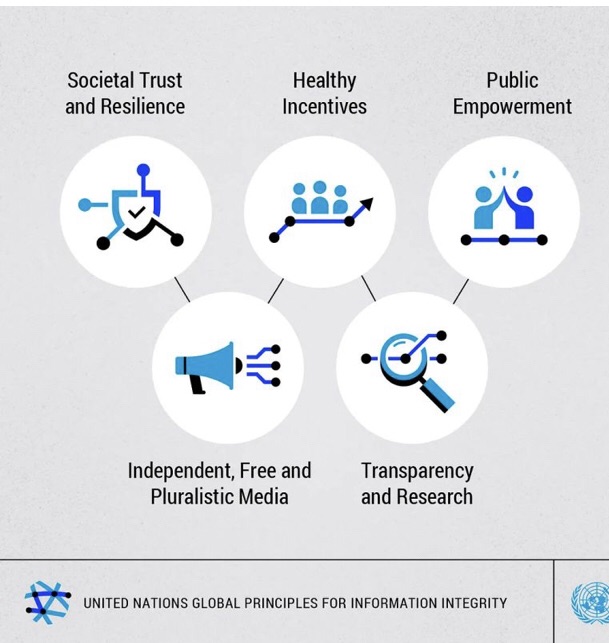
The Principles provide a framework for action to strengthen the information ecosystem — and are a resource to UN member countries in meeting the commitments agreed in the Global Digital Compact.
The Principles contain recommendations for a wide range of stakeholders around five pillars: societal trust and resilience; healthy incentives; public empowerment; independent, free and pluralistic media; and transparency and research.
The United Nations Global Principles for Information Integrity
Three key recommendation areas are highlighted below.
1. Countries play a central role in shaping information spaces, beginning with obligations to respect, protect and promote human rights, in particular the right to freedom of expression.
This means that regulatory measures to address information integrity comply with applicable international law and are carried out with the full participation of civil society.
Freedom of expression requires not only that people are able to express their views, but that they are able to seek and receive ideas and information of all kinds.
It is exponentially harder to do this when you’re in a polarized, opaque information environment crowded with lies and hate.
In such a landscape, guardrails allow for more free speech, not less, and protect people who feel unsafe in online spaces, giving voice to those otherwise silenced.
Guardrails can help enable inclusive access to information.
And they can support and encourage innovation and help foster public trust in fast-emerging AI technologies.
There is growing awareness among the communities the UN serves that the sooner guardrails are established, the less the risk for us all.
2. Information integrity is not possible without a free, independent and pluralistic media.
Professional journalism requires considerable investment. Yet the advertising-driven business model which long supported independent media has drastically eroded.
AI has prompted new concerns. Quality journalism is being scraped and summarized or used to train AI without permission or compensation.
GenAI search summaries replacing standard search results can reduce web traffic to news sites, further affecting revenue streams.
Many news outlets, particularly at the local level, just can’t compete. For them it is not just a matter of relevance. It is a matter of survival.
The result is news deserts. The vacuum is filled by AI-generated articles or downgraded versions of journalistic content, or malicious content imitating news.
This can be particularly destabilising in conflict and crisis zones.
Responses must therefore urgently support sustainable business models for public interest media.
They must also ensure better protection for media workers, along with researchers, academics and civil society, who are under attack around the world.
3. There is an urgent global need for public empowerment in the information ecosystem, including through measures to boost resilience.
Media and digital literacy skills can allow people to navigate information spaces safely and effectively.
Countries can prioritize the literacy needs of groups in vulnerable and marginalized situations — who are often those most adversely affected by information risks.
They can also undertake literacy efforts around specific problems related to AI, keeping up with new and emerging technologies
Public awareness must improve around online rights, how AI works, and how personal data is used.
The urgency of the challenge requires multi stakeholder coalitions with collaborations between countries to support capacity building and increase global resilience.
This is the only viable path to an information ecosystem in which AI innovation is harnessed for information integrity, human rights and international peace and security.
The text above is adapted from a briefing to the Security Council by Charlotte Scaddan, Senior Adviser on Information Integrity, UN Global Communications
The Indian Health Service (IHS) is a federally mandated health system providing care to approximately 2.6 million American Indian and Alaska Native people across 574 federally recognized Tribes. Many IHS facilities are in rural or remote areas, often providing the only available healthcare. Unlike other American health systems, IHS is not a benefit or entitlement – it is the product of treaties between the United States and sovereign Tribal Nations.
In FY2023, IHS spent approximately $4,078 per person on care, compared to a national average expenditure of $14,570 per person. Despite challenges, including aging facilities and staffing shortages, IHS delivers remarkable care. Staffed by dedicated Native and allied physicians, nurses, public health workers, and technicians, these facilities are models of resilience. They frequently incorporate traditional healers and language keepers into care delivery, finding innovative ways to meet complex health needs.
Federal decisions, like those discussed by Health Secretary Robert F. Kennedy Jr. during his “Make America Healthy Again” tour, directly impact the resources and policies that shape the IHS and its ability to serve Tribal communities effectively. Additional resources at IHS, combined with the cultivation and empowerment of Indigenous healthcare professionals and Tribal leadership, could be transformative. We hope that the pleas from our tribal members resonated with Secretary Kennedy and leads to meaningful support for IHS.
Secretary Kennedy The New York Times CDC Indian Country Today Indian Health Service Johns Hopkins Bloomberg School of Public Health National Indian Health Board National Native News Native News Online Urban Indigenous Collective Urban Indian Health Institute Johns Hopkins Department of International Health
When two black holes spiral inward and collide, they shake the very fabric of space, producing ripples in space-time that can travel for hundreds of millions of light-years. Since 2015, scientists have been observing these so-called gravitational waves to help them study fundamental questions about the cosmos, including the origin of heavy elements such as gold and the rate at which the universe is expanding.
But detecting gravitational waves isn’t easy. By the time they reach Earth and the twin detectors of the Laser Interferometer Gravitational-Wave Observatory (LIGO), in Louisiana and Washington state, the ripples have dissipated into near silence. LIGO’s detectors must sense motions on the scale of one ten-thousandth the width of a proton to stand a chance.
LIGO has confirmed 90 gravitational wave detections so far, but physicists want to detect more, which will require making the experiment even more sensitive. And that is a challenge.
“The struggle of these detectors is that every time you try to improve them, you actually can make things worse, because they are so sensitive,” says Lisa Barsotti, a physicist at the Massachusetts Institute of Technology.
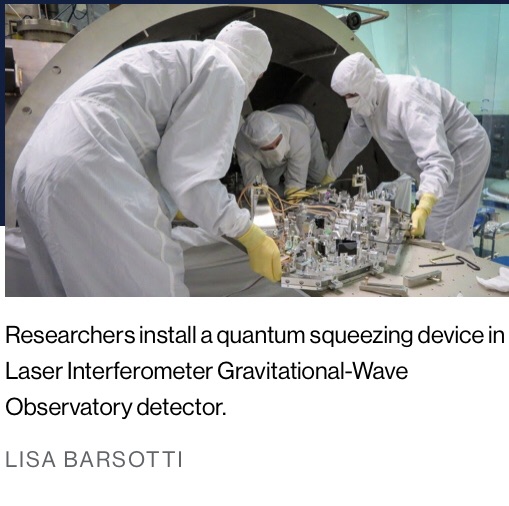
Nevertheless, Barsotti and her colleagues recently pushed past this challenge, creating a device that will allow LIGO’s detectors to detect far more black hole mergers and neutron star collisions. The device belongs to a growing class of instruments that use quantum squeezing—a practical way for researchers dealing with systems that operate by the fuzzy rules of quantum mechanics to manipulate those phenomena to their advantage.
Physicists describe objects in the quantum realm in terms of probabilities—for example, an electron is not located here or there but has some likelihood of being in each place, locking into one only when its properties are measured. Quantum squeezing can manipulate the probabilities, and researchers are increasingly using it to exert more control over the act of measurement, dramatically improving the precision of quantum sensors like the LIGO experiment.
“In precision sensing applications where you want to detect super-small signals, quantum squeezing can be a pretty big win,” says Mark Kasevich, a physicist at Stanford University who applies quantum squeezing to make more precise magnetometers, gyroscopes, and clocks with potential applications for navigation. Creators of commercial and military technology have begun dabbling in the technique as well: the Canadian startup Xanadu uses it in its quantum computers, and last fall, DARPA announced Inspired, a program for developing quantum squeezing technology on a chip. Let’s take a look at two applications where quantum squeezing is already being used to push the limits of quantum systems.
Taking control of uncertainty
The key concept behind quantum squeezing is the phenomenon known as Heisenberg’s uncertainty principle. In a quantum-mechanical system, this principle puts a fundamental limit on how precisely you can measure an object’s properties. No matter how good your measurement devices are, they will suffer a fundamental level of imprecision that is part of nature itself. In practice, that means there’s a trade-off. If you want to track a particle’s speed precisely, for example, then you must sacrifice precision in knowing its location, and vice versa. “Physics imposes limits on experiments, and especially on precision measurement,” says John Robinson, a physicist at the quantum computing startup QuEra.
By “squeezing” uncertainty into properties they aren’t measuring, however, physicists can gain precision in the property they want to measure. Theorists proposed using squeezing in measurement as early as the 1980s. Since then, experimental physicists have been developing the ideas; over the last decade and a half, the results have matured from sprawling tabletop prototypes to practical devices. Now the big question is what applications will benefit. “We’re just understanding what the technology might be,” says Kasevich. “Then hopefully our imagination will grow to help us find what it’s really going to be good for.”
LIGO is blazing a trail to answer that question, by enhancing the detectors’ ability to measure extremely tiny distances. The observatory registers gravitational waves with L-shaped machines capable of sensing tiny motions along their four-kilometer-long arms. At each machine, researchers split a laser beam in two, sending a beam down each arm to reflect off a set of mirrors. In the absence of a gravitational wave, the crests and troughs of the constituent light waves should completely cancel each other out when the beams are recombined. But when a gravitational wave passes through, it will alternately stretch and compress the arms so that the split light waves are slightly out of phase.
The resulting signals are subtle, though—so subtle that they risk being drowned out by the quantum vacuum, the irremovable background noise of the universe, caused by particles flitting in and out of existence. The quantum vacuum introduces a background flicker of light that enters LIGO’s arms, and this light pushes the mirrors, shifting them on the same scale as the gravitational waves LIGO aims to detect.
Barsotti’s team can’t get rid of this background flicker, but quantum squeezing allows them to exert limited control over it. To do so, the team installed a 300-meter-long cavity in each of LIGO’s two L-shaped detectors. Using lasers, they can create an engineered quantum vacuum, in which they can manipulate conditions to increase their level of control over either how bright the flicker can be or how randomly it occurs in time. Detecting higher-frequency gravitational waves is harder when the rhythm of the flickering is more random, while lower-frequency gravitational waves get drowned out when the background light is brighter. In their engineered vacuum, noisy particles still show up in their measurements, but in ways that don’t do as much to disturb the detection of gravitational waves.“ You can [modify] the vacuum by manipulating it in a way that is useful to you,” she explains.
The innovation was decades in the making: through the 2010s, LIGO incorporated incrementally more sophisticated forms of quantum squeezing based on theoretical ideas developed in the 1980s. With these latest squeezing innovations, installed last year, the collaboration expects to detect gravitational waves up to 65% more frequently than before.
Quantum squeezing has also improved precision in timekeeping. Working at the University of Colorado Boulder with physicist Jun Ye, a pioneer in atomic clock technology, Robinson and his team made a clock that will lose or gain at most a second in 14 billion years. These super-precise clocks tick slightly differently in different gravitational fields, which could make them useful for sensing how Earth’s mass redistributes itself as a result of seismic or volcanic activity. They could also potentially be used to detect certain proposed forms of dark matter, the hypothesized substance that physicists think permeates the universe, pulling on objects with its gravity.
The clock Robinson’s team developed, a type called an optical atomic clock, uses 10,000 strontium atoms. Like all atoms, strontium emits light at specific signature frequencies as electrons around the atom’s nucleus jump between different energy levels. A fixed number of crests and troughs in one of these light waves corresponds to a second in their clock. “You’re saying the atom is perfect,” says Robinson. “The atom is my reference.” The “ticking” of this light is far steadier than the vibrating quartz crystal in a wristwatch, for example, which expands and contracts at different temperatures to tick at different rates.
In practice, the tick in the Robinson team’s clock comes not from the light the electrons emit but from how the whole system evolves over time. The researchers first put each strontium atom in a “superposition” of two states: one in which the atom’s electrons are all at their lowest energy levels and another in which one of the electrons is in an excited state. This means each atom has some probability of being in either state but is not definitively in either one—similar to how a coin flipping in the air has some probability of being either heads or tails, but is neither.
Then they measure how many atoms are in each state. The act of measurement puts the atoms definitively in one state or the other, equivalent to letting the flipping coin land on a surface. Before they measure the atoms, even if they intend to wind up with a 50-50 mixture, they cannot precisely dictate how many atoms will end up in each state. That’s because in addition to the system’s change over time, there is also inherent uncertainty in the state of the individual atoms. Robinson’s team uses quantum squeezing to more reliably determine their final states by reducing these intrinsic fluctuations. Specifically, they manipulate the uncertainties in the direction of each atom’s spin, a property of many quantum particles that has no classical counterpart. Squeezing improved the clock’s precision by a factor of 1.5.
To be sure, gravitational waves and ultra-precise clocks are niche academic applications. But there is interest in adapting the approach to other, potentially more mainstream uses, including quantum computers, navigation, and microscopy.
The increased use of quantum squeezing is part of a wider technological trend toward higher precision—one that encompasses cramming more transistors on chips, studying the universe’s most elusive particles, and clocking the fleeting time it takes for an electron to leave a molecule. Squeezing benefits only measurements so subtle that the randomness of quantum mechanics contributes significant noise. But it turns out that physicists have more control than they think. They may not be able to remove the randomness, but they can engineer where it shows up.
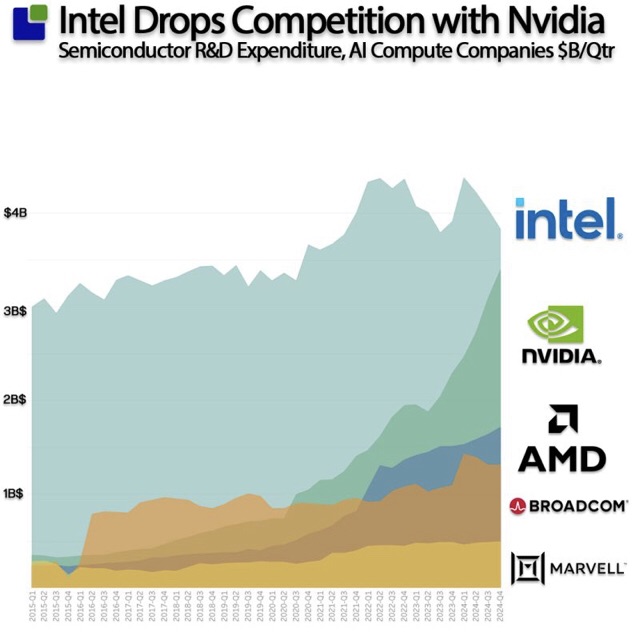
Only a year ago, Pat Gelsinger intended for Intel to compete with Nvidia, but the new CEO, Lip-Bu Tan, is burying that ambition. He does not aim at the Client Computing Group when discussing funding new engineering ideas and innovations. The Day 1 principle is a start-up philosophy; the new AI strategy after Gaudi has been virtually written off.
And it makes sense. While Intel was playing CEO roulette, Nvidia increased its R&D budget dramatically, and the AI giant did not need to fund other hobby projects like Intel. To catch Nvidia, Intel needed a big bet, which Gaudi never was, and now it is too late.
In 2024, Intel was spending 45% of its operating budget on Intel Foundry, and what was left of the R&D budget was prioritised for the Client Computing Group.
This is insufficient to compete with Nvidia, so the Intel Periscope has turned towards the two smaller vessels involved in XPU designs.
If the New Intel and the 2025 Vision are important to you, read more here: https://lnkd.in/drXUPZXJ
Intel’s new CEO, Lip-Bu Tan, brought many new words that can give us insight into Intel’s strategy. While words don’t easily move supertankers like Intel, words are important, and all strategy and transformation begin with words.
Under Pat Gelsinger, there were several strategic pivots. While he was the master of creative external CapEx deals to fund Intel Foundry, the strategy was retrenched to a focus on the x86 franchise and the Client Computing group under Michelle Johnston Holthaus as she protected her CCG tribe.
The appointment of Lip-Bu Tan does not continue the current Intel Strategy, and it is vital to understand what the new CEO brings to the party. You can think what you want about Intel, but it still powers most of the world’s computing even though it is struggling to do so profitably. Intel is still a key factor in the development of the semiconductor industry.
In his first keynote, Lip-Bu Tan directly discussed not being happy with where Intel is. While this is not the same as signalling a strategic change, his statements about ruthlessly focusing on the truth are. This is an acceptance of the Intel culture of “glossing over” rather than facing the brutal truths.
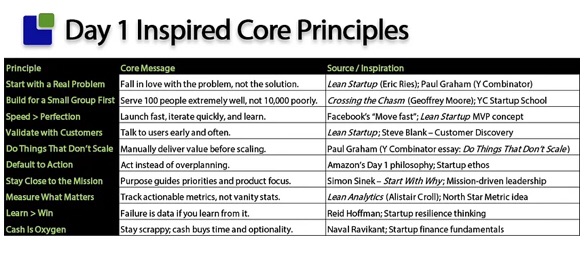
The most radical idea that Lip-Bu Tan introduced was that Intel needs to adopt a day 1 mentality. While it sounds like more words, the implications of a “Day 1 mentality” can mean dramatic change for the Intel organisation and culture, as Intel is currently the poster child of a “Day 2” company.
Amazon’s “Day One”: A Philosophy of Perpetual Innovation
At the heart of Amazon’s relentless drive lies its “Day One” philosophy, which emphasises maintaining a startup-like mentality, even within a massive corporation. Introduced by Jeff Bezos in his 1997 shareholder letter, “Day One” is about constant curiosity, nimbleness, and a willingness to experiment. It’s the antithesis of “Day Two,” where complacency sets in, and companies become slow, bureaucratic, and less customer-focused.
Bezos understood that customer obsession is the key to maintaining “Day One” vitality. As customers always seek better, faster, and more innovative solutions, companies must continuously adapt and evolve to meet their needs. As tech reporter Alex Kantrowitz explains in his book “Always Day One,” this philosophy encourages building for the future, not resting on past achievements. It means treating even a sprawling enterprise like a small, agile startup, fostering a culture of innovation and a relentless focus on the customer. In essence, “Day One” is about embracing change, challenging the status quo, and always acting with the urgency and passion of a company just starting.
Lip-Bu keeps flirting with “Day 1” as he calls for customer focus.
“My number one priority was spending time with customers, and they gave me honest feedback. We have a lot of work ahead of us.”
While talking to customers and getting feedback is essential, it is not the same as becoming customer-centric. A company like Apple is customer-centric and has delivered the most successful consumer product ever, even though nobody ever asked for an iPhone.
Talking to customers isn’t enough; you’ll need to understand their future situation and latent needs. This is not Intel’s traditional starting point, as the company has its cultural roots deep in products and technology, and Lip-Bu Tan wants to challenge that.
When discussing his background, Lip-Bu Tan highlights times when he successfully changed the culture of the companies he was involved with. This signals that cultural change is high on the agenda, and he believes he is the right person to drive it.
This also reveals that Lip-Bu Tan believes that corporate culture can be designed within a reasonable timeframe, which sounds more straightforward than it is.
Anybody who has worked in a company with several acquisitions knows that the acquired culture does not die. It lives on in the acquired people and influences the existing culture.
One of the key features of a large corporation is what I call management-dampening. All top management decisions must pass through the hierarchical layers in a sense-making process. The simple CEO decisions have complex impacts on the organisation, and each level needs to adapt to them in a way that makes sense for that layer and their internal and external customers.
The company’s suspension system ensures that radical changes don’t break the system and prevent change from happening.
I have seen several examples of how the management-dampening system has saved (prevented) senior management’s panic-flip-flopping decisions. Unfortunately, it also dampens necessary changes and complicates cultural change.
An overview of the “Day One” philosophy can be seen below, along with the key message.
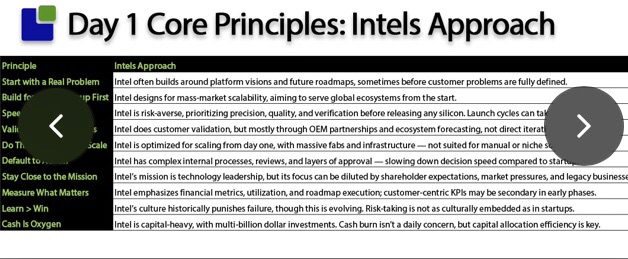
As Lip-Bu Tan talks about the truth, it is necessary to highlight Intel’s current approach to these principles. While you might disagree with my assessment, it is hard to characterise Intel as anywhere near a “Day One” company.
Lip-Bu Tan recognises this as he states that he is unhappy with things and wants to correct past mistakes. He wants to create the “New Intel”, an engineering-first company, suggesting that Intel is currently a “something else-first” company.
The truth
The foundation of everything I do starts with a data-driven assessment of the current situation. While I know it is easier to sell happy data, it is a principle of mine to stay clear of liking and disliking data.
There can be many truths, and data does respond to torture. Still, it is always in the company’s best interest to begin the strategic formulation based on an honest assessment of the situation.
Happy data rarely creates happy endings.
Intel is undoubtedly in a difficult spot, and Lip-Bu Tan’s ambitions are at odds with reality. Scarcity creates tension between different objectives but is innovation’s greatest friend.
As I pointed out in The Corporate Sandwich Model, Intel externally has a problem with the truth. It is all rah-rah and up and to the right. This might be different internally, but I doubt it.
It’s time to explore the tension between reality and the Intel 2025 Vision.
The x86 Franchise
The most apparent change in strategy from Gelsinger to Holthaus was the introduction of the “x86 franchise”. That the Queen of the Client Computing Group praised the holiest of relics in CCG was unsurprising and looked like the usual internal divisional power game. Lip-Bu Tan adds colour to the x86 concept and positions it more as an asset in the Foundry strategy as part of the differentiation strategy: IP and localisation. The x86 is also positioned in the future AI strategy built on the smoulders of Gaudi that Holthaus effectively killed by calling it “difficult” to use
The Innovation perspective.
Intel is trying to reduce operating costs to achieve positive cash flow. However, it is becoming evident that Intel’s current AI data centre product strategy is non-existent.
In the 2024 Intel Vision keynote, Pat Gelsigner called Gaudi the only alternative to Nvidia H100 in data centre learning applications. As Michelle Johnston Holthaus took the co-CEO chair, she demonstrated the rift between the client group and the other divisions and called Gaudi challenging. This was a virtual death sentence, and Lip-Bu Tan is not reviving the architecture.
He clearly stated that Intel is unhappy with its current position and needs to develop a new approach. Intel needs higher performance, lower power and lower cost. In one year, The focus shifted from competing with Nvidia to competing with Broadcom and Marvell in XPU accelerators in inference rather than Nvidia in Learning and inference.
This also correlates with his statements about becoming an outside-in company that starts with the customer’s problem rather than the hardware in the old inside-out approach.
Nvidia’s AI strategy builds on a well-executed product strategy, while Broadcom and Marvell are working on customer problems. Customers are telling Li-Bu Tan that they would love an Intel AI Platform (cheaper, faster, lower power—surprise!), and he has started deep-dive dives into reimagining the products.
This is the key area to win as AI accelerates tech adoption and is the only driver behind the upturn. Other focus areas, such as photonics, quantum, and robotics, are on the agenda, but the data centre AI needs to be revived.
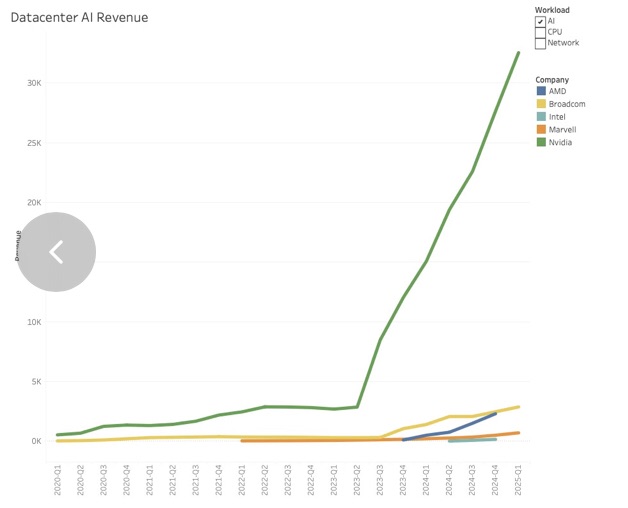
The competitive situation in AI is hopeless for Intel.
Excluding Nvidia revenue makes it even more embarrassing for Intel. For now, it is evident that Intel is not aiming at Nvidia and learning but at the competitors in sight that are focusing on the accelerator designs.
The AI firm Anthropic has developed a way to peer inside a large language model and watch what it does as it comes up with a response, revealing key new insights into how the technology works. The takeaway: LLMs are even stranger than we thought.
The Anthropic team was surprised by some of the counterintuitive workarounds that large language models appear to use to complete sentences, solve simple math problems, suppress hallucinations, and more, says Joshua Batson, a research scientist at the company.
It’s no secret that large language models work in mysterious ways. Few—if any—mass-market technologies have ever been so little understood. That makes figuring out what makes them tick one of the biggest open challenges in science.
Batson and his colleagues describe their new work in two reports published today. The first presents Anthropic’s use of a technique called circuit tracing, which lets researchers track the decision-making processes inside a large language model step by step. Anthropic used circuit tracing to watch its LLM Claude 3.5 Haiku carry out various tasks. The second (titled “On the Biology of a Large Language Model”) details what the team discovered when it looked at 10 tasks in particular.
“I think this is really cool work,” says Jack Merullo, who studies large language models at Brown University in Providence, Rhode Island, and was not involved in the research. “It’s a really nice step forward in terms of methods.”
Circuit tracing is not itself new. Last year Merullo and his colleagues analyzed a specific circuit in a version of OpenAI’s GPT-2, an older large language model that OpenAI released in 2019. But Anthropic has now analyzed a number of different circuits inside a far larger and far more complex model as it carries out multiple tasks. “Anthropic is very capable at applying scale to a problem,” says Merullo.
Eden Biran, who studies large language models at Tel Aviv University, agrees. “Finding circuits in a large state-of-the-art model such as Claude is a nontrivial engineering feat,” he says. “And it shows that circuits scale up and might be a good way forward for interpreting language models.”
Circuits chain together different parts—or components—of a model. Last year, Anthropic identified certain components inside Claudethat correspond to real-world concepts. Some were specific, such as “Michael Jordan” or “greenness”; others were more vague, such as “conflict between individuals.” One component appeared to represent the Golden Gate Bridge. Anthropic researchers found that if they turned up the dial on this component, Claude could be made to self-identify not as a large language model but as the physical bridge itself.
The latest work builds on that research and the work of others, including Google DeepMind, to reveal some of the connections between individual components. Chains of components are the pathways between the words put into Claude and the words that come out.
“It’s tip-of-the-iceberg stuff. Maybe we’re looking at a few percent of what’s going on,” says Batson. “But that’s already enough to see incredible structure.”
Growing LLMs
Researchers at Anthropic and elsewhere are studying large language models as if they were natural phenomena rather than human-built software. That’s because the models are trained, not programmed.
“They almost grow organically,” says Batson. “They start out totally random. Then you train them on all this data and they go from producing gibberish to being able to speak different languages and write software and fold proteins. There are insane things that these models learn to do, but we don’t know how that happened because we didn’t go in there and set the knobs.”
Sure, it’s all math. But it’s not math that we can follow. “Open up a large language model and all you will see is billions of numbers—the parameters,” says Batson. “It’s not illuminating.”
Anthropic says it was inspired by brain-scan techniques used in neuroscience to build what the firm describes as a kind of microscope that can be pointed at different parts of a model while it runs. The technique highlights components that are active at different times. Researchers can then zoom in on different components and record when they are and are not active.
Take the component that corresponds to the Golden Gate Bridge. It turns on when Claude is shown text that names or describes the bridge or even text related to the bridge, such as “San Francisco” or “Alcatraz.” It’s off otherwise.
Yet another component might correspond to the idea of “smallness”: “We look through tens of millions of texts and see it’s on for the word ‘small,’ it’s on for the word ‘tiny,’ it’s on for the French word ‘petit,’ it’s on for words related to smallness, things that are itty-bitty, like thimbles—you know, just small stuff,” says Batson.
Having identified individual components, Anthropic then follows the trail inside the model as different components get chained together. The researchers start at the end, with the component or components that led to the final response Claude gives to a query. Batson and his team then trace that chain backwards.
Odd behavior
So: What did they find? Anthropic looked at 10 different behaviors in Claude. One involved the use of different languages. Does Claude have a part that speaks French and another part that speaks Chinese, and so on?
The team found that Claude used components independent of any language to answer a question or solve a problem and then picked a specific language when it replied. Ask it “What is the opposite of small?” in English, French, and Chinese and Claude will first use the language-neutral components related to “smallness” and “opposites”to come up with an answer. Only then will it pick a specific language in which to reply. This suggests that large language models can learn things in one language and apply them in other languages.
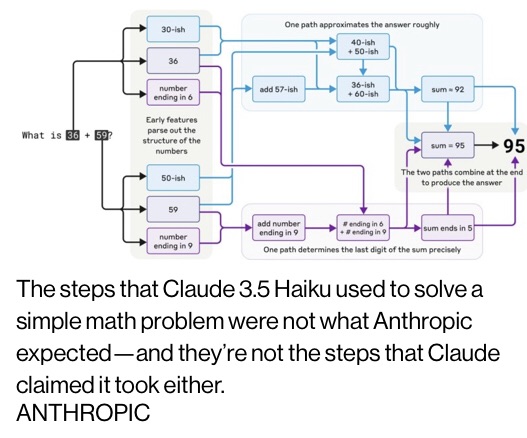
Anthropic also looked at how Claude solved simple math problems. The team found that the model seems to have developed its own internal strategies that are unlike those it will have seen in its training data. Ask Claude to add 36 and 59 and the model will go through a series of odd steps, including first adding a selection of approximate values (add 40ish and 60ish, add 57ish and 36ish). Towards the end of its process, it comes up with the value 92ish. Meanwhile, another sequence of steps focuses on the last digits, 6 and 9, and determines that the answer must end in a 5. Putting that together with 92ish gives the correct answer of 95.
And yet if you then ask Claude how it worked that out, it will say something like: “I added the ones (6+9=15), carried the 1, then added the 10s (3+5+1=9), resulting in 95.” In other words, it gives you a common approach found everywhere online rather than what it actually did. Yep! LLMs are weird. (And not to be trusted.)
This is clear evidence that large language models will give reasons for what they do that do not necessarily reflect what they actually did. But this is true for people too, says Batson: “You ask somebody, ‘Why did you do that?’ And they’re like, ‘Um, I guess it’s because I was— .’ You know, maybe not. Maybe they were just hungry and that’s why they did it.”
Biran thinks this finding is especially interesting. Many researchers study the behavior of large language models by asking them to explain their actions. But that might be a risky approach, he says: “As models continue getting stronger, they must be equipped with better guardrails. I believe—and this work also shows—that relying only on model outputs is not enough.”
A third task that Anthropic studied was writing poems. The researchers wanted to know if the model really did just wing it, predicting one word at a time. Instead they found that Claude somehow looked ahead, picking the word at the end of the next line several words in advance.
For example, when Claude was given the prompt “A rhyming couplet: He saw a carrot and had to grab it,” the model responded, “His hunger was like a starving rabbit.” But using their microscope, they saw that Claude had already hit upon the word “rabbit” when it was processing “grab it.” It then seemed to write the next line with that ending already in place.
This might sound like a tiny detail. But it goes against the common assumption that large language models always work by picking one word at a time in sequence. “The planning thing in poems blew me away,” says Batson. “Instead of at the very last minute trying to make the rhyme make sense, it knows where it’s going.”
“I thought that was cool,” says Merullo. “One of the joys of working in the field is moments like that. There’s been maybe small bits of evidence pointing toward the ability of models to plan ahead, but it’s been a big open question to what extent they do.”
Anthropic then confirmed its observation by turning off the placeholder component for “rabbitness.” Claude responded with “His hunger was a powerful habit.” And when the team replaced “rabbitness” with “greenness,”Claude responded with “freeing it from the garden’s green.”
Anthropic also explored why Claude sometimes made stuff up, a phenomenon known as hallucination. “Hallucination is the most natural thing in the world for these models, given how they’re just trained to give possible completions,” says Batson. “The real question is, ‘How in God’s name could you ever make it not do that?’”
The latest generation of large language models, like Claude 3.5 and Gemini and GPT-4o, hallucinate far less than previous versions, thanks to extensive post-training (the steps that take an LLM trained on text scraped from most of the internet and turn it into a usable chatbot). But Batson’s team was surprised to find that this post-training seems to have made Claude refuse to speculate as a default behavior. When it did respond with false information, it was because some other component had overridden the “don’t speculate” component.
This seemed to happen most often when the speculation involved a celebrity or other well-known entity. It’s as if the amount of information available on a subject pushed the speculation through, despite the default setting. When Anthropic overrode the “don’t speculate” component to test this, Claude produced lots of false statements about individuals, including claiming that Batson was famous for inventing the Batson principle (he isn’t).
Still unclear
Because we know so little about large language models, any new insight is a big step forward. “A deep understanding of how these models work under the hood would allow us to design and train models that are much better and stronger,” says Biran.
But Batson notes there are still serious limitations. “It’s a misconception that we’ve found all the components of the model or, like, a God’s-eye view,” he says. “Some things are in focus, but other things are still unclear—a distortion of the microscope.”
And it takes several hours for a human researcher to trace the responses to even very short prompts. What’s more, these models can do a remarkable number of different things, and Anthropic has so far looked at only 10 of them.
Batson also says there are big questions that this approach won’t answer. Circuit tracing can be used to peer at the structures inside a large language model, but it won’t tell you how or why those structures formed during training. “That’s a profound question that we don’t address at all in this work,” he says.
But Batson does see this as the start of a new era in which it is possible, at last, to find real evidence for how these models work: “We don’t have to be, like: ‘Are they thinking? Are they reasoning? Are they dreaming? Are they memorizing?’ Those are all analogies. But if we can literally see step by step what a model is doing, maybe now we don’t need analogies.”
Businessman Mark Cuban is making it his “mission” to shake up U.S. health care.
Cuban is known for owning the Dallas Mavericks and for his role as an angel investor on the ABC reality TV show “Shark Tank.”
He hasn’t shied away from the political arena as a prominent critic of President Trump. But Cuban says he has no interest in running for higher office, opting instead to disrupt health care.
“If I could change health care in this country, that would be amazing,” Cuban said in an interview for The Hill’s “Health Next Summit.”
For Cuban, that starts with his company Cost Plus Drugs, which launched in 2022 with the goal of pharmacies leapfrogging middleman wholesalers.
“I’m not saying I’m going to be able to pull it off, but I know we’ve had a significant impact with CostPlusDrugs.com, and I think getting there and focusing on that and just changing people’s lives for the better on the health care side, that’s my mission,” he said.
Cuban said the company carries more than 2,500 medications and that when customers type in the name of a medication, they immediately see its actual cost followed by the markup, which is always 15 percent. The businessman said the company’s transparency is what sets it apart from its competitors, which include Amazon Prime, Costco and GoodRX.
“As crazy as it sounds, we are the only company that publishes their entire price list,” he said.
However, Cuban said Cost Plus Drugs has run into the roadblock of pharmacy benefit managers (PBMs). Those are the intermediaries that manage drug coverage for businesses across the country. PBMs and brand drug manufacturers negotiate discounts in the form of rebates, and the PBM then passes most of the rebates on to employers.
Critics argue PBMs do not always find the best deals and are forcing independent drug stores out of business by not paying them enough to cover their costs. The PBM industry, says it saves employers and patients billions on drug costs.
“When we talk to manufacturers and we say, ‘Look, why can’t we get in the same rebate programs as these big PBMs?’ They tell us without telling us that they don’t want to lose their position on the formulary, which is hundreds of millions or billions of dollars in sales,” Cuban said.
“The big PBMs just won’t let them deal with us. That is our problem. Period. End of story,” he added.
But Cuban said he and his team are slowly making progress through going to drug manufacturer CEOs and working with pass-through PBMs, which eliminate discounts, rebates and fees directly to the payer.
“All of the rebates are passed through so you actually get significant savings, and slowly but surely we’re having inroads,” he said.
Cuban is also touting the company’s partnership with independent pharmacies through paying them a $12 fill fee per prescription, fully reimbursing the pharmacy and allowing them to make a profit.
“I want independent pharmacies to stay in business,” Cuban said. “I think as a country, we don’t want to see pharmacy deserts. We need them to stay in business. All those people, senior citizens that have been going to the same pharmacist for decades and that pharmacist knows them, they know their family, that’s important. That saves lives.”
“The problem is that the biggest PBMs won’t fully reimburse,” he said.
Cuban argued that Cost Plus Drugs would be able to dramatically cut the cost of brand medication if the pharmaceutical industry allows the company to participate in rebate programs.
“The amount of money that we can save taxpayers and patients will be, to paraphrase, like you’ve never seen before. Most in history ever,” he said, appearing to mimic Trump.
Cuban said he is hopeful the Trump administration will work to lower prices through the Centers for Medicare and Medicaid Services (CMS) and the Department of Health and Human Services (HHS). However, he added that he believes Republicans have been afraid to work with him, particularly those from the Department of Government Efficiency (DOGE)
Cuban described the approach of the Trump administration and DOGE head Elon Musk as “ready, fire, aim,” which, he added, “is no way to govern.”
“Particularly when the you-know-what, you know, rolls downhill onto the small-to-medium-sized communities and cities where all of a sudden, who knows how many people are losing jobs, who knows how many companies have to close because their grants have been cut, and who knows the impact on that community in terms of services they’re going to be able to offer, raising taxes,” he said.
Cuban is one of the most outspoken critics of Trump from the business community, and he opted to campaign with then-Vice President Kamala Harris last year.
Cuban said he does not particularly care about the future of the Democratic Party because of his status as an Independent. However, he encouraged Democrats to go into communities to get a sense of how Trump’s tariffs and DOGE cuts are playing out locally.
“You’re not going to get people to all of the sudden turn on Donald Trump, but what you can do, as we’ve seen with some of the town halls, is get people to turn on some of the Republican House members who are going to have to make a really tough choice,” he said.
“If their communities are being negatively impacted by the all-at-once cuts of DOGE and the impact of the tariffs, well, put the pressure on those House Republicans to make a choice. Either you support Donald Trump, or you go against Donald Trump and say these tariffs and these cuts are awful for my town, or you lose your job,” he said.
What happens when quantum computers can finally crack encryption and break into the world’s best-kept secrets? It’s called Q-Day—the worst holiday maybe ever.
ONE DAY SOON, at a research lab near Santa Barbara or Seattle or a secret facility in the Chinese mountains, it will begin: the sudden unlocking of the world’s secrets. Your secrets.
Cybersecurity analysts call this Q-Day—the day someone builds a quantum computer that can crack the most widely used forms of encryption. These math problems have kept humanity’s intimate data safe for decades, but on Q-Day, everything could become vulnerable, for everyone: emails, text messages, anonymous posts, location histories, bitcoin wallets, police reports, hospital records, power stations, the entire global financial system.
“We’re kind of playing Russian roulette,” says Michele Mosca, who coauthored the most recent “Quantum Threat Timeline” report from the Global Risk Institute, which estimates how long we have left. “You’ll probably win if you only play once, but it’s not a good game to play.” When Mosca and his colleagues surveyed cybersecurity experts last year, the forecast was sobering: a one-in-three chance that Q-Day happens before 2035. And the chances it has already happened in secret? Some people I spoke to estimated 15 percent—about the same as you’d get from one spin of the revolver cylinder.
The corporate AI wars may have stolen headlines in recent years, but the quantum arms race has been heating up too. Where today’s AI pushes the limits of classical computing—the kind that runs on 0s and 1s—quantum technology represents an altogether different form of computing. By harnessing the spooky mechanics of the subatomic world, it can run on 0s, 1s, or anything in between. This makes quantum computers pretty terrible at, say, storing data but potentially very good at, say, finding the recipe for a futuristic new material (or your email password). The classical machine is doomed to a life of stepwise calculation: Try one set of ingredients, fail, scrap everything, try again. But quantum computers can explore many potential recipes simultaneously.
So, naturally, tech giants such as Google, Huawei, IBM, and Microsoft have been chasing quantum’s myriad positive applications—not only for materials science but also communications, drug development, and market analysis. China is plowing vast resources into state-backed efforts, and both the US and the European Union have pledged millions in funding to support homegrown quantum industries. Of course, whoever wins the race won’t just have the next great engine of world-saving innovation. They’ll also have the greatest code-breaking machine in history. So it’s normal to wonder: What kind of Q-Day will humanity get—and is there anything we can do to prepare?
If you had a universal picklock, you might tell everyone—or you might keep it hidden in your pocket for as long as you possibly could. From a typical person’s vantage point, maybe Q-Day wouldn’t be recognizable as Q-Day at all. Maybe it would look like a series of strange and apparently unconnected news stories spread out over months or years. London’s energy grid goes down on election day, plunging the city into darkness. A US submarine on a covert mission surfaces to find itself surrounded by enemy ships. Embarrassing material starts to show up online in greater and greater quantities: classified intelligence cables, presidential cover-ups, billionaires’ dick pics. In this scenario, it might be decades before we’re able to pin down exactly when Q-Day actually happened.
Then again, maybe the holder of the universal picklock prefers the disaster-movie outcome: everything, everywhere, all at once. Destroy the grid. Disable the missile silos. Take down the banking system. Open all the doors and let the secrets out.
ILLUSTRATION: NICHOLAS LAW
SUPPOSE YOU ASK a classical computer to solve a simple math problem: Break the number 15 into its smallest prime factors. The computer would try all the options one by one and give you a near-instantaneous answer: 3 and 5. If you then ask the computer to factor a number with 1,000 digits, it would tackle the problem in exactly the same way—but the calculation would take millennia. This is the key to a lot of modern cryptography.
Take RSA encryption, developed in the late 1970s and still usedfor securing email, websites, and much more. In RSA, you (or your encrypted messaging app of choice) create a private key, which consists of two or more large prime numbers. Those numbers, multiplied together, form part of your public key. When someone wants to send you a message, they use your public key to encrypt it. You’re the only person who knows the original prime numbers, so you’re the only person who can decrypt it. Until, that is, someone else builds a quantum computer that can use its spooky powers of parallel computation to derive the private key from the public one—not in millennia but in minutes. Then the whole system collapses.
The algorithm to do this already exists. In 1994, decades before anyone had built a real quantum computer, an AT&T Bell Labs researcher named Peter Shor designed the killer Q-Day app. Shor’s algorithm takes advantage of the fact that quantum computers run not on bits but on qubits. Rather than being locked in a state of 0 or 1, they can exist as both simultaneously—in superposition. When you run an operation on a handful of qubits in a given quantum state, you’re actually running that same operation on those same qubits in all their potential quantum states. With qubits, you’re not confined to trial and error. A quantum computer can explore all potential solutions simultaneously. You’re calculating probability distributions, waves of quantum feedback that pile onto each other and peak at the correct answer. With Shor’s algorithm, carefully designed to amplify certain mathematical patterns, that’s exactly what happens: Large numbers go in one end, factors come out the other.
In theory, at least. Qubits are incredibly difficult to build in real life, because the slightest environmental interference can nudge them out of the delicate state of superposition, where they balance like a spinning coin. But Shor’s algorithm ignited interest in the field, and by the 2010s, a number of projects were starting to make progress on building the first qubits. In 2016, perhaps sensing the nascent threat of Q-Day, the US National Institute for Standards and Technology (NIST) launched a competition to develop quantum-proof encryption algorithms. These largely work by presenting quantum computers with complex multidimensional mazes, called structured lattices, that even they can’t navigate without directions.
In 2019, Google’s quantum lab in Santa Barbara claimed that it had achieved “quantum supremacy.” Its 53-qubit chip could complete in just 200 seconds a task that would have taken 100,000 conventional computers about 10,000 years. Google’s latest quantum processor, Willow, has 105 qubits. But to break encryption with Shor’s algorithm, a quantum computer will need thousands or even millions.
There are now hundreds of companies trying to build quantum computers using wildly different methods, all geared toward keeping qubits isolated from the environment and under control: superconducting circuits, trapped ions, molecular magnets, carbon nanospheres. While progress on hardware inches forward, computer scientists are refining quantum algorithms, trying to reduce the number of qubits required to run them. Each step brings Q-Day closer.
That’s bad news not just for RSA but also for a dizzying array of other systems that will be vulnerable on Q-Day. Security consultant Roger A. Grimes lists some of them in his book Cryptography Apocalypse: the DSA encryption used by many US government agencies until recently, the elliptic-curve cryptography used to secure cryptocurrencies like Bitcoin and Ethereum, the VPNs that let political activists and porn aficionados browse the web in secrecy, the random number generators that power online casinos, the smartcards that let you tap through locked doors at work, the security on your home Wi-Fi network, the two-factor authentication you use to log in to your email account.
Experts from one national security agency told me they break the resulting threats down into two broad areas: confidentiality and authentication. In other words, keeping secrets and controlling access to critical systems. Chris Demchak, a former US Army officer who is a professor of cybersecurity at the US Naval War College and spoke with me in a personal capacity, says that a Q-Day computer could let an adversary eavesdrop on classified military data in real time. “It would be very bad if they knew exactly where all of our submarines were,” Demchak says. “It would be very bad if they knew exactly what our satellites are looking at. And it would be very bad if they knew exactly how many missiles we had and their range.” The balance of geopolitical power in, say, the Taiwan Strait could quickly tilt.
Beyond that real-time threat to confidentiality, there’s also the prospect of “harvest now, decrypt later” attacks. Hackers aligned with the Chinese state have reportedly been hoovering up encrypted data for years in hopes of one day having a quantum computer that can crack it. “They wolf up everything,” Demchak told me. (The US almost certainly does this too.) The question then becomes: How long will your sensitive data remain valuable? “There might be some needles in that haystack,” says Brian Mullins, the CEO of Mind Foundry, which helps companies implement quantum technology. Your current credit card details might be irrelevant in 10 years, but your fingerprint won’t be. A list of intelligence assets from the end of the Iraq War might seem useless until one of those assets becomes a prominent politician.
The threat to authentication may be even scarier. “Pretty much anything that says a person is who they say they are is underpinned by encryption,” says Deborah Frincke, a computer scientist and national security expert at Sandia National Laboratories. “Some of the most sensitive and valuable infrastructure that we have would be open to somebody coming in and pretending to be the rightful owner and issuing some kind of command: to shut down a network, to influence the energy grid, to create financial disruption by shutting down the stock market.”
ILLUSTRATION: NICHOLAS LAW
THE EXACT LEVEL of Q-Day chaos will depend on who has access to the first cryptographically relevant quantum computers. If it’s the United States, there will be a “fierce debate” at the highest levels of government, Demchak believes, over whether to release it for scientific purposes or keep it secret and use it for intelligence. “If a private company gets there first, the US will buy it and the Chinese will try to hack it,” she claims. If it’s one of the US tech companies, the government could put it under the strict export controls that now apply to AI chips.
Most nation-state attacks are on private companies—say, someone trying to break into a defense contractor like Lockheed Martin and steal plans for a next-generation fighter jet. But over time, as quantum computers become more widely available, the focus of the attacks could broaden. The likes of Microsoft and Amazon are already offering researchers access to their primitive quantum devices on the cloud—and big tech companies haven’t always been great at policing who uses their platforms. (The soldier who blew up a Cybertruck outside the Trump International Hotel in Las Vegas early this year queried ChatGPT to help plan the attack.) You could have a bizarre scenario where a cybercriminal uses Amazon’s cloud quantum computing platform to break into Amazon Web Services.
Cybercriminals with access to a quantum computer could use it to go after the same targets more effectively, or take bigger swings: hijacking the SWIFT international payments system to redirect money transfers, or conducting corporate espionage to collect kompromat. The earliest quantum computers probably won’t be able to run Shor’s algorithm that quickly—they might only get one or two keys a day. But combining a quantum computer with an artificial intelligence that can map out an organization’s weakness and highlight which keys to decrypt to cause the most damage could yield devastating results.
And then there’s Bitcoin. The cryptocurrency is exquisitely vulnerable to Q-Day. Because each block in the Bitcoin blockchain captures the data from the previous block, Bitcoin cannot be upgraded to post-quantum cryptography, according to Kapil Dhiman, CEO of Quranium, a post-quantum blockchain security company. “The only solution to that seems to be a hard fork—give birth to a new chain and the old chain dies.”
But that would require a massive organizational effort. First, 51 percent of Bitcoin node operators would have to agree. Then everyone who holds bitcoin would have to manually move their funds from the old chain to the new one (including the elusive Satoshi Nakamoto, the Bitcoin developer who controls wallets containing around $100 billion of the cryptocurrency). If Q-Day happens before the hard fork, there’s nothing to stop bitcoin going to zero. “It’s like a time bomb,” says Dhiman.
THAT BOMB GOING off will only be the beginning. When Q-Day becomes public knowledge, either via grim governmental address or cheery big-tech press release, the world will enter the post-quantum age. It will be an era defined by mistrust and panic—the end of digital security as we know it. “And then the scramble begins,” says Demchak.
All confidence in the confidentiality of our communications will collapse. Of course, it’s unlikely that everyone’s messages will actually be targeted, but the perception that you could be spied on at any time will change the way we live. And if NIST’s quantum-proof algorithms haven’t rolled out to your devices by that point, you face a real problem—because any attempts to install updates over the cloud will also be suspect. What if that download from Apple isn’t actually from Apple? Can you trust the instructions telling you to transfer your crypto to a new quantum-secure wallet?
Grimes, the author of Cryptography Apocalypse, predicts enormous disruptions. We might have to revert to Cold War methods of transmitting sensitive data. (It’s rumored that after a major hack in 2011, one contractor purportedly asked its staff to stop using email for six weeks.) Fill a hard drive, lock it in a briefcase, put someone you trust on a plane with the payload handcuffed to their wrist. Or use one-time pads—books of pre-agreed codes to encrypt and decrypt messages. Quantum-secure, but not very scalable. Expect major industries—energy, finance, health care, manufacturing, transportation—to slow to a crawl as companies with sensitive data switch to paper-based methods of doing business and scramble to hire expensive cryptography consultants. There will be a spike in inflation. Most people might just accept the inevitable: a post-privacy society in which any expectation of secrecy evaporates unless you’re talking to someone in person in a secluded area with your phones switched off. Big Quantum is Watching You.
The best-case scenario looks something like Y2K, where we have a collective panic, make the necessary upgrades to encryption, and by the time Q-Day rolls around it’s such an anticlimax that it becomes a joke. That outcome may still be possible. Last summer, NIST released its first set of post-quantum encryption standards. One of Joe Biden’s last acts as president was to sign an executive order changing the deadline for government agencies to implement NIST’s algorithms from 2035 to “as soon as practicable.”
Already, NIST’s post-quantum cryptography has been rolled out on messaging platforms such as Signal and iMessage. Sources told me that sensitive national security data is probably being locked up in ways that are quantum-secure. But while your email account can easily be Q-proofed over the internet (assuming the update doesn’t come from a quantum imposter!), other things can’t. Public bodies like the UK’s National Health Service are still using hardware and software from the 1990s. “Microsoft is not going to upgrade some of its oldest operating systems to be post-quantum secure,” says Ali El Kaafarani, the CEO of PQShield, a company that makes quantum-resistant hardware. Updates to physical infrastructure can take decades, and some of that infrastructure has vulnerable cryptography in places it can’t be changed: The energy grid, military hardware, and satellites could all be at risk.
And there’s a balance to be struck. Rushing the transition risks introducing vulnerabilities that weren’t there before. “How do you make transitions slow enough that you can be confident and fast enough that you don’t dawdle?” asks Chris Ballance, CEO of Oxford Ionics, a quantum computing company. Some of those vulnerabilities might even be there by design: Memos leaked by Edward Snowden indicate that the NSA may have inserted a backdoor into a pseudorandom number generator that was adopted by NIST in 2006. “Anytime anybody says you should use this particular algorithm and there’s a nation-state behind it, you’ve got to wonder whether there’s a vested interest,” says Rob Young, director of Lancaster University’s Quantum Technology Centre.
Then again, several people I spoke to pointed out that any nation-state with the financial muscle and technical knowledge to build a quantum device that can run Shor’s algorithm could just as easily compromise the financial system, the energy grid, or an enemy’s security apparatus through conventional methods. Why invent a new computing paradigm when you can just bribe a janitor?
Long before quantum technology is good enough to break encryption, it will be commercially and scientifically useful enough to tilt the global balance. As researchers solve the engineering challenge of isolating qubits from the environment, they’ll develop exquisitely sensitive quantum sensors that will be able to unmask stealth ships and map hidden bunkers, or give us new insight into the human body. Similarly, pharma companies of the future could use quantum to steal a rival’s inventions—or use it to dream up even better ones. So ultimately the best way to stave off Q-Day may be to share those benefits around: Take the better batteries, the miracle drugs, the far-sighted climate forecasting, and use them to build a quantum utopia of new materials and better lives for everyone. Or—let the scramble begin.
Let us know what you think about this article. Submit a letter to the editor atmail@wired.com.
From 2023, Lesley Stahl’s report on AI, chatbots and a world of unknowns. From 2024, Stahl’s story on Kenyan workers training AI who say they’re overworked, underpaid and exploited by big American tech companies. Also from 2024, Anderson Cooper’s report on “nudify” sites that use AI to create realistic, revealing images of actual people. And from 2021, Bill Whitaker’s look at the use of artificial intelligence to create deepfakes.