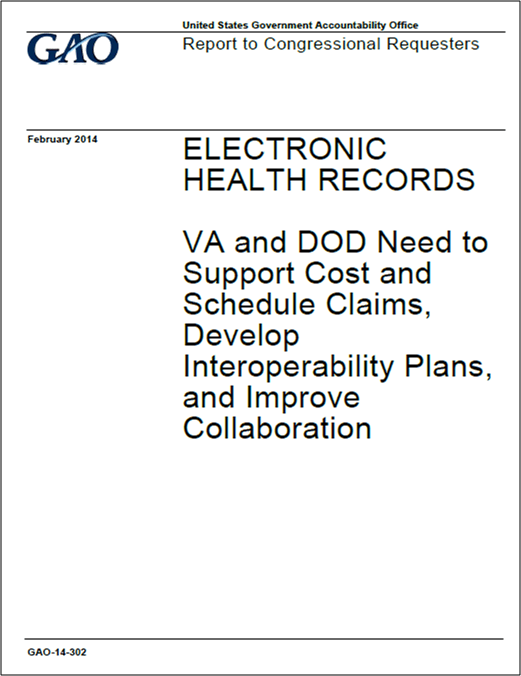
VA and DOD Need to Support Cost and Schedule Claims, Develop Interoperability Plans, and Improve Collaboration
VA and DOD Need to Support Cost and Schedule Claims, Develop Interoperability Plans, and Improve Collaboration


http://www.hiewatch.com/perspective/onc-rethinks-policy-horizon
After a decade of health IT adoption, the new national health IT leader, Karen DeSalvo, MD, thinks the “next chapter” of American medicine can be defined by its pursuit of innovation. If the government offers the right mix of policy, that is.
In the coming years, federal health leaders are striving to guide the nation toward a “learning health system, with a feedback loop where patient data is there across the continuum and can be used not just for care delivery but for quality and safety and evidence-based healthcare,” DeSalvo said at a HIT Standards Committee meeting.
To start that, DeSalvo said, the ONC and its policy committee that advises HHS are “taking a step back and looking forward for a multiyear trajectory where the big policy questions will be answered.”
That should come as a sigh of relief to many healthcare organizations seeking more breathing room in 2014, “the most stressful time in healthcare IT in our generation,” as summed up by John Halamka, MD, Beth Israel Deaconess Medical Center CIO and vice chair of the HIT Standards Committee.
The recent extended attestation period for the second phase of meaningful use stage 2 is also likely to be followed by another attempt to respond to providers needs: an 2015 EHR certification that tries to address shortfalls in this year’s certifications.
Sometime this month, HHS is going to publish a proposed rule for a 2015 EHR certification, said Jodi Daniel, director of the ONC’s office of policy and planning. This new certification would be voluntary for providers and vendors alike, she said.
“Providers would not — I’m going to say it again, would not — have to update to meet the meaningful use program,” Daniel said. “It would address issues we have heard about in the 2014 certification to hopefully make it simpler for folks to comply,” and it would also “reference updated standards and implementation guides that we hope will continue the momentum toward greater interoperability.”
The ONC’s interest in re-aligning long-term policy ideas, and the on-the-go tweaking for upcoming timelines, comes as Congress looks poised to consolidate the meaningful use, physician quality reporting and value-based payment modifier programs and eliminate related penalties as part of a new Medicare payment reform bill.
With Congress and bleary-eyed providers in the backdrop, the ONC and HHS are trying to “harmonize efforts and thinking on a longer-term horizon,” DeSalvo said. To that end, the agency is going to be working to fill gaps in health IT standards and interoperability — in part, as Halamka is arguing for, by approaching interoperability as a means to “empower innovation instead of prescriptive functionality.”
Health IT standards experts and stakeholders are at work on standards for several such use cases, as Doug Fridsma, MD, the ONC’s chief science officer and standards guru, outlined.
One use is a targeted query of patient records: for instance, “where you know the patient was seen in an emergency room last night and you want to take a look at the final CT scan.”
Another is data migration and patient portability, if a patient is moving from one provider to another and needs to have their records transferred between two (likely different) electronic record systems.
Depending on the relationship of the providers, any existing interfaces or the work of a regional or statewide health information exchange, that could be lengthy process, especially for medical practices.
“One wonders if there’s a way that we can streamline that process,” Fridsma said.
Anthony Brino the editor of HIEWatch, and covers health policy for Government Health IT and insurance for Healthcare Payer News.
By Former Sens. Tom Daschle (D-S.D.), Trent Lott (R-Miss.) and John Breaux (D-La.) – 02/12/14 06:07 PM EST
As Washington continues to debate ObamaCare, technological innovations have advanced to new levels, presenting a bipartisan opportunity to give Americans access to new ways to connect with their doctors.
Whether it involves patient portals, mobile apps, electronic health records or remote patient monitoring, technology has the power to bring high-quality care to more people with increased transparency and patient engagement. Telehealth, or as we like to call it, connected care, is harnessing technology through greater broadband deployment and adoption of new modalities to address gaps in the current system.
Patients who need primary care, chronic disease management, mental health consultations or even specialty care such as dermatology, can communicate with their physicians remotely through a laptop, iPad, smartphone or kiosk. Patient care is available after-hours and on weekends, often in a patient’s home or in another convenient location. This is not merely a big step for patient convenience; it also represents an opportunity to improve the quality of care and promote care coordination.
The Department of Veterans Affairs has been a pioneer in connected care. In fiscal 2012, nearly half a million veterans received 1.429 million remote care contacts. In the Defense Department spending bill recently signed by President Obama, one of the few amendments added to the bill extended healthcare services to transitioning veterans through telemedicine.
It is time to make connected care a bipartisan priority in Washington. Imagine an elderly woman with diabetes who can consult a doctor about managing her disease without having to leave her home, or a working parent who can video chat with his child’s pediatrician, or a patient in need of mental health services but too afraid to go to an office able to access care through a laptop, or a doctor who can monitor a patient already discharged from the hospital.
To achieve the true promise of connected care, we must ensure that our legal and regulatory structures allow Americans access to these innovations. We currently have rules that never anticipated what is possible today. We have an opportunity to embrace new platforms for the delivery of healthcare and prevention of chronic disease and to do so in a way that protects patients’ sensitive information.
Given the benefits of this technology, policymakers across government should be, and we believe are, asking themselves what they can do to expand its use while ensuring that appropriate safeguards are in place.
For example, we have created a major emphasis on keeping people out of the hospital with prevention, chronic disease management, care coordination and readmission penalties. But, we still don’t reimburse home health agencies for remote patient monitoring, nor do we pay for patients to check in with care providers from their homes via real-time video.
We must create a consistent definition of connected care that will promote participation and broaden acceptance of remote care among providers, payers and patients. We must also address the lack of broad and consistent reimbursement, insufficient broadband infrastructure, inconsistent state medical licensing and varying degrees of clinical permissibility.
The time is right to address these issues, and the following facts are indisputable: • Technology is more widely recognized as a job creator and an engine for economic growth. • The evidence base for connected care has grown. Studies are published regularly that demonstrate improvements in quality, access and cost – including one recently that highlighted how Partners Healthcare System in Boston reduced readmissions of 1,200 heart failure patients by 50 percent through a home health telemonitoring program. • Connected care aligns with broader efforts to strengthen the nation’s healthcare system. Notably, an emphasis on accountable care is putting pressure on providers to be in better contact outside of the office or hospital setting, and connected care offers a low-cost way for providers to follow up with their patients. • States and commercial insurers are increasingly reimbursing for connected care. In 2013 alone, legislation was introduced in 25 states to advance some type of telehealth policy, and 20 states now require commercial insurers to cover telehealth services. • As the expansion of coverage continues, more people will be enrolled in private health insurance plans or Medicaid than ever before but might not be able to access a physician. Connected care can help consumers find a doctor that suits their health needs.
Technology can be a powerful tool in meeting our healthcare challenges. To maximize its potential, we must pave the way by ensuring our laws and regulations keep pace with innovations in connected care.
Daschle, Lott and Breaux are co-chairmen of the Connected Care Alliance, a diverse coalition of companies dedicated to patient access to care through advanced technology.
Follow us: @thehill on Twitter | TheHill on Facebook
Read more: http://thehill.com/opinion/op-ed/198269-connected-healthcare-is-our-future-if-washington-acts#.Uv4lQZIpyfs.twitter#ixzz2tPKgVSNo Follow us: @thehill on Twitter | TheHill on Facebook
Article link: http://annals.org/data/Journals/AIM/927426/0000605-201308200-00011.pdf
The Affordable Care Act made preliminary efforts to collect and disseminate data on health care price, utilization, and quality in the United States. This commentary proposes that all such data need to be publicly available to achieve a health care system that delivers high value.
The Patient Protection and Affordable Care Act (ACA) made significant albeit preliminary efforts to collect and disseminate price and quality data. More action is essential, by shifting the basis of competition from structural market power to delivery of better value. To achieve this, we propose the transparency imperative: All data on price, utilization, and quality of health care should be made available to the public unless there is a compelling reason not to do so. The transparency imperative is part of the foundation for a post-ACA health care system that achieves better quality and cost control.
Few patients have any knowledge of prices for any health care service, from a laboratory test to surgery. More important, obtaining such information is almost impossible. First, services comprise different inputs, so it’s hard to obtain a unified price. Second, commercial prices are almost completely opaque. For example, differences in pricing power among hospitals has led to large disparities in price (typically more than 200%) within local markets, with little relationship to differences in quality (2). This remains true even within most preferred provider organization insurance networks.
It’s very difficult for patients to discover how many procedures a physician or hospital performs, yet utilization is critical for informed decision making. Physician case volume is one of the most important predictors of quality for many surgeries and medical conditions. For instance, it is estimated that a urologist needs to perform more than 700 robotic prostatectomies before the learning curve flattens out (3–4), yet determining how many procedures a urologist has performed is virtually impossible. Famously in 1979, the American Medical Association sued Medicare to block the release of data on the number of procedures billed to Medicare, claiming physician privacy (5).
Access to quality data is limited, and better performance has not led to gains in market share thus far. Few good-quality metrics exist, and the ones that do are largely limited to inpatient care processes for coronary artery bypass graft surgery, congestive heart failure, chronic obstructive pulmonary disease, diabetes, community-acquired pneumonia, pregnancy, hip replacement, knee replacement, and organ transplantation. Quality data that are publicly disclosed, such as Medicare’s Hospital Compare, are of limited utility because they are reported vaguely in most cases as “No Different than U.S. National Rate” or “Better (or Worse) than U.S. National Rate.”
The ACA contains requirements to release Medicare claims and Physician Quality Reporting System (PQRS) data. However, very few of these data have flowed into the public domain, probably the biggest limitation being risk aversion. Unfortunately, the data have been released to only a few “qualified entities” (6). The intent was to be sure that such entities had the technical capacity to analyze the Medicare data responsibly. But the latest regulations significantly restrict the flow of data and preclude smart but inexperienced people on tight budgets from analyzing them (6).
Initially, one would think that health plans should have the greatest desire to make price and quality transparent to their members because they capture savings when members choose better-value providers. Unfortunately, transparency is not necessarily their top priority. To satisfy the desires of employees, many employers demand broad provider networks that include market-dominant providers, such as prominent academic centers that prohibit transparency in 30% to 40% of cases. They try to keep costs down by negotiating rates instead of providing information and guiding patients to better-value providers.
Price and quality information are imperative for new payment models. With expansion of risk-based reimbursement models like accountable care organizations and patient-centered medical homes, providers will have to identify high-value providers who can consistently deliver high-quality care with fewer complications at an affordable price to capture more savings, achieve quality metric goals, and earn higher incomes.
For meaningful progress on transparency to occur, there must be a change in attitude throughout the system. All payers should be required to make their claims data publically available, with privacy protections, to enable quality measurement. Of importance, to protect privacy, the federal government should substantially increase the penalties for inappropriate patient re-identification.
Personalized pricing information should be made available for comparison before patients enter a care process. Both total price and patient price should be transparent to providers in shared-savings payment models to enable cost management. Only patient price should be available to providers in fee-for-service networks to mitigate the risk for price increases.
Fortunately, there is much that stakeholders can do. The federal government can relax restrictions on access to Medicare data. Other states should follow the lead of California and Massachusetts and require providers to disclose prices to patients before elective care. Health plans and employers should also support such transparency tools as Castlight (www.castlighthealth.com).
If we are going to bend the cost curve, a better functioning health care market is critical. Transparency is essential for patients to consume care from providers who deliver greater value. For providers, transparency is essential for risk-based reimbursement models to work. It is also the best approach to overcome local monopoly pricing power by providers. Most important, the current health care marketplace is ripe for patients to capture large and unjustified differences in price and quality. As more patients do this, we all benefit from more effective competition and health care prices that better reflect value.
Brill S. Bitter pill: why medical bills are killing us. Time. 4 March 2013.
Robinson JC, MacPherson K. Payers test reference pricing and centers of excellence to steer patients to low-price and high-quality providers. Health Aff (Millwood). 2012; 31:2028-36.
PubMed
Freire MP, Choi WW, Lei Y, Carvas F, Hu JC. Overcoming the learning curve for robotic-assisted laparoscopic radical prostatectomy. Urol Clin North Am. 2010; 37:37-47.
PubMed
CrossRef
Alemozaffar M, Duclos A, Hevelone ND, Lipsitz SR, Borza T, Yu HY, et al. Technical refinement and learning curve for attenuating neurapraxia during robotic-assisted radical prostatectomy to improve sexual function. Eur Urol. 2012; 61:1222-8.
PubMed
CrossRef
Statewide Website Will Soon Allow New Yorkers Access to their Healthcare Records Online

NEW YORK, Aug. 14, 2013 /PRNewswire/ — The New York eHealth Collaborative (NYeC) announced today that Mana Health, a New York City-based Health IT start-up, was awarded the vendor contract to build the Patient Portal for New Yorkers. The portal is a website through which New Yorkers will be able to access their healthcare records safely and securely online.
(Logo: http://photos.prnewswire.com/prnh/20120816/NE58665LOGO )
The Patient Portal for New Yorkers website will become available to patients beginning in early 2014 in select parts of the state. Additional capabilities are also in development and will be rolled out over time.
Via the portal, patients whose providers are participating in the program will soon have online access to their personal healthcare data, including lab results, lists of medications, radiology reports, and other information about procedures and medical conditions from the various providers they see. Patients will also be able to decide who can access their data such as their doctors or family members.
Mana Health was awarded the contract to build the portal by an interdisciplinary team of representatives including the New York State Department of Health, NYeC specialists, and Regional Health Information Organizations (RHIOs), who reviewed all bid submissions. Mana Health’s bid was deemed to have the best understanding of the needs of New Yorkers. Mana Health was also the winner of the Patient Portal for New Yorkers Design Challenge, held earlier this year. The Design Challenge was launched to source the most innovative and user-friendly portal designs and was voted on by the public at large.
Mana Health will work directly with NYeC to build the user interface for the portal website and its connection to the Statewide Health Information Network of New York (SHIN-NY). The SHIN-NY is a secure network for sharing clinical patient data across New York State.
“New Yorkers do everything else online. It’s imperative that they also be able to access their healthcare data online, whenever they need it. This is the most important information a person has about him or herself,” said David Whitlinger, Executive Director of NYeC. “We are excited to be partnering with Mana Health to provide patients across the state with that access.”
“Our aim is to empower today’s patient-consumer with an insightful and easy-to-use tool to familiarize themselves with their health data,” said Chris Bradley, CEO and Co-Founder of Mana Health. “Working with the great minds at NYeC to support this statewide patient portal for New Yorkers is truly a dream come true.”
For more information about the Patient Portal for New Yorkers, please visit www.patientportalfornewyorkers.org. For more information about Mana Health, please visit www.manahealth.com.
About Mana Health: Mana Health is a healthcare technology company that uses data to make healthcare work better. Based in New York City, their team is comprised of experts from across healthcare, software development, consumer experience, and analytics. Mana Health’s first product, the Mana Patient Gateway, offers an engaging experience that empowers patients through their HIE, hospital, and employer data. Learn more at www.manahealth.com.
About The New York eHealth Collaborative (NYeC): NYeC is a not-for-profit organization, working in partnership with the New York State Department of Health to improve healthcare for all New Yorkers through health information technology (health IT). Founded in 2006 by healthcare leaders, NYeC receives funding from state and federal grants to serve as the focal point for health IT in the State of New York. NYeC works to develop policies and standards, to assist healthcare providers in making the shift to electronic health records, and to coordinate the creation of the Statewide Health Information Network of New York (SHIN-NY), a network to connect healthcare providers statewide. For more information about NYeC, visit www.nyehealth.org and @NYeHealth.
SOURCE New York eHealth Collaborative
RELATED LINKS
http://www.nyehealth.org
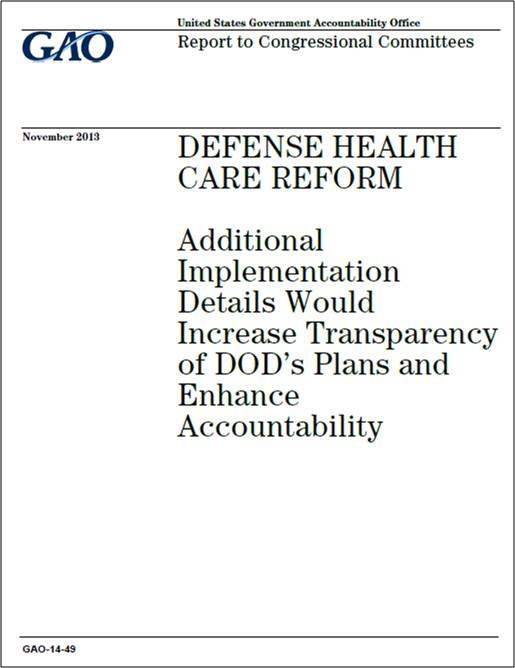
Additional Implementation Details Would Increase Transparency of DOD’s Plans and Enhance Accountability



 healthcarereimagined