by Ken Terry, iHealthBeat Contributing ReporterTuesday, April 15, 2014
Article link: http://www.ihealthbeat.org/insight/2014/despite-success-future-of-recs-uncertain
The 62 health IT regional extension centers have far exceeded their goal of helping 100,000 providers in small primary care practices attest to the meaningful use of electronic health records. As of March 4, more than 150,000 providers had enrolled with RECs. Of those providers, 90% had gone live on their EHRs and more than 93,000 had demonstrated meaningful use, according to the Office of the National Coordinator of Health IT.
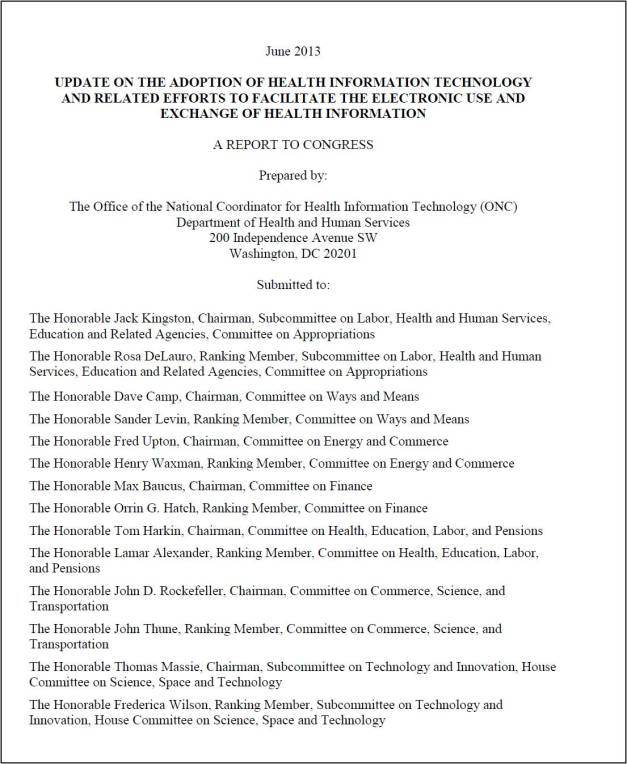
An ONC report to Congress in June 2013 pointed out that nearly half of the providers who received Medicaid EHR incentive payments and a fifth of those that got Medicare incentives had enrolled in RECs. Moreover, Medicare providers who worked with RECs were 2.3 times more likely to receive an EHR incentive payment than those who didn’t.
Based on these statistics, ONC views the REC program as a success. But it’s unclear where the RECs will go from here.
While federal funding for the RECs officially ended on April 15, ONC is allowing the RECs to request “no-cost,” one-year contract extensions that will enable them to use any remaining money in their budgets for specified purposes. At latest count, 55 RECs had asked for these extensions and 39 had received them, although other requests were still pending.
In addition, all of the RECs were required to submit “sustainability plans” before they received their federal grants. These business plans described how the RECs planned to support themselves after their government funds ran out. But some RECs have much more solid plans for the future than others.
How much help RECs across the country will be able to provide to physicians in meeting the goals of meaningful use stages 2 and 3 remains open to question.
“It’s like Stage 1,” said Steven Waldren, senior health care IT strategist at the American Academy of Family Physicians. “Some RECs will be able to do that effectively, and others will struggle.”
To help practices in the later stages of meaningful use, RECs will need a lot of expertise in areas like quality improvement and clinical workflow, Waldren noted. The RECs that are most likely to have those capabilities are those that were most successful in helping providers with meaningful use Stage 1.
Bill O’Byrne — director of NJ-HITEC, New Jersey’s REC — said, “Some of us are going to emerge from this current situation, and we’re going to be very significant players in helping providers become and stay meaningful users.”
RECs’ Track Records Vary
The track records of RECs across the country vary quite a bit, according to observers. Some RECs have worked hard to enroll physicians and to help them choose their EHRs and demonstrate meaningful use. Others have done little more than provide educational materials and conduct webinars.
“Some have not lived up to what I’d consider an acceptable level of performance,” O’Byrne said.
Several RECs have given AAFP members wrong information, Waldren said. Other family doctors have told him that their RECs “made it really easy for them to achieve meaningful use,” he said. RECs that have had trouble finding enough trained technicians “rely on more of a virtual assistance model,” he added.
Mark Anderson, a health IT consultant in Montgomery, Texas, said, “Overall, the REC program was probably good. But maybe 10 of the RECs were great, and 20 were useless.”
The real test of the RECs’ effectiveness, Anderson added, is not how many primary care physicians they enrolled, but how many of those doctors attested to meaningful use. That seems like a fair assumption: Some RECs have a far lower ratio between enrollees and meaningful users than the national average of 62%, according to ONC statistics.
On the other hand, HITEC-LA, the Los Angeles REC, has made significant progress in helping its enrollees in a challenging environment, although it has fallen short of its meaningful use goal.
To date, HITEC-LA has enrolled about 4,000 primary care physicians and 1,000 specialists. Of these, 4,000 have gone live on their EHRs and 2,500 PCPs have attested to meaningful use, short of the REC’s goal of 3,000.
Noting that 60% of the REC’s enrollees have large Medicaid practices, HITEC-LA Executive Director Mary Franz said, “We’ve seen the Medicare providers move forward in our population and sign up more aggressively for meaningful use because of the incentives and the penalties. In contrast, the Medicaid incentive program has a 2016 start and a 2021 end, so Medi-Cal providers are moving slower.”
(Eligible professionals who qualify for the Medicaid EHR incentive program don’t have to enroll in it until 2016. In the first year, they only have to adopt, implement or upgrade to a certified EHR to get an incentive payment; they have three years to attest to meaningful use.)
The REC has also had to cope with the fact that most primary care practices in Los Angeles have only one or two doctors. “Small practices and especially Medi-Cal small practices struggle because they don’t have a lot of money,” Franz said.
HITEC-LA Gearing Up for the Future
HITEC-LA has received a no-cost extension from ONC, allowing it to remain an REC until 2014. ONC has also given HITEC-LA a “scope of work change” that lets it use the money left in its budget to provide meaningful use Stage 2 support to doctors.
The $16 million REC grant for HITEC-LA went to L.A. Care, a Medicaid/Medicare managed care company that is HITEC-LA’s parent. (L.A. Care is one of two health plans nationally that received REC grants.) The insurer added 10% to the grant, bringing it up to nearly $18 million. The bulk of that money went to help providers qualify for $55 million in EHR incentives, including meaningful use payments and “adopt/implement/upgrade” payments to Medicaid providers.
As a result of efficient management, HITEC-LA has a substantial amount left in its kitty, Franz said. In addition, it has received $3.5 million in recent grants, including:
- $1 million from L.A. Care to expand a “virtual communications capability” for a coordination of care initiative;
- A $200,000 grant from the Blue Shield of California Foundation to advance safety-net innovations; and
- A 3-year grant of $1.8 million from the Health Resources and Services Administration.
Under the HRSA grant, HITEC-LA will provide technical services to 27 federally qualified health centers to help them attest to meaningful use Stage 2 and set up patient-centered medical homes.
Partially because of its support from L.A. Care, HITEC-LA plans to be around for a while.
“There’s a real possibility we’ll continue forward in some capacity,” Franz said. “Right now, the HITEC-LA program is one of seven different programs that we [L.A. Care] have going.”
New Jersey REC Roars
NJ-HITEC, one of the more successful RECs, has big plans for the future. After enrolling 8,700 doctors, including specialists who were recruited under a separate contract with the New Jersey Medicaid program, the REC helped 5,900 physicians attest to meaningful use Stage 1, including 4,100 PCPs and 1,800 specialists.
NJ-HITEC applied for a no-cost extension and, at press time, O’Byrne expected the REC would receive it soon. But there isn’t much left of its original budget.
“We aggressively used the original funding, which was under $24 million,” O’Byrne explained. “We spent nearly all of that money. But we’re doing the no-cost extension because it will allow us to stay as a REC at least for another year, although I expect we’ll be in a business a lot longer than that.”
Since November 2013, NJ-HITEC has been charging physicians who wanted to continue receiving REC services $600 a year.
Waldren said he doubts many physicians across the country would be willing to pay for meaningful use Stage 2 support after receiving no-cost support from RECs for Stage 1. A recent ONC-funded report on the REC program said the same. But NJ-HITEC has signed up more than 1,000 paying members, of whom nearly 500 are PCPs, according O’Byrne.
In addition, O’Byrne said NJ-HITEC is making money from a data registry that providers can use to do quality reporting for both meaningful use and CMS’ Physicians Quality Reporting System. RECs in Ohio, California and Massachusetts are using the registry under “white label” partnerships with the New Jersey REC, he noted.
NJ-HITEC also has contracts with four accountable care organizations in the Garden State. On behalf of these ACOs, the REC is collecting data in doctor’s offices for quality reporting to CMS and is also working with the physicians and their staffs on practice transformation, showing them how to use the data to improve quality.
NJ-HITEC is also involved in CMS’ Comprehensive Primary Care Initiative , but so far that has been a bust, O’Byrne said. The REC was hired to advise CPCI practices on how to collect quality data, but it has not been asked to do that, he said.
Finally, NJ-HITEC is offering its members Direct secure messaging services, which will help them meet meaningful use stage 2 criteria. Having partnered with a health information service provider, the REC has compiled a directory of Direct addresses for all its members. That allows any user to send secure email and attachments through the NJ-HITEC portal to anybody else with an address in the REC’s directory. NJ-HITEC will not allow the exchange of Direct messages with non-members because they are not paying for the service, O’Byrne said.
Not many RECs could do what NJ-HITEC is doing, according to Waldren. Asked how many RECs will be able to survive in the long run, he replied, “I’d expect that it’s highly variable across the different RECs. Some have aligned themselves with [health information exchanges] or [quality improvement organizations] in their state, and I think those will continue to provide value. Others that are more isolated will struggle to sustain themselves. Until there’s significant payment change, the sustainability for practice transformation is going to be difficult.”


 healthcarereimagined