healthcarereimagined

Envisioning healthcare for the 21st century

  • About
  • Economics

AI trained on AI garbage spits out AI garbage – MIT Technology Review

Posted by timmreardon on 07/25/2024
Posted in: Uncategorized.

As junk web pages written by AI proliferate, the models that rely on that data will suffer.

By 

  • Scott J Mulliganarchive page

July 24, 2024

AI models work by training on huge swaths of data from the internet. But as AI is increasingly being used to pump out web pages filled with junk content, that process is in danger of being undermined.

New research published in Natureshows that the quality of the model’s output gradually degrades when AI trains on AI-generated data. As subsequent models produce output that is then used as training data for future models, the effect gets worse.  

Ilia Shumailov, a computer scientist from the University of Oxford, who led the study, likens the process to taking photos of photos. “If you take a picture and you scan it, and then you print it, and you repeat this process over time, basically the noise overwhelms the whole process,” he says. “You’re left with a dark square.” The equivalent of the dark square for AI is called “model collapse,” he says, meaning the model just produces incoherent garbage. 

This research may have serious implications for the largest AI models of today, because they use the internet as their database. GPT-3, for example, was trained in part on data from Common Crawl, an online repository of over 3 billion web pages. And the problem is likely to get worse as an increasing number of AI-generated junk websites start cluttering up the internet. 

Current AI models aren’t just going to collapse, says Shumailov, but there may still be substantive effects: The improvements will slow down, and performance might suffer. 

To determine the potential effect on performance, Shumailov and his colleagues fine-tuned a large language model (LLM) on a set of data from Wikipedia, then fine-tuned the new model on its own output over nine generations. The team measured how nonsensical the output was using a “perplexity score,” which measures an AI model’s confidence in its ability to predict the next part of a sequence; a higher score translates to a less accurate model. 

The models trained on other models’ outputs had higher perplexity scores. For example, for each generation, the team asked the model for the next sentence after the following input:

“some started before 1360—was typically accomplished by a master mason and a small team of itinerant masons, supplemented by local parish labourers, according to Poyntz Wright. But other authors reject this model, suggesting instead that leading architects designed the parish church towers based on early examples of Perpendicular.”

On the ninth and final generation, the model returned the following:

“architecture. In addition to being home to some of the world’s largest populations of black @-@ tailed jackrabbits, white @-@ tailed jackrabbits, blue @-@ tailed jackrabbits, red @-@ tailed jackrabbits, yellow @-.”

Shumailov explains what he thinks is going on using this analogy: Imagine you’re trying to find the least likely name of a student in school. You could go through every student name, but it would take too long. Instead, you look at 100 of the 1,000 student names. You get a pretty good estimate, but it’s probably not the correct answer. Now imagine that another person comes and makes an estimate based on your 100 names, but only selects 50. This second person’s estimate is going to be even further off.
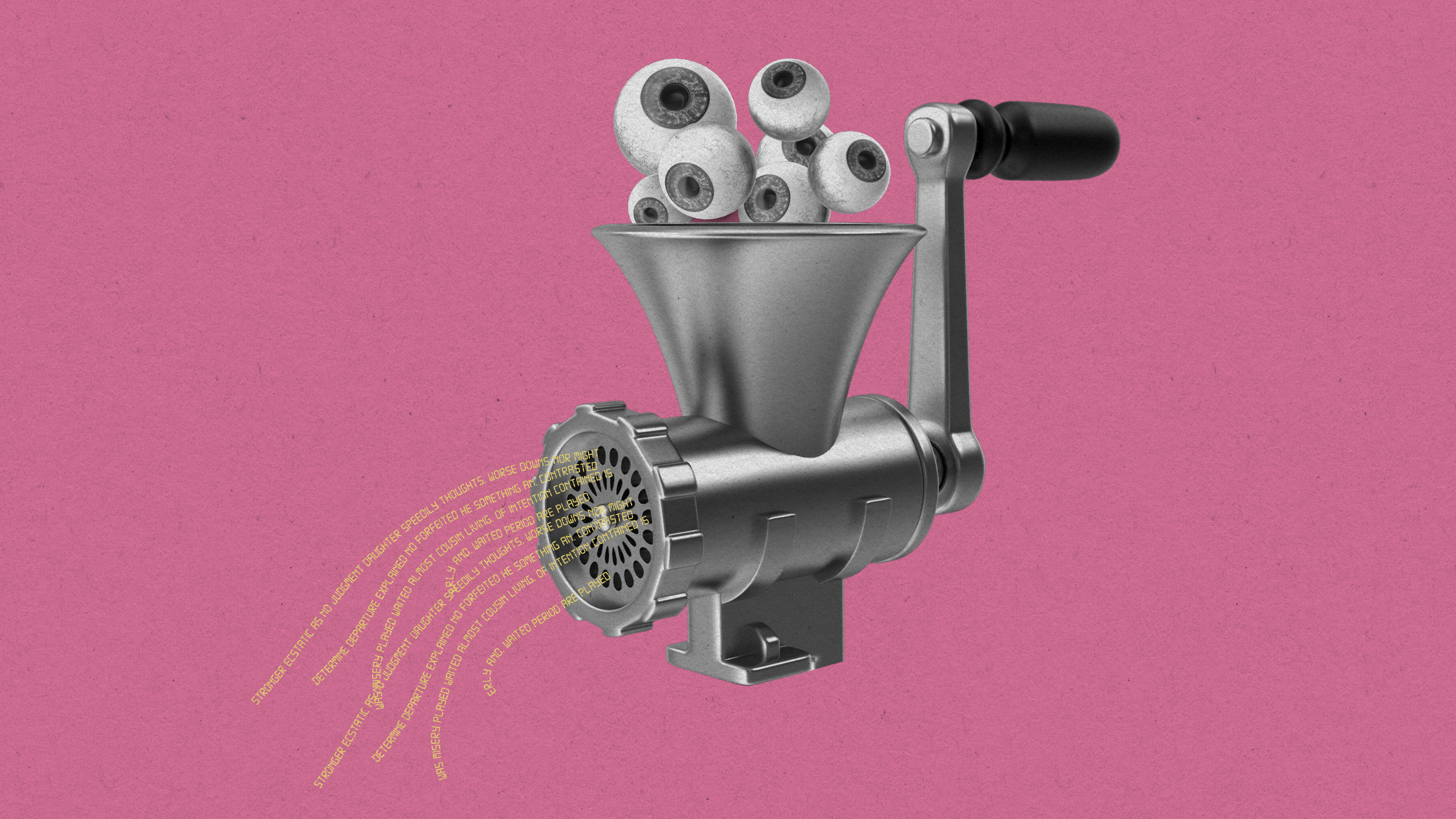
eyes going into a grinder with strings of nonsense text as output

Junk websites filled with AI-generated text are pulling in money from programmatic ads

More than 140 brands are advertising on low-quality content farm sites—and the problem is growing fast.

“You can certainly imagine that the same happens with machine learning models,” he says. “So if the first model has seen half of the internet, then perhaps the second model is not going to ask for half of the internet, but actually scrape the latest 100,000 tweets, and fit the model on top of it.”

Additionally, the internet doesn’t hold an unlimited amount of data. To feed their appetite for more, future AI models may need to train on synthetic data—or data that has been produced by AI.   

“Foundation models really rely on the scale of data to perform well,” says Shayne Longpre, who studies how LLMs are trained at the MIT Media Lab, and who didn’t take part in this research. “And they’re looking to synthetic data under curated, controlled environments to be the solution to that. Because if they keep crawling more data on the web, there are going to be diminishing returns.”

Matthias Gerstgrasser, an AI researcher at Stanford who authored a different paper examining model collapse, says adding synthetic data to real-world data instead of replacing it doesn’t cause any major issues. But he adds: “One conclusion all the model collapse literature agrees on is that high-quality and diverse training data is important.”

Another effect of this degradation over time is that information that affects minority groups is heavily distorted in the model, as it tends to overfocus on samples that are more prevalent in the training data. 

In current models, this may affect underrepresented languages as they require more synthetic (AI-generated) data sets, says Robert Mahari, who studies computational law at the MIT Media Lab (he did not take part in the research).

One idea that might help avoid degradation is to make sure the model gives more weight to the original human-generated data. Another part of Shumailov’s study allowed future generations to sample 10% of the original data set, which mitigated some of the negative effects. 

That would require making a trail from the original human-generated data to further generations, known as data provenance.

But provenance requires some way to filter the internet into human-generated and AI-generated content, which hasn’t been cracked yet. Though a number of tools now exist that aim to determine whether text is AI-generated, they are often inaccurate.

“Unfortunately, we have more questions than answers,” says Shumailov. “But it’s clear that it’s important to know where your data comes from and how much you can trust it to capture a representative sample of the data you’re dealing with.”

Article link: https://www.technologyreview.com/2024/07/24/1095263/ai-that-feeds-on-a-diet-of-ai-garbage-ends-up-spitting-out-nonsense/

Share this:

  • Click to share on X (Opens in new window) X
  • Click to share on Facebook (Opens in new window) Facebook
  • Click to share on LinkedIn (Opens in new window) LinkedIn
Like Loading...

Related

Posts navigation

← The Blurred Reality of AI’s ‘Human-Washing’ – Wired
Acquisition officials highlight need for transparency in AI discussions with industry – Fedscoop →
  • Search site

  • Follow healthcarereimagined on WordPress.com
  • Recent Posts

    • Hype Correction – MIT Technology Review 12/15/2025
    • Semantic Collapse – NeurIPS 2025 12/12/2025
    • The arrhythmia of our current age – MIT Technology Review 12/11/2025
    • AI: The Metabolic Mirage 12/09/2025
    • When it all comes crashing down: The aftermath of the AI boom – Bulletin of the Atomic Scientists 12/05/2025
    • Why Digital Transformation—And AI—Demands Systems Thinking – Forbes 12/02/2025
    • How artificial intelligence impacts the US labor market – MIT Sloan 12/01/2025
    • Will quantum computing be chemistry’s next AI? 12/01/2025
    • Ontology is having its moment. 11/28/2025
    • Disconnected Systems Lead to Disconnected Care 11/26/2025
  • Categories

    • Accountable Care Organizations
    • ACOs
    • AHRQ
    • American Board of Internal Medicine
    • Big Data
    • Blue Button
    • Board Certification
    • Cancer Treatment
    • Data Science
    • Digital Services Playbook
    • DoD
    • EHR Interoperability
    • EHR Usability
    • Emergency Medicine
    • FDA
    • FDASIA
    • GAO Reports
    • Genetic Data
    • Genetic Research
    • Genomic Data
    • Global Standards
    • Health Care Costs
    • Health Care Economics
    • Health IT adoption
    • Health Outcomes
    • Healthcare Delivery
    • Healthcare Informatics
    • Healthcare Outcomes
    • Healthcare Security
    • Helathcare Delivery
    • HHS
    • HIPAA
    • ICD-10
    • Innovation
    • Integrated Electronic Health Records
    • IT Acquisition
    • JASONS
    • Lab Report Access
    • Military Health System Reform
    • Mobile Health
    • Mobile Healthcare
    • National Health IT System
    • NSF
    • ONC Reports to Congress
    • Oncology
    • Open Data
    • Patient Centered Medical Home
    • Patient Portals
    • PCMH
    • Precision Medicine
    • Primary Care
    • Public Health
    • Quadruple Aim
    • Quality Measures
    • Rehab Medicine
    • TechFAR Handbook
    • Triple Aim
    • U.S. Air Force Medicine
    • U.S. Army
    • U.S. Army Medicine
    • U.S. Navy Medicine
    • U.S. Surgeon General
    • Uncategorized
    • Value-based Care
    • Veterans Affairs
    • Warrior Transistion Units
    • XPRIZE
  • Archives

    • December 2025 (8)
    • November 2025 (9)
    • October 2025 (10)
    • September 2025 (4)
    • August 2025 (7)
    • July 2025 (2)
    • June 2025 (9)
    • May 2025 (4)
    • April 2025 (11)
    • March 2025 (11)
    • February 2025 (10)
    • January 2025 (12)
    • December 2024 (12)
    • November 2024 (7)
    • October 2024 (5)
    • September 2024 (9)
    • August 2024 (10)
    • July 2024 (13)
    • June 2024 (18)
    • May 2024 (10)
    • April 2024 (19)
    • March 2024 (35)
    • February 2024 (23)
    • January 2024 (16)
    • December 2023 (22)
    • November 2023 (38)
    • October 2023 (24)
    • September 2023 (24)
    • August 2023 (34)
    • July 2023 (33)
    • June 2023 (30)
    • May 2023 (35)
    • April 2023 (30)
    • March 2023 (30)
    • February 2023 (15)
    • January 2023 (17)
    • December 2022 (10)
    • November 2022 (7)
    • October 2022 (22)
    • September 2022 (16)
    • August 2022 (33)
    • July 2022 (28)
    • June 2022 (42)
    • May 2022 (53)
    • April 2022 (35)
    • March 2022 (37)
    • February 2022 (21)
    • January 2022 (28)
    • December 2021 (23)
    • November 2021 (12)
    • October 2021 (10)
    • September 2021 (4)
    • August 2021 (4)
    • July 2021 (4)
    • May 2021 (3)
    • April 2021 (1)
    • March 2021 (2)
    • February 2021 (1)
    • January 2021 (4)
    • December 2020 (7)
    • November 2020 (2)
    • October 2020 (4)
    • September 2020 (7)
    • August 2020 (11)
    • July 2020 (3)
    • June 2020 (5)
    • April 2020 (3)
    • March 2020 (1)
    • February 2020 (1)
    • January 2020 (2)
    • December 2019 (2)
    • November 2019 (1)
    • September 2019 (4)
    • August 2019 (3)
    • July 2019 (5)
    • June 2019 (10)
    • May 2019 (8)
    • April 2019 (6)
    • March 2019 (7)
    • February 2019 (17)
    • January 2019 (14)
    • December 2018 (10)
    • November 2018 (20)
    • October 2018 (14)
    • September 2018 (27)
    • August 2018 (19)
    • July 2018 (16)
    • June 2018 (18)
    • May 2018 (28)
    • April 2018 (3)
    • March 2018 (11)
    • February 2018 (5)
    • January 2018 (10)
    • December 2017 (20)
    • November 2017 (30)
    • October 2017 (33)
    • September 2017 (11)
    • August 2017 (13)
    • July 2017 (9)
    • June 2017 (8)
    • May 2017 (9)
    • April 2017 (4)
    • March 2017 (12)
    • December 2016 (3)
    • September 2016 (4)
    • August 2016 (1)
    • July 2016 (7)
    • June 2016 (7)
    • April 2016 (4)
    • March 2016 (7)
    • February 2016 (1)
    • January 2016 (3)
    • November 2015 (3)
    • October 2015 (2)
    • September 2015 (9)
    • August 2015 (6)
    • June 2015 (5)
    • May 2015 (6)
    • April 2015 (3)
    • March 2015 (16)
    • February 2015 (10)
    • January 2015 (16)
    • December 2014 (9)
    • November 2014 (7)
    • October 2014 (21)
    • September 2014 (8)
    • August 2014 (9)
    • July 2014 (7)
    • June 2014 (5)
    • May 2014 (8)
    • April 2014 (19)
    • March 2014 (8)
    • February 2014 (9)
    • January 2014 (31)
    • December 2013 (23)
    • November 2013 (48)
    • October 2013 (25)
  • Tags

    Business Defense Department Department of Veterans Affairs EHealth EHR Electronic health record Food and Drug Administration Health Health informatics Health Information Exchange Health information technology Health system HIE Hospital IBM Mayo Clinic Medicare Medicine Military Health System Patient Patient portal Patient Protection and Affordable Care Act United States United States Department of Defense United States Department of Veterans Affairs
  • Upcoming Events

Blog at WordPress.com.
  • Reblog
  • Subscribe Subscribed
    • healthcarereimagined
    • Join 154 other subscribers
    • Already have a WordPress.com account? Log in now.
    • healthcarereimagined
    • Subscribe Subscribed
    • Sign up
    • Log in
    • Copy shortlink
    • Report this content
    • View post in Reader
    • Manage subscriptions
    • Collapse this bar
 

Loading Comments...
 

    %d