
Archives
All posts for the month October, 2014
Sept. 16, 2014
Champions reboot of technology to help physicians take better care of patients
CHICAGO – Building on its landmark study with RAND Corp. confirming that discontent with electronic health records (EHRs) is taking a significant toll on physicians, the American Medical Association (AMA) today called for solutions to EHR systems that have neglected usability as a necessary feature. Responding to the urgent physician need for better designed EHR systems, the AMA today released a new frameworkPDF FIle outlining eight priorities for improving EHR usability to benefit caregivers and patients.
“Physician experiences documented by the AMA and RAND demonstrate that most electronic health record systems fail to support efficient and effective clinical work,” said AMA President-elect Steven J. Stack, M.D. “This has resulted in physicians feeling increasingly demoralized by technology that interferes with their ability to provide first-rate medical care to their patients.”
While AMA/RAND findings show physicians generally expressed no desire to return to paper record keeping, physicians are justly concerned that cumbersome EHR technology requires too much time-consuming data entry, leaving less time for patients. Numerous other studies support these findings, including a recent survey by International Data Corporation that found 58 percent of ambulatory physicians were not satisfied with their EHR technology, “most office-based providers find themselves at lower productivity levels than before the implementation of their EHR” and that “workflow, usability, productivity, and vendor quality issues continue to drive dissatisfaction.”
“Now is the time to recognize that requiring electronic health records to be all things to all people – regulators, payers, auditors and lawyers – diminishes the ability of the technology to perform the most critical function – helping physicians care for their patients,” said Dr. Stack. “Physicians believe it is a national imperative to reframe policy around the desired future capabilities of this technology and emphasize clinical care improvements as the primary focus.”
To leverage the power of EHRs for enhancing patient care, improving productivity, and reducing administrative costs, the AMA framework outlines the following usability priorities along with related challenges:
•Enhance Physicians’ Ability to Provide High-Quality Patient Care
•Support Team-Based Care
•Promote Care Coordination
•Offer Product Modularity and Configurability
•Reduce Cognitive Workload
•Promote Data Liquidity
•Facilitate Digital and Mobile Patient Engagement
•Expedite User Input into Product Design and Post-Implementation Feedback
These priorities were developed with the support of an external advisory committee comprised of practicing physicians, as well as noted experts, researchers and executives in the field of health information technology.
Despite numerous usability issues, physicians are mandated to use certified EHR technology to participate in the federal government’s EHR incentive programs. Unfortunately, the very incentives intended to drive widespread EHR adoption have exacerbated and, in some instances, directly caused usability issues. The AMA has called for the federal government to acknowledge the challenges physicians face and abandon the all-or-nothing approach for meeting meaningful use standards. Moreover, federal certification criteria for EHRs need to allow vendors to better focus on the clinical needs of their physician customers.
The AMA recognizes that not all EHR usability issues are directly related to software design itself. Some issues are a result of institutional policies, regulations, and sub-optimal implementation and training. The AMA will continue to move aggressively on these fronts, including empowering physicians to work with vendors and other to develop and implement more usable products.
To advance these goals, the AMA plans to utilize the eight usability priorities to lead EHR improvements for physicians, vendors, federal and state policymakers, institutions and health care systems and researchers, which could ultimately lead to greater professional satisfaction for physicians. Through these efforts, the AMA hopes to advance the delivery of high-quality and affordable health care to improve the health of the nation.
# # #
Editor’s Note: The following selection of quotes has been drawn from the AMA/RAND research report and members of the AMA’s external advisory committee on EHR usability.
AMA/RAND Research Report
Factors Affecting Physician Professional Satisfaction and Their Implications for Patient Care, Health Systems, and Health Policy
“Electronic health record usability, however, represents a unique and vexing challenge to physician professional satisfaction. Few other service industries are exposed to universal and substantial incentives to adopt such a specific, highly regulated form of technology, one that our findings suggest has not yet matured.”
Gary Botstein, M.D.
AMA Advisory Committee on EHR Physician Usability
Decatur, Georgia
“The ultimate measure of a well-designed electronic health record is how it helps physicians take better care of patients. It is critical that enhancing quality patient care is the first priority of an electronic health record and data collection is second. Particularly for physicians in solo and small practices, digital data collection has become overwhelming and interferes with and detracts from time with patients.”
John Mattison, M.D.
AMA Advisory Committee on EHR Physician Usability
Southern California
“Data liquidity is critical to optimal patient safety and quality outcomes, especially as it supports a complete health record, and is essential for safe transitions between different care providers.”
Christine Sinsky, MD
AMA Advisory Committee on EHR Physician Usability
Dubuque, Iowa
“The designs of many electronic health records do not meet the needs of physicians and too often detract from valuable time with patients. As a practicing physician, my desire is that EHRs will help me focus on patient care. They can do this by providing concise, context sensitive and real time data that is uncluttered by extraneous information. This will help in eliminating the current information overload and unnecessary administrative data entry that is overwhelming today’s physicians and interfering with patient care.”
Steven Steinhubl, MD
AMA Advisory Committee on EHR Physician Usability
La Jolla, California
“Given the rapid growth of digital technology in health care, whether for health and wellness, or the management of chronic illness, a comprehensive health information technology strategy must include interoperability between a patient’s mobile technology, telehealth technology, and the electronic health record.”
Raj Ratwani, PhD
AMA Advisory Committee on EHR Physician Usability
Washington, DC
“User-Centered Design (UCD) is critical to advancing electronic health record usability to meet the cognitive and workflow needs of physicians. While some electronic health record vendors have implemented UCD, their results have been inconsistent and many others do not utilize UCD.”
Article link: http://www.ama-assn.org/ama/pub/news/news/2014/2014-09-16-solutions-to-ehr-systems.page
# # #
Media Contact:
Robert J. Mills
AMA Media & Editorial
(312) 464-5970
By Richard Pollock | October 10, 2014 | 5:00 am
A revolt is brewing among doctors and hospital administrators over electronic medical records systems mandated by one of President Obama’s early health care reforms.
The American Medical Association called for a “design overhaul” of the entire electronic health records system in September because, said AMA president-elect Steven Stack, electronic records “fail to support efficient and effective clinical work.”
That has “resulted in physicians feeling increasingly demoralized by technology that interferes with their ability to provide first-rate medical care to their patients,” Stack said.
Congress approved the Health Information Technology for Economic and Clinical Health Act in 2009, which mandated the health care industry to undertake a massive digitization of patient medical records.
More than 75 percent of all physicians now use some type of electronic records system, up from 18 percent in 2001, according to the Office of the National Coordinator for Health Information Technology at the U.S. Department of Health and Human Services.
In a report sent to Congress Thursday, the office also said hospital adoption of at least a basic electronic records system has increased from 12 percent in 2009 to 59 percent this year.
The concept of digitizing patient records where they can be accessed in real-time by multiple health care providers is popular, but a lengthening list of problems with its implementation is prompting increasingly vocal complaints.
The complaints focus on poorer quality care for patients and fewer medical reports while immense new financial burdens are imposed on medical providers. In addition, the new digitized system leaves millions of people vulnerable to hacker attacks.
Obama referred to studies showing the program would save the country $81 billion, but that claim has all but vanished as costs have escalated, billing errors have increased and there are new worries about medical fraud.
Early signs of a budding rebellion among doctors appeared in a study done last year by the Rand Corp. for the AMA.
Many of the responding physicians said they spend too much time looking at computer screens instead of the patients they are examining.
“The intensity of the problems with electronic health records was something we did not anticipate,” said Mark W. Friedberg, a senior scientist with Rand, who managed the study.
Doctors reported “being concerned that they weren’t picking up on everything they needed to pick up on to give good patient care,” Friedberg said.
The programs “were not terribly well-designed in terms of limiting the amount of time the physician was forced to look at the computer rather than the patient,” he said.
The same worries are expressed on KevinMD.com, an Internet site used by thousands of doctors.
Putting computers in the examination room “forces providers to spend more time than ever staring at a computer screen and clicking checkboxes with a mouse to satisfy onerous billing and administrative requirements that do little to help patients,” said Kevin Pho, an internist who runs the site.
“In the end, electronic medical records are made to satisfy regulations,” Pho said.
Pho was also critical of the software powering the electronic medical records systems, saying “it takes me over 50 mouse clicks, all while scrolling through dozens of screens, to document a straightforward office visit for a sinus infection.”
Routine tasks have become more complicated as a result, Pho said. “Refilling a single prescription electronically, which I do over a hundred times a day, takes over 10 clicks,” he said.
Pho cited a study published earlier this year by the American Journal of Emergency Medicine that found doctors in community hospitals average spending 44 percent of their time in front of a computer and only 28 percent in direct patient care.
The title of the study cited by Pho was “4000 Clicks: A productivity analysis of electronic medical records in a community hospital ED.”
Similarly, the Rand study said “poor EHR usability, time-consuming data entry, interference with face-to-face patient care, inefficient and less fulfilling work content, inability to exchange health information, and degradation of clinical documentation were prominent sources of professional dissatisfaction.”
Friedberg said one of the most common complaints he heard concerned the “degradation of clinical documentation.”
He said the software forces physicians to use rigid templates that can mislead other care providers about patient conditions and treatment, thus raising doubts about electronically transmitted diagnostic and treatment notes.
“A lot of text is ‘auto populated’ into the medical record. If you just click a box, it will document that you did an entire examination,” he said.
“Doctors don’t trust each other’s notes anymore in many cases because they see identical, replicated, huge blocks of text in these notes, and they know probably all those questions weren’t actually asked,” he said.
“Once you know there’s some false information in the record, why do you have faith in it? Is any of it true?” Friedberg said.
Obama promised that the use of computers would ease communications between doctors about their patients, but administration officials didn’t anticipate that vendors would sell unique software systems that can’t “talk” to each other.
As a result, doctors increasingly resort to sharing medical records by fax, defeating the entire purpose of the electronic program, he said.
Friedberg’s findings were confirmed today by Thursday’s HHS report to Congress. “In 2013, only 14 percent of physicians shared patient information with any providers outside of the organization,” the federal office reported.
Studies promised major savings with the new system, but all doctors and hospitals have seen is red ink.
Doctors were reporting a “negative return on investment” for deploying an electronic medical records program, according to Health Affairs, an industry trade publication in March 2013. The losses per doctor averaged $43,743.00, Health Affairs said.
Hospital administrators are having similar problems. At Maine’s 600-bed Medical Center in Portland, Me., CEO Richard Peterson told employees that inaccurate digital billing cost the hospital $13.4 million, according to a July 23, 2013, Healthcare IT News report.
“The launch of the shared electronic health records has had some unintended financial consequences,” Petersen said, adding that “we’ve been unable to accurately charge for the services we provide. This lack of charge capture is hurting our financial picture.”
Relying solely on electronic records can also endanger hospital patients when computers crash.
In January of this year, an IT network failure shut down for three days the electronic health record system at a three-hospital health system in Stuart, Fla., according to a Jan. 28 Healthcare IT report.
The same report stated that health records were inaccessible for a full day due to a network failure at the 24-hospital Sutter system in California.
Cyber-security fears that electronic records are vulnerable to hacking were confirmed in August when hackers hit the Franklin, Tenn.,-based Community Health Systems network of 206 hospitals in 29 states.
Records for 4.5 million patients were potentially compromised in the attack.
“That case was not an anomaly,” said Lillian Ablon, a technology and policy researcher who oversees cybersecurity issues at Rand. “They could commit identity theft and medical fraud. They could submit fraudulent insurance claims to get money.”
Other risks were involved as well, according to Ablon: “It means they could get into a medical network and access other pieces of the network where financial data is stored or other sensitive data.”
Article link: http://washingtonexaminer.com/article/2554622
By JULIE CRESWELLSEPT. 30, 2014
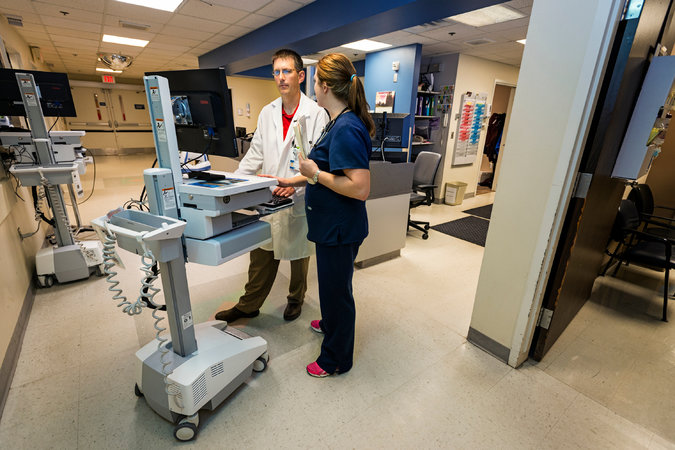
Dr. Jeffery O’Tool and Lizzie Wittrock, a registered nurse, use the electronic record system at UnityPoint Health-St. Luke’s Hospital in Sioux City, Iowa. The hospital’s 18-month old system still cannot be used to send records to another hospital two miles away. Credit Aaron C. Packard for The New York Times
As a practicing ear, nose and throat specialist in Ahoskie, N.C., Dr. Raghuvir B. Gelot says that little has frustrated him more than the digital record system he installed a few years ago.
The problem: His system, made by one company, cannot share patient records with the local medical center, which uses a program made by another company.
The two companies are quick to deny responsibility, each blaming the other.
Regardless of who is at fault, doctors and hospital executives across the country say they are distressed that the expensive electronic health record systems they installed in the hopes of reducing costs and improving the coordination of patient care — a major goal of the Affordable Care Act — simply do not share information with competing systems.
The issue is especially critical now as many hospitals and doctors scramble to install the latest versions of their digital record systems to demonstrate to regulators starting Wednesday that they can share some patient data. Those who cannot will face reductions in Medicare reimbursements down the road.

The Epic Systems headquarters in Verona, Wis. The company’s systems hold the health records of nearly half of all Americans. Credit Andy Manis for The New York Times
On top of that, leading companies in the industry are preparing to bid on a Defense Department contract valued at an estimated $11 billion. A primary requirement is that the winning vendor must be able to share information, allowing the department to digitally track the medical care of 9.6 million beneficiaries around the globe.
The contract is the latest boon to an industry that taxpayers have heavily subsidized in recent years with over $24 billion in incentive payments to help install electronic health records in hospitals and physicians’ offices.
While most providers have installed some kind of electronic record system, two recent studies have found that fewer than half of the nation’s hospitals can transmit a patient care document, while only 14 percent of physicians can exchange patient data with outside hospitals or other providers.
“We’ve spent half a million dollars on an electronic health record system about three years ago, and I’m faxing all day long. I can’t send anything electronically over it,” said Dr. William L. Rich III, a member of a nine-person ophthalmology practice in Northern Virginia and medical director of health policy for the American Academy of Ophthalmology.
Dr. Gelot, the ear, nose and throat specialist, uses a system made by Practice Fusion. His local medical center, Vidant Roanoke-Chowan Hospital, relies on a program built by Epic Systems.
There is no evidence that either company does a better or worse job of sharing information. But Epic and its enigmatic founder, Judith R. Faulkner, are being denounced by those who say its empire has been built with towering walls, delberately built not to share patient information with competing systems.
Almost 18 months after an Epic system was installed at UnityPoint Health-St. Luke’s hospital in Sioux City, Iowa, physicians there still cannot transmit a patient care document to doctors two miles south at Mercy Medical Center, which uses a system made by another major player in the field, the Cerner Corporation.
Where interconnectivity between systems does occur, it often happens with steep upfront connecting charges or recurring fees, creating what some see as a digital divide between large hospital systems that have money and technical personnel and small, rural hospitals or physician practices that are overwhelmed, financially and technologically.
The University of California Davis Health System has 22 specialists installing the technology so that doctors can share patient data between its Epic system and other internal systems, like the hemodynamic monitors in its critical care unit, or with some non-Epic systems outside the hospital.
“We’re a huge organization, so we can absorb those costs,” said Michael Minear, the chief information officer at the U.C. Davis Health System. “Small clinics and physician offices are going to have a harder time.”
Separately, through its maintenance contracts and other agreements, Epic charges a fee to send data to some non-Epic systems.
Epic is not alone in charging various fees, nor is there evidence that its fees are more expensive than its peers. But the barrier created by these types of charges “affects the small and rural providers much more significantly,” Morgan Honea, executive director of the Colorado Regional Health Information Organization, a public health information exchange, said in recent policy hearings in Washington.
While nearly all of the leading companies in this area have come under fire for their inability to easily share information, Epic faced some of the strongest attacks this summer.
A research report from the RAND Corporation described Epic as a “closed” platform that made it “challenging and costly for hospitals” to interconnect with the clinical or billing software of other companies. Shortly after, Representative Phil Gingrey, a Georgia Republican and a doctor, assailed the company in public hearings in Washington for the same shortfalls.
Executives at Epic rejected the criticism, labeling it as “vendors throwing smoke screens,” but for the first time, the company hired a Washington lobbying firm to improve its image.
Epic argues that its customers — some of the biggest hospitals in the country — share more records than any other. In interviews with nearly 200 providers for a study that will be released in early October, executives at the research firm Klas said Epic’s scores were “as good or better than most of the other vendors” in its ability to share information with other systems.
Moreover, at the request of Epic executives, several customers, including the Cedars-Sinai Health System in Los Angeles, the Yale New Haven Health System, and New York’s Mount Sinai Hospital, sent emails to The New York Times saying they were able to share records through Epic.
The office’s spokesman added that achieving interoperability “requires stakeholders to come together and agree on policy-related issues like who can access information and for what purpose.”
Dr. Gelot says he hopes interoperability comes sooner rather than later.
“The systems can’t communicate, and that becomes my problem because I cannot send what is required and I’m going to have a 1 percent penalty from Medicare,” Dr. Gelot said. “They’re asking me to do something I can’t control.”
Correction: October 3, 2014
An article on Wednesday about the difficulties faced by medical providers in sharing information through electronic health record systems described incorrectly the recipients of medical care through the Defense Department. There are 9.6 million beneficiaries, including retirees and dependents of military personnel; that number does not represent solely active-duty military personnel.
Article link: http://www.nytimes.com/2014/10/01/business/digital-medical-records-become-common-but-sharing-remains-challenging.html?_r=1
A version of this article appears in print on October 1, 2014, on page B1 of the New York edition with the headline: Doctors Hit a Snag in the Rush to Connect. Order Reprints|Today’s Paper|Subscribe
Recent Comments
Steve the Commoner
3 days ago
Our pediatric office installed electronic records in 2010 and have yet to receive a fraction of our Affordable Health Care reimbursements. …
James Igoe
3 days ago
Blame the medical profession in general; doctor’s have often set up proprietary systems.It was obvious from the beginning, that doctor’s…
SDK
3 days ago
I’ve read many of the regulations on Meaningful Use and they are incredibly detailed — describing exactly what IT providers who want to…
See All Comments
A sort of Microsoft of the Midwest, built on a sprawling campus on nearly 1,000 acres of farmland near Madison, Wis., the privately held Epic has emerged as a leader in the race to digitize patient medical records. Its systems hold the health records of nearly half the country.
Continue reading the main story Continue reading the main story
Continue reading the main story
The explosion in demand under the technology incentive plan has been a windfall for Epic. Ms. Faulkner is estimated to be worth $2.3 billion.
In a rare interview, Ms. Faulkner said the industry made great strides this year and noted that Epic’s customers were sending increasing numbers of records each month.
She and other company executives argued that the company was actually one of the first to create rules around sharing information and a platform to do so.
In 2005, when it became clear to her that the government was not prepared to create a set of rules around interoperability, Ms. Faulkner said, her team began writing the code for Care Everywhere. Initially seen as a health information exchange for its own customers, Care Everywhere today connects hospitals all over the country as well as to various public health agencies and registries.
“Let’s say a patient is coming from U.C.L.A. and going to the University of Chicago, an Epic-to-Epic hospital. Boom. That’s easy,” Ms. Faulkner said. “These are hospitals that have agreed to the Rules of the Road, a legal contract, that says the other organization is going to take good care of the data.”
Careful in her choice of words, Ms. Faulkner offered muted criticism of regulators for, essentially, failing to create what she did — a contract to help providers connect to one another and a way to authenticate that only the correct person could view the patient information.
“I’m not sure why the government doesn’t want to do some of the things that would be required for everybody to march together,” she said.
Regulators responded that interoperability was a “top priority” and that they recently set out a 10-year vision and agenda to achieve it, in an emailed statement from the Office of the National Coordinator for Health Information Technology.
Continue reading the main story
343
Comments
By Bob Brewin
October 3, 2014

Epic Systems, considered the front-runner for the Defense Department’s $11 billion electronic health record contract, has come under sustained criticism for lack of interoperability with other EHRs, including most recently a front-page story in The New York Times last Sunday.
The Times story reported the privately held Epic, which partnered with IBM for the defense EHR contract, “and its enigmatic founder, Judith R. Faulkner, are being denounced by those who say its empire has been built with towering walls, deliberately built not to share patient information with competing systems.”
Interoperability between Epic and other EHRs is possible, but only after hospitals pay high fees, the Times reported.
Modern Healthcare, in a recent article on Epic, said, “While interface fees are common across the EHR industry, some observers say Epic’s leading role in the EHR market means it has a disproportionate negative effect on interoperability.”
This March, in a report on a variety of medical technologies, the Rand Corporation described the Epic EHR as a “closed platform,” which “can make it challenging and costly for hospitals to interface their EHR with the clinical or billing software of other companies.”
Large Hospital Systems Embrace Epic
Large hospital systems, such as Kaiser Permanente, the second largest health care system in the country with 8.6 million patients – compared to 9.6 million in the military health system – have embraced Epic.
Rand said Epic has “established itself as the enterprisewide solution of choice for large private health care systems and academic medical centers, irrespective of ongoing concerns about its limited interoperability and less-than-ideal usability.”
As the biggest player in the market, Epic has derived huge benefits from the $24 billion of incentive payments paid out by the Centers for Medicare and Medicaid Services to clinician and hospitals that adopt EHRs, Rand said.
At a House Energy and Commerce Committee hearing July 17, Rep. Phil Gingrey, R-Ga, who’s also a doctor, noted the incentive payments were made to encourage interoperability.
He asked: “Is the government getting its money’s worth?… It may be time for the committee to take a closer look at the practices of vendor companies in this space, given the possibility that fraud may be perpetrated on the American taxpayer.”
Modern Healthcare reported Epic officials blame negative perceptions about the company and its software on misinformation spread by rivals.
Interoperability Key in Pentagon’s Planned EHR System
Interoperability is a key requirement for the new defense EHR system, which will replace the existing Armed Forces Health Longitudinal Technology Application outpatient EHR and the inpatient Essentris system. The new EHR needs to exchange data with Department of Veterans Affairs systems as well as with civilian clinicians and hospitals covered by the TRICARE insurance plan.
EPIC did not respond to a query from Nextgov on the interoperability of its system.
Andrew Maner, the leader of IBM’s federal services division, said in an email: “Epic is the most open solution by any measure. They have the highest-rated electronic health record suite with the most large-scale successful implementations in the U.S. and are securely transmitting billions of pieces of patient data through interfaces and open APIs.”
He said Epic’s health record exchange platform “also leads the nation, transmitting 5 million patient records a month between 295 Epic organizations and over 7,500 non-Epic organizations.”
(Image via kozirsky/Shutterstock.com)
By Bob Brewin
October 3, 2014

FOR IMMEDIATE RELEASE
October 1, 2014
VA Awards Contract for Independent Assessment of Health Care to Non-Profit Firm
Choice Act Requires Third Party Assessment of Processes; Firm Will Serve as Program Integrator
Washington – The Department of Veterans Affairs (VA) today announced that the MITRE Corporation, a not-for-profit company that operates multiple federally funded research and development centers, has been awarded a contract to support the Independent Assessment of VA health care processes, as required by the Veterans Access, Choice and Accountability Act of 2014 (“Choice Act”). MITRE Corporation will serve as program integrator.
Section 201 of the Choice Act directs VA to enter into one or more independent, third-party contracts for an assessment of the hospital care, medical services and other health care processes in VA medical facilities. The program integrator will be responsible for coordinating the outcomes of the assessments conducted by the third-party entities according to the scope of the contracts. The program integrator is required to report the independent assessment results to Congress within 60 days of the assessment’s conclusion.
“This independent assessment is a key element in our effort to rebuild trust with Veterans and our other stakeholders,” said Secretary of Veterans Affairs Robert A. McDonald. “It will provide the Department a way to transparently review our vital programs, organizations, and business practices to make us a better and more accountable VA for the Veterans we serve.”
Working with Congress, Veterans Service Organizations, and other stakeholders, VA has taken steps to implement Choice Act legislation, including:
•Establishing a Program Management office to oversee planning and implementation of the legislation across the Department.
•Putting in place the mechanisms to execute the outlined facilities with the authorization provided to carry out major medical facility leases.
•Working through the contracting process to extend the pilot program called Project ARCH to ensure the continued expanded access for Veterans in rural areas provided by that program.
•Holding Industry Day to seek input on how best to provide administrative support including issuing Veteran Choice Cards.
October 1, 2014
The ability to collect and analyze massive amounts of data is rapidly transforming science, industry and everyday life, but what we have seen so far is likely just the tip of the iceberg. Many of the benefits of “Big Data” have yet to surface because of a lack of interoperability, missing tools and hardware that is still evolving to meet the diverse needs of scientific communities.

This image and related research data–one of numerous projects being shared and stored using SeedMe–shows a simple model of a geodynamo used for benchmark codes. The view is from the center towards one of the poles, and the cones show convective flow towards higher temperature (light green to dark green with increasing velocity) in a spiraling form caused by rotation. The shells of various colors depict temperature, increasing from the outer boundary towards the interior.
Credit: Amit Chourasia, UC San Diego; Ashley Willis, University of Sheffield; Maggie Avery, UC San Diego; Chris Davies, UC San Diego/University of Leeds; Catherine Constable, UC San Diego; David Gubbins, University of Leeds.
One of the National Science Foundation’s (NSF) priority goals is to improve the nation’s capacity in data science by investing in the development of infrastructure, building multi-institutional partnerships to increase the number of U.S. data scientists and augmenting the usefulness and ease of using data.
As part of that effort, NSF today announced $31 million in new funding to support 17 innovative projects under the Data Infrastructure Building Blocks (DIBBs) program. Now in its second year, the 2014 DIBBs awards support research in 22 states and touch on research topics in computer science, information technology and nearly every field of science supported by NSF.
“Developed through extensive community input and vetting, NSF has an ambitious vision and strategy for advancing scientific discovery through data,” said Irene Qualters, division director for Advanced Cyberinfrastructure at NSF. “This vision requires a collaborative national data infrastructure that is aligned to research priorities and that is efficient, highly interoperable and anticipates emerging data policies.”
This year’s data cyberinfrastructure awards build capacity and capability across the nation and across research communities and complement previous awards.
“Each project tests a critical component in a future data ecosystem in conjunction with a research community of users,” Qualters said. “This assures that solutions will be applied and use-inspired.”
NSF sees these building blocks as digital components that can be joined together to develop the foundations for a robust data infrastructure. The building blocks encompass hardware, software and networking tools, as well as the communities and people who manage data and who are the practitioners of data science.
Of the 17 awards, two support early implementations of research projects that are more mature; the others support pilot demonstrations. Each is a partnership between researchers in computer science and other science domains.
One of the two early implementation grants will support a research team led by Geoffrey Fox, a professor of computer science and informatics at Indiana University. Fox’s team plans to create middleware and analytics libraries to allow data science to work at large scale on high-performance computing systems (also known as supercomputers).
Fox and his interdisciplinary team plan to test their platform with several different applications, including those used in geospatial information systems (GIS), biomedicine, epidemiology and remote sensing.
“Our innovative architecture integrates key features of open source cloud computing software with supercomputing technology,” Fox said. “And our outreach involves ‘data analytics as a service’ with training and curricula set up in a Massive Open Online Course or MOOC.”
Other institutions collaborating on the project include: Arizona State University, Emory University, Rutgers University, University of Kansas, University of Utah and Virginia Tech.
The other early implementation project is led by Ken Koedinger, professor of human computer interaction and psychology at Carnegie Mellon University. Whereas Fox’s team focuses on problems in sensing and the life sciences, Koedinger’s team concentrates on developing infrastructure that will drive innovation in education.
The team will develop a distributed data infrastructure called LearnSphere that will make more educational data accessible to course developers, while also motivating more researchers and companies to share their data with the greater learning sciences community. LearnSphere will include a graphical user interface, a library of analytical methods and a wide variety of educational data gathered from such sources as interactive tutoring systems, educational games and MOOCs.
“We’ve seen the power that data has to improve performance in many fields, from medicine to movie recommendations,” Koedinger said. “Educational data holds the same potential to guide the development of courses that enhance learning while also generating even more data to give us a deeper understanding of the learning process.”
Other institutions collaborating on this project include: MIT, Stanford University and the University of Memphis.
The DIBBs program awarded each early implementation project $5 million over 5 years.
The second group of awards supports pilot demonstrations that build upon the advanced cyberinfrastructure capabilities of existing research communities to address specific challenges in science and engineering research and extend those data capabilities to meet broad community needs. The awards provide $1.5 million over 3 years.
Among the projects supported by DIBBs awards are efforts to develop cyberinfrastructure to visualize geo-chronological data, like uranium dating of corals (College of Charleston); data capture and curation for materials science research (University of Illinois Urbana-Champaign); and efforts to manage data emerging from the Laser Interferometer Gravitational-wave Observatory or LIGO (Syracuse University).
The DIBBs program is part of a coordinated strategy within NSF to advance data-driven cyberinfrastructure. It complements other major efforts including the DataOne project, the Research Data Alliance and Wrangler, a groundbreaking data analysis and management system for the national open science community.
2014 NSF DIBBs Awards
Geoffrey Fox, Indiana University: Middleware and High Performance Analytics Libraries for Scalable Data Science
Ken Koedinger, Carnegie Mellon University: Building a Scalable Infrastructure for Data-Driven Discovery and Innovation in Education
Victor Pankratius, MIT: An Infrastructure for Computer Aided Discovery in Geoscience
Klara Nahrstedt, University of Illinois at Urbana-Champaign: Timely and Trusted Curator and Coordinator Data Building Blocks
Jerome Reiter, Duke University: An Integrated System for Public/Private Access to Large-scale, Confidential Social Science Data
Hsinchun Chen, University of Arizona: DIBBs for Intelligence and Security Informatics Research and Community
Santiago Pujol, Purdue University: Building a Modular Cyber-Platform for Systematic Collection, Curation, and Preservation of Large Engineering and Science Data–A Pilot Demonstration Project
James Bowring, College of Charleston: Collaborative Research: Cyberinfrastructure for Interpreting and Archiving U-series Geochronologic Data
Stephen Ficklin, Washington State University: Tripal Gateway, a platform for next-generation data analysis and sharing
Feifei Li, University of Utah: STORM: Spatio-Temporal Online Reasoning and Management of Large Data
Duncan Brown, Syracuse University: Domain-aware management of heterogeneous workflows: Active data management for gravitational-wave science workflows
Rafal Angryk, Georgia State University Research Foundation, Inc.: Systematic Data-Driven Analysis and Tools for Spatiotemporal Solar Astronomy Data
Jia Zhang, Carnegie Mellon University: An Infrastructure Supporting Collaborative Data Analytics Workflow Design and Management
Giridhar Manepalli, Corporation for National Research Initiatives (CNRI): User Driven Architecture for Data Discovery
Shaowen Wang, University of Illinois at Urbana-Champaign: Scalable Capabilities for Spatial Data Synthesis
Amit Chourasia, University of California, San Diego: Ubiquitous Access to Transient Data and Preliminary Results via the SeedMe Platform
Christopher Jenkins, University of Colorado at Boulder: Porting Practical NLP and ML Semantics from Biomedicine to the Earth, Ice and Life Sciences
-NSF-
Media Contacts
Aaron Dubrow, NSF, (703) 292-4489, adubrow@nsf.gov
Program Contacts
Irene Qualters, NSF, (703) 292-2339, iqualter@nsf.gov
Related Websites
Data Infrastructure Building Blocks: http://www.nsf.gov/funding/pgm_summ.jsp?pims_id=504776
The National Science Foundation (NSF) is an independent federal agency that supports fundamental research and education across all fields of science and engineering. In fiscal year (FY) 2014, its budget is $7.2 billion. NSF funds reach all 50 states through grants to nearly 2,000 colleges, universities and other institutions. Each year, NSF receives about 50,000 competitive requests for funding, and makes about 11,500 new funding awards. NSF also awards about $593 million in professional and service contracts yearly.
Article link: http://www.nsf.gov/news/news_summ.jsp?org=NSF&cntn_id=132880&preview=false
Get News Updates by Email
Useful NSF Web Sites:
NSF Home Page: http://www.nsf.gov
NSF News: http://www.nsf.gov/news/
For the News Media: http://www.nsf.gov/news/newsroom.jsp
Science and Engineering Statistics: http://www.nsf.gov/statistics/
Awards Searches: http://www.nsf.gov/awardsearch/
William H. McMichael, The News Journal 8:50 p.m. EDT October 3, 2014
PEMBERTON, NEW JERSEY – The problems continue at the Philadelphia Veterans Affairs benefits office despite scathing congressional testimony more than two months ago about mail and records manipulation, the woman who blew the whistle on the problems told members of the House VA committee Friday.
I “regret to tell you that things have not changed, and that accountability is greatly lacking for the management officials involved,” said Kristin Ruell, a quality services representative in the Pension Management Center at the Philadelphia Regional Office, which manages the Wilmington benefits office near Elsmere. “The practices of data manipulation have continued at the Philadelphia RO.”
“We do understand the … seriousness of the concerns about the operation in Philadelphia that have been raised,” responded Diana Rubens, regional office director since Aug. 26. “And I want to assure you, we share those concerns, and we’re quickly taking action to address those issues.”
The Veterans Benefits Administration, separate from VA’s medical side, processes disability compensation and pensions claims and provides other services.
The Wilmington office, dwarfed in size by the Philadelphia office it falls under, wasn’t mentioned during the hearing. Wilmington, however, has sent disability compensation claims to Philadelphia since at least fiscal year 2011 – the same year in which “boxes” of claims sent to Philadelphia were found unprocessed and piled up, said Ruell, who first described the problem on Capitol Hill on July 14.
That means some of the Wilmington cases – at least 10 disability compensation claims from fiscal years 2011 and 2012 and about 300 pending appeals in fiscal 2013 – could be in that same sort of limbo, Ruell said.
“Any case that comes in our building, I notice the same issues, regardless of where it’s from,” Ruell said in an interview following the field hearing, held at the campus of Burlington County College in Pemberton, New Jersey, an area rich with vets served by the Philadelphia office.
“I see problems across the board,” said Ruell, who began working for VA in August 2007. “These issues happen because employees are rushed, and they’re forced to meet a production standard at the end of the day. So sometimes, it’s not about going the extra mile for the veteran, because they won’t have a job if they fail their standards.”
The claims traveled in the opposite direction as well; 512 cases were “brokered” from Philadelphia to Wilmington in fiscal year 2013. The transfers to and fro, which became a major issue in 2013 when VA started getting roundly criticized for its large claims backlog, did not go unnoticed by disability compensation claims workers.
“It seems like it was kind of like a shell game, where they’re just shifting these cases from Philly to Delaware – and then saying, look, we’re making progress,” said Christian Dejohn, a claims handler in Philadelphia’s Veterans Service Center. “We think that a lot of people in the Philly office are aware that was going on. Of course, we were very disappointed.”
“It’s shuffling,” said Ryan Cease, like DeJohn an Army vet and a veterans service representative in the service center’s appeals department who, along with DeJohn, has cooperated with congressional investigators. “It’s basically shuffling.”
The hearing, before Reps. Jon Runyan, R-New Jersey, and Dina Titus, D-Nevada, was to hear “additional concerns” beyond those raised last summer, when Ruell told the full committee she been made aware of improper shredding of military mail, data manipulation and beneficiaries receiving improper benefits payments – and has been subjected to four years of retaliatory harassment as a result.
The data manipulation issue stemmed from a directive, since rescinded, that, misapplied, allowed staffers to give unadjudicated claims a more current data – a “discovered date.”
“A memo was used to minimize the average dates pending of the claim to make the regional office’s number look better,” Ruell told the committee in July.
VA’s inspector general substantiated those concerns during an unannounced visit in June. Its investigation continues, said Linda Halliday, the IG’s assistant inspector general for audits and evaluations.
Runyan expressed particular concern over the IG’s identification of several instances of duplicative pension payments – the result of duplicate records in the center’s electronic system. “If neither workload management nor fiscal stewardship are priorities, what do you see as the priority there?” he asked Halliday.
“I believe what is driving this is to meet production metrics at the expense of making the right decisions and processing the veteran’s claim according to how it should be processed,” Halliday replied.
In other words, DeJohn and Cease said and as Ruell indicated, production goals processors are expected to meet.
“The point system is a real problem,” DeJohn said. “The VA point system.”
“The point system basically evaluates your productivity,” Cease said. “It also covers your accuracy. So for a person to say you have a productive day based on how many points you did per day, a lot of people would cherry-pick and say, well, I’m going to pick the easy work, put aside the hard work, and just gain points.”
An “easy” claim, he said, would be one with fewer individual medical conditions.
DeJohn said he was fired in 2012 for “alleged low numbers,” winning his job back after 1½ years.
The system, the two claims workers said, remains in place – as do the repercussions felt by those speaking out. This, in spite of new VA Secretary Robert McDonald’s promise to protect them.
DeJohn said he’s received death threats. Ruell has felt more subtle retaliation.
“They’re very creative in the things that they do to employees,” she said after the hearing. “They make it look like it’s a legitimate, legal thing, but … I never feel like I’m wanted in that building. I’ve never felt appreciated for anything I’ve brought forward. I basically show up because people rely on me to do the right thing and help report things.
“That’s why I come back,” she said. “I would never choose this job again, if it wasn’t for helping veterans.”
IG spokeswoman Cathy Gromek said to look for the IG’s final report on the Philadelphia regional office in late November or early December.
Contact William H. McMichael at (302) 324-2812 or bmcmichael@delawareonline.com. On Twitter: @billmcmichael

 healthcarereimagined