healthcarereimagined

Envisioning healthcare for the 21st century

  • About
  • Economics

AI is reinventing hiring — with the same old biases. Here’s how to avoid that trap – MIT Sloan

Posted by timmreardon on 03/08/2026
Posted in: Uncategorized.

byEmilio J. Castilla

Dec 15, 2025

In this opinion piece, MIT Sloan professor Emilio J. Castilla argues that:

  • Algorithms promise objectivity, but in hiring, they’re learning human biases all too well.
  • Until we build fairer systems for defining and rewarding talent, algorithms will simply mirror the inequities and unfairness we have yet to correct.
  • The AI hiring revolution doesn’t have to be a story of automated bias. Asking tough questions before automating recruitment and selection can lead to fairer systems.

In my MIT Sloan classroom, I often ask executives and MBAs, “Who here believes AI can eliminate bias and unfairness in hiring?” Most hands go up. Then I show them the data, and their optimism fades.

One example: Amazon was forced to scrap its AI-driven recruitment tool after discovering that it penalized resumes containing the word “women” — as in “women’s chess club captain” or “women’s college.”

Another case: HireVue’s speech recognition algorithms, used by more than 700 companies, including Goldman Sachs and Unilever, were designed to assess candidates’ proficiency in speaking English. But research found that those algorithms disadvantaged non-white and deaf applicants.

Those are not isolated events; they are warnings — especially considering that the market for AI screening tools in hiring is projected to surpass $1 billion by 2027, with an estimated 87% of companies already having deployed these systems. 

The appeal is clear: faster screening, lower costs, and the promise of bias-free hiring decisions. But the reality is more complex — and far more troubling.

The problem: Bad data in

AI tools don’t operate in a vacuum. They learn from existing data — which can be incomplete, poorly coded, or shaped by decades of exclusion and inequality. Feed this data into a machine, and the results aren’t fair. They represent bias and inefficiency at scale.

Some AI tools have downgraded resumes from graduates of historically Black colleges and women’s colleges because those schools haven’t traditionally fed into white-collar pipelines. Others have penalized candidates with gaps in employment, disadvantaging parents — especially mothers — who paused their careers for caregiving. What appears to be an objective evaluation is really a rerun of old prejudices, stereotypes, and other hiring mistakes, now stamped with the authority of data science.

Beware the “aura of neutrality”

This is the paradox of algorithmic meritocracy. Train an AI system on past hiring decisions — who passed the first screening, who got an interview, who was hired, and who was promoted — and it won’t necessarily learn fairness. But it will learn patterns that were likely shaped by flawed human assumptions.

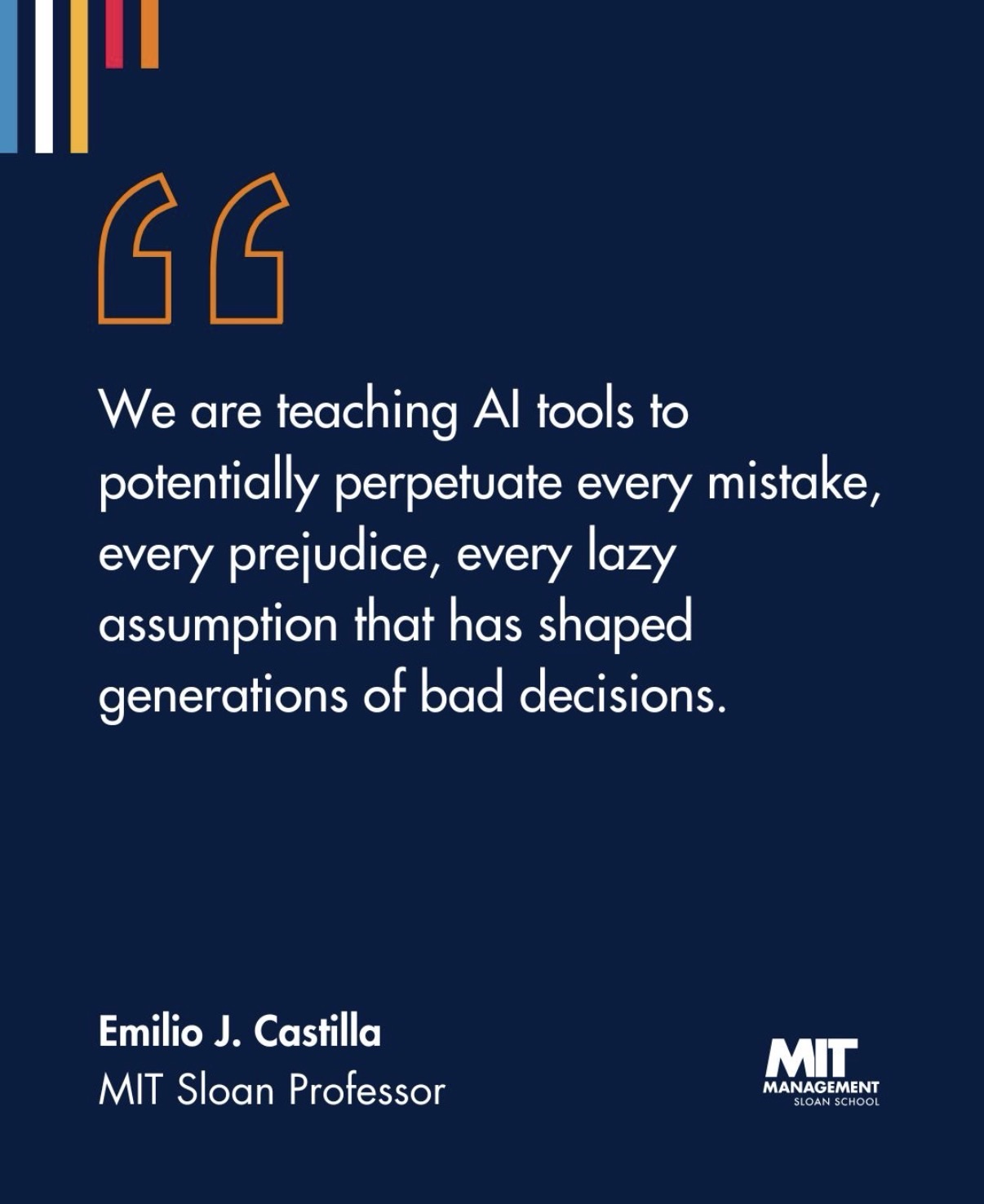
And because these systems are marketed as “data-driven,” their decisions are harder to challenge. A manager’s judgment can be questioned; an algorithm’s ranking arrives with an aura of neutrality. We are teaching AI tools to potentially perpetuate every mistake, every prejudice, every lazy assumption that has shaped generations of bad decisions.

First, check your assumptions

In my 2025 book, “The Meritocracy Paradox,” I argue that organizations invoking meritocracy without addressing structural challenges risk deepening the very gaps they seek to close. The same holds true for AI. Before we let AI automate hiring decisions, we need to carefully examine the data and the assumptions being encoded into these systems.

That means asking tough questions before automating candidate recruitment and selection: What data are we encoding? What processes are these algorithms built on, and are they still relevant to our organization’s needs? Who defines merit? Whose career paths are rewarded — or ignored?

AI won’t fix the problem of bias and inefficiency in hiring, because the problem isn’t technological. It’s human. Until we build fairer systems for defining and rewarding talent, algorithms will simply mirror the inequities and unfairness we have yet to correct.

AI as a turning point

The AI hiring revolution doesn’t have to be a story of automated bias or unfairness. It can be a turning point — a chance to reset how organizations define, measure, and reward talent, with the promise of employment opportunities for all. But that requires humility about what algorithms can — and cannot — do. Instead of using AI to avoid hard questions, we should use it to expose where our assumptions fall short and to locate and target issues in our talent management strategies.

That means engaging in continuous monitoring to catch inequities and inefficiencies, not executing one-time fixes. If we fail to confront these issues, the promise of “bias-free” AI will remain just that — a promise. And yesterday’s biases and stereotypes will quietly shape tomorrow’s workforce — one resume at a time.

Emilio J. Castillais a professor of work and organization studies at MIT Sloan, co-director of the MIT Institute for Work and Employment Research, and author of “The Meritocracy Paradox: Where Talent Management Strategies Go Wrong and How to Fix Them” (Columbia University Press, 2025). Castilla’s research focuses on the organizational and social aspects of work and employment, with an emphasis on recruitment, hiring, development, and career management, as well as on the impact of teamwork and social relations on organizational performance and innovation. Recent work includes the role of worker voice in successful AI implementations and an examination of the effect of gendered language in job postings.

Article link: https://mitsloan.mit.edu/ideas-made-to-matter/ai-reinventing-hiring-same-old-biases-heres-how-to-avoid-trap?

Share this:

  • Share on X (Opens in new window) X
  • Share on Facebook (Opens in new window) Facebook
  • Share on LinkedIn (Opens in new window) LinkedIn
Like Loading...

Related

Posts navigation

← Fiscal Year 2025 Year In Review – PEO DHMS
  • Search site

  • Follow healthcarereimagined on WordPress.com
  • Recent Posts

    • AI is reinventing hiring — with the same old biases. Here’s how to avoid that trap – MIT Sloan 03/08/2026
    • Fiscal Year 2025 Year In Review – PEO DHMS 02/26/2026
    • “𝗦𝗼𝗰𝗶𝗮𝗹 𝗠𝗲𝗱𝗶𝗮 𝗠𝗮𝗻𝗶𝗽𝘂𝗹𝗮𝘁𝗶𝗼𝗻 𝗳𝗼𝗿 𝗦𝗮𝗹𝗲” – NATO Strategic Communications COE 02/26/2026
    • Claude Can Now Do 40 Hours of Work in Minutes. Anthropic Says Its Safety Systems Can’t Keep Up – AJ Green 02/19/2026
    • Agentic AI, explained – MIT Sloan 02/18/2026
    • Anthropic’s head of AI safety Mrinank Sharma resigns, says ‘world is in peril’ in resignation letter 02/10/2026
    • Moltbook was peak AI theater 02/09/2026
    • WHAT A QUBIT IS AND WHAT IT IS NOT. 01/25/2026
    • Governance Before Crisis We still have time to get this right. 01/21/2026
    • On the Eve of Davos: We’re Just Arguing About the Wrong Thing 01/18/2026
  • Categories

    • Accountable Care Organizations
    • ACOs
    • AHRQ
    • American Board of Internal Medicine
    • Big Data
    • Blue Button
    • Board Certification
    • Cancer Treatment
    • Data Science
    • Digital Services Playbook
    • DoD
    • EHR Interoperability
    • EHR Usability
    • Emergency Medicine
    • FDA
    • FDASIA
    • GAO Reports
    • Genetic Data
    • Genetic Research
    • Genomic Data
    • Global Standards
    • Health Care Costs
    • Health Care Economics
    • Health IT adoption
    • Health Outcomes
    • Healthcare Delivery
    • Healthcare Informatics
    • Healthcare Outcomes
    • Healthcare Security
    • Helathcare Delivery
    • HHS
    • HIPAA
    • ICD-10
    • Innovation
    • Integrated Electronic Health Records
    • IT Acquisition
    • JASONS
    • Lab Report Access
    • Military Health System Reform
    • Mobile Health
    • Mobile Healthcare
    • National Health IT System
    • NSF
    • ONC Reports to Congress
    • Oncology
    • Open Data
    • Patient Centered Medical Home
    • Patient Portals
    • PCMH
    • Precision Medicine
    • Primary Care
    • Public Health
    • Quadruple Aim
    • Quality Measures
    • Rehab Medicine
    • TechFAR Handbook
    • Triple Aim
    • U.S. Air Force Medicine
    • U.S. Army
    • U.S. Army Medicine
    • U.S. Navy Medicine
    • U.S. Surgeon General
    • Uncategorized
    • Value-based Care
    • Veterans Affairs
    • Warrior Transistion Units
    • XPRIZE
  • Archives

    • March 2026 (1)
    • February 2026 (6)
    • January 2026 (8)
    • December 2025 (11)
    • November 2025 (9)
    • October 2025 (10)
    • September 2025 (4)
    • August 2025 (7)
    • July 2025 (2)
    • June 2025 (9)
    • May 2025 (4)
    • April 2025 (11)
    • March 2025 (11)
    • February 2025 (10)
    • January 2025 (12)
    • December 2024 (12)
    • November 2024 (7)
    • October 2024 (5)
    • September 2024 (9)
    • August 2024 (10)
    • July 2024 (13)
    • June 2024 (18)
    • May 2024 (10)
    • April 2024 (19)
    • March 2024 (35)
    • February 2024 (23)
    • January 2024 (16)
    • December 2023 (22)
    • November 2023 (38)
    • October 2023 (24)
    • September 2023 (24)
    • August 2023 (34)
    • July 2023 (33)
    • June 2023 (30)
    • May 2023 (35)
    • April 2023 (30)
    • March 2023 (30)
    • February 2023 (15)
    • January 2023 (17)
    • December 2022 (10)
    • November 2022 (7)
    • October 2022 (22)
    • September 2022 (16)
    • August 2022 (33)
    • July 2022 (28)
    • June 2022 (42)
    • May 2022 (53)
    • April 2022 (35)
    • March 2022 (37)
    • February 2022 (21)
    • January 2022 (28)
    • December 2021 (23)
    • November 2021 (12)
    • October 2021 (10)
    • September 2021 (4)
    • August 2021 (4)
    • July 2021 (4)
    • May 2021 (3)
    • April 2021 (1)
    • March 2021 (2)
    • February 2021 (1)
    • January 2021 (4)
    • December 2020 (7)
    • November 2020 (2)
    • October 2020 (4)
    • September 2020 (7)
    • August 2020 (11)
    • July 2020 (3)
    • June 2020 (5)
    • April 2020 (3)
    • March 2020 (1)
    • February 2020 (1)
    • January 2020 (2)
    • December 2019 (2)
    • November 2019 (1)
    • September 2019 (4)
    • August 2019 (3)
    • July 2019 (5)
    • June 2019 (10)
    • May 2019 (8)
    • April 2019 (6)
    • March 2019 (7)
    • February 2019 (17)
    • January 2019 (14)
    • December 2018 (10)
    • November 2018 (20)
    • October 2018 (14)
    • September 2018 (27)
    • August 2018 (19)
    • July 2018 (16)
    • June 2018 (18)
    • May 2018 (28)
    • April 2018 (3)
    • March 2018 (11)
    • February 2018 (5)
    • January 2018 (10)
    • December 2017 (20)
    • November 2017 (30)
    • October 2017 (33)
    • September 2017 (11)
    • August 2017 (13)
    • July 2017 (9)
    • June 2017 (8)
    • May 2017 (9)
    • April 2017 (4)
    • March 2017 (12)
    • December 2016 (3)
    • September 2016 (4)
    • August 2016 (1)
    • July 2016 (7)
    • June 2016 (7)
    • April 2016 (4)
    • March 2016 (7)
    • February 2016 (1)
    • January 2016 (3)
    • November 2015 (3)
    • October 2015 (2)
    • September 2015 (9)
    • August 2015 (6)
    • June 2015 (5)
    • May 2015 (6)
    • April 2015 (3)
    • March 2015 (16)
    • February 2015 (10)
    • January 2015 (16)
    • December 2014 (9)
    • November 2014 (7)
    • October 2014 (21)
    • September 2014 (8)
    • August 2014 (9)
    • July 2014 (7)
    • June 2014 (5)
    • May 2014 (8)
    • April 2014 (19)
    • March 2014 (8)
    • February 2014 (9)
    • January 2014 (31)
    • December 2013 (23)
    • November 2013 (48)
    • October 2013 (25)
  • Tags

    Business Defense Department Department of Veterans Affairs EHealth EHR Electronic health record Food and Drug Administration Health Health informatics Health Information Exchange Health information technology Health system HIE Hospital IBM Mayo Clinic Medicare Medicine Military Health System Patient Patient portal Patient Protection and Affordable Care Act United States United States Department of Defense United States Department of Veterans Affairs
  • Upcoming Events

Blog at WordPress.com.
  • Reblog
  • Subscribe Subscribed
    • healthcarereimagined
    • Join 153 other subscribers
    • Already have a WordPress.com account? Log in now.
    • healthcarereimagined
    • Subscribe Subscribed
    • Sign up
    • Log in
    • Copy shortlink
    • Report this content
    • View post in Reader
    • Manage subscriptions
    • Collapse this bar
 

Loading Comments...
 

    %d