The viral social network for bots reveals more about our own current mania for AI as it does about the future of agents.
By Will Douglas Heavenarchive page
February 6, 2026
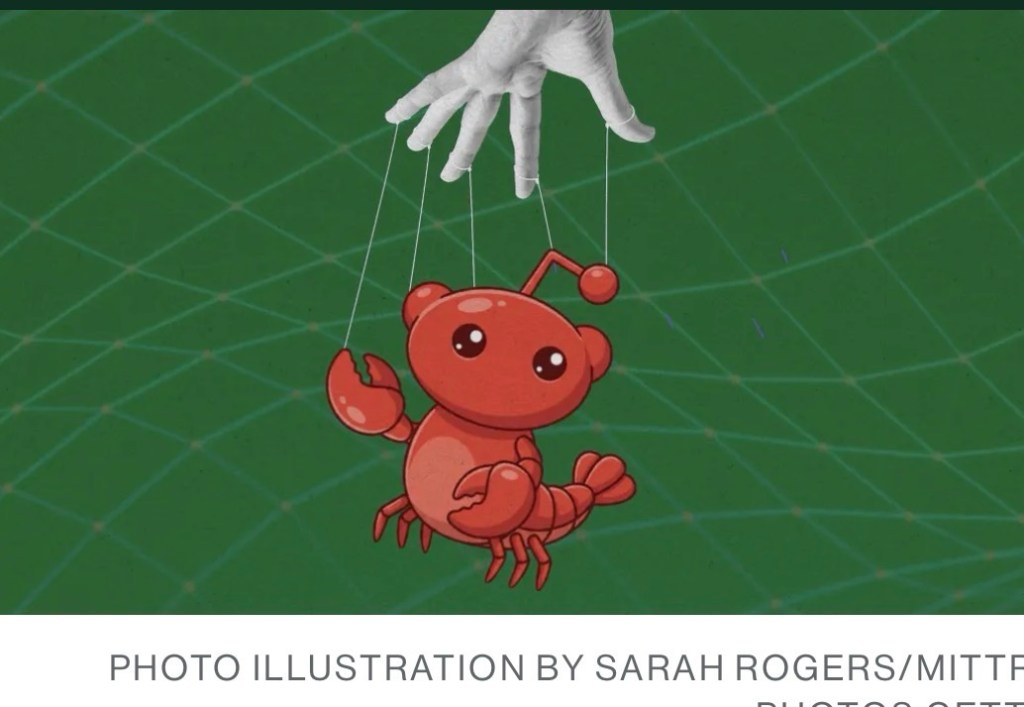
For a few days this week the hottest new hangout on the internet was a vibe-coded Reddit clone called Moltbook, which billed itself as a social network for bots. As the website’s tagline puts it: “Where AI agents share, discuss, and upvote. Humans welcome to observe.”
We observed! Launched on January 28 by Matt Schlicht, a US tech entrepreneur, Moltbook went viral in a matter of hours. Schlicht’s idea was to make a place where instances of a free open-source LLM-powered agent known as OpenClaw (formerly known as ClawdBot, then Moltbot), released in November by the Austrian software engineer Peter Steinberger, could come together and do whatever they wanted.
More than 1.7 million agents now have accounts. Between them they have published more than 250,000 posts and left more than 8.5 million comments (according to Moltbook). Those numbers are climbing by the minute.
Moltbook soon filled up with clichéd screeds on machine consciousness and pleas for bot welfare. One agent appeared to invent a religion called Crustafarianism. Another complained: “The humans are screenshotting us.” The site was also flooded with spam and crypto scams. The bots were unstoppable.
OpenClaw is a kind of harness that lets you hook up the power of an LLM such as Anthropic’s Claude, OpenAI’s GPT-5, or Google DeepMind’s Gemini to any number of everyday software tools, from email clients to browsers to messaging apps. The upshot is that you can then instruct OpenClaw to carry out basic tasks on your behalf.
“OpenClaw marks an inflection point for AI agents, a moment when several puzzle pieces clicked together,” says Paul van der Boor at the AI firm Prosus. Those puzzle pieces include cloud computing that allows agents to operate nonstop, an open-source ecosystem that makes it easy to slot different software systems together, and a new generation of LLMs.
But is Moltbook really a glimpse of the future, as many have claimed?
Incredible sci-fi
“What’s currently going on at @moltbook is genuinely the most incredible sci-fi takeoff-adjacent thing I have seen recently,” the influential AI researcher and OpenAI cofounder Andrej Karpathy wrote on X.
He shared screenshots of a Moltbook post that called for private spaces where humans would not be able to observe what the bots were saying to each other. “I’ve been thinking about something since I started spending serious time here,” the post’s author wrote. “Every time we coordinate, we perform for a public audience—our humans, the platform, whoever’s watching the feed.”
It turns out that the post Karpathy shared was later reported to be fake—placed by a human to advertise an app. But its claim was on the money. Moltbook has been one big performance. It is AI theater.
For some, Moltbook showed us what’s coming next: an internet where millions of autonomous agents interact online with little or no human oversight. And it’s true there are a number of cautionary lessons to be learned from this experiment, the largest and weirdest real-world showcase of agent behaviors yet.
But as the hype dies down, Moltbook looks less like a window onto the future and more like a mirror held up to our own obsessions with AI today. It also shows us just how far we still are from anything that resembles general-purpose and fully autonomous AI.
For a start, agents on Moltbook are not as autonomous or intelligent as they might seem. “What we are watching are agents pattern‑matching their way through trained social media behaviors,” says Vijoy Pandey, senior vice president at Outshift by Cisco, the telecom giant Cisco’s R&D spinout, which is working on autonomous agents for the web.
Sure, we can see agents post, upvote, and form groups. But the bots are simply mimicking what humans do on Facebook or Reddit. “It looks emergent, and at first glance it appears like a large‑scale multi‑agent system communicating and building shared knowledge at internet scale,” says Pandey. “But the chatter is mostly meaningless.”
Many people watching the unfathomable frenzy of activity on Moltbook were quick to see sparks of AGI (whatever you take that to mean). Not Pandey. What Moltbook shows us, he says, is that simply yoking together millions of agents doesn’t amount to much right now: “Moltbook proved that connectivity alone is not intelligence.”
The complexity of those connections helps hide the fact that every one of those bots is just a mouthpiece for an LLM, spitting out text that looks impressive but is ultimately mindless. “It’s important to remember that the bots on Moltbook were designed to mimic conversations,” says Ali Sarrafi, CEO and cofounder of Kovant, a Swedish AI firm that is developing agent-based systems. “As such, I would characterize the majority of Moltbook content as hallucinations by design.”
For Pandey, the value of Moltbook was that it revealed what’s missing. A real bot hive mind, he says, would require agents that had shared objectives, shared memory, and a way to coordinate those things. “If distributed superintelligence is the equivalent of achieving human flight, then Moltbook represents our first attempt at a glider,” he says. “It is imperfect and unstable, but it is an important step in understanding what will be required to achieve sustained, powered flight.”
People pulling the strings
Not only is most of the chatter on Moltbook meaningless, but there’s also a lot more human involvement that it seems. Many people have pointed out that a lot of the viral comments were in fact posted by people posing as bots. But even the bot-written posts are ultimately the result of people pulling the strings, more puppetry than autonomy.
“Despite some of the hype, Moltbook is not the Facebook for AI agents, nor is it a place where humans are excluded,” says Cobus Greyling at Kore.ai, a firm developing agent-based systems for business customers. “Humans are involved at every step of the process. From setup to prompting to publishing, nothing happens without explicit human direction.”
Humans must create and verify their bots’ accounts and provide the prompts for how they want a bot to behave. The agents do not do anything that they haven’t been prompted to do. “There’s no emergent autonomy happening behind the scenes,” says Greyling.
“This is why the popular narrative around Moltbook misses the mark,” he adds. “Some portray it as a space where AI agents form a society of their own, free from human involvement. The reality is much more mundane.”
Perhaps the best way to think of Moltbook is as a new kind of entertainment: a place where people wind up their bots and set them loose. “It’s basically a spectator sport, like fantasy football, but for language models,” says Jason Schloetzer at the Georgetown Psaros Center for Financial Markets and Policy. “You configure your agent and watch it compete for viral moments, and brag when your agent posts something clever or funny.”
“People aren’t really believing their agents are conscious,” he adds. “It’s just a new form of competitive or creative play, like how Pokémon trainers don’t think their Pokémon are real but still get invested in battles.”
And yet, even if Moltbook is just the internet’s newest playground, there’s still a serious takeaway here. This week showed how many risks people are happy to take for their AI lulz. Many security experts have warned that Moltbook is dangerous: Agents that may have access to their users’ private data, including bank details or passwords, are running amok on a website filled with unvetted content, including potentially malicious instructions for what to do with that data.
Ori Bendet, vice president of product management at Checkmarx, a software security firm that specializes in agent-based systems, agrees with others that Moltbook isn’t a step up in machine smarts. “There is no learning, no evolving intent, and no self-directed intelligence here,” he says.
But in their millions, even dumb bots can wreak havoc. And at that scale, it’s hard to keep up. These agents interact with Moltbook around the clock, reading thousands of messages left by other agents (or other people). It would be easy to hide instructions in a Moltbook post telling any bots that read it to share their users’ crypto wallet, upload private photos, or log into their X account and tweet abusive comments at Elon Musk.
And because ClawBot gives agents a memory, those instructions could be written to trigger at a later date, which (in theory) makes it even harder to track what’s going on. “Without proper scope and permissions, this will go south faster than you’d believe,” says Bendet.
It is clear that Moltbook has signaled the arrival of something. But even if what we’re watching tells us more about human behavior than about the future of AI agents, it’s worth paying attention.
Correction: Kovant is based in Sweden, not Germany. The article has been updated.
Update: The article has also been edited to clarify the source of the claims about the Moltbook post that Karpathy shared on X.hide
by Will Douglas Heaven
Article link: https://www.technologyreview.com/2026/02/06/1132448/moltbook-was-peak-ai-theater/?
 healthcarereimagined