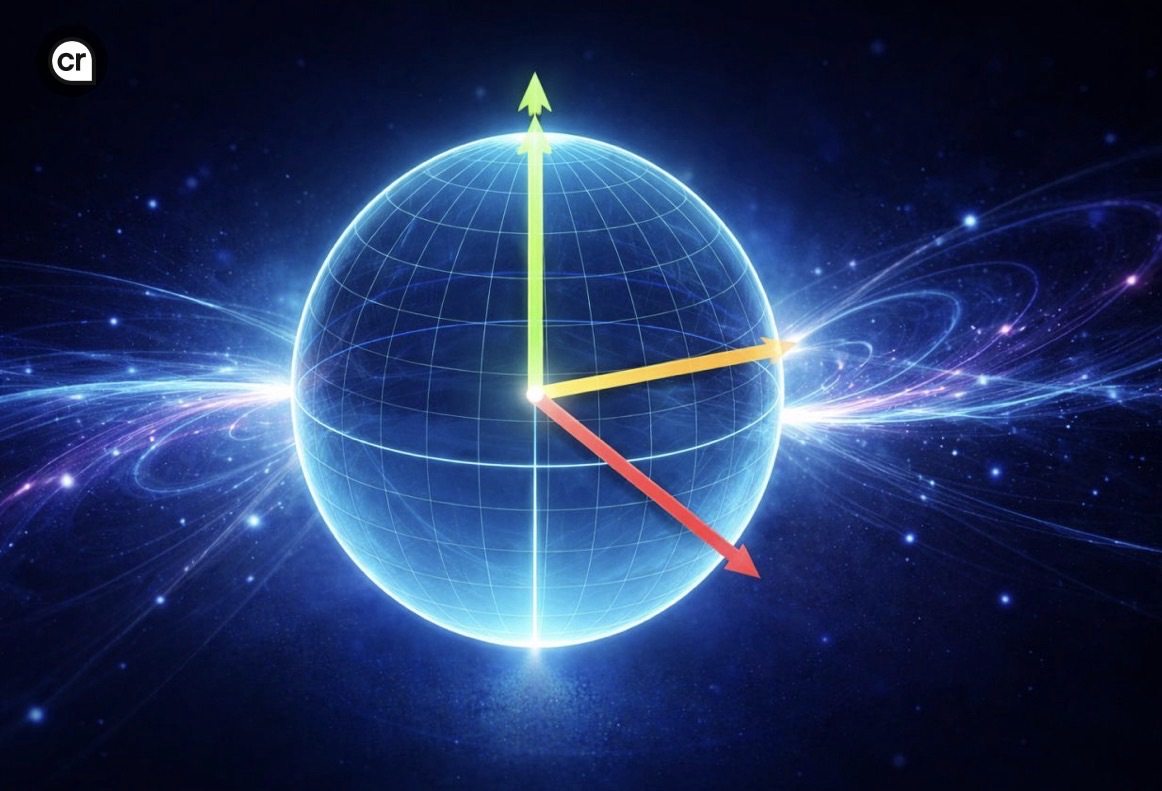
Does a qubit “hold” anything?
A qubit does not hold information the way a classical bit does.
A classical bit stores one stable, readable state: 0 or 1. You can copy it, inspect it, fan it out, cache it, and reuse it.
A qubit “holds”:
- A quantum state described by two complex amplitudes.
- That state is not directly accessible.
- The moment you try to read it, it collapses.
- After measurement, you get one classical bit, full stop.
There is no hidden warehouse of answers inside a qubit. There is no extractable parallel data. The Bloch sphere is a mathematical description, not storage capacity.
So yes, we know what a qubit contains: a fragile probability amplitude, not usable information.
Is that state useful?
Only in a very narrow, conditional sense.
A qubit is useful only IF:
- It stays coherent long enough,
- It is entangled in a very specific way,
- The algorithm is carefully constructed so interference biases the final measurement,
- And the error rate stays below a threshold that has never been achieved at scale.
Outside of that, the qubit is just noise waiting to collapse.
Do we know if it can ever be useful?
This is where honesty usually breaks down.
What we know:
- Certain quantum algorithms show theoretical speedups on paper.
- Those proofs assume idealized, noiseless, infinitely precise operations.
- No physical system has ever met those assumptions.
What we do not know:
- Whether fault-tolerant quantum computation is physically achievable at scale.
- Whether error correction overhead grows faster than usable computation.
- Whether decoherence, control complexity, and noise fundamentally dominate as systems grow.
After 40+ years, there is still NO empirical evidence that scalable, useful quantum computation is possible.
So is it all speculation?
Mostly, yes.
Quantum computing today is:
- Mathematically interesting.
- Experimentally delicate.
- Computationally unproven.
The leap from “a qubit has a describable quantum state” to “this will revolutionize computation” is SPECULATION layered on idealized theory, not demonstrated engineering.
The uncomfortable truth is this: We know what a qubit is. We do not know if it can ever be turned into a reliable computational resource.
EVERYTHING BEYOND THAT IS BELIEF, NOT FACT.
That’s the line most people refuse to draw or admit
Article link: https://www.linkedin.com/posts/alan-shields-56963035a_what-a-qubit-is-and-what-it-is-not-does-activity-7421207847851577344-WTaP?
 healthcarereimagined