If we’re not careful, Microsoft, Amazon, and other large companies will leverage their position to set the policy agenda for AI, as they have in many other sectors.
By Amba Kak, Sarah Myers West, &Meredith Whittaker
December 5, 2023
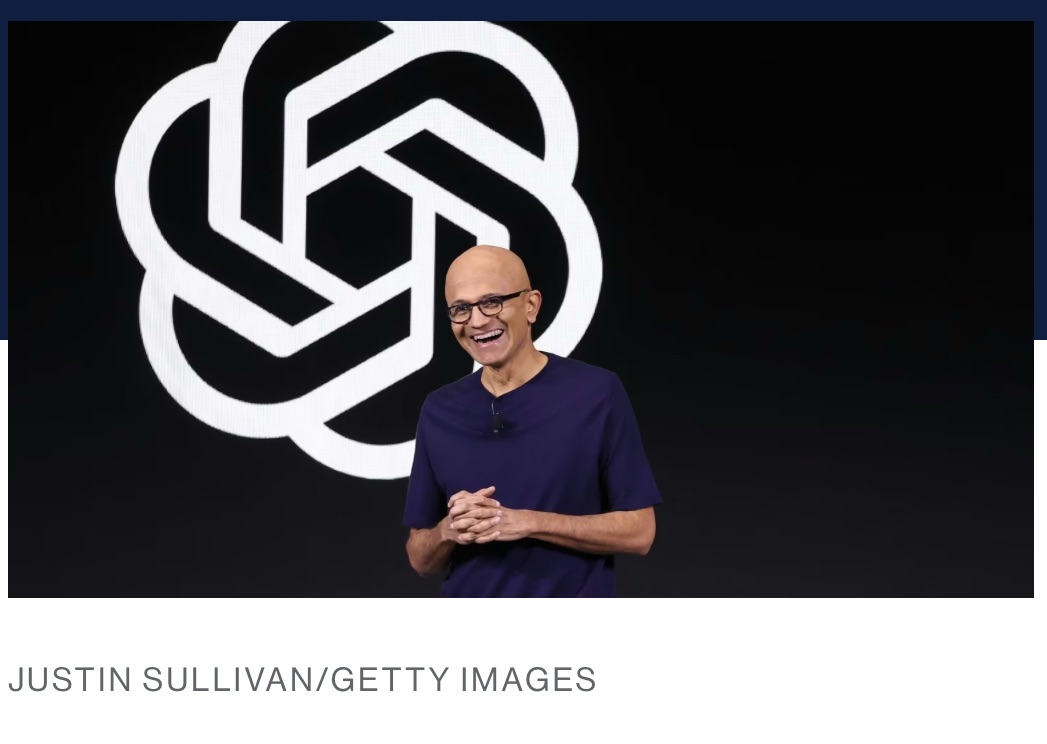
Until late November, when the epic saga of OpenAI’s board breakdown unfolded, the casual observer could be forgiven for assuming that the industry around generative AI was a vibrant competitive ecosystem.
But this is not the case—nor has it ever been. And understanding why is fundamental to understanding what AI is, and what threats it poses. Put simply, in the context of the current paradigm of building larger- and larger-scale AI systems, there is no AI without Big Tech. With vanishingly few exceptions, every startup, new entrant, and even AI research lab is dependent on these firms. All rely on the computing infrastructure of Microsoft, Amazon, and Google to train their systems, and on those same firms’ vast consumer market reach to deploy and sell their AI products.
Indeed, many startups simply license and rebrand AI models created and sold by these tech giants or their partner startups. This is because large tech firms have accrued significant advantages over the past decade. Thanks to platform dominance and the self-reinforcing properties of the surveillance business model, they own and control the ingredients necessary to develop and deploy large-scale AI. They also shape the incentive structures for the field of research and development in AI, defining the technology’s present and future.
The recent OpenAI saga, in which Microsoft exerted its quiet but firm dominance over the “capped profit” entity, provides a powerful demonstration of what we’ve been analyzing for the last half-decade. To wit: those with the money make the rules. And right now, they’re engaged in a race to the bottom, releasing systems before they’re ready in an attempt to retain their dominant position.
Concentrated power isn’t just a problem for markets. Relying on a few unaccountable corporate actors for core infrastructure is a problem for democracy, culture, and individual and collective agency. Without significant intervention, the AI market will only end up rewarding and entrenching the very same companies that reaped the profits of the invasive surveillance business model that has powered the commercial internet, often at the expense of the public.
The Cambridge Analytica scandal was just one among many that exposed this seedy reality. Such concentration also creates single points of failure, which raises real security threats. And Securities and Exchange Commission chair Gary Gensler has warned that having a small number of AI models and actors at the foundation of the AI ecosystem poses systemic risks to the financial order, in which the effects of a single failure could be distributed much more widely.
The assertion that AI is contingent on—and exacerbates—concentration of power in the tech industry has often been met with pushback. Investors who have moved quickly from Web3 to the metaverse to AI are keen to realize returns in an ecosystem where a frenzied press cycle drives valuations toward profitable IPOs and acquisitions, even if the promises of the technology in question aren’t ever realized.
But the attempted ouster—and subsequent reintegration—of OpenAI cofounders Sam Altman and Greg Brockman doesn’t just bring the power and influence of Microsoft into sharp focus; it also proves our case that these commercial arrangements give Big Tech profound control over the trajectory of AI. The story is fairly simple: after apparently being blindsided by the board’s decision, Microsoft moved to protect its investment and its road map to profit. The company quickly exerted its weight, rallying behind Altman and promising to “acquihire” those who wanted to defect.
Microsoft now has a seat on OpenAI’s board,albeit a nonvoting one. But the true leverage that Big Tech holds in the AI landscape is the combination of its computing power, data, and vast market reach. In order to pursue its bigger-is-better approach to AI development, OpenAI made a deal. It exclusively licenses its GPT-4 system and all other OpenAI models to Microsoft in exchange for access to Microsoft’s computing infrastructure.
For companies hoping to build base models, there is little alternative to working with either Microsoft, Google, or Amazon. And those at the center of AI are well aware of this, as illustrated by Sam Altman’s furtive search for Saudi and Emirati sovereign investment in a hardware venture he hoped would rival Nvidia. That company holds a near monopoly on state-of-the-art chips for AI training and is another key choke point along the AI supply chain. US regulators have since unwound an initial investment by Saudi Arabia into an Altman-backed company, RainAI, reinforcing the difficulty OpenAI faces in navigating the even more concentrated chipmaking market.
There are few meaningful alternatives, even for those willing to go the extra mile to build industry-independent AI. As we’ve outlined elsewhere, “‘open-source AI”—an ill-defined term that’s currently used to describe everything from Meta’s (comparatively closed) LLaMA-2 and Eleuther’s (maximally open) Pythia series—can’t on its own offer escape velocity from industry concentration. For one thing, many open-source AI projects operate through compute credits, revenue sharing, or other contractual arrangements with tech giants that grapple with the same structural dependencies. In addition, Big Tech has a long legacy of capturing, or otherwise attempting to seek profit from, open-source development. Open-source AI can offer transparency, reusability, and extensibility, and these can be positive. But it does not address the problem of concentrated power in the AI market.
The OpenAI-Microsoft saga also demonstrates a fact that’s frequently lost in the hype around AI: there isn’t yet a clear business model outside of increasing cloud profits for Big Tech by bundling AI services with cloud infrastructure. And a business model is important when you’re talking about systems that can cost hundreds of millions of dollars to train and develop.
Microsoft isn’t alone here: Amazon, for example, runs a marketplace for AI models, on which all of its products, and a handful of others, operate using Amazon Web Services. The company recently struck an investment deal of up to $4 billion with Anthropic, which has also pledged to use Amazon’s in-house chip, Trainium, optimized for building large-scale AI.
Big Tech is becoming increasingly assertive in its maneuverings to protect its hold over the market. Make no mistake: though OpenAI was in the crosshairs this time, now that we’ve all seen what it looks like for a small entity when a big firm it depends on decides to flex, others will be paying attention and falling in line.
Regulation could help, but government policy often winds up entrenching, rather than mitigating, the power of these companies as they leverage their access to money and their political clout. Take Microsoft’s recent moves in the UK as an example: last week it announced a £2.5 billion investment in building out cloud infrastructure in the UK, a move lauded by a prime minister who has clearly signaled his ambitions to build a homegrown AI sector in the UK as his primary legacy. This news can’t be read in isolation: it is a clear attempt to blunt an investigation into the cloud market by the UK’s competition regulator following a studythat specifically called out concerns registered by a range of market participants regarding Microsoft’s anticompetitive behavior.
From OpenAI’s (ultimately empty) threat to leave the EU over the AI Act to Meta’s lobbying to exempt open-source AI from basic accountability obligations to Microsoft’s push for restrictive licensing to the Big Tech–funded campaign to embed fellows in Congress, we’re seeing increasingly aggressive stances from large firms that are trying to shore up their dominance by wielding their considerable economic and political power.
Tech industry giants are already circling their wagons as new regulations emerge from the White House, the EU, and elsewhere. But it’s clear we need to go much further. Now’s the time for a meaningful and robust accountability regime that places the interests of the public above the promises of firms not known for keeping them.
We need aggressive transparency mandates that clear away the opacity around fundamental issues like the data AI companies are accessing to train their models. We also need liability regimes that place the burden on companies to demonstrate that they meet baseline privacy, security, and bias standards before their AI products are publicly released. And to begin to address concentration, we need bold regulation that forces business separation between different layers of the AI stack and doesn’t allow Big Tech to leverage its dominance in infrastructure to consolidate its position in the market for AI models and applications.
There are few meaningful alternatives, even for those willing to go the extra mile to build industry-independent AI. As we’ve outlined elsewhere, “‘open-source AI”—an ill-defined term that’s currently used to describe everything from Meta’s (comparatively closed) LLaMA-2 and Eleuther’s (maximally open) Pythia series—can’t on its own offer escape velocity from industry concentration. For one thing, many open-source AI projects operate through compute credits, revenue sharing, or other contractual arrangements with tech giants that grapple with the same structural dependencies. In addition, Big Tech has a long legacy of capturing, or otherwise attempting to seek profit from, open-source development. Open-source AI can offer transparency, reusability, and extensibility, and these can be positive. But it does not address the problem of concentrated power in the AI market.
The OpenAI-Microsoft saga also demonstrates a fact that’s frequently lost in the hype around AI: there isn’t yet a clear business model outside of increasing cloud profits for Big Tech by bundling AI services with cloud infrastructure. And a business model is important when you’re talking about systems that can cost hundreds of millions of dollars to train and develop.
Microsoft isn’t alone here: Amazon, for example, runs a marketplace for AI models, on which all of its products, and a handful of others, operate using Amazon Web Services. The company recently struck an investment deal of up to $4 billion with Anthropic, which has also pledged to use Amazon’s in-house chip, Trainium, optimized for building large-scale AI.
Big Tech is becoming increasingly assertive in its maneuverings to protect its hold over the market. Make no mistake: though OpenAI was in the crosshairs this time, now that we’ve all seen what it looks like for a small entity when a big firm it depends on decides to flex, others will be paying attention and falling in line.
Regulation could help, but government policy often winds up entrenching, rather than mitigating, the power of these companies as they leverage their access to money and their political clout. Take Microsoft’s recent moves in the UK as an example: last week it announced a £2.5 billion investment in building out cloud infrastructure in the UK, a move lauded by a prime minister who has clearly signaled his ambitions to build a homegrown AI sector in the UK as his primary legacy. This news can’t be read in isolation: it is a clear attempt to blunt an investigation into the cloud market by the UK’s competition regulator following a studythat specifically called out concerns registered by a range of market participants regarding Microsoft’s anticompetitive behavior.
From OpenAI’s (ultimately empty) threat to leave the EU over the AI Act to Meta’s lobbying to exempt open-source AI from basic accountability obligations to Microsoft’s push for restrictive licensing to the Big Tech–funded campaign to embed fellows in Congress, we’re seeing increasingly aggressive stances from large firms that are trying to shore up their dominance by wielding their considerable economic and political power.
Tech industry giants are already circling their wagons as new regulations emerge from the White House, the EU, and elsewhere. But it’s clear we need to go much further. Now’s the time for a meaningful and robust accountability regime that places the interests of the public above the promises of firms not known for keeping them.
We need aggressive transparency mandates that clear away the opacity around fundamental issues like the data AI companies are accessing to train their models. We also need liability regimes that place the burden on companies to demonstrate that they meet baseline privacy, security, and bias standards before their AI products are publicly released. And to begin to address concentration, we need bold regulation that forces business separation between different layers of the AI stack and doesn’t allow Big Tech to leverage its dominance in infrastructure to consolidate its position in the market for AI models and applications.
 healthcarereimagined