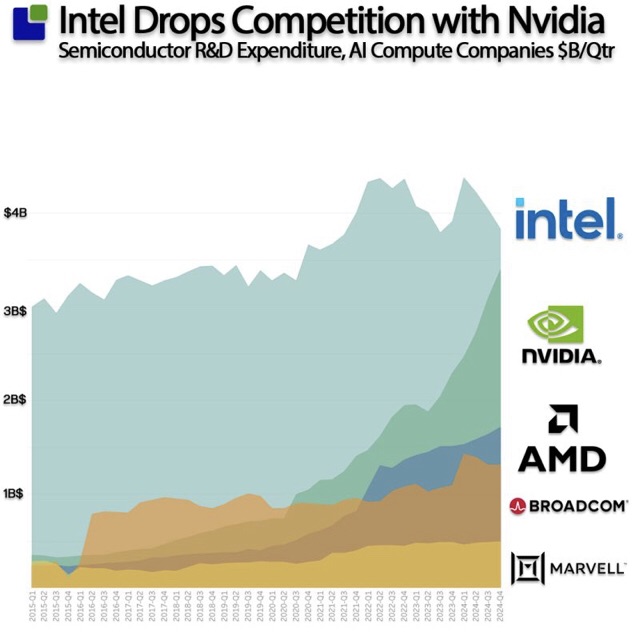
Only a year ago, Pat Gelsinger intended for Intel to compete with Nvidia, but the new CEO, Lip-Bu Tan, is burying that ambition.
He does not aim at the Client Computing Group when discussing funding new engineering ideas and innovations.
The Day 1 principle is a start-up philosophy; the new AI strategy after Gaudi has been virtually written off.
And it makes sense. While Intel was playing CEO roulette, Nvidia increased its R&D budget dramatically, and the AI giant did not need to fund other hobby projects like Intel. To catch Nvidia, Intel needed a big bet, which Gaudi never was, and now it is too late.
In 2024, Intel was spending 45% of its operating budget on Intel Foundry, and what was left of the R&D budget was prioritised for the Client Computing Group.
This is insufficient to compete with Nvidia, so the Intel Periscope has turned towards the two smaller vessels involved in XPU designs.
If the New Intel and the 2025 Vision are important to you, read more here: https://lnkd.in/drXUPZXJ
Article link; https://www.linkedin.com/posts/clausaasholm_only-a-year-ago-pat-gelsinger-intended-for-activity-7314629995451064321-RGiv?
The Lip-Bu Tan 2025 Vision of The New Intel
APR 05, 2025
Intel’s new CEO, Lip-Bu Tan, brought many new words that can give us insight into Intel’s strategy. While words don’t easily move supertankers like Intel, words are important, and all strategy and transformation begin with words.
Under Pat Gelsinger, there were several strategic pivots. While he was the master of creative external CapEx deals to fund Intel Foundry, the strategy was retrenched to a focus on the x86 franchise and the Client Computing group under Michelle Johnston Holthaus as she protected her CCG tribe.
The appointment of Lip-Bu Tan does not continue the current Intel Strategy, and it is vital to understand what the new CEO brings to the party. You can think what you want about Intel, but it still powers most of the world’s computing even though it is struggling to do so profitably. Intel is still a key factor in the development of the semiconductor industry.
In his first keynote, Lip-Bu Tan directly discussed not being happy with where Intel is. While this is not the same as signalling a strategic change, his statements about ruthlessly focusing on the truth are. This is an acceptance of the Intel culture of “glossing over” rather than facing the brutal truths.
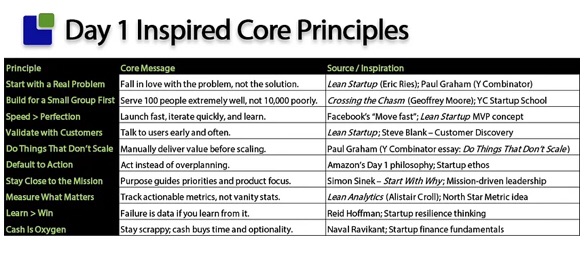
The most radical idea that Lip-Bu Tan introduced was that Intel needs to adopt a day 1 mentality. While it sounds like more words, the implications of a “Day 1 mentality” can mean dramatic change for the Intel organisation and culture, as Intel is currently the poster child of a “Day 2” company.

Amazon’s “Day One”: A Philosophy of Perpetual Innovation
At the heart of Amazon’s relentless drive lies its “Day One” philosophy, which emphasises maintaining a startup-like mentality, even within a massive corporation. Introduced by Jeff Bezos in his 1997 shareholder letter, “Day One” is about constant curiosity, nimbleness, and a willingness to experiment. It’s the antithesis of “Day Two,” where complacency sets in, and companies become slow, bureaucratic, and less customer-focused.
Bezos understood that customer obsession is the key to maintaining “Day One” vitality. As customers always seek better, faster, and more innovative solutions, companies must continuously adapt and evolve to meet their needs. As tech reporter Alex Kantrowitz explains in his book “Always Day One,” this philosophy encourages building for the future, not resting on past achievements. It means treating even a sprawling enterprise like a small, agile startup, fostering a culture of innovation and a relentless focus on the customer. In essence, “Day One” is about embracing change, challenging the status quo, and always acting with the urgency and passion of a company just starting.
Lip-Bu keeps flirting with “Day 1” as he calls for customer focus.
“My number one priority was spending time with customers, and they gave me honest feedback. We have a lot of work ahead of us.”
While talking to customers and getting feedback is essential, it is not the same as becoming customer-centric. A company like Apple is customer-centric and has delivered the most successful consumer product ever, even though nobody ever asked for an iPhone.
Talking to customers isn’t enough; you’ll need to understand their future situation and latent needs. This is not Intel’s traditional starting point, as the company has its cultural roots deep in products and technology, and Lip-Bu Tan wants to challenge that.
When discussing his background, Lip-Bu Tan highlights times when he successfully changed the culture of the companies he was involved with. This signals that cultural change is high on the agenda, and he believes he is the right person to drive it.
This also reveals that Lip-Bu Tan believes that corporate culture can be designed within a reasonable timeframe, which sounds more straightforward than it is.
Anybody who has worked in a company with several acquisitions knows that the acquired culture does not die. It lives on in the acquired people and influences the existing culture.
One of the key features of a large corporation is what I call management-dampening. All top management decisions must pass through the hierarchical layers in a sense-making process. The simple CEO decisions have complex impacts on the organisation, and each level needs to adapt to them in a way that makes sense for that layer and their internal and external customers.
The company’s suspension system ensures that radical changes don’t break the system and prevent change from happening.
I have seen several examples of how the management-dampening system has saved (prevented) senior management’s panic-flip-flopping decisions. Unfortunately, it also dampens necessary changes and complicates cultural change.
An overview of the “Day One” philosophy can be seen below, along with the key message.
As Lip-Bu Tan talks about the truth, it is necessary to highlight Intel’s current approach to these principles. While you might disagree with my assessment, it is hard to characterise Intel as anywhere near a “Day One” company.
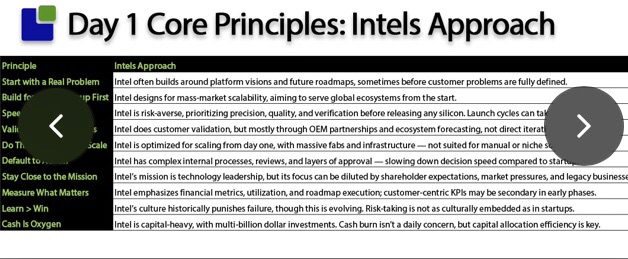
Lip-Bu Tan recognises this as he states that he is unhappy with things and wants to correct past mistakes. He wants to create the “New Intel”, an engineering-first company, suggesting that Intel is currently a “something else-first” company.
The truth
The foundation of everything I do starts with a data-driven assessment of the current situation. While I know it is easier to sell happy data, it is a principle of mine to stay clear of liking and disliking data.
There can be many truths, and data does respond to torture. Still, it is always in the company’s best interest to begin the strategic formulation based on an honest assessment of the situation.
Happy data rarely creates happy endings.
Intel is undoubtedly in a difficult spot, and Lip-Bu Tan’s ambitions are at odds with reality. Scarcity creates tension between different objectives but is innovation’s greatest friend.
As I pointed out in The Corporate Sandwich Model, Intel externally has a problem with the truth. It is all rah-rah and up and to the right. This might be different internally, but I doubt it.
It’s time to explore the tension between reality and the Intel 2025 Vision.
The x86 Franchise
The most apparent change in strategy from Gelsinger to Holthaus was the introduction of the “x86 franchise”. That the Queen of the Client Computing Group praised the holiest of relics in CCG was unsurprising and looked like the usual internal divisional power game. Lip-Bu Tan adds colour to the x86 concept and positions it more as an asset in the Foundry strategy as part of the differentiation strategy: IP and localisation. The x86 is also positioned in the future AI strategy built on the smoulders of Gaudi that Holthaus effectively killed by calling it “difficult” to use
The Innovation perspective.
Intel is trying to reduce operating costs to achieve positive cash flow. However, it is becoming evident that Intel’s current AI data centre product strategy is non-existent.
In the 2024 Intel Vision keynote, Pat Gelsigner called Gaudi the only alternative to Nvidia H100 in data centre learning applications. As Michelle Johnston Holthaus took the co-CEO chair, she demonstrated the rift between the client group and the other divisions and called Gaudi challenging. This was a virtual death sentence, and Lip-Bu Tan is not reviving the architecture.
He clearly stated that Intel is unhappy with its current position and needs to develop a new approach. Intel needs higher performance, lower power and lower cost. In one year, The focus shifted from competing with Nvidia to competing with Broadcom and Marvell in XPU accelerators in inference rather than Nvidia in Learning and inference.
This also correlates with his statements about becoming an outside-in company that starts with the customer’s problem rather than the hardware in the old inside-out approach.
Nvidia’s AI strategy builds on a well-executed product strategy, while Broadcom and Marvell are working on customer problems. Customers are telling Li-Bu Tan that they would love an Intel AI Platform (cheaper, faster, lower power—surprise!), and he has started deep-dive dives into reimagining the products.
This is the key area to win as AI accelerates tech adoption and is the only driver behind the upturn. Other focus areas, such as photonics, quantum, and robotics, are on the agenda, but the data centre AI needs to be revived.
The competitive situation in AI is hopeless for Intel.
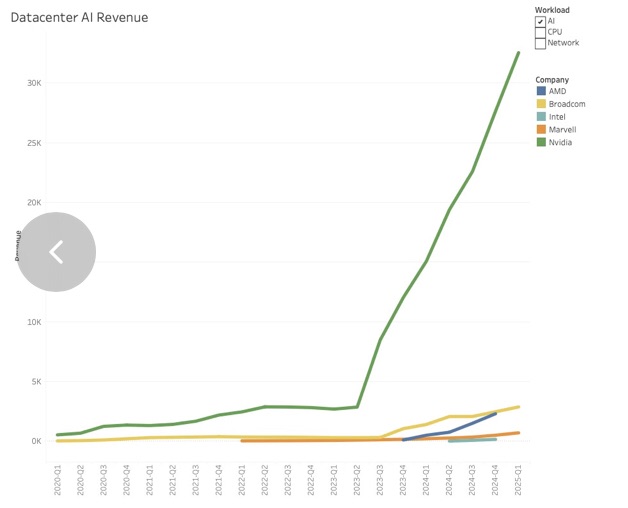
Excluding Nvidia revenue makes it even more embarrassing for Intel. For now, it is evident that Intel is not aiming at Nvidia and learning but at the competitors in sight that are focusing on the accelerator designs.
Article link; https://clausaasholm.substack.com/p/from-a-something-else-first-to-an?
 healthcarereimagined