healthcarereimagined

Envisioning healthcare for the 21st century

  • About
  • Economics

Amazon’s first quantum computing chip makes its debut – MIT Technology Review

Posted by timmreardon on 02/27/2025
Posted in: Uncategorized.

Dubbed Ocelot, it’s designed to correct errors with less hardware overhead.

By Sophia Chenarchive page

    February 27, 2025

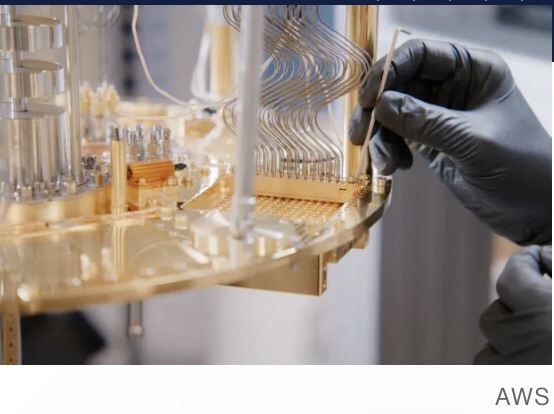
    Amazon Web Services today announced Ocelot, its first-generation quantum computing chip. While the chip has only rudimentary computing capability, the company says it is a proof-of-principle demonstration—a step on the path to creating a larger machine that can deliver on the industry’s promised killer applications, such as fast and accurate simulations of new battery materials.

    “This is a first prototype that demonstrates that this architecture is scalable and hardware-efficient,” says Oskar Painter, the head of quantum hardware at AWS, Amazon’s cloud computing unit. In particular, the company says its approach makes it simpler to perform error correction, a key technical challenge in the development of quantum computing.  

    Ocelot consists of nine quantum bits, or qubits, on a chip about a centimeter square, which, like some forms of quantum hardware, must be cryogenically cooled to near absolute zero in order to operate. Five of the nine qubits are a type of hardware that the field calls a “cat qubit,” named for Schrödinger’s cat, the famous 20th-century thought experiment in which an unseen cat in a box may be considered both dead and alive. Such a superposition of states is a key concept in quantum computing.

    The cat qubits AWS has made are tiny hollow structures of tantalum that contain microwave radiation, attached to a silicon chip. The remaining four qubits are transmons—each an electric circuit made of superconducting material. In this architecture, AWS uses cat qubits to store the information, while the transmon qubits monitor the information in the cat qubits. This distinguishes its technology from Google’s and IBM’s quantum computers, whose computational parts are all transmons. 

    Notably, AWS researchers used Ocelot to implement a more efficient form of quantum error correction. Like any computer, quantum computers make mistakes. Without correction, these errors add up, with the result that current machines cannot accurately execute the long algorithms required for useful applications. “The only way you’re going to get a useful quantum computer is to implement quantum error correction,” says Painter.

    Unfortunately, the algorithms required for quantum error correction usually have heavy hardware requirements. Last year, Google encoded a single error-corrected bit of quantum information using 105 qubits.

    Amazon’s design strategy requires only a 10th as many qubits per bit of information, says Painter. In work published in Nature on Wednesday, the team encoded a single error-corrected bit of information in Ocelot’s nine qubits. Theoretically, this hardware design should be easier to scale up to a larger machine than a design made only of transmons, says Painter. 

    This design combining cat qubits and transmons makes error correction simpler, reducing the number of qubits needed, says Shruti Puri, a physicist at Yale University who was not involved in the work. (Puri works part-time for another company that develops quantum computers but spoke to MIT Technology Review in her capacity as an academic.)

    Related Story

    A view of Microsoft's new quantum chip in the palm of a hand.

    A new Microsoft chip could lead to more stable quantum computers

    The company says it is on track to build a new kind of machine based on topological qubits.

    “Basically, you can decompose all quantum errors into two kinds—bit flips and phase flips,” says Puri. Quantum computers represent information as 1s, 0s, and probabilities, or superpositions, of both. A bit flip, which also occurs in conventional computing, takes place when the computer mistakenly encodes a 1 that should be a 0, or vice versa. In the case of quantum computing, the bit flip occurs when the computer encodes the probability of a 0 as the probability of a 1, or vice versa. A phase flip is a type of error unique to quantum computing, having to do with the wavelike properties of the qubit.

    The cat-transmon design allowed Amazon to engineer the quantum computer so that any errors were predominantly phase-flip errors. This meant the company could use a much simpler error correction algorithm than Google’s—one that did not require as many qubits. “Your savings in hardware is coming from the fact that you need to mostly correct for one type of error,” says Puri. “The other error is happening very rarely.” 

    The hardware savings also stem from AWS’s careful implementation of an operation known as a C-NOT gate, which is performed during error correction. Amazon’s researchers showed that the C-NOT operation did not disproportionately introduce bit-flip errors. This meant that after each round of error correction, the quantum computer still predominantly made phase-flip errors, so the simple, hardware-efficient error correction code could continue to be used.

    AWS began working on designs for Ocelot as early as 2021, says Painter. Its development was a “full-stack problem.” To create high-performing qubits that could ultimately execute error correction, the researchers had to figure out a new way to grow tantalum, which is what their cat qubits are made of, on a silicon chip with as few atomic-scale defects as possible. 

    It’s a significant advance that AWS can now fabricate and control multiple cat qubits in a single device, says Puri. “Any work that goes toward scaling up new kinds of qubits, I think, is interesting,” she says. Still, there are years of development to go. Other experts have predicted that quantum computers will require thousands, if not millions, of qubits to perform a useful task. Amazon’s work “is a first step,” says Puri.

    She adds that the researchers will need to further reduce the fraction of errors due to bit flips as they scale up the number of qubits. 

    Still, this announcement marks Amazon’s way forward. “This is an architecture we believe in,” says Painter. Previously, the company’s main strategy was to pursue conventional transmon qubits like Google’s and IBM’s, and they treated this cat qubit project as “skunkworks,” he says. Now, they’ve decided to prioritize cat qubits. “We really became convinced that this needed to be our mainline engineering effort, and we’ll still do some exploratory things, but this is the direction we’re going.” (The startup Alice & Bob, based in France, is also building a quantum computer made of cat qubits.)

    As is, Ocelot basically is a demonstration of quantum memory, says Painter. The next step is to add more qubits to the chip, encode more information, and perform actual computations. But they have many challenges ahead, from how to attach all the wires to how to link multiple chips together. “Scaling is not trivial,” he says.

    Article link: https://www.technologyreview.com/2025/02/27/1112560/amazon-quantum-computing-chip-makes-its-debut/?

    Share this:

    • Click to share on X (Opens in new window) X
    • Click to share on Facebook (Opens in new window) Facebook
    • Click to share on LinkedIn (Opens in new window) LinkedIn
    Like Loading...

    Related

    Posts navigation

    ← These six questions will dictate the future of generative AI – MIT Technology Review
    Quantum computing requires high-performance software – Science →
    • Search site

    • Follow healthcarereimagined on WordPress.com
    • Recent Posts

      • Hype Correction – MIT Technology Review 12/15/2025
      • Semantic Collapse – NeurIPS 2025 12/12/2025
      • The arrhythmia of our current age – MIT Technology Review 12/11/2025
      • AI: The Metabolic Mirage 12/09/2025
      • When it all comes crashing down: The aftermath of the AI boom – Bulletin of the Atomic Scientists 12/05/2025
      • Why Digital Transformation—And AI—Demands Systems Thinking – Forbes 12/02/2025
      • How artificial intelligence impacts the US labor market – MIT Sloan 12/01/2025
      • Will quantum computing be chemistry’s next AI? 12/01/2025
      • Ontology is having its moment. 11/28/2025
      • Disconnected Systems Lead to Disconnected Care 11/26/2025
    • Categories

      • Accountable Care Organizations
      • ACOs
      • AHRQ
      • American Board of Internal Medicine
      • Big Data
      • Blue Button
      • Board Certification
      • Cancer Treatment
      • Data Science
      • Digital Services Playbook
      • DoD
      • EHR Interoperability
      • EHR Usability
      • Emergency Medicine
      • FDA
      • FDASIA
      • GAO Reports
      • Genetic Data
      • Genetic Research
      • Genomic Data
      • Global Standards
      • Health Care Costs
      • Health Care Economics
      • Health IT adoption
      • Health Outcomes
      • Healthcare Delivery
      • Healthcare Informatics
      • Healthcare Outcomes
      • Healthcare Security
      • Helathcare Delivery
      • HHS
      • HIPAA
      • ICD-10
      • Innovation
      • Integrated Electronic Health Records
      • IT Acquisition
      • JASONS
      • Lab Report Access
      • Military Health System Reform
      • Mobile Health
      • Mobile Healthcare
      • National Health IT System
      • NSF
      • ONC Reports to Congress
      • Oncology
      • Open Data
      • Patient Centered Medical Home
      • Patient Portals
      • PCMH
      • Precision Medicine
      • Primary Care
      • Public Health
      • Quadruple Aim
      • Quality Measures
      • Rehab Medicine
      • TechFAR Handbook
      • Triple Aim
      • U.S. Air Force Medicine
      • U.S. Army
      • U.S. Army Medicine
      • U.S. Navy Medicine
      • U.S. Surgeon General
      • Uncategorized
      • Value-based Care
      • Veterans Affairs
      • Warrior Transistion Units
      • XPRIZE
    • Archives

      • December 2025 (8)
      • November 2025 (9)
      • October 2025 (10)
      • September 2025 (4)
      • August 2025 (7)
      • July 2025 (2)
      • June 2025 (9)
      • May 2025 (4)
      • April 2025 (11)
      • March 2025 (11)
      • February 2025 (10)
      • January 2025 (12)
      • December 2024 (12)
      • November 2024 (7)
      • October 2024 (5)
      • September 2024 (9)
      • August 2024 (10)
      • July 2024 (13)
      • June 2024 (18)
      • May 2024 (10)
      • April 2024 (19)
      • March 2024 (35)
      • February 2024 (23)
      • January 2024 (16)
      • December 2023 (22)
      • November 2023 (38)
      • October 2023 (24)
      • September 2023 (24)
      • August 2023 (34)
      • July 2023 (33)
      • June 2023 (30)
      • May 2023 (35)
      • April 2023 (30)
      • March 2023 (30)
      • February 2023 (15)
      • January 2023 (17)
      • December 2022 (10)
      • November 2022 (7)
      • October 2022 (22)
      • September 2022 (16)
      • August 2022 (33)
      • July 2022 (28)
      • June 2022 (42)
      • May 2022 (53)
      • April 2022 (35)
      • March 2022 (37)
      • February 2022 (21)
      • January 2022 (28)
      • December 2021 (23)
      • November 2021 (12)
      • October 2021 (10)
      • September 2021 (4)
      • August 2021 (4)
      • July 2021 (4)
      • May 2021 (3)
      • April 2021 (1)
      • March 2021 (2)
      • February 2021 (1)
      • January 2021 (4)
      • December 2020 (7)
      • November 2020 (2)
      • October 2020 (4)
      • September 2020 (7)
      • August 2020 (11)
      • July 2020 (3)
      • June 2020 (5)
      • April 2020 (3)
      • March 2020 (1)
      • February 2020 (1)
      • January 2020 (2)
      • December 2019 (2)
      • November 2019 (1)
      • September 2019 (4)
      • August 2019 (3)
      • July 2019 (5)
      • June 2019 (10)
      • May 2019 (8)
      • April 2019 (6)
      • March 2019 (7)
      • February 2019 (17)
      • January 2019 (14)
      • December 2018 (10)
      • November 2018 (20)
      • October 2018 (14)
      • September 2018 (27)
      • August 2018 (19)
      • July 2018 (16)
      • June 2018 (18)
      • May 2018 (28)
      • April 2018 (3)
      • March 2018 (11)
      • February 2018 (5)
      • January 2018 (10)
      • December 2017 (20)
      • November 2017 (30)
      • October 2017 (33)
      • September 2017 (11)
      • August 2017 (13)
      • July 2017 (9)
      • June 2017 (8)
      • May 2017 (9)
      • April 2017 (4)
      • March 2017 (12)
      • December 2016 (3)
      • September 2016 (4)
      • August 2016 (1)
      • July 2016 (7)
      • June 2016 (7)
      • April 2016 (4)
      • March 2016 (7)
      • February 2016 (1)
      • January 2016 (3)
      • November 2015 (3)
      • October 2015 (2)
      • September 2015 (9)
      • August 2015 (6)
      • June 2015 (5)
      • May 2015 (6)
      • April 2015 (3)
      • March 2015 (16)
      • February 2015 (10)
      • January 2015 (16)
      • December 2014 (9)
      • November 2014 (7)
      • October 2014 (21)
      • September 2014 (8)
      • August 2014 (9)
      • July 2014 (7)
      • June 2014 (5)
      • May 2014 (8)
      • April 2014 (19)
      • March 2014 (8)
      • February 2014 (9)
      • January 2014 (31)
      • December 2013 (23)
      • November 2013 (48)
      • October 2013 (25)
    • Tags

      Business Defense Department Department of Veterans Affairs EHealth EHR Electronic health record Food and Drug Administration Health Health informatics Health Information Exchange Health information technology Health system HIE Hospital IBM Mayo Clinic Medicare Medicine Military Health System Patient Patient portal Patient Protection and Affordable Care Act United States United States Department of Defense United States Department of Veterans Affairs
    • Upcoming Events

    Blog at WordPress.com.
    • Reblog
    • Subscribe Subscribed
      • healthcarereimagined
      • Join 154 other subscribers
      • Already have a WordPress.com account? Log in now.
      • healthcarereimagined
      • Subscribe Subscribed
      • Sign up
      • Log in
      • Copy shortlink
      • Report this content
      • View post in Reader
      • Manage subscriptions
      • Collapse this bar
     

    Loading Comments...
     

      %d