healthcarereimagined

Envisioning healthcare for the 21st century

  • About
  • Economics

The Semiconductor tide is not lifting all boats

Posted by timmreardon on 02/15/2025
Posted in: Uncategorized.

The Depressing State of the Hybrid Semiconductor Manufacturing Companies

CLAUS AASHOLM

FEB 13, 2025

The sun is shining down from a clear blue sky on the fertile semiconductor soil, full of healthy chip crops ready to be harvested. According to the Semiconductor Industry Association (SIA) and its faithful sidekick, the World Semiconductor Trade Statistics, this will be the largest harvest ever. 

The Semiconductor market is expected to grow 19% in 2024 and 11% in 2025. (To achieve these numbers, Nvidia Server Sales and double-count HBM must be included—but who wants to spoil a good story?).

The large consultancy companies are jumping on the wagon and are trying to outbid each other and the self-proclaimed prophets in the industry.

Even though most companies subscribe to one or several of these oracles, they fortunately do not use the market forecasts for anything strategic. In my time in corporate, we always looked at WSTS and went “Fascinating” (in the British meaning of the word) and did more of the same. 

In the good old days, when the tide lifted all ships, market growth numbers were a meaningful input for timing investments and retrenchments, but this is no longer true.

This upcycle is driven by price increases, profits, and lousy market categorisation. It benefits only a few companies in the AI space while their supply chain is scouting for an upturn on the horizon. 

Semiconductor companies and the supply chain need much better and deeper market research to make strategic decisions about the size and timing of their investment. 

While I enjoy following the AI boom, it is nearly meaningless for most of the industry, which is why my methodology is to analyse sections of the market and follow the supply flow up and downstream. While I track the size of markets, I am much more interested in the dynamics: What is changing?

This is the first strategic question: What is going on?

Neighboring the fertile AI fields is a desolate and barren Tolkian landscape—the land of the Hybrid Semiconductor companies. They are still waiting for an invitation to the party.

The state of the Hybrid Semiconductor Market.

The Hybrid semiconductor companies are still in trouble, and there is no immediate way out. While this is no surprise, it is painful, and the cracks are starting to show.

The collective Q4-24 guidance was negative 5.2%, and the result was slightly worse: revenue declined 5.7% compared to last quarter.
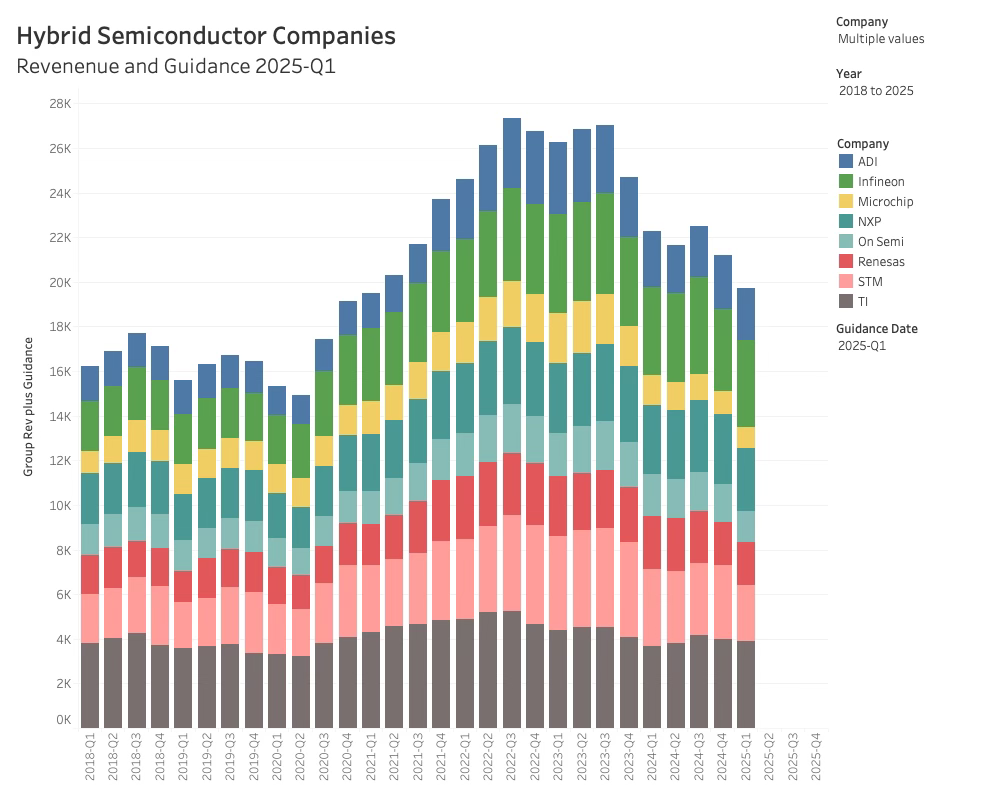
The Q1-2025 guidance was equally depressive. The collective guidance was down -7 %, which means the downward trend has lasted 10 quarters since the last peak. 

While the CxOs bravely performed their rehearsed tap dance in front of the broader investment community, which had to endure the prepared remarks to get to some substance, they are starting to sound like a broken record. 
I am not blaming the CxO’s; they are just playing their part in the staged show and are expected to say: 

“We did better than average” (In average, you didn’t!)

“Our people performed well” (It is their fault!)

“We delivered a result above guidance” (We set mediocre targets for ourselves)

While I might sound harsh, I also listen to investor calls in the upmarket, and they are like an Academy Awards show where the CxO’s can enjoy the limelight. The brutal truth is that most of the company’s performance is down to the market situation and some good bets.

And the markets sucks – for both good performers, average performers and poor performers. Listening to the calls gave no hope for optimism in Q2-25 either. The Hybrid companis are stuck in a hole.

It will be no surprise to my readers that I care less about the adjectives about the quarterly performance and more about the numbers. So, let us get to the numbers.
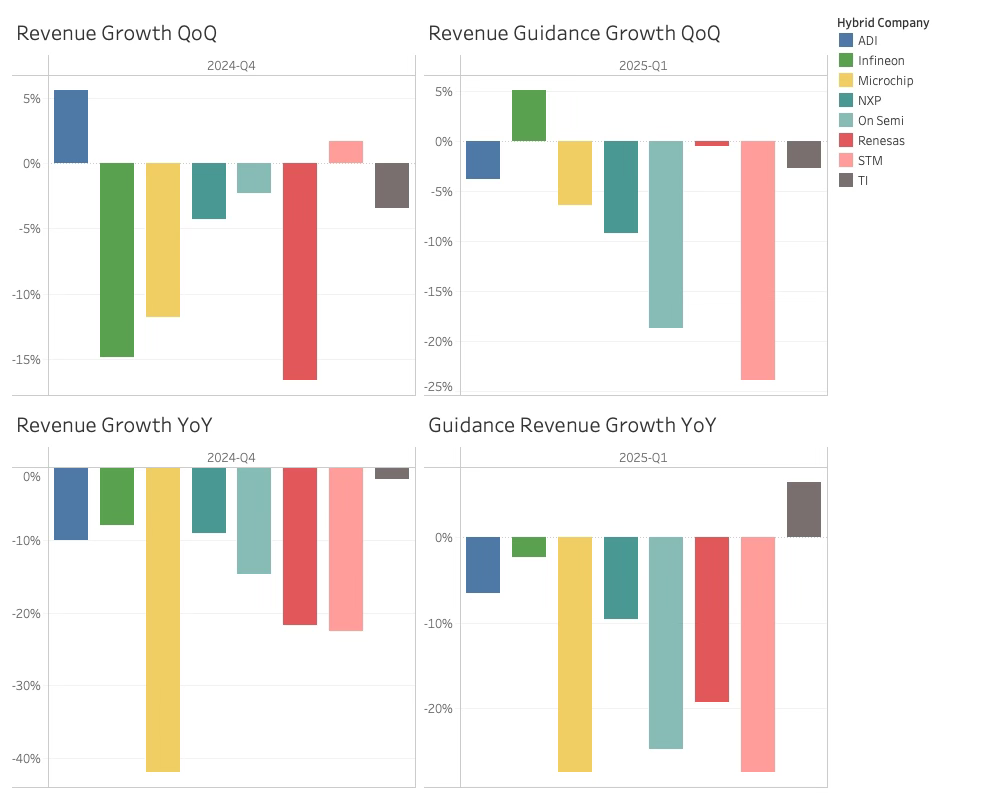
Regarding revenue growth, only ADI was able to beat last quarter. The analog company was up 5.7% over the previous quarter, but with -6.5% guidance for Q1-25, the spot in the limelight is not going to last. In general, ADI had the most optimistic market comments and saw an uptick in China’s EV companies and their share of products for the data center. 

On the other end of the scale, Renesas had a brutal quarter with a decline of close to 17% QoQ while their YoY growth was -21.6 %. Renesas guidance was -0.5% for Q1-25. The Japanse had two explanations; one was currency, and the other was a significant reduction in distribution inventory that caused less sell-through. This sounds pretty wild to me. 

An investigation of Renesas’ two main distributors did not reveal anything. WT Microelectronics have not reported Q4-24 yet, and Hagiwara reported flattish inventories. The two companies are the only ones that account for more than 10% of Renesas’s revenue. 

Also, Microchip had a brutal quarter with a 12% decline QoQ and 42% YoY. Steve Sanghi is back in the saddle and swinging his machete. Factory personnel are sent on leave, and radical changes will be made to the company over the next period. 

Lastly, Infineon also had a tough quarter with a 15% decline but will claw some back in Q1-2025 as the only hybrid company with a positive guidance of 5%. Besides parking the decline at currency fluctuations and inventory corrections peppered with positive remarks about the future, Infineon did not enlighten us much.

Fortunately, the Hybrid Semiconductor companies have a solid business model that is now significantly under pressure.
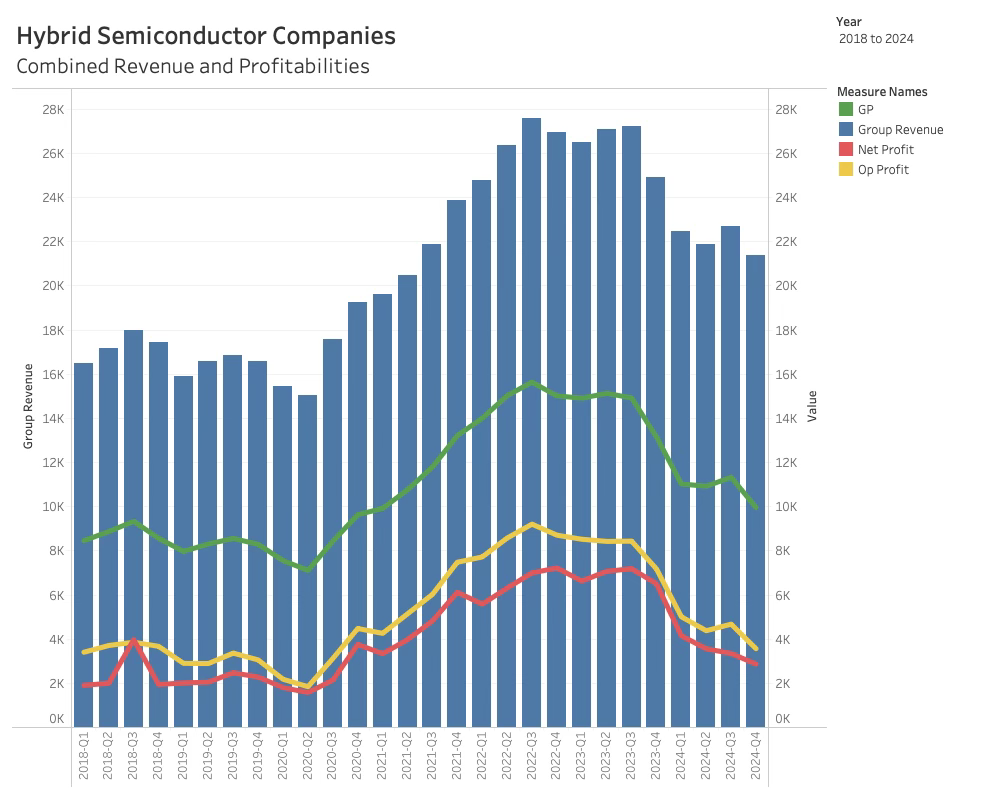
Since its peak nine quarters ago, combined gross profit has declined by 36%, and this trend will continue for some time. 

From a market perspective, both the automotive and industrial markets are down significantly. While the automotive markets attempt a correction lifted by the EV business in China, the industrial market continues to tank.
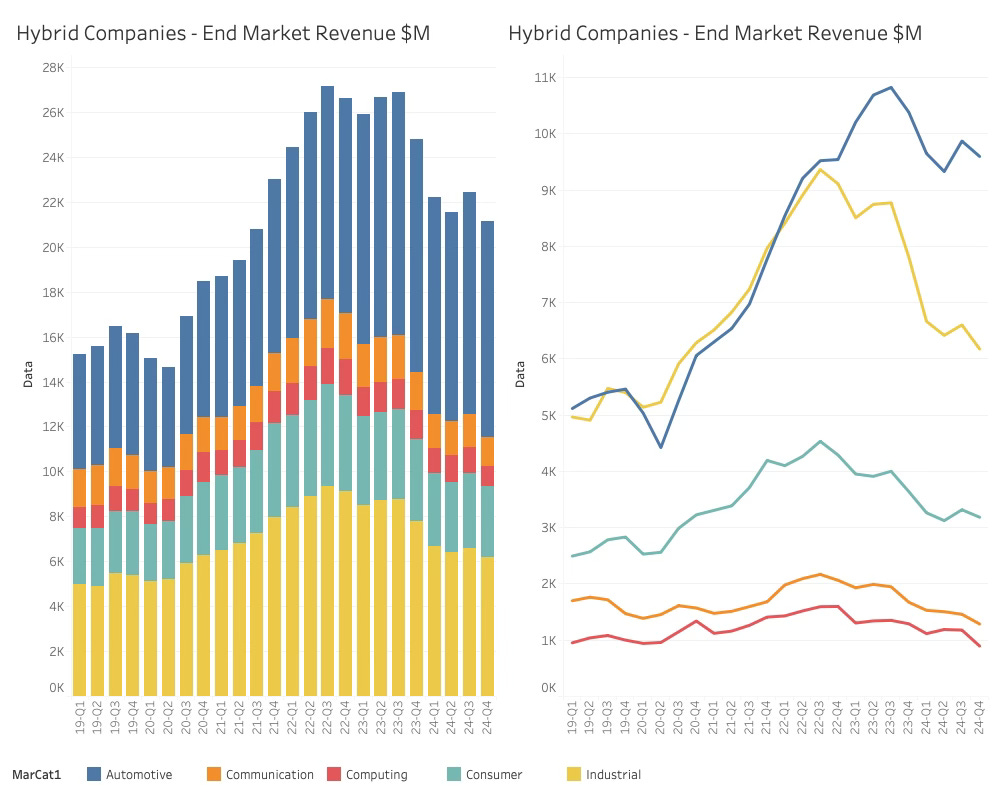
The Chinese market might need the advanced automotive power semiconductors from the Hybrid leaders, but it doesn’t need them for industrial manufacturing. This is most likely being absorbed by an entirely Chinese supply chain.

From a product perspective, this is confirmed.

Article link: https://clausaasholm.substack.com/p/the-semiconductor-tide-is-not-lifting?

Share this:

  • Click to share on X (Opens in new window) X
  • Click to share on Facebook (Opens in new window) Facebook
  • Click to share on LinkedIn (Opens in new window) LinkedIn
Like Loading...

Related

Posts navigation

← FEHRM Congressional Reports
Three things to know as the dust settles from DeepSeek – MIT Technology Review →
  • Search site

  • Follow healthcarereimagined on WordPress.com
  • Recent Posts

    • Hype Correction – MIT Technology Review 12/15/2025
    • Semantic Collapse – NeurIPS 2025 12/12/2025
    • The arrhythmia of our current age – MIT Technology Review 12/11/2025
    • AI: The Metabolic Mirage 12/09/2025
    • When it all comes crashing down: The aftermath of the AI boom – Bulletin of the Atomic Scientists 12/05/2025
    • Why Digital Transformation—And AI—Demands Systems Thinking – Forbes 12/02/2025
    • How artificial intelligence impacts the US labor market – MIT Sloan 12/01/2025
    • Will quantum computing be chemistry’s next AI? 12/01/2025
    • Ontology is having its moment. 11/28/2025
    • Disconnected Systems Lead to Disconnected Care 11/26/2025
  • Categories

    • Accountable Care Organizations
    • ACOs
    • AHRQ
    • American Board of Internal Medicine
    • Big Data
    • Blue Button
    • Board Certification
    • Cancer Treatment
    • Data Science
    • Digital Services Playbook
    • DoD
    • EHR Interoperability
    • EHR Usability
    • Emergency Medicine
    • FDA
    • FDASIA
    • GAO Reports
    • Genetic Data
    • Genetic Research
    • Genomic Data
    • Global Standards
    • Health Care Costs
    • Health Care Economics
    • Health IT adoption
    • Health Outcomes
    • Healthcare Delivery
    • Healthcare Informatics
    • Healthcare Outcomes
    • Healthcare Security
    • Helathcare Delivery
    • HHS
    • HIPAA
    • ICD-10
    • Innovation
    • Integrated Electronic Health Records
    • IT Acquisition
    • JASONS
    • Lab Report Access
    • Military Health System Reform
    • Mobile Health
    • Mobile Healthcare
    • National Health IT System
    • NSF
    • ONC Reports to Congress
    • Oncology
    • Open Data
    • Patient Centered Medical Home
    • Patient Portals
    • PCMH
    • Precision Medicine
    • Primary Care
    • Public Health
    • Quadruple Aim
    • Quality Measures
    • Rehab Medicine
    • TechFAR Handbook
    • Triple Aim
    • U.S. Air Force Medicine
    • U.S. Army
    • U.S. Army Medicine
    • U.S. Navy Medicine
    • U.S. Surgeon General
    • Uncategorized
    • Value-based Care
    • Veterans Affairs
    • Warrior Transistion Units
    • XPRIZE
  • Archives

    • December 2025 (8)
    • November 2025 (9)
    • October 2025 (10)
    • September 2025 (4)
    • August 2025 (7)
    • July 2025 (2)
    • June 2025 (9)
    • May 2025 (4)
    • April 2025 (11)
    • March 2025 (11)
    • February 2025 (10)
    • January 2025 (12)
    • December 2024 (12)
    • November 2024 (7)
    • October 2024 (5)
    • September 2024 (9)
    • August 2024 (10)
    • July 2024 (13)
    • June 2024 (18)
    • May 2024 (10)
    • April 2024 (19)
    • March 2024 (35)
    • February 2024 (23)
    • January 2024 (16)
    • December 2023 (22)
    • November 2023 (38)
    • October 2023 (24)
    • September 2023 (24)
    • August 2023 (34)
    • July 2023 (33)
    • June 2023 (30)
    • May 2023 (35)
    • April 2023 (30)
    • March 2023 (30)
    • February 2023 (15)
    • January 2023 (17)
    • December 2022 (10)
    • November 2022 (7)
    • October 2022 (22)
    • September 2022 (16)
    • August 2022 (33)
    • July 2022 (28)
    • June 2022 (42)
    • May 2022 (53)
    • April 2022 (35)
    • March 2022 (37)
    • February 2022 (21)
    • January 2022 (28)
    • December 2021 (23)
    • November 2021 (12)
    • October 2021 (10)
    • September 2021 (4)
    • August 2021 (4)
    • July 2021 (4)
    • May 2021 (3)
    • April 2021 (1)
    • March 2021 (2)
    • February 2021 (1)
    • January 2021 (4)
    • December 2020 (7)
    • November 2020 (2)
    • October 2020 (4)
    • September 2020 (7)
    • August 2020 (11)
    • July 2020 (3)
    • June 2020 (5)
    • April 2020 (3)
    • March 2020 (1)
    • February 2020 (1)
    • January 2020 (2)
    • December 2019 (2)
    • November 2019 (1)
    • September 2019 (4)
    • August 2019 (3)
    • July 2019 (5)
    • June 2019 (10)
    • May 2019 (8)
    • April 2019 (6)
    • March 2019 (7)
    • February 2019 (17)
    • January 2019 (14)
    • December 2018 (10)
    • November 2018 (20)
    • October 2018 (14)
    • September 2018 (27)
    • August 2018 (19)
    • July 2018 (16)
    • June 2018 (18)
    • May 2018 (28)
    • April 2018 (3)
    • March 2018 (11)
    • February 2018 (5)
    • January 2018 (10)
    • December 2017 (20)
    • November 2017 (30)
    • October 2017 (33)
    • September 2017 (11)
    • August 2017 (13)
    • July 2017 (9)
    • June 2017 (8)
    • May 2017 (9)
    • April 2017 (4)
    • March 2017 (12)
    • December 2016 (3)
    • September 2016 (4)
    • August 2016 (1)
    • July 2016 (7)
    • June 2016 (7)
    • April 2016 (4)
    • March 2016 (7)
    • February 2016 (1)
    • January 2016 (3)
    • November 2015 (3)
    • October 2015 (2)
    • September 2015 (9)
    • August 2015 (6)
    • June 2015 (5)
    • May 2015 (6)
    • April 2015 (3)
    • March 2015 (16)
    • February 2015 (10)
    • January 2015 (16)
    • December 2014 (9)
    • November 2014 (7)
    • October 2014 (21)
    • September 2014 (8)
    • August 2014 (9)
    • July 2014 (7)
    • June 2014 (5)
    • May 2014 (8)
    • April 2014 (19)
    • March 2014 (8)
    • February 2014 (9)
    • January 2014 (31)
    • December 2013 (23)
    • November 2013 (48)
    • October 2013 (25)
  • Tags

    Business Defense Department Department of Veterans Affairs EHealth EHR Electronic health record Food and Drug Administration Health Health informatics Health Information Exchange Health information technology Health system HIE Hospital IBM Mayo Clinic Medicare Medicine Military Health System Patient Patient portal Patient Protection and Affordable Care Act United States United States Department of Defense United States Department of Veterans Affairs
  • Upcoming Events

Blog at WordPress.com.
  • Reblog
  • Subscribe Subscribed
    • healthcarereimagined
    • Join 154 other subscribers
    • Already have a WordPress.com account? Log in now.
    • healthcarereimagined
    • Subscribe Subscribed
    • Sign up
    • Log in
    • Copy shortlink
    • Report this content
    • View post in Reader
    • Manage subscriptions
    • Collapse this bar
%d